Contemporary Art Extravaganza Provides Time-Travel Portals

The scale and scope of the contemporary art on display is tremendous, but how often do art-seekers also get an opportunity to travel across ancient streets and landscapes, to meet real and fictional historic characters, contemplate fables and real-life stories, and see art of the past and present side by side?

It can take days to experience and fully absorb all of the history and potential futues presented in the films, paintings, sculptures, and installations in Once Within a Time: 12th SITE Santa Fe International, on view across 15 art spaces across Santa Fe through January 12, 2026.

Exhibition banner in the courtyard of Palace of the Governors (1610) (New Mexico History Museum) – gateway to SITE installations by Daisy Quezada Ureña (Santa Fe) and Charisse Perlina Weston. (Harlem, New York)

Besides the expansive white galleries and screening rooms of SITE’s museum in Santa Fe’s always-popping Railyard District, visitors can choose to contemplate giant abstract murals in a church-like auditorium, an innovative historical-object installation in a 400-year-old seat of power, or enter an old foundry to see an evocative installation by a Silk Road artist across farm fields adjacent to the Old Spanish Trail.
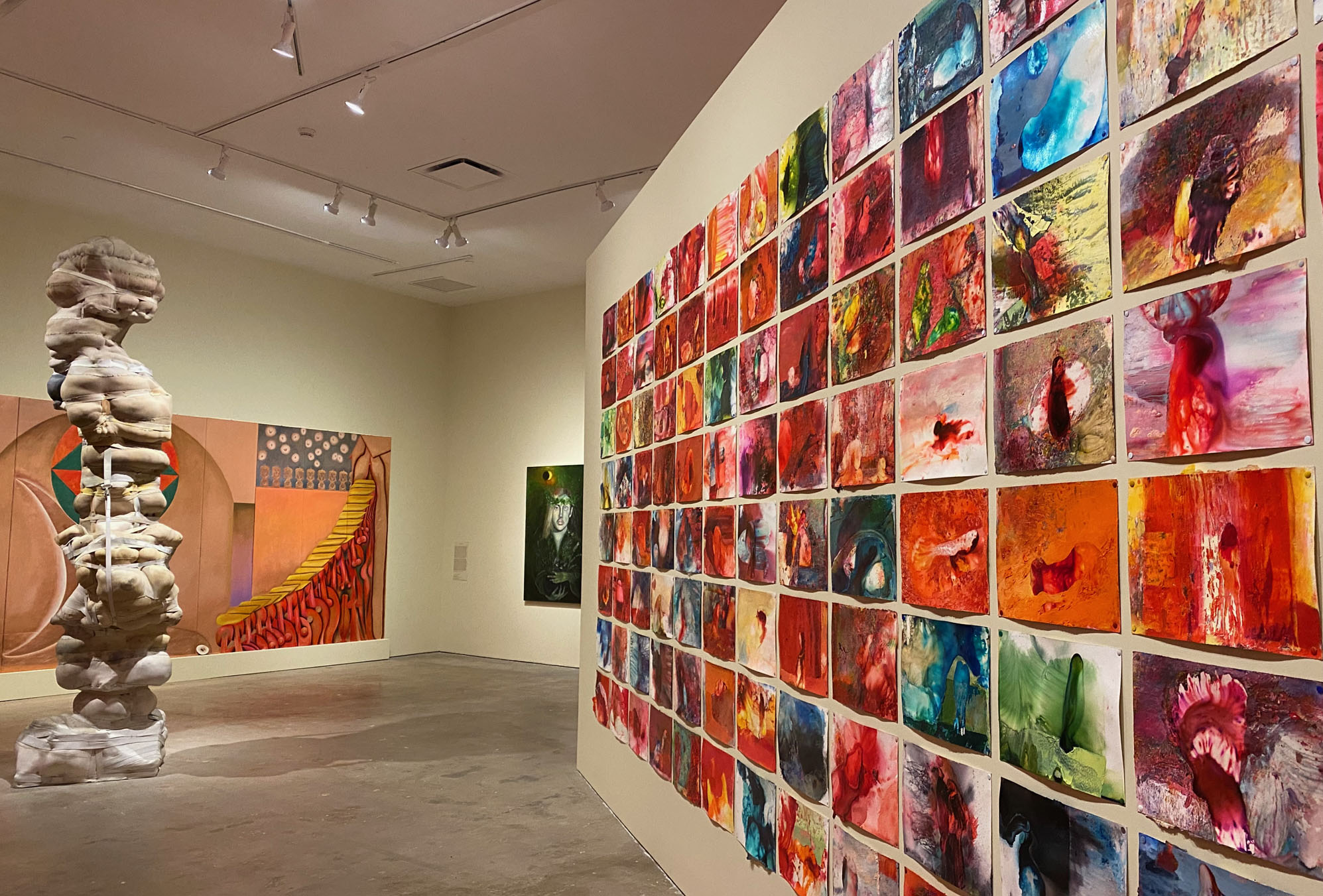
SITE Santa Fe gallery theme: appears like real life and sensual free-thinkers. 2025 mixed-media sculpture “18-1-4-5-7-21-14-4” by Patricia Ayres; copper work by Santiago de Paoli; Katja Sieb’s 2025 “perpetual novice” painting; and 2020 grid painting “Atlas” by Penny Siopis (South Africa).
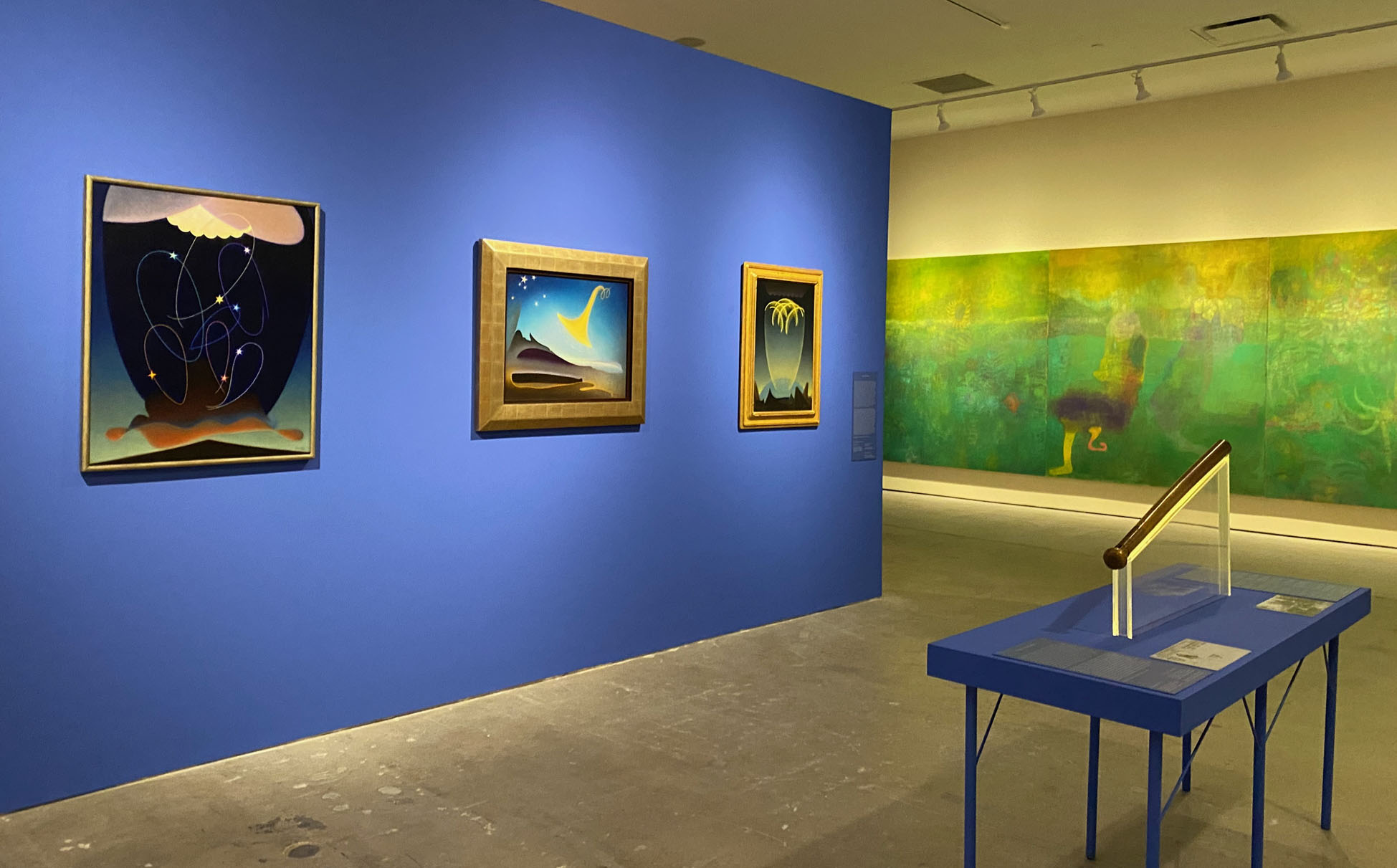
SITE Santa Fe gallery theme: in touch with light (spiritual) – Agnes Pelton’s paintings (1930s), Maja Ruznic’s mural (2025), and the 1895 healing rod of itinerant Southwestern mystic Francis Schlatter. Courtesy: Phoeix Art Museum; New Mexico Museum of Art; Oakland Museum of California; Maja Ruznic and Karma Gallery; and New Mexico History Museum.

In every space and art encounter, visitors may reflect upon whether history is repeating itself and whether inspiration can be drawn from futures that artists imagined nearly a century ago. Each space is designed for visitors to look, read, encounter, and reflect.
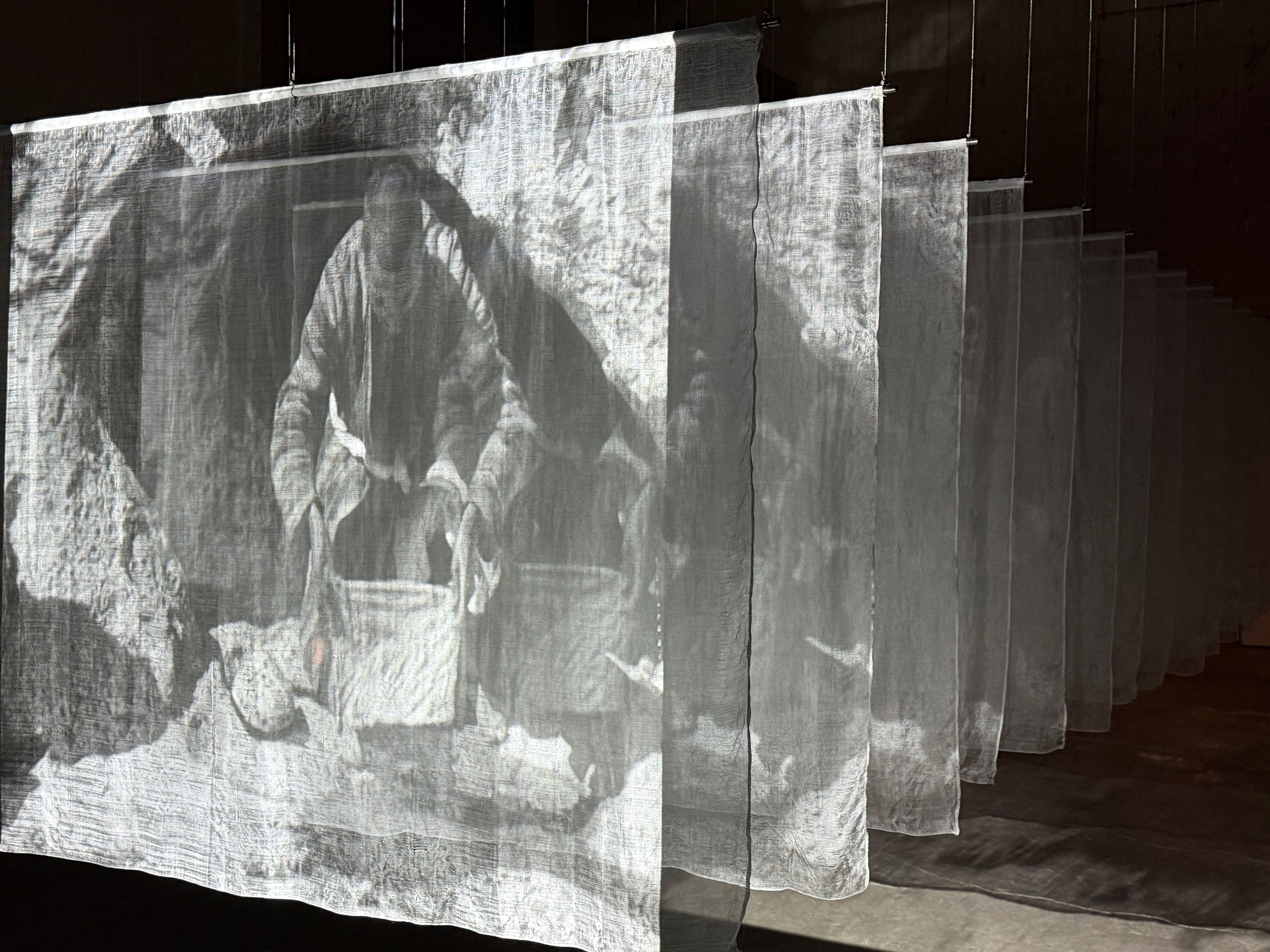
In the old foundry at Tesuque: 2024 video As We Fade by Saodat Ismailova (Uzbeckistan), showing visitors to one of Central Asia’s most sacred sites (Throne of Solomon) along the ancient Silk Road; projected across 24 suspended silk screens. Courtesy: the artist and Milan’s Pirelli HangarBicocca.

The theme for the show – Once Within a Time – is inspired by Godfrey Reggio’s most recent film – a suggestive and wordless mix of innocence, nostalgic images, visual poetry, and the future facing the next generation. The film screens continuously inside SITE, with visitors caught up in Godfrey’s dream-like images, which highlighted in this mesmerizing movie trailer:

Like Godfrey’s film, each space and gallery presents a theme, story, historic character, and provocative contemporary art that pulls back in time, creates an unforgettable experience, and asks the viewer to go inward to contemplate the future. 
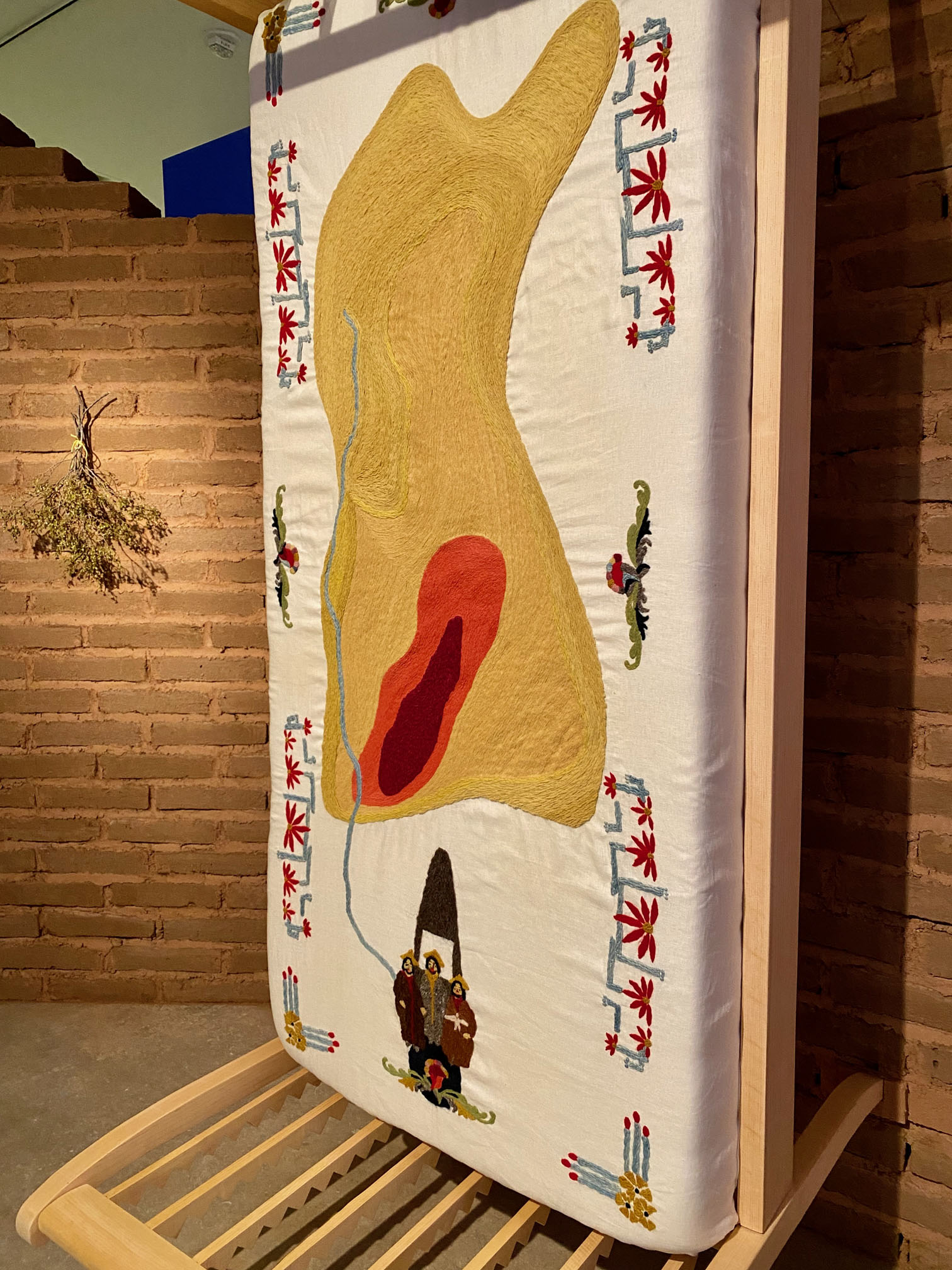
Joanna Keane Lopez’s 2024 Batter my heart, three person’d God – adobe, a handmade bed, colcha embroidery showing a radiation cloud, and creosote bush, referencing her family’s experience of living downwind of the Trinity detonation.

SITE’s galleries, for example, present themes such as storytelling, technology and language, the power of spiritual energy, and New Mexico’s undeniable status as a natural Land of Enchantment.  

The exhibition presents traditional New Mexico superstars and inspirations –  Awa Tsireh and Helen Cordero (San Ildefonso Pueblo), Agnes Pelton, Rebecca Salsbury James, Florence Miller Pierce, Pop Chalee (Taos), Pablita Velarde (Santa Clara Pueblo), and Eliot Porter – alongside artists who are breaking through on the international stage.

Cochiti pueblo ceramicist Helen Cordero’s storyteller figures are paired with Pablita Velardi’s storyteller illustrations (both are inspired by grandfathers and fathers) and Simone Leigh’s epic stone and raffia goddesses.
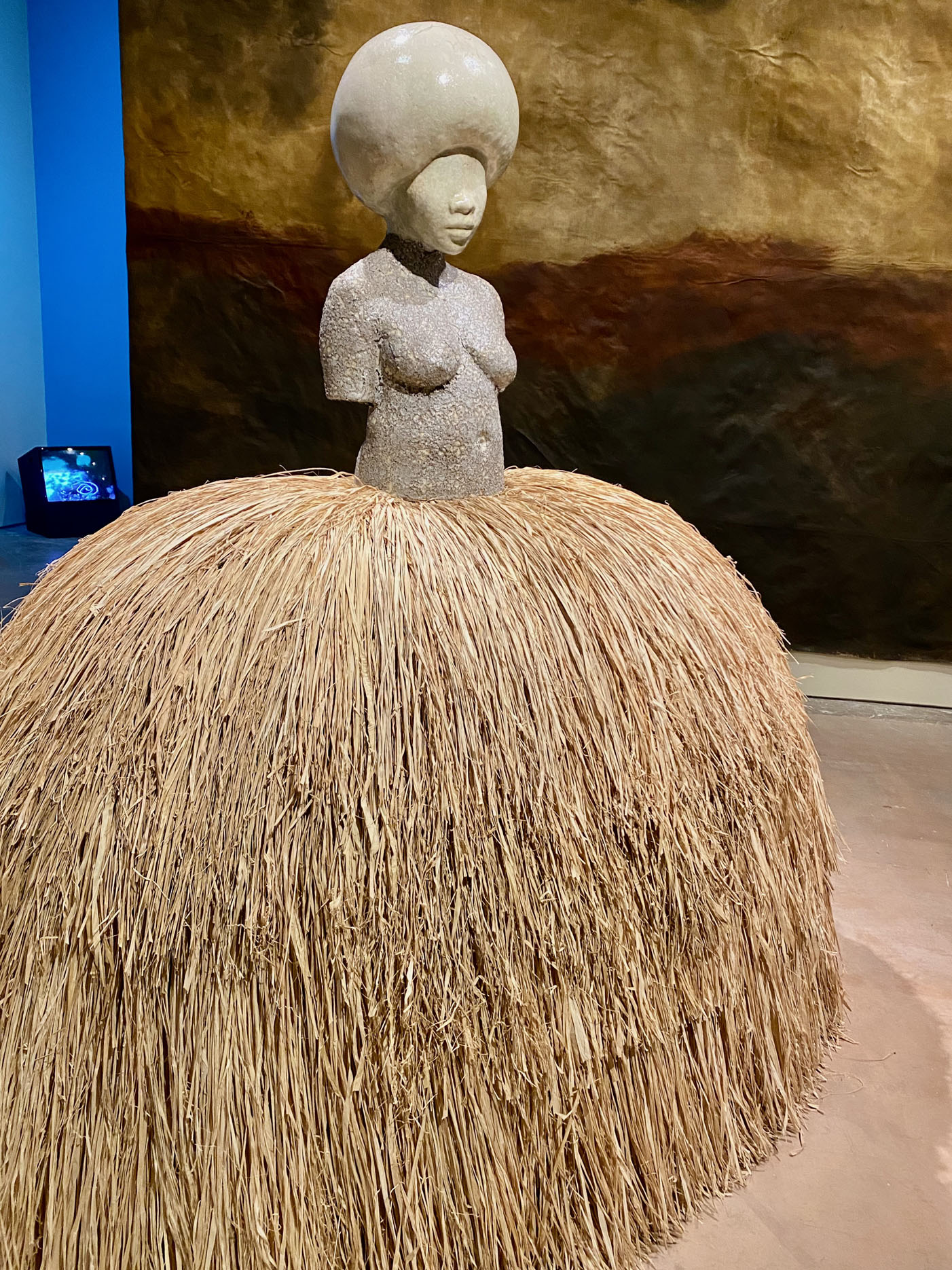
SITE Santa Fe gallery theme: storytelling. Simone Leigh’s 2025 untiled stoneware and raffia sculpture. At rear, 2025 oil The Solemn and Dignified Burial Befitting My Beloved for All Seasons by Dominique Knowles. Courtesy: Matthew Marks Gallery; the artist and Hannah Hoffman Gallery, Los Angeles.
Gallery theme: storytelling. Helen Cordero’s 1970 painted clay Storyteller – the creator of the Cochiti Pueblo sculptural tradition, inspired by her grandfather’s stories; championed by patron Alexander Girard. Courtesy: School for Advanced Research.
SITE Santa Fe gallery theme: language Marilou Schultz’s 2024 weaving Integrated Circuit Chip & AI Diné Weaving – a reference to the controvercial 1970s Fairchild Semiconductor chip plant on Navajo Nation staffed primarily with Diné women. Courtesy: private foundation.

The story of the legendary WWII heroes, the Navajo Code Talkers, is featured in a gallery alongside Marilou Schultz’s weavings of chip technology using traditional Diné methods with Fred Hammersly’s ground-breaking IBM computer drawings at the University of New Mexico in 1968-1970. 

Fred was given an opportunity to create the first mainframe-generated art in the form of drawings programmed by traditional IBM punch-card technology and the Art1 program.  SIITE not only displays a selection of the 400 computer drawings that he generated over the course of 18 months, but some of the punch cards he used, which are now archived at the Smithsonian’s Archives of American Art.

Sensual free-thinkers are represented by the story of Santa Fe gambling mogul Doña Tules (Maria Gertrudis Barceló) and her actual 1840s money chest, witty contemporary porcelain playing cards and magical paintings by Katja Seib (UK), and jaw-dropping drawings by Shanghai’s Zhang Yunyao.
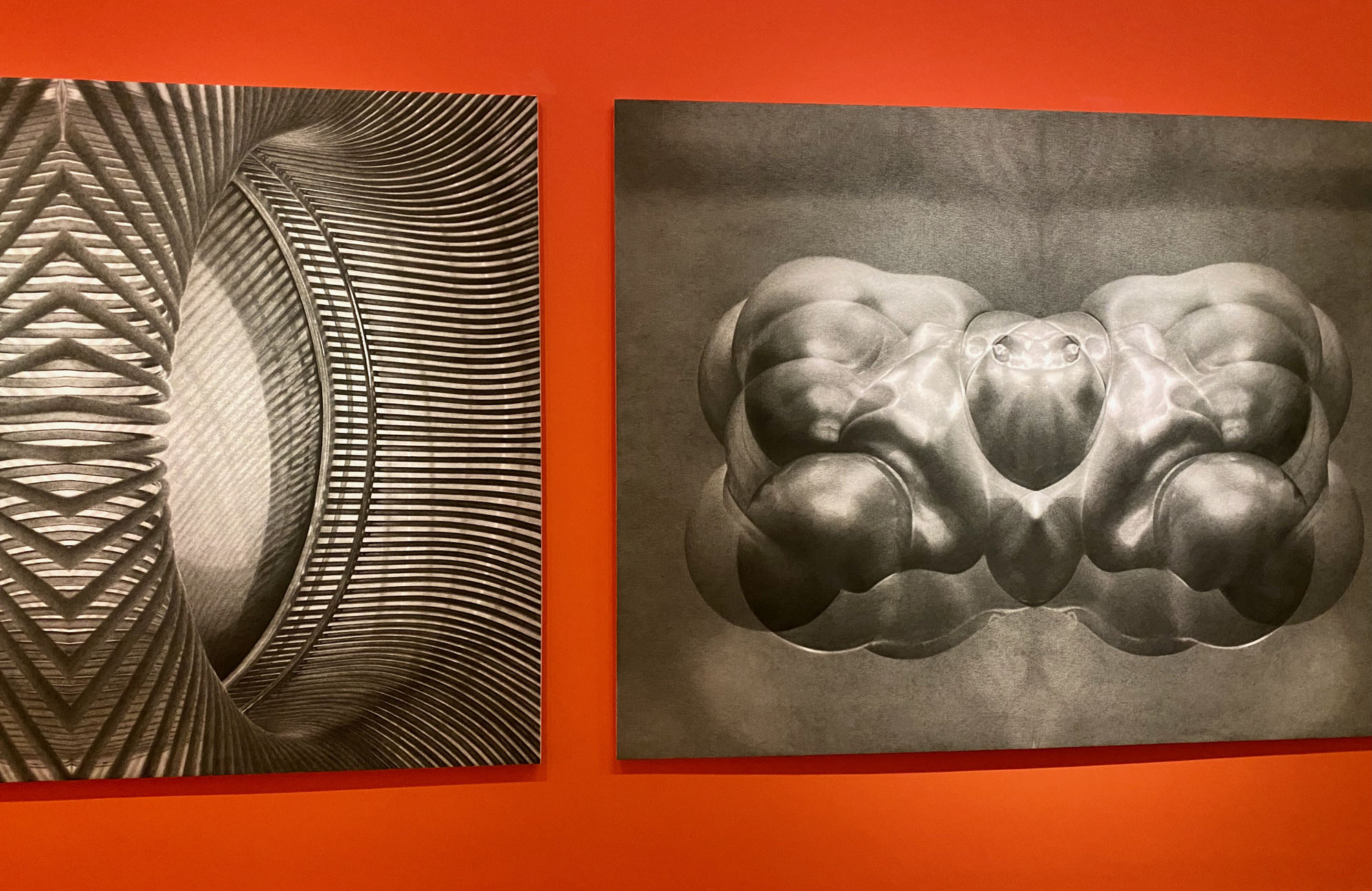
SITE Santa Fe gallery theme: sensual free-thinkers. Two of three 2025 Connector drawings by Zhang Yunyao (Shanghai); pencil on stretched felt. Courtesy: the artist, Don Gallery.

Around the corner from Agnes Pelton’s transcendental paintings are Diego Medina’s landscapes reflecting the Piro-Mansa-Tiwa spiritual power inhabiting ancestral lands of Southern New Mexico and also installations about a different type of New Mexico light – the impact of the nuclear energy tests on people living downwind and the legacy of uranium mining across native lands.

SITE Santa Fe gallery theme:In touch with light (nuclear energy): Will Wilson’s 2025 series Hubris on the Land – aerial photography of abandoned 1940s uranium mines on Navajo Nation paired with his documentation of Land Art sites created by Holt, Smithson, Heiser, and Turrell in the 1960s-1970s. Courtesy: the artist

New Mexico’s natural world is paid tribute in stories and artwork by travelers and residents – watercolors of Pueblo spirits and wildlife by Awa Tsireh (Alfonso Roybal) in the 1930s, Vladimir Nabokov’s sketches of butterfly wing cells (1940s-1950s), and Eliot Porter’s spectacular photos of Tesuque jays in the 1960s.

But these examples are just snippets of Once Within a Time – the entire show deserves multiple visits, and time to visit the other locations in the city, such as the hidden basement natural wonderland epic at the Museum of Internatonal Folk Art created by Taiwan ‘s Zhang Xu Zhan. It’s not only an immersive environment, but a film, animal-spirit sculptures, and selections from the MoIFA’s paper funerary object collection.  Don’t miss the Day of the Dead altar, the 18th-century Pere Lachaise Cemetary tribute initially collected by Mr. Girard himself, and paper funerary fantasies made by the artist’s own family. Truly unforgettable.
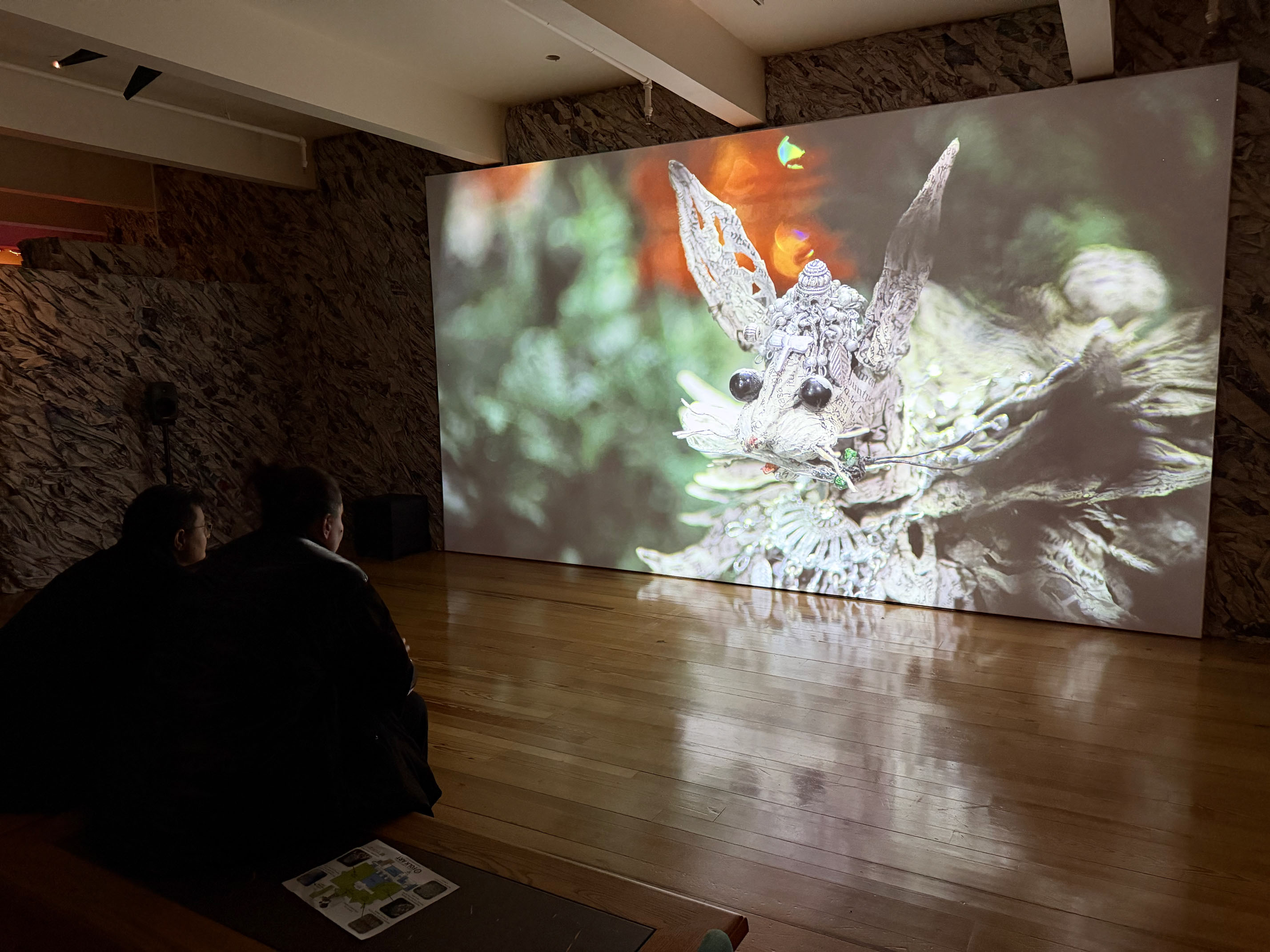
Museum of International Folk Art: Zhang Xu Zhan’s 2020-2022 paper-animation video Compound Eyes of Tropical (Animal story series), with a Southeastern Asian deer-mouse outwitting a group of predatory crocodiles. Courtesy: the artist and Project Fulfill Art Space, Taiwan.

The Wheelwright Museum of the American Indian fills the Klah Gallery (in the shape of a traditional hogan) with a meditation on healing by Cristina Flores Pescorán, a wild organic sculpture by Nora Naranjo Morse, and a mini-retrospective of paintings by the incomparable Emmi Whitehorse.
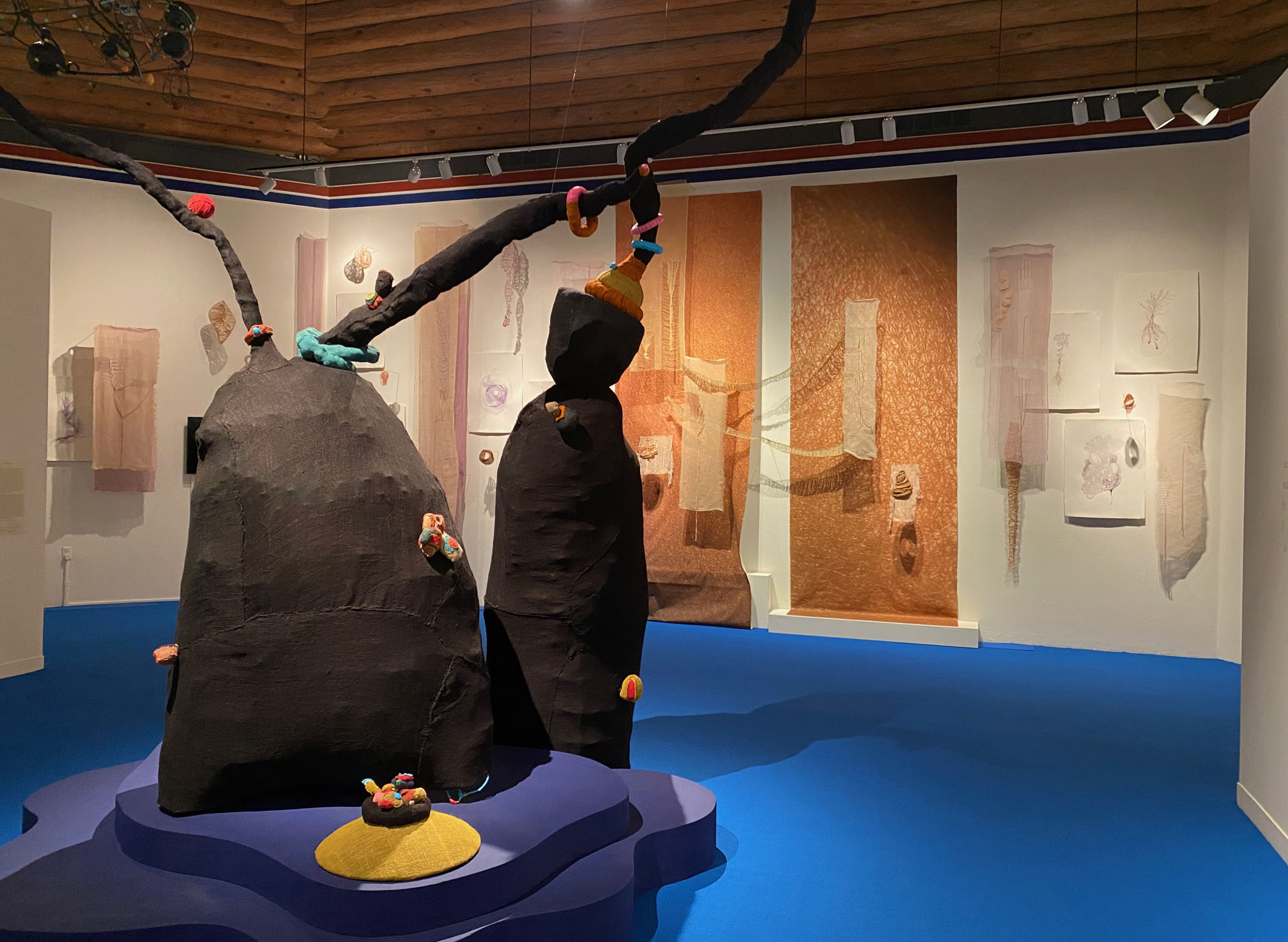
Wheelwright Klah Gallery theme: journeys. Nora Naranjo Morse’s sculpture Into the Forever; on walls, Cristina Flores Pescorán’s 2025 installation Treinta y ocho. Ofrendas para reescribir historia medica y renacer Huaca. Courtesy: the artists

The Tesuque location also features rooms with installations by Mexico’s Guillermo Galindo incorporating burned wood from the recent New Mexico fires (crossed with Picasso’s Guernica),  David Horvitz’s tribute to the men incarcerated in Santa Fe’s Japanese internment camp (and a hat from one them), and Thailand’s Korakrit Arunanondchai’s room-sized contemplation that incorporates the ashes from the burning of Zozobra.

Video of Korakrit Arunanondchai’s 2025 installation Unity for Nostalgia, with floor incorporating ashes from Santa Fe’s Zozobra’s burning and a prayer to the phoenix; layered soundtrack. Courtesy: the artist, Bangkok City Gallery, London’s Carlos/Ishikawa, CLEARNING NY-LA, Kukje Gallery, Seoul
Video of Max Hooper Schneider’s 2025 Written in Sand (Finquita Garden) installation; spheres mysteriously travel sand channels. Courtesy: the artist; Maureen Paley, London, Hove; Francois Ghebaley, Los Angeles, New York.

For more, take a walk through the main exhibit and five other sites in and around Santa in our Flickr album to see work by legendary New Mexican artists, and travel back and forth to see how contemporary art reflects epic histories and mystic systems of the Southwest.
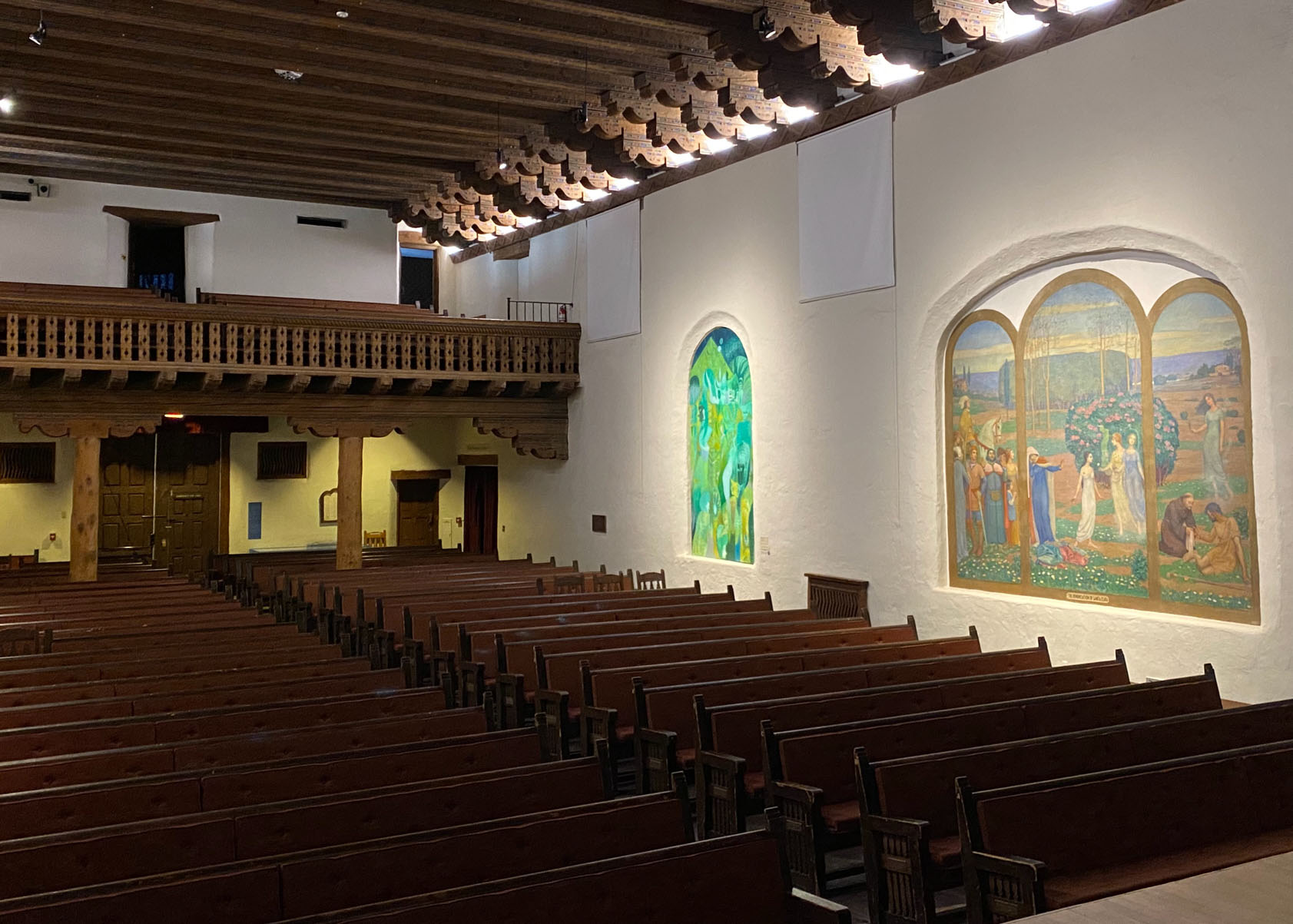
View of historic St. Francis Auditorium (1917) with Maja Ruznic’s 2025 Kisa Pada, Trava Raste, Gora Zeleni installed atop Donald Beauregad’s painting The Conversion of St. Francis; to right, Beauregard’s The Renunciation of Santa Clara.

Sea Dragons of Nevada Brought to Life

Most fossil fans are familiar with the spectacular Jurassic marine reptiles found by Mary Anning along England’s Dorset Coast in the early 1800s, but few are aware that their predecessors – gigantic Triassic ichthyosaurs (250-201 mya)– have been emerging from the central mountains of Nevada’s Great Basin for the last 125 years.

A beautiful exhibition – Deep Time: Sea Dragons in Nevadashines a spotlight on these magnificent extinct creatures, brings them to life through life-size animations, and tells stories of scientific discoveries at the Nevada Museum of Art in Reno through January 11, 2026.

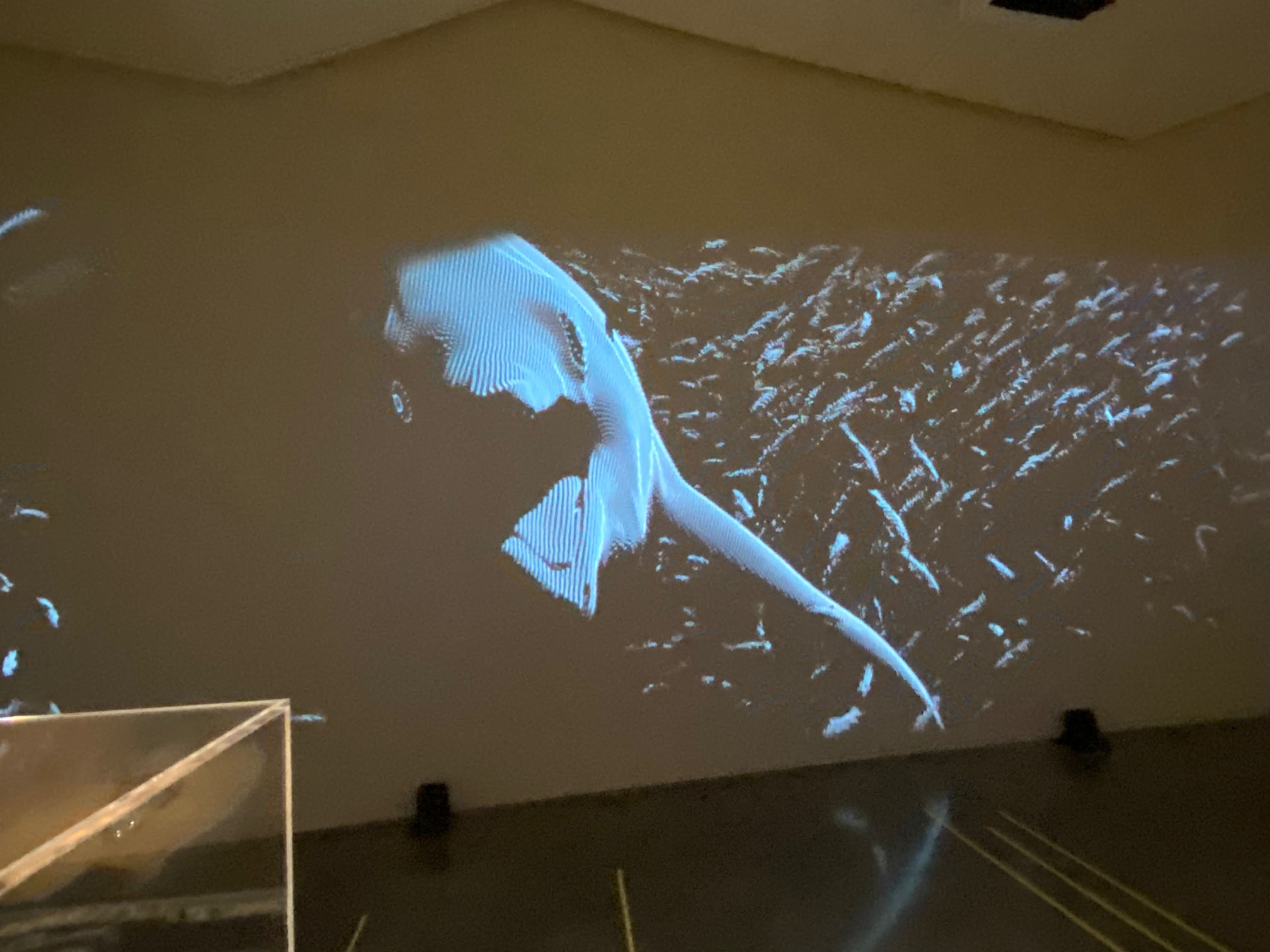
Life-sized digital animation of swimming ichthyosaur by artist Ivan Cruz, paleontologist Martin Sander, and exhibition designer Nik Hafermaas.

The art museum reunites the state’s stunning Triassic marine reptiles from museum collections across North America, and couples this with an engaging walk through 200 years of paleo-art history starring these enigmatic Mesozoic “sea dragons.”

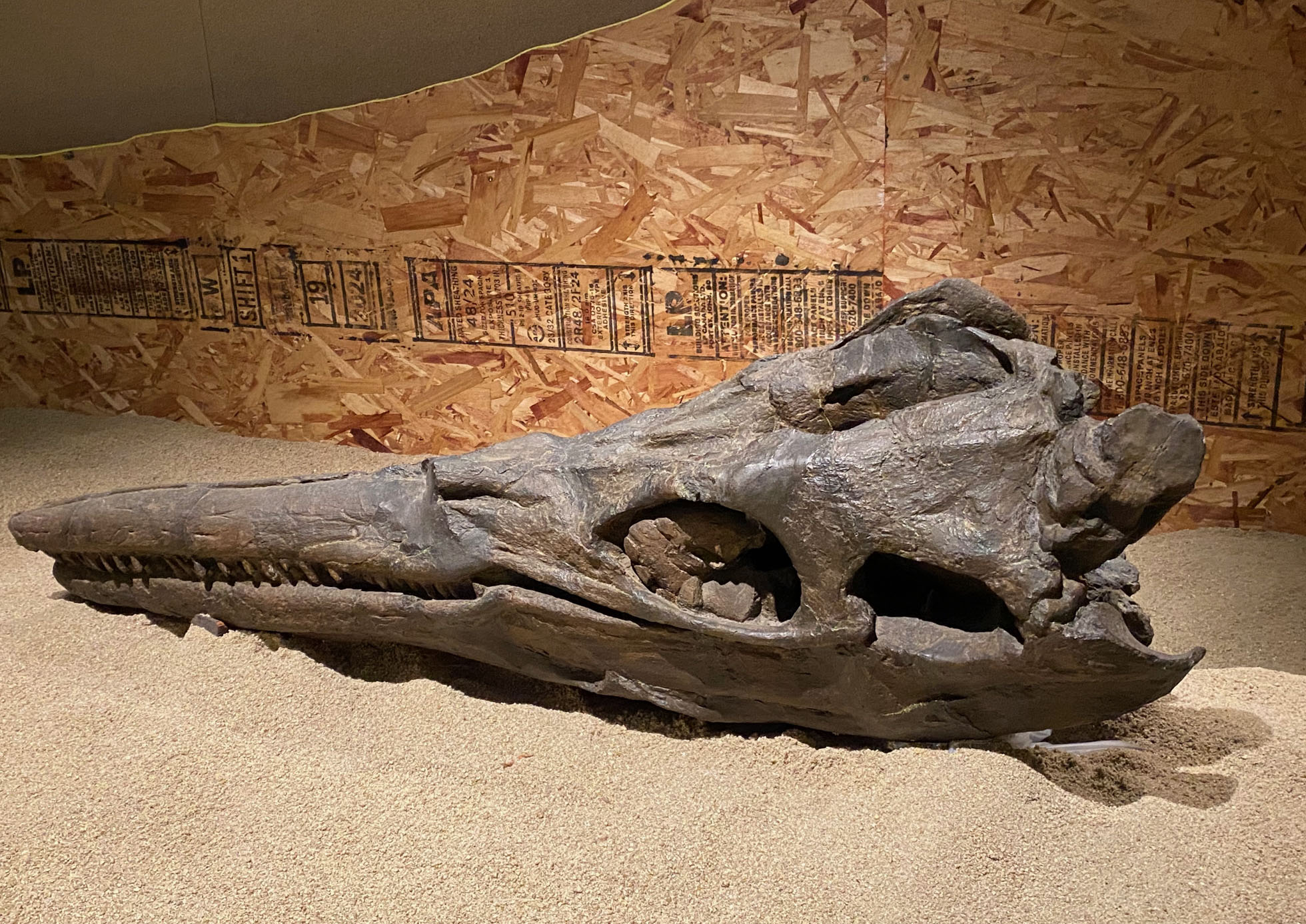
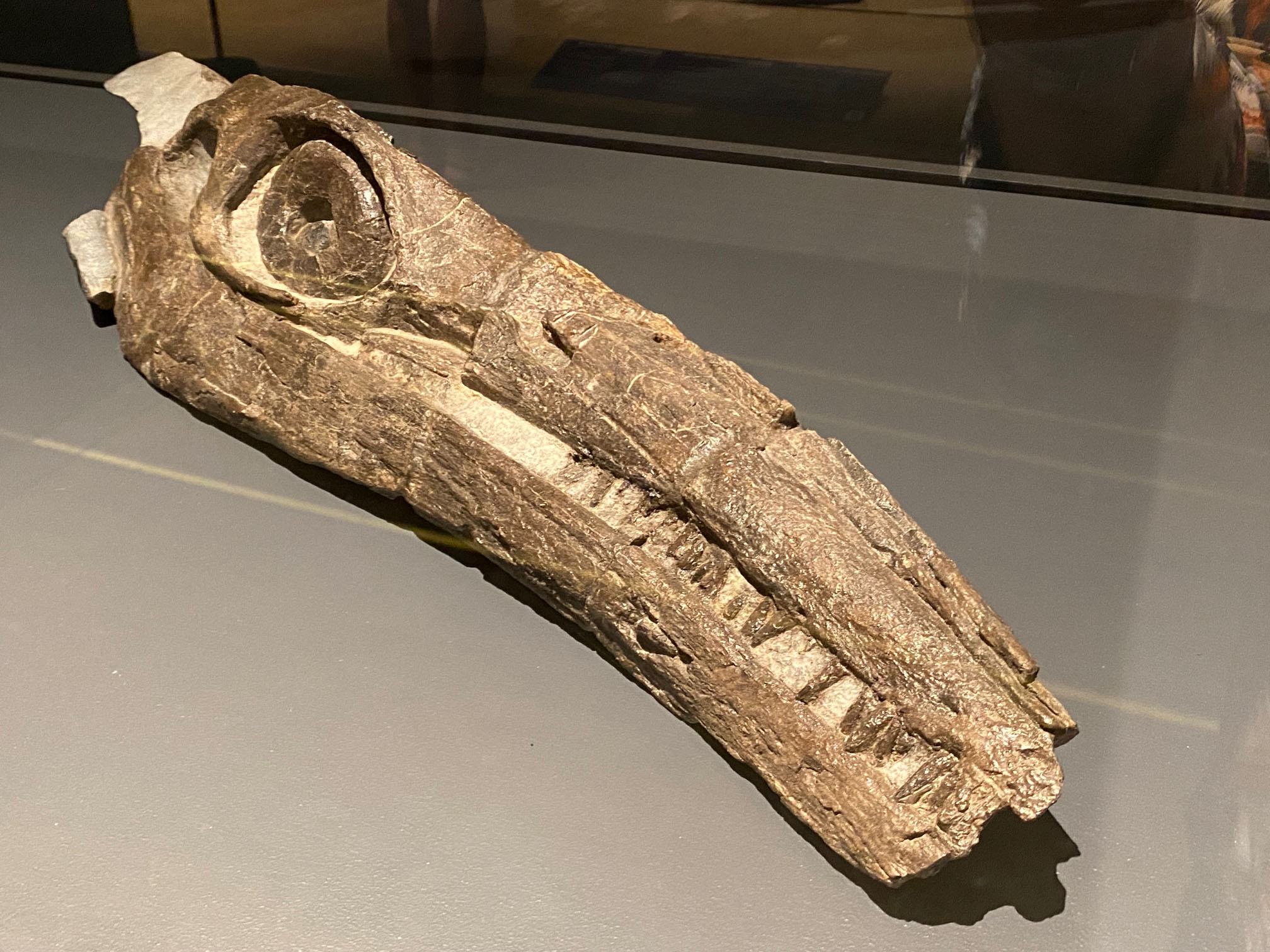
Triassic ichthyosaur (Cymbospondylus) (245 mya) discovered in Nevada’s Humboldt Range in 1905 by John Merriam and Annie Alexander. Courtesy: UC-Berkeley Museum of Paleontology
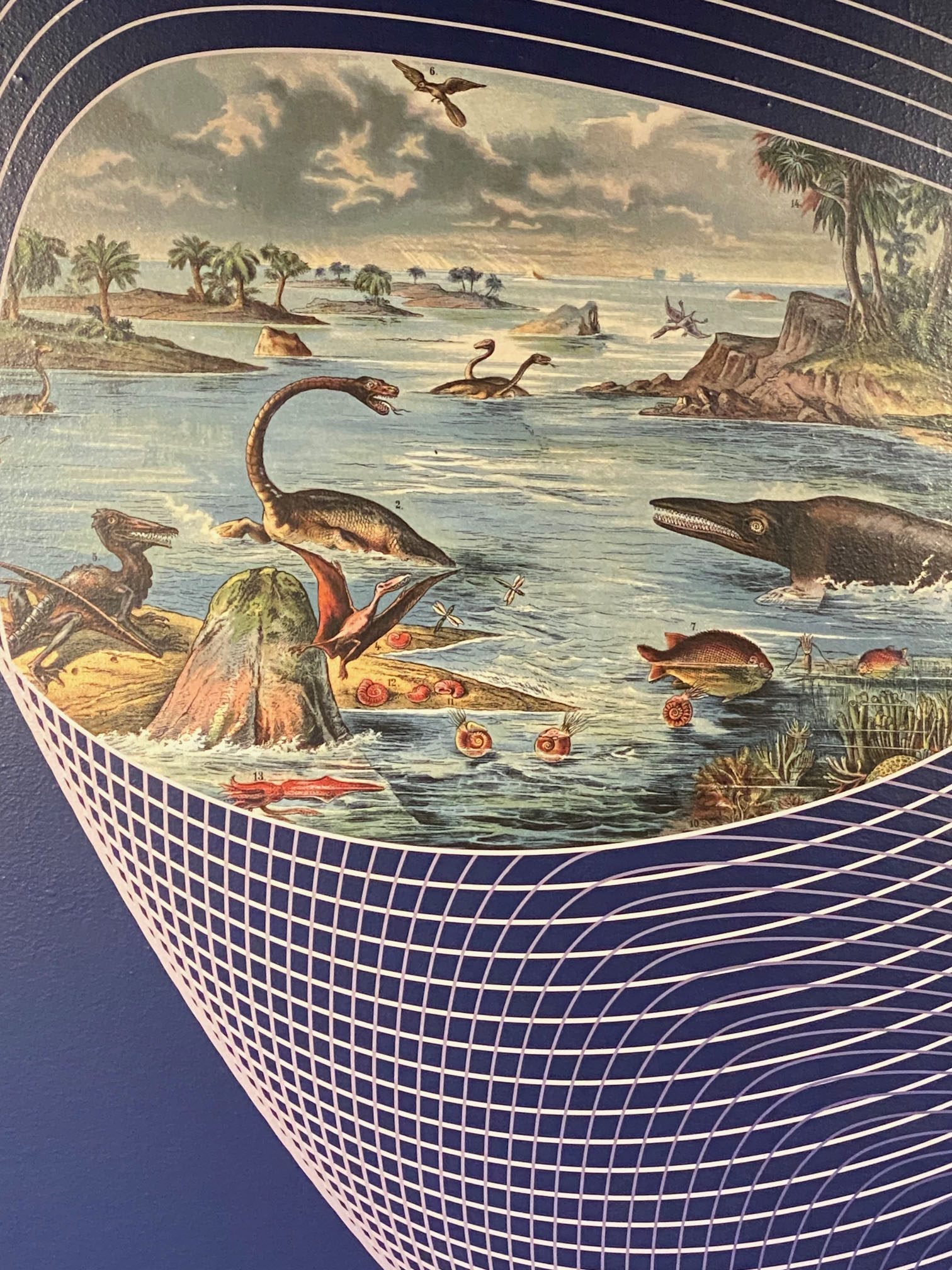
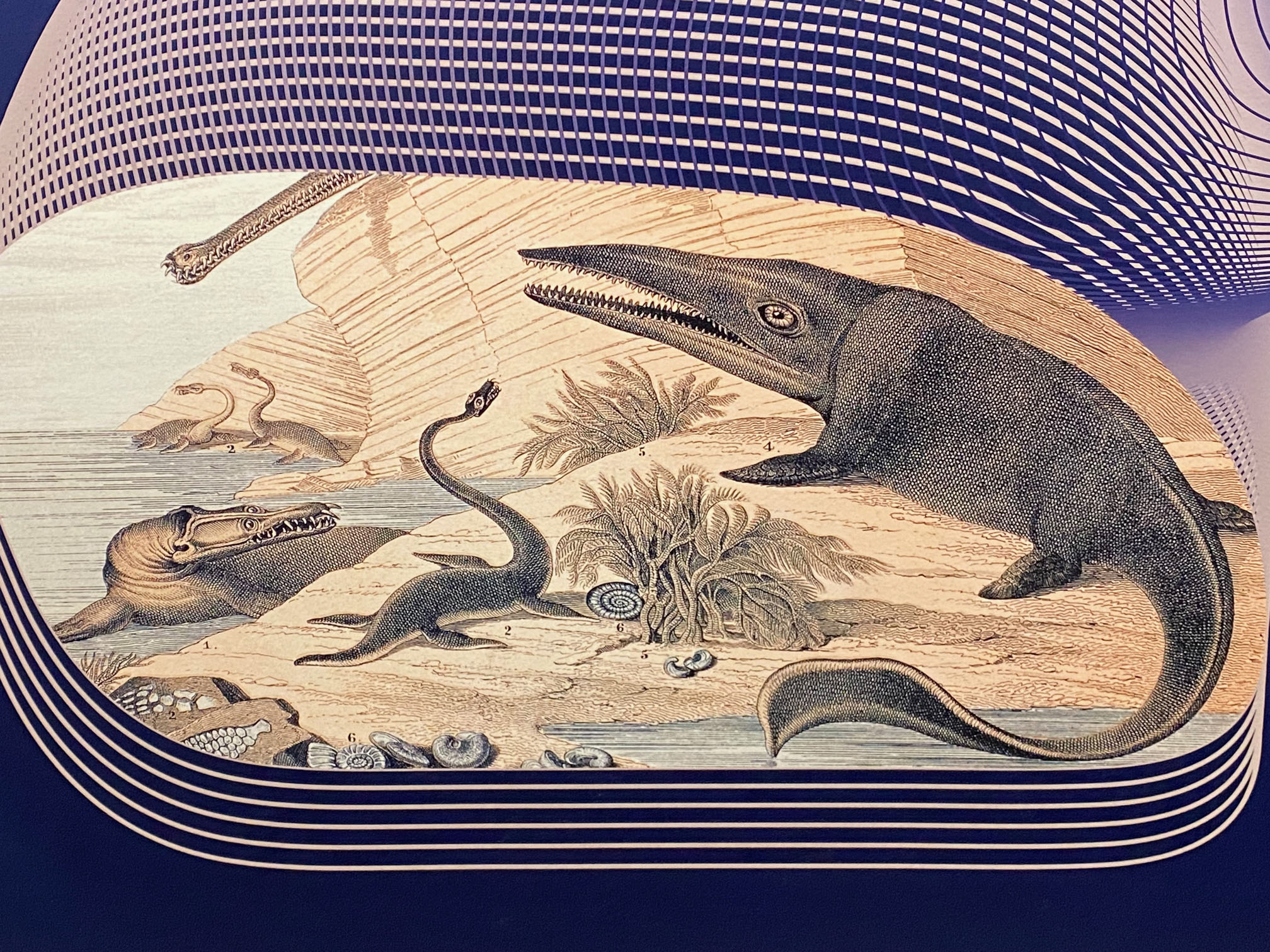
Reproduction of Frederick Rolle ‘s illustration Geology and Paleontology: Landscape of Europe in the Jurassic Era from Gotthilf Heinrich von Schubert’s 1887 Natural History.

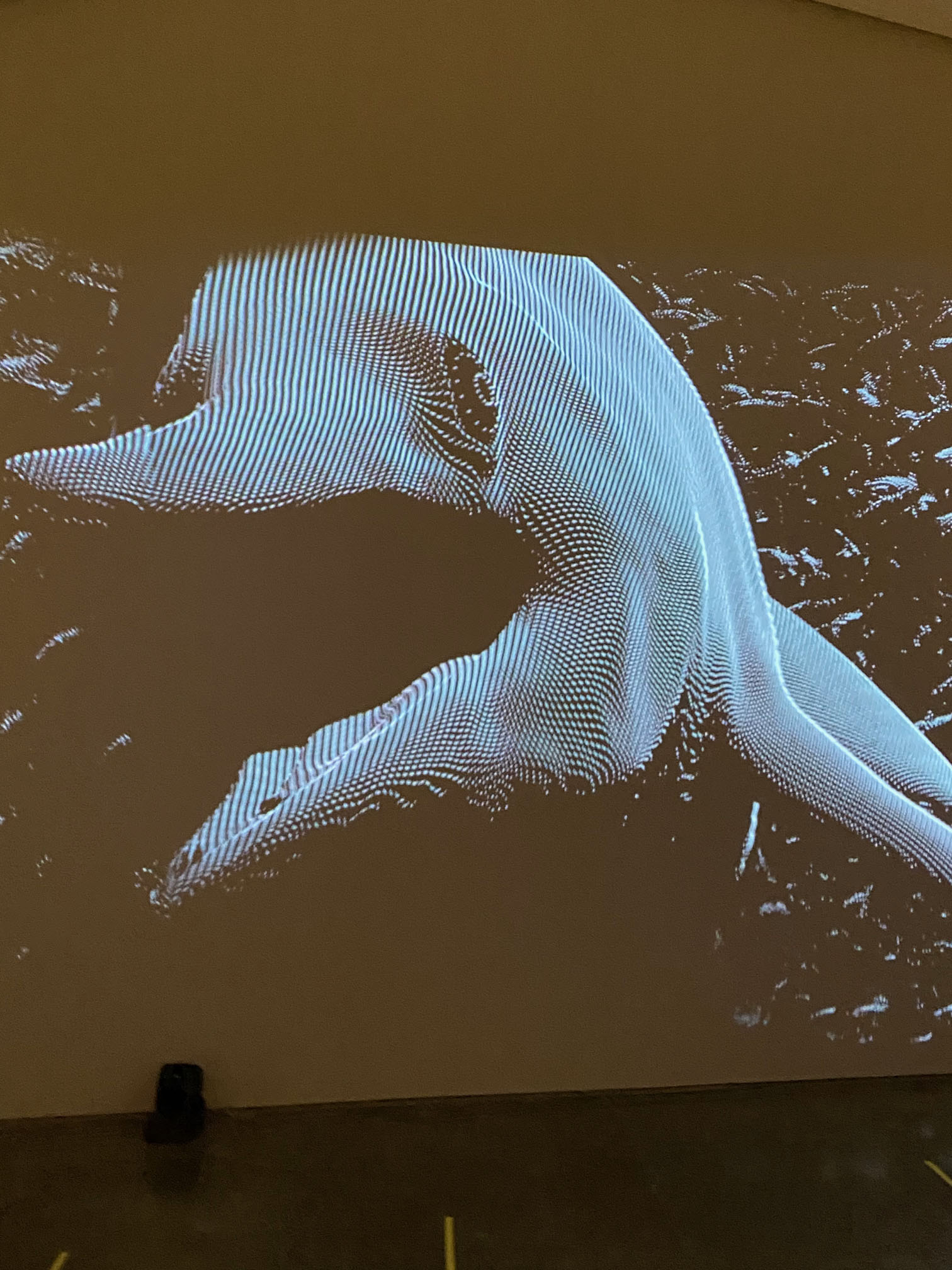
The most dramatic spectacle is on the far wall – a life-sized animated recreation of these gigantic swimming creatures by artist Ivan Cruz in collaboration with paleontologist Martin Sander and exhibition designer Nik Hafermaas. From the inky blackness, thousands of points of light emerge, float across the long wall, and coalesce into 3-D sea creatures that appear to swim across the entire length of the room.

Digital animation of swimming ichthyosaurs by artist Ivan Cruz, paleontologist Martin Sander, and exhibition designer Nik Hafermaas.

Take a close-up look at the gorgeous Deep Time exhibition design and ichthyosaur animations by Hafermaas°creative here.

History, adventure, art, and expeditions intertwine. The gallery tells the story of ichythyosaur discoveries across three Nevada mountain ranges – the Humboldt, Shoshone, and Augusta. Each section presents spectacular ichthyosaur fossils and along with tales of intrepid paleontologists who have toiled away in Nevada’s most remote regions for over a century.

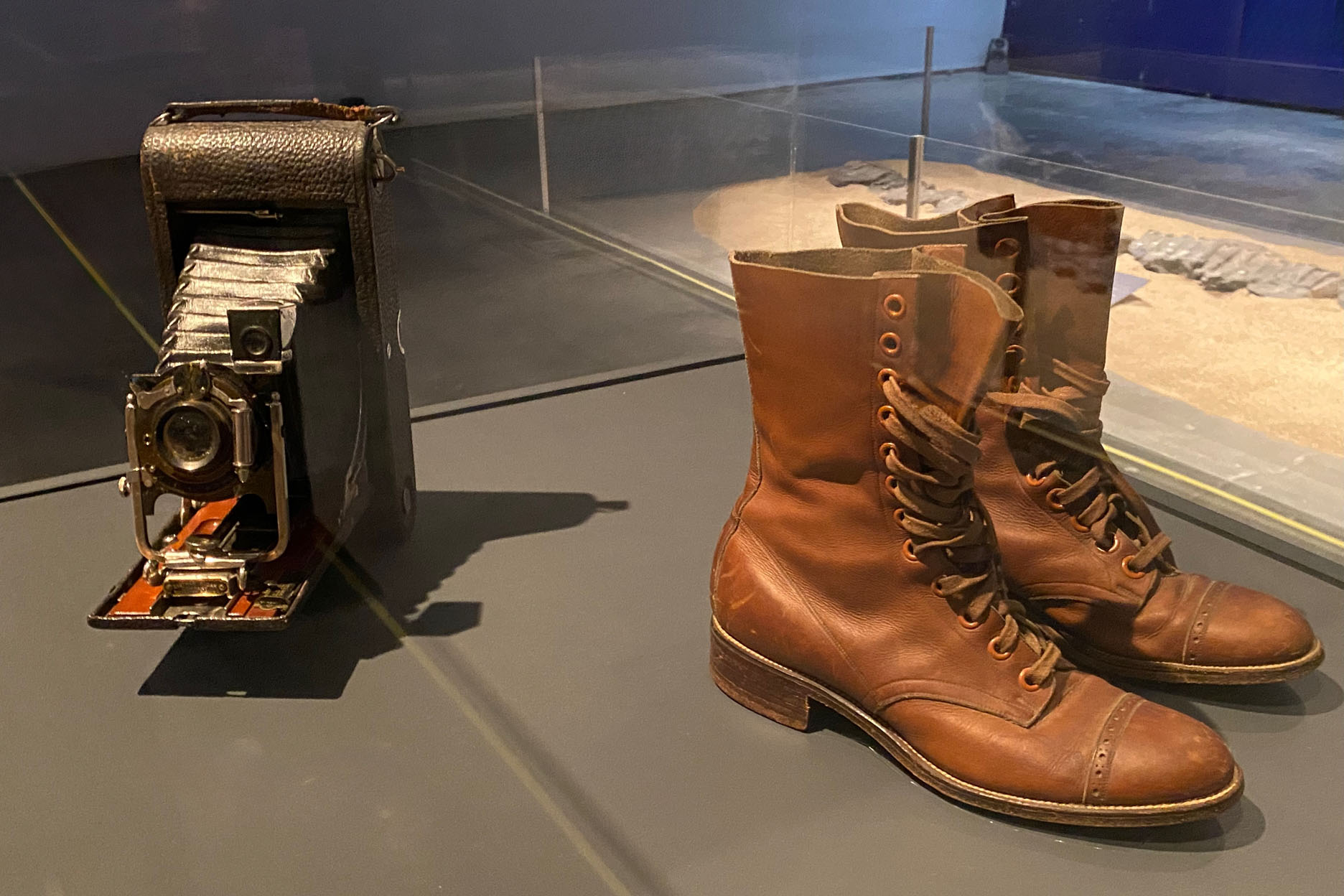
Paleontologist and philanthropist Annie Alexander’s Kodak field camera and boots; excavated 25 ichthyosaur fossils with UC-Berkeley 1905 Saurian expedition. Courtesy: UC-Berkeley Bancroft Library and Museum of Vertebrate Paleontolgy Archives.

Nevada’s “sea dragon” story begins in the Humboldt Range in 1867-1868 as the U.S. Geological Exploration of the Fortieth Parallel, led by Charles King, discovers and collects bits and pieces of ichthyosaur ribs and vertebrae in their survey of the Great Basin. These discoveries spawned national news stories. The fossils ended up in Harvard’s museum collection, so it’s nice to see them here.

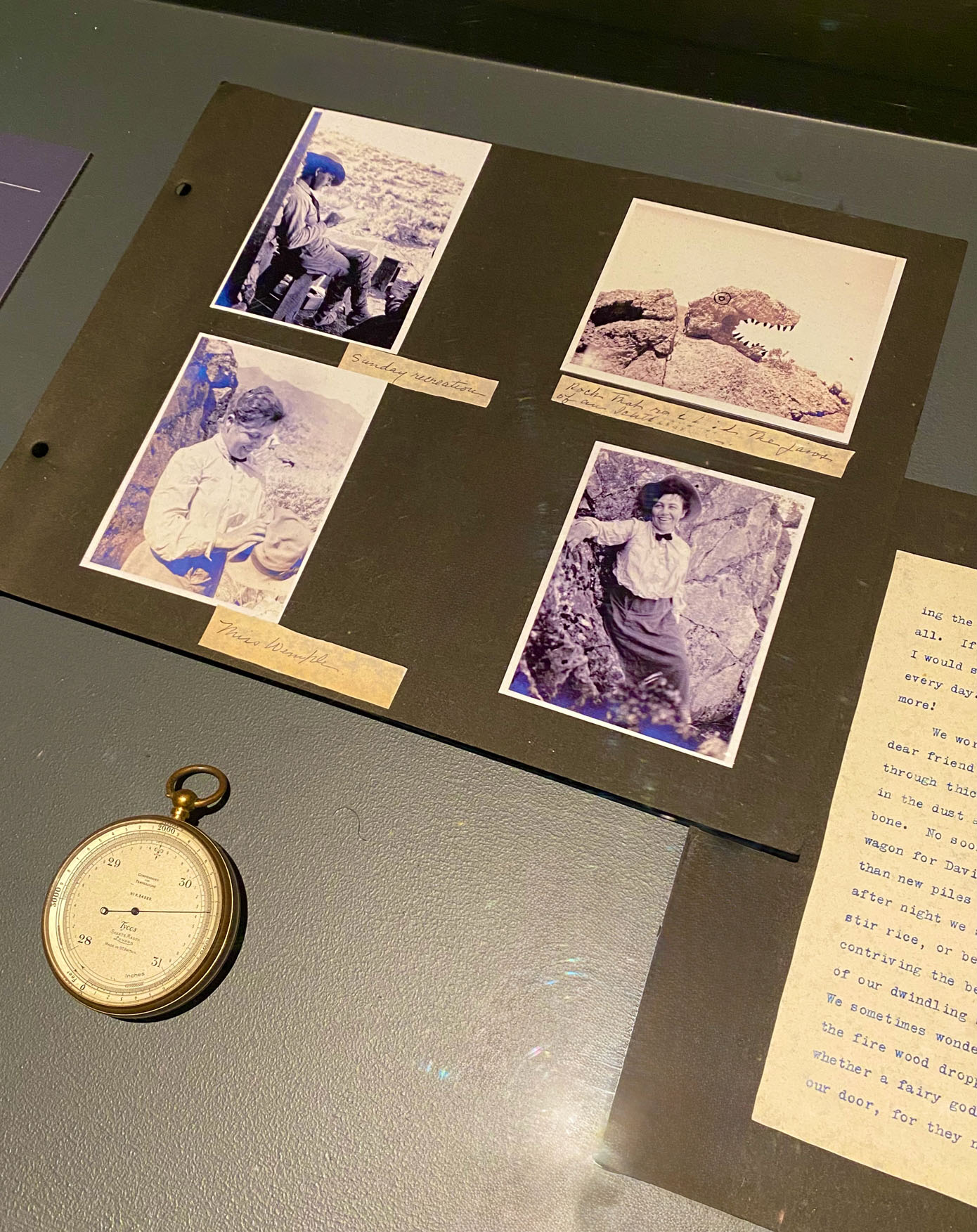
Paleontologist Annie Alexander’s field notes and photographs in scrapbook of the UC-Berkeley 1905 Saurian expedition to Nevada’s Humboldt’s Range, where she discovered and excavated 25 ichthyosaur fossils. Courtesy: UC-Berkeley Museum of Paleontolgy.

1905 was a big year for Triassic discoveries in the Humboldt Range.  James Perrin Smith and his team from Stanford collected dozens of ammonites from the Humboldt slopes, and philanthropist Annie Alexander bankrolled (and participated in) John Merriam’s UC-Berkeley Saurian expedition.

Merriam’s team excavated 25 ichythyosaur skeletons, loaded them out by horse-pulled wagons, and then got them back to Berkeley via train.  Annie’s field notebook and photo scrapbook give us a look at the fossils, camp, and the team. In 1907, Annie founded and funded the UC-Berkeley Museum of Vertebrate Zoology. Her subsequent field trips led her to collecting more than Triassic fossils, but Annie’s the one to thank for kicking off spectacular preservation efforts for Nevada’s marine-reptile riches.

And as most fossil hunters know, discoveries are often made inside the collections storage room.  It’s nice to see one of Annie’s 1905 fossils redefined as a new ichythyosaur species in the 21st century by exhibition co-curator paleontologist Martin Sanders!

Found in the Humboldt Range: 245-million-year-old Triassic ichthyosaur skull discovered in 1905; Nicole Klein and Martin Sander have recently reclassified “slender snout” as a new species. Courtesy: UC-Berkeley Museum of Paleontology

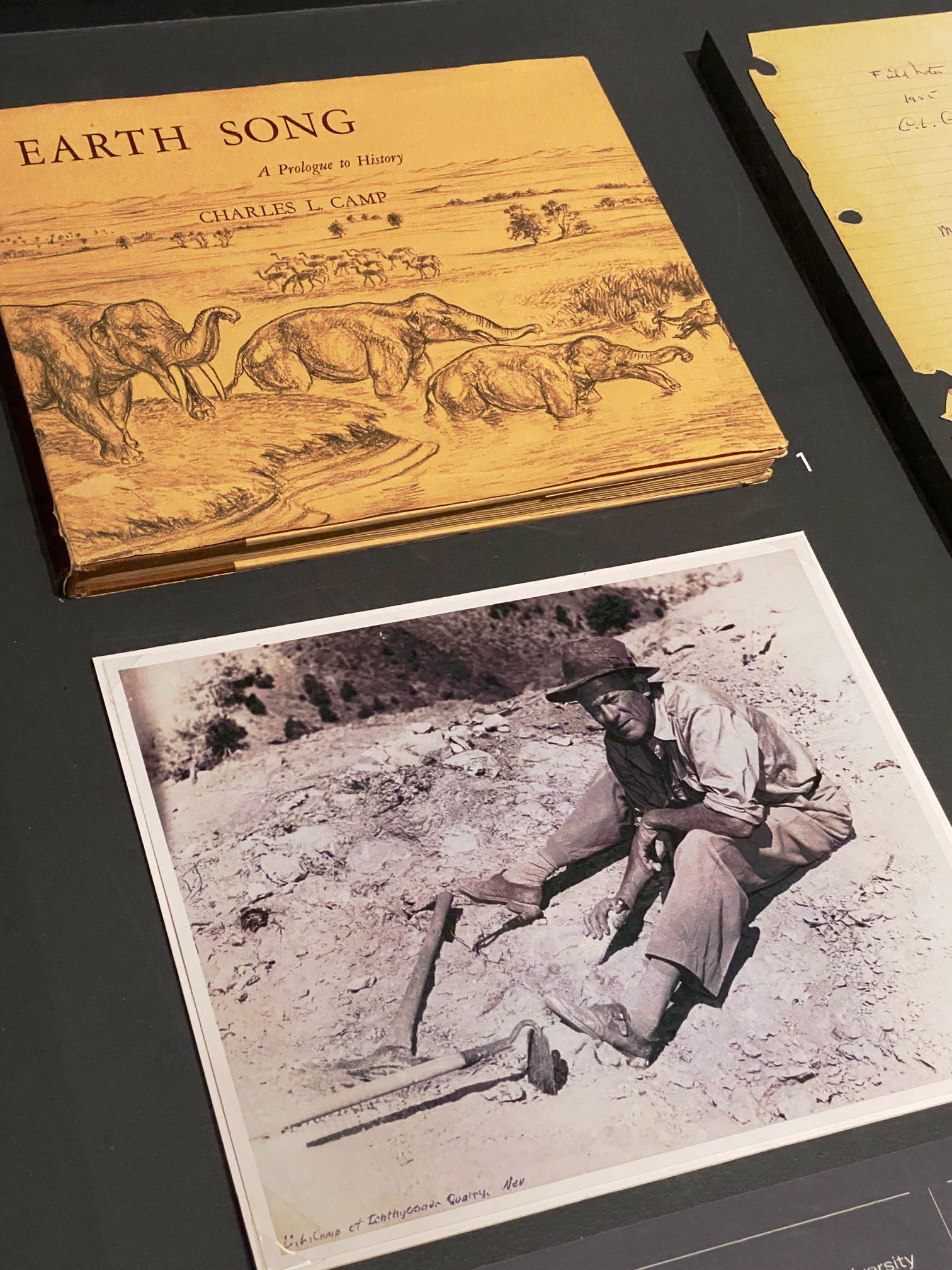
The story moves to the Shoshone Mountains near the old silver mining town of Berlin.  In 1928, paleontologist Siemon Muller came across a massive amount of ichthyosaur remains encased in super-hard limestone near Berlin.  Although he told the paleontologists at UC-Berkeley about them, no one followed up until Charles Camp went out to take a look in 1953. He found huge, articulated skeletons that were younger in age than the fossils from Humboldt.

In the Shoshone Mountains: 1954 photo of Charles Camp excavating fossils at the site that will become Berlin-Ichthyosaur State Park; Camp’s book Earth Song. Courtesy: University of California Museum of Paleontology; Nevada Museum of Art.
From the Shoshone Mountains: Digital print of front flipper of 228-million-year-old Triassic ichthyosaur (Shonisaurus) discovered in the 1950s by Charles Camp. Courtesy: Nevada State Museum; scan by Alyson Wilkins, Tyler Birthisel, and Randy Irmis. 

Over the next ten years, Camp and his team found and sand-blasted out remains of 40 Triassic ichythyosaurs, which he later named Shonisaurus. In one quarry, the skeletons were so complete and numerous that Camp decided just to uncover their them and leave them exposed in place. People heard about these unique finds from news reports, and came out to marvel for themselves.

By 1957, the site was named a Nevada state park – a place where visitors could large concentrations of the world’s largest ichthyosaurs. Over time, Camp opened ten separate quarries in the area. The fossils Camp removed are now held in the Nevada State Museum in Las Vegas.

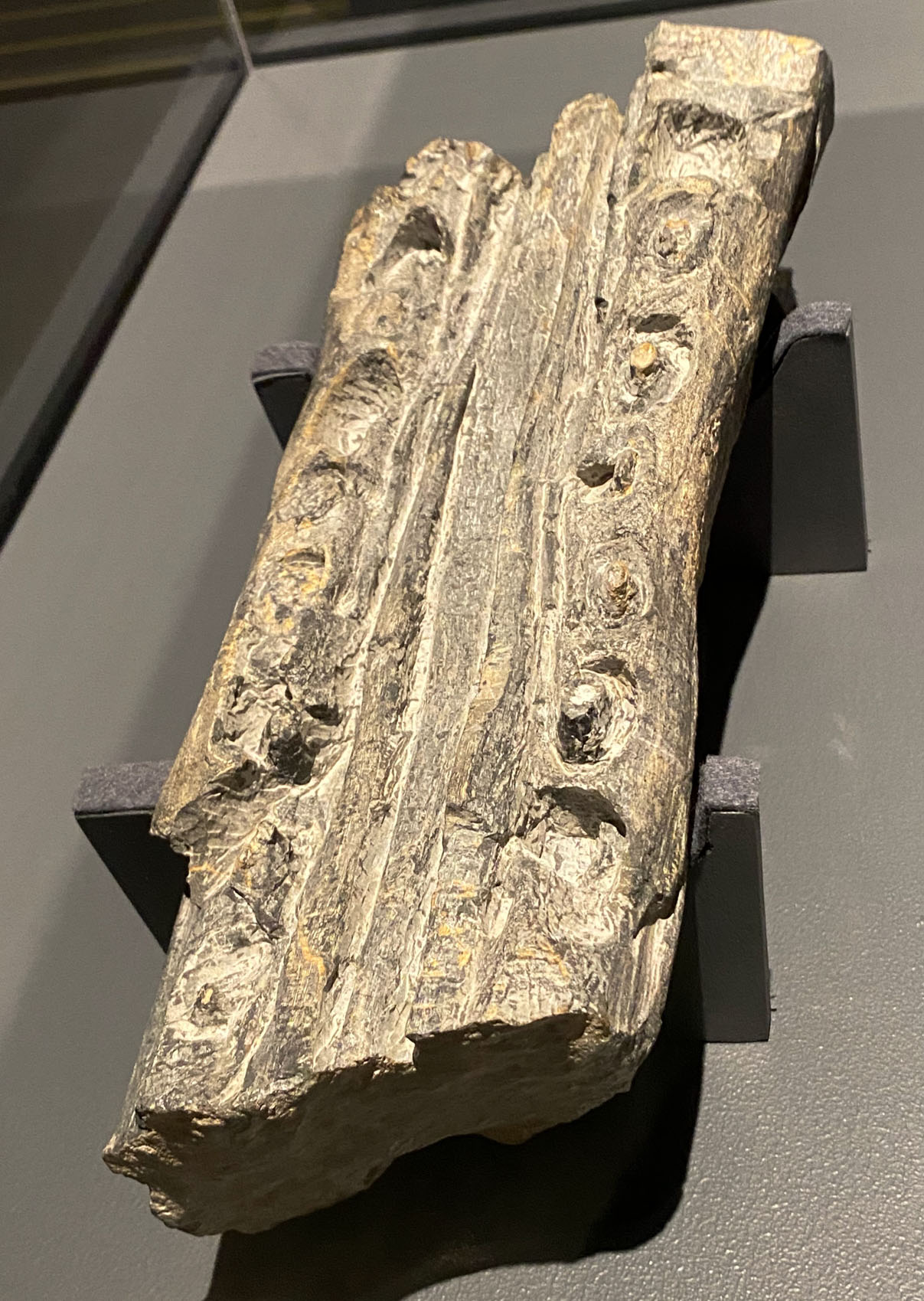
For the last ten years, palentologists Randy Irmis and Neal Patrick Kelly have been working in the same area. The exhibition includes their recent ichthyosaur discoveries, including baby Shonisaurus bones, teeth, and a snount containing tooth sockets – evidence that the animal was likely a formidable predator.

Watch their video here for a history of ichthyosaur collecting in Nevada, a digital model of Camp’s main quarry, and new fossils

From the Shoshone Mountains: Tooth sockets in snout fragment of a 228-million-year-old Triassic ichthyosaur (Shonisaurus) discovered in 2015 by Randy Irmis, Neal Patrick Kelly, Paula Noble, and Paige dePolo. Courtesy: Natural History Museum of Utah, US Forest Service, and Nevada State Parks. 

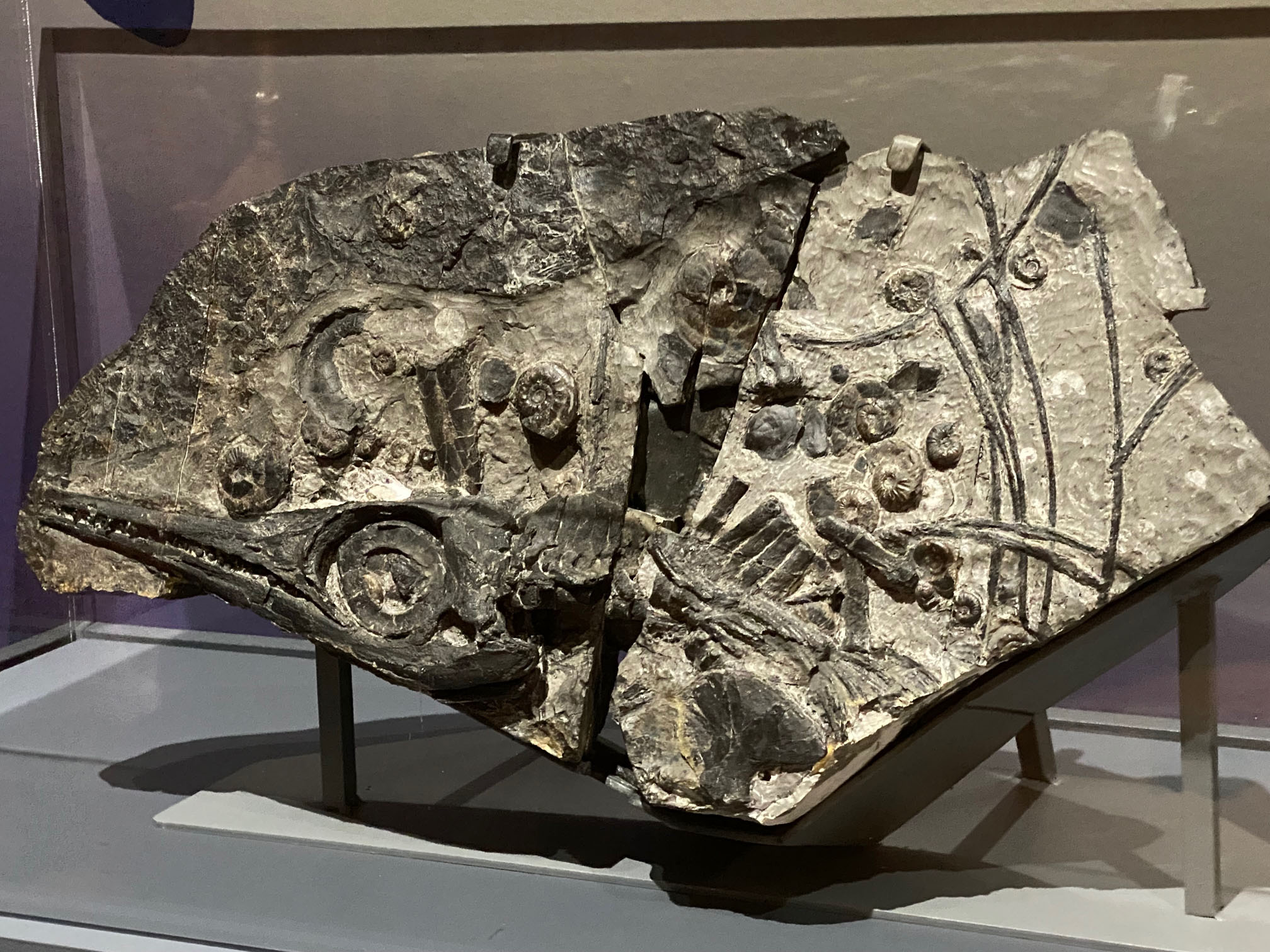
The Augusta Mountains has been the site of field work by Martin Sanders and team for nearly 30 years – – old and new ichthyosaur species, which are on display.

Fossilized sea floor with 242-million-year-old Triassic ichythyosaur (Phalarodon) and ammonites; found in 1996 by Martin Sander and Glenn Storrs in Nevada’s Augusta Mountains. Courtesy: Cincinnati Museum/BLM
From the Augusta Mountains: Skull of 243-million-year-old Triassic ichthyosaur (Cymbospondylus) discovered in the 2011 by Martin Sander (excavated 2014). Courtesy: Natural History Museums of Los Angeles County; BLM.

The exhibition includes a whimsical corridor leading to images from 19th-century paleo art and to vintage toys from a dinosaur and prehistoric-animal collector. The final room is a kaleidoscope of nostalgia – images from Europe’s earliest prehistoric ecosystem recreations to dinosaur collectibles from Chicago’s 1934 Century of Progress Fair.

It’s a fun way to observe how scientific thinking has changed about prehistoric marine lifestyles and body plans. Remember when science thought Brontosaurus spent its life submerged in lagoons? Or ichthyosaurs used their flippers to paddle around on land?

Take a look at our favorite fossils and toys in our Flickr album.

Reproduction of 1862 wall-chart illustration by Benjamin Waterhouse Hawkins Enaliosauria (extinct marine reptiles) produced for the UK’s Department of Science and Art, featuring land-dwelling Ichthyosaurus and Plesiosaurus.

To see how art and science were brought together to create this immersive time-travel experience, watch this short documentary from PBS Reno, take a trip to Nevada’s Augusta Mountains with paleontologist Martin Sander and see how artists and designers brought his Triassic creatures to life:

Virtual Museum Events – New Show Tours at MoMA, The Whitney, Poster House, and American Folk Art

For Easter Week, you’ll have an opportunity to join online tours of the new architecture show at MoMA, Julie Mehretu’s retrospective at The Whitney, the Lincoln Center poster show at Poster House, and a look at visionary photography at the Museum of American Folk Art.  See the full list of activities this week on our virtual events page.

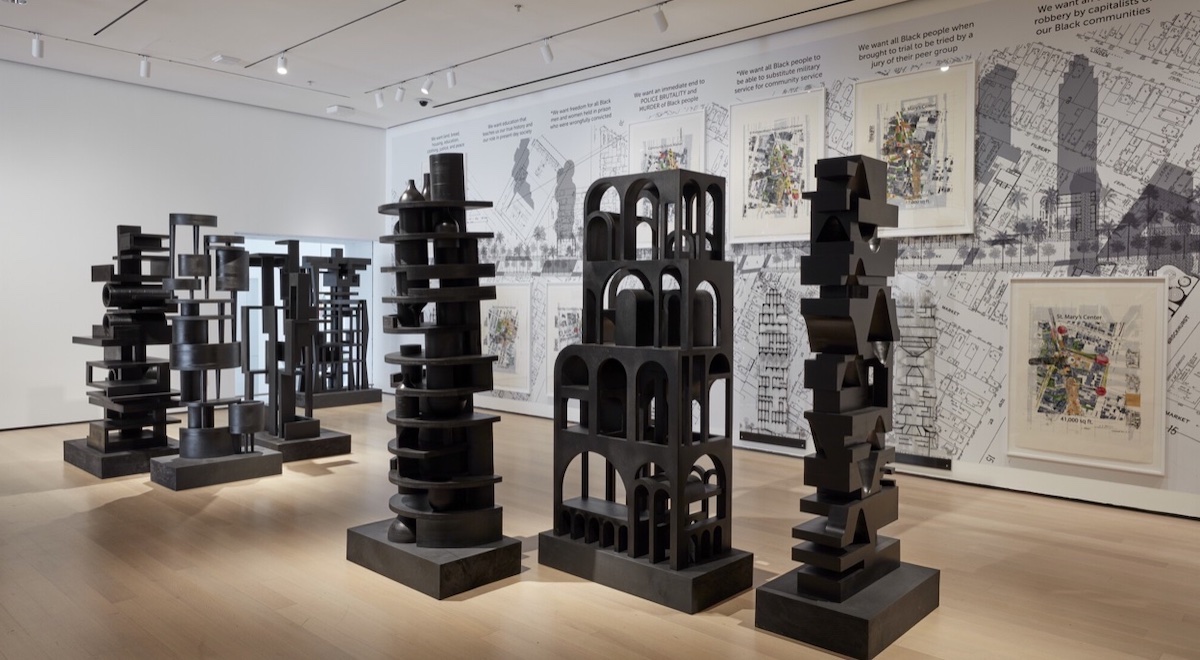
Today (March 29) at 6:30pm, join MoMA to hear a panel of high-powered Black architects and designers to discuss Cities and Spatial Justice – one of the themes presented in MoMA’s new exhibition Reconstructions: Architecture and Blackness in America. How are Black urban spaces created and protected? How do communities reckon with the past to create a future? Join in to participate in this timely discussion.

At 9pm, join the New Museum for a talk with Rachel Rossin, an artist whose work is part of World on a Wire, an online visual exhibition that is the first exhibition in a new partnership between Hyundai Motor Company and Rhizome, the museum’s digital art affiliate. The later (US) time was set to allow art lovers in Seoul and Beijing to join in at a reasonable time, too.

2_New Museum_Rhizome_Rossin

Rachel Rossin work at Hyundai Motorstudio Beijing and World on a Wire digital project.

On Tuesday (March 30) at 7pm, join a tour for the new Julie Mehretu mid-career retrospective at the Whitney Museum. See the giant, genius, multilayered canvases with the curator and find out how maps, revolutions, social justice, and architecture have inspired her to create such monumental works. (And for the tour of Julie’s show in Spanish, join the tour online at noon on Friday, April 2.)

3_Whitney_Mehretu_Invisible Line

Pondering Julie Mehretu’s Invisible Line at the Whitney

At 8pm, take a trip to Tokyo’s An’yo-in Temple to hear one of the earliest forms of meditative, chanting vocal music reimagined in a new work by the young composer. Japan Society, the University of Chicago, and Carnegie Hall present Shomyo: Buddhist Ritual Chant – Moonlight Mantra, followed by a live Q&A with the composer.

4_Japan Society_Chant_Shomyo

Traditional Buddhist chanting in Tokly’s An’yo-in Temple on Tuesday, courtesy of Japan Society and Carnegie Hall

The temple is created in a traditional method of joining wood without nails or glue, and ties into the society’s current exhibition, When Practice Becomes Form: Carpentry Tools from Japan.

On Wednesday (March 31), join Poster House for its program, For the Many: the Public Art of Lincoln Center, which is being held in association with the museum’s current exhibition, Vera List & The Posters of Lincoln Center. The program includes an introduction to Lincoln Center’s poster project – the landmark series pioneered by Vera List –and goes on to showcase the full range of public art commissioned for this New York cultural landmark.

Dorothy Gillespie’s 1989 Lincoln Center information center poster.

On Thursday (April 1) at 11am, take another trip to Japan to visit the Tokachi Millennium Forest ecological project on Hokkaido with experts from the New York Botanical Garden. Hear them talk about the master plan for this project, how they merged the “new Japanese horticulture” with wild nature, and how they created not only a beautiful garden but a gorgeous new book.

7_NYBG_Tokachi

Travel to the Tokachi Millennium Forest in Japan with NYBG and Dan Pearson and Midori Shintani

At 6pm, join the Museum of American Folk Art for a panel discussion (Re)Turning the Gaze, on the relationship of “the gaze” to gender, race, and sexuality. The panelists will feature photographs from the provocative current exhibition, PHOTO | BRUT: Collection Bruno Decharme & Compagnie.

Adam Pendleton at New Museum. Photo: Dario Lasagni

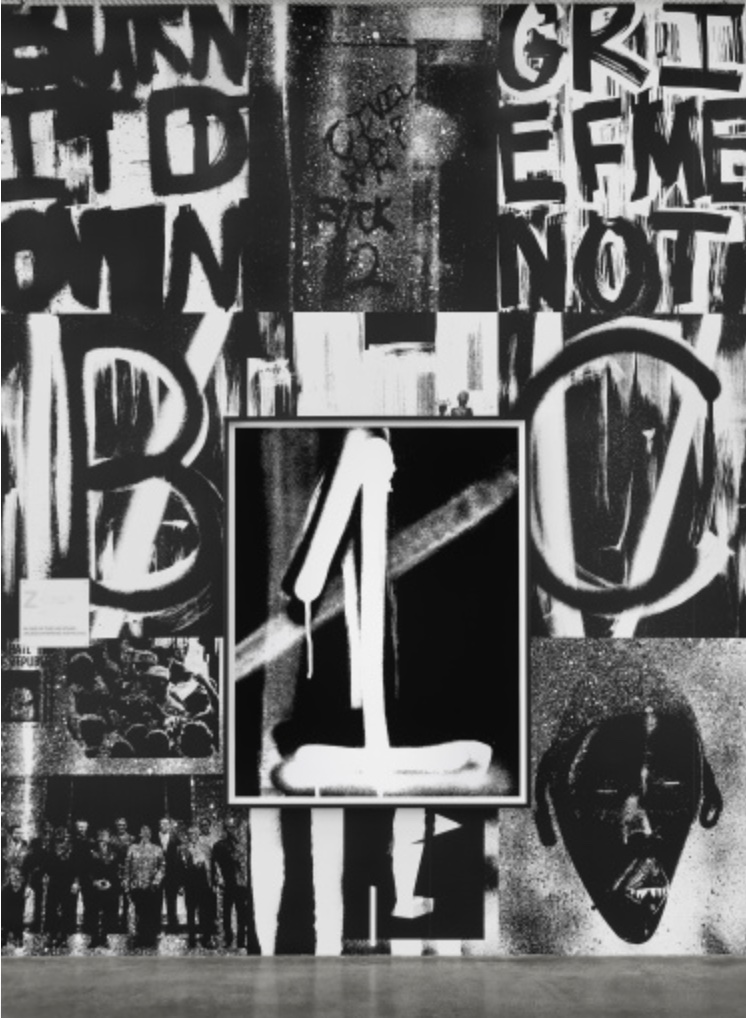
At 7pm, join the conversation at the New Museum with Adam Pendleton, who’s transformed the museum lobby into an exciting environment for the acclaimed Grief and Grievance: Art and Mourning in America exhibition. He often talks about “Black dada” – art that incorporates blackness, abstraction, and the avant-garde. If you can’t get to New York, take an online tour of the exhibition at 11am on Saturday, April 3.

There’s a lot more happening this week, so check the complete schedule. Most of the events are free, but it’s always nice to add a thank-you donation.

Museum Update

The crowds were at the Whitney to get their first look at the Julie Mehretu retrospective and to take a last look at the Kamoinge Workshop photographs from the Sixties and Seventies in the last weekend of Working Together. We saw lots of conversations and contemplations happening inside the Kamoinge gallery.  Although the show closed yesterday, the Whitney is offering one final virtual tour at noon on Thursday (April 1).

This past week, we went to the Met’s virtual opening of the Alice Neel retrospective, which is now posted online. Take a look.

We also joined MoMA’s online event with the Calder Foundation to take a closer look at the new exhibition, Alexander Calder – Modern from the Start.

The program is now posted on MoMA’s YouTube channel. Nearly 4,700 people have listened to Calder’s grandson Sandy Rower (and head of the Calder Foundation) shatter some Calder myths and show decades-old color 16mm film of Tanguy, Duchamp, and his grandmother hanging out with Calder in MoMA’s garden on 54th Street. (Don’t break that sculpture with the cat, Marcel!)

And while you’re on that YouTube channel, check out MoMA Virtual Cinema’s discussions with the directors, crews, and actors associated with some of their top picks for the film-awards season – Nomadland, Borat, Mank, Sound of Metal, and Minari.

Calder’s 1934 sculpture A Universe at MoMA