Embroidered Menswear 100% Flash

Embroidered front jacket pocket typical of 1780s court wear

Embroidered front jacket pocket typical of 1780s court wear

The womenswear in the Metropolitan Museum of Art’s China show couldn’t be more spectacular, but flashy menswear is not forgotten in the Ratti Center’s show, Elaborate Embroidery: Fabrics for Menswear before 1815, running through July 19.

It’s tiny, but lets you see what rich, fashionable men of the late 1700s and early 1800s were getting from their tailors in the biggest cities of Europe just before the fashions changed. Around 1815, Western men all adopted the monochrome suits that they’re still wearing for formal occasions and business today.

Until that fashion wave hit, the most spectacularly dressed men on the Continent would sport elaborate embroidery on silk or velvet jackets. The Met’s conservation center and textile library has selected some of its most spectacular samples. Check out the elaborate needlework in our Flickr feed.
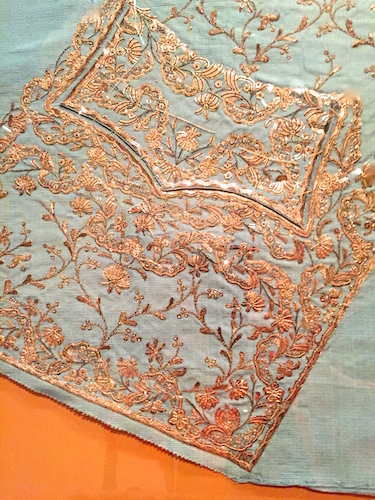
Waistcoat front panel from 1760s Europe; metal thread embroidery with sequins on silk.

Waistcoat front panel from 1760s; metal thread embroidery with sequins on silk.

The show centers around a few samples that would be on display in retail shops where fashionable men would place custom orders. For more details on the 1770s showroom experience, read the Met’s blog post.

You’ll see swaths of silk or velvet all embroidered to the fit of the customer, just waiting for the tailor to perform the 3D transformation. The handwork is truly incredible. An early sample from the 1760s uses silver (that’s metal) embroidery interlaced with different-sized sequins to catch the light. Just imagine the dazzle when that guy made his entrance at court.

Some of the samples in the cases appear toned down by comparison to the silk-silver-sequin combo, but close inspection reveals how piling on a profusion of different stitches create botanical illusions running up and down the edges of coats and waistcoats. They’re comparable to botanical illustrations in the NYBG’s collections.

Close-up of embroidered velvet sample from 1800-1815, after which men preferred plain suits

Close-up of embroidered velvet sample from 1800-1815, after which men preferred plain suits

The most elaborate work was done in France, but with the switch to more democratic, monochrome suits in the early 1800s meant that people who had developed some of the best embroidery skills in Europe had to look for other jobs.

Whose stitches are on top? East or West? There’s just one more week to compare these snippets of handwork history with the elaborately embroidered 1700s and 1800s Manchu robes on loan from Beijing’s Palace Museum in the downstairs gallery of the Costume Institute. Decide for yourself.
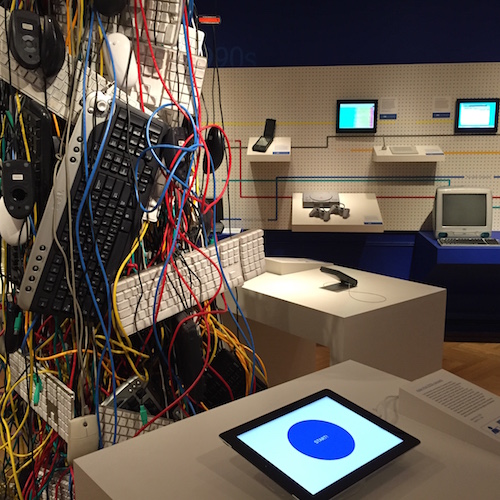
When Apple Met Alto and Game Boy Began

Tower of keyboards and wires in the center of the fourth-floor gallery; Newton visible against the history wall

Tower of keyboards and wires in the center of the fourth-floor gallery; Newton, PlayStation, and iMac visible on the history wall as iPad watches over everything

What’s the longest you ever sat in front of a computer screen or stared at stuff on your phone? Can you even remember a time before there were texts, browsers, and interactive screens? Bard Graduate Center Gallery has assembled a retrospective that asks you to remember your first keyboard, joystick, trackball, and mouse in their exhibition, The Interface Experience: Forty Years of Personal Computing, on view through July 19.

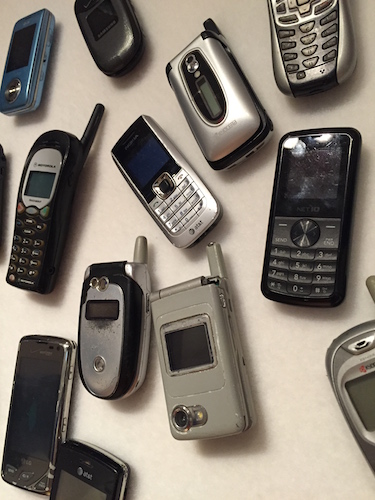
Plus, you can touch everything in the show and even sort through maybe every clamshell and Internet-enabled cellphone ever designed. What a stroll down memory lane!

Your first view of the fourth-floor show is a tangled tower of keyboards and cables, surrounded by a pegboard gallery with little platforms displaying the timeline of devices – desktop PCs, tablets, and game consoles.

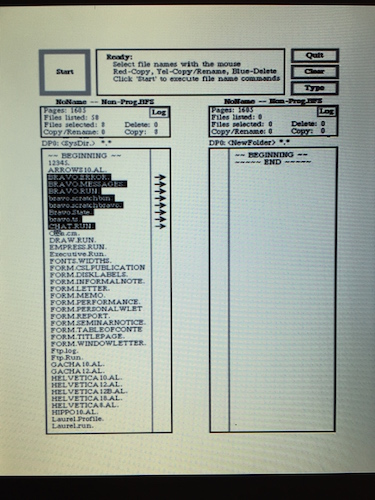
The 1973 Xerox Alto operating system featured the first mouse and graphic user interface.

The 1973 Xerox Alto operating system featured the first mouse and graphic user interface.

The oldest item in the show is the famous (but rarely glimpsed) 1973 Xerox Alto operating system, which the curators display on an ever-playing loop. Experience what Steve Jobs saw when he came face to face with the first graphical user interface, replete with the screen arrow. Brain flash on using a mouse to point to stuff on a screen – Steve said that someday everyone would be using something like this interface.

Walk on to see the Apple IIe (Woz built in an unbelievable 64K of RAM), VisiCalc (first “killer app” all quants had to have – a spreadsheet), and the predecessor to Steve’s Macintosh – the 1981 Xerox Star, which was the first commercially produced computer system to use a mouse and GUI. At a price of $16,000 in 1981, Steve’s up-and-coming Apple Macintosh was positioned to become a winner.

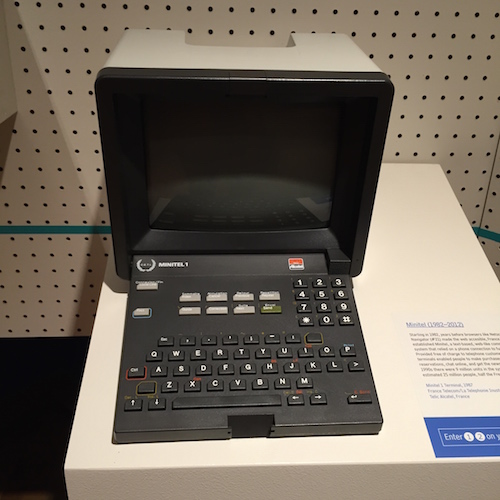
Before web browsers: Rarely seen, the exotic Minitel (1987 model) text information interface, which the French government distributed for free to half its population.

Before web browsers: Rarely seen, the exotic Minitel (1987 model) text information interface, which the French government distributed for free to half its population.

The Commodore 64 and IBM’s PC aren’t neglected, and neither is MS-DOS. Consider other game-changers such as Palm Pilot, Newton, and Kinect. You can touch them all and remember the way it was before things got smaller, faster, and got more oomph. Get a glimpse of the installation (pegboards and all) on our Flickr feed.

Don’t worry if you can’t get up to 86th Street to handle the technology in person. As usual, Bard’s students and faculty, who collaborated on this show, have produced a highly fulfilling web application that highlights everything in their show, adds historic tidbits, and shows each piece’s original print and TV ads.

Click on “Grid” to see all the exhibition items. Click on “Connections” to read interesting comments by the curators comparing different items or telling little histories about the relationships between the tech innovations. Click on “Device Statistics” to see how many units of each sold, how long it was in the market, and how much each would cost in today’s dollars. You’ll be able to sort the items by any of these parameters.

Steve’s hip and happening1998 iMac injected color into a drab, drab desktop computing world

Steve’s hip and happening1998 iMac injected color into a drab, drab desktop computing world

Example: sorted by today’s cost, the most expensive computing investment in the show would be the Xerox Alto operating system at (today) $225,981.

Be sure to click on “more” and enjoy the gallery of magazine ads for these innovations. And check out the 1979 TV commercial for Xerox Alto, on loan from the Xerox Archives, and please, do not miss the unforgettable all singing and dancing MS-DOS product introduction video.

You’ll read memories shared by gallery visitors about various items in the exhibition. For that matter, click on any item on the Grid and add your own story about your first personal encounter with these icons!

Bravo, Bard Graduate Center!

Mobile phones for days – the future of computing. The curators put these up with Velcro so visitors could feel them.

Mobile phones for days – the future of computing. The curators put these up with Velcro so visitors could feel them.

Dramatic Live Steam Show Envelops Virginia Museums

The restored 611 arrives in downtown Roanoke behind the art museum

The restored 611 arrives in downtown Roanoke behind the art museum

For the last month, crowds in western Virginia have been turning out in droves to see the dramatic result of engineering, technology, and determination by several museums and volunteers to resurrect the biggest, fastest passenger steam locomotive to live out its former glory on the Norfolk & Western Railroad.

If the CEO of Norfolk Southern hadn’t sold his Rothko in New York in 2013 and donated $1.5 million of its record-breaking proceeds, this amazing steam revival might not have happened.

Waiting for the 611 at Evington, Virginia on its debut run

Waiting for the 611 at Evington, Virginia on its debut run

The Virginia Museum of Transportation is celebrating the culmination of efforts to “Fire Up the 611” and let this 100-mile-per-hour wonder rip through the foothills of the Blue Ridge and points east all month and hopefully into the future.

As the 611 made its way from its rehab yard at the North Carolina Transportation Museum in Spencer, North Carolina, people lined the tracks to see the newly refurbished 1950s streamlined locomotive pull 17 passenger cars loaded with fans 140 miles north to its new home in Roanoke. The celebration of 611’s return has been going on all month, as the locomotive keeps making runs to Petersburg, Lynchburg, Radford, and other Virginia towns.

611 parked next to the O. Winston Link Museum

611 parked next to the O. Winston Link Museum

The 611’s Twitter feed lets everyone know when to expect it, although the piercing steam whistle and roaring sound are also sufficient alerts to anyone in a five-mile radius. Listen to its sounds on our Flickr video of its 45-mph pass through one lucky town and see photos its Roanoke arrival.

The 611 and its 13 sister locomotives (Norfolk & Western J Class) were produced after 1941 and pulled passenger trains through Ohio, North Carolina, Virginia, and Tennessee until the late 1950s – around the same time that Rothko painted the canvas that would later benefit the 611’s resurrection. Since it’s retirement, this coal-fired steam engine mostly sat in the yard at the Roanoke museum, but had a brief comeback in the 1980s making a few tourist rail runs.

Inside the O. Winston Link Museum, showcasing Link’s spectacular photographs of the last days of steam on the Norfolk & Western Railroad

Inside the O. Winston Link Museum, showcasing Link’s spectacular photographs of the last days of steam on the Norfolk & Western Railroad

Norfolk Southern initiated a “21st Century Steam” initiative, and volunteers at the Roanoke museum began the “Fire Up the 611!” campaign. The NS CEO decided to jump-start the initiative with the $1.5 million from the Rothko sale, and volunteers put in over 8,000 hours to bring the magnificent machine back to life.

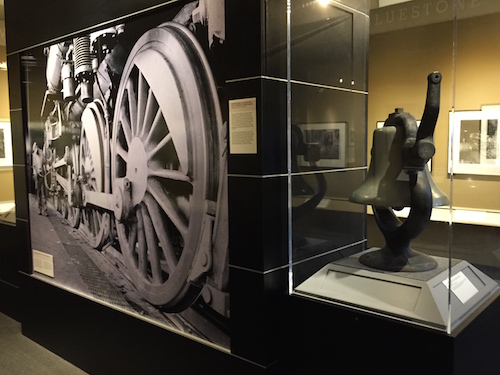
When the 611 steamed into downtown Roanoke on May 30, it stopped for photos and an official welcome right behind Roanoke’s contemporary at museum and in front of the O. Winston Link Museum, housing the work of one of the most acclaimed railway photographers of the 20th century in the former Norfolk & Western Railway Building.

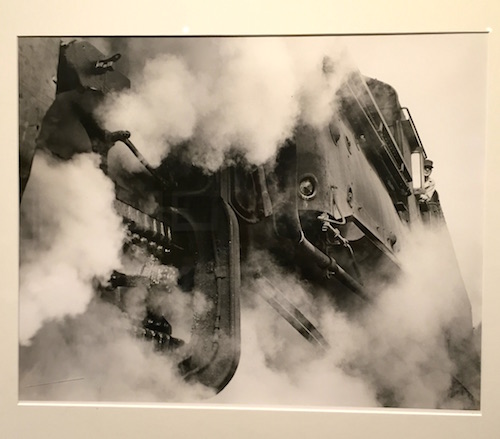
Link’s 1960s portrait of steam locomotive fireman, Joe Estes

Link’s 1960s portrait of steam locomotive fireman, Joe Estes

Link, a Brooklyn-born commercial photographer, fell in love with steam locomotives that he knew were rapidly being replaced by diesel. He innovated nighttime lighting gear to capture dramatic shots of the steam giants coursing through the hills and crossroads of West Virginia and Virginia. Link recorded their sounds as well – recordings that continued to sell well for decades. Catch a glimpse of Link’s gorgeous images, equipment and recordings on our Flickr site.

After finishing its July runs, the 611 will be on display in the museum yard in Roanoke, parked alongside other giants of steam.

Enlightenment through Gems

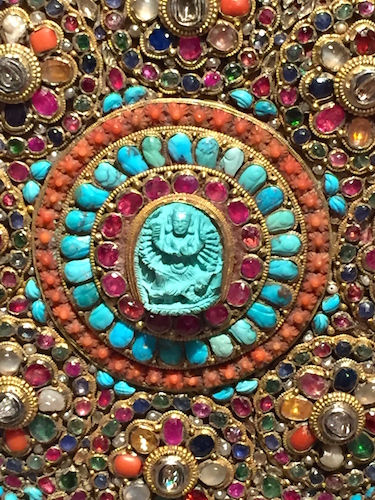
Center of 8-in. ritual offering dish made in 17th-18th c. Nepal

Turquoise Dhurga defeats a dragon in the center of 8-in. ritual offering dish (17th-18th c. Nepal)

It’s clear that wearing and giving precious (and semi-precious) gems can elevate the mind to higher levels of consciousness – at least in the minds of the Tibetan Buddhists – according to what you’ll see in Sacred Traditions of the Himalayas, running through this weekend at the Metropolitan Museum of Art.

The curators feature some remarkable statues, ritual dancewear, mandalas, and arms in the show, but let’s focus on the jewel-encrusted mosaics, containers, and jewelry displayed in the corner of the second-floor gallery, estimated to date from the 17th to 20th centuries.

Tibetan Buddhism emerged over the centuries in a dry, dusty, seemingly barren but beautiful region where people’s own adornment or bright flags atop mountain passes seem to be the only bursts of color. Inside homes, personal shrines, and monastery temples hang intricate, colorful mandalas pictorially suggesting the path to enlightenment, often symbolized by brightly adorned temples.

Mrs. Tsarong and two ladies from Tsang wearing special-occasion jewelry and hats as photographed by C. Suydam Cutting in 1937. Courtesy: Newark Museum collection

Mrs. Tsarong and two ladies from Tsang sport special-occasion jewelry and hats near Lhasa in 1937. Photo: C. Suydam Cutting. Courtesy: Newark Museum

These conceptual centers of enlightenment are often thought of as colorful crystal palaces emblazoned with jewels – an attractive image to hold in one’s mind on the lifelong journey to this higher plane of existence. What better way to remember your goal than to contemplate bedazzling diamonds, rubies, emeralds, sapphires, garnets, quartz, pearls, amber, coral, lapis lazuli, and turquoise?

To honor one’s journey to enlightenment, wealthy Tibetans often donated jewels to temples to adorn statues of the deities or commissioned personal devotional objects. That’s why you see so many jewel-encrusted objects in the Met’s collection. Personal shrines had jewel mosaics jam-packed with a dazzling array of stones. Gigantic statues were adorned with jewel-encrusted ornaments and surrounded by similarly elaborate containers for offerings.

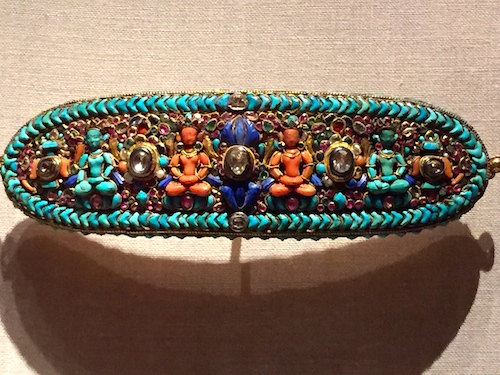
This Forehead Ornament for a Deity is only 8 inches long. Four celestial Buddhas are interspersed with diamonds

This Forehead Ornament for a Deity is only 8 inches long. Four celestial Buddhas are interspersed with diamonds

For special occasions, women sported accessories with amazing numbers of stones, reminding everyone of their social status, wealth, and devotion to an enlightened path.

Although some of the metal work was done in and around Lhasa, Tibet’s capital, the majority of the eye-popping jeweled settings were created across the border in Kathmandu, Nepal by Newari masters who created some of the most intricate visions in metal, wood, and paint ever known to the world. We’ve provided you with some close-up looks here and on our Flickr site. As shown, the result is a mix of Tibetan and Hindu imagery – typical of this region where so many cultural influences mix.

Densely packed diamonds, rubies, emeralds, sapphires, garnets, quartz, pearls, amber, coral, lapis, and turquoise in corner of Birth of the Buddha mosaic (18th-19th c. Nepal)

Densely packed diamonds, rubies, emeralds, sapphires, garnets, quartz, pearls, amber, coral, lapis, and turquoise in corner of Birth of the Buddha mosaic (18th-19th c. Nepal)

The Met’s own site for the objects in the show also allows you to zoom in on the details. Learn more about how the Met conserves such intricate jewel work in this blog post by an intern in the conservation department. See close-ups of how the Newaris set their gems.

Finally, explore Tibet as it was 100 years ago through this slideshow prepared for this show at the Met by the Newark Museum, which itself has a world-class collection of Tibetan objects and perhaps the largest collection of photographs of Tibetan people and temples from that time.

Plains Indians Wearable Art at The Met

1780 Plains Indian horned headdress assembled from a powerful mix of materials including bison horns, deer and horsehair, porcupine quills, glass beads, wood, metal cones, cotton cloth, silk ribbon, and paint. From the Musée du quai Branly in Paris

1780 Horned headdress assembled from a powerful mix from mighty bison , deer, and horse. From Musée du quai Branly in Paris.

With all the attention this week on the couture gowns at the Metropolitan Museum of Art ball and Costume Institute show, don’t forget that some of the most elaborately embellished mixed-media wearable art is installed on the second floor in the expansive tribute, The Plains Indians: Artists of Earth and Sky, through this weekend.

The masterworks have been gathered from select European and North American collections and feature beadwork (mostly on leather), symbolic headdresses, and magical objects that directly telegraph the wearer’s connection to nature, the universe, and supernatural power.

The show was organized by the Musée du quai Branly, Paris, in collaboration with The Met, and in partnership with The Nelson-Atkins Museum of Art, Kansas City, and features works from the 18th century through today (like the China exhibition in the other wing).

All-over beading on contemporary platform shoes by artist Jamie Okuma, 2014.

All-over beading on 2014 platform shoes by artist Jamie Okuma.

The curators track changes in materials, styles, and concerns of the Osage, Quapaw, Omaha, Crow, Cheyenne, Arapaho, Lakota, Blackfeet, Pawnee, Kiowa, Comanche, and Meskwaki nations from the time they dominated the Midwest through the demise of the buffalo, the great wars, the transition to reservation life, and participation in 21st century art and culture.

Take a read through the curators’ story on this exhibition site and see some of our favorite looks on our Flickr feed, where we’ve organized the pieces in chronological order. We’re giving you a close-up view of some of the bead, quill, and embroidery work. You can see the transition from more shamanistic embellishment to use of imported Venetian glass beads, to the all-over bead style, and finally to current creations, such as Jaime Okuma’s beaded platform shoes.

Central painting on large-scale Mythic Bird robe from the Illinois Confederacy, 1700-1740. Courtesy: Musée du quai Branly in Paris

Central painting on Mythic Bird robe, Illinois Confederacy, 1700-1740. Courtesy: Musée du quai Branly in Paris

Much of the painting and handwork was divided according to gender – men painted figures and women did the beadwork and painted the geometric forms. This beautiful robe with a geometric mythological bird is one of the earliest surviving large-scale paintings from Plains tribes, and the beaded geometry of the 1895 Crow wedding robe is another marvel.

Compare the mixed-media horned headdresses from 1780s Missouri with Chief Red Cloud’s dramatic all-business trophy-feathered war bonnet of 1865. The fluffy-feathered 1925 creation from Cody’s Buffalo Bill Center almost makes you wonder if that version were strictly for wild west shows.

It’s also interesting to learn that the powerful symbolic paintings on shirts and shields were essentially “owned” by their creators.

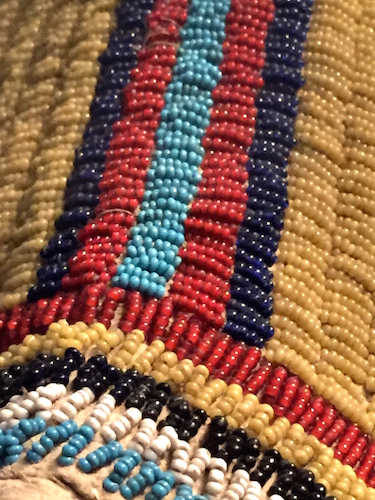
Close up of the tiny Venetian seed beads used to decorate a Lakota woman’s dress (Teton Sioux), 1865. From the Smithsonian’s NMAI

Tiny Venetian seed beads decorate a Lakota woman’s 1865 dress. From the Smithsonian’s NMAI

Similar to what we learned about 1920s French couture designers’ concerns about unlicensed copies in FIT’s recent Faking It show, anyone wanting to replicate a particular war shirt or shield, had to be granted formal permission. The Met exhibition explains that replication permission of Plains Indian designs were closely held and protected for generations.

A full database of the amazing objects in the show is on the Met’s website, as well as the complete audio guide to the exhibit on the museum’s Soundcloud site. As you click on the audio tracks, you’ll see a small thumbnail of the object.

Listen to curator Gaylord Torrence, explain how French culture and embroidery techniques collided with Plains Indians culture three hundred years ago to such magnificent result:


Reverent Ceramic Master Honored in NC

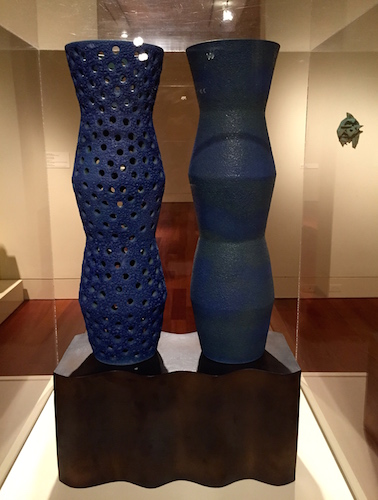
Hiroshi’s “Twin Vase”, a monumental 2002 stoneware sculpture with crawl glaze

Hiroshi’s Twin Vase, a monumental 2002 stoneware sculpture with crawl glaze

Known for a strong pottery tradition, North Carolina’s Cameron Art Museum is paying tribute to a Japanese ceramic expert in Hiroshi Sueyoshi: Master of Reverence through September 6.

As a young artist who apprentices with ceramic masters of 1960s Japan, he was advised by folk artist Shoji Hamada to see as much of the world as he could before he turned 25.

In the early 1970s, he came to Asheboro to help build a pottery, trained with Japanese ceramic-artist ex-pats, worked at Seagrove, and landed teaching jobs at several North Carolina colleges.

By the end of the decade, he relocated to Wilmington, teaching and serving as an artist-in-resident at the Museum.

Although the show features the full scope of Hiroshi’s work, it exhibits the work of the ceramic artists who influenced him. Works by Rita Duckworth, Isamu Noguchi, Peter Voulkos, and Shoji Hamada are shown side-by-side with his own, demonstrating the tradition upon which he draws.

Rock Garden, a 2014 interpretation of a Zen garden made with hand-built “rocks”. He wants the viewer to be conscious of their surroundings

Rock Garden, Hiroshi’s 2014 interpretation of a Zen garden made with hand-built “rocks”.

Landscapes, biomorphic shapes, streams, voids, spirals, crackled surfaces, and Zen gardens – you’ll see and feel it all as you slowly work through the galleries. Find power in Hiroshi’s simplicity and lots of detail upon closer inspection.

The sculptures echoes of the primitive power of Brancusi and installations evoke the meditative calm of the Rothko Chapel. The museum has even hung up some of the coverings that Hiroshi uses for his pottery tables on the wall in the back gallery. Their subtle dust-ground, worked surfaces feel like subtle, magical Twombly atmospheres. So, even Hiroshi’s work cloths feel like art.

If you can’t make it to see this beautiful work in Wilmington, take a stroll through our Flickr site.

Biomorphic 2009 wall sculpture Blossom. Stoneware with crater and crawl glaze. Courtesy: New Hanover Library

Biomorphic 2009 wall sculpture Blossom. Stoneware with crater and crawl glaze. Courtesy: New Hanover Library

Ennion: Luxury Tableware at The Met

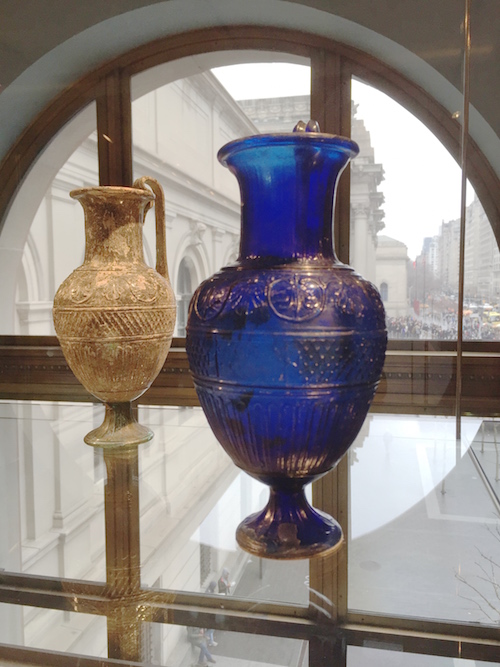
Two identical one-handled Ennion jugs from different sites. On right, the only Ennion piece with an intact foot, 1st c. A.D.

Two identical one-handled Ennion jugs from different sites. On right, the only Ennion piece with an intact foot, 1st c. A.D.

It’s unlikely that you have any of this sought-after designer’s pieces accompanying your best table setting or that the MAD Museum has any of his hand-blown, molded glassworks in their collection.

Two thousand years before ABC Carpet began retailing high-end home goods on Broadway and Martha Stewart branded her at-home lifestyle line, a Mediterranean craftsman in Sidon, Lebanon (then Phoenecia) created a line that every aspiring tastemaker in the Roman Empire just had to have. The Metropolitan Museum of Art pays tribute to his output in Ennion: Master of Roman Glass, on view just off the Greek-Roman study galleries through April 12.

Who needs old-fashioned metal cups or pottery jugs on the well-laid Roman table when Ennion was creating stunning cobalt-blue and transparent glass equivalents?

Two-handled cup, with Ennion’s Greek brand (“Ennion made this/it”). Blown glass into mold, 1st c. A.D. Courtesy: Turin museum; other by private collector

Two-handled cup, with Ennion’s Greek brand (“Ennion made this/it”). Blown glass into mold, 1st c. A.D. Courtesy: Turin museum; other by private collector

Ennion’s workshop was on the cutting edge of a manufacturing-and-craft revolution – blowing glass into decorative molds (which took the guesswork out of creating place settings for four, six, or ten) and exporting sets for sale throughout The Empire.

Ennion’s competitors were doing the same, but Ennion of Sidon had the big brand emblazoned on his work, working it into the design in the same way that MK, DKNY, DVF or YSL do today. His logo was written in Greek, the universal language of the first century: ““Ennion made me/it.” Scholars reckon that it was all made and exported from Sidon, a first-century glassmaking powerhouse, since none of Ennion’s molds featured a bilingual brand.

After two millennia, only about 50 of Ennion’s gorgeous works remain, and the Met’s show has assembled about half that amount from its own collection (courtesy of master-collector J. Pierpont Morgan), the Corning Museum, private collections, and other museums of antiquities in Israeli and Europe.

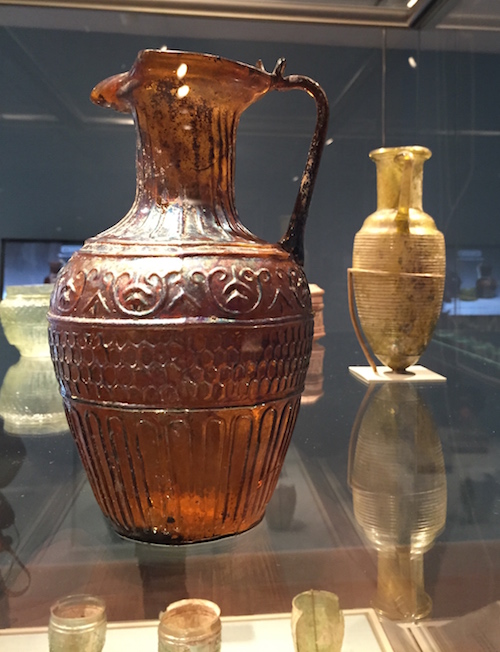
Non-Ennion glass jug made in a four-part mold; right, a two-handled amphora blown into a three-part mold, ist c. A.D. Source: The Met

Non-Ennion glass jug made in a four-part mold, 1st c. A.D. Source: The Met

In addition to Sidon, Ennion’s output has been found in excavations of ancient homes in places as far flung as Jerusalem, Croatia, Italy, and Spain. The Met’s team has had fun displaying glassware from identical molds next to one another, despite the fact that pairs were discovered thousands of miles from each other at different archeological sites.

Check out the Met’s beautiful tribute to a master artist on our Flickr feed.

FIT Tribute to Lauren’s Look

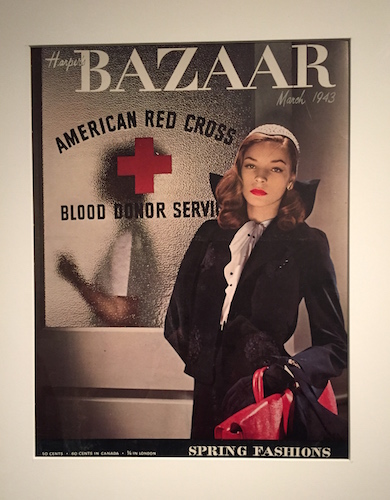
18-year-old Bacall poses as a Red Cross WWII nurse on Harpers Bazaar cover, March 1943. Cover photo: Louise Dahl Wolfe

18-year-old Bacall poses as a Red Cross WWII nurse on Harpers Bazaar cover, March 1943. Cover photo: Louise Dahl Wolfe

What’s a New York City style icon to do when you run out of room at the Dakota but can’t bear to part with 700 of your favorite designer dresses, gown, daytime wear, and accessories? Give them to FIT, of course.

The FIT graduate students are paying tribute to the classic simplicity, clean lines, and casual elegance of a particularly generous donor in the capsule show, Lauren Bacall: The Look, on view at The Museum at FIT through April 4.

The show chronicles Bacall’s start (under the watchful eye of Ms. Vreeland) as a Forties’ cover girl and her quick ascent into the Hollywood pantheon as a 19-year-old leading lady in To Have and Have Not with her soon-to-be-husband Mr. Bogart.

The students have unearthed an early studio photo-test of various hairstyles for the Hollywood newcomer – revealing the casual, wavy down-to-the-shoulder look that would be her signature look for the rest of her life.

1968 Cardin dress of Dynel, which can be crushed and washed without losing its shape. Worn in the 1968 CBS fashion special, Bacall and The Boys

1968 Cardin dress of Dynel, which can be crushed and washed without losing its shape. Worn in the 1968 CBS fashion special, Bacall and The Boys

Take a look at clips of Lauren at her best in snippets from famous films, including How to Marry a Millionaire alongside Ms. Monroe and Designing Women.

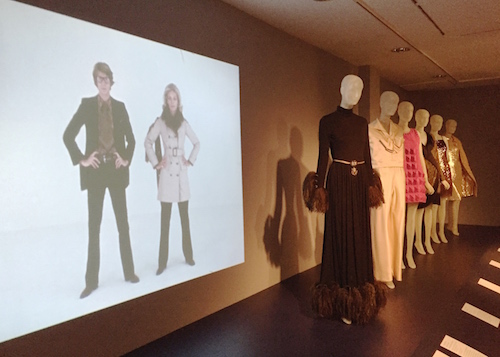
On to the clothes: The narrow gallery displays a hot pink Norell coat from Sex and The Single Girl, but the focal point of the show is in the back room — an array of frocks custom-fit for Bacall from the leading Sixties designers as part of a 1968 CBS special, Bacall and The Boys.

The wall-size projection shows Bacall modeling the outfits you’ll see right in the gallery – looks from Yves Saint Laurent, Pierre Cardin, Mr. Ungaro, and Marc Bohan of Dior. All of the designers make appearances and clearly Ms. Bacall has an artist-muse connection with each of them.

The back wall features a silk Ungaro pantsuit with sleek dresses that became Ms. Bacall’s day-to-day “uniform” around town – most by Norell and Miss Dior. There’s also an iPad featuring close-ups of outfits that don’t appear in this capsule show (but do appear in the FIT show downstairs on Halston and YSL).

1968 CBS special Bacall and The Boys showing Yves Saint-Laurent with Lauren Bacall. Nearby are ensembles and dresses by Marc Bohan of Dior, Cardin, Norell, YSL, and Ungaro.

1968 CBS special Bacall and The Boys showing Yves Saint-Laurent with Lauren Bacall. Nearby are ensembles and dresses by Marc Bohan of Dior, Cardin, Norell, YSL, and Ungaro.

As always, the students have provided some digital punch to the show on line: Click through the FIT timeline, loaded with great 1960s-style fashion illustrations.

See what’s on the iPad by clicking here and enjoy looks from Ms. Bacall’s closet by Ossie Clark, Halston, YSL, Norell, Chanel, and Pucci.

For more of Lauren’s looks, visit the exhibition website, FIT’s Flickr website and our own Flickr site.

Norell’s 1956 “Subway” cashmere silk ensemble.

Norell’s 1956 “Subway” cashmere silk ensemble.

Killer Heels as Art in Brooklyn

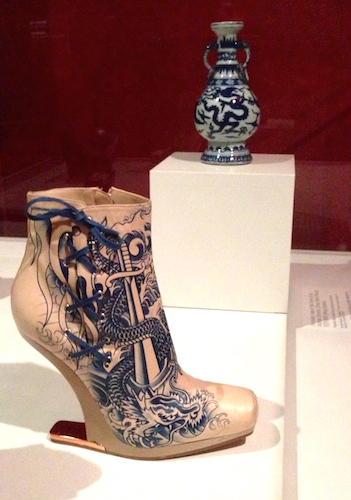
Gaultier’s 2012 Nude Tattoo Boot displayed next to its inspiration, a Chinese porcelain Ming vase (1573-1619)

Gaultier’s 2012 Nude Tattoo Boot displayed next to its inspiration, a Chinese porcelain Ming vase (1573-1619)

The hottest show in New York right now is Killer Heels: The Art of the High-Heeled Shoe, a curatorial masterwork that the Brooklyn Museum has decided to extend through March 1.

As soon as you enter the first-floor gallery, you’ll encounter Zach Gold’s mesmerizing Spike video, a wall-sized video extravaganza of high fashion, high glamour, and high heels. Why rush into the first room of the exhibition when your eye is trying process all the lush details? This digital kaleidoscope genuinely sets the tone for what lies ahead – an historical mash-up of style, fashion, and design all seen through the lens of ladies’ shoes.

What an eyeful – carefully composed vitrines where you can behold golden Baroque curliques on Prada platforms, 1920s evening shoes, and a 19th century gilded table. What about silver-and-pearl Chanel boots whose heels mimic the 1890s Gorham candlestick right next to them? Or the red-hot strappy Miu Miu shoes whose ornament is identical to the handles on a 18th-century Wedgewood ice cream cup? Check out our Flickr feed to see some of our favorites.

2008 Heels by Miu Miu next to a Wedgewood ice cream cup and saucer (1790-1800)

2008 Heels by Miu Miu next to a Wedgewood ice cream cup and saucer (1790-1800)

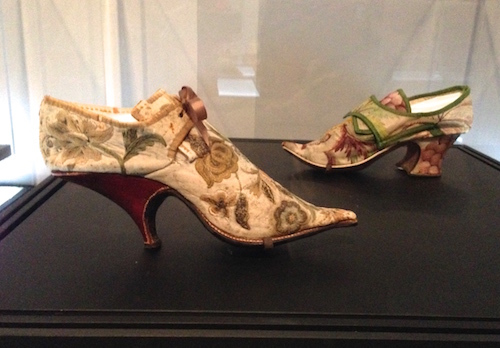
Everywhere you look, there are delightful juxtapositions across time, culture, and material – embellished pointy-toed heels from the 1690s, iron-and-leather pallets that boosted the feet of ladies above the muck of 18th-century city streets, and sky-high mother-of-pearl-inlay stilt shoes that Syrian beauties sported in the Twenties. It’s interesting that the latter are displayed in proximity to those dangerous purple Vivienne Westwood gillies that gave Naomi Campbell such problems on the runway.

Nothing’s chronological. It’s all designed to unfold in your mind by pinging unexpected references and associations – designer shoes next to concoctions from another place and time, fantastical embellishments, and streamlined perfection.

Fashionable, embellished pointy-toed 1690 French and 1720 British heels

Fashionable, embellished pointy-toed 1690 French and 1720 British heels

Provocative, room-sized videos commissioned for this show and small historical films only heighten the pizzazz. Check out Edison’s 1903 short, The Gay Shoe Clerk, or snippets from Sophia Coppola’s Marie Antoinette or other Hollywood classics. Don’t miss Eve A.D. 2000, shot in 1939 to predict what fashions and footwear of the future would look like. You’ll have fun evaluating whether those Thirties visionaries got it right.

There’s simply too much to describe – glass slippers by Georgina Goodman, political-statement heels, shoes that seem to take Metamorphoses at its word, and architectural-engineering wonders. Go see for yourself. You’ll find shoes by Ford, Ferragamo, Prada, Gaultier, and unknown Italian, French, and British craftsmen of long ago.
Watch curator Lisa Small’s video but make the trip out to Brooklyn to immerse yourself in one of the best adventures of the season:

Sending a Message by Dressing in Black

Dramatic 1861 British mourning attire in black silk moiré.

Dramatic 1861 British mourning attire in black silk moiré.

When the curators at the Metropolitan Museum of Art were researching collections for last year’s Impressionism-fashion show, they noticed something curious – a disproportionate number of luxurious 19th century American dresses in black. The black silhouettes found in the Costume Institute’s collection formed the basis for their first fall exhibition in seven years, Death Becomes Her: A Century of Mourning Attire, closing this weekend.

The show is a sumptuous walk-through of the years spanning the 1840s to the early 20th century, when fashionable women telegraphed their status as widows, paid tribute to fallen heroes, and acknowledged the passing of a member of the British royal family through dress, hats, parasols, rings, brooches, and other purchases. Click here to see our Flickr feed, and here for the Met’s own gallery views.

1868 wedding ensemble designed by West Virginia bride to honor casualties of the Civil War

1868 wedding ensemble designed by West Virginia bride to honor casualties of the Civil War

Fashion became such a rich language that the women in the 19th century felt “forced” to conform, according to associate curator Jessica Regan. It was an expensive proposition, and during the hard times of the American Civil War, many women stopped worrying about what others might think if they didn’t conform. If you didn’t have the cash to commission a new frock, it seemed to be OK just to dye an old one black.

As fashion magazines and periodicals became ubiquitous, middle-class and elite-status women eagerly sought styles that telegraphed sorrow while maintaining an up-to-the-minute silhouette.

Men of the 19th century were essentially wearing all-black suits, so the show’s focus is squarely on the ladies and the complex codes of mourning-attire etiquette. For example, after a sufficient period of time, a woman could introduce a bit of grey into her wardrobe, then mauve.

1894-1896 half-mourning dress purchased at James McCreery at 180 Broadway,when machine sewing was more common

1894-1896 half-mourning dress purchased at James McCreery at 180 Broadway,when machine sewing was more common

The team has assembled stunning examples of each from local collections (the now in-house Brooklyn collection, New-York Historical Society, and the Museum of the City of New York) as well as from the V&A’s collection in London. The most dramatic all-black look is the sweeping silk moiré gown from 1861 Britain. Perhaps the most startling is the 1868 a all-black bridal gown designed for a West Virginia bride who chose to pay tribute to fallen Civil War soldiers on her happy day.

Boutiques within department stores catered to mourning clothes buyers. Entire warehouses were filled to the brim with essential accouterments for the correct “look”. By the 1860s, mass-production of fabric increased the accessibility of the raw materials. A few decades later, heavy fabrics fell out of fashion in favor of lighter weight, more flowing options.

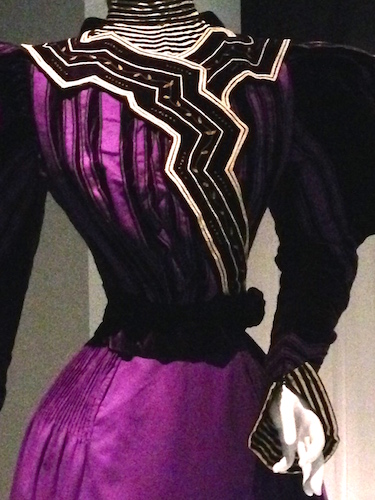
The 1890s fashions feature the best from New York department stores, including a mourning dress emblazoned with a bold geometric design.

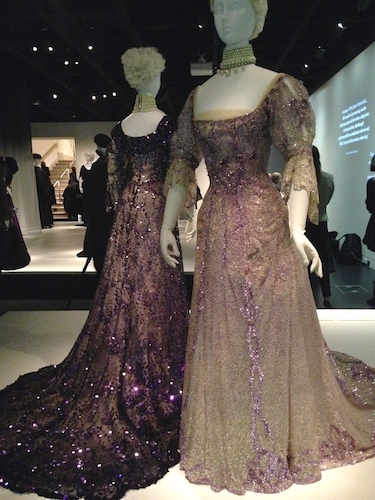
1902 dresses worn by Queen Alexandra to mourn Queen Victoria’s death. French tulle, chiffon, and sequins.

1902 dresses worn by Queen Alexandra to mourn Queen Victoria’s death. French tulle, chiffon, and sequins.

A conservative black dress worn by Queen Victoria stands in stark contrast to the sparkly mauve gowns worn in tribute to her by Queen Alexandra – exquisite and subtle, but not really subdued. The spotlights emphasize the delicate pizzazz of these French confections.

By 1910, wearing all black became fashionable, decoupling the color from its sorrowful past. The show concludes by noting that World War I essentially brought an end to mourning-attire traditions and fashions in Europe.

Enjoy this lecture by associate curator Jessica Regan here, posted on the exhibition home page.

Next up at the Costume Institute, Spring 2015: Chinese Whispers: Tales of the East in Art, Film and Fashion. Get out your cheongsams.

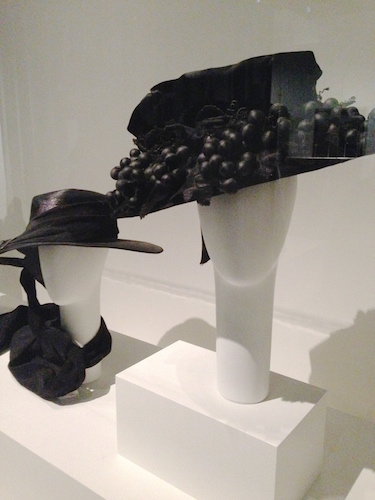
1915 Mme. Boué-Debat mourning hat with silk grapes from Brooklyn Museum collection at the Met

1915 Mme. Boué-Debat mourning hat with silk grapes from Brooklyn Museum collection at the Met