African Art – 20th-c Modern Master Collectables

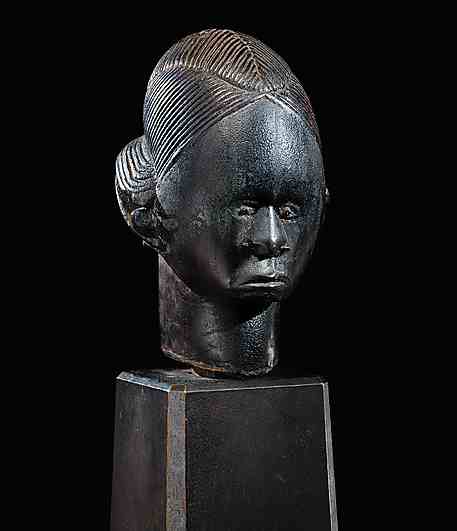
Sculptural Element from a Reliquary Ensemble: Head. The first African sculpture to be exhibited with modern masters in NY at Robert Coady’s Washington Square Gallery. This pre-1914 wood sculpture is from Gabon. Source: Curtis Galleries, Inc.

The first African sculpture to be exhibited with modern masters in NY at Coady’s Washington Square Gallery in 1914. From Gabon. Source: Curtis Galleries, Inc.

The show closing at the Metropolitan Museum of Art this weekend, African Art, New York, and the Avant-Garde, is a love letter to the advent of modernist art in New York 100 years ago. In the early 1900s, artists like Picasso and Matisse began looking more closely at the exotic shapes and forms pouring out of Gabon and Cote d’Ivoire – the primary sources of wooden African statuary at the time in Europe.

The Armory Show in 1913, rocked New York, where crowds viewed disruptive cubist works by Picasso, Duchamp, and Braque. Although the edgy work startled New Yorkers and the press, American modern artists and connoisseurs went crazy for African art because it looked so “modern”.

Sensing an opportunity, Stieglitz sent his friend, Marius de Zayas, to Europe to bring back more. Good thing, since Europe was soon at war and the global art scene shifted to New York. Stieglitz’s 291 Gallery and the Washington Square Gallery in the Village became leaders of the new trend, mounting a series of shows. De Zayas had to push Stieglitz to mix African art with Picasso, and it worked. One critic looked and said, “Here are the fathers of Gaugin, Matisse, and Picasso!”
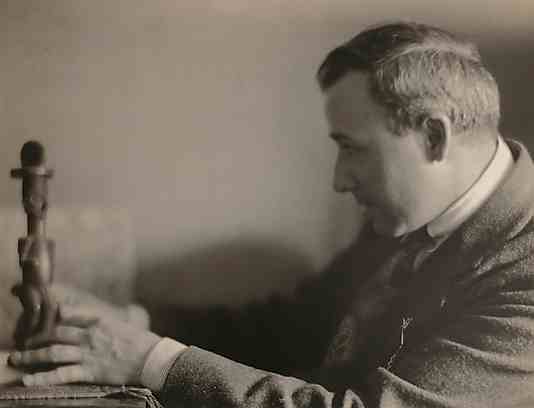
Clara Sipprell’s 1916 Portrait of Max Weber, where the artist holds a wooden figure from the Democratic Republic of the Congo. He bought it in 1906, the first African sculpture to be brought back to the City by a New York art-lover. Source: Museum of Fine Arts, Boston.

Clara Sipprell’s 1916 Portrait of Max Weber, where the artist holds a wooden figure from the Democratic Republic of the Congo. He bought it in 1906, the first African sculpture to be brought back to the City by a New York art-lover. Source: Museum of Fine Arts, Boston.

This show is special because the curators really went all out – huge photo-murals of the ground-breaking shows, the actual works you see in the photos, and photos of same from the magazines and newspapers of the day. It’s an art-history, primitive art, and modernist master trifecta.

Visitors feel like they’re stepping right into 291 itself, seeing mash-ups of African art, nature objects, and European cubist works. Poking through the vitrines, you’ll see works appearing in New York for the first time since 1914, gorgeous Sheeler photos of early exhibitions, and lots of work collected by Mr. Schamberg (for whom NYPL’s Harlem library/collection/study center is named).
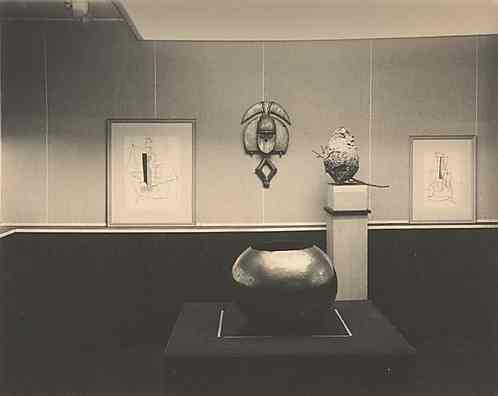
Stieglitz’s Picasso and Braque show at 291 Gallery (Dec 1914-Jan 1915). This features a Kota reliquary statue hung as art, like the fine Picasso nearby, a brass bowl, and a wasp nest. Source: Stieglitz photo from The Met.

Stieglitz’s Picasso and Braque show at 291 Gallery (Dec 1914-Jan 1915). This features a Kota reliquary statue hung as art, like the fine Picasso nearby, a brass bowl, and a wasp nest. Source: Stieglitz photo from The Met.

Since Georgia O’Keefe gave Mr. Stieglitz’s entire collection to the Met, the show packs in many surprises — his African works, his Matisse and Rivera paintings, and issues of Camera Work. There are key pieces from the Smithsonian’s National Museum of African Art and loans from Philadelphia’s Arnesberg collection.

In 1923, the Brooklyn Museum was the first museum in the West to show African art as “art” (versus “anthropology”), Penn was the first museum to actively collect it, and we all know what Mr. Barnes did when he displayed his magnificent modernist collection.

Check out all the objects in this amazing exhibition, but walk through the show in person if you can.

If you have some time, sit in on the curator’s talk via YouTube. Around 33:00 they start talking about the works in the show with a nice split screen that shows the speakers and the slides, so skip ahead and take a provocative, virtual tour.

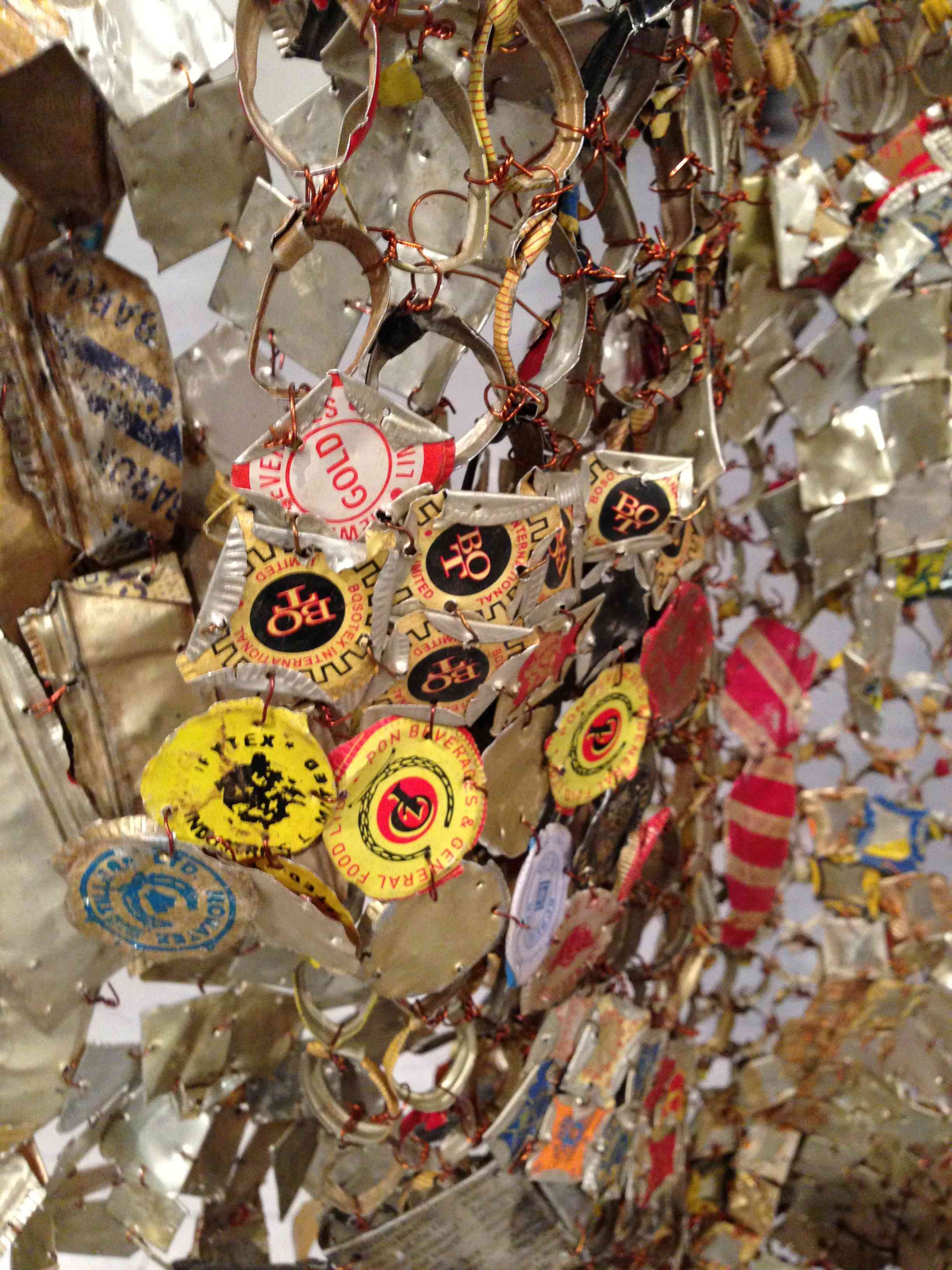
Shimmering Curtains of Liquor-Bottle Caps Hung in Brooklyn

Installation view in the Iris and B. Gerald Cantor Gallery on the Fifth Floor. Brooklyn Museum photo: JongHeon Martin Kim.

Installation view in the Iris and B. Gerald Cantor Gallery on the Fifth Floor. Brooklyn Museum photo: JongHeon Martin Kim.

They’re big, they’re from Africa, they’re hung in one of the most spectacular art spaces in the City, and you need to see them before August 18. If you’re going out to Brooklyn to see the Sargent show, be sure to see the spectacular contemporary installation, Gravity and Grace: Monumental Works by El Anatsui.

The one-man retrospective of London-trained Ghanaian artist El Anatsui (his first) takes up half of the Brooklyn Museum’s Fifth Floor, but really shines under the skylight in the Iris and B. Gerald Gallery.

DetailYou might have seen his large piece hung in the African gallery on the First Floor of the Met or his installation in the 20s on the High Line, but in Brooklyn you’ll see 30 big, shimmering pieces arranged on walls and suspended under the dome. They’re all made out of scrounged metal material and wire from garbage dumps near his home, but the experience of seeing these big, beautiful pieces could not feel further from the source.

Hung from the ceiling, the metal-and-wire pieces look like open-weave textiles fabricated on a grand scale. Visitors wander through Anatsui’s hangings, silently gazing, stepping up to look close, and then move further back to wonder how he creates such a lightweight, effortless illusion from years of collected, flattened, punched bottle caps and stuff.

Earth's SkinTwo more galleries feature other large-scale works, arranged and pinned on walls, bunched like beautiful fabrics. Anatsui creates his gigantic constructions, carefully sorting the different colors of metal from the various brands of beverages. He says it’s like doing a watercolor wash, and when you view the work in person, you’ll be stunned by the variety of color, pattern, and lovingly arranged metal tapestries.

Here’s a time-lapse video of the Brooklyn crew installing the show, initially mounted at the Akron Art Museum. Anatsui says that he enjoys giving installation crews and curators a lot of leeway in how they hang his work, and he was a little surprised (in a good way) about some of the choices by the crew in Brooklyn. See for yourself. The big, shiny silver sculptures snaking across the floor are made of milk tin lids.

Brooklyn Museum Reveals Sargent’s Master Strokes

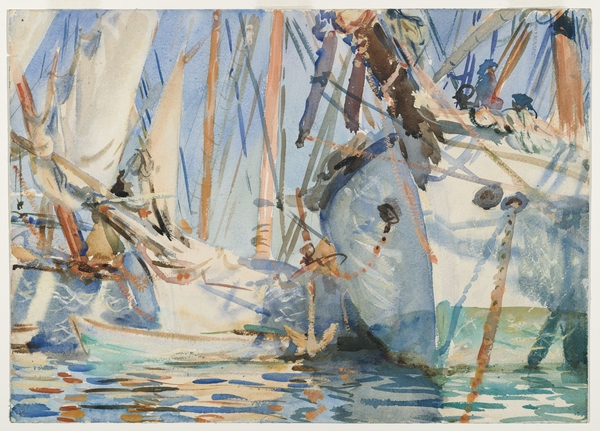
Sargent’s masterful 1908 White Ships. Translucent and opaque watercolor and wax resist with graphite underdrawing, Source: Brooklyn Museum.

Sargent’s masterful 1908 White Ships that he likely painted in a day. Translucent and opaque watercolor and wax resist with graphite underdrawing, Source: Brooklyn Museum.

Back in 1909, John Singer Sargent’s watercolor show at Knoedler was considered a knockout, drawing discerning crowds in awe of his sensational technique. The images of Bedouin life, Venice, and boats on the Mediterranean were so compelling that the Brooklyn Museum raced in to buy 83 (nearly all of them), forcing Boston’s Museum of Fine Arts to wait until 1912, when they could clean out his entire next watercolor show.

Bedouins

Bedouins (c.1905–6). Opaque and translucent watercolor, Source: Brooklyn Museum.

Walking into John Singer Sargent Watercolor on Brooklyn’s Fourth Floor, you can see why the two great institutions went crazy. With 93 of their finest Sargent purchases collectively displayed, it’s impossible for visitors to pick the most spectacular. They’re all exceptional – the Bedouin horses at rest inside the tent, Sargent’s niece wrapped in her cashmere shawl, the cliffs of the Carrara quarries, and the lush Medici gardens.

How did he make such magnificent work with such an unforgiving medium? How did he whip them out? The two museums asked a team of conservators and curators to put the works under the microscope and ultraviolet light to discern more about the master’s process – the sequence of paint application, the types of paint used, and whether he did a pencil sketch before applying paint to paper.

The team gives visitors insights to the scientific process used — an unusual twist at the back of the gallery that visitors poured through enthusiastically. Brooklyn’s digital team installed a 30-second video in which paper conservator Toni Owen asks visitors what more they’d like to know. Here’s the site where she answers with comments on Sargent’s use of gouache, soft-wax resist, yellow paints, and the difficulties of explaining false-color infrared imaging (FCIR) in limited-space wall text in the gallery.

Carrara: A Quarry (1911). Translucent and opaque watercolor and wax resist with graphite underdrawing, Photo: © 2013 Museum of Fine Arts, Boston

Carrara: A Quarry (1911). Translucent and opaque watercolor and wax resist with graphite underdrawing, Photo: © 2013 Museum of Fine Arts, Boston

You’ll learn that Mr. Sargent painted very fast, did not rely on photographs, and did at least one watercolor sitting in a gondola.

Brooklyn’s integrating much more media into its visual art shows, and they’ve hit upon a winning combination here. Some videos show the gardens that were the subjects of Sargent’s work in Italy. Others explain the techniques that Sargent used in the painting next to it.

Listen as artist Monika deVries Gohlke reflects on the type of day Mr. Sargent might have experienced working on his 1908 Melon Boat painting. Watch as she prepares the watercolors, selects his colors, chooses his brushes, and attempts to recreate his “jungle” of shapes and impressions. Does her painting look like his? You be the judge and go get your own paintbox.

War Ends at NY Historical

Welcome to New YorkJoin the crowds for two more days to pay tribute to NYC’s Greatest Generation at the revealing, reflective exhibition, WWII & NYC created by the New-York Historical Society. If you can’t get there in person, take a look at the synopsis here, but in the galleries there are surprises at every turn. The slideshow gives you a glimpse.

Right inside, you’ll find a line-up of people checking out a portion of the actual 1938 Cyclotron, a kind-of atom smasher that physicists at Columbia University were using confirm nuclear fission. It’s also surprising to see an interactive map of where “The Manhattan Project” was actually located in Manhattan. At Fifth Avenue and 29th Street, the Army had 300 people on the 22nd Floor of 261 Fifth sourcing materials for the first atom bomb. Other teams were working in the Woolworth Building and at 270 Broadway.

People also cluster around the interactive map of New York’s harbor, which explains how all those interesting-looking, now quiet big buildings, forts, and warehouses along the shore were once alive with 3.3 million active duty service men and women headed for Europe and North Africa. Take this video tour and see it then and now:

And the show would not be complete without a in-depth look at the activities of the Brooklyn Navy Yard and the rise of Rosie the Riveter. Watch this video to experience what it was like from a woman who lived it:

The show includes stories about how Tito Puente, Jacob Lawrence, filmmaker Francis Lee, MoMA, the Metropolitan Museum of Art, Maiden Form, Nabisco, and countless other New York people and companies joined in to the war effort. Check out additional videos expertly produced by NYHS on line. You’ll never look at these City streets or harbor the same way again.

If You Love Brooklyn, Get to GO!

Installation view of Yeon Ji Yoo’s The Fight (2012), made of paper, paper pulp, acetate, glue, packing tape, cheesecloth, plastic flowers, recycled plastic bottles and bags

Installation view of Yeon Ji Yoo’s The Fight (2012), made of paper, paper pulp, acetate, glue, packing tape, cheesecloth, plastic flowers, recycled plastic bottles and bags

Tucked away in the Mezzanine Gallery on the second floor at the Brooklyn Museum is a valentine to the borough, its artists, and the support and love they received last September in Go: A Community-Curated Open Studio Project. It mixed trudging around Brooklyn, democracy in action, and high-tech to peer into other worlds right in our own backyard.

The museum commissioned an app, asked artists to open their studios, and invited the world to visit and vote for their favorites. (Apparently, it was inspired by an art competition organized out of Grand Rapids!)

GO tracked the art makers and art seekers – take a look at the “weekend activity heatmap” and the other GPS-gathered stats. The results showed a lot of love – 18,000 visitors making 147,000 studio visits to about 1,700 artists over a two-day period, or about eight studio visits per participant. See the raw data for yourself, broken out by neighborhood. Learn a bit more about the voters here.

Art lovers nominated 9,457 artists for a museum showing, and eventually voting and curators whittled it down to five spectacular representatives. Interestingly, four on display were born outside the United States.

Yeon Ji Yoo of South Korea, currently lives in Greenpoint and works in Red Hook. The large installation piece in the show is inspired by her grandmother’s fading memory. Listen as she talks about growing up in South Korea’s rural countryside:

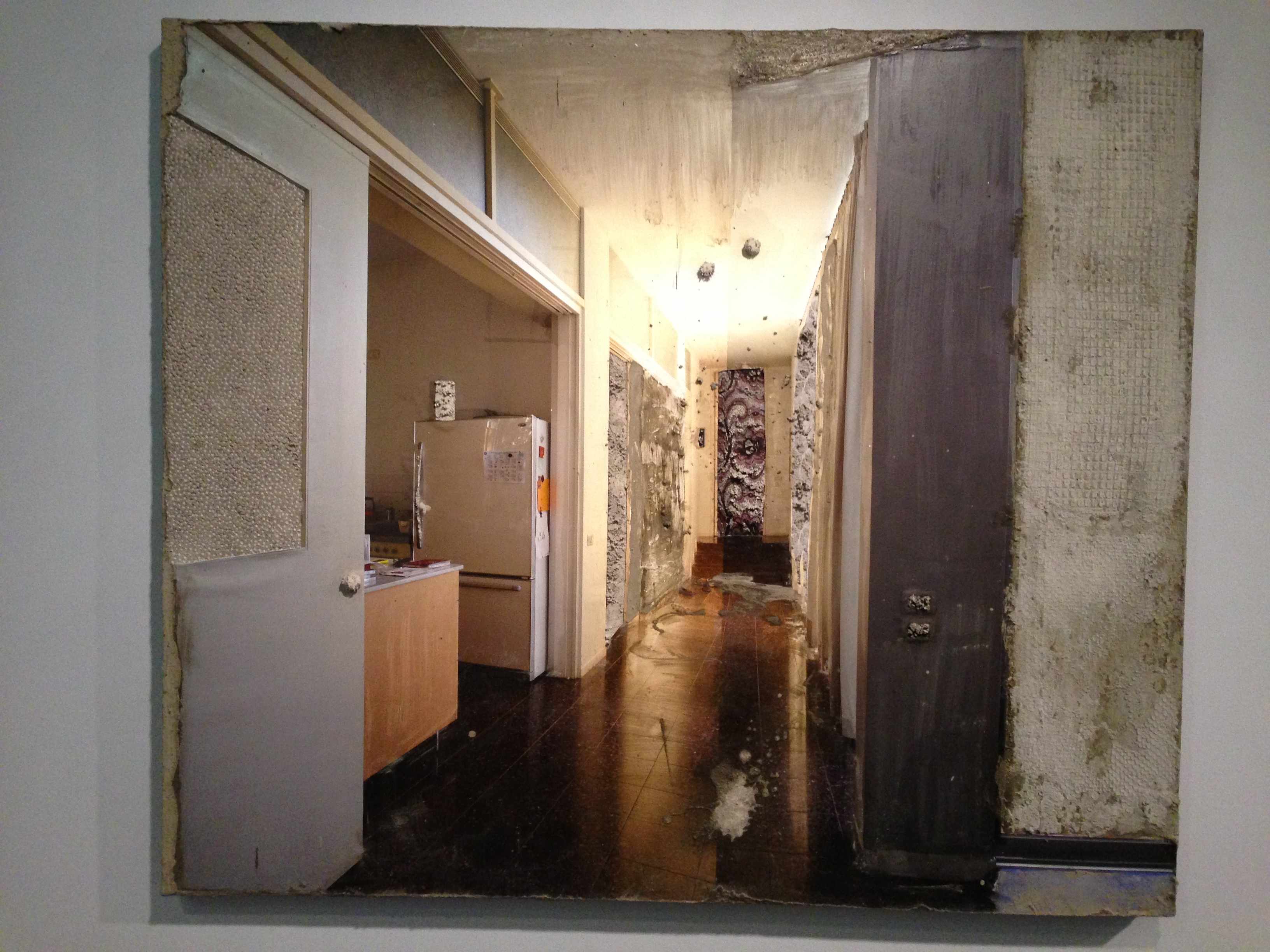
Installation view of Naomi Safran-Hon’s Home Invasion (2011). Archival inkjet print, lace, and cement on canvas

Installation view of Naomi Safran-Hon’s Home Invasion (2011). Archival inkjet print, lace, and cement on canvas

Naomi Safran Hon (of Prospect Heights) prints photographs of her hometown of Haifa, Israel on canvas; makes some cuts in the image; and pushes cement through lace to make a 3-D effect. She feels she’s working out the push/pull of the political and domestic realities of where she grew up. But let her tell you:

Meet the other artists, too: urban watercolorist Adrian Coleman, and painters Oliver Jeffers, and Gabrielle Watson. But if you really love Brooklyn, get over to experience the work in person, and add your comments. The museum’s open late on Thursday.

Meet The Building You Didn’t Know at NYHS

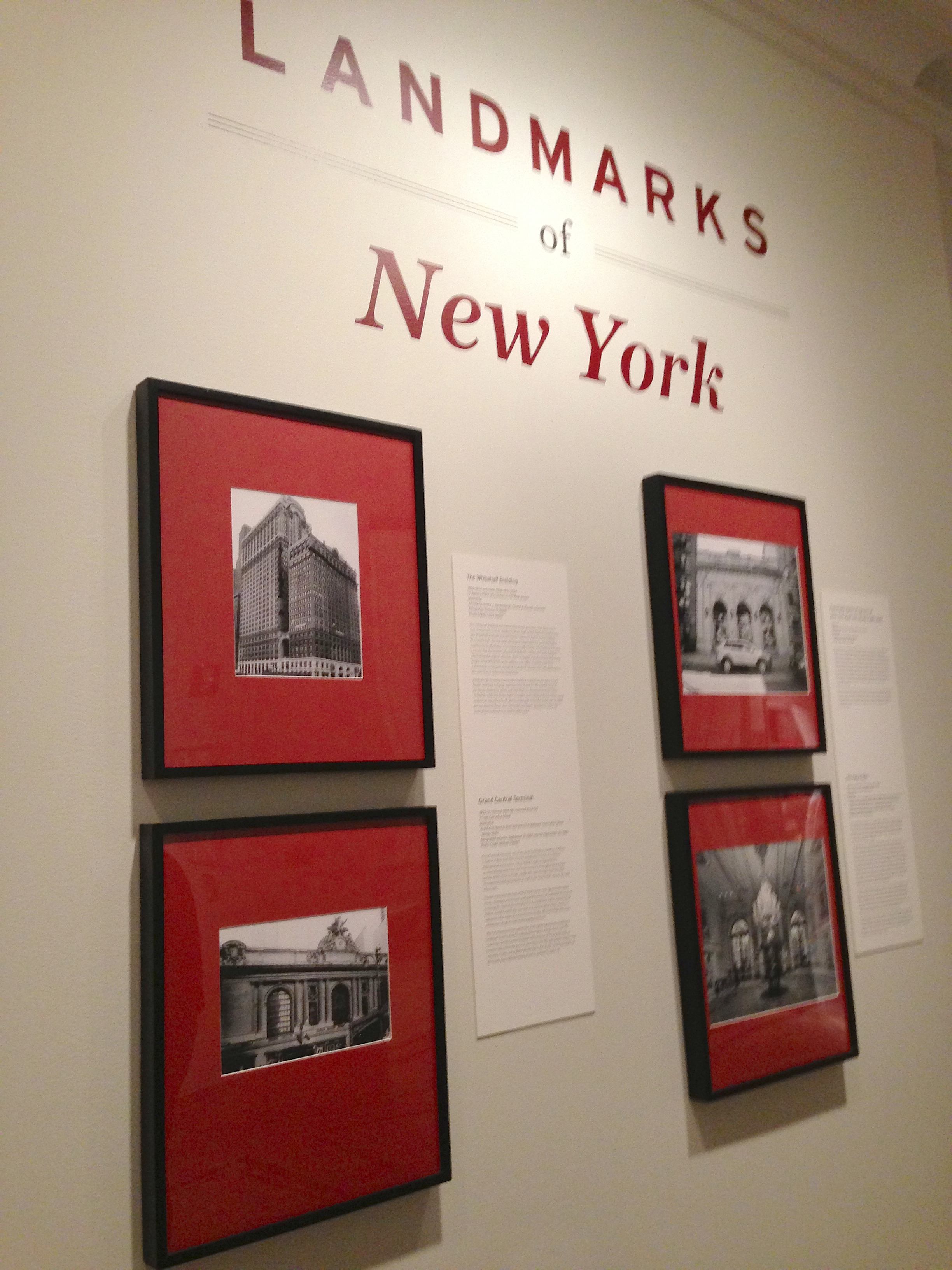
Installation view featuring photos of the Whitehall Building (17 Battery Place), Grand Central Terminal, the Free Public Baths (538 East 11th), and the interior of the Plaza Hotel

Installation view featuring photos of the Whitehall Building (17 Battery Place), Grand Central Terminal, the Free Public Baths (538 East 11th), and the interior of the Plaza Hotel

In one of the most deceptively simple installations at the New-York Historical Society, visitors can’t stop looking, reading, absorbing, talking, and pointing.  The Landmarks of New York show was humming all last weekend, with exhibition goers moving up and down the staid second-floor hallway, quietly moving from photo to photo learning stuff about buildings they’ve seen a million times.

Did you ever think the entire history of New York could be told in 90 identically framed photographs? Take a look at a few of the 1,287 landmarked buildings in NYC. Since the NYHS web site does not contain any of these buildings’ compelling stories, run up to their second floor before the show closes.

The show pays tribute the 1965 Landmarks Law and resulting Landmarks Commission, established in the wake of the greatest architectural disaster in the history of the modern City – the 1963 destruction of the historic Penn Station.  Today, 30,000 structures are protected, and the photos show you some of the exteriors, interiors, and scenic landmarks of our five boroughs.

Installation view of John Bowne House (1661) photo by Jeanne Hamilton

Installation view of John Bowne House (1661) photo by Jeanne Hamilton

Which are the oldest? The Wyckoff House, built sometime before 1641, at 5816 Clarendon Road, Brooklyn, and the oldest surviving home in Queens, the 1661 John Bowne House. The label copy says that Bowne had a huge flare-up with Peter Stuyvesant over his ban on the Quaker religion (actually, he was arrested), which led Bowne to lend his sliver of Flushing to regular meetings of the Quaker community.

Nothing in Manhattan even come close, although 1764 St. Paul’s Chapel is the oldest surviving church. Did you know it was modeled upon St. Martin-in-the-Fields on London’s Trafalgar Square?

This exhibit is packed with story after story of places you pass all the time. Charlie Parker’s Residence at 151 Avenue B is a landmark, partly because Charlie lived there between 1950-1954, but also because Franz Kline did, too.

Lucky for us, that the City has posted all of the Historic District Maps for each borough. Or go to the interactive city map and click on “Landmarks” to see what’s in your neighborhood. Who knew Greenpoint has the Eberhard Faber Pencil Company Historic District? Adventures await. Get to know a building.

Sparkle Plenty, Move Over Manet

Installation view of Mickalene Thomas's Les Dejeuner sur l’herb Les Trois Femmes Noires, 2010.

Installation view of Mickalene Thomas’s Les Dejeuner sur l’herb Les Trois Femmes Noires, 2010.

It’s large-scale, monumental painting of beautiful women languishing amidst patterned profusion, but it’s not Manet or Monet. Unlike MoMA’s modern masters, you’re encountering Afro-wearing, rhinestone-studded Black lovelies with an ambiance of the 1970s and Blaxploitation about them.

It’s all the work of Mickalene Thomas (originally from Camden, New Jersey, and now Brooklyn) in the grand show, Mickalene Thomas: Origin of the Universe, mounted first by the Santa Monica Museum of Art and now expanded by the Brooklyn Museum.

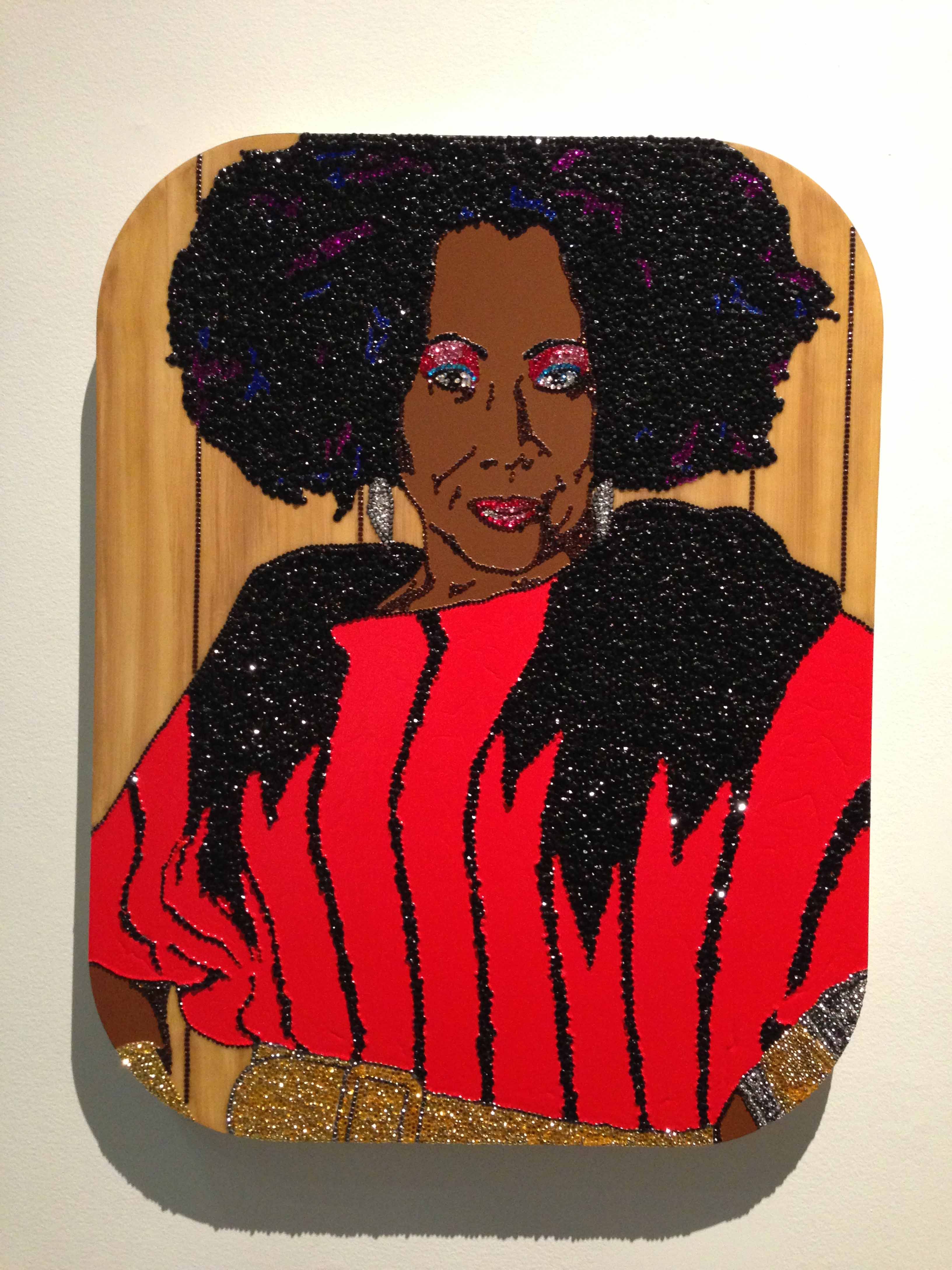
Thomas uses an encyclopedic knowledge of art history and museum-world references to tease viewers to reflect on how her fancy, sparkly ladies are equally worthy of fine-art treatment as any ruffed Dutch gal from the 1600s or French odalisque.

Installation view of part of Mickalene Thomas's depiction of her mother: "Ain’t I Woman, Sandra," 2009. Rhinestones, acrylic paint, and oil enamel on wood panel. DVD and framed monitor; rhinestones, acrylic paint, and enamel on wood.

Installation view of part of Mickalene Thomas’s depiction of her mother: Ain’t I Woman, Sandra, 2009. Rhinestones, acrylic paint, and oil enamel on wood panel. DVD and framed monitor; rhinestones, acrylic paint, and enamel on wood.

Enamored of slightly vintage interior decor magazines, Thomas constructs settings in her studio corner and photographs her subjects dressed in 70s prints laying on 70s sofas in wood-paneled rooms. Later she turns these into paintings merged with old photos, faux wood paneling, and Photoshop fracturing on a large scale. Check out the Flickr gallery.

On every visit, crowds gather in the back video gallery to hear her mother tell the story of how she changed her ways from a drug-addicted girl to a clean and sober, meditation-minded fine-art model for her brilliant, fantastically creative daughter. She’s a stunning model.

See these large-scale works in person this week. Otherwise, catch her work at ICA in Boston through April.

For more, listen in on this discussion between Mickalene Thomas and Carrie Mae Weems. It’s a great insight to how an established artist inspires an emerging artist to forget about law school and do great things in the art world.

Celebrity Lace at the Met

EuropeanLace_posterIt was all the rage 100 years ago – who could amass the best collection of antique lace owned by the rich and powerful, and what could you do with it to make a fashion statement?

The Met still has its Gems of European Lace micro-exhibit on display in a lower-level nook for a few more days, right outside of the Ratti Textile Center. (It’s down the stairs on the left side of the tiled medieval Gallery 304 on the first floor.)

The show blends astonishing craftsmanship with an object lesson in conspicuous consumption of the rich and famous of a century ago. It seems that in the late 1800s, wealthy American women tried to outdo one another with lace collections, vying for little masterpieces that might have been owned by European royalty.

Adolf de Meyer’s photo of Rita de Acosta Lydig in Harper’s Bazaar in 1917 (Source: The Met; gift of Mercedes de Acosta)

Adolf de Meyer’s photo of Rita de Acosta Lydig in Harper’s Bazaar in 1917 (Source: The Met; gift of Mercedes de Acosta)

One gem is the bobbin-made lace cravat end (featured above), allegedly commissioned by Austrian empress Maria Therese and later given to her daughter, Marie Antoinette. The Met cites this provenance, but will only say that it’s “maybe” true.

In the race by society ladies to amass the best lace collections, international lace-dealers made out like bandits. The frenzy only benefits us today, since so many patrons ultimately bequeathed their collections to the Metropolitan and the Brooklyn Museum.

By the early 20th century, the super-wealthy were also acquiring antique lace and asking for it to be refashioned into stylish haute couture. The example on display in Gems is a Callot Soers original made of 16th-century-style lace for the style icon Rita de Acosta Lydig, known for her celebrity-filled New York salons; lace-covered accessories and bedecked couture; and having her portraits done by Rodin, Sargent, and anyone who was anyone at the turn of the century.

Rita's 16th c. style lace remade by Callot Soers in the 1920s (Brooklyn Collection at the Met)

Rita’s 16th c. style lace remade by Callot Soers in the 1920s (Brooklyn Collection at the Met)

Check out the Met site for close-ups of masterworks of needle and bobbin.


Brooklyn Holiday Art Mash Up

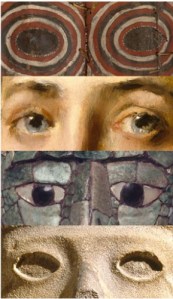
Details of four works in Connecting Cultures, from top: Korumbo Gable Painting, 20th century, unidentified Abelam artist; Girl in a Japanese Costume, circa 1890, William Merritt Chase; Mosaic Head Pendant, 700–800, unidentified Maya artist; and Life-Death Figure, circa 900–1250, unidentified Huastec artist.

Details of four featured works, from top: Korumbo Gable Painting, 20th c. by unidentified Abelam artist; Girl in a Japanese Costume, c. 1890, William Merritt Chase; Mosaic Head Pendant, 700–800, unidentified Maya artist; and Life-Death Figure, c. 900–1250, unidentified Huastec artist.

A big mix-up has happened on the First Floor of The Brooklyn Museum, but it’s OK. In fact, if you like rambling around the Brooklyn Flea, the Connecting Cultures: A World in Brooklyn exhibit is less congested but just as much fun.

The museum curators clearly enjoyed picking and choosing objects from their wide-ranging collections, and packing a gallery full of juxtapositions from different centuries, cultures, and countries. The designers made great use of the soaring space of the Great Hall, creating floor-to-ceiling murals, maps, and display shelves that provoke, delight, and mystify. Check out the museum’s Flickr photostream. As a visitor, you feel as though you’ve wandered in on a modern version of a Victorian-era World Exposition.

Gaston Lachaise’s modern Standing Woman bronze is installed near Nick Cave’s Soundsuit, Picasso’s cubist Woman in Gray portrait is hung next to Huntington’s classical portrait The Sketcher, and Ikea-clean wall grids house ornate pitchers from many cultures and time periods. Catch a glimpse of the variety in the installation views on Flickr, or peruse the objects in Brooklyn’s on-line database.

As an added bonus, the Museum has established both human and social-media feedback options for visitors. It’s nice to use the terminal to input comments on the show (posted on the exhibition site), but maybe it’s even nicer to have staff members positioned inside the exhibit to chat, answer questions, and elicit your comments.

The installation is reflected in Pistoletto’s Standing Man, Standing Woman with Hat, a 1980 silkscreen on stainless steel.

Installation as reflected in Pistoletto’s Standing Man, Standing Woman with Hat, 1980 silkscreen on stainless steel.

The Museum has been collecting since 1823, and there’s both an on-line chronology and a pictorial history slightly hidden away inside the show.

Upcoming and news flash: Brooklyn Museum is going to continue it’s Target First Saturday tradition into the New Year (next on January 5), but for the time being, it’s cancelling the dance party portion of the festivities. Get there for the rest of the night.