
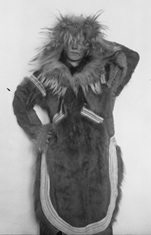
Striking a pose in an “Eskimo” hide, fur, and sinew coat in 1916. Source: AMNH
What if you took a group of young designers to a major NYC museum, threw open the doors to one of the largest textile and costume collections in the country, let them try on furs and dresses in the archives, seek inspiration, sketch, and create something that a major retailer could sell to a fashion-forward buyer?
It’s hard to imagine that FIT or the Met’s Costume Institute would ever agree to this (even under Tim Gunn’s watchful eye), but it’s exactly what happened in 1915 when a “fashion staff” inside the Anthropology Department of the American Museum of Natural History encouraged American designers and manufacturers to probe the AMNH collections to view the images, patterns, textiles, embroidery, beadwork, furs, and clothing of indigenous Great Plains, Mesoamerica, and the Andes people.
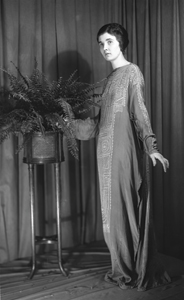
Mary Tannahill batik dress inspired by South Sea Island Art. 1919. Photo: Julius Kirschner. Source: AMNH
The Bard Graduate Center has seized upon this heretofore unknown fragment of museum and NYC history to create its own mind-bending reality show, An American Style: Global Sources for New York Textile and Fashion Design, 1915-1928, that weaves together fashion, industrial, museum, and scientific plot lines. Take this journey in person before February 2 or via the excellent digital site that BGC Digital Media has created.
In the wake of the 1913 Armory Show, three AMNH anthropology curators (Clark Wissler, Herbert J. Spinden, and Charles W. Mead) and one of Fairchild’s Women’s Wear journalists, M.D.C. Crawford, (who also held a Research Associate position at the museum) got a bee in their collective bonnet about leveraging AMNH’s extensive textile collection to convince designers that native Americas design could offer as much inspiration as Europe or primitive art from Africa.

M. D. C. Crawford, co-founder of the Costume Institute, with artist-designer Ilonka Karasz (1916-1919) Courtesy: Brooklyn Museum Archives.
After the top brass from H.R. Mallison & Co. began visiting AMNH’s Peruvian textile collections for inspiration on how to improve their silk fabric line, it wasn’t long before other business managers, designers, and mill experts were delightedly poking around behind the scenes, too. Why look to William Morris arts-and-crafts style from Europe, when you can offer something “American” to the consumer? Didn’t Aztec, Hopi, Cherokee, or Mesoamerican culture have something to offer? Soon, Wanamakers was hosting in-store displays of Mayan textiles and out-of-town retailers were heading uptown to the AMNH collections on their NYC buying trips.
Bard has plucked many of the inspirational items from the AMNH collections for this show (like the stunning Koryak dancing coat and another embellished waterproof topper made entirely of embroidered and appliqued salmon skin), adding samples of the fabrics they inspired, gorgeous dresses with evocative trims and prints, design sketchbooks, multimedia interactives, and a fashion slide show — perhaps an hour’s worth of perusing inside their tiny fouth-floor Focus Gallery. It’s quite a story.
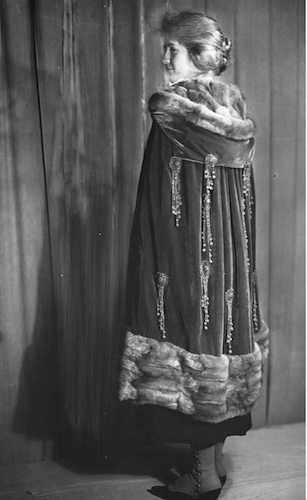
Max Meyer’s hooded evening coat, inspired by the AMNH Koryak coat. Source: AMNH
Crawford recounts the Museum’s foray into industrial-arts inspiration in two 1917/18 articles in The American Museum Journal, which you can read in the digital flipbook that Bard has on its website and inside the exhibition, which documents the original artifacts that inspired each retail look. (Check out our Flickr site to see some of the items you can find for yourself your next ramble through the AMNH second and third floors.)
Soon after, Stewart Culin opened the textile study room in the Brooklyn Museum, and by 1919, AMNH mounted the Exhibition of Industrial Art in Textiles and Costumes. Take a look at the silks, industrial embroidery display, tea gowns, and ultra-modern bohemian-style batik dresses on the Bard multimedia site. See silks inspired by Plains Indian war bonnets, gowns inspired by South Seas batik prints, and numerous other designers, stories, ethnic looks, photographs, and industrial wonders.
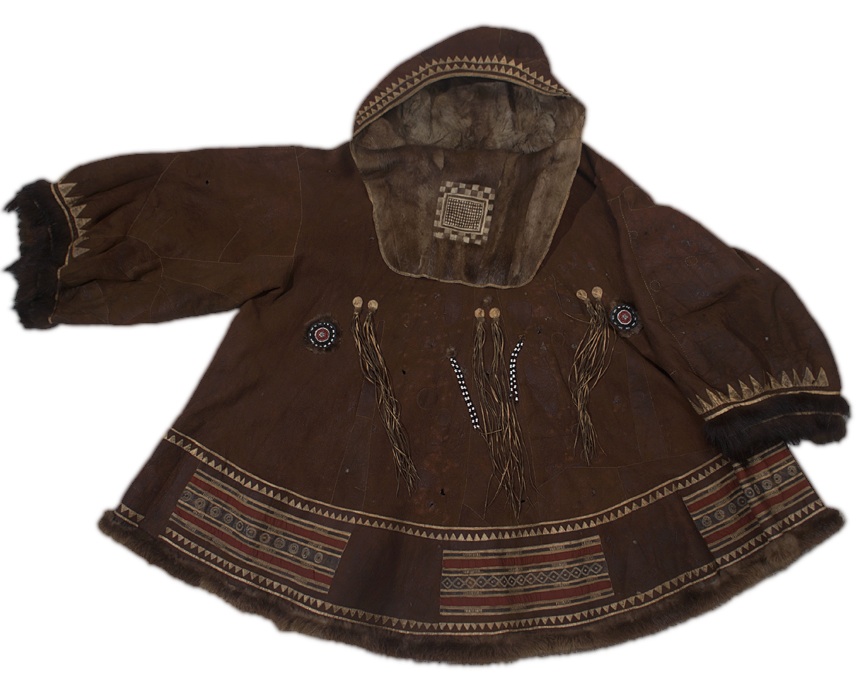
Koryak woman’s dancing coat from Kushka, Siberia; fur, hide, bead, cloth, sinew; acquired 1901 by AMNH.
It’s surprising to discover that so many really sharp fashion photos were buried deep within the AMNH photo archives. The digital images, originally on lantern slides, look like they were taken yesterday.
The curators say that the AMNH initiative withered a few years later when some of the staff left and Mr. Mead passed away. But this museum-fashion story didn’t really end there. Mr. Spinder went to the Brooklyn Museum and worked with John Sloan and Abby Rockefeller to elevate tribal art’s status in the fine-arts world. Mr. Crawford, who became Women’s Wear design editor, co-founded the Met’s Costume Institute in 1937 and was a key advocate within the Brooklyn Museum to establish its influential Design Lab, which debuted in 1948. (Hello, Charles James!)

Curator Clark Wissler with the AMNH Anthropology accessories wall.
Could anyone imagine how much those sparks flying 100 years ago among AMNH’s and Mr. Boas’s snowshoes, bows, baskets, headdresses, teepee covers, and 19th-century Siberian armor would ignite such bright lights in fashion way out in Brooklyn and across the Park?
Thanks for unearthing this fashion story, Bard.















 itsnewstoyou