Enlightenment through Gems

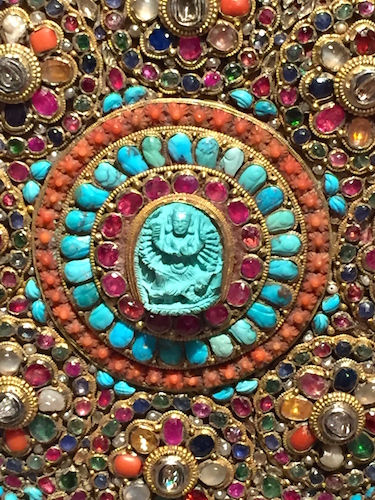
Center of 8-in. ritual offering dish made in 17th-18th c. Nepal

Turquoise Dhurga defeats a dragon in the center of 8-in. ritual offering dish (17th-18th c. Nepal)

It’s clear that wearing and giving precious (and semi-precious) gems can elevate the mind to higher levels of consciousness – at least in the minds of the Tibetan Buddhists – according to what you’ll see in Sacred Traditions of the Himalayas, running through this weekend at the Metropolitan Museum of Art.

The curators feature some remarkable statues, ritual dancewear, mandalas, and arms in the show, but let’s focus on the jewel-encrusted mosaics, containers, and jewelry displayed in the corner of the second-floor gallery, estimated to date from the 17th to 20th centuries.

Tibetan Buddhism emerged over the centuries in a dry, dusty, seemingly barren but beautiful region where people’s own adornment or bright flags atop mountain passes seem to be the only bursts of color. Inside homes, personal shrines, and monastery temples hang intricate, colorful mandalas pictorially suggesting the path to enlightenment, often symbolized by brightly adorned temples.

Mrs. Tsarong and two ladies from Tsang wearing special-occasion jewelry and hats as photographed by C. Suydam Cutting in 1937. Courtesy: Newark Museum collection

Mrs. Tsarong and two ladies from Tsang sport special-occasion jewelry and hats near Lhasa in 1937. Photo: C. Suydam Cutting. Courtesy: Newark Museum

These conceptual centers of enlightenment are often thought of as colorful crystal palaces emblazoned with jewels – an attractive image to hold in one’s mind on the lifelong journey to this higher plane of existence. What better way to remember your goal than to contemplate bedazzling diamonds, rubies, emeralds, sapphires, garnets, quartz, pearls, amber, coral, lapis lazuli, and turquoise?

To honor one’s journey to enlightenment, wealthy Tibetans often donated jewels to temples to adorn statues of the deities or commissioned personal devotional objects. That’s why you see so many jewel-encrusted objects in the Met’s collection. Personal shrines had jewel mosaics jam-packed with a dazzling array of stones. Gigantic statues were adorned with jewel-encrusted ornaments and surrounded by similarly elaborate containers for offerings.
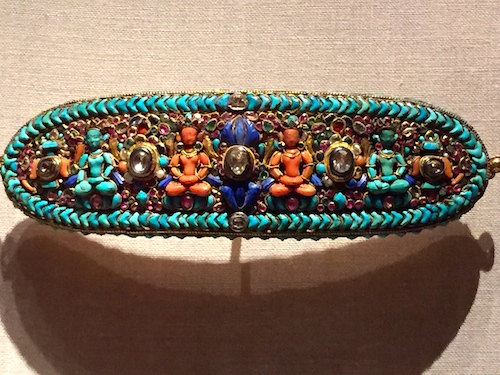
This Forehead Ornament for a Deity is only 8 inches long. Four celestial Buddhas are interspersed with diamonds

This Forehead Ornament for a Deity is only 8 inches long. Four celestial Buddhas are interspersed with diamonds

For special occasions, women sported accessories with amazing numbers of stones, reminding everyone of their social status, wealth, and devotion to an enlightened path.

Although some of the metal work was done in and around Lhasa, Tibet’s capital, the majority of the eye-popping jeweled settings were created across the border in Kathmandu, Nepal by Newari masters who created some of the most intricate visions in metal, wood, and paint ever known to the world. We’ve provided you with some close-up looks here and on our Flickr site. As shown, the result is a mix of Tibetan and Hindu imagery – typical of this region where so many cultural influences mix.

Densely packed diamonds, rubies, emeralds, sapphires, garnets, quartz, pearls, amber, coral, lapis, and turquoise in corner of Birth of the Buddha mosaic (18th-19th c. Nepal)

Densely packed diamonds, rubies, emeralds, sapphires, garnets, quartz, pearls, amber, coral, lapis, and turquoise in corner of Birth of the Buddha mosaic (18th-19th c. Nepal)

The Met’s own site for the objects in the show also allows you to zoom in on the details. Learn more about how the Met conserves such intricate jewel work in this blog post by an intern in the conservation department. See close-ups of how the Newaris set their gems.

Finally, explore Tibet as it was 100 years ago through this slideshow prepared for this show at the Met by the Newark Museum, which itself has a world-class collection of Tibetan objects and perhaps the largest collection of photographs of Tibetan people and temples from that time.

Plains Indians Wearable Art at The Met

1780 Plains Indian horned headdress assembled from a powerful mix of materials including bison horns, deer and horsehair, porcupine quills, glass beads, wood, metal cones, cotton cloth, silk ribbon, and paint. From the Musée du quai Branly in Paris

1780 Horned headdress assembled from a powerful mix from mighty bison , deer, and horse. From Musée du quai Branly in Paris.

With all the attention this week on the couture gowns at the Metropolitan Museum of Art ball and Costume Institute show, don’t forget that some of the most elaborately embellished mixed-media wearable art is installed on the second floor in the expansive tribute, The Plains Indians: Artists of Earth and Sky, through this weekend.

The masterworks have been gathered from select European and North American collections and feature beadwork (mostly on leather), symbolic headdresses, and magical objects that directly telegraph the wearer’s connection to nature, the universe, and supernatural power.

The show was organized by the Musée du quai Branly, Paris, in collaboration with The Met, and in partnership with The Nelson-Atkins Museum of Art, Kansas City, and features works from the 18th century through today (like the China exhibition in the other wing).

All-over beading on contemporary platform shoes by artist Jamie Okuma, 2014.

All-over beading on 2014 platform shoes by artist Jamie Okuma.

The curators track changes in materials, styles, and concerns of the Osage, Quapaw, Omaha, Crow, Cheyenne, Arapaho, Lakota, Blackfeet, Pawnee, Kiowa, Comanche, and Meskwaki nations from the time they dominated the Midwest through the demise of the buffalo, the great wars, the transition to reservation life, and participation in 21st century art and culture.

Take a read through the curators’ story on this exhibition site and see some of our favorite looks on our Flickr feed, where we’ve organized the pieces in chronological order. We’re giving you a close-up view of some of the bead, quill, and embroidery work. You can see the transition from more shamanistic embellishment to use of imported Venetian glass beads, to the all-over bead style, and finally to current creations, such as Jaime Okuma’s beaded platform shoes.

Central painting on large-scale Mythic Bird robe from the Illinois Confederacy, 1700-1740. Courtesy: Musée du quai Branly in Paris

Central painting on Mythic Bird robe, Illinois Confederacy, 1700-1740. Courtesy: Musée du quai Branly in Paris

Much of the painting and handwork was divided according to gender – men painted figures and women did the beadwork and painted the geometric forms. This beautiful robe with a geometric mythological bird is one of the earliest surviving large-scale paintings from Plains tribes, and the beaded geometry of the 1895 Crow wedding robe is another marvel.

Compare the mixed-media horned headdresses from 1780s Missouri with Chief Red Cloud’s dramatic all-business trophy-feathered war bonnet of 1865. The fluffy-feathered 1925 creation from Cody’s Buffalo Bill Center almost makes you wonder if that version were strictly for wild west shows.

It’s also interesting to learn that the powerful symbolic paintings on shirts and shields were essentially “owned” by their creators.

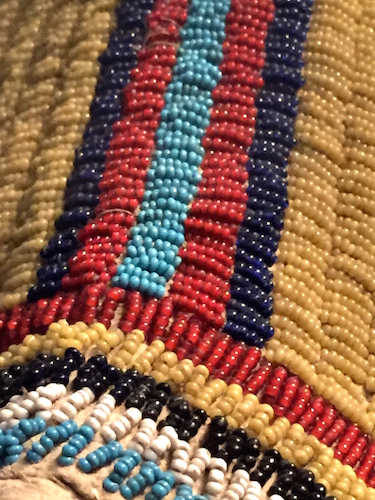
Close up of the tiny Venetian seed beads used to decorate a Lakota woman’s dress (Teton Sioux), 1865. From the Smithsonian’s NMAI

Tiny Venetian seed beads decorate a Lakota woman’s 1865 dress. From the Smithsonian’s NMAI

Similar to what we learned about 1920s French couture designers’ concerns about unlicensed copies in FIT’s recent Faking It show, anyone wanting to replicate a particular war shirt or shield, had to be granted formal permission. The Met exhibition explains that replication permission of Plains Indian designs were closely held and protected for generations.

A full database of the amazing objects in the show is on the Met’s website, as well as the complete audio guide to the exhibit on the museum’s Soundcloud site. As you click on the audio tracks, you’ll see a small thumbnail of the object.

Listen to curator Gaylord Torrence, explain how French culture and embroidery techniques collided with Plains Indians culture three hundred years ago to such magnificent result:


Reverent Ceramic Master Honored in NC

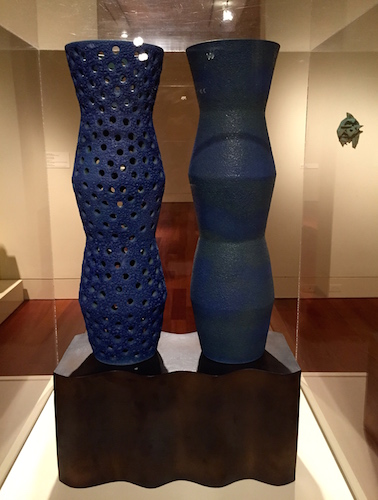
Hiroshi’s “Twin Vase”, a monumental 2002 stoneware sculpture with crawl glaze

Hiroshi’s Twin Vase, a monumental 2002 stoneware sculpture with crawl glaze

Known for a strong pottery tradition, North Carolina’s Cameron Art Museum is paying tribute to a Japanese ceramic expert in Hiroshi Sueyoshi: Master of Reverence through September 6.

As a young artist who apprentices with ceramic masters of 1960s Japan, he was advised by folk artist Shoji Hamada to see as much of the world as he could before he turned 25.

In the early 1970s, he came to Asheboro to help build a pottery, trained with Japanese ceramic-artist ex-pats, worked at Seagrove, and landed teaching jobs at several North Carolina colleges.

By the end of the decade, he relocated to Wilmington, teaching and serving as an artist-in-resident at the Museum.

Although the show features the full scope of Hiroshi’s work, it exhibits the work of the ceramic artists who influenced him. Works by Rita Duckworth, Isamu Noguchi, Peter Voulkos, and Shoji Hamada are shown side-by-side with his own, demonstrating the tradition upon which he draws.

Rock Garden, a 2014 interpretation of a Zen garden made with hand-built “rocks”. He wants the viewer to be conscious of their surroundings

Rock Garden, Hiroshi’s 2014 interpretation of a Zen garden made with hand-built “rocks”.

Landscapes, biomorphic shapes, streams, voids, spirals, crackled surfaces, and Zen gardens – you’ll see and feel it all as you slowly work through the galleries. Find power in Hiroshi’s simplicity and lots of detail upon closer inspection.

The sculptures echoes of the primitive power of Brancusi and installations evoke the meditative calm of the Rothko Chapel. The museum has even hung up some of the coverings that Hiroshi uses for his pottery tables on the wall in the back gallery. Their subtle dust-ground, worked surfaces feel like subtle, magical Twombly atmospheres. So, even Hiroshi’s work cloths feel like art.

If you can’t make it to see this beautiful work in Wilmington, take a stroll through our Flickr site.

Biomorphic 2009 wall sculpture Blossom. Stoneware with crater and crawl glaze. Courtesy: New Hanover Library

Biomorphic 2009 wall sculpture Blossom. Stoneware with crater and crawl glaze. Courtesy: New Hanover Library

Ennion: Luxury Tableware at The Met

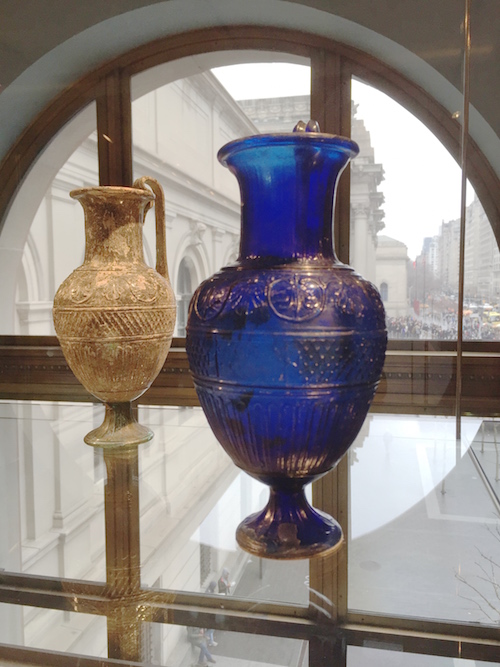
Two identical one-handled Ennion jugs from different sites. On right, the only Ennion piece with an intact foot, 1st c. A.D.

Two identical one-handled Ennion jugs from different sites. On right, the only Ennion piece with an intact foot, 1st c. A.D.

It’s unlikely that you have any of this sought-after designer’s pieces accompanying your best table setting or that the MAD Museum has any of his hand-blown, molded glassworks in their collection.

Two thousand years before ABC Carpet began retailing high-end home goods on Broadway and Martha Stewart branded her at-home lifestyle line, a Mediterranean craftsman in Sidon, Lebanon (then Phoenecia) created a line that every aspiring tastemaker in the Roman Empire just had to have. The Metropolitan Museum of Art pays tribute to his output in Ennion: Master of Roman Glass, on view just off the Greek-Roman study galleries through April 12.

Who needs old-fashioned metal cups or pottery jugs on the well-laid Roman table when Ennion was creating stunning cobalt-blue and transparent glass equivalents?

Two-handled cup, with Ennion’s Greek brand (“Ennion made this/it”). Blown glass into mold, 1st c. A.D. Courtesy: Turin museum; other by private collector

Two-handled cup, with Ennion’s Greek brand (“Ennion made this/it”). Blown glass into mold, 1st c. A.D. Courtesy: Turin museum; other by private collector

Ennion’s workshop was on the cutting edge of a manufacturing-and-craft revolution – blowing glass into decorative molds (which took the guesswork out of creating place settings for four, six, or ten) and exporting sets for sale throughout The Empire.

Ennion’s competitors were doing the same, but Ennion of Sidon had the big brand emblazoned on his work, working it into the design in the same way that MK, DKNY, DVF or YSL do today. His logo was written in Greek, the universal language of the first century: ““Ennion made me/it.” Scholars reckon that it was all made and exported from Sidon, a first-century glassmaking powerhouse, since none of Ennion’s molds featured a bilingual brand.

After two millennia, only about 50 of Ennion’s gorgeous works remain, and the Met’s show has assembled about half that amount from its own collection (courtesy of master-collector J. Pierpont Morgan), the Corning Museum, private collections, and other museums of antiquities in Israeli and Europe.

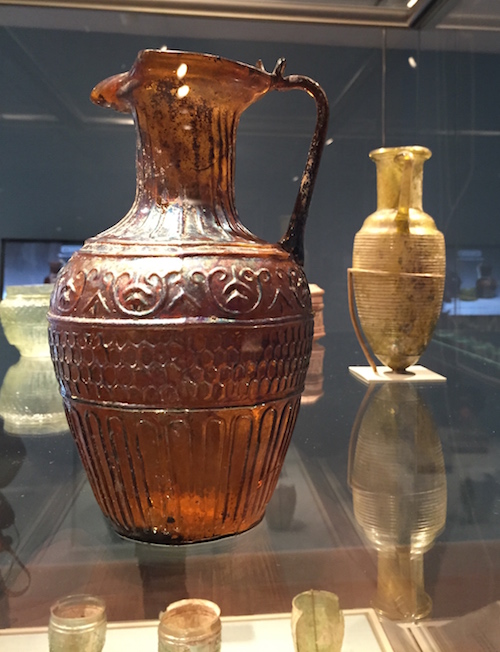
Non-Ennion glass jug made in a four-part mold; right, a two-handled amphora blown into a three-part mold, ist c. A.D. Source: The Met

Non-Ennion glass jug made in a four-part mold, 1st c. A.D. Source: The Met

In addition to Sidon, Ennion’s output has been found in excavations of ancient homes in places as far flung as Jerusalem, Croatia, Italy, and Spain. The Met’s team has had fun displaying glassware from identical molds next to one another, despite the fact that pairs were discovered thousands of miles from each other at different archeological sites.

Check out the Met’s beautiful tribute to a master artist on our Flickr feed.

Killer Heels as Art in Brooklyn

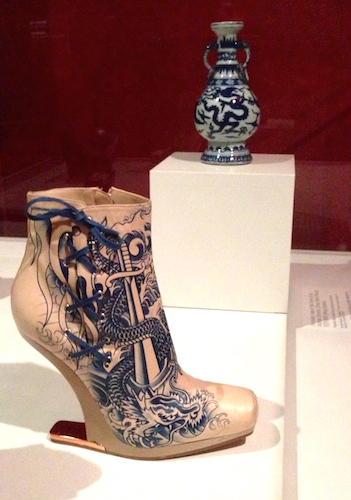
Gaultier’s 2012 Nude Tattoo Boot displayed next to its inspiration, a Chinese porcelain Ming vase (1573-1619)

Gaultier’s 2012 Nude Tattoo Boot displayed next to its inspiration, a Chinese porcelain Ming vase (1573-1619)

The hottest show in New York right now is Killer Heels: The Art of the High-Heeled Shoe, a curatorial masterwork that the Brooklyn Museum has decided to extend through March 1.

As soon as you enter the first-floor gallery, you’ll encounter Zach Gold’s mesmerizing Spike video, a wall-sized video extravaganza of high fashion, high glamour, and high heels. Why rush into the first room of the exhibition when your eye is trying process all the lush details? This digital kaleidoscope genuinely sets the tone for what lies ahead – an historical mash-up of style, fashion, and design all seen through the lens of ladies’ shoes.

What an eyeful – carefully composed vitrines where you can behold golden Baroque curliques on Prada platforms, 1920s evening shoes, and a 19th century gilded table. What about silver-and-pearl Chanel boots whose heels mimic the 1890s Gorham candlestick right next to them? Or the red-hot strappy Miu Miu shoes whose ornament is identical to the handles on a 18th-century Wedgewood ice cream cup? Check out our Flickr feed to see some of our favorites.

2008 Heels by Miu Miu next to a Wedgewood ice cream cup and saucer (1790-1800)

2008 Heels by Miu Miu next to a Wedgewood ice cream cup and saucer (1790-1800)

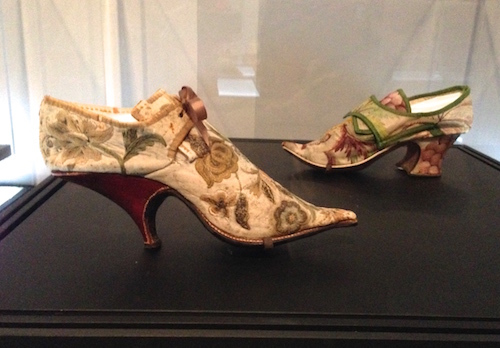
Everywhere you look, there are delightful juxtapositions across time, culture, and material – embellished pointy-toed heels from the 1690s, iron-and-leather pallets that boosted the feet of ladies above the muck of 18th-century city streets, and sky-high mother-of-pearl-inlay stilt shoes that Syrian beauties sported in the Twenties. It’s interesting that the latter are displayed in proximity to those dangerous purple Vivienne Westwood gillies that gave Naomi Campbell such problems on the runway.

Nothing’s chronological. It’s all designed to unfold in your mind by pinging unexpected references and associations – designer shoes next to concoctions from another place and time, fantastical embellishments, and streamlined perfection.

Fashionable, embellished pointy-toed 1690 French and 1720 British heels

Fashionable, embellished pointy-toed 1690 French and 1720 British heels

Provocative, room-sized videos commissioned for this show and small historical films only heighten the pizzazz. Check out Edison’s 1903 short, The Gay Shoe Clerk, or snippets from Sophia Coppola’s Marie Antoinette or other Hollywood classics. Don’t miss Eve A.D. 2000, shot in 1939 to predict what fashions and footwear of the future would look like. You’ll have fun evaluating whether those Thirties visionaries got it right.

There’s simply too much to describe – glass slippers by Georgina Goodman, political-statement heels, shoes that seem to take Metamorphoses at its word, and architectural-engineering wonders. Go see for yourself. You’ll find shoes by Ford, Ferragamo, Prada, Gaultier, and unknown Italian, French, and British craftsmen of long ago.

Watch curator Lisa Small’s video but make the trip out to Brooklyn to immerse yourself in one of the best adventures of the season:

The Paper Bag Was Her Design

MoMA honors Margaret Knight, 1870s inventor of the flat-bottomed paper bag

MoMA honors Margaret Knight, 1870s inventor of the flat-bottomed paper bag

What will the MoMA curators pull out of the design collection next? Designing Modern Women 1890–1990, running through October 19, puts the spotlight on furniture, textiles, graphics, performance, kitchens, and even inflatables designed by some innovative women over the last century. How can you not love a show that begins with 1890s modern-dance provocateur Loïe Fuller and ends with 1980s pop icon Grace Jones?

The crowd last weekend was loving every bit of it, pausing to watch videos sprinkled throughout the show and marvel at designs – some 80 to 100 years old that are as modern today as they were at their creation.

The next time you carry away your morning muffin from the coffee counter in that little white paper bag, ponder that the flat-bottomed paper bag was invented in the 1870s by Margaret E. Knight and Charles B. Stilwell. Ms. Knight not only invented this classic, but also invented the machine that made it and was one of the first American women ever to receive a patent.

1901 dinner service by Jutta Sika and Koloman Moser

1901 dinner service by Jutta Sika and Koloman Moser

No, the dinner service is not from Pottery Barn. It was created in 1901 by the Austrian design team of Jutta Sika and Koloman Moser. Didn’t I just see a copy of Eileen Gray’s 1927 adjustable table at the D & D Building? Open shelving in your new, modern kitchen? Yes, that was Charlotte Perriand’s idea, and MoMA has (for the first time) installed this full-size, fully efficient, ground-breaking kitchen from her 1952 project with Le Corbusier.

And what about the Slinky? Invented by Betty and Richard James in 1945. You’ll have fun peering into the design cases and learning more about the women behind some remarkable things.

Slinky was designed by Betty and Richard James in 1945

Slinky was designed by Betty and Richard James in 1945

In the 1960s portion of the show, you’ll see those famous Fillmore posters designed by Bonnie Maclean. And there’s an entire wall filled with iconic pop and punk graphics – all created by female designers – that should be familiar to anyone that traversed the downtown CBGBs scene.

There’s no digital media to accompany this fantastic show, so take a walk through our Flickr site. All of the items are from MoMA’s own collection, and we’ve taken slight liberties by arranging the photos in the show album in chronological order of the year that each design debuted.

And to bring it all back to the beginning of this design innovation tribute: Here’s a glimpse of 1897 Art Nouveau performance art by Loïe Fuller, courtesy of the Lumiere Brothers. The color you see here is a result of hand-tinting the film, but her actual perfomances used new theatrical stage lighting for which she held numerous patents. Listen to the MoMA curators explain her influence, but get over to MoMA (or the Flickr site) to take in this super-fun tribute to 100-plus years of smart women who thought differently and made it happen.

Groundbreakers App Ties History and Beauty Together

AppTitle

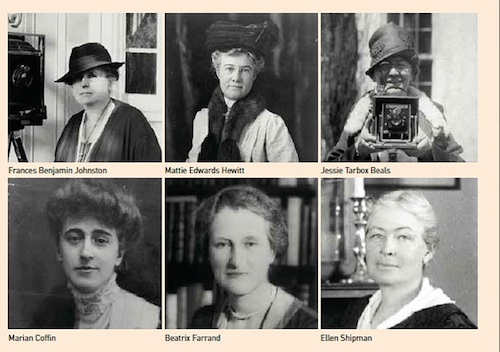
The New York Botanical Garden carved out an ambitious agenda in its Groundbreakers show – to tie the stories of six women of landscaping history, present a two-gallery recreation of an historic garden, pay tribute to the contributions of several landscapes within NYBG itself, create a poetry walk, and wrap it up with the history of early 20th-century photography and high-gloss publishing. They did it with GPS and an iPhone app, courtesy of Bloomberg.

Closing this weekend, Groundbreakers: Great American Gardens and the Women Who Designed Them is still worth downloading from iTunes, just to get a glimpse into the lives of six landscape-gardening pioneers, see their work, and understand the popularization of American gardening long before the dawn of HGTV or Lifestyles of the Rich and Famous. Here’s the link.

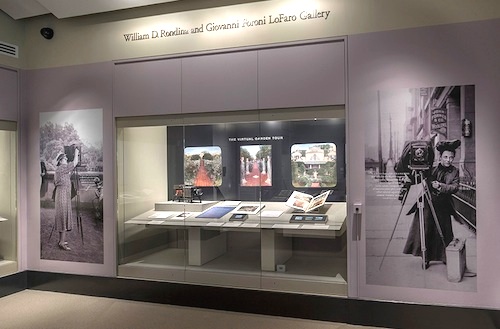
Photos of Ms. Johnston (left), lantern slides and projector, and Beals (right) on NYC street in 1902. Courtesy: NYBG

Photos of Ms. Johnston (left), lantern slides and projector, and Beals (right) on NYC street in 1902. Courtesy: NYBG

Here’s the story: back in the day (early 1900s), garden design and photography were two of the few career avenues available to women.

Way before Instagram, Photoshop, and two-way phone cameras, documenting the lush gardens involved lugging a gigantic, large-format camera up and down garden paths and around water features, processing black-and-white negatives into prints, turning some into newly-invented lantern slides, and having each slide painstakingly colored by hand. It helped if you had a car and an able-bodied assistant to help navigate the flagstone-lined paths with all the heavy gear.

Six American landscape pioneers who changed the course of American gardening. Courtesy: NYBG

Six American landscape pioneers who changed the course of American gardening. Courtesy: NYBG

Also, after the Industrial Revolution, aesthetically minded women (predating Lady Bird Johnson) felt it was time for American homescapes to get a little more spruced up.

The rich and famous were beginning to hire landscape designers to fix up the areas behind their East Side townhomes and acreages around their country estates. Why not document this and inspire upper middle class homeowners to follow suit?

The exhibition gives us a look at how artist visionaries, authors, and the publishing industry worked in tandem to record how landscape architects were creating romantic backyard landscapes and popularize beautification. Although seeing actual lantern slides, projectors, and gigantic tripods is amazing, one of the highlights is a recreation of the slide show by Frances Benjamin Johnston that basically blazed the trail of a new vision of what was possible – one image after another of gorgeous, visionary landscapes on the grounds of homes on the East Coast, California, England, and France.

NYBG recreated the evocative Moon Gate from the Rockefeller garden, inspired by their experience of the Forbidden City and designed by Beatrix Farrand

NYBG recreated the evocative Moon Gate from the Rockefeller garden, inspired by their experience of the Forbidden City and designed by Beatrix Farrand

In the Conservatory, the team at NYBG recreated Mrs. Rockefeller’s garden, originally designed by Beatrix Farrand, to highlight how the garden was conceived, used, and enhanced by the Asian art Mr. and Mrs. John D. collected. Since Farrand took on this project in 1926, NYBG has the sounds of America’s Jazz Age wafting through the galleries. Take a look on our Flickr page.

Another great feature of this show and the app – NYBG’s GPS feature shows you where you are in the expansive garden and encourages you to visit features where these groundbreakers had a hand – such as Marian Coffin’s ornamental conifer collection and Ferrand’s Rose Garden.

Get a closer view of the spectacular Groundbreakers in NYBG’s news-style video:

If you have a bit more time, listen to this curator lecture on the Beautiful Garden movement in America in 1900 and see the photos used by Johnston home to show suburbanites exactly how it should be done. You’ll witness garden images that hadn’t been seen since 1930. Take a look and get inspired:

Click here for other videos: a lecture about Beatrix Farrand created Mrs. Rockefeller’s garden and how the NYBG team recreated it in the stunning Victorian conservatory.

Folk Art Geniuses Take a Trip

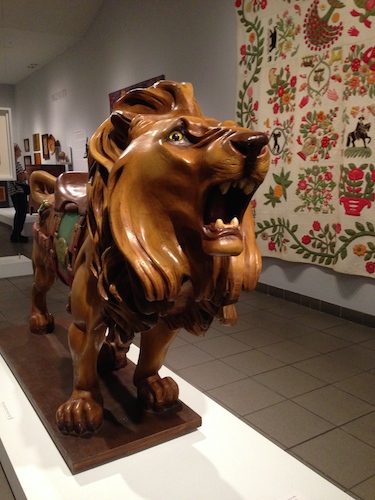
Brooklyn’s Lion, carved in 1910 by Marcus Charles Illions, who worked at the carousel shop and later set up his own studio

Brooklyn’s Lion, carved in 1910 by Marcus Charles Illions, who worked at the carousel shop and later set up his own studio

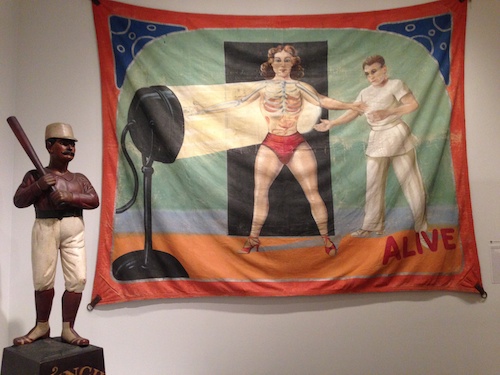
The American Folk Art Museum knows how to put on a show and take it on the road. After today, the staff will be packing up Self-Taught Genius: Treasures from the American Folk Art Museum and letting the Brooklyn Lion, Connecticut’s Weathervane Elephant, Chicago’s Sideshow “Radium Girl”, and a baseball old-timer from Centre Street see what’s up in Davenport, San Diego, Fort Worth, New Orleans, Saint Louis, and Tampa. We’re betting that there will be crowds waiting to greet them.

The museum’s staff has brought out its best to show off four centuries of made-in-America maker art – furniture, sculptures, textiles, painting, and what-not. It’s genius that they’ve put the spotlight on “genius” because their collection is jam-packed with some truly remarkable artists, visionaries, and craftsmen. Get the full view on the Museum web site and some close-ups on our Flickr page.

The curators say that the United States was a make-it-up-as-you-go-along democracy, so they felt “self taught” was right in line with this unique Americana theme – having a vision and making a masterwork.

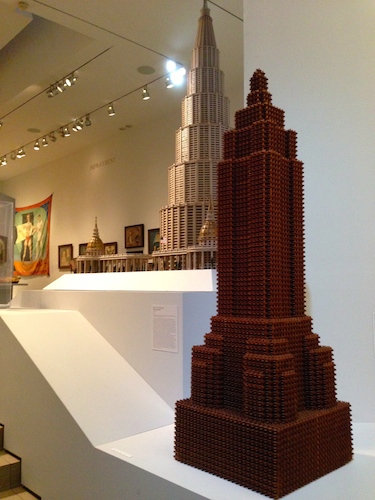
Empire State Building, carved in New Jersey in 1931 from precious cherry wood. Auriti's Palace is just behind.

Empire State Building, carved in New Jersey in 1931 from precious cherry wood. Auriti’s Palace is just behind.

Yes, there are some true eccentrics in the mix, but let’s momentarily focus on the People with a Plan from the section of the show on “Achievers”. Their works are immensely pleasurable and intense, and they’re right inside the entry.

You could spend hours contemplating the detail and work that went into the monumental Empire State Building made from cut cherry wood pieces in New Jersey in 1931. No one knows who created it, but legend has it that it was an ironworker that actually worked on that 13-month wonder and couldn’t let go of the achievement.

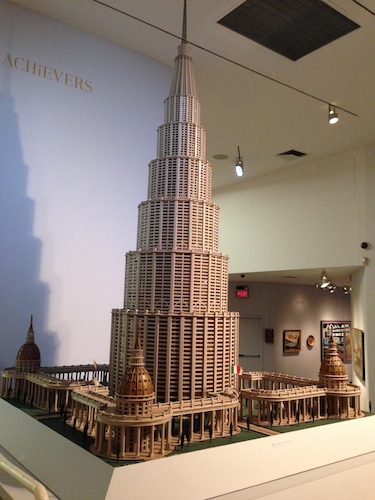
Consider The Encyclopedic Palace of the World, created by Maurino Auriti, an auto body worker who just loved designing and building architecture. Mind blowing. If his visionary campus was actually constructed, the skyscraper would be taller than that spire in Dubai.

The Encyclopedic Palace, created by Maurino Auriti, an auto body mechanic, in the 1950s from from wood, plastic, glass, metal, hair combs, and hobby kit parts

The Encyclopedic Palace, created by Maurino Auriti, an auto body mechanic, in the 1950s from wood, plastic, glass, metal, hair combs, and hobby kit parts

If you get to Lincoln Square today, you’ll enjoy one amazing treasure after another, but if not, check it out the beautiful web site archive created by the museum team for the tour. Browse by time period, theme, or artist.

And check out the Museum’s other brilliant online solution to letting you in on the world’s interpretation of these works. They’ve assembled all the media written and produced about the pieces in the show, which have often served as a springboard for scholarly research. This is a fun, serious treasure chest of work, so probe to your heart’s content — baseball folk art, mourning pictures, 18th century folk-art Washington portraits, and even more recent works.

What will it take to take this show of masterworks on the road? Last year, Auriti’s The Encyclopedic Palace was chosen as the theme of the  55th International Venice Biennial, so it got to go on its first trip to Italy.

Get a glimpse of where the folk art lives when it’s not on display and see how art gets packed to take a trip.

Baseball statue from 114 Centre Street and the sideshow’s Radium Girl banner from Chicago in the 1930s

Baseball statue from 114 Centre Street and the sideshow’s Radium Girl banner from Chicago in the 1930s

Dissident Artist Leaves Brooklyn for Second Time

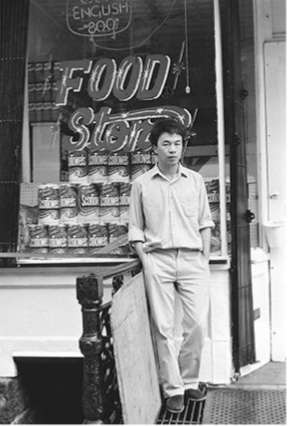
The artist in Williamsburg, 1983. From his New York Photograph Series (1983-1993). Courtesy: the artist

Then: Ai Weiwei in Williamsburg, 1983. From his New York Photograph Series (1983-1993). Courtesy: the artist

If you haven’t yet trekked to Brooklyn to see one of the world’s most famous international provocateurs, go this weekend to see Ai Weiwei: According to What? and get to know the work of the artist who was incarcerated a few years ago by the Chinese government for pulling the veil off its bureaucratic repression and dishonesty. Closing August 10, it’s the last stop on the show’s North American tour – a fitting finale since Ai Weiwei first lived in Williamsburg when he moved to New York back in 1983.

You know him either from his collaboration on the famous “bird nest” stadium at the 2008 Beijing Olympics, smashing Han Dynasty vases as an art project, or from having bulldozers sent by the Chinese government to eradicate his studio in 2011 and being put into house arrest for 81 days – an event that made front-page news and sparked an international outcry – museums and political leaders took out protest ads, made videos, placed flowers on his public works, and called for his release all over the world.

Close-up of R itual, one of the six dioramas of S.A.C.R.E.D. (2011-2013), inspired by his 2008 incarceration. Courtesy of Ai Weiwei Studio. © Ai Weiwei

Now: Close-up of R itual, one of six dioramas of S.A.C.R.E.D. (2011-2013), showing his 2008 incarceration. Courtesy of Ai Weiwei Studio. © Ai Weiwei

Even before you hit the admissions booth, you’ll see his response to all of this – a series of six large, mysterious boxes that make up his work, S.A.C.R.E.D. You climb up to peer into them, right inside Brooklyn’s entrance. Inside, you’ll see everyday depictions of what it was like for him in detainment – eating, sleeping under the watch of the uniformed guards, and interrogations.

Upstairs, you’ll see an expansive show filled with thought-provoking works along with some black-and-white photos of his East-Village life in the 1980s, where he hug with Tan Dun, Xu Bing, and other artists-on-the-move and artists-on-the-run from a conformist Mainland.

At a distance, his sculptures seem like simple, cool contemporary installations. Read the label copy and you realize the subversive is at work. It looks like some found-art piece, but the room is actually filled with the full contents of a young woman’s home. Ai Weiwei found her and all her stuff on the side of a road after the authorities evicted her.

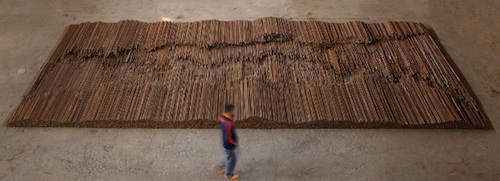
Straight (2008-2012) is made from 70 tons of rebar reclaimed from the Sichuan earthquake and hammered straight back into rods. © Ai Weiwei

Straight (2008-2012) is made from 70 tons of rebar rods, reclaimed from the Sichuan earthquake and hammered straight. © Ai Weiwei

A single room is devoted to Straight, a monumental installation made up of rebar, metal rods used to strengthen concrete calls. Except that this is the actual rebar from the 2008 earthquake that claimed 5,400 young lives in Sichuan Province when the schools collapsed due to shoddy construction practices. He bought the scrap rebar from those buildings, spent four years hammering to straighten them out, and assembled the rods into a 70-ton sculpture. Nearby, he’s listed the names of every school child – something that the Chinese government never did.

Performance art: dropping a Han dynasty vase (206 BC-220 AD), along with other historic ceramic pieces altered by a dip into modern industrial paint (2007-2010). Photo: C. Carver. Courtesy: the artist

Performance art: dropping a Han dynasty vase (206 BC-220 AD), along with other historic ceramic pieces altered by a dip into modern industrial paint (2007-2010). Photo: C. Carver. Courtesy: the artist

How and why does he do it? Find out by listening to Ai Weiwei’s answers to visitors’ questions. You’ll have quite an insight to his thought process, since there are 45 pages of video Q&A. Well worth the time to meet this brave, inspirational artist-activist.

He’s simply one of the top contemporary artists working today and you owe it to yourself to experience work that literally takes on the world. Kudos to the Brooklyn Museum for also publishing the amazing teacher’s guide, which asks students to ponder and think about news, authority, and speaking out.

Watch as the Brooklyn crew assembles Stacked, Ai Weiwei’s 2014 sculpture made from 700 bicycles, a comment on the transportation traditionally used by Chinese commuters until the dawn of the smog-inducing automobile. It’s all happening under the watchful Egyptian eye on Brooklyn’s main floor:

William Morris: Meeting the Needs of Artistic Shoppers

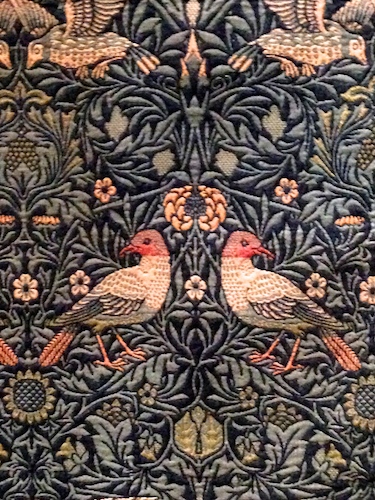
Detail of the large woolen Bird textile that Morris designed in 1878 for his home that was still being sold decades later.

Detail of the large woolen Bird textile that Morris designed in 1878 for his home that was still being sold decades later.

William Morris not only did his historic homework, but was able to channel his convictions about the magic of the Medieval to tap into what artistic Victorian shoppers wanted – stylized visions of nature and old-school craftsmanship, the way it was done in the “old days.” See the evidence in two Metropolitan Museum of Art shows on right now — The Pre-Raphaelite Legacy: British Art and Design (running through October 26) and William Morris Textiles and Wallpaper (closing July 20).

You’ll see how Morris used the historic textile collections at the Victoria & Albert Museum as inspiration for his modern wall coverings and textiles. In the little low-light gallery outside the museum’s textile center –many designed by his designer, John Henry Dearle — right next to the older textiles that inspired them both. You’ll be able to compare Morris’s own winding, intricate patterns with those woven by the 15th-18th c. Venetians, Germans, and Spaniards.

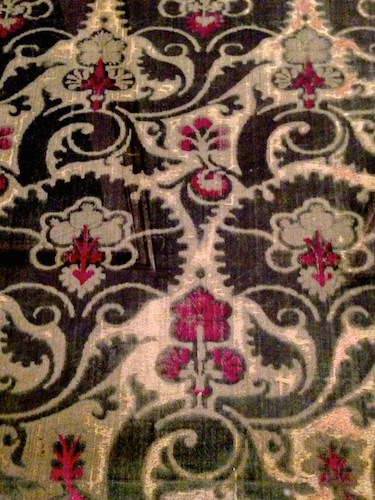
Voided velvet and silk from Venice, 1420

Voided velvet and silk from Venice, 1420

As our Flickr site shows, the Met has its own examples for you to enjoy.

Morris began designing in 1861, went through a couple of iterations of his company and collaborators, and finally landed at Hanover Square in 1917, where his workshop was located just a few steps from Liberty of London on Regent, another retail hotbed of the Arts and Crafts movement where many of the Pre-Raphaelites shopped. As Oscar Wilde once remarked, ““Liberty is the chosen resort of the artistic shopper.”

In 1923, the Met decided to scoop up all of the still-being-sold Morris textiles from London. What you’ll see in the show aren’t the originals, but likely subsequent runs of the super-popular block-printed decorating papers and yardage.


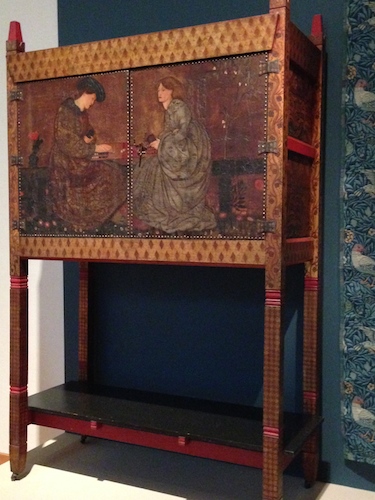
The Backgammon Players, the faux-Medieval, mixed-arts furniture collaboration that started it all1861, with the 1878 Bird wall hanging far right.

The Backgammon Players, the faux-Medieval, mixed-arts furniture collaboration that started it all 1861, with the 1878 Bird wall hanging far right.

The Pre-Raphaelite Legacy has paintings, photos, sculptures, and other works by a wide range of artists. Check out the early painted furniture that Morris did with Edmund Burne-Jones (1861) and the book, written by Morris in archaic English and illustrated by Mr. Burne-Jones at the height of Morris mania (1898).

Next to the furniture collaboration, the curators have hung Morris’s own Bird textile, an intricate woven wonder of woodland creatures and forest marvels. The detail will blow you away, but so will the fact that the original was created in 1878, but what you are looking at was likely manufactured decades later for artistic shoppers and décor enthusiasts who just had to have it.