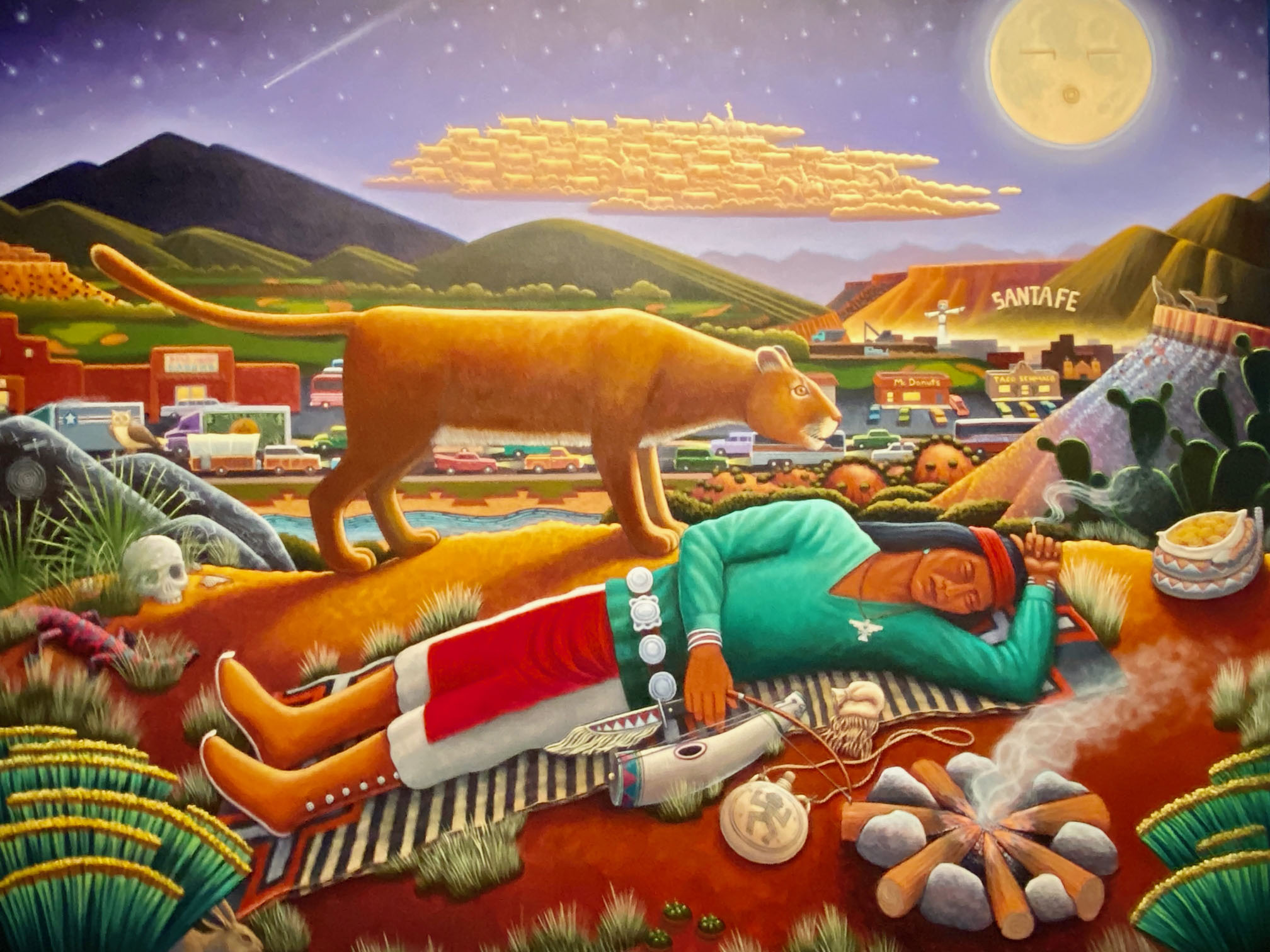
Since its founding in 1937 as an institution documenting Navajo ceremonial art, Santa Fe’s Wheelwright Museum of the American Indian has shifted toward collecting contemporary Native American art and serving as a platform to boost careers of emerging artists.
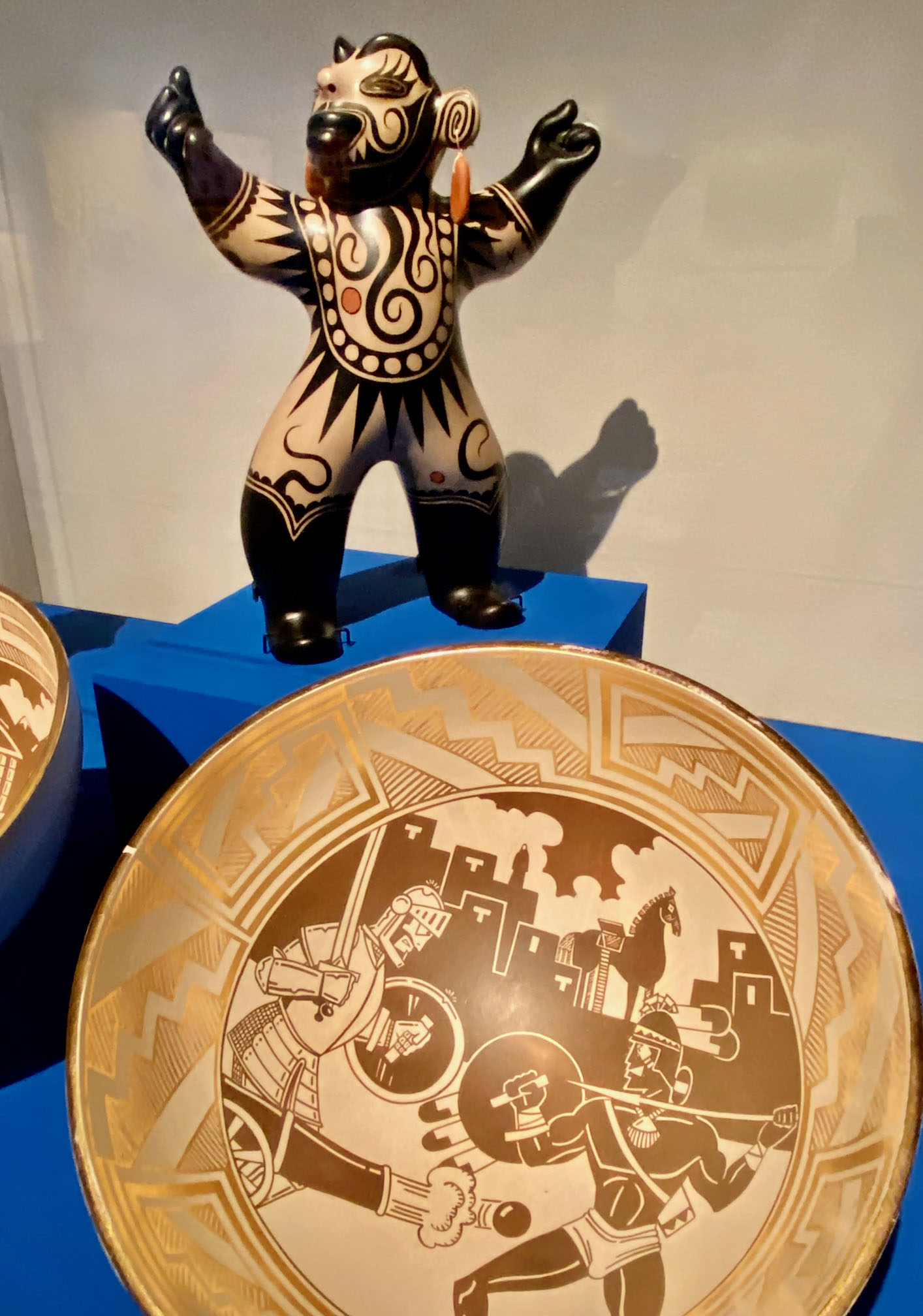
Virgil Ortiz’s (Cochiti) 2005 ceramic sculpture Monos Figure with Diego Romero’s (Chochiti) 2005 bowl Tenga Cuidado Con Griegos Salvo Obseqios.
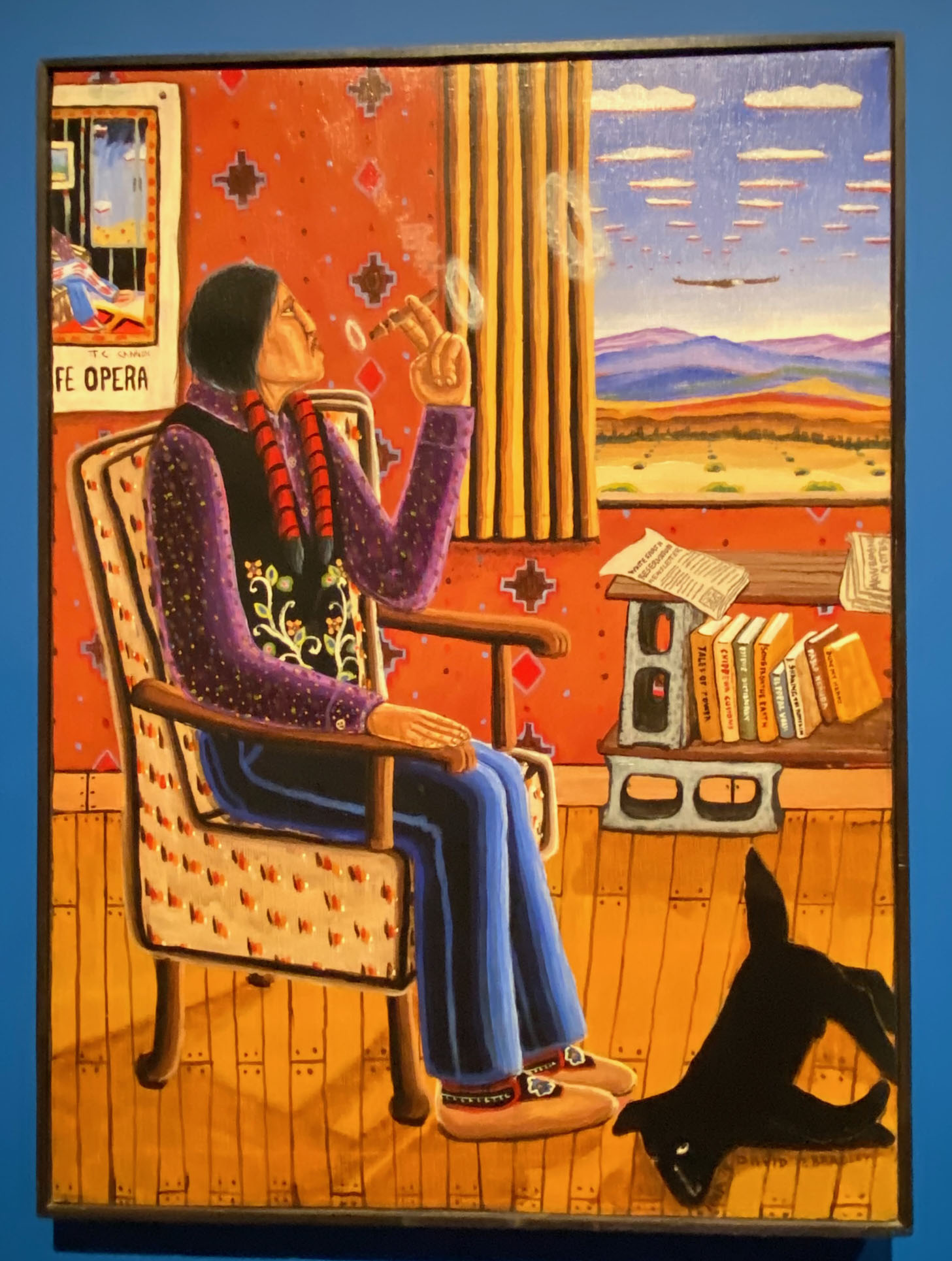
For example, on a wall honoring T.C. Cannon, the curators showcase a crazy, irreverent David Bradley work painted in T.C.’s bold, satirical style, but display a rather conservative (and rarely seen) woodcut by T.C. himself.
David Bradley’s (Minnesota Chippewa) 1979 acrylic Remembering T.C. Cannon in the style of his hero.
T.C. Cannon’s (Kiowa/Caddo) 1977 woodblock print Hopi with Manta.
Contemporary textile artist Ramona Sakiestewa’s comment that her work represents “visual echoes of what came before” inspired the title of the exhibition. Sakiestewa’s tapestry incorporates colors and motifs of traditional Hopi wicker plaques. This theme is carried throughout the show.
Ramona Sakiestewa’s 1992 Basket Dance/9-B echoes a traditional woven Hopi ceremonial plaque.
A grouping of intricately painted Acoma ceramics pays tribute to the Wheelwright’s 1981 exhibition Sky City Salute that honored two matiarchs of that art form – Lucy Lewis, who lived at Acoma before and after tourists began beating a path to the ancient mesa-top city, and Marie Z. Chino. The curators match it with work by Marie’s grandson, Robert Patricio, who channels traditional themes into a modern ceramic context.
Acoma legacies: a 1965-85 seed pot and 1958 bowl by Lucy Lewis, and large 1980 storage jar by Marie Z. Chino.
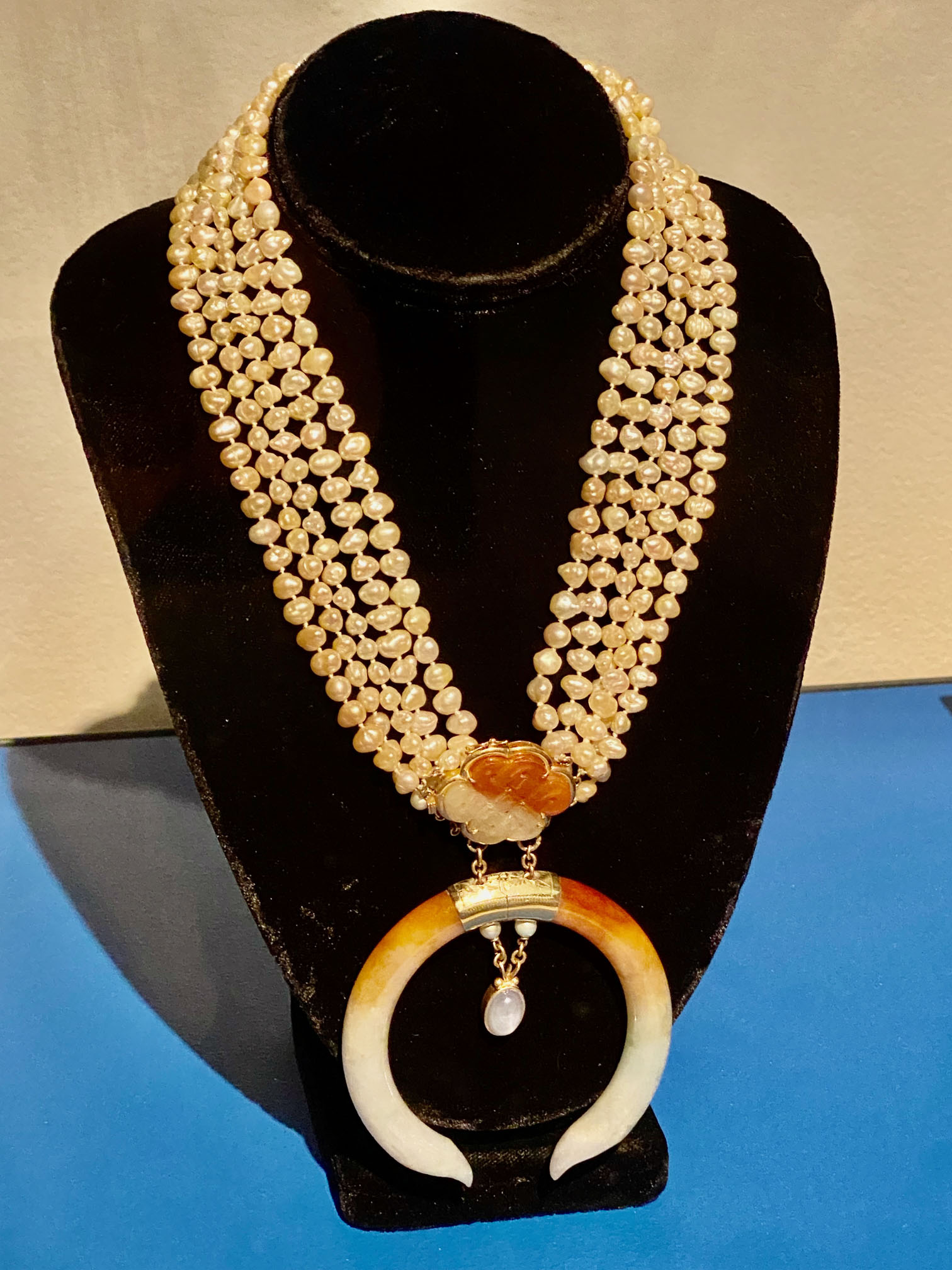
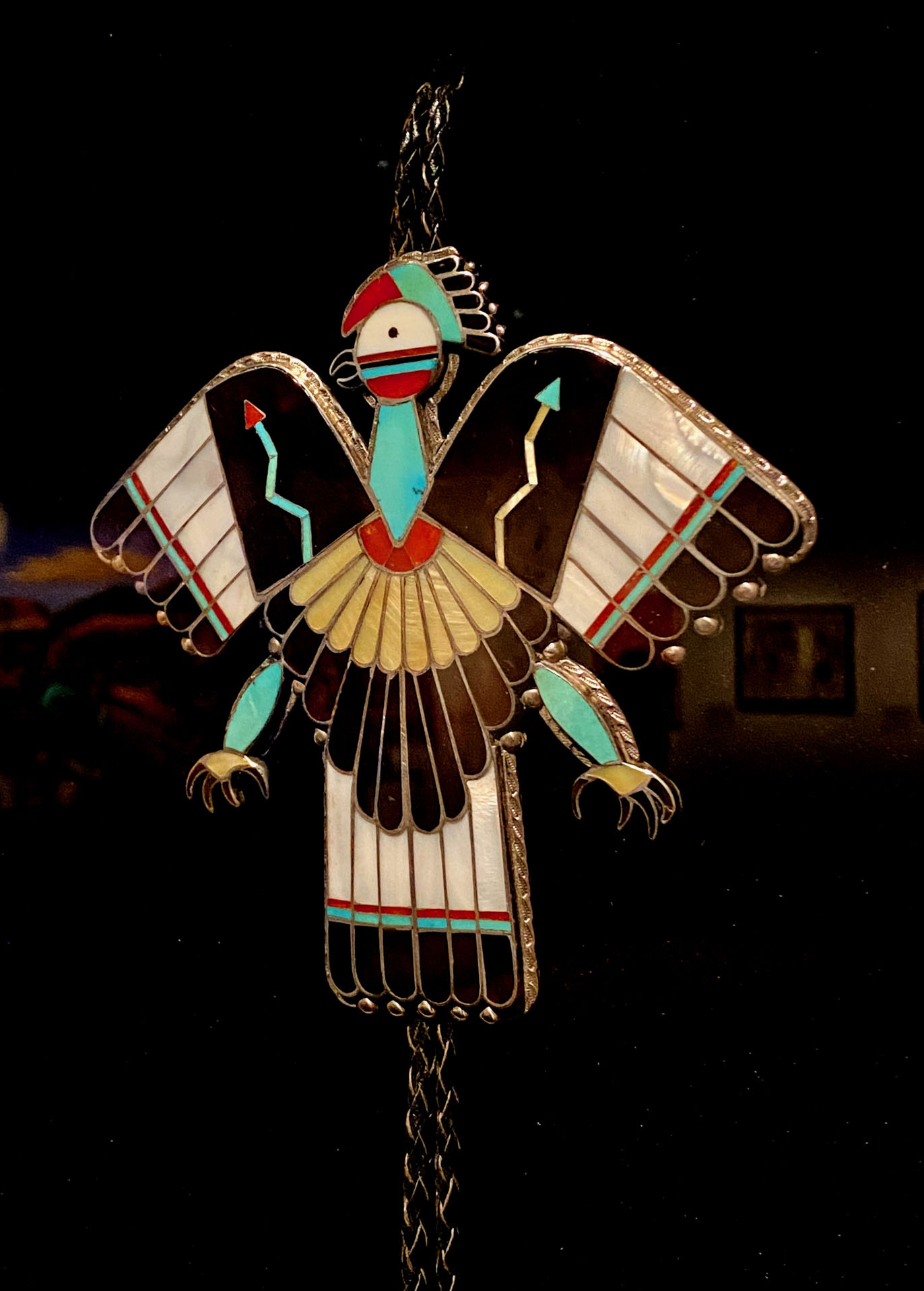
Another grouping references the Wheelwright’s 2011 show Radical Recycled Jewelry Makeover with a bold piece by Kenneth Johnson and the Wheelwright’s stellar collection of Zuni bolo-tie inlays.
Kenneth Johnson’s (Muscogee/Seminole) 2011 necklace from recycled pearls, jade, gold, and silver..
1970s-1980s thunderbird bolo by Owen Bobelu (Zuni); inlaid silver, jet, turquoise, and mother-of-pearl.
The “salon wall” is peppered with paintings that tell the interconnected histories and styles of nine Native artists – the trajectory from flat-style styles of the 1920s and 1930s to more open innovation of Ben Harjo and Linda Lomahaftewa, some of earliest graduates at the Institute of American Insitute Arts (IAIA).
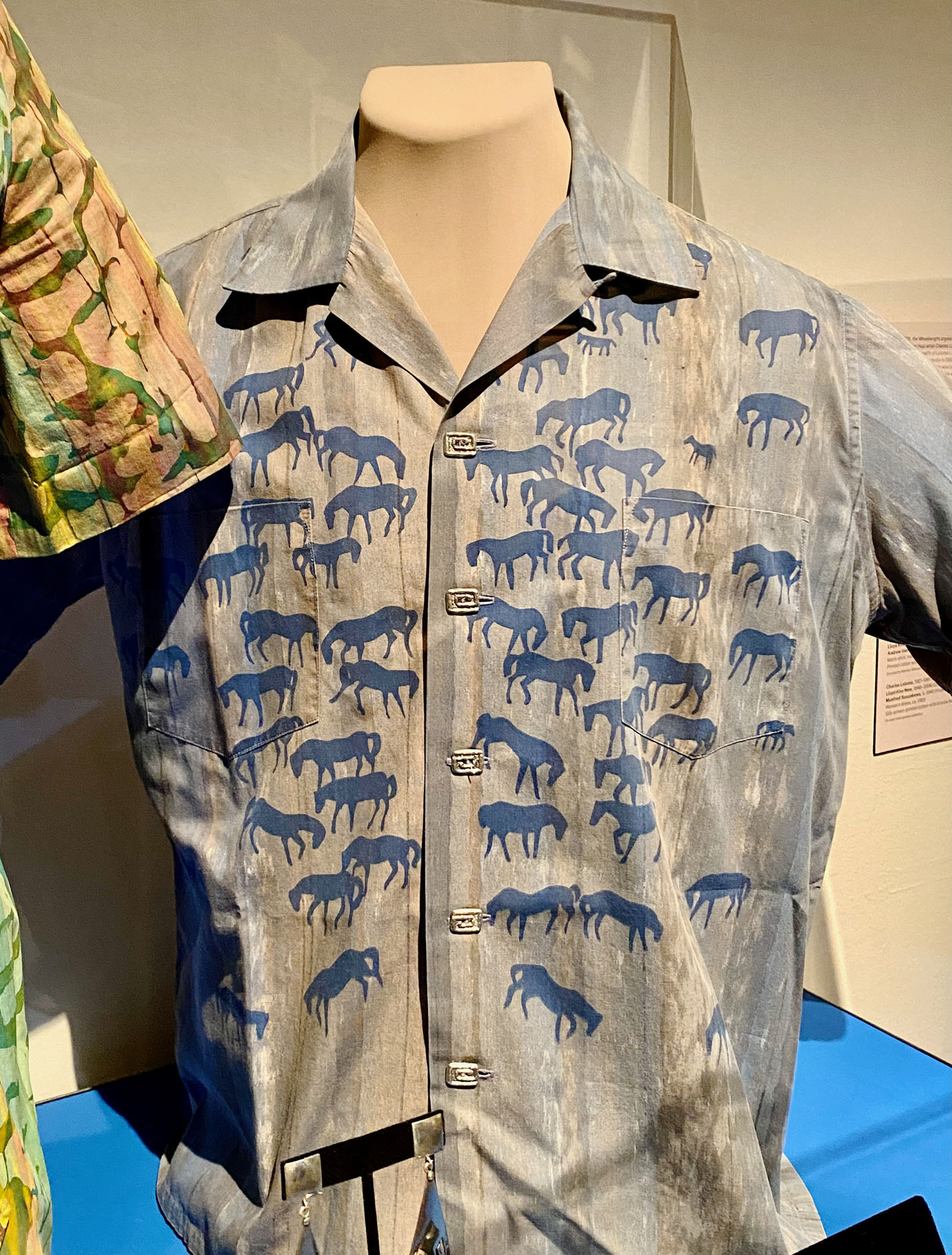
The exhibition also presents another group of work to acknowledge the artists who began working together in Scottsdale in the 1950s and who began IAIA in 1962 – clothing designed by co-founder/president Lloyd Kiva New and jewelry by instructor Charles Loloma..
Lloyd Kiva New’s (Cherokee) 1950s man’s shirt with Andrew van Tsinajinnie (Diné) printed fabric and Charles Laloma (Hopi) silver buttons.
Charles Laloma’s 1970 silver, coral, turquoise pin.
The local artist honored in Taos with a lifetime retrospective lives and works only 18 miles from Georgia O’Keeffe’s famous home in El Rito. But their work, lives, purpose, and legacy couldn’t be further apart.
Nicholas Herrera: El Rito Santero, on view at the Harwood Museum of Art through June 1, fills three galleries with work by a New Mexican wood carver who not only pays tribute to saints and ceremonies important to the nearby rural Hispanic communities, but also channels politics, social commentary, lowrider culture, and pressures of modern life in a mixed-up world into his craft.
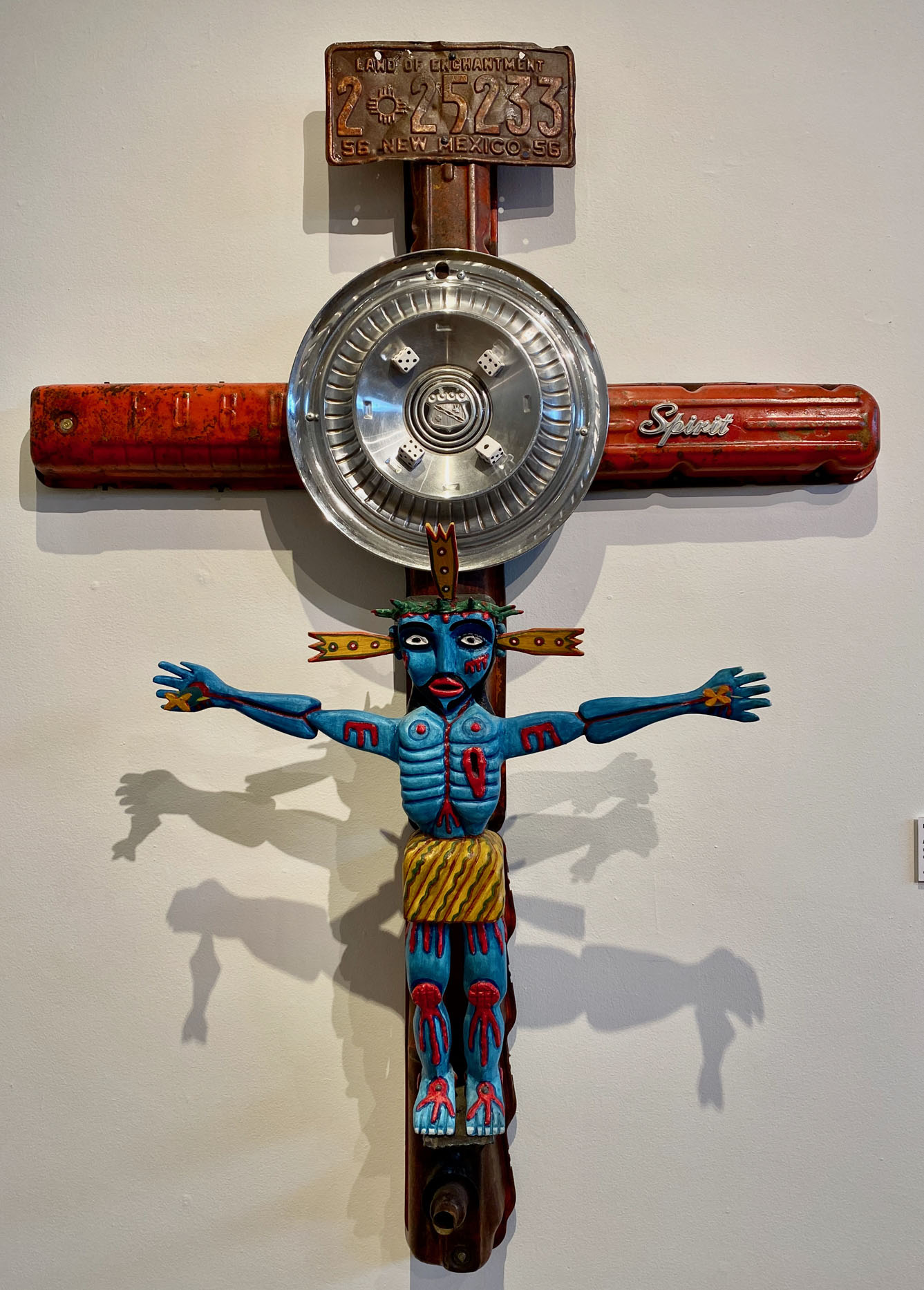
Herrera’s Espiritu mixes religion with found car parts. Courtesy: private collector
It’s a colorful, irreverent, heart-felt tribute to the people, places, religion, and culture of the rural high hills that he calls home. And here’s Herrera’s self-portrait – the namesake of this engaging retrospective.
Herrera’s1998 hand-carved image of his favored protector La Virgen de Guadalupe. Courtesy: Evoke Contemporary
At first glance around the gallery at the top of the back stairs, Herrera’s work seems firmly situated in the tradition of the last 400 years of northern New Mexico saint-carving. Since the 1600s, when Spanish farmers first colonized these remote hills, the faithful relied primarily on local artists and carvers to decorate home chapels, churches, and shrines.
Herrera’s work is the 20th century version. There’s a grand, colorful painted altar honoring his brother in which a pantheon of Catholic icons gazing benevolently upon you. You’ll also meet his special icon – a bright, enigmatic Lady of Guadalupe.
In a small, dark room you’ll experience a powerful home altar, filled with hand-carved spiritual tributes, surrounded by candles and and all manner of other-worldly retablos.
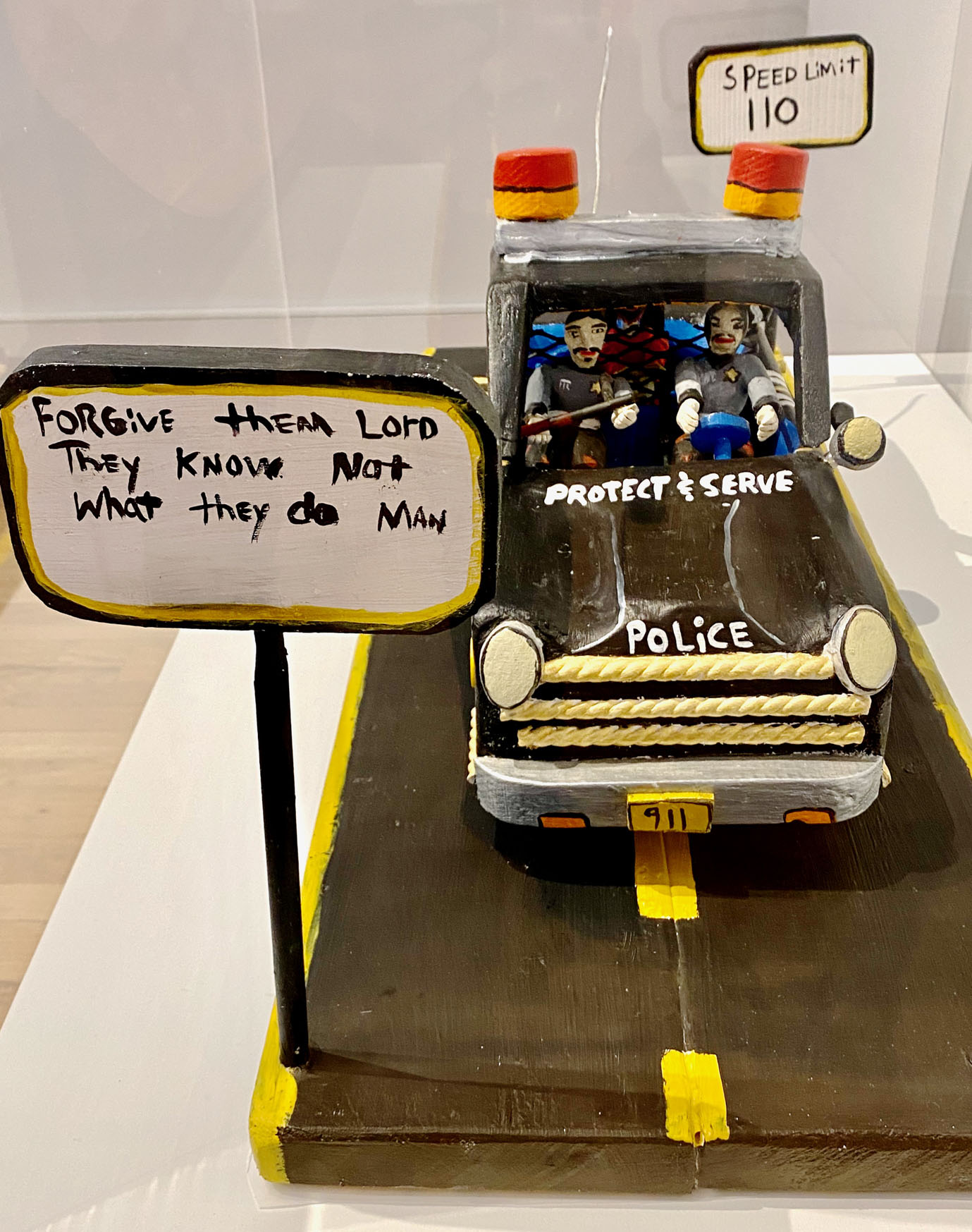
But the next two galleries, you’ll encounter work using these same materials and techniques, but reflects life-changing events in the artist’s life that are mashed up with ancient spiritual traditions – Jesus in the back of a speeding cop car, Herrera’s own near-death experience in a car crash when he was in this twenties, and a crazy lights-flashing slot machine promising allures that only the Devil can love., or aerial views of old Spanish valleys.
Herrera’s 1994 painted wood and mixed-media sculpture Protect and Serve with Jesus in the back seat of the patrol car. Courtesy: Smithsonian American Art Museum
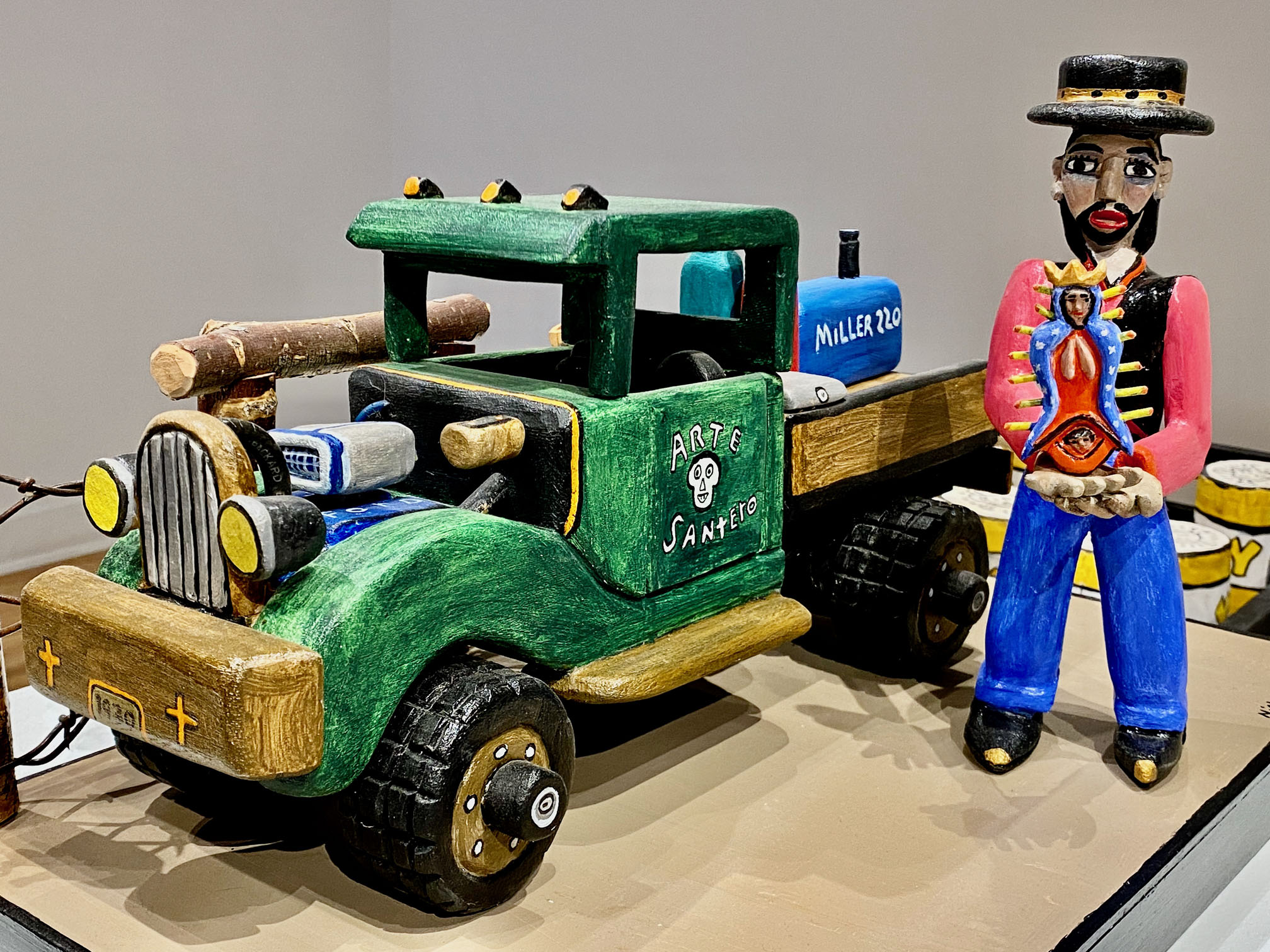
Herrera’s 1995 painted wood and metal Los Alamos Death Truck. Courtesy: private collection
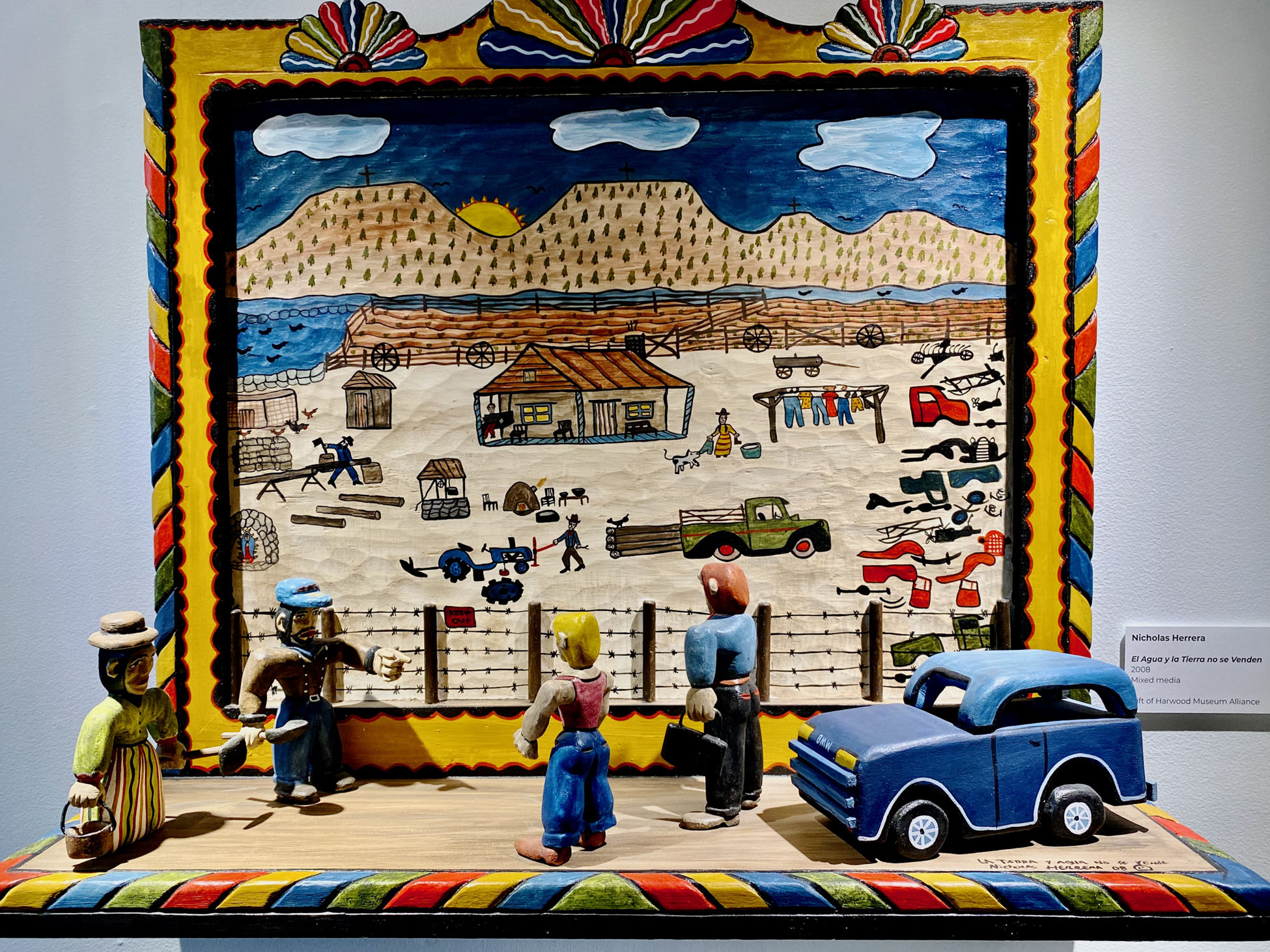
Like all great artists, Herrera is inspired from life events and the world around him – reflections about his growing up and home life, land-use and traditions in his community, and issues ripped from the headlines, like the terror of transporting Los Alamos nuclear waste or issues with the border patrol.
Herrera’s 2008 mixed-media El Agua y la Tierra no se Venden, highlighting the importance of 400 years of protective land stewardship in Northern New Mexico.
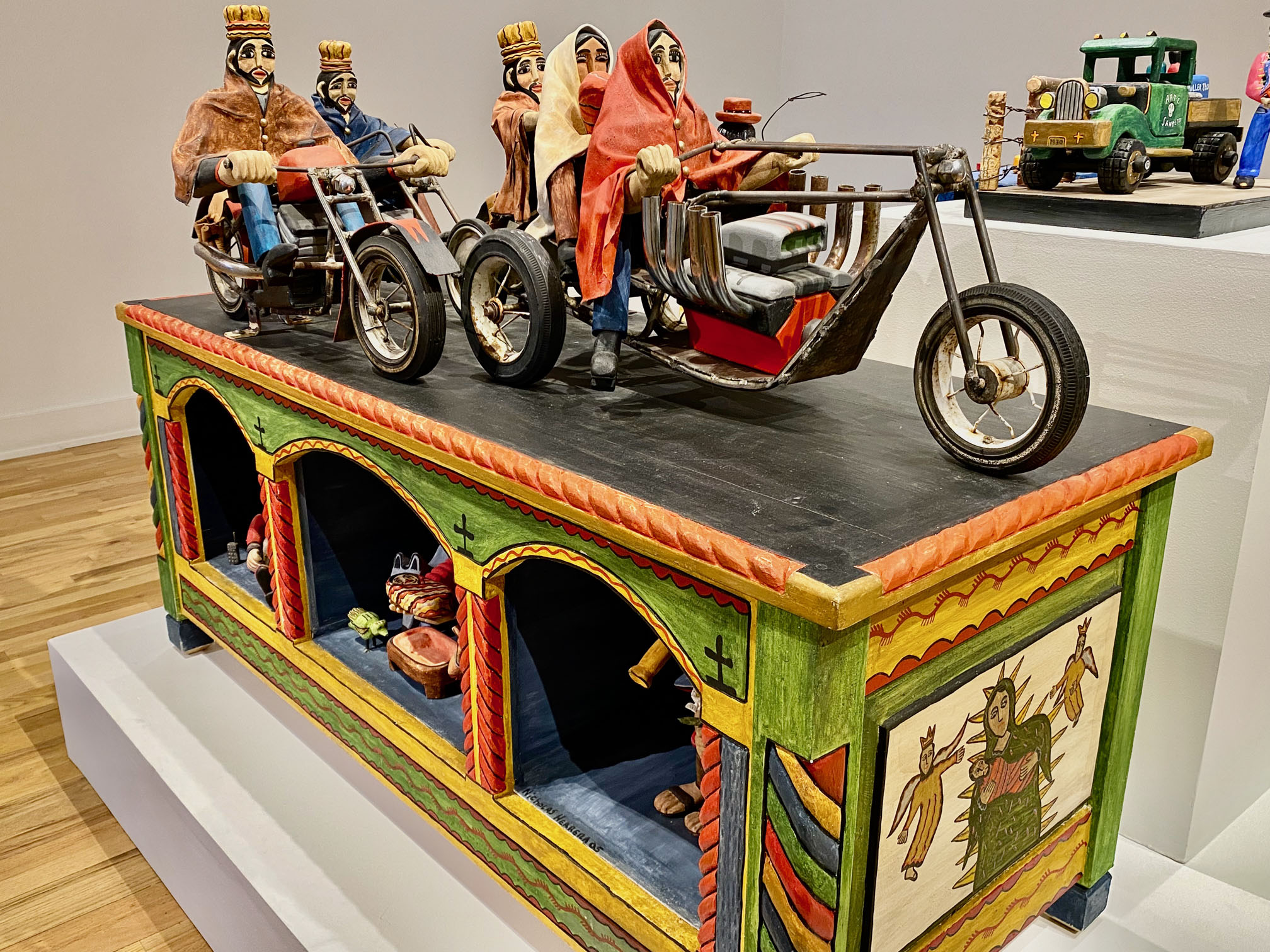
Used car parts, toy parts, and other stuff from the junkyard “tell” Herrera how and where he might use them. Lowrider culture is an important source of price in Northern New Mexico, so it’s not surprising that he’s channeled that part of the local experience into his work, too.
The Holy Family hits the road in Herrera’s 2005 carved and painted Low Rider Nativity, embellished with cloth, toy wheels, and found metal. Courtesy: private collection
See some of our favorite works in our Flickr album, and meet the artist himself in this short video profile created by the Smithsonian American Art Museum:
Do you wish you could travel back to Taos in the Thirties and Forties to experience the quiet, small, out-of-the-way place that inspired so many artists? Take a walk through this two-site exhibition, Legacy in Line: The Art of Gene Kloss, on view through June 8, 2025 at the Harwood Museum of Art and through May 31 at the Couse-Sharp Historic Site just off the Taos Plaza.
Kloss, whose artistic style was honed in the 1920s and 1930s, is arguably one of New Mexico’s favorite artists. Kloss specialized in printmaking, creating an immediately recognizable style – a landscape, village, or pueblo scene with dramatic contrasts (often at night). Look at some of our favorites in our Flickr album
Kloss 1934 aquatint and drypoint Eve of the Green Corn Ceremony –Domingo Pueblo, which received a gold medal from the Pennsylvania Academy of Fine Arts. Courtesy: Couse Sharp Historic Site
Kloss fell in love with plrintmaking as an undergraduate art student at UC-Berkeley. She was captivated by the printmaking revival that swept Paris and Britain in the mid-19th century. Artists owned their own presses and produced affordable prints of landscapes and small towns that encouraged everyone to collect art.
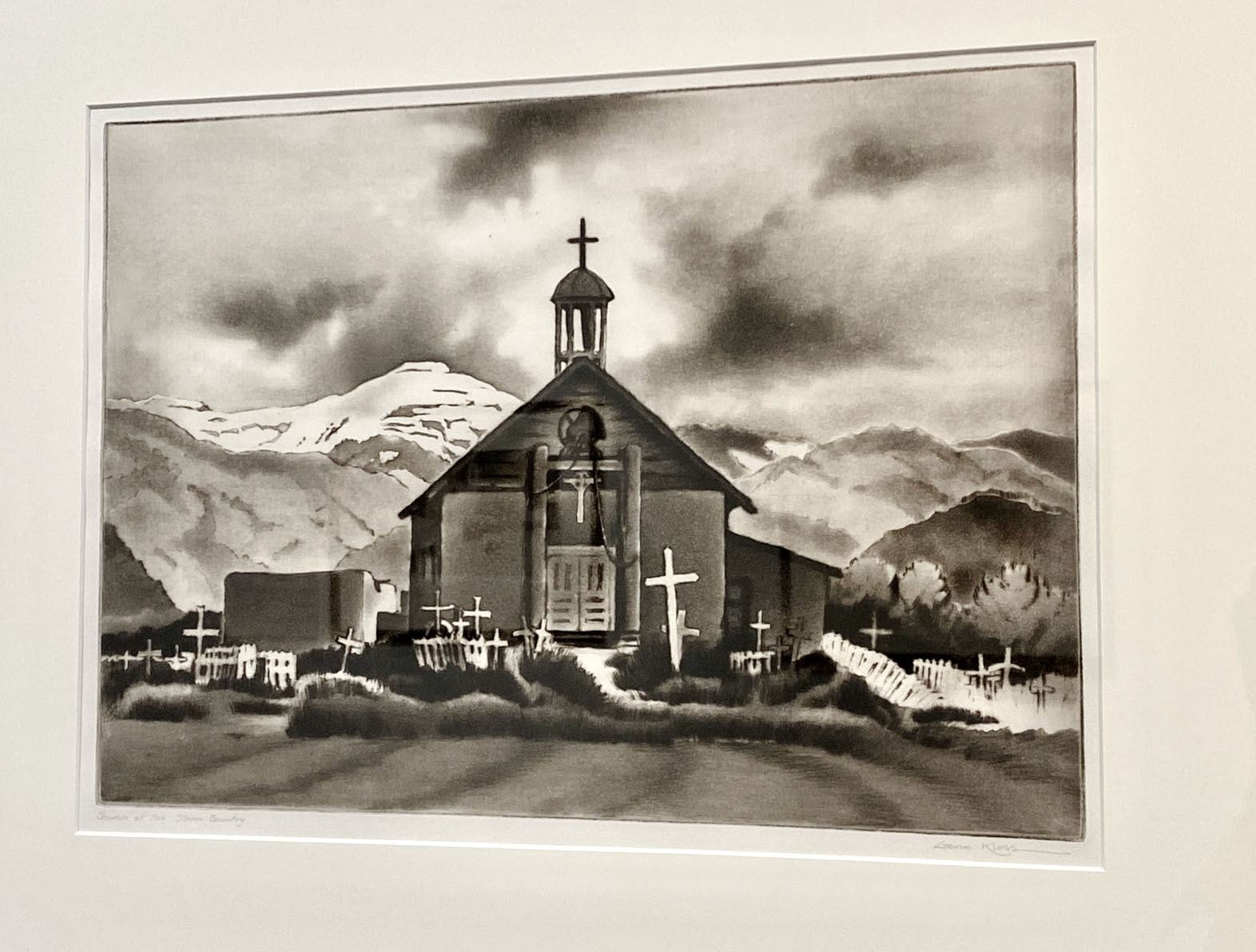
Kloss 1941 drypoint Church of the Storm Country. Courtesy: Taos Municipal Schools.
A lifelong resident of the Bay Area, she first came to Taos on a car-camping honeymoon in 1925 with her writer-composer husband. She fell in love with the landscape, the culture, and the pueblos of Northern New Mexico. Did I mention she brought along her 60-lb. portable printing press?
Kloss 1934 drypoint All Saints Day Mass – Taos. Courtesy: Taos Municipal Schools.
Kloss was prolific, and the next year showed over 100 of her paintings and prints – including Taos subjects – at a wildly successful solo show in Berkeley. She and her husband were hooked on the inspiration Taos provided, and soon rented a getaway home, where they would spend two to four months per year.
Kloss 1934 drypoint Acoma. Courtesy: Taos Municipal Schools.
Kloss developed her images from quick sketches and from memory, bringing the drama as she precisely worked her impressions into the copper.
In the Thirties, Kloss did artwork under several New Deal programs and produced a nine-part series on New Mexico that was gifted to public schools in the state.
As a master of intaglio, drypoint, and aquatint, she developed an innovative technique in which she painted acid directly into the ground with a brush or pencil that allowed her to create super-deep tones, gradations, and atmospheres in her prints.
Few others could create scenes like hers – dramatic nighttime scenes at the pueblos, tiny pilgrims making their way at dusk among the mountains, or aerial views of old Spanish valleys.
Over her lifetime, Kloss would create over 18,000 signed prints, show in New York and Europe, and be honored with membership in the National Academy of Design. She always pulled her own prints in the studio, and kept on working through the Seventies, until the quality of commercial copper and ink that she had always used became unavailable.
Kloss 1950 drypoint and aquatint Desert Drama. Courtesy: Harwood Museum (Purcell gift)
The Couse-Sharp Historic Site (where the Taos Society of Artists was founded) and the Harwood Museum have mounted this fantastic show to honor a gift bestowed upon them by Joy and Frank Purcell, Taos residents and Kloss collectors that ultimately amassed over 130 of her works.
To see more of her work, watch this short New Mexico PBS documentary on Ms. Kloss with art historian David Witt, who talks about his friendship with her, her process, and unique interpretation of her Taos world:
An exhibition of dramatic, action-filled prints by legendary Abstract Expressionists shows how experts at the new printmaking workshops during the Sixties and Seventies gave art-world mavericks the tools to take their ideas to new dimensions.
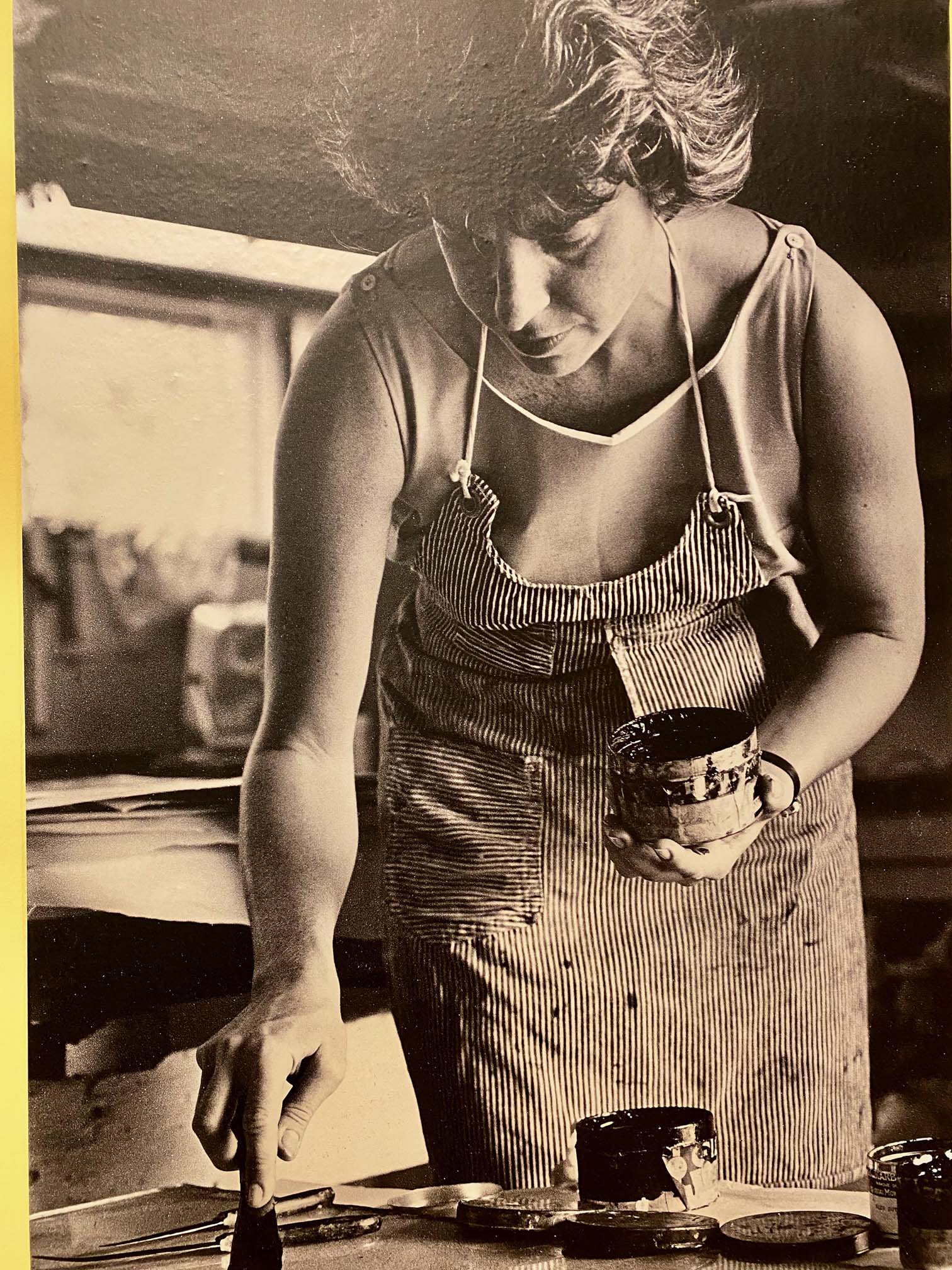
Hans Namuth’s 1964 photo of Frankenthaler working at ULAE in West Islip, NY. Courtesy: artist’s estate and University of Arizona’s Center for Creative Photography
The main gallery shows them alongside prints by Elaine de Kooning, telling the story of how these remarkable abstractionists collaborated with different workshops, used their distinctive styles to create portfolios, and formed decades-long bonds with master printers.
Helen Frankenthaler grew up and studied in the ever-evolving New York City art world. Her studies with Hans Hoffman – known for teaching abstractionists how to capitalize upon the “push pull” of color – and her technique of physically soaking and staining colors across canvases laid on her studio floor put her squarely at the intersection of the Abstract Expressionist and Color Field painting movements.
Frankenthaler had her first big solo painting exhibition in 1960, and began her printmaking experiments the following year. Some of her earliest works in the exhibition are silkscreens – some in the color-field direction, and some more gestural.
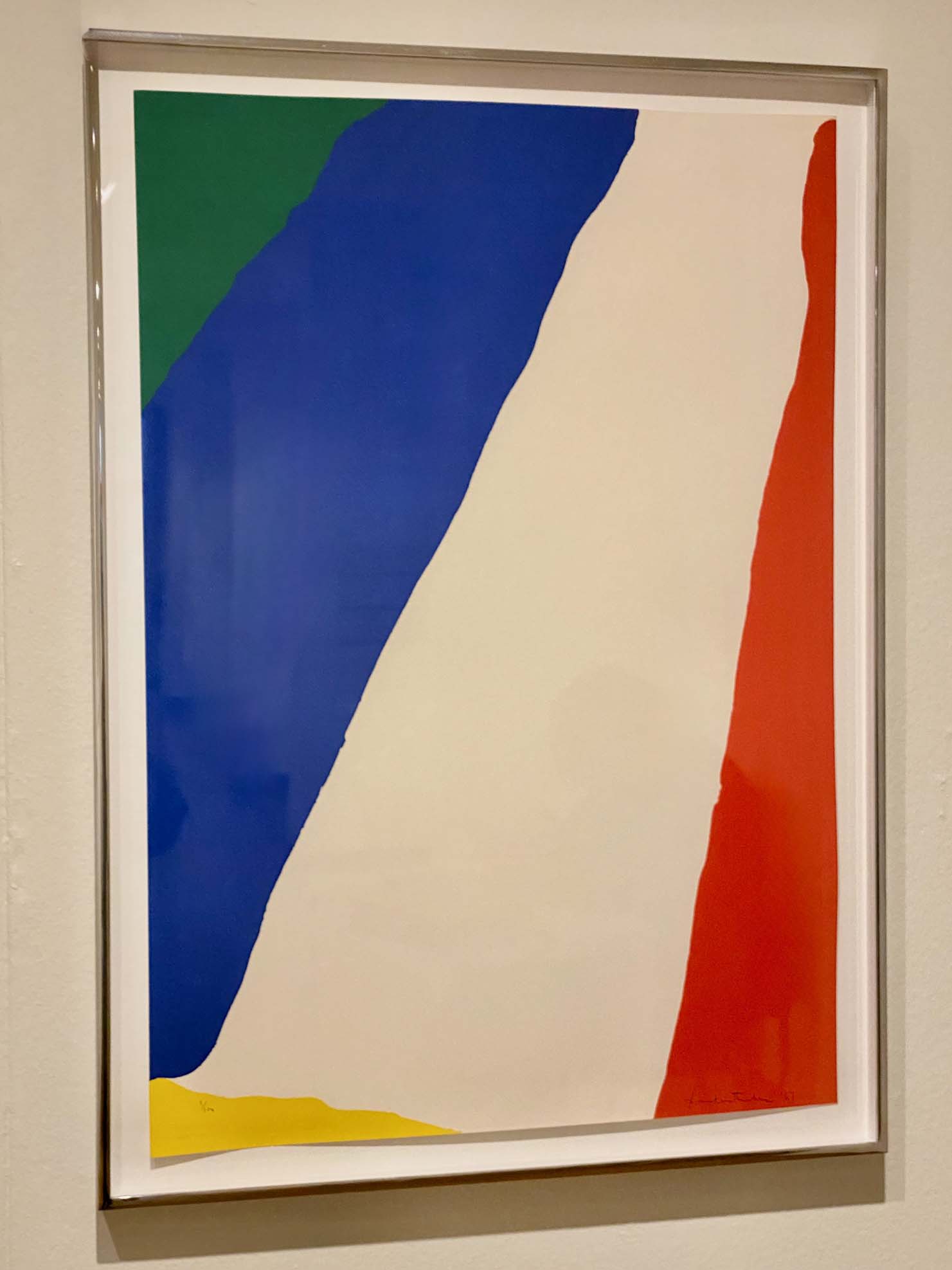
Frankenthaler’s 1967 untitled silkscreen (1/100); published by Chiron Press in New York; collaborating printer Patricia Yamashiro.
Frankenthaler’s 1970 silkscreen (artist’s proof) (19/24) from her What Red Lines Can Do portfolio, published by Multiples, Inc., NY; collaborating printers Sheila Marbain and Patricia Yamashiro.
Frankenthaler’s prints are grouped according to her work with various presses, such as Universal Limited Art Editions (ULAE), Tyler Graphics Ltd., and Tamarind Institute. Often with the guidance of print masters, she experimented to see how her “soak stain” could be layered and pressed multiple times across the lithography stone.
The exhibition curators display a series of proofs and experiments at Tyler Graphics to demonstrate the artist’s creative process with the expert printmaking team.
Frankenthaler’s 1978 lithograph Bronze Smoke (36/38) published by ULAE in Bayshore, NY; collaborating printers Thomas Cox and Bill Gordon.
Frankenthaler’s 1987 Sudden Snow lithograph proof (4/12); published by Tyler Graphics Ltd. (Mount Kisco, NY); collaborating printers Roger Campbell, Lee Funderburt, Michael Herstand, and Kenneth Tyler.
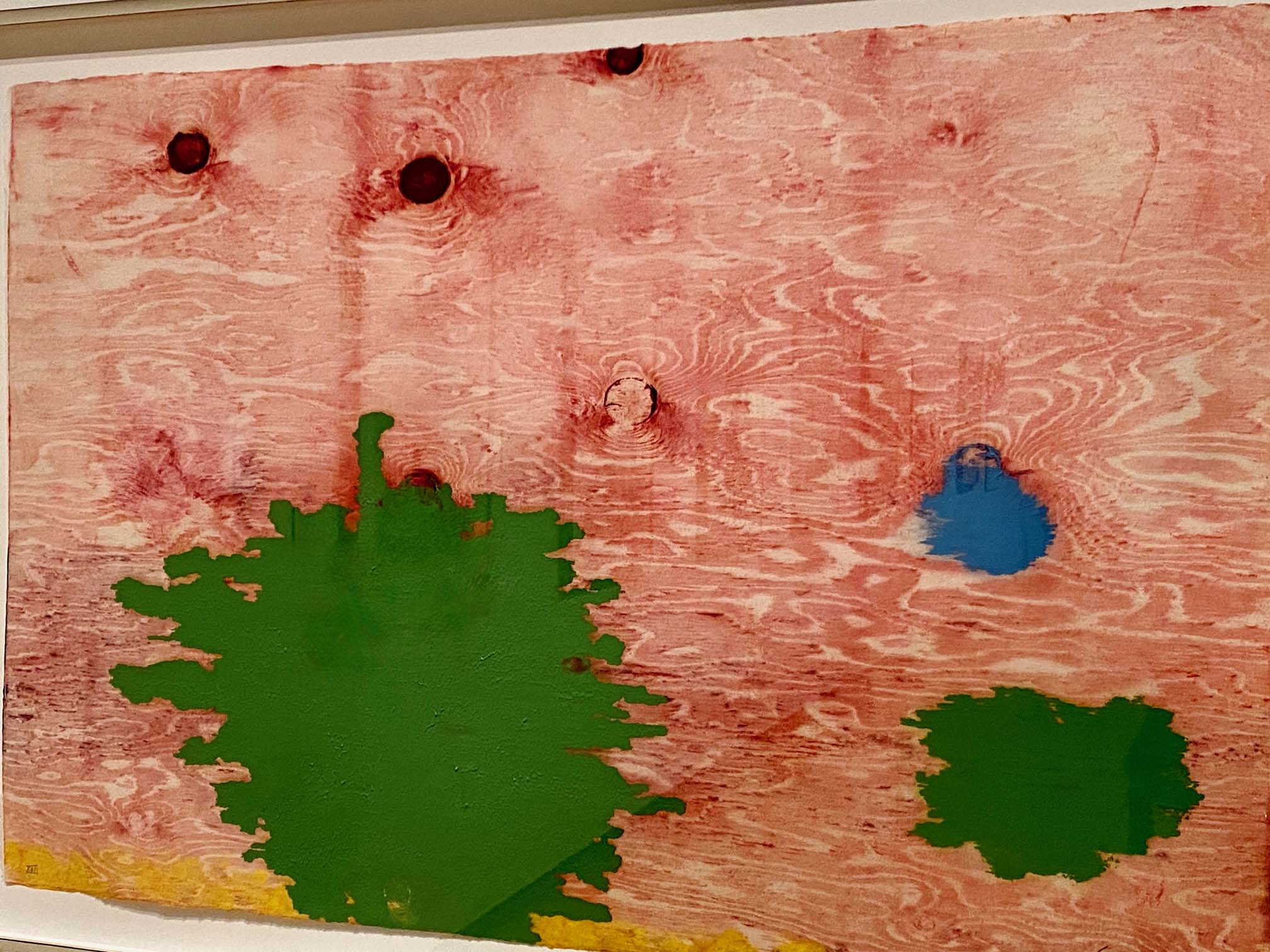
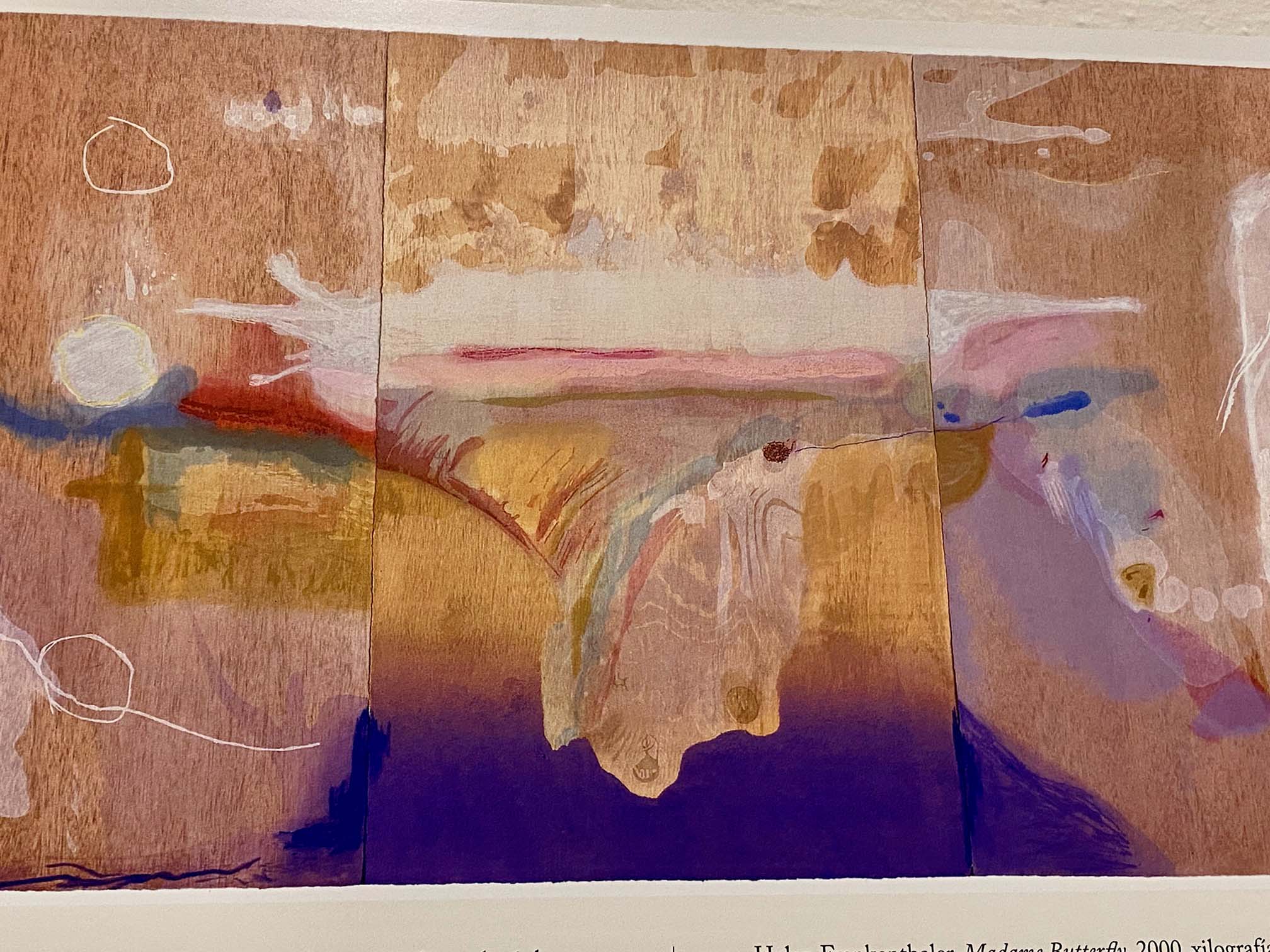
Later experiments show off Frankenthaler’s experimentation with woodcuts and monoprints. Here, she inked a woodblock and ran it multiple times to produce a “ghost print” of the wood, then applied bright red over the wood knots and added bright blobs of floating colors atop the natural backdrop.
Helen Frankenthaler’s 1991 Monotype XVII, published by Garner Tullis, NY; collaborating printers Emanuele Cacciatore, Benjamin Gervis, and Garner Tullis.
The exhibition also showcases two dramatic print series by action painter Elaine de Kooning made at the Tamarind Institute. Check out Elaine’s wild lithographs of bulls.
Elaine de Kooning’s 1973 lithograph Taurus XI published by Tamarind Institute in Albuquerque; collaboraring printers John Sommers and Ben Q. Adams. Courtesy: Tamarind Archive.
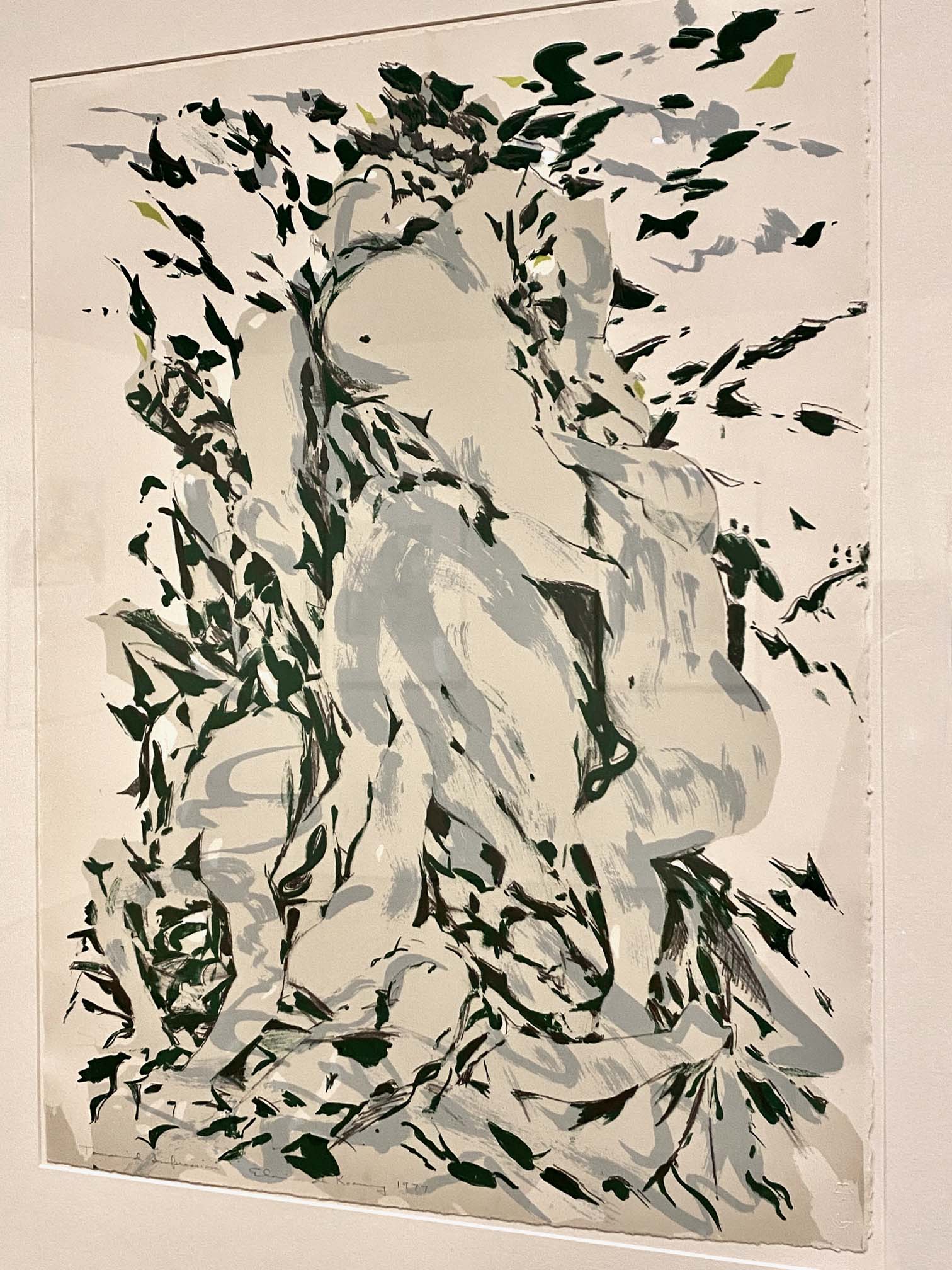
The curators also showcase Elaine’s multiverse interpretation of a famous Parisian sculpture in the Jardin de Luxembourg. The series mounted across the long wall gives gallery goers a close-up look at the intricate collaboration between Tamarind’s workshop masters and a midcentury mark maker.
The exhibition also includes prints from plenty of other mid-century abstractionists from the UNM collection – Motherwell, Diebenkorn, and Lewitt – as well as prints by current UNM students who were asked to create art inspired by Frankenthaler and company.
Take a look at all of these action-packed prints in our Flickr album.
Elaine de Kooning’s 1977 lithograph Jardin de Luxembourg II; published by Tamarind Institute; collaborating printers John Sommers and Marlys Dietrick. Courtesy: Tamarind Archive Collection.
Photo of Frankenthaler’s 2000 woodcut Madame Butterfly made from 46 woodblocks; published by Tyler Graphics Ltd. Courtesy: Canberra’s National Gallery of Art.
Edward Olecksak’s 1972 photo of Helen Frankenthaler and Bill Goldston working on Venice II at ULAE in West Islip, New York. Courtesy: Frankenthaler Foundation Archives
How did a stylish, ambitious, saavy librarian toiling in the stacks of Princeton’s library at age 22 transform herself into the trusted confidante of the richest man in the world, helping him to build a celebrated collection of manuscripts, books, and art?
Find out in Belle da Costa Greene: A Librarian’s Legacy, the blockbuster exhibition at The Morgan Library and Museum on display through May 4, 2025. To celebrate its 100th birthday, the Morgan Library & Museum wanted to honor its first director, Belle da Costa Greene.
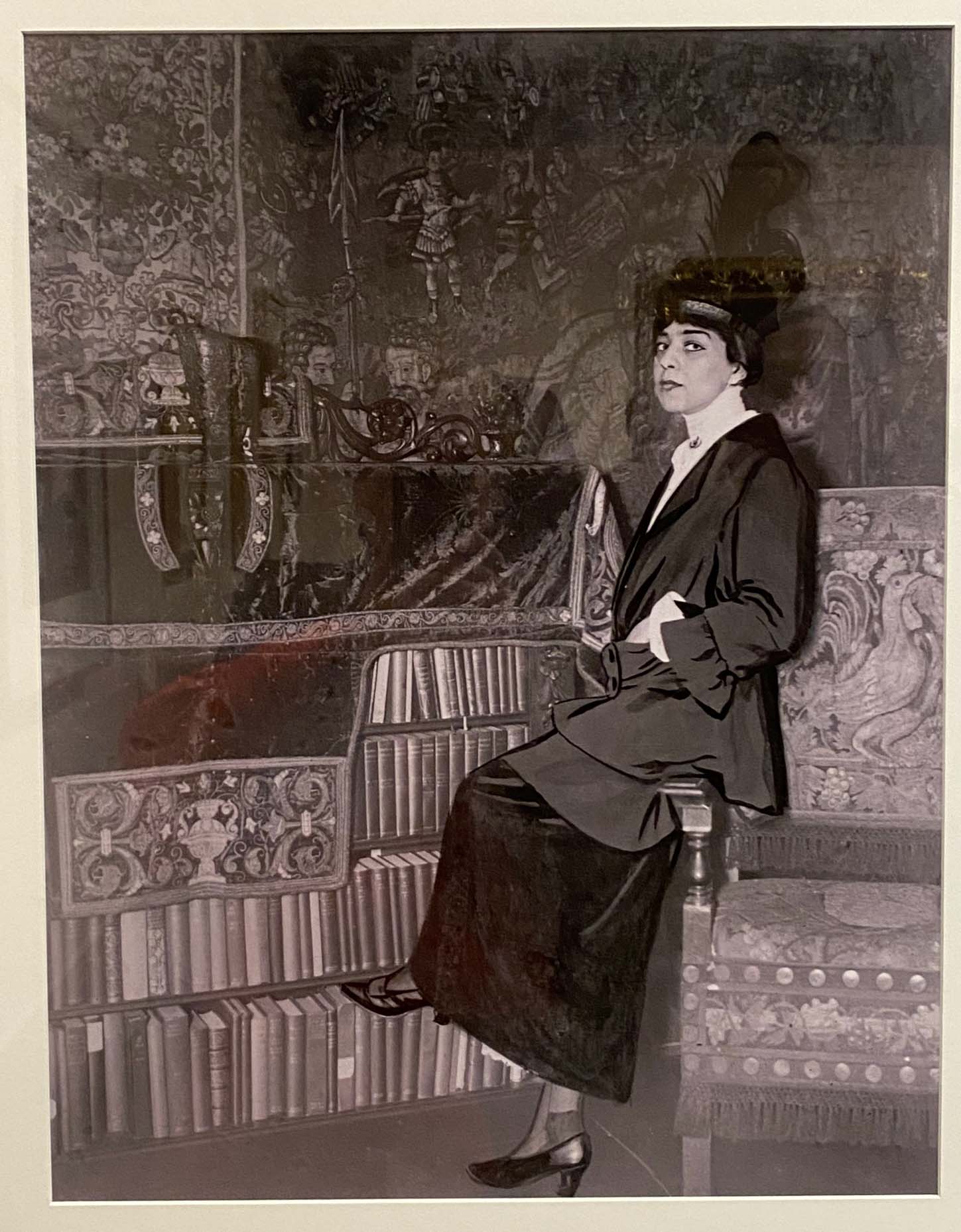
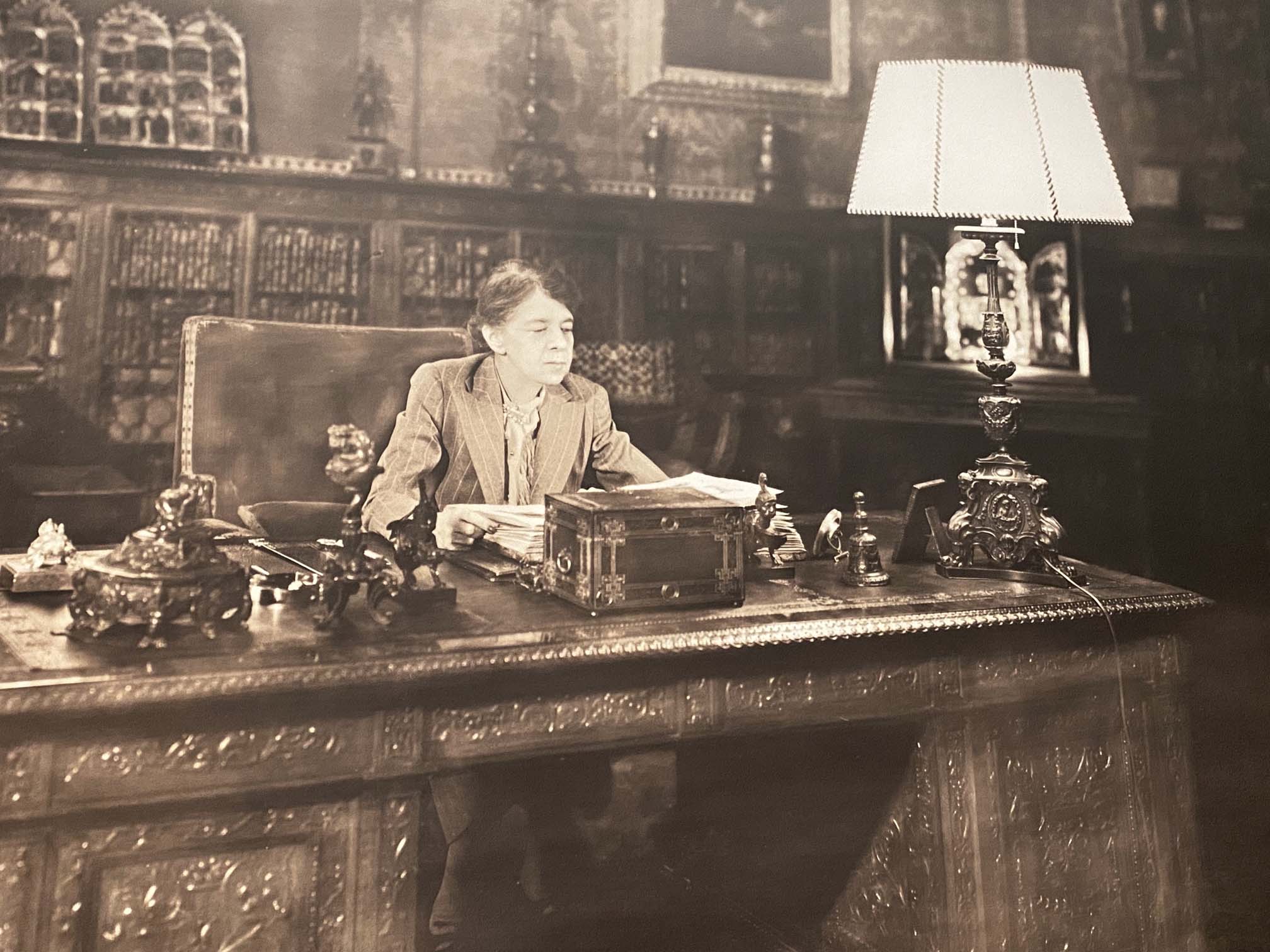
Belle Greene’s 1915 portrait at home; Paul Thompson photo for a news story on NYC high-salaried women. Courtesy: Getty/Bettmann.
Belle decended from an illustrious line of African-American intellectuals, lawyers, cultural leaders, and social-justice advocates, but lived her entire life passing for white in the early 20th century.
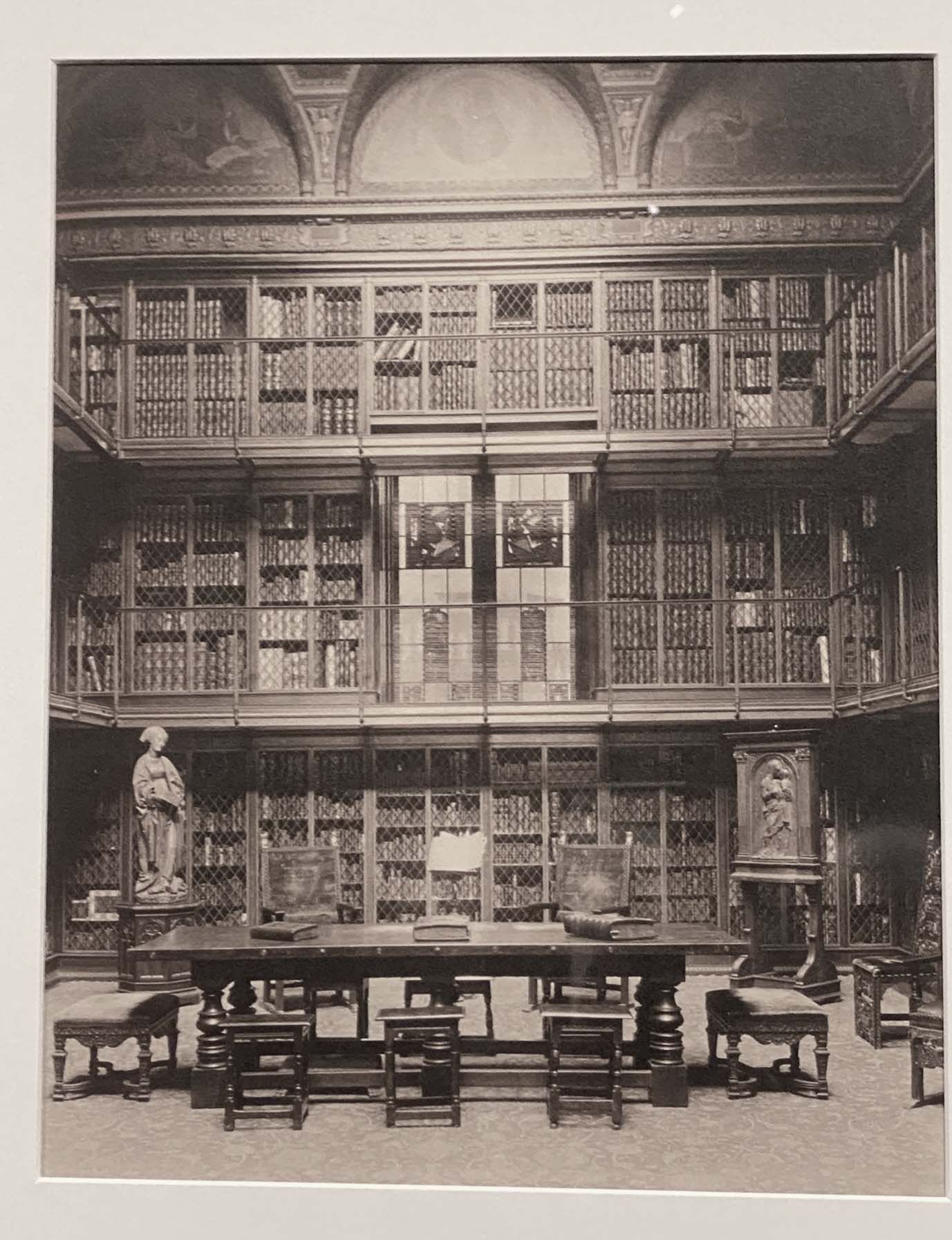
Tebbs & Knell’s 1923-1935 photograph of Mortan Library’s East Room with most of the 11,000 volumes acquired by Belle Greene.
As a young, culturally oriented woman, Belle dreamed of working in the brand-new field of library science. Her impressive intellectual curiosity and research skills attracted benefactors who helped her with tuition at the best schools. Ultimately in 1901, she landed a job at Princeton’s library (when the campus was still segregated).
She came under the mentorship of library-science champiom Junius Spencer Morgan, J.P.’s nephew who eventually recommended her to his uncle who was building a private library to rival the best in Britain and France. The rest was history.
The exhibition tells Belle’s personal story, documents her acquisition triumphs for Morgan, shows her fame as one of the highest paid professional women in New York, and explains how she spent four decades building Mr. Morgan’s library into a premiere cultural institution.
Belle deftly navigated through society by gaining acclaim as a scholar, curator, and cultural innovator – often as the only woman on the auction bidding floor or at scholarly societies.
When she set her mind to something, she usually found a way to acquire it – even if it took years of waiting and entreaties. It was a quality that J.P. Morgan admired in her. He paid her handsomely, and trusted her completely to acquire works across Europe in his name.
Illustration for The World Magazine (May 21, 1911), showing Belle in action with at the auction of Robert Hoe’s library.
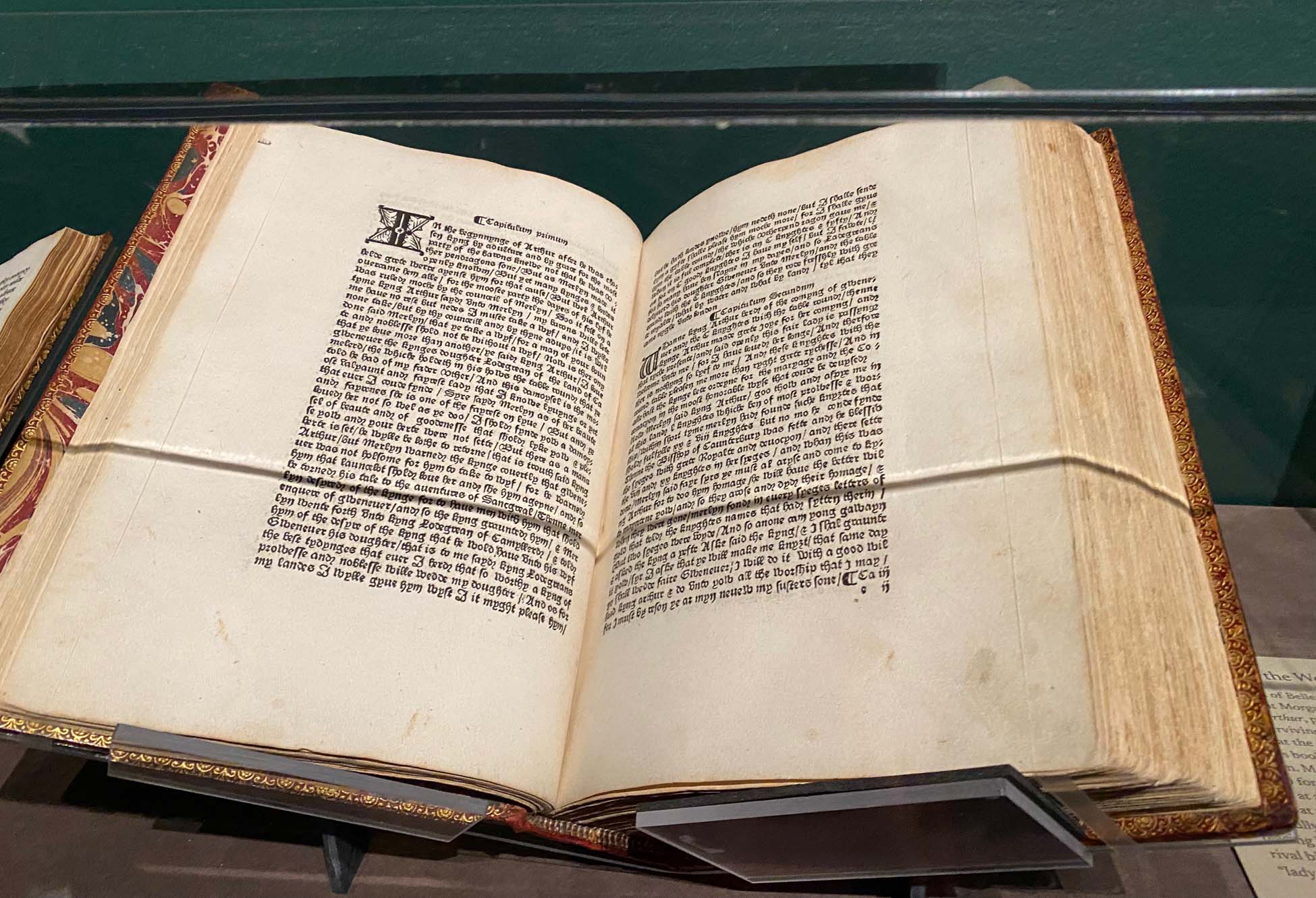
Belle Greene’s prized acquisition – the only surviving 1485 print edition of Thomas Malory’s Le Morte d’Arthur.
She even convinced Morgan to embrace classical Islamic art from India and Persia for the collection before other collectors caught on to their beauty and drove up prices.
In 1911, Belle purchased this 1750-75 album of Persian and Mughal paintings owned by British Museum expert Charles Hercules Read.
When Morgan died in 1913, his son, Jack, asked Belle to continue in her position and oversee the construction of the Annex on 36th Street.
In 1916 (without permission), Belle snuck over to Europe during World War I to convince an English collector to part with the much admired “Crusader Bible,” a gorgeous illuminated 13th century manuscript. Mr. Morgan had once made an offer for it. After Morgan died in 1913, Belle met with the collector in person, struck a deal, brought it back, and presented it to Jack Morgan for the collection.
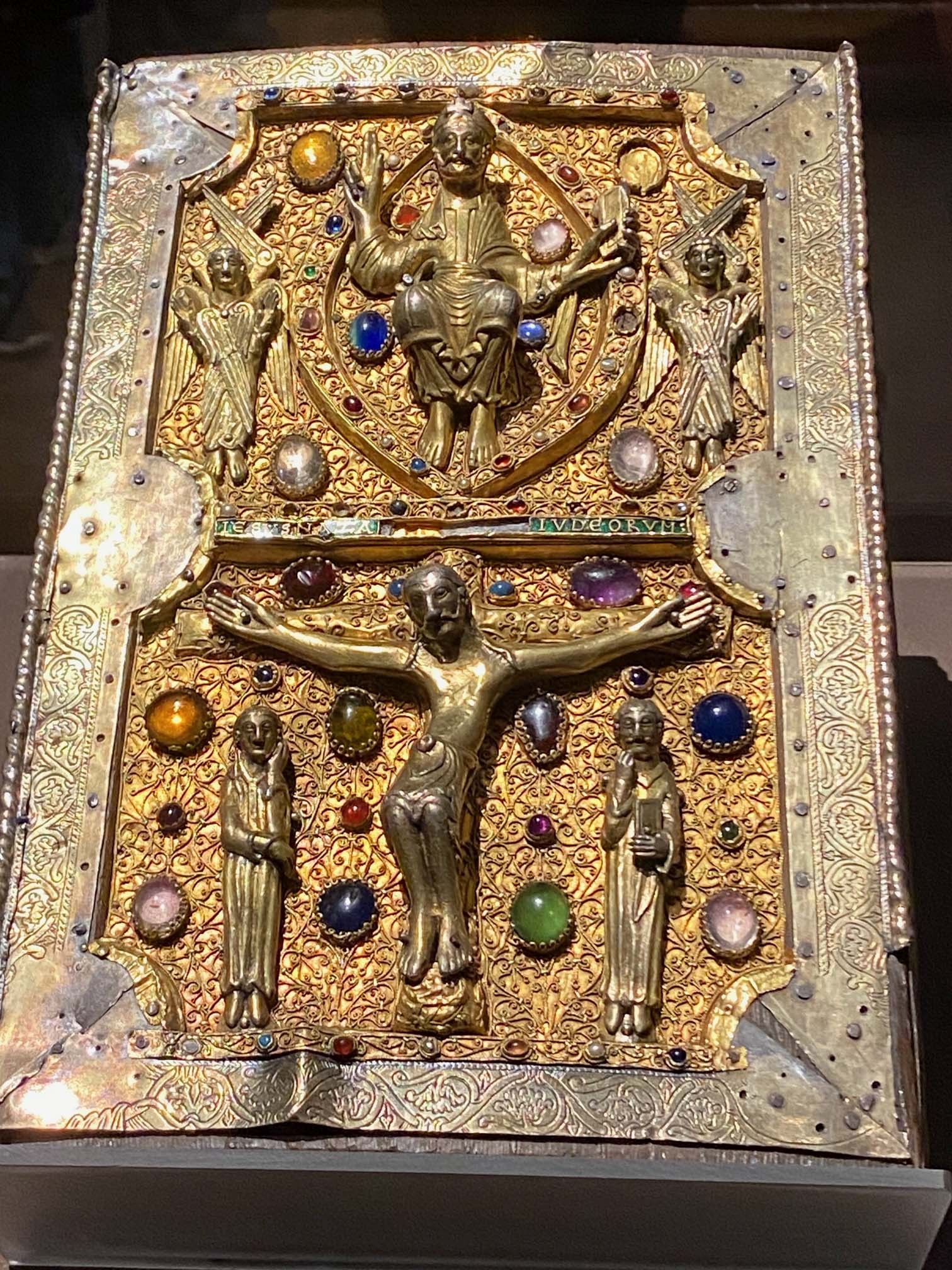
Jeweled cover of 1051-64 Gospels of Judith of Flanders – a 1926 purchase by Belle Greene and Jack Morgan.
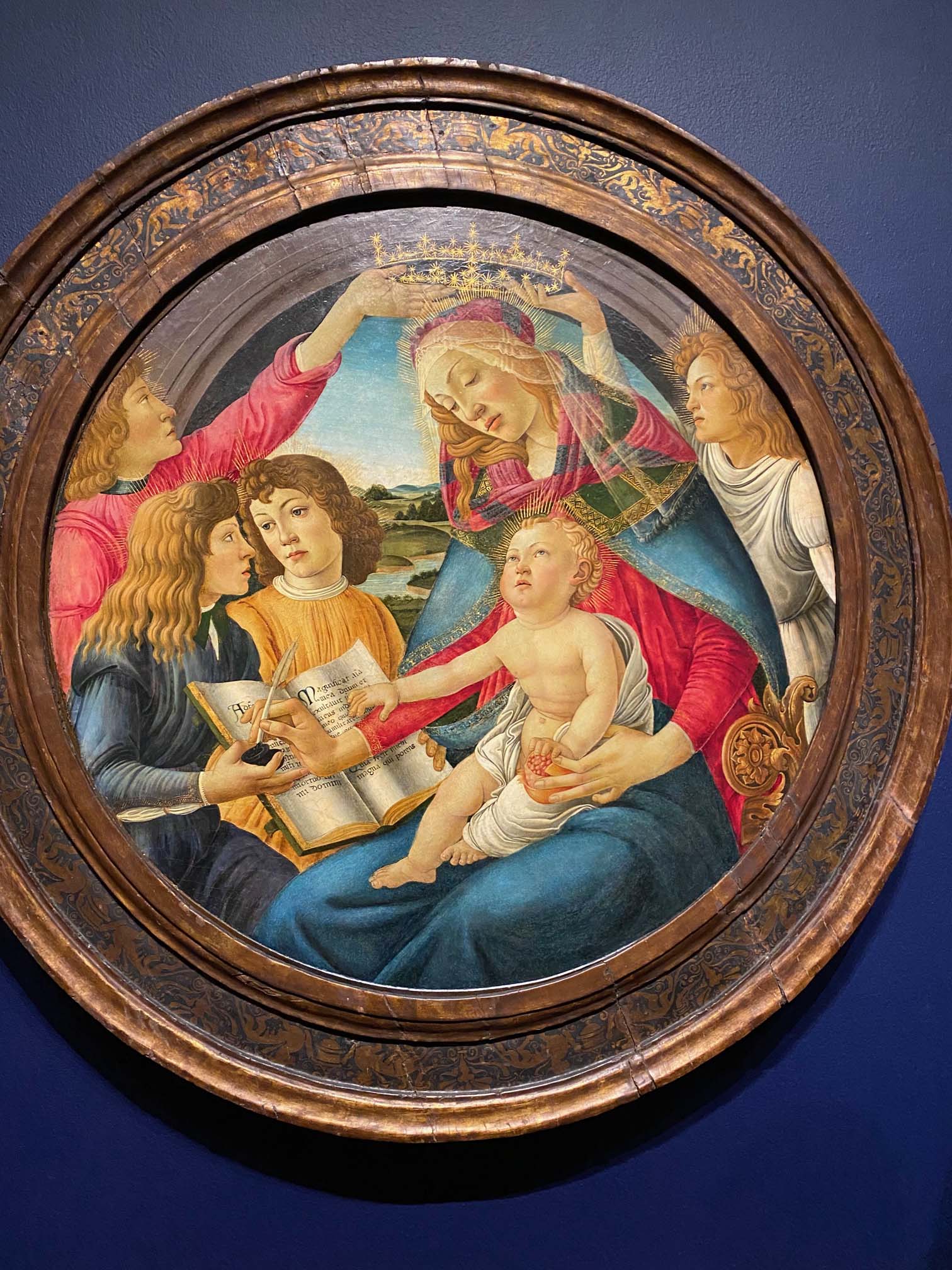
1490 Madonna of the Magnificent, a Florentine painting that Belle conserved, still hanging in Morgan’s study.
Her expertise in medieval illumination and manuscripts made her a friend and advisor for life among American and European scholars, collectors, and museum curators. The Metropolitan Museum made her a trustee for life, and often consulted with her on medieval masterpieces, fakes and forgeries, and other acquisitions.
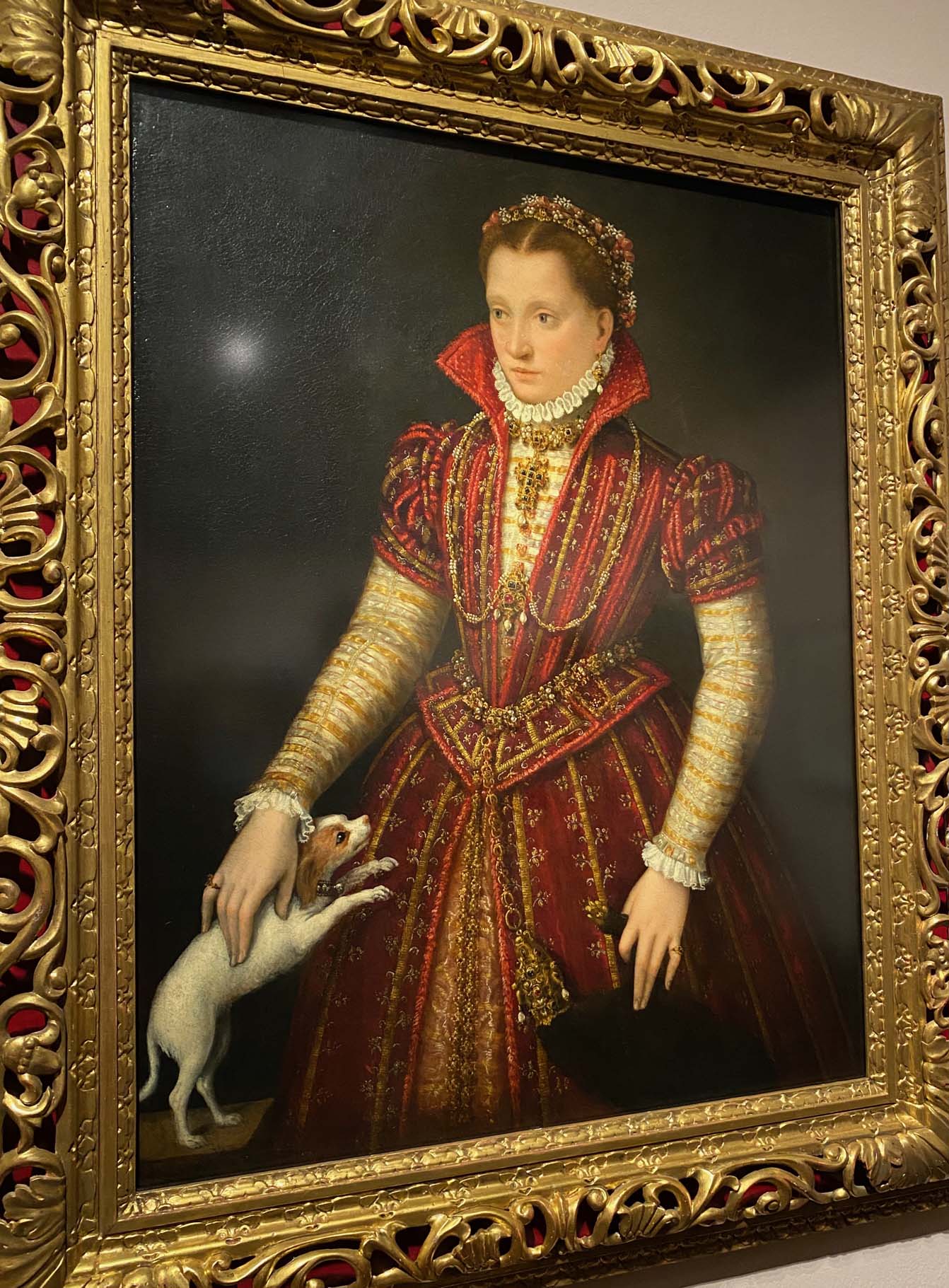
In Belle’s personal art collection – Lavinia Fontana’s 1580 Marriage Portrait of a Bolognese Noblewoman. Courtesy: National Museum of Women in the Arts.
From Belle’s jewelry– Benedetto Pistrucci’s 1840-1850 jasper and gold Head of Medusa. Courtesy: The Metropolitan Museum.
The curators tell her story across two galleries using items from the Morgan’s collection (including the many portraits of her!) as well as paintings, prints, photographs and documents from 20 other lenders. Take a peek into the exhibition and hear the Morgan’s curators summarize Belle’s ground-breaking achievements:
Explore the works at your leisure here as you complete a 3D digital walk-through on the Morgan’s website. You can also listen to the audio tour from right inside the virtual gallery.
Get to know this legend, and take a look at our favorite exhibition pieces in our Flickr album.
The ony question is – who will play Belle in the movie?
1950 photo of Bella reviewing her last acquisition, a 10th century Gospel Book from France. Courtesy: Harvard University’s Berenson Library in Florence, Italy.
Take a look at generations of 20th century craft mentorship in Craft Front & Center: ConversationPieces, on view at MAD Museum through April 20, 2025. The exhibition shines a light on how innovators shaped subsequent generations of craft artists at schools and art colonies across the United States. The curators have pulled from the MAD collection to show us the work of student and teacher side by side in several disciplines – fiber arts, ceramics, and glass.
Many of the mentors either taught at or were influenced by the Bauhaus, the legendary early 20th century design incubator.
Who are the generational inspirations for Eve Biddle’s 2019-2023 tiny ceramic sculptures, New Relics?
Bauhaus students could take classes in weaving, ceramics, typography, and metalwork alongside traditional fine arts classes. They were expected to excel in their applied-arts training and mix in aesthetics learned in their fine arts classes.
Bauhaus innovator Margeurite Friedlander Wildenhain’s 1966 Square and Textured Vase
When the Nazis closed the progressive school in 1933, many German-Jewish refugee teachers and students fled, transplanting Bauhaus design and educational philosophies across the world.
MAD highlights several artists – including Anni Albers, Trude Guermonprez, Margeurite Friedlander Wildenhain, and Maija Grotell – who came to the United States and integrated Bauhaus practice into curriculums at Black Mountain College, the California College of Arts and Crafts, Cranbrook, and new craft workshops they began.
One of the best-known 20th century textile artists, Anni Albers is featured in the show by a fine-art “pictoral textile” made on a small handloom. At the Bauhaus, Albers she trained under master weaver Gunta Stölzl, and eventally took over as head of the textile workshop. Albers moved to Black Mountain College in North Carolina with her husband, painter Josef Albers, and was the first textile artist invited by MoMA to have a one-person exhibition.
Anni Albers’s 1959 textile Sheep May Safely Graze made on a small handloom using gauze weave technique
Anni also designed commercial textiles for Knoll for years. Her influence on the next generation of painters and textile artists was profound.
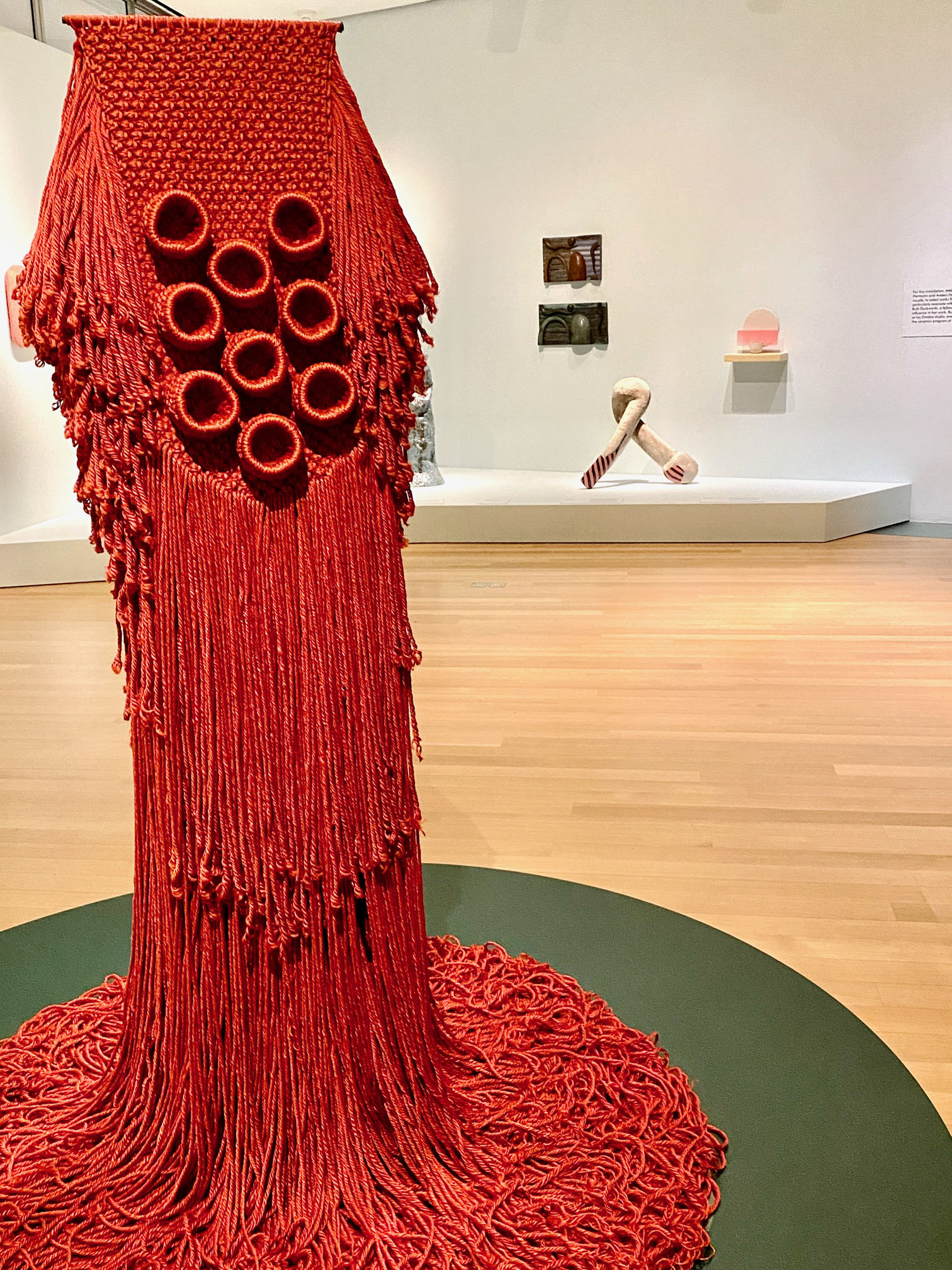
MAD features work by two fiber-arts innovators (and Albers admirers) who pushed boundaries by crafting commanding, large-scale sculptures. Sheila Hicks (who studied with Josef at Yale) and Claire Zeisel (who studied with the former Bauhaus faculty at Chicago’s IIT) are credited as the leaders of America’s textile arts movement. Tufts burst from the wall in Hicks’ piece, and Zeisel’s hovers in the center of the gallery like a shaman.
Sheila Hicks’s 1968 Dark Prayer Rug, inspired by Anni Albers and Mexican and Moroccan textile artists.
Claire Zeisler’s 1967 Red Wednesday with braid and cords twisting the sculpture’s armature
Trude Guermonprez, an unconventional materials artist known for innovations in three-dimensional weaving once worked at Berlin’s textile engineering academy; later, she consulted with industrial textile firms, as did Anni Albers.
Next to Guermonprez’s dynamic 3D hanging woven sculpture, MAD shows us a piece by Kay Sakimachi, a student who met Guermonprez in 1951 at the California College of Arts and Crafts summer craft workshop.
Guermonprez encouraged students to use latest technology, and here we see how Kay used a 1959 invention by DuPont – monofilament that’s better known today as fishing line. Kay’s woven it into an ethereal hanging sculpture.
Innovative fishing-line weaving 1968 Kunoyuki by Kay Sakimachi alongside 1962 Banner by her mentor, Trude Guermonprez.
In ceramics, MAD displays a series of vessels that transform into sculptures, starting with a modest, contained piece by Margeurite Friedlander Wildenhain, one of the first Bauhaus students and the first woman in Germany to be honored as a master potter. After emigrating to the United States in 1940, Wildenhain founded Pond Farm Workshops in Sonoma County, California ad instituted a rigorous Bauhaus instructional approach.
Frances Senska, her ceramics student, applied Wildenhain’s instructional principles to her own classes at Montana State, where student Peter Voulkos learned how to breathe new life into clay. Voulkos shashed, prodded, and poked clay, vigorously transforming the humble medium into wild, dramatic expressions.
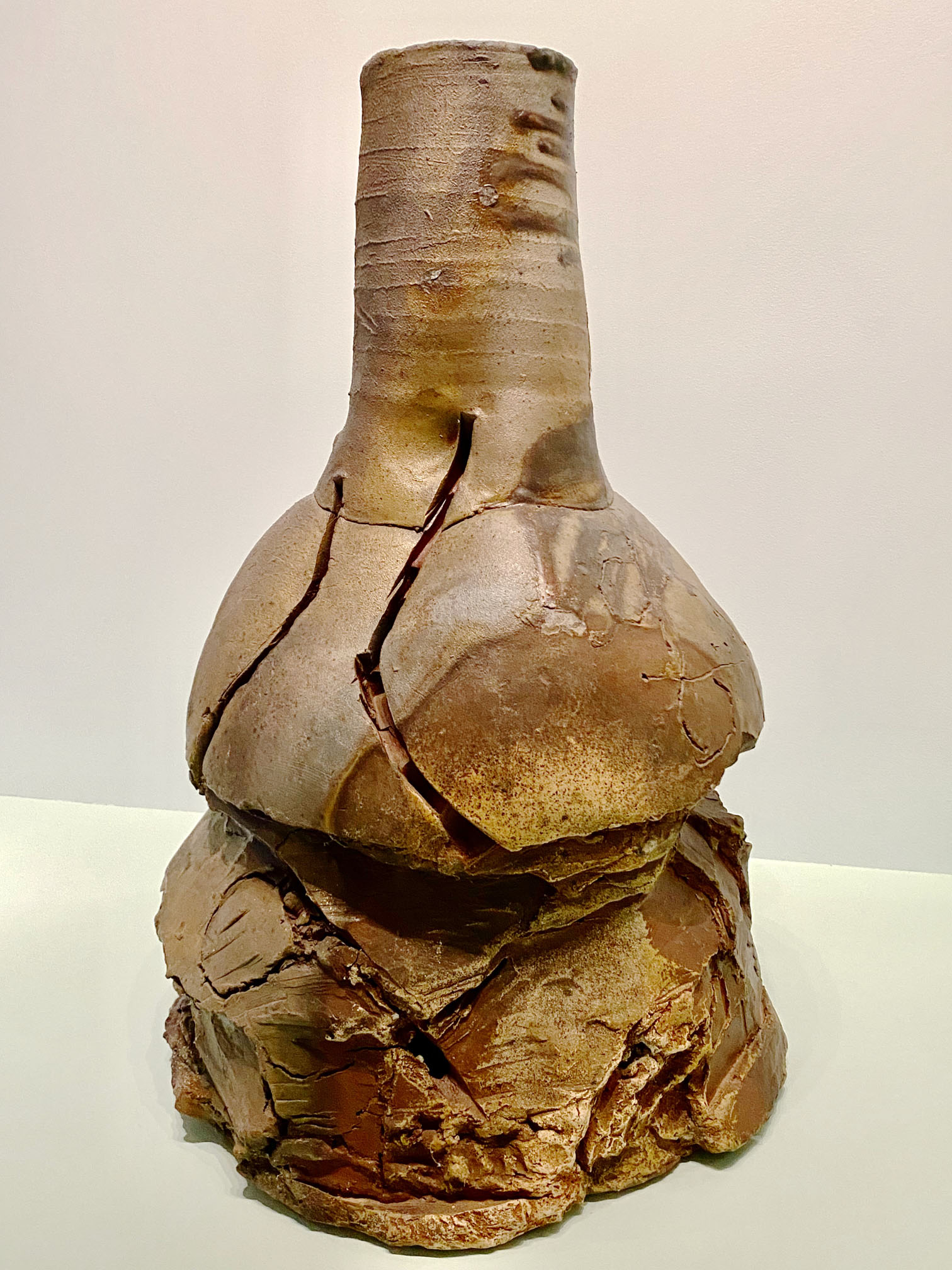
Peter Voulkos’s 1992 stoneware Sibley, an example of his revolutionary approach to ceramic form.
Mary Ann Unger 1994 terra cotta Hoist – an approach to ceramic sculpture inspired by teacher Peter Voulkos
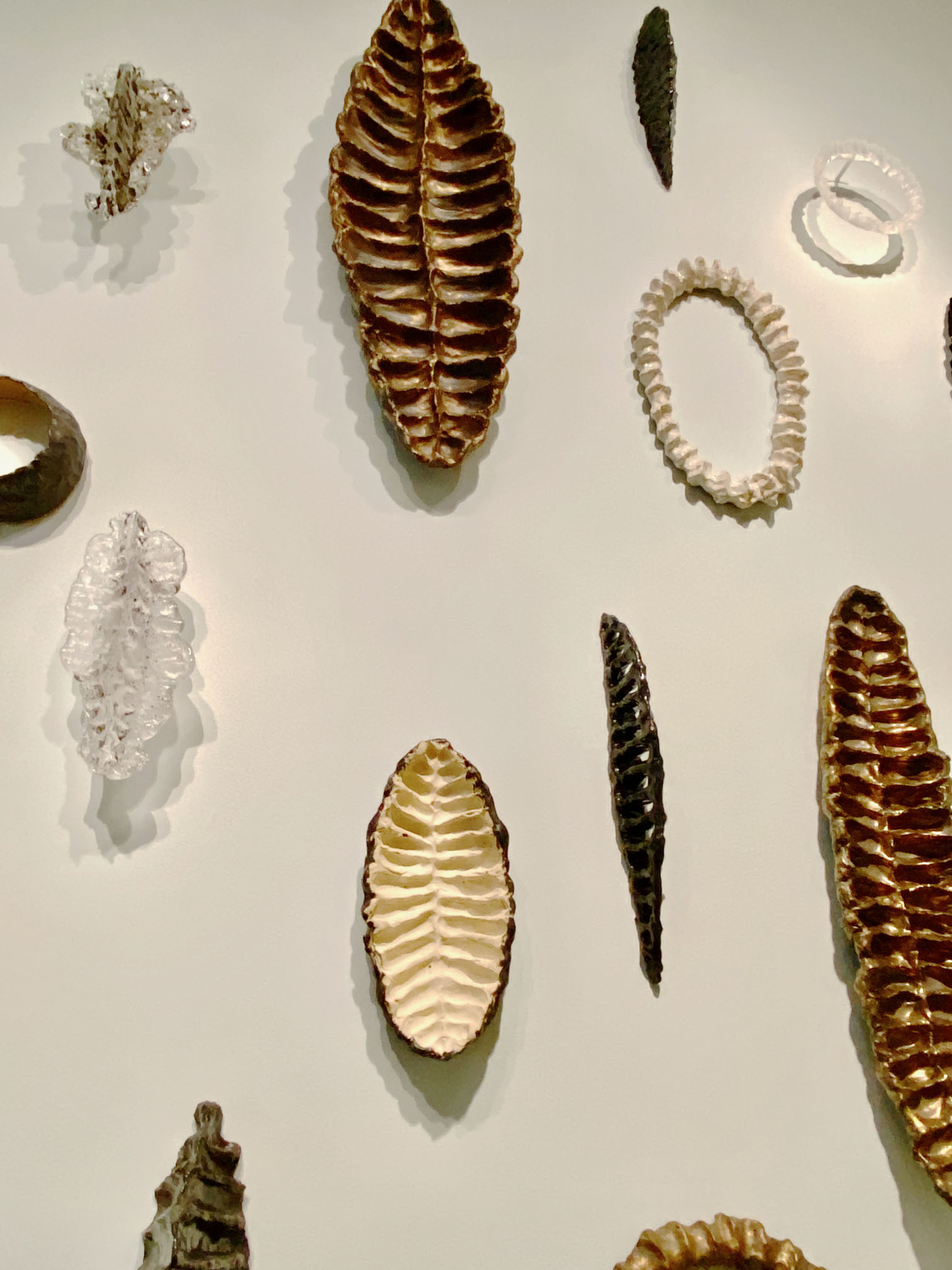
In turn, his UC-Berkeley student, Mary Ann Unger injected whimsey and improvisation into her sculptures, which allowed her daughter, Eve Biddle, to push it even further. MAD shows Biddle’s ingenious installation of creative ceramic geodes, trilobites, and spines crawling around the gallery wall.
Ceramics mentors even play a role in the development of America’s Studio Glass movement, which begins with Harvey Littleton, whose dad was a physicist on the first reasarch team at Corning Glass Works (he later developed Pyrex). MAD displays Harvey’s gorgeous glass arcs.
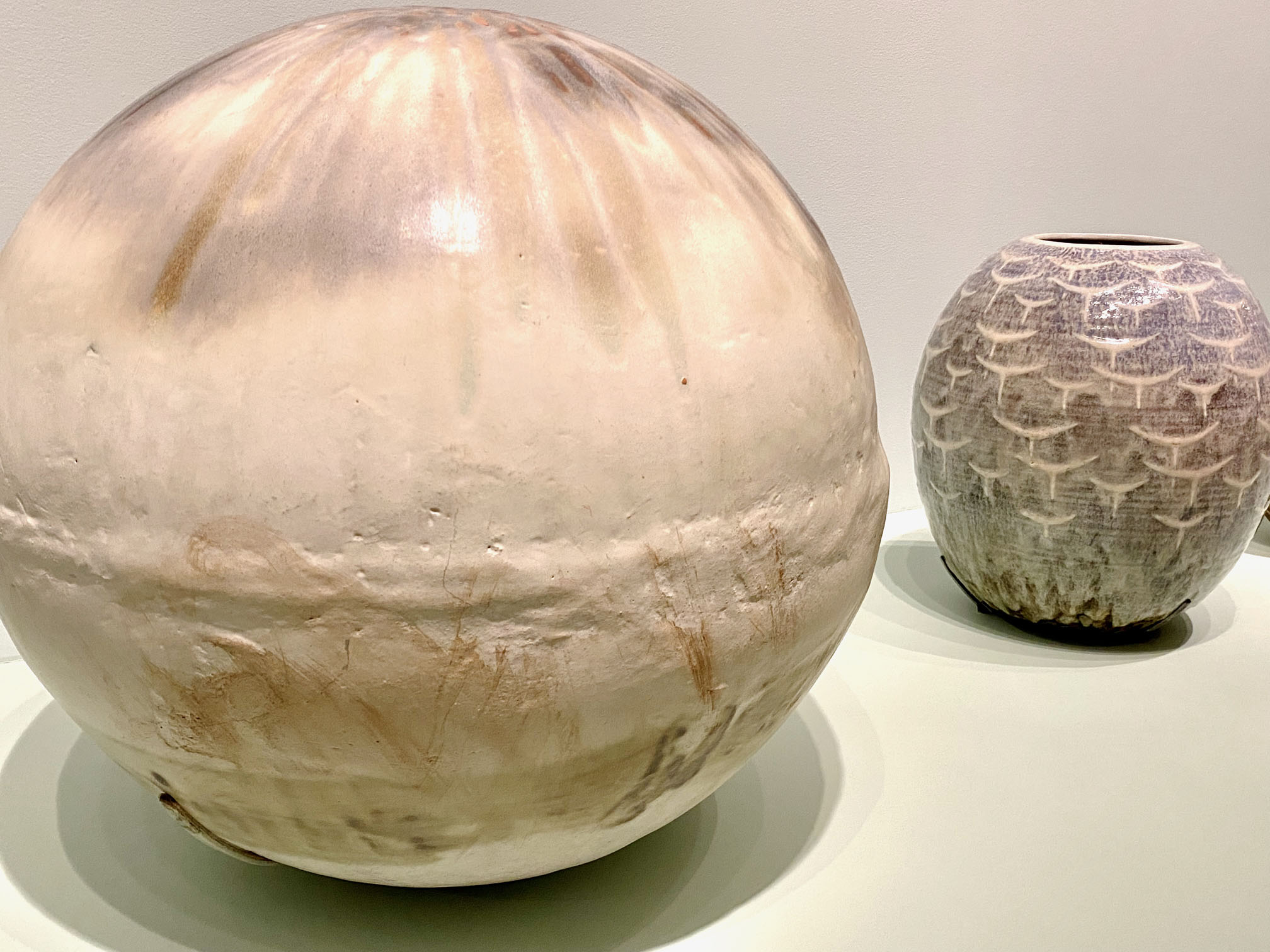
Work by student and teacher: Toshiko Takaezu’s 1995 stoneware Mist #2, part of her Moon series, with Maija Grotell’s 1953 glazed earthenware vase
On weekends, Harvey spent lots of time with his dad in the Corning lab, assuming he would follow in dad’s footsteps as a physicist at the University of Michigan. But after Harvey experienced UM art classes, he switched major. Eventually, he was specializing in ceramics under Maija Grotell at Cranbrook Academy of Art (who also taught ceramic superstar Toshiko Takaezu).
Littleton’s travels to observe the Italian glassmaking masters at Verano inspired him to apply his kiln and physics skills to experimental glassmaking. Back home, e pioneered low-temperature glass-blowing techniques that enabled glass artists to create work in studio setting and not a factory.
Littleton achievement was established the first university-based glass-blowing program at University of Wisconsin-Madison. A lucky undergraduate, Dale Chihuly, learned from the master, and the rest was history for American glass making.
Glass sculptures by teacher and student – 1983 Double Blue Arches by innovator Harvey Littleton and 1968 Wine Bottle by created by Dale Chihuly in Venice under a Fulbright Fellowship.
After receiving his MFA in ceramics at RISD, Chihuly traveled to Venice (like his mentor), and observed how the team worked together to create a finished work of glass art. In 1971, he founded Pilchuk Glass Works in Washington State, where he emphasized the collaborative, collective process. Chihuly’s own sculptural wonders emerged, plus the next generation of indigenous glass artist gained experience in collaborative expression – Tony Jojolla and Preston Singletary.
There are many more stories told in this illuminating exhibition from the MAD collection. Take a look in our Flickr album.
Tony Jojolla’s 1996-1997 Large Glass Olla, a traditional Pueblo pot made of glass at Dale Chihuly’s Pilchuk School; at right, Chihuly’s 1978 Untitled Basket
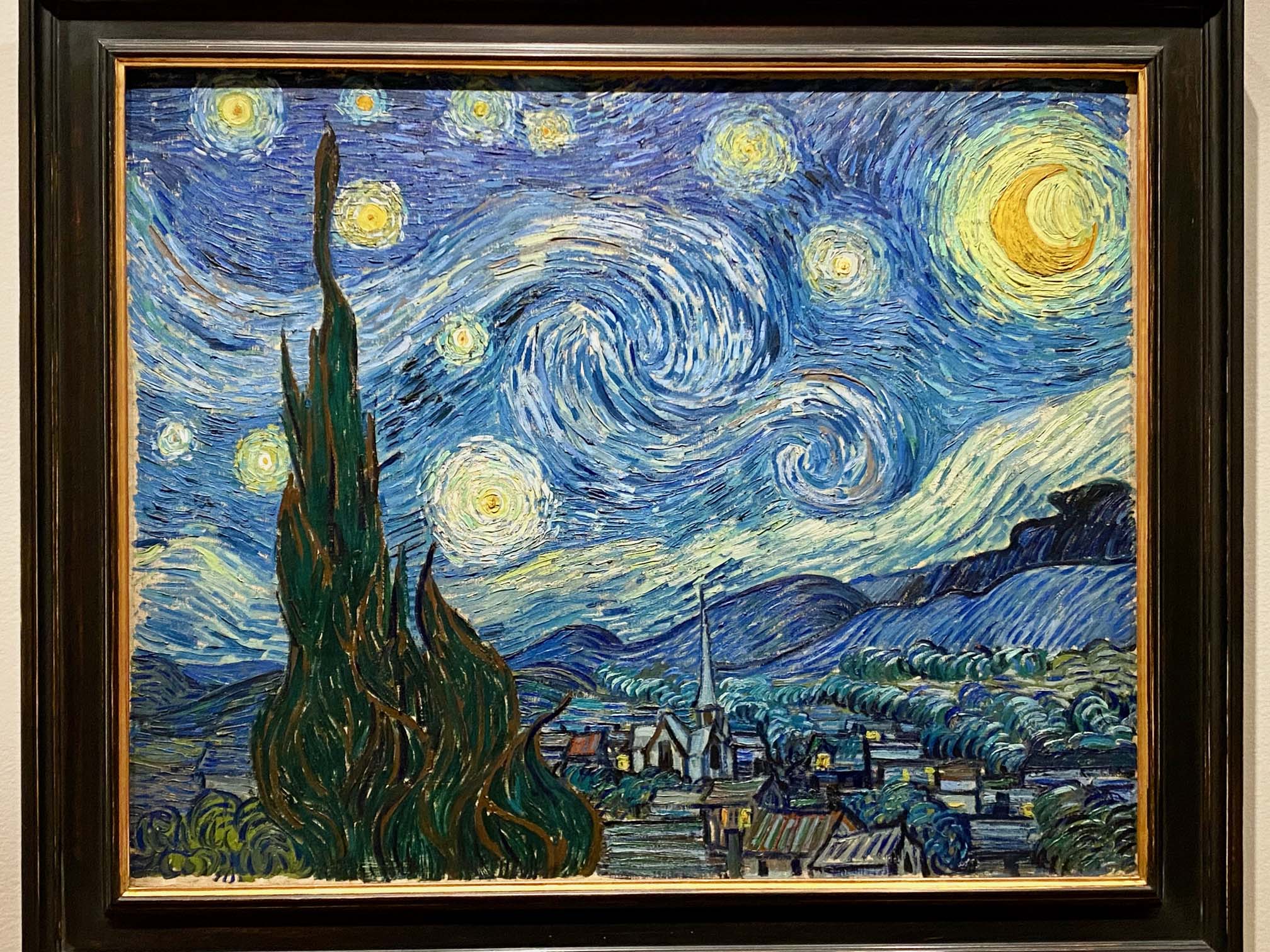
When you peek into the second-floor MoMA exhibition, you’ll see where Van Gogh’s The Starry Night has been holding court for the last few months.
Lillie P. Bliss and the Birth of the Modern, on view through March 29, tells the story of how one woman’s passion for modern art over a century ago formed the basis of the MoMA collection and MoMA itself.
Van Gogh’s 1889 The Starry Night, one of MoMA’s most beloved works.
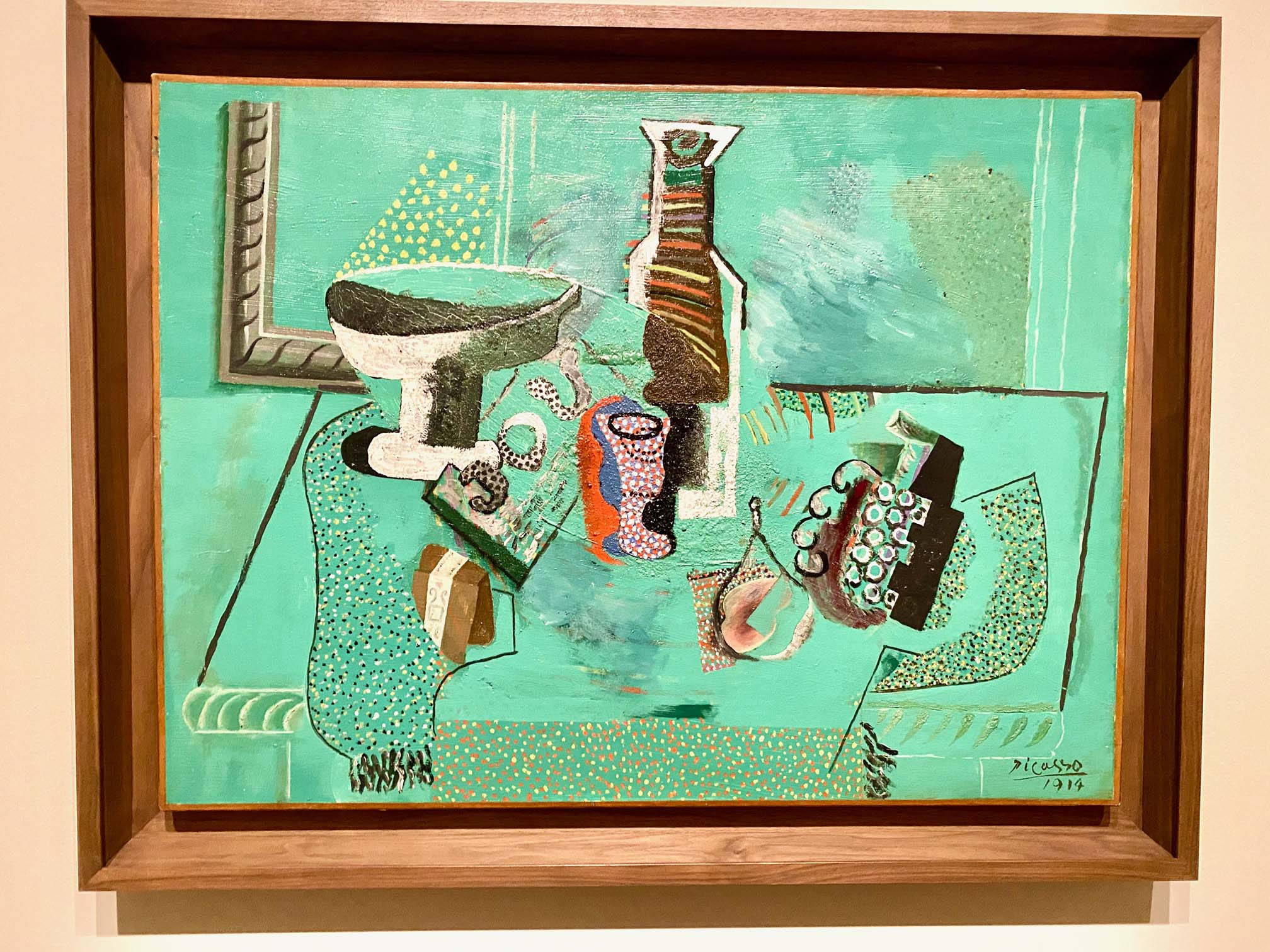
Bliss was an early American patron of Cézanne, Seurat, Picasso, and Redon at a time when New York society looked askance at modern art’s tilted tables, fractured still lifes, and stippled surfaces. She even contributed to getting the 1913 Armory Show off the ground as a sponsor, art lender, daily visitor, and new-work buyer.
Maybe the constraints of growing up female in the Victorian era gave her an appreciation for the lack of inhibition Picasso’s and Matisse’s colors, Gauguin’s wild Tahitian woodcuts, and Redon’s ethereal woodsy fantasy figures.
Picasso’s 1914 Green Still Life.
Endless modern-art discussions with art-world friends and mentors Arthur Davies and John Quinn gave her a sophisticated view of all the latest artists and trends. She joined a small group of modern-art lovers to lobby the Metropolitan Museum of Art to show the latest breakthroughs from Europe.
In 1921, the Met acquiesced and borrowed enough art to mount an exhibition of French impressionist and post-impressionist work. Bliss anonymously lent twelve pieces. People came to look, but the Met still resisted acquiring work that it considered too far-out.
When Bliss came into her inheritance in 1923, the pursestrings were unleashed. At age 49, she began to assemble the collection of her dreams via annual European buying trips and estate sales. Where could she show it?
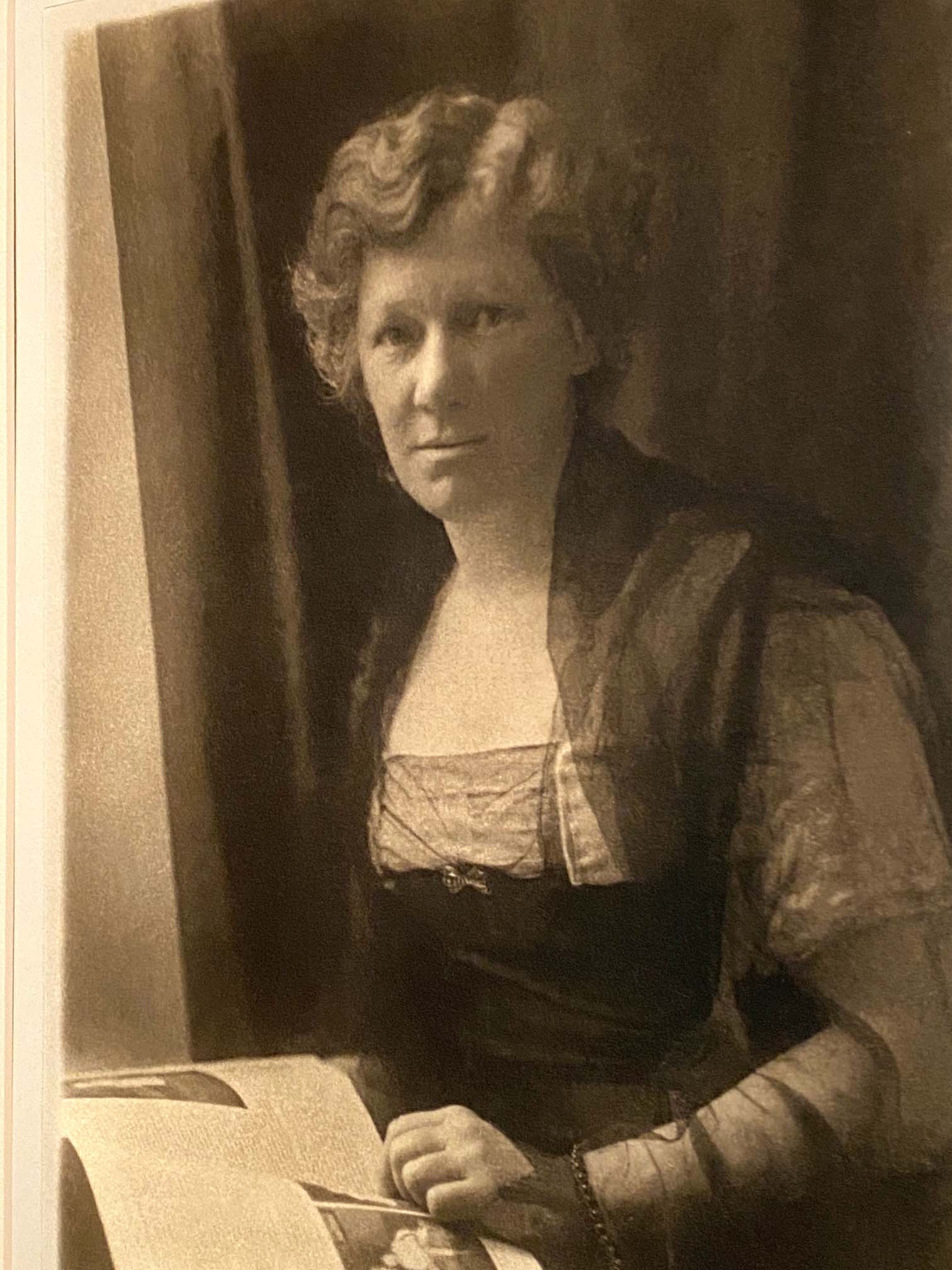
1904 portrait of Lillie P. Bliss
In 1928, she bought a lavish uptown triplex with a two-story gallery. She hung her favorite Cezanne over the grand piano and arranged a “who’s who” of avant-garde masters. Check out The Bather front and center, surrounded by Picassos, Seurats, and Gauguins.
1929-1931 photo of Lillie P. Bliss’s modernist collection hung in the music room of her Park Avenue apartment
Cézanne’s 1895-1898 Still Life with Apples hung at home in the place of honor, above the piano
The next year in a brainstorming session with Abby Rockefeller and Elizabeth Parkinson, the trio decided that New York needed a special place that was devoted exclusively to modern art. MoMA was born!
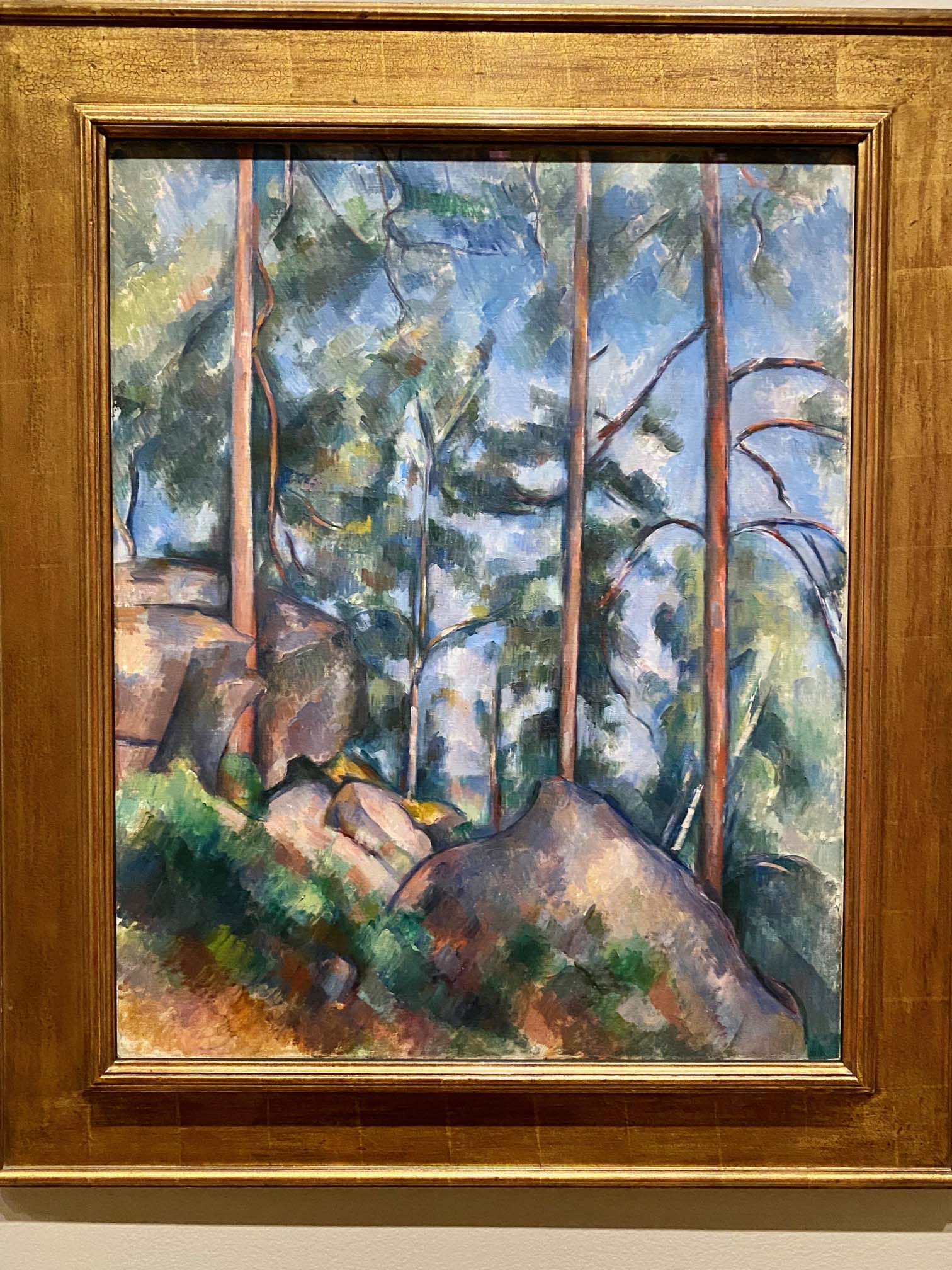
MoMA’s first exhibition – Cézanne, Gauguin, Seurat, van Gogh – was mounted in rented space at 730 Fifth Avenue, and crowds came. The exhibition was a huge popular success, even though it coincided with the historic 1929 market crash.
Cézanne’s 1897 oil Pines and Rocks (Fontainebleau?)
Seurat’s 1884 crayon drawing A Woman Fishing.
Lillie’s health crashed, too. On the heels of MoMA’s test run, she was diagnosed with cancer, and started drawing up a will to ensure that her beloved collection would carry on when she could not. She gave a Monet and a few gems to the Met, but bequeathed 150 works to the new Museum of Modern Art – forming the core of the collection we know today.
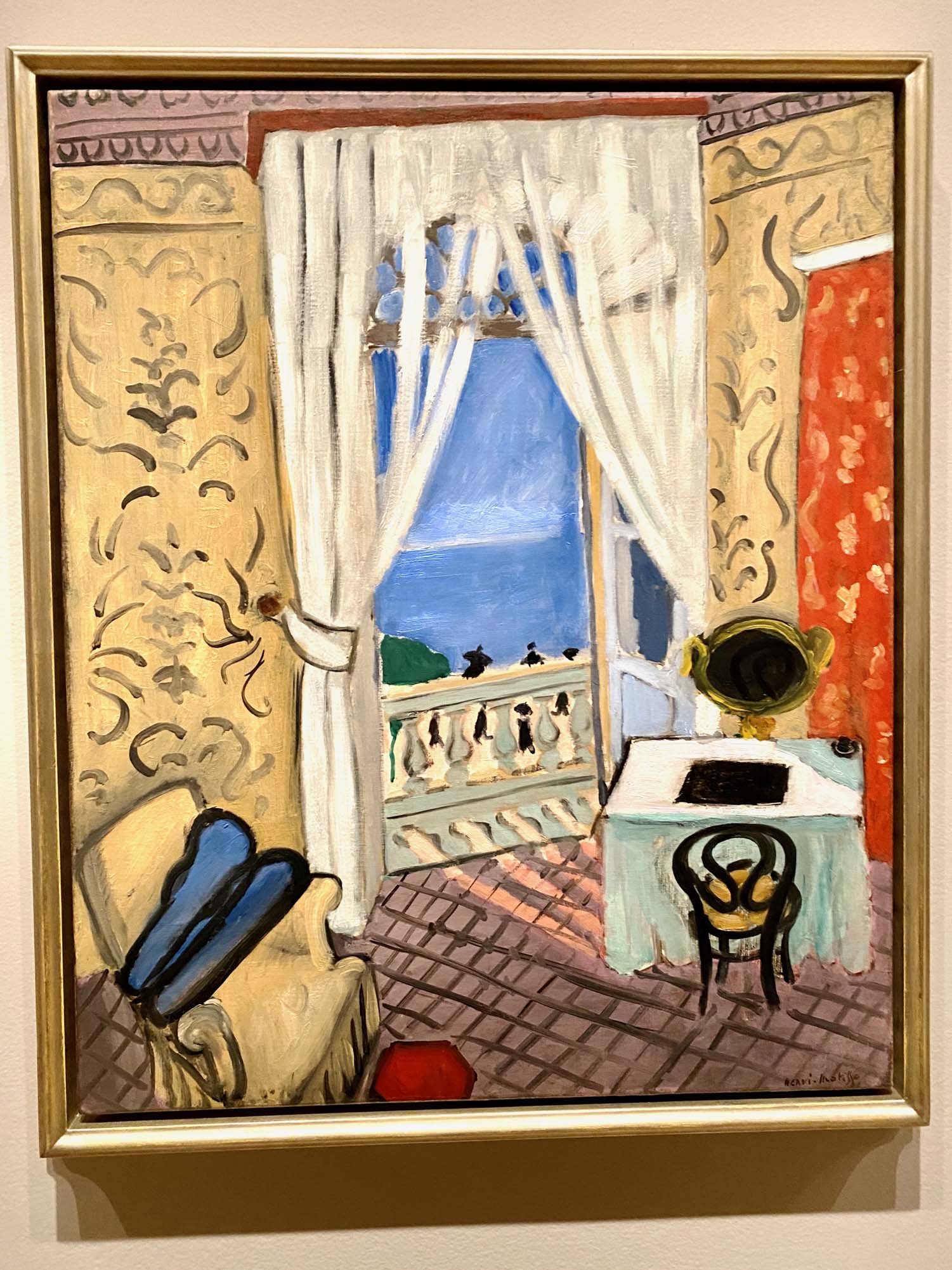
Matisse’s 1918-1919 Interior with a Violin Case.
When Lillie died in 1931 at age 66, there was only one last thing. She was never able to acquire a Van Gogh. But in her will, she did give the museum permission to sell or exchange most of the paintings she bequeathed.
A few years later, MoMA sold one of Lillie’s Degas to acquire Picasso’s epic Demoiselles d’Avignon.
And in 1941, Alfred Barr made her dream come true. He heard that a dealer possessed a very special Van Gogh, and traded three of Lillie’s paintings for The Starry Night.
See our favorite works in our Flickr album, and enjoy other stories about this visionary MoMA founder by listening to the audio guide for the exhibition here.
Gauguin’s 1894 woodcut print The Creation of the Universe from the 10-print series, Noa Noa (Fragrant Scent)
Decending into the ground-floor gallery of the University of New Mexico Art Museum, visitors find themselves in a transcendental chamber, filled with abstraction, color, and spiritual emanations.
Pelton & Jonson: The Transcendent 1930s, on view in Albuquerque through March 15, features the work, letters, and personal photographs documenting the professional and personal friendship between two artists that wanted people to see realities beyond the visible world. Artists Raymond Jonson, former UNM professor, and Agnes Pelton, the visionary New York artist who relocated to the Western desert, felt they were kindred spirits, and the exhibition shows us why.
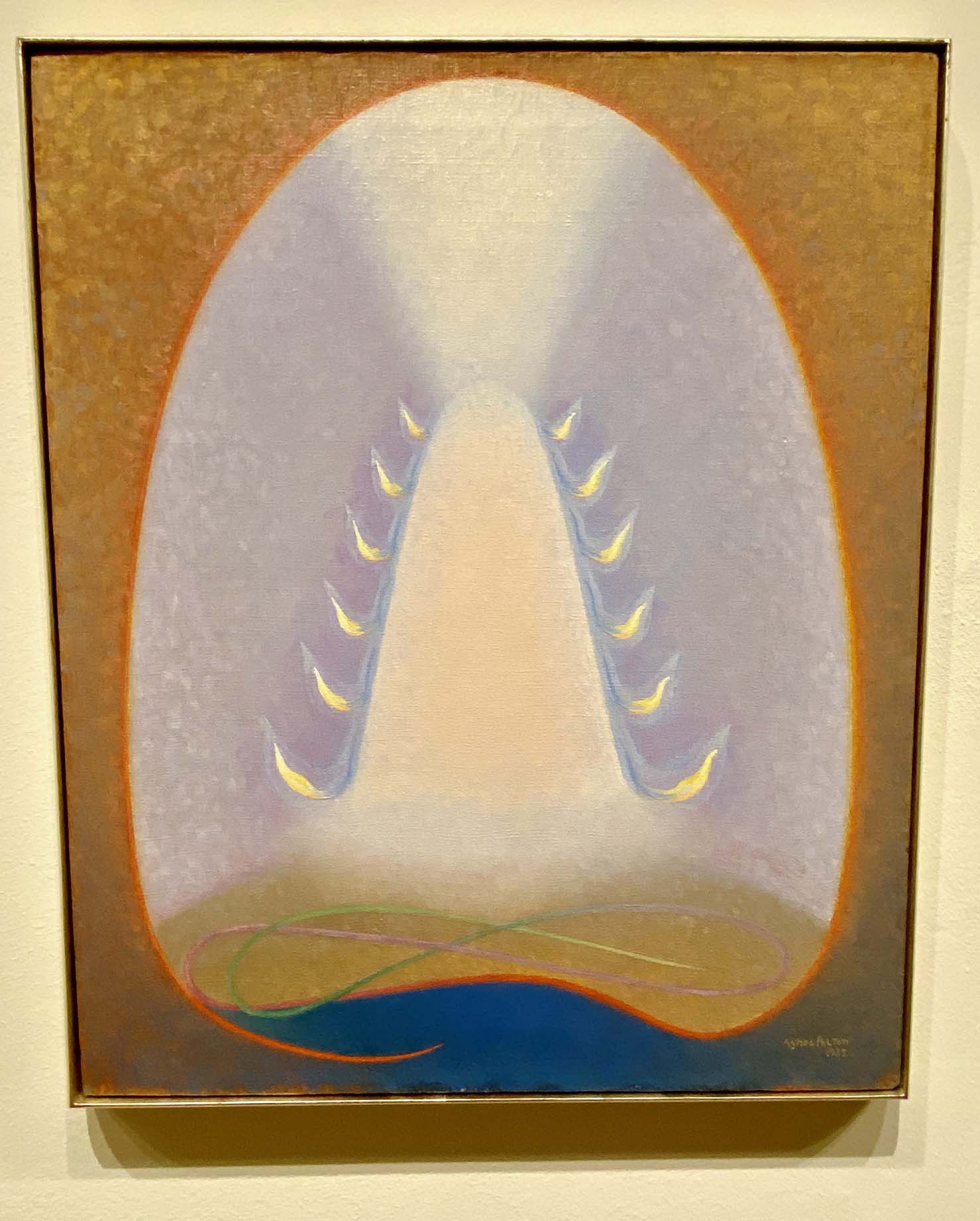
Agnes Pelton’s 1930 painting The Voice – suggesting enlightened dialogue within human consciousness.
As a young artist, Jonson was thunderstruck by the modern art he witnessed in the 1913 Armory Show when it came to Chicago (which included a painting by his future friend, Agnes Pelton from her “imaginative” period of work). Jonson read Kandinsky’s influential The Art of Spiritual Harmony when it was published in English in 1914, and increasingly pushed his work toward pure shape and design that could evoke a deeper response from the viewer.
By 1930, he and his wife moved to Santa Fe. He began teaching, curating shows, and continuing to pursue abstraction. When concepts were simply too much for a single canvas, he conceived a triptych.
Raymond Jonson’s 1930 tryptich – Time Cycle: Morning, Noon, and Night
Around 1931, new-age/Jungian composer, author, and painter Dane Rudhyar told Jonson about Pelton’s abstractions, and put them in touch. For the next 30 years, Jonson and Pelton corresponded about art making, materials, abstraction, and spiritual connections.
By this time, Pelton had had 14 solo exhibitions and been in 20 group shows. Her interest in spiritual practices kept growing, and the lure of the new-age communities in southern California beckoned her. During a 1932 yoga-retreat trip to Cathedral City, she decided to stay put and paint in the peaceful desert for the rest of her life
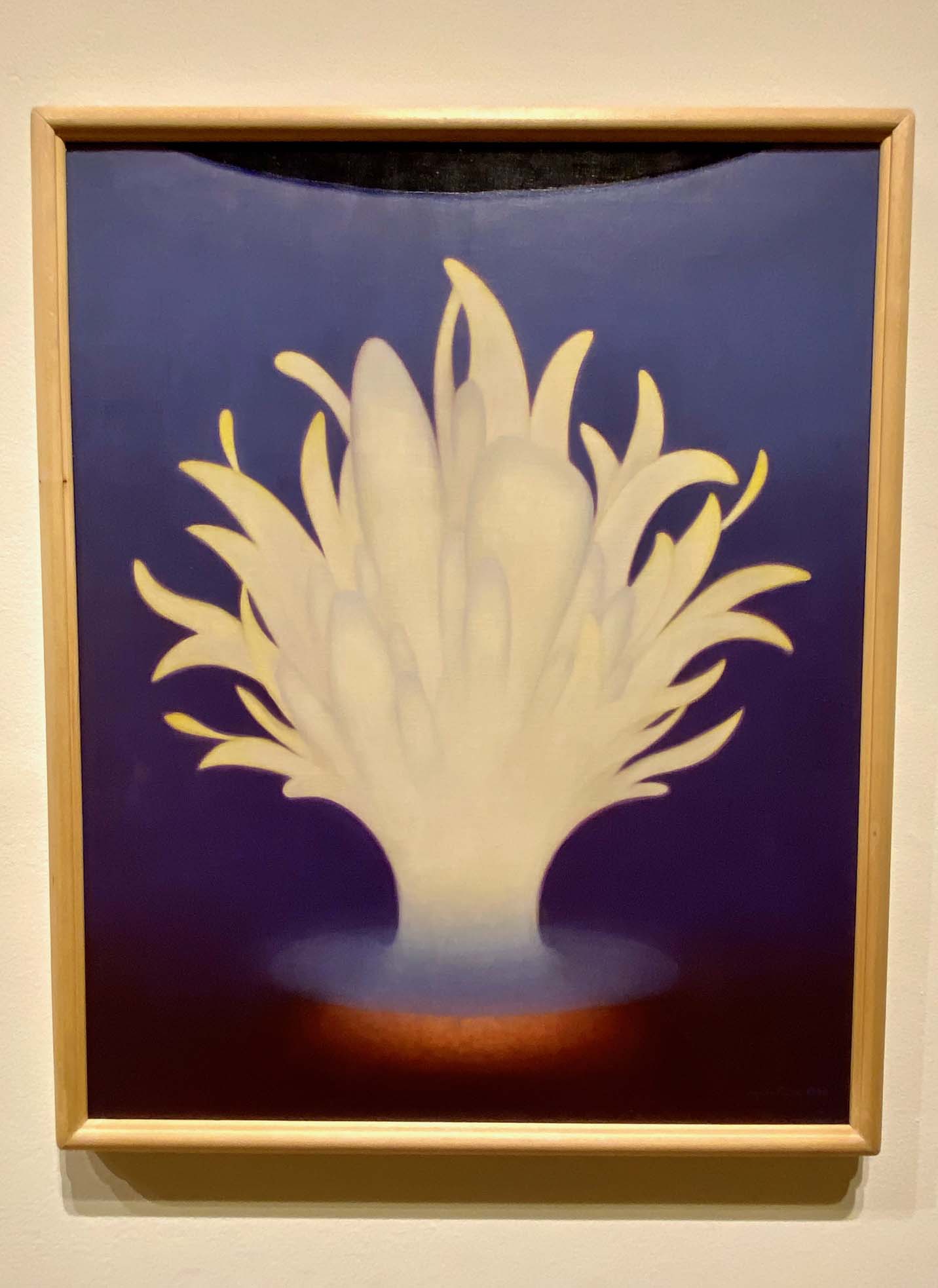
Pelton’s 1930 White Fire – showing light radiating from the inner self – from Jonson’s 1933 exhibition
Pelton’s 1932 Mount of Flame – symbolizing the beauty in the abstract – from Jonson’s 1933 exhibition.
In 1933, Jonson invited Pelton to participate in a Santa Fe exhibition alongside himself and Cady Wells. This current exhibition at UNM commemorates this convergence by reuniting some of the original works by Pelton, Wells, and Jonson. See some of the pieces in our Flickr album.
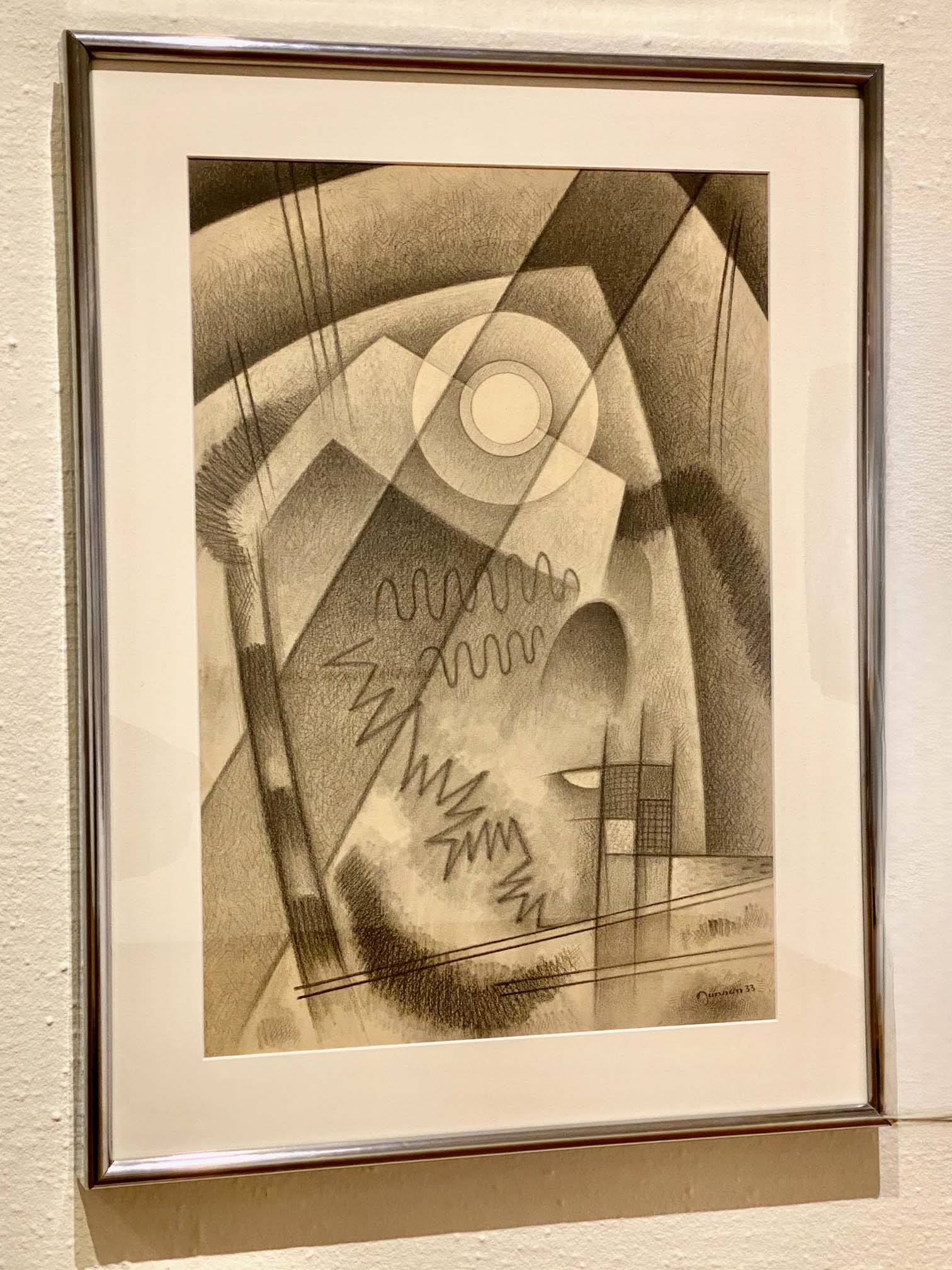
From the 1933 exhibition: Jonson’s 1933 charcoal drawing Ascending Circle
Jonson and his wife took a road trip to visit Pelton in 1935 – their one and only meeting. Although they were at a distance, the letters kept coming, and when Jonson and others in New Mexico organized the Transcendental Painting Group in 1938, she was invited to participate and serve as the grand dame/president.
In recent years, Agnes Pelton’s work has been resurgent due to the traveling exhibition organized in 2019 by the Phoenix Art Museum, which traveled to the Whitney in 2020. Read our review here.
To hear how this Albuquerque exhibition came together, listen in on Christian Waguespack’s interview with curator Mary Statzer:
UNM is lucky to have over 600 works by Raymond Jonson in its collection, and all the letters, sketches, publications, and journals he kept. For more on Raymond Jonson’s life and work, visit his portal on the UNM website.
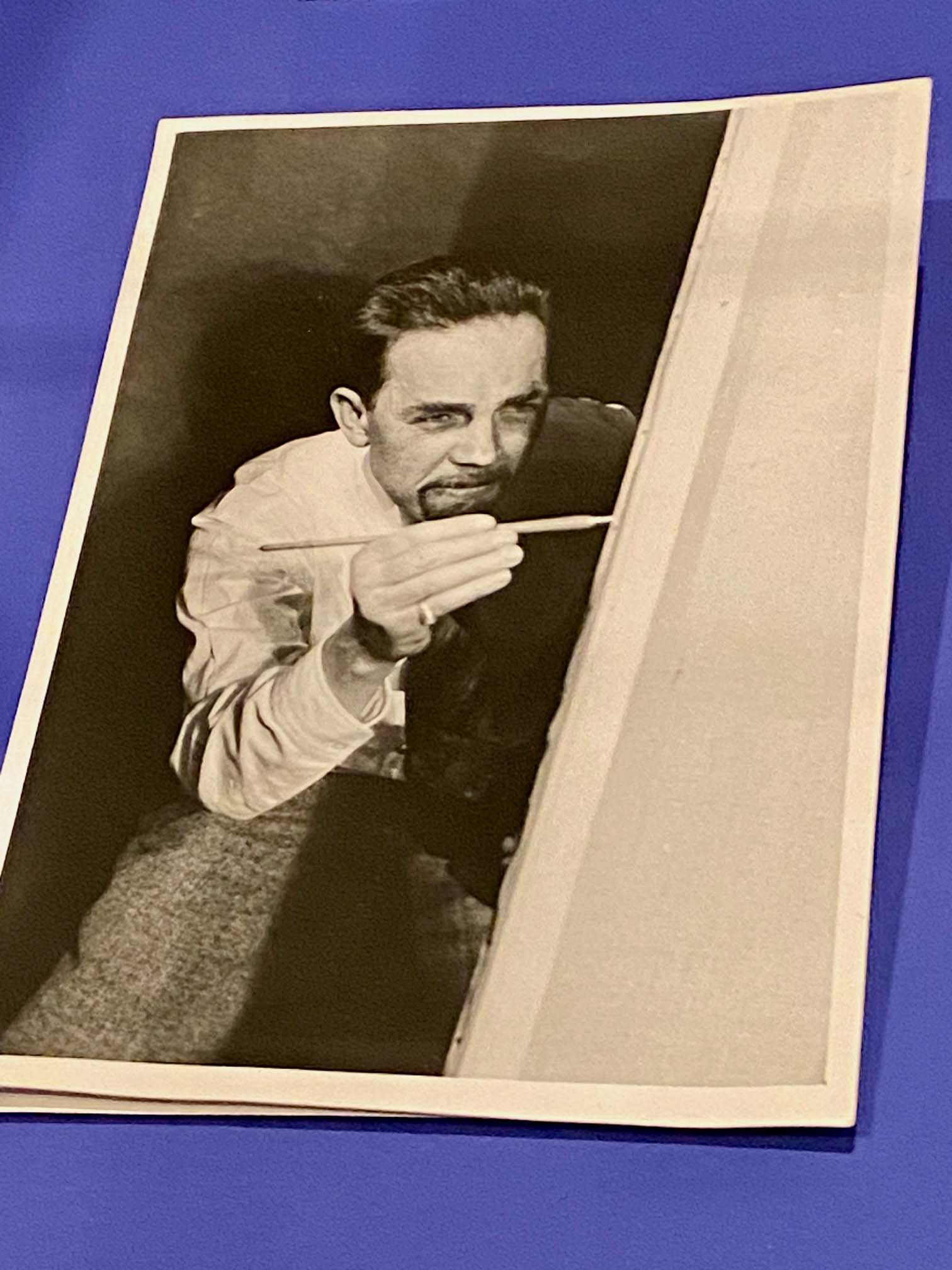
Jonson touching up work at his solo exhibition in Tulsa in a 1937 photo by F. Von James.
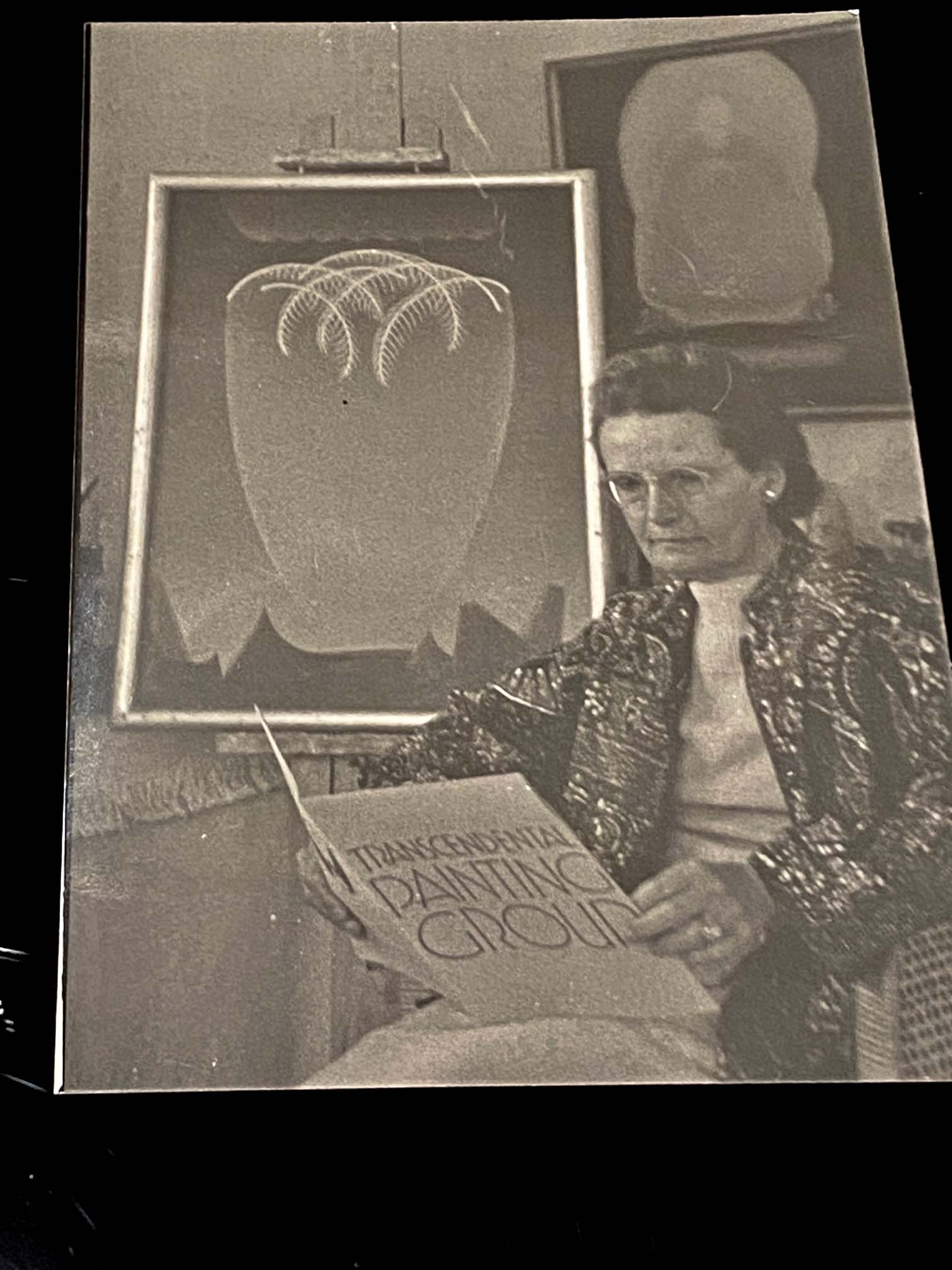
1935-1940 photo of Pelton reading the TPG brochure in her Cathedral City studio with Mount of Flame behind her.
Ascending the ramp inside the Guggenheim Museum to enjoy Harmony and Dissonance: Orphism in Paris, 1910-1930, European optimism and color abound. The exhibition, on view through March 9, 2025, showcases the exuberance and innovation of artists living in early 20th century Paris, who felt exhilarated by the profusion of modern forms of music, dance, and architecture and used abstraction and prismatic color to translated their enthusiasm.
Avant-garde power couple Robert and Sonia Delaunay broke from analytic cubism’s monochromatic approach and injected pulsing color into the art-scene conversation in Paris.
Robert Delaunay’s 1911-1912 Red Eiffel Tower – modern architecture and cubism with a twist of color.
Inspired by 19th century color theory (wheels demonstrating complimentary and dissonant colors), they painted swirling orbs pulsing with harmonies and contrasts to show optimism about the future.
Modern buildings like the Eiffel Tower, electrification of city streets, and the syncopation in dance-hall music created a pre-war energy in Paris that motivated these “orphists.” Everything seemed to be happening simultaneously. Harmonious and dissonant colors and whirling shapes on large canvases seemed a good way to represent it, as shown in the Guggenheim’s fun musical promo:
The style was named “orphism” by none other than Apollinaire himself. Robert Delaunay’s works in the exhibition include some of his early experimentation with abstract oval “windows,” his abstract riffs on the cosmos, and canvases still showing a hint of the real world. All convey the simultaneous push-pull of Paris, modern life, and larger scientific forces.
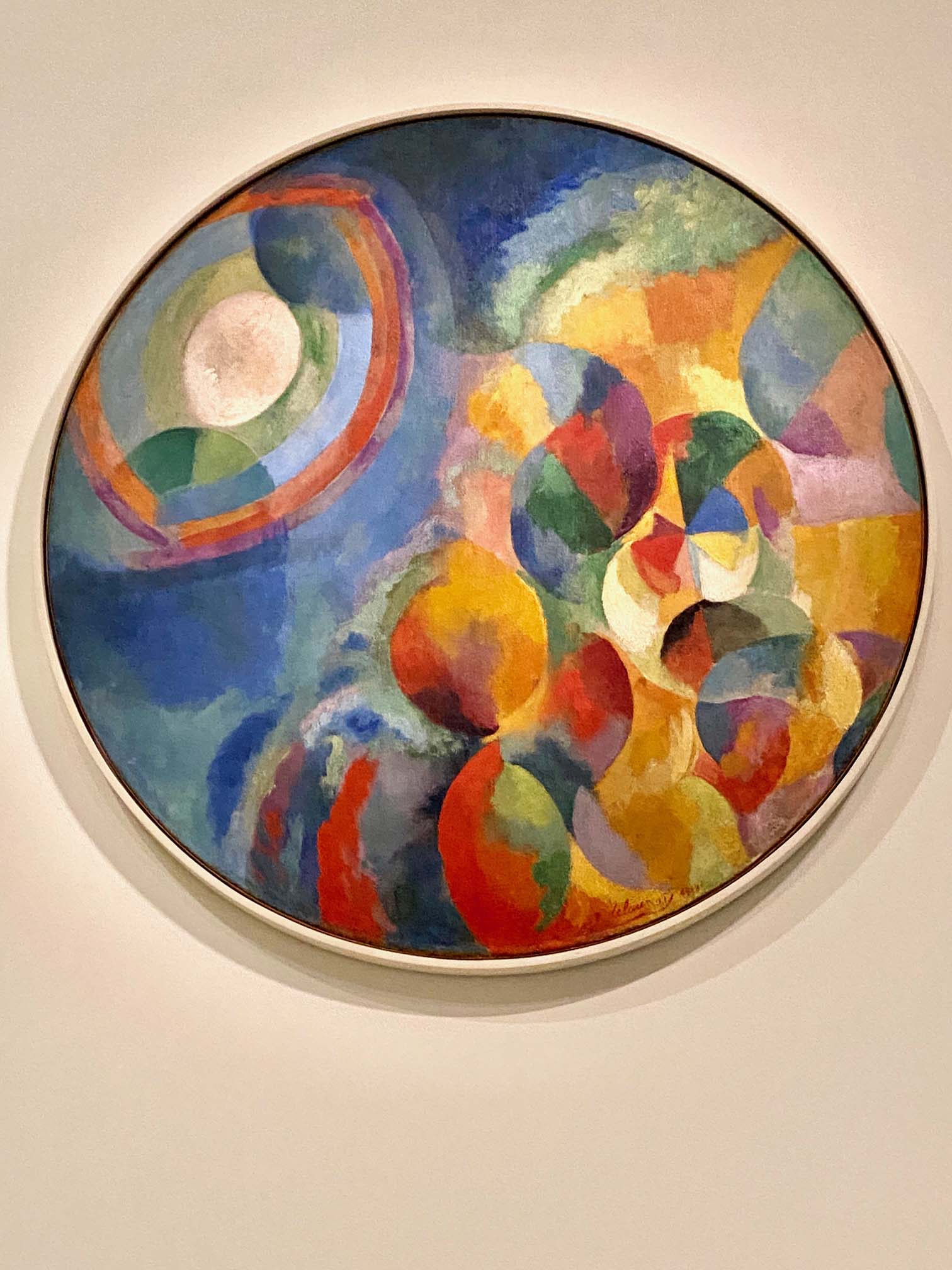
Robert Delaunay’s 1913 Simultaneous Contrasts: Sun and Moon. Courtesy: MoMA
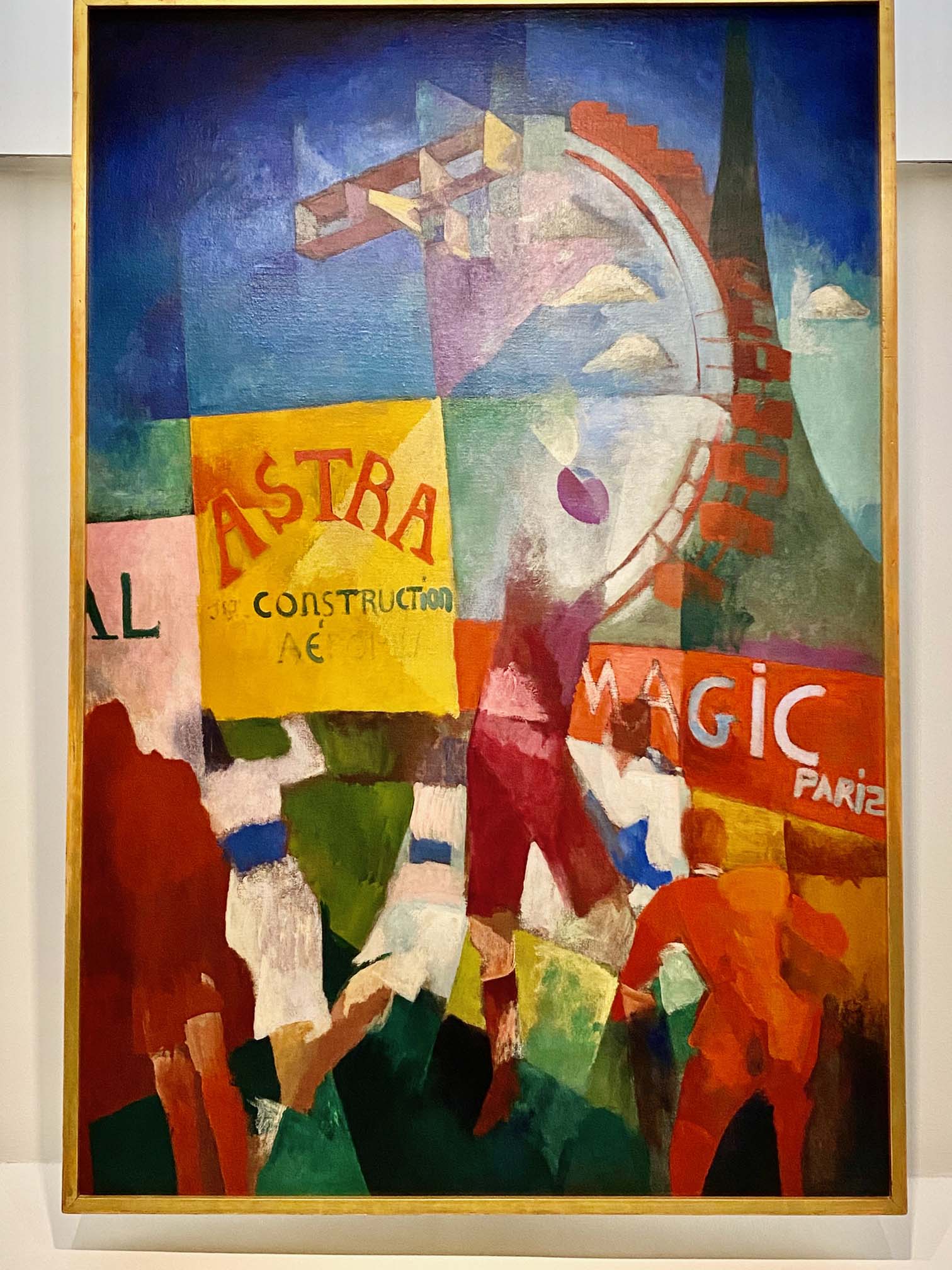
Robert Delaunay’s 1913 The Cardiff Team, with Eiffel’s tower, aerial achievements, and sports dynamics. Courtesy: Van Abbemuseum, The Netherlands.
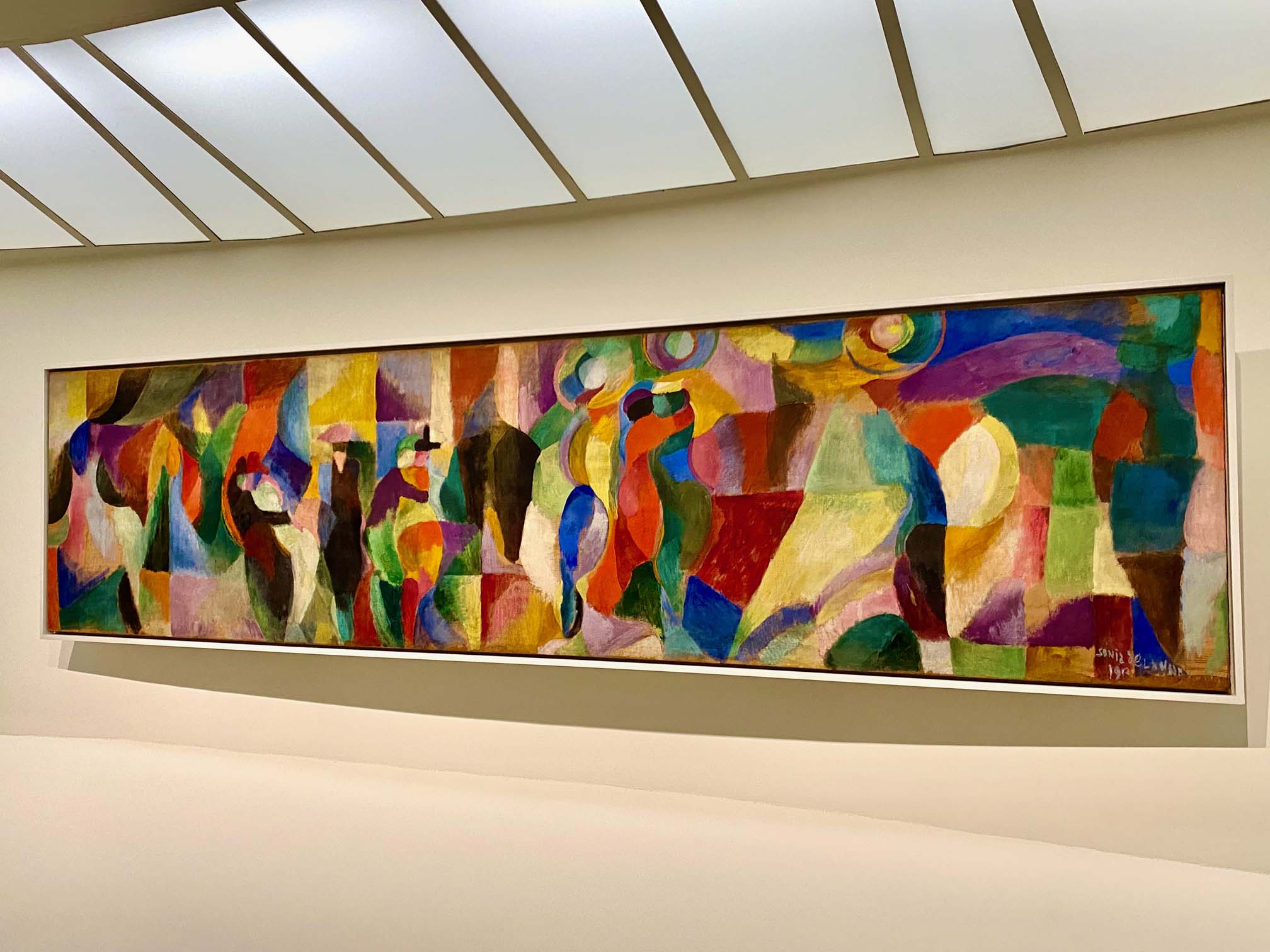
Many of Sonia’s orphist paintings are featured, including a gigantic horizontal color work inspired by the dynamic movement of tango dancers at a popular Parisian club. No doubt the massive 2024 Bard Graduate Center Gallery show about her forays into fashion and other creative fields (Sonia Delaunay: Living Art) influenced the Guggenheim curators to include her painted toy box and her celebrated super-tall accordion-book painting representing her collaboration with poet Blaise Cendrars.
Sonia Delaunay’s 1913 oil Bal Bullier inspired by dynamism of tango dancers at the popular Parisian club. Courtesy: Centre Pompidou
Innovations by the Delaunays are placed alongside other artists’ works that reflect the artistic breakthroughs of the early Twentieth Century – Kandinsky’s abstraction, the Blue Rider group’s symbolic use of color, and the synergies that artists felt between abstraction and music. In 1912, Leopold Survage intended to create the first fully abstract film, but the project was halted by World War I. Fortunately, we can envision his plan from his series of dynamic color drawings.
Colored Rhythms series of twelve 1912 ink drawings created by Léopold Survage for the first abstract film. Courtesy: La Cinémathèque Française
The music that inspired the Orphism is referenced throughout the exhibition – the improvisation and free structure of jazz, the dissonance of cutting-edge experimental music, and the staccato of the latest Parisian dance-hall craze – Argentine tango. The curators have even provided musical tracks to underscore this influence.
The Italian futurists Balla and Severini are also featured. Speed, modernity, and simultaneous city sensations were their bread and butter, too, even though they argued in the press and art journals that Futurism and Orphism were totallydifferent.
Italian futurist Giacomo Balla’s 1914 Mercury Passing before the Sun, an allusion to recent cosmic events. Milan’s Museo del Novocento.
Gino Severini’s 1915 Dancer–Propeller–Sea. Courtesy: The Metropolitan Museum
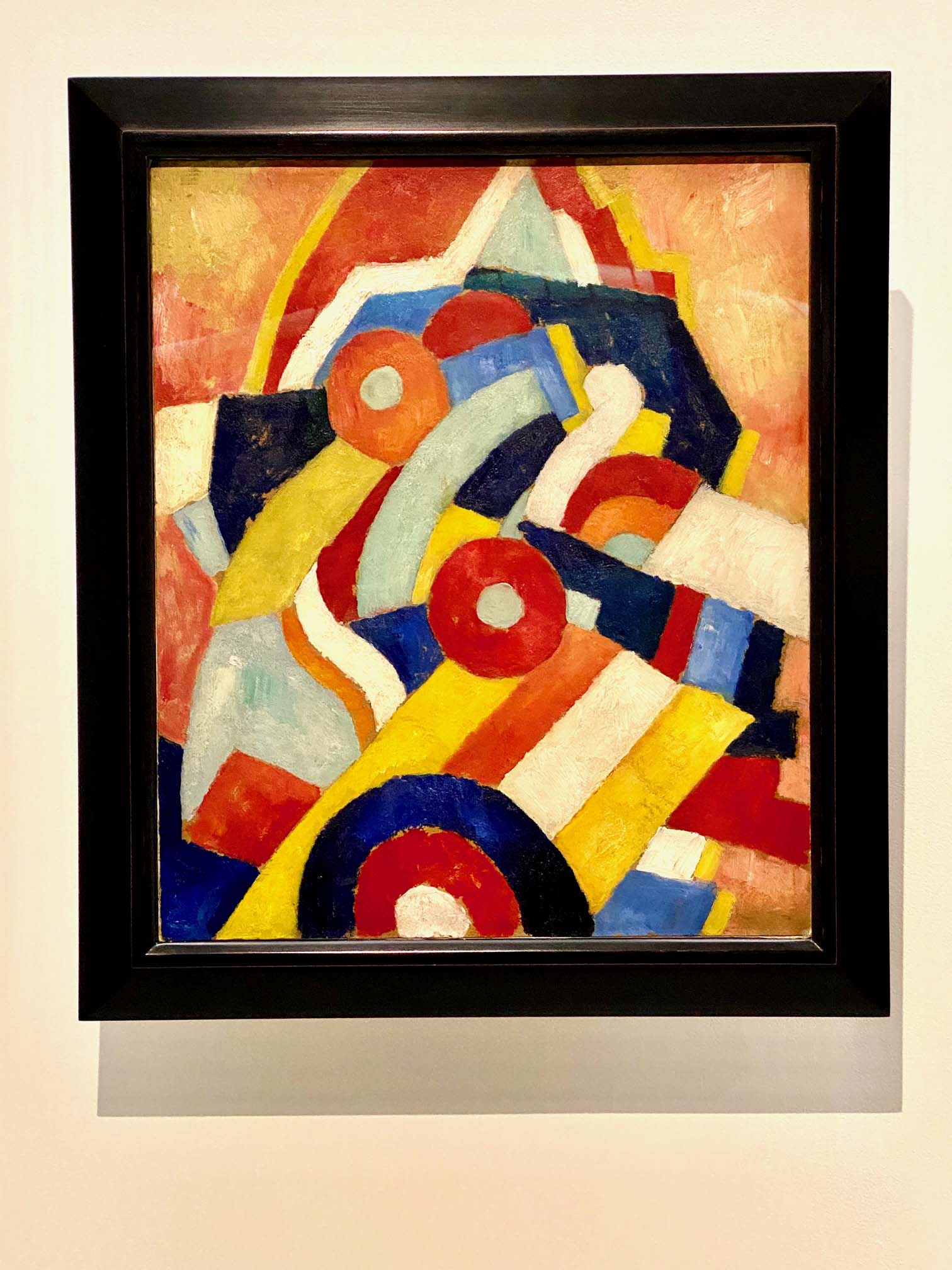
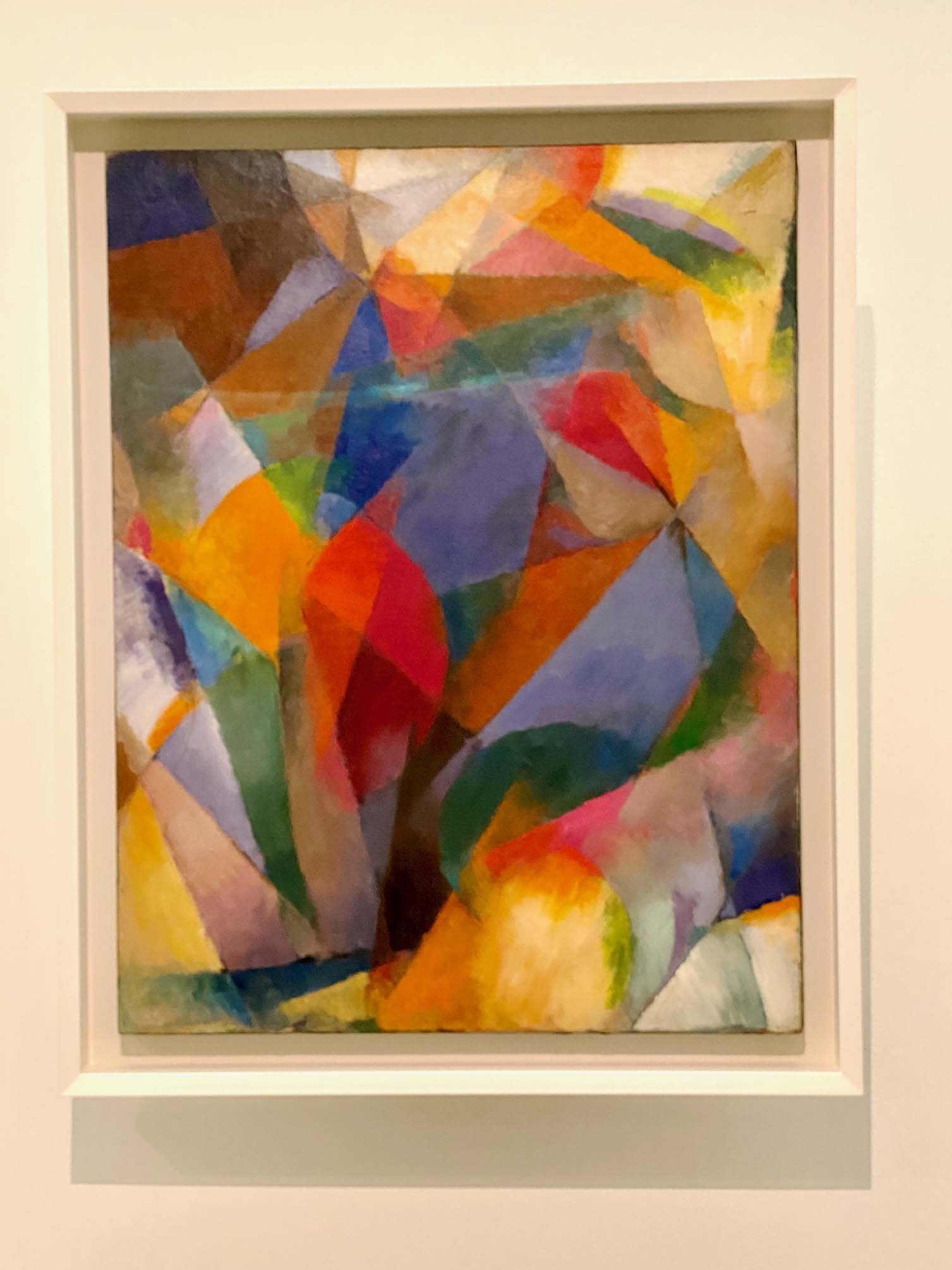
In pre-war Paris, American modernist painters Marsden Hartley, Stanton Macdonald-Wright, and Morgan Russell picked up on Orphism, although the latter two rebranded their work Synchronism when they wrote their manifesto.
Marsden Hartley’s 1914 Abstraction Courtesy: The Museum of Fine Arts, Houston.
Even after the War, the Delaunays continued to represent orphism even if they occasionally incorporated real-world elements. Early orphism adopter Albert Gleizes also continued in this style throughout his career, and inspired students like Mairnie Jelett to explore color theory and its potential.
Albert Gleizes’s 1942 Painting for Contemplation, Dominant Rose and Green.
Irish artist Mairnie Jellett’s 1938 Painting. Courtesy: National Museum, NI, Ulster.
Take a look at our favorite works in our Flickr album here, and enjoy a syncpated strut through the colorful side of Modernism in this catalog preview:
Did you ever want to walk into a podcast? The grand installation of Broken Boxes: A Decade of Art, Action, and Dialogue lets you experience large-scale work by some of the socially conscious artists that have been featured on Ginger Dunnill’s interview series. Enter, listen, and get inside the heads of 23 artists at the Albuquerque Museum through March 2, 2025.
The exhibition honors ten years of Broken Boxes conversations, which you can hear at various “listening spots” inside the exhibition. Ginger began her project as a way to encourage community among artists who were creating disruptive work that prompts viewers to imagine a different world.
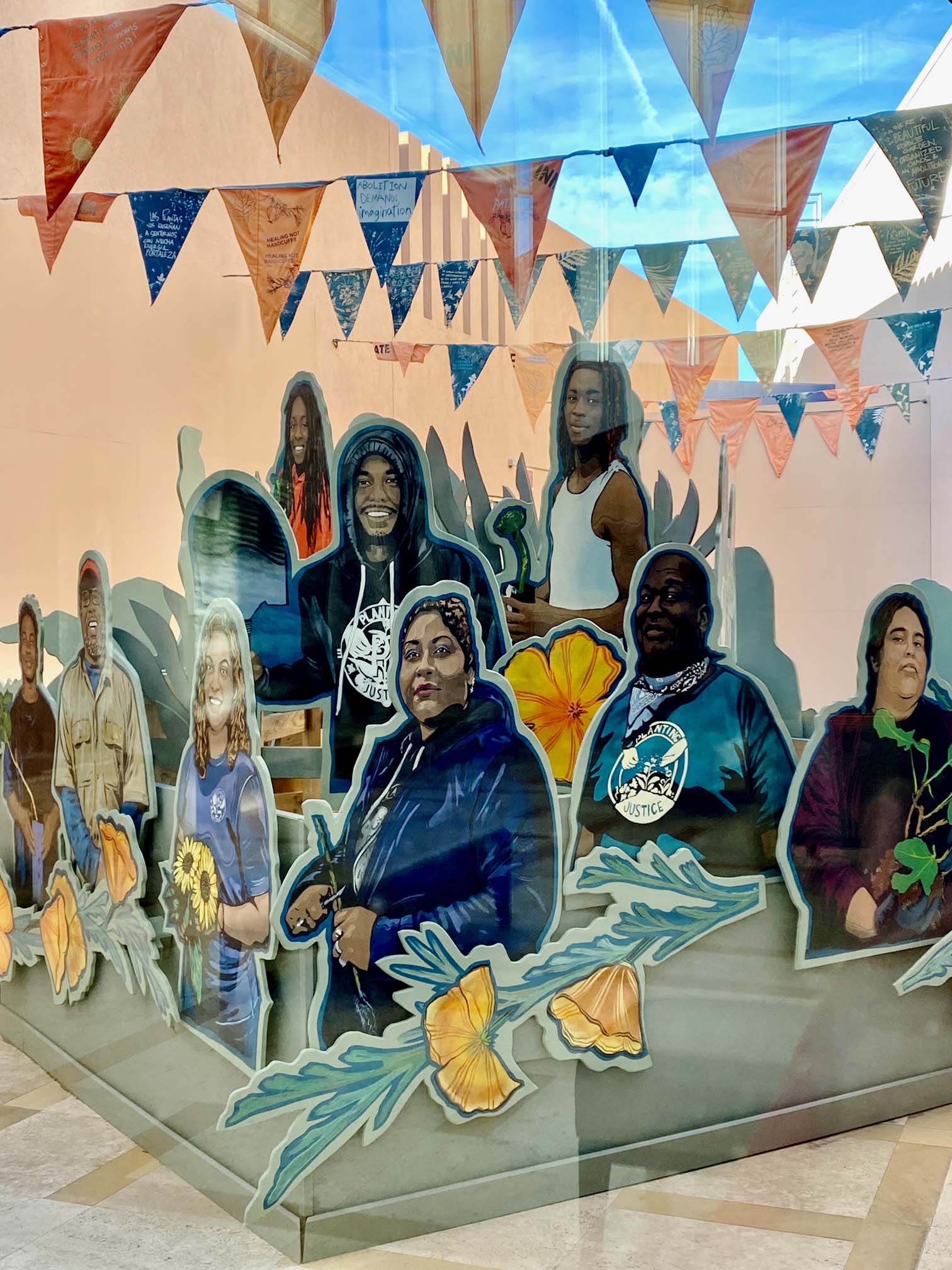
Kate DeCiccio’s Blooming Abolition depicts formerly incarcerated community members who develop gardens. Created by local artists, Planting Justice, Hiroyo Kaneko, and Malaya Tuyay.
The show spills way beyond this main gallery into a theater showing artist videos, another space featuring a soundscape by Raven Chacon, and a courtyard reflecting artist-educator Kate DeCiccio’s vision for sustainable community gardens that give purpose and fulfillment to formerly incarcerated neighbors.
Inside the main space, visitors wind through and around different installations, such as Marie Watt’s hanging jingle sculptures and her spectacular collaboration with Cannupa Hanska Luger. The jingle “clouds” take a traditional element of powwow and turn it into fine art that invites participation in the soundscape.
2023 dangling jingle sculptures Sky Dances Light: Revolution VII, VIII, and IX created by Marie Watt (Seneca Nation of Indians). Courtesy: private collection
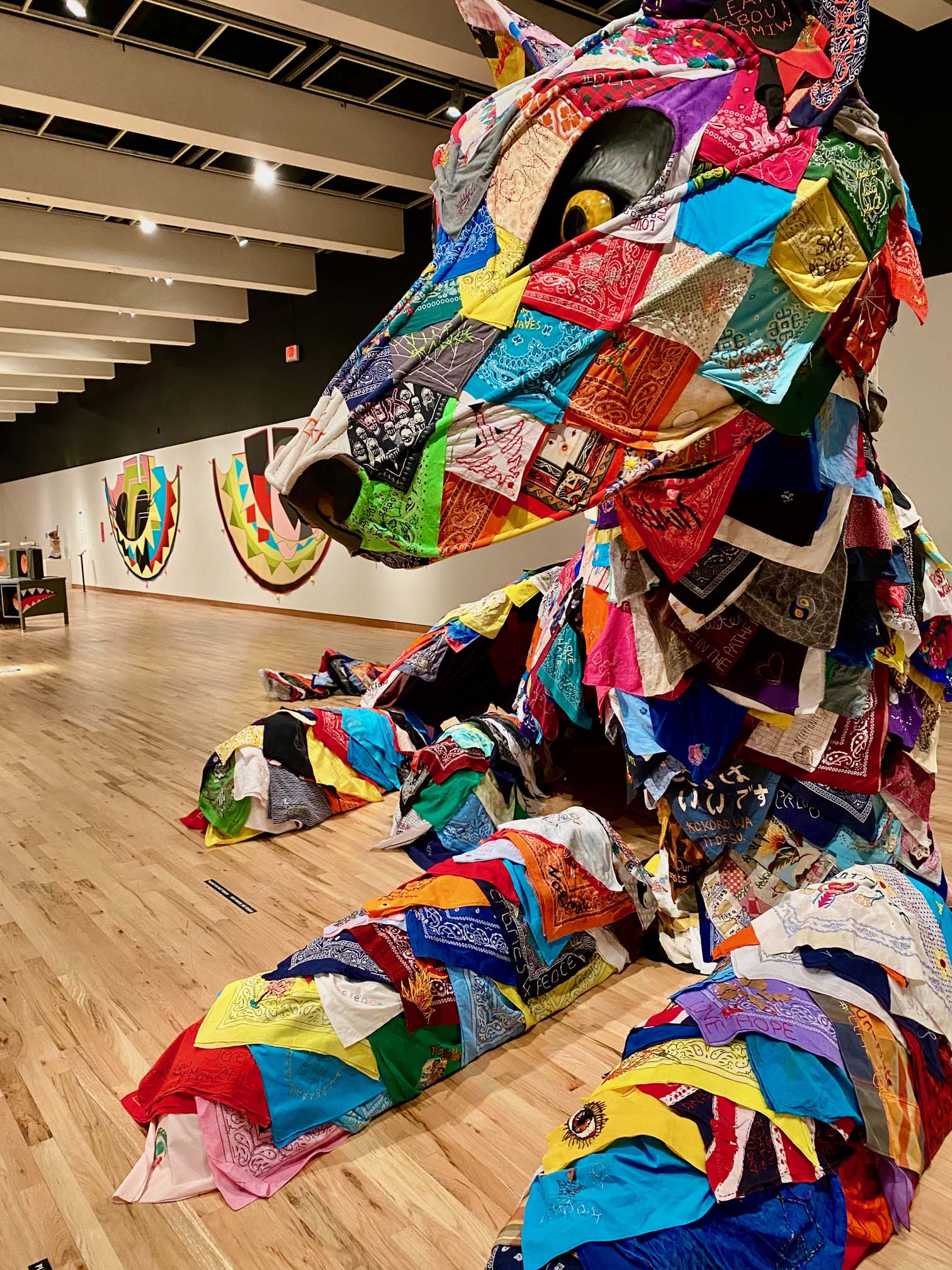
Across the way is an enormous canine created by Luger and Watt. As he’s done with other large-scale participatory projects, Luger sent out a call worldwide requesting people to embroider messages on bandanas and send them in. Visitors are fascinated by the Each Other collaboration, circling around the wolf to discover messages about rescue, shelter, and sustainability.
Guadalupe Maravilla’s installation draws inspiration from his own story and struggle. He assembled the piece from items picked up when he retraced his migration route from El Salvador to the United States when he was a child. But he made it to emit therapeutic vibrational sounds, similar to the sound therapy that brought him relief as an adult when he underwent therapies to cure his own cancer.
2020-2021 Each Other community bandana-sculpture created by Cannupa Hanska Luger (Mandan, Hidatsa, Ankara, Lakota) and Marie Watt (Seneca Nation of Indians). Courtesy: the artists
Guadalupe Maravilla’s 2021 Disease Thrower #17 – a therapeutic sound installation using materials found when he retraced his El Salvador-US migration route. Courtesy: the artist
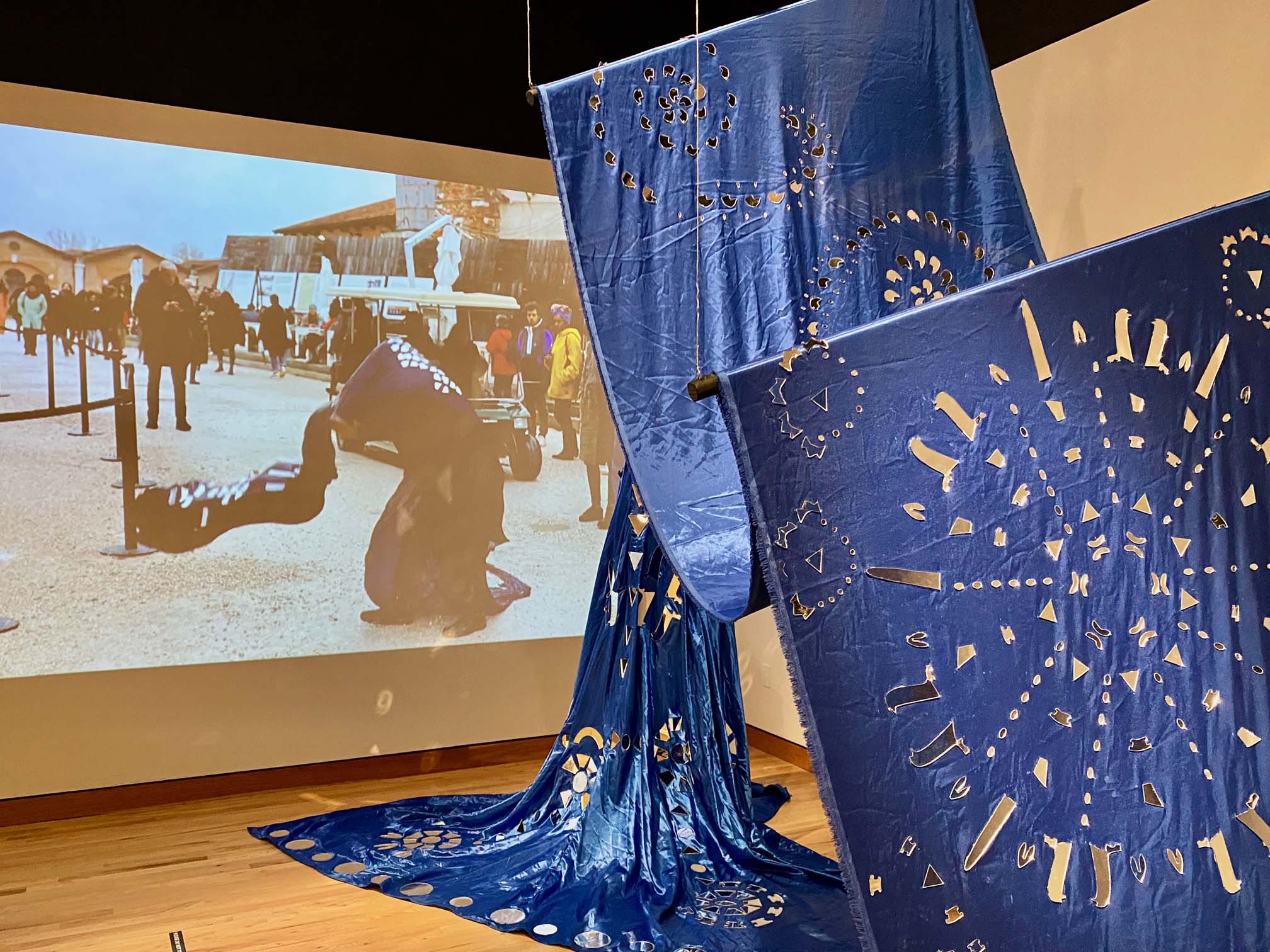
Work by Ethiopian refugee Tsedaye Makonnen includes a performance video and installation that focuses attention on African refugees who risk dangerous ocean crossings to escape violence in their home countries. The blue fabric represents the ocean, and each mirror a life lost.
Tsedaye Makonnen’s Astral Sea Views video with Astral Sea Series mirrored fabrics – commemorating women migrants who perished attempting dangerous European ocean crossings. Courtesy: the artist.
See some of our other favorite installations here in our Flickr album – a shrine by Mario Yvarra, Jr. dedicated to his Chicana-activist mother –Music My Mom Played While Cleaning House – and works by Natalie Ball (Klamath/Modoc) that are straight from her recent show at the Whitney.
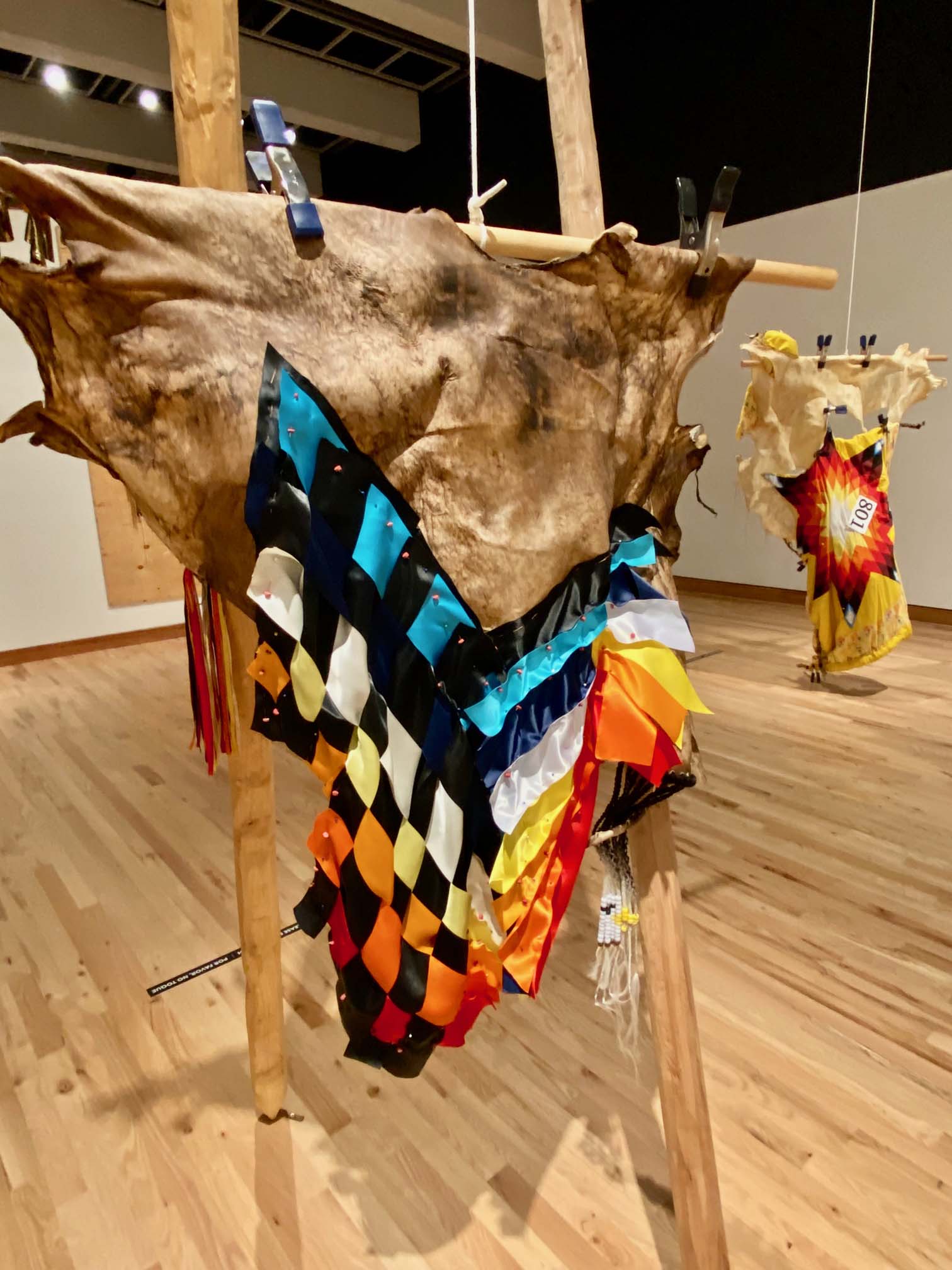
2023 mixed-media sculptures by Natalie Ball – ribbon skirt: There’s Indian and than there’s Indian; (rear) Baby Board. Courtesy: the artist.
Music My Mom Played While Cleaning the House…, a parade float by California artist Mario Ybarra, Jr. that honors his mother, a Chicana civil rights activist.
Listen to the Broken Boxespodcast to hear Ginger and international artists talk about making art, building community, and meeting the challenge of the moment.




































 itsnewstoyou