More Time Tripping at Grand Central

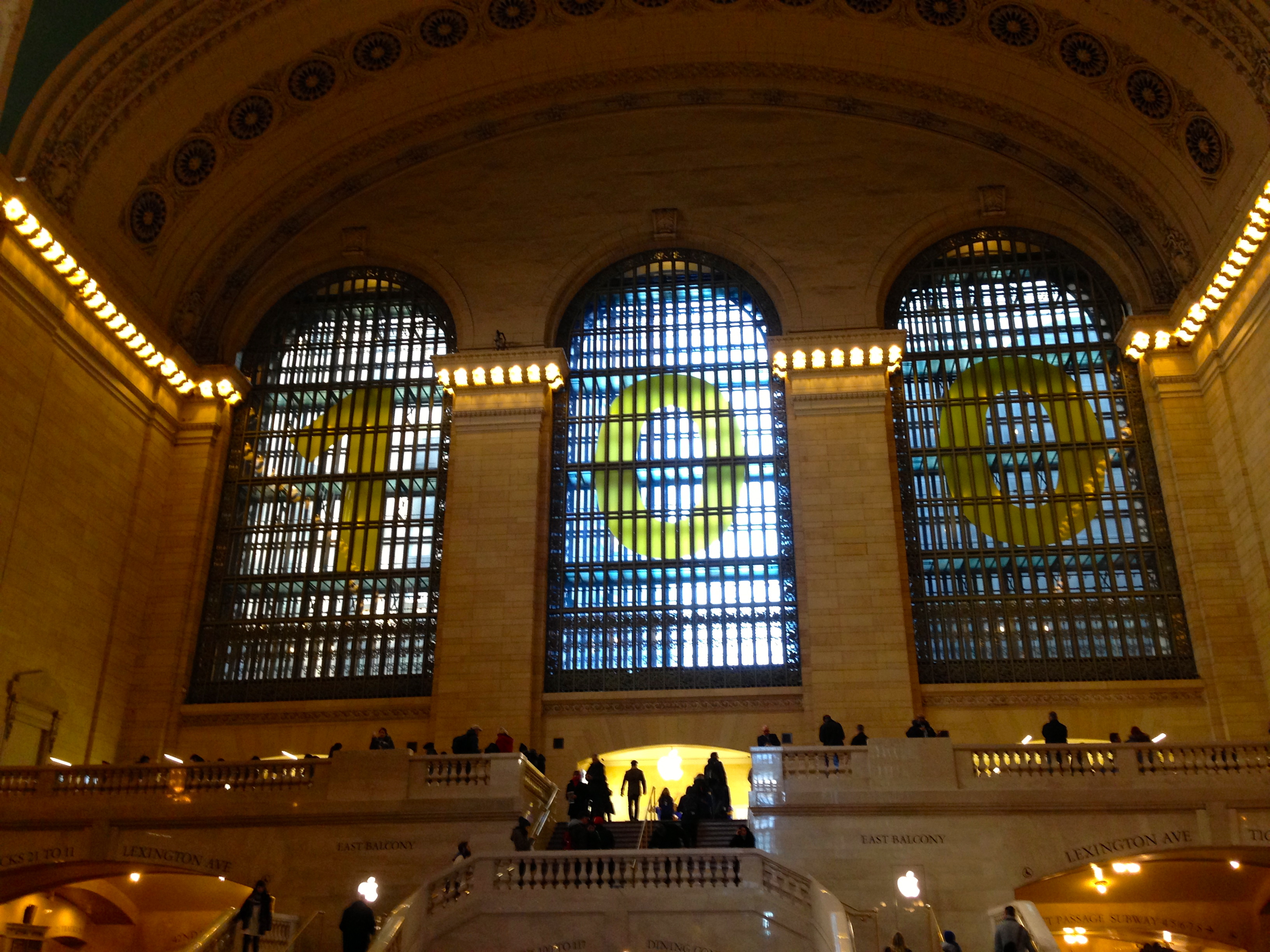
Annex window view of Lothar Osterburg’s model of his dream of Grand Central as a zeppelin docking station back in the 1930s

Annex window view of Lothar Osterburg’s model of his dream of Grand Central as a zeppelin docking station back in the 1930s

Even if you didn’t manage to board the historic train cars at Grand Central in May, you can still go back in time, courtesy of 18 artists featured in the GCT exhibition in the New York Transit Museum Annex, On Time: Grand Central at 100.

Inspired by The Clock and the continual flow of people and trains through Grand Central, MTA Arts for Transit cooked up a delightful mix of contemporary 2D works, models, videos, and digital art that puts a smile on the face of every commuter, tourist, and art-seeker that we’ve seen inside the tiny Annex.

Look closely to find this minute secret portal: Ledge with Lunette, 2013 by Patrick Jacobs

Look closely to find this minute secret portal: Ledge with Lunette by Patrick Jacobs

Have you seen the mysterious Zeppelin posters by Lothar Osterburg on the subway? Right in the Annex window you’ll see the gigantic, fun-house model that he created to photograph as one step in the process of making the photogravure you see on the A train. Kids and parents can’t resist Lothar’s newspaper-covered multi-story GCT impression and the funny, fat yellow old-time taxis and zeppelin ends that poke out. Right next to it, you can examine his resulting print, Zeppelins Docking on Grand Central.

People are usually transfixed by the 2008 video documenting Frozen Grand Central, where Improv Everywhere staged a 250-person flash mob, where people “froze” for 5 minutes as commuters, tourists, and workers wondered what was going on.

Another hit is Grand Central Diary. London Squared Productions interviewed tourists and commuters about GCT, animated the furniture and items around the terminal, and…well, just watch The Clock and the Maintenance Cart speak for themselves:

Nearby, several small digital screens show Alexander Chen’s Conductor, a 15-minute video loop that animates the subway lines, suggesting trains moving through the system. He turns the subway lines into an animated stringed instrument. No wonder he’s working for Google Creative Labs. Spend a few moments, take a look, and experience it here.
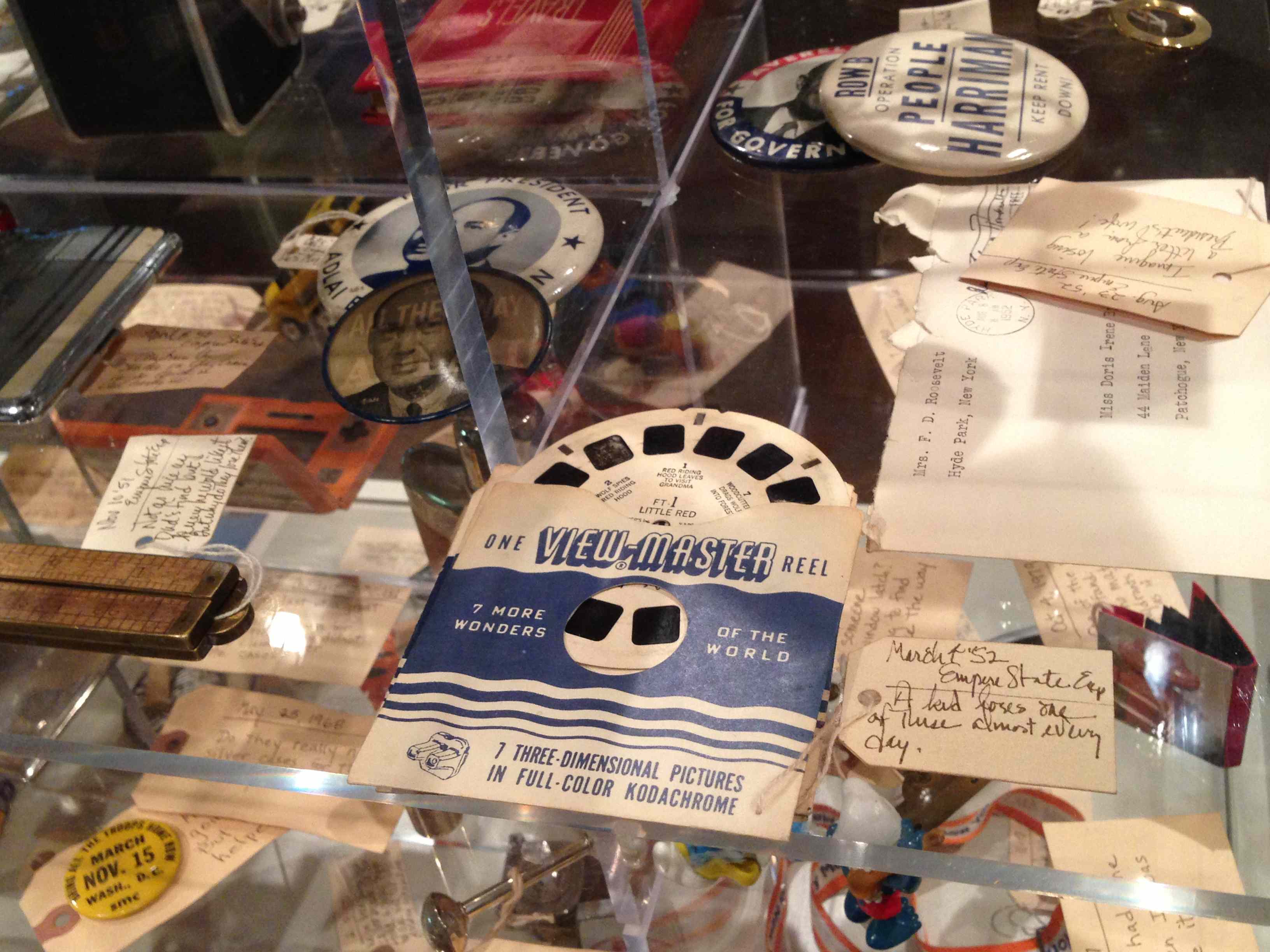
Close-up of Viewmasters and other leave-behinds inside Jane Greengold’s Lost and Found.

Close-up of Viewmasters and other leave-behinds inside Jane Greengold’s Lost and Found.

Another must-see piece (among many) is Jane Greengold’s Lost and Found. She’s created a sort-of fiction about the dozens of tagged items in the vitrine, evoking the memories and observations of generations of conductors who found items that train passengers left behind. Actually, the items you’re looking at are actual leave-behinds collected by real-life conductors, so Jane’s work isn’t entirely made up. The archeological discoveries include things from the old Lake Shore Limited on the NY Central, a 1948 boxed baby tooth, 1943 ration cards, 1952 Viewmasters, a Kennedy campaign button, and a Kindle.

Get to the Annex before July 7. In the meantime, check out curator Amy Hausmann and her artists telling about the fun they had contemplating time, architecture, fashion, and Jackie O.

Abstraction All-Stars Featured in MoMA’s LinkedIn

Installation view of the network behind the birth of abstract art

Installation view of the network behind the birth of abstract art, according to MoMA and Columbia Business School

As soon as you arrive at Inventing Abstraction 1910-1925, MoMA’s soon-to-close extravaganza featuring the relationships among painters, poets, composers, and dance innovators, you encounter a big, bold infographic on the wall – a web showing who was collaborating with, influencing, viewing, and reading each other as “abstract art” was born.

The stunning exhibit is a who’s who of modern art, with work by Picasso, Kandinsky, and Malevich (of course), but pulls in works from lesser-known early innovators from Britain, Poland, Italy, and America (hi, Georgia!) and across disciplines. So many connections, so little time! The show has books, music, pioneers of modern dance…just about everything.

If you can’t get to it, don’t worry. MoMA’s put it all on the web so you can explore all the connections yourself. The highlighted names show the artists with over 25 connections, like an early 20th century LinkedIn or really popular Facebook friends. Who knew that Russian fine-art diva Goncharova was more connected than, say, Malevich or El Lissitsky?  I guess inventing Rayism and designing sets for the Ballet Russes paid off in getting her positioned in this MoMA pantheon.

Created by MoMA curators, designers, and pros from the Columbia Business School, the interactive web highlights every artist featured in the massive MoMA show. The infographic allows you to zoom in to see how the buzz, particularly in 1911-1915, brought abstract art into being.  No matter which name you click on, you’ll get to view the works, play the music, and watch the dances – a web-based multimedia tour-de-force.

Now dive into one of the best art-websites ever, and get to know the network and likes of the hot, emerging artists who made the art world of 100 years ago into what we know today.

Watch how this show and web project were brought to life with Excel, great minds, and graphic design. And be sure to check out Paul Ingram’s views on the value of networks at the MoMA video site.

Celebrity Robot Says Good-Bye to Upper East Side

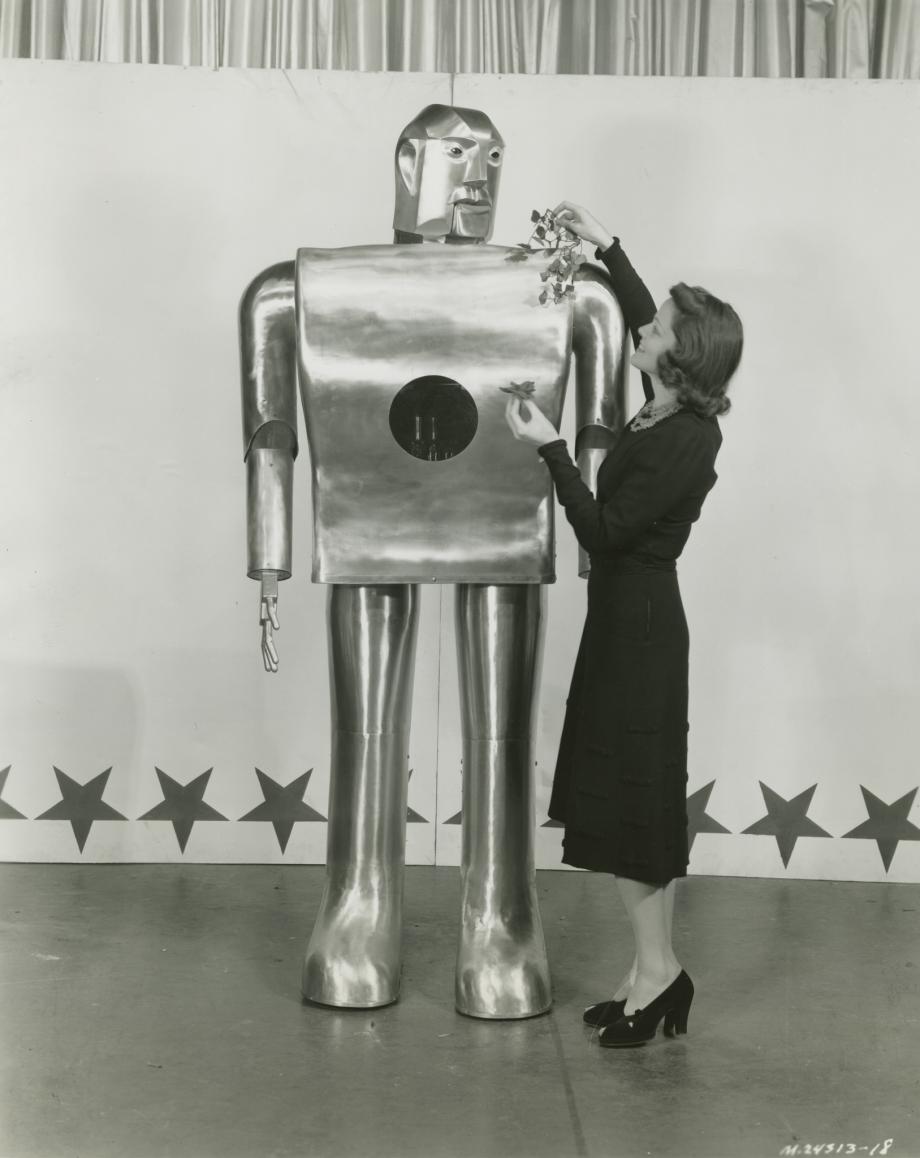
As musician Lois Kendall shows him red roses and green leaves, Elektro tells her the color of each. Source: NYPL

As musician Lois Kendall shows him red roses and green leaves, Elektro tells her the color of each. Source: NYPL

If you love the future, you have to see Elektro, the celebrity robot, who once held court in the Westinghouse pavilion at the 1939 New York’s World’s Fair, before he leaves the city once again. He’s the star attraction in the Museum of the City of New York’s Designing Tomorrow: America’s World’s Fairs of the 1930s exhibition, closing soon.

We couldn’t take photos inside the show, so here’s a publicity picture of Elektro back in 1939. He walked, talked, smoked cigarettes, as you’ll witness in this 1939 YouTube clip. This sensational moto-man used vacuum tubes, a 78 RPM record player, photoelectric cells, and telephone relays to wow the crowds.

But Elektro is only the tip of the Trylon of how fair design and engineering shaped modern American style. The show introduces the industrial design engineers that shaped products that grace MoMA’s design collection and insinuated themselves into everyday life – streamlined appliances, nylon stockings, Herman Miller clocks, Greyhound buses, and superhighways. Check out the MCNY’s excellent Tumblr feed for their visions of the future.

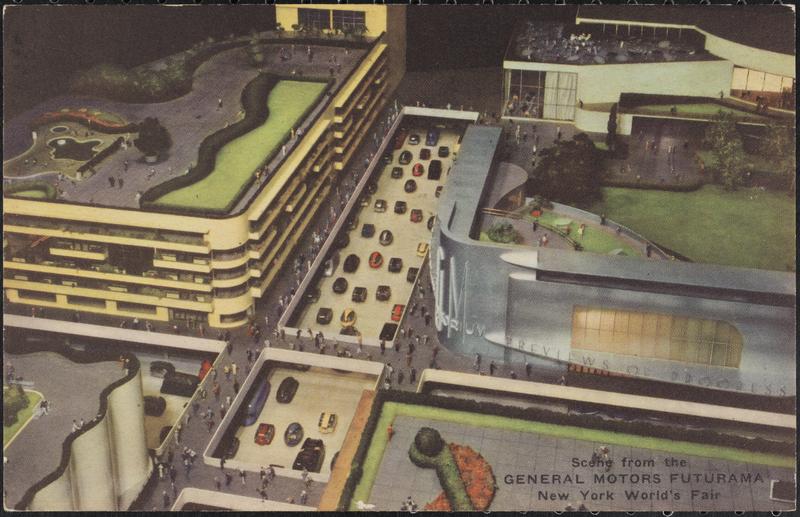
Postcard of the General Motors Futurama, NY 1939 World's Fair. Source: MCNY

Postcard of the General Motors Futurama, NY 1939 World’s Fair, that resembles BPC today. Source: MCNY

Among the show’s highlights are clips showing the GM Futurama, where New Yorkers waited in line for hours to see what the city of 1960 would look like. “Sound chairs” moved them along a conveyor belt where they could witness a vast scale model of modernized America, with superhighways soaring over canyons and cutting through mountains, and urban/suburban cloverleaf interchanges to keep traffic moving.

Afterward, people would exit into a full-scale World of Tomorrow where they would see what the urban intersection of the future would be – filled with pedestrian overpasses, department stores, and unimpeded whizzing traffic. It sure looked a lot like the view of Battery Park City along West Street.

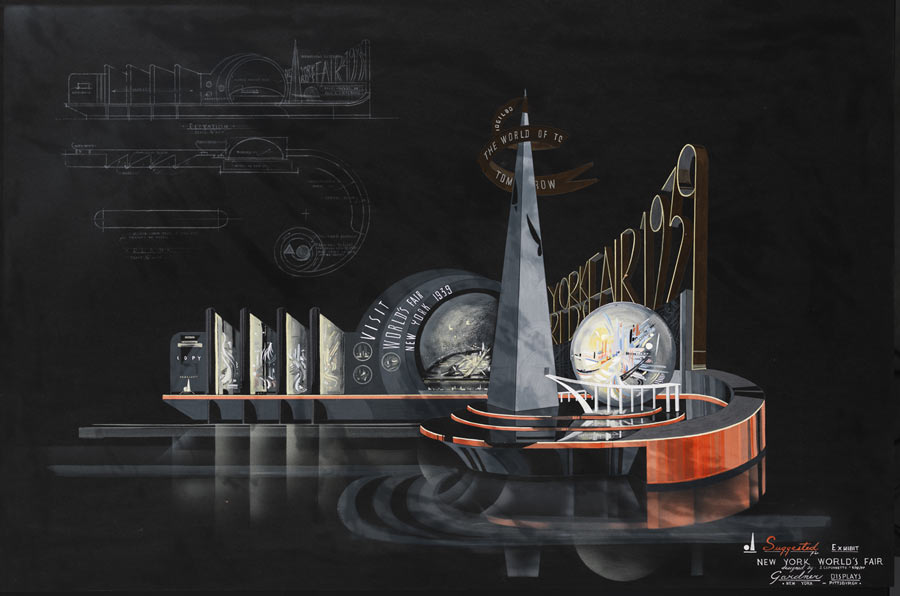
Suggested Exhibit for NY 1939 World's Fair. Watercolor & gouache on board. Source: MCNY

Beautiful watercolor/gouache from MCNY collection: “Suggested Exhibit for NY 1939 World’s Fair.”

Oh! Wallace Harrison, one of the architects of the Trylon and Perisphere actually did the master plan for Battery Park City…and Lincoln Center and the UN Headquarters building and Time-Life on Sixth Avenue!

So, no wonder Elektro feels right right at home in 2013 Manhattan. In 1939, he already could see what it would look like, right from his pavilion!

Take a spin around Elektro’s world, courtesy of the New York Public Library:

I Sat in the Saarinen Chair

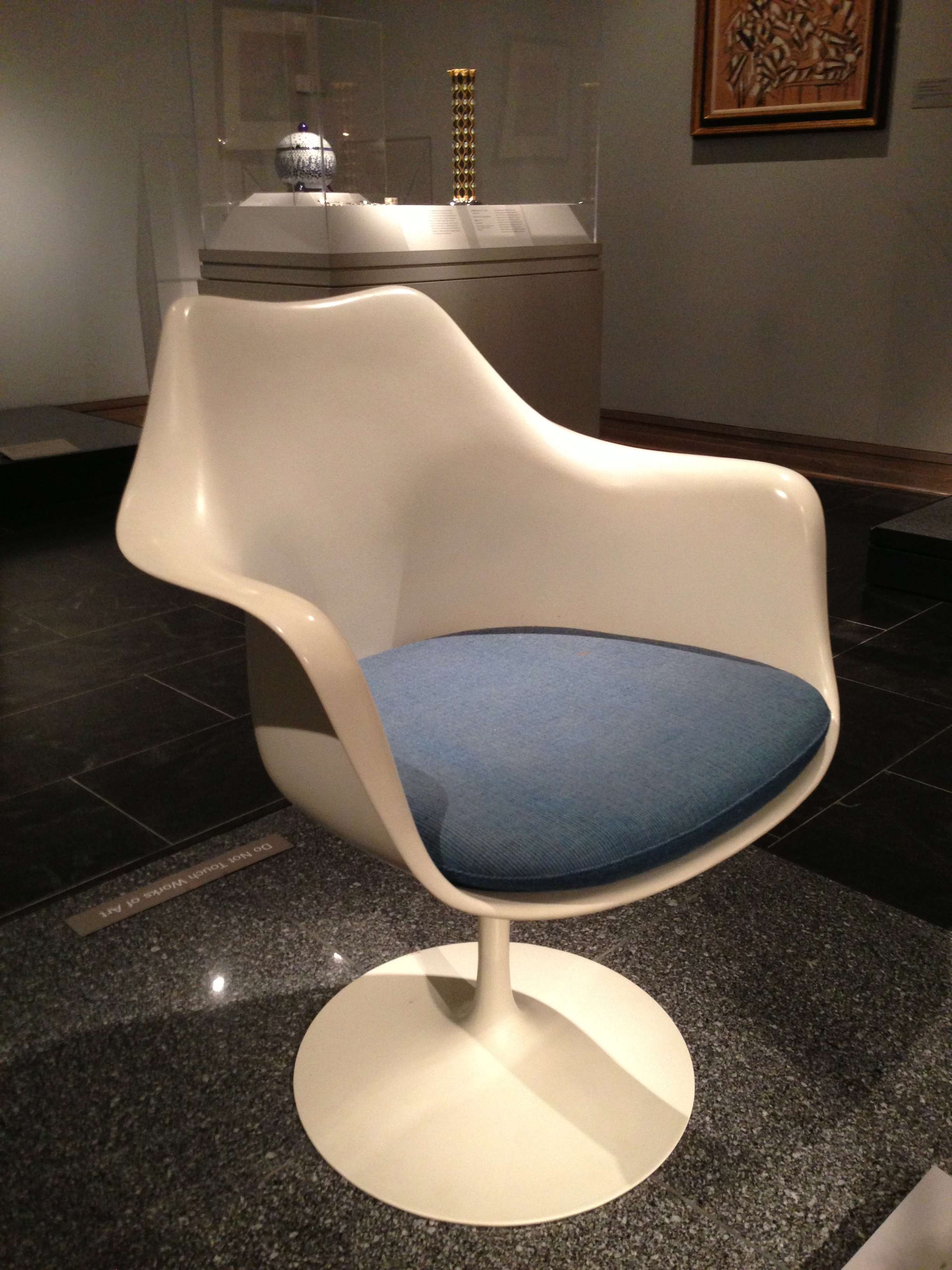
The Saarinen chair at the Met

The 1956 Saarinen Tulip chair at the Met

If you’ve been to the Metropolitan Museum’s Modern Design gallery on the first floor, you’ve seen the iconic Eero Saarinen chair sitting on its platform at the back of the gallery with a “do not sit” sign prominently displayed.

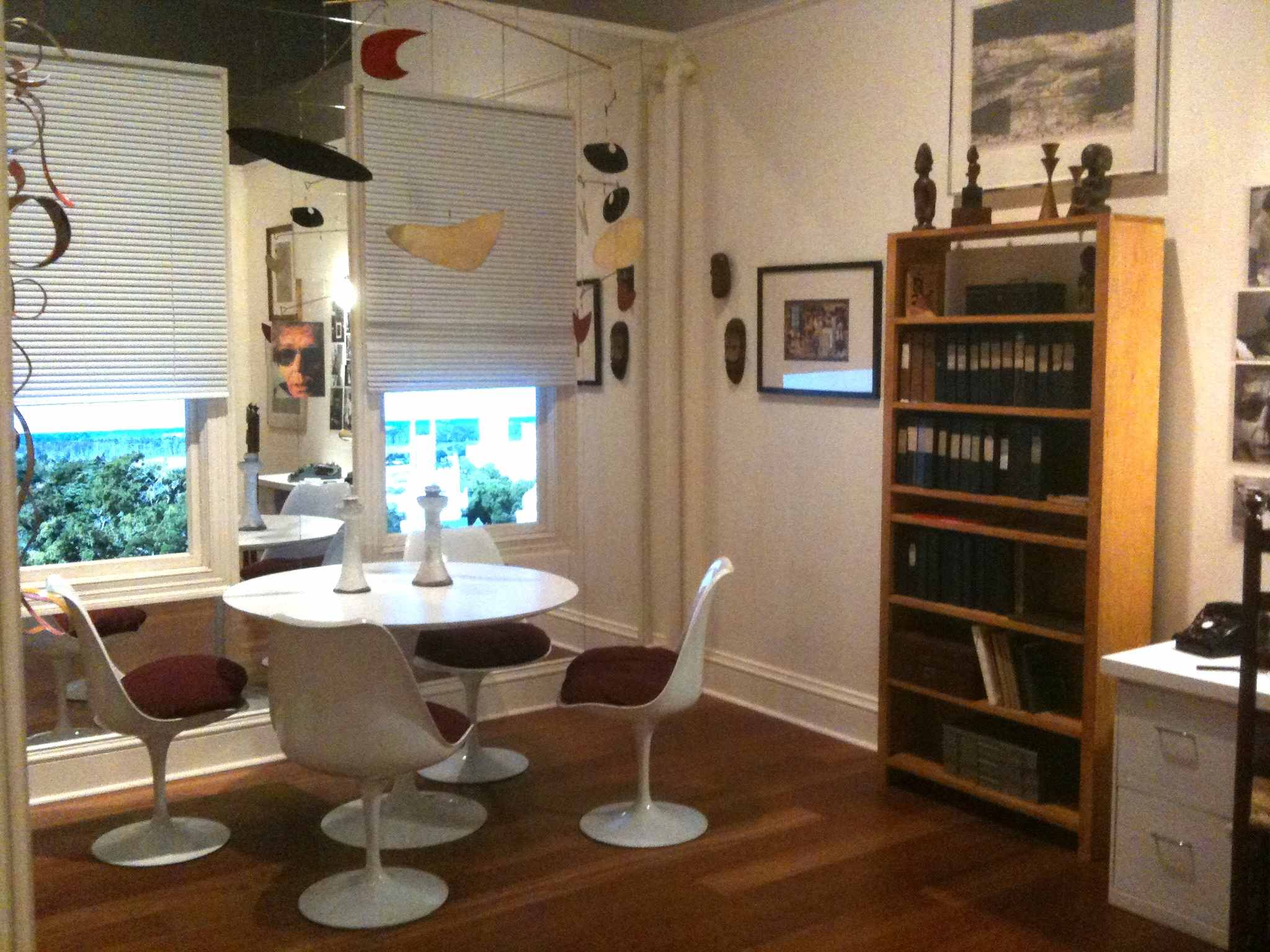
Too bad you aren’t down in Wilmington, North Carolina at the Cameron Art Museum, where a tribute to three famous local artists provides you with an opportunity not only to sit in one, but at a Saarinen table with four of them, all surrounded by classy contemporary art in a setting only an artist can create. It’s a recreation of Claude Howell’s apartment 44, collecting and making art and holding salons for his entire life. Check out the Flickr photos of his fantastic place (yes, it’s a recreation, right down to the views of the Cape Fear River outside!).

The Cameron invites you to sit down to enjoy Claude Howell’s beloved Saarinen set

The Cameron invites you to sit down to enjoy Claude Howell’s beloved Saarinen set

It’s part of the fantastic tribute “From Gatehouse to Winehouse” that is extended to April 14. Besides Claude’s apartment, the curators have also built the ramshackle botanical garden gatehouse where Minnie Evans sold tickets and created her visionary masterworks from 1948 to 1974. (By the 1970s, her work was displayed at the Whitney.) Take a look. The surrounding gallery walls are filled with projected “visions” and crayon drawings hung on a line. The third studio belongs to mysterious, mystical woman of the 1920s, Elisabeth Chant (and Claude’s art teacher.)

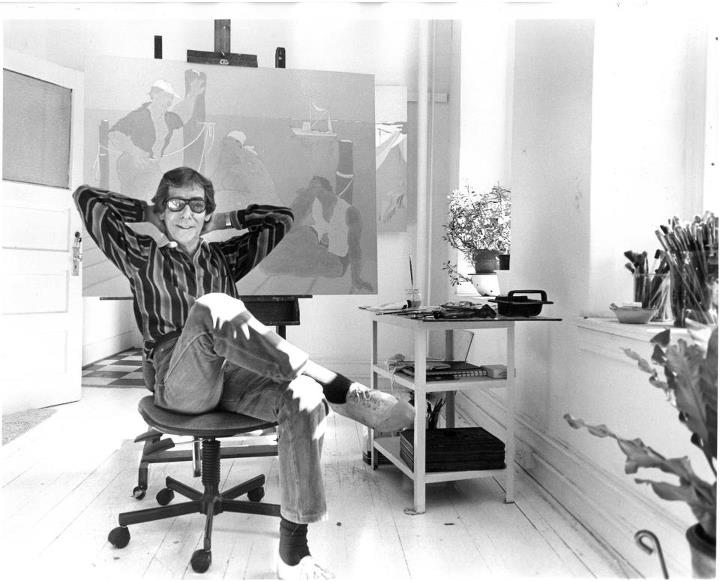
Claude at home in his salon-studio. Source: Cameron Art Museum

Claude at home in his salon-studio. Source: Cameron Art Museum

Enjoy seeing how Claude lived and worked with his museum-quality dining set, and if you are anywhere near Wilmington, be sure to go sit in the chairs for real. Claude would be glad to have you over!

Red Carpet History at Grand Central

Original Red CarpetIf you’ve ever wanted to see where the red carpet began, run over to 42nd Street and take a left into Vanderbilt Hall to gaze upon the plush surface upon which so many famous, fabulous, and acclaimed celebrities and moguls trod – the red carpet that was spread daily to the lucky ones who could afford to board the 20th Century Limited from New York to Chicago.

It’s all part of the New York Transit Museum’s spectacular exhibition Grand by Design: A Centennial Celebration of Grand Central Terminal, running through March 15.

Docents give tours on the half hour, and they’ll tell you that the care taken with passengers right here at Grand Central was the origin of the phrase “red carpet treatment”. You’ll see an original destination sign, menus, and photos of the glamorous train (which will itself make an appearance at GCT on May 10-12). Take a look at the Flickr photos.

GCT at 100You’ll also be entertained by stories of the engineering, architectural, and pop-culture history of the terminal itself, and remember the stories about the chandeliers, stonework, ramps, and restoration every time you pass through. Get over to see all the memorabilia, trunks, engineering plans, and videos in person from 8am to 10pm daily before they are gone.

Some of the surprises are the “Ask Me” kiosks scattered throughout the hall, descriptions of how GCT changed the course of Midtown real estate, the story of how CBS and Walter Cronkite used to broadcast from here, and the size of that tunnel boring machine creating access for the LIRR to get into GCT 18 stories below. It’s all amazing, including the 1855 view of Midtown looking south from 42nd Street, lent to the show by the New-York Historical Society.

For a prequel, check out the NY Transit Museum’s historic timeline that lets you flip through online photos of various GCT incarnations since 1831. It’s really good, but not a substitute for seeing the red carpet, power-switch control panel, restored lamp post, and clips from movies that were filmed right where you’re standing. About 750,000 people pass through here each day, and from what we can tell, a lot of them are stopping to take a free 25-minute tour and check out the red carpet that started it all.

Look Up to See Where Your Grandmother’s Clothes Came From

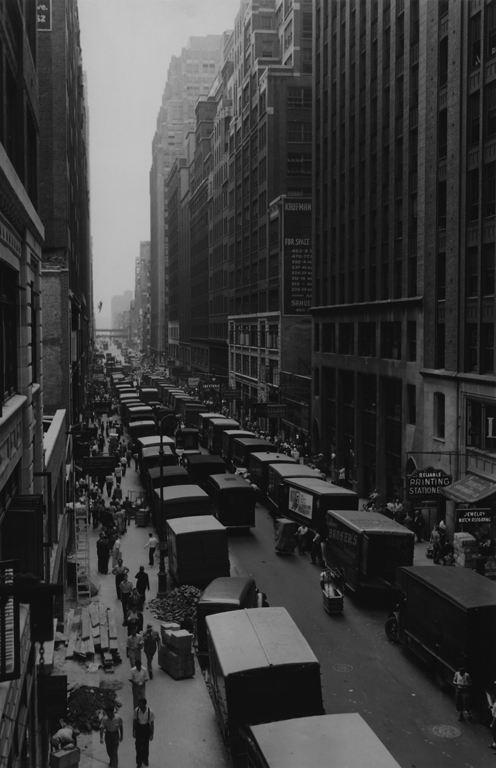
West 35th Street in 1938, looking east between Seventh and Eighth Avenues. Source: NYC Department of Records, Municipal Archives

West 35th Street in 1938, looking east between Seventh and Eighth Avenues. Source: NYC Department of Records, Municipal Archives

It can seem a little quiet walking over to Mood these days. Not too long ago, the streets above 34th Street between Sixth and Eighth Avenues were clogged with push boys, wheeling racks of  materials, trims, and fashions among jobbers, contractors, accessory importers, fabric stores, and showrooms. The way it used to be comes alive in the Skyscraper Museum’s show (closing today) Urban Fabric: Building New York’s Garment District.

In its heyday, those 18 blocks just north and west of Macy’s produced 75% of all US women’s and children’s clothes.  The exhibit tells the story of how this bustling hive happened.  In a nutshell, the old sweatshops in tenement buildings gave way to factory loft spaces in the 1890s around the area where NYU is today. When the big department stores emerged along Sixth Avenue and 23rd Streets, the lofts came with them. But the congestion proved to be a bit much for the female shoppers, who were disturbed by the throngs of guys loitering about on their lunch breaks, and the retailers took action.

The department stores (like Macy’s and Lord & Taylor) moved above 34th Street. To prevent the factory lofts from overwhelming them again, the City implemented the first zoning ordinance in America in 1916. The garment makers, closed out of the fancy retail neighborhood, started razing the Tenderloin District on the West Side and erecting architect-designed skyscrapers (like the Fashion Tower on West 36th) from that point on. About 125 buildings went up on those 18 blocks before the Depression hit.

Here’s a glimpse of what it was like in 1952:

As recently as the 1970s, carts were still being shuttled through the narrow streets, but we know how that story ended.  Today, no one even looks up at the entrances, set-backs, lobbies, or embellishments of these once grand hubs where models, marketers, Mad Men, laborers, seamstresses, teamsters, pattern makers, the designers co-mingled.

Interestingly enough, not a single building is landmarked. In fact, the Skyscraper Museum had trouble even finding photographs of the original buildings and had to turn to historic adverts and early brochures on factory electricity.

For the full, fascinating story by the curator who unearthed it all, listen to Andrew Dolkart of Columbia University, and watch his slide show:

Interns and staff built a nice model of the buildings lining 37th Street for the show, and a big thank you to The Skyscraper Museum for (again) putting the history and installation walkthrough on line. Tell your friends, and be sure to look up next time you walk over to Mood.

Thin, Rich, and MAD Embrace of the Middle East

Martin Munkácsi photo of Doris in an ensemble that is in the exhibition. Source: Doris Duke Charitable Foundation Historical Archives, Duke University.

Martin Munkácsi photo of Doris in an ensemble that is in the exhibition. Source: Doris Duke Charitable Foundation Historical Archives, Duke University.

Walking into MAD’s soon-to-close exhibit, Doris Duke’s Shangri La: Architecture, Landscape, and Islamic Art, what do you see? An architect’s model of a small palace by the sea, dazzling objects that adorned it, exotic loungewear inspired by faraway ports of call, Vogue-worthy jewelry, and photographs of a young socialite/philanthropist consulting with master craftsmen in busy Iranian and Moroccan workshops off the world’s most ancient streets.

As you examine these bits and pieces of Shangri La and its history, there’s a single vision that emerges – a portrait of a woman who knew about light, color, beauty, form, design, artistry, history, and had the vision, passion, and resources to put it all together in a way that any interior designer, fashionista, curator, and global traveler would envy.

Here’s the story line: In 1935, Doris Duke fell in love, went on a round-the-world honeymoon with James Cromwell, and fell in love again – with the exotic sights, sounds, patterns, textures, and artisanal wonders of the Middle East. Followed everywhere by reporters, she and James sojourned for months through Palestine, Jordan, Egypt, and the Indian subcontinent, marveling at the dazzling historic architecture, sinuous designs, luxurious carpets, lattice metalwork, colorful tile, and bejeweled ornament.

Tim Street-Porter’s photo of Doris’s dining room at Shangri La (2011) Source: DDFIA

Tim Street-Porter’s photo of Doris’s dining room at Shangri La (2011) Source: DDFIA

She just had to have it, and when she and James landed in Hawaii, she knew that no home in Palm Beach was going to cut it. They bought an ocean-view lot on the Big Island and began constructing a dream house. Her architects hewed to her vision — to create a seaside home into a tribute to the Islamic architecture and design that thrilled her imagination.

They brought artists and designers in from Iran, Syria, India, and Morocco to work on the home, and Doris herself traveled went back to check on progress in the home-country workshops and buy more. Eventually, she amassed one of the largest private collections of Islamic art in the world. Peruse her collecting timeline.

The actual home (now christened Doris Duke Foundation for Islamic Art) is now open to the public. Take time to explore Shangri La on the virtual tour. It hosts not only a 2,500-item collection, but thought-provoking installations by contemporary artists. (So does the show.) Here’s a video of artist Shahzia Sikander sharing what it felt like to project her light installations on this magical dream house.

For more history, watch the curators’ video. Doris’s vision, taste, and style will be on view at MAD for a few more days, then tour museums across the country.

You’ll never walk through the Islamic Wing at The Met again without thinking, “What would Doris do with this?”

Meet The Building You Didn’t Know at NYHS

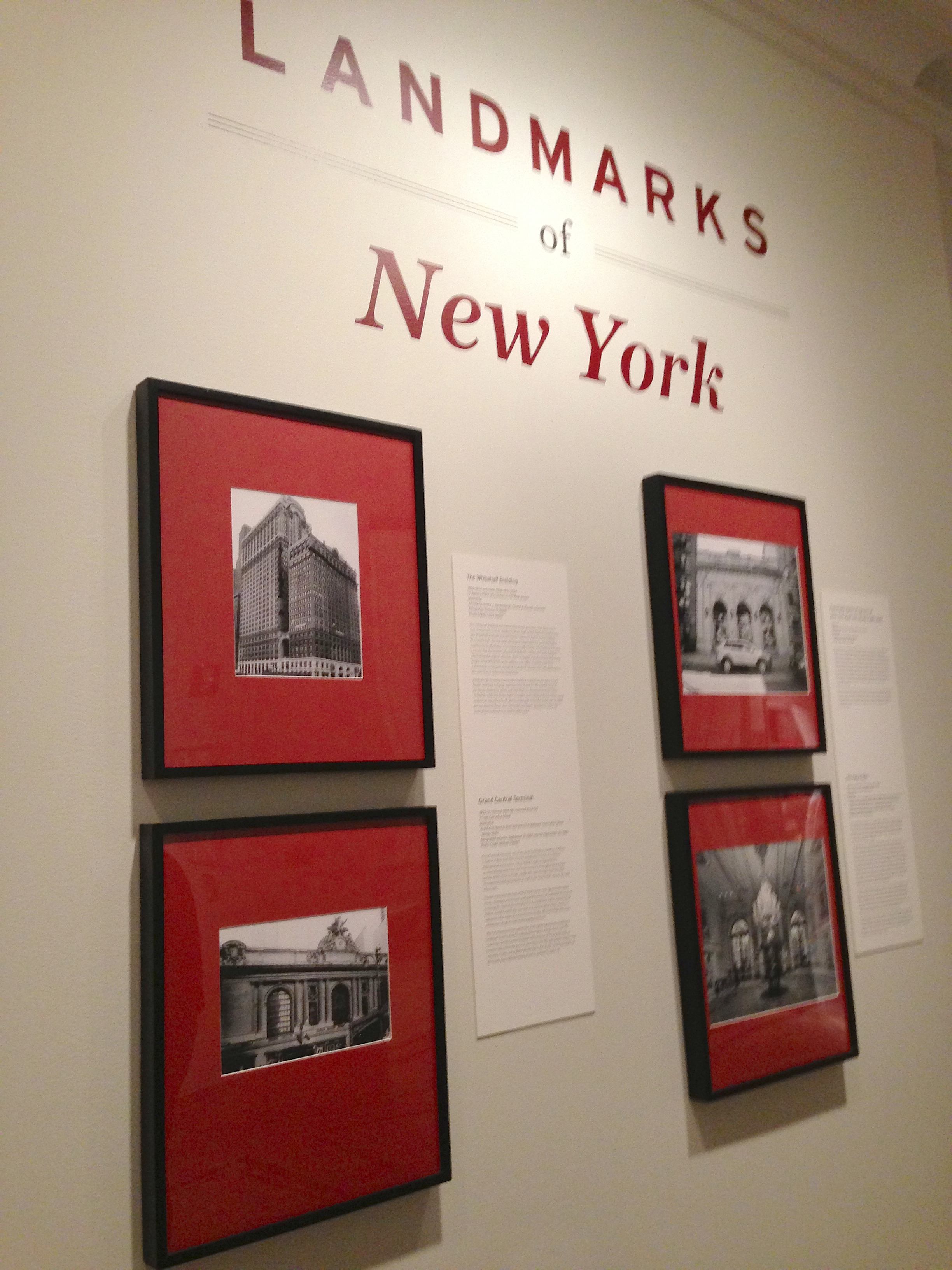
Installation view featuring photos of the Whitehall Building (17 Battery Place), Grand Central Terminal, the Free Public Baths (538 East 11th), and the interior of the Plaza Hotel

Installation view featuring photos of the Whitehall Building (17 Battery Place), Grand Central Terminal, the Free Public Baths (538 East 11th), and the interior of the Plaza Hotel

In one of the most deceptively simple installations at the New-York Historical Society, visitors can’t stop looking, reading, absorbing, talking, and pointing.  The Landmarks of New York show was humming all last weekend, with exhibition goers moving up and down the staid second-floor hallway, quietly moving from photo to photo learning stuff about buildings they’ve seen a million times.

Did you ever think the entire history of New York could be told in 90 identically framed photographs? Take a look at a few of the 1,287 landmarked buildings in NYC. Since the NYHS web site does not contain any of these buildings’ compelling stories, run up to their second floor before the show closes.

The show pays tribute the 1965 Landmarks Law and resulting Landmarks Commission, established in the wake of the greatest architectural disaster in the history of the modern City – the 1963 destruction of the historic Penn Station.  Today, 30,000 structures are protected, and the photos show you some of the exteriors, interiors, and scenic landmarks of our five boroughs.

Installation view of John Bowne House (1661) photo by Jeanne Hamilton

Installation view of John Bowne House (1661) photo by Jeanne Hamilton

Which are the oldest? The Wyckoff House, built sometime before 1641, at 5816 Clarendon Road, Brooklyn, and the oldest surviving home in Queens, the 1661 John Bowne House. The label copy says that Bowne had a huge flare-up with Peter Stuyvesant over his ban on the Quaker religion (actually, he was arrested), which led Bowne to lend his sliver of Flushing to regular meetings of the Quaker community.

Nothing in Manhattan even come close, although 1764 St. Paul’s Chapel is the oldest surviving church. Did you know it was modeled upon St. Martin-in-the-Fields on London’s Trafalgar Square?

This exhibit is packed with story after story of places you pass all the time. Charlie Parker’s Residence at 151 Avenue B is a landmark, partly because Charlie lived there between 1950-1954, but also because Franz Kline did, too.

Lucky for us, that the City has posted all of the Historic District Maps for each borough. Or go to the interactive city map and click on “Landmarks” to see what’s in your neighborhood. Who knew Greenpoint has the Eberhard Faber Pencil Company Historic District? Adventures await. Get to know a building.