Modern Art and Political Survival in 20th Century Germany

How do artists – and their art – survive two world wars, an authoritatian dictatorship, and the bifurcation of nation’s premiere art institution? It’s the story told by the must-see exhibition, Modern Art and Politics in Germany 1910-1945: Masterworks from the Neue Nationalgalerie, on view at the Albuquerque Museum through January 4, 2026.

Berlin’s Neue Nationalgalerie mounted the show to bring never-before-seen works to the United States and tell the story of how modern art became an ideological battleground in Germany during the early 20th-century and how the history of politics, artistic innovation, and social commentary are reflected in the institution’s collections today.
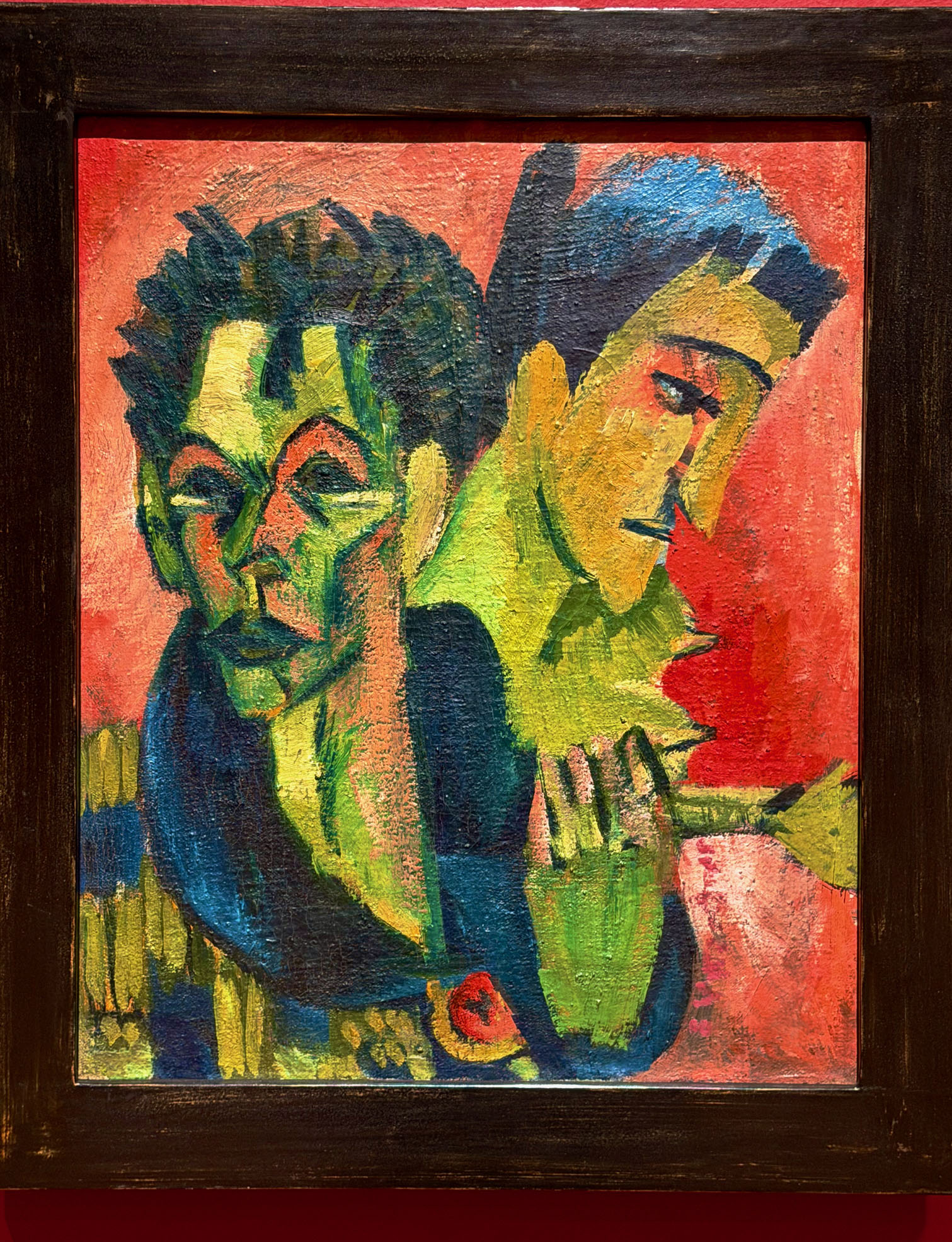
Ernst Kirchner’s 1914-1915 vividly expressionist Self-Portrait with a Girl.

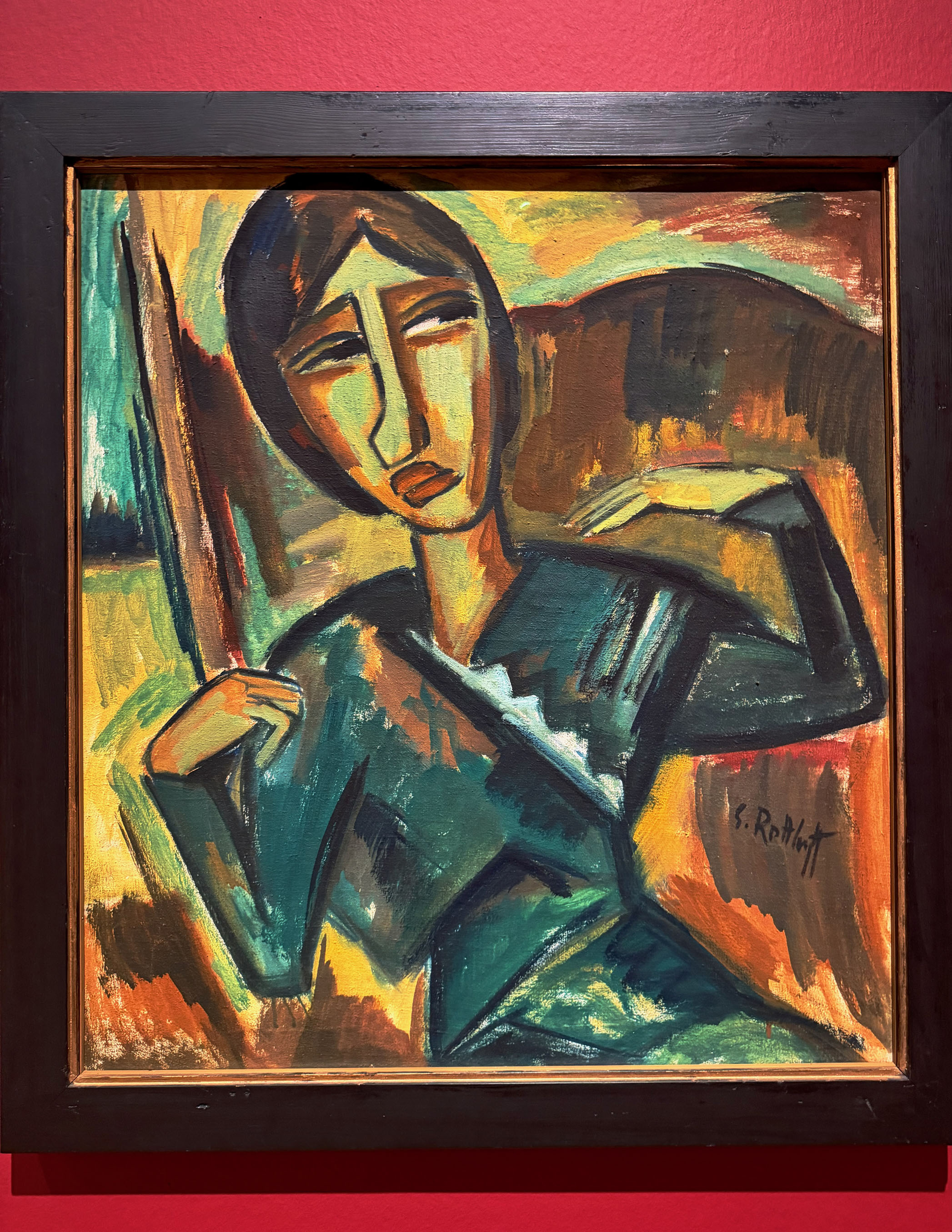
The exhibition opens with works from some of the best-known German expressionists – Kirschner, Pechstein, Schmitt-Rotluff, and Nolde. Slalshes of wild color, sharp angles, and modernist portraits nearly leap out of the frames of paintings, showing the influences of the French avant-garde fauves and Picasso’s angular Cubist planes.
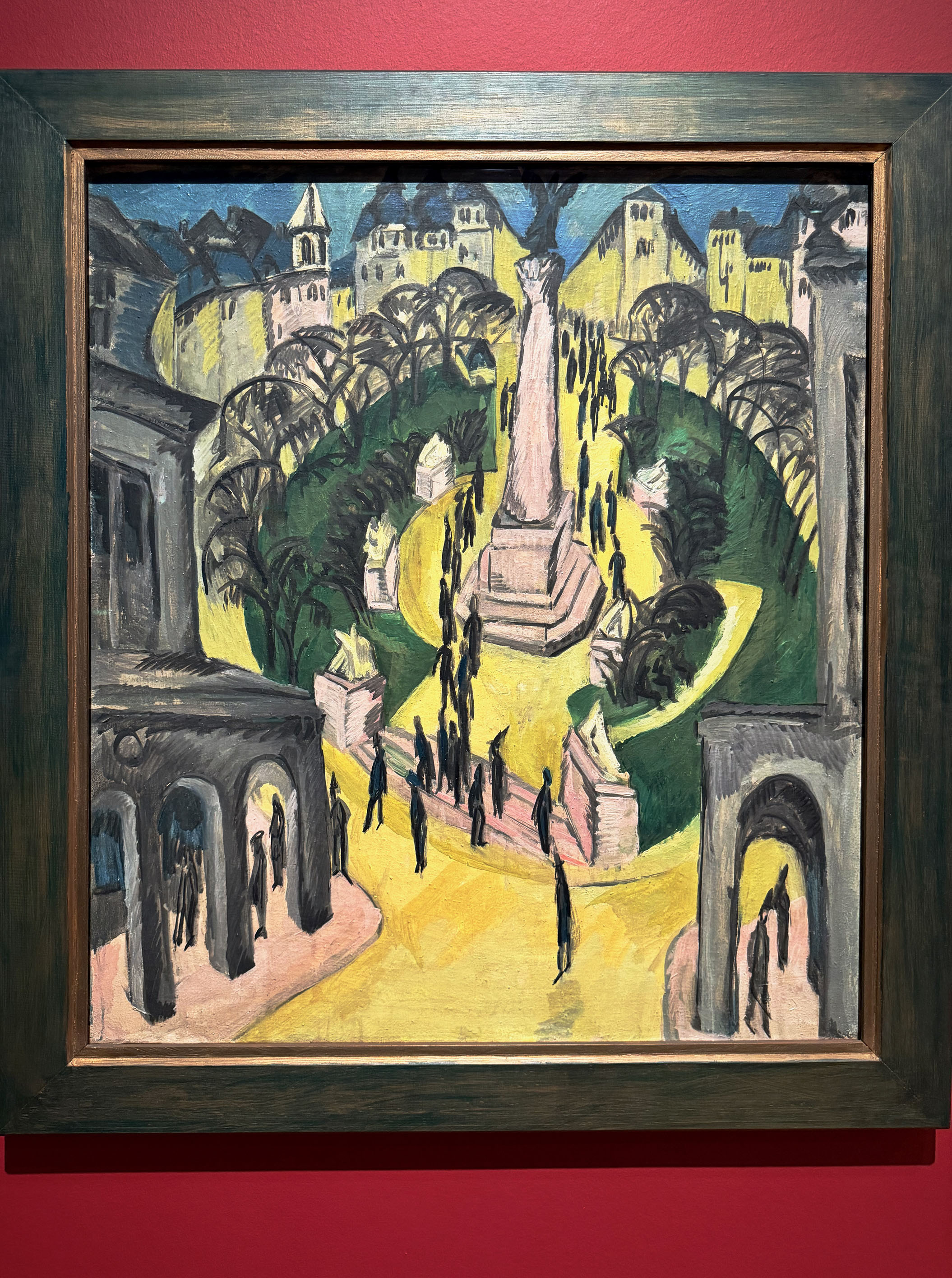
Ernst Kirchner’s 1914 expressionistic city view Belle-Alliance-Platz in Berlin.
Karl Schmitt-Rotluff’s 1915 expressionist painting The Green Girl.

Another section of the exhibition presents portraits of influential German art dealers who brought the best of the avant-garde to Berlin, Munich, Dusseldorf, and other German culture capitals in the early 20th century. Works by influential modernists Picasso, Leger, and Kokolschka hang alongside works by the Russian ex-pats who formed the forerunner group to Die Brücke in 1909 – Kandinsky, Alex Jawlensky, and Marianne von Werefki.

See some of our favorite works in our Flickr album.

Austrian avant-garde: Oskar Kokoschka’s 1909 oil portrait of Viennese architect, Adolph Loos; both artists represented by Berlin gallery owner Herworth Walden.

In 1911, the German modernists formed Die Brücke – a group that celebrated getting an artist’s inner feeling out on the canvas – not just a formalist declaration against classical painting and historical norms. When World War I broke out, many went to the front. If they survived, they continued painting to process the psychological agony of the War and the economic toll it took on the homeland.

The exhibition also features a gallery full of works that are a logical outcome of experimentation – abstract works by German artists that merge the symbology and energy of Italian Futurism with the riotous colors of Orphism.
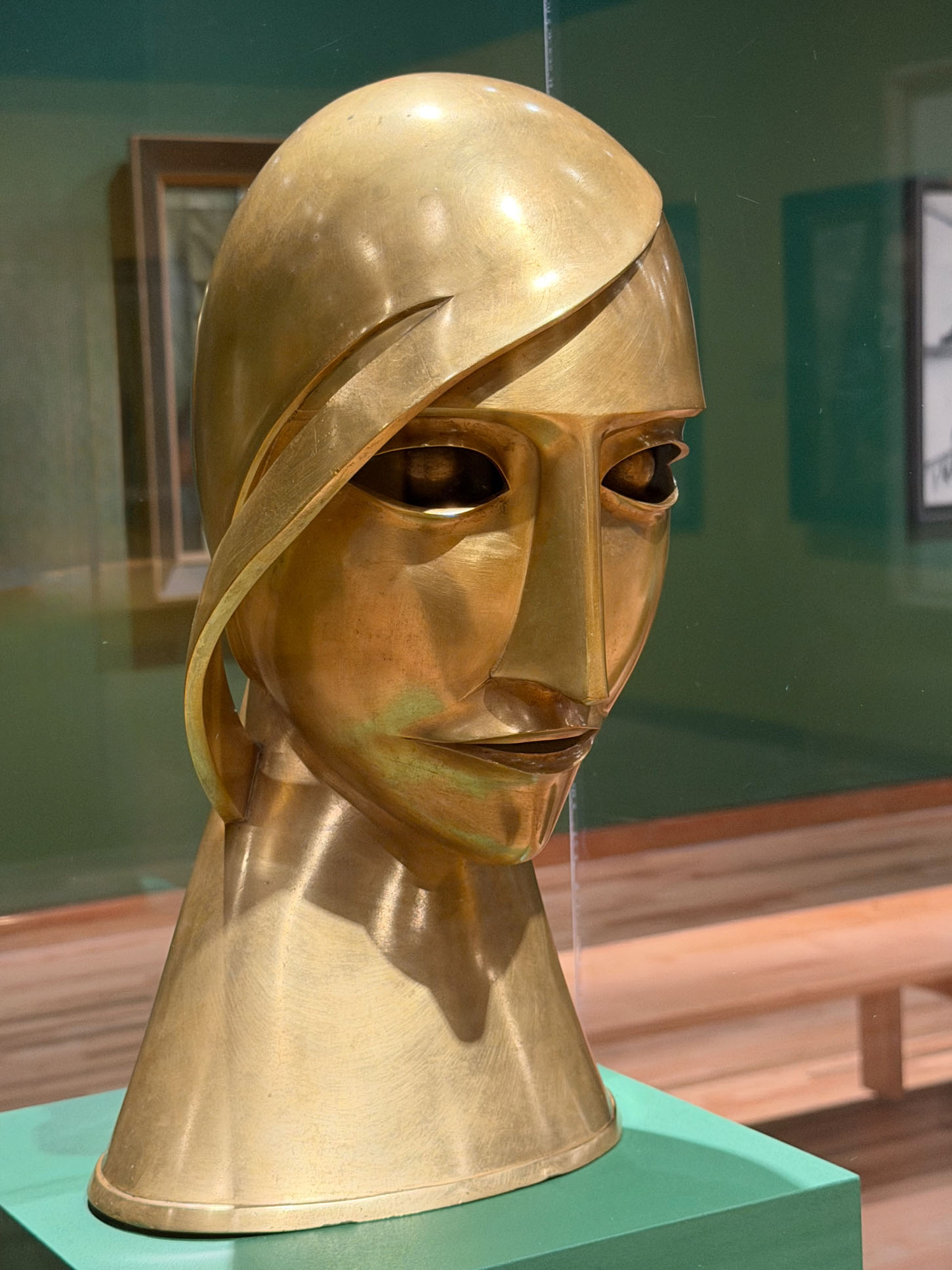
Abstract innovator: Rudolf Belling’s 1925 sculpture Head in Brass – confiscated and labeled “degenerate” by the Nazis in 1937.
Abstract innovator: Otto Möller’s 1921 oil painting City – influenced by Futurism.

Surviving hardship together, the end of World War I only motivated the survivors to come together, form societies and political action committees and keep creating.

Leading up to World War I, it seemed as though modernism would sweep the Continent and become the dominant art style collected by the progressive National Gallery. However, during the 1919-1933 democratic Weimar Republic, art preferences shifted to a highly literal, figurative style dubbed “the New Objectivity.”

This gallery shows the artistic and political shift to realistic portraits with hints of social commentary, depictions of new technology, and a new culture of enfranchised, emamcipated women (exemplified by the museum’s iconic Sonja by Christian Schad).

But over time, the political mood shifted, and the National Socialist Party rose.
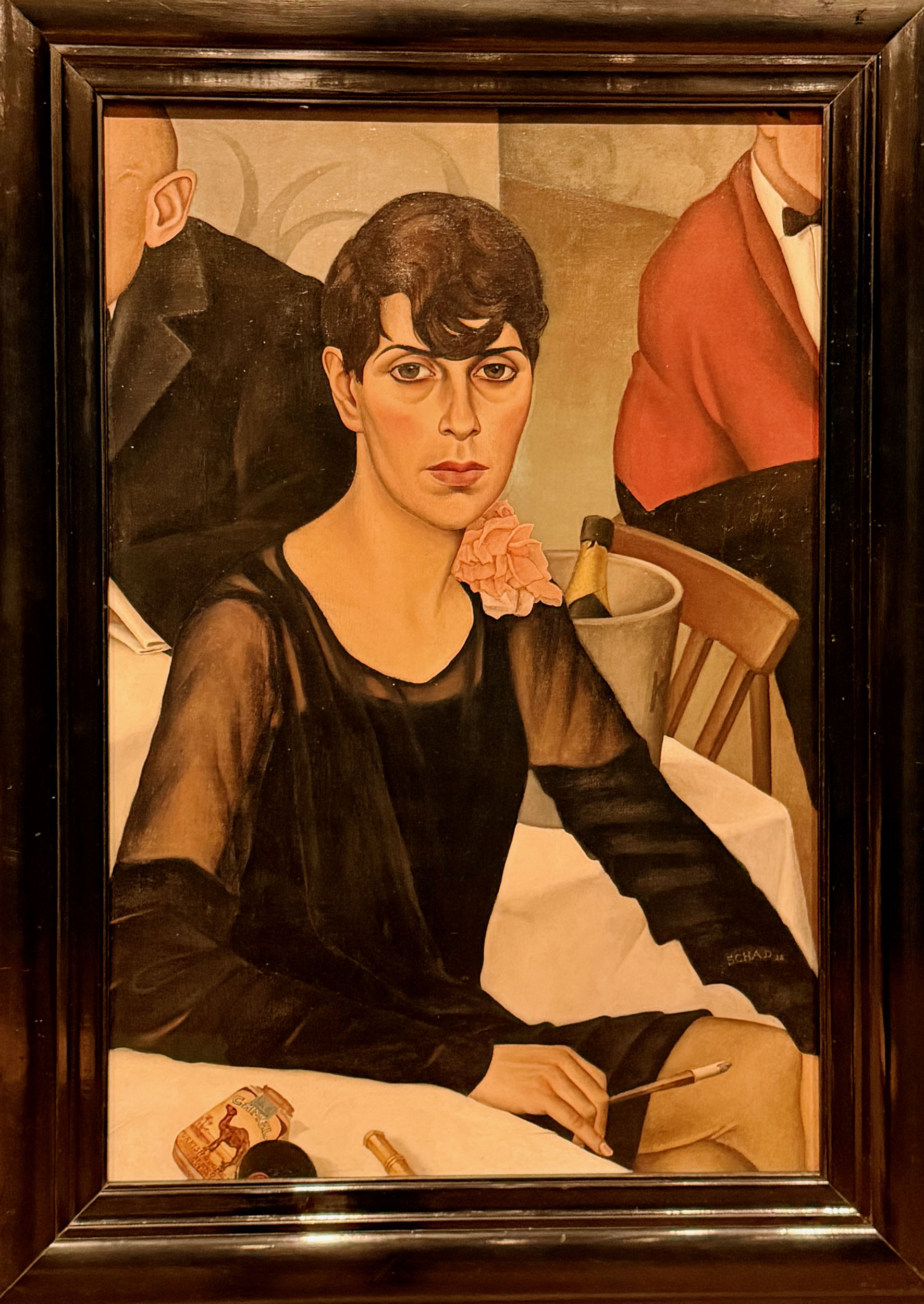
New Objectivity: Christian Schad’s 1928 Sonja– a portrait of the new emancipated women
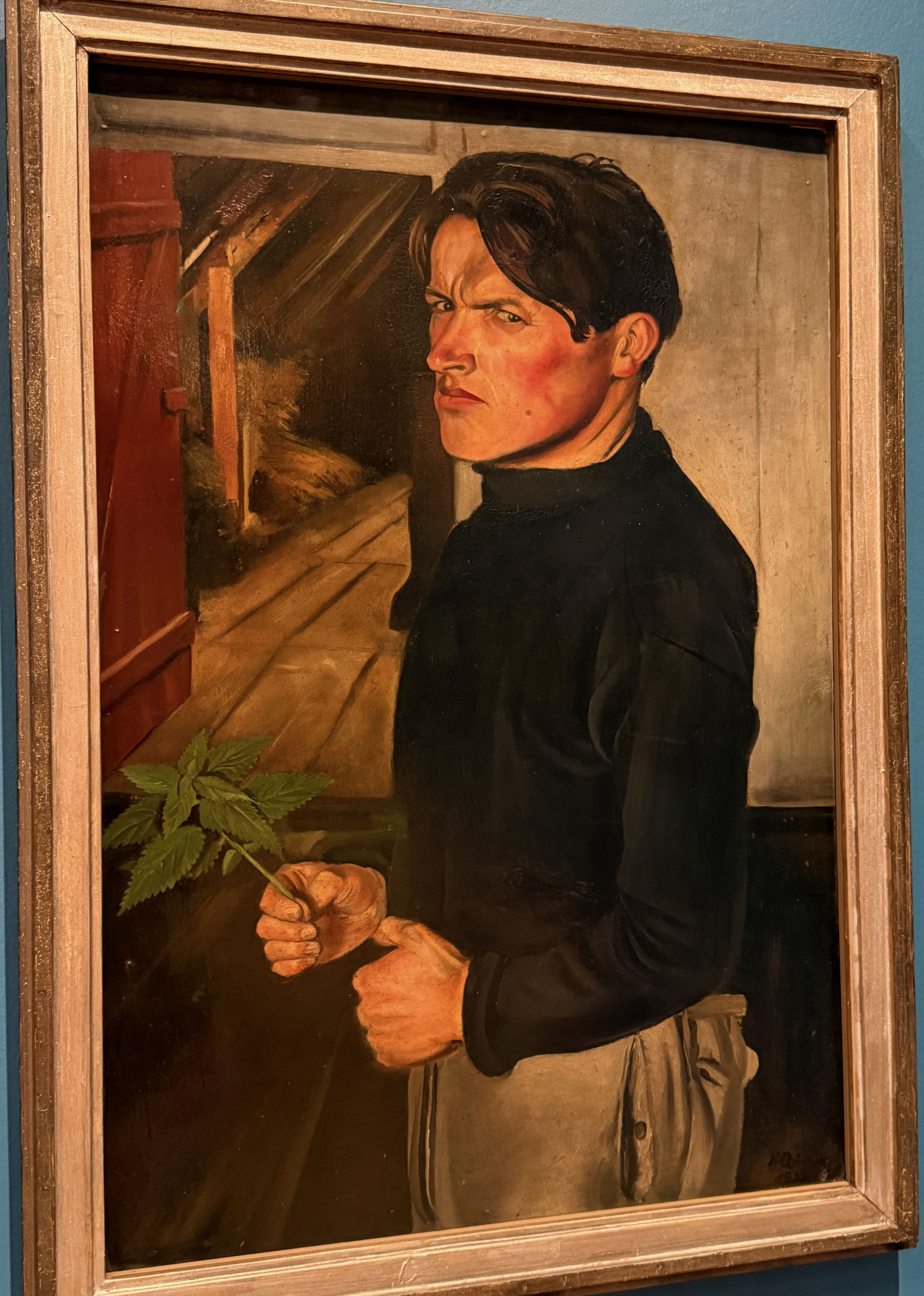
New Objectivity: Curt Querner’s 1933 oil on cardboard painting Self-Portrait with Stinging Nettle – painted in secret (and hidden) as a reaction to a violent police raid on a Communist Party meeting.

Throughout the 1930s, increasingly militaristic and anti-semetic groups formed in Germany, and as the National Socialists came to power, they fired heads of the leading art schools, shuttered the innovative Bauhaus, and banned abstract art and modernism because it did nothing to support their agenda. Artists either went underground (painting in basements) or fled the country entirely. 
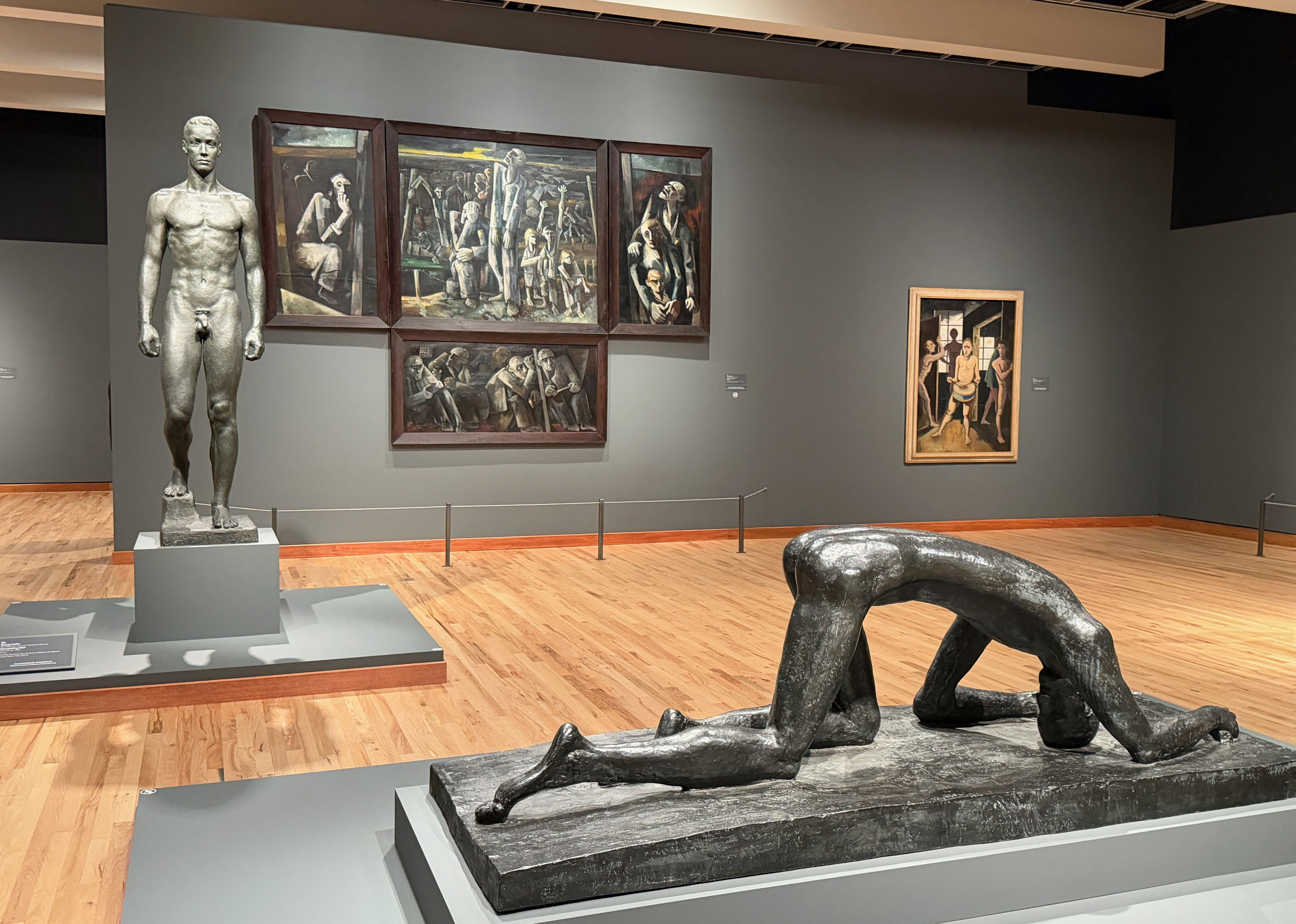
Art responding to WWI and WWII: Georg Kolbe’s 1939-1940 bronze Descending Man, Horst Strempel’s 1945-1946 oil on burlap Night Over Germany, and (foreground) Wilhelm Lehmbruck’s 1915-1916 bronze (cast 1972) Fallen Man.

The exhibition concludes by showcasing works made at the end of the war by German artists reacting to the societal disruption and atrocities.  In some cases, banned artists like Karl Kunz were able to paint in secret, wait until the War ended, and emerge to help a divided Germany revive the arts in the post-war years.

Watch the exhibition’s opening lecture by Berlin curator Irina Hiebert Grun, who provides an overview of the Neue Nationalgalerie’s collecting history, responses to the changing politics that affected early 20th century art, how the museum reassembled its collections and personnel after the Nazi-era persecutions.

The war destroyed the buildings and the Allies divided the country, but the story of this museum’s incredible 21st-century renaissance is one for the ages.

After the exhibition closes in Albuquerque, it be on view at the Minneapolis Museum of Art March 7 – July 19, 2026. Don’t miss it!

Banned modernist Karl Kunz was inspired by Picasso’s Guernica to paint Germany, Awake! in secret in 1942 – Kunz survived the war in Germany and participated in its post-War artistic resurgence.
Contemporary Pueblo Architecture Honors Ancient Beliefs

Any visitor to Chaco Canyon National Historial Park (850-1250 CE) makes the journey to appreciate innovative masonry of the Great Houses, the precision of the ancient road system, and the astronomically aligned walls, windows, and kivas. But how do contemporary Pueblo architects incorporate these traditional beliefs in their 21st century projects?

A fascinating, in-depth exhibition, Restorying our Heartplaces: Contemporary Pueblo Architecture – on view at Albuquerque’s Indian Pueblo Cultural Center through December 7, 2025 – explores how modern Indigenous architects incorporate traditional world views into their work.

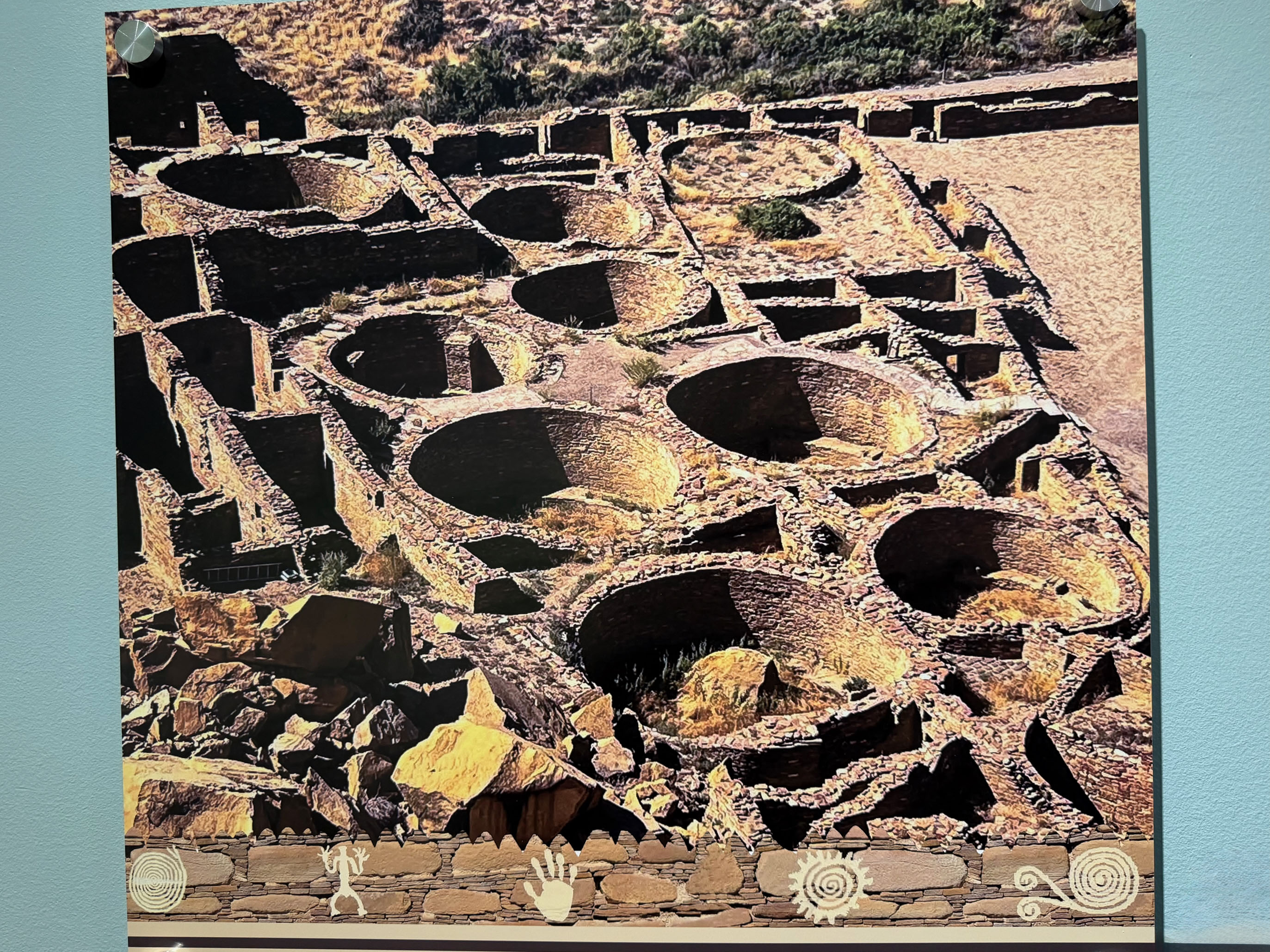
2023 photo Kivas at Pueblo Bonito,Chaco Canyon by curator Ted Jojola (Islela Pueblo) showing advanced masonry and architectural concepts.

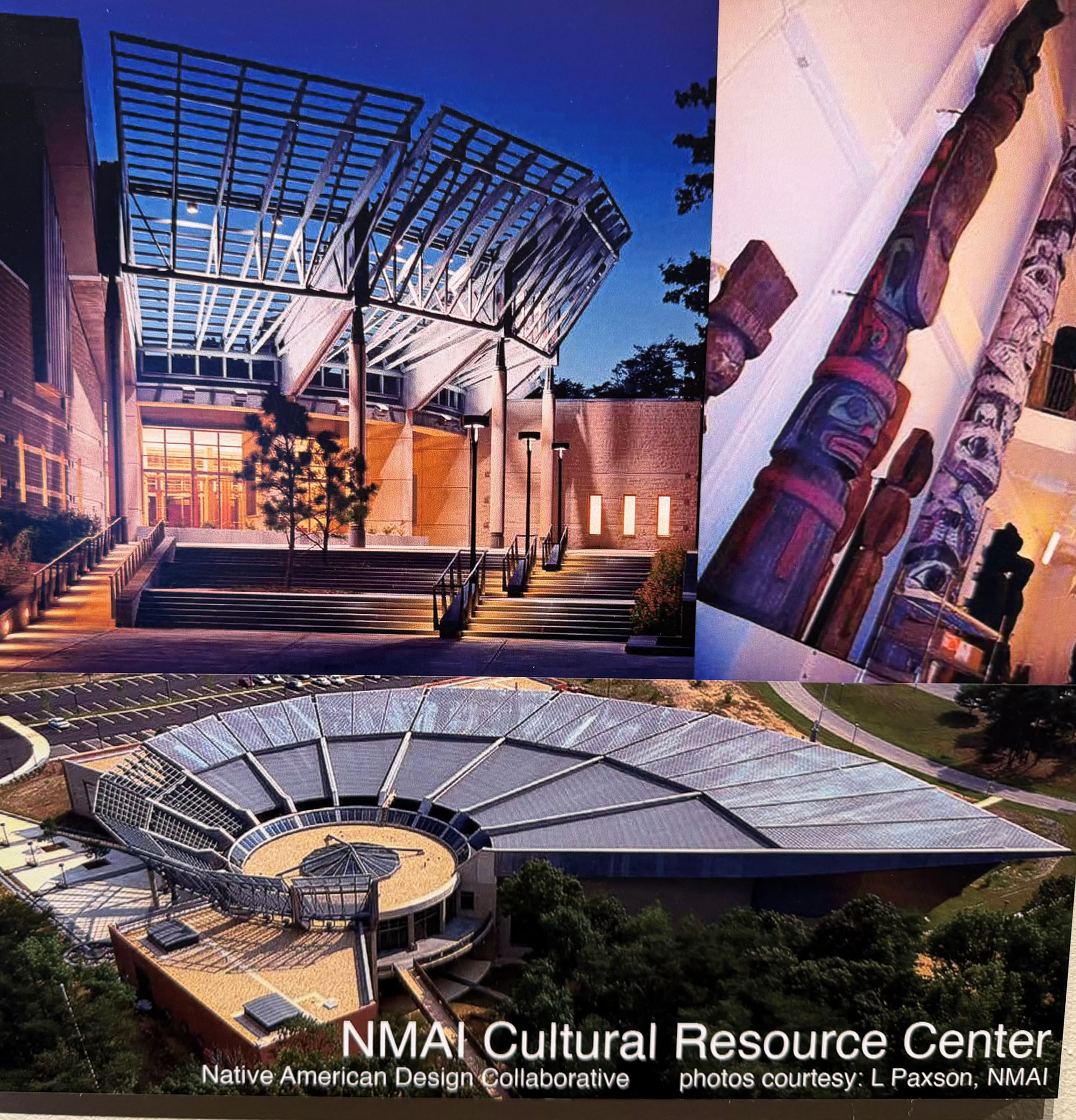
For example, just look at the design of the National Museum of the American Indian’s Resource Center – an organic design, aligned to the four cardinal directions, with extensive use of cedar wood.

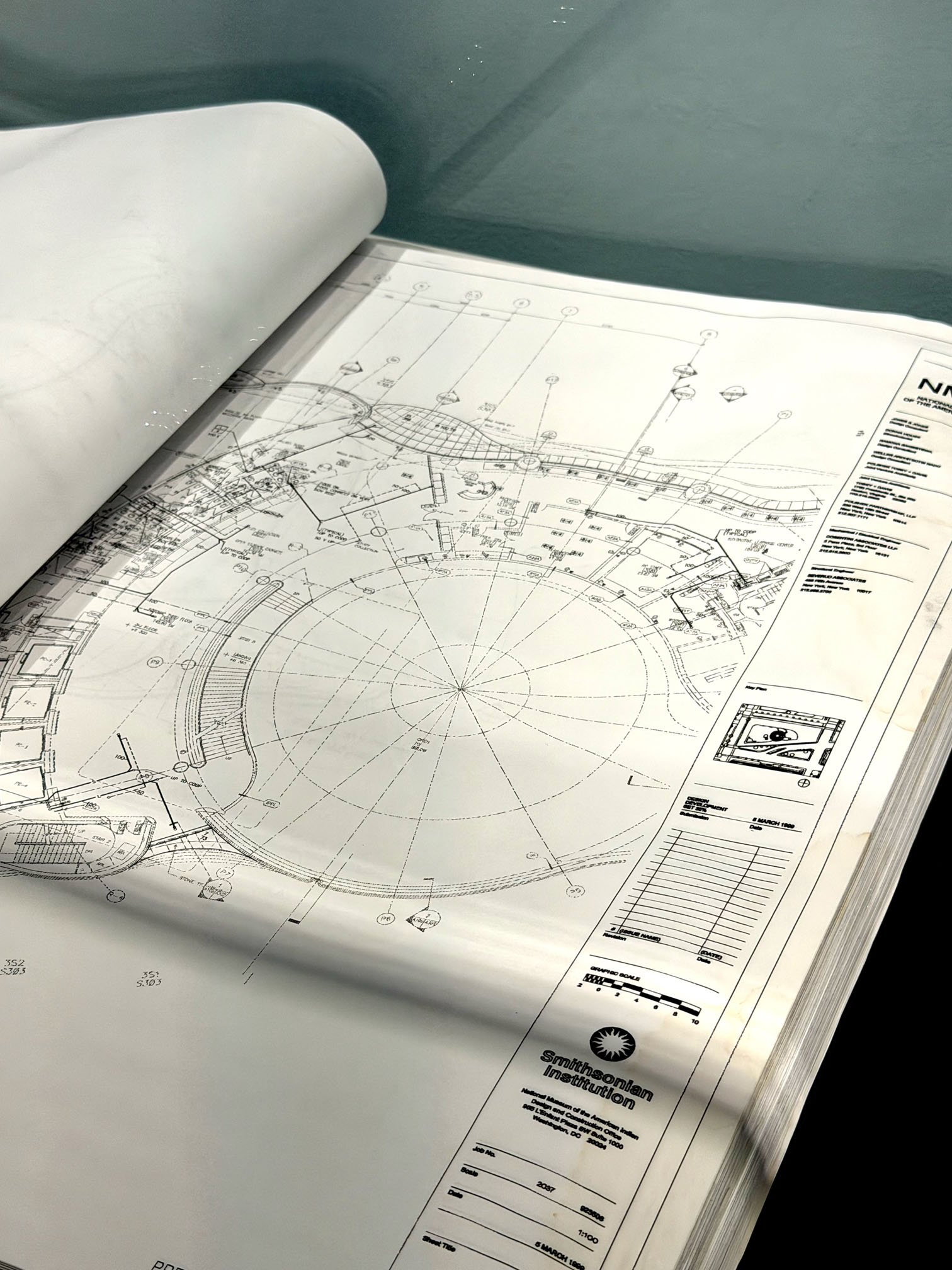
1999 plans for the National Museum of the American Indian Resource Center. Courtesy: Ted Jojola (Isleta Pueblo)
Views of the 1999 National Museum of the American Indian Cultural Resource Center in Suitland, Maryland. Courtesy: Lynn Paxson.

This exhibition coincides with the 50th anniversary of the 1975 Indian Self-Determination and Education Assistance Act – legislation that shifted Native American policy in the United States from assimilation to self-determination. Tribes were now able to initiate and run justice, government, health and education departments of their own – a change that triggered a construction boom for new schools and administrative buildings.

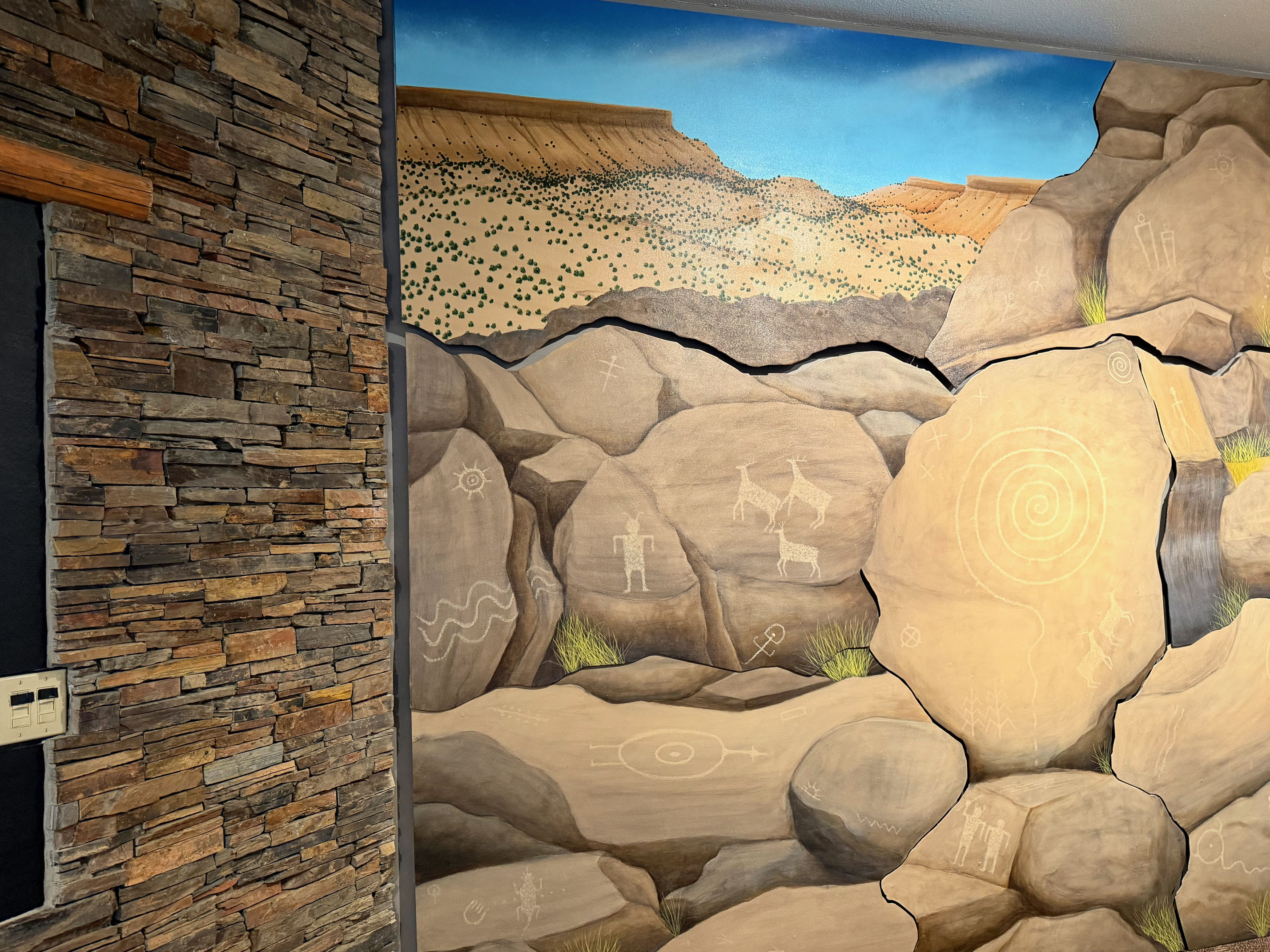
The show opens as an immersive experience in a large, circular gallery that introduces the core belief system and origin story of the Ancient Puebloans. Across a large screen in a vivid animation, the Pueblo people emerge into this world from a previous world. You watch them migrating outward in a spiral – symbols that are reflected across the art, murals, and photographs on the surrounding walls.

Mural by Dominic Aquero (Cochiti) with symbols of Pueblo creation; T-door represents the spiritual passage between two worlds (sky and Earth)

This experience sets the stage for the rest of the exhibition by showing how the stonework and beliefs reflected by the architecture of Ancient Puebloan centers points the way forward for Pueblo architects today.

2022 print by Gerald Dawavandewa (Hopi Cherokee) with T-shaped door for passage between worlds (sky and Earth]

The exhibition describes Ancient Puebloan architectural innovations – passive solar heating, precise window alignment, and masonry approaches. How did the Ancients achieve such precision in their dramatic Chaco and Mesa Verde buildings?

The curators present engineering and survey tools from archaeological excavations and modern survey backpacks side by side – plumb bobs, levels, and measuring devices.

Ancient stone and ceramic plumb bobs (from California and from Hewitt excavation at Rito de los Frijoles, Bandelier). Courtesy: Museum of Indian Arts & Culture/Lab of Anthropology.
Modern survey tools: level, tape measure, compass, brass plumb bob, wood, and string. Courtesy: curator Ted Jojola (Isleta Pueblo)

They also add comparisons of selenite used as window panels in Old Acoma’s Sky City (among the longest-inhabited communities in the US) and the contemporary architectural approach to windows in the recently built Acoma museum – a thoughtful reflection of the past

The exhibition directly addresses past HUD housing approaches on tribal lands – pushing suburban-style low-income housing, which moved families away from the traditional Pueblo plaza (the HeartPlace) and provided pitched-roof designs that blunted community cultural practices that utilized traditional Pueblo flat-roof construction.

The curators remind us of the continual upkeep required by adobe construction – a repeated communal task typically undertaken by a community’s women that happened on a regular, cyclical basis.  It’s also a reminder that Pueblo communities view buildings as living presences that evolve – not just concrete objects exist in a “finished” state.

Views of the 2000 campus for the Institute of American Indian Arts in Santa Fe. Courtesy: Paul Fragua (Jemez Pueblo)
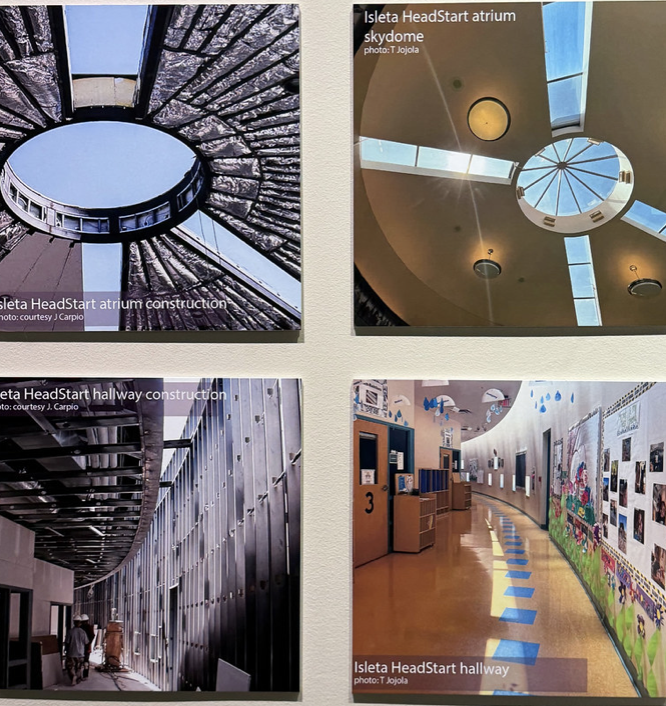
Views of 2004 building designed by Janet Carpio (Laguna/Isleta Pueblos) for Pueblo of Isleta’s Headstart/Child Care Center.

Wall panels, blueprint books, and architectural models are used to demonstrate the contemporary innovations of Pueblo architects – the Resource Center of the National Museum of the American Indian (1999), the campus of the Institute of Amercian Indian Arts in Santa Fe (2000), and the Headstart Child Care Center for Isleta Pueblo (2004). Both incorporate design elements echoing the spiral migration path, alignment to the cardinal directions, and colors and elements of the Earth.

A huge multimedia interactive theater punctuates the walk-through – an immersive visit to Acoma’s new Cultural Center and Haa’ku Museum with tribal members and designers explaining the architectural details and how the buildings reflect the landscape and traditional belief systems.

Immersive interactive experience of Acoma’s new Cultural Center and Haa’ku Museum. Courtesy: Anna Seed Productions, Electric Playouse, and UNM ASPIRE.

The exhibition features the work of the Indiginous Design and Planning Institute (iD+Pi) at UNM and presents dramatic architectural models of the past, present, and future of the community of Nambe Pueblo.

Look through the exhibition in our Flickr album here – a future-forward look at the continuing progression of innovative architectural designs and the next generation of designers and architects respecting and integrating the Pueblo world view with buildings considered to be living, breathing HeartPlaces for the community. 

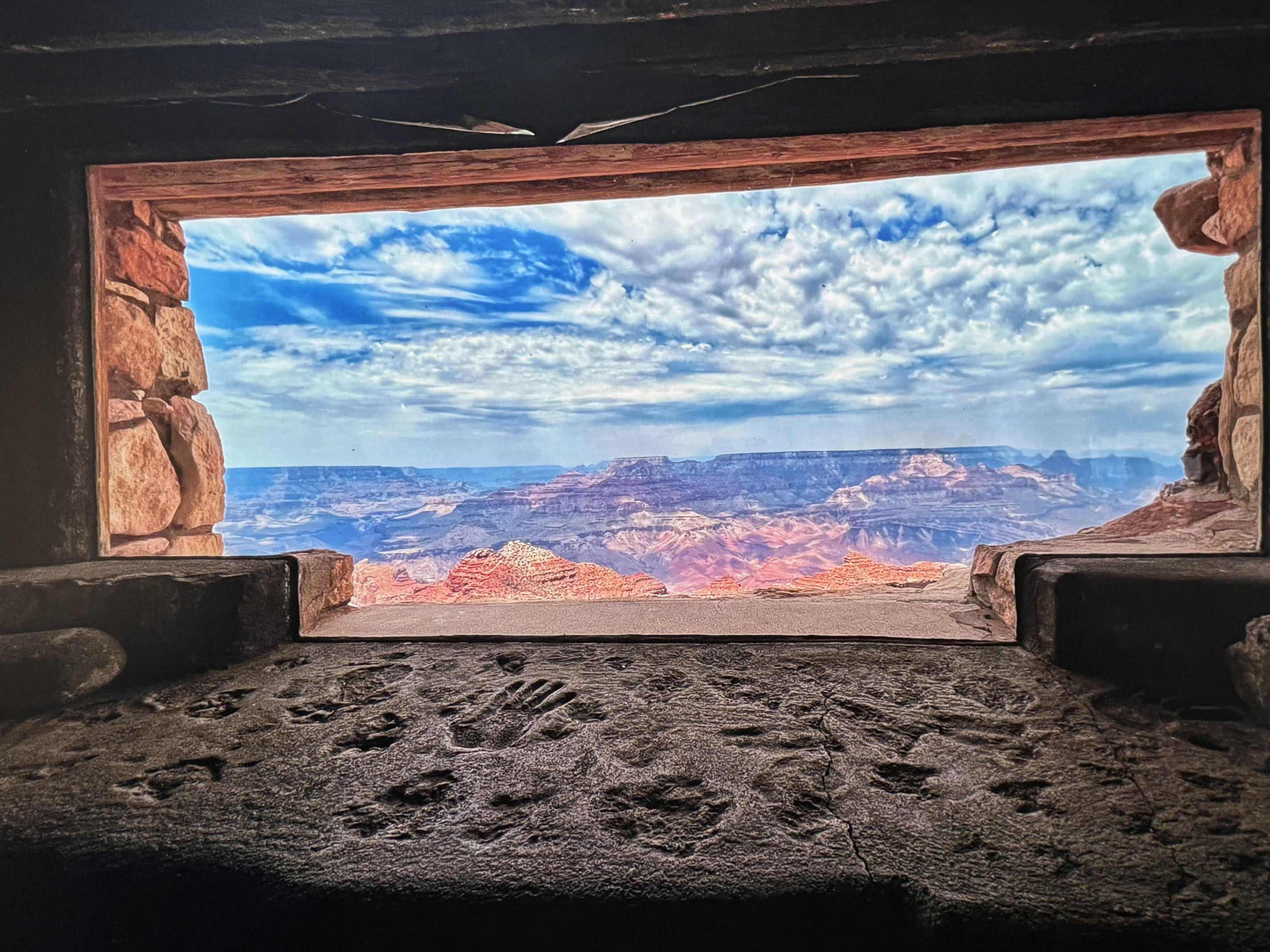
2023 photo by curatorTed Jojola (Islela Pueblo) North Window View from Desert View Watchtower, Grand Canyon showing the T-shaped doorway symbolizing passage between worlds

As the curators made clear in their opening-day remarks, a similarly extensive exhibition could explore architectural innovation and spiritualism across Navajo Nation. Let’s hope that happens!

Abstracting Nature in Albuquerque

How do abstract artists visually channel their response to awesome landscapes? You’ll get a glimpse of how ten artists approach natue and atmospheric phenomenon in Abstracing Nature, an engaging contemporary exhibition at the Albuquerque Museum, on view thorugh October 12.

Works by grand-master abstractionists Richard Diebenkorn and Agnes Martin greet you right at the entrance. 

Diebenkorn isn’t normally associated with New Mexico, but decades before embarking upon his epic Ocean Park series, he spent two years (1950-1952) at the University of New Mexico (1950-1952) working toward his MFA before returning to the West Coast.

Richard Diebenkorn’s 1952 Untitled (Albuquerque), featuring deep earth tones and undulating forms.

The Diebenkorn on display is a recent museum acquisition from those years. Complete abstract expressionist approach to the colors and undulating geologic forms he saw surrounding the post-war boom town.

Martin – the abstractionist grand-dame of New Mexico – made no attempt to hide the fact that her grids and minimal approach were expressions of the tranquililty and serenity she saw and felt from her retreats in Cuba and Galisteo, New Mexico.  She was channeling her emotional, meditative response in her surroundings – not following the reductivist, minimalist trend fo the East and West Coast gallery scene.

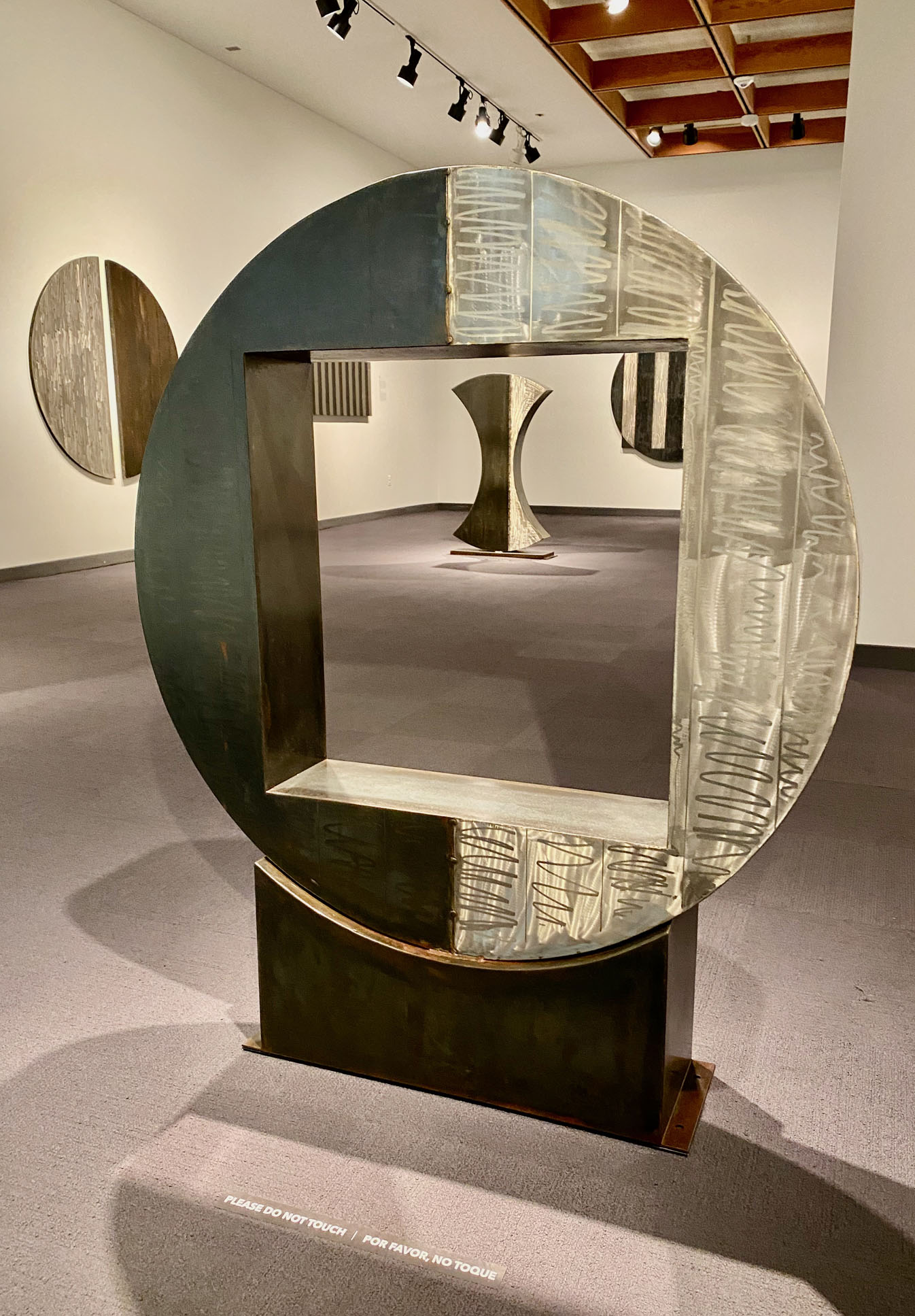
By getting up close to the two Martin paintings, you can appreciate her hand-drawn approach. Several stainless-steel sculptures by Agnes Martin’s great friend and student Karen Yank are nearby. The gleaming, hard-edged pieces do not resemble her mentor’s approach, except for the light, gestural touches across the surface.

Agnes Martin’s 1980 acrylic Untitled #6. Courtesy: New Mexico Museum of Art.
Karen Yank’s 2023 steel View with Silhouette VII and other sculptures visible through the portal. Courtesy: the artist.

The large pastels by Emmi Whitehorse look to the landscape and sacred colors of the Navajo Nation inspiration – a poetic approach most evident in Yei Retires to Mt. Taylor. Dramatic blue gestures suggest the spiritual turquoise color associated with the Navajo’s soutnern sacred mountain Tsoodzil.

Emmi Whitehorse 1985 pastel abstraction on canvas Yei Retires to Mt. Taylor.

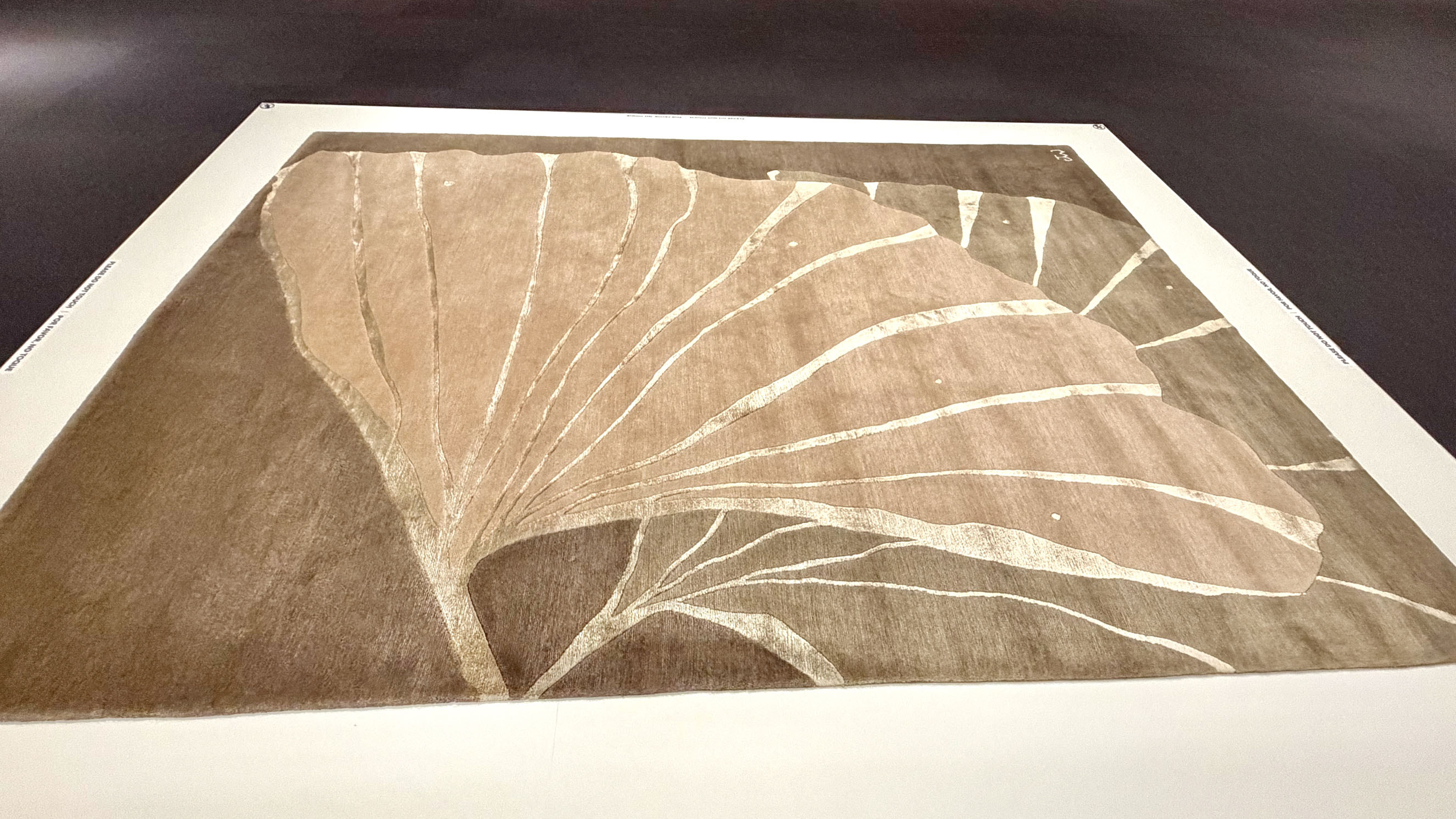
Abstractions used by textile artist Joan Weissman come from a place of process in which she starts with recognizable nature studies but allows her iterations to become more abstract.  Approaching her seemingly abstract Ginko, only gradually do visitors see that the hand-knotted rug (created at large scale by Pakistani artisans) is an extreme close-up of a leaf. 

Joan Weissman’s 2006 Ginko, a wool and silk hand-knotted rug, highlighting the intricacies of the leaf. Courtesy: the artist

2023 Hearing the Sun by Marietta Patricia Leis. Courtesy: the artist

Mariette Patricia Leis translates her experience of nature more formally. In one case, six seemingly minimalist wall-mounted panels are painted to reflect how we perceive the color of sunlight in different atmospheres and at different times of the day.

Another is a series of abstract panels suggesting horizons across volcanic surfaces during Iceland’s 24 hours of darkness.

Enjoy walking through the full exhibition in our Flickr album.

Detail of 2018 Vacuities by Marietta Patricia Leis inspired by Iceland’s winter night sky. Courtesy: the artist.

Here’s a close look at Judy Tuwaletstiwa’s 2001 Divination. She transformed sand by creating an arrangement of glass objects – cubes, spheres, and organic shapes – all displayed across a soft sand base.

Like the rest of the work in this exhibition, it allows us to think about the natural world, our perception of it, and the many ways that the experience can be transformed into art.

Light, Space and Time in Albuquerque

Drift into another dimension in Light, Space, and the Shape of Time at the Albuquerque Museum through July 20, 2025. The show, with significant works from the museum’s own collection, harkens back to the founders of California’s 1960s Light and Space movement, but also presents work by contemporary artists – many from New Mexico – who continue to explore the same phenomenon.

The curators have arranged the exhibition to show how artists use light, space, and time as subjects through which visitors can slow down, contemplate, and experience.

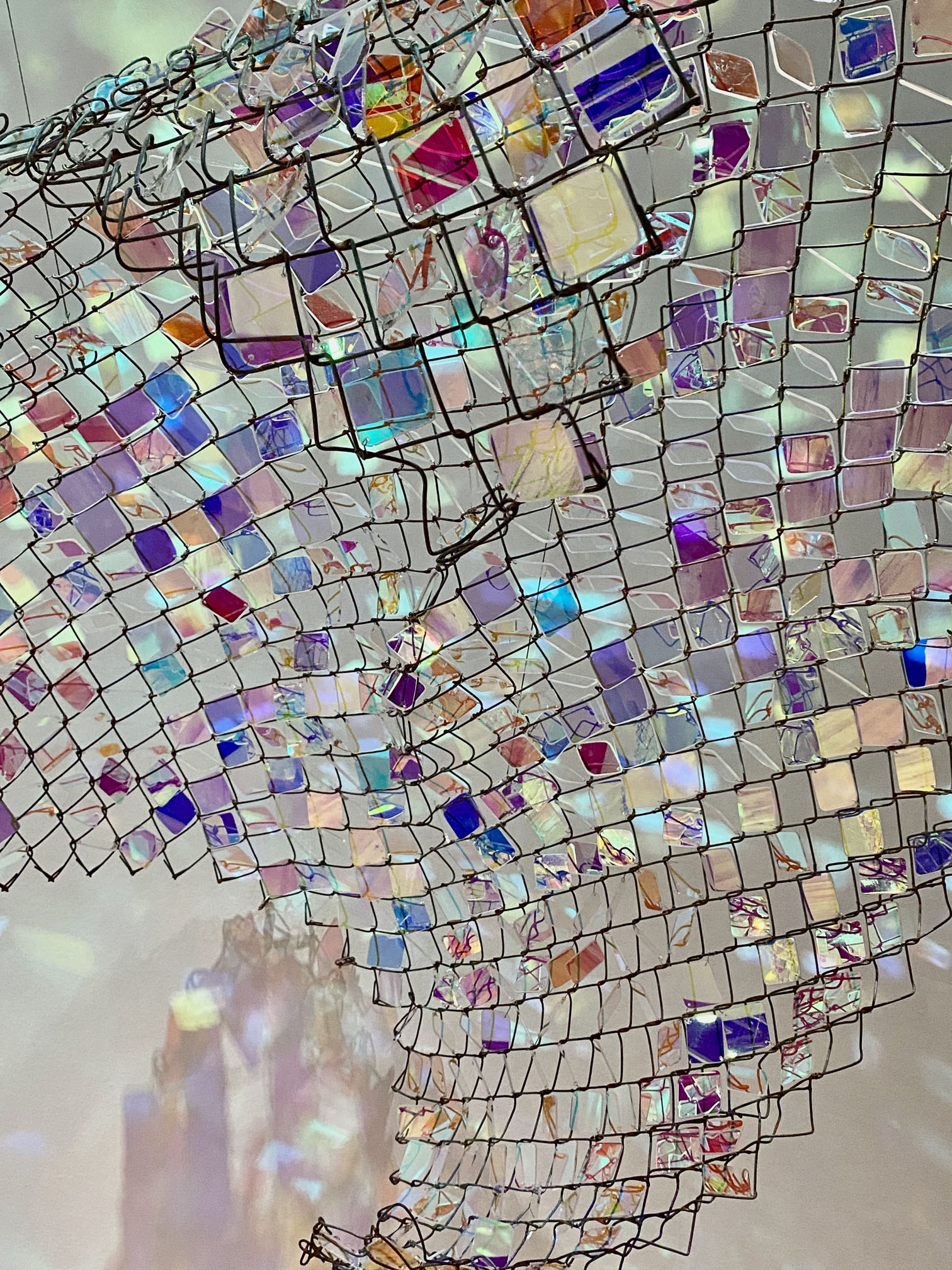
Detail of Soo Sunny Park’s 2013 Unwoven Light, an installation that seems to move as visitors walk through it. Courtesy: the artist

For more, see some of our favorites works in our Flickr album.

The first section showcases works where artists use light as the primary medium. Visitors can enjoy works by some of the most famous innovators from the Sixties and Seventies – Robert Irwin, who inspired a generation of West Coast art students to think differently; Dan Flavin, who merged minimalism with industrial light; and Helen Pashgian, who makes magic from luminous resins.

Irwin’s 2011 piece appears minimal, but his six fluorescent-light colors can be activated in four different variations, and he associated each with agricultural colors of Southern California. You can enjoy looking at Lucky You for its purity of form, or contemplate Irwin’s recollections of home.

Two fluorescent works by Space and Light superstars – Robert Irwin’s 2011 Lucky You and Dan Flavin’s 1987 untitled (in honor of Leo at the 30th anniversary of his gallery. Courtesy: Thoma Foundation

Behind the black curtain, you can enter a tranquility chamber. Helen Pashgian’s 2021 installation provides an unforgettable experience to visitors to slow down and wait. What are you seeing? The frosted, peach-colored epoxy sculpture at center stage appears dissolve in the light-filled space as lights slowly change. It’s like watching show changes to the sky during a dramatic sunset, but it’s light, white, ethereal, and pure.

Helen Pashgian’s 2021 untitled (peach lens) – the lens dissolve into space as the light changes to sunrise and sunset modes. Courtesy: Tia Collection

All-star word artist Jenny Holtzer’s Red Tilt takes an absolutely maximalist approach with multiple LED displays – a too-much, all-at-once, never-stopping tsunami of emotional words from her own story about survival and trauma.

Leo Villareal’s piece Scramble is the opposite. Albuquerque-bassed Villareal creates a mesmerizing, tranquil, never-repeating abstraction by programming LED lights. He’s done this on a larger scale in his epic commissions to light the San Francisco-Oakland Bay Bridge and all of London’s bridges over the Thames. Here, visitors get a more intimate experience – slowing down to watch Scramble’s gently changing colors and know what they’re seeing is unique to the moment.

Jenny Holtzer’s 2002 LED display, Red Tilt. Courtesy: Thoma Foundation
Leo Villareal’s 2011 Scramble, a programmed LED artwork that changes constantly. Courtesy: Thoma Foundation

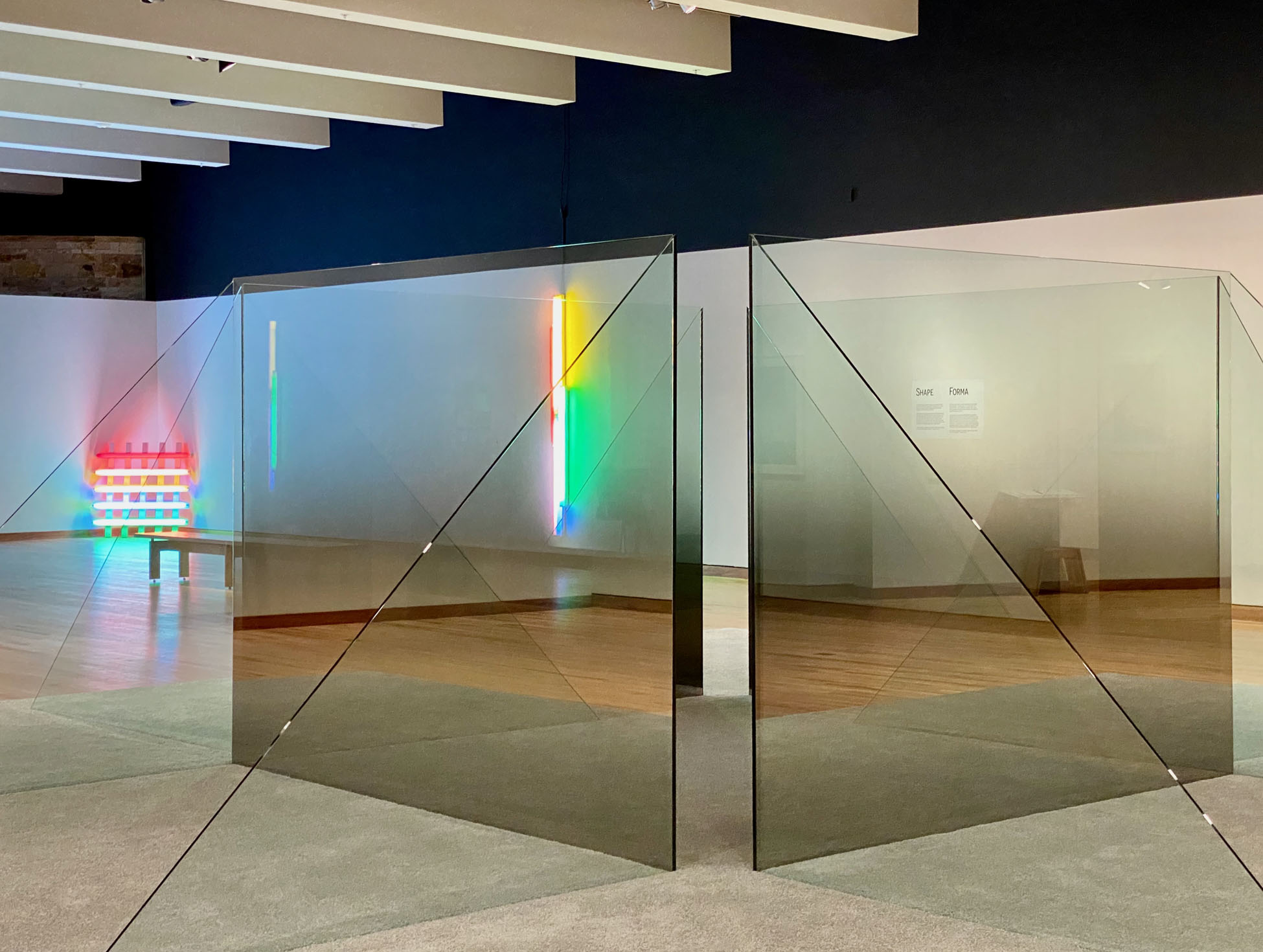
Larry Bell’s 1984 installation is the centerpiece of exhibition’s exploration of how artists use light, illusion, and technology to explore (and play with) our perceptions of space. Direct from his retrospective in Phoenix, Bell’s barely-there The Cat is a delicate but monumental presence in the show.  Huge, planes of coated and non-coated glass require a circumnavigation. Moving around, you can see how works are reflected and how some opaque surfaces block views of others.

Larry Bell’s 1984 The Cat – rectangles of coated and uncoated float glass.

Two nearby works by Santa Fe-based August Muth offer visitors a more intimate experience. Muth uses a holographic etching technique in which he creates the illusion of a “floating” image.

August Muth’s 2024 holographic etching Shadow Within Light. Courtesy: Pie Projects Contemporary Art.
August Muth’s 2022 holographic etching Terra Solaris. Courtesy: Pie Projects Contemporary Art.

The exhibition concludes with a magnificent installation by Soo Sunny Park – an installation of lights and plexiglass pieces that appear to move as you move through. Take a peek in this video.

Detail of Soo Sunny Park’s 2013 Unwoven Light installation with tiles that appear to move as the visitor moves through it. Courtesy: the artist

Frankenthaler and Friends Put Action into Prints

An exhibition of dramatic, action-filled prints by legendary Abstract Expressionists shows how experts at the new printmaking workshops during the Sixties and Seventies gave art-world mavericks the tools to take their ideas to new dimensions.

Push & Pull: The Prints of Helen Frankenthaler and Her Contemporarieson view at the University of New Mexico Art Museum through May 17, 2025, is a must-see journey into collaboration and experimentation at mid-century.

UNM recently received a gift of 20 magnificent artworks from the Helen Frankenthaler Print Initiative.

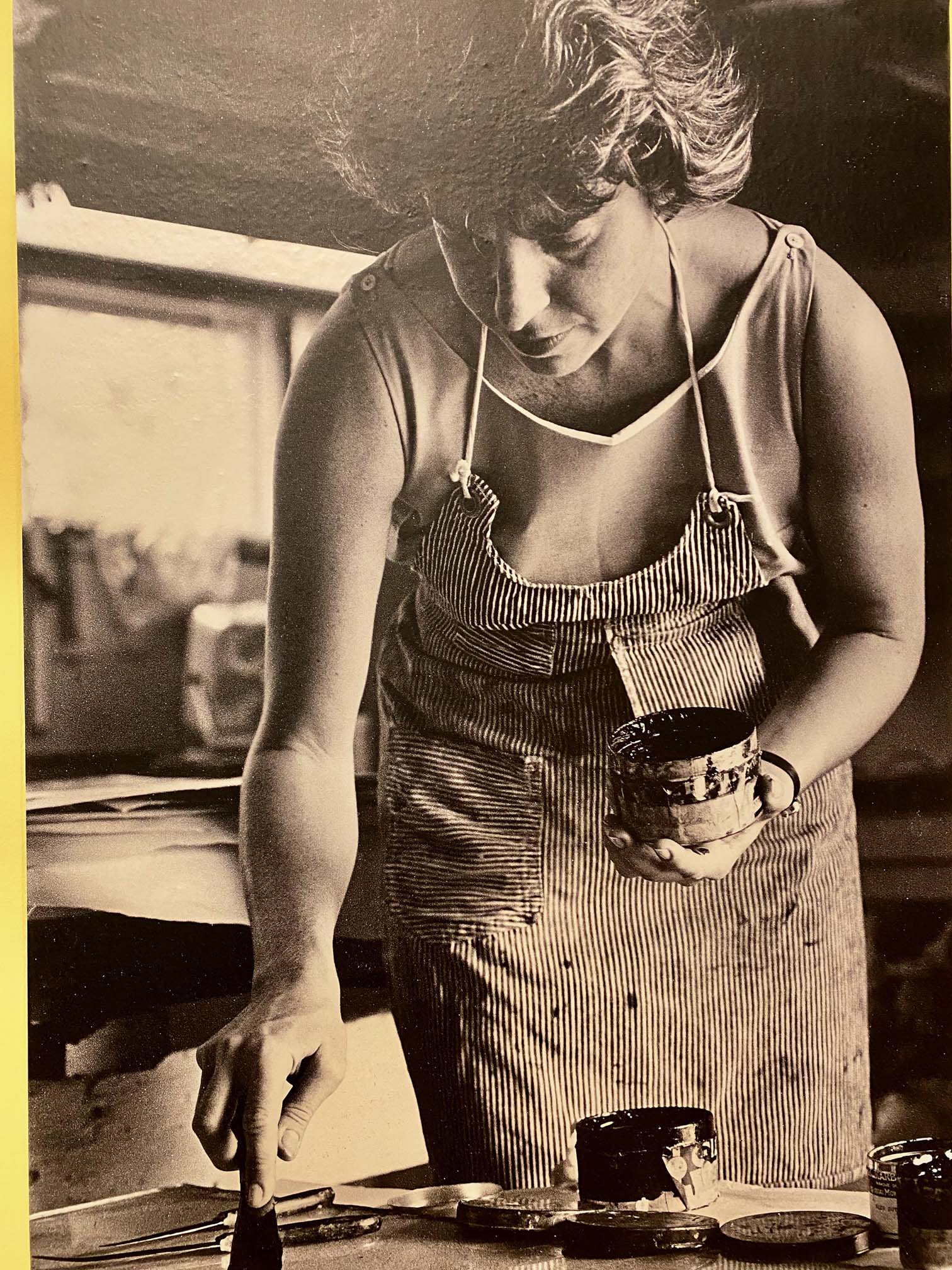
Hans Namuth’s 1964 photo of Frankenthaler working at ULAE in West Islip, NY. Courtesy: artist’s estate and University of Arizona’s Center for Creative Photography

The main gallery shows them alongside prints by Elaine de Kooning, telling the story of how these remarkable abstractionists collaborated with different workshops, used their distinctive styles to create portfolios, and formed decades-long bonds with master printers.

Helen Frankenthaler grew up and studied in the ever-evolving New York City art world. Her studies with Hans Hoffman – known for teaching abstractionists how to capitalize upon the “push pull” of color – and her technique of physically soaking and staining colors across canvases laid on her studio floor put her squarely at the intersection of the Abstract Expressionist and Color Field painting movements.

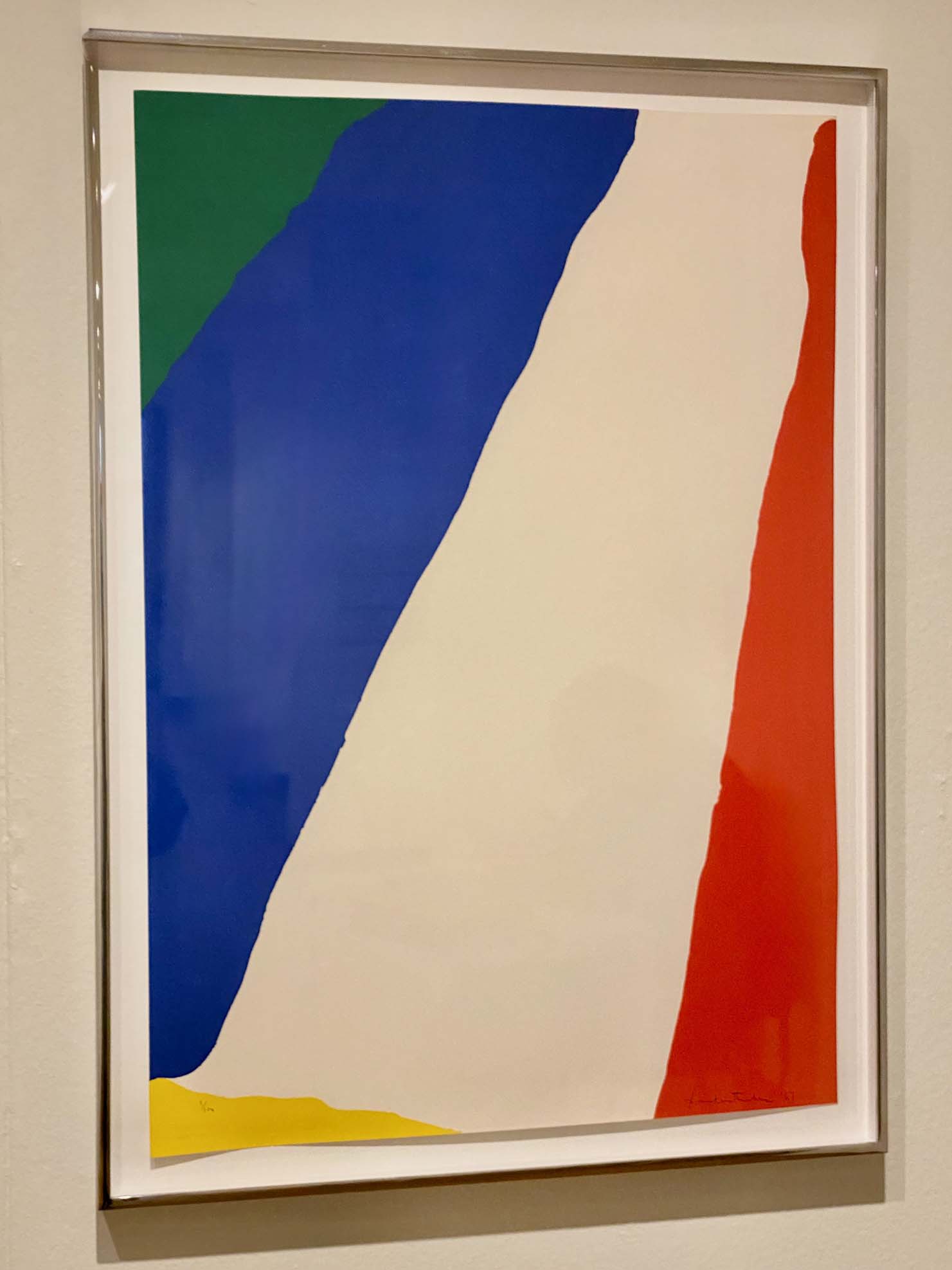
Frankenthaler had her first big solo painting exhibition in 1960, and began her printmaking experiments the following year. Some of her earliest works in the exhibition are silkscreens – some in the color-field direction, and some more gestural.

Frankenthaler’s 1967 untitled silkscreen (1/100); published by Chiron Press in New York; collaborating printer Patricia Yamashiro.
Frankenthaler’s 1970 silkscreen (artist’s proof) (19/24) from her What Red Lines Can Do portfolio, published by Multiples, Inc., NY; collaborating printers Sheila Marbain and Patricia Yamashiro.

Frankenthaler’s prints are grouped according to her work with various presses, such as Universal Limited Art Editions (ULAE), Tyler Graphics Ltd., and Tamarind Institute. Often with the guidance of print masters, she experimented to see how her “soak stain” could be layered and pressed multiple times across the lithography stone.

The exhibition curators display a series of proofs and experiments at Tyler Graphics to demonstrate the artist’s creative process with the expert printmaking team.

Frankenthaler’s 1978 lithograph Bronze Smoke (36/38) published by ULAE in Bayshore, NY; collaborating printers Thomas Cox and Bill Gordon.
Frankenthaler’s 1987 Sudden Snow lithograph proof (4/12); published by Tyler Graphics Ltd. (Mount Kisco, NY); collaborating printers Roger Campbell, Lee Funderburt, Michael Herstand, and Kenneth Tyler.

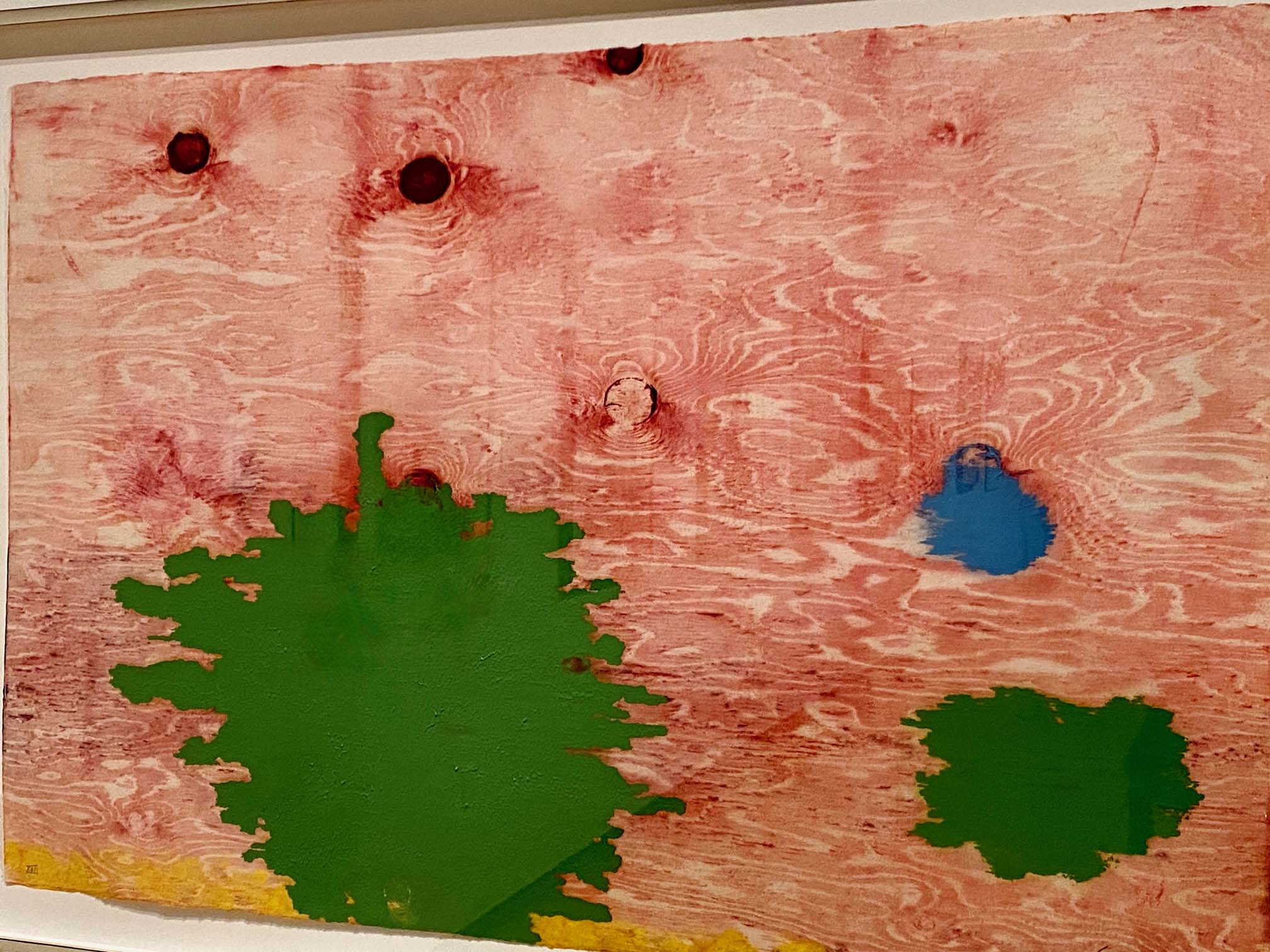
Later experiments show off Frankenthaler’s experimentation with woodcuts and monoprints. Here, she inked a woodblock and ran it multiple times to produce a “ghost print” of the wood, then applied bright red over the wood knots and added bright blobs of floating colors atop the natural backdrop.

Helen Frankenthaler’s 1991 Monotype XVII, published by Garner Tullis, NY; collaborating printers Emanuele Cacciatore, Benjamin Gervis, and Garner Tullis.

The exhibition also showcases two dramatic print series by action painter Elaine de Kooning made at the Tamarind Institute. Check out Elaine’s wild lithographs of bulls.

Elaine de Kooning’s 1973 lithograph Taurus XI published by Tamarind Institute in Albuquerque; collaboraring printers John Sommers and Ben Q. Adams. Courtesy: Tamarind Archive.

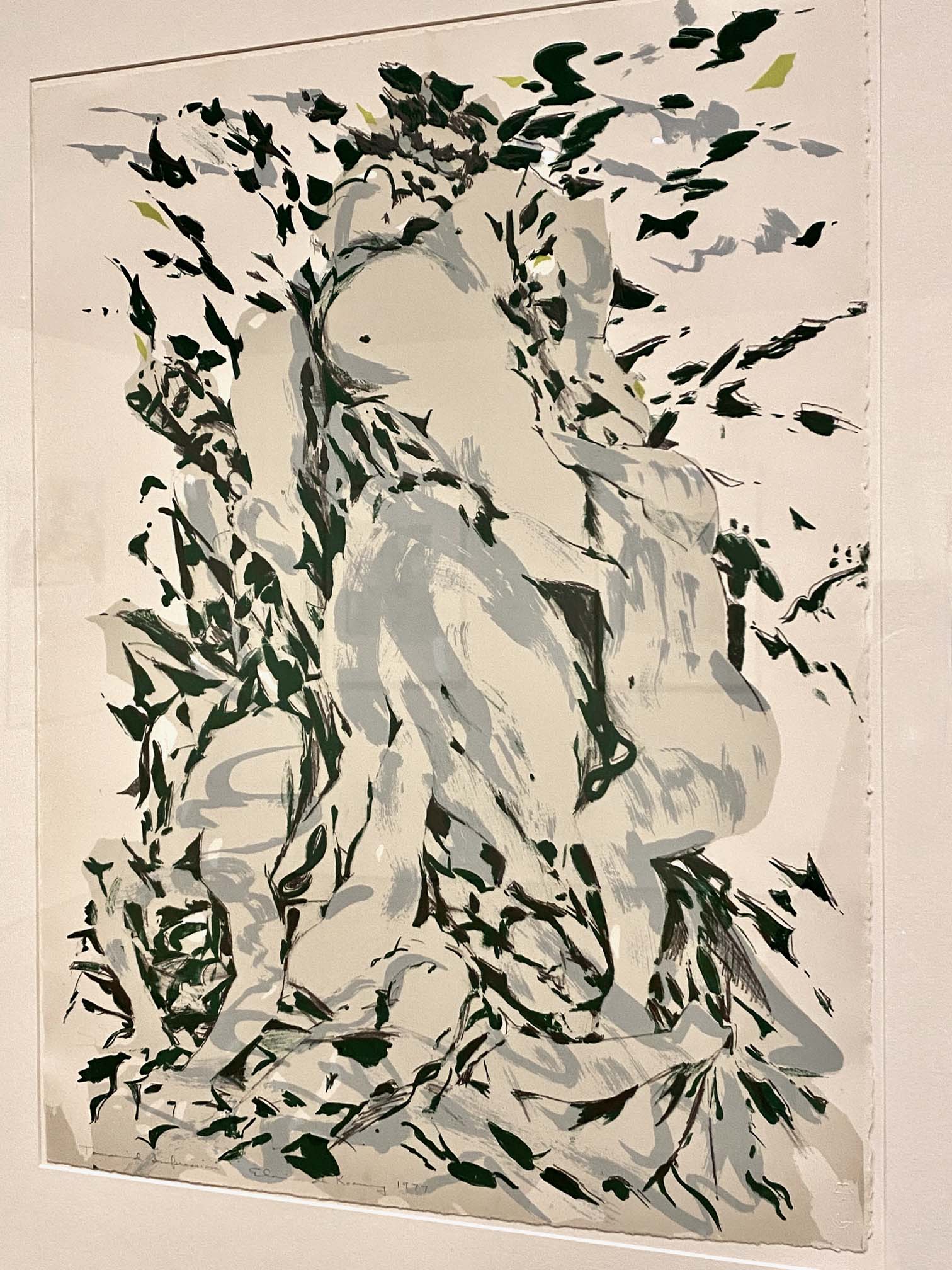
The curators also showcase Elaine’s multiverse interpretation of a famous Parisian sculpture in the Jardin de Luxembourg. The series mounted across the long wall gives gallery goers a close-up look at the intricate collaboration between Tamarind’s workshop masters and a midcentury mark maker.

The exhibition also includes prints from plenty of other mid-century abstractionists from the UNM collection – Motherwell, Diebenkorn, and Lewitt – as well as prints by current UNM students who were asked to create art inspired by Frankenthaler and company.

Take a look at all of these action-packed prints in our Flickr album.

Elaine de Kooning’s 1977 lithograph Jardin de Luxembourg II; published by Tamarind Institute; collaborating printers John Sommers and Marlys Dietrick. Courtesy: Tamarind Archive Collection.
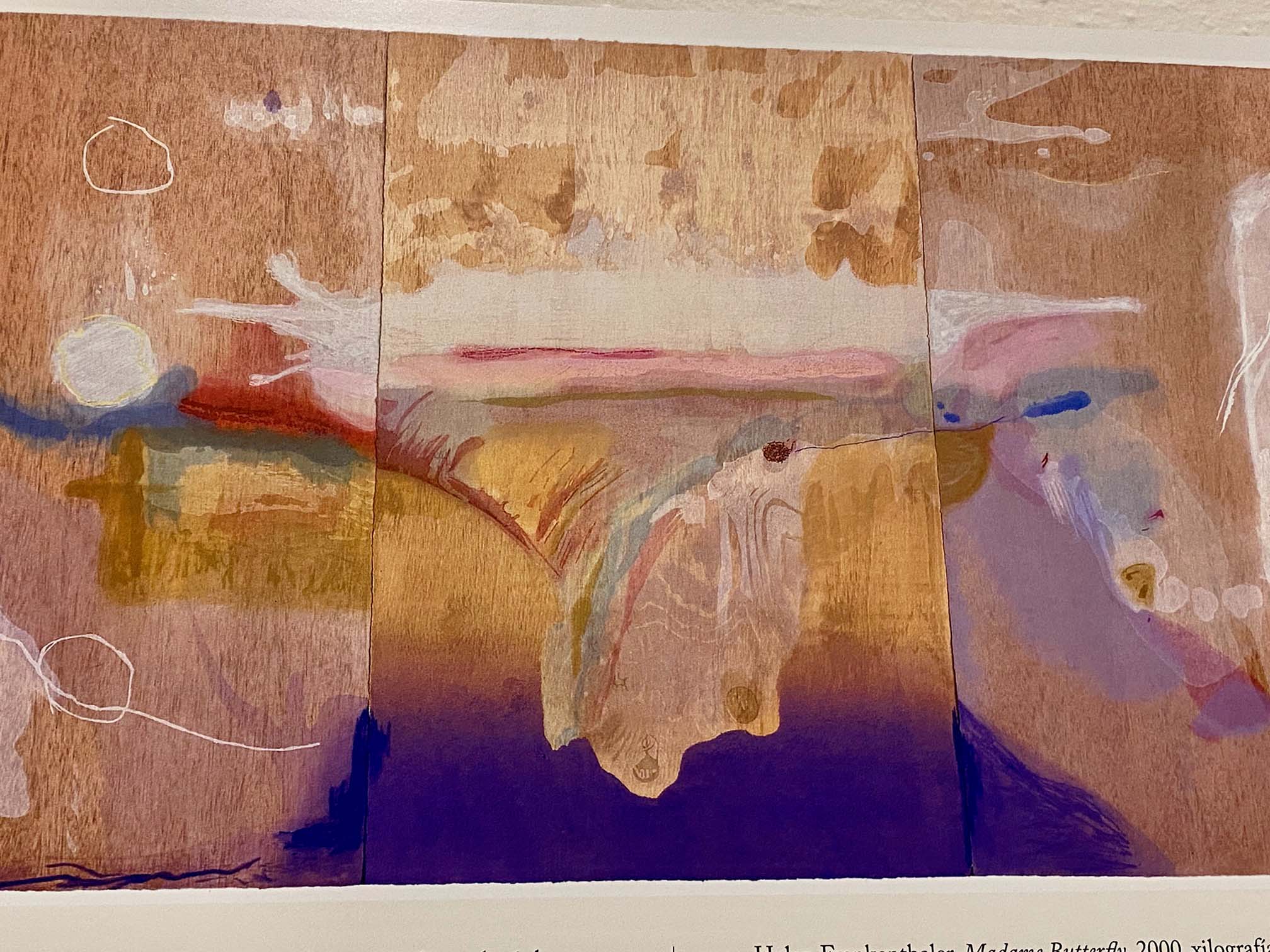
Photo of Frankenthaler’s 2000 woodcut Madame Butterfly made from 46 woodblocks; published by Tyler Graphics Ltd. Courtesy: Canberra’s National Gallery of Art.
Edward Olecksak’s 1972 photo of Helen Frankenthaler and Bill Goldston working on Venice II at ULAE in West Islip, New York. Courtesy: Frankenthaler Foundation Archives

Walking Into the Broken Boxes Podcast

Did you ever want to walk into a podcast? The grand installation of Broken Boxes: A Decade of Art, Action, and Dialogue lets you experience large-scale work by some of the socially conscious artists that have been featured on Ginger Dunnill’s interview series. Enter, listen, and get inside the heads of 23 artists at the Albuquerque Museum through March 2, 2025.

The exhibition honors ten years of Broken Boxes conversations, which you can hear at various “listening spots” inside the exhibition. Ginger began her project as a way to encourage community among artists who were creating disruptive work that prompts viewers to imagine a different world.

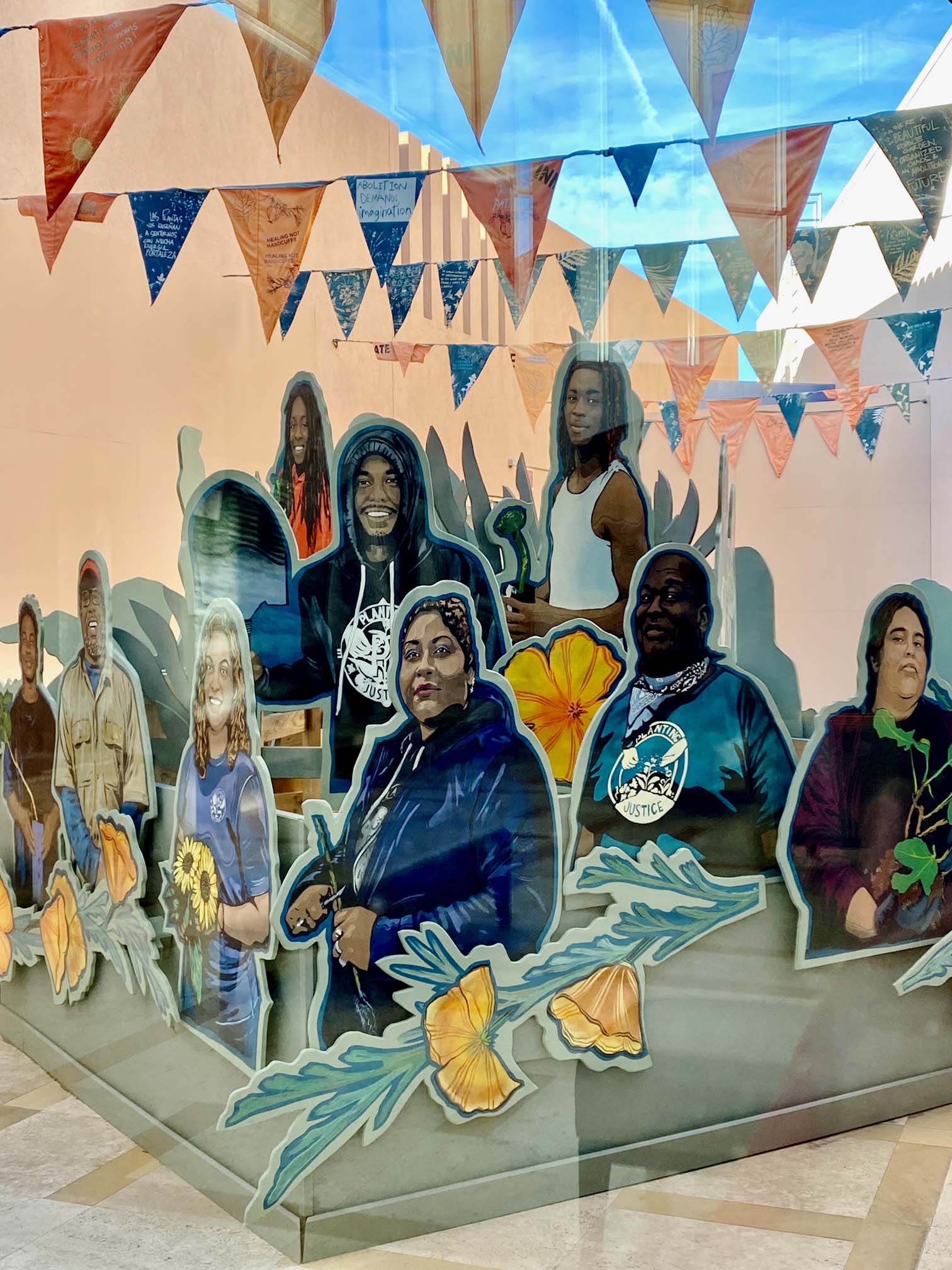
Kate DeCiccio’s Blooming Abolition depicts formerly incarcerated community members who develop gardens. Created by local artists, Planting Justice, Hiroyo Kaneko, and Malaya Tuyay.

The show spills way beyond this main gallery into a theater showing artist videos, another space featuring a soundscape by Raven Chacon, and a courtyard reflecting artist-educator Kate DeCiccio’s vision for sustainable community gardens that give purpose and fulfillment to formerly incarcerated neighbors. 

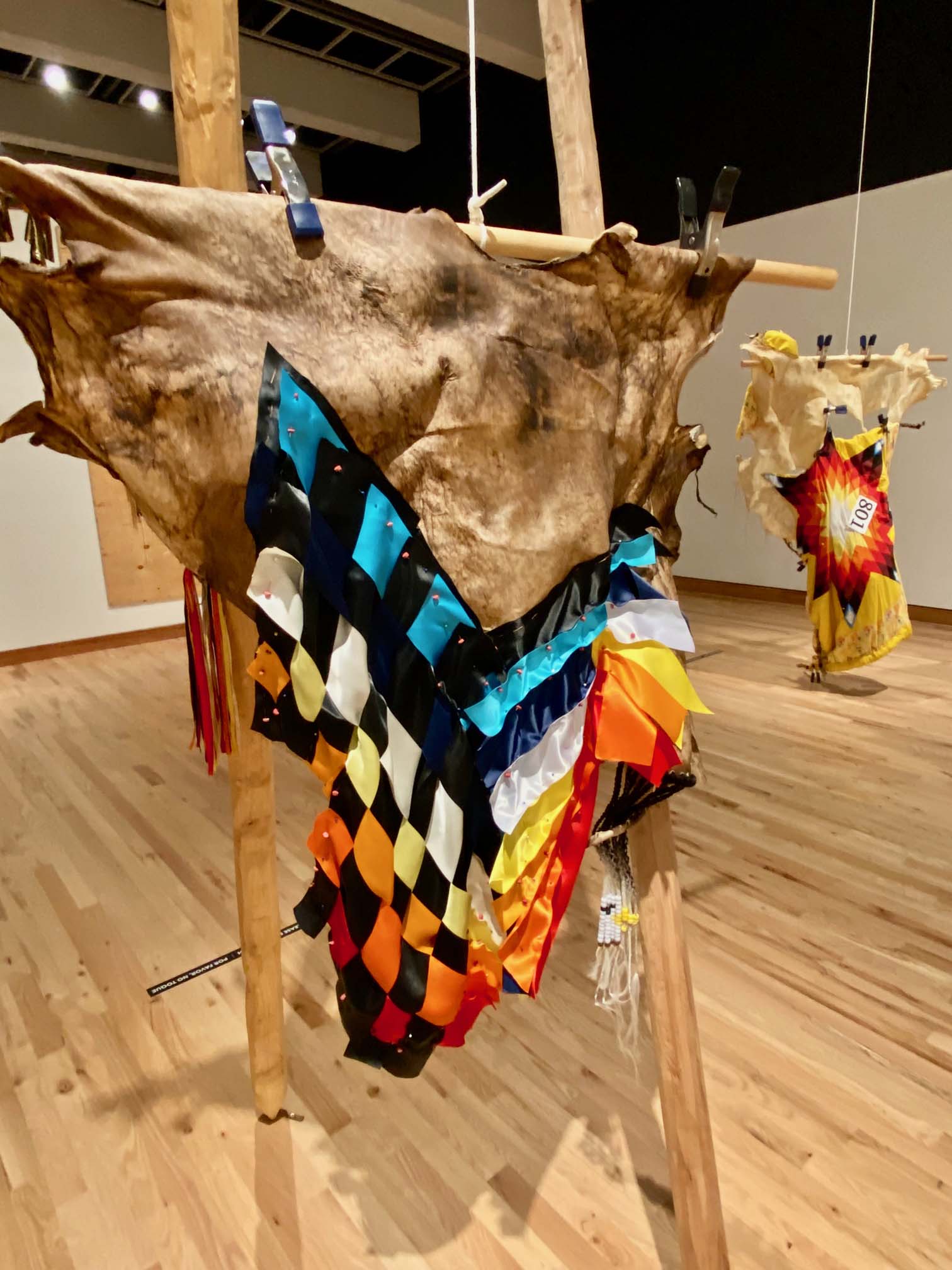
Inside the main space, visitors wind through and around different installations, such as Marie Watt’s hanging jingle sculptures and her spectacular collaboration with Cannupa Hanska Luger. The jingle “clouds” take a traditional element of powwow and turn it into fine art that invites participation in the soundscape.

2023 dangling jingle sculptures Sky Dances Light: Revolution VII, VIII, and IX created by Marie Watt (Seneca Nation of Indians). Courtesy: private collection

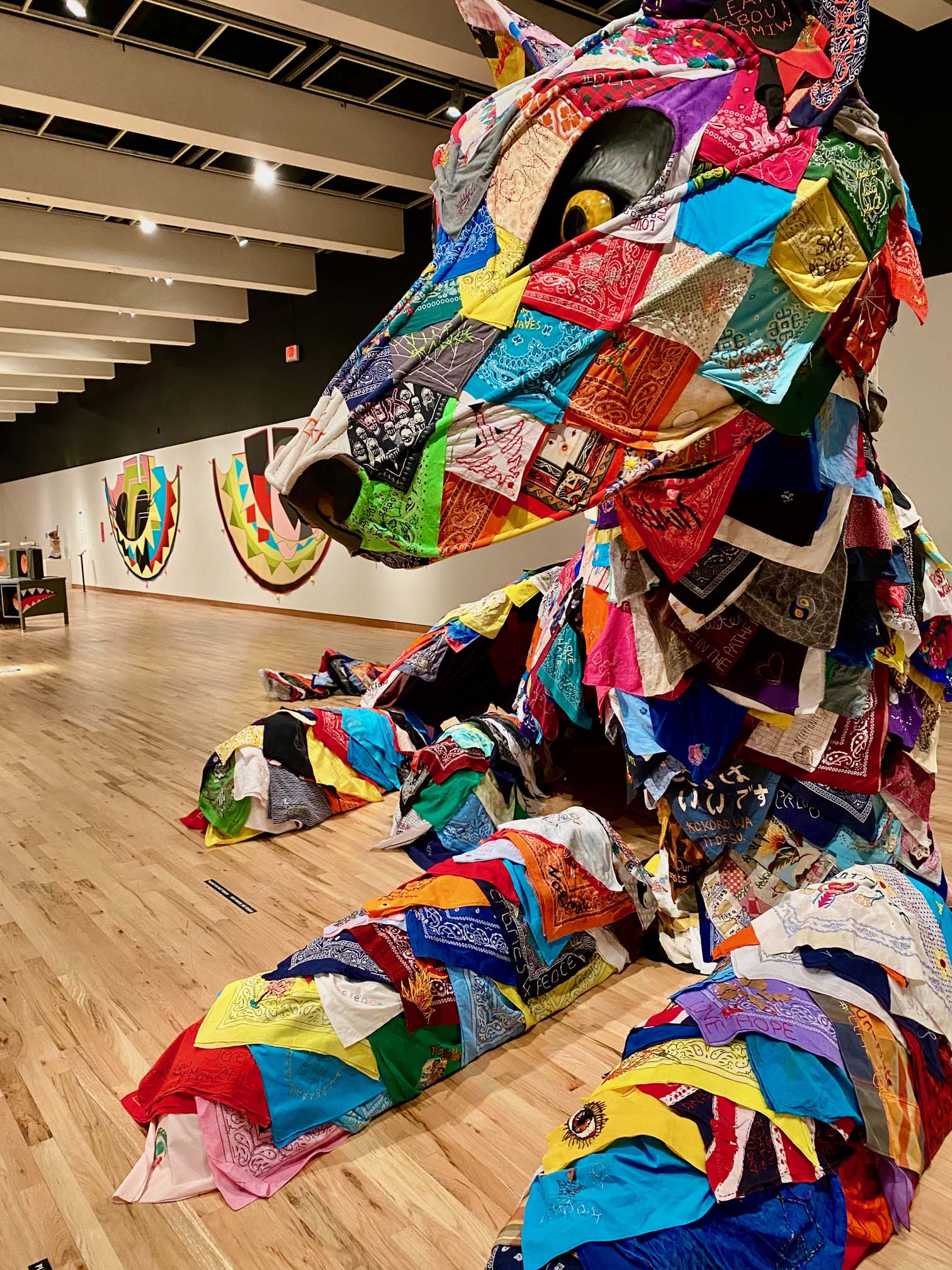
Across the way is an enormous canine created by Luger and Watt. As he’s done with other large-scale participatory projects, Luger sent out a call worldwide requesting people to embroider messages on bandanas and send them in. Visitors are fascinated by the Each Other collaboration, circling around the wolf to discover messages about rescue, shelter, and sustainability.

Guadalupe Maravilla’s installation draws inspiration from his own story and struggle. He assembled the piece from items picked up when he retraced his migration route from El Salvador to the United States when he was a child. But he made it to emit therapeutic vibrational sounds, similar to the sound therapy that brought him relief as an adult when he underwent therapies to cure his own cancer.

2020-2021 Each Other community bandana-sculpture created by Cannupa Hanska Luger (Mandan, Hidatsa, Ankara, Lakota) and Marie Watt (Seneca Nation of Indians). Courtesy: the artists
Guadalupe Maravilla’s 2021 Disease Thrower #17 – a therapeutic sound installation using materials found when he retraced his El Salvador-US migration route. Courtesy: the artist

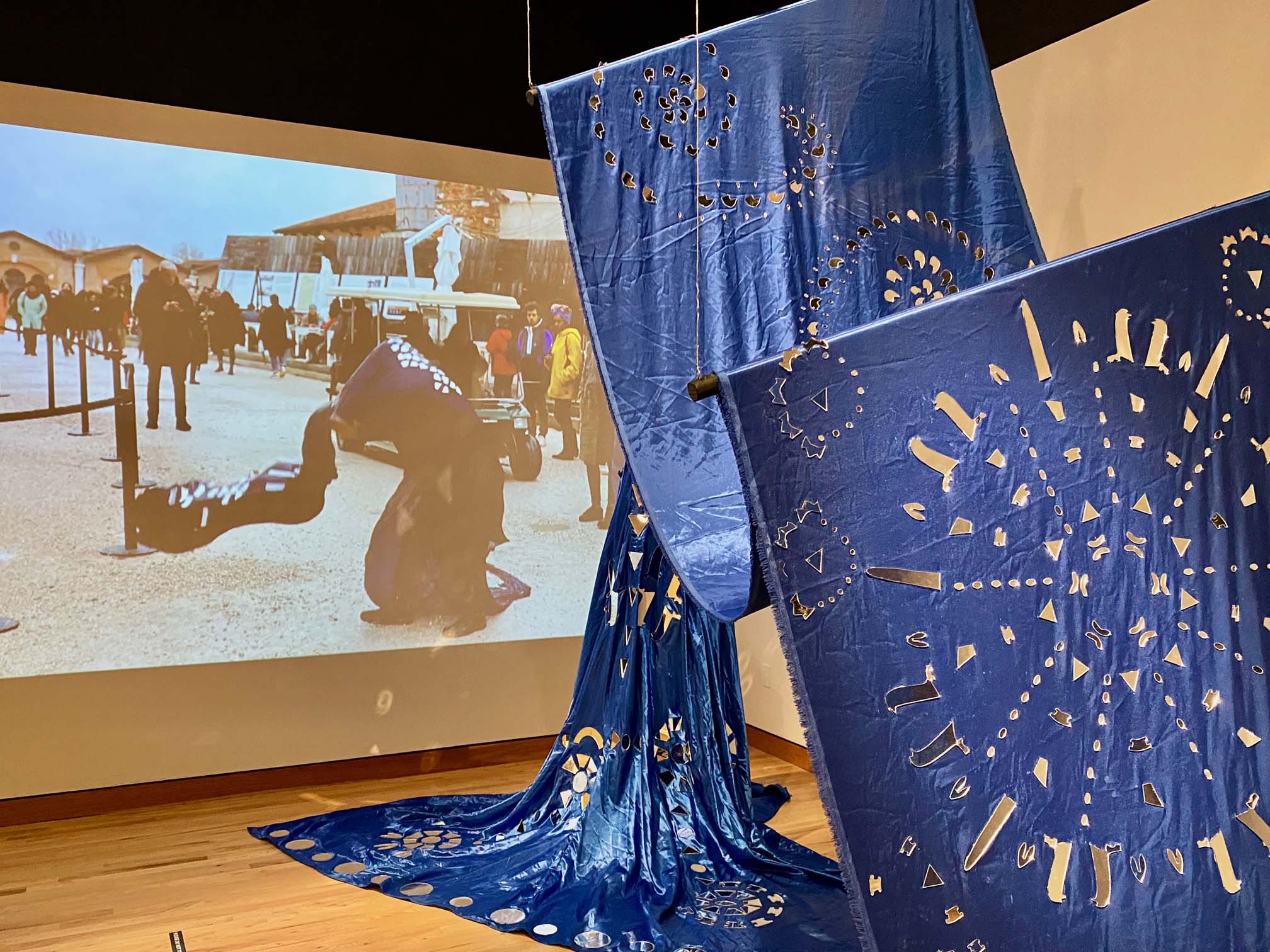
Work by Ethiopian refugee Tsedaye Makonnen includes a performance video and installation that focuses attention on African refugees who risk dangerous ocean crossings to escape violence in their home countries. The blue fabric represents the ocean, and each mirror a life lost.

Tsedaye Makonnen’s Astral Sea Views video with Astral Sea Series mirrored fabrics – commemorating women migrants who perished attempting dangerous European ocean crossings. Courtesy: the artist. 

See some of our other favorite installations here in our Flickr album – a shrine by Mario Yvarra, Jr. dedicated to his Chicana-activist mother –Music My Mom Played While Cleaning House – and works by Natalie Ball (Klamath/Modoc) that are straight from her recent show at the Whitney.

2023 mixed-media sculptures by Natalie Ball – ribbon skirt: There’s Indian and than there’s Indian; (rear) Baby Board. Courtesy: the artist.
Music My Mom Played While Cleaning the House…, a parade float by California artist Mario Ybarra, Jr. that honors his mother, a Chicana civil rights activist.

Listen to the Broken Boxes podcast to hear Ginger and international artists talk about making art, building community, and meeting the challenge of the moment.

Painters Tell Stories of Nature’s Resilience

Feel like things are out of balance?  Seven narrative painters let animals take center stage get visitors thinking about the future for nature and the world in Vivarium, Exploring Intersections of Art, Storytelling, and the Resilience of the Living World at the Albuquerque Museum through February 9, 2025..

Big, bold paintings let nature tell the story and present juxtapositions that present questions about society, environmental dissonance, and what messages animals might want to send. See some of our favorites in our Flickr album.

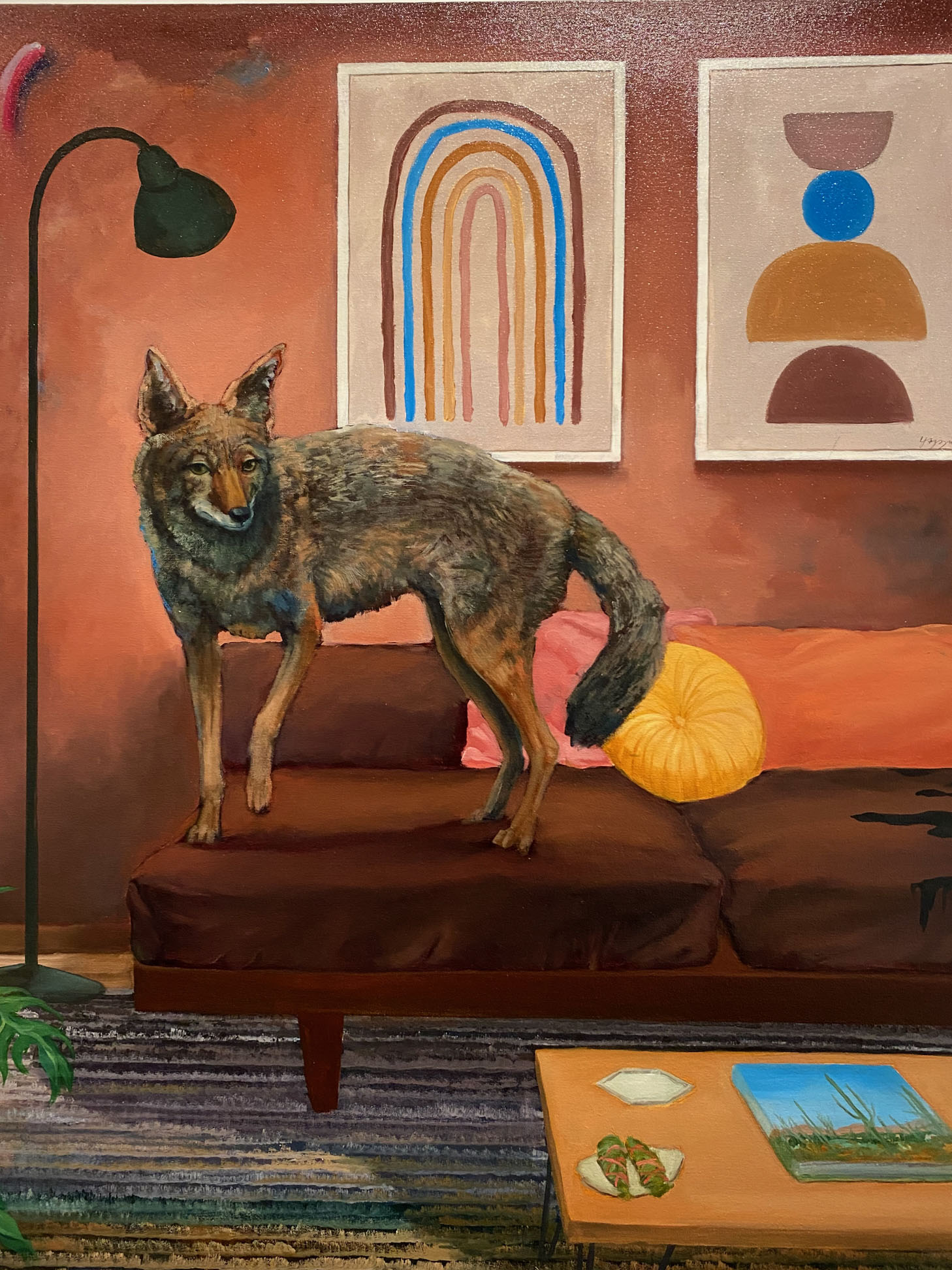
2023 oil Astrid by Stephen J. Yazzie (Laguna Pueblo/Diné). Courtesy: private collection

Although the exhibition begins with a small selection of works from Santa Fe’s Tia Collection – Dan Namingha (Hopi-Tewa), Nanibah Chacon (Dine/Chicana), and others – the majority of the space features a selection of works by the seven featured painters. Clusters of paintings immerse viewers in each artist’s unique world, style, and narrative – mini-vivariums, or artificial worlds.

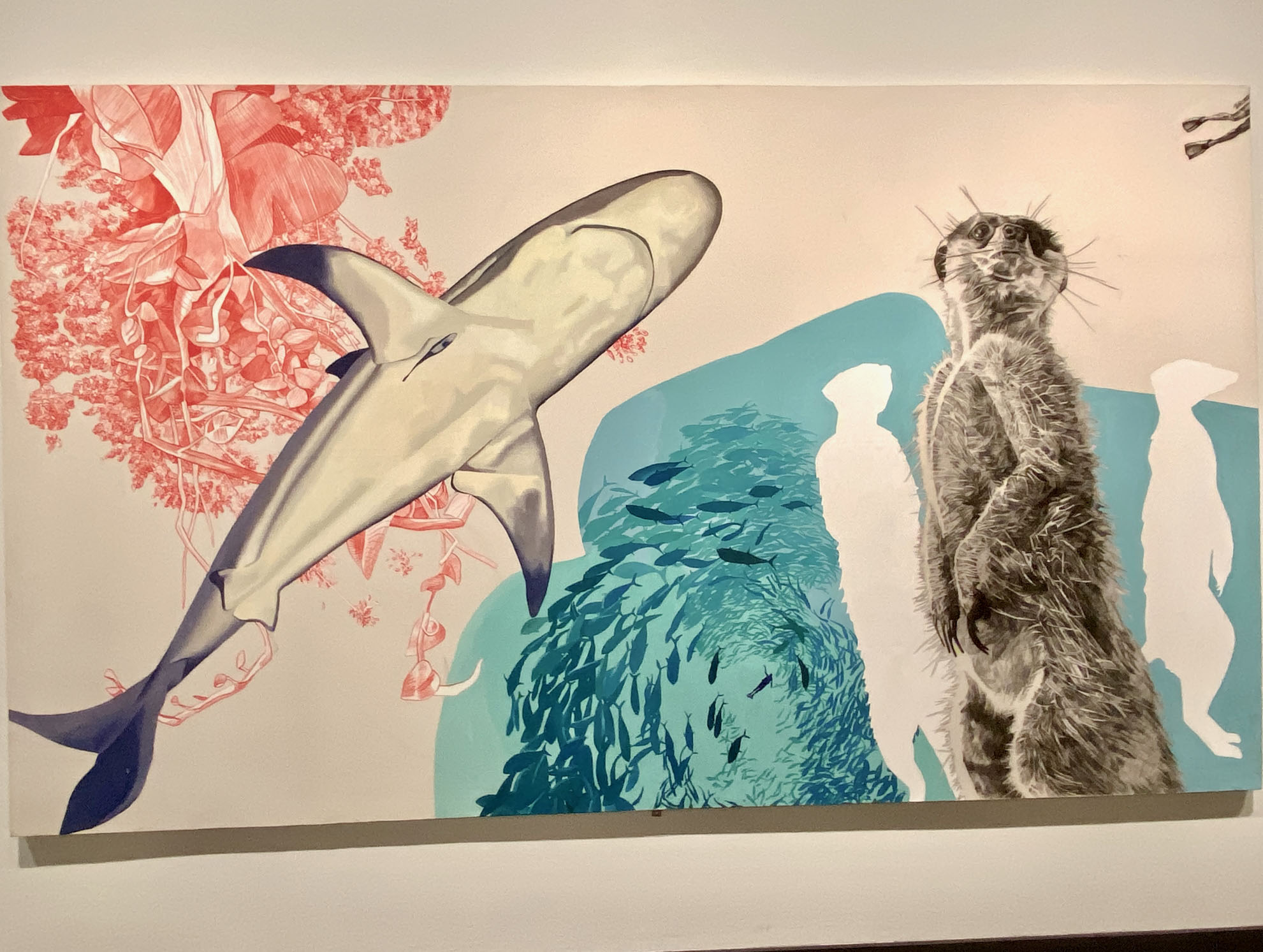
Nature explodes of Nathan Budoff’s giant canvases – tigers, meerkats, swimming octopii, schools of fish, prarie dogs – all floating and interacting in a pure, white space.  He creates realistic depictions in charcoal, oil, acrylic, and ink, but juxtaposes natural components that are startling. Visitors stand back, pause, take it all in at once, trying to make sense of how these magnificent creatures interact in unusual landscapes.  Mostly, the canvases do not include people, but Nathan enjoys letting the remarkable, minutely observed wildlife speak their own truths.

2017 charcoal, oil, acrylic, and ink Imminent Danger by Nathan Budoff – showing systems and social behaviors in the natural world. Courtesy: the artist.

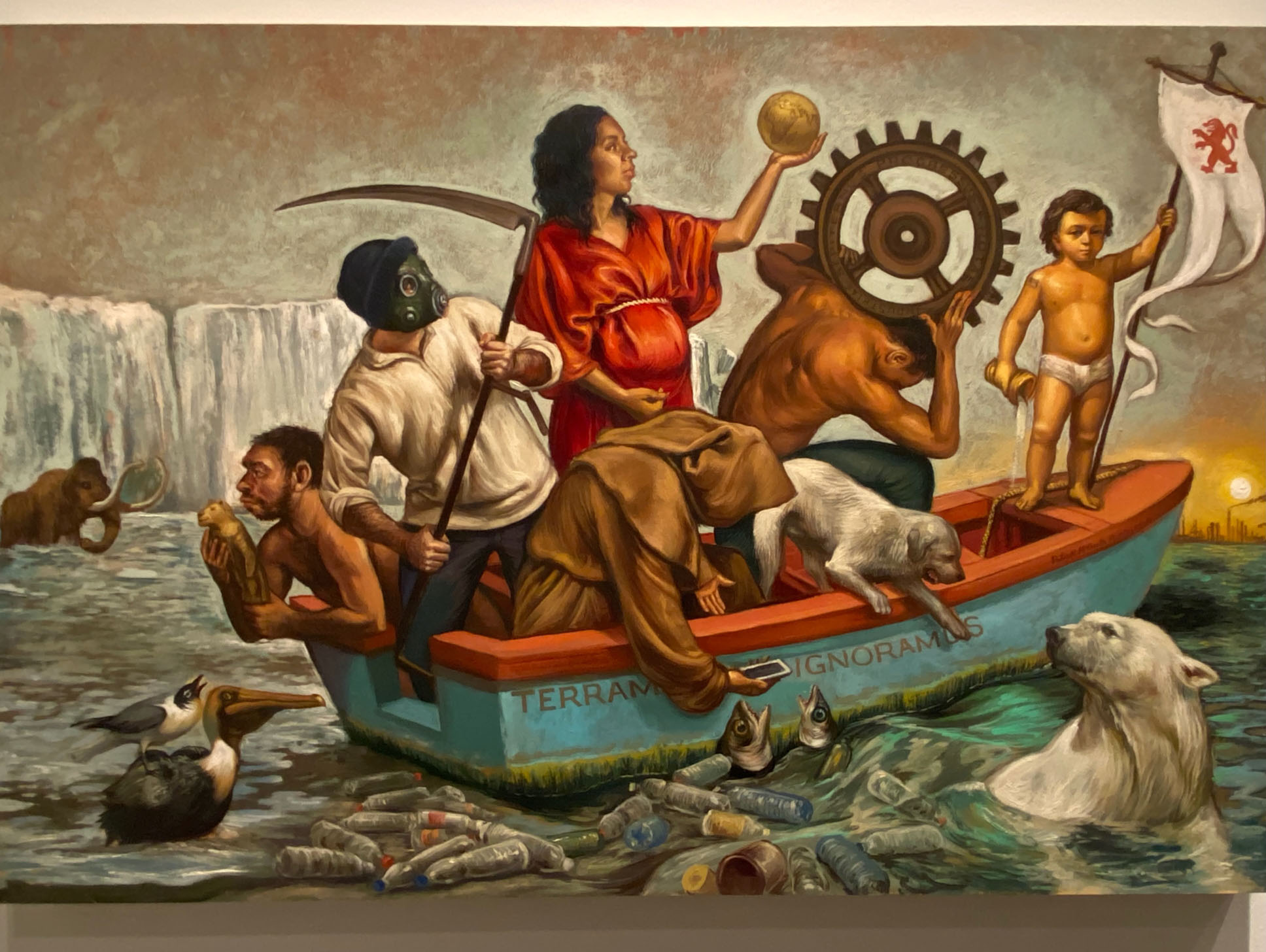
Paintings by Patrick McGrath Muñiz are intellectual puzzles, mixing modern issues, depictions of modern technology, and classical Renaissance and

Baroque painting techniques.  Signs, symbols, and details on the horizon demand slow scrutiny to unravel the allegories and associations packed into the paintings.

2018 oil painting Terram Ignoramus by Patrick McGrath Muñiz – a warning about the perils of climate change; depicting a perilous Arctic journey in a boat named “We know not the earth.” Courtesy: the artist

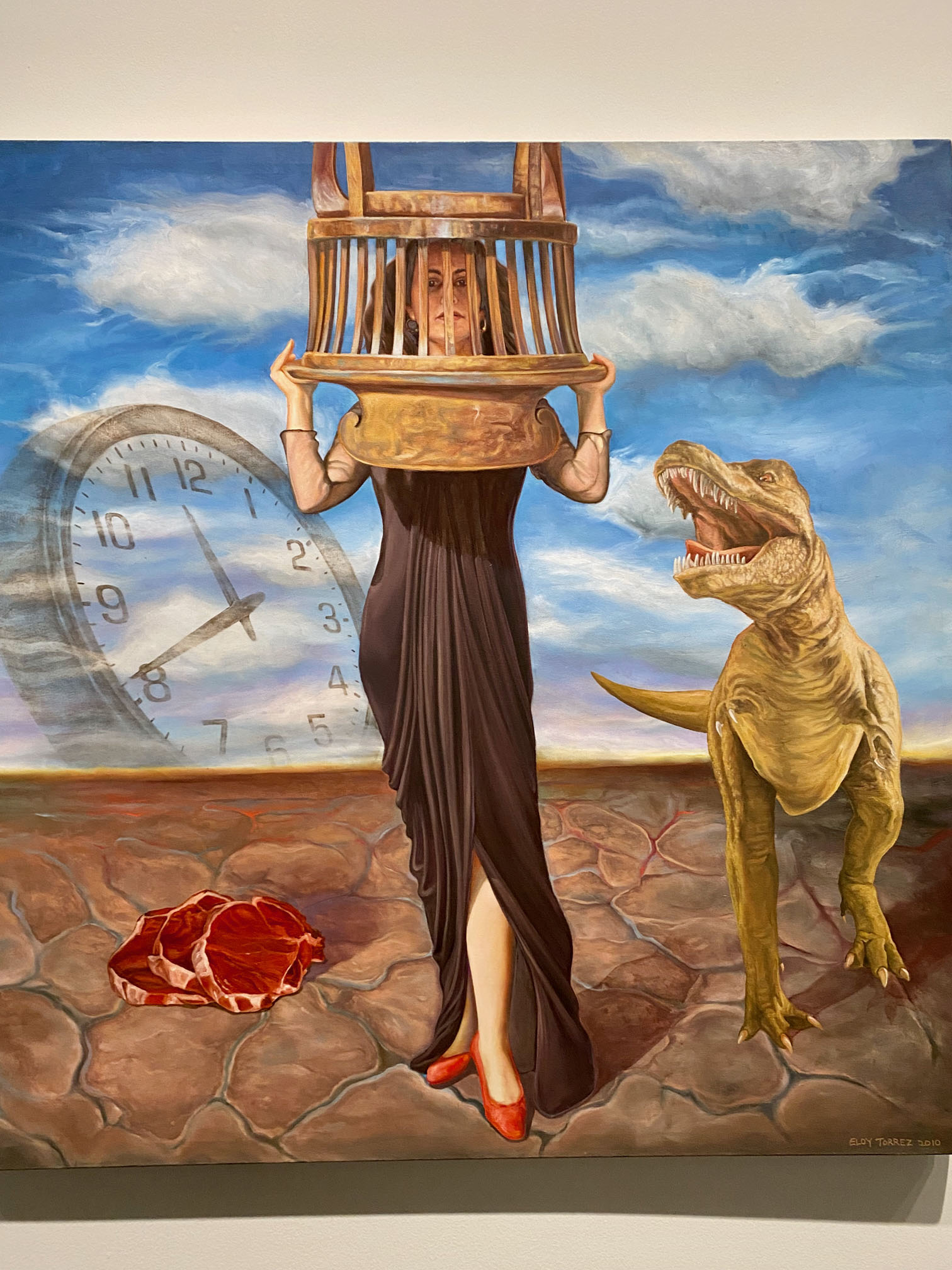
Eloy Torres, a Chicano activist and muralist, uses religious, mythological, and surrealist pictorial conventions to construct worlds that lets the viewer their intuition to connect the dots.

2006 oil portrait of Cheech Martin It’s a Brown World After All by Eloy Torrez; the crown connects him to his ancestral past. Courtesy: Riverside Art Museum.
2010 oil on panel Meat by Eloy Torrez, a surreal allegory on precarious relationships between humans and thenatural world. Courtesy: the artist.

Stephen J. Yazzie (Laguna Pueblo/Diné) exhibits a series of works in which Coyote inhabits upscale suburban interiors, emphasizing the inside/outside, nature/culture dichotomies in contemporary life.

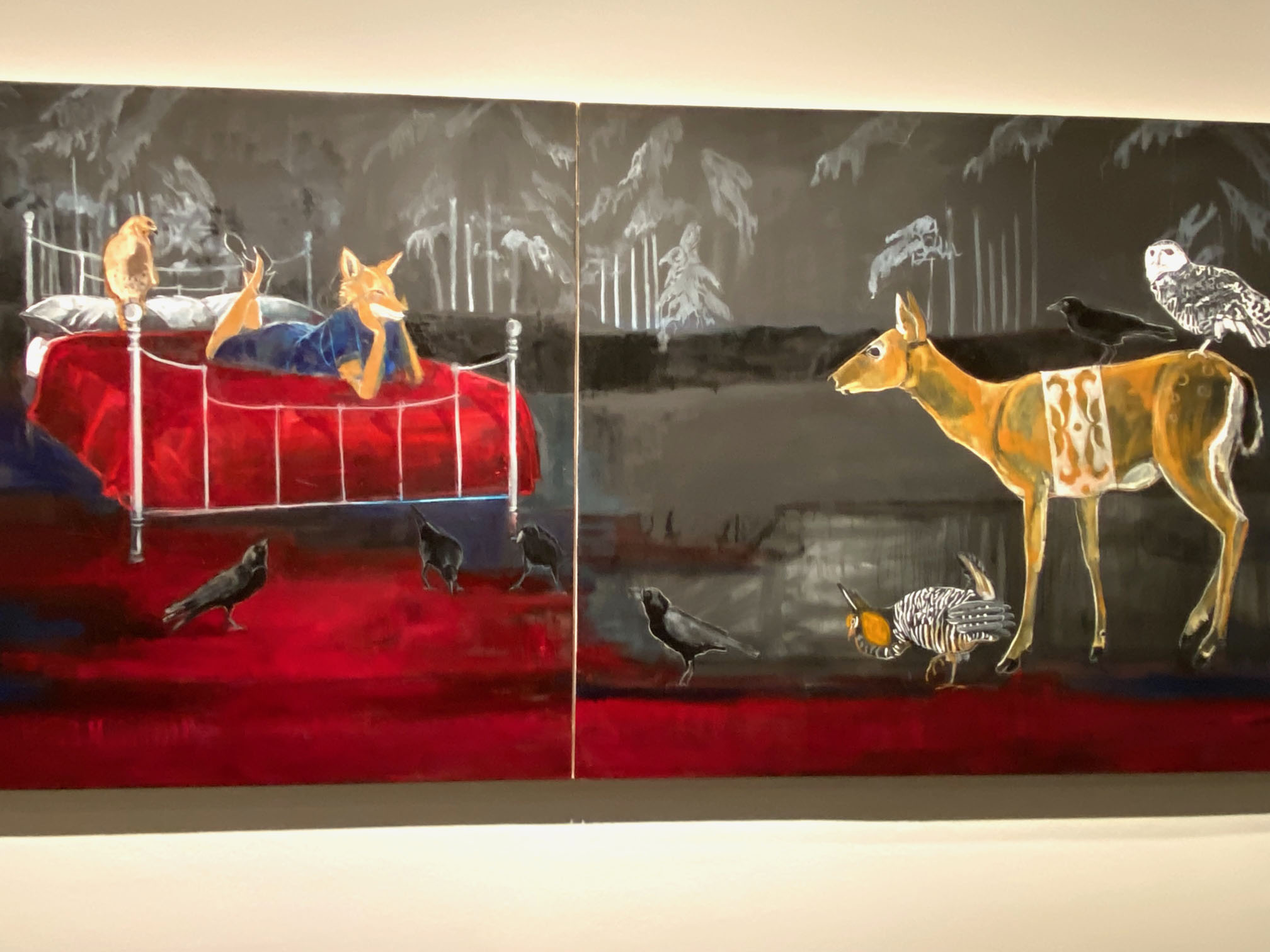
Julie Buffalohead (Ponca Tribe of Oklahoma), a member of her tribe’s Deer Clan, creates narratives featuring animals as protagonists, often metaphors for interactions between natural and spiritual realms. Large works allow players in her stories to prance, dance, and float across saturated color fields.

2018 oil and pastel Straight Legs by Julie Buffalohead (Ponca Tribe of Oklahoma) – a painting reflecting her membership in the Deer Clan. Courtesy: University of Wyoming Art Museum

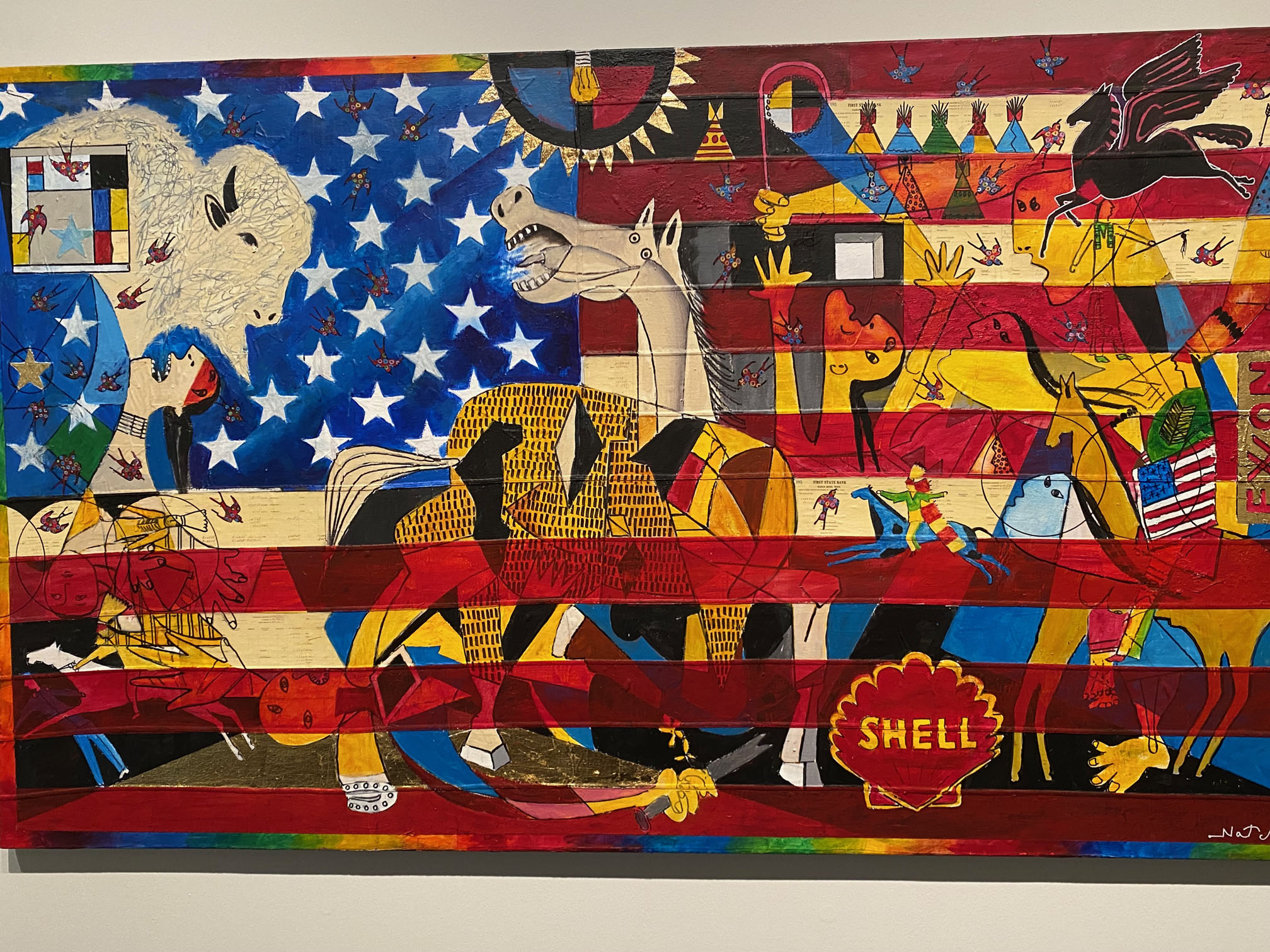
Artist/educator Stan Netchez (Shoshone/Tataviam) presents a throught-provoking masterpiece, using Picasso’s Guernica imagery, US brands, and indigenous spiritual icons to display the chaos and destruction inflicted on indigenous peoples.

2019 acrylic, oil, and metal leaf “Guernica Flag” by Stan Netchez (Shoshone/Tataviam) – a critique of colonialism’s impact. Courtesy: Tia Collection

Listen in on a panel with four of these storytellers conducted by the Albuquerque Museum.

Fronteras del Futuro in the Southwest

Pow! Wham! What? It’s superheroes, avatars, and mixed-media channeling sci-fi social consciousness in an engaging, colorful, thought-provoking mix in the super-fun Fronteras del Futuro: Art in New Mexico and Beyond exhibition at Albuquerque’s National Hispanic Cultural Center through March 12.

These artists love mixing pop culture images, found objects, and historic iconography to question where we’ve been and where we’re going. Take a look at our favorites in our Flickr album.

Some artists use pop culture to get our attention on deeper issues. The back-to-the-future B-movie poster series by Angel Cabrales prompts reflection on societal attitudes about immigrants and border issues.

2016 B-movie poster by Angel Cabrales to spur discussion on immigration and border issues. Courtesy: the artist.

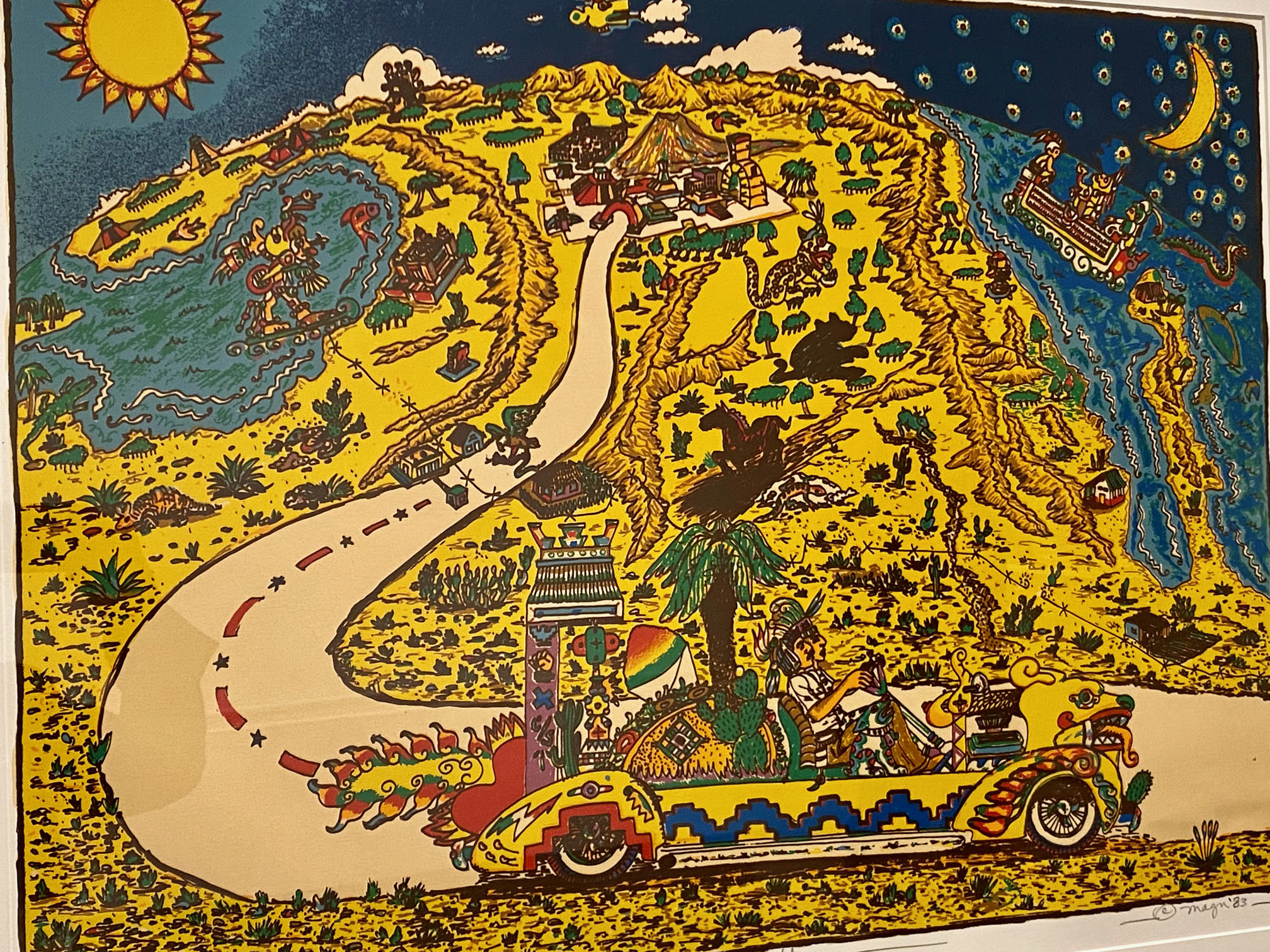
Gilbert “Magú” Luján’s silkscreen merges the epic scope of Mesoamerican history into a contemporary context. A stylish Aztec couple takes a cross-border journey from Aztlán to Texas in a pre-Columbian-styled low rider.

1983 silkscreen Return to Aztlán by Gilbert “Magú” Luján; a cross-border journey and reflection on pre-Columbian roots and heritage.

One of the most epic achievements is a wall-length, accordian-folded letterpress codex – a collaboration by Enrique Chagoya, Guillermo Gómez-Peña, and Felicia Rice. Codex Espangliensis features pop-culture superheroes, pre-Columbian imagery, comics, and social declarations to explore New World history from 1492 to the present.

Designed to be read right to left: cover and first pages of Codex Espangliensis from Columbus to the Border Patrol, a hand-colored letterpress accordian-folded book.
Pages from 1999 Codex Espangliensis from Columbus to the Border Patrol, a hand-colored letterpress book by Enrique Chagoya, Guillermo Gómez-Peña, and Felicia Rice.

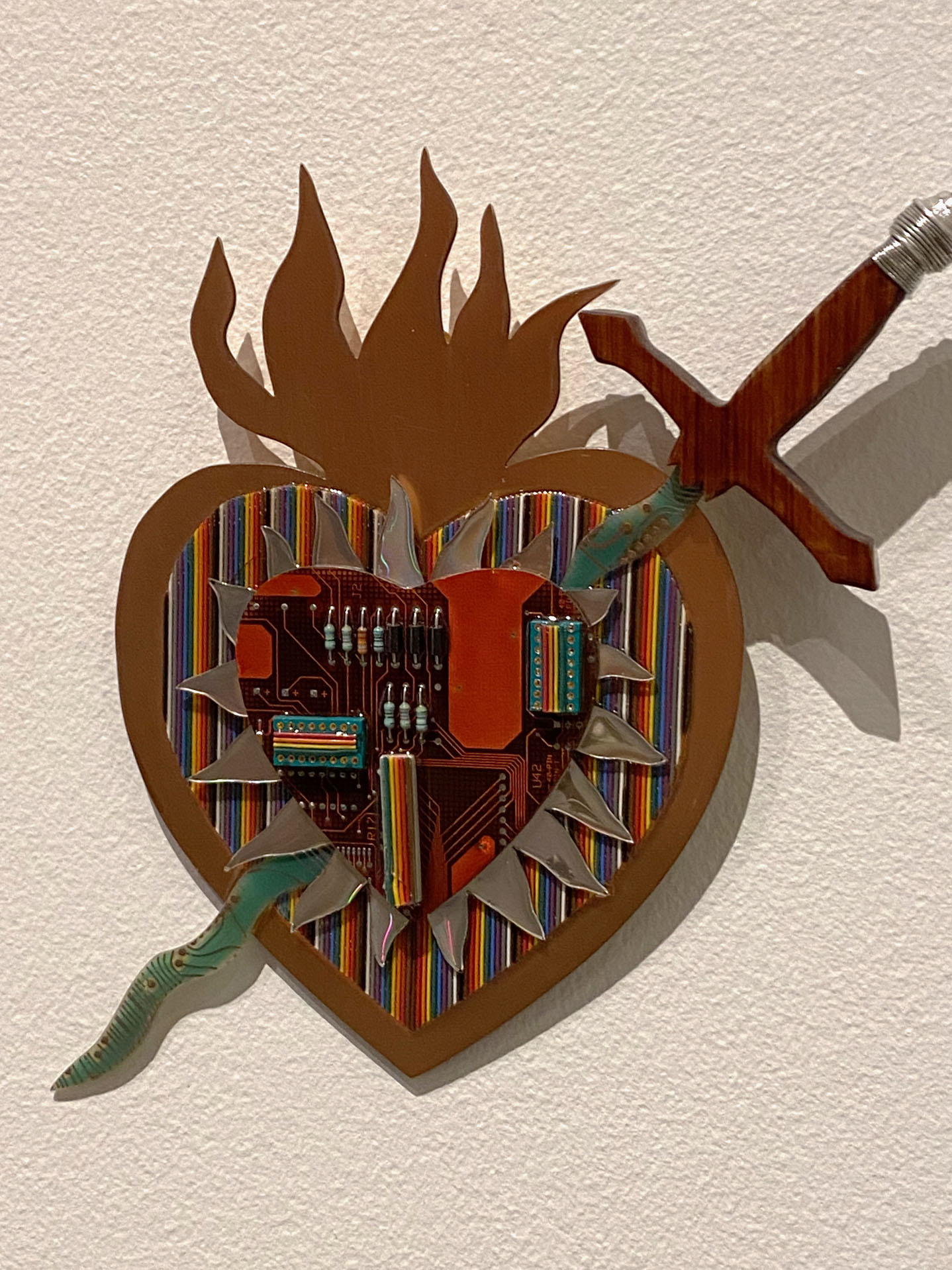
Another set of artists rummages around to find tossed-off computer parts, circuit boards, skateboard parts, and other found items to create their works.

Marion Martinez’s 2002 Pierced Heart/Milagro; circuit boards and wood. Courtesy: the artist
Esteban Borjorquez’s 2018 Zena of Urion – a sci-fi creation from discarded items. Courtesy: the artist.

Marion Martinez grew up near Los Alamos National Laboratory, and started visiting its salvage area to find components from which to assemble her artworks – transforming discarded tech into beautiful icons of Northern New Mexican heritage.

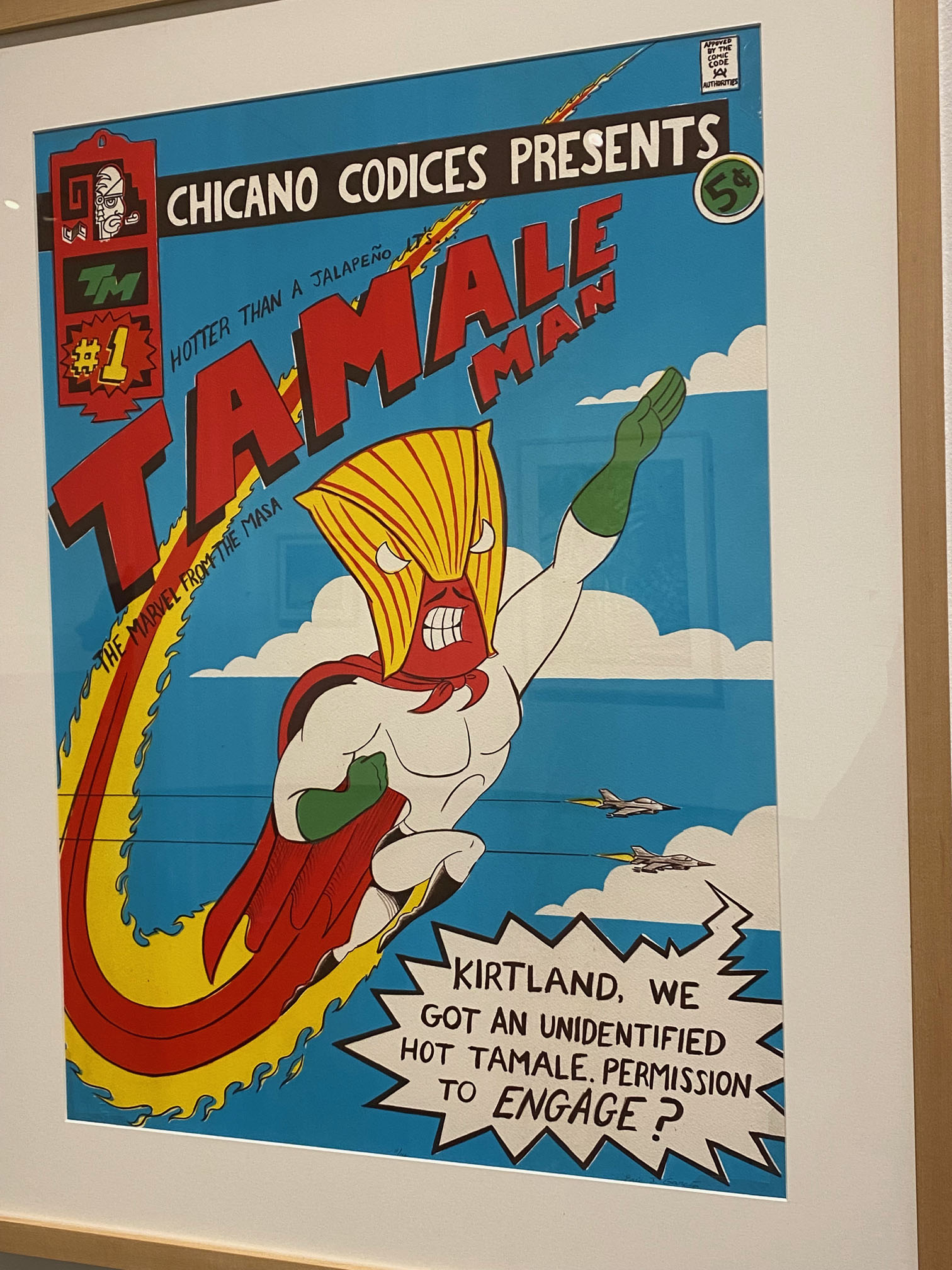
Eric J. Garcia’s 2005 lithograph Tamale Man.

Roswell political cartoonist Eric J. Garcia takes another angle on mixing New Mexico’s cultural, culinary, and nuclear history. His Tamale Man series features the transformation of a guy munching a tamale at the first blast at the Trinity Site into a radioactive superhero.

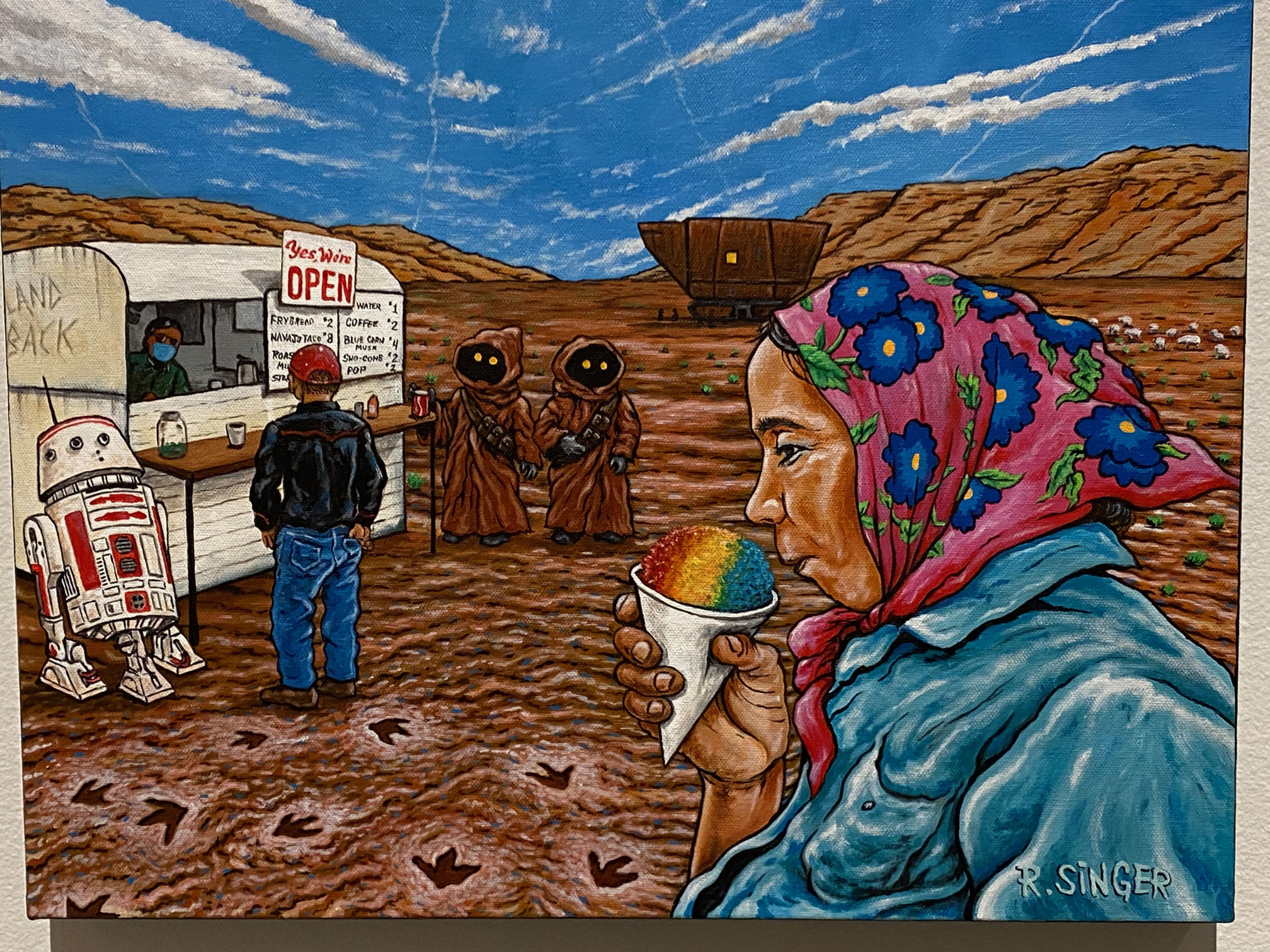
Ryan Singer’s painting series blends his childhood fascination with Star Wars and other futuristic sagas with his Navajo heritage and upbringing.

Ryan Singer’s 2021 acrylic, Rainbow Flavor.

Meet Ehren Kee Natay, a Diné artist, whose work opens the exhibition with a loving tribute to his grandfather, the first Native American to release a commercial record:

Artists Call to Action for Central America

In the early 1980s, socially minded artists living downtown in New York couldn’t handle the news coming out of Central America and did something about it. The United States government was intervening in the affairs of Nicaragua, El Salvador, and Guatemala, and everyone was worried that the situation was going to devolve into another Vietnam.

This is just one part of the story told by the dynamic, timely, informative exhibition, Art for the Future: Artists Call and Central American Solidarities, on view at the University of New Mexico Museum of Art in Albuquerque through December 3.

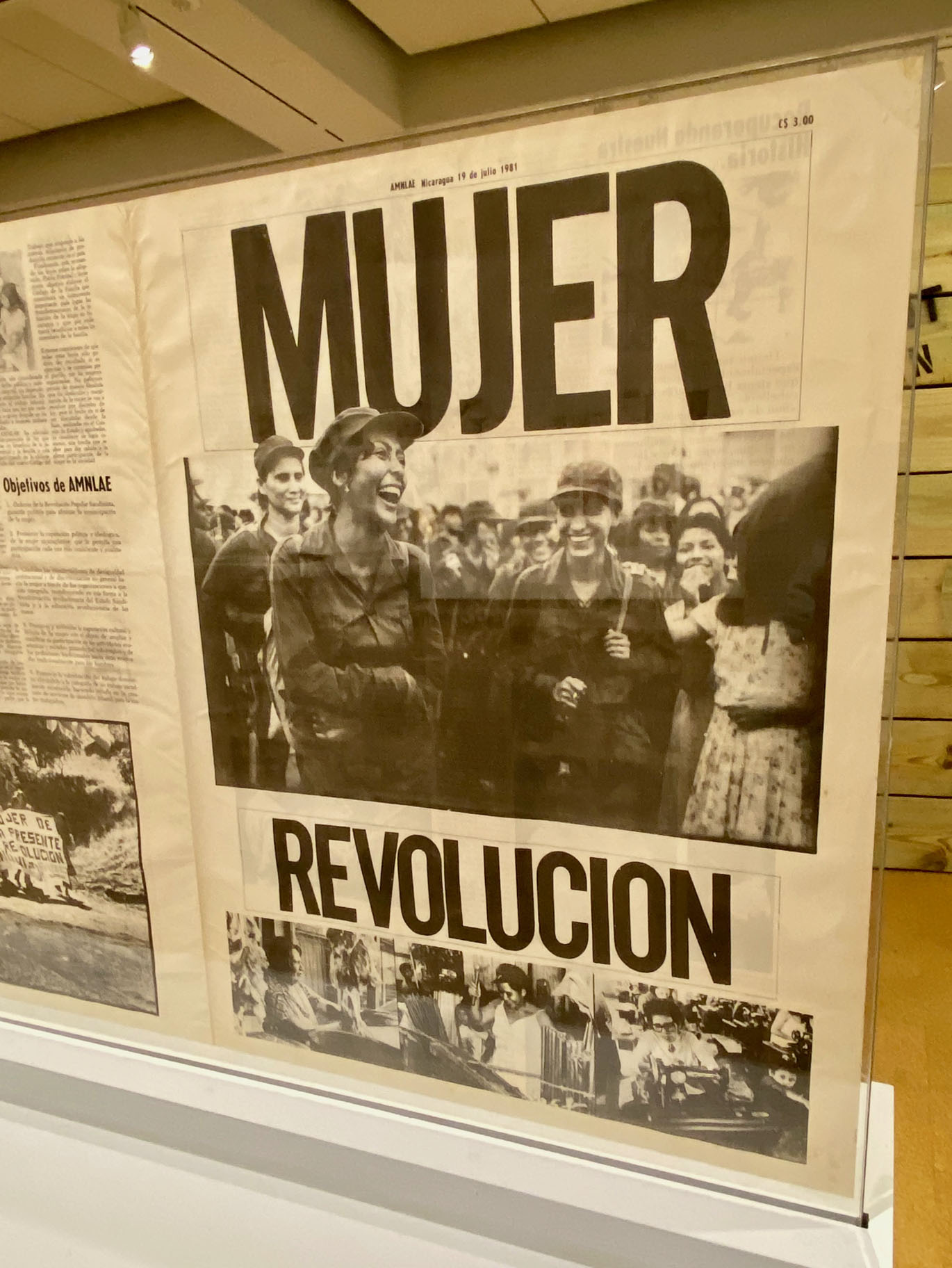
1981 pamphlet Mujer Revolución by Association of Nicaraguan Women. Private collection
1983 Print of Contra (after a drawing in Rock Comics, 1979) by Jerry Kearns, depicting communist fears stoked by the US government

In 1982, a group of New York artists collaborated with Latin American artists to create a show with contemporary art and cultural artifacts to draw attention to the escalating crises in Latin America. By 1984, organizers launched a national call to artists to raise money and awareness of what was happening.

Artists responded with performances, music concerts, films, poetry readings, and exhibition. In New York alone, over 1,100 artists participated in over 30 exhibitions.

Nationally, artists in 27 cities organized chapters and events and tried to build alliances in Latin America.

Videos, photographs, sculptures, paintings, and ephermera pulled from archives (like posters, buttons, mail art, and pamphlets) bring the story of artist-activists to life – their concerns about US government intervention, their efforts to organize artists across the United States, and their attempts to help artists living in oppressed Central American countries.

The Tufts University-organized show resurrects a largely forgotten story of artist activism, illuminates the tribulations of indigenous communities in Central America at the time, introduces us to contemporary works from artists inspired by their indigenous heritage, and gives us an idea of what’s happening in those countries now.

Two contributions to Solidarity Art by Mail project, a fast, cheap solution to boost Latin American and Caribbean participation in a 1984 New York exhibit at Judson Memorial Church. Private collection.

The three-floor show is packed with arresting images, works, and histories. The art work and documentation push and pull visitors between the international political crises of the 1980s and social-justice issues being addressed by artists today.

Take a look at the show on our Flickr site.

The installation features work by heavy hitters of the 1980s New York art scene – wall-size Vietnam-era work by Leon Golub, images documenting Ana Mendieta’s performance pieces, and Claes Oldenburg and Coosje van Bruggen’s sketches, maquettes, and exploding-banana image that branded the Artists Call Against US Intervention initiative.

The first-floor exhibition area includes Nancy Spero’s dramatic scroll-like drawing that calls attention to the oppression of Salvadorean women.

1984 Arts Magazine cover with Oldenburg’s image promoting Artists Call. Private collection

Downstairs, there’s another 1984 work that similarly unfurls the length of the gallery – an accordian-book project led by Sabra Moore that is a collaborative reconstruction of a rare 16th-century Mayan codex by 22 women. It’s the first time the codex has been displayed since 1984.

1984 “Reconstructed Codex,” a project organized by Sabra Moore with contributions from 22 diverse female Latin American and US artists. Courtesy: Barnard

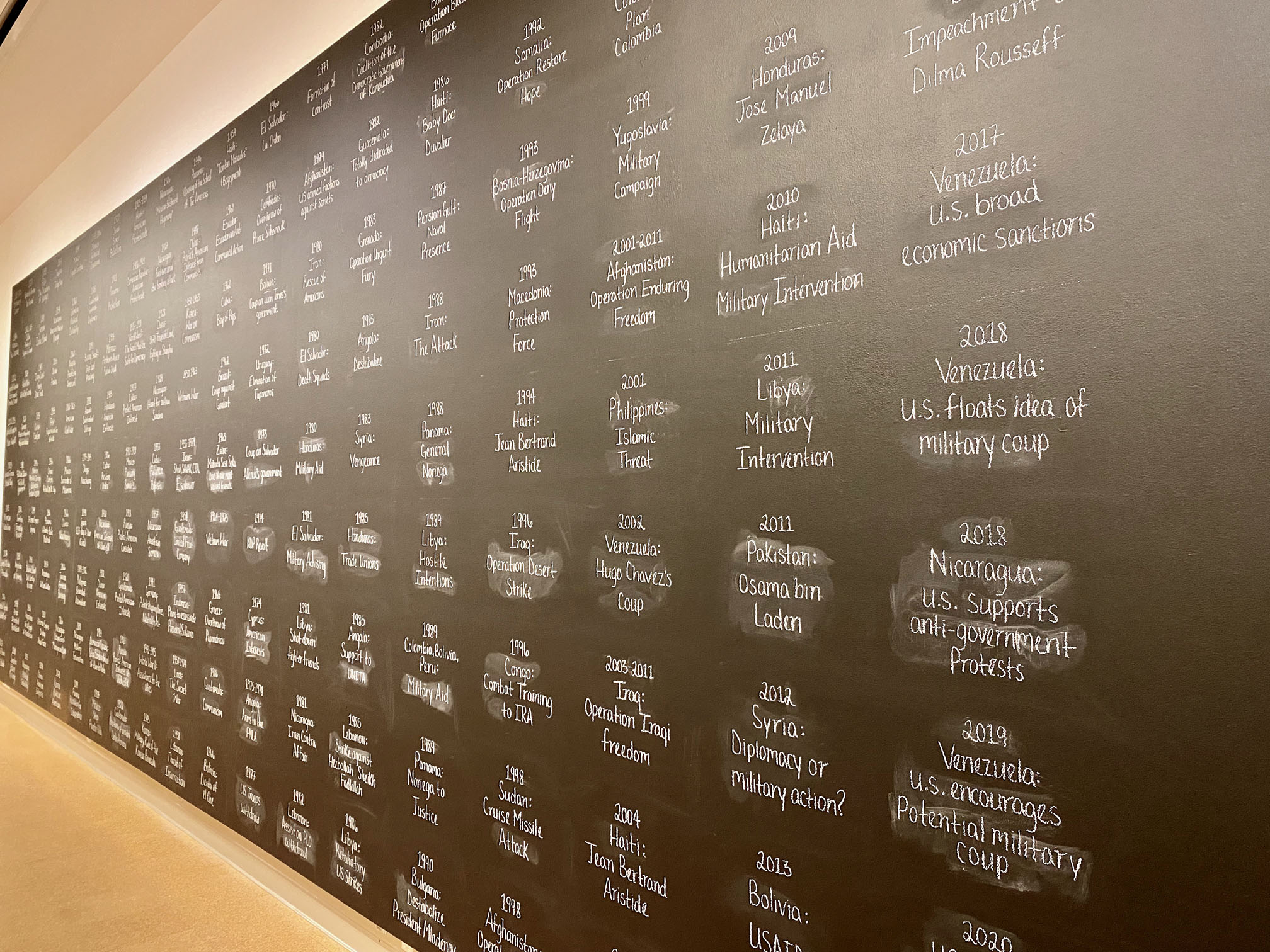
The third floor packs a punch, installing revolutionary images and publications around the infamous (and censored) Hans Haacke piece that questions the aftermath of the 1983 US invasion of Grenada.  Across the room, visitors pour over Carlos Motta’s 2005 wall-sized chalkboard installation Brief History of US Interventions in Latin America since 1946. 

Although the 1980 artist-activists did not achieve all of their utopian goals, the contemporary selections show that social consciousness, pride in indigenous heritage, and artistic futures are still alive – including a beautiful feathered immigrant history dome by Batriz Cortez, stitched by a team of immigrant collaborators.

2021 sculpture 1984: Space-Time Capsule by Salvadorian artist Batriz Cortez and immigrant collaborators – a shelter for immigrant histories.

Learn more about how the curator Erina Duganne and her collaborator Abigail Satinsky created this remarkable show:

Art for the Future will be on display at Chicago’s DePaul Art Museum from March to August 2023.

Carlos Motta’s 2005 detailed chalkboard installation Brief History of US Interventions in Latin America since 1946. Courtesy: the artist