Tiny Natural History Show Has Eyes Bugging Out

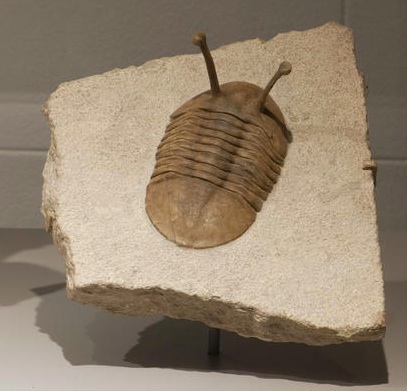
Asaphus, from St. Petersburg, has eyes bugging out (Ordovidian, 490-440 mya). Photo: ©AMNH/R.Mickens)

Asaphus, from St. Petersburg, has eyes bugging out (Ordovidian, 490-440 mya). Photo: ©AMNH/R.Mickens)

Confined to a tiny case in the “canoe” rotunda at the American Museum of Natural History, some extinct species from more than 400 million years ago are putting on quite a show, thanks to two trilobite lovers from the heavy-metal music and vert paleo worlds.

Andy Secher and Martin Shugar went through their massive trilobite collections (Andy has 4,000 in his Manhattan apartment and Martin turned over 200,000 fossils and shells to AMNH) and picked out fifteen “best of the best” from each of the six geologic periods that hosted these little waterway critters – from the Cambrian to the Permian (521 to 240 million years ago). It’s quite something, considering there are over 20,000 recognized species lingering in 281 million years of rocks around the world!

When the exoskeleton of Dicranurus disintegrated in the Lower Devonian, it left a fossilized cast that is so perfectly prepared you think you’re watching him in action

When the exoskeleton of Dicranurus disintegrated in the Lower Devonian, it left a fossilized cast so perfectly prepared you think you’re watching him in action

The tiny show, which is in an open-ended run,  is a “wow” due to the spectacular preservation and preparation of each of these little snubs of rock containing fossilized “casts” of animals whose exoskeletons disintegrated soon after they expired millions of years ago. The state of preservation of even the most delicate features is pretty remarkable.

Consider Asaphus kowalewskii from Ordivician rocks near St. Petersburg (490-440 mya), whose long eye stalks are truly a wonder of nature, evolution, and behind-the-scenes prep that make this character’s eyes pop. Trilobites invented complex, multi-lens eyes, and this Asaphus provocatively suggests the ability to check things out above the sediments where they burrowed, sort of like a horseshoe crab equipped with a modern submarine periscope.

The little Olenoides on display hails from British Columbia’s famous Burgess Shale and has long antenna curving back along its sides. He’s also found in New York, Pennsylvania, Virginia, Utah, and other places in Cambrian rocks 450-490 million years old.  For all those AMNH visitors asking where they can see the Burgess Shale, here’s your chance to commune with a critter and some rock from the same formation that so inspired uber-naturalist Stephen Jay Gould.

Olenoides of British Columbia’s Burgess Shale (Cambrian 450-490 mya) has curve-back spines

Olenoides of British Columbia’s Burgess Shale (Cambrian 450-490 mya)

Walliserops has a full trident sprouting out of his head –a unique apparatus that adapted him for who-knows-what in Devonian life in what-is-now Morocco. Is this where Neptune got the idea of what works best down under the sea?

The hometown favorite is Arctinurus boltoni, first found in upstate New York in the early 1800s during the construction of the Erie Canal. The AMNH has an entire website showcasing these upstate wonders from the Rochester Shale. See them all and take a peek behind the scenes into the AMNH collection drawers on the image gallery.

Andy and Martin’s enthusiasm for trilobites puts them in good company. Tom Jefferson and Ben Franklin are said to have collected them. Trilobite fossils were hawked on 15th century European streets and several trilobite websites say that 25,000-year-old European burials were found with these fossils, too.

Trilobites with tridents and horns. Walliserops is found in Morocco’s Lower to Middle Devonian strata.

Trilobites with tridents and horns. Walliserops is found in Morocco’s Lower to Middle Devonian strata.

Although AMNH has terrific trilobite blog and a page with “Twenty Trilobite Fast Facts,” why not go for the slick YouTube video tour? Watch as AMNH’s Neil Landman, Andy, and Martin talk about their passion and show the cabinet-sized exhibit in close-up.  You really need to come, meet the trilobites, and journey back to a time on Earth before animals had even colonized land.
 

AMNH Honors America’s Super-Early Explorers

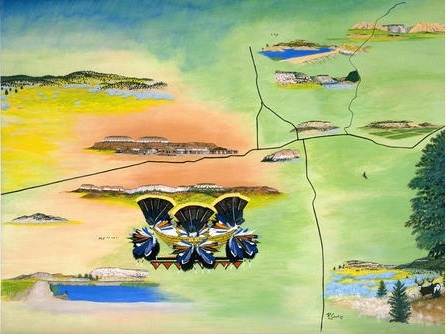
Ronnie Cachini’s 2006 acrylic, Ho’n A:wan Dehwa:we/(Our Land), Source: AMNH/ of A:Shiw A:Wan Museum and Heritage Center

Ronnie Cachini’s 2006 acrylic, Ho’n A:wan Dehwa:we/(Our Land), Source: AMNH/ of A:Shiw A:Wan Museum

Long before John Wesley Powell steered his boats down the rapids and mapped the Grand Canyon for the US Geological Survey, another set of intrepid explorers had walked, mapped, documented, and guided travelers through the entire Colorado River system. Climb up to the hidden Audubon Gallery on the Fourth Floor of the American Museum of Natural History before January 12 and get a fresh perspective on pueblo cartography in the special exhibition, A:shiwi A:wan Ulohnanne: Zuni World.

 The show features 31 paintings by seven contemporary painters from the Zuni Pueblo of New Mexico – one of the ancient tribes whose ancestors built the cliff dwellings and multistory wonders of the Four Corners.

Installation view in the “quiet gallery” on the Fourth Floor of AMNH

Installation view in the “quiet gallery” on the Fourth Floor of AMNH

After 500 years of seeing their sacred places renamed by the conquistadors, Spanish land owners, government mapmakers, and the National Park Service, Zuni cultural leaders thought it was high time to start creating maps that reflected traditional Zuni place names, stories, and symbols. They asked some leading Zuni artists to choose the story, sacred sites, and landscapes that would “map” Zuni cultural history. According to some of the artists in the show, the exercise required them to look at what they knew in an entirely different way.

The Zuni people consider their place of origin to be the Grand Canyon. Back in deep time, the Zuni ancestors were instructed to find “the Middle Place”, so groups set out in journeys to the north, south, east, and west. The northern group, for example, settled in what is now called “Navajo National Monument” and eventually built multistoried dwellings inside the most spectacular red-rock shelter in the American Southwest.

Cliff dwellings in Betatakin alcove, a NPS site at Navajo National Monument where pueblo elders continue to hold sacred ceremonies. Photo: Dan Boone/Ryan Belnap, Bilby Research Center, Northern Arizona University

Cliff dwellings in Betatakin alcove at Navajo National Monument, where pueblo elders travel to hold sacred ceremonies. Photo: Dan Boone/Ryan Belnap, Bilby Research Center, Northern Arizona University

Each painter’s style is different, but when you take it all in, the exploration story is one of fairly mind-blowing proportions – the Zuni ancestors explored the entire Colorado River system, carved petroglyphs in canyons to point travelers to nearby communities, and even journeyed south to the “land of endless summer” –Central America’s coastal communities.

Although the paintings depict myths and symbols in the Southwestern landscapes, East Coast art-lovers should be aware that the Zuni expedition story isn’t fiction: Chaco Canyon’s great archeological sites contain the evidence — tropical shells, stones, Scarlet macaw skeletons, cacao, and the network of banked, engineered roads (circa 850 – 1100 A.D.) that actually lead to many of the places depicted by the Zuni painters.

Geddy Epaloose’s 2006 acrylic, The Middle Place. Source: AMNH/ of A:Shiw A:Wan Museum and Heritage Center

Geddy Epaloose’s 2006 acrylic, The Middle Place. Source: AMNH/ of A:Shiw A:Wan Museum and Heritage Center

Geddy Epaloose’s 2006 painting The Middle Place features an aerial view of Zuni’s Middle Village with sacred trails spiking out in all directions. Colorado River by Ronnie Cachini includes the edge of the distant ocean. Other paintings include the Zuni’s version of their Great Flood, the spiritual importance of their salt lake, and even unmarked lines representing some modern paved roads. Unless you’re Zuni, you’ll have to read the captions on each of the paintings.

Hunted deer is honored with a Zuni necklace

Hunted deer is honored with a Zuni necklace

AMNH has one of the largest collections of Zuni artifacts in the country, and has a good, close working relationship with that pueblo. Entering the Audubon Gallery on the Fourth Floor feels like a sacred space. You’ll be greeted by a hunted deer honored with a necklace of precious stones and ceremonial rods festooned with pieces of traditional Zuni clothing loaned by the painters and their children for us to see while their work is on display in New York.

Make a pilgrimage to this hidden gallery on AMNH’s Fourth Floor and learn about some remarkable people, places, origins, and cartography. (And stop into the First Floor rotunda to see some of the museum’s Chaco Canyon treasures.)

Enjoy this short YouTube video featuring Jim Enote, the director of A:Shiw A:Wan Museum and Heritage Center, who describes the exhibition when it debuted iat the Indian Pueblo Cultural Center.

Magritte’s Surrealist Train Departing MoMA for Houston

Magritte’s 1938 oil, La durée poignardée (Time Transfixed) from The Art Institute of Chicago’s Winterbotham Collection. © Charly Herscovici ADAGP–ARS, 2013

Magritte’s 1938 oil, La durée poignardée (Time Transfixed) from The Art Institute of Chicago’s Winterbotham Collection. © Charly Herscovici ADAGP–ARS, 2013

One of the most recognizable trains in the history of modern art hasn’t left the station. It’s coming out of the wall at MoMA until January 12 as part of the tribute to Belgium’s only big-time Surrealist painter, Magritte: The Mystery of the Ordinary, 1926–1938. But don’t worry – this intriguing tribute chugs on, arriving at The Menil in Houston on Valentine’s Day (February 14) and at Chicago’s Art Institute on June 25. Catch it, because it’s loaded with new revelations, in person and on line.

In person: So many of paintings are icons of 20th century art, that it’s shocking to think that one anarchic visual artist had the chops to turn out so many great works in such a relatively short period of time. Walking through the first couple of galleries, you’ll recognize many famous images, but check out the dates on the labels: 40 were done in just his first three years in Paris between 1927 and 1929! He was so prolific, it makes you wonder when he made time to hang out at cafes, discuss dreams, and publish with Breton and the rest of the crew.

Jasper Johns owns the small version of Magritte’s 1935 oil La clef des songes (The Interpretation of Dreams), which uses English. © Charly Herscovici ADAGP–ARS, 2013. Photograph: Jerry Thompson

Jasper Johns owns the small English version of Magritte’s 1935 oil La clef des songes (The Interpretation of Dreams). © Charly Herscovici ADAGP–ARS, 2013. Photo: Jerry Thompson

Magritte liked making the familiar unfamiliar, playing with fact and fiction, probing dreams and reality, and appropriating pop culture into an art context.

Like Andy Warhol, Magritte began as an ad illustrator, and MoMA’s curators have included a few of his early fashion illustrations. It’s surprising to know that phrases that he injected onto his canvas (like “Ceci n’est pas une pipe”) were written in a script that was one of the most recognizable fonts used in European newspaper and magazine ads in the Twenties.

Was appreciation of Magritte’s ground-breaking cultural appropriation and subversion lost on our own American Pop pantheon? Not really, and the evidence is that one of the best examples of Magritte’s sly presentation of an everyday-object grid with ironic words was lent by the midcentury grandmaster, Jasper Johns.

So much contemporary pop culture and advertising art has reinterpreted, reimagined, and referenced Mr. Magritte’s images that it’s easy to forget that they rocked the world in the Twenties. His reverberation with our beloved 1960s Pop masters (and this show) reminds us that Mr. Magritte truly blazed an innovation pathway in taking the everyday and turning it into art.

MoMA discovered something lurking beneath the surface of its Magritte’s 1936 oil, Le portrait (The Portrait). Gift of Kay Sage Tanguy. © Charly Herscovici ADAGP–ARS, 2013

MoMA discovered something historic lurking under Magritte’s 1936 , Le portrait (The Portrait). Gift of Kay Sage Tanguy. © Charly Herscovici ADAGP–ARS, 2013

And speaking of pioneering, check out the amazing interactive site that lets us enter Magritte’s mind; learn how he turned nature, desire, dreams, language, and symbols into troubling, evocative, subversive works; and see the behind-the-scenes conservation and curatorial work. The beautiful, musical experience is designed by Hello Monday, and should probably win a Webby Award. See it now.

You’ll see how MoMA took off the old varnish, examined the canvases under ultra-violet light, and did detective work of which Magritte and his silent-movie-icon inspiration, Fantômas, would be proud.

Spend time letting each painting’s mini-site load into your browser window, click to hear the curators talk, and keep scrolling down to see what the conservators discovered. You can even toggle back and forth to see the surface of the painting and X-ray.

As a preview, here’s the YouTube video about the “lost” Magritte painting that conservator Cindy Albertson found lurking underneath The Portrait.

And while you’re at it, you might take a minute to see what technology was at work in possibly Magritte’s most famous image:

When Whales Walked Explained at AMNH

Whales exhibit tells the evolution story. Courtesy: Museum of New Zealand Te Papa Tongarewa

Whales exhibit tells the evolution story. Courtesy: Museum of New Zealand Te Papa Tongarewa

Right inside the exhibit, Whales: Giants of the Deep, the American Museum of Natural History answers two questions that have stumped centuries of nature lovers – how did the world’s largest sea-loving mammals ever evolve from land animals, and who are their closest relatives?

In the last 20 years, DNA experts and paleontologists have been hacking away at these questions, and the show provides some startling visuals and answers: Whales (a group that includes dolphins and porpoises) came from four-legged animals that hovered close to shore lines, snapping up fish. Oh, and their closest relatives on the Mammal Tree of Life are…get ready…hippos. See the show before January 5.

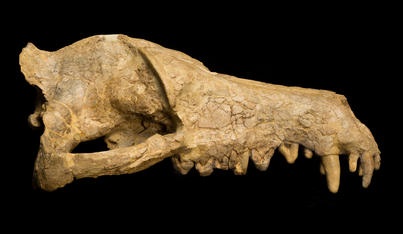
Clue to solving the mystery – the skull of Andrewsarchus, three feet long, found in 1923 by Kan Chuen Pao on AMNH’s second Gobi expedition. Courtesy: AMNH/R. Mickens

Clue to solving the mystery – the skull of Andrewsarchus, three feet long, found in 1923 by Kan Chuen Pao on AMNH’s second Gobi expedition. Courtesy: AMNH/R. Mickens

The first thing you’ll see is a massive skull of Andrewsarchus, a 45-million-year-old whale cousin, who would have stood over six feet tall at the shoulder. He was found in Mongolia on the famous AMNH Central Asiatic Expedition in the 1920s (remember the dinosaur eggs?) and to this day is the only one found.

The paleo team compared the features on his skull to other mammals, ran their analysis through cladistics software, generated a family tree, and learned that Andrewsarchus falls somewhere near the evolutionary point where whales and hippos had a common ancestor, a key clue.

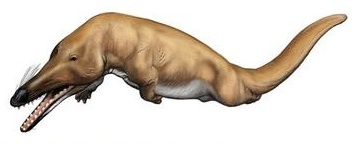
Artist Carl Buell’s depiction of Pakicetus, the oldest known ancestor to  whales

Artist Carl Buell’s depiction of Pakicetus, the oldest known ancestor to whales

A huge discovery in Northern Pakistan in 1983 began to unlock the rest of the mystery. Found in 50-million-year-old Eocene rocks, remains of the enigmatic, four-legged, fish-eating Pakicetus were discovered at the edge of what was once an ancient sea. It was deemed by scientists to be the earliest known modern-whale ancestor. Many specimens were unearthed, with ear bones looking like modern-day dolphins, but ankle bones more like a pig’s, giving scientists a reason to place his ancestry in the “artiodactyl” category, which includes hippos, pigs, antelopes, camels, and other even-toed hoofed animals. Subsequent finds and DNA analysis of modern whales further solidified the hippo-relation hypothesis.

Cladogram showing family relationships of whales and artiodactyls from the AMNH guide for students in grades 6-8

Cladogram showing family relationships of whales and artiodactyls from the AMNH guide for students in grades 6-8

The show includes a full replica of his skeleton, along with other fossils from the subcontinent showing the transition of four-legged wolf-sized animals to the streamlined bodies that we now associate with ocean- and river-going cetaceans. You’ll see a terrific video that animates the transition from longer-snouted, web-footed fish-eaters that paddled through estuaries (Ambulocetus), to more streamlined sea-going mammals whose front legs became flippers and back legs disappeared nearly completely. Kutchicetus (43-46 million years ago) shows evidence that it probably did some deep dives, and Durudon (37 mya) had nostrils at the top of his head, flipper-hands, and apparatus at the end of his tail that suggests a support for flukes.

A clue from India. Artist Carl Buell’s depiction of Kutchicetus, dweller in ancient tropical seas

A clue from India. Artist Carl Buell’s depiction of Kutchicetus, who lived in ancient tropical seas

The show was originally organized by the Museum of New Zealand Te Papa Tongarewa, and features a mix of AMNH and Te Papa artifacts and insights.

There are many other wonderful biological, historical, and cultural details to the whale story, as the YouTube below shows (84K hits and counting), but shout-outs must be given to the two stars — large Sperm whale skeletons (think Moby Dick) on display, lovingly named and transported here by the Maoris, who found the stranded duo, prepared, and blessed them for special appearance in New York.

History Twist in Brooklyn’s Period Rooms

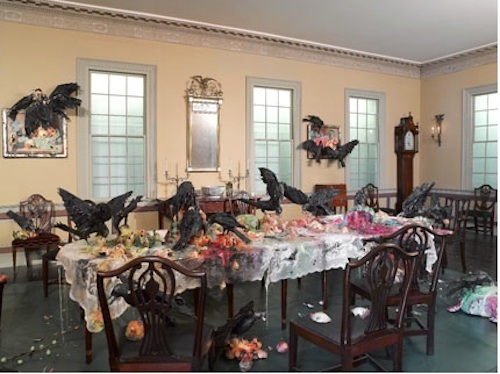
Hegarty’s “activation” of the Cane Acres Plantation dining room: Still Life with Peaches, Pear, Grapes and Crows; Still Life with Watermelon, Peaches and Crows; and Table Cloth with Fruit and Crows. Photo: Brooklyn Museum

Hegarty’s “activation” of the Cane Acres Plantation dining room including Still Life with Watermelon, Peaches and Crows. Photo: Brooklyn Museum

The Brooklyn Museum’s Period Rooms are again the focus of a rip-roaring, history-tearing, upside-down interpretation by an installation artist. Go before December 1 to see what’s happened to three rooms up on the museum’s Fourth Floor in Valerie Hegarty: Alternative Histories.

The dining room from the South Carolina’s Cane Acres Plantation is alive with dozen or so papier-mâché crows that are chowing down on the faux watermelons and peaches that you imagine to have been so beautifully arranged on the long, grand table.

Peering into either of the two plantation doorways, it’s disconcerting to see how the delicacies are being ripped apart and strewn about. The fruit literally pops out of the frames in this cross-referenced mash-up of Hitchcock terror, racial segregation issues, and classic still life painting.

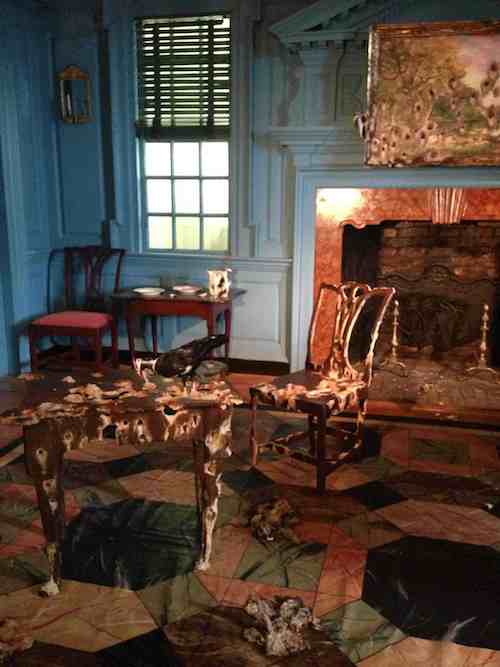
Hegarty’s Pendleton carpet in the Cupola House parlor.

Hegarty’s Pendleton carpet is growing in the Cupola House parlor.

See how Hegarty created it all out of wire, glue, foil, foam, and everything else you can purchase at Michael’s on the Brooklyn Museum’s Flickr feed.

She was equally ambitious in two other rooms from the Cupola House, originally built in Edenton, North Carolina: The 1725 parlor room focuses on a visual “conversation” between General George Washington and Pawnee Chief Sharitarish, featuring a Native American-style Pendleton parlor rug that is “growing” grass, flowers, and roots to make you think about what happened to the native culture over the last few centuries.

She kicks the Manifest Destiny discussion right where it hurts in the Cupola House “hall” (where guests socialized) by letting two Pileated and Downy Woodpeckers have their way with everything valuable in the room, including (a reproduction of) Thomas Cole’s 1846 painting The Pic-Nic. Nature is getting out of hand.

The Downey Woodpeckers take over the Cupola House hall. Photo: Brooklyn Museum

The Downey Woodpeckers take over the Cupola House hall. Photo: Brooklyn Museum

Get over to Brooklyn and encounter a new twist on what you were taught in grade school history, but watch out for Hegarty’s flying bullets and birds.

Go Underground and Outside at Grand Central

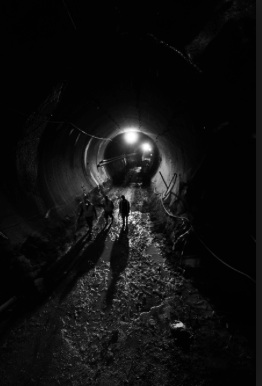
Hiroyuki Suzuki’s dramatic black-and-white view of the massive $8.2B project

Hiroyuki Suzuki’s dramatic black-and-white view of the massive $8.2B project

See New York above and below in two unique photography installations at everyone’s favorite train station right now.

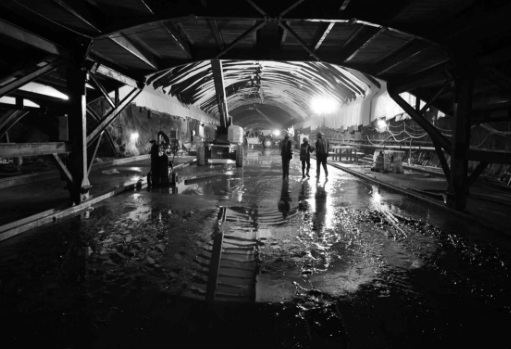
At the New York Transit Museum Annex, you can glimpse your future path to the Hamptons in The Next Level: East Side Access Photographs by Hiroyuki Suzuki through October 27. Suzuki takes you over 14 stories below Grand Central to see the tunnels, sandhogs, tunnel boring machines, and chasms of the huge construction project that will allow 160,000 daily LIRR riders to arrive on Manhattan’s East Side when it’s done in 2019.

Suzuki had never before visited New York before starting his project, but he considers it a thank-you for the relief work done by the US Armed Services following the devastating earthquake and tsunami that hit his home country of Japan in 2011.

Underground view of East Side Access by Hiroyuki Suzuki

Underground view of East Side Access by Hiroyuki Suzuki

Contemplating the more than 50 black-and-white images, you can feel the monumental achievement happening underground, feel the damp, hear the light sloshing of men and machines moving through slightly damp tunnels, and see the miles of spaghetti-like cables illuminating the gigantic spaces where trains will soon thunder.

Suzuki made four trips down there during the project, and you may not even get to make one, so drop in and take a look at the engineering marvel happening right beneath a good patch of Midtown East. You’ll see supports labeled “48 Street” or “FDR” for orientation in the black wilderness.

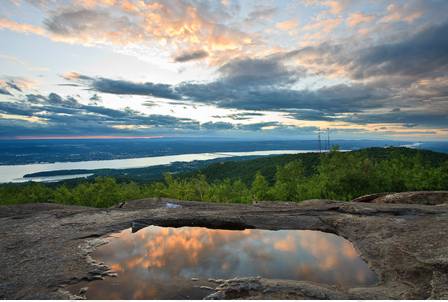
Beautiful Hudson River photograph by Robert Rodriguez, Jr. from the one-day exhibition in Vanderbilt Hall

Beautiful Hudson River photograph by Robert Rodriguez, Jr. from the one-day exhibition in Vanderbilt Hall

Speaking of wilderness, get over to Vanderbilt Hall sometime today to experience the opposite – gorgeous landscapes of the spectacular Hudson Valley. To celebrate the achievements of an historic environmental organization (and encourage you to buy a train ticket to see scenery that inspired generations of artists), there’s a one-day-only photo spectacular — 150 images by Annie Leibovitz and 12 other photographers whose subject is the beauty of the Hudson River.

On Time and Place: Celebrating Scenic Hudson’s 50 Years, sponsored by Metro-North and Scenic Hudson, has traveled to five cities to celebrate this historic environmental organization’s 50 years of success. The photos are in Vanderbilt Hall from 10am until 4pm.

Rich & Famous at Green-Wood’s 175th Anniversary

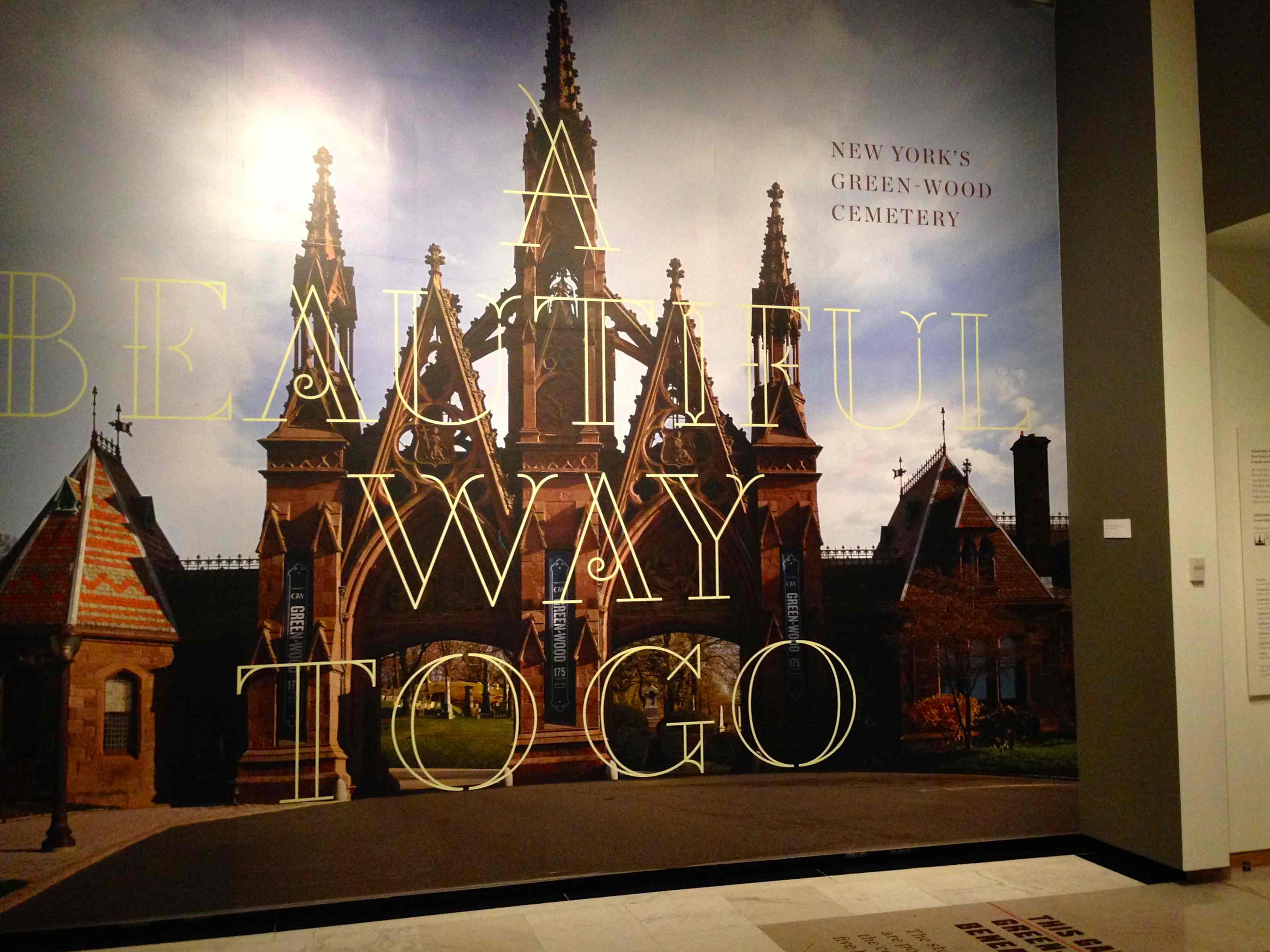
Show entrance featuring Green-Wood’s spectacular Gothic architecture.

Show entrance featuring Green-Wood’s spectacular Gothic architecture.

It’s big, green, historic, beautiful, and has more celebrities inside than you could ever imagine possible in an out-of-the-way spot in Brooklyn. Any day of the week, you can take a trip out to the lush woodlands, hills, and statuary gardens of Green-Wood Cemetery (and you should!), but every NYC history geek needs to visit the Museum of the City of New York’s A Beautiful Way to Go: New York’s Green-Wood Cemetery before October 13 to plumb the riches that have been assembled to celebrate its 175-year history.

We’re providing a walk-through on our Flickr feed, but the virtual experience is no match for the first-hand encounters with objects associated with the New York titans that are interred within the 478 acres of hills and countryside of Green-Wood itself – Tiffany, Duncan Phyfe, Boss Tweed, and even The Little Drummer Boy.

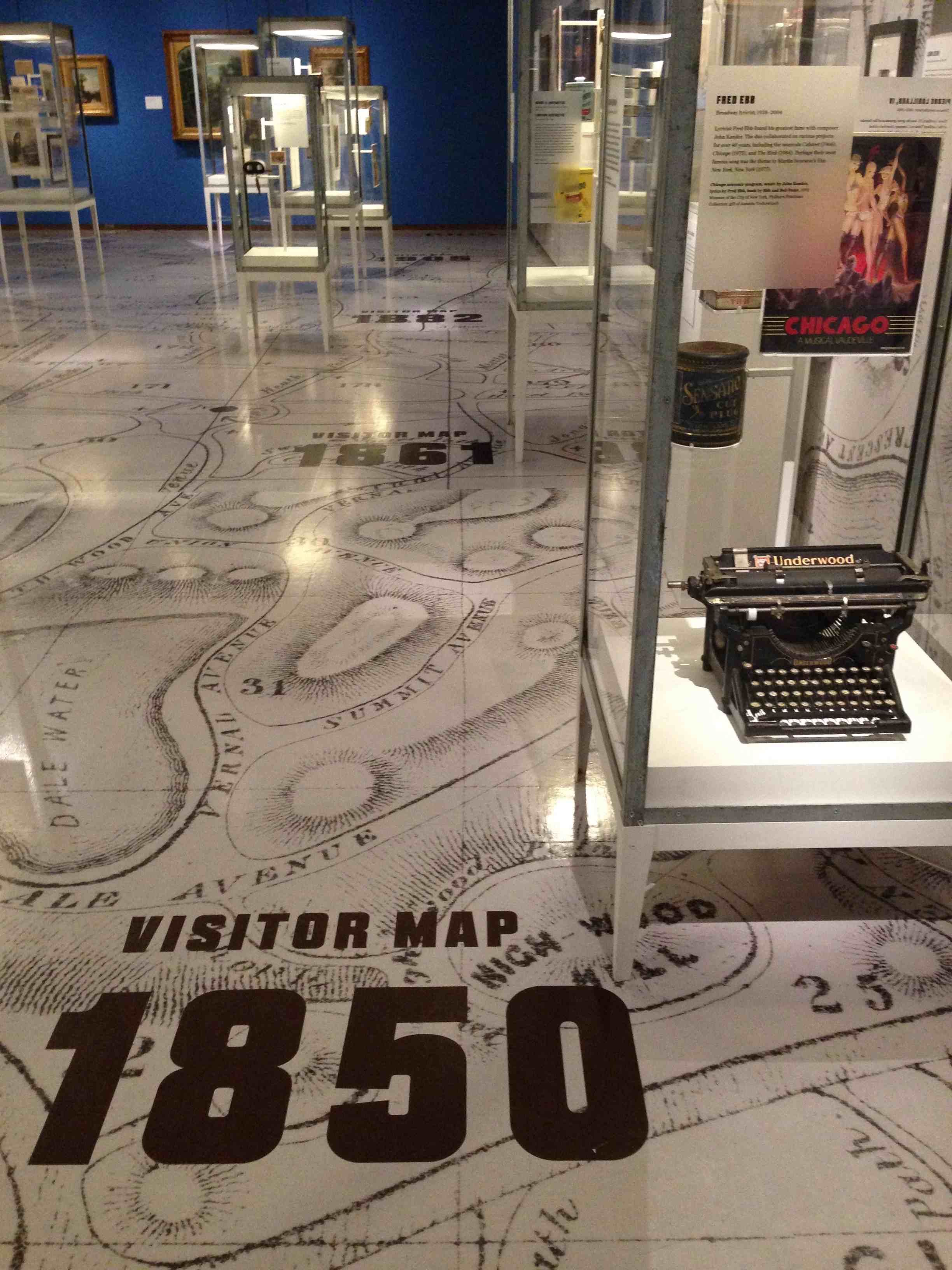
The floor map and vitrines with items associated with Green-wood’s most famous

The floor map and vitrines with items associated with Green-wood’s most famous

Consider the retail giants and brands: All five Brooks Brothers (who invented ready-made suits in 1849), the six Steinways who made pianos in Queens, Ebhard Faber (remember pencils?), the Domino Sugar owners (who once had 98% of the entire US market and who gave most of their vast art collection to the Met), the creator of Chiclets, the founder of Pan Am, and even F.A.O. Schwartz (yes, it’s a person).

MCNY has put the map of Green-wood on the floor of the gallery and has placed vitrines with objects associated with the rich and famous sort-of where they would be in the actual cemetery. Walking through the show is like random-access memory. You don’t know what or who you’ll stumble upon.

The tribute includes artists (from Currier & Ives and Asher Durand to Leon Golub, Nancy Spero, and Jean-Michel Basquiat); composers (Frank Ebb, Mr. Bernstein, and disco legend Paul Jibara); and inventors of things like the safety razor, the sewing machine, soda fountains, and the safety pin (think about that). Yes, it all happened in New York.

Spanish-language poster for "The Wizard of Oz" as a tribute to Frank Morgan, who played The Wizard

Spanish-language poster for “The Wizard of Oz” as a tribute to Frank Morgan, who played The Wizard

Green-wood is New York’s equivalent of the Pere Lachaise Cemetery in Paris, full of vistas, trees, paths, lakes, works by celebrity sculptors, military memorials, and elaborate, ornate above-ground tombs. Lachaise spawned an international mania for sylvan-glade cemeteries when it opened in 1804, and when Mr. Pierrepont was laying out the Brooklyn street system in the early 1800s, he left a big, open green spot in the plan, where Green-Wood is today. It opened in 1838, predating Central Park, and grew into the No. 2 tourist attraction in the United States (after Niagara) by the 1850s.

An 1875 Howe Sewing Machine by the inventor of the sewing machine, Elias Howe.

An 1875 Howe Sewing Machine by the inventor of the sewing machine, Elias Howe.

The show’s front hall has spectacular landscape photos taken last year by Jeff Chien-Hsing Liao, serving as luring calling cards to take the actual expedition to Green-Wood and its celebrated trolley tours led by uber-historian Jeff Richman.

Find Lightness of Being at City Hall

Alicja Kwade’s bicycle sculpture, Journey without arrival (Ralegh), 2012/2013

Alicja Kwade’s bicycle sculpture, Journey without arrival (Ralegh), 2012/2013

No, it’s not the mayoral race. As long as the nice weather holds up, get down to City Hall Park and poke around among the trees and plaza to see the whimsical sculpture that the Public Art Fund has on display in Lightness of Being. There’s plenty of time before the show closes December 13.

Take a look at what you can find on our Flickr feed.

Everyone will have their own favorites, but you’ll have to look closely to catch some of the work, since you can easily walk by and not notice – David Shrigley’s nearly hidden Metal Flip Flops near the fountain and Alicja Kwade’s delightfully twisted bicycle sculpture that’s hopefully not how your Citibike is going to end up. People walk right by them and then do a double-take.

At the foot of the park, Dalniel Buren’s Suncatcher functions more like an impromptu stage for fun-loving toddlers, but the true stars of the show are the six fantasty characters holding court nearby.

Buzzing it Down, 2012, by UK artist Gary Webb

Buzzing it Down, 2012, by UK artist Gary Webb

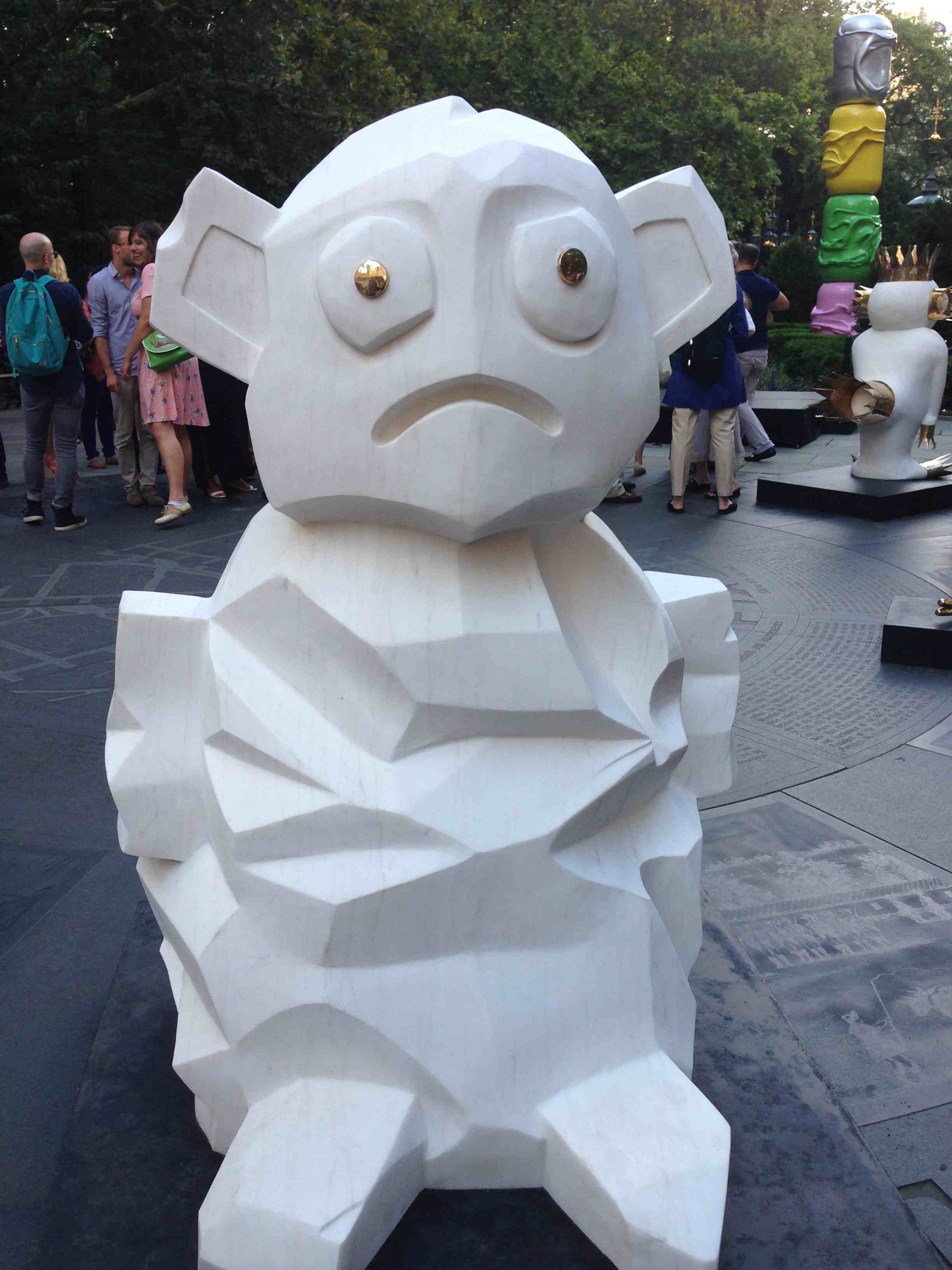
Get out your cameras for Olaf Breuning’s installation, The Humans. They’re some of the craziest marble statues you’ll ever meet, forming a circle to evoke the human evolution from “fish” to “fisher king.” Enjoy the contrast they make to the Park’s other, more traditional marbled details.

Poke around behind Nathan Hale to see Franz West’s whimsical forest of bulbous growths, and don’t miss the super-intriguing sculpture by James Angus. He’s made a full-scale John Deere tractor in steel and cast iron, but instead of being a faithful reproduction, he stretched it digitally and left it toppled among the trees near Broadway. It makes you think back to the pre-industrial 1660s when this land was used as a livestock pasture, and reflect on where agriculture is today.

One of six fantasy characters in Olaf Bruening’s installation, The Humans, 2007.

One of six fantasy characters you’ll meet in Olaf Bruening’s  The Humans, 2007.

The show will delight, make you think, and turn you into an urban explorer probing the nooks and crannies of the southern portion of the park’s nine acres.

And if you take your camera and get any good shots, you can contribute them to the Gallery on the Pubic Art Fund’s site.

Water, Water Everywhere at the Academy

Tintagel, 1881. Large, masterful watercolor depicting castle ruins on the Cornwall coast of England, which Richards associated with the legends of King Arthur.

Tintagel, 1881. Large, masterful watercolor by William Trost Richards depicting castle ruins on the Cornwall coast of England, which Richards associated with the legends of King Arthur. Who needs to mess with oil paint and build big canvases when you can do this with water and paper?

In a brilliant pairing, the National Academy Museum has mounted dual shows by artists who draw their greatest inspiration from water. There’s no need for a trip out of town to experience crashing waves, monumental waterfalls, and wide expanses of sea and sky done by one of America’s greatest watercolorists of all time and a celebrated 21st century painter.

William Trost Richards: Visions of Land and Sea features 60 works from the Academy’s collection – early graphite sketches, oil paintings, and beautiful, grand, sweeping watercolor vistas that are some of the tiniest, most meticulous works you’ll see anywhere. Some are on display for the first time, which is remarkable considering that critics believe WTR to be among the greatest American landscape painters of the 19th century.

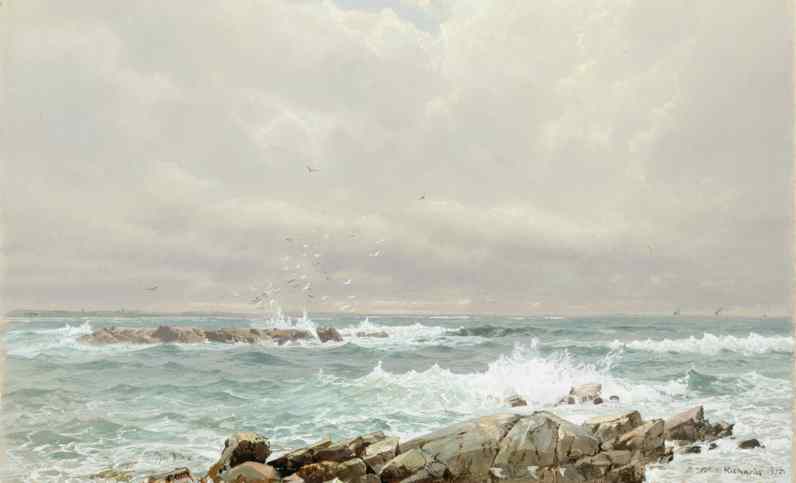
Seascape (1875), a watercolor on cream paper that’s only 9 X 14 inches. Source: National Academy

Seascape (1875), a tiny but monumental watercolor by William Trost Richards on cream paper. It’s only 9 X 14 inches. Source: National Academy

Inspired by Ruskin and the Pre-Raphaelites early in his career, WTR began documenting the intricacies of the Wissahickon River paths near Germantown, on the outskirts of Philadelphia. He soon became part of the American watercolor movement that began making works that were just as grand, romantic, and full of transcendence as anything by Church or Bierstadt. Quite a feat, when you’re working on such a tiny scale.

He spent years perfecting vistas of the ocean and sky from his home near Newport and on travels to the edges of the British Isles. Remarkably, he kept the horizon low to showcase the sky, all meticulously painted and built up from a ground of blue-gray wove paper. It’s remarkable how he evokes mood, rocks, night, dusk, and pale sky from that gray. Click here for more.

Steir’s monumental Blue River (2005) – one of her celebrated Waterfall series. Steir’s monumental Blue River (2005) – one of her celebrated Waterfall series. The video shows it’s true scale.

Steir’s monumental Blue River (2005) – one of her celebrated Waterfall series. Steir’s monumental Blue River (2005) – one of her celebrated Waterfall series. The video shows its true scale.

Pat Steir’s paintings, on the other hand, feature an opposite approach. Like Sam Francis or early post-Pop color-field painters, she pours, splatters, and drips her paint across canvases that seem a mile high and a block long. The masterwork on display at the Academy is Blue River, a virtual waterfall that’s just as mesmerizing as any of WTR’s watercolors, but done in bold, wide strokes on a larger-than-life canvas.

Go this weekend and delight in the masterful scenery. Pat herself indulges in the joy right here.

If you miss the Academy show, be sure to look for Pat’s Everlasting Waterfall hanging on the Fifth Floor of the Brooklyn Museum right next to Church.

Civil War Photos and High Line

The High Bridge and the former Civil War rail line, now turned into a pedestrian walking trail across the Appomattox River last year by the State of Virginia.

The High Bridge and the former Civil War rail line, now turned into a pedestrian walking trail across the Appomattox River last year by the State of Virginia.

What can you see from the perspective of 150 years after Gettysburg? If you go to Farmville, Virginia, you can experience a tranquil, soaring view of lush greenery 160 feet above the Appomattox River – a railroad trestle that was once burned, chopped, and torn apart in desperation just a few days before Lee’s surrender.

If you go to the Metropolitan Museum of Art today or tomorrow, you can see Photography and the American Civil War, a show on the First Floor that snaps you back to the birth of image-making, self-promotion, and day-to-day documentation in a way that makes today’s mania for image-sharing look a little lame in comparison.

Essentially, there were over 2,000 photographers roaming through the North and South during those four years of the Civil War. They produced over 1 million pictures of people, soldiers, current/former slaves, battlefield encampments, and more. Photographers trailed the troops everywhere they went, setting up tented studios on site.

Half of Timothy O’Sullivan’s stereo photo, Farmville, Va. April 1865, High Bridge of the South Side Railroad across the Appomattox. Source: Library of Congress

Half of Timothy O’Sullivan’s stereo photo, Farmville, Va. April 1865, High Bridge of the South Side Railroad across the Appomattox. Source: Library of Congress

As soon as you walk into the tented galleries, you’ll see a dizzying array of new technology and firsts – the first campaign button (Lincoln’s) using photos, the carte de visite mass marketed by Sojourner Truth to raise funds and promote her many social-change initiatives (check it out), stereo photos, albumen silver prints from glass negatives, Matthew Brady’s Union Square photo studio for the rich and famous, and before-and-after panoramas of what was going on at the front (not easy when the medium does not capture motion). But that’s just the first two rooms, so plan about an hour or more for the rest of the show.

Timothy O’Sullivan’s 1865 photograph, High Bridge, Appomattox, Va. from Gardner's Photographic Sketch Book of the War [c1866] Source: Library of Congress

Timothy O’Sullivan’s 1865 photograph, High Bridge, Appomattox, Va. from Gardner’s Photographic Sketch Book of the War [c1866] Source: Library of Congress

The photos from this week’s walk across the High Bridge in central Virginia is in stark contrast to the Library of Congress photos of the site in 1865, just after the war ended – a ground-up view of the famous rail bridge that was part of the historic photo-tome produced and marketed to the wealthy by Alexander Gardner and a stereo view of same, produced for the 3-D mass market. See and compare more views of Virginia’s Civil War “high line” with our Flickr photos.

There’s a lot more to the Met’s show than it’s possible to write about here (like the original $100K reward poster for Booth that was the first time photos were used in a perp search) and the fact that Brady never actually went to a battlefield (he sent others).

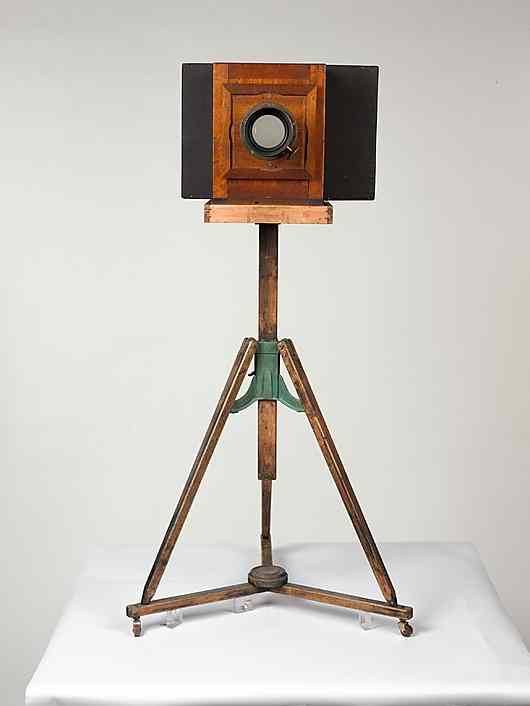
Matthew Brady’s 1860s studio camera is part of the Met’s show. Source: Lowenthell Family Photography Collection.

Matthew Brady’s 1860s studio camera is part of the Met’s show. Source: Lowenthell Family Photography Collection.

It’s simply one of the best shows that the Met has mounted, and congratulations to curator Jeff Rosenheim for this triumph. He’s written a great blog post and recorded a nice 30-minute video that sums up a lot of his thinking.

Check it out and if you’ve missed it, get your Amtrak ticket and head South: This mind-bending, must-see show is coming to the Gibbes Museum, Charleston, South Carolina (September 27, 2013–January 5, 2014), and the New Orleans Museum of Art (January 31–May 4, 2014).