Museum as Model with Temple and Condo Plans

Did you miss the Francesca Woodman show at the Guggenheim? You can catch one of her spectacular pieces at the Met in the small contemporary photography exhibit, Spies in the House of Art.
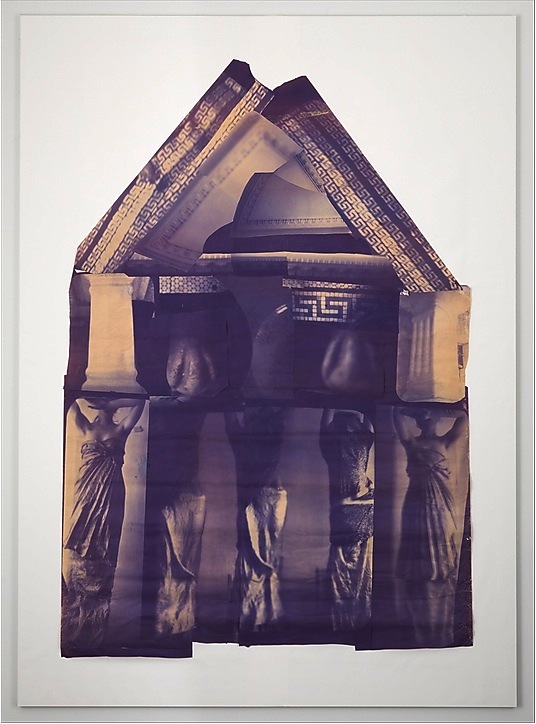
Francesca Woodman’s Blueprint for a Temple, 1980. Diazo collage. Gift of George and Betty Woodman to the Metropolitan Museum, 2001.

The show features works by photographers, filmmakers, and video artists inspired by museums, collections, and exhibitions. The standout (Cindy Sherman’s Italian history portrait notwithstanding) is the epic piece by Woodman:  the large-scale Blueprint for a Temple made up of 29 photographs on blueprint paper. The piece uses live models as caryatids and everyday stuff to evoke classical architecture, and it’s an experience.

The Met’s also given over a large, dark exhibition area to show Rosalind Nashashibi and Lucy Skaer’s film shot with strobes late at night when the Met’s ancient-art halls look particularly magical and spooky. Perhaps the most startling aspect of the installation is the medium. We’ve become accustomed to digital projection, but this experience is enhanced by the sight and sound of a 16mm film loop clicking through a 16mm projector.

For some fun, be sure to sit down, put on the headsets, and listen in to Andrea Fraser’s 1989 fictional museum walk that’s also part of the show. And check out Peter Nagy’s 1985 work done when there was a citywide kerfuffle over the MoMA’s plans to renovate (remember that?). Nagy layers condominium floor plans over the old layout of the MoMA galleries. It’s hilarious.

380-Year Old Dutch Girl Plays House

When the Brooklyn Museum invited four artists into their period rooms for Playing House, who knew that one would be channeling her own family history, complete with her ancestors’ dramatic flight to America over 380 years ago and a tribute to the first girl in her family born in New Amsterdam?

Mary Lucier’s video Still Life #1 atop the table inside the 1675 Jan Martense Schenck House in the Brooklyn Museum

Mary Lucier created a compelling multipart installation above, around, and inside the Jan Martense Schenck House (1675), which stood in Brooklyn for about 275 years and is currently the oldest “home” in the gallery. Lucier evokes the 1572 persecution of the Huguenots in Europe through a clip from D.W. Griffith’s Intolerance overhead, and invites visitors to sit in a modern replica of an old Dutch chair to watch a slide presentation about the Rapaljie family – a story that also happens to be her own.

The chronology takes you graphically from the religious wars in Europe to a 19-year old couple who escaped, to their colonization of Albany in 1624, and to the 1625 birth of their daughter Sara at their homestead in Wallabout Bay (now the Brooklyn Navy Yard). Lucier’s video installation inside the older Schenck house evokes New Amsterdam; her transformation of his grandson Nicholas’s house (right next door in the gallery) depicts the faces and stories of Sarah’s over one million current descendants 380 years later.

Take a look at my Flickr feed to glimpse installations by Lucier, Ann Agee, Ann Chu, and Betty Woodman. Then go to Brooklyn’s site to see all four at work installing their art in the period rooms.

When the 1675 Jan Martense Schenck House stood in Brooklyn. From the digital archive of the Brooklyn Museum of Art

If you have time, browse through Brooklyn’s digital archive for the Schenck house and what it took to get it installed inside the museum in 1971.

Eavesdropping on Schiaparelli, Prada, and Iris

Don’t despair if you haven’t gotten to the Met’s Costume Institute show Schiaparelli and Prada: Impossible ConversationsThe Met’s put up a spectacular web site that lets you in behind the scenes, around the dining table, and inside the head of everyone’s favorite fashion icon, Iris Apfel.

If you get to the gallery this week before the show ends, expect large crowds (“normal” large, not like McQueen). Hopefully you’ll get close enough to the clothes to check out Schiaparelli’s innovative tree-bark rayon. If you can’t get there, preview the exhibition set-up on line, and go take the curator’s walk through (the second video from the top).

You can look through some of the images that the Met is sharing on line, but they don’t feature some of the in-person eye-poppers – the blue-squiggled Schiaparelli bridal veil on loan from Philadelphia, a color photo of Schiaparelli’s gold sari dress and veil (although the Horst photo is great), or Prada’s stuff with monkey and banana prints. [Prada quote: “I never thought people would want to wear clothes with monkeys and bananas on them.”]

One of the biggest complaints visitors have about the show is that it’s so hard to see and hear the “conversation” videos between Prada and Schiaparelli (played by Judy Davis, and, yes, someone did ask me “who played Prada?”).  Not  a problem, because all eight conversation videos are posted online (scroll to the bottom of the page).

If you have an extra hour in front of the computer, here’s the added bonus: the video of Iris Apfel discussing good and bad taste in contemporary fashion at the Met last June.  Who doesn’t want Iris’s amazing perspective on style?

If you don’t have the time, just check out The Rules by Elsa Schiaparelli, courtesy of Philadelphia’s 2005 exhibition site. Agree? Disagree? Well, maybe you’ll concur with Prada’s side of the conversation.

Disturbed Bird Watching on The Bowery

You don’t need binoculars at the slightly subversive installation at The New Museum featuring dozens of fantastical avian creatures.

The Parade is Nathalie Djurberg’s collaboration with musician Hans Berg, which fills the space at Studio 231 (to the right of the museum’s main entrance). As you poke and pick your way among the feathered flock (actually painted canvas, wire, and other assembled materials), you may feel a little unsettled.  Then you’ll notice several video screens on the walls in which the animated people and creatures do, well….not so nice things.

Djurberg’s known for her animated films in which her animated clay sculptures do horrible things. She says that in order to position her little characters correctly, she often has to act out the parts so she can understand how to portray the movements during the tedious shot-by-shot animation process.

As you watch surrounded by the bird parade, Berg’s music often layers sweet sounds on top of some disturbing candy-colored images, making your safari through 231 more than a little unnerving.

This Swedish team was originally commissioned by the Walker in Minneapolis. Download the audio guide to The Parade and take the journey.

Channel Your Inner Coward

Noel Coward, that is, by going for the full immersion experience at NYPL of the Performing Arts at Lincoln Center’s show that covers every inch of his creative life. Spend an hour or two probing the films, videos, music, and items that overflow at the exhibition, Star Quality: The World of Noel Coward.

It will definitely inspire you to write that musical revue, star in your own drama, entertain around a piano, paint a landscape that you love, snag a cameo in a film, be a friend to one and all, and party like it’s 1999.

You can begin by visiting the special website the NYPL has created and digging around in the decade-by-decade archive that keeps unfurling before you. Not all of the photos are dated, but you’ll see stage production photos from the original 1920s productions of Easy Virtue and The Vortex, Private Lives from the 30s, and Blithe Spirit from the 40s (go, Mildred Natwick!). There’s plenty of Lunt-Fontanne to go around in subsequent decades, and some classic shots of Elaine Stritch in Sail Away from the 60s.

If you need a quick refresher on all Coward’s shows, check out his portion of the Playbill vault.

But the walk-through at Lincoln Center goes well beyond just the songs, reviews, and drawing-room comedies with tales of his debut as a precocious child actor, iconic dressing gowns, inscribed gold and silver cigarette cases, a piano festooned with his favorite celebrity portraits, his “spy” career during WWII, his Vegas career (tuxedo in the desert?), and his TV/film work.

In fact, the lights, camera, and action are on full display with NYPL’s multiple viewing stations around the show, including some early 1930s footage of Coward’s musical stage reviews that are filmed from the wings, including a parade of “Children of the Ritz” and the Broadway debut of “Mad About the Boy”.

Go to see this now, and don’t miss the slide show of recently discovered private 3-D photos from the 1950s that is just inside the door.

Cool Off in Dublin Water Works

During the summer heat wave, there’s a way to cool down in Chelsea and let the team from the Science Gallery at Trinity College challenge you to think differently about the splashing water you take for granted.

Take advantage of the final weeks of Surface Tension: The Future of Water at Eyebeam Art & Technology Center on West 21st Street, an incubator for digital art/design experimentation. For the past two-plus months, they’ve hosted an exhibition (first curated in Dublin) on the social-economic-political tensions created by water scarcity.

As soon as you walk into Eyebeam, you’ll be struck by the plethora of infographics that show you just how much water bounty that we have in the United States versus the availability and consumption per capita in the rest of the world. What’s your water footprint?

One of the ways you’ll find out is by looking at The Virtual Water Project, a celebrated infographic by German designer Tim Kekeritz, that depicts everyday objects and the amount of water required to produce them. Download the iPhone app. For $1.99, it will blow your mind (but not your budget) and continue to deliver a truly a conscious-raising experience of epic proportion.

Another unforgettable experience is Bit.Fall by artist Julius Popp, an installation that translates words from Internet newsfeeds into bits that are reconverted into a stunning waterfall of words:

There’s so much great stuff: multiple takes on water consumption, conservation, next-gen thinking, third-world innovations, and art-meets-technology solutions. Like Tele-Present Water by David Bowen, which recreates actual water movements from NOAA data being collected from a random buoy out in the ocean.

If you can’t get over to Chelsea for an hour, just click through the thought-provoking objects, artworks, design solutions, documentaries, and thought pieces by the scientists, artists, engineers, and designers whose works are on display on the Dublin microsite.

Egyptian Animal Planet at The Met

Animal lovers, rush to see the final days of a truly spectacular journey back in time to experience the African wildlife that bounded across the still-lush lands surrounding the Nile. Tucked back into the lower level of the Met’s Lehman Wing, it may be easy to miss The Dawn of Egyptian Art, but don’t!

The items in this show are embellished with some of the liveliest, whimsical, and dramatic creatures, big and small, that entranced the citizens of Dynasties I and II, over five millennia ago.

Back in 3300 B.C., it was all about the animals – carvings of sleek and savvy jackals, mehen game boards in the shapes of snakes and turtles, fat bird jars, and frog containers that would make 14th century Mesoamerican artists jealous.  Who knew that you’d carry your stuff around in ostrich-egg containers? Or use palettes adorned with antelopes and turtles? Or have hair combs decorated with giraffes, hippos, and wildebeest? (Pre-dating Hello Kitty by about 5,000 years.)

It’s as if the curators were mounting a show for the AMNH, because they clearly have an eco-anthro explanation about the hottest trends. Examples: elephants were commonly seen in the lands around the Nile around 3700 B.C., but they vanished from the desert (and thus, from the art) by 2649 B.C.

Also, around 3300 B.C., there was art trend to portray some animals as sacred. But it wasn’t until the Upper and Lower Egyptian kingdoms were united in 2150 B.C. that animals were used as royal symbols and the well-known style of animal-head-on-human-body became the thing.

Jackal (ca. 3300-3100 B.C.)

Other highlights of this show include the Two-Dog Palette (which gives the famous Narmar Palette a run for its money) and a seemingly unremarkable ceramic bowl that documents a time of unprecedented high-tech innovation in 3700-3450 B.C. textile making: a new technique with ground looms that enabled the ancient Egyptians to weave the strongest, widest linen in the world (ever).

Join this safari and go spot some big game through the eyes of the ancient Egyptians.

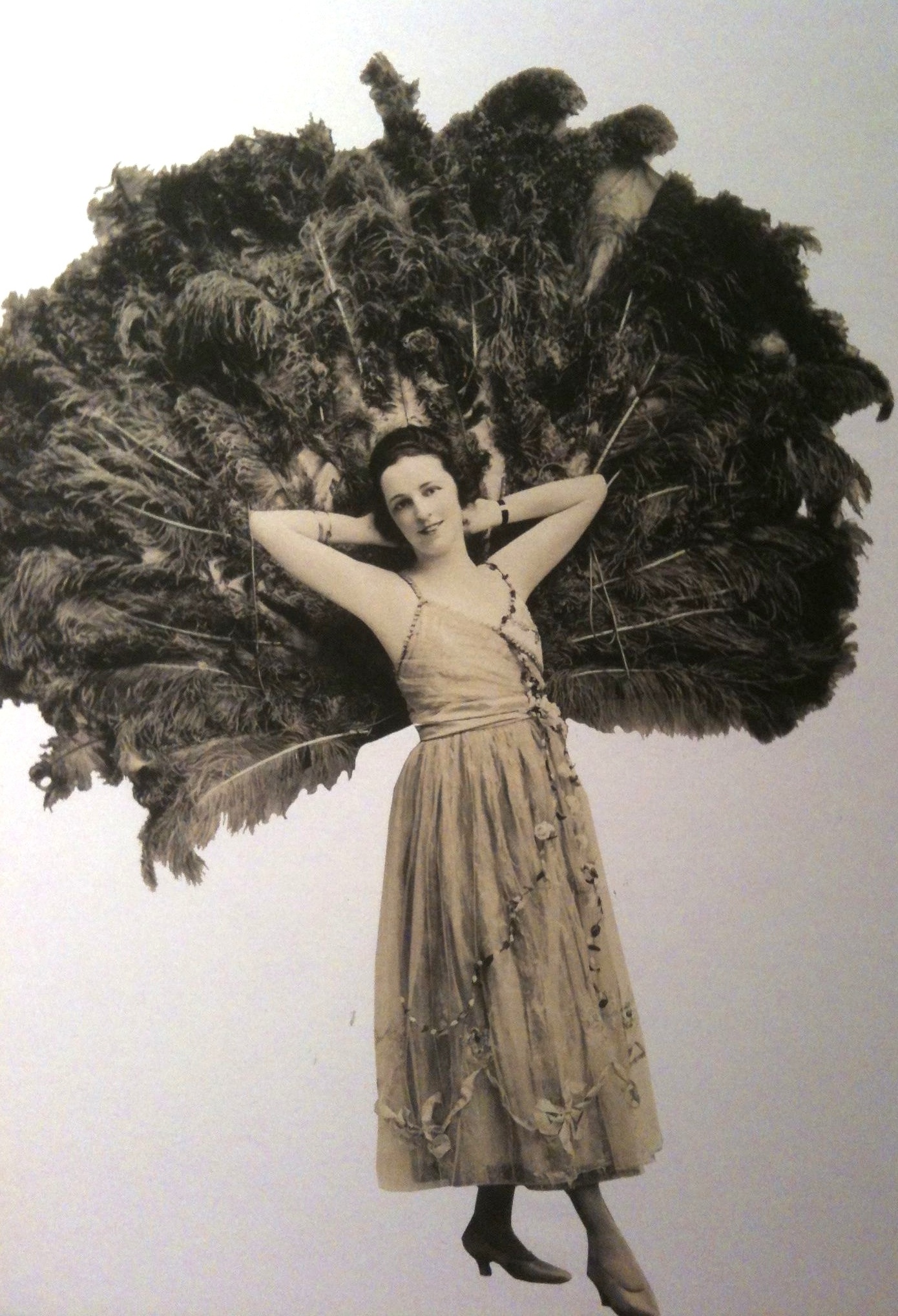
Curtain Comes Down on Follies

Unfortunately, the show has closed: The Great American Revue exhibition at NYPL’s Library of Performing Arts at Lincoln Center ended its run last weekend.

Performer in one of The Passing Show revues (1912-1919), which spoofed politicians and Broadway shows (kind of like “Forbidden Broadway”)

Today, Broadway pretty much consists of musicals and dramas, but back in the day, the “tired businessman” was entertained by chorus lines, comics, impersonators, satirists, and the best songwriters. (Think Cohan, Berlin, Rogers & Hart.)

Perhaps the note found in the archives inside a Follies costume swatch book sums it up: “Costume designs are attached. Lyrics will be written if you are interested.”

This terrific NYPL show explored how follies and revues evolved between the years 1902 (the dawn of the Hammerstein Roof Garden shows) to 1938 (when topical revues of the Great Depression, such as Pins and Needles made their mark).

The curators’ chronology and commentary is brilliant, chronicling the four stages of development: beginnings, experimenting with formats, celebrating the “body as performance”, and the emergence of political satires (1930s). (Download the show’s mini-program to get the Cliff Notes version.)

Chorus line from Earl Carroll’s Vanities (1923-1940), which featured the Most Beautiful Girl in the World

Who knew that the original Hippodrome was also built by the team that built Coney Island’s Luna Park? Who knew that George White invented “souvenir programs”? Who knew that Martha Graham got her start in settlement-house venues way back when the Neighborhood Playhouse was at the Henry Street Settlement? Who knew that audience participation shows and mini-revues on rooftop eating-drinking gardens predated the Brooklyn Bowl mash-up by 100 years?

Olympic-Sized Dreams for the Suburbs

You’ve seen Danny Boyle transform the Olympic stadium from a 19th Century industrial landscape into the digital home of today. What happens when you give a 21st century design team the chance to do the same with Chicago’s suburban industrial wasteland?

See for yourself at MoMA’s show “Foreclosed: Rehousing the American Dream.” Although it closes tomorrow, the MoMA website has replicated everything on line–videos, maps, manifestos, and plans.

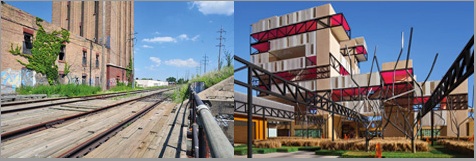
The proposed transformation of Cicero’s abandoned railside factories into a 21st century village where people work and live is particularly interesting. Abandoned factories currently take up 30% of Cicero. What if you redesigned it and let people buy only the parts of the home they need (vs. everyone living in a brick bungalow with a yard)? See the video and solution by Studio Gang Architects.

Cicero, Illinois and the proposal for the Vertical Neighborhood in the Garden in the Machine project by Studio Gang Architects. © 2011 James Ewing, photograph courtesy James Ewing.

Also, check out WORKac’s creation of “Nature-City” in a down-and-out Oregon suburb, Keizer. What happens when you integrate organic farming businesses and wildlife crossings into a village? Or MOS’s proposed transformation of The Oranges, New Jersey from a grid to a walking city.

Enjoy meeting our own artistic visionaries with Olympic-sized dreams on line.

What You’ll Be Wearing in Space

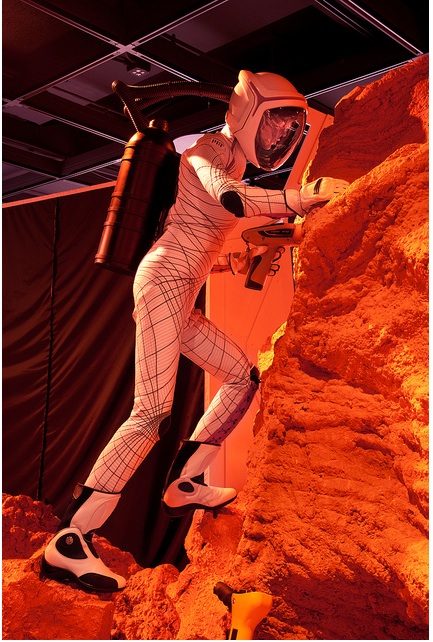
BioSuit™, a form-fitting next-generation spacesuit prototype by MIT aeronautics and astronautics professor Dava Newman displayed in the AMNH exhibition. © AMNH\D. Finnin

If the wizards at MIT have their way, the future look on Mars (for us) will be spandex, nylon, and polymer. It’s the look that’s featured in the soon-to-close show at AMNH, Life Beyond Planet Earth: The Future of Space Exploration.

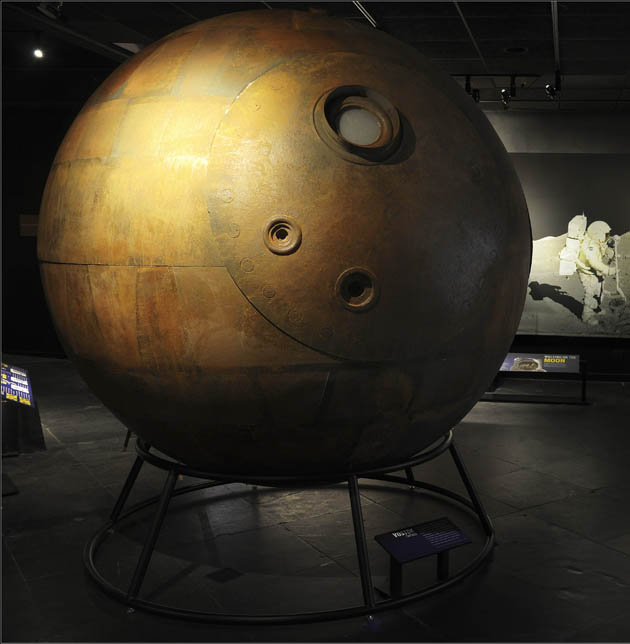
Some of the highlights include a model of Yuri Gagarin’s 1961 space capsule (don’t walk by it in the entry to the show!), Soviet and US space helmets, the “smell” of the Moon, a model of Sir Richard Branson’s space-tourist vehicle, and a space elevator.  (Didn’t you ever wonder how you’d get back from another planet?)

There are two great interactive opportunities – sitting down at a small console to skim over the surface of Mars and a big, well-lit interactive table (near the spacesuit) that lets you and others trigger modifications to Mars that eventually transform it into a habitable Earth colony.

Again, you can’t beat those 1950s letters to the Hayden Planetariumto get the juices flowing about the promise of space travel. Now, were do we order the suits?

Exhibition model of the Vostok capsule, in which Yuri Gagarin became the first person in space on April 12, 1961. © AMNH\R. Mickens