Met’s YouTube Star Seeks Holiday Friends

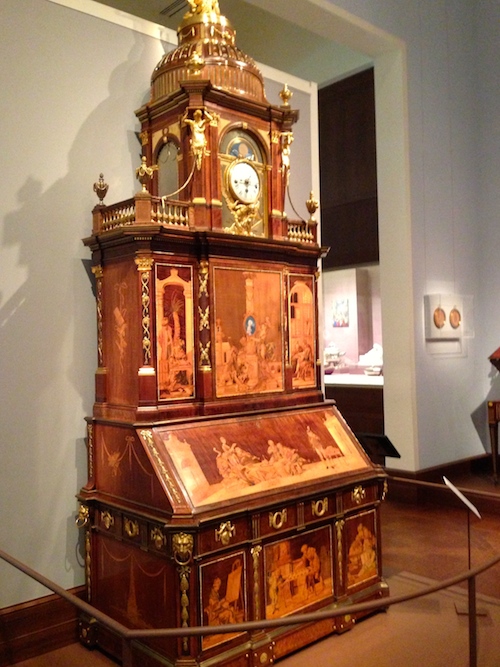
Mr. Roentgen's Berlin Secretary Cabinet, the viral NYC museum YouTube sensation, awaiting visitors in Met Gallery 553

Mr. Roentgen’s Berlin Secretary Cabinet, the viral NYC museum YouTube sensation, awaits visitors in Met’s Gallery 553

It’s lonely at the top. More specifically, it’s lonely in the Metropolitan Museum’s Gallery 553, where one of the biggest YouTube stars in NYC museum history is holding court until January 26 – David Roentgen’s Berlin Secretary Cabinet, which has racked up 4.4 million hits since his show, Extravagant Inventions, closed last January.

That’s right. A piece of mechanical furniture has 4.4 million YouTube fans (in addition to 13K on the Met’s own website) – quite an achievement since it had only around 200,000 when its show closed. It’s not the only piece of mechanical furniture to gain big YouTube numbers (another has over 91K), but to put the Cabinet’s achievement in perspective, consider that the Met’s McQueen video has only racked up 72,000 views in the two years since that blockbuster ended.

The crowds were crazy for the 18th-century marquetry extravaganza (see our earlier post), and the Met asked the Kunstgewerbemuseum, Staatliche Museen zu Berlin if it could keep the YouTube star a little longer.
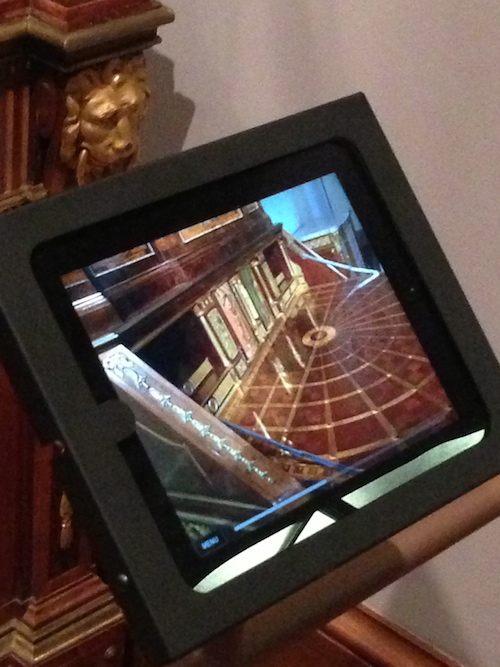
The Cabinet's video, displayed also in the gallery, has gone viral with 4.4M views

The Cabinet’s video, displayed also in the gallery, has gone viral with 4.4M views

The Met dedicated a cozy corner of its First Floor to the Cabinet and some of its other pieces from Mr. Roentgen’s studio — a rolltop desk and tall clock from the Met’s own collection, and a mechanical table lent by the Cooper-Hewitt. Take a closer look on our Flickr feed.

But every time we pass by, the Cabinet seems a little lonely. The Met says it’s likely the most expensive piece of furniture ever manufactured (there were only three), but it seems like the Fabergé eggs in the hallway are getting all the foot traffic. Yes, they’re beautiful, but a piece of marquetry that’s gone viral is something that deserves some in-person praise.

During the holidays, just hang a left at the Christmas tree. Look for a tall stately Cabinet in a gallery on the right after you pass through the European Sculpture Court and before the rooftop elevator. Spend a little time with the star before he decamps the Big Apple for Berlin.

Roentgen's Rolltop Desk also has its own video and has 59,000 YouTube fans of its own

Roentgen’s Rolltop Desk also has its own video and has 59,000 YouTube fans of its own

If you want to see the Roentgens in performance, the Met’s hosting a gallery talk and demo of the mechanical furniture at 2:30pm in Gallery 553 on December 17 and January 14

The Cabinet’s mega-hit video (produced by the Berlin museum, but posted by the Met) is also on display in the gallery — no people, no curators, no talking, no cats…just subtitles, a human hand wielding a key, and the magnificent magic of Mr. Roentgen. Hold on for the hidden easel.
Science Superwomen at Grolier

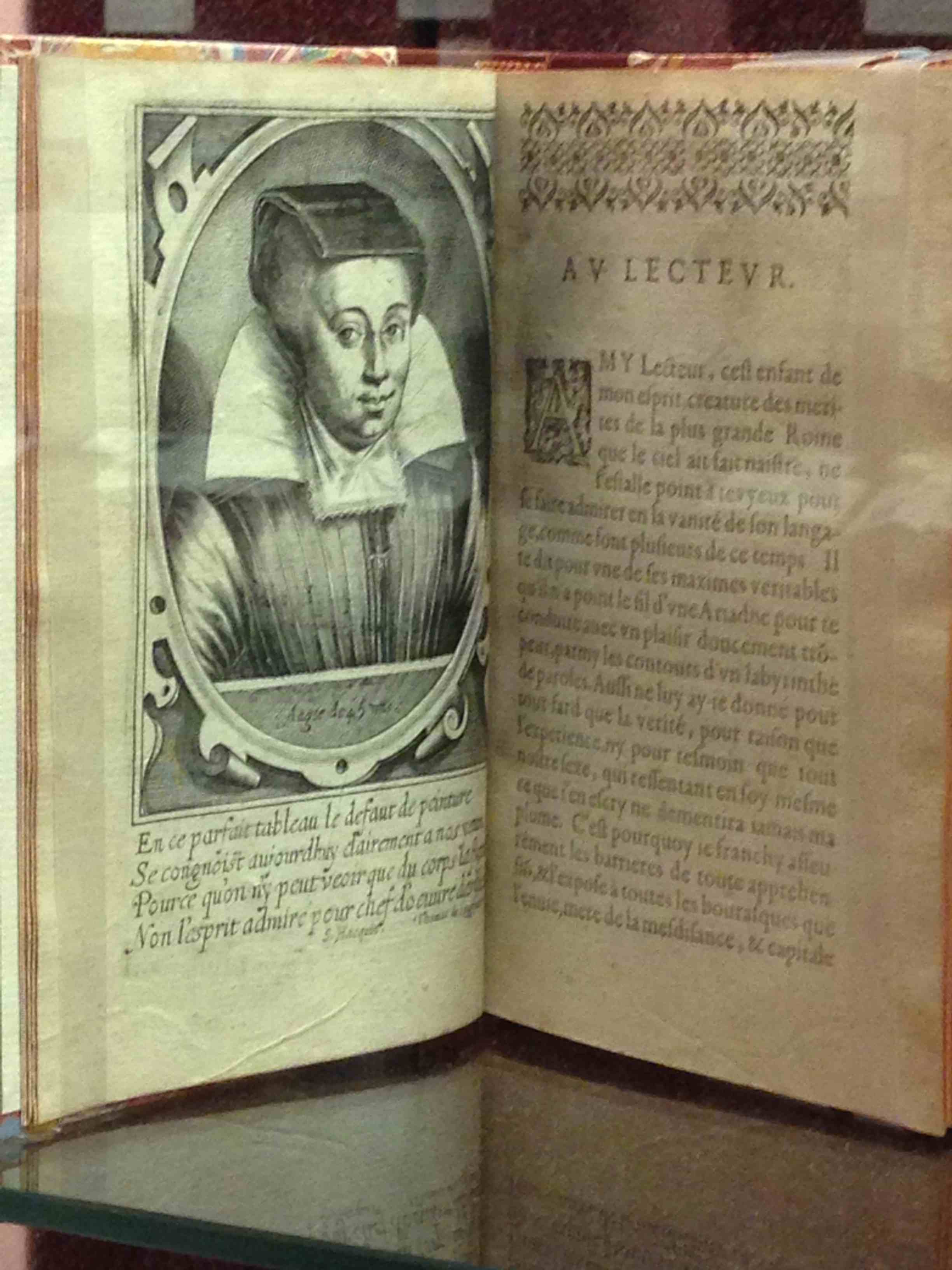
Portrait of Louise Bourgeois Boursier in one of her early 17th-c books on obstetrics, medical must-reads for over 100 years

Portrait of Louise Bourgeois Boursier in one of her early 17th-c books on obstetrics, medical must-reads for over 100 years

Just because the confab is ending, it’s no reason not to acknowledge the loving assembly of super-fantastic women pulled together by the curators at the Grolier Club for the astonishing exhibition, Extraordinary Women in Science & Medicine: Four Centuries of Achievement, which closes today.

Inside the Club’s small gallery, ten cases and other repositories enclose the names, histories, portraits, papers, and publications of 32 remarkable women that deserve high praise and high fives. Yesterday the gallery was packed with academics, admirers, school groups, and bibliophiles who couldn’t contain themselves at their astonishment at the relative obscurity of some of these grand dames in our pop-culture-saturated psyches.

Get to know some of our favorites:

Louise Bourgeois Boursier (1563-1636) was the first woman to write a book on obstetrics – a pioneer in evidence-based medicine. Having observed 2,000 deliveries as a midwife, she personally delivered all of the children of Henry IV and Queen Marie de Medici of France, including Louis XIII.

Madame Du Chatelet’s name is absent from  the top book, which she co-wrote in 1735 with Voltaire about Newton’s philosophy

Madame Du Chatelet’s name is absent from the top book, which she co-wrote in 1735 with Voltaire about Newton’s philosophy

Physicist, mathematician, and author Madame du Châtelet (1706-1749) was the first to translate Newton’s work Principia Mathematica into French. To this day, it’s the standard translation for students there, although in its day, only Voltaire’s name was on it, since it was considered inappropriate to print a lady’s name on a frontspiece. Her dad, who worked for Louis XIV, encouraged her scientific accomplishments, but her mom bucked her all the way. She worked on scientific philosophy, the properties of fire, and made breakthroughs in the understanding of kinetic energy – a foundation of the 150-years-later E = mc2.

Laura Bassi (1711-1778) was the first female physics professor in Europe and the second woman in Europe to actually have a university degree. Remarkably she still had 12 children, had a cheerleader in Pope Benedict XIV, and had the reputation and chops to do most of her work from home.

Victorian-era portrait of Ada Byron, Countess of Lovelace, with her 1843 “computer” program – the published sequence by which Babbage’s analytical engine could perform calculations

Victorian-era portrait of Ada Byron, Countess of Lovelace, with her 1843 “computer” program – the published sequence by which Babbage’s analytical engine could perform calculations

Lord Byron’s daughter, Augusta Ada Byron, Countess of Lovelace (1815-1852) created, according to some, the first computer program. She translated an Italian engineer’s description of the analytical engine designed by mathematician Charles Babbage, but she added a lot of her own notes to explain its difference from earlier incarnations and explained the steps by which it could perform complex calculations. She felt it was important to use calculating machines to do more than mathematics, and she speculated that a computing engine “might compose music” and other “poetic” things.

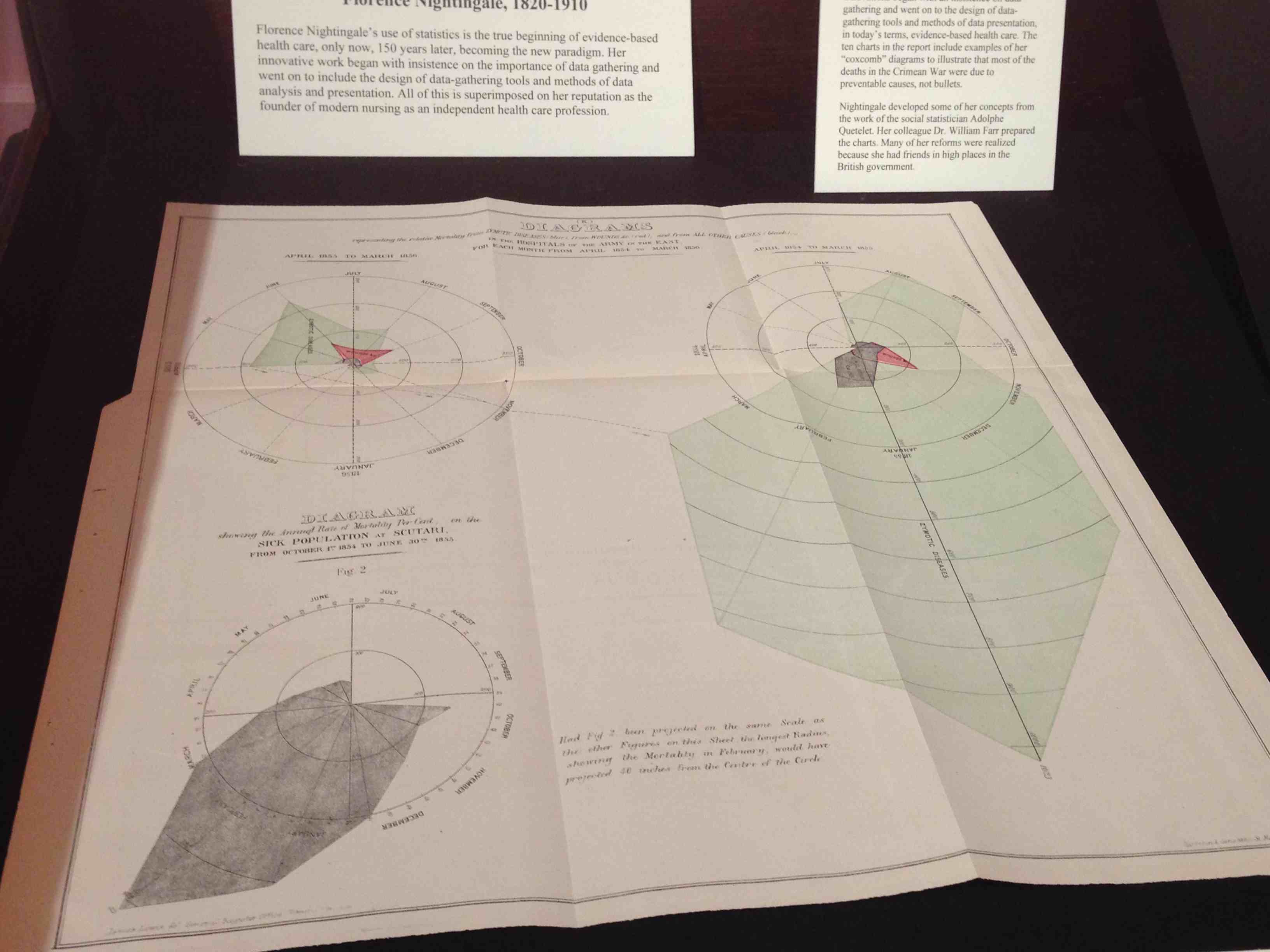
Everybody knows that Florence Nightingale (1820-1910) innovated modern nursing, but the exhibit showcased the fact that she got her ideas across because she was an expert statistician. She used stats to kick-start evidence-based healthcare. Think about it: life before Excel.

Madame Curie (1867-1934), along with Florence, is the most famous of the Grolier group – the first person (and only woman) ever to have received two Nobel Prizes in two scientific disciplines (physics and chem). After discovering radioactivity, polonium, and radium with her husband, the Polish super-achiever applied radiology to help surgeons deal with battlefield injuries in WWI, accompanied by her 17-year-old daughter, Irène (1897-1958). Irène also later won a Nobel Prize in Chemistry for creating radioactive elements.

Nightingale’s 1858 document for Queen Victoria’s commission, proving that Crimean War casualties were mostly from preventable diseases

Nightingale’s 1858 document for Queen Victoria’s commission, proving that Crimean War casualties were mostly from preventable diseases

New Yorker and Nobel-winner Gertrude Elion (1918-1999) never got a doctorate, but climbed her way to innovation from a job as a lab assistant. Say thank-you to her for inventing the first anti-cancer drugs, anti-viral drugs, and drugs to enable human organ transplants. Her pharma inventions treated leukemia, malaria, meningitis, and led to the development of AZT.

According to the curators, the show – which includes Curie’s apparatus, Ada’s portrait from London, a box showing how pre-mainframe pioneers tracked and sorted results of their experiments, and other items – will have a second life as a traveling exhibit and website. Until then, find out more by picking up the catalog, crammed with interesting essays, to this unforgettable tribute.

NYU Shows How Modern Art Popped in 1960s Iran

Zarrine-Asfar’s 1970s Black Plaster Hand in oil and pencil on canvas with plaster. Source: Grey

Zarrine-Asfar’s 1970s Black Plaster Hand in oil and pencil on canvas with plaster. Source: Grey

If you go downstairs at NYU’s Grey Art Gallery, a collection of seemingly quiet works will show you how a cadre of avant-Garde painters injected the spirit of 1960s downtown New York into Iran’s gallery scene just before the 1979 revolution transformed Persian society. Get down to Washington Square to contemplate Modern Iranian Art before December 7.

Gallery founder and woman-about-the-world, Abby Weed Grey, made it her priority to collect modern-influenced Iranian artists in the 1960s and 1970s just before the transition from the Shah to the Ayatollah, amassing (and ultimately bequeathing to NYU) the largest Iranian modern art collection outside the country.

Tanavoli’s Persian Telephone I, a 1963 bronze sculpture inspired by Johns and Warhol. Source: Grey

Tanavoli’s Persian Telephone I, a 1963 bronze sculpture inspired by Johns and Warhol. Source: Grey

This show and its scholarship is first rate, hitting a home run with Sixties connoisseurs. Good job, Grey team, with your first-ever e-book on the web site, which connects the dots in some unexpected places.

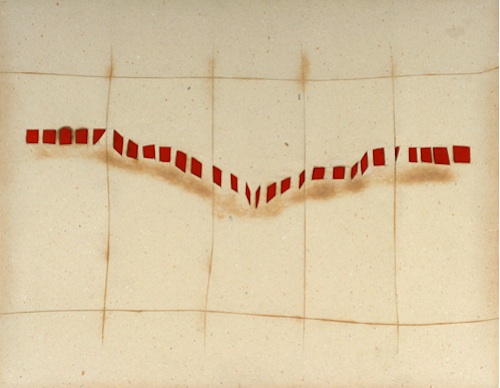
Consider Parviz Tanavoli, who experimented with some Jasper Johns techniques — incorporating dishes into ceramics and playing with bronzed objects. Hamid Zarrine-Asfar was also experimenting with whitewashed 3D grids in a refined, painterly, and Johns-like way. Not copies, but reinterpretations that resonated with cosmopolitan Persians. Abby bought 35 of his works.

Robert Indiana wasn’t the only one playing with letters-as-art during the Sixties.  Abby collected work by a lot of artists who used the calligraphy of their own culture in their work — a more lyrical, poetic approach than the brash American appropriations.

Two extremely understated painting in the show were influenced by one artist’s interest in Cage and Duchamp. Read the label copy, and you’ll learn that they were done by a young revolutionary artist, Mir-Hossein Mousavi, fresh out of school, who later served as Iran’s Prime Minister in the 1980s and challenged Ahmadinejad in a run for president in 2009. He lost, but the work makes you wonder about the number of political candidates (anywhere in the world), who are trained architects interested in channeling the I Ching, playing with alt notation, or using chess as a visual metaphor.

Mir-Hossein Mousavi (Khameneh), Musical Notations, a 1967 mixed media work inspired by Cage. Source: Grey

Mir-Hossein Mousavi (Khameneh), Musical Notations, a 1967 mixed media work inspired by Cage. Source: Grey

The startling image of Kamran Diba’s Diver at the foot of the stairs debuted as part of a multimedia piece, with two actors’ voices repeating the “conversation” that appears on the canvas – a reminder of performance mash-ups that young Yoko Ono might experimenting with around the same time.

The more you probe, the more you’ll see. No Ben Day dots or photo imagery — just glimmers of interdisciplinary thought normally associated with that boundary-pushing Black Mountain crowd.

Abby, you wanted your Middle East buying spree to inspire cross-cultural associations among generations of US scholars. Grey Gallery team, you did your founder proud. Well done in supplying this special lens.

Kamran Diba’s Diver, a 1967 oil that originally included an audio track with two actors’ voices. Source: Grey

Kamran Diba’s 1967 Diver,  whch originally included an audio track with two actors’ voices. Source: Grey

If you can’t get there, browse the e-book and photos of the work here. Abby’s collection of Iranian modern art has its own website, and you can browse through dozens of examples by each of her favorite artists.

If you’re up on Park Avenue, works that Abby collected are also at the Asia Society until January 5 in another exhibition shining the light on Iranian modernism.

History Twist in Brooklyn’s Period Rooms

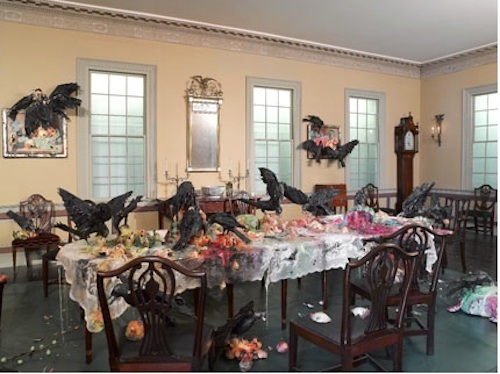
Hegarty’s “activation” of the Cane Acres Plantation dining room: Still Life with Peaches, Pear, Grapes and Crows; Still Life with Watermelon, Peaches and Crows; and Table Cloth with Fruit and Crows. Photo: Brooklyn Museum

Hegarty’s “activation” of the Cane Acres Plantation dining room including Still Life with Watermelon, Peaches and Crows. Photo: Brooklyn Museum

The Brooklyn Museum’s Period Rooms are again the focus of a rip-roaring, history-tearing, upside-down interpretation by an installation artist. Go before December 1 to see what’s happened to three rooms up on the museum’s Fourth Floor in Valerie Hegarty: Alternative Histories.

The dining room from the South Carolina’s Cane Acres Plantation is alive with dozen or so papier-mâché crows that are chowing down on the faux watermelons and peaches that you imagine to have been so beautifully arranged on the long, grand table.

Peering into either of the two plantation doorways, it’s disconcerting to see how the delicacies are being ripped apart and strewn about. The fruit literally pops out of the frames in this cross-referenced mash-up of Hitchcock terror, racial segregation issues, and classic still life painting.

Hegarty’s Pendleton carpet in the Cupola House parlor.

Hegarty’s Pendleton carpet is growing in the Cupola House parlor.

See how Hegarty created it all out of wire, glue, foil, foam, and everything else you can purchase at Michael’s on the Brooklyn Museum’s Flickr feed.

She was equally ambitious in two other rooms from the Cupola House, originally built in Edenton, North Carolina: The 1725 parlor room focuses on a visual “conversation” between General George Washington and Pawnee Chief Sharitarish, featuring a Native American-style Pendleton parlor rug that is “growing” grass, flowers, and roots to make you think about what happened to the native culture over the last few centuries.

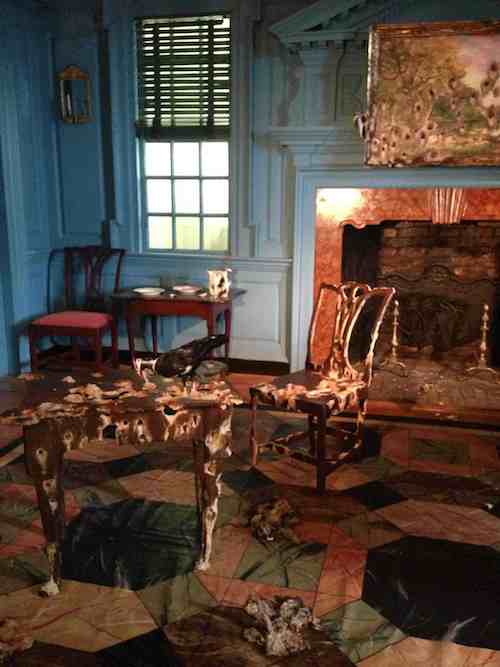
She kicks the Manifest Destiny discussion right where it hurts in the Cupola House “hall” (where guests socialized) by letting two Pileated and Downy Woodpeckers have their way with everything valuable in the room, including (a reproduction of) Thomas Cole’s 1846 painting The Pic-Nic. Nature is getting out of hand.

The Downey Woodpeckers take over the Cupola House hall. Photo: Brooklyn Museum

The Downey Woodpeckers take over the Cupola House hall. Photo: Brooklyn Museum

Get over to Brooklyn and encounter a new twist on what you were taught in grade school history, but watch out for Hegarty’s flying bullets and birds.

Making Yesterday’s Fashion Totally Now

History repeats – a silk Robe d’anglaise from 1765 and a 2009 ribbon-and-wire creation by Agatha Ruiz de la Prada

History repeats – a 1765 silk Robe d’anglaise with Agatha Ruiz de la Prada’s 2009 ribbon-and-wire runway creation

Within FIT’s upstairs gallery, you’ll receive a master class (from the masters) on how to take something old, inject it with an inspired twist, and create Vogue-ready looks ready for the modern world in FIT’s show RetroSpective, running through November 16.

FIT curator Jennifer Farley did an outstanding job of selecting iconic looks associated with well-dressed woman from previous centuries and pulling interpretation after interpretation on that theme from FIT’s collection. Historical references, empire waists, hoop skirts, and leg-o-mutton sleeves all get the old/new side-by-side treatment in the galleries.

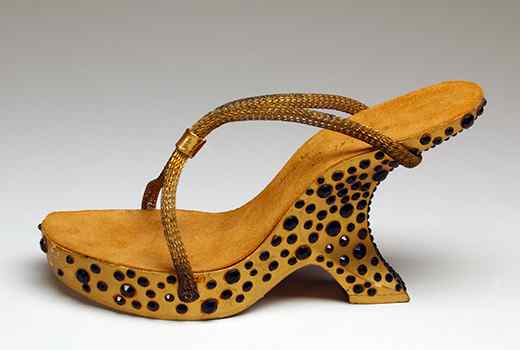
History reinterpreted –elevated sandal created by David Evins for Elizabeth Taylor in her 1961 epic, Cleopatra

History reinterpreted –elevated sandal created by David Evins for Elizabeth Taylor in her 1961 epic, Cleopatra

How did forward-looking designers mine ancient cultures, textures, and materials and make them look current? Look no further than the Grecian evocation of Madame Grés, sandals designed by David Evins for Liz’s 1961 Cleopatra look, Valerie Porr’s 1960s take on Guinevere, and Versace gone baroque. Click on the links to see the pieces on the show’s website.

Was there ever a time that rhinestone buckles weren’t applied to dainty evening shoes? Apparently not in the last several centuries, since examples from the 1740s are displayed alongside Peter Yapp 1910 satin pumps, 1959 Julianelli suede pumps, and 1995 red-velvet Manolos.

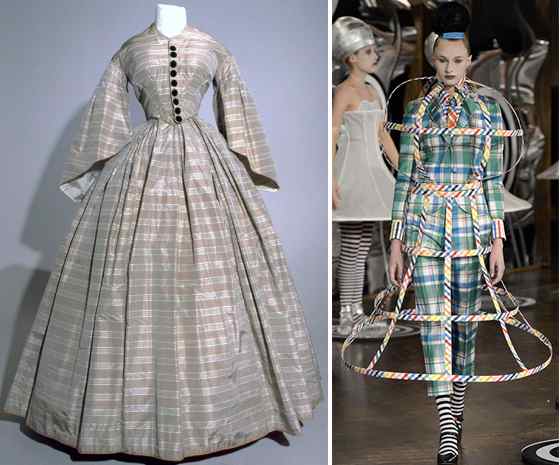
Hoop dreams from 1860 and Thom Browne’s Spring 2013 collection

Hoop dreams from 1860 and Thom Browne’s Spring 2013 collection

In the section on bustles, you’ll see beautiful 1870s creations alongside bustle-inspired works by Schiaparelli (1939), Herrera (1988), and Anna Sui (1999). But across the aisle in the section on hoop skirts, you expect to see 1860s dresses next to more modern works by Hishinuma (1996), Rochas (2004), and Thom Browne (2013). But who could expect to see hoops from the Fifties – Hoop-la (1956), which kept your bouffant skirt fluffed out, and the amazing Belle O’ the Ball collapsible skirt hoop (in its original box!), which allowed every girl-on-the-go to sleep easier knowing that her bouffant could be perfectly pouffed wherever she travelled.

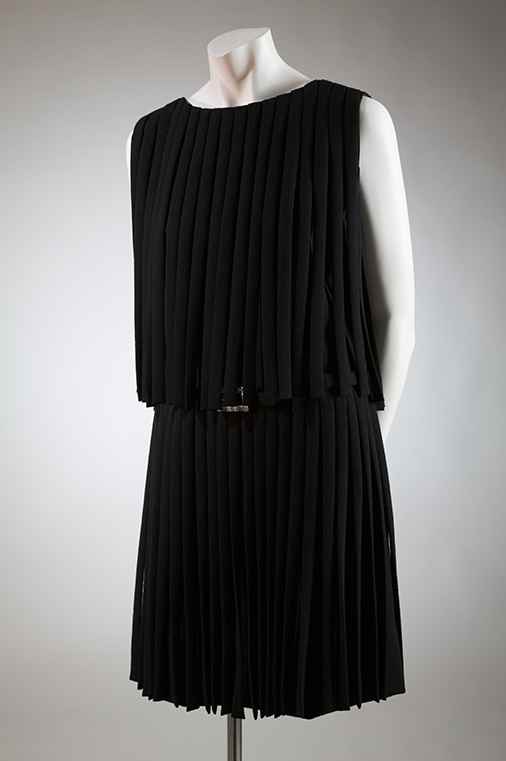
Lauren Bacall’s wool crepe 1965 flapper-inspired dress by Norman Norell

Lauren Bacall’s wool crepe 1965 flapper-inspired dress by Norman Norell

If you love fashion, get to this show and enjoy additional meditation on the decades of transformations associated with the New Look, corsets, platform pumps, playsuits, paper dresses, clogs, grunge, and graffiti. If you can’t get to the show, take some time to look through the show’s website to see about a third of what’s there and to read more about each concept and creation. FIT did a beautiful job on it.

And maybe someone from FIT can explain how Norell made such a perfectly pleated 1965 flapper dress for Lauren Bacall out of wool crepe?

Go Underground and Outside at Grand Central

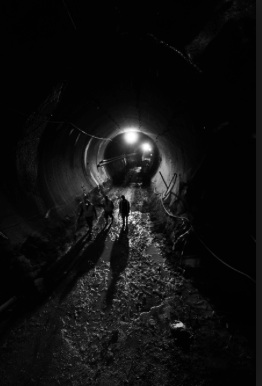
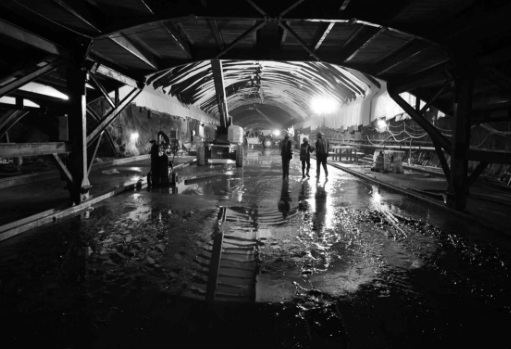
Hiroyuki Suzuki’s dramatic black-and-white view of the massive $8.2B project

Hiroyuki Suzuki’s dramatic black-and-white view of the massive $8.2B project

See New York above and below in two unique photography installations at everyone’s favorite train station right now.

At the New York Transit Museum Annex, you can glimpse your future path to the Hamptons in The Next Level: East Side Access Photographs by Hiroyuki Suzuki through October 27. Suzuki takes you over 14 stories below Grand Central to see the tunnels, sandhogs, tunnel boring machines, and chasms of the huge construction project that will allow 160,000 daily LIRR riders to arrive on Manhattan’s East Side when it’s done in 2019.

Suzuki had never before visited New York before starting his project, but he considers it a thank-you for the relief work done by the US Armed Services following the devastating earthquake and tsunami that hit his home country of Japan in 2011.

Underground view of East Side Access by Hiroyuki Suzuki

Underground view of East Side Access by Hiroyuki Suzuki

Contemplating the more than 50 black-and-white images, you can feel the monumental achievement happening underground, feel the damp, hear the light sloshing of men and machines moving through slightly damp tunnels, and see the miles of spaghetti-like cables illuminating the gigantic spaces where trains will soon thunder.

Suzuki made four trips down there during the project, and you may not even get to make one, so drop in and take a look at the engineering marvel happening right beneath a good patch of Midtown East. You’ll see supports labeled “48 Street” or “FDR” for orientation in the black wilderness.

Beautiful Hudson River photograph by Robert Rodriguez, Jr. from the one-day exhibition in Vanderbilt Hall

Beautiful Hudson River photograph by Robert Rodriguez, Jr. from the one-day exhibition in Vanderbilt Hall

Speaking of wilderness, get over to Vanderbilt Hall sometime today to experience the opposite – gorgeous landscapes of the spectacular Hudson Valley. To celebrate the achievements of an historic environmental organization (and encourage you to buy a train ticket to see scenery that inspired generations of artists), there’s a one-day-only photo spectacular — 150 images by Annie Leibovitz and 12 other photographers whose subject is the beauty of the Hudson River.

On Time and Place: Celebrating Scenic Hudson’s 50 Years, sponsored by Metro-North and Scenic Hudson, has traveled to five cities to celebrate this historic environmental organization’s 50 years of success. The photos are in Vanderbilt Hall from 10am until 4pm.

Shanghai Glamour Tribute in NYC Chinatown

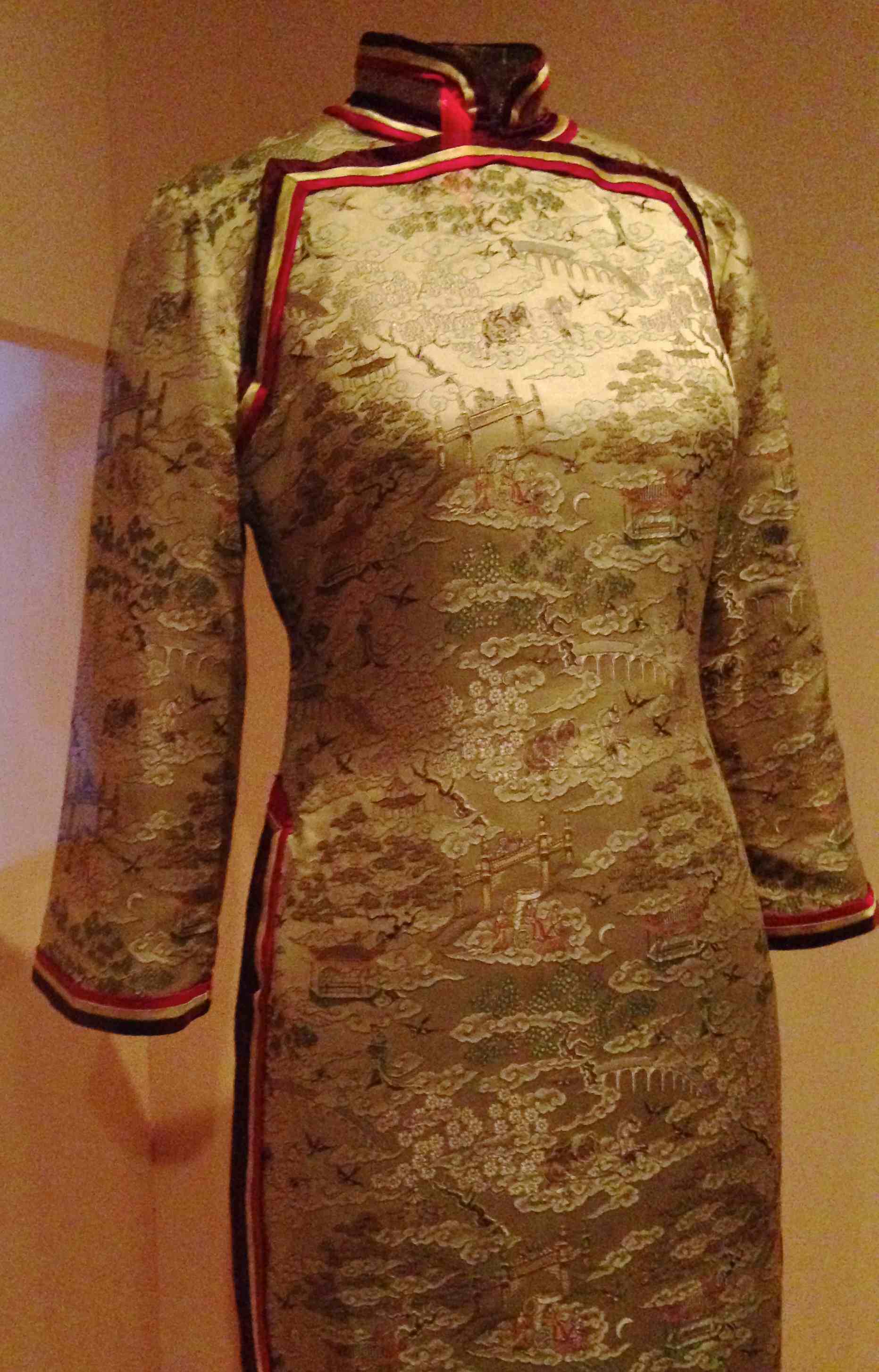
1940 Qipao (cheongsam) designed and worn by Madame Wellington Koo, the wife of China's ambassador to France. Note the tricolor piping.

1940 Qipao (cheongsam) designed and worn by Madame Wellington Koo, the wife of China’s ambassador to France. Note the tricolor piping.

If you think Shanghai is the most modern city in China today, its association with forward-looking design and trend is nothing new. It’s been on the vanguard of style back for over 100 years, and the Museum of Chinese in America is paying tribute by looking back to the 1920s, when it was called the “Paris of the East”.

MoCA’s fashion history tribute, Shanghai Glamour: New Women 1910s-40s, is mounted in an intimate gallery on the first floor, right next to it’s acclaimed show of contemporary Chinese-American fashion designers, Front Row. But this show takes you back to a time when women in Shanghai began breaking out of traditional roles, pursuing academic careers, and sporting unique, cutting-edge fashion that was all their own.

Dance-hall hostesses and courtesans in Shanghai led the charge toward 20th-century fashions as early as the 1910s, and other “modern” women didn’t want to be left behind. Shorter dresses and more fitted styles were leaving behind the traditional wide-cut Manchu cover-ups. Check out the slim look of the aviatrix depicted in this 1918 magazine. Whether Shanghai women were flying planes back then or not, Shen Bochen’s magazine illustration indicated the shape of things to come.

Modern 1918 aviatrix, as illustrated by China's leading socio-political cartoonist Shen Boehen

Modern 1918 aviatrix, as illustrated by China’s leading socio-political cartoonist Shen Boehen

Although it was a time when coquettes still flirted with ostrich feather fans, modern Shanghai women were being celebrated in special issues of Vogue and other pop culture magazines. It’s nice that MoCA’s curator has featured a few magazines right alongside the fashions, which are no loan from the China National Silk Museum in Hangzhou.

Take a look at the installation on our Flickr feed, where you can glimpse the evolution of Shanghai’s famous form-fitting qipao, or cheongsam, one of China’s most iconic contributions to world of fashion.

By the Twenties, cheongsams got tighter and more embellished as they were adopted by movie stars, daughters of the rich and powerful, diplomats’ wives, really smart women, and other over-achievers. Throughout the 20th century, Hollywood appropriated Shanghai’s sleek invention to represent exotic beauty, intrigue, cunning, and glamour.

Green silk and black velvet evening shoes worn by fashionable women in the Twenties, lent by FIT

Green silk and black velvet evening shoes worn by fashionable women in the Twenties, lent by FIT

Get downtown to Centre Street before November 3 to go back in time with dancing dresses of silk georgette, embroidered and embellished silk silhouettes, colorful silks, vintage films of Shanghai style, and several pair of stylish strappy silk shoes on loan from FIT’s collection.

Mondrian Goes Digital Electronic at MoMA

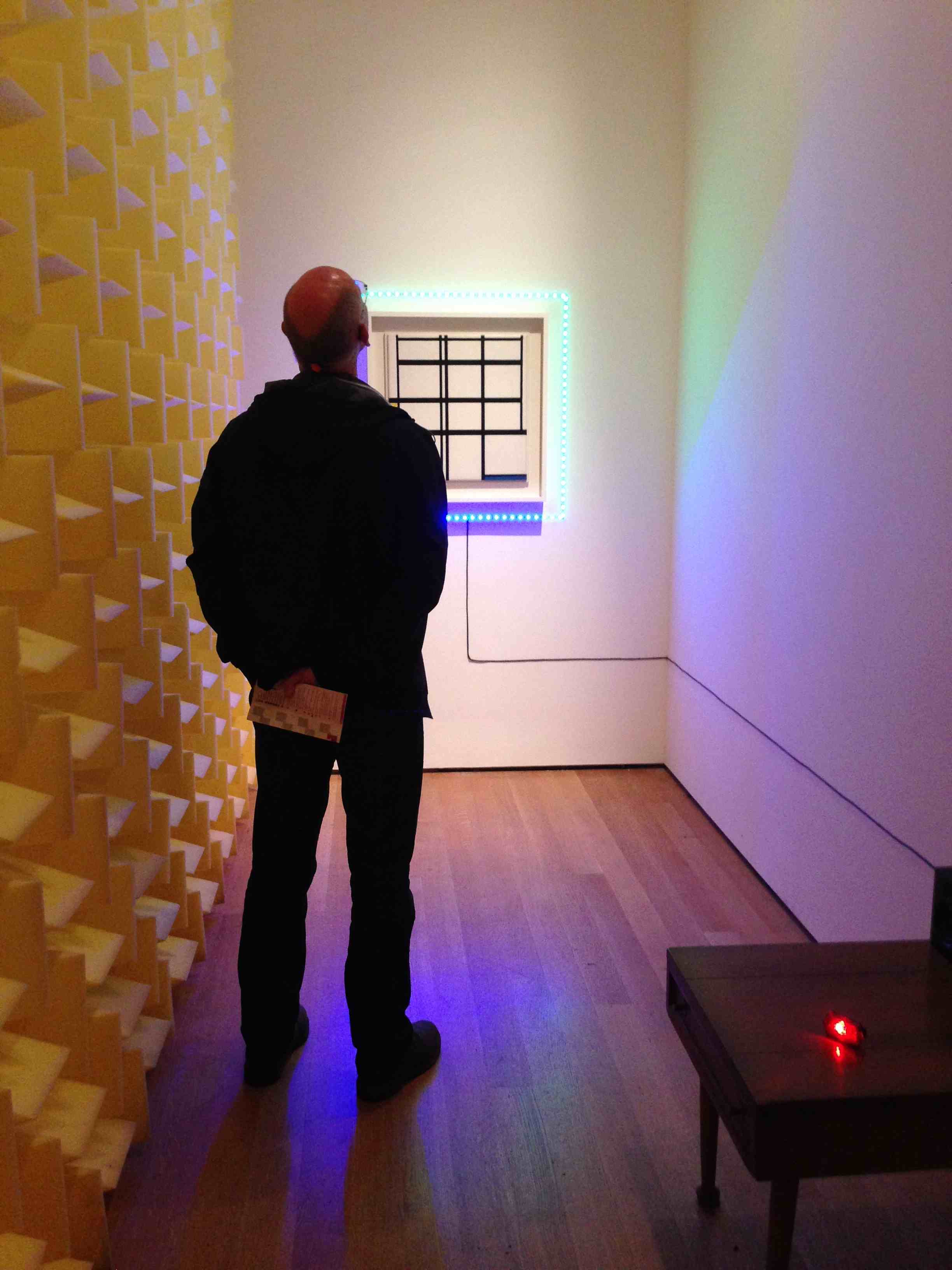
Mondrian’s Composition in Yellow, Blue, and White, I inside Haroon Mizra's installation Frame for a Painting

Mondrian’s Composition in Yellow, Blue, and White, I is framed in LEDs inside Haroon Mizra’s sound installation Frame for a Painting

Mondrian’s in the house (literally), starring in a fun interactive installation tucked away near the exit to Soundings: A Contemporary Score, MoMA’s first exhibition devoted entirely to the work of creative contemporary artists working in sound.

The show, which runs through November 3, has plenty of fascinating, thoughtful works in hallways, around bends, and in darkened galleries, such as Tristan Perich’s Microtonal Wall in the entrance hallway, which lets you experience the sound of 1,500 1-bit speakers up close and personal. Listen to it at the bottom of his MoMa artist page.

IMG_2939But the delightful surprise installation is a long, narrow almost hidden room, where Haroon Mizra has installed his ever-changing Frame for a Painting. On the occasion of being at MoMA, he’s chosen Mr. Mondrian’s Composition in Yellow, Blue, and White, I from MoMA’s collection and given this small, jazzy gridwork its own ultra-modern, swinging London, mid-century electro-pad. See it on our Flickr feed.

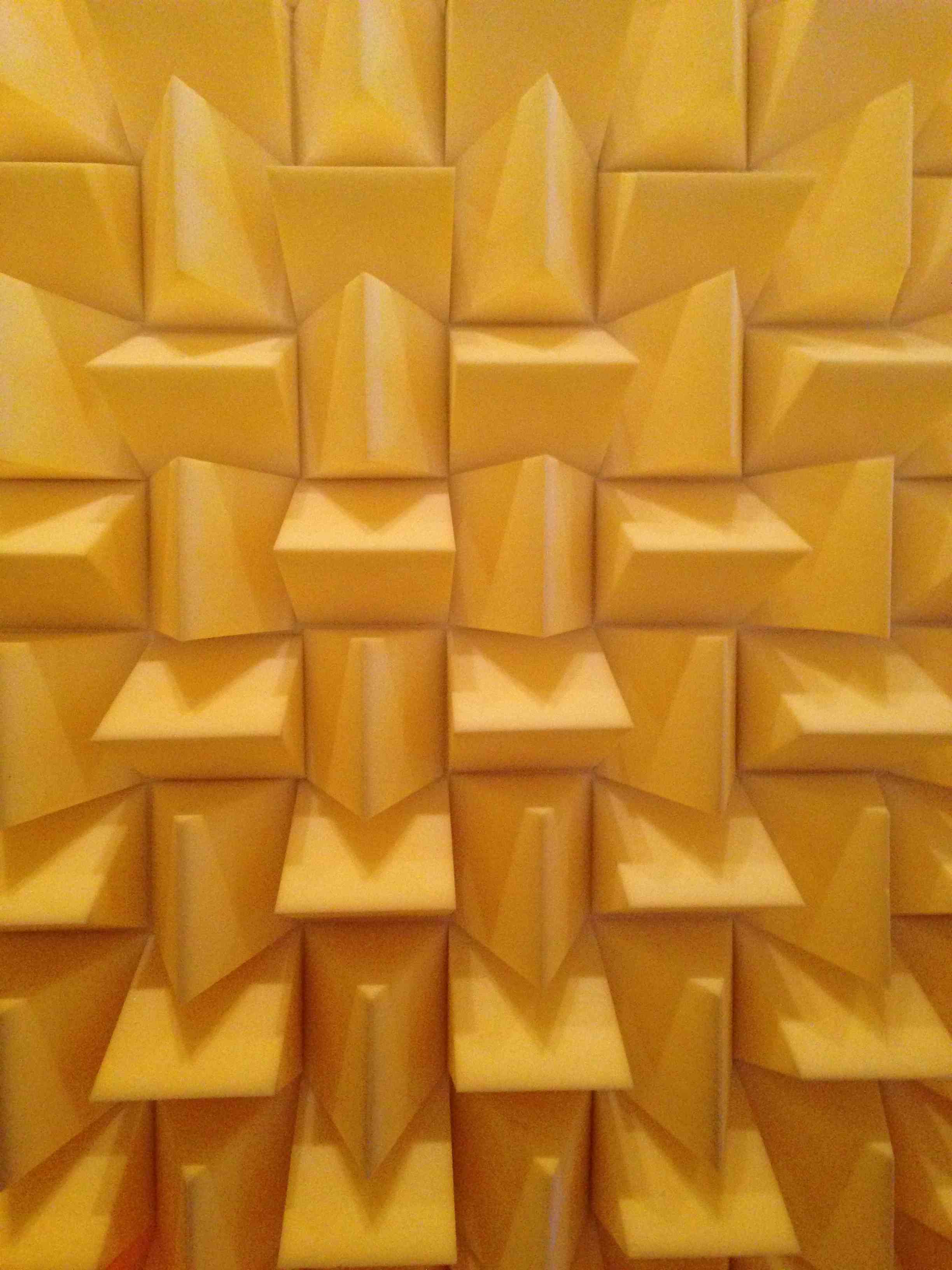
The narrow room has pointy yellow acoustic foam covering the tall walls. At the far end, you see Composition framed in a rectangle of electric blue LED lights that flash in sync to a pulsing electronic sound track. You have to maneuver around a low Danish modern side table from which a bright red bicycle light pulses and bleeps.

It’s a nice tribute to this favorite Modern master, and one of the few nooks in the show where visitors are taking photos and making little Vine videos like crazy. Composition harkens back to 1937, the table to the 1950s, and the sounds to the dawn of electronic music. It feels like a crazy time machine in an over-the-top conceptual 1960s living room.  Surely Mr. Mondrian would approve of the precision and interrupted rhythm. In any case, Composition certainly seems to enjoy being liberated from the white-wall treatment upstairs.

Close-up of the foam lining all the walls of Mondrian's slim room

Close-up of the foam lining all the walls of Mondrian’s slim room

Another work in the show that you might remember is a sound piece that used to be installed on the High Line in 2010 – Stephen Vitiello’s A Bell for Every Minute, which features New York City bells that he recorded and are heard every 60 seconds. You can get a taste of the experience listening to Bell Study, an audio track embedded at the bottom of his artist page used as an underlay in his longer audio piece.

Also check out the track from Jana Winderen’s Ultrafield, which slows down the ultrasound communications of bats, fish, and underwater insects so that we can hear the “hidden” sounds of our fellow species for the first time. Listen in to Jana’s work and check out the other artists on MoMA’s interactive show site.

And feel free to record and add your own everyday sounds to MoMA’s show site.

Down-to-Earth Women and Space

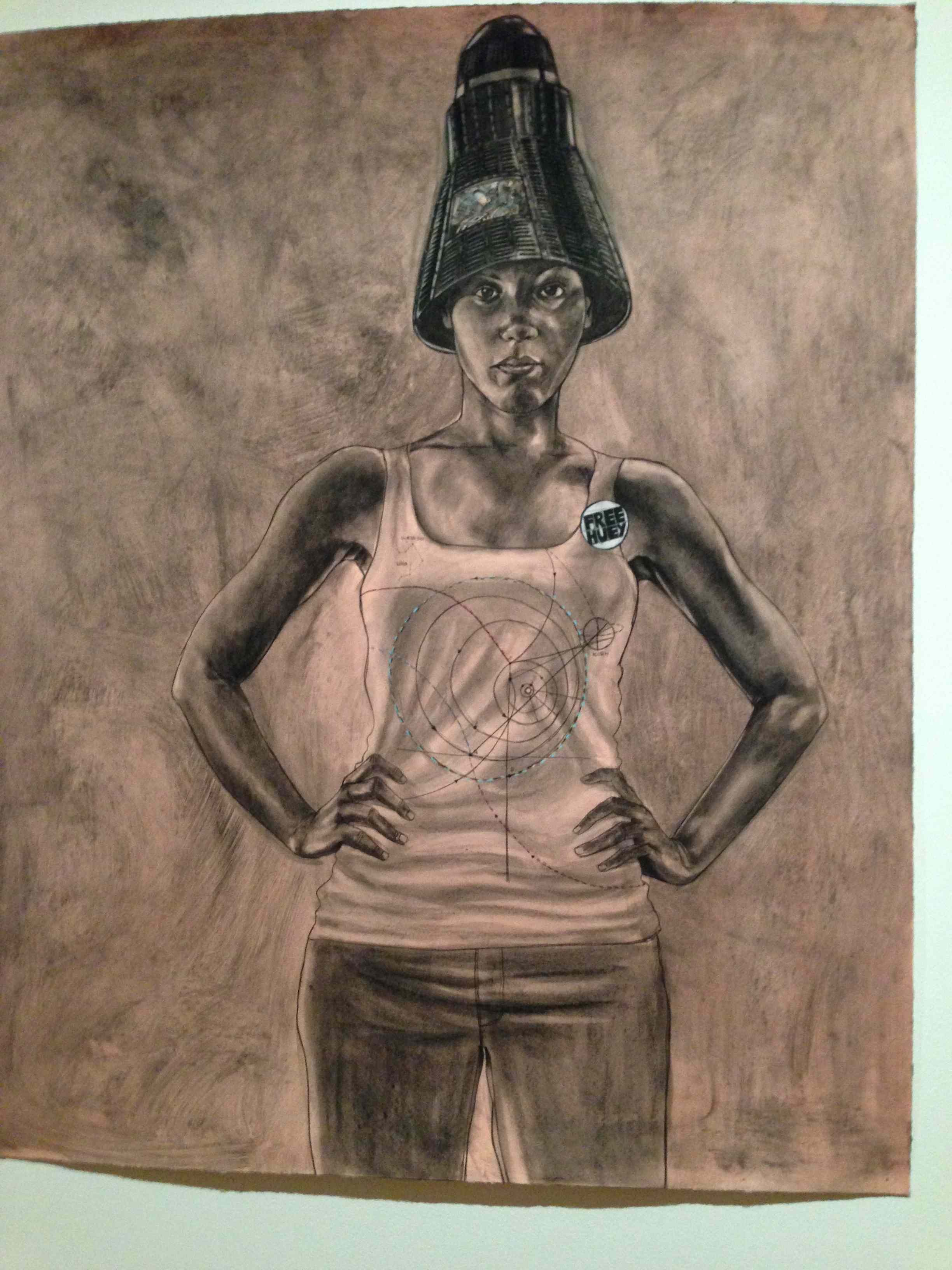
Installation view of Pruitt’s 2012 drawing, Diasporic Leaps and Bounds, courtesy of the Koplin Del Rio Gallery in Culver City, CA

Installation view of Pruitt’s 2012 drawing, Diasporic Leaps and Bounds, courtesy of the Koplin Del Rio Gallery in Culver City, CA

At the Studio Museum in Harlem’s current show, Robert Pruitt: Women, you’ll get to meet some regal-looking smarties who have a handle on art, space, and day-to-day life. Sandra Bullock’s astro-surfer is the talk of the town, but it’s these dozen-plus beauties, with their feet on the ground, who are soaring into the stratosphere with their intellectual firepower, accessories, and hairdos.

We’re talking about the stunning portraits on display through October 27. Click on the link to see more views of the installation, courtesy of photographer Adam Reich, but you need to get up to 125th Street to meet them in person.

First, it’s astonishing that these grand portraits are done with those first-year art school staples – conté crayon and brown butcher-block paper. Pruitt’s a master of the medium, and the women in his series can definitely hold their own against any Dutch Renaissance doyenne. They’re calm, cool, and collected. Yes, he’s added a touch of color or glint of gold to some detail or another, but it’s the fine hand and the technical mastery that gives each ethereal woman such large-format presence.

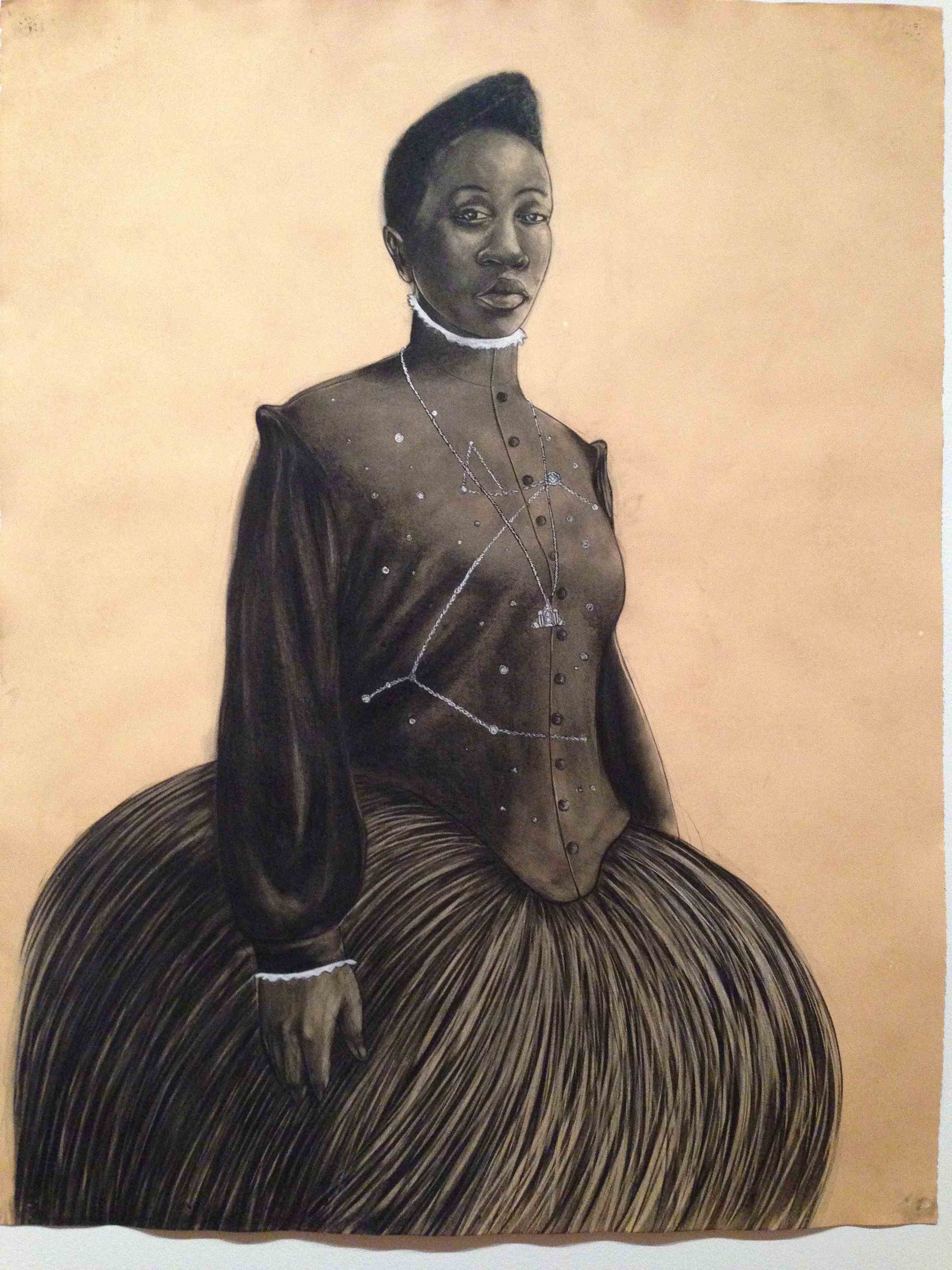
Pruitt’s 2011 Dreaming Celestial, featuring a Shuttle pendant suspended against a constellation bodice.

Pruitt’s 2011 Dreaming Celestial, featuring a Shuttle pendant suspended against a constellation bodice.

But there’s another dimension going on, too. Pruitt goes one step further by creating headpieces, outfits and accessories that tantalize art-lovers and science buffs with references to sometimes unknowable realms — art and astrophysics.

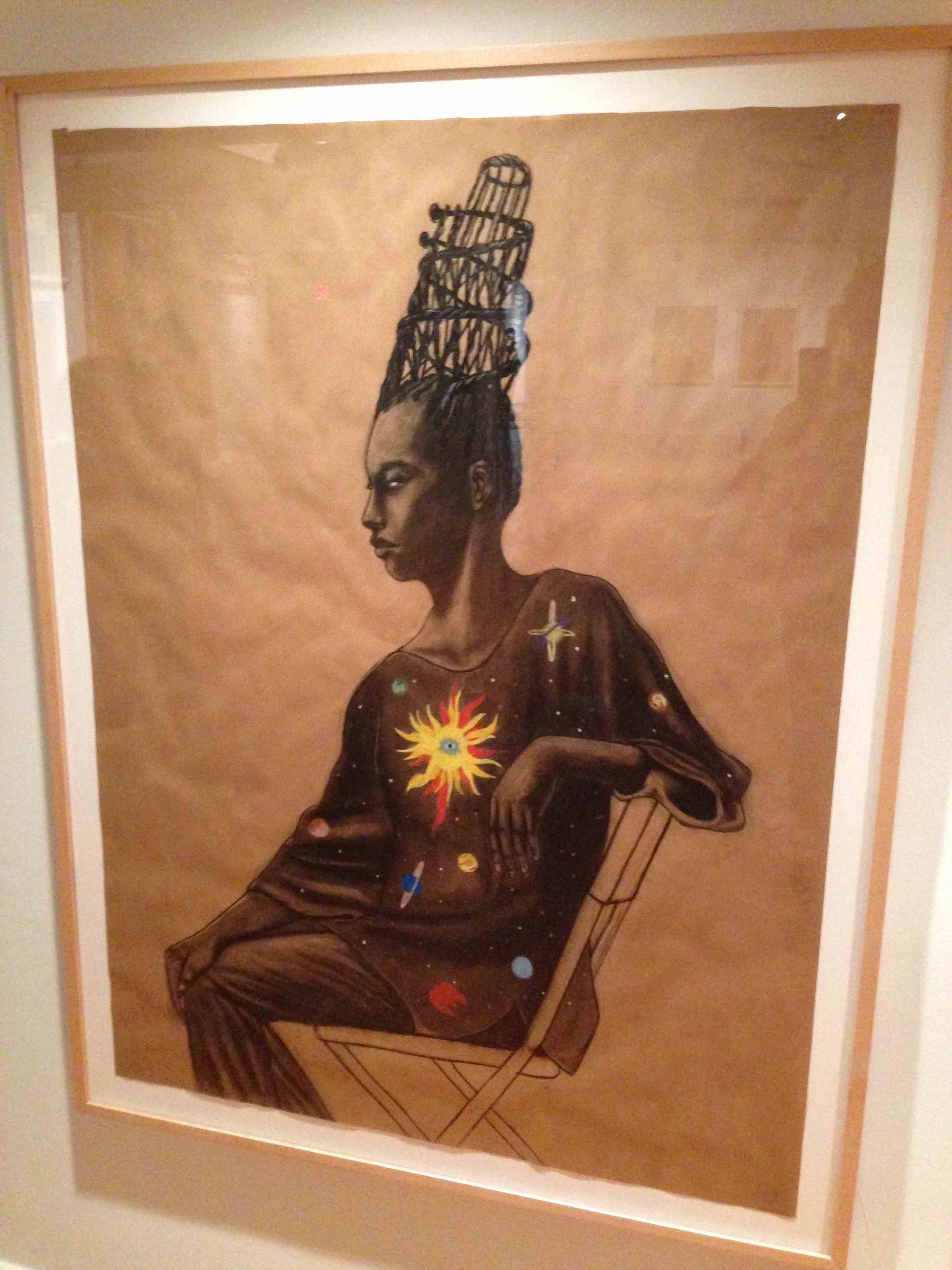
Consider the Tatlin-inspired updo coupled with the solar-system tunic in Be of Our Space World, the tiny Space Shuttle pendant and constellation bodice in Dreaming Celestial, the planetary tank top in Sun Fired, the Suprematist-inspired T in El Saturn, the space capsule chapeau and orbit diagram T sported in Diasporic Leaps and Bounds, and those choir-robe-looking outfits embellished with the tiniest of Star Trek logos for the sisters in the corner.

Yes, there are other political and pop references, but the space spin is pretty satisfying, particularly considering that Pruitt’s hometown is Houston.

Installation view of Be of Our Space World, a 2010 work featuring braids fashioned into Tatlin’s Monument to the Third International, courtesy of Houston’s Hooks-Epstein Gallery

Installation view of Be of Our Space World, a 2010 work featuring braids fashioned into Tatlin’s Monument to the Third International, courtesy of Houston’s Hooks-Epstein Gallery

Pruitt’s women are real-world and smart beyond belief — just the type of people we’d like to meet at the next SciCafe or have Dr. Neil interview at an upcoming panel at the planetarium – women whose look tells us they have some super-big insights to share.

Rich & Famous at Green-Wood’s 175th Anniversary

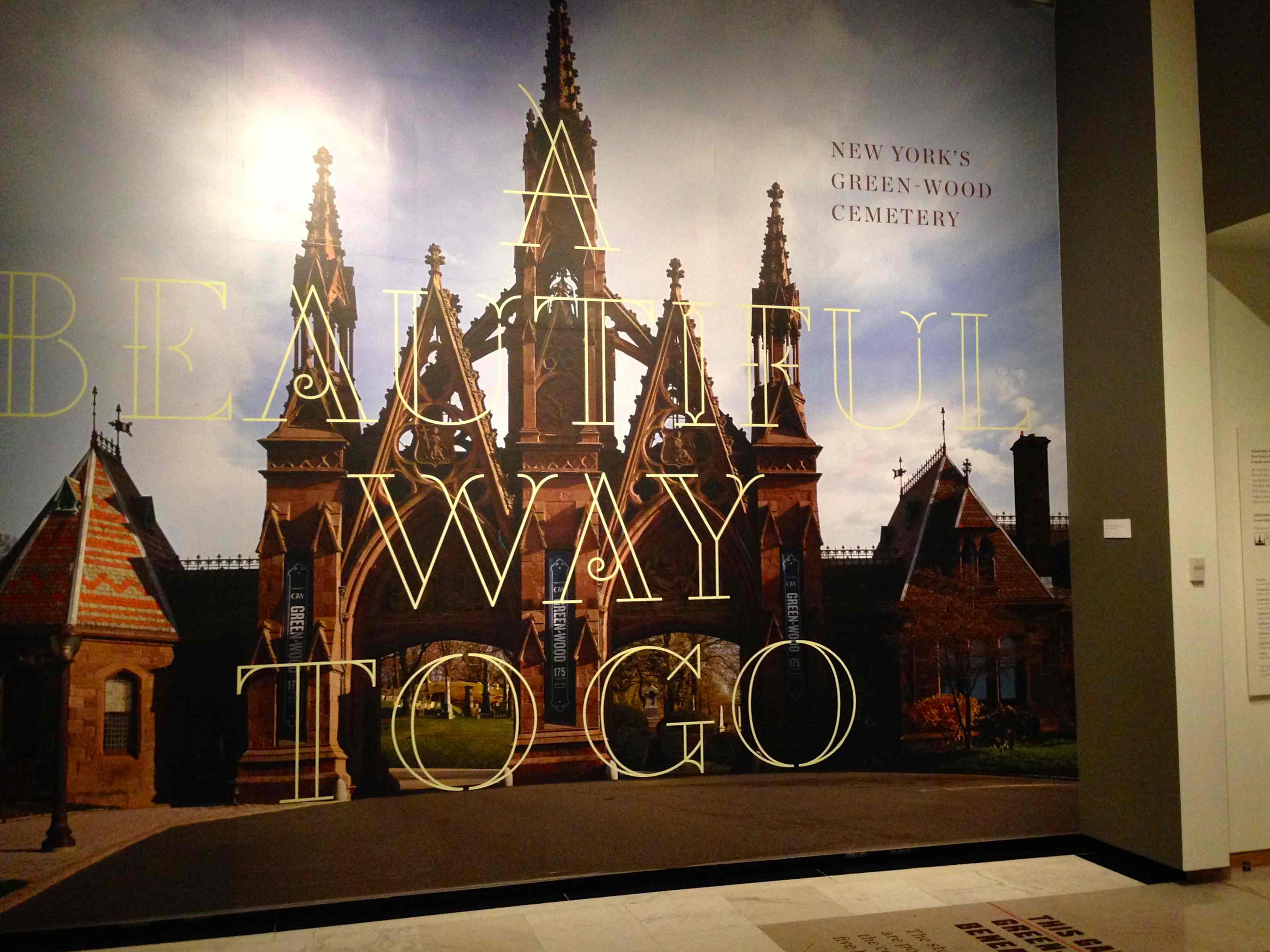
Show entrance featuring Green-Wood’s spectacular Gothic architecture.

Show entrance featuring Green-Wood’s spectacular Gothic architecture.

It’s big, green, historic, beautiful, and has more celebrities inside than you could ever imagine possible in an out-of-the-way spot in Brooklyn. Any day of the week, you can take a trip out to the lush woodlands, hills, and statuary gardens of Green-Wood Cemetery (and you should!), but every NYC history geek needs to visit the Museum of the City of New York’s A Beautiful Way to Go: New York’s Green-Wood Cemetery before October 13 to plumb the riches that have been assembled to celebrate its 175-year history.

We’re providing a walk-through on our Flickr feed, but the virtual experience is no match for the first-hand encounters with objects associated with the New York titans that are interred within the 478 acres of hills and countryside of Green-Wood itself – Tiffany, Duncan Phyfe, Boss Tweed, and even The Little Drummer Boy.

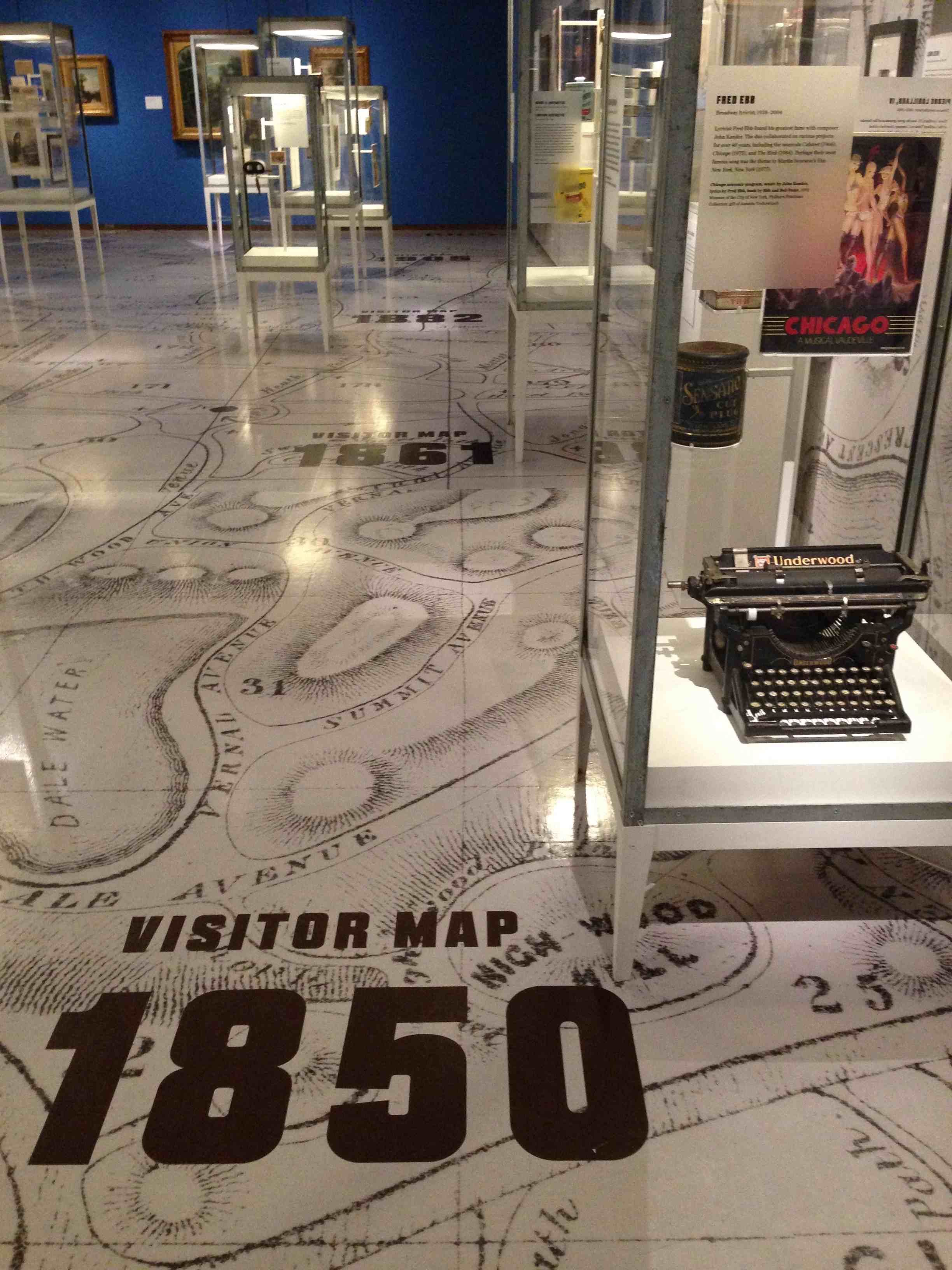
The floor map and vitrines with items associated with Green-wood’s most famous

The floor map and vitrines with items associated with Green-wood’s most famous

Consider the retail giants and brands: All five Brooks Brothers (who invented ready-made suits in 1849), the six Steinways who made pianos in Queens, Ebhard Faber (remember pencils?), the Domino Sugar owners (who once had 98% of the entire US market and who gave most of their vast art collection to the Met), the creator of Chiclets, the founder of Pan Am, and even F.A.O. Schwartz (yes, it’s a person).

MCNY has put the map of Green-wood on the floor of the gallery and has placed vitrines with objects associated with the rich and famous sort-of where they would be in the actual cemetery. Walking through the show is like random-access memory. You don’t know what or who you’ll stumble upon.

The tribute includes artists (from Currier & Ives and Asher Durand to Leon Golub, Nancy Spero, and Jean-Michel Basquiat); composers (Frank Ebb, Mr. Bernstein, and disco legend Paul Jibara); and inventors of things like the safety razor, the sewing machine, soda fountains, and the safety pin (think about that). Yes, it all happened in New York.

Spanish-language poster for "The Wizard of Oz" as a tribute to Frank Morgan, who played The Wizard

Spanish-language poster for “The Wizard of Oz” as a tribute to Frank Morgan, who played The Wizard

Green-wood is New York’s equivalent of the Pere Lachaise Cemetery in Paris, full of vistas, trees, paths, lakes, works by celebrity sculptors, military memorials, and elaborate, ornate above-ground tombs. Lachaise spawned an international mania for sylvan-glade cemeteries when it opened in 1804, and when Mr. Pierrepont was laying out the Brooklyn street system in the early 1800s, he left a big, open green spot in the plan, where Green-Wood is today. It opened in 1838, predating Central Park, and grew into the No. 2 tourist attraction in the United States (after Niagara) by the 1850s.

An 1875 Howe Sewing Machine by the inventor of the sewing machine, Elias Howe.

An 1875 Howe Sewing Machine by the inventor of the sewing machine, Elias Howe.

The show’s front hall has spectacular landscape photos taken last year by Jeff Chien-Hsing Liao, serving as luring calling cards to take the actual expedition to Green-Wood and its celebrated trolley tours led by uber-historian Jeff Richman.