Embroidered Menswear 100% Flash

Embroidered front jacket pocket typical of 1780s court wear

Embroidered front jacket pocket typical of 1780s court wear

The womenswear in the Metropolitan Museum of Art’s China show couldn’t be more spectacular, but flashy menswear is not forgotten in the Ratti Center’s show, Elaborate Embroidery: Fabrics for Menswear before 1815, running through July 19.

It’s tiny, but lets you see what rich, fashionable men of the late 1700s and early 1800s were getting from their tailors in the biggest cities of Europe just before the fashions changed. Around 1815, Western men all adopted the monochrome suits that they’re still wearing for formal occasions and business today.

Until that fashion wave hit, the most spectacularly dressed men on the Continent would sport elaborate embroidery on silk or velvet jackets. The Met’s conservation center and textile library has selected some of its most spectacular samples. Check out the elaborate needlework in our Flickr feed.
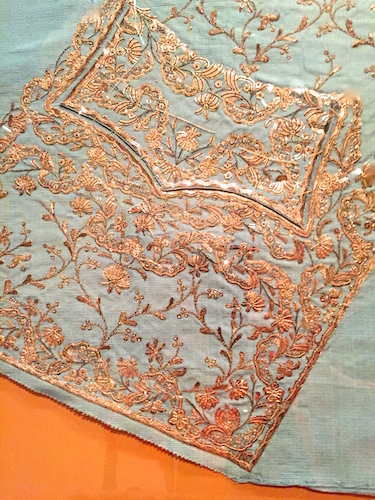
Waistcoat front panel from 1760s Europe; metal thread embroidery with sequins on silk.

Waistcoat front panel from 1760s; metal thread embroidery with sequins on silk.

The show centers around a few samples that would be on display in retail shops where fashionable men would place custom orders. For more details on the 1770s showroom experience, read the Met’s blog post.

You’ll see swaths of silk or velvet all embroidered to the fit of the customer, just waiting for the tailor to perform the 3D transformation. The handwork is truly incredible. An early sample from the 1760s uses silver (that’s metal) embroidery interlaced with different-sized sequins to catch the light. Just imagine the dazzle when that guy made his entrance at court.

Some of the samples in the cases appear toned down by comparison to the silk-silver-sequin combo, but close inspection reveals how piling on a profusion of different stitches create botanical illusions running up and down the edges of coats and waistcoats. They’re comparable to botanical illustrations in the NYBG’s collections.

Close-up of embroidered velvet sample from 1800-1815, after which men preferred plain suits

Close-up of embroidered velvet sample from 1800-1815, after which men preferred plain suits

The most elaborate work was done in France, but with the switch to more democratic, monochrome suits in the early 1800s meant that people who had developed some of the best embroidery skills in Europe had to look for other jobs.

Whose stitches are on top? East or West? There’s just one more week to compare these snippets of handwork history with the elaborately embroidered 1700s and 1800s Manchu robes on loan from Beijing’s Palace Museum in the downstairs gallery of the Costume Institute. Decide for yourself.
Enlightenment through Gems

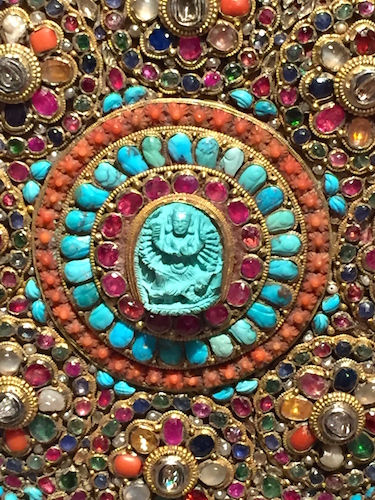
Center of 8-in. ritual offering dish made in 17th-18th c. Nepal

Turquoise Dhurga defeats a dragon in the center of 8-in. ritual offering dish (17th-18th c. Nepal)

It’s clear that wearing and giving precious (and semi-precious) gems can elevate the mind to higher levels of consciousness – at least in the minds of the Tibetan Buddhists – according to what you’ll see in Sacred Traditions of the Himalayas, running through this weekend at the Metropolitan Museum of Art.

The curators feature some remarkable statues, ritual dancewear, mandalas, and arms in the show, but let’s focus on the jewel-encrusted mosaics, containers, and jewelry displayed in the corner of the second-floor gallery, estimated to date from the 17th to 20th centuries.

Tibetan Buddhism emerged over the centuries in a dry, dusty, seemingly barren but beautiful region where people’s own adornment or bright flags atop mountain passes seem to be the only bursts of color. Inside homes, personal shrines, and monastery temples hang intricate, colorful mandalas pictorially suggesting the path to enlightenment, often symbolized by brightly adorned temples.

Mrs. Tsarong and two ladies from Tsang wearing special-occasion jewelry and hats as photographed by C. Suydam Cutting in 1937. Courtesy: Newark Museum collection

Mrs. Tsarong and two ladies from Tsang sport special-occasion jewelry and hats near Lhasa in 1937. Photo: C. Suydam Cutting. Courtesy: Newark Museum

These conceptual centers of enlightenment are often thought of as colorful crystal palaces emblazoned with jewels – an attractive image to hold in one’s mind on the lifelong journey to this higher plane of existence. What better way to remember your goal than to contemplate bedazzling diamonds, rubies, emeralds, sapphires, garnets, quartz, pearls, amber, coral, lapis lazuli, and turquoise?

To honor one’s journey to enlightenment, wealthy Tibetans often donated jewels to temples to adorn statues of the deities or commissioned personal devotional objects. That’s why you see so many jewel-encrusted objects in the Met’s collection. Personal shrines had jewel mosaics jam-packed with a dazzling array of stones. Gigantic statues were adorned with jewel-encrusted ornaments and surrounded by similarly elaborate containers for offerings.

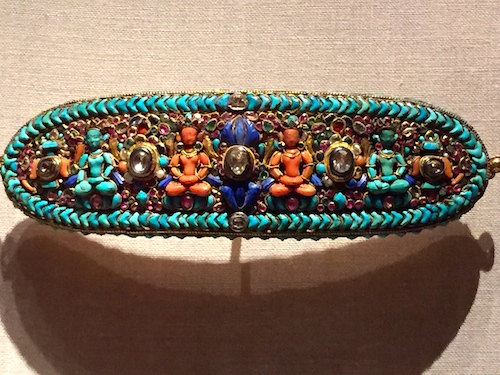
This Forehead Ornament for a Deity is only 8 inches long. Four celestial Buddhas are interspersed with diamonds

This Forehead Ornament for a Deity is only 8 inches long. Four celestial Buddhas are interspersed with diamonds

For special occasions, women sported accessories with amazing numbers of stones, reminding everyone of their social status, wealth, and devotion to an enlightened path.

Although some of the metal work was done in and around Lhasa, Tibet’s capital, the majority of the eye-popping jeweled settings were created across the border in Kathmandu, Nepal by Newari masters who created some of the most intricate visions in metal, wood, and paint ever known to the world. We’ve provided you with some close-up looks here and on our Flickr site. As shown, the result is a mix of Tibetan and Hindu imagery – typical of this region where so many cultural influences mix.

Densely packed diamonds, rubies, emeralds, sapphires, garnets, quartz, pearls, amber, coral, lapis, and turquoise in corner of Birth of the Buddha mosaic (18th-19th c. Nepal)

Densely packed diamonds, rubies, emeralds, sapphires, garnets, quartz, pearls, amber, coral, lapis, and turquoise in corner of Birth of the Buddha mosaic (18th-19th c. Nepal)

The Met’s own site for the objects in the show also allows you to zoom in on the details. Learn more about how the Met conserves such intricate jewel work in this blog post by an intern in the conservation department. See close-ups of how the Newaris set their gems.

Finally, explore Tibet as it was 100 years ago through this slideshow prepared for this show at the Met by the Newark Museum, which itself has a world-class collection of Tibetan objects and perhaps the largest collection of photographs of Tibetan people and temples from that time.

Saints in the ‘Hood in Brooklyn

Kehinde Wiley’s Saint Amelie in stained glass, 2014

Kehinde Wiley’s Saint Amelie in stained glass, 2014

Take a look at the saints as you’ve never seen them in Kehinde Wiley: A New Republic through this weekend at the Brooklyn Museum of Art.

They’re not saints, exactly, but Mr. Wiley is asking you to look at the young African American men you pass in your everyday life in a slightly different way – through the lens of Byzantine icons and Medieval stained glass. The icons and would-be saints are magnificent, proud, and mysterious, just like his slightly earlier portraits that are grace the walls of Lucious Lyon’s mansion in the hit series Empire.

The Cantor Gallery is filled with these men of higher purpose, and the crowds love it. Bronze busts echo the 18th century marble work of Houdon, and visitors check them out from all angles.

The Archangel Gabriel, Wiley’s 22-karat gold leaf and oil on wood painting from his Iconic series

The Archangel Gabriel, Wiley’s 22-karat gold leaf and oil on wood painting from his Iconic series

Beyond this gallery, the curators have assembled a survey of Mr. Wiley’s 14-year career – dominated by his giant canvases in which guys from the neighborhood take on the heroic poses of European aristocrats and conquerors. In fact, when he began, Wiley would scan neighborhood streets for handsome, statuesque subjects and ask them if they would feel comfortable posing as other-era men of means in his painting studio. Those who said yes were asked to select the person they felt comfortable emulating from Wiley’s library of art books on European portraiture.

Elsewhere in the show are Wiley’s first-ever bronze sculpture of female subjects and selections from his world tour, where he found portrait subjects in Israel, Palestine, Africa, and the Indian subcontinent. Check out some of the works in our Flickr feed and on the museum website.

Although it’s common to see a gigantic Wiley portrait in another museum these days, Brooklyn is proud that it was among the first to collect his work. If you journey to another floor, you’ll see a five-panel painting installed on a ceiling like some Renaissance master’s and several portraits from his Passing/Posing series in 2003.

If you can’t get to Brooklyn to see this show, let Mr. Wiley take you through the exhibition via video:

Plains Indians Wearable Art at The Met

1780 Plains Indian horned headdress assembled from a powerful mix of materials including bison horns, deer and horsehair, porcupine quills, glass beads, wood, metal cones, cotton cloth, silk ribbon, and paint. From the Musée du quai Branly in Paris

1780 Horned headdress assembled from a powerful mix from mighty bison , deer, and horse. From Musée du quai Branly in Paris.

With all the attention this week on the couture gowns at the Metropolitan Museum of Art ball and Costume Institute show, don’t forget that some of the most elaborately embellished mixed-media wearable art is installed on the second floor in the expansive tribute, The Plains Indians: Artists of Earth and Sky, through this weekend.

The masterworks have been gathered from select European and North American collections and feature beadwork (mostly on leather), symbolic headdresses, and magical objects that directly telegraph the wearer’s connection to nature, the universe, and supernatural power.

The show was organized by the Musée du quai Branly, Paris, in collaboration with The Met, and in partnership with The Nelson-Atkins Museum of Art, Kansas City, and features works from the 18th century through today (like the China exhibition in the other wing).

All-over beading on contemporary platform shoes by artist Jamie Okuma, 2014.

All-over beading on 2014 platform shoes by artist Jamie Okuma.

The curators track changes in materials, styles, and concerns of the Osage, Quapaw, Omaha, Crow, Cheyenne, Arapaho, Lakota, Blackfeet, Pawnee, Kiowa, Comanche, and Meskwaki nations from the time they dominated the Midwest through the demise of the buffalo, the great wars, the transition to reservation life, and participation in 21st century art and culture.

Take a read through the curators’ story on this exhibition site and see some of our favorite looks on our Flickr feed, where we’ve organized the pieces in chronological order. We’re giving you a close-up view of some of the bead, quill, and embroidery work. You can see the transition from more shamanistic embellishment to use of imported Venetian glass beads, to the all-over bead style, and finally to current creations, such as Jaime Okuma’s beaded platform shoes.

Central painting on large-scale Mythic Bird robe from the Illinois Confederacy, 1700-1740. Courtesy: Musée du quai Branly in Paris

Central painting on Mythic Bird robe, Illinois Confederacy, 1700-1740. Courtesy: Musée du quai Branly in Paris

Much of the painting and handwork was divided according to gender – men painted figures and women did the beadwork and painted the geometric forms. This beautiful robe with a geometric mythological bird is one of the earliest surviving large-scale paintings from Plains tribes, and the beaded geometry of the 1895 Crow wedding robe is another marvel.

Compare the mixed-media horned headdresses from 1780s Missouri with Chief Red Cloud’s dramatic all-business trophy-feathered war bonnet of 1865. The fluffy-feathered 1925 creation from Cody’s Buffalo Bill Center almost makes you wonder if that version were strictly for wild west shows.

It’s also interesting to learn that the powerful symbolic paintings on shirts and shields were essentially “owned” by their creators.

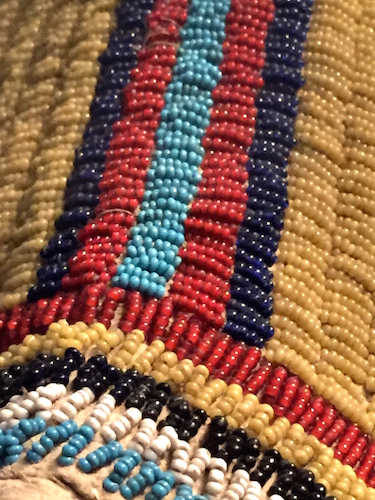
Close up of the tiny Venetian seed beads used to decorate a Lakota woman’s dress (Teton Sioux), 1865. From the Smithsonian’s NMAI

Tiny Venetian seed beads decorate a Lakota woman’s 1865 dress. From the Smithsonian’s NMAI

Similar to what we learned about 1920s French couture designers’ concerns about unlicensed copies in FIT’s recent Faking It show, anyone wanting to replicate a particular war shirt or shield, had to be granted formal permission. The Met exhibition explains that replication permission of Plains Indian designs were closely held and protected for generations.

A full database of the amazing objects in the show is on the Met’s website, as well as the complete audio guide to the exhibit on the museum’s Soundcloud site. As you click on the audio tracks, you’ll see a small thumbnail of the object.

Listen to curator Gaylord Torrence, explain how French culture and embroidery techniques collided with Plains Indians culture three hundred years ago to such magnificent result:


FIT Tribute to Lauren’s Look

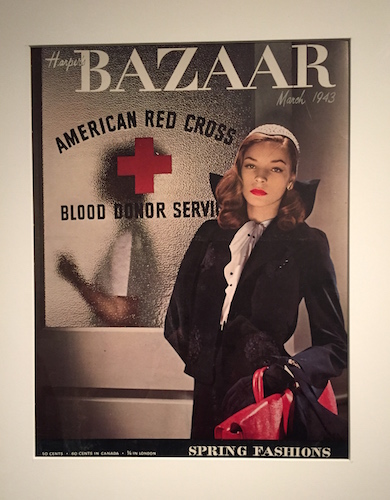
18-year-old Bacall poses as a Red Cross WWII nurse on Harpers Bazaar cover, March 1943. Cover photo: Louise Dahl Wolfe

18-year-old Bacall poses as a Red Cross WWII nurse on Harpers Bazaar cover, March 1943. Cover photo: Louise Dahl Wolfe

What’s a New York City style icon to do when you run out of room at the Dakota but can’t bear to part with 700 of your favorite designer dresses, gown, daytime wear, and accessories? Give them to FIT, of course.

The FIT graduate students are paying tribute to the classic simplicity, clean lines, and casual elegance of a particularly generous donor in the capsule show, Lauren Bacall: The Look, on view at The Museum at FIT through April 4.

The show chronicles Bacall’s start (under the watchful eye of Ms. Vreeland) as a Forties’ cover girl and her quick ascent into the Hollywood pantheon as a 19-year-old leading lady in To Have and Have Not with her soon-to-be-husband Mr. Bogart.

The students have unearthed an early studio photo-test of various hairstyles for the Hollywood newcomer – revealing the casual, wavy down-to-the-shoulder look that would be her signature look for the rest of her life.

1968 Cardin dress of Dynel, which can be crushed and washed without losing its shape. Worn in the 1968 CBS fashion special, Bacall and The Boys

1968 Cardin dress of Dynel, which can be crushed and washed without losing its shape. Worn in the 1968 CBS fashion special, Bacall and The Boys

Take a look at clips of Lauren at her best in snippets from famous films, including How to Marry a Millionaire alongside Ms. Monroe and Designing Women.

On to the clothes: The narrow gallery displays a hot pink Norell coat from Sex and The Single Girl, but the focal point of the show is in the back room — an array of frocks custom-fit for Bacall from the leading Sixties designers as part of a 1968 CBS special, Bacall and The Boys.

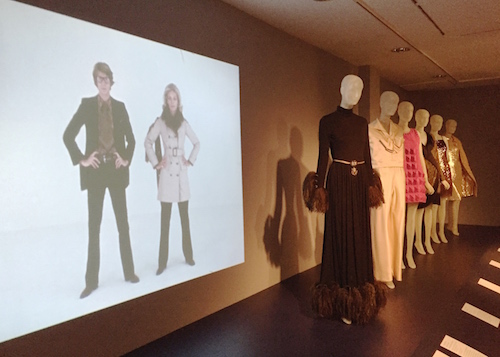
The wall-size projection shows Bacall modeling the outfits you’ll see right in the gallery – looks from Yves Saint Laurent, Pierre Cardin, Mr. Ungaro, and Marc Bohan of Dior. All of the designers make appearances and clearly Ms. Bacall has an artist-muse connection with each of them.

The back wall features a silk Ungaro pantsuit with sleek dresses that became Ms. Bacall’s day-to-day “uniform” around town – most by Norell and Miss Dior. There’s also an iPad featuring close-ups of outfits that don’t appear in this capsule show (but do appear in the FIT show downstairs on Halston and YSL).

1968 CBS special Bacall and The Boys showing Yves Saint-Laurent with Lauren Bacall. Nearby are ensembles and dresses by Marc Bohan of Dior, Cardin, Norell, YSL, and Ungaro.

1968 CBS special Bacall and The Boys showing Yves Saint-Laurent with Lauren Bacall. Nearby are ensembles and dresses by Marc Bohan of Dior, Cardin, Norell, YSL, and Ungaro.

As always, the students have provided some digital punch to the show on line: Click through the FIT timeline, loaded with great 1960s-style fashion illustrations.

See what’s on the iPad by clicking here and enjoy looks from Ms. Bacall’s closet by Ossie Clark, Halston, YSL, Norell, Chanel, and Pucci.

For more of Lauren’s looks, visit the exhibition website, FIT’s Flickr website and our own Flickr site.

Norell’s 1956 “Subway” cashmere silk ensemble.

Norell’s 1956 “Subway” cashmere silk ensemble.

Killer Heels as Art in Brooklyn

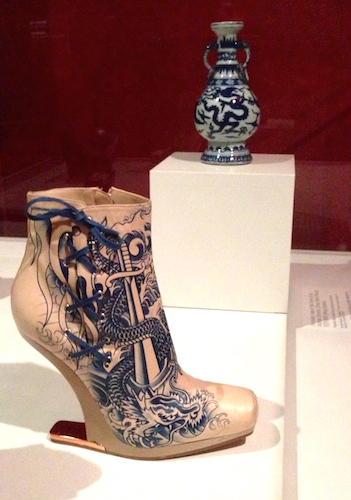
Gaultier’s 2012 Nude Tattoo Boot displayed next to its inspiration, a Chinese porcelain Ming vase (1573-1619)

Gaultier’s 2012 Nude Tattoo Boot displayed next to its inspiration, a Chinese porcelain Ming vase (1573-1619)

The hottest show in New York right now is Killer Heels: The Art of the High-Heeled Shoe, a curatorial masterwork that the Brooklyn Museum has decided to extend through March 1.

As soon as you enter the first-floor gallery, you’ll encounter Zach Gold’s mesmerizing Spike video, a wall-sized video extravaganza of high fashion, high glamour, and high heels. Why rush into the first room of the exhibition when your eye is trying process all the lush details? This digital kaleidoscope genuinely sets the tone for what lies ahead – an historical mash-up of style, fashion, and design all seen through the lens of ladies’ shoes.

What an eyeful – carefully composed vitrines where you can behold golden Baroque curliques on Prada platforms, 1920s evening shoes, and a 19th century gilded table. What about silver-and-pearl Chanel boots whose heels mimic the 1890s Gorham candlestick right next to them? Or the red-hot strappy Miu Miu shoes whose ornament is identical to the handles on a 18th-century Wedgewood ice cream cup? Check out our Flickr feed to see some of our favorites.

2008 Heels by Miu Miu next to a Wedgewood ice cream cup and saucer (1790-1800)

2008 Heels by Miu Miu next to a Wedgewood ice cream cup and saucer (1790-1800)

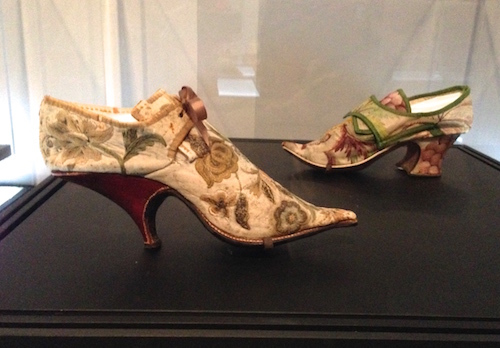
Everywhere you look, there are delightful juxtapositions across time, culture, and material – embellished pointy-toed heels from the 1690s, iron-and-leather pallets that boosted the feet of ladies above the muck of 18th-century city streets, and sky-high mother-of-pearl-inlay stilt shoes that Syrian beauties sported in the Twenties. It’s interesting that the latter are displayed in proximity to those dangerous purple Vivienne Westwood gillies that gave Naomi Campbell such problems on the runway.

Nothing’s chronological. It’s all designed to unfold in your mind by pinging unexpected references and associations – designer shoes next to concoctions from another place and time, fantastical embellishments, and streamlined perfection.

Fashionable, embellished pointy-toed 1690 French and 1720 British heels

Fashionable, embellished pointy-toed 1690 French and 1720 British heels

Provocative, room-sized videos commissioned for this show and small historical films only heighten the pizzazz. Check out Edison’s 1903 short, The Gay Shoe Clerk, or snippets from Sophia Coppola’s Marie Antoinette or other Hollywood classics. Don’t miss Eve A.D. 2000, shot in 1939 to predict what fashions and footwear of the future would look like. You’ll have fun evaluating whether those Thirties visionaries got it right.

There’s simply too much to describe – glass slippers by Georgina Goodman, political-statement heels, shoes that seem to take Metamorphoses at its word, and architectural-engineering wonders. Go see for yourself. You’ll find shoes by Ford, Ferragamo, Prada, Gaultier, and unknown Italian, French, and British craftsmen of long ago.

Watch curator Lisa Small’s video but make the trip out to Brooklyn to immerse yourself in one of the best adventures of the season:

Sending a Message by Dressing in Black

Dramatic 1861 British mourning attire in black silk moiré.

Dramatic 1861 British mourning attire in black silk moiré.

When the curators at the Metropolitan Museum of Art were researching collections for last year’s Impressionism-fashion show, they noticed something curious – a disproportionate number of luxurious 19th century American dresses in black. The black silhouettes found in the Costume Institute’s collection formed the basis for their first fall exhibition in seven years, Death Becomes Her: A Century of Mourning Attire, closing this weekend.

The show is a sumptuous walk-through of the years spanning the 1840s to the early 20th century, when fashionable women telegraphed their status as widows, paid tribute to fallen heroes, and acknowledged the passing of a member of the British royal family through dress, hats, parasols, rings, brooches, and other purchases. Click here to see our Flickr feed, and here for the Met’s own gallery views.

1868 wedding ensemble designed by West Virginia bride to honor casualties of the Civil War

1868 wedding ensemble designed by West Virginia bride to honor casualties of the Civil War

Fashion became such a rich language that the women in the 19th century felt “forced” to conform, according to associate curator Jessica Regan. It was an expensive proposition, and during the hard times of the American Civil War, many women stopped worrying about what others might think if they didn’t conform. If you didn’t have the cash to commission a new frock, it seemed to be OK just to dye an old one black.

As fashion magazines and periodicals became ubiquitous, middle-class and elite-status women eagerly sought styles that telegraphed sorrow while maintaining an up-to-the-minute silhouette.

Men of the 19th century were essentially wearing all-black suits, so the show’s focus is squarely on the ladies and the complex codes of mourning-attire etiquette. For example, after a sufficient period of time, a woman could introduce a bit of grey into her wardrobe, then mauve.

1894-1896 half-mourning dress purchased at James McCreery at 180 Broadway,when machine sewing was more common

1894-1896 half-mourning dress purchased at James McCreery at 180 Broadway,when machine sewing was more common

The team has assembled stunning examples of each from local collections (the now in-house Brooklyn collection, New-York Historical Society, and the Museum of the City of New York) as well as from the V&A’s collection in London. The most dramatic all-black look is the sweeping silk moiré gown from 1861 Britain. Perhaps the most startling is the 1868 a all-black bridal gown designed for a West Virginia bride who chose to pay tribute to fallen Civil War soldiers on her happy day.

Boutiques within department stores catered to mourning clothes buyers. Entire warehouses were filled to the brim with essential accouterments for the correct “look”. By the 1860s, mass-production of fabric increased the accessibility of the raw materials. A few decades later, heavy fabrics fell out of fashion in favor of lighter weight, more flowing options.

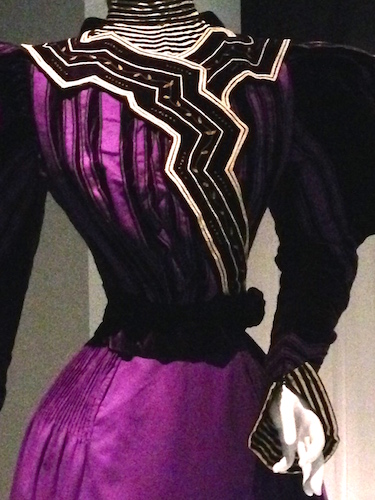
The 1890s fashions feature the best from New York department stores, including a mourning dress emblazoned with a bold geometric design.

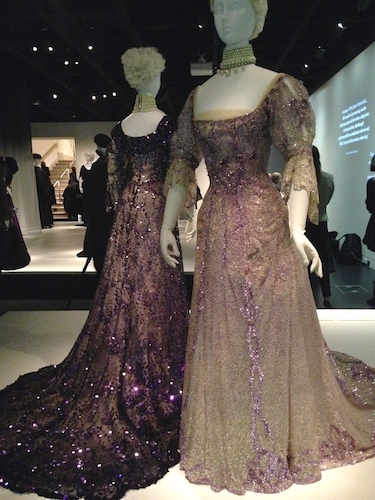
1902 dresses worn by Queen Alexandra to mourn Queen Victoria’s death. French tulle, chiffon, and sequins.

1902 dresses worn by Queen Alexandra to mourn Queen Victoria’s death. French tulle, chiffon, and sequins.

A conservative black dress worn by Queen Victoria stands in stark contrast to the sparkly mauve gowns worn in tribute to her by Queen Alexandra – exquisite and subtle, but not really subdued. The spotlights emphasize the delicate pizzazz of these French confections.

By 1910, wearing all black became fashionable, decoupling the color from its sorrowful past. The show concludes by noting that World War I essentially brought an end to mourning-attire traditions and fashions in Europe.

Enjoy this lecture by associate curator Jessica Regan here, posted on the exhibition home page.

Next up at the Costume Institute, Spring 2015: Chinese Whispers: Tales of the East in Art, Film and Fashion. Get out your cheongsams.

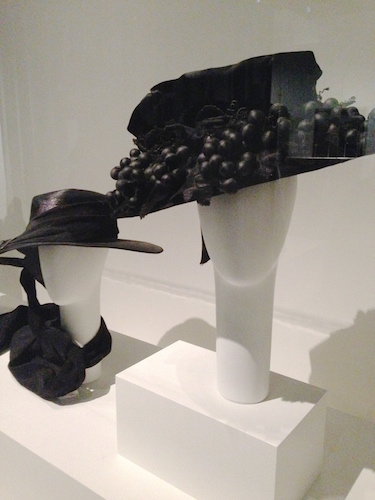
1915 Mme. Boué-Debat mourning hat with silk grapes from Brooklyn Museum collection at the Met

1915 Mme. Boué-Debat mourning hat with silk grapes from Brooklyn Museum collection at the Met

Philly Hosts Patrick Kelly’s Runway of Love

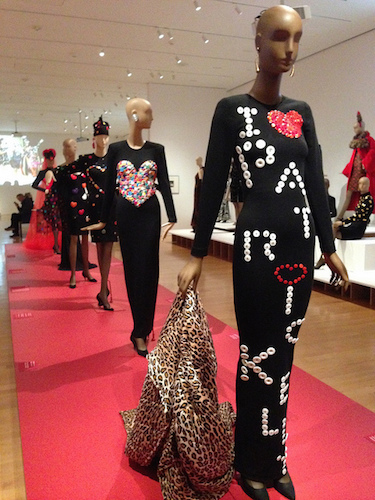
Mismatched button-inspired looks line the center runway in the show (1986)

Mismatched button-inspired looks line the center runway in the show (1986)

Supermodels having fun, crazy colorful buttons, zingy color, and tongue-in-cheek tributes to fashion’s greats – it’s all on display at the Philadelphia Museum of Art’s tribute to one of our all-time favorite fashion designers in the exhibition Patrick Kelly: Runway of Love, on through December 7.

Click here to see our favorite Flickr photos from the exhibition, which has been packed with fashion admirers throughout the show’s run. The gallery is ablaze with life, references to African-American heritage, supermodel sizzle, and the sheer joy that Patrick took in upending fashion’s icons.

The center runway features lots of Patrick’s iconic button dresses, evoking his grandmother’s way of using mismatched buttons to refresh his well-worn clothes as a kid in Mississippi. As a youngster, Patrick consumed acres of fashion magazines – Vogue and Harpers were his favorites – and high-tailed it to Paris as soon as he could.

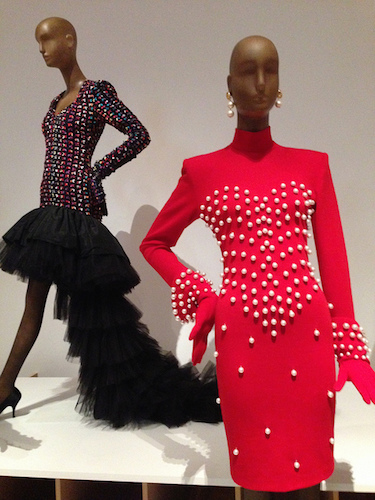
Always fun to spoof Chanel’s use of pearls (1988) and create a Ricci-inspired flamenco dress once modeled by Iman

Always fun to spoof Chanel’s use of pearls (1988) and create a Ricci-inspired flamenco dress once modeled by Iman

He made and sold voluminous coats (inspired by Issey Miyake and Balenciaga) on the streets of Paris to earn cash. But soon his cut-up jersey tube dresses caught the eye of editors of Elle. Maybe it was because he created them for his model-friends to wear on casting calls. When the “tubes” were published, Bergdorf’s placed an order, put his work in their windows, and his career was off and running.

He appropriated sly references to Black culture in the American South and put his own unique high-fashion spin – flouncy dance dresses made from bandana fabric, denim jumpers inspired by sharecropper wear, runway shows with models sporting Blackamoor turbans, and watermelon accessories. Paris went wild over his exuberant runway shows.

A lot of the excitement was over the models who walked his shows — Pat Cleveland, Iman, L’Wren Scott, and other beauties – who cavorted and flounced all his flirty and fun creations. Watch the trailer and see Patrick and his supermodels in action:


Patrick created a bit of fashion history in 1986 when Pat Cleveland interpreted Josephine Baker in Patrick’s famous Banana Dance costume, a collaboration with jeweler David Spada. The photos went viral.

Two looks inspired by Josephine Baker. Left, the “Banana Dance Costume” (1986), a collaboration with jewelry designer David Spada

Two looks inspired by Josephine Baker. Left, the “Banana Dance Costume” (1986), a collaboration with jewelry designer David Spada

The show features videos of Patrick sporting his familiar denim overalls, a joyful designer with a lot of love in his heart for his models, friends, and colleagues. It’s fitting that the museum has posted on its web the things that he loved best. Click here to see Patrick’s Love List and a photo of Bette Davis wearing one of his looks.

If you can’t get to Philly to see the show, click here to see the museum’s site and work your way through each mini-slideshow. The curator’s copy is attached to each look.

Thanks to Bill T. Jones for lending so many of Patrick’s inspired creations and to the museum’s web team that has created such a terrific documentation of this bright light.

And how does a fashion exhibition like Patrick’s all come together? Here’s a backstage look with the exhibitions team:


FIT’s Fun, Flirty Historic Lingerie Show

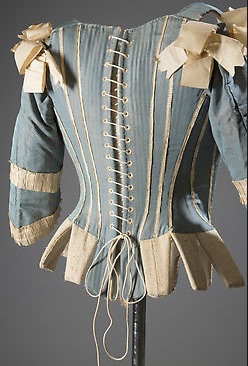
Unusual combination: Sleeves on a silk corset with whalebone stays, circa 1770

Unusual combination: Sleeves on a silk corset with whalebone stays, circa 1770

After sifting through hundreds of corsets, petticoats, slips, nightgowns, knickers, baby dolls, and stockings, the FIT curators have selected 70 key pieces from the archives that lay out trajectory of ladies’ underthings in Exposed: A History of Lingerie, on display through November 15.

The upstairs gallery – usually reserved for gems from FIT’s spectacular collection – takes you on a journey through four centuries of shape-shifting garments that really contributed to the silhouettes of yesteryear. Remarkably, many look totally “today”. The first room pairs underwear and outerwear to make the point.

Hard corsetry items follow next – bustles and corsets from the 17th and 18th centuries, including two that are reckoned to be some of the first examples (at least, in FIT’s collection) of “underwear as outerwear” – a delicate, lavish petticoat and a spectacular 17th century whalebone corset. The telltale signs: If you weren’t showing them off, why would you own a corset with sleeves or a petticoat with such fine hand-embroidered detail?

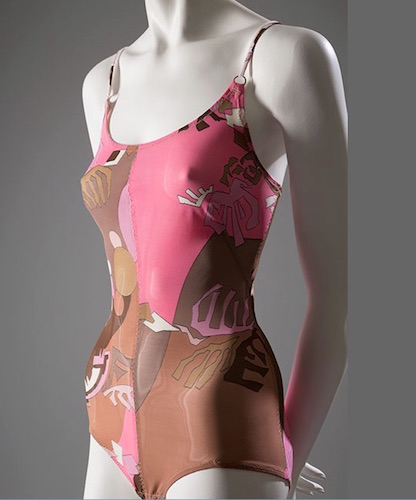
1969 Pucci Lycra-Spandex body stocking for Formfit Rogers

1969 Lycra-Spandex body stocking by Pucci for Formfit Rogers

Predating flappers by more than a century, you can gaze upon the unstructured “natural corset” that 1815 fashionistas wore under their white Grecian-style muslins. One hundred years later, underwear history repeats itself with the 1920s silk underwear designed to be worn under the “corsetless” styles of the Roaring Twenties.

Then it’s on to many more 1920s intimate-fashion innovations – hostess gowns, boudoir mules, French cami-knickers sold at Saks, and the ultimate in period bohemian luxury, the Fortuny tea gown.

Retail history is noted in the 1930s section. Alongside the languid lounging pajamas, negligees, and lingerie-inspired evening gowns, you’ll learn that in 1935, Bergdorf Goodman became the first Manhattan retailer to open up a specialty store within the store specifically devoted to lingerie.

1949 overwire and a 1951 nylon net and silk taffeta petticoat from Dior.

1949 overwire and a 1951 nylon net and silk taffeta petticoat from Dior.

In the 1940s section of the show, special honor is given to Dior’s structured nylon petticoats that gave the New Look’s iconic silhouette its shape, the role of the overwire bra, and the sensation caused by the 1940 debut of nylon stockings – a fashion must-have that quickly became impossible to acquire during WWII.

Historic intimate gems keep appearing through the exhibition, culminating in more recent innovations, such as the Gaultier’s girdle dress, Rudi Gernriech’s no-bra bra, and the revolutionary Wonderbra, as well as up-to-the-minute styles by La Perla, Agent Provocateur, and Victoria’s Secret.

Want to know more? FIT again gives us a stellar on-line exhibition site organized by decade. On each decade, click on “more images” to see nearly the entire exhibition. FIT’s exhibition blog contains the backstory on a dozen or more pieces from the collection.

Even if you’re able to get to Seventh Avenue this week, why not take a walk-through with Coleen Hill, the curator who created this beautiful, thoughtful, and delight-packed show?

Stunning Jewelry at Met Reflects Contemporary Art

These stunning creations of Eugene and Hiroko Pijanowski are made from paper cord and canvas

These stunning creations of Eugene and Hiroko Pijanowski are made from paper cord and canvas

The Metropolitan Museum of Art has not only reinstalled its American Modernist wing on the first floor, but it’s given over the design gallery right inside the door to Unique by Design: Contemporary Jewelry in the Donna Schneier Collection, on view through August 31.

Gertrude Stein is holding court in the far back gallery with some of Mr. Stieglitz’s treasures, but on your way to see them, check out the high-class, high-gloss presentation of masterworks of wearable art from the 1960s through today.

The thesis of the show is contemporary jewelry doesn’t exist in a vacuum and often reflects the prevailing art of the day — Pop, Minimalism, Abstraction, and so forth.

In 2007, Ms. Schneier donated 130 of her favorite pieces to the Met – just a small fraction of the collection she has been building for over 30 years. Here, these gleaming, surprising, artful, fun pieces are grouped to highlight their context within various themes of recent contemporary art.

Kiff Slemmonds Sticks and Stones and Words

Kiff Slemmonds Sticks and Stones and Words

As you marvel at each one, you’ll be thinking back across decades of gallery shows and installations of minimalist art, performance art, funky found art, and 3D printing.

Check out the gold neckpiece right inside the door. You might think it’s a riff on the Met’s room full of Columbian gold across the hall, but this treasure is actually made of paper and canvas by the Pijanowskis (Eugene and Hiroko).

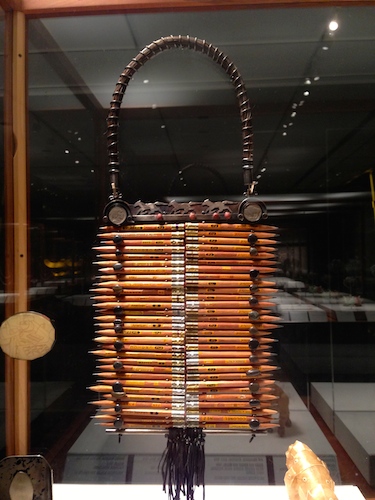
Marvel at what seems to be Native American-inspired breastworks by Kiff Slemmonds. Her art piece is fabricated with a lot of stuff but mainly No. 2 pencils in the “narrative” portion of the show.

If you like self-referential playfulness, consider Gijs Bakker’s piece – a real diamond mounted on a PVC-laminated photo of a diamond. Recyclable art? Check out Robert Ebendorf’s brooch made from crushed auto window glass, beach glass, and a vinyl record.

Ted Noten’s clever Fashionista necklace made of tiny resin high-heeled shoes

Ted Noten’s clever Fashionista necklace made of tiny resin high-heeled shoes

And if you think it’s fun to poke around the history of contemporary art through jewelry that’s neatly tucked inside a single room, don’t ignore the fact that right beyond this gallery door is another art-history tour-de-force-in-a-box: The Met is displaying Mr. Duchamp’s famous green case, which is full of many of the same visual and conceptual challenges – “what is art?”, “what is play?” “what is hidden?”, and “everything you see is not as it appears.”

What would Rose Sélavy herself choose to don from the next room if the Met and Ms. Schneier gave her chance?

Peek at a few of the choices on our Flickr site, but enjoy wandering through the gallery and deciding for Rose and yourself.