Fans have had a special opportunity to get up close to that iconic black dress and gaucho hat, OK Calder pin, denim apron, and Marimekko dress in Georgia O’Keeffe: Making a Life, on view in Santa Fe through October 19 2025 at the O’Keeffe Museum.
After you’ve walked through a somewhat chronological presentation of Ms. O’Keeffe’s paintings in the museum, the final two galleries allow you to take a close-up look at tools, cookbooks, and other stuff that she used to make things – sculpture, recipes, pastels, and clay pots.
Photomural of Todd Webb’s 1962 photograph Georgia Making Stew, Ghost Ranch.
Due to the overwhelming popular response to Living Modern, the traveling exhibition that featured O’Keeffe’s wardrobe and chronicled how she portrayed herself for the greatest photographers of the 20th century, the museum curators decided to give visitors a little taste of the woman behind the art.
See some of our favorite things in our Flickr album here, and listen to the museum’s audio guide here.
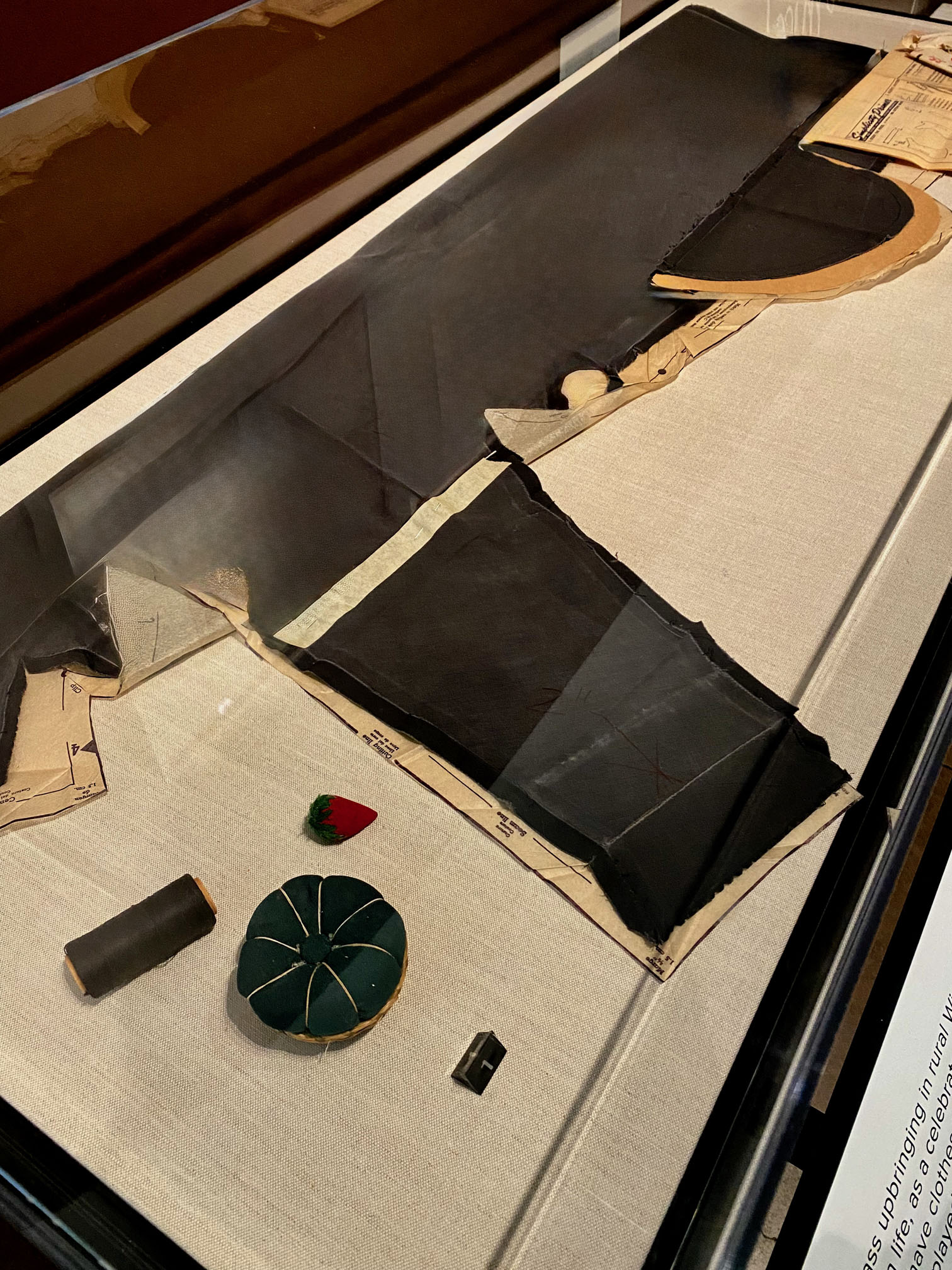
It’s the first time that the O’Keeffee Museum has itself presented her clothing. To emphasize the “making” part of her life in New Mexico, they’ve included a case showing how Santa Fe artist Carol Sarkasian moonlighted as Georgia’s seamstress. There’s a case with sewing notions and cut pattern pieces for another version of Georgia’s always in-style black wrap dress. She totally believed in multiples!
Georgia’s iconic 1960-1970 wrap dress sewn by Carol Sarkasian with 1950 belt by Hector Aguilar; Tony Vacarro’s 1960 Portrait of O’Keeffe with one of her dogs.
Sewing notions, cut fabric, and tissue-paper pattern – Carol Sarkasian’s preparation to make a wrap dress for Ms. O’Keeffe.
She also believed in wearing her clothes for a long time, and so they showed they had years of life.
The most popular feature of her Abiquiu home tour is the kitchen and pantry, and learn about Georgia’s farm-to-table approach with her garden, recipies, and day-to-day lifestyle. Here, you get a glimpse of the modern and traditional appliances used for her daily coffee ritual (yes, she loved Bustelo!) and get to peruse a sampling of her cookbooks and hand-written recipies.
Shelves with Georgia’s pantry items
One of her unrealized dreams was to write a cookbook, and it shows. She was all about healthy eating and living, and in her later years she relied upon her trusted Abiquiu team to assist with gardening, cooking, and putting out a spread for the constant stream of visitors. (No recluse, she!)
From the pantry: Georgia’s cookbooks with her hand-written breakfast, rice, and drink recipe cards.
The final room shows the process and tools she used to create her paintings, pastels, and sculptures.
There’s a dramatic photomural of Georgia standing in front of her largest sculpture – temporarily housed nearby at the New Mexico Museum of Art until the new GOK museum is built. Beneath, you see several prototypes – a wax spiral made in 1916 and bronze maquettes from the Forties.
Cast when she was in her nineties, the case demonstrates that she kept making versions of this her whole life and finding inspiration from stuff found on her New Mexico wanderings.
Bruce Webber’s photo of Georgia and her 1979-1980 spiral sculpture; the case below with its inspiration – a ram’s horn and earlier maquettes.
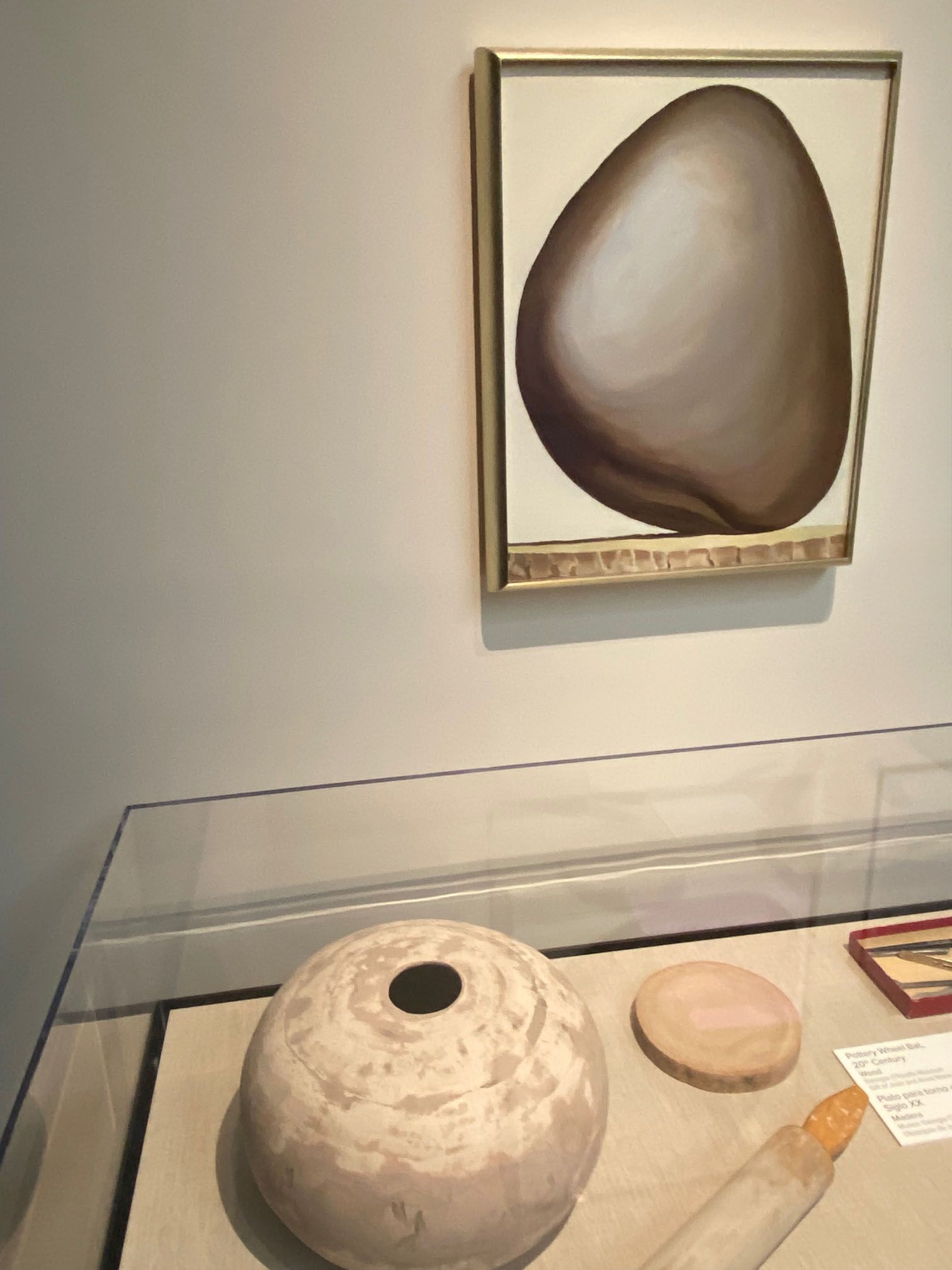
There are things from her travels to Japan, an unfinished work on an easel, and a case showing the pot she made when her assistant, Juan Hamilton, convinced her to keep making shapes, even when her macular degeneration made it impossible for her to paint.
The round, smooth shape echoes the rocks that she liked to collect, so it’s fitting that the museum paired her tools and pot with a beautiful oil painting done of one of her favorites.
1963-1971 Black Rock with White Background; below, Georgia’s 1980 stoneware pot and tools– a pottery wheel bat and Sears rolling pin.
Georgia’s denim studio apron and an unfinished work – a pencil sketch on primed canvas.
For more on Georgia and her life, listen to Pita Lopez, who worked as a companion and secretary for Miss O’Keeffee from 1974 to 1986 and later oversaw maintenance and preservation of her Abiquiu and Ghost Ranch homes.
How does a Lakȟóta artist link dreams and artificial intelligence to imagine futures for her people? Experience five years of innovative installations in Kite and Wíhaŋble S’a Center: Dreaming with AI, on view at the IAIA Museum of Contemporary Native Arts in Santa Fe through July 13, 2025.
The IAIA exhibition – Suzanne Kite’s third solo exhibition this year across the United States – presents several installations that highlight her collaborative work that merges cutting-edge technology with Indigenous knowledge systems.
Download the exhibition catalogue here, and look at photos of the installation in our Flickr album.
2023 Wičhíŋčala Šakówiŋ (Seven Little Girls) and Wicháhpi Wóihanbleya (Dreamlike Star) use stones to translate Kite’s dreams into Lakhóta symbols.
In Iron Road and Dreamlike Star, stones and minerals (the building blocks of computers!) are arranged in Lakȟóta geometric language that suggest Lakȟóta quilt patterns. They’re placed atop a mirror to show resonance between the Earth and the cosmos (stars).
2023 Wicháhpi Wóihanbleya (Dreamlike Star) suggest that ancestor stars can point the way to Indigenous futures.
In this first section, inputs are taken from Kite’s dreams. Using AI, her dreams are translated into geometric Lakȟóta shapes created by designer Sadie Red Wing. Kite has figured out a way to bypass large-scale, commercial AI networks in favor of an AI model (run on her PC) that aligns more closely with Indigenous knowledge systems.
A digital embroidery machine has yards of embroidered black velvet flowing out of it. Oihanke Wanica (Infinity) is a collaboration with New York City’s Center for Art, Research and Alliances. As you examine the velvet, you’ll find geometric Lakȟóta shapes translated (using AI) from Kite’s dreams.
Nearby, there’s a comfortable lounge where you can watch Cosmologyscape, an interactive digital quilt – a public art project in which AI translates the public’s dreams into artist-created geometric symbols. It’s a collaboration with Alisha B. Wormsley, so the virtual community quilt manifests both African-American and Lakȟóta shapes.
2023 Oihanke Wanica (Infinity) – a digital embroidery machine stitches symbols representing dreams onto black velvet. Collaborator; Center for Art, Research and Alliances.
Lounge to watch Kite and Alisha B. Wormsley’s 2024 Cosmologyscape – Ai translates the public’s dreams into symbols for an ever-expanding digital quilt.
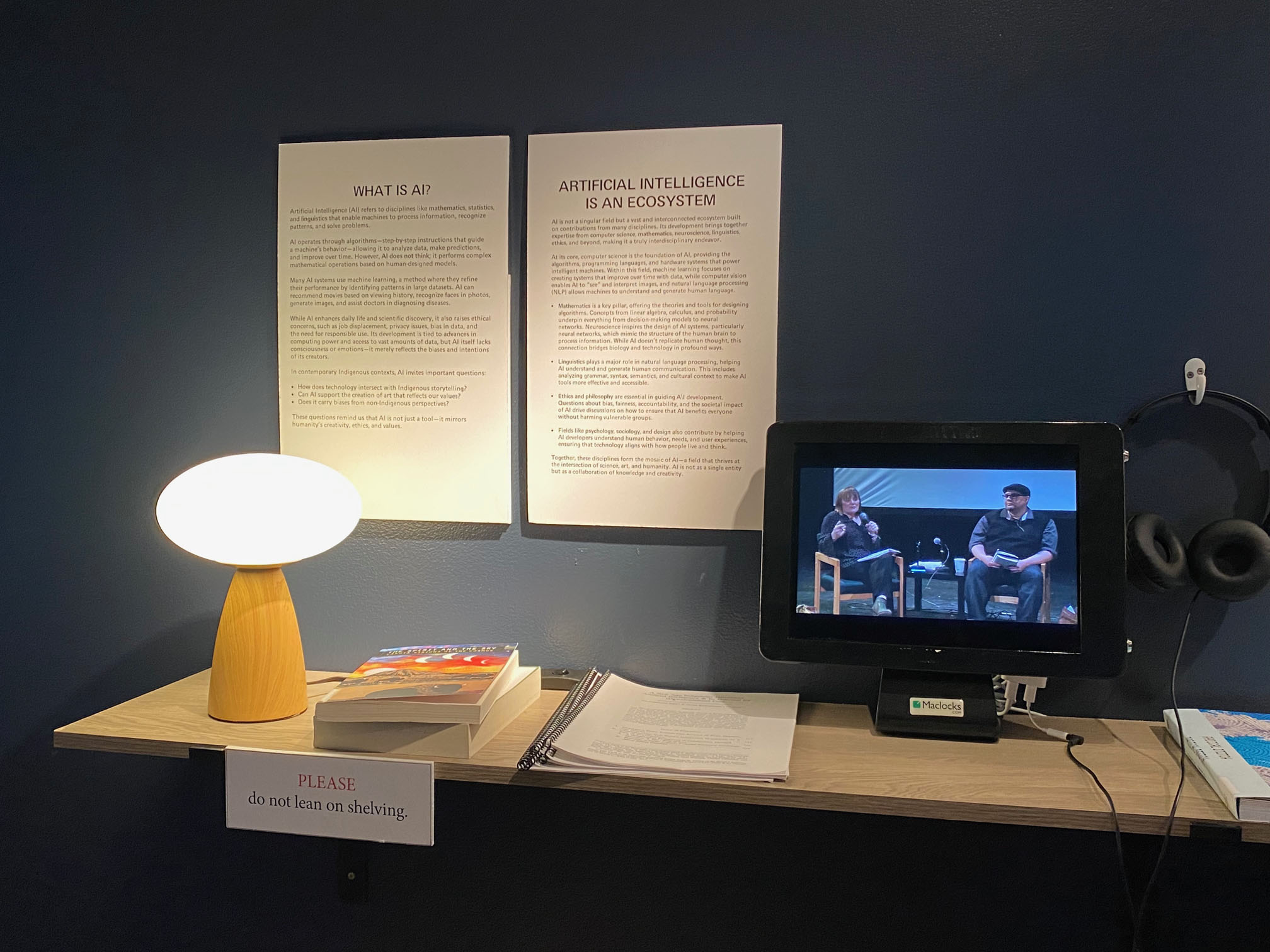
Installations in the other half of the exhibition shows collaborative projects that combine Indigenous knowledge systems and AI. Along one wall in the spectacular, tranquil gallery, you can explore a print and digital resource library on international research programs that integrate Indigenous knowledge systems into AI design.
Abundant Intelligences – a library and digital resource station for information on AI and futurism in contemporary Indigenous art.
Oneiris is a large interactive station through which visitors are invited to generate dream symbols that AI adds into a wall-sized display that looks like a portal to the cosmos. Inspired by the Lakȟóta concept of a Dream Language, she and her many technical collaborators genuinely bring dreams to life.
Oneiris – a collaborative project using advanced AI models to allow visitors to bring dreams to life.
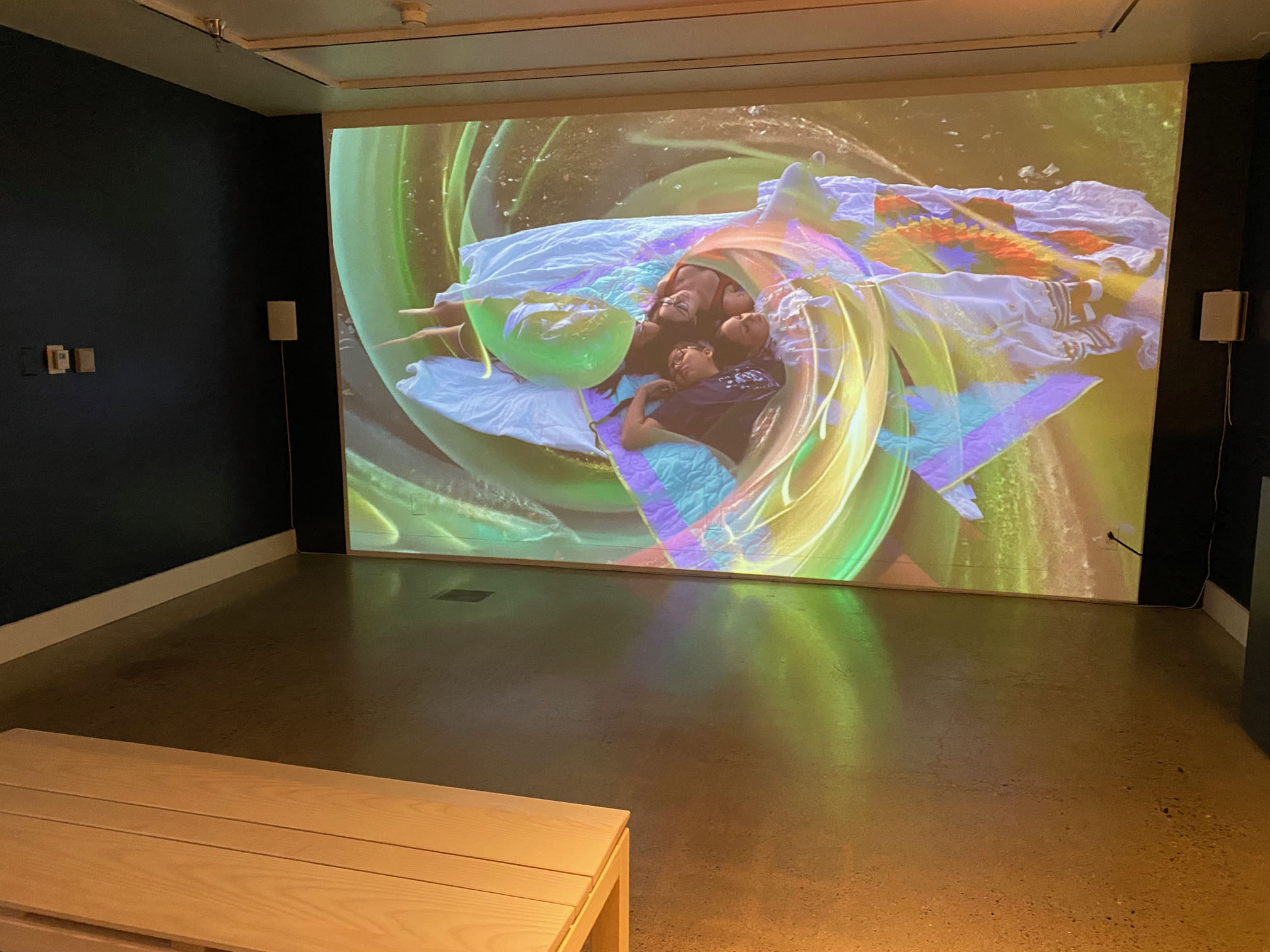
Spashed across the final wall of the space, The Land Paints Itself is a video collaboration with her Wíhaŋble S’a Center for Indigenous AI at Bard – a lab that explores Indigenous advances in this science and art. Watch as AI generates dazzling colors and patterns as four Lakȟóta dream about Indigenous futures. Kite suggests that the evolving technology of dreams is a legitimate way for her nation to envision ways forward.
2025 The Land Paints Itself video that uses AI to illustrate Lakhóta people’s dreams about Indigenous futures.
Provocative, visionary, and affirmative – meet Kite herself in an interview with Artforum editor Tina Rivers Ryan in March 2025, when Kite’s work was featured on the cover.
To celebrate its 200th anniversary, the Brooklyn Museum decided to dazzle us with 500 gold pieces – Tiffany, Cartier, Egyptian, Renaissance altarpieces, golden sculptures, Greek wreaths, and eye-popping bedazzled fashion – in Solid Gold, on view through July 6. Half of the pieces are from the museum collection, and half loaned by private collectors and design houses. See our favorites in our Flickr album.
The ten-part show, spread across the museum’s two top-floor galleries deliberately pairs shimmering art from its vast collection with haute couture, gold records, and dramatic jewelry. The exhibition begins by acknowledging the ancient gold in Brooklyn’s Mediterranean and American collections.
Nam June Paik’s 2005 Golden Buddha checks himself out on TV. Courtesy: estate of the artist.
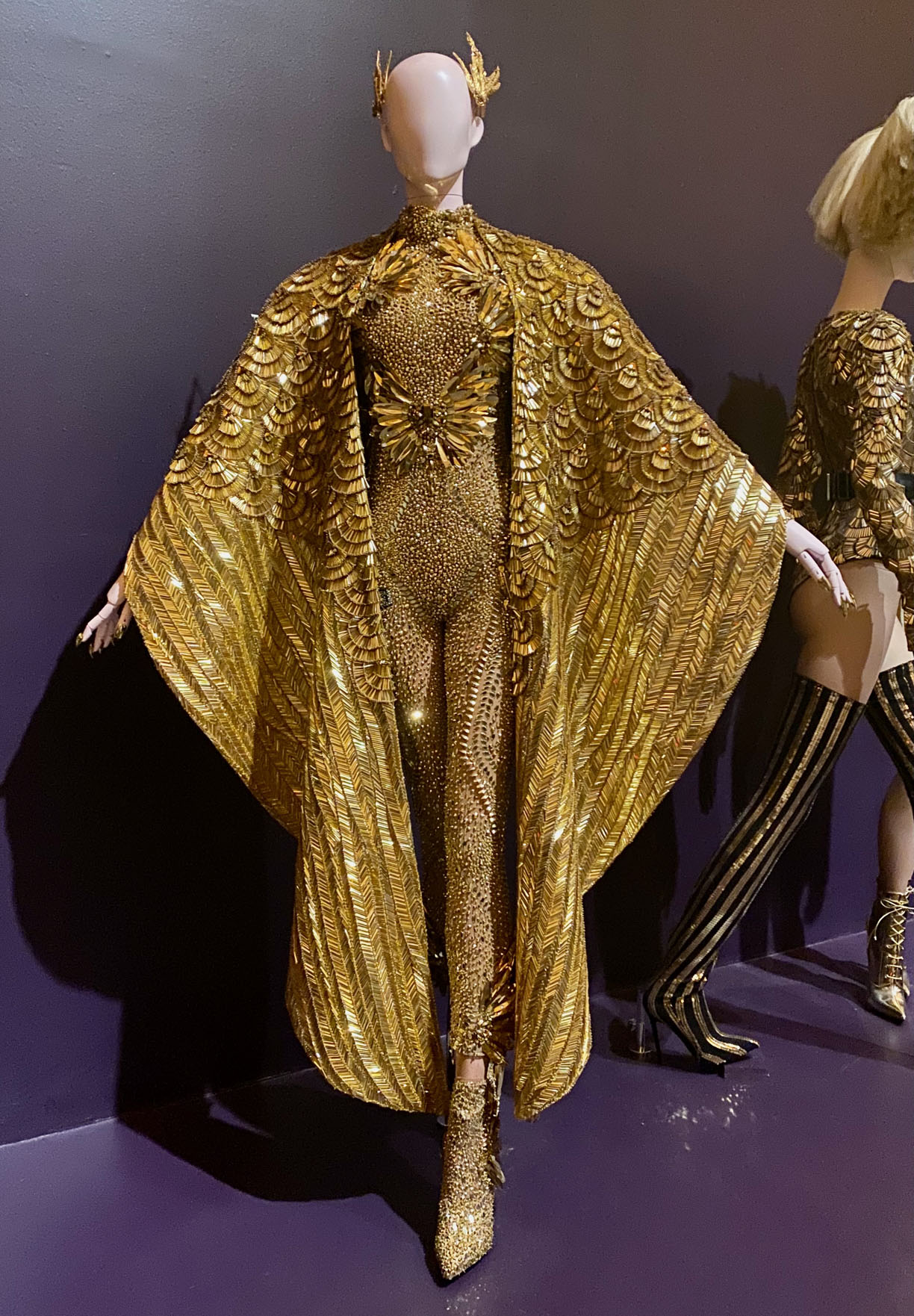
Known for its massive Egyptian holdings, the exhibition’s introductory gallery allows us to plunge directly into a mix of actual and retro Egyptian objects and fashion – golden Egyptian tomb fragments, Victorian-era faux Egyptian decor, clips of Elizabeth Taylor from her Sixties Cleopatra extravaganza, and many dazzling pieces from the Egyptian Disco collection by The Blonds, including the Cleopatra catsuit-cape that Billy Porter wore as he was carried on a litter onto the 2019 Met Gala red carpet.
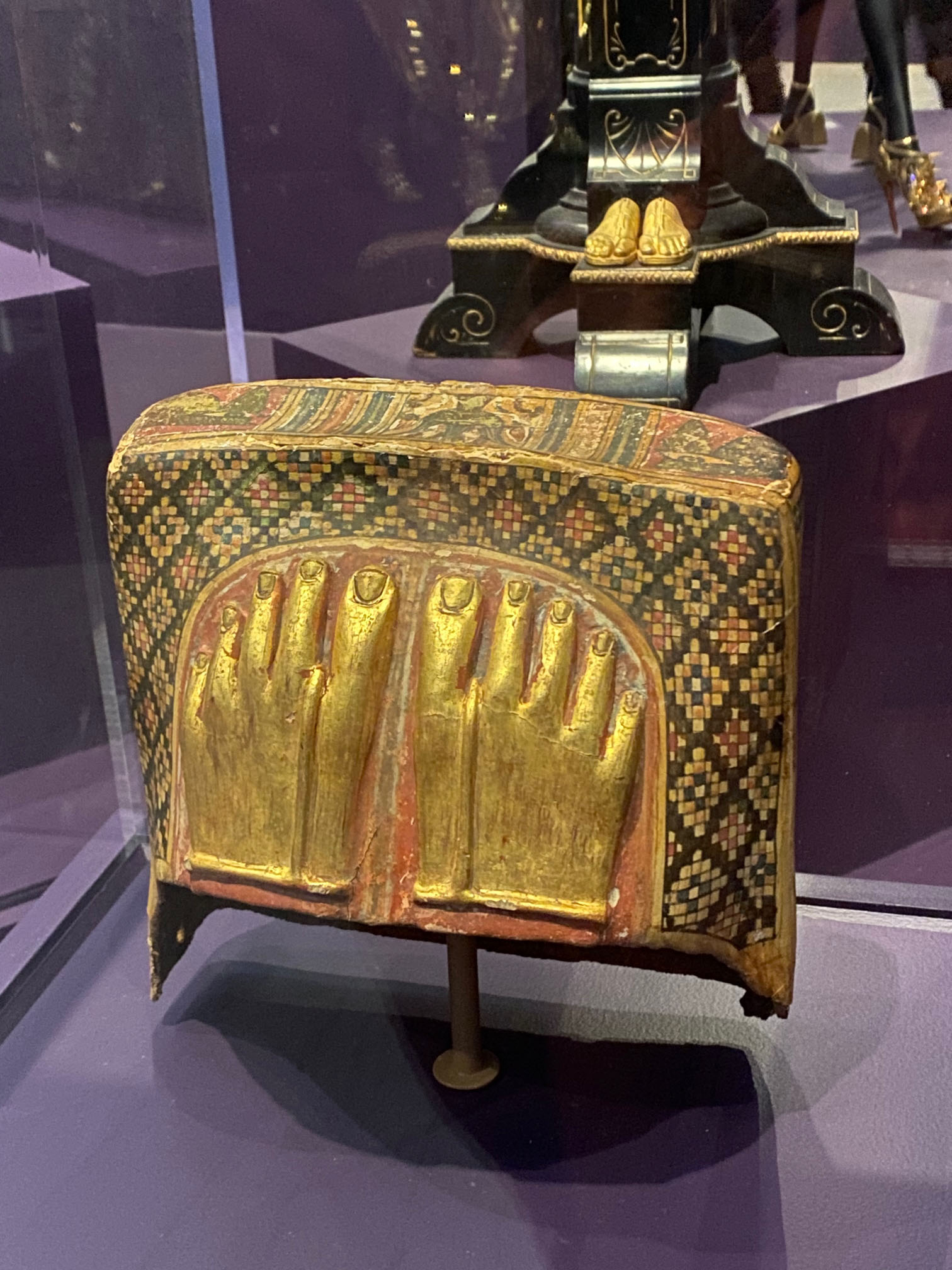
Gold in the First Century: painted gold-leafed footcase from Coptic era Egypt; (rear) 1870 gilded and lacquered pedestal by Kimbel and Cabus.
From The Blonds’ Egyptian Disco collection: Cleopatra catsuit, cape, and headdress worn by Billy Porter to the 2019 Met Gala.. Courtesy: The Blonds
You could spend hours in the first room just taking in the gold, platinum, and diamond details of Jacob Arabo’s wristwatches; wondering how Galliano crafted a gown of Lurex pyramids; admiring Mary McFadden’s golden macrame gowns; or contemplating the 4th-century golden hoard from the Middle East.
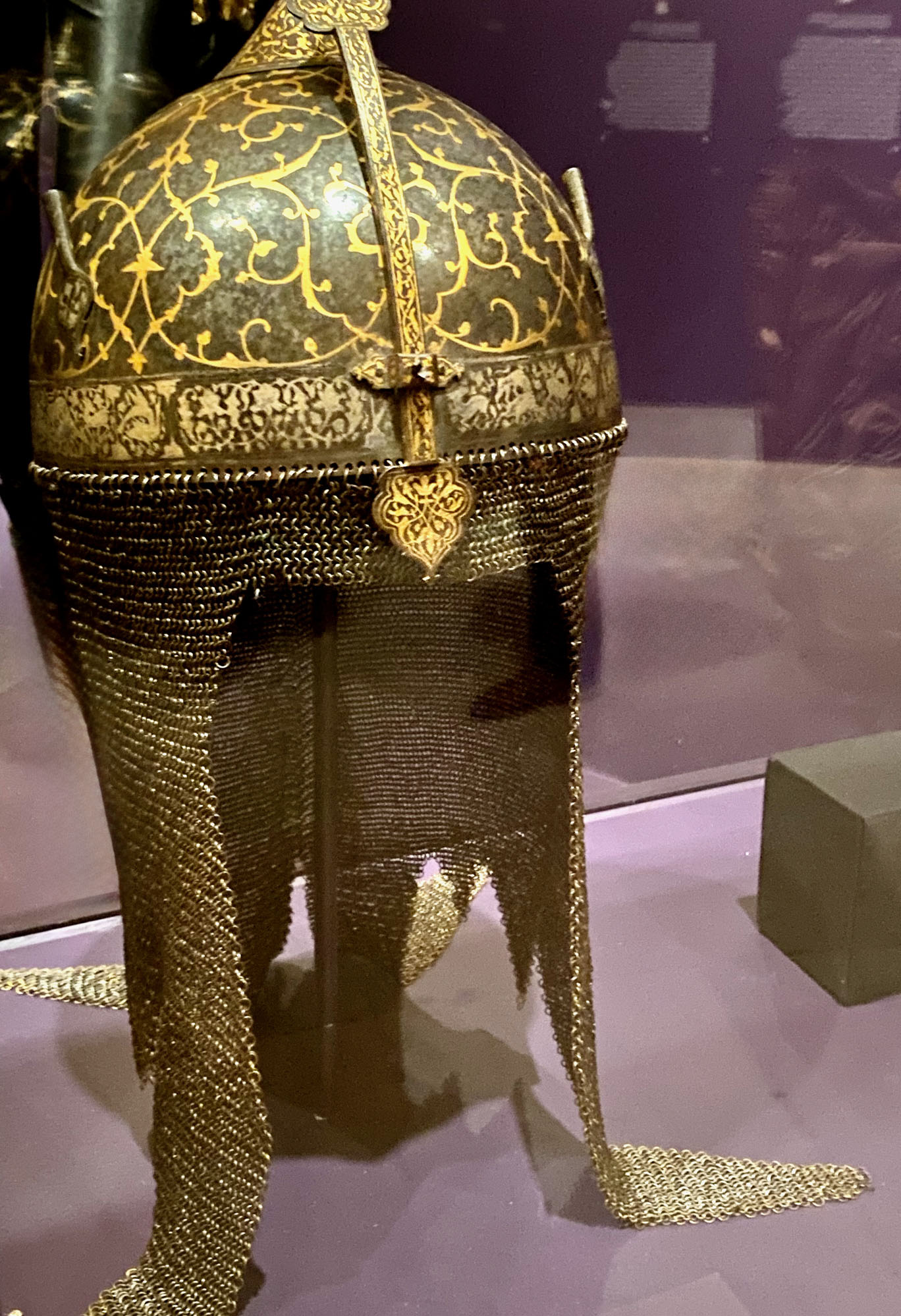
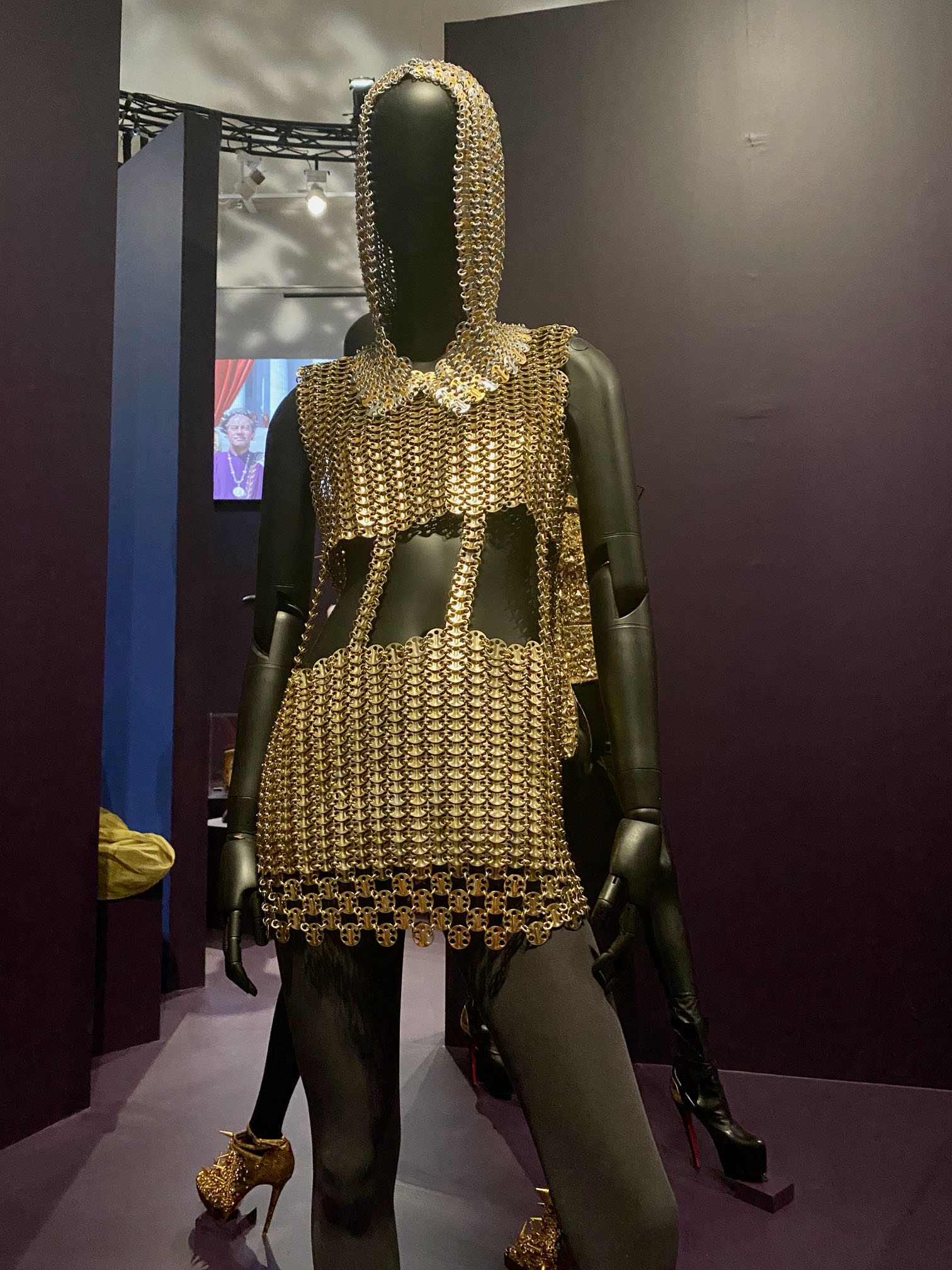
But even more dazzlers await in the linked-chain section – 18th century Islamic helmets, Janelle Monet’s gold-braid wig by The Blonds, and a Seventies chain mini by Paco Rabanne.
From the Safavid Islamic Empire in Central Asia: a 1700 steel, gold, and silver helmet.
1971-72 gold, silver, and patinated aluminum cowl and dress by Paco Rabanne. Courtesy: private collection
A large, dramatic gold sculpture punctuates the first quarter of the exhibition – the dramatic piece by Zadik Zadikian is only plaster covered in gold leaf, but if it were solid gold, it would represent $1 billion in value. Visitors take a break here to circumnavigate the piece, watch a video and read about the history of gold mining – and its human cost – throughout the world.
2024 24-karat gold Path to Nine by Zadik Zadikian – a wall of 1,000 gold bars (gold leaf on plaster). Courtesy: private collectors
Golden mosaics, golden halos, golden chasubles, embellished holy portaits, golden uniforms, and golden coin containers from Italy, Mexico, Peru, China, and Japan line the next galleries, demonstrating how different cultures have integrated gold into private and public devotions, court, and the economy. In Italy, for example, one era’s minted golden coins are transformed into another era’s golden halos for saints in home altars.
Somehow, it’s a fitting punctuation to this section of the exhibit to encounter the epic, shimming wall sculpture by El Antsui. The “golden” glow emanates from recycled whiskey bottle cap
2010 Black Block by El Antsui, a wall hanging of recycled whiskey bottle caps.
The second half of the exhibition features objects from Brooklyn’s own collection and fashions that combine gold with other colors.
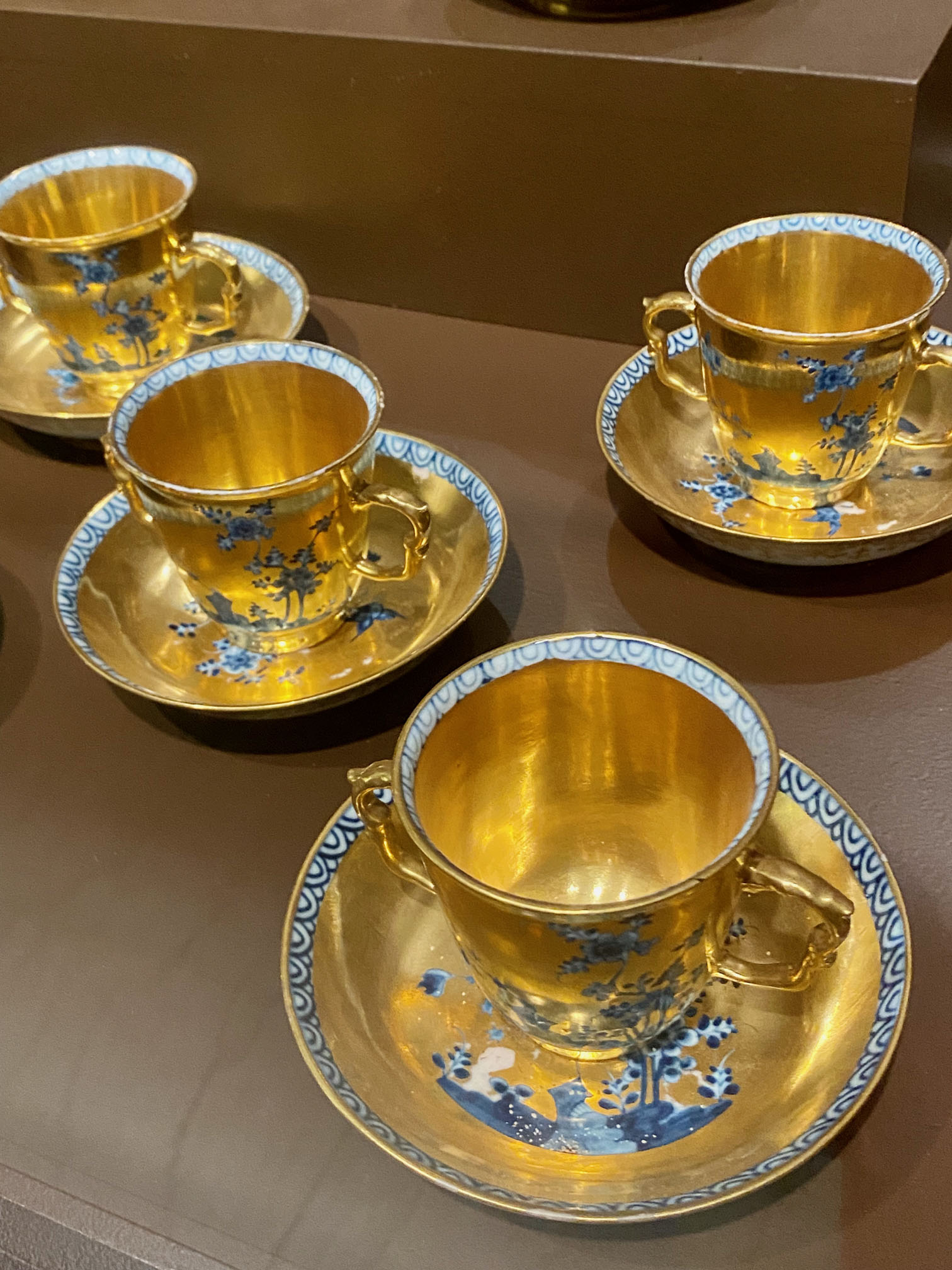
1720-25 gilded Meissen porcelain coffee and chocolate set.
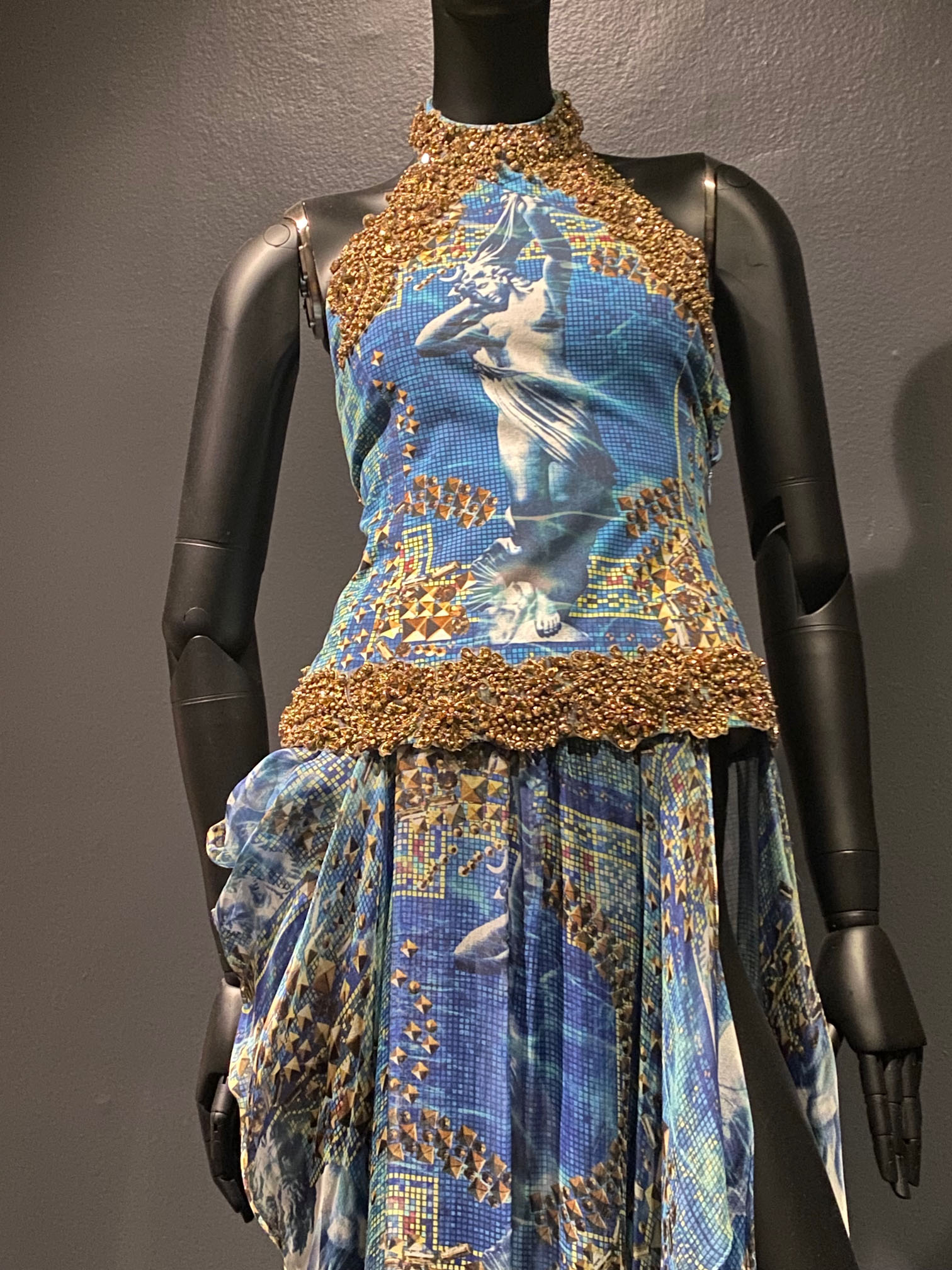
Claudio Cina’s 2017 photo-printed skirt and top depicting Venus, embroidered in gold with gold studs and crystals. Courtesy: the designer
And then it’s just one golden haute couture gown after another – Dior, Yves Saint Laurent, Cardin – accented by cases containing masterpieces of jewelry design by Cartier and Schiaparelli.
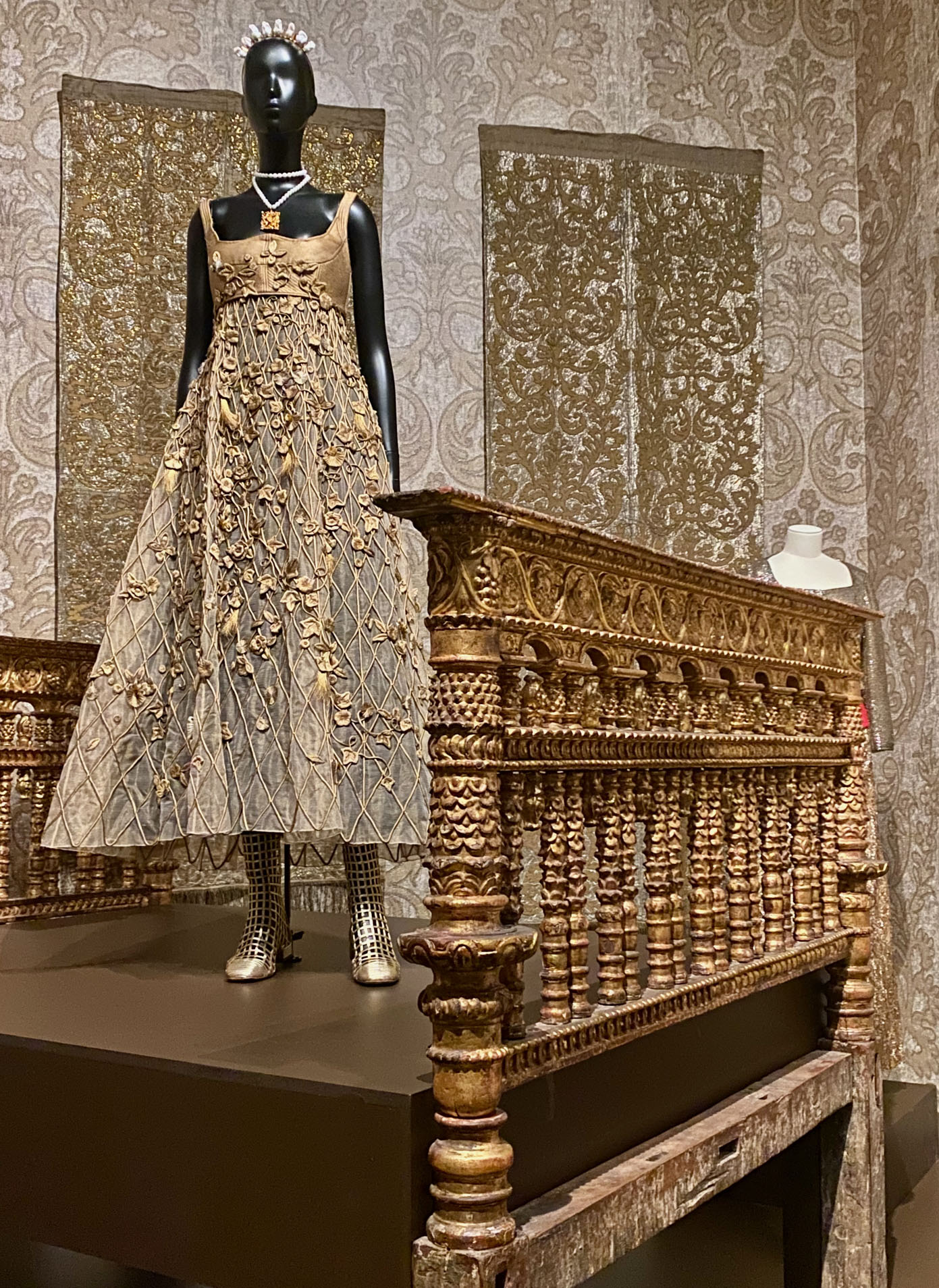
2021 embroidered gold silk haute couture dress by Maria Grazia Chiuri for Dior atop 1700-1760 gilt wood bed from Peru. Courtesy: Dior.
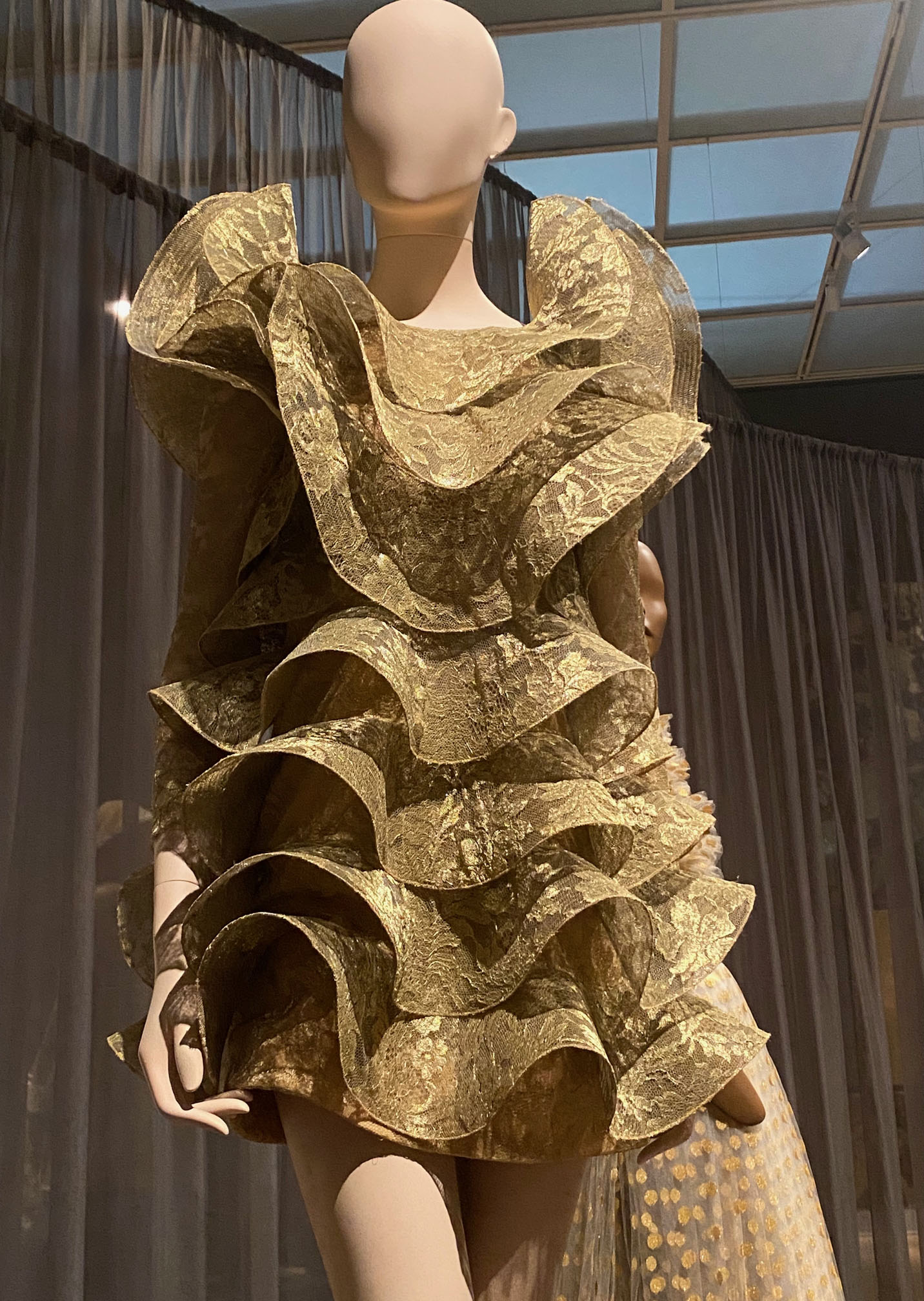
1991 gold nylon lacework ruffled cocktail dress by Pierre Cardin. Courtesy: Musée Pierre Cardin.
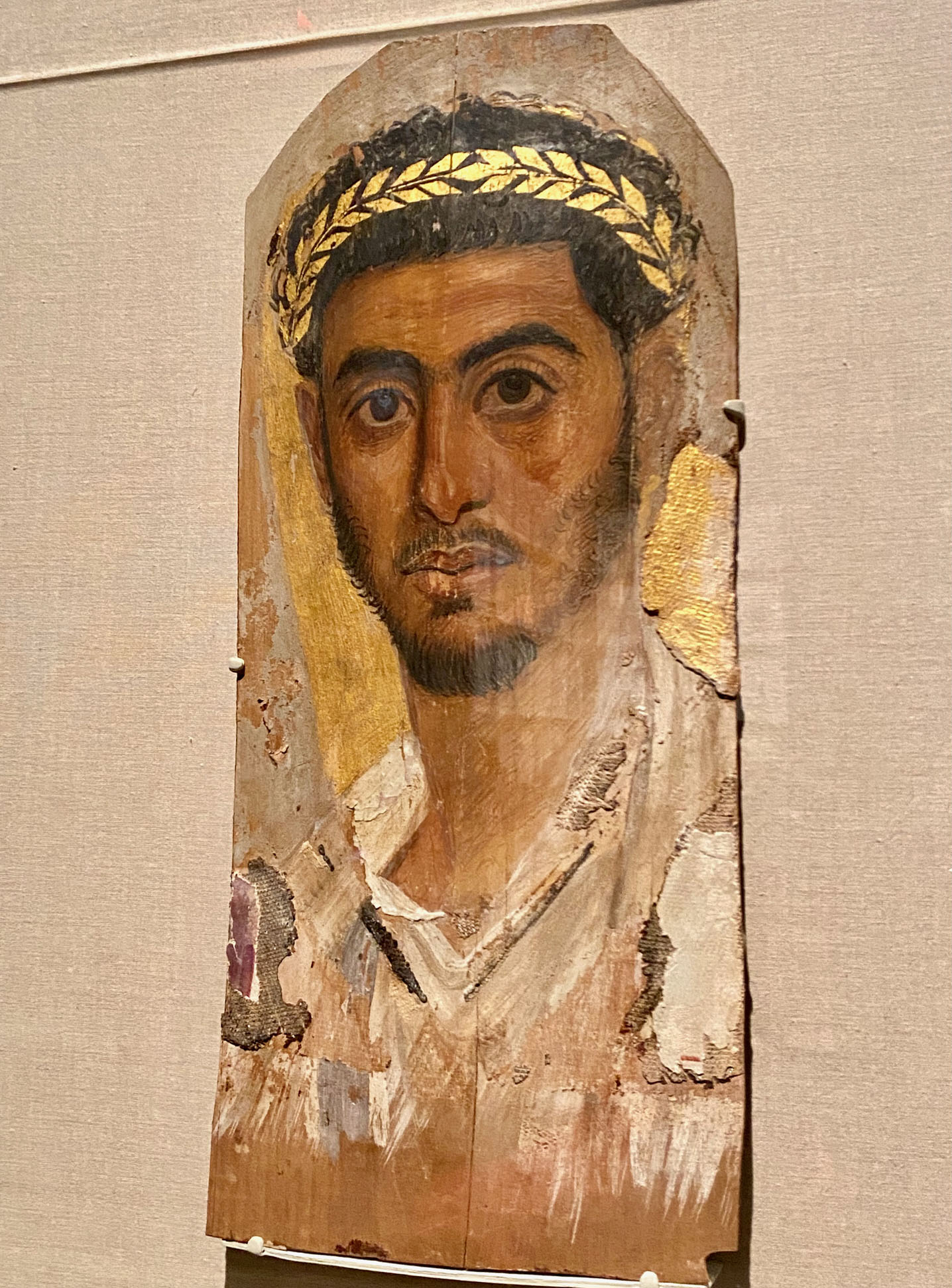
The final gallery – and it’s a stunner – shows how ancient and contemporary artists and designers use gold to signify special status and power. A gold wreath encircles an Egyptian man’s portrait, and Basquiat honors his friend in a painting by inserting his iconic gold crown. We get a chance to examine Brooklyn’s rare hammered leafy gold wreath from ancient Greece alongside a golden dress made by Dior for the opening of the 2024 Paris Olympics.
120-130 A.D. Egyptian Mummy Portrait of a Man.
Aya Nakamura’s 2024 metallic gold feather dress for the 2024 Paris Olympics opening ceremony by Maria Grazia Chiuri for Dior. Courtesy: Dior.
To see inside the gallieries and hear more, watch this video with Brooklyn Museum curator Matthew Yokobosky:
Take a look at generations of 20th century craft mentorship in Craft Front & Center: ConversationPieces, on view at MAD Museum through April 20, 2025. The exhibition shines a light on how innovators shaped subsequent generations of craft artists at schools and art colonies across the United States. The curators have pulled from the MAD collection to show us the work of student and teacher side by side in several disciplines – fiber arts, ceramics, and glass.
Many of the mentors either taught at or were influenced by the Bauhaus, the legendary early 20th century design incubator.
Who are the generational inspirations for Eve Biddle’s 2019-2023 tiny ceramic sculptures, New Relics?
Bauhaus students could take classes in weaving, ceramics, typography, and metalwork alongside traditional fine arts classes. They were expected to excel in their applied-arts training and mix in aesthetics learned in their fine arts classes.
Bauhaus innovator Margeurite Friedlander Wildenhain’s 1966 Square and Textured Vase
When the Nazis closed the progressive school in 1933, many German-Jewish refugee teachers and students fled, transplanting Bauhaus design and educational philosophies across the world.
MAD highlights several artists – including Anni Albers, Trude Guermonprez, Margeurite Friedlander Wildenhain, and Maija Grotell – who came to the United States and integrated Bauhaus practice into curriculums at Black Mountain College, the California College of Arts and Crafts, Cranbrook, and new craft workshops they began.
One of the best-known 20th century textile artists, Anni Albers is featured in the show by a fine-art “pictoral textile” made on a small handloom. At the Bauhaus, Albers she trained under master weaver Gunta Stölzl, and eventally took over as head of the textile workshop. Albers moved to Black Mountain College in North Carolina with her husband, painter Josef Albers, and was the first textile artist invited by MoMA to have a one-person exhibition.
Anni Albers’s 1959 textile Sheep May Safely Graze made on a small handloom using gauze weave technique
Anni also designed commercial textiles for Knoll for years. Her influence on the next generation of painters and textile artists was profound.
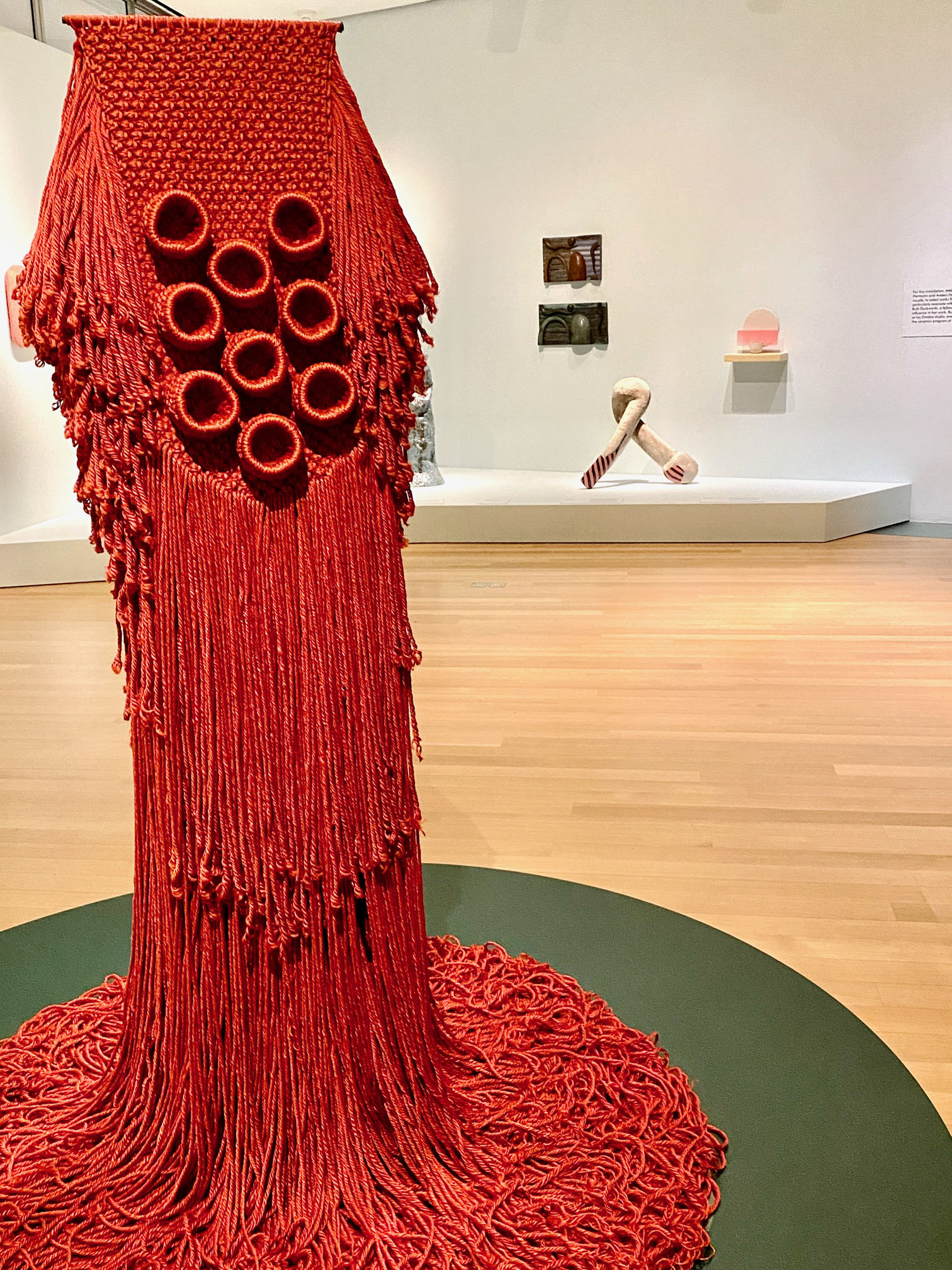
MAD features work by two fiber-arts innovators (and Albers admirers) who pushed boundaries by crafting commanding, large-scale sculptures. Sheila Hicks (who studied with Josef at Yale) and Claire Zeisel (who studied with the former Bauhaus faculty at Chicago’s IIT) are credited as the leaders of America’s textile arts movement. Tufts burst from the wall in Hicks’ piece, and Zeisel’s hovers in the center of the gallery like a shaman.
Sheila Hicks’s 1968 Dark Prayer Rug, inspired by Anni Albers and Mexican and Moroccan textile artists.
Claire Zeisler’s 1967 Red Wednesday with braid and cords twisting the sculpture’s armature
Trude Guermonprez, an unconventional materials artist known for innovations in three-dimensional weaving once worked at Berlin’s textile engineering academy; later, she consulted with industrial textile firms, as did Anni Albers.
Next to Guermonprez’s dynamic 3D hanging woven sculpture, MAD shows us a piece by Kay Sakimachi, a student who met Guermonprez in 1951 at the California College of Arts and Crafts summer craft workshop.
Guermonprez encouraged students to use latest technology, and here we see how Kay used a 1959 invention by DuPont – monofilament that’s better known today as fishing line. Kay’s woven it into an ethereal hanging sculpture.
Innovative fishing-line weaving 1968 Kunoyuki by Kay Sakimachi alongside 1962 Banner by her mentor, Trude Guermonprez.
In ceramics, MAD displays a series of vessels that transform into sculptures, starting with a modest, contained piece by Margeurite Friedlander Wildenhain, one of the first Bauhaus students and the first woman in Germany to be honored as a master potter. After emigrating to the United States in 1940, Wildenhain founded Pond Farm Workshops in Sonoma County, California ad instituted a rigorous Bauhaus instructional approach.
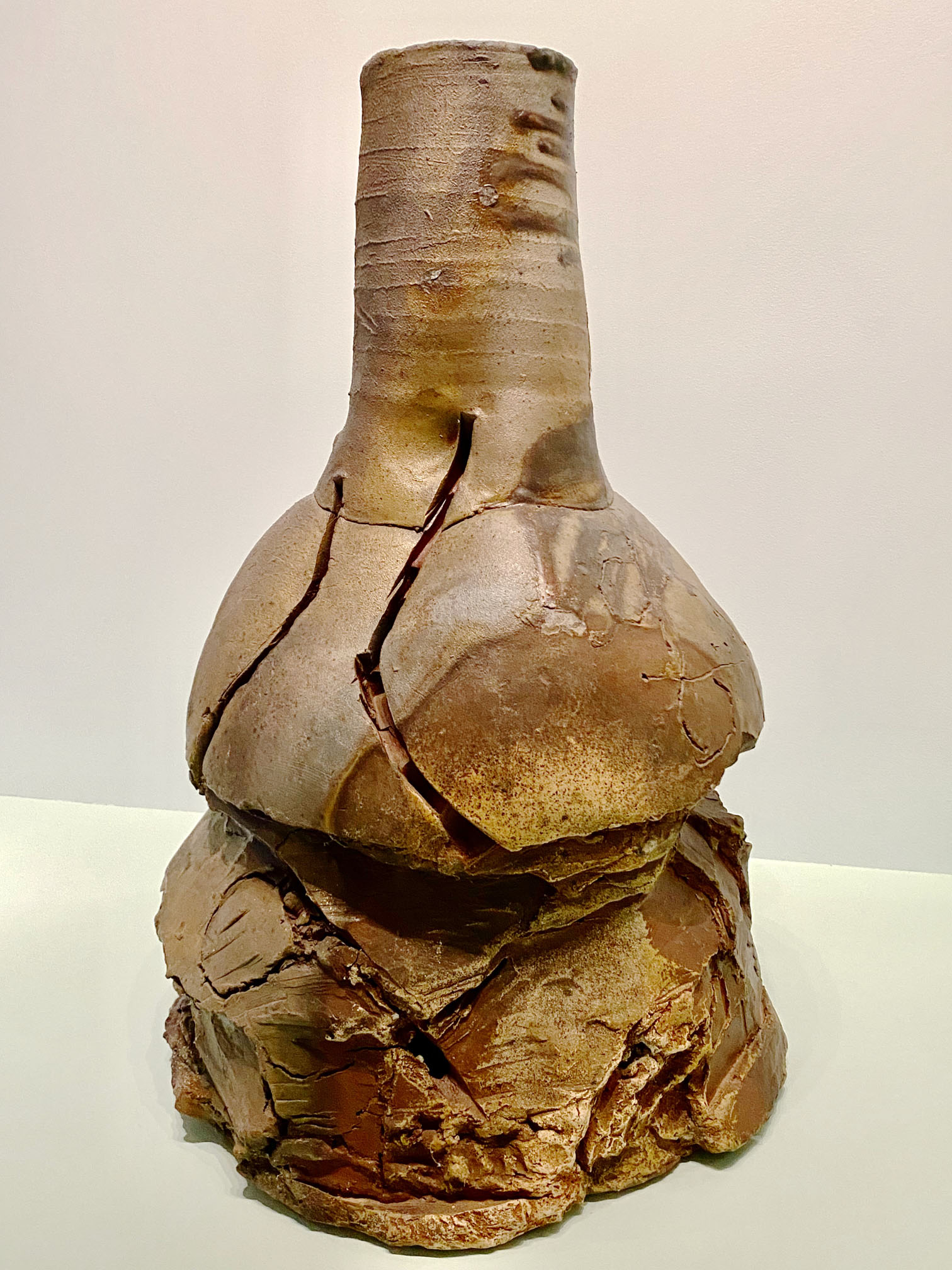
Frances Senska, her ceramics student, applied Wildenhain’s instructional principles to her own classes at Montana State, where student Peter Voulkos learned how to breathe new life into clay. Voulkos shashed, prodded, and poked clay, vigorously transforming the humble medium into wild, dramatic expressions.
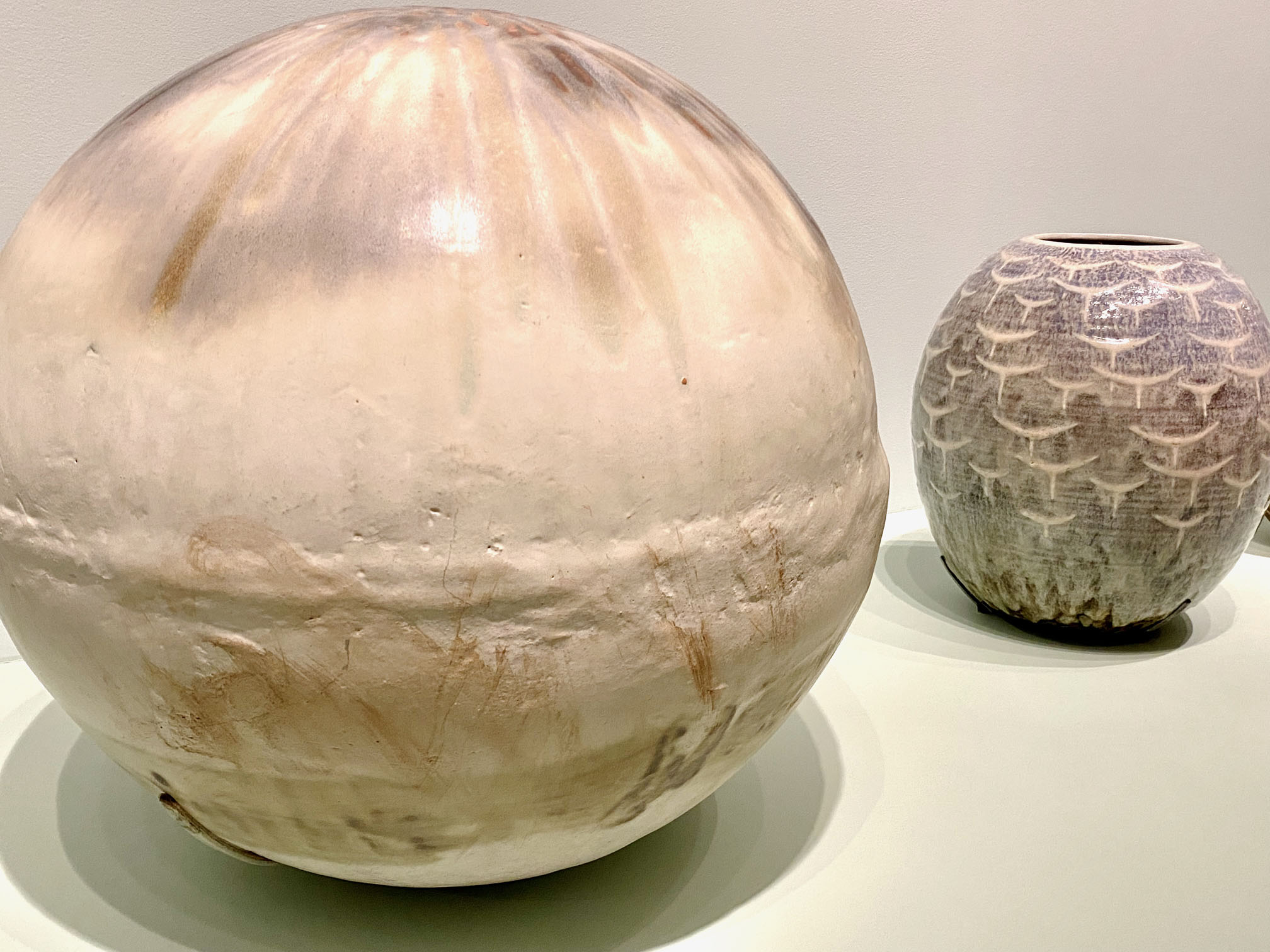
Peter Voulkos’s 1992 stoneware Sibley, an example of his revolutionary approach to ceramic form.
Mary Ann Unger 1994 terra cotta Hoist – an approach to ceramic sculpture inspired by teacher Peter Voulkos
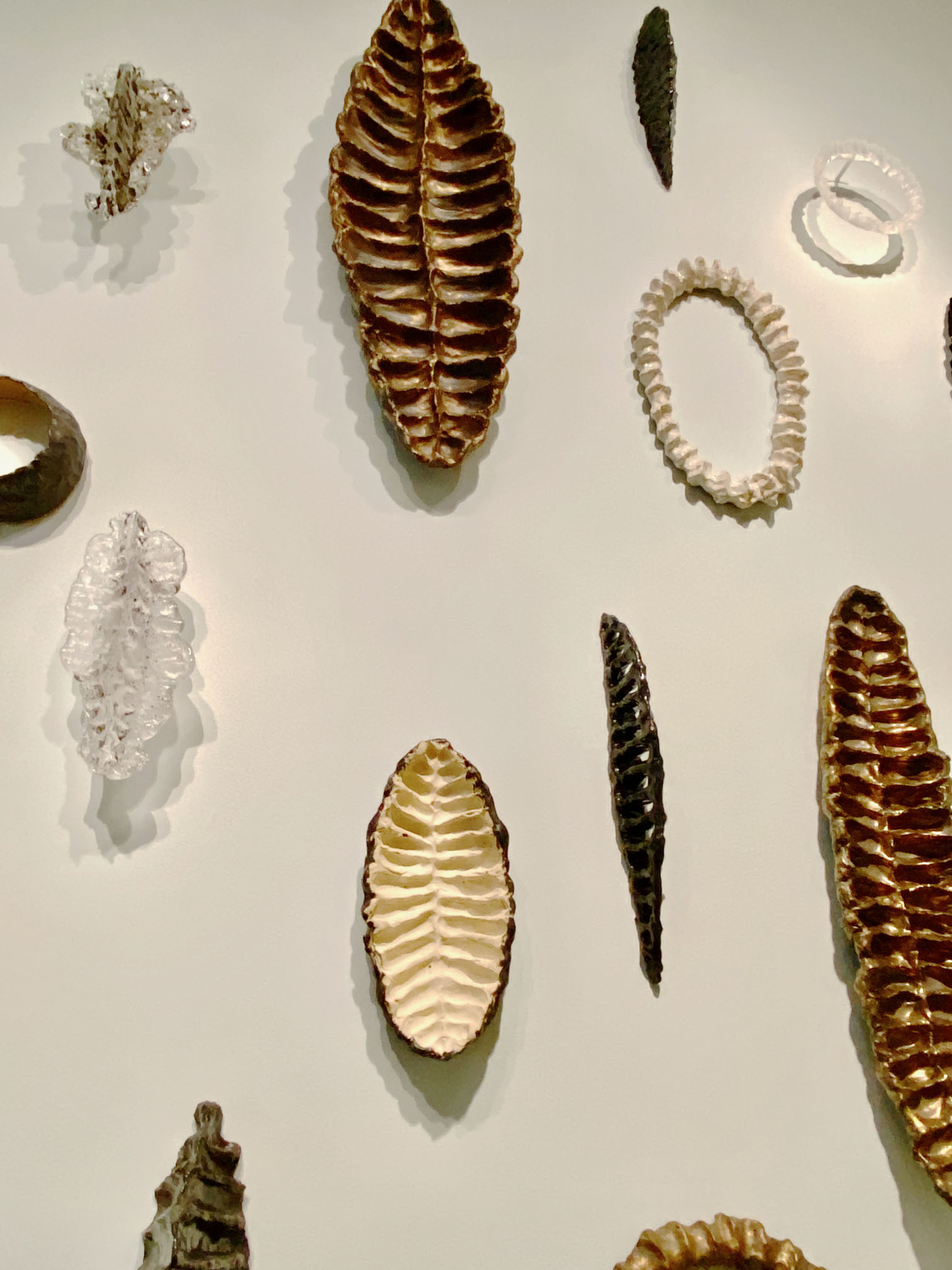
In turn, his UC-Berkeley student, Mary Ann Unger injected whimsey and improvisation into her sculptures, which allowed her daughter, Eve Biddle, to push it even further. MAD shows Biddle’s ingenious installation of creative ceramic geodes, trilobites, and spines crawling around the gallery wall.
Ceramics mentors even play a role in the development of America’s Studio Glass movement, which begins with Harvey Littleton, whose dad was a physicist on the first reasarch team at Corning Glass Works (he later developed Pyrex). MAD displays Harvey’s gorgeous glass arcs.
Work by student and teacher: Toshiko Takaezu’s 1995 stoneware Mist #2, part of her Moon series, with Maija Grotell’s 1953 glazed earthenware vase
On weekends, Harvey spent lots of time with his dad in the Corning lab, assuming he would follow in dad’s footsteps as a physicist at the University of Michigan. But after Harvey experienced UM art classes, he switched major. Eventually, he was specializing in ceramics under Maija Grotell at Cranbrook Academy of Art (who also taught ceramic superstar Toshiko Takaezu).
Littleton’s travels to observe the Italian glassmaking masters at Verano inspired him to apply his kiln and physics skills to experimental glassmaking. Back home, e pioneered low-temperature glass-blowing techniques that enabled glass artists to create work in studio setting and not a factory.
Littleton achievement was established the first university-based glass-blowing program at University of Wisconsin-Madison. A lucky undergraduate, Dale Chihuly, learned from the master, and the rest was history for American glass making.
Glass sculptures by teacher and student – 1983 Double Blue Arches by innovator Harvey Littleton and 1968 Wine Bottle by created by Dale Chihuly in Venice under a Fulbright Fellowship.
After receiving his MFA in ceramics at RISD, Chihuly traveled to Venice (like his mentor), and observed how the team worked together to create a finished work of glass art. In 1971, he founded Pilchuk Glass Works in Washington State, where he emphasized the collaborative, collective process. Chihuly’s own sculptural wonders emerged, plus the next generation of indigenous glass artist gained experience in collaborative expression – Tony Jojolla and Preston Singletary.
There are many more stories told in this illuminating exhibition from the MAD collection. Take a look in our Flickr album.
Tony Jojolla’s 1996-1997 Large Glass Olla, a traditional Pueblo pot made of glass at Dale Chihuly’s Pilchuk School; at right, Chihuly’s 1978 Untitled Basket
Ascending the ramp inside the Guggenheim Museum to enjoy Harmony and Dissonance: Orphism in Paris, 1910-1930, European optimism and color abound. The exhibition, on view through March 9, 2025, showcases the exuberance and innovation of artists living in early 20th century Paris, who felt exhilarated by the profusion of modern forms of music, dance, and architecture and used abstraction and prismatic color to translated their enthusiasm.
Avant-garde power couple Robert and Sonia Delaunay broke from analytic cubism’s monochromatic approach and injected pulsing color into the art-scene conversation in Paris.
Robert Delaunay’s 1911-1912 Red Eiffel Tower – modern architecture and cubism with a twist of color.
Inspired by 19th century color theory (wheels demonstrating complimentary and dissonant colors), they painted swirling orbs pulsing with harmonies and contrasts to show optimism about the future.
Modern buildings like the Eiffel Tower, electrification of city streets, and the syncopation in dance-hall music created a pre-war energy in Paris that motivated these “orphists.” Everything seemed to be happening simultaneously. Harmonious and dissonant colors and whirling shapes on large canvases seemed a good way to represent it, as shown in the Guggenheim’s fun musical promo:
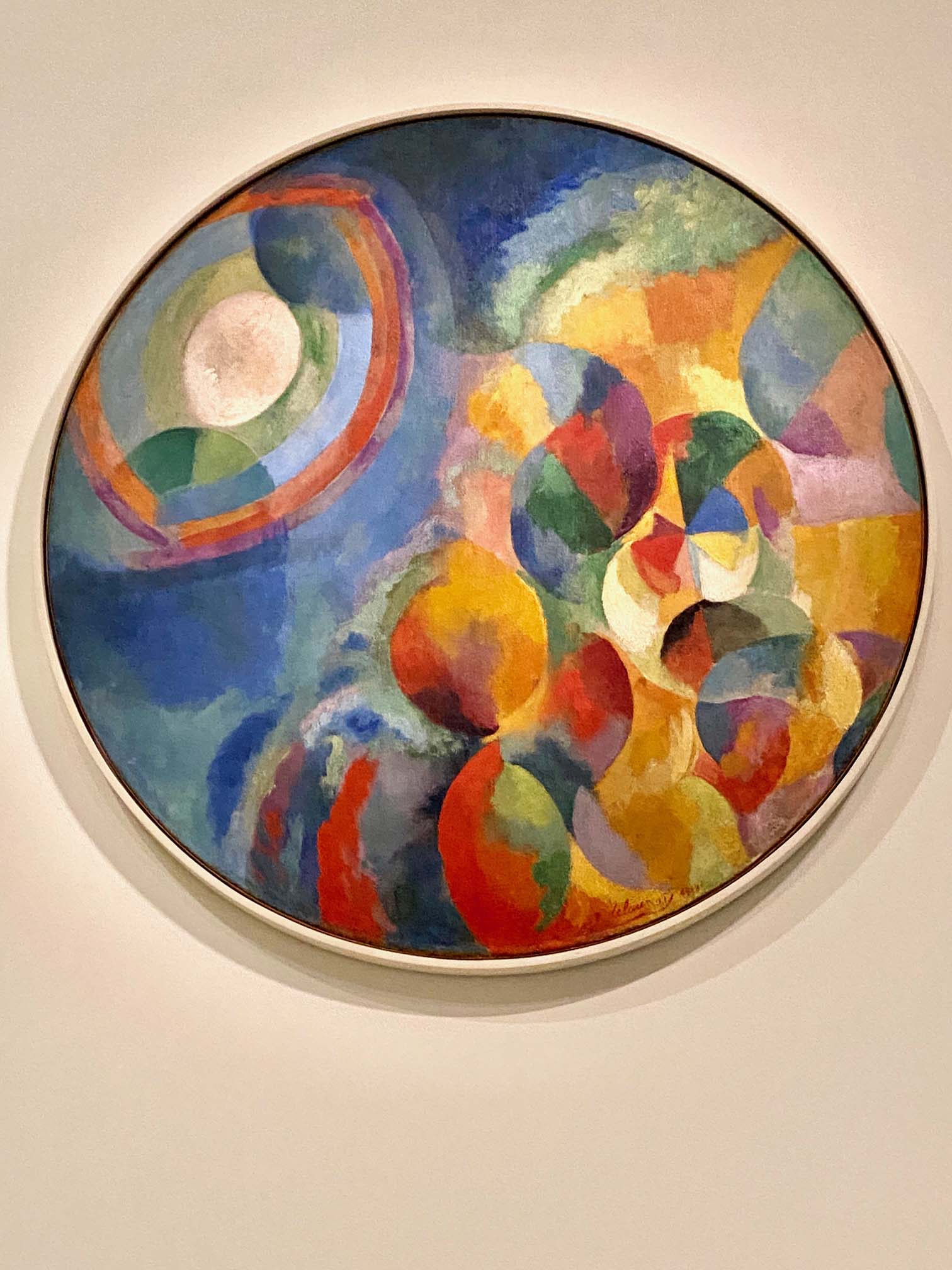
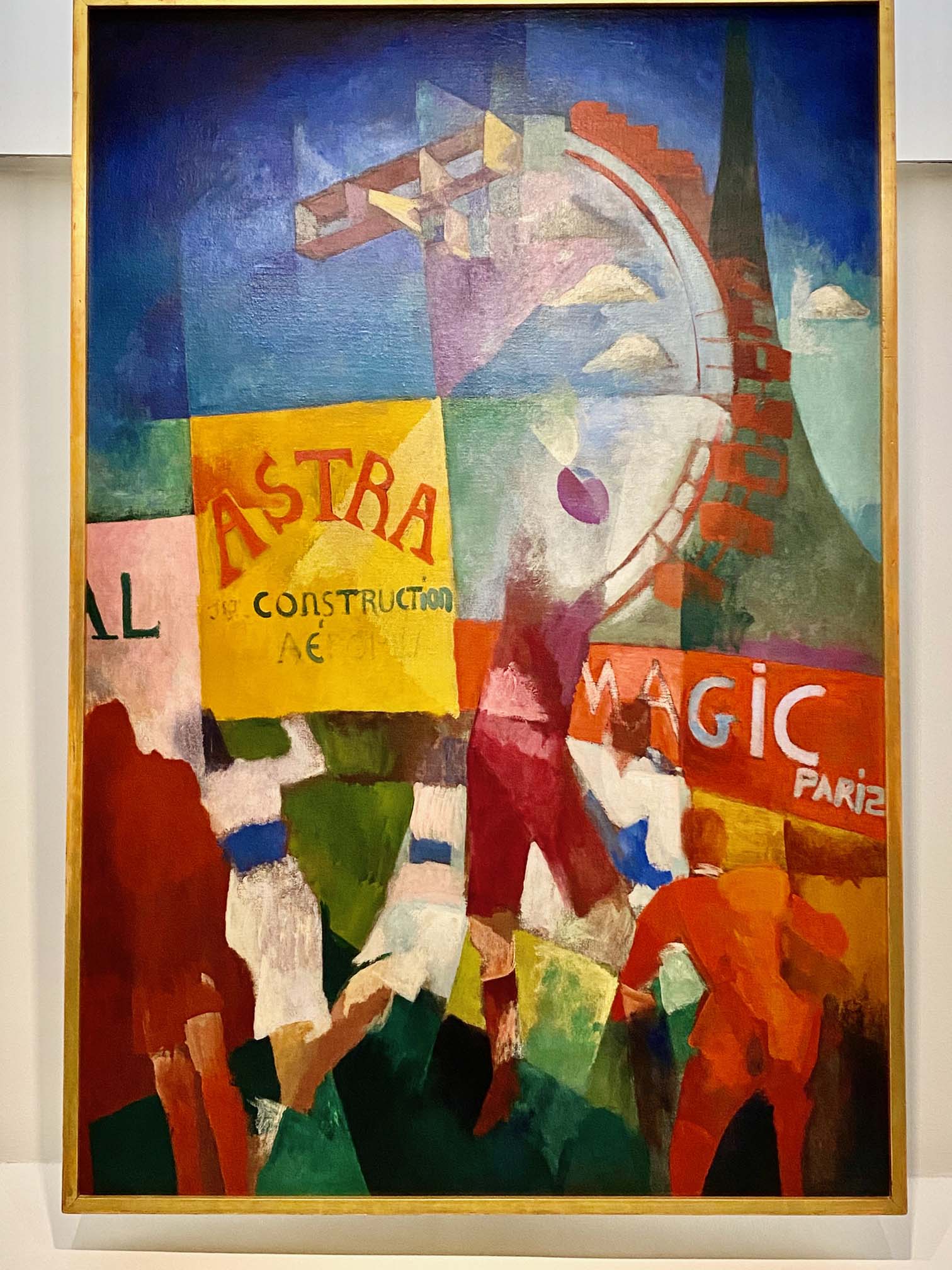
The style was named “orphism” by none other than Apollinaire himself. Robert Delaunay’s works in the exhibition include some of his early experimentation with abstract oval “windows,” his abstract riffs on the cosmos, and canvases still showing a hint of the real world. All convey the simultaneous push-pull of Paris, modern life, and larger scientific forces.
Robert Delaunay’s 1913 Simultaneous Contrasts: Sun and Moon. Courtesy: MoMA
Robert Delaunay’s 1913 The Cardiff Team, with Eiffel’s tower, aerial achievements, and sports dynamics. Courtesy: Van Abbemuseum, The Netherlands.
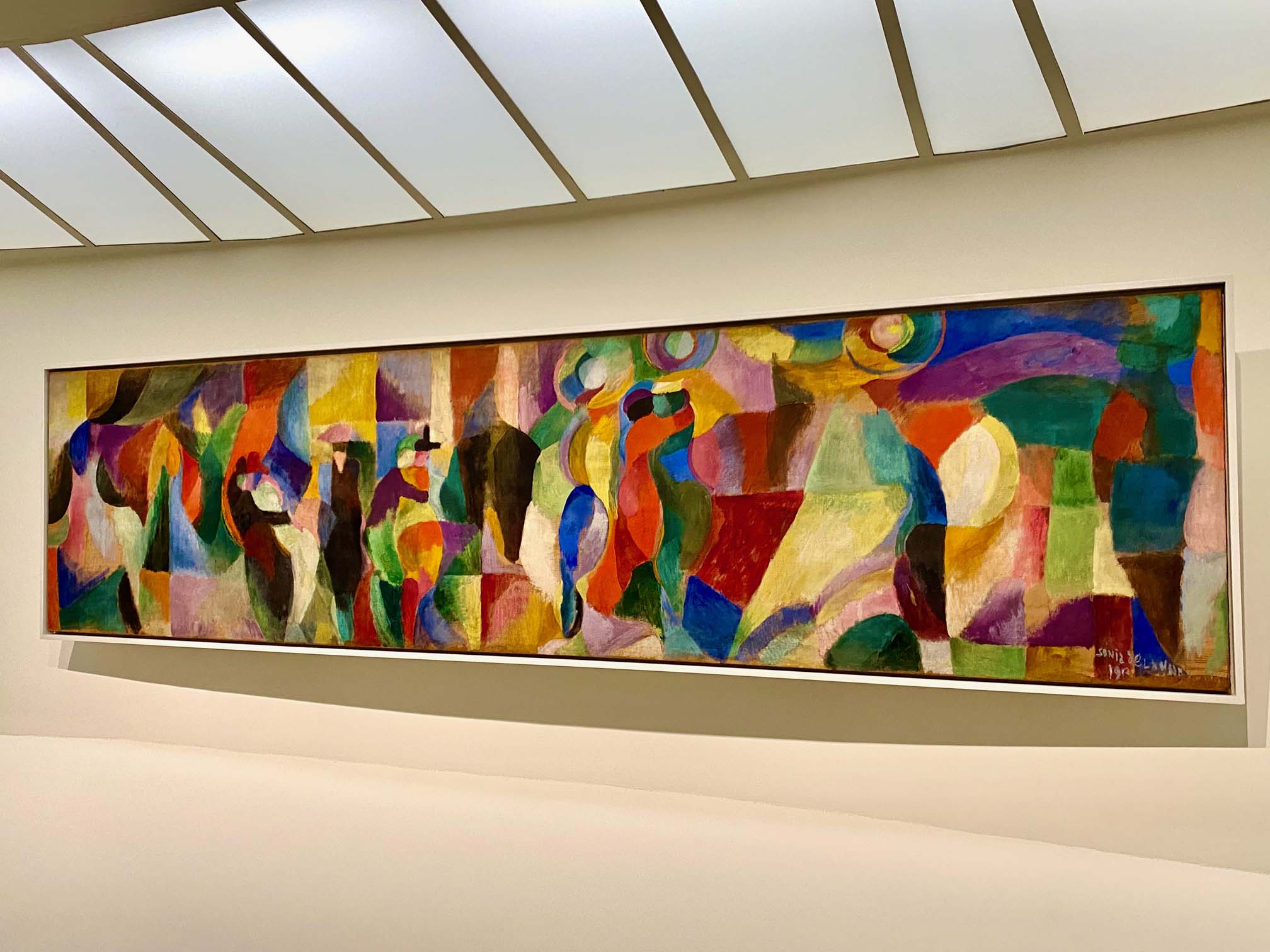
Many of Sonia’s orphist paintings are featured, including a gigantic horizontal color work inspired by the dynamic movement of tango dancers at a popular Parisian club. No doubt the massive 2024 Bard Graduate Center Gallery show about her forays into fashion and other creative fields (Sonia Delaunay: Living Art) influenced the Guggenheim curators to include her painted toy box and her celebrated super-tall accordion-book painting representing her collaboration with poet Blaise Cendrars.
Sonia Delaunay’s 1913 oil Bal Bullier inspired by dynamism of tango dancers at the popular Parisian club. Courtesy: Centre Pompidou
Innovations by the Delaunays are placed alongside other artists’ works that reflect the artistic breakthroughs of the early Twentieth Century – Kandinsky’s abstraction, the Blue Rider group’s symbolic use of color, and the synergies that artists felt between abstraction and music. In 1912, Leopold Survage intended to create the first fully abstract film, but the project was halted by World War I. Fortunately, we can envision his plan from his series of dynamic color drawings.
Colored Rhythms series of twelve 1912 ink drawings created by Léopold Survage for the first abstract film. Courtesy: La Cinémathèque Française
The music that inspired the Orphism is referenced throughout the exhibition – the improvisation and free structure of jazz, the dissonance of cutting-edge experimental music, and the staccato of the latest Parisian dance-hall craze – Argentine tango. The curators have even provided musical tracks to underscore this influence.
The Italian futurists Balla and Severini are also featured. Speed, modernity, and simultaneous city sensations were their bread and butter, too, even though they argued in the press and art journals that Futurism and Orphism were totallydifferent.
Italian futurist Giacomo Balla’s 1914 Mercury Passing before the Sun, an allusion to recent cosmic events. Milan’s Museo del Novocento.
Gino Severini’s 1915 Dancer–Propeller–Sea. Courtesy: The Metropolitan Museum
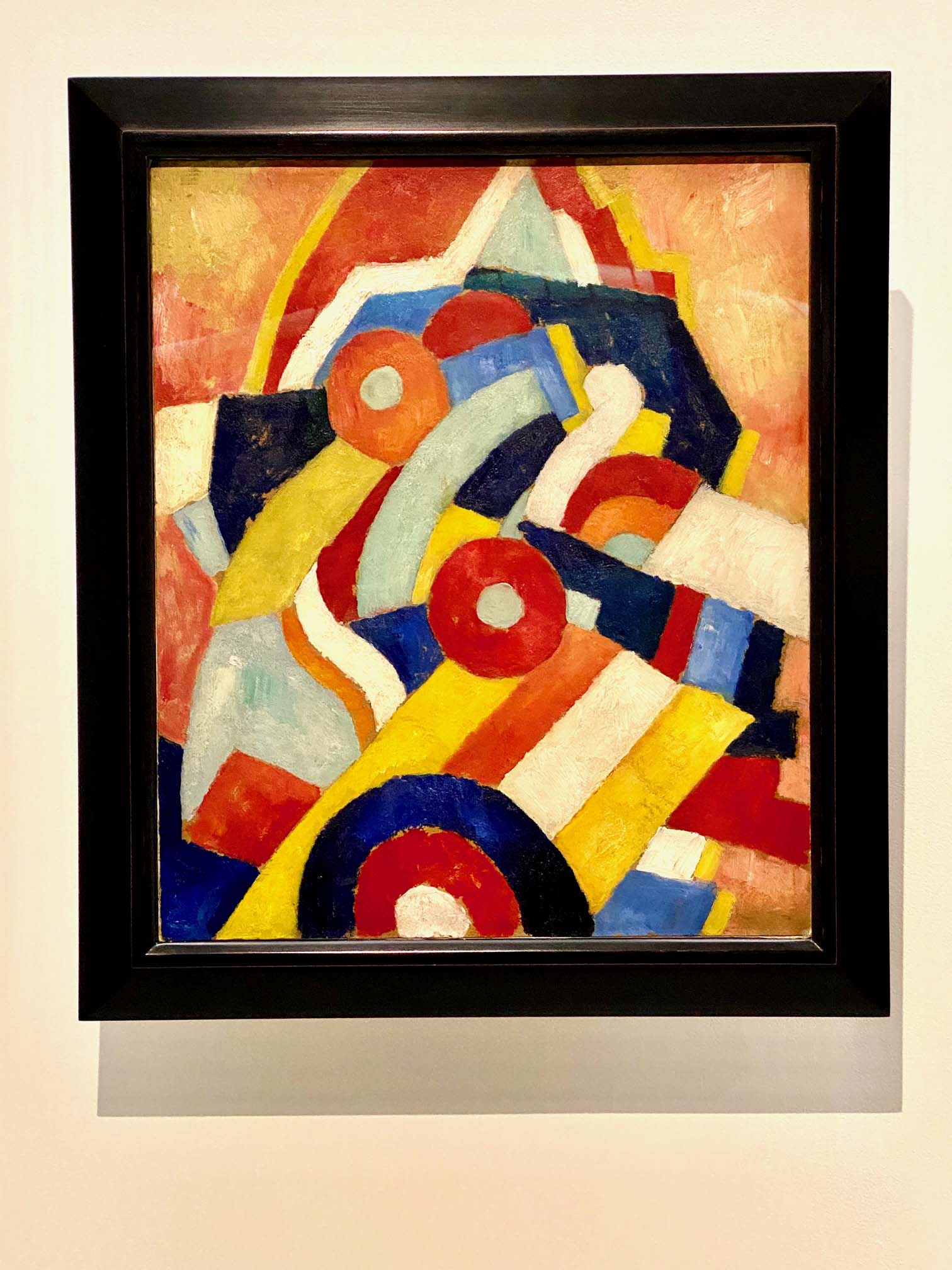
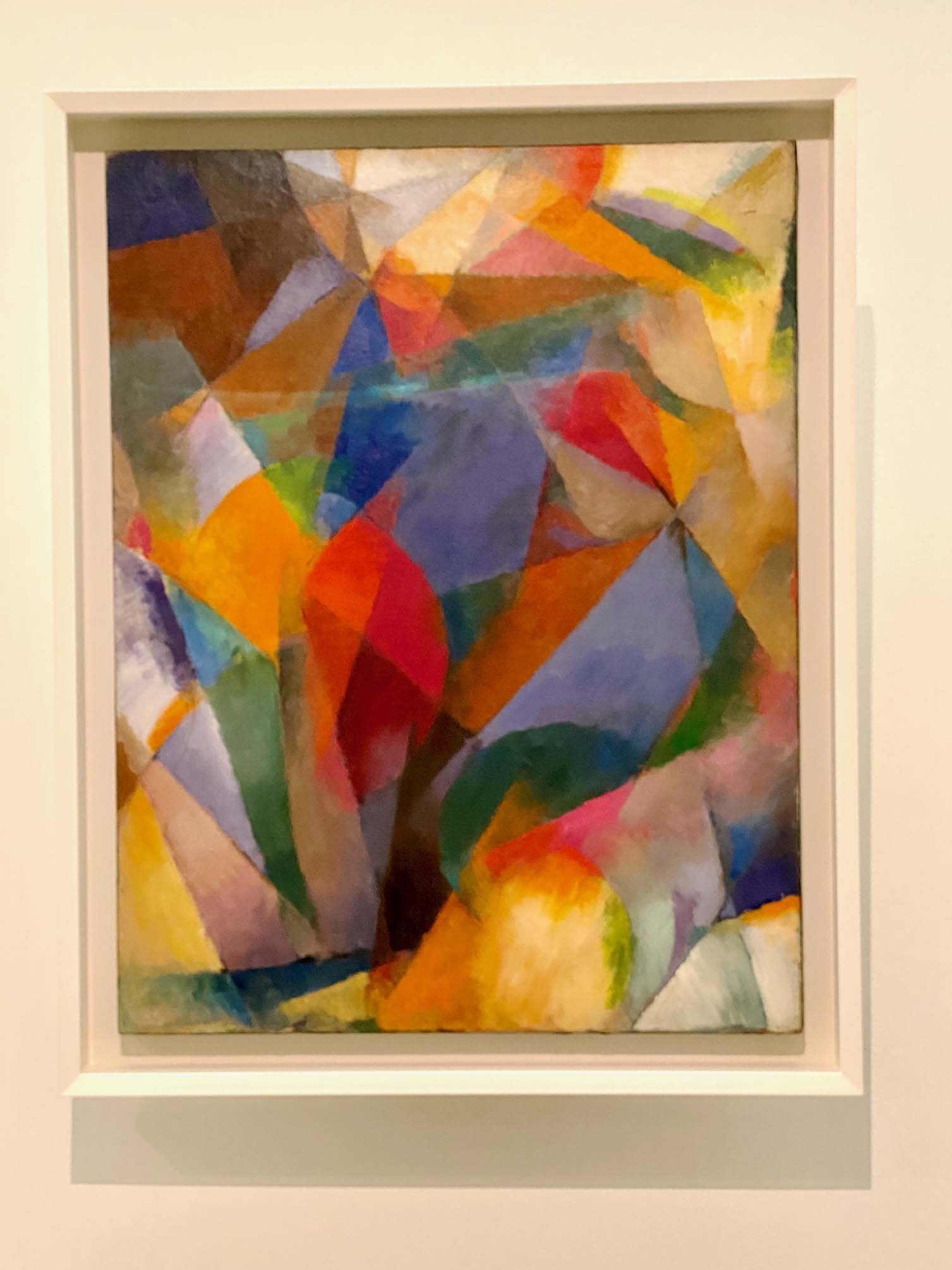
In pre-war Paris, American modernist painters Marsden Hartley, Stanton Macdonald-Wright, and Morgan Russell picked up on Orphism, although the latter two rebranded their work Synchronism when they wrote their manifesto.
Marsden Hartley’s 1914 Abstraction Courtesy: The Museum of Fine Arts, Houston.
Even after the War, the Delaunays continued to represent orphism even if they occasionally incorporated real-world elements. Early orphism adopter Albert Gleizes also continued in this style throughout his career, and inspired students like Mairnie Jelett to explore color theory and its potential.
Albert Gleizes’s 1942 Painting for Contemplation, Dominant Rose and Green.
Irish artist Mairnie Jellett’s 1938 Painting. Courtesy: National Museum, NI, Ulster.
Take a look at our favorite works in our Flickr album here, and enjoy a syncpated strut through the colorful side of Modernism in this catalog preview:
Building on the groundwork laid in the artist-curated exhibition Grounded in Clay: The Spirit of Pueblo Pottery (opening in St. Louis on March 7), Santa Fe’s Museum of Indian Arts and Culture asked five Navajo textile artists, photographers, and scholars to delve into MIAC’s historic collections to tell the story of Diné weavng.
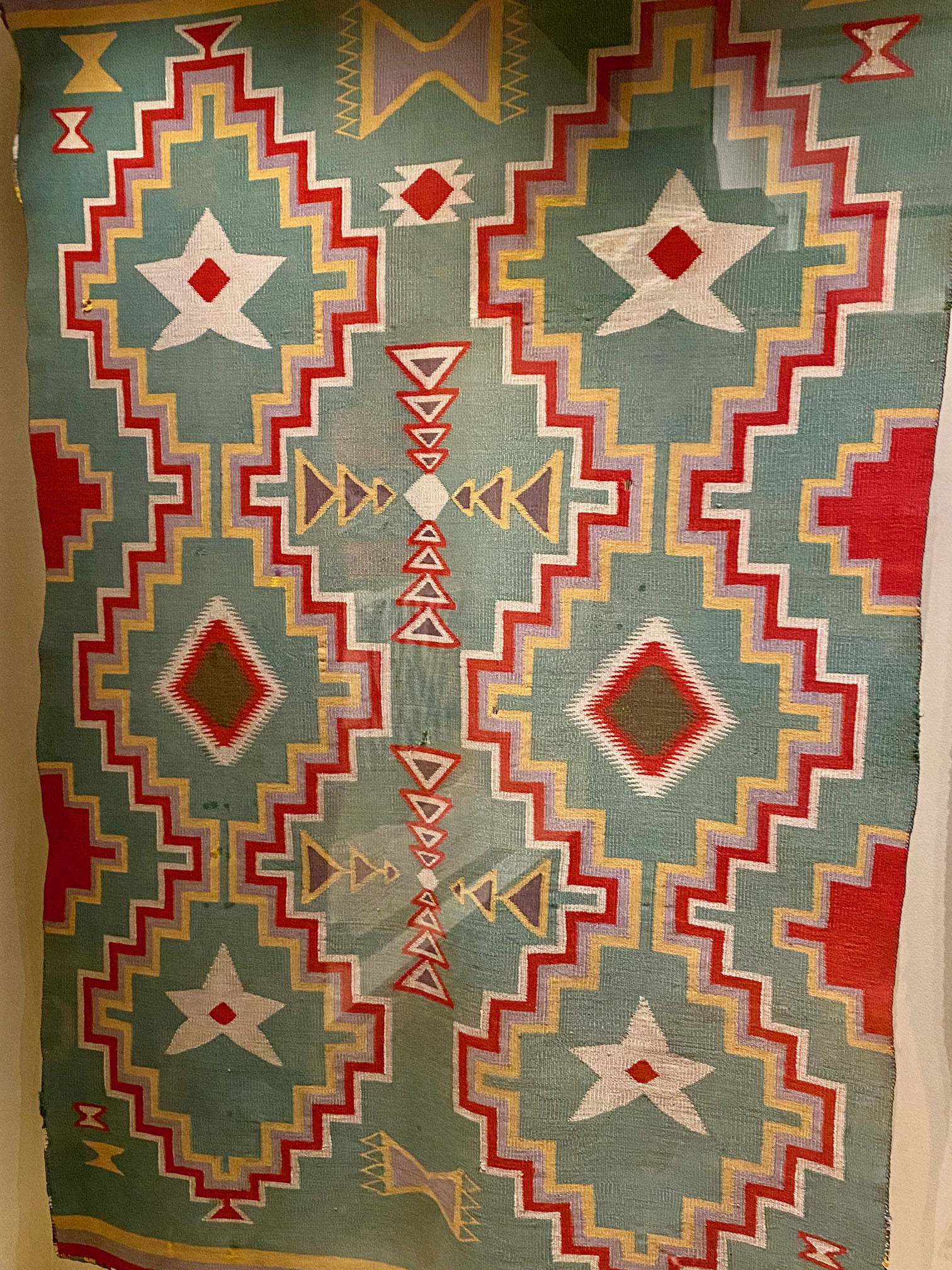
Horizons: Weaving Between the Lines with Diné Textiles, on view through February 2, 2025, presents historic and contemporary weavings alongside epic photographs of Navajo Nation landscapes to show the connections textile artist have to ancestors, their mentors, the community, the land, and their materials.
Historic Diné weaving with photomural by co-curator Rapheal Begay. Courtesy: the artist.
Appropriately, the story told by over 30 historic textiles is presented in MIAC’s Masterpieces gallery.
The entrance presents a dazzling display – a pictorial blanket woven in the 1890s set against a photomural of co-curator Rapheal Begay’s family sheep corral. It’s a visual testament to the importance of wool, life, and the 27,000 square miles of Navajo Nation.
The blanket’s creator (unknown today) was an astute observer of the life on the land and translated it all into warp and weft – cow punchers, cattle, boots, birds, and new-fangled railroad cars, that only arrived in Navajo Country around the 1880s. Click here to see the detail.
1885 pictorial blanket created with Germantown wool yarn introduced in the Southwest by the railroads; photomural Navel (Hunter’s Point, AZ) by co-curator Rapheal Begay. Photo courtesy of artist.
Nothing was newer than the railroad, at the time this artist depicted it – a steam-fed invention from the East that would change western life forever, but that also brought a wide array of colorful yarn that could be mixed and matched with vegetal dyes to create new Native designs.
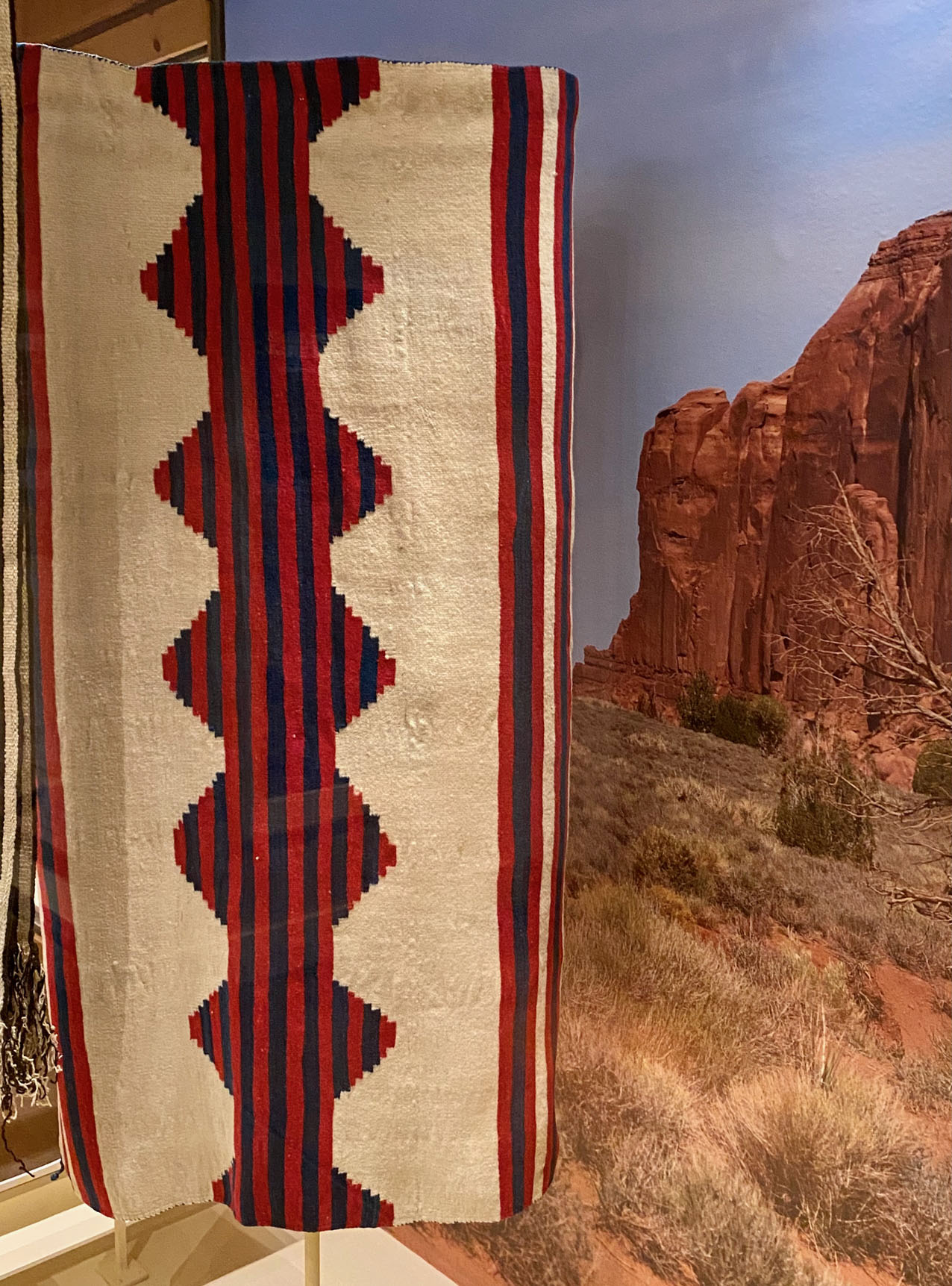
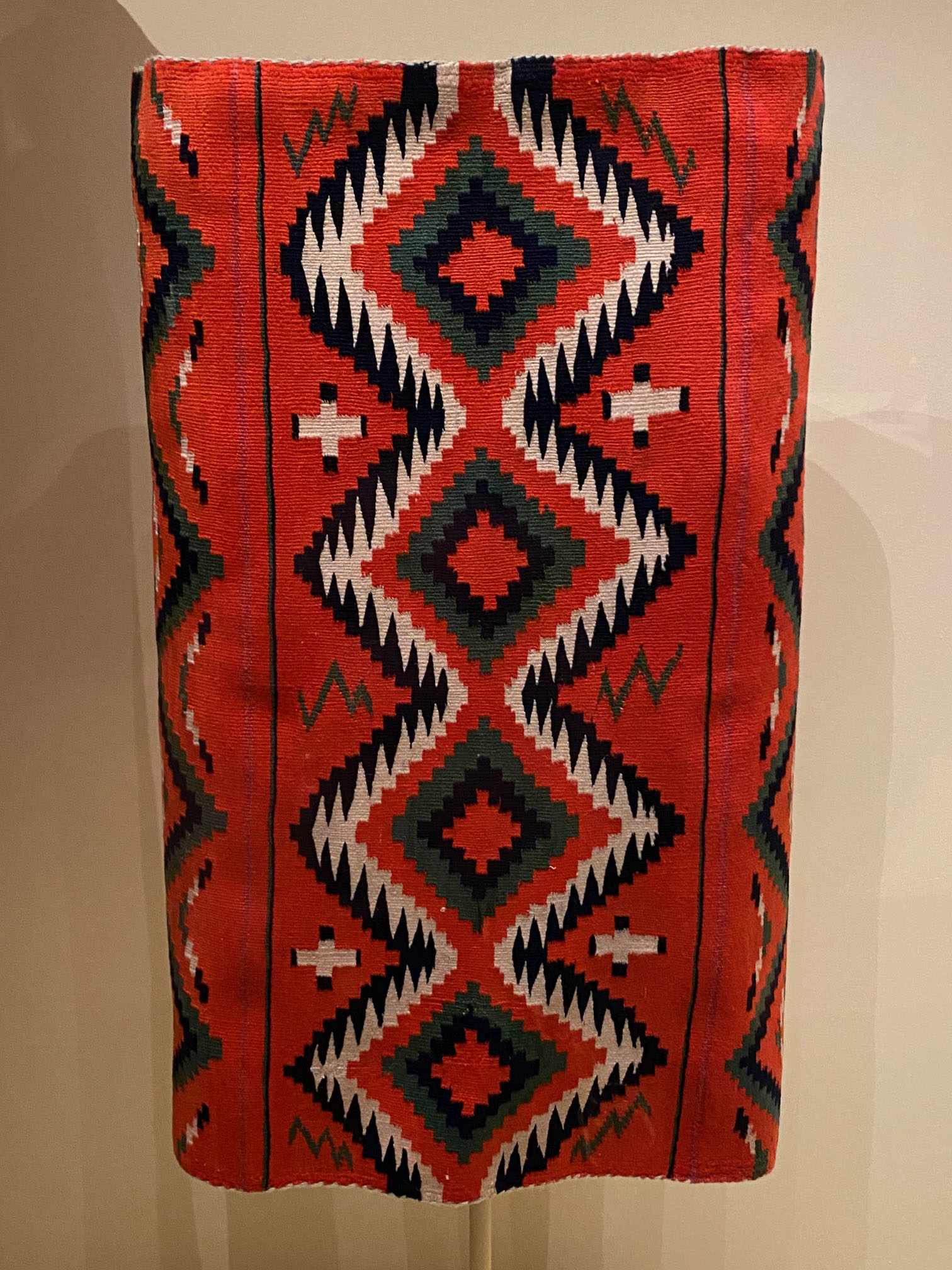
The intertwined history of Diné (“The People” in the Navajo language), textile art, and the land is told through quotes and recollections by the exhibition’s Native collaborators. While examining masterful geometric weaving techniques in 19th-century works, visitors are provided with an historic context – the types of art materials introduced to captives imprisoned at Bosque Redondo after the Long Walk, the images that could be interpreted as a longing for the homeland by the incarcerated, and coded spiritual affirmations.
1850-1860 hand-spun wool child’s (or saddle) blanket with Spider Woman crosses; created with natural cocineal, indigo, and chamisa dye
1880-1897 rug made with Germantown wool yarn, cotton string, and raveled yarn; materials used in weaving at Bosque Redondo era, post-Long Walk.
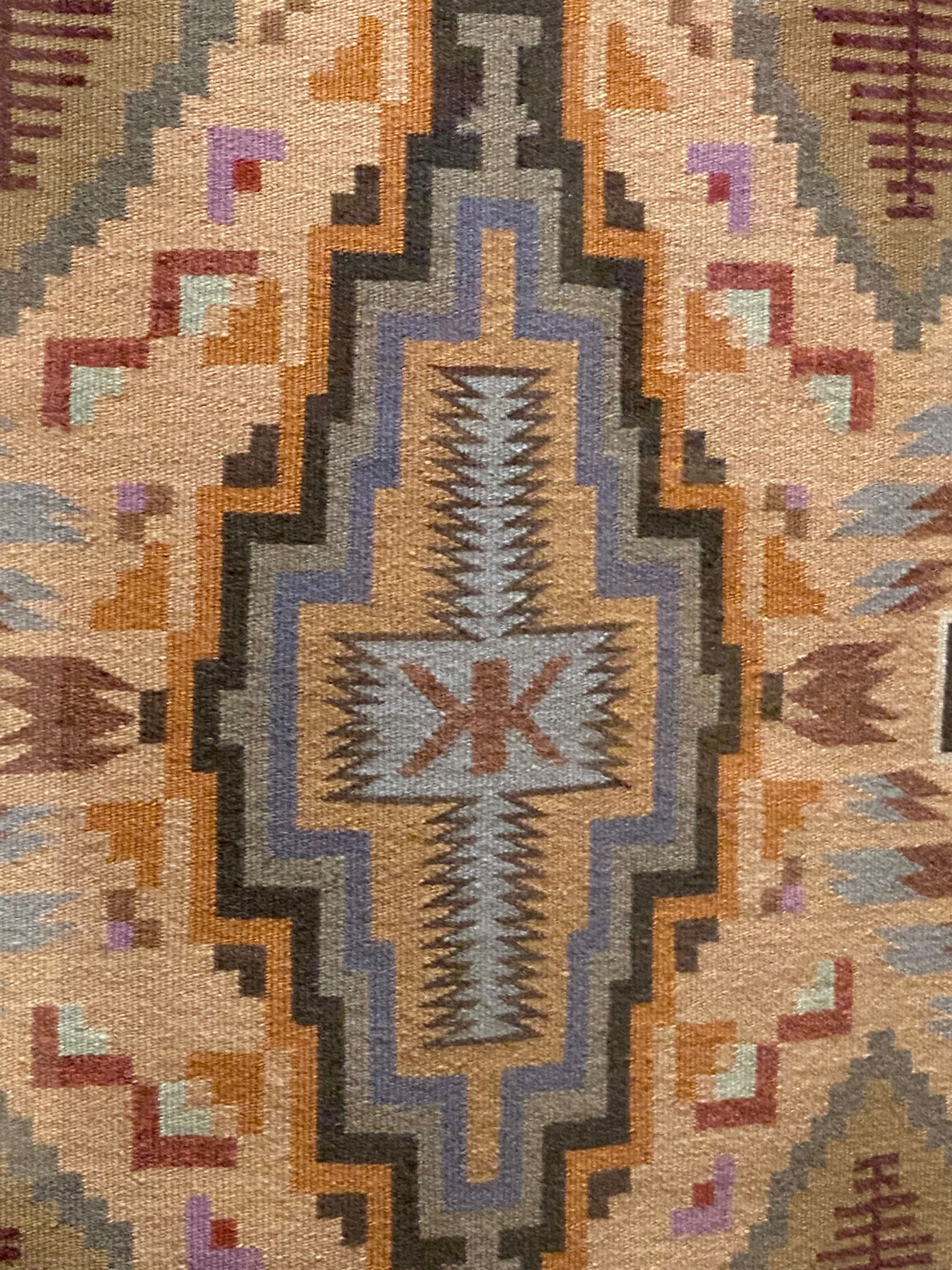
The participants in the exhibition make sure that viewers also experience how the landscape inspires the work of the past and contemporary Native textile artists. Diné fiber artist Tyrrell Tapaha includes her two-panel dress in which incorporates images of the Utah clouds and mountains that bring her spiritual peace. The masterful wall hanging by Lillie Joe uses the palette of the desert to create a mesmerizing geometric dazzler.
2020 two-panel dress by fiber artist Tyrrell Tapaha with images from Utah landscapes that inspired her; woven from churro, silk, mohair, and marino wool..
Close up of highly detailed 1980s Burntwater wall hanging by Lillie Joe, reflecting colors and patterns of the Navajo Nation landscape.
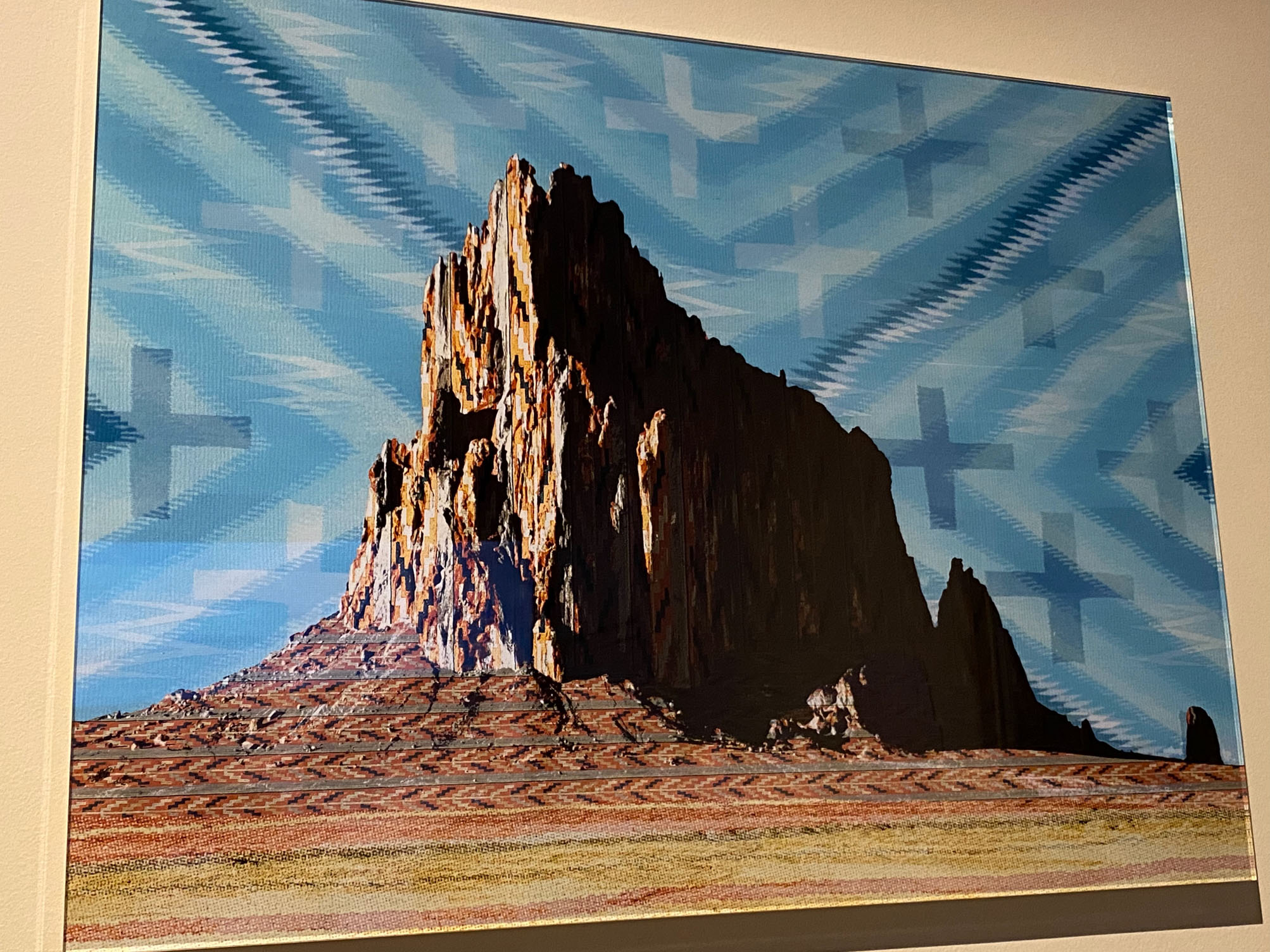
The curators feature both the photography of co-curator Rapheal Begay and Darby Raymond-Overstreet to allow gallery visitors to experience the awesome beauty of the homeland that inspires artists. Digital artist Raymond-Overstreet overlays geometric textile patterns across his luscious, beautiful landscapes.
2018 digital print Woven Landscape, Shiprock by Darby Raymond-Overstreet (Diné), overlaying digital landscapes with traditional weavings. Courtesy: the artist
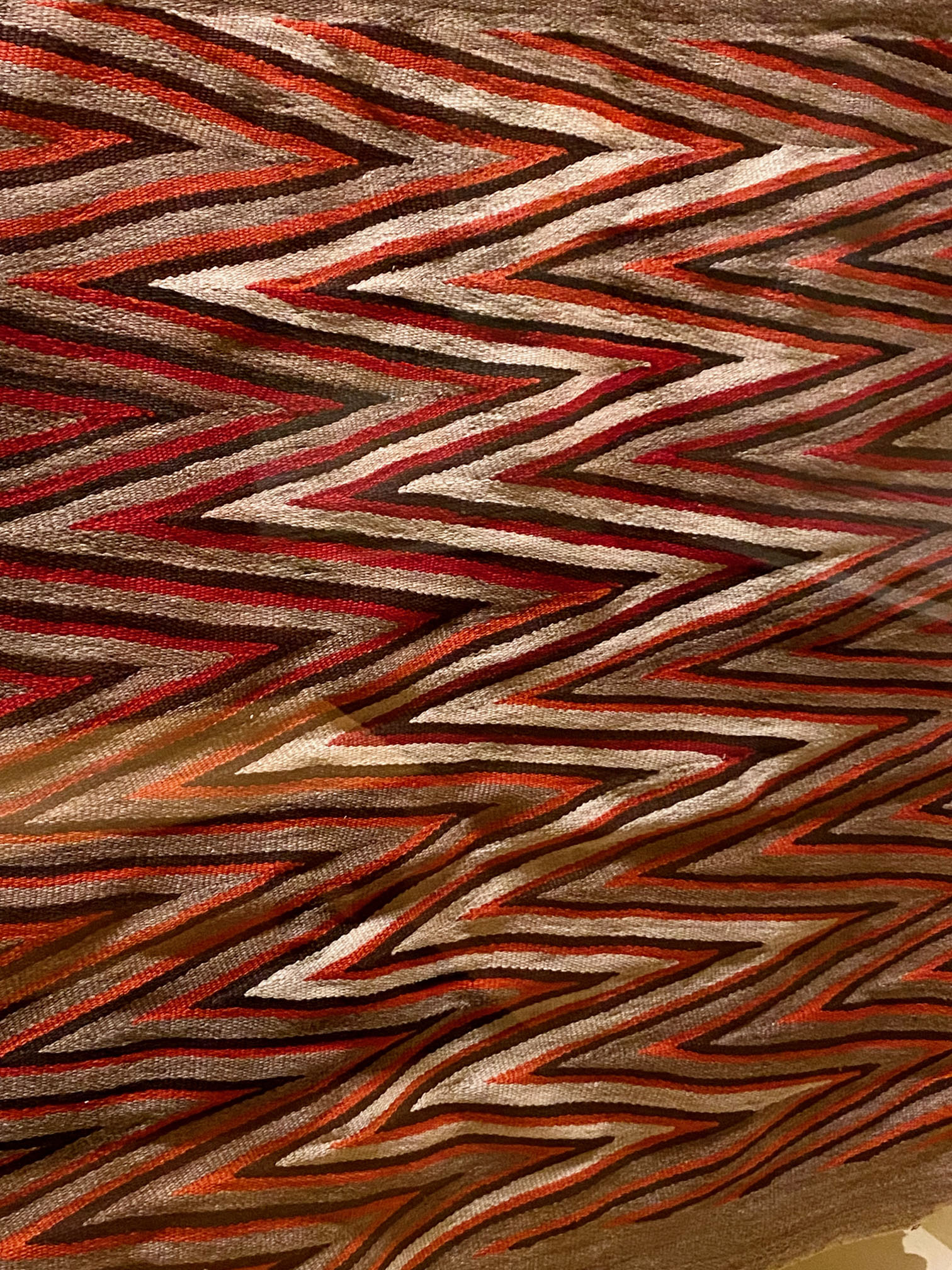
Take a look at some of our favorite works in our Flickr album. And enjoy these historic and contemporary dazzlers.
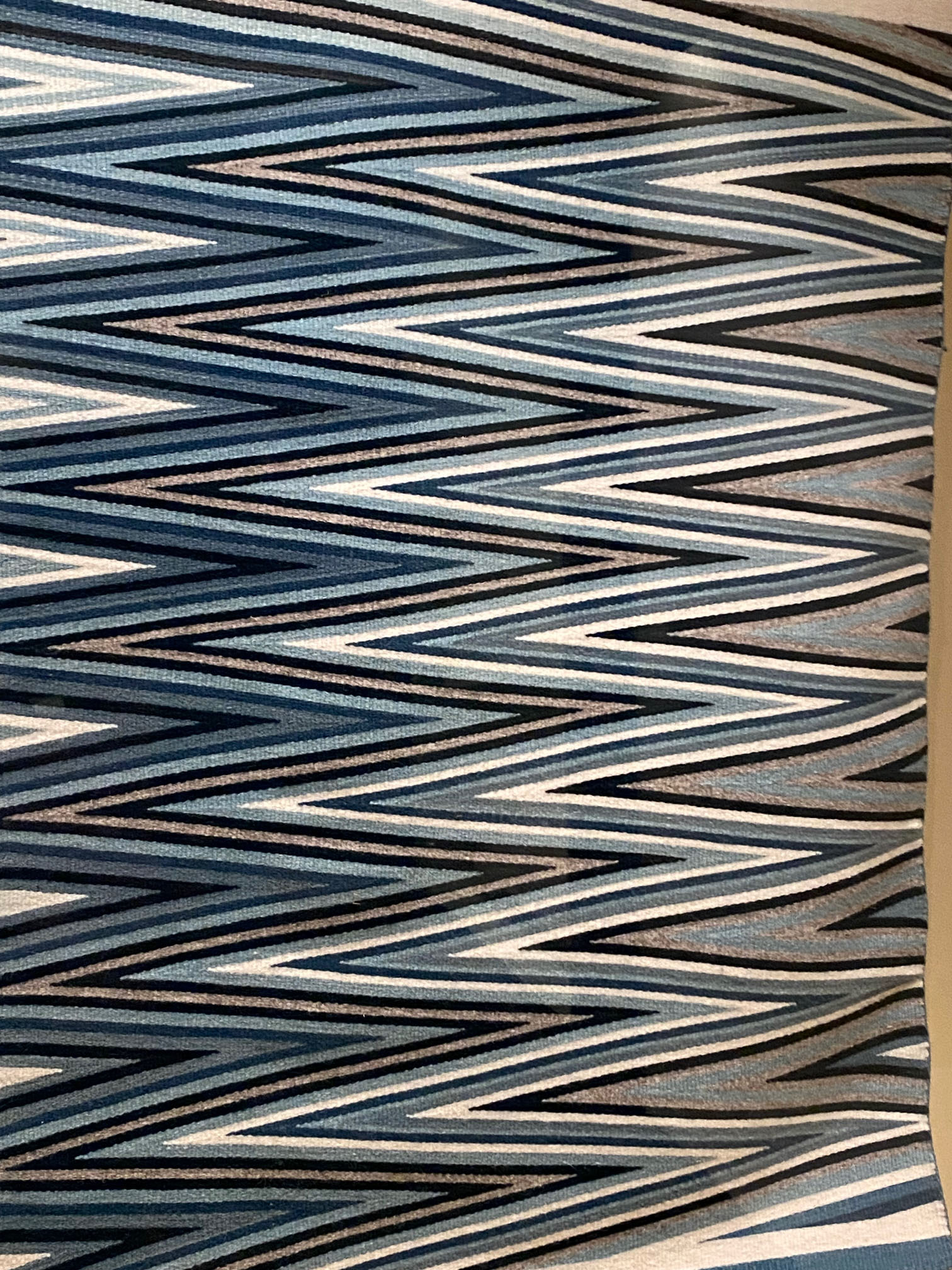
Detail of 1895 wedge weave blanket made with commercial cotton string and Germantown wool – a dramatic 19th c. weaving innovation. Courtesy: International Museum of Folk Art.
2022 wedge weave by Kevin Aspaas; white and grey wool yarn with indigo dye. Courtesy: private collection.
Detail of dynamic Diné 1960 wool tapestry weave. Courtesy: International Museum of Folk Art
2023 A Family of 4 red oak side chairs by LANZA Atelier (Isabel Abascal and Alessandro Arienzo).
Everything you could want from a design exhibition is packed into Have a Seat: Mexican Chair Design Today at the Denver Museum of Art through January 12, 2025 – history, context, videos, inspiration behind the designs, and…
Did we mention that you get to sit on the chairs?
The creative lighting and gallery layout invites visitors to take a journey that reflects Mexico’s ancient and colonial history – just like the work of the 22 designers featured here.
Everything on display is part of the Denver Museum’s permanent design collection,
The museum has created an environment that’s engaging and fun, so visitors seem to take time to read about the designers and the history of Mexican furniture while they sample the diverse range of furniture (“it’s more comfortable than it looks!”) as they wind their way through the clean, modern installation. View it all in our Flickr album.
Laura Noriega’s 2012 Your Skin chair made of walnut, handwoven cotton, and synthetic fabric, combining Japanese woodworking and Mexican textiles.
As you enter, you’re greeted by a tiny carved Guatemalan figurine from 300-100 CE, showing the type of simple thrones from which Olmec rulers or religious leaders might sit – a backless seat. Ancient civilizations are the inspiration for the innovative seats made by the first set of designers.
Some of these humble-looking stools by Camilia Apaez and HABITACIÓN 116 are made from stoneware, basalt and volcanic ash – harkening back to landscapes, environments, and simplicity that resonates with these forward-looking 21st century designers.
Camila Apaez’s 2002 stoneware Room in the Cave seats – inspired by deep associations with Paleolithic and Neolithic architecture and ceramics.
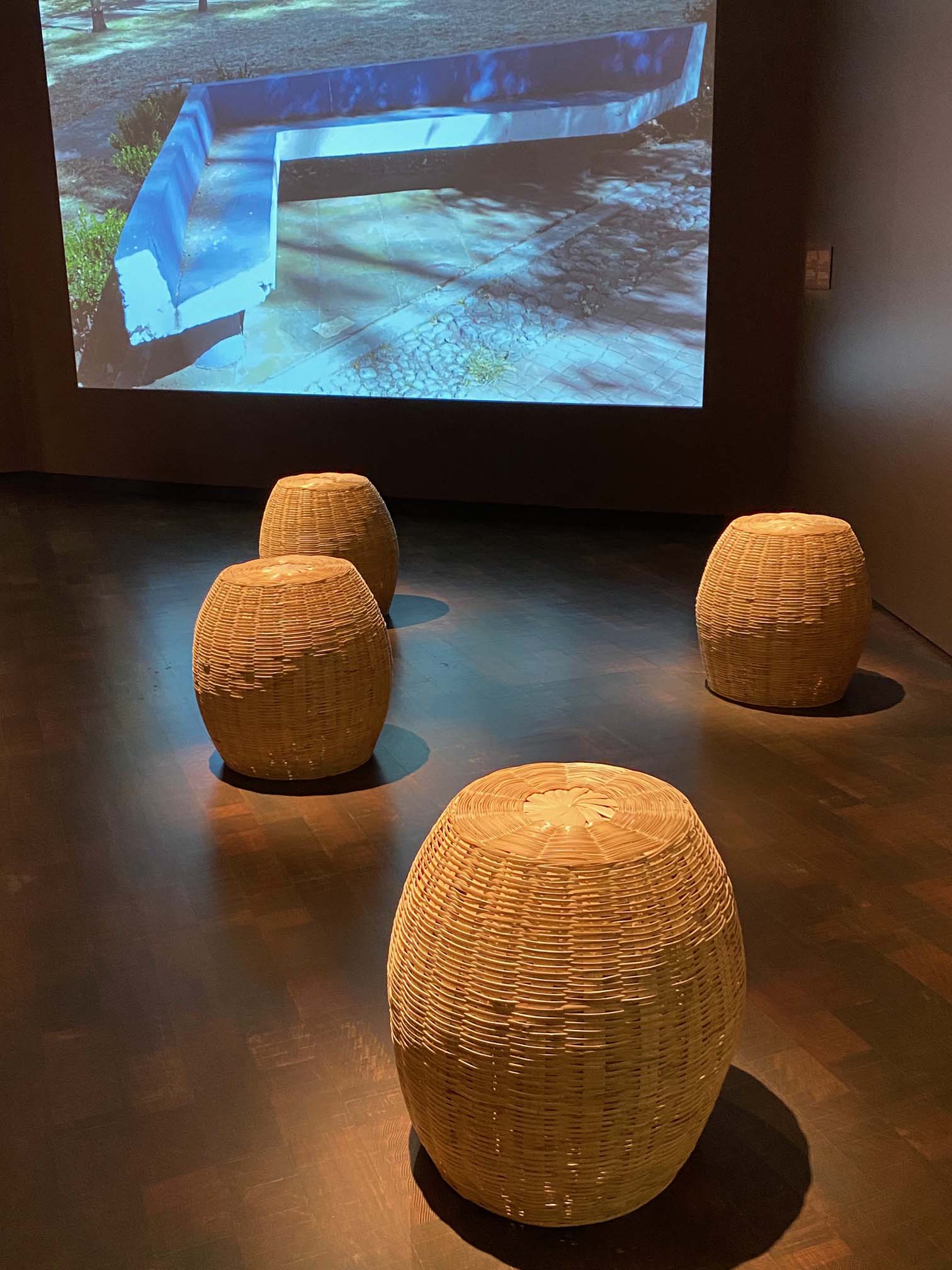
Raúl Cabra’s 2009 Bamboo seats made from carizzo reeds; video shows public seating.
Visitors are invited to sit and experience the enjoyment of relaxing in each of the exhibition areas – and many couples and families do! It’s nice to sit and watch the large-screen videos that take you on a trip around Mexico, showing you modern and traditional public seating areas along city streets and town squares.
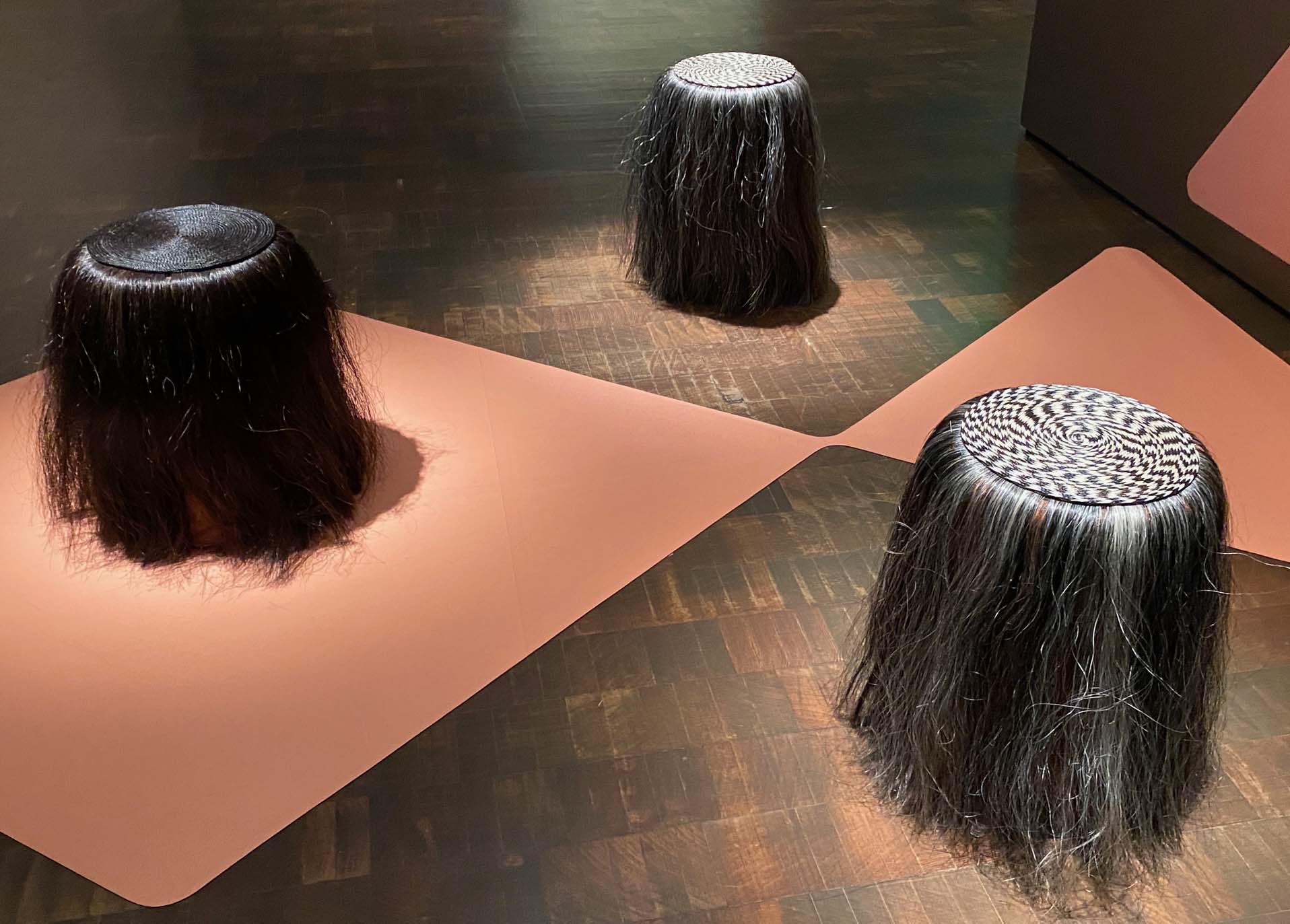
Not all of the stools are minimalistic, proven by the creations of Aldo Alvarez Tostado, who turned from architecture to making smaller pieces that enabled him to work with traditional Mexican weavers and woodworkers to invent seats that are run and new.
Aldo Alvarez Tostado’s 2022 Little Horse stools, made of wool and synthetic horsehair.
The second section of the show features the history and modern interpretation of easy chairs – comfortable seating that invites visitors to stay and enjoy. There’s an upscale Spanish Colonial chair to demonstrate traditional European design roots, surrounded by Ricardo Casas’s classy designs and Mauricio Lara Eguiluz’s funny foam take on the Yucatan’s Chac-Mool Mayan deity (always reclining comfortably!)
But if truth be told, all the visitors are having the most fun flopping onto the super-comfortable recycled “stuffables” by Andrés Lhima!
An array of comfortable easy chairs – the 2013 Clara design by Ricardo Casas and the 2005 polyurethane foam Chac Seat by Mauricio Lara Eguiluz
Andrés Lhima’s fun, portable easy chairs – comfy 2011 plastic mesh Fidencio chairs filled with shredded foam and recyclables.
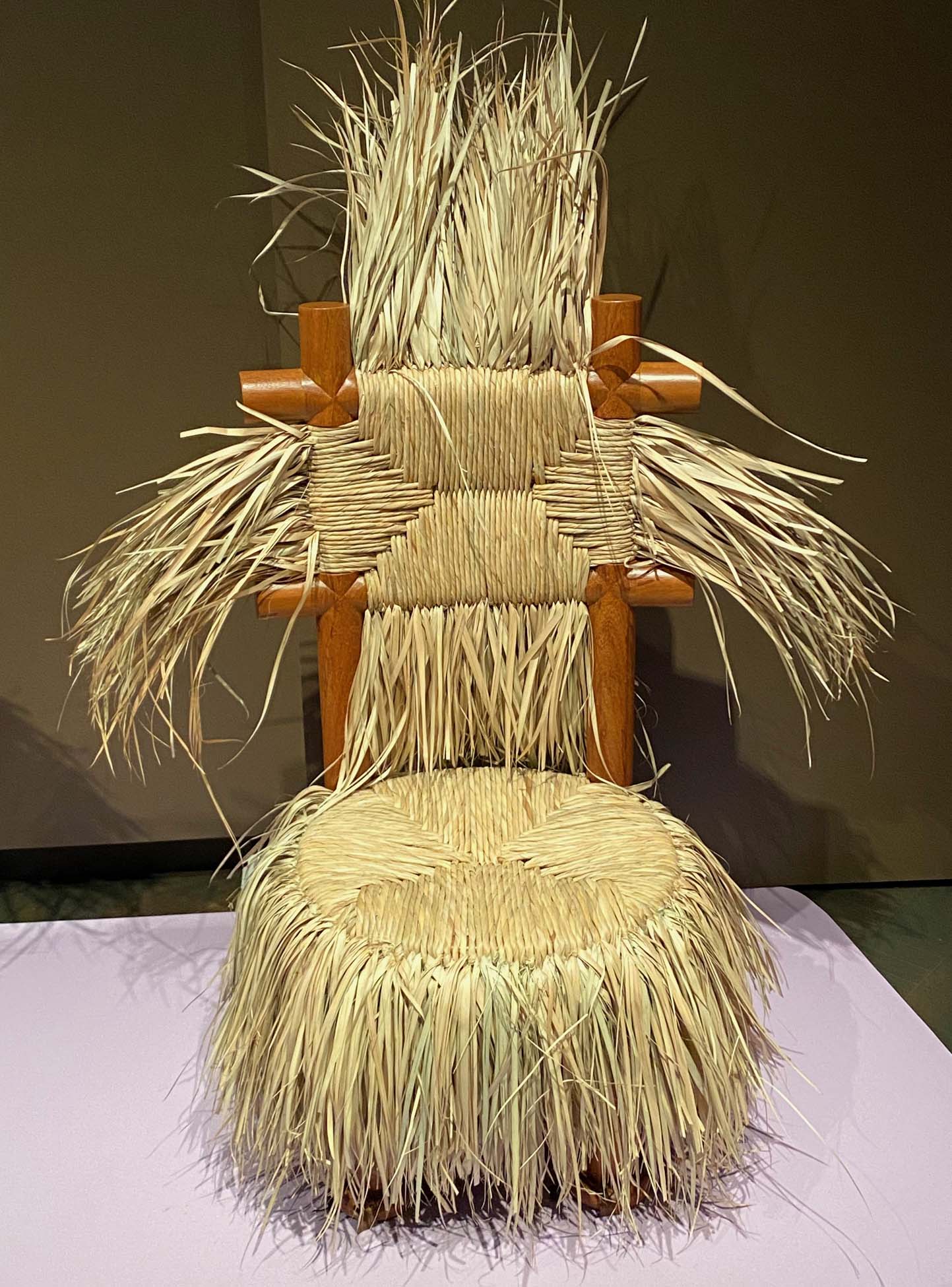
The final section pays tribute new takes on the Spanish side chair, comparing a 19th-century classic with high-style sets by Oscar Hagerman and La Metropolitana and outrageous reinventions by Estaban Calcendo Cortés. You can feel the Afro-Colombian rhythms in his woven palm chairs.
A highly decorative painted 1800s Mexican side chair.
2022 Palapa side chairs by Estaban Calcendo Cortés – inspired by Afro-Mexican and Colombian cultures
To learn more about the designers and their inspiration, scroll through the exhibition guide.
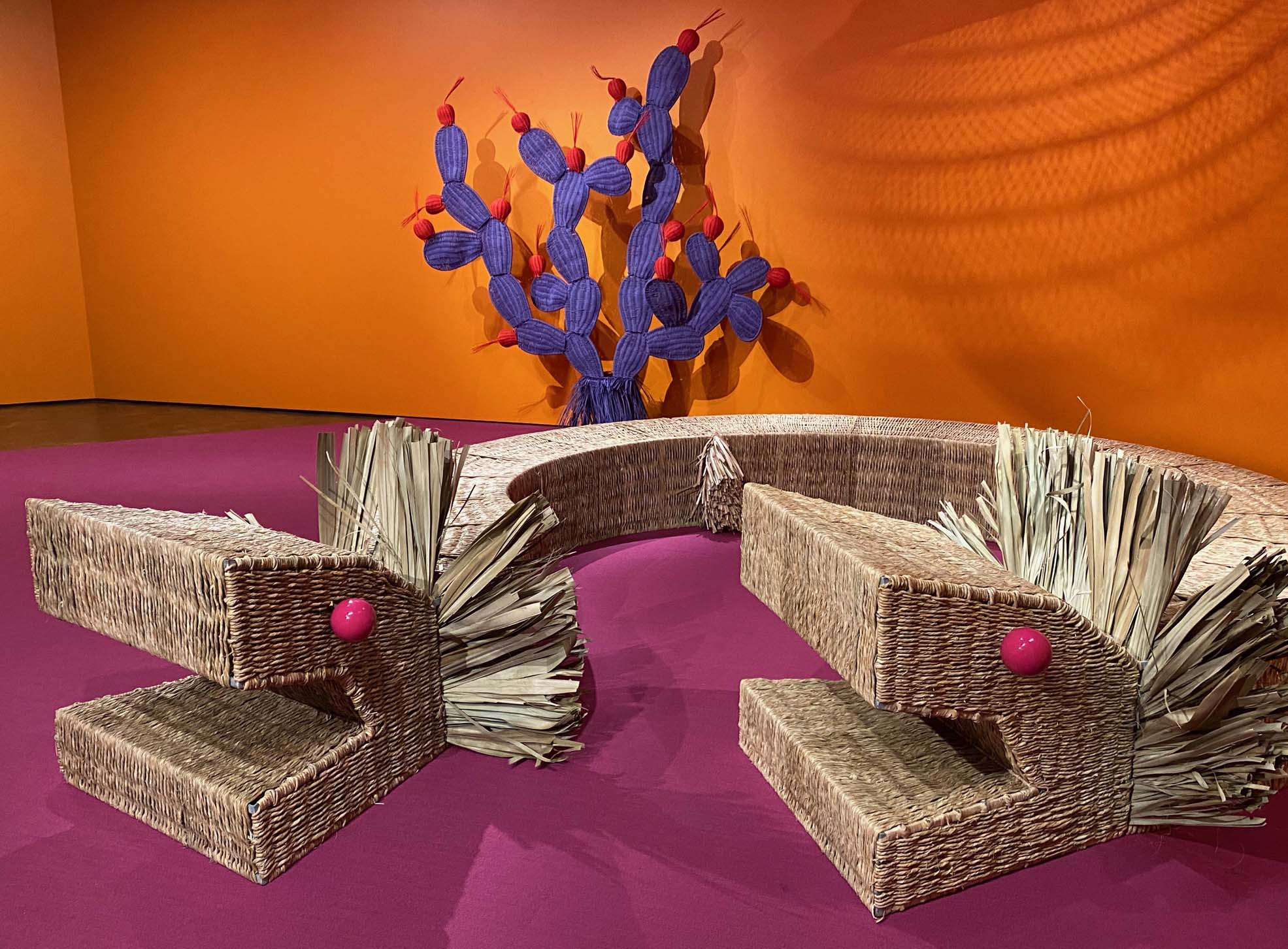
And this beautifully designed show would not be complete with an out-of-the-box participatory woven-wicker design section for kids of all ages!
2023 El Charco environment by Mestiz for visitors to contemplate design and the environment, including the wicker Cactus of a Thousand Eyes and Great Two-Headed Viper.




























 itsnewstoyou