On Kawara: Time and Life as Art

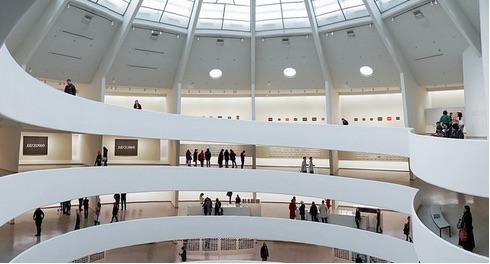
On Karawa always wanted to see his work on the timeless, spiritual spiral ramps of the Guggenheim and got his wish. Photo by David Heald

On Karawa always wanted to see his work on the Guggenheim’s timeless, spiritual spiral ramps. Photo by David Heald

Back in the 1970s, you couldn’t find a language-art or Conceptual art exhibition without the enigmatic world traveler On Kawara. Sometimes you would see canvases with a single day’s date, but other times you might encounter a single telegram sent from a major world city with simply the message: “I am still alive.”

The Guggenheim is paying tribute to this favorite through the weekend in its show On Kawara – Silence, and has done a magnificent job of displaying and interpreting the life work of an artist who always appeared barely there. Although he was fully immersed in the New York art scene, he seemed always to be on the go, traveling to some other major world capital. He managed to make art out of this peripatetic life.
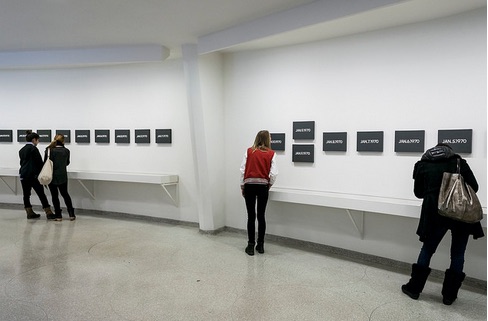
Visitors peruse On Karawa’s Today series paintings and peer into their newspaper-lined storage boxes below. Photo by David Heald

Visitors peruse On Karawa’s Today series paintings and peer into their newspaper-lined storage boxes below. Photo by David Heald

Indeed, at one point in his early life he thought he might like to be a travel agent, but an immersion in the ancient cave paintings of Altamira changed that. He decided to dedicate himself to art and set upon a unique course.

At the start of the walk up the spiral ramp, you encounter his Today series – a continuous set of rectangle canvases, painted each day with the day’s date, beginning with January 1, 1970. Over the next four decades, he would create more than 3,000 of these. In a twist, the Guggenheim displays many with its associated storage box that the artist assembled each day when he was done, lined with the newspaper from the same day.

From the I Got Up postcard series. Photo by David Heald

From the I Got Up postcard series. Photo by David Heald

Although the artist never intended the paintings to be shown with the storage boxes, the throngs of visitors have quite a time looking at the date and then peering down to see what else was happening in the world that day – for example, Golda Meir’s proclamations about Israeli-Egyptian standoffs, desegregation in the South, the Chicago Seven trial, and Vincent Canby reviews.

It’s stunning to see the assemblage of tourist postcards that he sent at the rate of two per day to friends and colleagues with the stamped inscription I Got Up Today with a time stamp of his rising. Travel and personal routine systematized and packaged into a series of projects he carried out from 1968 through 1979.

He didn’t want the moments or people to pass as he journeyed throughout the world, so he began the series I Met. He noted every single person he met every day for twelve years – friends, artists, waiters, store clerks – and typed their names on pieces of paper that were time-stamped and bound into books.
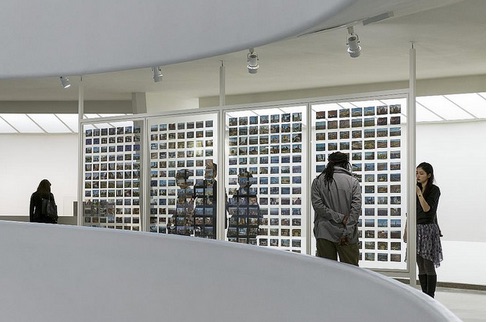
Viewers peruse a fraction of the 1,800 postcards that On Kawara sent to document the time he got up at various cities in his travels. Photo by David Heald

Viewers peruse a fraction of the 8,000 postcards that On Kawara sent to document the time he got up at various cities in his travels. Photo by David Heald

It’s amazing to encounter the bound volumes on the ramp, visitors circling the extensive set wondering what it must have been like to carry out this level of life documentation.

The curators explain more in the video below about how On Kawara took on monumental projects to translate his day-to-day life, travels, and schedule into the art that fills this meditative, peaceful, and mind-expanding show:

See more views of this thought-provoking installation here. For more curator videos, click here.

Benton’s Freebie Masterpiece at The Met

Viewer contemplates “The Changing West” panel of Thomas Hart Benton’s America Today mural (1930-1931)

Met visitor contemplates “The Changing West” panel of Thomas Hart Benton’s America Today mural (1930-1931)

When times get tough, did you ever take on a job or make something for free just to build up your resume and showcase what you could do? That’s exactly what one New York up-and-comer did, and it really paid off. The Metropolitan Museum of Art’s show, Thomas Hart Benton’s ‘America Today’ Mural Rediscovered, tells the story.

Back in 1930, the New School was just completing its modern building in the Village on West 12th Street and was seeking something to jazz up the boardroom.

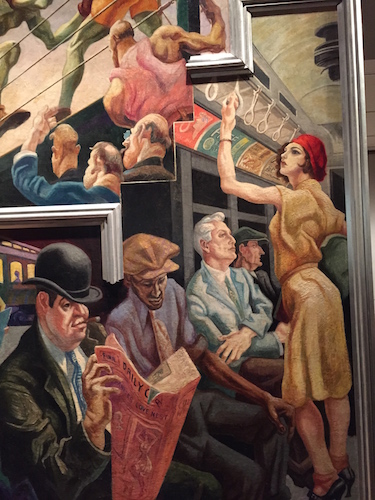
“City Activities with Subway” portion of America Today based on his portrait sketches

“City Activities with Subway” portion of America Today based on his portrait sketches. (It’s Pollack’s sister-in-law, Elizabeth)

Mr. Orozco, the famed Mexican muralist, had already been commissioned for the more visible dining room/lounge, and Mr. Benton, who was teaching at the Art Students League, saw an opportunity to showcase his painting chops.

Social realist chronicler Reginald Marsh had introduced Benton to the mysteries of mastering egg tempera, and Benton felt ready to go to town on a large-scale portrait of American life in all of its regional glory. Here’s the deal: no pay, just loft studio space about a block away.

Twenty years earlier, Benton had hung around Paris, soaking up the birth of the French Cubist and Italian Futurist movements in Europe. Ten years earlier, he roamed around the back roads of the United States, filling up sketchbooks with steel town landscapes, lumber camps, oil derricks popping up in Los Angeles, dives, diners, and small town stuff.

“Steel” portion of the mural, featuring model Jackson Pollack, Benton’s student

“Steel” portion of the mural, featuring model Jackson Pollack, Benton’s student

The mural began taking shape, crammed to the gills with swirling activities, people, industry, and pop culture that he saw. Need models? Why not ask Jackson Pollack, his art student, and his sister to pose?

It’s hard to imagine serious board meetings taking place in a room so alive with oversized ambition and action. Over the decades, the New School repurposed the room for classroom lectures, and over time, the scuffed mural was removed completely.

Lucky for us, Benton’s 1930s historic masterpiece found its way to the Met, which has lovingly restored and installed it in a rectangular room just beyond the Frank Lloyd Wright room.

The curators have filled the adjacent galleries with extra treats: the inspirational sketches from Benton’s earlier road trips and works by Mr. Pollack and Benton’s Village contemporaries.

See our Flickr album to glimpse the installation (and works by early Pollack, Abbott, Marsh from the Met’s collection), and watch the Met curators tell the story of how Mr. Benton’s freebie paid off and their joy in giving this ten-panel chronicle a new home.

Reverent Ceramic Master Honored in NC

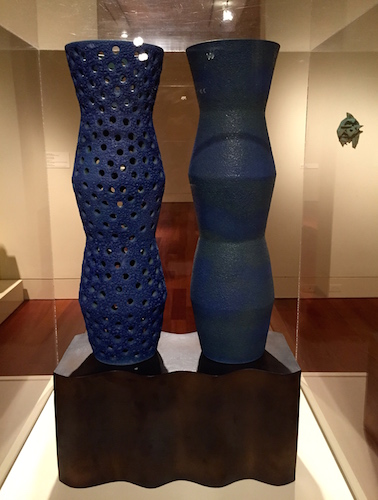
Hiroshi’s “Twin Vase”, a monumental 2002 stoneware sculpture with crawl glaze

Hiroshi’s Twin Vase, a monumental 2002 stoneware sculpture with crawl glaze

Known for a strong pottery tradition, North Carolina’s Cameron Art Museum is paying tribute to a Japanese ceramic expert in Hiroshi Sueyoshi: Master of Reverence through September 6.

As a young artist who apprentices with ceramic masters of 1960s Japan, he was advised by folk artist Shoji Hamada to see as much of the world as he could before he turned 25.

In the early 1970s, he came to Asheboro to help build a pottery, trained with Japanese ceramic-artist ex-pats, worked at Seagrove, and landed teaching jobs at several North Carolina colleges.

By the end of the decade, he relocated to Wilmington, teaching and serving as an artist-in-resident at the Museum.

Although the show features the full scope of Hiroshi’s work, it exhibits the work of the ceramic artists who influenced him. Works by Rita Duckworth, Isamu Noguchi, Peter Voulkos, and Shoji Hamada are shown side-by-side with his own, demonstrating the tradition upon which he draws.

Rock Garden, a 2014 interpretation of a Zen garden made with hand-built “rocks”. He wants the viewer to be conscious of their surroundings

Rock Garden, Hiroshi’s 2014 interpretation of a Zen garden made with hand-built “rocks”.

Landscapes, biomorphic shapes, streams, voids, spirals, crackled surfaces, and Zen gardens – you’ll see and feel it all as you slowly work through the galleries. Find power in Hiroshi’s simplicity and lots of detail upon closer inspection.

The sculptures echoes of the primitive power of Brancusi and installations evoke the meditative calm of the Rothko Chapel. The museum has even hung up some of the coverings that Hiroshi uses for his pottery tables on the wall in the back gallery. Their subtle dust-ground, worked surfaces feel like subtle, magical Twombly atmospheres. So, even Hiroshi’s work cloths feel like art.

If you can’t make it to see this beautiful work in Wilmington, take a stroll through our Flickr site.

Biomorphic 2009 wall sculpture Blossom. Stoneware with crater and crawl glaze. Courtesy: New Hanover Library

Biomorphic 2009 wall sculpture Blossom. Stoneware with crater and crawl glaze. Courtesy: New Hanover Library

Ennion: Luxury Tableware at The Met

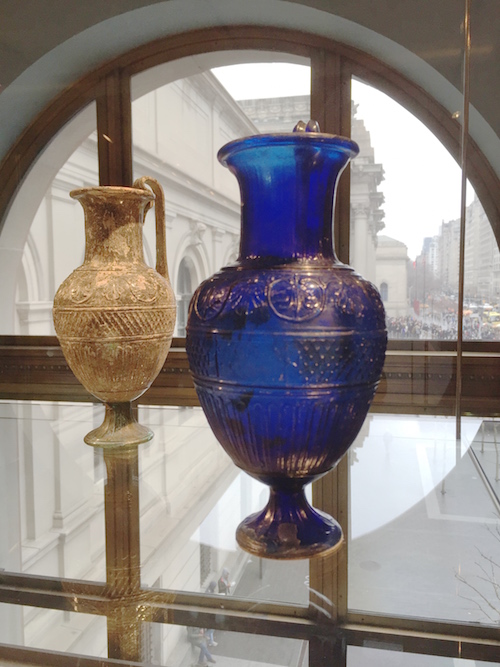
Two identical one-handled Ennion jugs from different sites. On right, the only Ennion piece with an intact foot, 1st c. A.D.

Two identical one-handled Ennion jugs from different sites. On right, the only Ennion piece with an intact foot, 1st c. A.D.

It’s unlikely that you have any of this sought-after designer’s pieces accompanying your best table setting or that the MAD Museum has any of his hand-blown, molded glassworks in their collection.

Two thousand years before ABC Carpet began retailing high-end home goods on Broadway and Martha Stewart branded her at-home lifestyle line, a Mediterranean craftsman in Sidon, Lebanon (then Phoenecia) created a line that every aspiring tastemaker in the Roman Empire just had to have. The Metropolitan Museum of Art pays tribute to his output in Ennion: Master of Roman Glass, on view just off the Greek-Roman study galleries through April 12.

Who needs old-fashioned metal cups or pottery jugs on the well-laid Roman table when Ennion was creating stunning cobalt-blue and transparent glass equivalents?

Two-handled cup, with Ennion’s Greek brand (“Ennion made this/it”). Blown glass into mold, 1st c. A.D. Courtesy: Turin museum; other by private collector

Two-handled cup, with Ennion’s Greek brand (“Ennion made this/it”). Blown glass into mold, 1st c. A.D. Courtesy: Turin museum; other by private collector

Ennion’s workshop was on the cutting edge of a manufacturing-and-craft revolution – blowing glass into decorative molds (which took the guesswork out of creating place settings for four, six, or ten) and exporting sets for sale throughout The Empire.

Ennion’s competitors were doing the same, but Ennion of Sidon had the big brand emblazoned on his work, working it into the design in the same way that MK, DKNY, DVF or YSL do today. His logo was written in Greek, the universal language of the first century: ““Ennion made me/it.” Scholars reckon that it was all made and exported from Sidon, a first-century glassmaking powerhouse, since none of Ennion’s molds featured a bilingual brand.

After two millennia, only about 50 of Ennion’s gorgeous works remain, and the Met’s show has assembled about half that amount from its own collection (courtesy of master-collector J. Pierpont Morgan), the Corning Museum, private collections, and other museums of antiquities in Israeli and Europe.

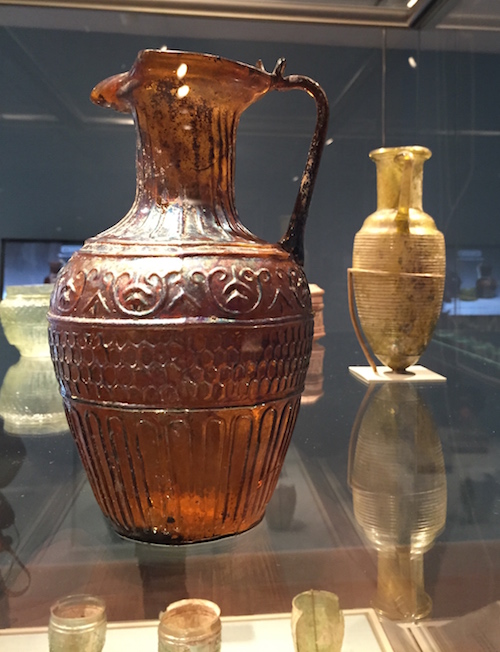
Non-Ennion glass jug made in a four-part mold; right, a two-handled amphora blown into a three-part mold, ist c. A.D. Source: The Met

Non-Ennion glass jug made in a four-part mold, 1st c. A.D. Source: The Met

In addition to Sidon, Ennion’s output has been found in excavations of ancient homes in places as far flung as Jerusalem, Croatia, Italy, and Spain. The Met’s team has had fun displaying glassware from identical molds next to one another, despite the fact that pairs were discovered thousands of miles from each other at different archeological sites.

Check out the Met’s beautiful tribute to a master artist on our Flickr feed.

Killer Heels as Art in Brooklyn

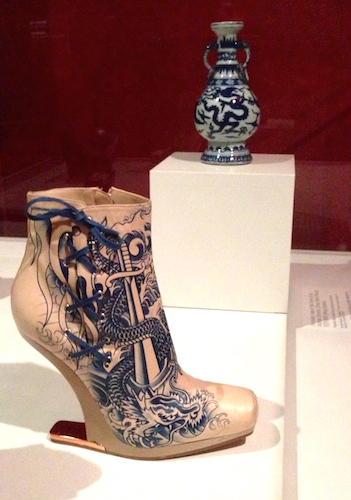
Gaultier’s 2012 Nude Tattoo Boot displayed next to its inspiration, a Chinese porcelain Ming vase (1573-1619)

Gaultier’s 2012 Nude Tattoo Boot displayed next to its inspiration, a Chinese porcelain Ming vase (1573-1619)

The hottest show in New York right now is Killer Heels: The Art of the High-Heeled Shoe, a curatorial masterwork that the Brooklyn Museum has decided to extend through March 1.

As soon as you enter the first-floor gallery, you’ll encounter Zach Gold’s mesmerizing Spike video, a wall-sized video extravaganza of high fashion, high glamour, and high heels. Why rush into the first room of the exhibition when your eye is trying process all the lush details? This digital kaleidoscope genuinely sets the tone for what lies ahead – an historical mash-up of style, fashion, and design all seen through the lens of ladies’ shoes.

What an eyeful – carefully composed vitrines where you can behold golden Baroque curliques on Prada platforms, 1920s evening shoes, and a 19th century gilded table. What about silver-and-pearl Chanel boots whose heels mimic the 1890s Gorham candlestick right next to them? Or the red-hot strappy Miu Miu shoes whose ornament is identical to the handles on a 18th-century Wedgewood ice cream cup? Check out our Flickr feed to see some of our favorites.

2008 Heels by Miu Miu next to a Wedgewood ice cream cup and saucer (1790-1800)

2008 Heels by Miu Miu next to a Wedgewood ice cream cup and saucer (1790-1800)

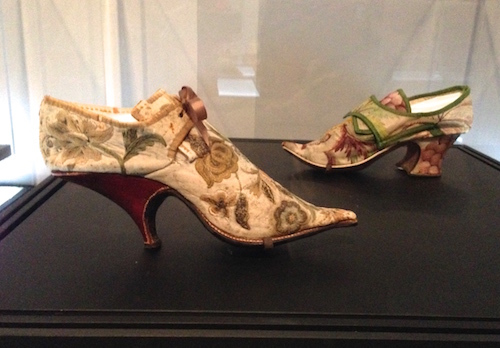
Everywhere you look, there are delightful juxtapositions across time, culture, and material – embellished pointy-toed heels from the 1690s, iron-and-leather pallets that boosted the feet of ladies above the muck of 18th-century city streets, and sky-high mother-of-pearl-inlay stilt shoes that Syrian beauties sported in the Twenties. It’s interesting that the latter are displayed in proximity to those dangerous purple Vivienne Westwood gillies that gave Naomi Campbell such problems on the runway.

Nothing’s chronological. It’s all designed to unfold in your mind by pinging unexpected references and associations – designer shoes next to concoctions from another place and time, fantastical embellishments, and streamlined perfection.

Fashionable, embellished pointy-toed 1690 French and 1720 British heels

Fashionable, embellished pointy-toed 1690 French and 1720 British heels

Provocative, room-sized videos commissioned for this show and small historical films only heighten the pizzazz. Check out Edison’s 1903 short, The Gay Shoe Clerk, or snippets from Sophia Coppola’s Marie Antoinette or other Hollywood classics. Don’t miss Eve A.D. 2000, shot in 1939 to predict what fashions and footwear of the future would look like. You’ll have fun evaluating whether those Thirties visionaries got it right.

There’s simply too much to describe – glass slippers by Georgina Goodman, political-statement heels, shoes that seem to take Metamorphoses at its word, and architectural-engineering wonders. Go see for yourself. You’ll find shoes by Ford, Ferragamo, Prada, Gaultier, and unknown Italian, French, and British craftsmen of long ago.

Watch curator Lisa Small’s video but make the trip out to Brooklyn to immerse yourself in one of the best adventures of the season:

Sturtevant’s Mini-MoMA Imitation Game

Sturtevant’s 2004 piece — a reproduction of an light bulb and cord installation “ Gonzalez-Torres Untitled (America)”. On far wall, “Study for Rosenquist’s Spaghetti & Glass”, an oil painted in 1965-1966

Sturtevant interprets Gonzalez-Torres Untitled (America) (2004). On far wall, Study for Rosenquist’s Spaghetti & Glass, an oil painted in 1965-1966

The free Friday night crowd at MoMA could not get enough of the Elaine Sturtevant tribute, Double Trouble, closing this weekend. Sturtevant spent her long career creating ready-mades out of other people’s art.

The show is a who’s who of 20th century art, except that all the pieces were done by Ms. Sturtevant. The show has it all – an entryway plastered with Warhol’s cow wallpaper (done by her), Lichtensteins, Rosenquists, Johns oil paintings – all done in her hand. Take a walk through our Flickr site and see more in the photos on the curator’s blog.

It’s all imitation, except that Elaine’s versions are really, really good. It’s hard to tell them from the originals displayed through the rest of the museum. Nothing in the show is a line-by-line copy, but you’ll have to go MoMA’s permanent galleries to compare them with the real thing.

Sturtevant’s 1967-1968 oil on canvas,Study for LIchtenstein’s ‘Happy Tears’

Sturtevant’s 1967-1968 oil on canvas, Study for LIchtenstein’s ‘Happy Tears’

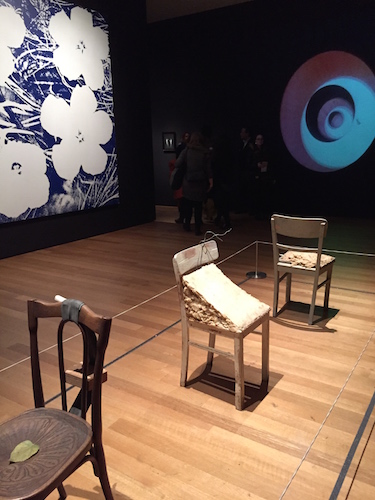
In fact, MoMA encourages a trek upstairs to compare Duchamp’s own ready-mades and whirligig. Or Mr. Beuys slabs of fat with those sitting on Sturtevant’s chairs in the darkened gallery.

Can anyone distinguish the Warhol Wall Flowers that Elaine made from the reproduced images of the originals on the stuff all over the gift shop?

The Gonzalez-Torres installation was the dramatic high point, all flashy bulbs in a charismatic, mysterious circle near the pretty perfect interpretations of early video games. Everyone is having a blast lining up to contemplate Sturtevant’s walk down digital memory lane with her interpretation of Pacman 1.0.

Is that Sturtevant’s Duane Hanson museum security guard reproduction in the corner? Oh, no, it’s an actual MoMa guard! Sorry. Just about everything else is a fool-the-eye art encounter. Total fun in the white cube.

Sturtevant’s 1990 vision of Warhol’s Flowers alongside her 1968 Duchamp film with interpretations of three Beuys chairs

Sturtevant’s 1990 vision of Warhol’s Flowers alongside her 1968 Duchamp film with interpretations of three Beuys chairs

Nature Meditations in the Land of Fire and Ice

Katrín Sigurðardóttir, Haul IV (2004) travelling landscape-in-a-box on loan from private collector. Courtesy: The artist.

Katrín Sigurðardóttir, Haul IV (2004) travelling landscape-in-a-box on loan from private collector. Courtesy: The artist.

When the weather dips below freezing and people think they’re in the Arctic, there’s no better place to get out of the elements and meditate on the landscapes of long, dark winters than the third floor of Scandinavia House on Park Avenue. Until tomorrow, January 10, you’ll join eleven contemporary artists from the sub-arctic on their journeys in a show mounted by the Katonah Museum of Art, Iceland Artists Respond to Place.

Bjork may get all the media attention, but do yourself a favor and walk through this three-gallery show, which beautifully and simply presents the work of Iceland’s other leading visual artists. See the land of fire and ice through their eyes.

Olafur Eliasson, The Aerial River Series, 2000 on loan from private collector. Courtesy: The artist. Installation photo: Ben Blackwell

Olafur Eliasson, The Aerial River Series, 2000 on loan from private collector. Courtesy: The artist. Photo: Ben Blackwell

Olafur Eliasson takes you on an aerial journey along a 60-mile meltwater river, from the mouth to the source. Ragna Róbertsdóttir splatters miniscule lava rocks against a wall but it’s not what it sounds like. Far from a violent eruption, it’s an undulating, mesmerizing meditation that you’ll spend time contemplating.

For sheer romantic and modernist punch, enjoy Georg Guðni Hauksson’s two works – a large landscape memory and a solid dark blue canvas evoking the long winter nights (like an emotional Ad Reinhardt).

Lava rocks “talk” in Egill Sæbjörnsson’s Pleasure Stones installation (2008) on loan from private collector. Courtesy: The artist.

Lava rocks “talk” in Egill Sæbjörnsson’s Pleasure Stones installation (2008) on loan from private collector. Courtesy: The artist.

Egill Saebjornsson takes home the whimsy award with a multimedia installation in which rocks speak (seriously!). Eggert Pétursson zeros in the microscopic natural phenomenon – painting flowers (life sized) in patterns that read like tapestries. You’ll wish you were on some hikes with him. Katrín Sigurðardóttir simply packs up her landscapes into boxes. Tiny, tiny recreations of vast, romantic landscapes.

When we visited the galleries this week, visitors were asking if there was more they could see. Scandinavia House always hosts classy, elegant shows, so although the exhibition space is limited, we have to admit they always leave us wanting to see what’s next from that part of the world.

Seth Myers was recounting his Icelandic adventures this week on Late Night. If you can’t get to the country like Seth or visit the show, at least you can spend chilly days and nights like the natives do, courtesy of this instructional video produced by Scandinavia House:


36 Hours of Jeff Koons at The Whitney

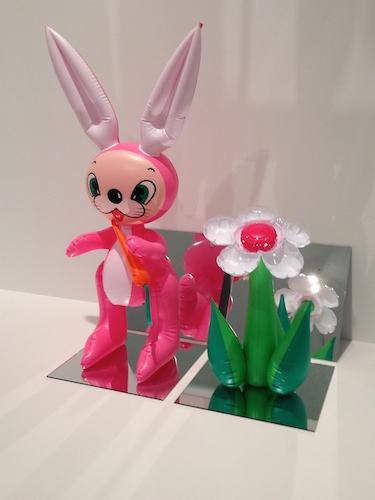
Inflatable Flower and Bunny, a cheeky take on minimalist work NYC galleries showcased in the 1970s

Inflatable Flower and Bunny, a cheeky take on minimalist work NYC galleries showcased in the 1970s

It’s the last 36 hours, and the Whitney is taking it’s Jeff Koons retrospective out with a bang – all day, all night fun-filled wonder on all four floors, letting the crowds take in his irreverent porcelains, 70s inflatables, whimsical fool-the-eye aluminum sculptures, and giant billboards. It’s the first proper retrospective that Koons has had in New York and the last show to be mounted on Madison Avenue before the Whitney moves to the High Line.

Any day of the week, lines of art-seekers have snaked out the door of the Whitney, past the pretzel carts on Madison and around the corner along 75th Street, waiting for admission into this no-holes-barred finale.

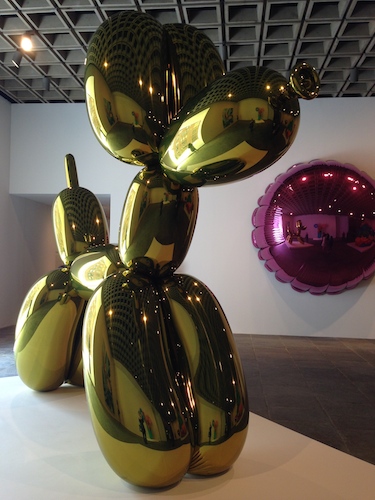
The curators and crew have done a spectacular job with the installation – no mean feat, since those big bulbous “inflatables” on the top floor are really highly polished, super-heavy hunks of stainless steel. Oh, and don’t get any fingerprints or scratches on the highly polished surfaces…it will break the illusion that these are just Mylar balloons!

Ten-ton stainless steel Balloon Dog with Moon (Light Pink) (1994-2000)

Ten-ton stainless steel Balloon Dog with Moon (Light Pink) (1994-2000)

The show starts strong on the second floor with a light-filled room of recreated works from the late Seventies – actually inflatable flowers, bunnies, and what-not. Everything uses angled mirrors.

You can’t get the joke unless you trod the floors of those West Broadway galleries in Soho way back then and saw the Minimalists and Earth Works guys in full force.Think Barry Le Va, Heizer, and Smithson who arranged rocks or dirt in a few square feet of gallery space and added a mirror or two to make a statement about nature, art, reflection (i.e. art viewing), and formal criticism inside the art world.

Koons turns all this on its head with silly found inflatables and similarly formalist presentation. It’s kitchen sponges instead of Richard Long’s rocks! Thanks, Whitney and Mr. Koons, for giving us this walk down memory lane.

The main space on Floor 2 is devoted to a spectacular low-light installation of favorite Koons pieces from the early Eighties. Several double-decker and triple-decker vitrines house illuminated and never-used Hoover vacuum cleaners, which Koons assembled to illustrate the feeling of “newness” in American society.

Billboard and illuminated Hoover vacuum cleaners, the essence of “newness” from 1983

Billboard and illuminated Hoover vacuum cleaners, the essence of “newness” from 1983

It’s a beautiful, magical room dominated by a gigantic billboard on The New, all of it from his first window-display installation on 14th Street and Fifth, when Marcia Tucker had her New Museum there back in 1983, just before the move to Soho.

Speaking of moves, it seems fitting to come full circle – spectacular early works by Mr. Koons that debuted on 14th Street as the finale to the Whitney’s long run on Madison Avenue, just prior to its move back to its new 14th Street neighborhood.

Missed the show? Take a look on our Flickr feed.

The Paper Bag Was Her Design

MoMA honors Margaret Knight, 1870s inventor of the flat-bottomed paper bag

MoMA honors Margaret Knight, 1870s inventor of the flat-bottomed paper bag

What will the MoMA curators pull out of the design collection next? Designing Modern Women 1890–1990, running through October 19, puts the spotlight on furniture, textiles, graphics, performance, kitchens, and even inflatables designed by some innovative women over the last century. How can you not love a show that begins with 1890s modern-dance provocateur Loïe Fuller and ends with 1980s pop icon Grace Jones?

The crowd last weekend was loving every bit of it, pausing to watch videos sprinkled throughout the show and marvel at designs – some 80 to 100 years old that are as modern today as they were at their creation.

The next time you carry away your morning muffin from the coffee counter in that little white paper bag, ponder that the flat-bottomed paper bag was invented in the 1870s by Margaret E. Knight and Charles B. Stilwell. Ms. Knight not only invented this classic, but also invented the machine that made it and was one of the first American women ever to receive a patent.

1901 dinner service by Jutta Sika and Koloman Moser

1901 dinner service by Jutta Sika and Koloman Moser

No, the dinner service is not from Pottery Barn. It was created in 1901 by the Austrian design team of Jutta Sika and Koloman Moser. Didn’t I just see a copy of Eileen Gray’s 1927 adjustable table at the D & D Building? Open shelving in your new, modern kitchen? Yes, that was Charlotte Perriand’s idea, and MoMA has (for the first time) installed this full-size, fully efficient, ground-breaking kitchen from her 1952 project with Le Corbusier.

And what about the Slinky? Invented by Betty and Richard James in 1945. You’ll have fun peering into the design cases and learning more about the women behind some remarkable things.

Slinky was designed by Betty and Richard James in 1945

Slinky was designed by Betty and Richard James in 1945

In the 1960s portion of the show, you’ll see those famous Fillmore posters designed by Bonnie Maclean. And there’s an entire wall filled with iconic pop and punk graphics – all created by female designers – that should be familiar to anyone that traversed the downtown CBGBs scene.

There’s no digital media to accompany this fantastic show, so take a walk through our Flickr site. All of the items are from MoMA’s own collection, and we’ve taken slight liberties by arranging the photos in the show album in chronological order of the year that each design debuted.

And to bring it all back to the beginning of this design innovation tribute: Here’s a glimpse of 1897 Art Nouveau performance art by Loïe Fuller, courtesy of the Lumiere Brothers. The color you see here is a result of hand-tinting the film, but her actual perfomances used new theatrical stage lighting for which she held numerous patents. Listen to the MoMA curators explain her influence, but get over to MoMA (or the Flickr site) to take in this super-fun tribute to 100-plus years of smart women who thought differently and made it happen.

Groundbreakers App Ties History and Beauty Together

AppTitle

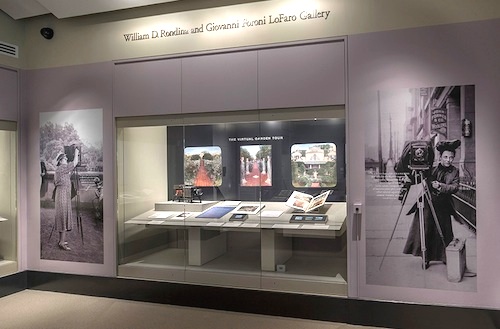
The New York Botanical Garden carved out an ambitious agenda in its Groundbreakers show – to tie the stories of six women of landscaping history, present a two-gallery recreation of an historic garden, pay tribute to the contributions of several landscapes within NYBG itself, create a poetry walk, and wrap it up with the history of early 20th-century photography and high-gloss publishing. They did it with GPS and an iPhone app, courtesy of Bloomberg.

Closing this weekend, Groundbreakers: Great American Gardens and the Women Who Designed Them is still worth downloading from iTunes, just to get a glimpse into the lives of six landscape-gardening pioneers, see their work, and understand the popularization of American gardening long before the dawn of HGTV or Lifestyles of the Rich and Famous. Here’s the link.

Photos of Ms. Johnston (left), lantern slides and projector, and Beals (right) on NYC street in 1902. Courtesy: NYBG

Photos of Ms. Johnston (left), lantern slides and projector, and Beals (right) on NYC street in 1902. Courtesy: NYBG

Here’s the story: back in the day (early 1900s), garden design and photography were two of the few career avenues available to women.

Way before Instagram, Photoshop, and two-way phone cameras, documenting the lush gardens involved lugging a gigantic, large-format camera up and down garden paths and around water features, processing black-and-white negatives into prints, turning some into newly-invented lantern slides, and having each slide painstakingly colored by hand. It helped if you had a car and an able-bodied assistant to help navigate the flagstone-lined paths with all the heavy gear.

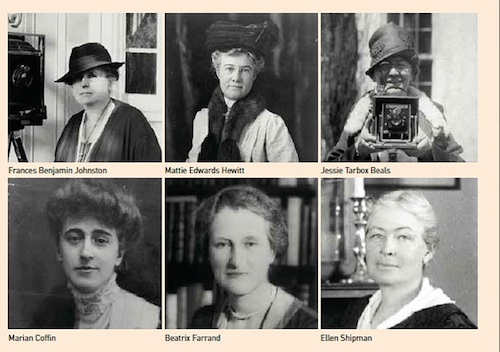
Six American landscape pioneers who changed the course of American gardening. Courtesy: NYBG

Six American landscape pioneers who changed the course of American gardening. Courtesy: NYBG

Also, after the Industrial Revolution, aesthetically minded women (predating Lady Bird Johnson) felt it was time for American homescapes to get a little more spruced up.

The rich and famous were beginning to hire landscape designers to fix up the areas behind their East Side townhomes and acreages around their country estates. Why not document this and inspire upper middle class homeowners to follow suit?

The exhibition gives us a look at how artist visionaries, authors, and the publishing industry worked in tandem to record how landscape architects were creating romantic backyard landscapes and popularize beautification. Although seeing actual lantern slides, projectors, and gigantic tripods is amazing, one of the highlights is a recreation of the slide show by Frances Benjamin Johnston that basically blazed the trail of a new vision of what was possible – one image after another of gorgeous, visionary landscapes on the grounds of homes on the East Coast, California, England, and France.

NYBG recreated the evocative Moon Gate from the Rockefeller garden, inspired by their experience of the Forbidden City and designed by Beatrix Farrand

NYBG recreated the evocative Moon Gate from the Rockefeller garden, inspired by their experience of the Forbidden City and designed by Beatrix Farrand

In the Conservatory, the team at NYBG recreated Mrs. Rockefeller’s garden, originally designed by Beatrix Farrand, to highlight how the garden was conceived, used, and enhanced by the Asian art Mr. and Mrs. John D. collected. Since Farrand took on this project in 1926, NYBG has the sounds of America’s Jazz Age wafting through the galleries. Take a look on our Flickr page.

Another great feature of this show and the app – NYBG’s GPS feature shows you where you are in the expansive garden and encourages you to visit features where these groundbreakers had a hand – such as Marian Coffin’s ornamental conifer collection and Ferrand’s Rose Garden.

Get a closer view of the spectacular Groundbreakers in NYBG’s news-style video:

If you have a bit more time, listen to this curator lecture on the Beautiful Garden movement in America in 1900 and see the photos used by Johnston home to show suburbanites exactly how it should be done. You’ll witness garden images that hadn’t been seen since 1930. Take a look and get inspired:

Click here for other videos: a lecture about Beatrix Farrand created Mrs. Rockefeller’s garden and how the NYBG team recreated it in the stunning Victorian conservatory.