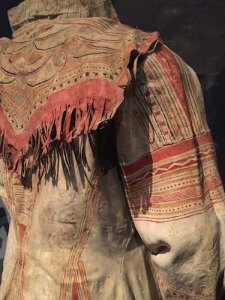
Boy’s 1870-1900 hide shirt decorated in glass beads in geometric pattern by female Crow artist
Exquisite detail and spiritual power are evident in every item showcased in the Metropolitan’s show, Native American Masterpieces from the Charles and Valerie Diker Collection, closing March 31.
The Dikers have spent a lifetime collecting objects of incredible detail, spirit, and beauty and sharing truly dazzling works with the public, most recently in the Indigenous Beauty show which ends its national tour here in New York.
Every time we have visited the small showcase inside the Met’s African and Mesoamerican galleries, visitors have been pouring over every detail of the weave, beadwork, paint, inlay, and woodcarving on the masks, clay jars, baskets, shirts, coats, hats, headdresses, war shields, and hide canvases on display.
Magical colors, geometric patterns, attached talismans, and even mysterious paint splotches pack powerful messages as animals, spirit-creatures, and half-human beings emerge in two and three dimensions.
1840s man’s European-style hide coat created by a female Naskapi artist in Labrador
The majority of artwork and clothing dates from the 19th and early 20th centuries, but pieces are earlier, such as a nearly perfect Anasazi clay pot from 1100 A.D., which uses geometric 2-D wizardry on the curved surface to convey the interconnection of underground water reservoirs that enable agricultural communities to thrive in the Southwestern desert.
Native designs and magical powers are sometimes merged with European style, as in a man’s painted hide summer coat, which was created by a female Naskapi artist from Labrador, Canada. Designed inspired by European coats, with images for a good hunt, but worn by the hunter for only one season
The curators have taken care to cite the artists in cases where they are known, such as an1880s buffalo-hide shield painted by Joseph No Two Horns, a Lakota artist who participated in the 1876 Battle of the Little Bighorn.
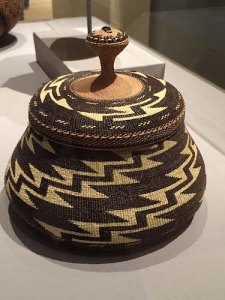
1910 woven quilled basket and 3D lid by Elizabeth Hickox of Northern California
The show puts a spotlight on innovators, who began making monumental works for collectors, such as the large pottery jar by Nampeyo, the first well-known Hopi artist and Elizabeth Hickox, who became known for her three-dimensional embellishments in woven basketry in Northern California.
Enjoy all of the details of our favorites from this show in our Flickr album.
Tiffany’s glass vases against De Forest’s stenciled walls of the Teak Room
If you’d like to experience a few moments surrounded by the splendors of the Gilded Age in America, climb the staircase inside the Carnegie Mansion (Cooper Hewitt) and enter another world. As a tribute to the mansion’s second-floor renovation, Cooper Hewitt mined its own collection and borrowed key pieces as part of the installation, Passion for the Exotic: Louis Comfort Tiffany and Lockwood de Forest, closing March 26.
You’ll find yourself in a quiet mystical room that served as the Carnegie family library when it was first designed in 1902 by Lockwood de Forest, a superstar of the Aesthetic movement. The Smithsonian has brought the room back to its original glory, carved teak, stenciled walls, and all.
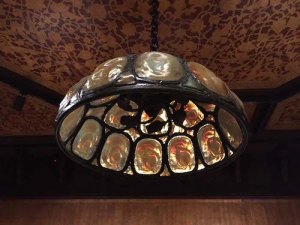
Paying tribute to Mr. Carnegie’s passion for all things Tiffany, the curators have brought out their lamps, lit them up, and borrowed a magnificent turtleback Tiffany chandelier that is close to original. The effect of low light emanating through all the iridescent glass and illuminating the walls and built-in cabinet is unusually magical.
Painted bronze and blown glass Turtleback glass chandelier by Tiffany Studios, 1910
The design triumph is even more interesting when you think that at the time, 92 percent of New Yorkers did not even have electricity. So, this installation is not only beautiful, but stands as a 1902 example of cutting-edge technology and avant-garde design.
Take a look at our Flickr album, showing the objects in the room, and explore each one and its provenance on a special page on the Cooper Hewitt website.
So, how did this seemingly perfect collaboration interior embellishment, light, and the exotic happen? De Forest and Tiffany, who began working together in the 1880s, both shared a passion for the intricate designs of the Middle East and India. Each globetrotter had seen Indian interiors firsthand and felt their American design practices would benefit from exotic infusions.
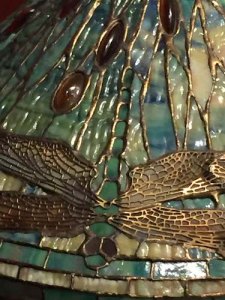
Electrified Dragonfly Lamp designed by Clara Driscoll, who led the Women’s Glass Cutting Department
Tiffany and de Forest once were business partners, but after that dissolved, they kept working together on a project-by-project basis. De Forest brokered a deal with a workshop in Ahmedabad in Gujarat, India, to manufacture decorative teak wood and brass panels that he designed for his own and Tiffany’s interior-design clients.
So the installation at the Cooper Hewitt is your chance to experience the magic of one of America’s great design collaborations.
To give the room a unique aesthetic glow, De Forest stenciled the wall in yellow lacquer to create an illusion that he associated with Indian screens. The teak details, inspired by Indian design, and the built-in cabinet inside Mr. Carnegie’s room came from the Gujarat workshop.
The Teak Room is currently the most complete De Forest interior still in existence in the site for which it was created. Seeing this work, lit by the glow of the Tiffany lamps and decorated with other Tiffany decorative objects, is a must.
Japanese-inspired Tiffany desk set, 1910-1920.
And when you climb the grant staircase to the second floor, you can also take advantage of the interactive display at the top of the stairs, which is loaded with history about the mansion and photos showing the original interiors.
If you want to soak in more of Tiffany’s prowess, watch Ben Macklowe’s Cooper Hewitt livestream on the master’s background, influences, technology, and business and find out what happened to the Tiffany-designed rooms at the White House:
1967 bus by Mason Williams and Max Yavno with designer autographs from MoMA’s 1968 Word and Image show, with Joshua Light Snow’s 1967 Liquid Loops
Big alert to baby boomers: Only a little time left to catch MoMA’s big Sixties bus that’s parked on the fourth floor in a room filled with psychedelic posters and a Fillmore-style rock show light extravaganza. It’s all part of the crowd-pleaser of a show that’s been in residence for about a year – From the Collection: 1960-1969, closing March 19.
The curators cleared out the floor and organized their permanent collection year by year, taking you through every movement, ism, and trend in contemporary art of the Sixties, from Rauchenberg’s combines from his downtown loft, to Christo’s wraps, to Warhol’s Pop, the psychedelic revolution in poster and cover art, and the rise of women taking on the art establishment (go, Eva Hesse and Lynda Benglis!). Except for the room with the Beatles and the bus, it’s like vintage Artforum come to life.
Wall of 1967 psychedelic posters publicizing East and West coast rock bands
MoMA called upon six of its departments to assemble the look, touch, and feel of the decade, from scrappy mix-it-up works to minimal plastic design and flat-out revolts to the museum world.
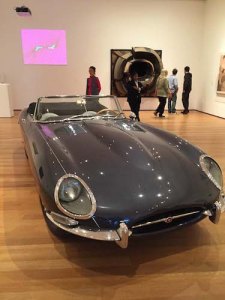
The first room features an sleek Jaguar roadster from the design department, the first commercially produced car to resemble racers. It’s a reminder that aerodynamic lines of 1961 swinging London were a harbringer of things to come as imaginations and images turned to space, rockets, and the future as the years of the Sixties ticked by.
See shots of some of our favorites in a chronological gallery walk in our Flickr album. The decade begins with Bubble wrap (thanks again, design department!) and concludes with NASA Apollo photographs.
The aforementioned bus is actually a flat 1967 display that MoMA kept in its warehouse that was designed by Mason Williams and Max Yavno MoMA’s 1968 poster show Word and Image. It’s covered with autographs of Milton Glaser and other famous designers whose work was featured in the original show.
Jaguar’s aerodynamic 1961 E-Type Roadster sharing space with a Lee Bonticou work
For the rest of the weekend, the bus serves as kind of a boomer hangout. The Avedon Beatles (distributed in magazines worldwide to promote their Sgt. Pepper transition) and other iconic rock images are in the room.
Other hang-outs for different populations include the cushion-cubes near the video monitors showing analog reel-to-reel videos from the years when Portapak video cameras were born (remember when video cameras weren’t on your phone?) an cool art hounds entranced by all four walls of Mr. Rosenquist’s mind-blowing F-111 masterwork. It’s installed just as Mr. Castelli did way back when.
Hear what James Rosenquist was thinking in 1964 as he created his iconic wraparound painting, F-111. Thank you, MoMA!
The Museum of Modern Art has pulled 260 paintings, films, magazines, books, drawing, porcelain, posters, and paraphernalia from its collection to take us back 100 years and tell the story of one of the most astonishing artistic and political breakthroughs of the 20th century in A Revolutionary Impulse: The Rise of the Russian Avant-Garde, closing March 12.
While Picasso and company were breaking boundaries in Paris, the Russians exited the war years by overthrowing their monarchy, getting rid of classical style, inventing non-objective picture making, and creating forms of revolutionary works that could reach the masses.
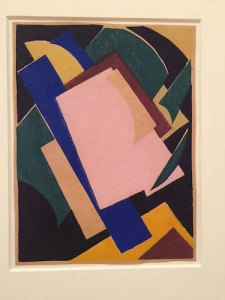
Lyubov Popova’s 1917-1919 print with Cubo-Suprematist style
Creativity, artistic manifestos, photo mash-ups, new cinematic forms, and philosophical inventions poured forth like an avalanche between 1913 and 1923.
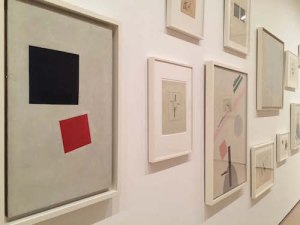
The curators at MoMA have organized the show chronologically to try to give context to the players and the “isms” that were being invented and then upended by the next new thing – Rayonism, Cubo-Futurism, Suprematism, Constructivism.
The artists truly believed that abstraction and upheaval from classic style would usher in the utopia envisioned by the fall of the Czar, hence the profusion of experimentation in theater, film, photography, cinema, books, textiles, household goods, and publishing.
Easel painting was a no-no. Manifestos, how-to-do-it manuals, and Suprematist road shows were the norm. Due to MoMA’s dedicated collecting in this almost-forgotten period, all of the art, tools, passions, and beliefs are brought to life in the show.
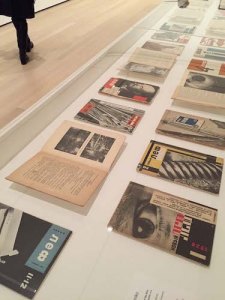
Rodchenko’s 1928 magazine covers for New LEF: Journal of the Left Front of the Arts
MoMA allows gallery goers to peek inside two of its most notable books in its Russian collection through digital touchscreens – Malevich’s 1920 portfolio of Suprematist drawings and El Lissitzky’s 1922 illustrated children’s book Of Two Squares.
El Lissitsky’s unbound prints from his historic Proun manifesto are mounted across the wall of the fourth gallery, allowing close examination of the masterful lithographer.
The latter galleries focus on 1920s Cubo-Futurist theater costumes and stage sets, breakthrough cinema techniques (with three films screening simultaneously in an immersion room), mass-market publications, and posters advertising films and sporting extravaganzas. See examples of all on Flickr.
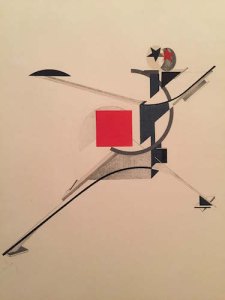
El Lissitzky 1923 litho honoring the 1920 restaging of the famed Cubo-Futurist opera Victory Over the Sun
Everywhere you look, Rodchenko’s innovative typography, photographs, and layouts are jumping out, demanding attention. Among the more unusual surprises are Rodchenko’s branding for the state airline and the modernist layouts in the 1925 Kino-Pravda films used to tell the public the status of Lenin’s vital signs during his final days.
The innovations created by this group of artist-revolutionaries would soon be undone by the Stalin’s preference for social realism. But although he stamped out Russian modernism in his day, the white-on-white Malevich, El Lissitsky’s fourth dimension, Vertov’s lightening fast film edits, and Rodchenko’s tilting letters still pack the punch on MoMA’s white walls nearly 100 years after they were created.
Take a look at some of our favorite pieces on Flickr, and watch a brief orientation to the show by MoMA curator Sarah Suzuki.
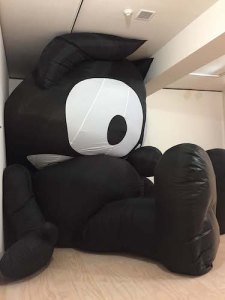
Mark Leckey’s 2013 Felix the Cat, a tribute to TV’s first celebrity.
It’s the last weekend to take a walk through the output of the creative mind of an award-winning British artist MoMA PS1, which has dedicated its top two floors of the schoolhouse to Mark Leckey: Containers and Their Drivers. Film assemblages, appropriated pop images, and funky juxtapositions are served up to everyone plucky enough to climb the stairs and peek around corners.
Visitors take an eclectic journey through a labyrinth of video galleries, movie rooms, and installations. The highlight is his 1999 breakthrough film about UK trance-dance culture, Fiorucci Made Me Hardcore, using found footage.
Several small rooms include meditations on RCA’s first TV transmission in 1928 using a Felix the Cat. For added punch, Leckey adds his own inflatable oversize Felix to the gallery.
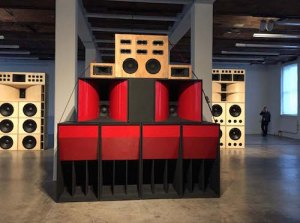
Mark Leckey’s 2001-2001 Sound System sculptures, which communicate all on their own
The intimate viewing experience is punctuated by large-scale installations of provocative work that asks visitors to reconsider their experience of everyday objects.
One major room contains towers of low-range, mid-range and high-range frequency speakers that emit tweets and signs, programmed to converse. Their range of sounds make one recollect times in Leckey’s early career, when he used his speaker-towers in showdowns with other large, inert behemoths, such as gigantic quarry rocks or Henry Moore sculptures. Visitors slow down to get close to the structures and wait for them to speak.
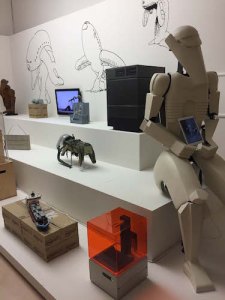
Installation view of The Universal Addressability of Dumb Things (Machine), with costume, Lego ship, copy of a 1959 Soviet space dog suit
Other large-scale installations are from Leckey’s recent project to “collect” interesting art and artifacts inside his computer, assemble them into virtual installations, and then reproduce it all in 3D. Leckey’s multi-part project, The Universal Addressability of Dumb Things, isdepicted in the Flickr album here. The objects are carefully placed but it takes a (literal) scorecard in the gallery to discern what you’re seeing – a copy of a work by another young artist, an engineering model, or fantastical emanation of Leckey’s own mind.
The two ends of a mysterious, dark gallery with fluorescent painted figures are anchored by archeological fragments of the mythological past, except that the fragments are 3D-printed copies.
Traversing one floor, sounds emanate from Leckey’s 2010 green room/shrine. Enter to find a large fluorescent fixture above, a quiet crowd just taking it all in, and the focal point — a talking Samsung smart refrigerator that steals the show. The refrigerator holds court, surrounded by fantasy videos of itself hurtling through time and the cosmos.
Check out Leckey’s 2010 video of the GreenScreenRefrigerator to hear what’s inside the mind of his smart appliance and contemplate a future dominated by the Internet of Things.





 itsnewstoyou