See Hamilton No Waiting

Taking their Shot in the lobby of the Public Theater in 2015

Taking their Shot in the lobby of the Public Theater in 2015

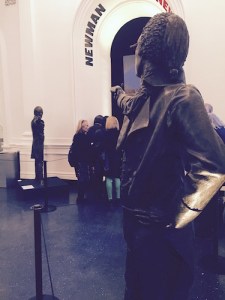
If you really want to experience Hamilton before the Tony Awards, it’s not that hard. Get up to New-York Historical Society at 77th Street and Central Park West and check out the life-size bronze statues of Hamilton and Burr one second before The Shot.

If you went to see Hamilton last year at the Public, you had to pass right between Kim Crowley’s bronze recreations when you entered the theater — a bespectacled Hamilton (wearing tinted glasses because he was facing the sunrise) and an intense Burr who was branded for all time in the history books one second later.

These action figures were initially installed at NYHS in 2004 as part of its ground-breaking Hamilton show…a magnificent installation that drew both raves (for the classy reimagining of NYHS and its exhibitions program after a near-collapse of that institution) and criticism (was it pandering to New York’s besmirched banking community?).

Their 1797 dueling pistols in the NYHS lobby

Their 1797 dueling pistols in the NYHS lobby

Interesting that 2004 was the 300th anniversary of both the duel and the year that NYHS was founded. In fact, Hamilton’s attending doctor that day was one of the founders.

NYHS Ham

Hamilton takes aim inside NYHS

After three hundred years and countless tries at the Hamilton’s pre-show lottery at the Richard Rodgers Theater, it will be a little disconnect to realize that the two facing off in the white marbled lobby are not Lin Manuel and Leslie Odom, Jr. The intensity and the historical dress are there, but the faces are different. Just stand there and run through all the lyrics you’ve memorized from the show.

Walk a few steps further and gaze down at the actual pistols – not stage props – and Angelica Schuyler’s letter to her brother, conveying the terrible news. All real, in her own hand, dated July 11, 1804.

OK, that’s just the lobby. By now, you’ve probably heard that NYHS has just announced its Summer of Hamilton, replete with a large gallery show of all the Hamilton-related documents, artifacts, and portraits plus special clips from Hamilton, movie musicals that inspired Lin, Ron Chernow’s book, and costumed performers on July 4 weekend.

But why not visit right now and have Ham and Burr all to yourself? To fill in the blanks about Ham’s life or prep to see the Broadway show, treat yourself to an exploration of the 2004 Ham show website. It’s full of all types of fun things – a quiz to test your Ham knowledge, a map of where Hamilton hung out in New York City, and real-life historical portraits of all the Schuyler sisters and everyone else in the Broadway show.

Lin's Ham 4 Ham reading outside the theater during the preview lottery

Lin’s Ham 4 Ham reading outside the theater during the preview lottery

There’s even a handy timeline of Hamilton’s “strange and amazing life,” which is a nice reference for things you’ve seen (or hope to see) in the show. For true fans (or curiosity-seekers), there’s even a small selection of short academic papers on Hamilton, including an interview with Ron Chernow, whose book inspired the current Broadway smash hit, and other brief treatises on his schooling, the duel, and the hours before his death.

Although it’s not inside the museum (or the Richard Rodgers), you can check out other Hamilton excitement at the Ham4Ham shows performed at lottery time on 47th Street, many of which have been taped by fans and put up on YouTube. Check out the recreation of the cabinet meeting by the Tony-nominated crew:
Meditative Eyeful at El Museo del Barrio

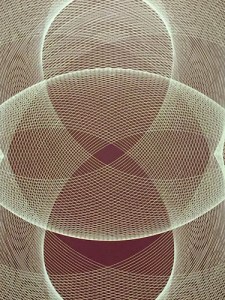
Detail of Argentine painter Miguel Vidal’s 1975 Equilibrium from the OAS Museum

Detail of Argentine painter Miguel Vidal’s 1975 Equilibrium from the OAS Museum

Mystical, transcendent, hypnotic visions from the Sixties and Seventies dot the white walls, all part of The Illusive Eye at El Museo del Barrio, closing this weekend. It’s a tribute to a corner of modern art history that’s sometimes overshadowed by the larger-than-life, attention-grabbing Pop Art movement – the global movement of Op Art and Kinetic Art.

The inspiration for the show is MoMA’s 1964 ground-breaking show, The Responsive Eye, which paid tribute to the global community of painters and sculptors using geometric purity to dazzle and confound the eye.

Many of the same artists are reunited here, with an emphasis on the spectacular contributions from Latin American artists who shuttled between South America and Europe, mixing it up with superstars like Vasarely and Biasi. Click here to see our Flickr album.

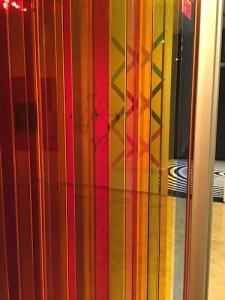
Other works seen through the1965-2009 plexiglass and steel piece by Carlos Cruz-Diez

Other works seen through the 1965-2009 plexiglass and steel installation by Carlos Cruz-Diez

American color-field legends Stella and Albers are featured, but the curators have put the spotlight on stars from Argentina, Cuba, Brazil, Venezuela, and Colombia as well. As the artist biographies demonstrate, most were leading geometric art revolutions in their own countries – like Chilean artist Matilde Perez and Venezuelan artist Carlos Cruz-Diez, who wrote an influential book on color theory in the Eighties and whose works essentially open and close the show here.

Except for the dramatic room-sized vinyl spiral by Italy’s Marina Apollonio, most of the works are on a small scale that invites close inspection. Move back and forth in front of Cruz-Diez’s entryway work and see the colors appear and disappear.

Walk past the shimmering black-and-white lines of Venezuelan artist Jesus Rafael Soto’s 1975 mixed media work of paint, wire, nylon, and wood. Spend time with the barely-there tower of gold thread by Brazilian sculptor Lygia Pape in the back gallery.

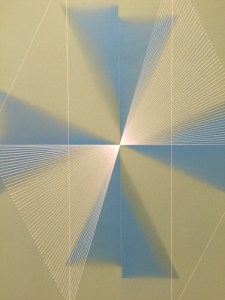
Detail of Generative Painting Transparencies (1965), by Argentine innovator, Eduardo Mac Entyre

Detail of Generative Painting Transparencies (1965), by Argentine innovator, Eduardo Mac Entyre

The American and European works were gathered from a variety of small and personal collections, but the curators have pulled from the extensive holdings of two museums to populate the rest of the show – the OAS Art Museum of the Americas in Washington, D.C. and the Museum of Contemporary Art in Buenos Aires (MACBA).

You’ll find meditation and stillness at every stop in this beautiful, contemplative, and exciting show that mesmerizes the eye and brings together a body of work that will be enjoyed by anyone who takes the time to get to Fifth and 104th. No content, no distraction — just pure, simple, engaging form that quiets the mind and shifts the attention to your own, inner capability to perceive and get lost in line.

Take a walk through the exhibition with the museum director and see what we’re talking about:

The Goose Gets Loose at Grolier

The Pleasant Game of the Goose, a 1640 hand-colored Italian woodblock print. In the center, a fancy family dines on one! Courtesy: Morgan Library

The Pleasant Game of the Goose, a 1640 hand-colored Italian woodblock print. In the center, a fancy family dines on one! Courtesy: Morgan Library

The geese are running wild inside the historic Grolier Club on Madison and 60th Street – part of the tribute exhibition organized by curator-collector Adrian Seville, The Royal Game of the Goose: Four Hundred Years of Printed Board Games, running through this weekend.

The show is an historical overview of one of the most replicated and popular board-game entertainments of the Western world — The Goose, a board-game design that has existed since the Middle Ages.

It’s remarkable to see over 70 examples including hand-colored woodblock prints, games from copperplate engravings, chromolithographs, and commercially printed folding boards spanning the 1600s through today.

Most feature some form of The Goose. The Goose board is designed as a single track in which players move their markers toward the finish based on a dice roll. Sound familiar? The rules have been around since 1600.

Detail of The New Game of Aerostatic Balloons, a 1784 French hand-colored engraving depicting the early history of ballooning

Detail of The New Game of Aerostatic Balloons, a 1784 French hand-colored engraving depicting the early history of ballooning

Wildly popular across the European continent, the Goose game has survived and depicted the French Revolution, the fall of Napoleon, the various configurations of royal marriages, WWII, and the evolution of social mores.

After the French Revolution, Goose games appealing to the middle-class appear, providing graphic lessons about reading music notation, the Parisian theater, ethnicity in America states, and countries you’d visit on an round-the-world voyages. A late 18th century French game depicts the history of ballooning, featuring Ben Franklin’s witness to a spectacular liftoff in Paris.

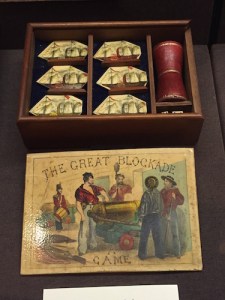
At the end of the 19th century, the games featured subjects like British ships running the Union blockades in America’s Civil War, monuments of the world, and significant inventors like Edison and Roebling (complete with a picture of the brand new Brooklyn Bridge).

Game pieces for The Game of the Great Blockade, produced in 1863 London about the British ships that were helping the Confederacy by running through the Union blockade during the Civil War

Game pieces for The Game of the Great Blockade, produced in 1863 London about the British ships that were helping the Confederacy by running through the Union blockade during the Civil War

Commercials creep into the mix, too, but what else is new? The Grolier has again hit a home run with chronicle of Western culture’s time spent around a table, hanging with friends, and rolling the dice.

Click here to view some of our favorites in our Flickr album.