Contemporary Art Extravaganza Provides Time-Travel Portals

The scale and scope of the contemporary art on display is tremendous, but how often do art-seekers also get an opportunity to travel across ancient streets and landscapes, to meet real and fictional historic characters, contemplate fables and real-life stories, and see art of the past and present side by side?

It can take days to experience and fully absorb all of the history and potential futues presented in the films, paintings, sculptures, and installations in Once Within a Time: 12th SITE Santa Fe International, on view across 15 art spaces across Santa Fe through January 12, 2026.

Exhibition banner in the courtyard of Palace of the Governors (1610) (New Mexico History Museum) – gateway to SITE installations by Daisy Quezada Ureña (Santa Fe) and Charisse Perlina Weston. (Harlem, New York)

Besides the expansive white galleries and screening rooms of SITE’s museum in Santa Fe’s always-popping Railyard District, visitors can choose to contemplate giant abstract murals in a church-like auditorium, an innovative historical-object installation in a 400-year-old seat of power, or enter an old foundry to see an evocative installation by a Silk Road artist across farm fields adjacent to the Old Spanish Trail.
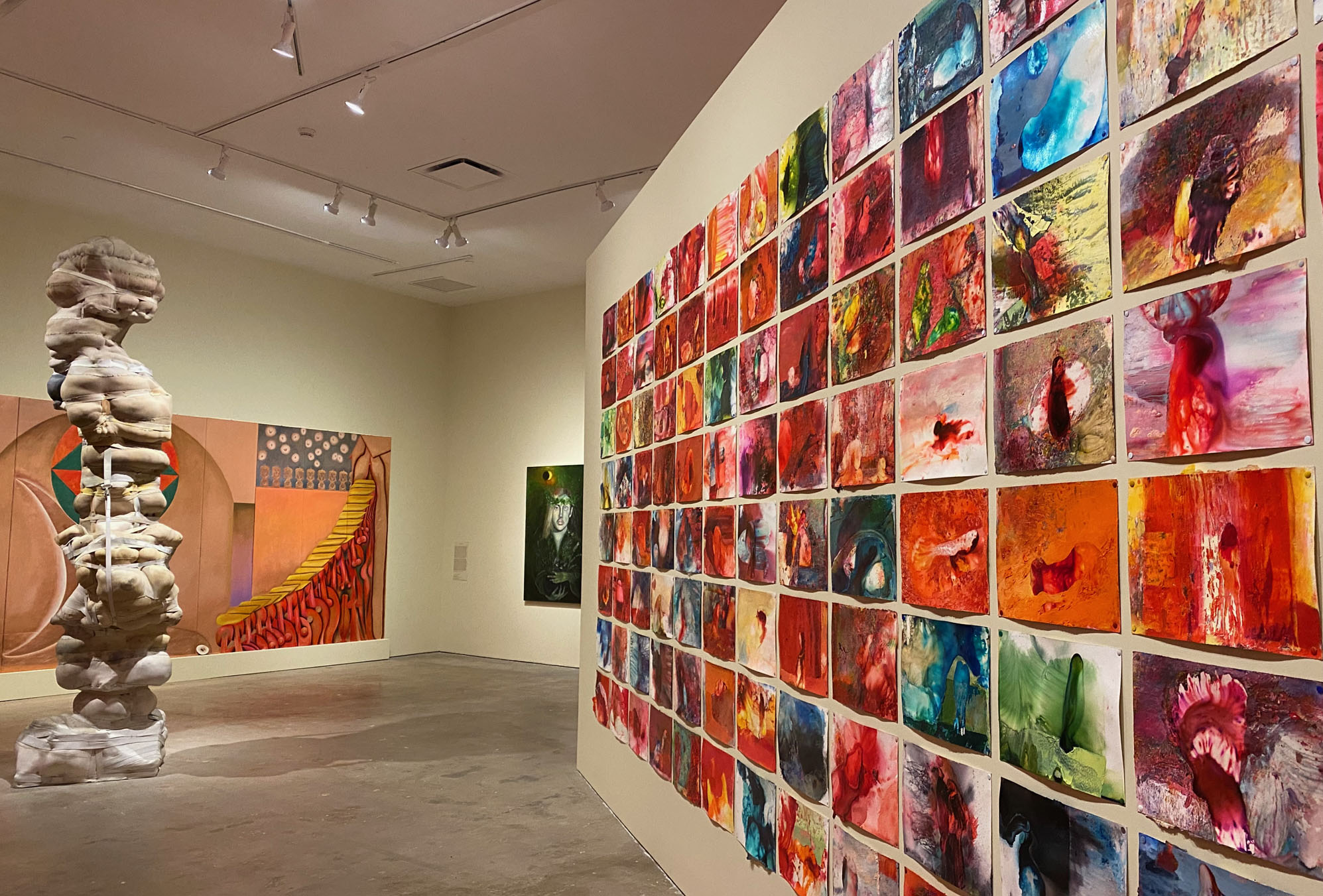
SITE Santa Fe gallery theme: appears like real life and sensual free-thinkers. 2025 mixed-media sculpture “18-1-4-5-7-21-14-4” by Patricia Ayres; copper work by Santiago de Paoli; Katja Sieb’s 2025 “perpetual novice” painting; and 2020 grid painting “Atlas” by Penny Siopis (South Africa).
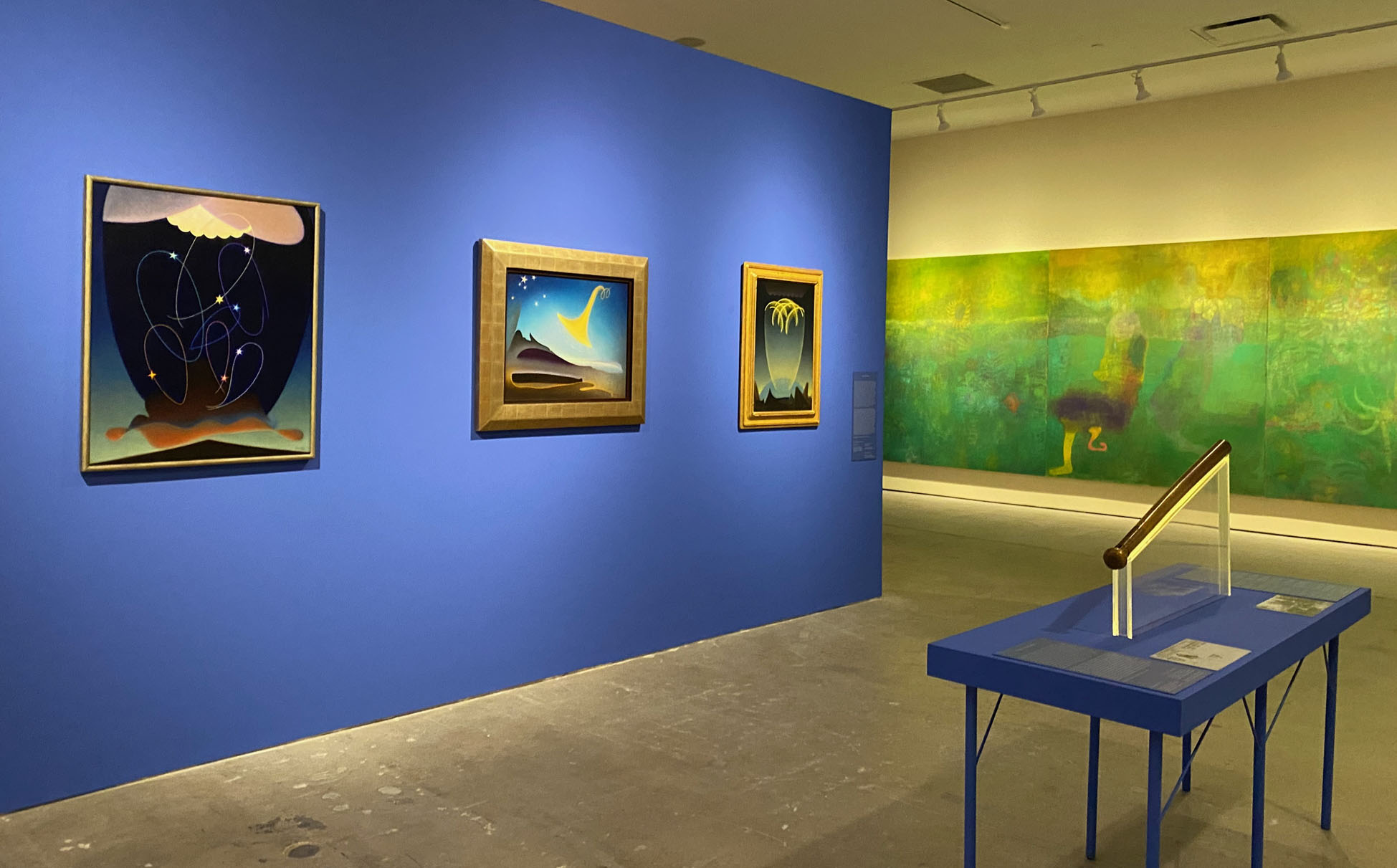
SITE Santa Fe gallery theme: in touch with light (spiritual) – Agnes Pelton’s paintings (1930s), Maja Ruznic’s mural (2025), and the 1895 healing rod of itinerant Southwestern mystic Francis Schlatter. Courtesy: Phoeix Art Museum; New Mexico Museum of Art; Oakland Museum of California; Maja Ruznic and Karma Gallery; and New Mexico History Museum.

In every space and art encounter, visitors may reflect upon whether history is repeating itself and whether inspiration can be drawn from futures that artists imagined nearly a century ago. Each space is designed for visitors to look, read, encounter, and reflect.
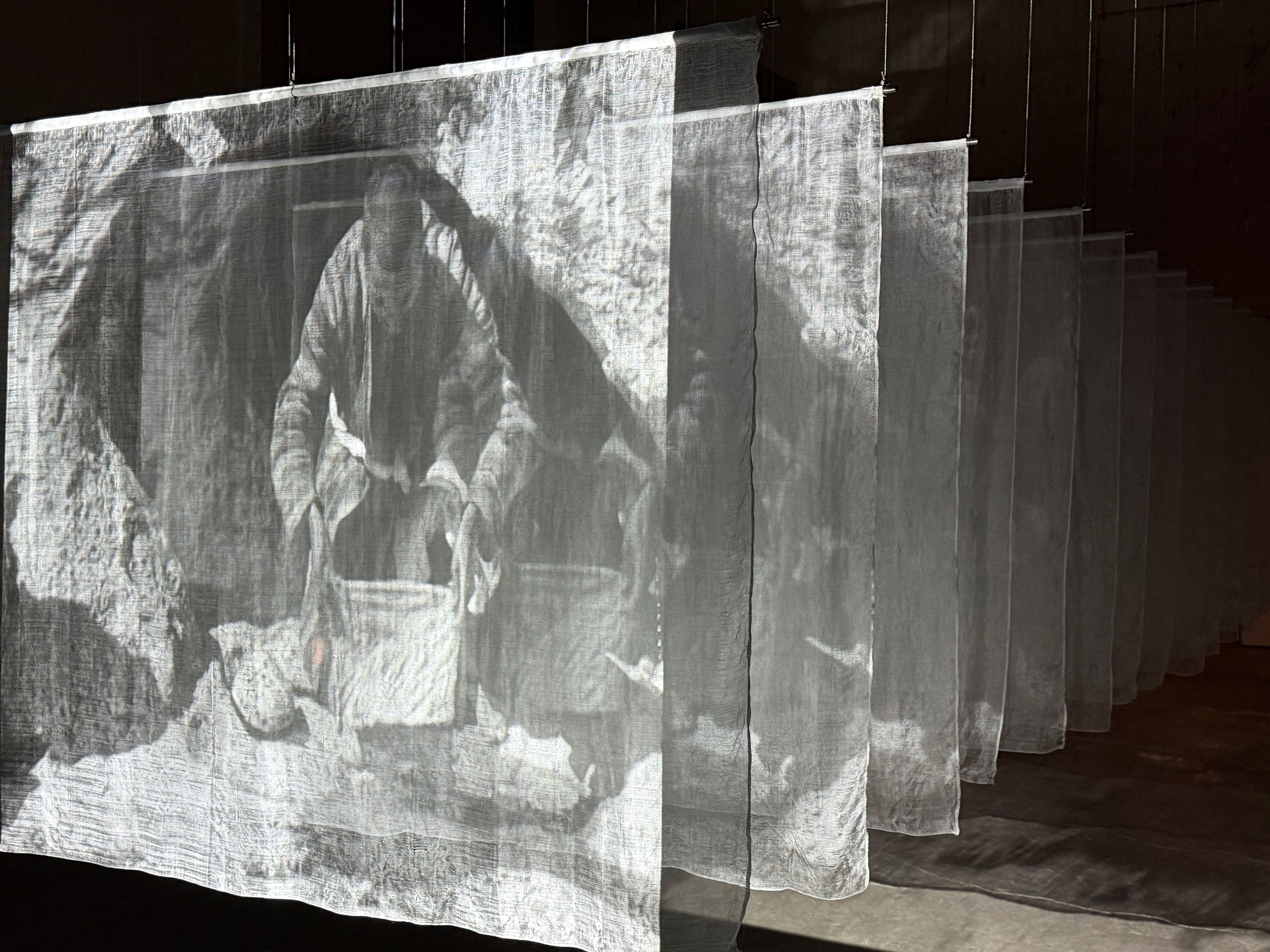
In the old foundry at Tesuque: 2024 video As We Fade by Saodat Ismailova (Uzbeckistan), showing visitors to one of Central Asia’s most sacred sites (Throne of Solomon) along the ancient Silk Road; projected across 24 suspended silk screens. Courtesy: the artist and Milan’s Pirelli HangarBicocca.

The theme for the show – Once Within a Time – is inspired by Godfrey Reggio’s most recent film – a suggestive and wordless mix of innocence, nostalgic images, visual poetry, and the future facing the next generation. The film screens continuously inside SITE, with visitors caught up in Godfrey’s dream-like images, which highlighted in this mesmerizing movie trailer:

Like Godfrey’s film, each space and gallery presents a theme, story, historic character, and provocative contemporary art that pulls back in time, creates an unforgettable experience, and asks the viewer to go inward to contemplate the future. 
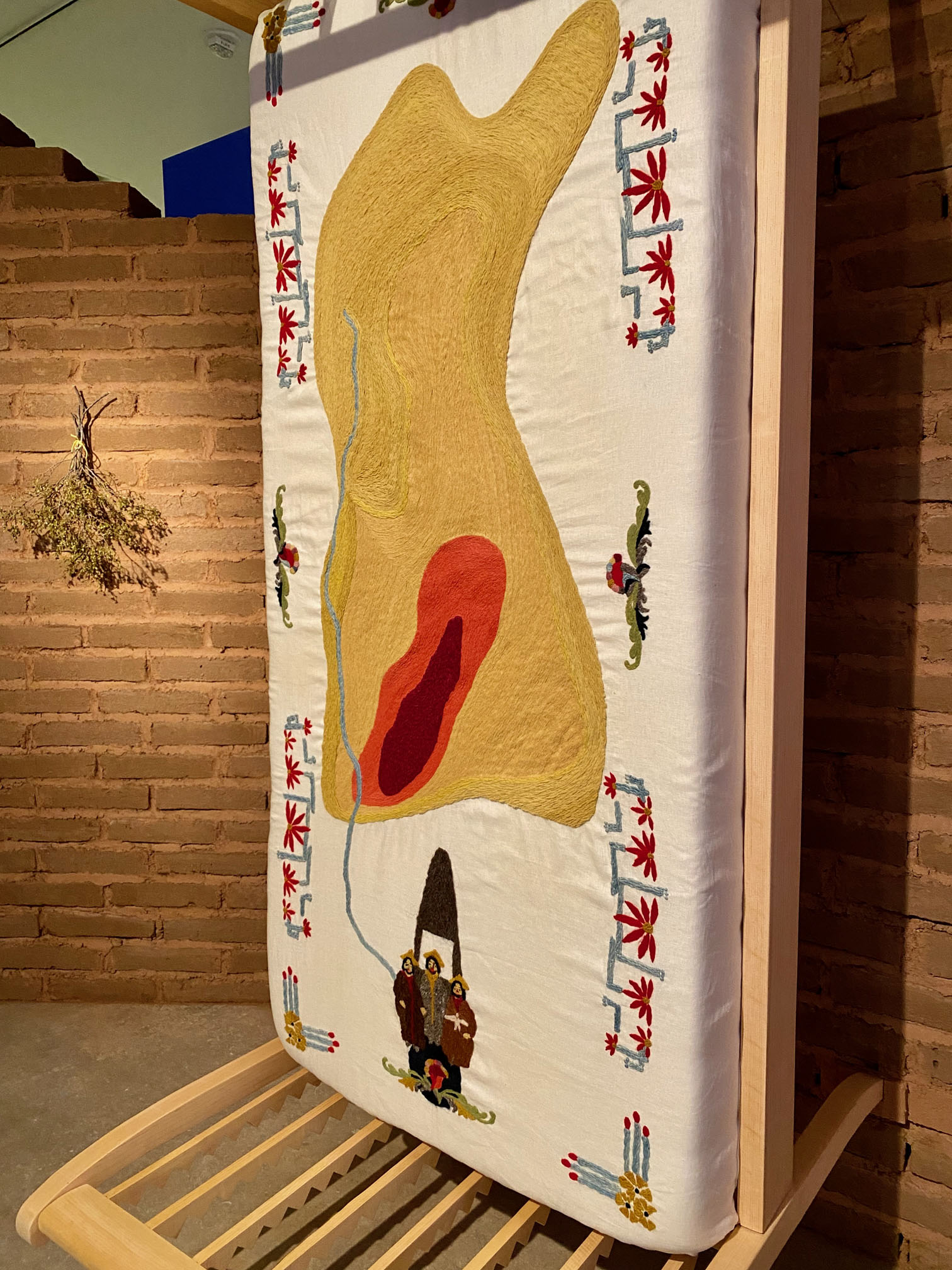
Joanna Keane Lopez’s 2024 Batter my heart, three person’d God – adobe, a handmade bed, colcha embroidery showing a radiation cloud, and creosote bush, referencing her family’s experience of living downwind of the Trinity detonation.

SITE’s galleries, for example, present themes such as storytelling, technology and language, the power of spiritual energy, and New Mexico’s undeniable status as a natural Land of Enchantment.  

The exhibition presents traditional New Mexico superstars and inspirations –  Awa Tsireh and Helen Cordero (San Ildefonso Pueblo), Agnes Pelton, Rebecca Salsbury James, Florence Miller Pierce, Pop Chalee (Taos), Pablita Velarde (Santa Clara Pueblo), and Eliot Porter – alongside artists who are breaking through on the international stage.

Cochiti pueblo ceramicist Helen Cordero’s storyteller figures are paired with Pablita Velardi’s storyteller illustrations (both are inspired by grandfathers and fathers) and Simone Leigh’s epic stone and raffia goddesses.
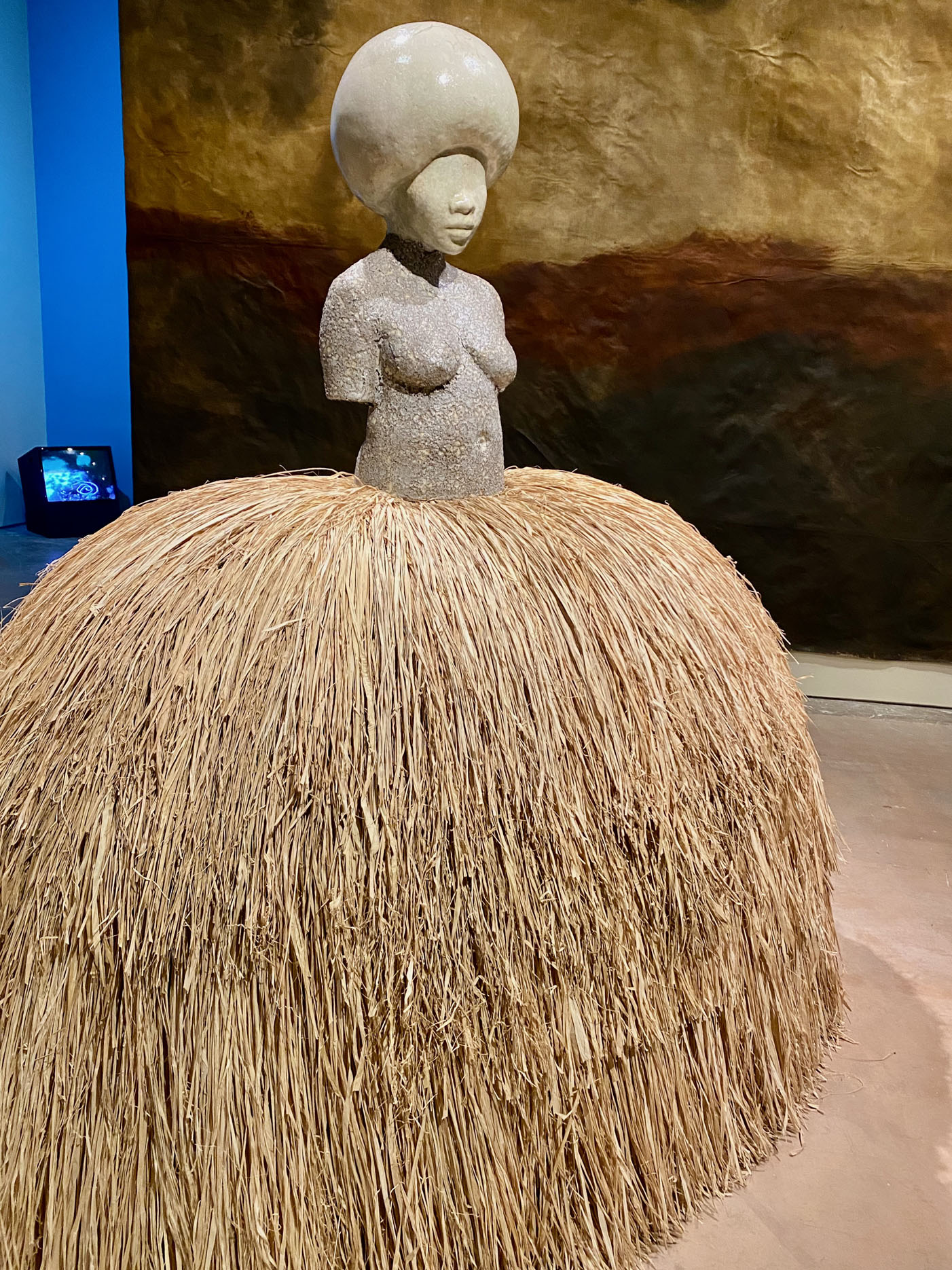
SITE Santa Fe gallery theme: storytelling. Simone Leigh’s 2025 untiled stoneware and raffia sculpture. At rear, 2025 oil The Solemn and Dignified Burial Befitting My Beloved for All Seasons by Dominique Knowles. Courtesy: Matthew Marks Gallery; the artist and Hannah Hoffman Gallery, Los Angeles.
Gallery theme: storytelling. Helen Cordero’s 1970 painted clay Storyteller – the creator of the Cochiti Pueblo sculptural tradition, inspired by her grandfather’s stories; championed by patron Alexander Girard. Courtesy: School for Advanced Research.
SITE Santa Fe gallery theme: language Marilou Schultz’s 2024 weaving Integrated Circuit Chip & AI Diné Weaving – a reference to the controvercial 1970s Fairchild Semiconductor chip plant on Navajo Nation staffed primarily with Diné women. Courtesy: private foundation.

The story of the legendary WWII heroes, the Navajo Code Talkers, is featured in a gallery alongside Marilou Schultz’s weavings of chip technology using traditional Diné methods with Fred Hammersly’s ground-breaking IBM computer drawings at the University of New Mexico in 1968-1970. 

Fred was given an opportunity to create the first mainframe-generated art in the form of drawings programmed by traditional IBM punch-card technology and the Art1 program.  SIITE not only displays a selection of the 400 computer drawings that he generated over the course of 18 months, but some of the punch cards he used, which are now archived at the Smithsonian’s Archives of American Art.

Sensual free-thinkers are represented by the story of Santa Fe gambling mogul Doña Tules (Maria Gertrudis Barceló) and her actual 1840s money chest, witty contemporary porcelain playing cards and magical paintings by Katja Seib (UK), and jaw-dropping drawings by Shanghai’s Zhang Yunyao.
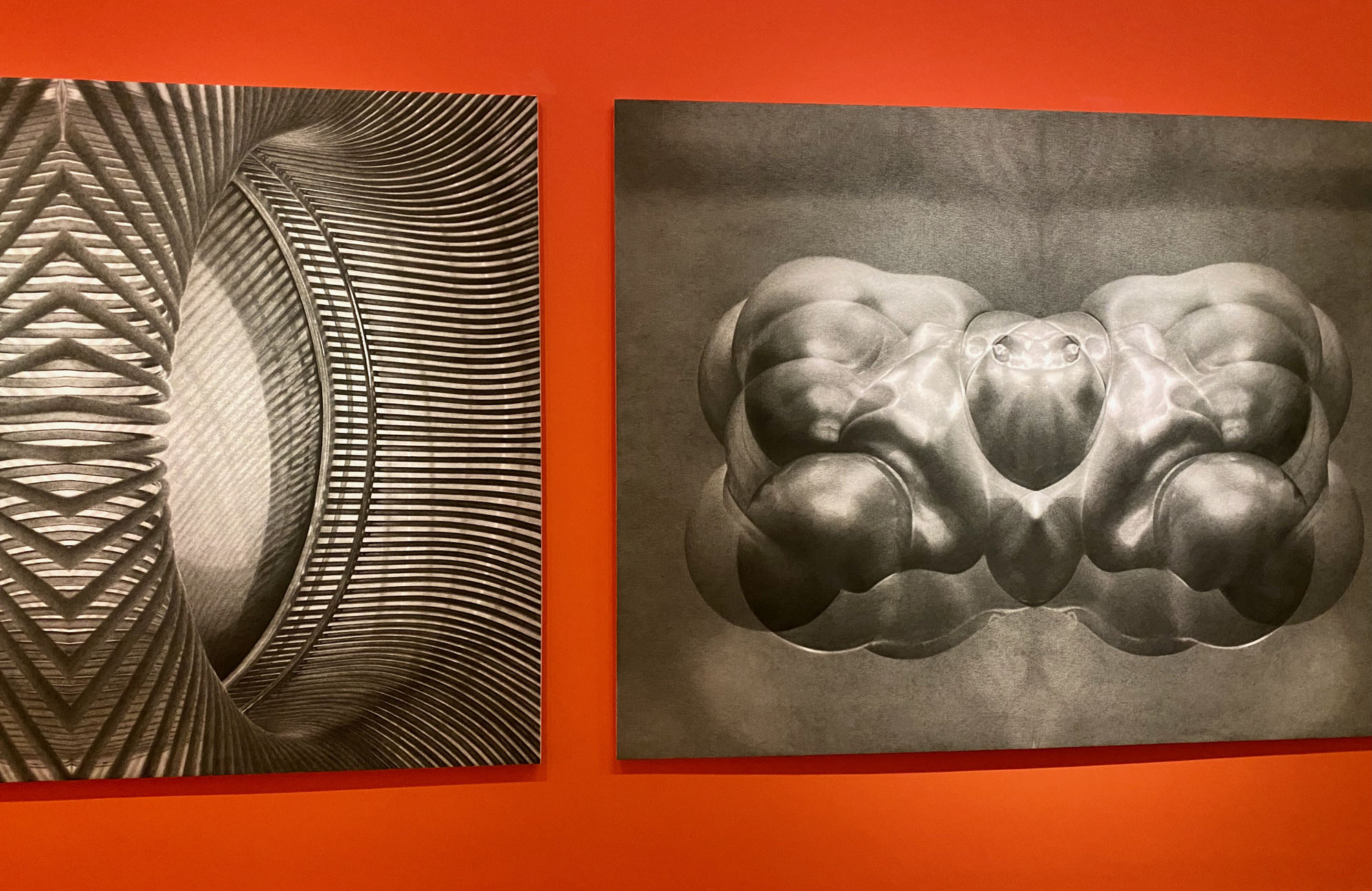
SITE Santa Fe gallery theme: sensual free-thinkers. Two of three 2025 Connector drawings by Zhang Yunyao (Shanghai); pencil on stretched felt. Courtesy: the artist, Don Gallery.

Around the corner from Agnes Pelton’s transcendental paintings are Diego Medina’s landscapes reflecting the Piro-Mansa-Tiwa spiritual power inhabiting ancestral lands of Southern New Mexico and also installations about a different type of New Mexico light – the impact of the nuclear energy tests on people living downwind and the legacy of uranium mining across native lands.

SITE Santa Fe gallery theme:In touch with light (nuclear energy): Will Wilson’s 2025 series Hubris on the Land – aerial photography of abandoned 1940s uranium mines on Navajo Nation paired with his documentation of Land Art sites created by Holt, Smithson, Heiser, and Turrell in the 1960s-1970s. Courtesy: the artist

New Mexico’s natural world is paid tribute in stories and artwork by travelers and residents – watercolors of Pueblo spirits and wildlife by Awa Tsireh (Alfonso Roybal) in the 1930s, Vladimir Nabokov’s sketches of butterfly wing cells (1940s-1950s), and Eliot Porter’s spectacular photos of Tesuque jays in the 1960s.

But these examples are just snippets of Once Within a Time – the entire show deserves multiple visits, and time to visit the other locations in the city, such as the hidden basement natural wonderland epic at the Museum of Internatonal Folk Art created by Taiwan ‘s Zhang Xu Zhan. It’s not only an immersive environment, but a film, animal-spirit sculptures, and selections from the MoIFA’s paper funerary object collection.  Don’t miss the Day of the Dead altar, the 18th-century Pere Lachaise Cemetary tribute initially collected by Mr. Girard himself, and paper funerary fantasies made by the artist’s own family. Truly unforgettable.
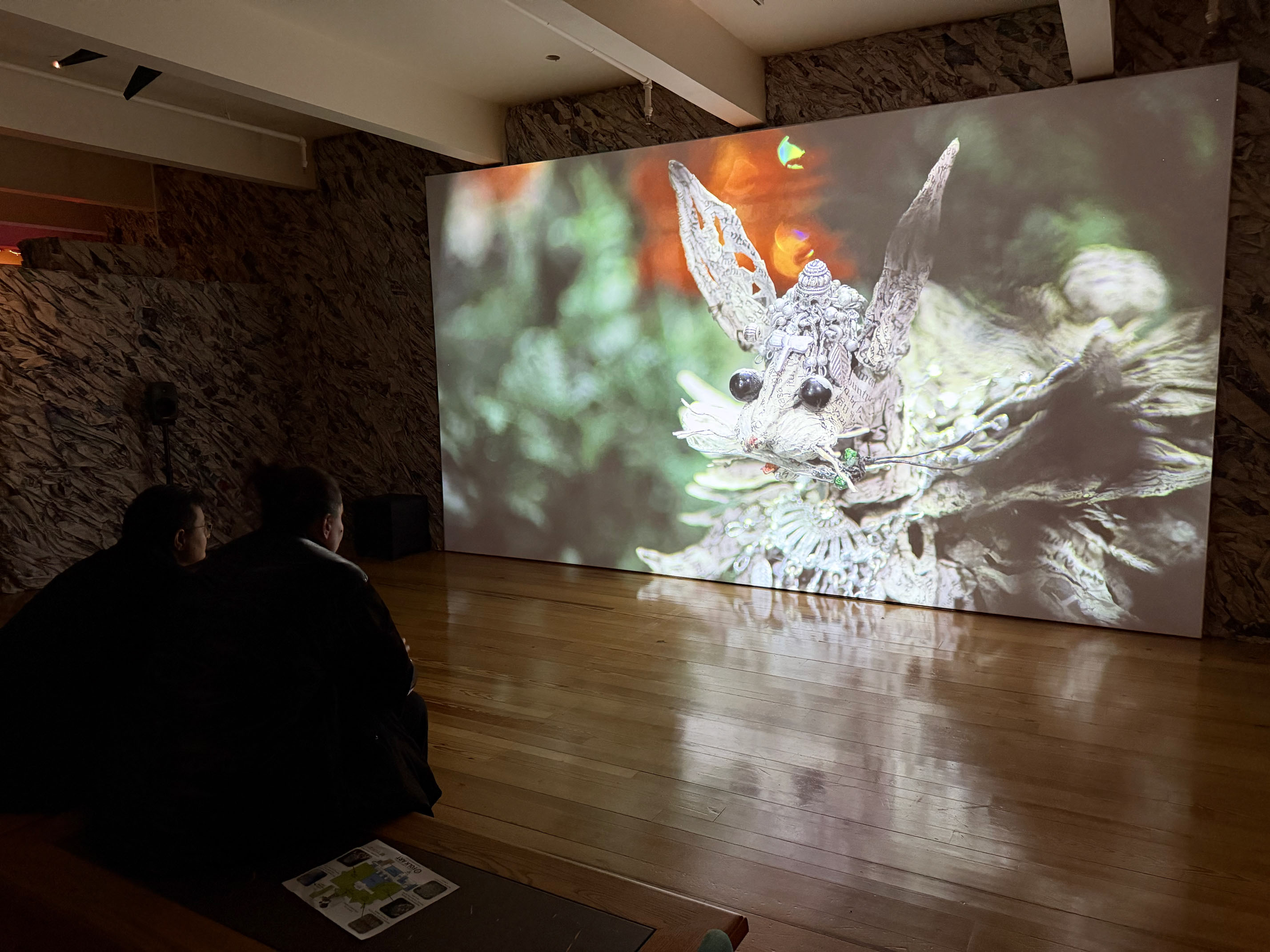
Museum of International Folk Art: Zhang Xu Zhan’s 2020-2022 paper-animation video Compound Eyes of Tropical (Animal story series), with a Southeastern Asian deer-mouse outwitting a group of predatory crocodiles. Courtesy: the artist and Project Fulfill Art Space, Taiwan.

The Wheelwright Museum of the American Indian fills the Klah Gallery (in the shape of a traditional hogan) with a meditation on healing by Cristina Flores Pescorán, a wild organic sculpture by Nora Naranjo Morse, and a mini-retrospective of paintings by the incomparable Emmi Whitehorse.
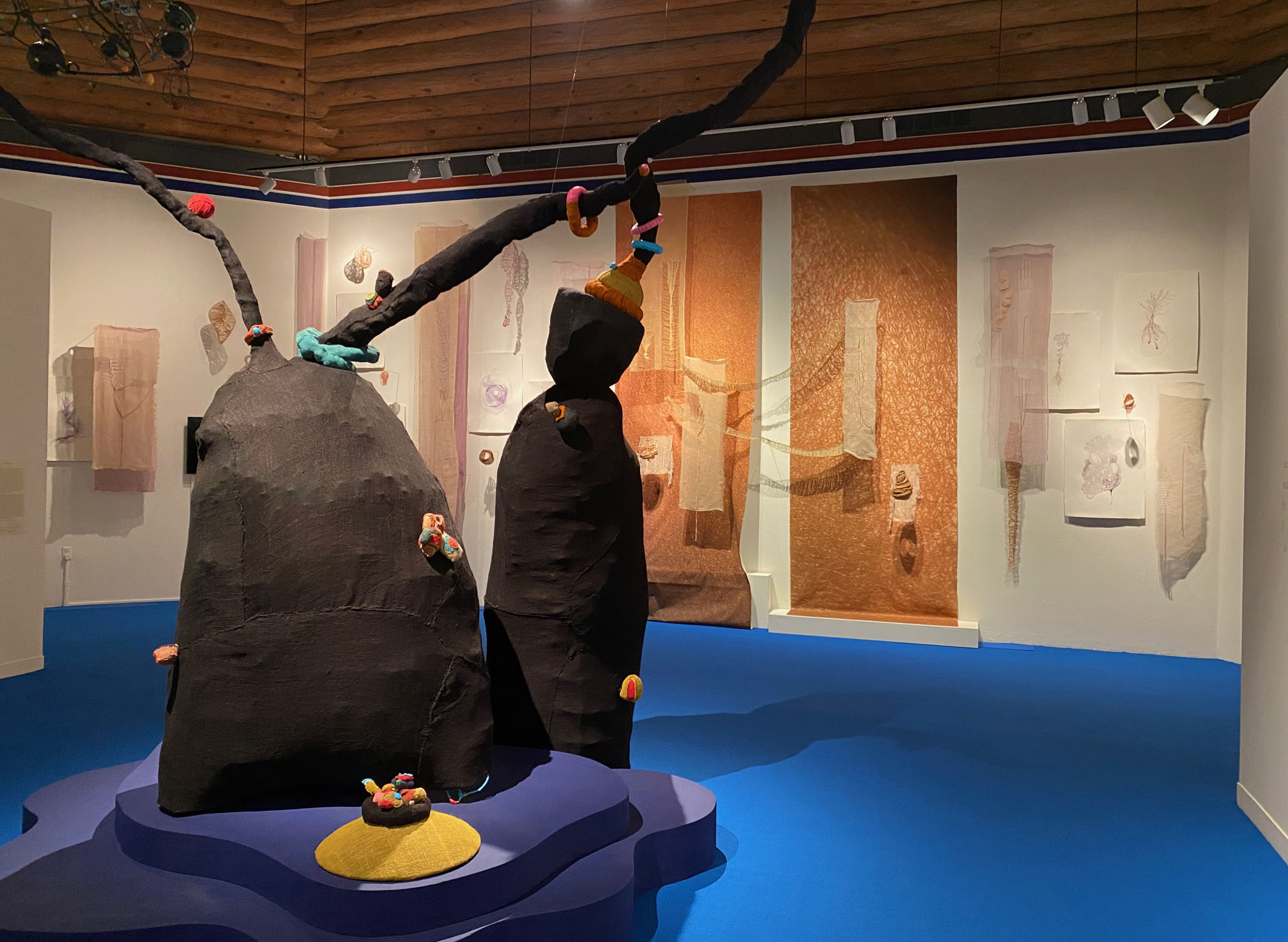
Wheelwright Klah Gallery theme: journeys. Nora Naranjo Morse’s sculpture Into the Forever; on walls, Cristina Flores Pescorán’s 2025 installation Treinta y ocho. Ofrendas para reescribir historia medica y renacer Huaca. Courtesy: the artists

The Tesuque location also features rooms with installations by Mexico’s Guillermo Galindo incorporating burned wood from the recent New Mexico fires (crossed with Picasso’s Guernica),  David Horvitz’s tribute to the men incarcerated in Santa Fe’s Japanese internment camp (and a hat from one them), and Thailand’s Korakrit Arunanondchai’s room-sized contemplation that incorporates the ashes from the burning of Zozobra.

Video of Korakrit Arunanondchai’s 2025 installation Unity for Nostalgia, with floor incorporating ashes from Santa Fe’s Zozobra’s burning and a prayer to the phoenix; layered soundtrack. Courtesy: the artist, Bangkok City Gallery, London’s Carlos/Ishikawa, CLEARNING NY-LA, Kukje Gallery, Seoul
Video of Max Hooper Schneider’s 2025 Written in Sand (Finquita Garden) installation; spheres mysteriously travel sand channels. Courtesy: the artist; Maureen Paley, London, Hove; Francois Ghebaley, Los Angeles, New York.

For more, take a walk through the main exhibit and five other sites in and around Santa in our Flickr album to see work by legendary New Mexican artists, and travel back and forth to see how contemporary art reflects epic histories and mystic systems of the Southwest.
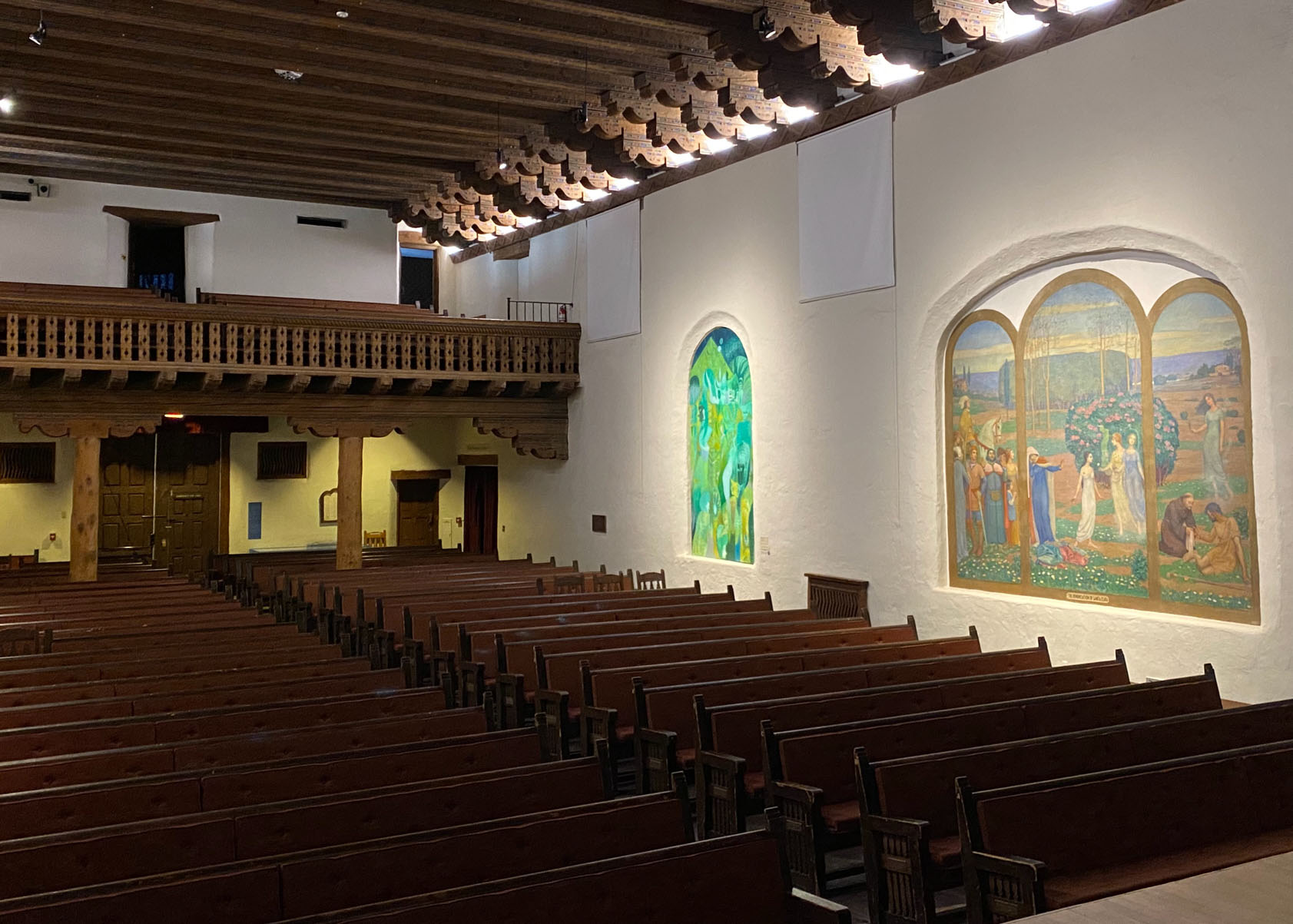
View of historic St. Francis Auditorium (1917) with Maja Ruznic’s 2025 Kisa Pada, Trava Raste, Gora Zeleni installed atop Donald Beauregad’s painting The Conversion of St. Francis; to right, Beauregard’s The Renunciation of Santa Clara.

Marsden Hartley: A Modernist on the Move

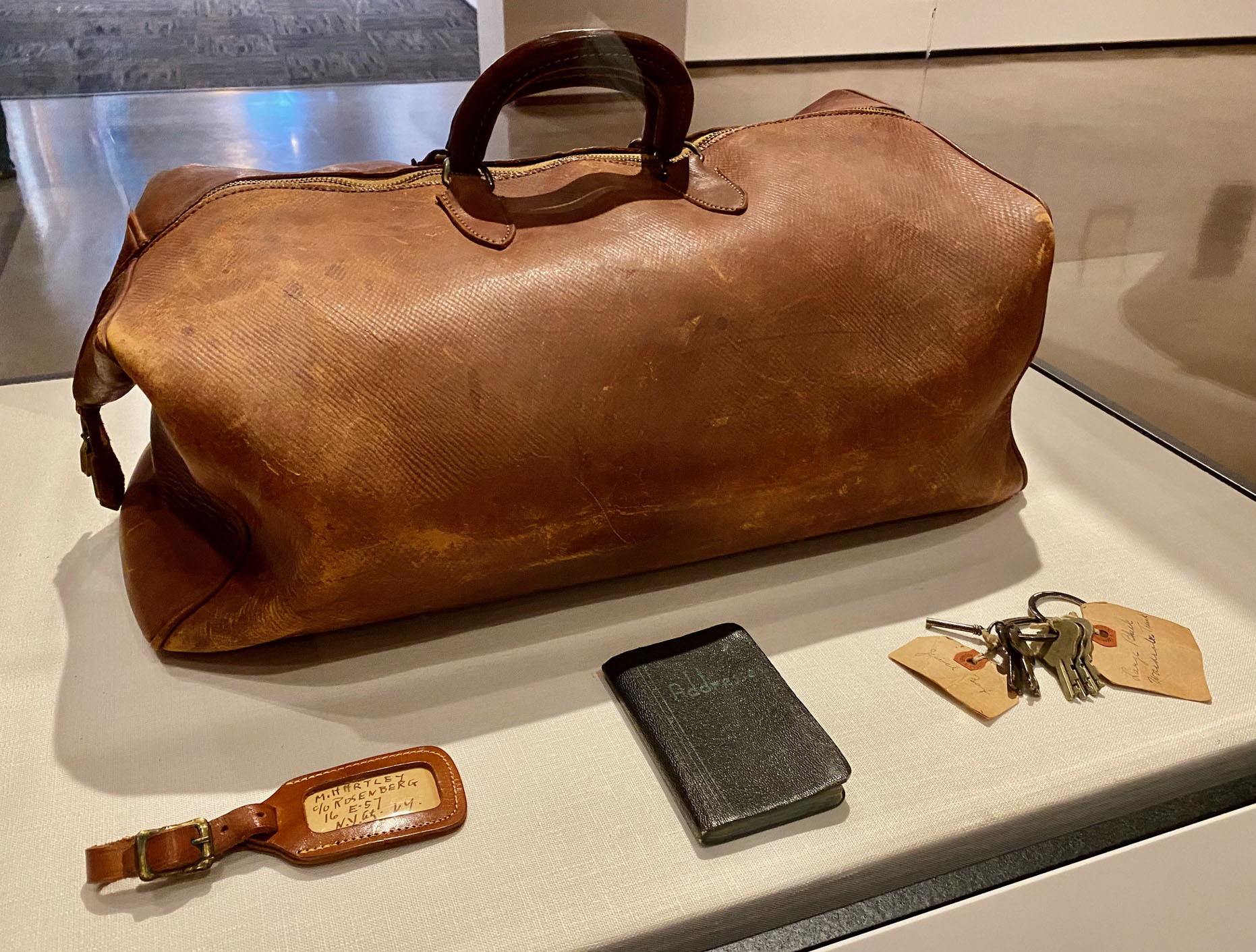
With his traveling valise sitting in the center of the introductory gallery and a map nearby, you understand instantly that superstar artist Marsden Hartley was a man on the go.

Marsden Hartley: Adventurer in the Arts, on view at the New Mexico Museum of Art in Santa Fe through July 20, 2025, uses his personal possessions, works painted on two continents, and non-stop itinerary to demonstrate how landscape, life, and modern-art legends led him to create an epic body of work.

Take a look at our favorites in our Flickr album.

Hartley’s 1914 Berlin Series, No. 2 – flat, abstracted natural symbols. Courtesy: Jan T. and Marica Vilcek Collection.
Ready to travel – Hartley’s leather valise, address book and luggage tags. Courtesy: the artist’s estate; Bates College Museum of Art.

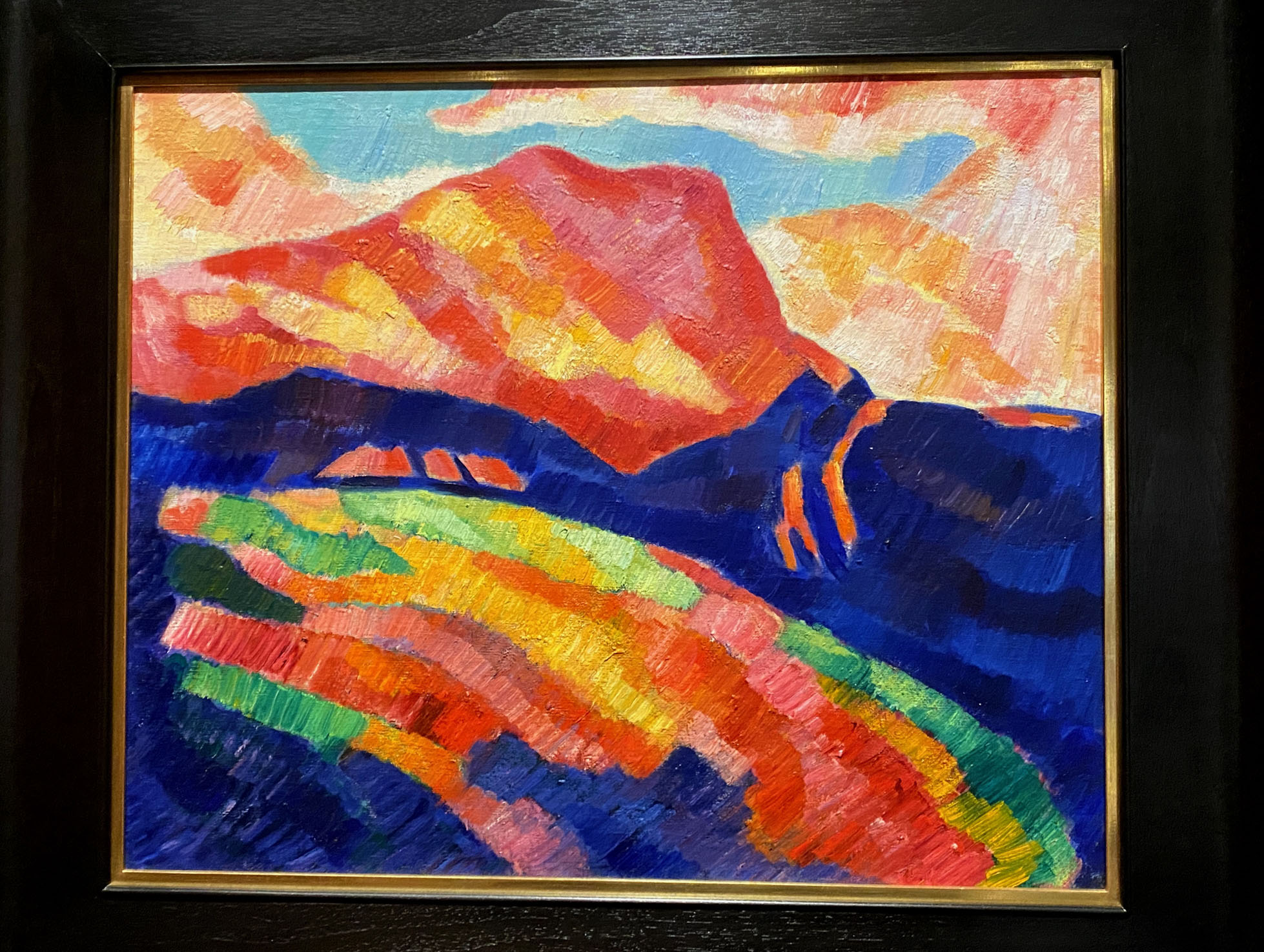
Looking around, there’s a wall of Maine mountainscapes he did in his thirties, a painting done just after Stieglitz sent him to Paris to soak up the vibes in Gertrude Stein’s salon, his accessories of rings and cigarette cases from Berlin in the 1920s, a Fauve-ist impression of Mount Saint-Victoire at Cezanne’s old stomping grounds in Aix, and photos of him and his dog at his Maine studio in the 1940s.

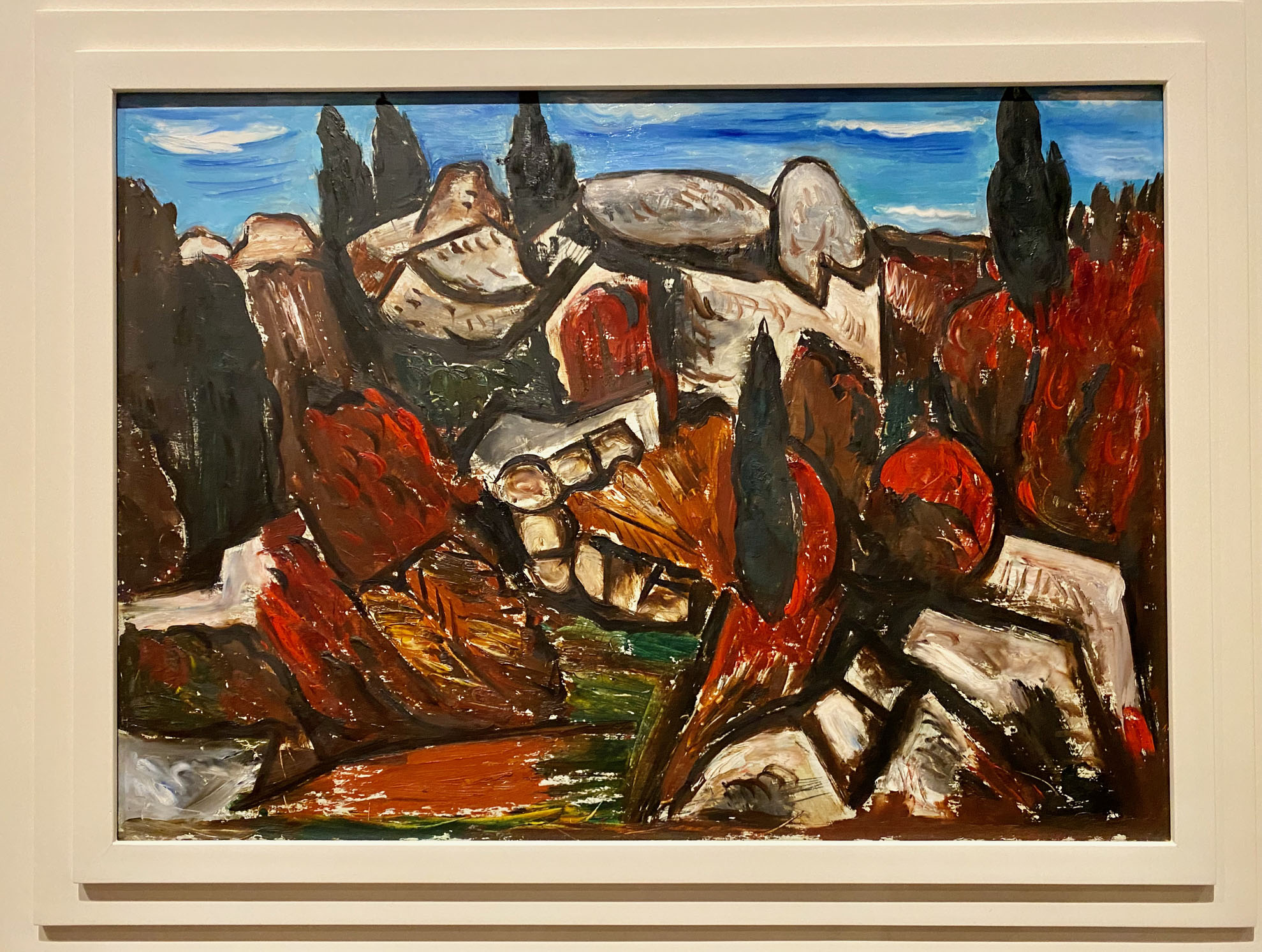
Hartley’s 1927 oil Mont Sainte-Victoire – painted in Aix, France where Cezanne once lived. Courtesy: Jan T. and Marica Vilcek Collection.

The exhibition merges Hartley’s paintings from the Jan T. and Marica Vilcek Collection with items donated by his favorite niece to Bates College in Maine – items he collected as he traveled; sketches and stuff sent to his neice; his camera, books, and snapshots; his studio paintbox, and other personal art. Together, the exhibition tells a story of innovation, personal journey, and relentless art making.

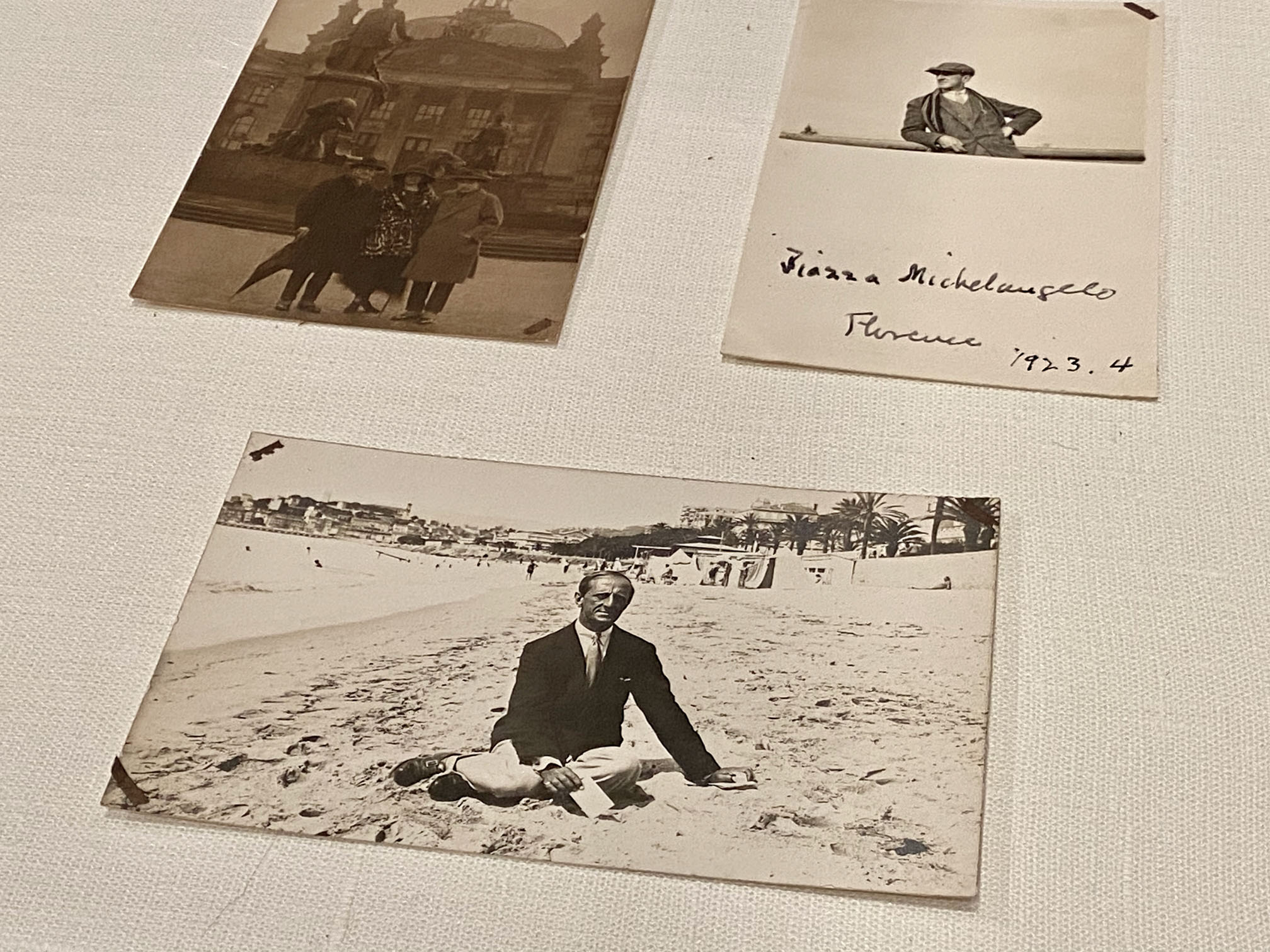
Hartley’s personal photos from his 1920s European adventures. Courtesy: Bates College Museum of Art

Hartley emerged from a hardscrabble childhood to see, feel, and experience art, nature, and transcendental spiritualism in New York, Boston, and Maine in 1890s.

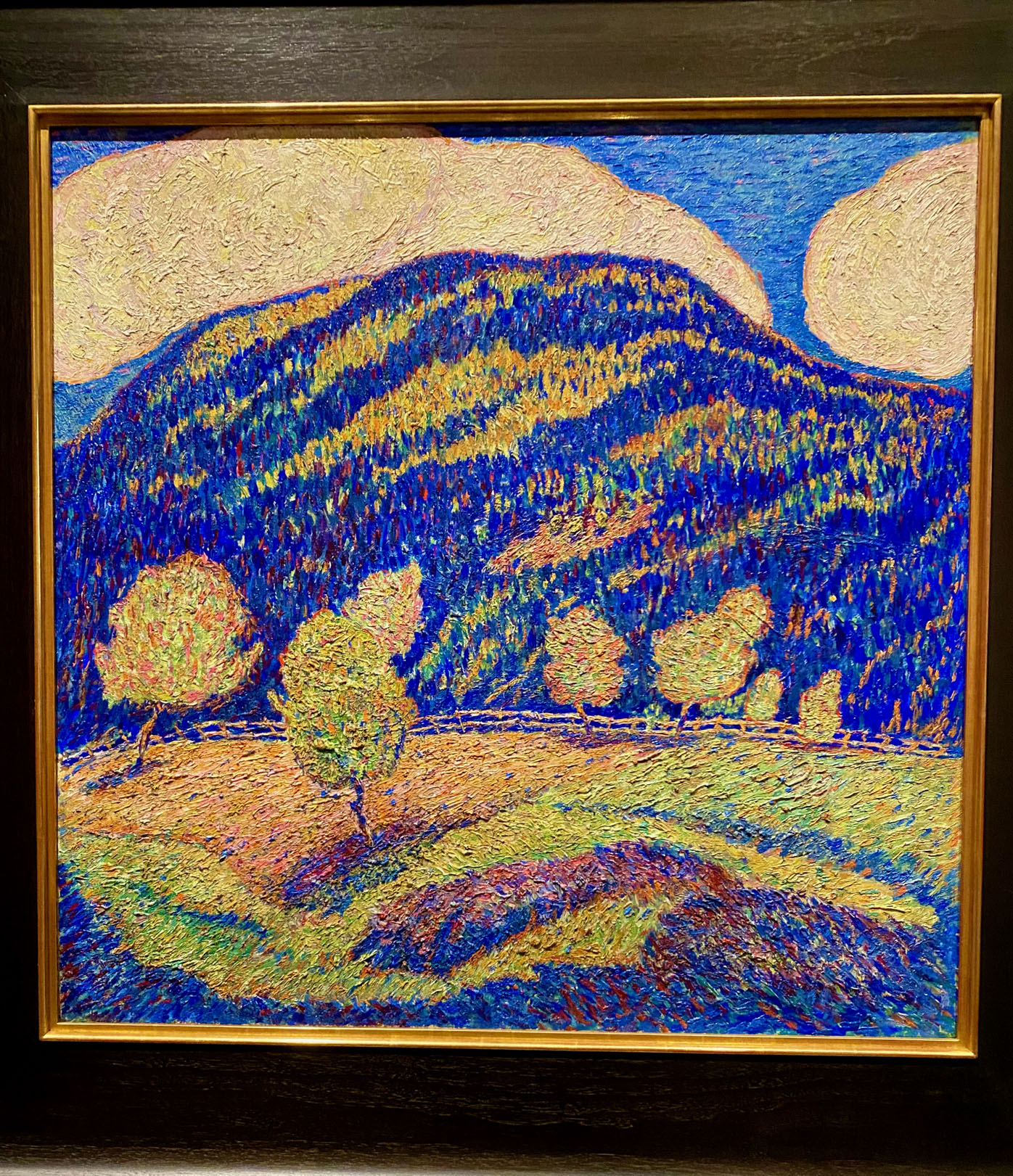
He loved painting mountains and depicted water, earth and sky as a color-filled flat plane filled with jabbing brushstrokes – an approach that stuck with him throughout his life as he journeyed through New Mexico, the Alps, Mexico, and back in Maine.

Hartley’s 1907-08 oil Silence of High Noon – Midsummer painted in Stoneham Valley, Maine. Courtesy: Jan T. and Marica Vilcek Collection.

By the time he was in his early thirties, he had shown his landscapes to The Eight, knocked on Stieglitz’s gallery door, and got a one-man show (and a dealer for the next 20 years) at 291, the hottest modern art gallery in America.

Hartley’s 1910 Untitled (Maine Landscape)– water cascading down a rock face. Courtesy: Jan T. and Marica Vilcek Collection.

Getting to Europe in 1912, the color, cubism, and symbolism of the Blue Rider, Matisse, and Picasso made his head spin. His German friends introduced him to Kandinsky’s book Concerning the Spiritual in Art. He went out of his way to meet the man himself, and his painterly wheels turned.

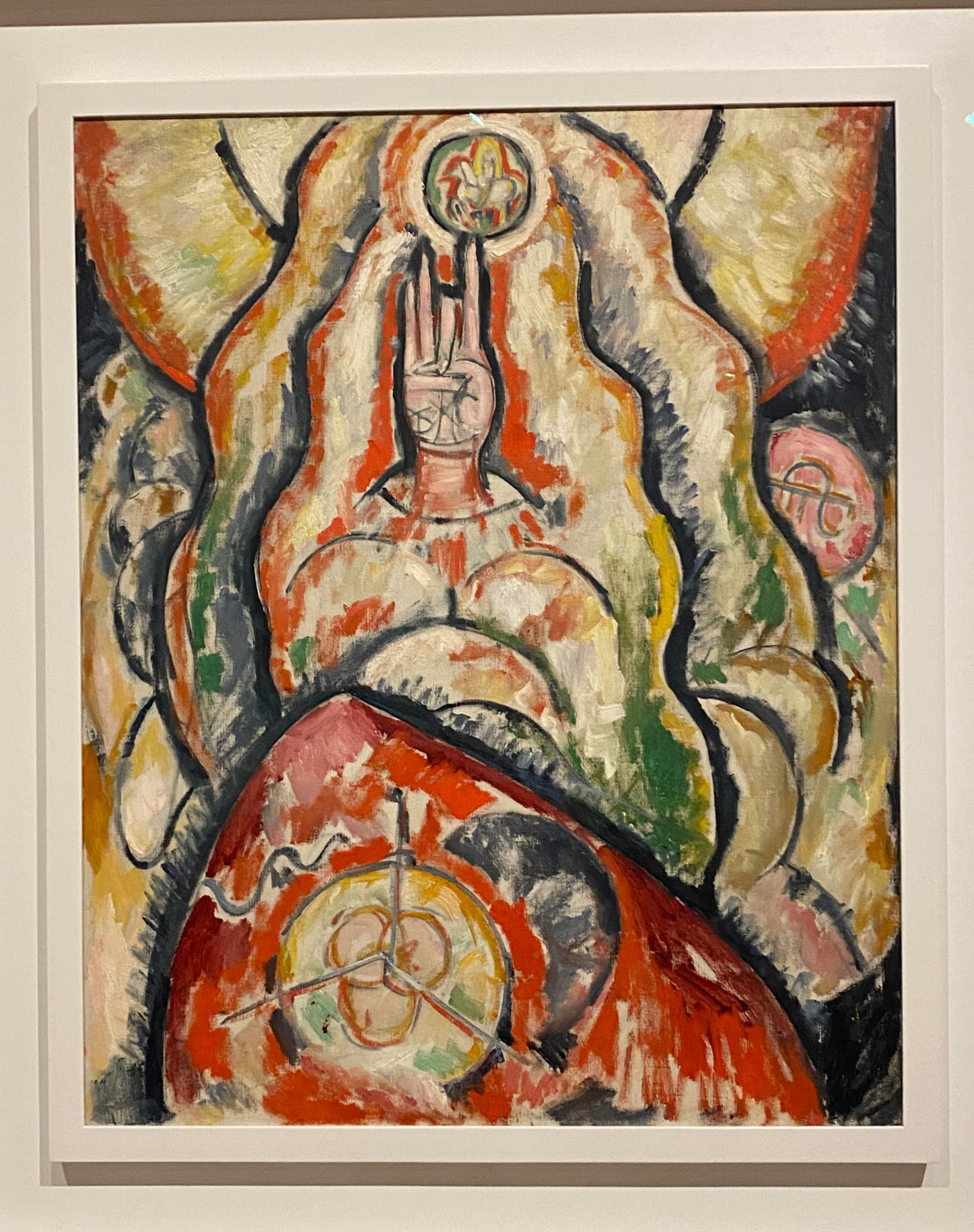
The second gallery presents a large work from his Cosmic Cubism series – an airy, dreamy arrangement of signs, spiritual symbols, colors, and planes – along with drawings from his Amerika series, based loosely on Native American symbols and other abstract shapes. On view for only the second time in the United States, Schiff is a dazzling creation drawing signs and symbols from Native American and Egyptian cultures that spill out onto the painted frame.

Hartley’s 1912-1913 Portrait Arrangement, No. 2, created in Paris. Courtesy: Courtesy: Jan T. and Marica Vilcek Collection.
Schiff – part of the Amerika series Hartley painted in Germany. Courtesy: Vilcek Collection.
April 5 – July 20, 2025

Up to this point, Hartley’s only encounter with indigenous American culture came from visits to ethnography museums in Paris and Berlin, but that would soon change. The advent of World War I tore apart the avant-garde, his social circles, and the direction of his work. Although these Berlin abstractions were long considered by late 20th century critics to be the high point of his career, Hartley abandoned this artistic path when forced to return to the United States, started over, kept wandering, and went back to landscapes and still lifes to discover his “American” expressionist vision.

Hartley’s 1934 Autumn Landscape, Dogtown – a colorful painting made near Gloucester, Maine. Courtesy: Jan T. and Marica Vilcek Collection.

The exhibition does not unfold chronologically. Instead, it shows how much friends, place, and spiritual encounters affected him.

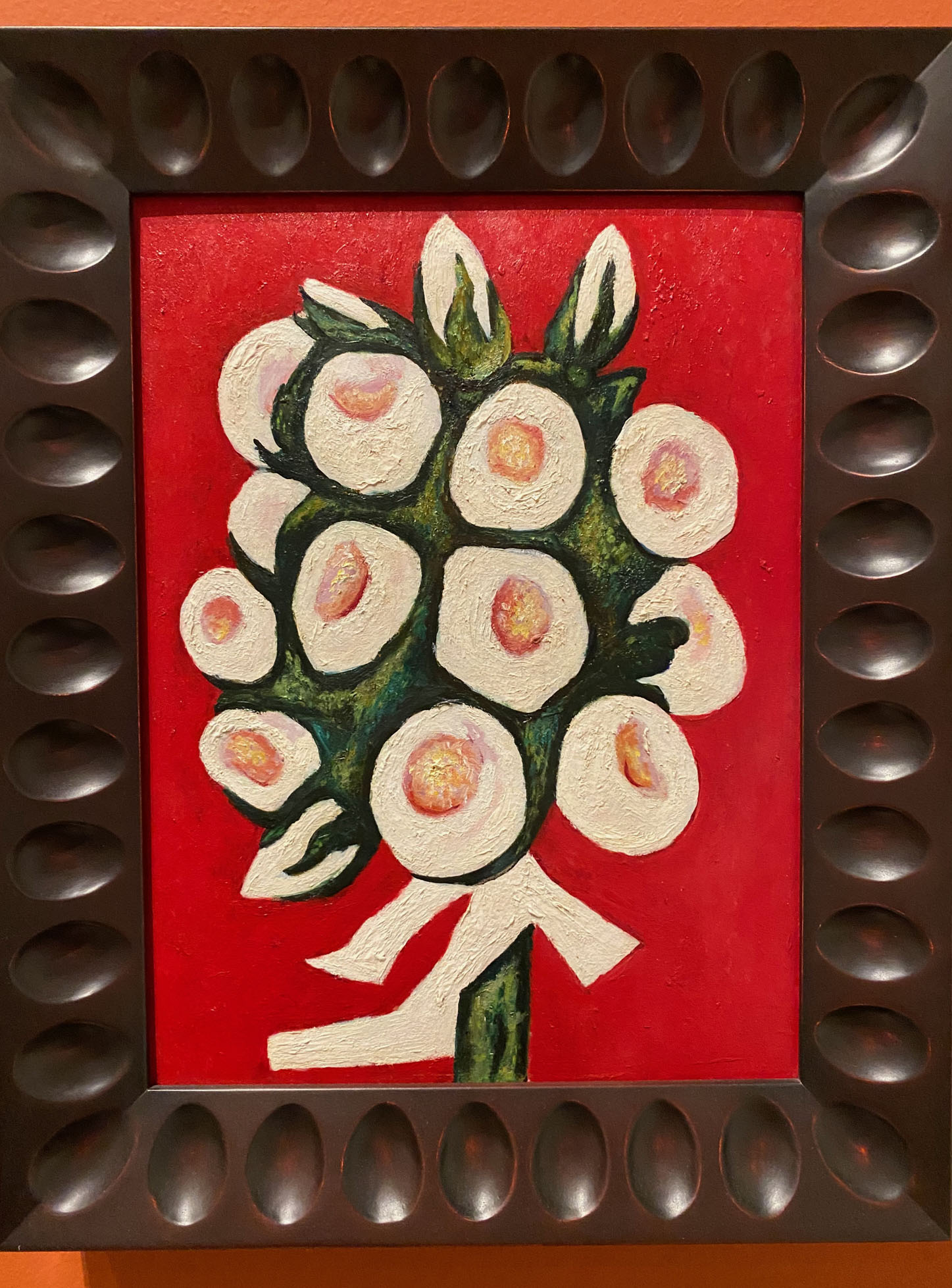
Near the Berlin abstractions are highly expressionist 1930s rockscapes from Maine and pointy Alpine peaks from his return to Bavaria. There’s an example of his stripped-down 1916 “synthetic cubist” work in Provincetown, a 1917 New England still life painted in Bermuda when he was budget-bunking with Demuth, and a red-saturated still life that is a therapeutic tribute to his Nova Scotia friends who died at sea in the late Thirties.

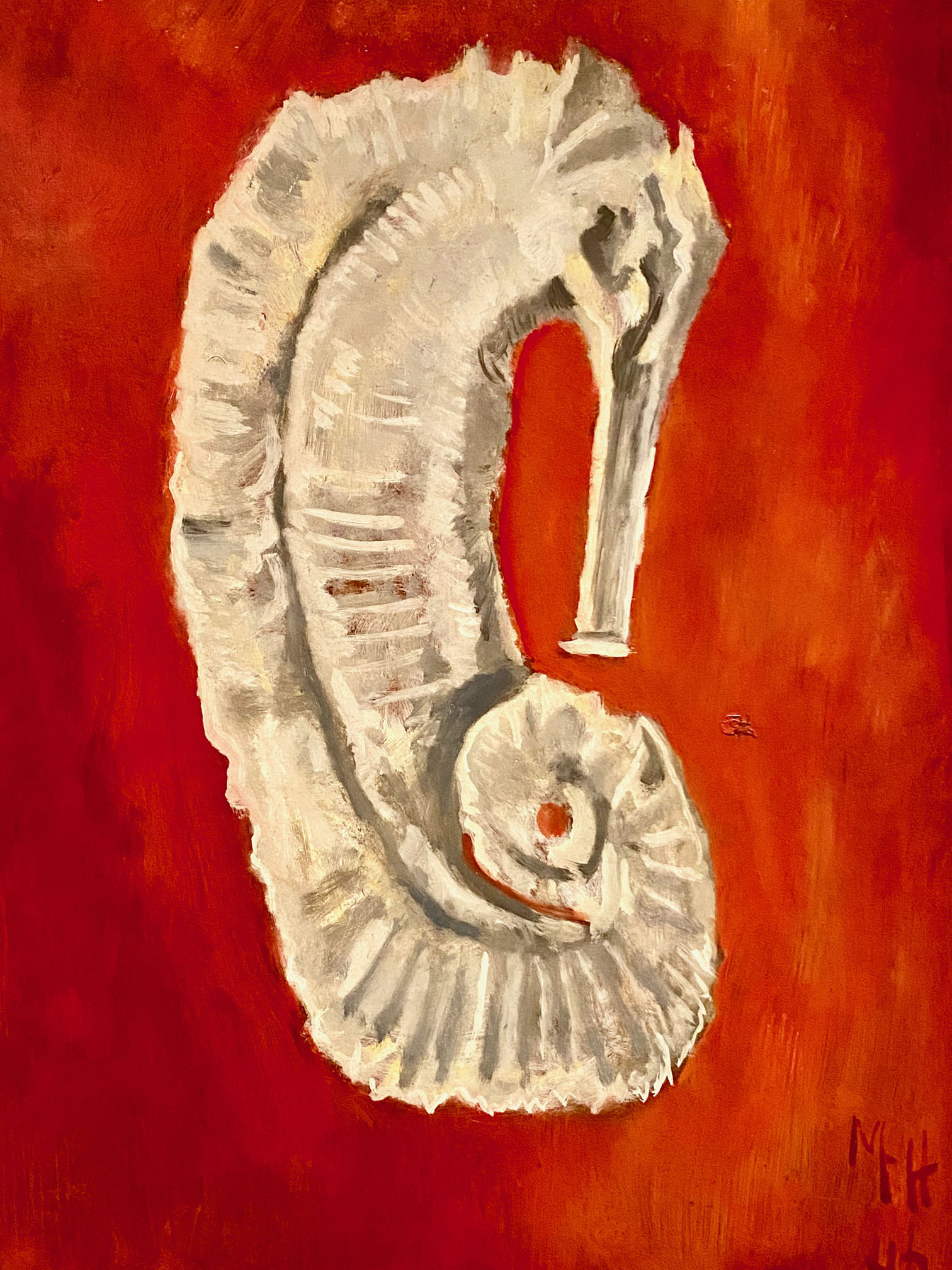
Hartley’s 1942 White Sea Horse – part of a series with vivid backgrounds done in Maine. Courtesy: Jan T. and Marica Vilcek Collection
Hartley’s 1935-39 Roses for Seagulls that Lost Their Way –made in Bermuda to honor his Nova Scotia friends lost at sea. Courtesy: Jan T. and Marica Vilcek Collection.

In the middle of this gallery are vitrines with highly personal, everyday stuff from a painter who never settled down, stayed on the move, and always kept creating.

Here’s his camera, a scrapbook of personal photos, his 1923 published book of poetry, a few books from his library, and a little toy and pressed flowers sent to his niece.    

Hartley’s photos from his 1917-1918 trip to Santa Fe. Courtesy: Bates College Museum of Art

Except for the Provincetown piece, all the surrounding paintings have direct, bold outlines, vivid colors, and vigorous, unglamorized visions – a fitting prelude to the last gallery of New Mexico landscapes.

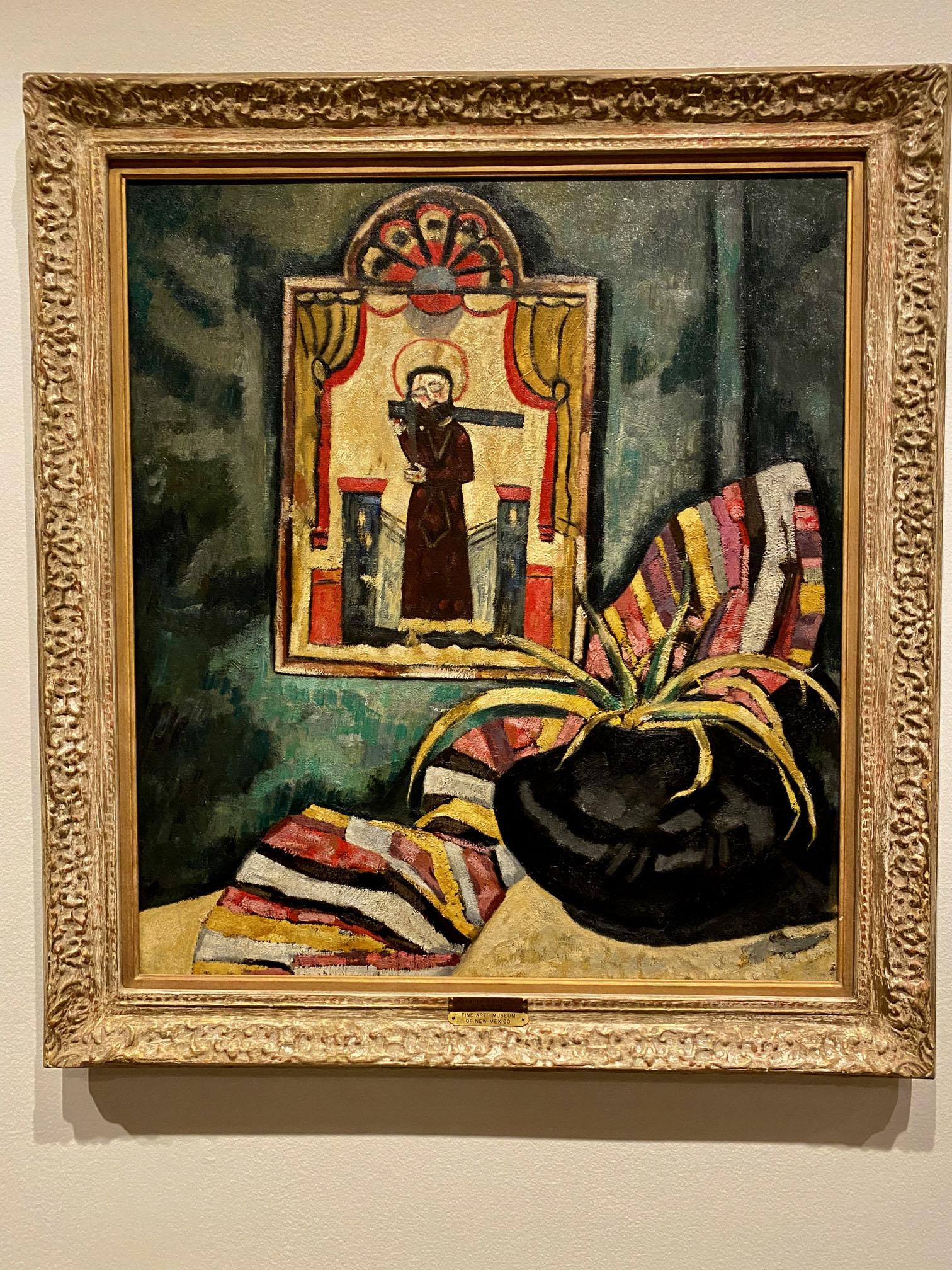
Hartley’s 1919 El Santo painted in New Mexico.

The final gallery provides a panorama of landscapes, plus a dramatic image of a ridge of Mexican volcanoes. Hartley only spent part of

1918 in Taos and Santa Fe, where he traversed the hills, attended Pueblo ceremonies, and wrote about the indigenous culture. He also completed his El Santo still life with a black-on-black ceramic vase, a striped textile, and a Northern New Mexican retablo of a suffering Jesus.  

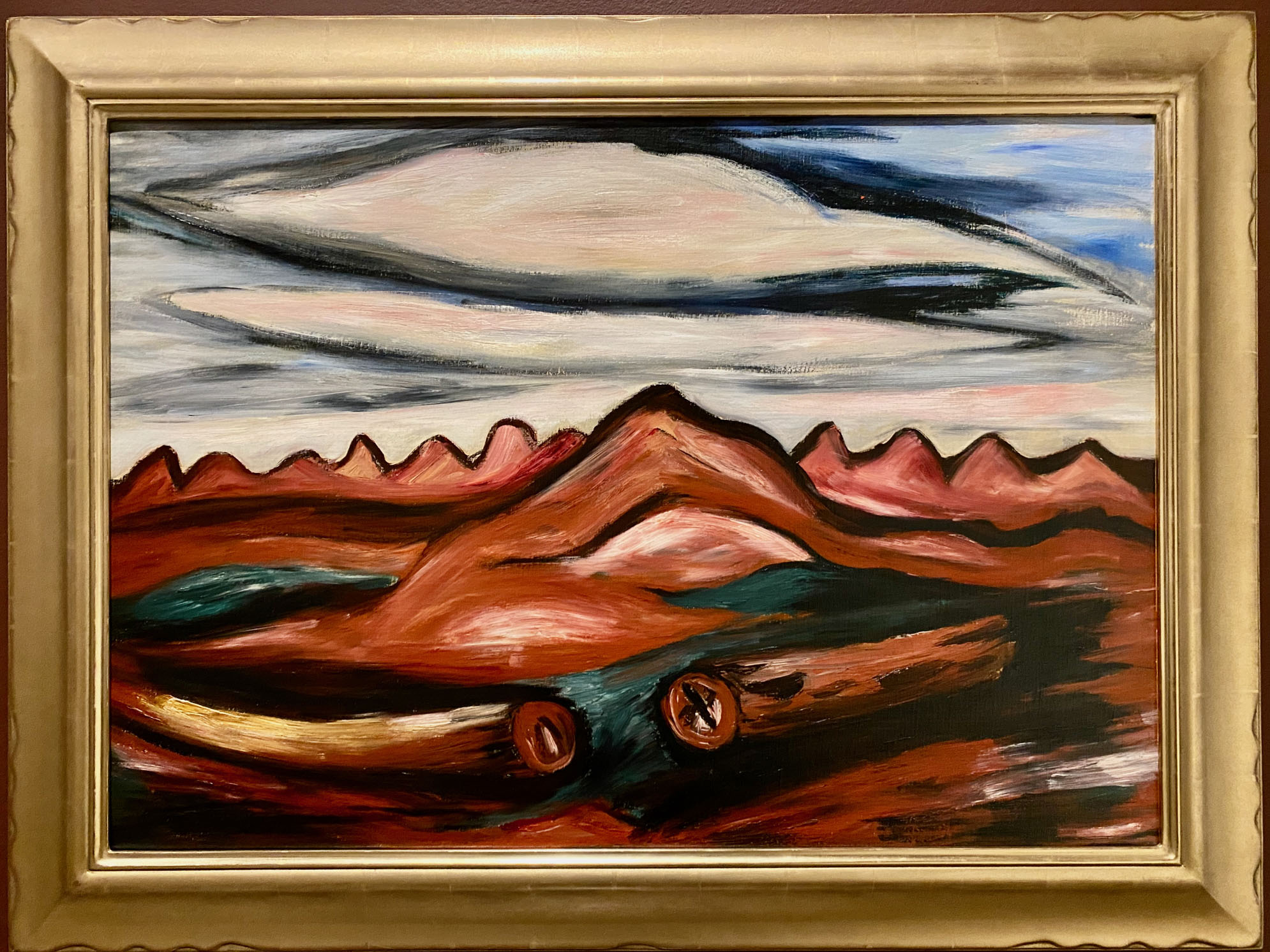
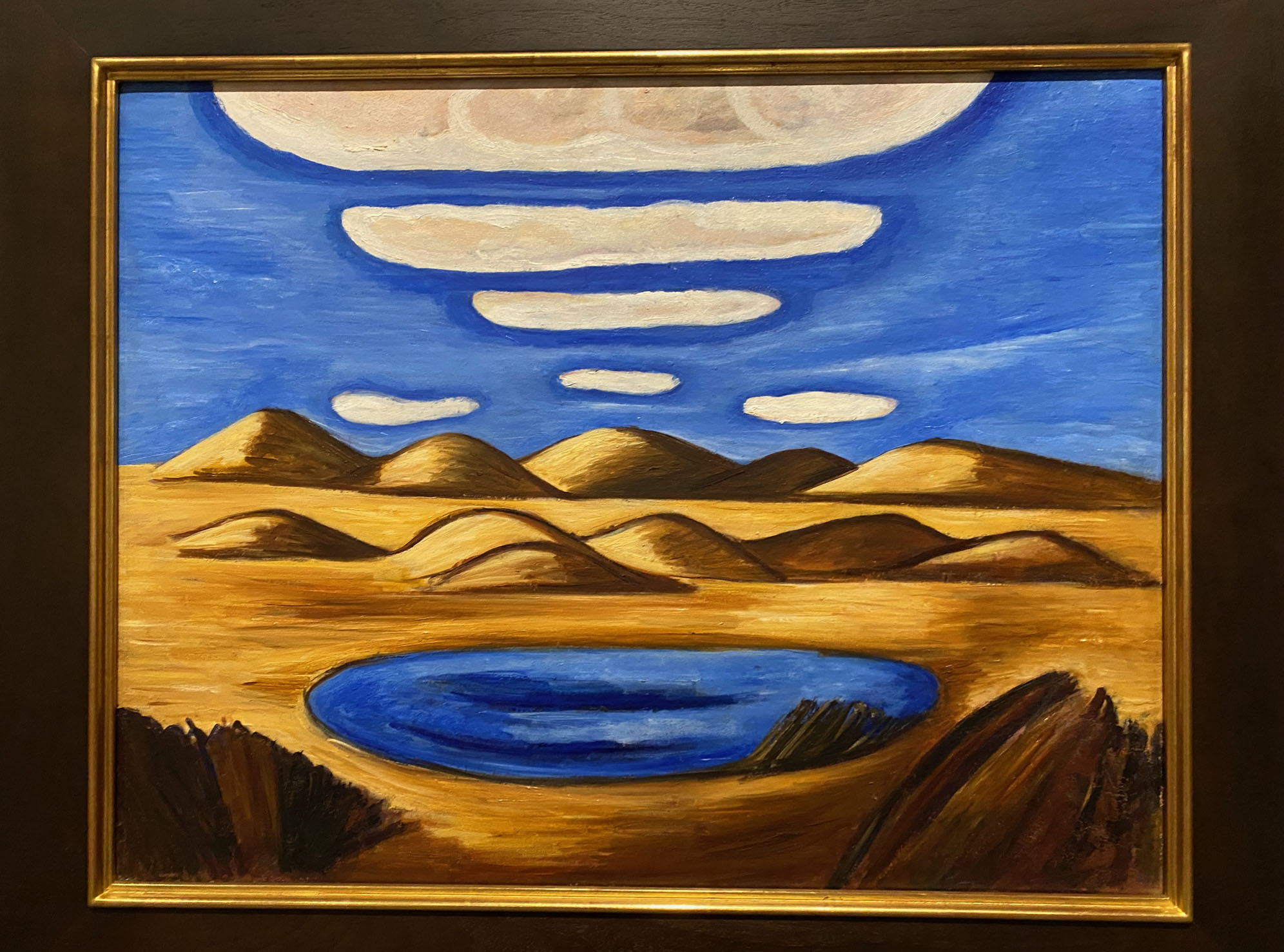
But it might be a surprise to learn that all of the Southwest landscapes were painted in Berlin in the 1920s – fittingly called his New Mexico “recollections” – or in Mexico in the 1930s.

Floating clouds, expressive lines, and abstracted mountains – all from his vivid mind and recollections of spiritual and physical experiences long past.  In the 21st century, increasing numbers of art historians and artists have looked to this phase of Hartley’s work for insight and inspiration – bold brushwork, expressive memory, and both a spiritual and emotional creative process.

Hartley’s 1923 oil New Mexico Recollection #14– painted in Berlin based upon memories of his year in the Southwest. Courtesy: Jan T. and Marica Vilcek Collection.
Hartley’s 1932 oil Lost Country – Petrified Sand Hills – a symbolic landscape inspired by mystical texts he discovered while painting in Mexico. Courtesy: Jan T. and Marica Vilcek Collection.

Toward the end of his life, the accolades, awards, honors, and retrospective exhibitions came his way, but Hartley remained the hardscrabble “painter of Maine,” barely interested in cashing the checks.

His niece, who preserved her uncle’s posessions and legacy after his death in 1943, took a train trip to New Mexico for the first time to see the landscapes that so inspired her uncle. Upon emerging from the train at the stop near Santa Fe, she looked up to take in the big, dramatic, cloud-filled sky. Thinking of all her uncle’s landscapes, she said, “Those clouds…I’d recognize them anywhere!”

If you see this show in Santa Fe, you will, too.

Louise Zelda Young’s 1943 photo Marsden Hartley’s Studio, Corea, Maine, where he worked in his final years. Courtesy: Bates College Museum of Art.

O’Keeffe Above and Beyond the Grid

Six years before she became transfixed with the drama of the colorful New Mexico desert, Georgia O’Keeffe began translating another magnificent, magical view from her skyscraper home in Manhattan. You can see all her transformational aerial cityscapes in Georgia O’Keeffe: “My New Yorks” on view at Atlanta’s High Museum of Art through February 16, 2025.

Created by the Art Institute of Chicago, the show assembles Georgia’s breakthrough city paintings and puts them squarely into the context of her better-known nature close-ups and other modernist takes – just the way she wanted it.

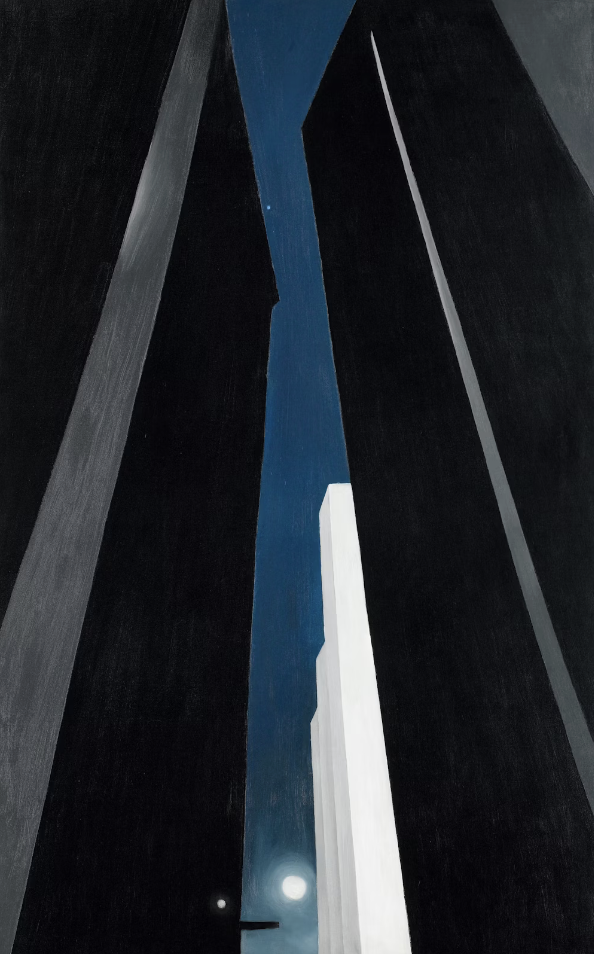
O’Keeffe’s 1927 Radiator Building – Night, New York. Courtesy: Crystal Bridges Museum of American Art

Listen to the Art Institute curators talk about Georgia’s approach to New York landscapes, her life in the city’s Roaring Twenties, and what inspired her walking Manhattan’s grid at a time of of such transformational urban change:

As a total modernist, Georgia couldn’t wait to move into the Shelton Hotel, a brand-new skyscraper, with her brand-new husband (Stieglitz) in 1924. As half of New York’s art-world “power couple” it’s most likely that Georgia was one of the first women to enjoy high-rise living in Manhattan.

O’Keeffe’s 1926 The Shelton with Sunspots, N.Y. Courtesy: Art Institute of Chicago

The Shelton (still there at Lexington and 49th Street) was an apartment-hotel built in Midtown around Grand Central. Although it was first envisioned as a men’s residence, the marketing team soon pivoted a more expanded market with newspaper ads that would attract women, couples, and artists!

Read more about the Shelton, Georgia’s life there, and see 1920s photographs on the Art Institute’s blog post.

Georgia and Alfred moved in, captivated by the views of the East River and rapidly changing Manhattan skyline, where new skyscrapers were popping up like daisies.  Alfred took photographs and Georgia recorded ths shifting light, atmosphere, and moods of the rapidly changing landscape.

O’Keeffe’s 1928 East River from the 30th Story of the Shelton Hotel.
Courtesy: New Britain Museum of American Art.

As the exhibition demonstrates, Georgia didn’t limit herself to urban landscapes at the time. She was still depicting the natural world, but was determined to channel the rising modern city.  At the time, Alfred and her fellow artists strongly discouraged her from displaying her urban work, arguing that painting cityscapes was “best left to the men.”  You can just imagine what our Georgia thought about that! Naturally, it was full steam ahead! 

Before Google Street view, Georgia walked the Midtown Grid, exploring (and remembering) her neighborhood streets as they transformed into skyscraper canyons. More high rises! The Empire State Building! Rockefeller Center!

O’Keeffe’s 1926 City Night. Courtesy: Minneapolis Institute of Art
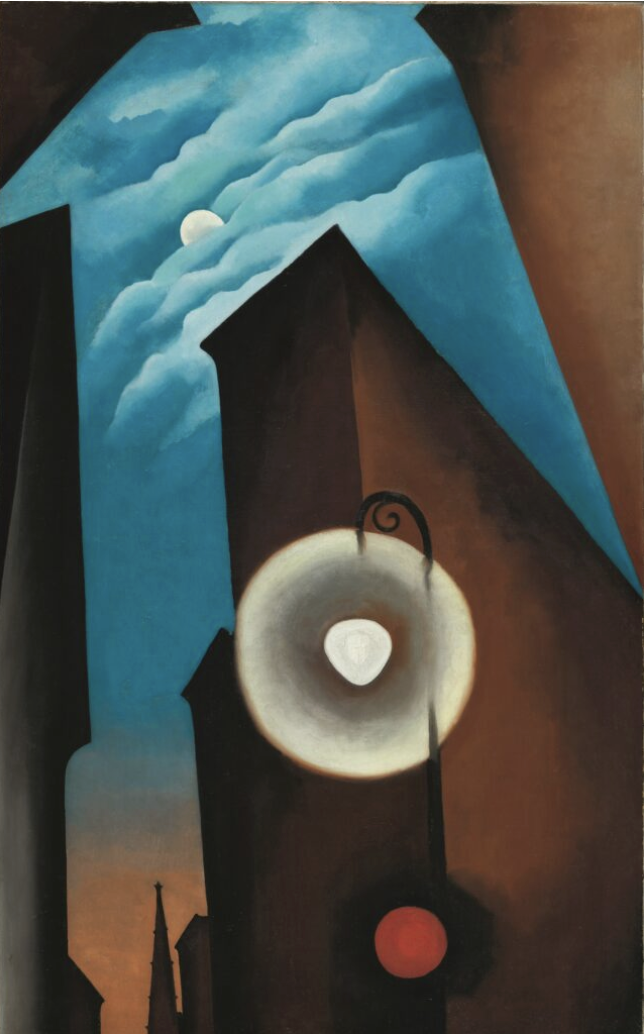
O’Keeffe’s 1925 New York with Moon. Courtesy: Carmen Thyssen Collection

Who knows if Georgia ever experienced Manhattanhenge, but she certainly enjoyed the verticality and sky views between the buildings.  A nature-lover, modernist, and virtuoso painter! 

Despite Stieglitz’s misgivings about her city paintings, when she finally had her annual one-woman show at his gallery, her city painting was the first work that sold!

The curators have hung some of Georgia’s paintings just as she displayed them – side-by-side flower close-ups, other nature-inspired works, and City views – to provide the full experience of a modern woman’s mastery.

O’Keeffe’s 1924 From the Lake, No. 1.
Courtesy: Des Moines Art Center
O’Keeffe’s 1929 Black Cross, New Mexico.
Courtesy: Art Institute of Chicago

For more, here’s a longer discussion about Georgia rip-roaring 1920s life and work by one of the Chicago Art Institute curators for Georgia O’Keeffe Museum members.