Front Row at Chinese Fashion Runway

Vivienne Tam’s 2007 embroidered/quilted silk cheongsam and Peter Som’s 2010 chartreuse and yellow silk dress.

Silk dresses from Vivienne Tam’s 2007 and Peter Som’s 2010 collections

In a brilliant move to honor some of the City’s fashion favorites, the Museum of Chinese in America is welcoming everyone downtown to see their bright, joyful tribute, Front Row: New York City’s Chinese-American Designers, which they’ve extended until December 1.

The show’s been a hit, with many museumgoers and fashion insiders making the trek downtown to wonderfully welcoming MOCA.

Inside the gallery, you’ll see a grand celebration of the contributions made to NYC’s fashion scene by a host of greats– the irrepressible Anna Sui, evocative Vivienne Tam, minimalist superstar Yeohlee, sumptuous Vera Wang, Jason Wu (one of Michelle Obama’s favorite), and eleven others.

Take a look at what we saw on our Flickr feed.
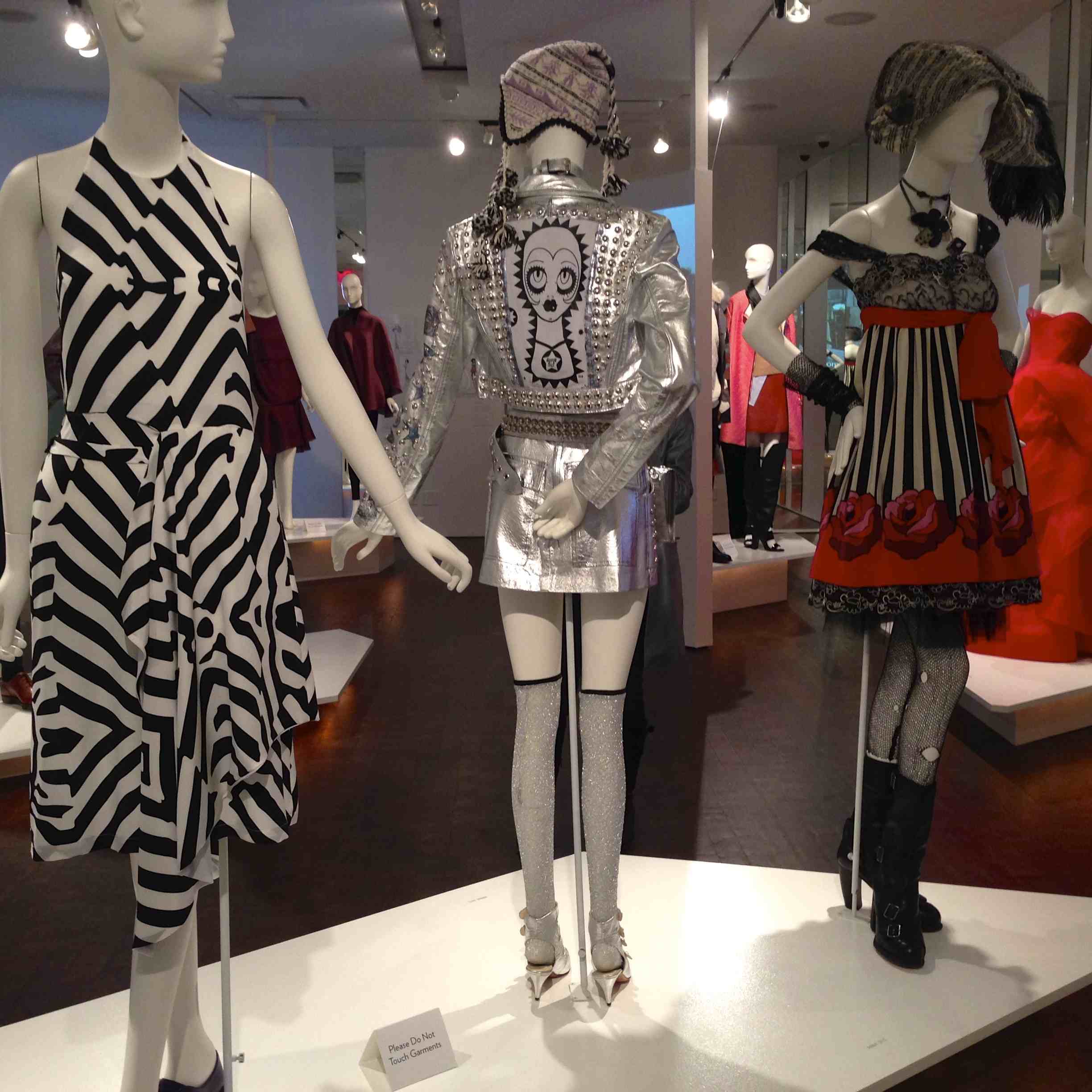
Striped dress by Wayne Lu and two by Anna Sui

Striped dress by Wayne Lu and two by Anna Sui

Some of the dazzlers include Vera Wang’s cardinal red ballgown embellished with horsehair trim, Zang Toi’s red knit embroidered red-carpet gown, and Anna Sui’s silver leather punk ensemble first seen on the runway on Linda Evangelista back in 1993. Take a look. It easily holds up today, particularly with the addition of the Peruvian tassel cap. For a bit of nostalgia, check out the vintage New York Times coverage of that show, which also features great reviews of Zang Toi and Yeohlee, too.

Curator and featured designer Mary Ping did a great job showcasing iconic looks, video clips of memorable runway shows, and video interviews with the designers. She worked with an advisory committee from the Met, FIT, and Parsons, and the overall effect is top-class – smaller than shows that the Costume Institute or FIT mount in their main galleries, but every bit as thoughtful, well documented, and illuminating.

Organza and horsehair trim on Vera Wang's Spring 2013 gown.

Organza and horsehair trim on Vera Wang’s Spring 2013 gown.

At a time when the Garment Center has gotten a little quiet and most manufacturing has shifted to China and other Asian countries, it’s a nice touch just to include just a sampling of the behind-the-scenes work of this illustrious and talented group – a few notebook sketches and some of the paper patterns from Yeohlee’s 38th Street atelier.
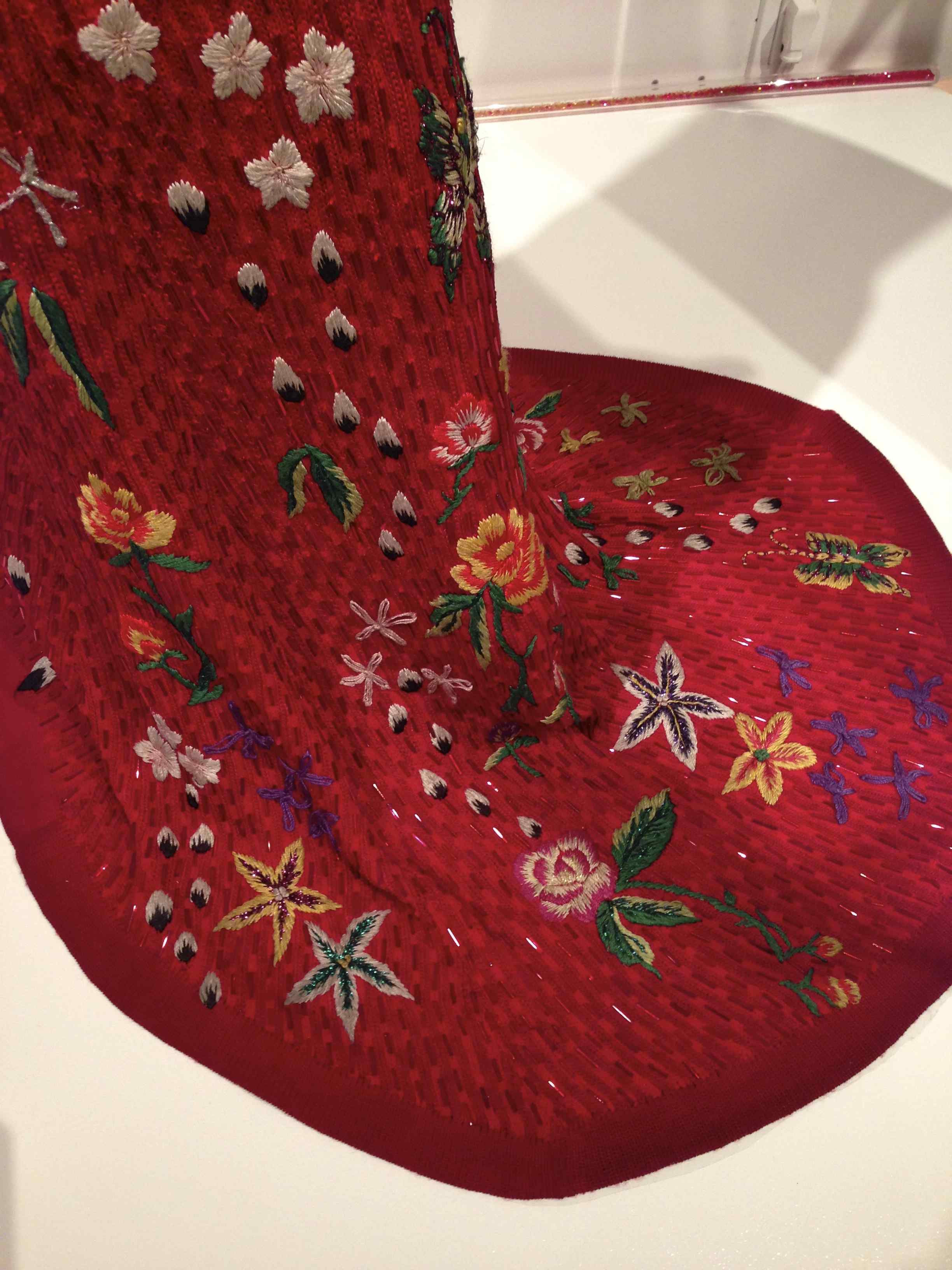
Embroidered train of Zang Toi’s 1991 red-carpet knit dress worn by Gong Li

Embroidered train of Zang Toi’s 1991 red-carpet knit dress worn by Gong Li

As Tim Gunn would say, “Go, go, go!”
Wood Goes Against Grain at MAD

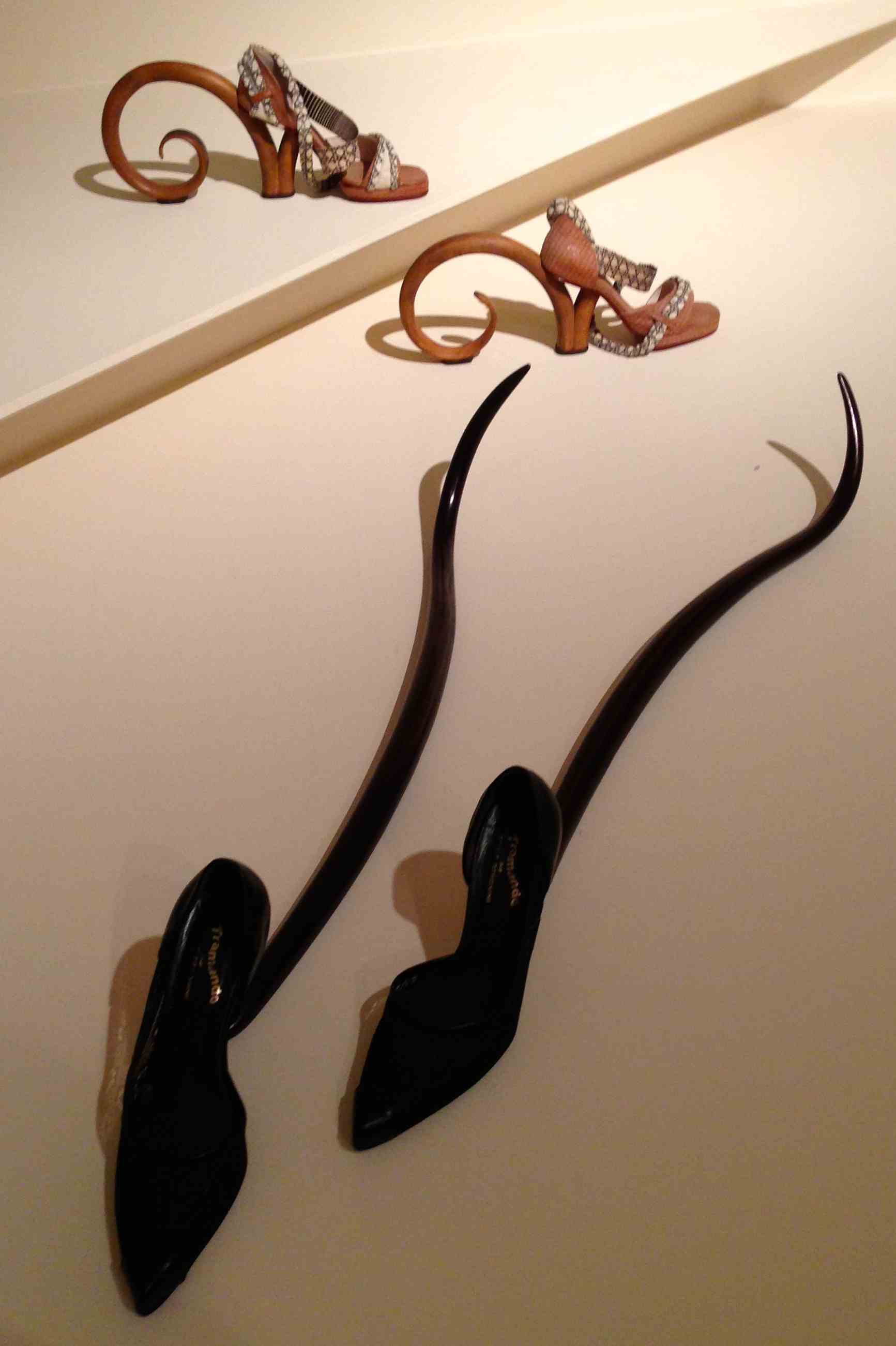
Pablo Reinoso's whimsical wooden shoes

Pablo Reinoso’s whimsical wooden shoes

All those years walking up and down the aisles at craft fairs may have you convinced that there’s nothing new in wood art. Get over to the final days of Against the Grain: Wood in Contemporary Art, Craft, and Design at the Museum of Art and Design.

It’s not what you’d expect, and curator Lowery Stokes Sims has done a magnificent job in telling us what’s trending now with forward-looking artists on the scene.

In short, she focuses her two-floor exhibition on seven trends that she sees: Artists, like Ai Weiwei, working on socio-political themes, whimsical designers who make us smile, digital artists pushing the envelope with wood, collages, virtuoso technique, takes on trees, and works that just capitalize on the beautiful texture in the wood itself.

Check out our Flickr feed for views of some of our favorite works, and MAD’s four-minute video as Sims herself walks you through the show, the artists, and her thinking about the pieces and themes.

Steam-bent ash chairs by Christopher Kurtz

Steam-bent ash chairs by Christopher Kurtz

But let’s focus on some of our favorites, which you can see on Flickr.

Wood as fashion: What about these shoes by Pablo Reinoso? If you’re thinking Dutch wooden shoes, think again, because these dainties are inspired by Thonet chairs, that he’s embellished with long, wooden “tails”. Or wooden hats by fashionable Moody & Farrell of London.

Music: How did Maria Elena Gonzalez go from looking at a fallen birch tree to creating paper-thin birch rolls that can create stunning music on a player piano? Watch and hear it all on this video of her player piano in action.

Laurel Roth's Hominid Chimpanze (2011) from vere wood with Swarovsky crystals in the teeth

Laurel Roth’s Hominid: Chimpanze (2011) from vere wood with Swarovsky crystals in the teeth

How-did-they-do-that category: Bud Latvin’s gravity-defying wooden spiral sculptures, Christopher Kurtz’s impossible steam-bent chairs, and Elisa Strozyk’s wooden textile.

Recycled surprises: Think about what it took to turn 8,000 recycled chopsticks into a collapsible sofa. Good going, Yuya Yoshida.

If you can get to this show today or tomorrow, go. If not, take time to meet Leonard Drew in his studio, see his wood works in progress, and hear what success in wood feels like:

Unicorn Natural History

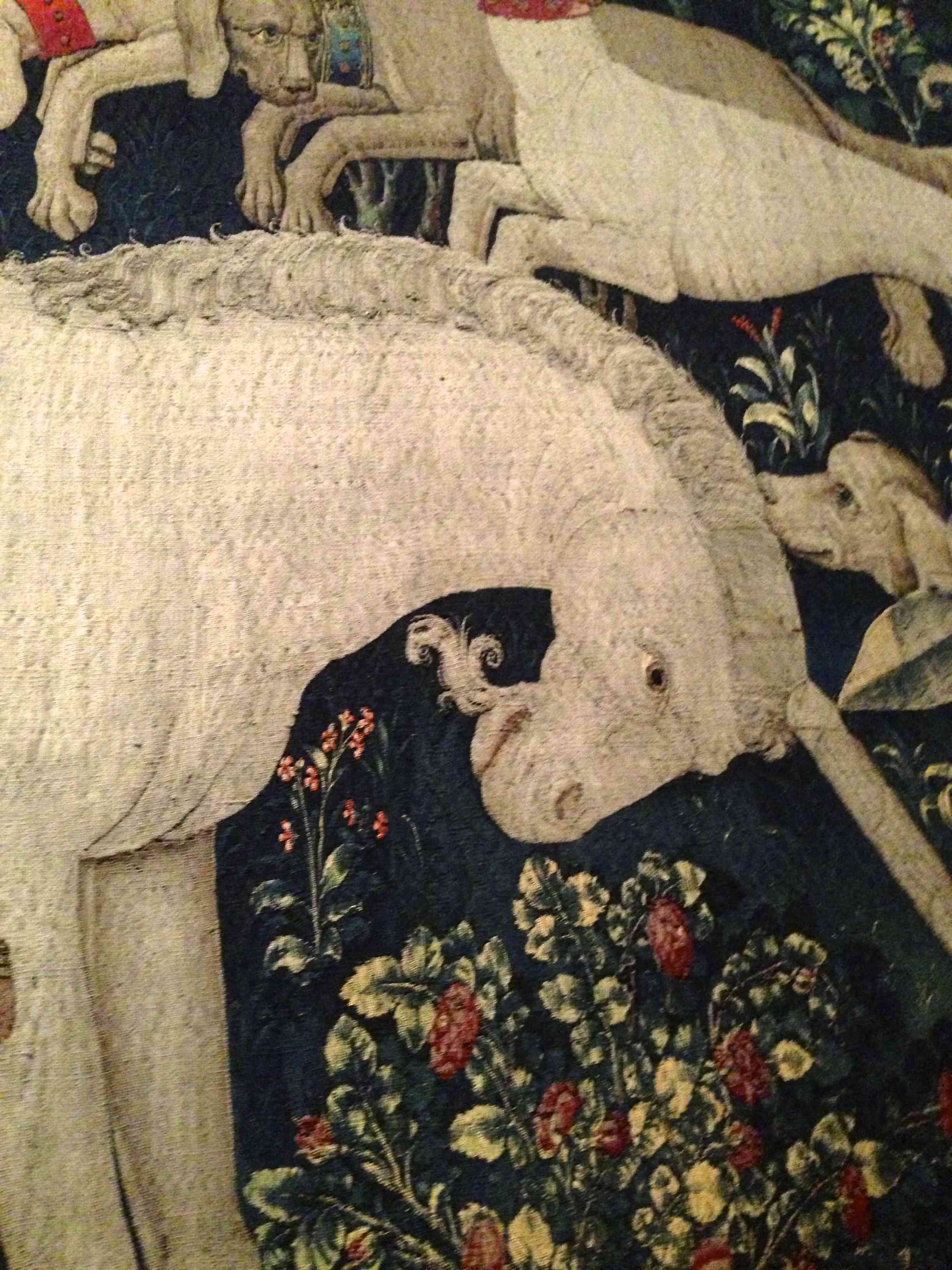
Detail from "The Unicorn Defends Itself" (1495-1505), a large tapestry in the main gallery.

Detail from The Unicorn Defends Itself (1495-1505), a large tapestry in the main gallery.

Who says unicorns aren’t real? Mr. Rockefeller’s tapestry unicorns have been the celebrity draw for the last 75 years uptown at The Cloisters, and are the cavorting centerpieces of the show, Search for the Unicorn. But it took some brave curators to finally display all the unicorn-themed stuff in the Met’s collection and truly reveal the place this beloved icon has held in science, medicine, and art for the last 2,000 years.

The small micro-show in the Romanesque gallery just inside the entrance presents ivory coffers, playing cards, etchings, a carved-bone parade saddle, and coats of arms featuring unicorns in all manner of activity.

But the surprises are loans from NYPL and the National Library of Medicine in Bethesda showing the unicorn’s inclusion in scientific texts, which attest to sightings and miracle cures from the impressive cloven-hoofed trotter.

Pome’s 1694 identification of species in General History of Drugs. Courtesy: US National Library of Medicine, Bethesda.

Pome’s 1694 identification of species in General History of Drugs. Courtesy: US National Library of Medicine, Bethesda.

Conrad Gesner’s Histories of the Animals (1551), the most popular natural history book during the Renaissance, included the unicorn among its 1,200 woodcut images of the world’s quadrupeds. Gesner, who also published images of fossils for the first time here, was a stickler for documentation, and asserts that unicorns had been seen in Mecca by a reliable source. He wrote several pages about how to discern real from fake unicorn horns and told how it should be used to purify water, counteract poisons, and treat epilepsy.

General History of Drugs, which achieved global circulation after it was published in 1694, was written by Pierre Pome, the pharmacist to Louis XIV known for his expertise in medicines and treatments from exotic cultures. Pome gave unicorns their own chapter and described five species living in the Arabian desert and in proximity to the Red Sea. In Chapter 33, he correctly proclaimed “unicorn horn” to be narwhal tusk.

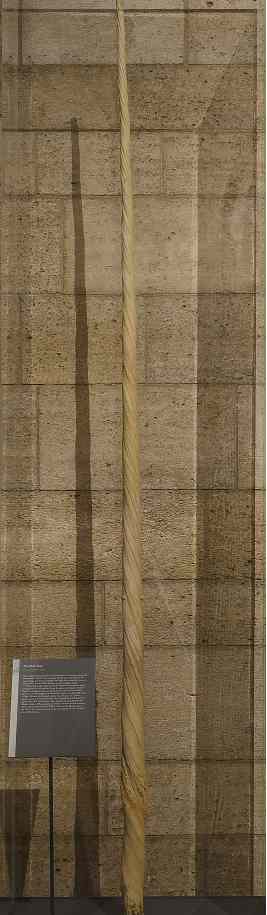
Narwahl tooth (a.k.a. unicorn horn). Source: Metropolitan Museum of Art.

Narwahl tooth (a.k.a. unicorn horn). Source: Metropolitan Museum of Art.

The narwhal’s gracefully shaped, unicorn-looking incisor tooth is given a place in the show, too. One from a private collector is in the Romanesque gallery alongside one of the tapestries, The Unicorn in Captivity (the one in the fenced-in pasture); the second stands behind glass opposite the rest of the tapestries in their usual gallery.

Fancied by rich and powerful in years gone by, Charlemagne, Suleyman the Magnificent, Charles VI of France, and Lorenzo de Medici all owned this Arctic collectible.

We couldn’t take photos inside the show, but don’t worry. The Met’s done a fantastic job documenting everything online, so take time to peruse all the items in the show. Then click on our Flickr site to see the famous Unicorn gallery and glimpse the Cloisters on a perfect summer day.

Do you have 13 minutes? If so, you’ll enjoy the hilarious introduction to the show by curator Barbara Drake Boehm and her speculation on why it took the Cloisters 75 years to mount a show on unicorns. The natural history of unicorns starts around 3:40, and she’ll take you through all the key library materials. Watch to the end to find out where the unicorn was last sighted in the 21st century. It wasn’t Toys ‘R’ Us.

Patching Up the Emperor’s Carpet

Carpet

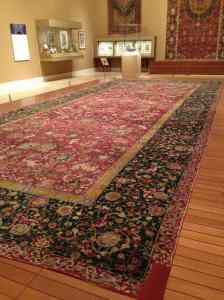
Installation view of the Emperor’s Carpet, second half 16th century. Iran, Safavid period (1501–1722). Source: The Met.

If royal guests had walked all over your Persian carpet for the last 600 years, how many repairs would you need? Before coming to the Met, the 16th-century Emperor’s Carpet, covered in animals and poetry, was once owned by the Shah of Iran and the Hapsburgs.

Since this large, beautiful carpet arrived in New York 60 years ago, the Metropolitan Museum was only able to display it twice because it was in such fragile shape.  When they turned it over, they saw it had been patched over 700 times. How could they stabilize it and install it in their expansive New Galleries of the Art of the Arab Lands on the second floor?

You’ll find out all about the behind-the-scenes work analyzing, stabilizing, patching, and repairing it in the micro- show, Making the Invisible Visible: Conservation and Islamic Art.

Carpet Detail

Restored corner of the Emperor’s Carpet.

The show features all manner of science, technology, and process that the magical conservators put to work for other pieces, too – ceramics, tapestries made of gold and silver threads, wood, and works on paper over the last 2,000 years. One of our favorites is the child’s coat made from antique pashmina. They also have examples of the natural materials that were crushed and pounded into pigments for all these beautiful dyes and paints.

Although the gallery is tiny, the Met decided to send visitors on a treasure hunt by providing a brochure through which seekers of conservation wizardry can locate the Emperor’s Carpet and other works throughout the dozens of Islamic Art galleries. See the details on these and more our Flickr site.

Child Coat

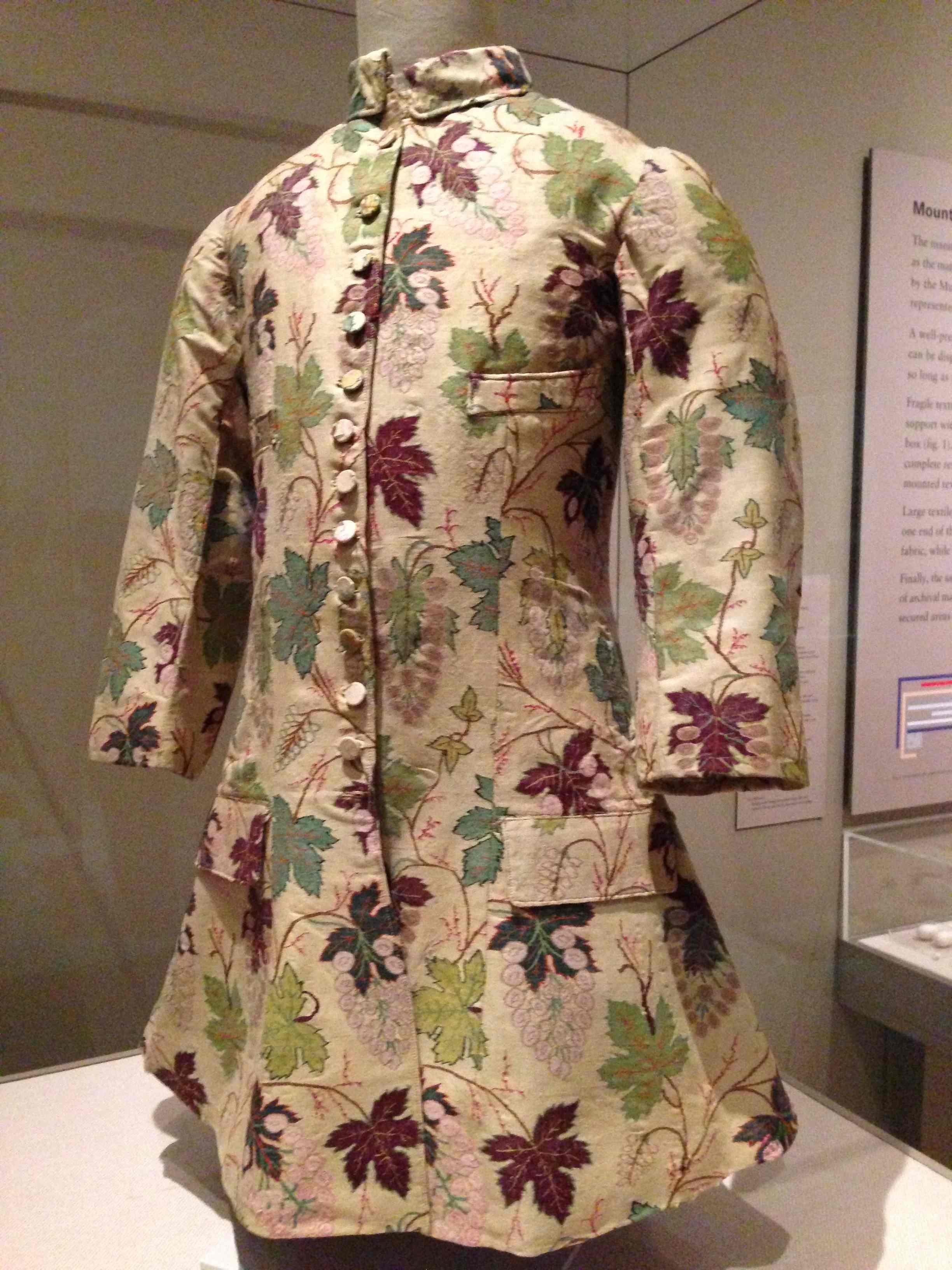
Child’s coat from India on display in the show. Tailored in the late 19th c., but but fabric woven late 18th c. The textile is from Kashmir and is likely pashmina.

One of the shockers is seeing what the conservators reckon are the true colors of the 1707 Damascus room, long a favorite of Met period-room fans. The science showed that the darkened panels that we’re so familiar with were once bright, bright blue and gold.

If you can’t see the conservator’s showcase before August 4, read about all the science and technology on line at the special web site. You’ll find links to the stories of rehab for the carpet, the child’s coat, the gold-weave chadar, and more.

If you have eight minutes, take a look at three years of work on the royal carpet by the Met’s magicians:

Shimmering Curtains of Liquor-Bottle Caps Hung in Brooklyn

Installation view in the Iris and B. Gerald Cantor Gallery on the Fifth Floor. Brooklyn Museum photo: JongHeon Martin Kim.

Installation view in the Iris and B. Gerald Cantor Gallery on the Fifth Floor. Brooklyn Museum photo: JongHeon Martin Kim.

They’re big, they’re from Africa, they’re hung in one of the most spectacular art spaces in the City, and you need to see them before August 18. If you’re going out to Brooklyn to see the Sargent show, be sure to see the spectacular contemporary installation, Gravity and Grace: Monumental Works by El Anatsui.

The one-man retrospective of London-trained Ghanaian artist El Anatsui (his first) takes up half of the Brooklyn Museum’s Fifth Floor, but really shines under the skylight in the Iris and B. Gerald Gallery.

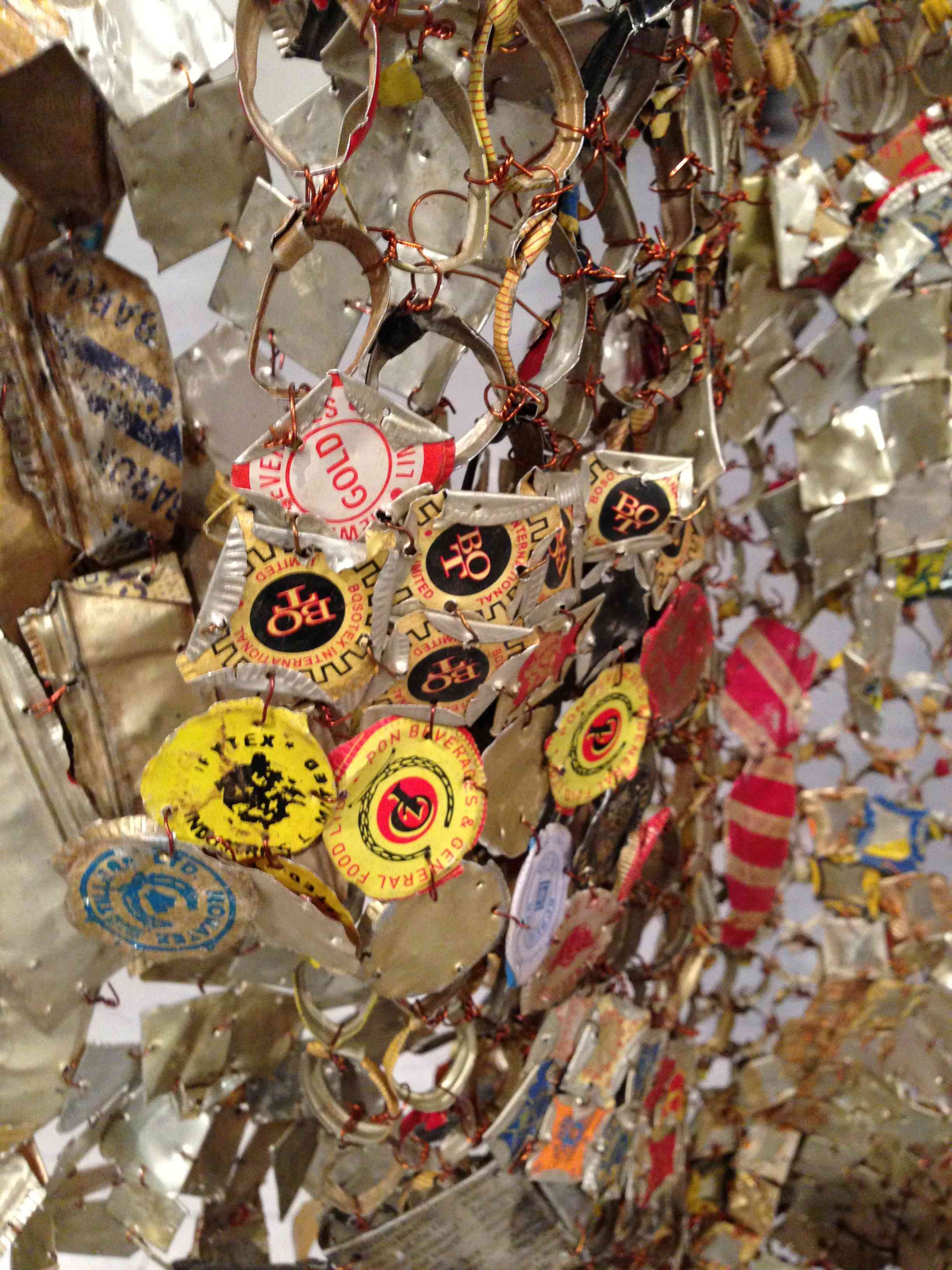
DetailYou might have seen his large piece hung in the African gallery on the First Floor of the Met or his installation in the 20s on the High Line, but in Brooklyn you’ll see 30 big, shimmering pieces arranged on walls and suspended under the dome. They’re all made out of scrounged metal material and wire from garbage dumps near his home, but the experience of seeing these big, beautiful pieces could not feel further from the source.

Hung from the ceiling, the metal-and-wire pieces look like open-weave textiles fabricated on a grand scale. Visitors wander through Anatsui’s hangings, silently gazing, stepping up to look close, and then move further back to wonder how he creates such a lightweight, effortless illusion from years of collected, flattened, punched bottle caps and stuff.

Earth's SkinTwo more galleries feature other large-scale works, arranged and pinned on walls, bunched like beautiful fabrics. Anatsui creates his gigantic constructions, carefully sorting the different colors of metal from the various brands of beverages. He says it’s like doing a watercolor wash, and when you view the work in person, you’ll be stunned by the variety of color, pattern, and lovingly arranged metal tapestries.

Here’s a time-lapse video of the Brooklyn crew installing the show, initially mounted at the Akron Art Museum. Anatsui says that he enjoys giving installation crews and curators a lot of leeway in how they hang his work, and he was a little surprised (in a good way) about some of the choices by the crew in Brooklyn. See for yourself. The big, shiny silver sculptures snaking across the floor are made of milk tin lids.

Amazing Baby Shoes Under the Met’s Stairs

Infant-size palm leaf sandals (only 2 x 5 in.) made at the Kharga Oasis, Byzantine-era Egypt (4th-7th c.)

Infant-size palm leaf sandals (only 2 x 5 in.) made at the Kharga Oasis, Byzantine-era Egypt (4th-7th c.)

Will all the excitement over babies this week (the Royals and the Fallons), you might want to sneak a peak at some of the most perfect infant shoes ever, on display at the Met’s micro-exhibit, Objects from the Kharga Oasis, right under the grand staircase just past security until August 4.

Back in the 1930s, Metropolitan Museum archaeologists found this pair of infant sandals crafted beautifully from palm leaves at an oasis in the western Egyptian desert that was one of the earliest frontier Christian communities serving the trans-Saharan caravan routes.

The shoes are tiny – only about 2 x 5 inches – and were made during the Coptic (Byzantine) era sometime between 300 AD and 600 AD. There are also 1,500 year-old linen tunics and caps for kids and adults nearby, too. It’s amazing that the clothing survived at all.

Totally wearable Kharga bracelet. Iron from 4th-7th c. Egypt. Source: Met

Totally wearable Kharga bracelet. Iron from 4th-7th c. Egypt. Source: Metropolitan Museum of Art

Besides building churches (and there are plenty of photos and illustrations in the show), the communities around Kharga were busy growing grains, sesame, olives, and grapes. They apparently had a huge business making and exporting wine to the thirsty Egyptians 150 miles east along the Nile and 400 miles northeast in Cairo.

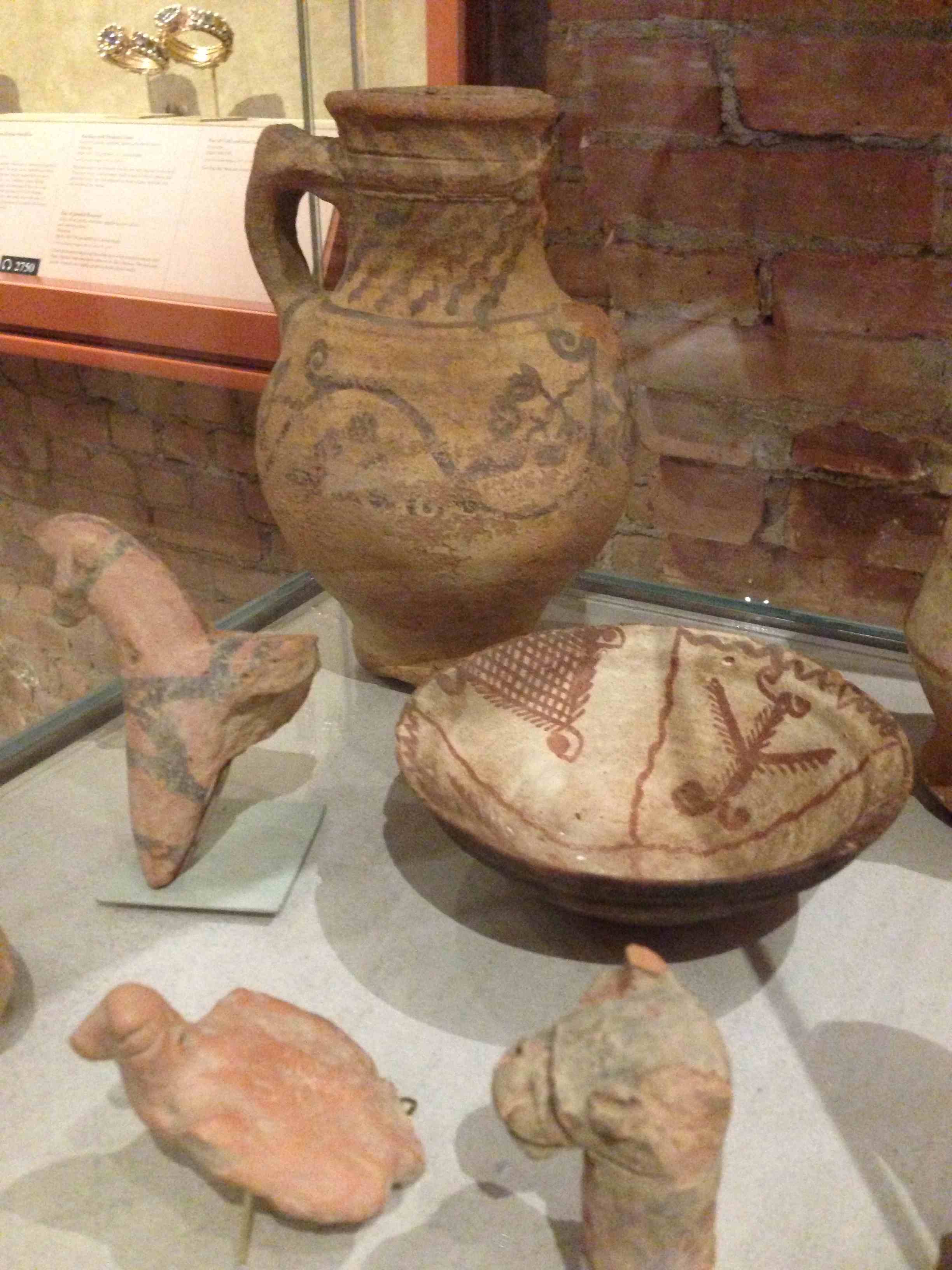
Drawing upon a ceramic craft tradition that was happening at the oasis since Old Kingdom times (2600 BC), potters cranked out transport jugs for the vino (shown here) and decorated them with grapevine paintings. The show has jewelry, tombstones, and photos of early Christian churches, but the brand-new-looking baby shoes are really the stars of the show.

Among dozens of ceramic items dug up by the Met are grapevine-decorated earthenware jugs to transport locally made wine from the Oasis to the Nile and upriver to Cairo.

Among dozens of ceramic items dug up by the Met are grapevine-decorated earthenware jugs to transport locally made wine from the Oasis to the Nile and upriver to Cairo.

Virtual Visit to the Met’s Punk Couture Show

IMG_2416Too hot to get over to the Met this weekend and climb up all those high stairs out front? Stay in the comfort of your air-conditioned home and take this virtual tour of the Met’s Punk: Chaos to Couture show (closing August 14).

Curator Andrew Bolton explains the real-life inspirations for much of the iconic looks in this show –people from music, pop, and celebrity worlds, taking you through the galleries one by one, emphasizing the importance of recycling and deconstruction to the haute couture designers of today.

Our favorites: Rodarte’s crochet looks alongside those of Westwood and McLaren, McQueen’s faux recycled trash bag dresses, Chris Bailey’s spiked Burberry ensemble, and the great finale – Comme des Garcon’s amazing collection with trousers, mutton sleeves, and disassembled pieces of clothing brilliantly attached for maximum punch to the runway models.

Look closely, remember, and enjoy.

Mardis Gras Indians Land in NC Beach Town

"Chief Albert Lambreaux: No Hum Bow, Don’t Know How" costume. In the pilot, the character returns to his devastated home six months after Katrina, enters, and emerges in this costume.

“Chief Albert Lambreaux: No Hum Bow, Don’t Know How” costume. In the pilot, the character returns to his devastated home six months after Katrina, enters, and emerges in this costume.

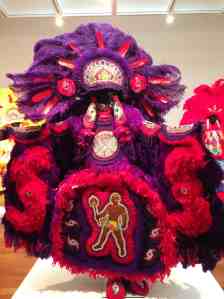
Towering feathered headdresses, intricate beaded panels, plumes, and miles and miles of ruffled edging adorn more than a dozen Mardis Gras Indians that are camping out until November 3 at the Cameron Art Museum in Wilmington, North Carolina.

The dazzling incarnations are all part of the exhibition, Well Suited: The Costumes of Alonzo V. Wilson for HBO’s ® Treme. Alonzo was on hand for the opening, where he explained the challenges he faced designing elaborate, 60-lb. Mardis Gras Indian costumes for the actors playing characters living in New Orleans’ Tremé neighborhood (the Third Ward) in the months after Hurricane Katrina.

The African-American men who bead the panels and feather the elaborate costumes for their Mardis Gras Indian tribes typically take all year to execute their visions, which reflect their position in the tribe (e.g. the Big Chief, Second Chief, Spy Boy, Wild Man). To meet HBO’s production schedule, Alonzo and his team often had a much shorter time to create the patches, headdresses, staffs, panels, and shoes for the script’s characters.

Alonzo Wilson explains how the cycle of life and the seasons are reflected on the beaded apron of the "Big Chief: Tree of Life" costume.

Alonzo Wilson explains how the cycle of life and the seasons are reflected on the beaded apron of the “Big Chief: Tree of Life” costume.

For the series, Alonzo felt it was important to embed part of each character’s story into the stories being told on the panels, even if the costume was only seen for a few minutes on TV. Thankfully, the exhibition (and our Flickr feed) lets you closely examine some of this character development-in-beadwork – a chief shedding a crystal tear for his hurricane-damaged home, a white buffalo evoking the return of bounty post-Katrina, and stunning use of hurricane weather symbols amidst a bold S.O.S.

Originally mounted by the Ogden Museum of Southern Art, curator Bradley Sumrall was impressed by Alonzo’s use of narrative that broke through the typical Hollywood stereotypes of African Americans and Indians. “We could have just done a show with traditional Mardi Gras Indian costumes, but Alonzo’s work had so much narrative built in.” With the mix of African-American, Native American, government, city, and current-event references, Bradley felt the layers of meaning in such intricate craftwork was an achievement worthy of a fine-art exhibition.

"Spy Boy: Katrina Memorial" costume. Feathers on lower half spell out "S.O.S.", the international distress signal, using the universal symbol for hurricanes from weather maps.

“Spy Boy: Katrina Memorial” costume. Feathers on lower half spell out the “S.O.S.” distress signal, using the universal weather-map symbol for hurricanes.

The NC stop for the show is a way for others to understand a bit more about New Orleans people, neighborhoods, and culture. Plus, Wilmington is Alonzo’s hometown. The movie and slide show inside the gallery provide an even deeper window into to this achievement – showing how Alonzo and his crew learned from the traditional craftsmen, shared new beading techniques, and received some “rescue help” from the locals when the production deadlines were too much to handle.

The exhibition all adds up to win-win storytelling about Alonzo, his team, New Orleans, and the Indians. Read an interview with Alonzo on the HBO blog and see behind-the-scenes production photos on page 40 of the Wilmington magazine Salt.

Bird Watching Opportunity at The Met

1-4 Birds in Japan

Detail from Flock of Cranes (1767-1784) by Ishida Yutei, a six-panel folding screen

An avian free-for-all is happening on the second floor of the Met’s Asian Wing, with a lot of flapping, stalking, crowing, and displaying for all the world to see through July 28.

The birds (and one big, hairy deer) really come alive in the Sackler Wing show, Birds in the Art of Japan, The curators went into the collections to dig out masterworks featuring dozens of species of birds native to Japan, including medieval to modern clothing, jewelry, paintings, sculptures, ceramics, and baskets. If you’re a bird-lover still wondering whether the AMNH will ever bring back the Birds of the World dioramas in all their splendor, you’ll find comfort on examining all these species close up in the quietude of the Met,

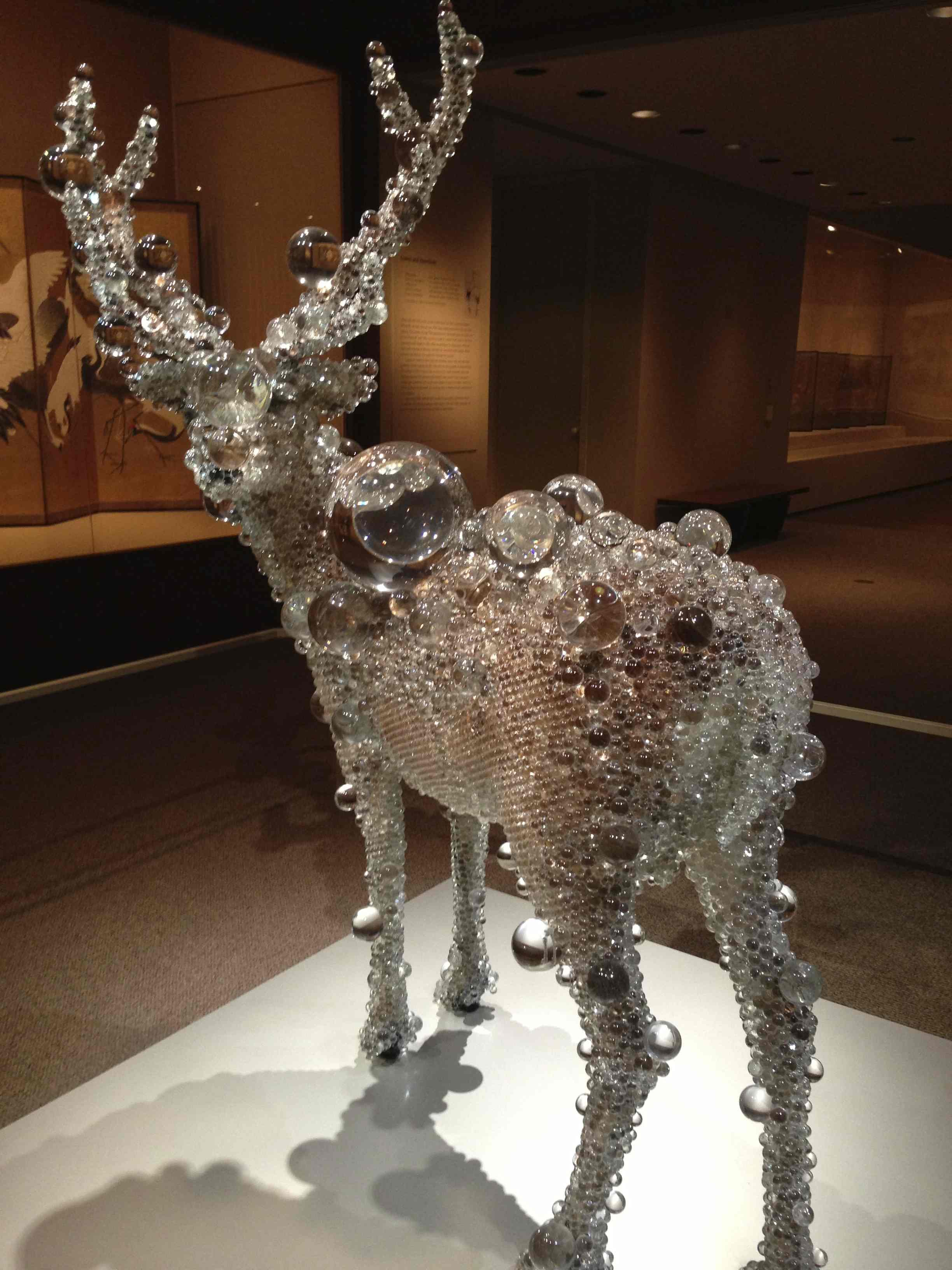
The exhibition starts behind the 12th century Buddhist temple platform and just past the 13th Century Bodhisattvas, where you’re greeted by a charming rooster that’s actually an 18th century incense burner. Turn the corner and you’ll come face to face with a startling 2011 Japanese sculpture — Kohei Nawa’s PixCell-Deer#24, an auspicious presence (ref. the messenger animal of the Shinto deities) in the form of a taxidermy specimen that Kohei creativly covered in glass bubbles.

How did Kohei Nawa’s deer get in here?

How did Kohei Nawa’s deer get in here?

Every gallery delivers a surprise, from the water birds area right through to the “exotics”. Exquisite paintings of the 1700 are interspersed with startling realistic works by the masters of the forge. One of the show-stoppers is a spectacular life-size iron eagle hovering from his perch in the raptor gallery that the curators reckon was made for display at one of the late 19th century world expositions. The detail is amazing. Each feather was forged and riveted individually onto the bird’s metal body. It’s no wonder that the eagle, a nearby raven, and another headdress normally live in the Arms and Armor Department at The Met. Nice collaboration!

Check out our Flickr site for a walk-through of some of our favorite works, including the embroidered Phoenix-covered kimono, the 1908 Peafowl painting/screen by Mochizuki Gyokkei, Asano Toshichi’s hawk-shaped zither, and Kamisaka Sekka’s artistic book, which is brilliantly displayed in interactive form by the Met’s digital team.

Spectacular iron eagle lent by Arms & Armor Department

Spectacular iron eagle lent by Arms & Armor Department

Enjoy this wildlife walk through the eyes of artists on the other side of the world, and be sure to relax in the George Nakashima reading room – a kind of “fire pit” roundtable where we found visitors sharing their impressions of the show. Check out the Met’s on-line catalog of the exhibition, but do yourself a favor and hike over to the Met in the next month before these birds fly away back to the collections.

You won’t be seeing the birds in the wild, but it’s likely that J.J. Audubon would approve. You’ll find joy in getting to know your new Asian friends, who you will likely spot in future exhibitions or in the aviary at the zoo.

Kimono embroidery detail. What did the Phoenix signify to this 19th c. bride?

Kimono embroidery detail. What did the Phoenix signify to this 19th c. bride?

Enter House of Memory at The Customs House

Detail of Dad’s House, (2012). Horse hair, feathers, cotton cloth, Photo by Clarissa Rose Pepper.

Detail of Dad’s House (2012). Installation with horse hair, feathers, cotton cloth, Photo by Clarissa Rose Pepper.

What do you remember about where you grew up? About your family when you were young? C. Maxx Stevens, an artist of the Seminole/Muscogee Nation of Oklahoma, answers these questions for herself (and us) in the evocative show, House of Memory, in its final weeks at the Customs House at the Smithsonian’s National Museum of the American Indian in New York.

Stevens, currently teaching art at University of Colorado-Boulder, scrounges around in junk stores and yard sales out west to find the ephemeral materials for her installations – slightly transparent gauze made into hoop-skirt structures and large multimedia recreations of 1950s homes with floating scrims. Can you see through the haze?

The experience of walking around the show takes you back to corners of Stevens’ memory growing up in a multitribal community of Plainview, Kansas, just outside Wichita. It may not be like your own experience, but the stuff she weaves, scatters, and constructs will cause you to tap into your own memories.

Three Graces (2004) installation. Source: Eitelijorg Museum of American Indians and Western Art, Indianapolis

Three Graces (2004) mixed-media installation. Source: Eitelijorg Museum of American Indians and Western Art, Indianapolis

The first gallery with The Three Graces is a tribute to her relationships with her sisters, and a must-see for lovers of fabrics, textiles, and interwoven mixed media.

The second gallery has several installation that resemble mini-stage sets that trigger memories through scattered photos, altered clothing, suspended objects, horse hair, garden stakes, and evocative combinations of other props – Dad’s House, Mum’s House, Sister’s House, Four Directions House, and House of Transitions.

Detail of Cultural Landscape installation of 1950s houses (2012). Photo: Clarissa Rose Pepper

Detail of Cultural Landscape installation of 1950s houses (2012). Photo: Clarissa Rose Pepper

Cultural Landscape is an immersive installation with tiny illuminated homes (found in thrift stores), scrims, and multimedia that “remembers” the 1950s streets of her suburban Kansas community.

The Smithsonian chose to publish black-and-white photos of the installations, which we’re using here. It’s kind of fitting…not quite of-the-moment and a little back-in-time feeling.

Want to reflect more about your own childhood home, your grandparents, and your neighborhood? Take a trip down to the Customs House before June 16, and let Stevens take you on that journey.

NMAI is making the leap into downloadable digital media with this show, so go to the iTunes U store, type in “NMAI-NY” and download the app, which contains an audio guide for this show. If you’d prefer to read about Stevens and her work, download the PDF.