You’ve seen them everywhere over town…the enigmatic dotted signs with the face of Yayoi Kusama peering out. During Fashion’s Night Out, the Vuitton store was ablaze in polka dots, all a tribute to this reclusive Japanese pop-art sensation who burst upon the Manhattan art scene in the 1960s.
This is the last weekend to see her retrospective in person at The Whitney, but if you can’t make it, enjoy the Vuitton collection that she inspired (they’ve created a whole website).
Take a peek into the show.
And click on this link to see a documentary clip about this Kusama’s life. Be surprised and find out how to merge into infinity!
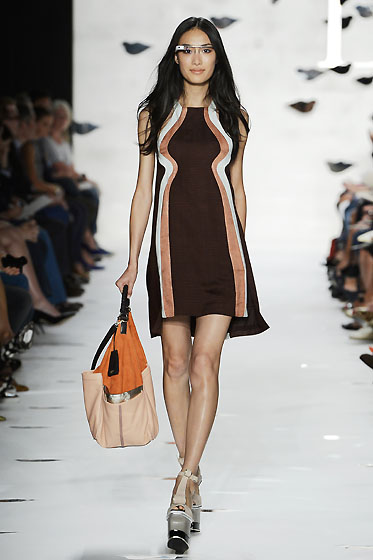
When Diane von Furstenberg and her models walked the runway at NYC’s recently concluded Fashion Week, they decided to give the world an inside peek at how it feels by recording the experience with Google Glass, the still-in-Beta avant-eyewear.
The innovative accessory shoots video, snaps pix, streams messages, and apparently looks good, so Diane decided to snap on the specs and take you with her (and her posse) on a fashion-tech flashbulb-popping stroll.
What’s cooler than Diane’s embrace of the new? Her Spring/Summer 2013 collection and her attitudes about life, potential, and empowerment. Take a look. Thanks, Diane!
But what happens when the party ends? That question is what inspired two curators from Saratoga Springs to create a micro-show from fashion museum cast-offs — Tattered and Torn (On the Road to Deaccession).
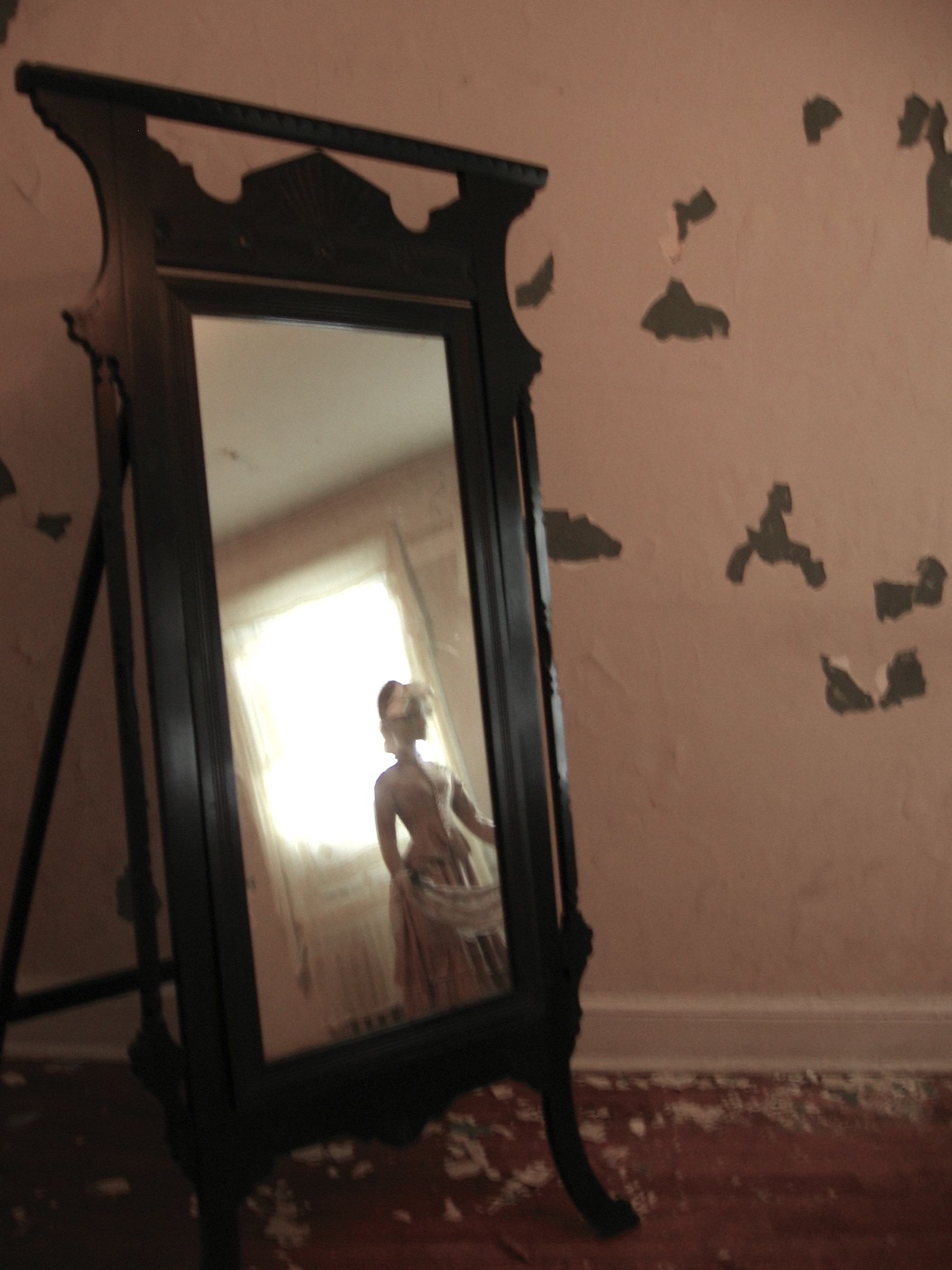
Empire Historic Arts Fund (founded by curators Rodney DeJong and Michael Levinson) gathered together less-than-perfect examples of 19th-century couture and used the abandoned rooms of the Governor’s Galleries on Governors Island to evoke the passage of time for fashion, finery, and fanfare. Rooms that once housed the U.S. Coast Guard as recently as the 1960s felt far older, perhaps due to the dreamlike state evoked by the presence of peeling paint, claustrophobic rooms, and props with which the curators surrounded their proud mannequins.
When you enter, the dresses look glamorous, but upon closer inspection, you can see that the silk has peeled away, seams have come apart, and the total elegance that must have accompanied these dresses’ debuts has passed into history. Take a look.
Considering the $250 budget for this installation, the curators have done a fine job of paying tribute to the history of fashion, creating a memorable experience on the Island, and letting us meditate on the still-beautiful details of fabric and design up close in a quiet place.
(The show is tucked away the far east side of the Island, beyond the Parade Ground, in Building 315 facing the Brooklyn waterfront. It’s the last building on your way toward Yankee Pier.)
Better use the holiday weekend to rest up, since Fashion’s Night Out happens next Thursday!
The tents are going up at Lincoln Center, the stores are getting ready for the onslaught, and the NYPD is gearing up for crowd control everywhere in the City.
Check out the New York event listings at the web site, or (if you’re not in NYC that night) the FNO worldwide or elsewhere US sites. Hey, there are even events planned in Wyoming and online, so there’s no excuse not to shop, contribute to a cause (by buying stuff from the collection), and have fun all night!
If you’re in NYC, start early, have a strategy, and be prepared for crowds. The web site lets you sort the 800-plus events by neighborhood, shopping category, and the type of event you’re hankering for (pop-ups, fashion shows, new product launches, charity-focused, DJs, designer appearances, and block parties).
Don’t despair if you haven’t gotten to the Met’s Costume Institute show Schiaparelli and Prada: Impossible Conversations. The Met’s put up a spectacular web site that lets you in behind the scenes, around the dining table, and inside the head of everyone’s favorite fashion icon, Iris Apfel.
If you get to the gallery this week before the show ends, expect large crowds (“normal” large, not like McQueen). Hopefully you’ll get close enough to the clothes to check out Schiaparelli’s innovative tree-bark rayon. If you can’t get there, preview the exhibition set-up on line, and go take the curator’s walk through (the second video from the top).
You can look through some of the images that the Met is sharing on line, but they don’t feature some of the in-person eye-poppers – the blue-squiggled Schiaparelli bridal veil on loan from Philadelphia, a color photo of Schiaparelli’s gold sari dress and veil (although the Horst photo is great), or Prada’s stuff with monkey and banana prints. [Prada quote: “I never thought people would want to wear clothes with monkeys and bananas on them.”]
One of the biggest complaints visitors have about the show is that it’s so hard to see and hear the “conversation” videos between Prada and Schiaparelli (played by Judy Davis, and, yes, someone did ask me “who played Prada?”). Not a problem, because all eight conversation videos are posted online (scroll to the bottom of the page).
If you have an extra hour in front of the computer, here’s the added bonus: the video of Iris Apfel discussing good and bad taste in contemporary fashion at the Met last June. Who doesn’t want Iris’s amazing perspective on style?
If you don’t have the time, just check out The Rules by Elsa Schiaparelli, courtesy of Philadelphia’s 2005 exhibition site. Agree? Disagree? Well, maybe you’ll concur with Prada’s side of the conversation.
Animal lovers, rush to see the final days of a truly spectacular journey back in time to experience the African wildlife that bounded across the still-lush lands surrounding the Nile. Tucked back into the lower level of the Met’s Lehman Wing, it may be easy to miss The Dawn of Egyptian Art, but don’t!
The items in this show are embellished with some of the liveliest, whimsical, and dramatic creatures, big and small, that entranced the citizens of Dynasties I and II, over five millennia ago.
Back in 3300 B.C., it was all about the animals – carvings of sleek and savvy jackals, mehen game boards in the shapes of snakes and turtles, fat bird jars, and frog containers that would make 14th century Mesoamerican artists jealous. Who knew that you’d carry your stuff around in ostrich-egg containers? Or use palettes adorned with antelopes and turtles? Or have hair combs decorated with giraffes, hippos, and wildebeest? (Pre-dating Hello Kitty by about 5,000 years.)
It’s as if the curators were mounting a show for the AMNH, because they clearly have an eco-anthro explanation about the hottest trends. Examples: elephants were commonly seen in the lands around the Nile around 3700 B.C., but they vanished from the desert (and thus, from the art) by 2649 B.C.
Also, around 3300 B.C., there was art trend to portray some animals as sacred. But it wasn’t until the Upper and Lower Egyptian kingdoms were united in 2150 B.C. that animals were used as royal symbols and the well-known style of animal-head-on-human-body became the thing.
Jackal (ca. 3300-3100 B.C.)
Other highlights of this show include the Two-Dog Palette (which gives the famous Narmar Palette a run for its money) and a seemingly unremarkable ceramic bowl that documents a time of unprecedented high-tech innovation in 3700-3450 B.C. textile making: a new technique with ground looms that enabled the ancient Egyptians to weave the strongest, widest linen in the world (ever).
Join this safari and go spot some big game through the eyes of the ancient Egyptians.
What do you see when a classically trained African American fine artist from LA decides to mash up Jewish Eastern European folk art with portraits of passionate Israeli hip-hop men of color?
Kehinde Wiley portrait of Jewish Ethiopian Israeli hip-hop artist Kalkian Mashasha
Find out at the most recent installment of Kehinde Wiley’s series, The World Stage, which will soon end its run at The Jewish Museum. It’s the Israel portion of Wiley’s effort to “chart the presence of black and brown people around the world.” It’s a stunner partly because of the paintings, the models, the provocative country choice, the Museum, and the physical Fifth Avenue setting.
Traveling to Tel Aviv during 2011, Wiley wanted to see, meet, and document men of color in a country that he really only associated with an anxious source of conflict. When he scoured the discos, malls, and promenades, he found that hip-hop practitioners and fans associated regardless of their identity as Ethiopian Jews, Arab Israelis, and other native-born Jews. That’s who you’ll meet on the walls and in the video.
If you’ve seen Wiley’s other work, you know that he smothers his canvases and subjects in pattern. In this case, inspired by the collection at the Jewish Museum, you’ll have the treat of actually viewing patterned 19th-cetury textiles and Eastern European paper cuts from the collection that inspired him. Plus, you can enjoy the echo between the curlicues on canvas and on the wood paneling of the (former) Felix Warburg mansion.
Wiley wanted to “broaden the discussion” about Israel, race, culture, and art, and his skill, vision, creativity, and deep-dive into the Tel Aviv youth scene delivers big time. Enjoy walking the Tel Aviv streets with the artist at work. (And for more, look at the other discussions and videos here.)
Best gift items associated with a current exhibition: Wiley’s skateboard deck and dog tags featuring his proud subjects.
If you’re running over to the Met to catch the Prada/Schiaparelli show in the next two weeks (don’t worry, it’s up until August 19), be sure to see the other rarely seen, worth-the-trip clothes – the robes, tunics, and kids’ stuff that’s straight from the Seventh Century.
It’s the textile/clothing room of the show Byzantium and Islam: Age of Transition. It’s not often you get to see clothes from 430-870 A.D., much less see a one-room summary of all the cross-cultural fashion trends.
It’s Byzantine fashion at it’s best, from a time when Greek Orthodox, Coptic, Christian, and Jewish lifestyles were all mixing and mingling across the Empire between the Seventh and Ninth Centuries. Radio carbon dating of the fibers gave the curators a range of dates on the outfits, but let’s just call it even by saying “Seventh Century”.
In the fashion gallery of the show, you’ll see several tapestry-weave tunics (woven to shape), along with a small Egyptian kid’s fringed-trimmed hoodie (430-620 A.D.), a tunic with polychrome-pattered trim, and a huge, oversized Persian riding coat made of cashmere and wool. In a tapestry panel, you’ll see a veritable Vogue layout of various styles, including someone dressed in skins and boots below this more conservative tunic/mantle combo. Did they really wear that? You be the judge.
Amazingly enough, a lot of the coats and tunics come from the Met’s and the Brooklyn Museum’s own collections. Take a look and marvel at what curatorial care has wrought. (And check out the popular Samson silk fabric swatch in the adjacent gallery.)






 itsnewstoyou
