How do abstract artists visually channel their response to awesome landscapes? You’ll get a glimpse of how ten artists approach natue and atmospheric phenomenon in Abstracing Nature, an engaging contemporary exhibition at the Albuquerque Museum, on view thorugh October 12.
Works by grand-master abstractionists Richard Diebenkorn and Agnes Martin greet you right at the entrance.
Diebenkorn isn’t normally associated with New Mexico, but decades before embarking upon his epic Ocean Park series, he spent two years (1950-1952) at the University of New Mexico (1950-1952) working toward his MFA before returning to the West Coast.
Richard Diebenkorn’s 1952 Untitled (Albuquerque), featuring deep earth tones and undulating forms.
The Diebenkorn on display is a recent museum acquisition from those years. Complete abstract expressionist approach to the colors and undulating geologic forms he saw surrounding the post-war boom town.
Martin – the abstractionist grand-dame of New Mexico – made no attempt to hide the fact that her grids and minimal approach were expressions of the tranquililty and serenity she saw and felt from her retreats in Cuba and Galisteo, New Mexico. She was channeling her emotional, meditative response in her surroundings – not following the reductivist, minimalist trend fo the East and West Coast gallery scene.
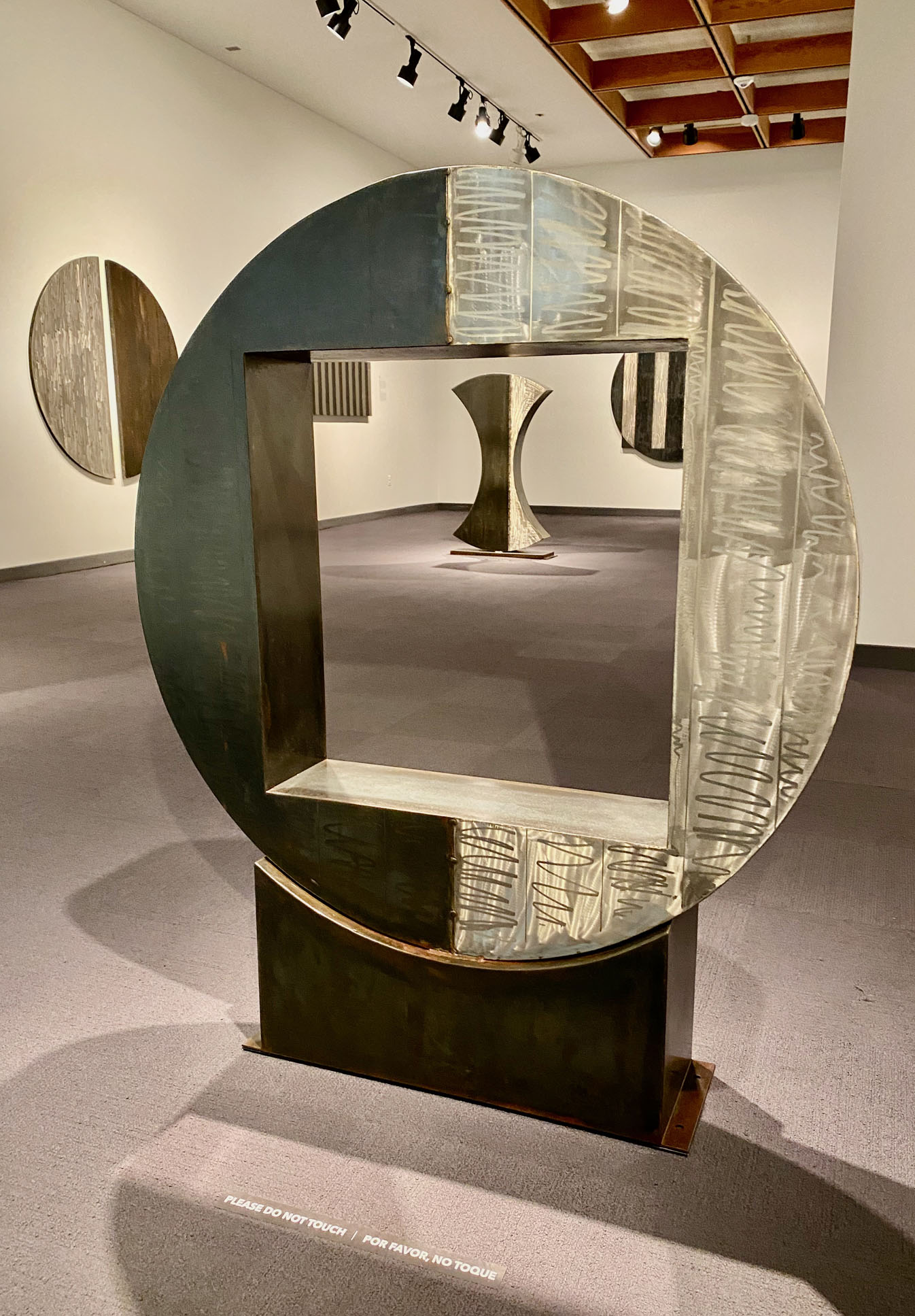
By getting up close to the two Martin paintings, you can appreciate her hand-drawn approach. Several stainless-steel sculptures by Agnes Martin’s great friend and student Karen Yank are nearby. The gleaming, hard-edged pieces do not resemble her mentor’s approach, except for the light, gestural touches across the surface.
Agnes Martin’s 1980 acrylic Untitled #6. Courtesy: New Mexico Museum of Art.
Karen Yank’s 2023 steel View with Silhouette VII and other sculptures visible through the portal. Courtesy: the artist.
The large pastels by Emmi Whitehorse look to the landscape and sacred colors of the Navajo Nation inspiration – a poetic approach most evident in Yei Retires to Mt. Taylor. Dramatic blue gestures suggest the spiritual turquoise color associated with the Navajo’s soutnern sacred mountain Tsoodzil.
Emmi Whitehorse 1985 pastel abstraction on canvas Yei Retires to Mt. Taylor.
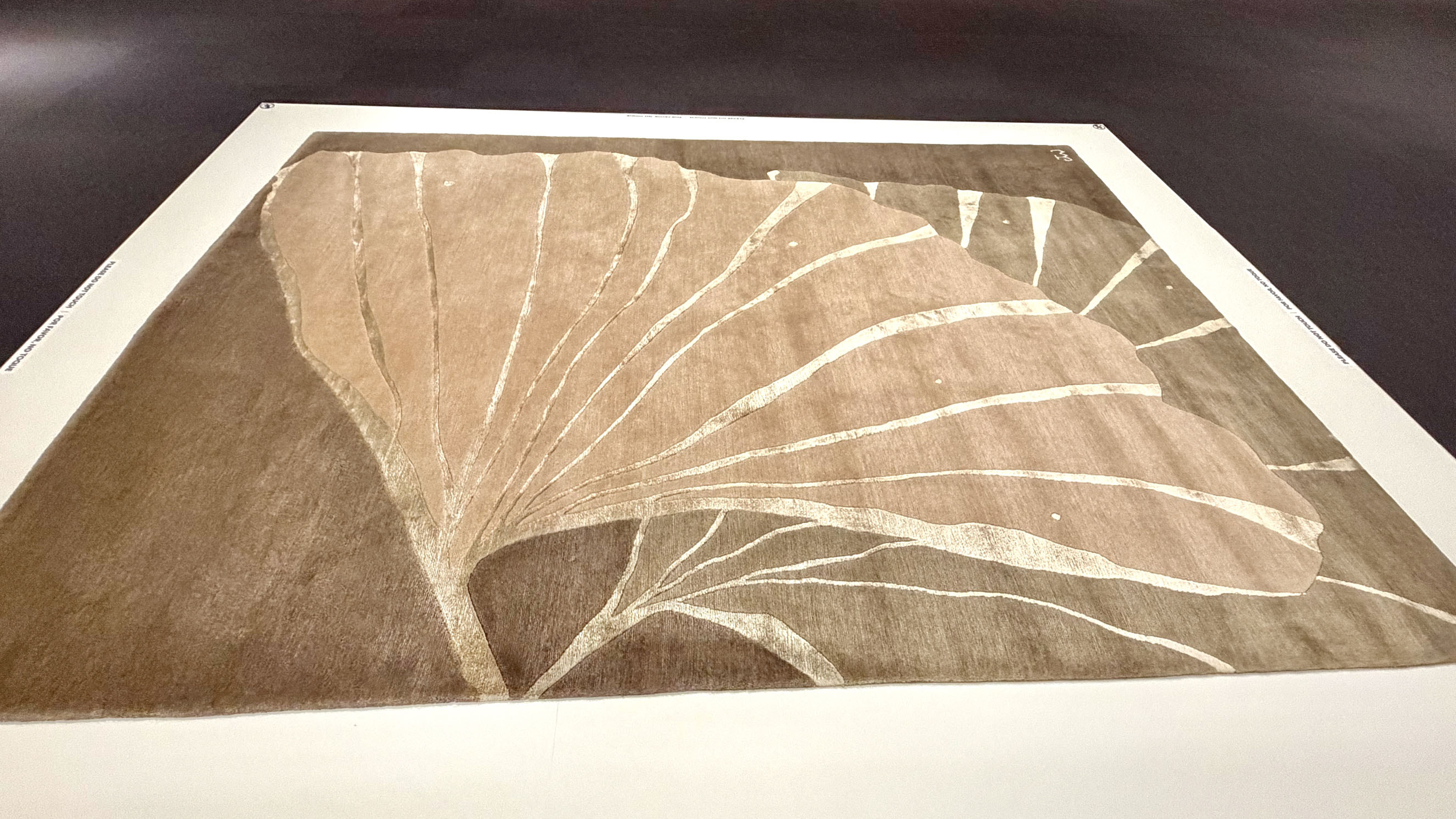
Abstractions used by textile artist Joan Weissman come from a place of process in which she starts with recognizable nature studies but allows her iterations to become more abstract. Approaching her seemingly abstract Ginko, only gradually do visitors see that the hand-knotted rug (created at large scale by Pakistani artisans) is an extreme close-up of a leaf.
Joan Weissman’s 2006 Ginko, a wool and silk hand-knotted rug, highlighting the intricacies of the leaf. Courtesy: the artist
2023 Hearing the Sun by Marietta Patricia Leis. Courtesy: the artist
Mariette Patricia Leis translates her experience of nature more formally. In one case, six seemingly minimalist wall-mounted panels are painted to reflect how we perceive the color of sunlight in different atmospheres and at different times of the day.
Enjoy walking through the full exhibition in our Flickr album.
Detail of 2018 Vacuities by Marietta Patricia Leis inspired by Iceland’s winter night sky. Courtesy: the artist.
Here’s a close look at Judy Tuwaletstiwa’s 2001 Divination. She transformed sand by creating an arrangement of glass objects – cubes, spheres, and organic shapes – all displayed across a soft sand base.
Like the rest of the work in this exhibition, it allows us to think about the natural world, our perception of it, and the many ways that the experience can be transformed into art.
Take a look at generations of 20th century craft mentorship in Craft Front & Center: ConversationPieces, on view at MAD Museum through April 20, 2025. The exhibition shines a light on how innovators shaped subsequent generations of craft artists at schools and art colonies across the United States. The curators have pulled from the MAD collection to show us the work of student and teacher side by side in several disciplines – fiber arts, ceramics, and glass.
Many of the mentors either taught at or were influenced by the Bauhaus, the legendary early 20th century design incubator.
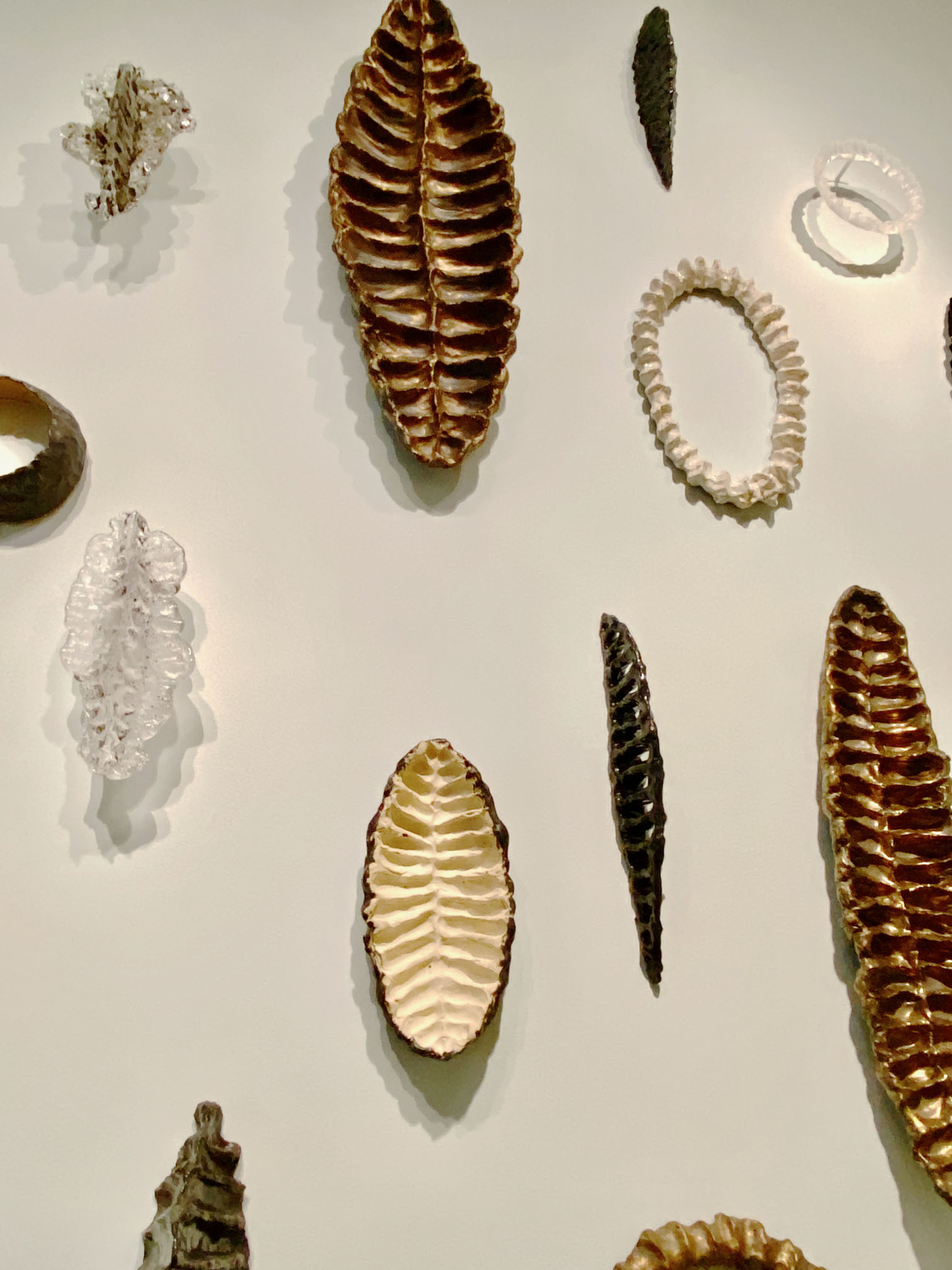
Who are the generational inspirations for Eve Biddle’s 2019-2023 tiny ceramic sculptures, New Relics?
Bauhaus students could take classes in weaving, ceramics, typography, and metalwork alongside traditional fine arts classes. They were expected to excel in their applied-arts training and mix in aesthetics learned in their fine arts classes.
Bauhaus innovator Margeurite Friedlander Wildenhain’s 1966 Square and Textured Vase
When the Nazis closed the progressive school in 1933, many German-Jewish refugee teachers and students fled, transplanting Bauhaus design and educational philosophies across the world.
MAD highlights several artists – including Anni Albers, Trude Guermonprez, Margeurite Friedlander Wildenhain, and Maija Grotell – who came to the United States and integrated Bauhaus practice into curriculums at Black Mountain College, the California College of Arts and Crafts, Cranbrook, and new craft workshops they began.
One of the best-known 20th century textile artists, Anni Albers is featured in the show by a fine-art “pictoral textile” made on a small handloom. At the Bauhaus, Albers she trained under master weaver Gunta Stölzl, and eventally took over as head of the textile workshop. Albers moved to Black Mountain College in North Carolina with her husband, painter Josef Albers, and was the first textile artist invited by MoMA to have a one-person exhibition.
Anni Albers’s 1959 textile Sheep May Safely Graze made on a small handloom using gauze weave technique
Anni also designed commercial textiles for Knoll for years. Her influence on the next generation of painters and textile artists was profound.
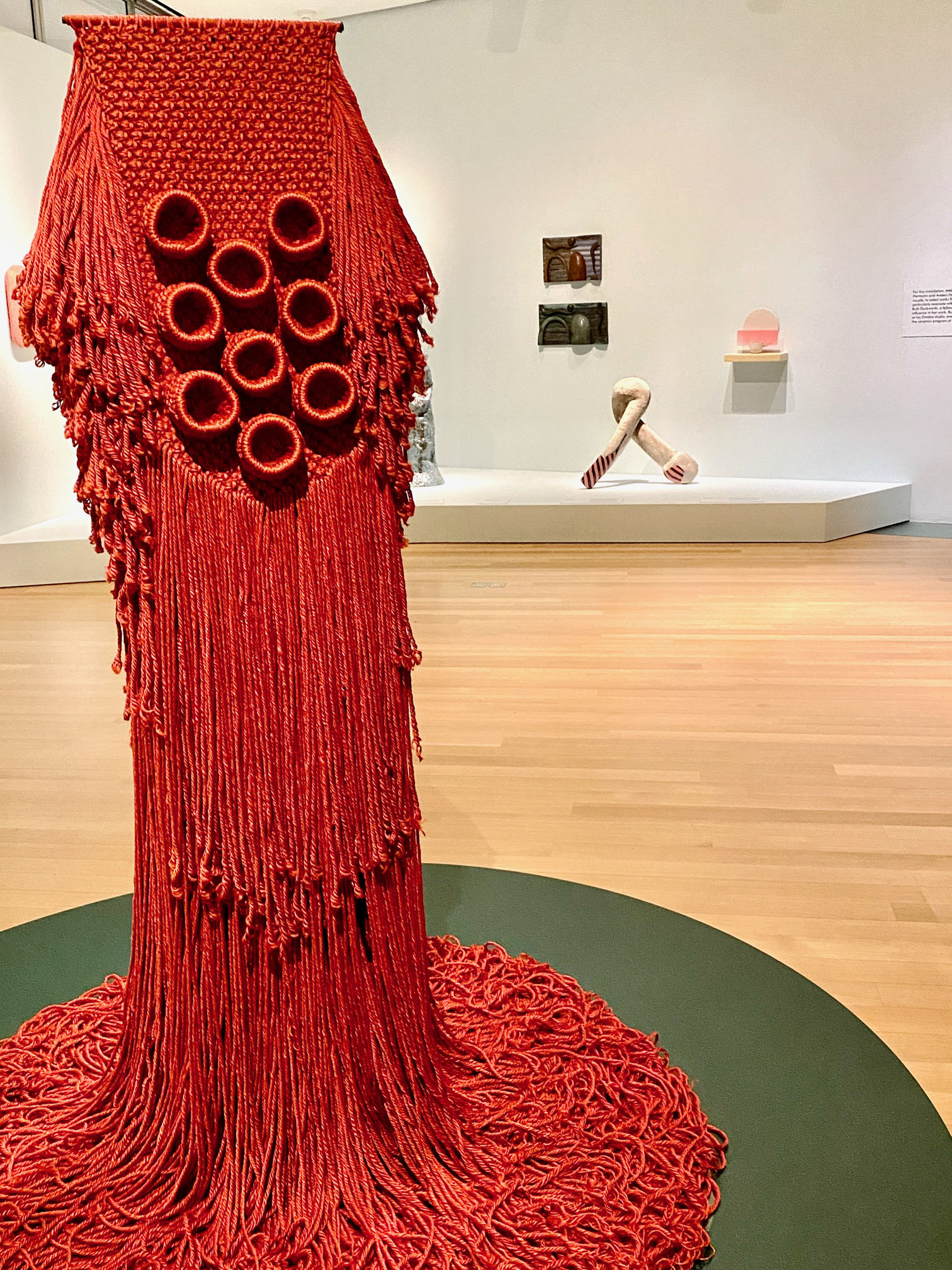
MAD features work by two fiber-arts innovators (and Albers admirers) who pushed boundaries by crafting commanding, large-scale sculptures. Sheila Hicks (who studied with Josef at Yale) and Claire Zeisel (who studied with the former Bauhaus faculty at Chicago’s IIT) are credited as the leaders of America’s textile arts movement. Tufts burst from the wall in Hicks’ piece, and Zeisel’s hovers in the center of the gallery like a shaman.
Sheila Hicks’s 1968 Dark Prayer Rug, inspired by Anni Albers and Mexican and Moroccan textile artists.
Claire Zeisler’s 1967 Red Wednesday with braid and cords twisting the sculpture’s armature
Trude Guermonprez, an unconventional materials artist known for innovations in three-dimensional weaving once worked at Berlin’s textile engineering academy; later, she consulted with industrial textile firms, as did Anni Albers.
Next to Guermonprez’s dynamic 3D hanging woven sculpture, MAD shows us a piece by Kay Sakimachi, a student who met Guermonprez in 1951 at the California College of Arts and Crafts summer craft workshop.
Guermonprez encouraged students to use latest technology, and here we see how Kay used a 1959 invention by DuPont – monofilament that’s better known today as fishing line. Kay’s woven it into an ethereal hanging sculpture.
Innovative fishing-line weaving 1968 Kunoyuki by Kay Sakimachi alongside 1962 Banner by her mentor, Trude Guermonprez.
In ceramics, MAD displays a series of vessels that transform into sculptures, starting with a modest, contained piece by Margeurite Friedlander Wildenhain, one of the first Bauhaus students and the first woman in Germany to be honored as a master potter. After emigrating to the United States in 1940, Wildenhain founded Pond Farm Workshops in Sonoma County, California ad instituted a rigorous Bauhaus instructional approach.
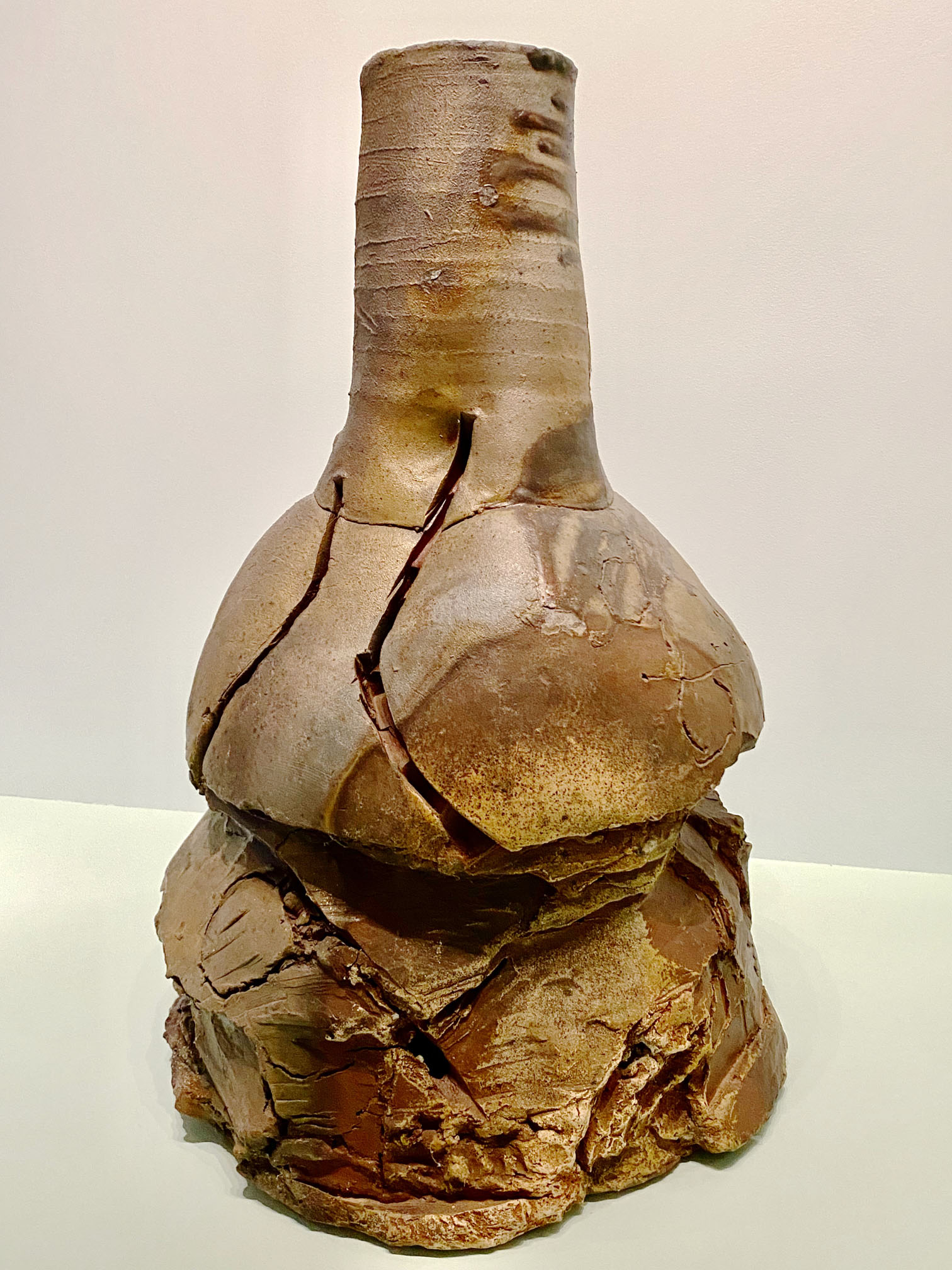
Frances Senska, her ceramics student, applied Wildenhain’s instructional principles to her own classes at Montana State, where student Peter Voulkos learned how to breathe new life into clay. Voulkos shashed, prodded, and poked clay, vigorously transforming the humble medium into wild, dramatic expressions.
Peter Voulkos’s 1992 stoneware Sibley, an example of his revolutionary approach to ceramic form.
Mary Ann Unger 1994 terra cotta Hoist – an approach to ceramic sculpture inspired by teacher Peter Voulkos
In turn, his UC-Berkeley student, Mary Ann Unger injected whimsey and improvisation into her sculptures, which allowed her daughter, Eve Biddle, to push it even further. MAD shows Biddle’s ingenious installation of creative ceramic geodes, trilobites, and spines crawling around the gallery wall.
Ceramics mentors even play a role in the development of America’s Studio Glass movement, which begins with Harvey Littleton, whose dad was a physicist on the first reasarch team at Corning Glass Works (he later developed Pyrex). MAD displays Harvey’s gorgeous glass arcs.
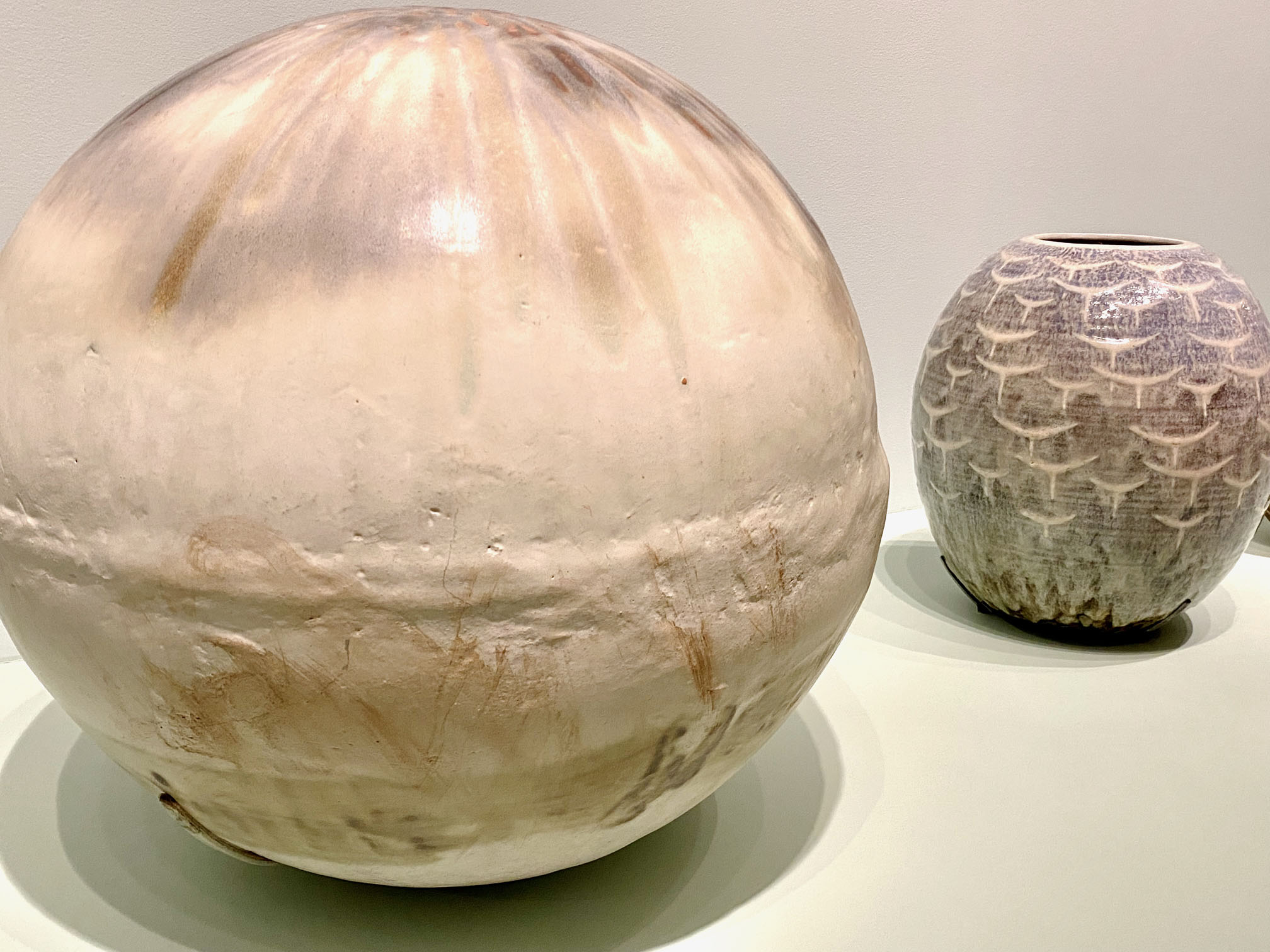
Work by student and teacher: Toshiko Takaezu’s 1995 stoneware Mist #2, part of her Moon series, with Maija Grotell’s 1953 glazed earthenware vase
On weekends, Harvey spent lots of time with his dad in the Corning lab, assuming he would follow in dad’s footsteps as a physicist at the University of Michigan. But after Harvey experienced UM art classes, he switched major. Eventually, he was specializing in ceramics under Maija Grotell at Cranbrook Academy of Art (who also taught ceramic superstar Toshiko Takaezu).
Littleton’s travels to observe the Italian glassmaking masters at Verano inspired him to apply his kiln and physics skills to experimental glassmaking. Back home, e pioneered low-temperature glass-blowing techniques that enabled glass artists to create work in studio setting and not a factory.
Littleton achievement was established the first university-based glass-blowing program at University of Wisconsin-Madison. A lucky undergraduate, Dale Chihuly, learned from the master, and the rest was history for American glass making.
Glass sculptures by teacher and student – 1983 Double Blue Arches by innovator Harvey Littleton and 1968 Wine Bottle by created by Dale Chihuly in Venice under a Fulbright Fellowship.
After receiving his MFA in ceramics at RISD, Chihuly traveled to Venice (like his mentor), and observed how the team worked together to create a finished work of glass art. In 1971, he founded Pilchuk Glass Works in Washington State, where he emphasized the collaborative, collective process. Chihuly’s own sculptural wonders emerged, plus the next generation of indigenous glass artist gained experience in collaborative expression – Tony Jojolla and Preston Singletary.
There are many more stories told in this illuminating exhibition from the MAD collection. Take a look in our Flickr album.
Tony Jojolla’s 1996-1997 Large Glass Olla, a traditional Pueblo pot made of glass at Dale Chihuly’s Pilchuk School; at right, Chihuly’s 1978 Untitled Basket












 itsnewstoyou