An early 1988 look in orange-orange wool – scarf, coat, and jumpsuit
For a shot of color and inspiration to let creative impulses run free, trot up to the second floor of the Jewish Museum to see the closing day of the tribute to one of New York’s favorite sons — “Isaac Mizrahi: An Unruly History”. It’s open late tonight until 8 pm.
Isaac has filled four galleries with the results of his imagining in the worlds of fashion, theater, and film, showing how it’s done when you have so many talents, so many ideas, interest in everything, and so little time. You just do it all.
The entry to the show is a wall of organized color, all pulled from his meticulously organized archive of fabrics and color swatches – a great introduction to a brilliant mind harnessed to bring a little more beauty and whimsy into the world.
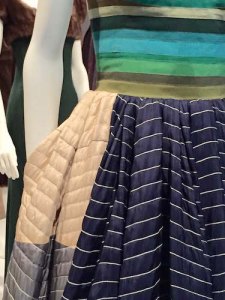
Inspired by elevator padding – silk quilting and grosgrain go to the ball in 2005
Beyond that, the first room – mostly from his early 1990 collections – is a riot of color featuring his high-low approach to style: pair something everyday (like a T-shirt or bomber jacket) with silk-taffeta glamor (like a ball-gown skirt). This is where Isaac made his splash into the world of fashion, and it’s a fun, exciting introduction to the rest of the exhibit.
The curators have mounted his fashion sketches floor to ceiling in a small gallery, showing how Isaac maps out his fashion shows like storyboarding a movie. The room also reveals his passion for drawing, his favorite part of creating a collection.
Another gallery gives a nod to his theatrical costuming work and the next features two ensembles that demonstrate his interest in everyday style and good causes: Isaac was one of the first big-name designers work with Target, and here we see one of those 2004 sweaters.
Sketches with swatches organize the run of show
His Coca-Cola sequined dress grew out of his collaboration with a charity that employed the homeless to collect and flatten discarded cans. Isaac had a Parisian couture house cut the smashed metal into sequins and had them hand-embroidered – another think-about-the-world creation.
Witty, wonderful, and full of life – Isaac’s accessories, film, fashions, and colors should inspire you to get a little more creative with your own day to day. Visit via our Flickr album, watch the Isaac video snippets, and listen to the audio tour the show.
For more Isaac right here, watch his conversation with editor Wendy Goodman on style and the pressures of starting out in the fashion industry.
Lasers: Sara Burton’s 2013 ensemble for McQueen: laser-cut pony skin bonded to leather, machine-sewn and finished with Mongolian lamb
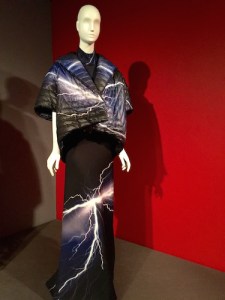
As cool as an iPhone and as meticulously engineered, the Met’s new blockbuster Costume Institute show — Manus + Machina: Fashion in the Age of Technology — asks you to think about the frocks you’re seeing: does a designer’s reliance on technology diminish the artistic value of haute couture, which has for centuries relied upon handcrafted structure and embellishment?
See for yourself before August 14 and click here to look at the details in our Flickr album.
The show is a meditation on the beauty that can come when great design minds have centuries-old craft collide with technology. It helps to have gazzilions of resources (hands in Paris) at your disposal. The result: really good art and wondrous feats of engineering that just happens to be fashion.
There’s plenty to ponder and repeat visits are a must. Curator Andrew Bolton said that the idea came to him as he examined YSL’s iconic Mondrian dress and realized that this Sixties haute couture dress-that-went-viral was mostly stitched by sewing machine, a no-no in the rule-book of the Paris high-fashion syndicate.
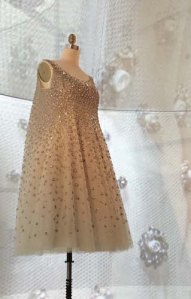
Yves Saint Laurent’s hand-worked 1958 trapeze in his first collection at Dior. Five layers of tulle with hand embroidery
It made him ponder the extent to which handwork and machine intersect in the world of high fashion.
Underwritten by Apple, there are no digital iPads or robots on the scene (like the Met’s revolutionary Charles James show) – just classical domes and arches highlighting masterworks of craftsmanship that cry out for the closest of scrutiny. Although it’s fun to waft through the crowds, getting glimpses of dazzling beadwork and dreamy Grecian-pleated chiffon gowns, to join Bolton in his investigation, reading the label copy, wall copy, and close inspection is a must.
Your first glimpse sets the historic context: The stunning Chanel wedding ensemble under the main dome (a created space made from a false floor across the upper level of the usually empty atrium of the Lehman wing) is surrounded by books. Leather-bound volumes of Diderot’s 1762-71 encyclopedia on liberal and mechanical arts are open to engravings of lacemaking and embroidery.
Diderot’s 1762-71 encyclopedia on liberal and mechanical arts
By including these “métiers”, Diderot elevated fine dressmaking skills to the level of respect given to other types of 18th-century engineering.
Bolton chose Diderot’s encyclopedia categories as the sub-sections of the show and gave each métier can-you-believe-what-you’re-seeing treatment. Click here to read more about each métier on the Met’s website.
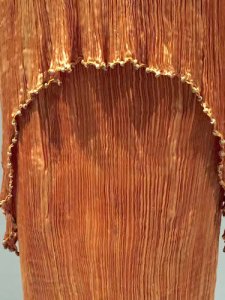
The pleating section of the show is a great example, beginning by displaying the masterful hand-formed pleats on Grecian gowns designed by Madame Grés and the still-mysterious processes used by Fortuny to clothe boho types in liquid charmeuse pleats at the dawn of the 20th century.
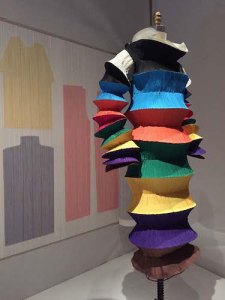
Issey Miyake ready-to-wear 1994 Flying Saucer dress fully extended; synthetic polyester that is machine pleated and stitched
Across the way, you can compare Fortuny’s craftsmanship with machine-stitched and pleated versions, which are no less compelling. Mary McFadden’s pleated dresses were must-haves of the must-be-seen society set in the Seventies and Eighties. Mary’s synthetic pleated fabric was a pull-it-out-of-the-suitcase miracle in a world of jet-set travel and society parties.
And don’t ignore the works in the show by Issey Miyake, who wowed the design world with innovative pleated shapes that twisted and turned into avant-garde dresses and tops. Machine made from synthetic material, Miyake’s creations could fold flat and be popped into action in a nanosecond. His techno-trick was to make an entire, gigantic garment, position the fabric into pleats and run the entire garment through a heat press. Go, Flying Saucer dress!
In every section of the show, Bolton provides something historic (such as the 1870s hand-crocheted wedding gown) bookended by blazingly new creations, such as Iris Van Herpen’s 3-D-printed creations.
Close-up: Fortuny’s hand-pleated, hand-sewn 1920s charmeuse dress; Venetian-beads embroidery and hand-knotted silk trim
Muslins from Charles James reveal classic tailoring techniques by the master engineer, worked and re-worked by hand until perfection was achieved. Miyake pushed the boundaries of modern dressmaking one step further by using lasers to cut polyester monofilament, draping it, and shaping it with metal snaps –creating a dress without using any needles, thread, or scissors.
Laser cutting makes multiple appearances in the show with the work of Comme des Garcons, Iris van Herpen, Thom Brown, and Sarah Burton for Alexander McQueen. However, traditional techniques by historic Parisian ateliers are on view, too – a Chanel embellished by Maison Lemarie with 2,500 fabric camellias that took 90 minutes each to create, Dior’s post-war embroidered floral dresses bursting with foilage, and YSL’s game-changing trapeze dress in his first collection for Dior. This last creation had five layers of tulle embellished with crystals, beads, and sequin clusters by Maison Rébé.
At the press opening, Apple’s designer extraordinaire, Jony Ive, cautioned viewers to remember that technology and craft are not at odds. The notion of care – whether by hand or machine – is intrinsic to everything in the show.
Steeplechase Funny Face, the symbol of a famous amusement park.
How did a strip of pristine, white-sand beach turn into one of the most fantastical, lurid, menacing, and whimsical destinations in the United States? You won’t find a sociological essay, but you’ll experience a lot of evidence in the Brooklyn Museum’s Coney Island extravaganza.
The crowds filling the galleries last Saturday night savored the experience of the sky-high towers of contemporary hand-painted, Coney-inspired signs by the collaborative, ICY SIGNS. You could stand for an hour, just taking in all the messages, philosophy, and witty send-ups of contemporary life, curated by TED-talking artist Stephen Powers.
Through the door, however, another world waits. Seeing Coney Island’s gaudy jumble today from the air or Q train, it’s hard to imagine how it looked in the mid-1800s in the post-Civil War era.
Chase’s 1886 oil, Landscape, Near Coney Island
The show, organized by Hartford’s Wadsworth Atheneum Museum of Art, opens with tranquil landscapes of the aspiring middle-classes enjoying the salt air and low-key entertainments and diversions on the beach – maybe having a photo taken by an itinerant photographer, or sampling some sweet treats. Back in these more genteel times, the sandy shores were open to a mix of races and nations, or so the oils by William Merritt Chase and John Henry Twachtman attest.
How times changed! A giant vintage black-and-white film clip of romance on a roller coaster draws you into a world of more visceral wonder – carousel horses and gambling wheels interspersed with a hundreds of works by famous American artists that explore the magic, mayhem, and malevolence that made Coney such a phenomenon.
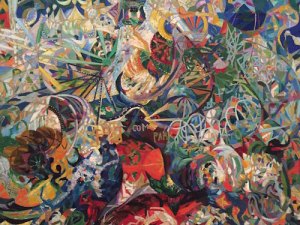
Detail of Joseph Stella’s 1913-1914 Battle of Lights, Coney Island, Mardi Gras from Yale University.
Figurative work from Reginald Marsh and others catapult you back to bawdy bathers and burlesque scenes brought to life last year in Broadway’s On the Town. Photographs by Arbus, Weegee, and Walker Evans provide close-up views of what it was like above and under the boardwalk.
Much of the shows’s fun is driven by the jarring injection of super-cool modern abstraction next to the flotsam and jetsam of the actual historic artifacts.
Edwin Porter’s 1905 silent movie Coney Island at Night gave nickelodeon viewers a novel way to see Edison’s incandescent lights in all their glory.
It’s startling to see Joseph Stella’s Futurist-inspired tribute to Coney Island’s Mardis Gras and realize that it’s from the same 1910-1914 era in which Jimmy Durante played honkey tonk piano for newcomer Mae West. It was all happening at the same time as the Armory Show.
1991 acrylic painting featuring iconic Spook-A-Rama Cyclops by Arnold Mesches.
Frank Stella’s 1950’s abstraction holds its own amidst the sideshow banners and relics that inspired his jarring color bars and mystery portal. Maybe it’s not a coincidence that right around the corner you come face-to-face with the real-life Coney landmark – the Cyclops who lured riders into America’s largest dark ride, Spook-A-Rama. The curators have placed him right next to his menacingly large portrait by Arnold Mesches.
Take a walk on the wild side of history, art, and sideshow performance while you can in person or via our Flickr album.
The Stephen Powers installation runs through the summer. Here he is explaining the allure of Coney Island as a contemporary inspiration:
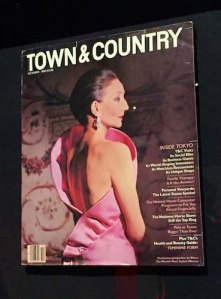
Jacqueline de Ribes on 1983 Town and Country cover by Victor Skrebneski
Does anyone want to be elegant anymore? If so, the exhibition about best-dressed-woman-in-the-word, Jacqueline de Ribes: The Art of Stylefeatured at the Metropolitan Museum of Art through February 21, is the place to take an immersion course.
As curator Harold Koda noted, even though the garments in the show span several decades, it’s a little difficult to pin any one of them on a specific decade. Jacqueline was all about perfect elegance and creative expression – not just style for style’s sake. Go to our Flickr album to view our favorites from the show and click through the Met’s gallery slideshow.
Although she was photographed incessantly throughout the Sixties, Seventies, and Eighties, Jacqueline was not just a patron of the couture – she was a hands-on designer and style partner to haughtiest of the haute couture.
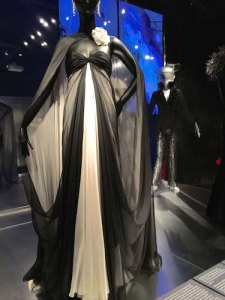
Her timeless 1988 design looks good from every angle
We’re talking about the likes of Yves Saint Laurent, Marc Bohan, and countless other designers at the top of their game. If Jacqueline wanted one of their dresses, they expected that she would make suggestions to enhance their creation. What about changing those sleeves? Moving that bow? Making it a little more dramatic?
And she wasn’t above a good copy, either. If Jackie O wore something that was truly spectacular, Jacqueline might have Cassini do one for her, too. Duplicates? No problem.
When Yves Saint Laurent announced that he was retiring, she put in an order for multiples of the same stunning dress in different colors.
Knowing one’s limits is important. When she was just starting out, she knew she was great at dramatic conceptions, but terrible at sketching.
Her own 1986 design in which the body and cape are from a single piece of fabric
It was her good fortune that she got a recommendation to hire a sketch artist that some older designers thought might work with her to illustrate some of her ideas. His name was Valentino, and he turned out to be a lifelong friend and eventual supplier of some of the best red eveningwear the world has ever seen.
When she began her own dress line, she didn’t rely upon family money. She traveled to New York and raised it herself, like any other up-and-coming designer. The galleries are filled with her own work, which hold up spectacularly well next to the giants of Paris fashion. The Costume Institute genuinely loves her look, style, fabrications, and full-out drama.
Moving through the different galleries of the show, it was clear that Jacqueline chose and designed clothes that looked great from any angle. No wonder someone called her a “living fashion drawing.” In the white-and-black section, there are several stunning creations where the dress fabric is brought up toward the shoulder in a flowing, elegant, dramatic sweep.
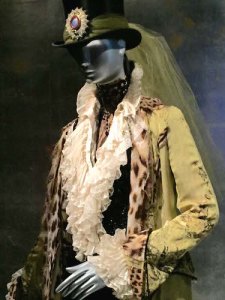
Her mix and match Lady Corsaire look with vintage, Cavalli, and Ralph Lauren
In the slide walls, she’s often shown working in jeans behind the scenes to bring a fashion show and collection to life. Although the focus is on eveningwear, there are marvelous mix-and-match get-ups where her love of vintage, ready-to-wear, and one-of-a-kind layering really shows.
It’s a joy to see how she refashioned her Laroche couture coat into masked-ball Mongolian princess costume and to see her mixing separates from the Express or Cache with turn-of-the-century tophats and Cavalli stuff. Yes, she spent a fortune on clothes, but also shows everyone how to cobble runway-ready looks from easily accessible parts if you have loads of creativity and style.
Bravo, Jacqueline!
Her dramatic 1967 silk chiffon and embroidered crystal evening dress by Marc Bohan for Dior
Henut does Queen Neferu’s hair, 11th dynasty (2051-2000 B.C.) Courtesy: Brooklyn Museum
While New York City is digging out from record snowfalls, there’s some great news about a few items that have been buried for centuries and are none the worse for wear – cosmetic boxes, bracelets, belts, and styling tips of the great divas (male and female) of ancient Egypt. The Metropolitan Museum of Art moved some gems out of the cavernous Egyptian wing – and borrowed a few things from Brooklyn and elsewhere – for its monumental tribute to the 12th dynasty, Ancient Egypt Transformed: The Middle Kingdom, closing today.
Usually buried among the collections on the first floor, the curators pulled out some of our favorites from the galleries (along the way to the Costume Institute) and presented them as the spectacular showpieces they are. It warrants a shout-out to the effort it took to conceive, mount, and present this terrific show. What a way to leverage the collections that are right inside the city limits!
Queen or Princess as a Sphinx, 12th dynasty (1981-1802 B.C.) Once owned by Emperor Hadrian , later by a Cardinal. From Brooklyn Museum
The story of the transformations happening in Egypt’s 11tth to 13th Dynasties (ca. 2030–1650 B.C.) is big (enough to fill twelve galleries), so we’re just highlighting a few of the things we noticed that modern People of Style might enjoy. Check out our Flickr site.
First, Brooklyn is in the house in the gallery dedicated to royal women: off to the side, there’s a limestone relief fragment (normally at the Brooklyn Museum of Art) showing Queen Nefuru having her tresses done by 11th Dynasty celebrity stylist, Henut. The curators point out that a telltale sign of royals (men and women) is the distinctive winged-eye look that her makeup artist achieved in kohl. The styling is incised in limestone, showing the Queen getting ready to emulate Hathor, the goddess of love and romance. In those days (2051-2000 B.C.), only royals could sport the jeweled necklace or eye makeup style.
Nearby, Brooklyn also contributes a beautifully sculpted head, said to be broken off from a larger sphinx statue from the 12th Dynasty – a protective guardian featuring a fantastic coif that only a queen or a princess would sport. It was all wigs, all the time.
372-piece cloisonné pectoral of Princess Sithathoryunet. Gold, carnelian, lapis lazuli, turquoise, and garnet. 12th dynasty (1887-1878 B.C.).
One of the most spectacular pieces is the 372-piece cloisonné pectoral worn by Princess Sithathoryunet. It’s a 12th Dynasty masterwork (1887-1878 B.C.). of gold, carnelian, lapis lazuli, turquoise, and garnet. The piece is magical and protective, but instead of being inlaid with the name of the princess, it features the name of the king. The idea is that the king himself is being protected when the royal daughter wears it – not the diva herself. You get what you pay for.
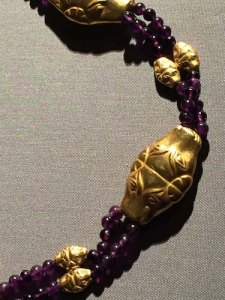
She also had another set of formal jewelry — a cowerie shell girdle and matching bracelet of gold, carnelian, feldspar, and crystal. The imitation shells had small pellets inside, which would have made a tinkling sound when she walked. The same is true for the feline-headed set of jewelry of gold and amethyst.
Feline-Headed Girdle of gold and amethyst from 12th Dynasty (1887-1813 B.C.).
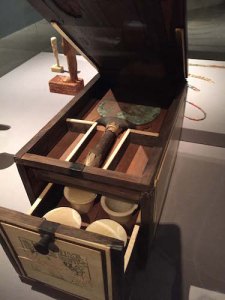
Sithathoryunet kept these and other treasures in a beautiful jewelry box, which is displayed nearby alongside a cosmetic box. The Met reconstructed the wood boxes by putting the ebony, ivory, gold, carnelian, blue faience, and silver back into place. Magnificent. Look for it all when these spectacular items go back on display at the back of the Egyptian Wing later this year.
By this time in Middle Kingdom culture, the elites started copying the royals, so some of the buried treasures that the Met found on its early 20th century expeditions belonged more to aspirational upper classes than the royals themselves. Check out the cosmetic case and mirror belonging to Amenemhat IV’s royal butler, Kemeni. Or the faience necklace worn by Wah, the overseer who served Meketre, the royal chief steward serving kings in both the 11th and 12th Dynasties.
The Met found a bonanza of fantastic reality art in Meketre’s tomb – so much that only a few pieces were brought up to the second floor for the special show. The show features a real-life depiction of a grainery and sport fishing boat, but if you look on the first floor as you walk through to the Costume Institute, you’ll see many more boats and several more rooms of day-to-day life – all meant to serve Meketre in the next world.
Cosmetic box of the royal butler, Kemeni, with four ointment jars and a mirror. 12th dynasty (1814-1805 BC.)
The Met has meticulously documented this show online. Spend a snow day (or not) by taking a tour through all twelve galleries on the Met’s web site and listening to the curators’ take on the on-line audio guide, which also features photos of each of the objects. Here’s where you can search the exhibition objects and find more detail.
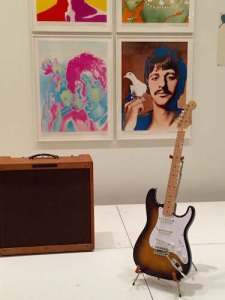
A decade apart – 1957 Stratocaster and Avendon’s 1967 posters of the Beatles
The MoMA Design Department had a brilliant idea – to tell the history of 20th century music culture by pulling out objects and two-dimensional art from the museum’s rich collection. How did modernism and music influence one another? See Making Music Modern: Design for Eye and Ear, on view through January 18.
There’s still time to catch some demos of the Scopitone, the Stratocaster, and the Mechanical Flux Orchestra inside the gallery this weekend.
Although a lot of the buzz in the gallery is over visitors’ recollections of the turntables, radios, and album covers on display, the curators do everyone a favor by putting the mod, mod world into historical context at the start of the show.
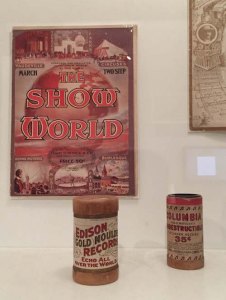
Early Edison sound experiments, films of Loie Fuller and Josephine Baker, and a poster of Yvette Guilbert from the can-can era remind everyone that shocking live performances, revolutionary music trends (go, ragtime!), and print designs that pushed the limits don’t belong exclusively to the mod, punk, or techno eras.
Early pop music innovations: sheet music and Edison wax cylinders
Tucked into side panels and corners are photos of costumed interplanetary performers of the Triadic Ballet at the Bauhaus in 1922 and early Russian avant-garde takes on the advent of radio, the broadcast and communications technology that changed entertainment forever.
These were worlds where artists and designers did it all – fine art, typography, industrial design, textiles, and performance. There are even some snippets of early acoustic-enhancing textiles on display, courtesy of Anni Albers. Design and music mixed, right from the start of the last century.
The sleek, streamlined radios, microphones, and Rural Electrification poster from the 1930s are presented as icons of the earliest era of broadcasting, with reminders from the curators that the designs were made to rescue the radio from its early haywire, spaghetti-city look that first appeared on 1920s garage workbenches across the country. Make it look nice, and you can bring it inside, where we can all enjoy it.
Stylish: 1932 Bakelite radio by Wells Coates and a 1939 Unidyne mic by Benjamin Baker.
Throughout the Fifties and Sixties, music and design seemed to go hand in hand. Consider the Sixties revolution in turntable and speaker design – everything fit for a super-modern lifestyle of easy listening with jazz and high-concept percussion album covers nearby.
The invention of the Fender Stratocaster guitar revolutionized the sound and look of early rock and roll with its iconic whammy bar and performances that represented out and out rebellion. Although the Stratocaster was invented in the 1950s, it’s appropriately displayed in front of posters of Bob Dylan, The Yardbirds, and Avedon’s Beatles – an innovation adopted by Buddy Holly that inspired the next generation.
Where pop music and art come together – Sixties album covers, including those by Richard Hamilton and Warhol
If you really want to dig into the details, there are dozens of famous album covers and posters on display with tribute paid to their designers. Among the luminaries are pop-god Richard Hamilton’s “White Album” for the Beatles, Warhol’s “Sticky Fingers” cover for the Stones, and Rauchenberg’s design for the vinyl disk inside the Talking Heads’ “Speaking in Tongues” album. The chronicle of the Fillmore East posters is a book unto itself.
And Mr. Jobs’ imprint is never forgotten at MoMA. An early version of his iPod is displayed right next to the Seventies invention from Japan that rocked the music world – the Sony Walkman.
If you can’t make it, take a look at the show through our Flickr views. We’ve grouped the items in chronological order.
And check out the excellent MoMA blog posts about the show on MoMA’s “Inside/Out” platform, where curators go to share enthusiasm about the hunt for the Stratocaster, famous rock posters, and other gems from the Fifties and Sixties. Leave your own comments, reflection on music and design, and memories right there on the MoMA website.
Bracelet of coral, opal, suglite, lapis, turquoise, gold, and silver by Raymond Yazzie. Courtesy: NMAI/Knight collection. Photo: S. Franks
If you’d like an immersion into a chamber of glistening silver and gems, enter the National Museum of the American Indian’s exhibition of stunning beauty and tranquility — Glittering World: Navajo Jewelry of the Yazzie Family.
The Smithsonian is providing New York with a unique chance to view 300 remarkable necklaces, bracelets, rings, and buckles from a New Mexico family of artists known for catapulting Navajo symbols, colors, and gems into a modern-art context.
Lapis and gold bracelet by Lee Yazzie, 1984. Photo: E. Aboroso, NMAI.
The focus is on Lee and Raymond Yazzi, brothers whose award-winning, intricate creations are sought by collectors worldwide. You’ll see five magnificent pieces as soon as you enter, including work by their sister, Mary Marie – representing lifetimes of master craftsmanship inspired by the mountains, sun, sky, spirits, and family in Gallup, New Mexico.
Photomurals inside the door will transport you to the red rock monuments of Navajo Nation, 1950s trading posts along the old Route 66, and maps to turquoise mines that have supplied native peoples with high-end bedazzlers since 300 A.D. The Smithsonian will be returning it all to private collectors after January 10, so be sure to enter this beautiful realm before then.
Watch this testament to artistic inspiration and dedication to beauty:
And take a trip to the Navajo world to hear more on a lifetime of creation:
1990 Mathu & Zaldy body suit and attached boots that Susanne wore to an Armani party
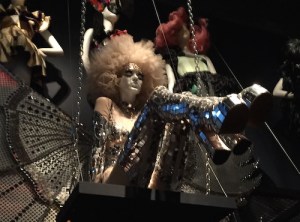
If you think the music and fashion stopped after Studio 54 shut its doors to Liza, Liz, Andy, Calvin, Halston, and Yves, FIT’s club-scene exhibition, Fashion Underground: The World of Susanne Bartsch, presents evidence to the contrary through December 5.
The show features nightlife splendor (with all the trimmings) from Susanne’s clothes-to-be-seen-in archive. Plus, you’ll get the thrill of pretending that you’ve stepped into one of her over-the-top parties, filled with celebrities, outrageous clothes, spectacle, and glitter.
Wielding “the list” in a 2008 Jean-Paul Gaultier jacket and Patricia Fields hat
Right downstairs at the gallery entrance, you’ll be taken back to a graffiti-splashed Nineties club entrance with a dolled-up doorkeeper sizing you up and holding “the list”. But there’s no anxiety about whether you’ll be let inside…Just walk in and be transported back to 1981.
As the glittery disco 54 era was coming to an end in New York in 1981, Bartsch arrived from London and opened up a shop in Soho filled with up-and-coming London designers that were creating the “new look” catching on in clubs across the pond.
In the early 1980s, Japanese and British designers experimented with crinkly natural fibers and oversized smocks – which looked fresh and hip after a decade of form-fitting, glitzy disco looks.
The Eighties — Vivienne Westwood looks with Galliano linen ensembles
Susanne sold the oversized, anti-disco baggy look of nightlife trendsetters Boy George and Leigh Bowery, imported dandy mix-and-match men’s and women’s looks from Vivienne Westwood, and featured flowing frocks by London’s Rachel Auburn.
The first part of the FIT show walks down this part of memory lane, including linen frocks by Mr. Galliano. Smocks are punctuated with dramatic hats (decades before fascinators) or beads from Portobello Road.
By the late Eighties, all that had given way to raggedy and accessorized mash-ups sported by the Material Girl and by the Nineties, bejeweled and bedazzled clubwear reigned again. Susanne was regularly hosting parties clad in an ever-evolving array of embellished corsets, fashioned by the master of form and shape, Mr. Pearl.
Mr. Pearl corset ensembles (1989, 1991) with 1992 Mugler Cowgirl ensemble for Naomi Campbell
In a well-deserved tribute to his creations, FIT has installed a carousel of Mr. Pearl’s work on a turntable in the show’s back room of the show, next to a corner where mannequins form a towering tribute to the magic of Mr. Mugler, another of Ms. Bartsch’s favorites. After she introduced Mr. Pearl to Mr. Mugler, the rest was fashion history.
Fashion designers flocked to her parties and she did justice to them all – working in their hats, jackets, shoes, bags, and separates into her never-ending array of special occasion get-ups. When you peruse the specific looks on display in the show, it’s an all-star line-up of New York, Paris, and London fashion heavyweights.
Gareth Pugh 2015 ensemble of paper, Lycra and leather
The show screams of creativity and it’s wonderful that curator Valerie Steele put a spotlight on this Queen of Nightlife and her impact on the underground/high fashion scene for the last three decades. A lot of Susanne’s featured clubwear is credited to Mathu & Zaldy, who turned out plenty of over-the-top looks when designer ready-to-wear just didn’t pack enough punch for a special occasion.
Another charming touch in the show is the ensemble of paper, Lycra and leather contributed by Gareth Pugh. Susanne asked him to send something she could (and would) wear.
As always, FIT provides lots of history and photographs of Susanne and friends in action at multitudes of balls and parties on its exhibition website. Spend time looking at Susanne in action and at snapshots of her historic Love Ball. For close-ups of the clothes and costumes, visit our Flickr feed.
Take 360 spin around each room of the show courtesy of FIT’s virtual tour produced by Synthescape. The arrows appearing on the floor will take you to all three rooms.
Do you wish you could have been at the opening of this exhibit? Not to worry – her friends and fans let you in on the party and remember unforgettable nights in this celebratory video. Even Calvin’s there:
Stepping inside Global Fashion Capitals at the Museum at FIT is an around-the-world trip that gives a nod to fashion’s past while presenting style innovators who are thriving in nearly every corner of the world. Right inside the front door of the exhibit is a powerful mannequin duo straight outta Istanbul. Wow!
Turn around and you’ll see a packed International Fashion Week Calendar and an illuminated world map. It’s pretty clear that every hour or so, the sun rises on another hotbed of sartorial creativity. Except for Antarctica, every continent has multiple fashion weeks, fashion bloggers, innovative designers, and fashion followers all their own. Explore through the show’s website, and visit in person before November 14.
Representing London, Alexander McQueen’s 2009 dress and corset
The curators tell the story of the rise of traditional couture centers — Paris, New York, Milan, and London – through selected looks and accessories, dating all the way back to the mid-19th century and the House of Worth, when the fashion system and seasonal cycles were institutionalized. It’s interesting to learn that by 1949, the House of Dior was generating 5% of French export profits.
Of course, after WWII, New York was hot on the heels of Paris. Eleanor Lambert kickstarted New York’s Fashion Week in 1943 and Halston and his designer pals won their place in the pantheon of style by vanquishing the Parisians in the 1973 Battle of Versailles.
Milan took over the mantle from Rome after World War II, and London came into its own in the Sixties and Seventies with the debut of mad Mod, rocker chic, and Westwood’s over-the-top subversions.
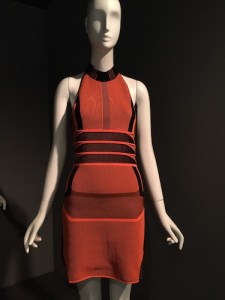
Alexander Wang’s 2015 dress from Nike’s “flyknit” sneaker fabric
In each section, the curators are careful to add a look from recent runways – Christopher Kane’s layered silk organza masterpiece and Alexander Wang’s shift made from the same fabric as Nike’s “flyknit” sneakers.
But the remainder of the floor space tells the story of other influential capitals of fashion – the 1981 emergence of the Antwerp 6 in Belgium; Tokyo’s wild ride with Miyake, Yamamoto, and Kawakubo; and what H&M did for Scandinavia as a fashion capital.
Next, the show highlights cities and fashion culture in Kiev, Mexico City, Sao Paulo, Lagos, J-burg, Sydney, Seoul and Mumbai. Click through these fashion histories on the FIT exhibition site, and marvel at Lisa Folawiyo’s bead-encrusted dress (Lagos) and Lie Sangbong’s graphic silk ensemble (Seoul).
Take a trip through the gallery on our Flickr site, and watch an interview with curator Ariele Elia below:
And for more on the Battle of Versailles, courtesy of FIT, click here.
NYBG’s Haupt Conservatory is transformed into Frida’s Casa Azul
Ever since the New York Botanical Garden installed its Frida Khalo: Art, Garden, Life show, it’s been a nonstop party and feast for the eyes, ears, and tastebuds.
Not sufficient to import fourteen of Frida’s rarely seen paintings for the formal gallery upstairs in its library building, the creative NYBG team has made environments, commissioned artists, designed apps, booked acts, hosted special events, transformed the conservatory, made a wall of cactus, redesigned menus, and even brought in a taco truck to give everyone an immersion into her sophisticated Mexican lifestyle.
This blockbuster sensory experience is in its last week, going out with a bang with a Dia de los Muertos theme as this traditional Mexican holiday collides with our own Halloween. Sugar skulls and whimsical skeletons are taking over Frida and Diego’s pyramid that serves as the centerpiece of the garden portion of the show.
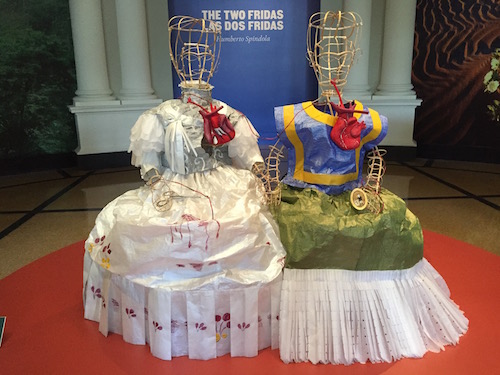
Tissue-paper dresses for The Two Fridas by artist Humberto Spindola
It’s an appropriate mix, given Frida’s own proclivity to merge the everyday with the surreal in her own works. The Library has an exquisite collection of her self-portrait and still life paintings, featuring flowers, animals, and deep-rooted Mexican myth and culture.
Downstairs in the Britton Rotunda, there’s a stunning installation of The Two Fridas by artist Humberto Spindola – side-by-side mannequins wearing tissue-paper dresses in colors that Frida sported, but with the surreal outer heart that she painted more than once. Visitors approach as if it were a shrine with special powers.
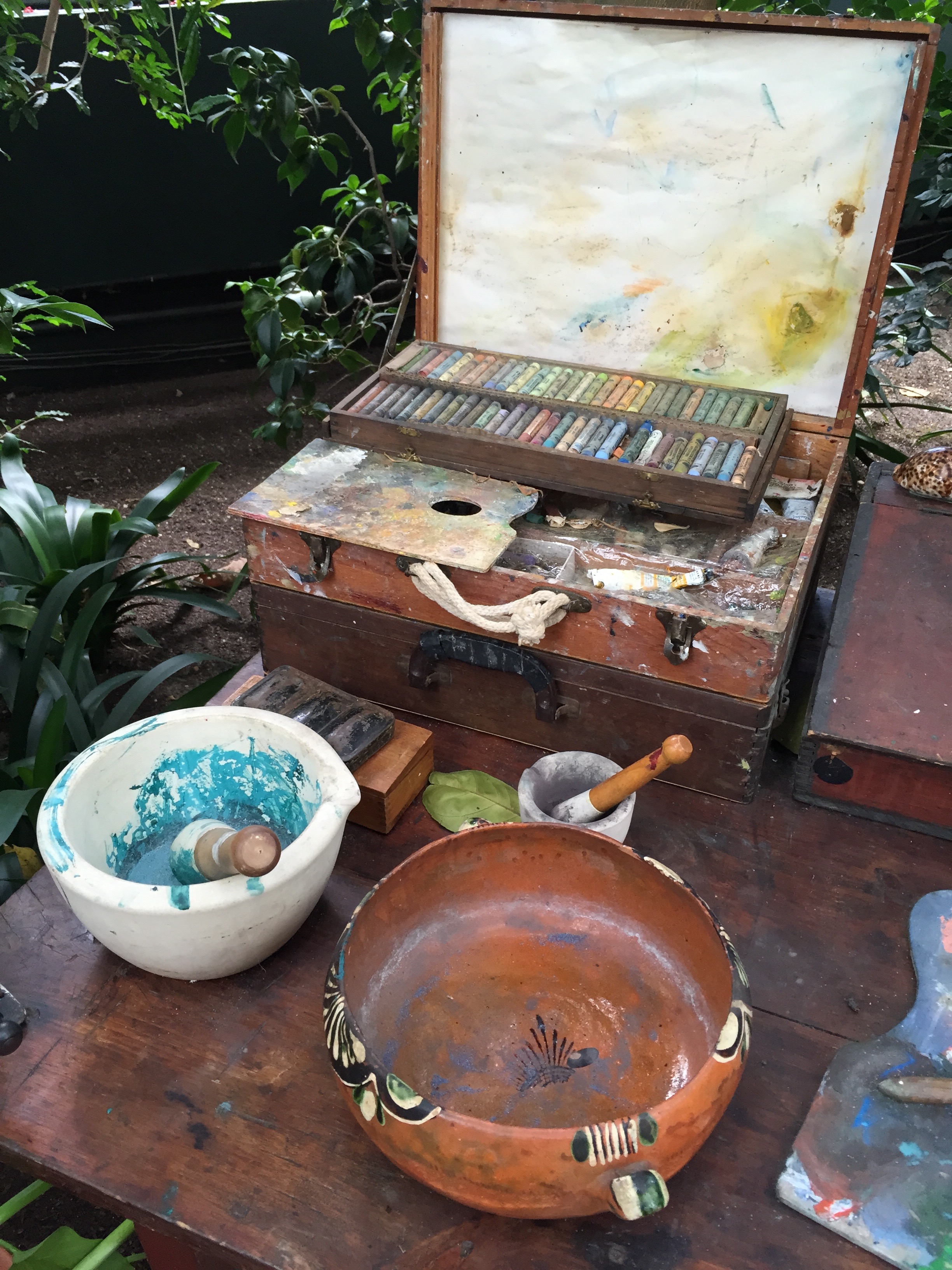
Frida’s workspace
The Haupt Conservatory serves up a riot of color with floating blue containers of vivid flowers, the dynamic blue of the recreated Casa Azul, where she lived, pops of the types of flowers with which she adorned her table and sills, and the intensely painted Mexican-style pyramid in the center of it all.
The sensations are so bright that it’s easy to miss the recreation of Frida’s studio, tucked away in the trees to the left of the main event – brushes, paints, paint sticks, and other tools.
Outdoors, the curators have succulents jammed into every piece of oversize Mexican pottery near a “wall” of cactus, replicating a natural fence that Diego had outside his studio for decades.
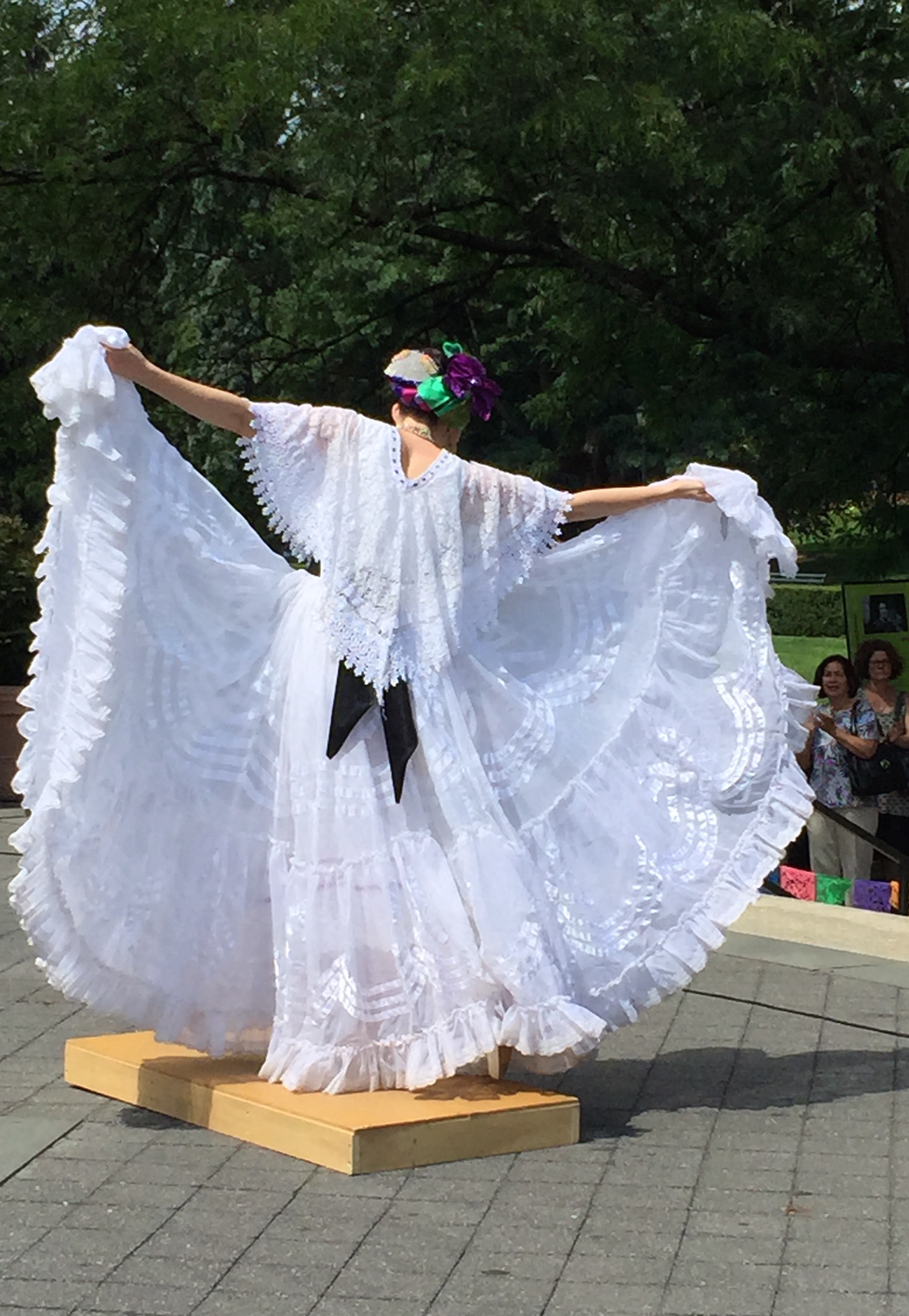
Soloist from Capulli Danza Mexicana channels her inner Frida for the crowd
The “Life” portion of the show’s title is represented by the generous schedule of music, performances, films, and events that the NYBG has featured throughout the show’s six-month run. Dance companies, all-female mariachi bands, chefs, and authors provide sensuous infusions of movement, wit, gaiety, and sophistication that Frida embodied her entire life. Flashing red skirts, exciting beats, fast footwork, dramatic flourishes, and meaty conversation all contribute to the experience of who Frida was, how she lived, and what she loved.
Download the exhibition panel to see all the parts of Mexico City that meant so much to Frida and Diego – images of parks, gardens, markets, and historic sites, including photos of Casa Azul.
















 itsnewstoyou
