Pathfinder Marcus Amerman at The Wheelwright

Shape-shifter, beadwork innovator, pop-culture provocateur, fashion designer, and performance artist – it’s hard to know where to start when summarizing four-decades of work by a Native-American contemporary art superstar. But his first retrospective, Pathfinder: 40 Years of Marcus Amerman, does showcases his wide range of work in spectacular fashion. See it at the Wheelwright Museum of the American Indian in Santa Fe through January 11.

Marcus Amerman (Choctaw Nation of Oklahoma) is best known for his intricate beaded “paintings,” which take center stage.

1994 Stormbringer beaded portrait of Lakota leader Chief Iron Hawk. Surrealist eyes by Man Ray watch from a brewing storm. Courtesy: Colorado Springs Fine Arts Center.

Once Amerman developed his bead technique, which provided a photo-realist spin to a traditional “native” craft, he really felt that he could take on any subject as a contemporary artist – movie stars, historic characters, and cartoon images. The impact is electric. 

2002 beaded painting Greetings from Indian Country, merging vintage tourism with pointed social commentary on exploitation. Private collection

Gazing across the main gallery, you see pop-culture images of “Indian” memes splashed across large canvases, cartoony self-portraits, fashion mannequins, glass sculptures, and photos by his wry collaborators. It’s a splendid mix of eye-dazzling color, technical mastery, and social commentary. Take a look at some of our favorites in our Flickr gallery.

Amerman garnered a lot of attention in the late 1980s and early 1990s for merging his beadwork into contemporary fashion. He cites his beaded leather motorcycle jacket with a beaded meme of bikini-clad Brooke Shields starting it all – a shock-worthy mix of leather toughness with one of the hottest young stars of the day.  He took on custom commissions and leapt at the opportunity to participate in fashion shows. He was overjoyed to see his buckskin fashions featured in Elle.

1982 Iron Horse Jacket with beaded Brooke Shields. Courtesy: Private collection
American eagles beaded on lapels of 1992 dinner jacket; commissioned by veteran Doug Hyde (Nez Perce, Assiniboine, Chippewa).

It’s obvious that Amerman rejects staying put into a single category. He loves collecting vintage “Indian” objects and collaging art-world and historic references in all of his work. Check out those hubcaps!

2023 acrylic painting Old Masters in the New World, showing 17th century Dutch colonizers next to a Santa Fe train. Courtesy: the artist
2023 Rattles found-object collage, mixing pop cultural and Native images. Courtesy: the artist

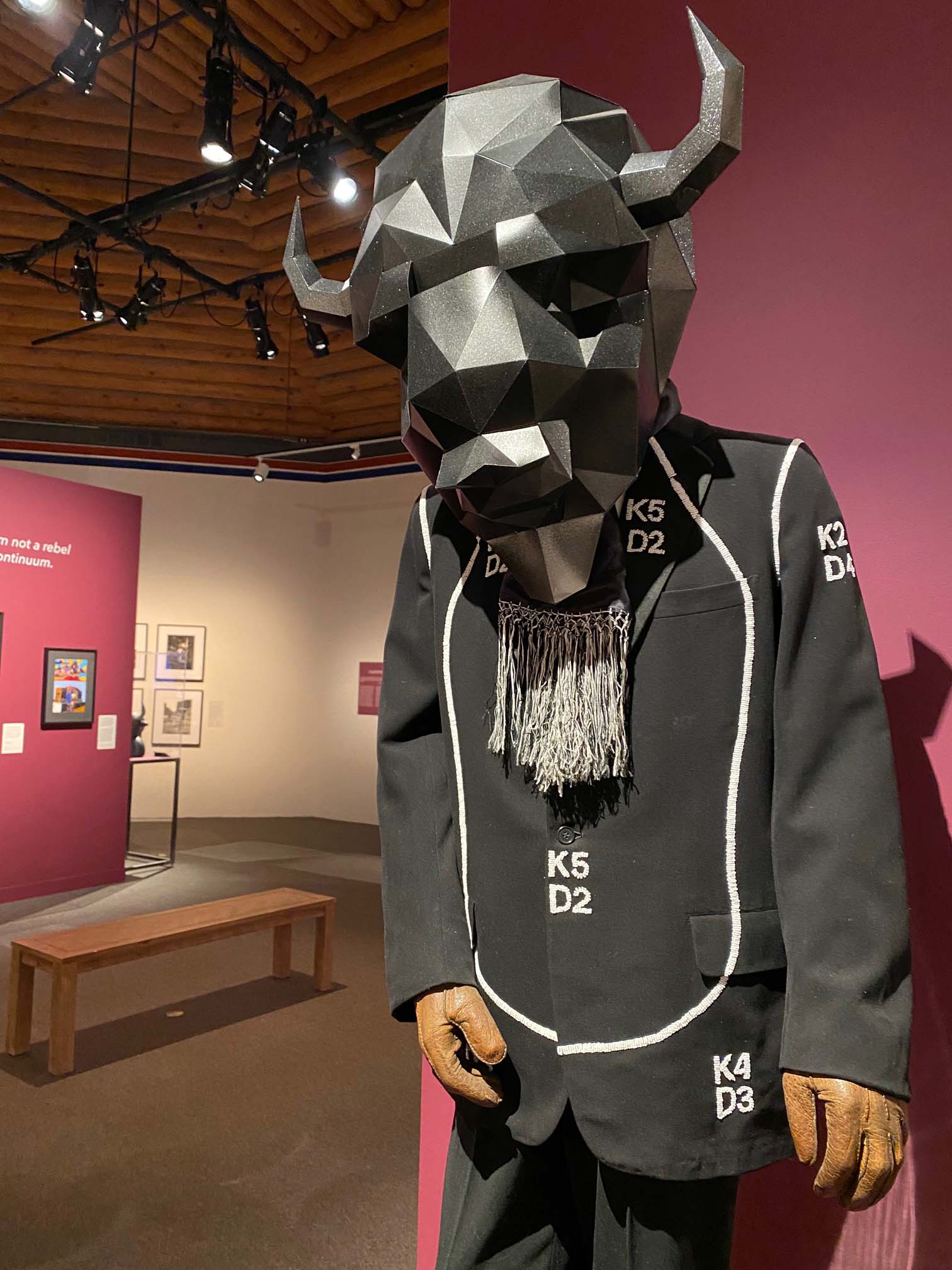
Amerman’s alter ego, Buffalo Man, features prominently in the show, particularly in his collaborations with acclaimed photographer Cara Romero, where icons of Native culture insert themselves into American pop culture.
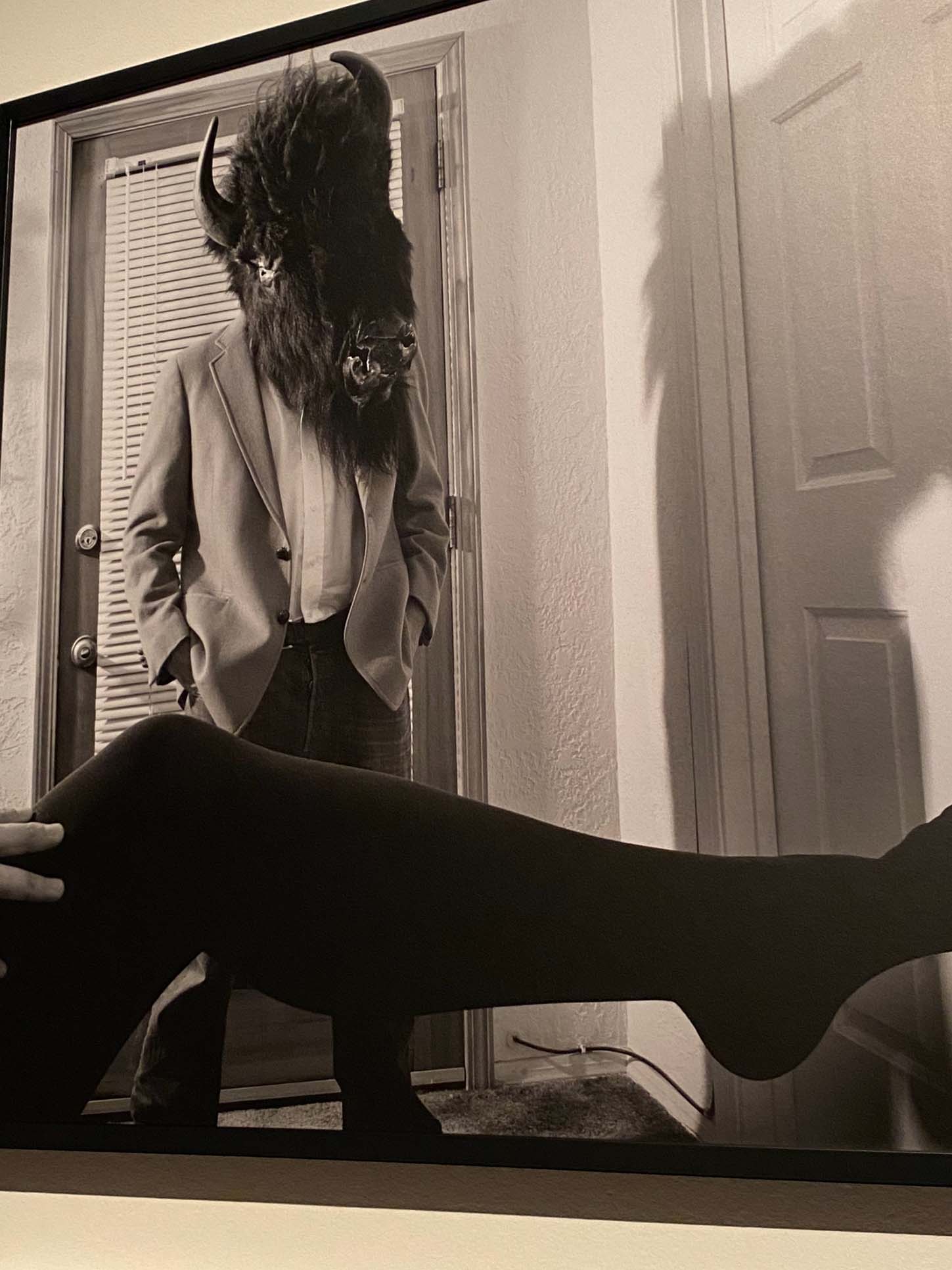
Cara Romero’s 2013 photo El Graduaté – a collaboration with Amerman’s performance alter ego, Buffalo Man. Courtesy: Cara Romero
2002 Target Jacket with glass beads, worn by the artist in fashion shows as himself and as Buffalo Man. Courtesy: the artist

The gorgeous collaborations with glass artists from Amerman’s time at Pilchuk are a delight – some self-referential and others harkening back to his own culture’s ancestry.  He claims that everything he makes is genuinely as “self portrait.”

2010 blown and sand-carved Buffalo Man – a collaboration by Amerman and Preston Singletary (Tlingit). Courtesy: the artist
2006 Glass Shield, one of a series created during a residency at Pilchuk Glass School and inspired by historic Plains Indian shields. Courtesy: the artist

It’s a joyful tribute to an artist who gives back, inspires others, and keeps asking pertinent questions about the role of art and artists in our society.

Enjoy this close-up look at some of Amerman’s masterful beadwork and hear why Amerman continues to create:
Alma Thomas Splashes Denver with Color

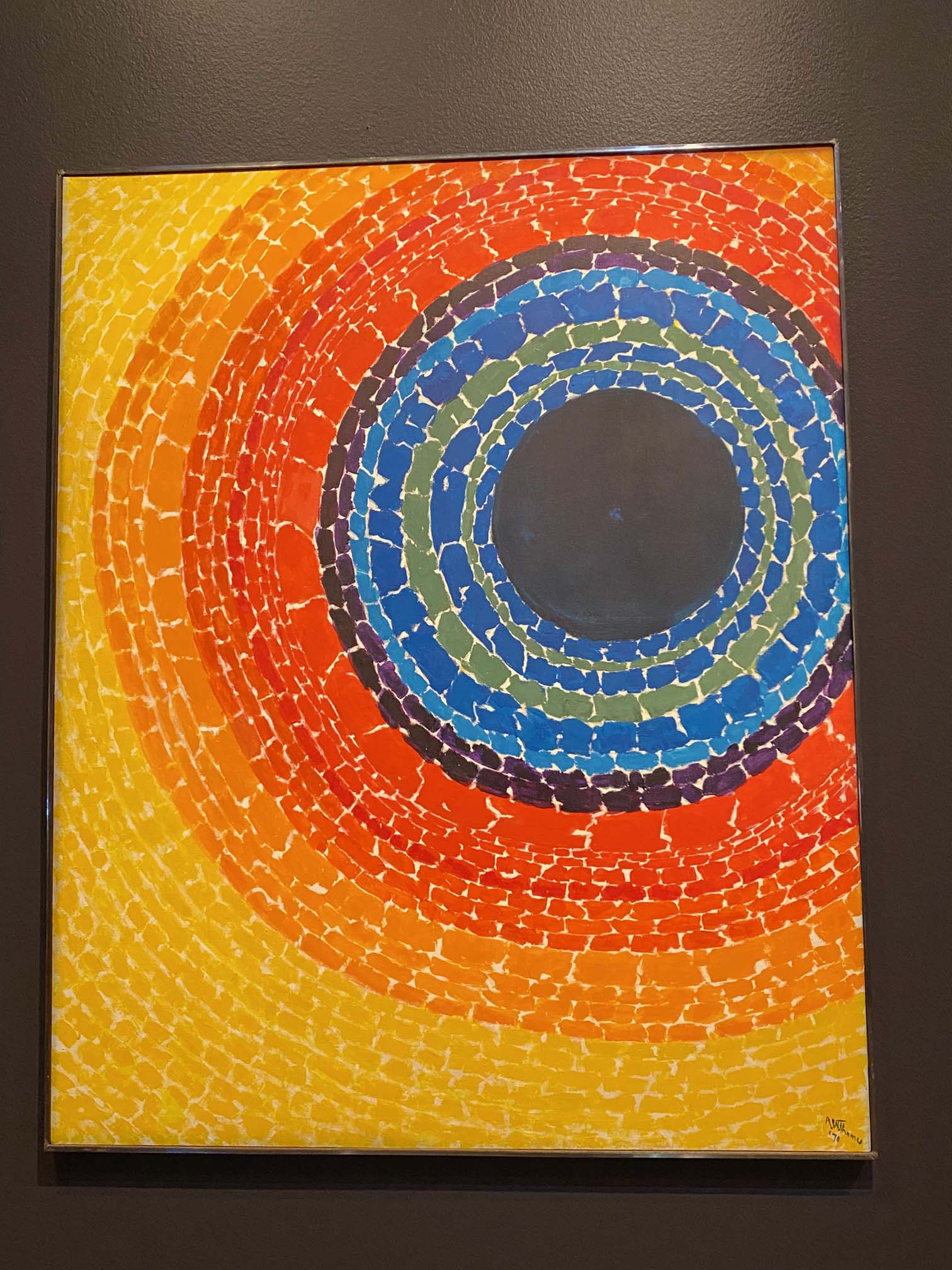
For a pop of color in the winter season, see Composing Color: Paintings by Alma Thomas from the Smithsonian Museum of American Art at the Denver Museum of Art through January 12 and at the Memorial Art Gallery in Rochester, New York February 8 through May 25, 2025.

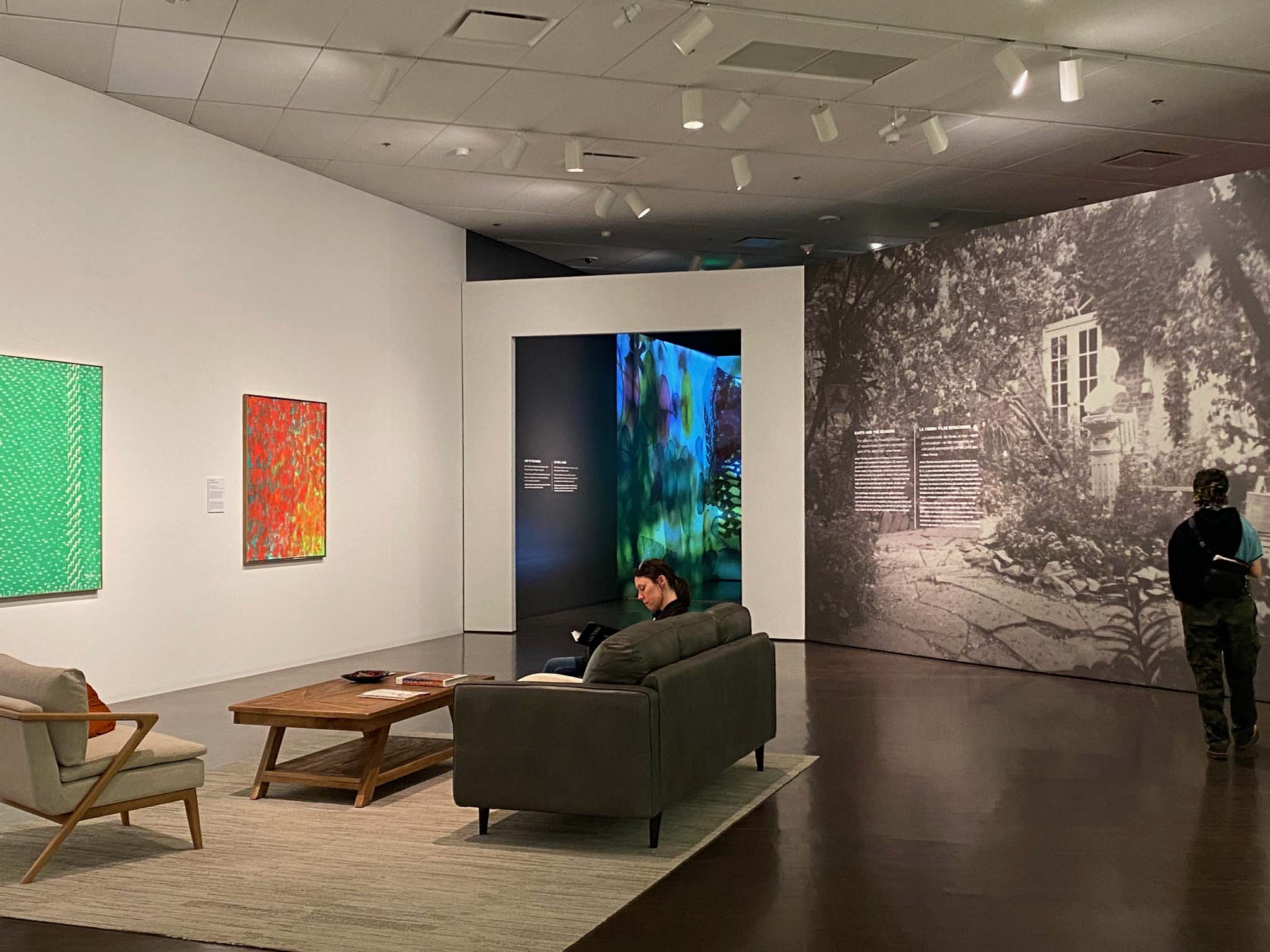
Denver has welcomed this mid-century modern painter with open arms, with visitors lounging in several living-room settings surrounded by abstractions from the Sixties and Seventies by a Washington, D.C. painter who born in the late 19th century but who lived to see a man land on the Moon.

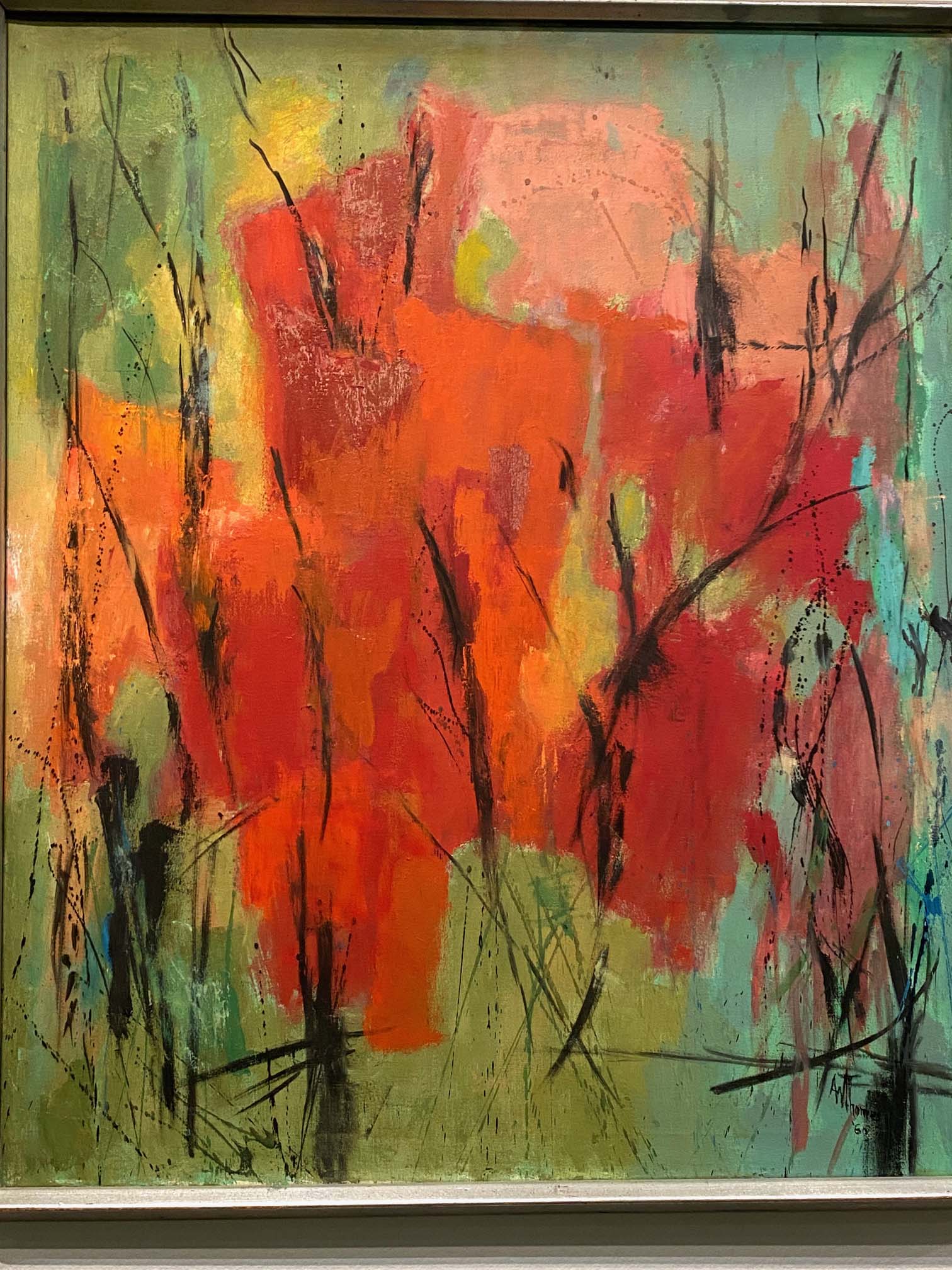
1960 Red Abstraction by Alma Thomas. Courtesy: Smithsonian American Art Museum.

Alma Thomas grew up in Georgia, and earned the first fine arts degree ever granted by Howard University in 1924.  After receiving a masters in education from Columbia, Alma spent the next 30 years teaching in Washington, D.C. public schools. 

Ida Jervis’s 1968 photo Alma Thomas working in her studio. Courtesy: Archives of American Art, Smithsonian Institution.

But she stayed close with her professors at Howard, who founded the Barnett Aden Gallery, one of first racially integrated and Black-owned art galleries in the United States.  Alma served as the gallery’s VP, which displayed a who’s who of contemporary African-American artists, like Elizabeth Catlett, Aaron Douglas, Jacob Lawrence, and Henry O. Tanner. 

By the early 1950s, Alma’s work was regularly shown in exhibitions at the gallery. When Alma finally retired from teaching in 1960 at age 69, she was finally able to paint full time. The Smithsonian’s exhibition features Alma’s work from this highly productive period.

Take a look at our favorites in our Flickr album.

The exhibition is centered around three subjects that inspired her – nature, the cosmos, and music. Her vivid color paintings welcome you to the exhibition but around the corner you see what really inspired her – a wall-sized photo of Alma’s beloved flower garden

Mid-century modern lounge in the Denver exhibition with paintings by Alma Thomas inspired by her garden

She loved the changing seasons, the patterns of gardens, and patterns observed by light flickering through the crepe myrtles in her garden or through the trees on her walks through DC’s endless greenways and parks.

1976 oil Fall Begins, suggesting rustling leaves. Courtesy: Smithsonian American Art Museum.
Detail of 1972 acrylic, Arboretum Presents White Dogwood. Courtesy: Smithsonian American Art Museum.

The exhibition also features an immersive environment where visitors can use colors and shapes from Alma’s paintings to splash supersized across the gallery walls.

Room in Denver where visitors use filters to create lightscapes on the gallery walls.
1976 acrylic, Grassy Melodic Chart. Courtesy: Smithsonian American Art Museum.

By the 1970s, Alma’s love of music and rhythm were reflected in her abstractions, although the titles of her canvases tell us that she saw expressive melodies in nature too.

Captivated by the promise of technology, Alma also reveled in the mysteries and rhythms of the planets, space, and those frontiers of exploration. She really felt that the Moon, planets, and stars represented the peace and harmony that were sometimes lacking on Earth.

Always searching for beauty in the world, continuing to paint, and contemplating a brighter future, Alma achieved unprecedented art-world recognition in 1972 at age 80 –a one-woman show at the Corcoran Gallery in Washington and in New York at the Whitney Museum of American Art.

Not bad for a gal who grew up in “horse and buggy days” in Georgia! Thank you to the Smithsonian for collecting Alma’s work and producing this joyful, colorful show.

1970 acrylic The Eclipse, based on the March 7, 1970 total solar eclipse. Courtesy: Smithsonian American Art Museum.
1973 acrylic Celestial Fantasy. Courtesy: Smithsonian American Art Museum.

Click here to read more in Denver’s exhibition guide and watch this short glimpse of the galleries below:

Listen to curator Rory Padeken discuss Alma Thomas’s life and work with artist Jordan Casteel, choreographer and dancer Cleo Parker Robinson, and floral artist Breigh Jones-Coplin.