Master Printmaker Gene Kloss Sees Taos

Do you wish you could travel back to Taos in the Thirties and Forties to experience the quiet, small, out-of-the-way place that inspired so many artists? Take a walk through this two-site exhibition, Legacy in Line: The Art of Gene Kloss, on view through June 8, 2025 at the Harwood Museum of Art and through May 31 at the Couse-Sharp Historic Site just off the Taos Plaza.

Kloss, whose artistic style was honed in the 1920s and 1930s, is arguably one of New Mexico’s favorite artists.  Kloss specialized in printmaking, creating an immediately recognizable style – a landscape, village, or pueblo scene with dramatic contrasts (often at night). Look at some of our favorites in our Flickr album

Kloss 1934 aquatint and drypoint Eve of the Green Corn Ceremony –Domingo Pueblo, which received a gold medal from the Pennsylvania Academy of Fine Arts. Courtesy: Couse Sharp Historic Site

Kloss fell in love with plrintmaking as an undergraduate art student at UC-Berkeley. She was captivated by the printmaking revival that swept Paris and Britain in the mid-19th century. Artists owned their own presses and produced affordable prints of landscapes and small towns that encouraged everyone to collect art.
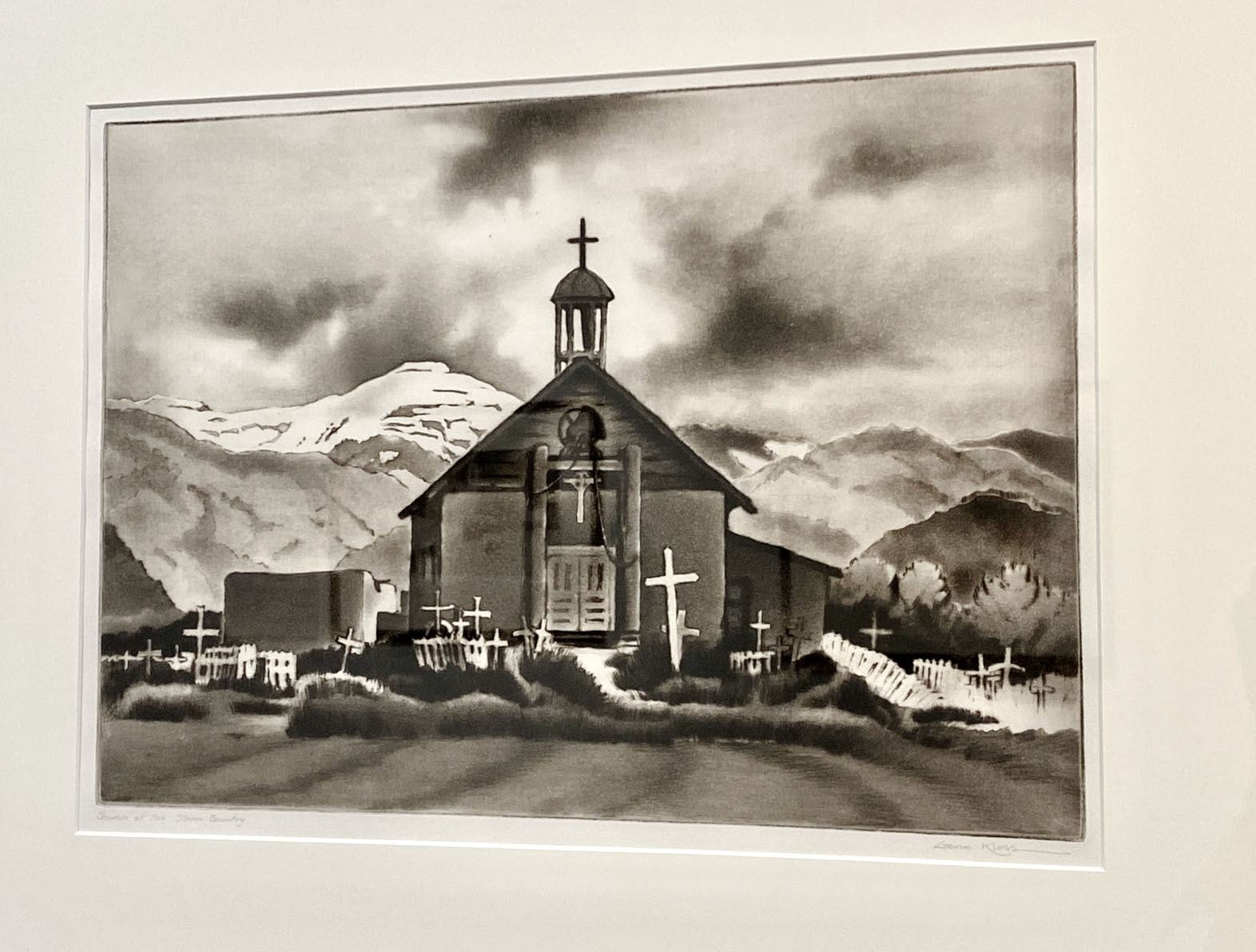
Kloss 1941 drypoint Church of the Storm Country. Courtesy: Taos Municipal Schools.

A lifelong resident of the Bay Area, she first came to Taos on a car-camping honeymoon in 1925 with her writer-composer husband. She fell in love with the landscape, the culture, and the pueblos of Northern New Mexico. Did I mention she brought along her 60-lb. portable printing press?

Kloss 1934 drypoint All Saints Day Mass – Taos. Courtesy: Taos Municipal Schools.

Kloss was prolific, and the next year showed over 100 of her paintings and prints – including Taos subjects – at a wildly successful solo show in Berkeley. She and her husband were hooked on the inspiration Taos provided, and soon rented a getaway home, where they would spend two to four months per year. 

Kloss 1934 drypoint Acoma. Courtesy: Taos Municipal Schools.

Kloss developed her images from quick sketches and from memory, bringing the drama as she precisely worked her impressions into the copper.

In the Thirties, Kloss did artwork under several New Deal programs and produced a nine-part series on New Mexico that was gifted to public schools in the state.

As a master of intaglio, drypoint, and aquatint, she developed an innovative technique in which she painted acid directly into the ground with a brush or pencil that allowed her to create super-deep tones, gradations, and atmospheres in her prints.

Few others could create scenes like hers – dramatic nighttime scenes at the pueblos, tiny pilgrims making their way at dusk among the mountains, or aerial views of old Spanish valleys.

Over her lifetime, Kloss would create over 18,000 signed prints, show in New York and Europe, and be honored with membership in the National Academy of Design. She always pulled her own prints in the studio, and kept on working through the Seventies, until the quality of commercial copper and ink that she had always used became unavailable.

Kloss 1950 drypoint and aquatint Desert Drama. Courtesy: Harwood Museum (Purcell gift)

The Couse-Sharp Historic Site (where the Taos Society of Artists was founded) and the Harwood Museum have mounted this fantastic show to honor a gift bestowed upon them by Joy and Frank Purcell, Taos residents and Kloss collectors that ultimately amassed over 130 of her works.

To see more of her work, watch this short New Mexico PBS documentary on Ms. Kloss with art historian David Witt, who talks about his friendship with her, her process, and unique interpretation of her Taos world:
Frankenthaler and Friends Put Action into Prints

An exhibition of dramatic, action-filled prints by legendary Abstract Expressionists shows how experts at the new printmaking workshops during the Sixties and Seventies gave art-world mavericks the tools to take their ideas to new dimensions.

Push & Pull: The Prints of Helen Frankenthaler and Her Contemporarieson view at the University of New Mexico Art Museum through May 17, 2025, is a must-see journey into collaboration and experimentation at mid-century.

UNM recently received a gift of 20 magnificent artworks from the Helen Frankenthaler Print Initiative.

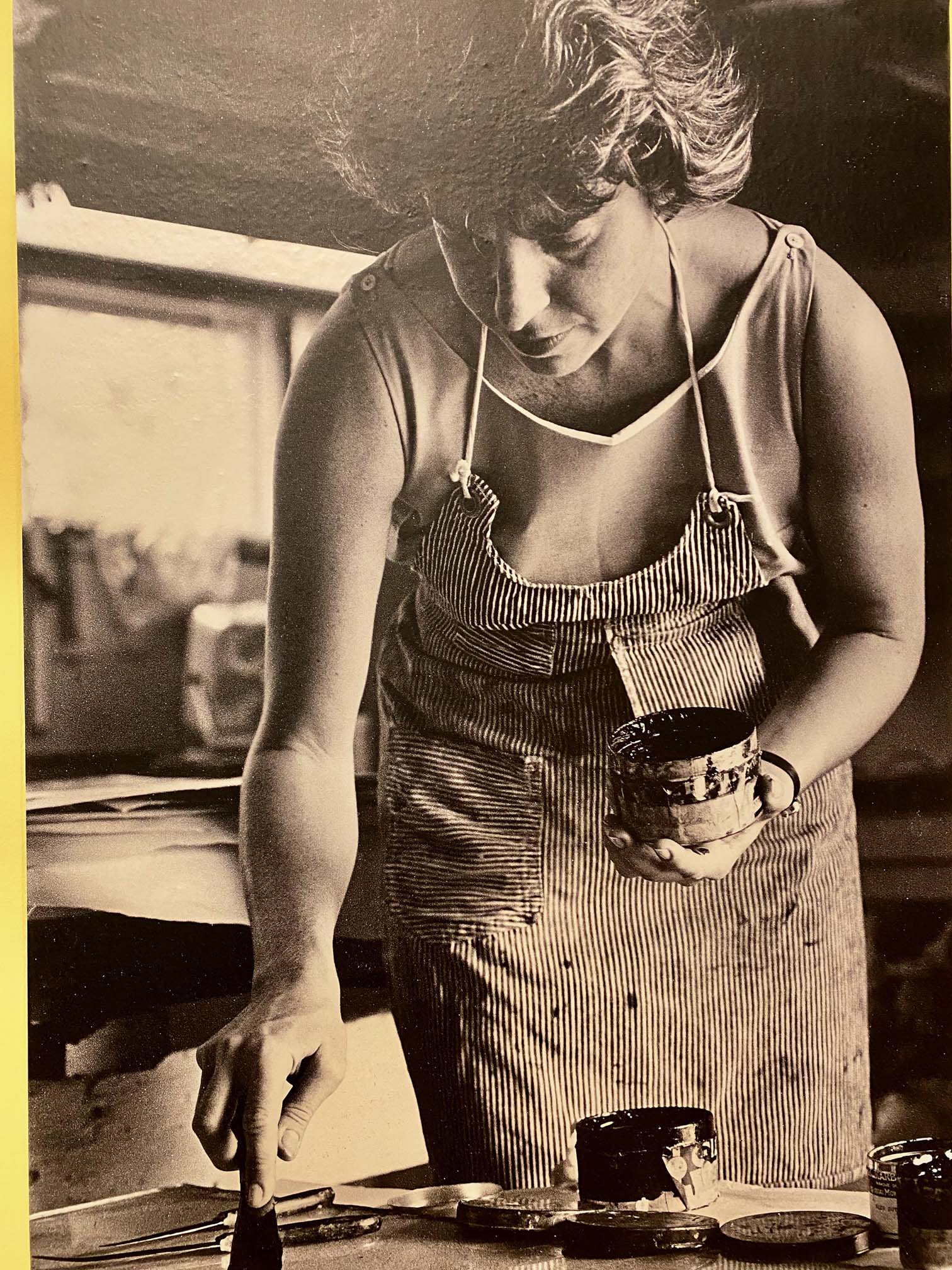
Hans Namuth’s 1964 photo of Frankenthaler working at ULAE in West Islip, NY. Courtesy: artist’s estate and University of Arizona’s Center for Creative Photography

The main gallery shows them alongside prints by Elaine de Kooning, telling the story of how these remarkable abstractionists collaborated with different workshops, used their distinctive styles to create portfolios, and formed decades-long bonds with master printers.

Helen Frankenthaler grew up and studied in the ever-evolving New York City art world. Her studies with Hans Hoffman – known for teaching abstractionists how to capitalize upon the “push pull” of color – and her technique of physically soaking and staining colors across canvases laid on her studio floor put her squarely at the intersection of the Abstract Expressionist and Color Field painting movements.

Frankenthaler had her first big solo painting exhibition in 1960, and began her printmaking experiments the following year. Some of her earliest works in the exhibition are silkscreens – some in the color-field direction, and some more gestural.

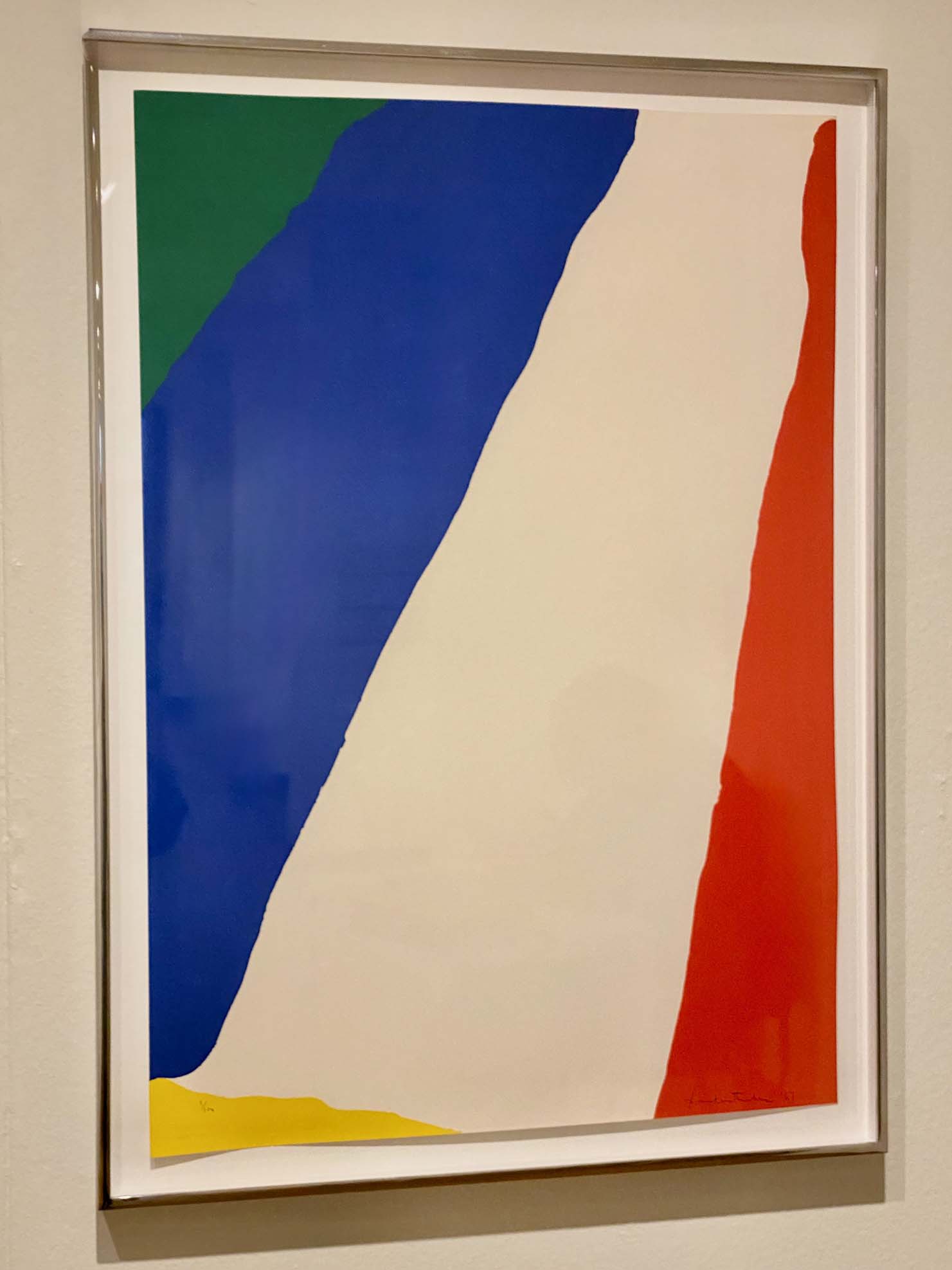
Frankenthaler’s 1967 untitled silkscreen (1/100); published by Chiron Press in New York; collaborating printer Patricia Yamashiro.
Frankenthaler’s 1970 silkscreen (artist’s proof) (19/24) from her What Red Lines Can Do portfolio, published by Multiples, Inc., NY; collaborating printers Sheila Marbain and Patricia Yamashiro.

Frankenthaler’s prints are grouped according to her work with various presses, such as Universal Limited Art Editions (ULAE), Tyler Graphics Ltd., and Tamarind Institute. Often with the guidance of print masters, she experimented to see how her “soak stain” could be layered and pressed multiple times across the lithography stone.

The exhibition curators display a series of proofs and experiments at Tyler Graphics to demonstrate the artist’s creative process with the expert printmaking team.

Frankenthaler’s 1978 lithograph Bronze Smoke (36/38) published by ULAE in Bayshore, NY; collaborating printers Thomas Cox and Bill Gordon.
Frankenthaler’s 1987 Sudden Snow lithograph proof (4/12); published by Tyler Graphics Ltd. (Mount Kisco, NY); collaborating printers Roger Campbell, Lee Funderburt, Michael Herstand, and Kenneth Tyler.

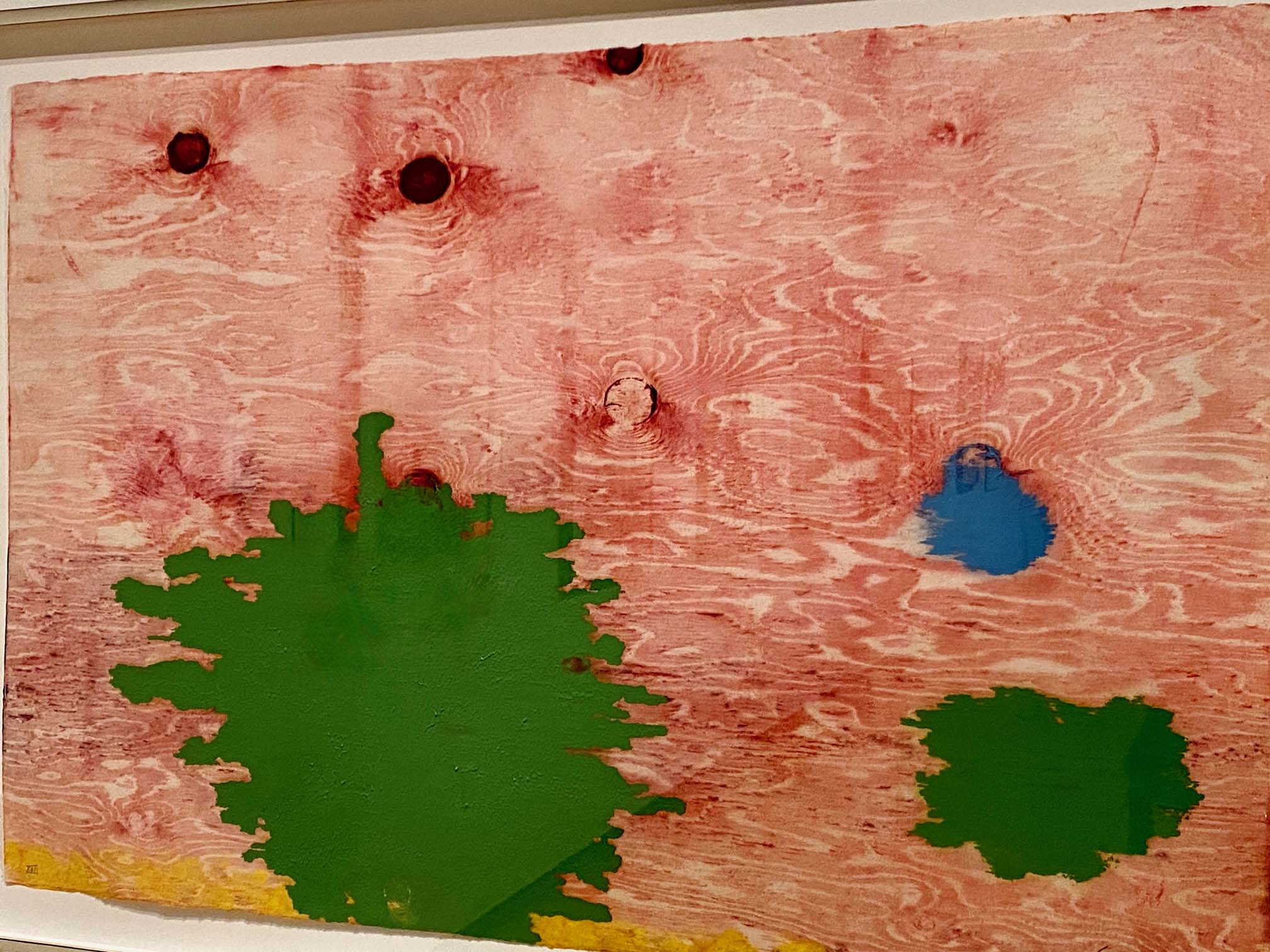
Later experiments show off Frankenthaler’s experimentation with woodcuts and monoprints. Here, she inked a woodblock and ran it multiple times to produce a “ghost print” of the wood, then applied bright red over the wood knots and added bright blobs of floating colors atop the natural backdrop.

Helen Frankenthaler’s 1991 Monotype XVII, published by Garner Tullis, NY; collaborating printers Emanuele Cacciatore, Benjamin Gervis, and Garner Tullis.

The exhibition also showcases two dramatic print series by action painter Elaine de Kooning made at the Tamarind Institute. Check out Elaine’s wild lithographs of bulls.

Elaine de Kooning’s 1973 lithograph Taurus XI published by Tamarind Institute in Albuquerque; collaboraring printers John Sommers and Ben Q. Adams. Courtesy: Tamarind Archive.

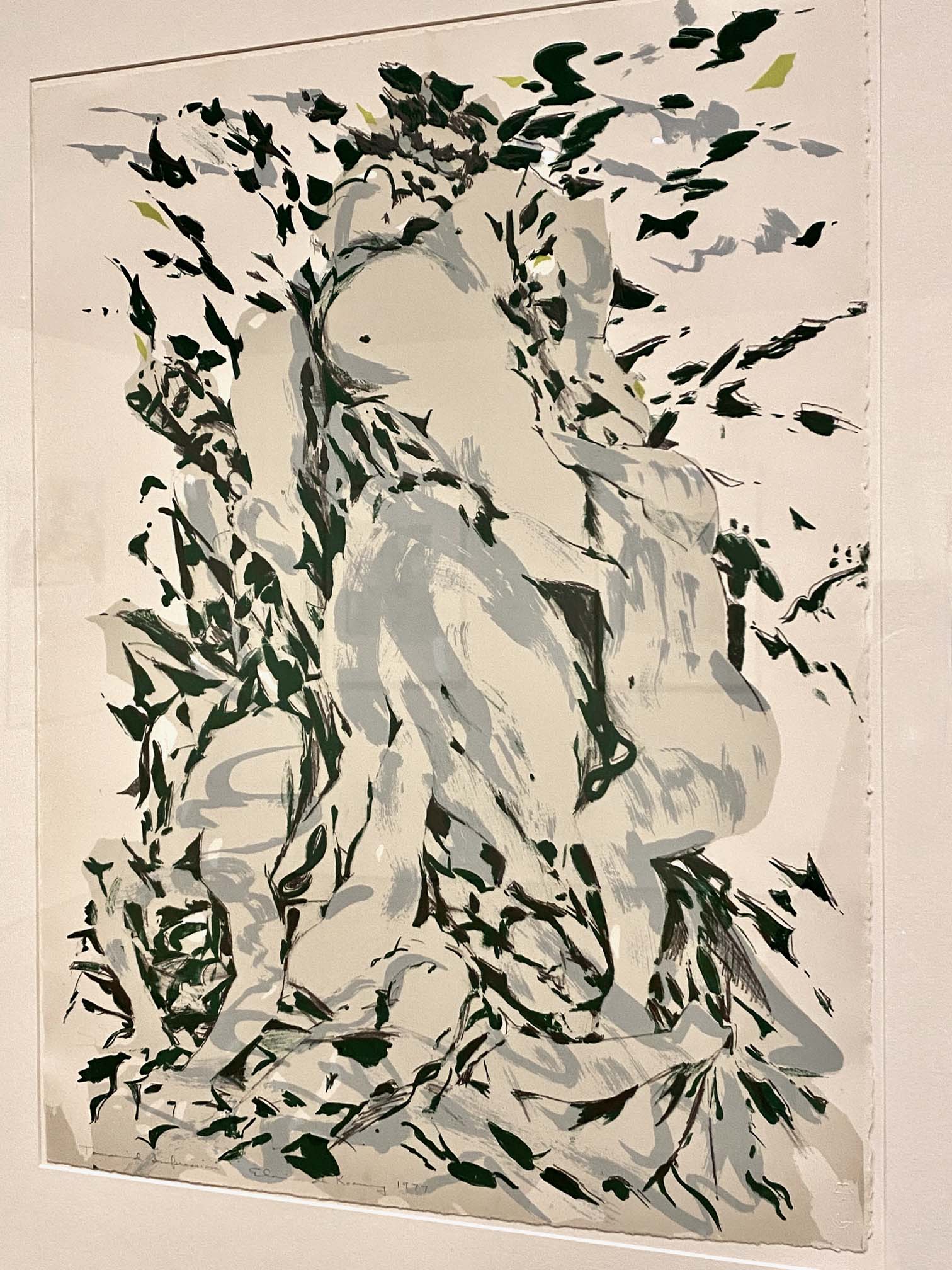
The curators also showcase Elaine’s multiverse interpretation of a famous Parisian sculpture in the Jardin de Luxembourg. The series mounted across the long wall gives gallery goers a close-up look at the intricate collaboration between Tamarind’s workshop masters and a midcentury mark maker.

The exhibition also includes prints from plenty of other mid-century abstractionists from the UNM collection – Motherwell, Diebenkorn, and Lewitt – as well as prints by current UNM students who were asked to create art inspired by Frankenthaler and company.

Take a look at all of these action-packed prints in our Flickr album.

Elaine de Kooning’s 1977 lithograph Jardin de Luxembourg II; published by Tamarind Institute; collaborating printers John Sommers and Marlys Dietrick. Courtesy: Tamarind Archive Collection.
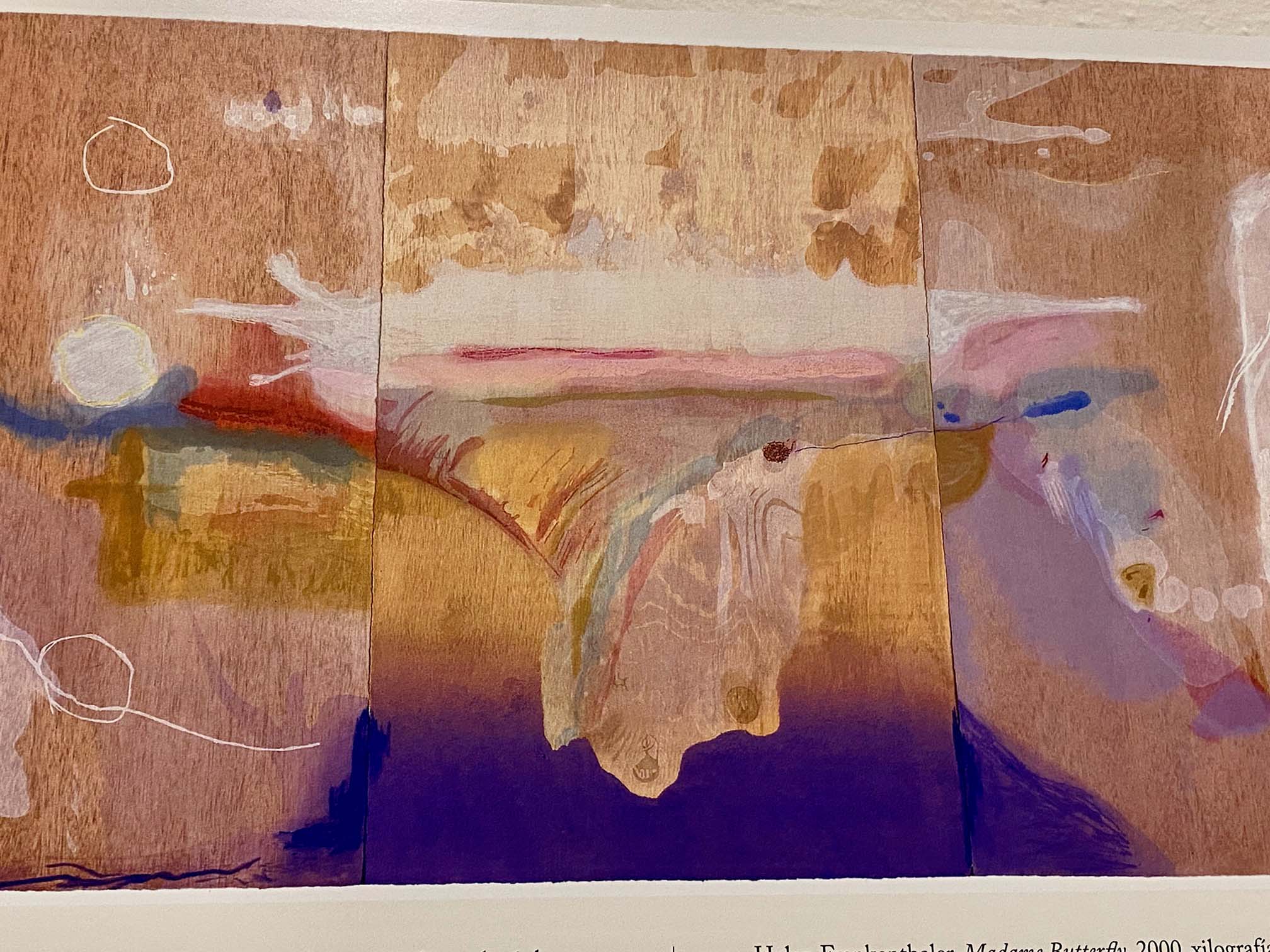
Photo of Frankenthaler’s 2000 woodcut Madame Butterfly made from 46 woodblocks; published by Tyler Graphics Ltd. Courtesy: Canberra’s National Gallery of Art.
Edward Olecksak’s 1972 photo of Helen Frankenthaler and Bill Goldston working on Venice II at ULAE in West Islip, New York. Courtesy: Frankenthaler Foundation Archives

National Gallery Celebrates 50 Contemporary Native Artists

If you want to take a trip across American land with 50 living Native artists, there’s still time to catch the ground-breaking exhibition, The Land Carries Our Ancestors: Contemporary Art by Native Americans, at Connecticut’s New Britain Museum of American Art through September 15, 2024.

The National Gallery of Art in Washington, D.C. asked Jaune Quick-to-See Smith (Citizen of the Confederated Salish and Kootenai Nation) to survey the United States and create an exhibition reflecting the diversity of the living Native American artists.

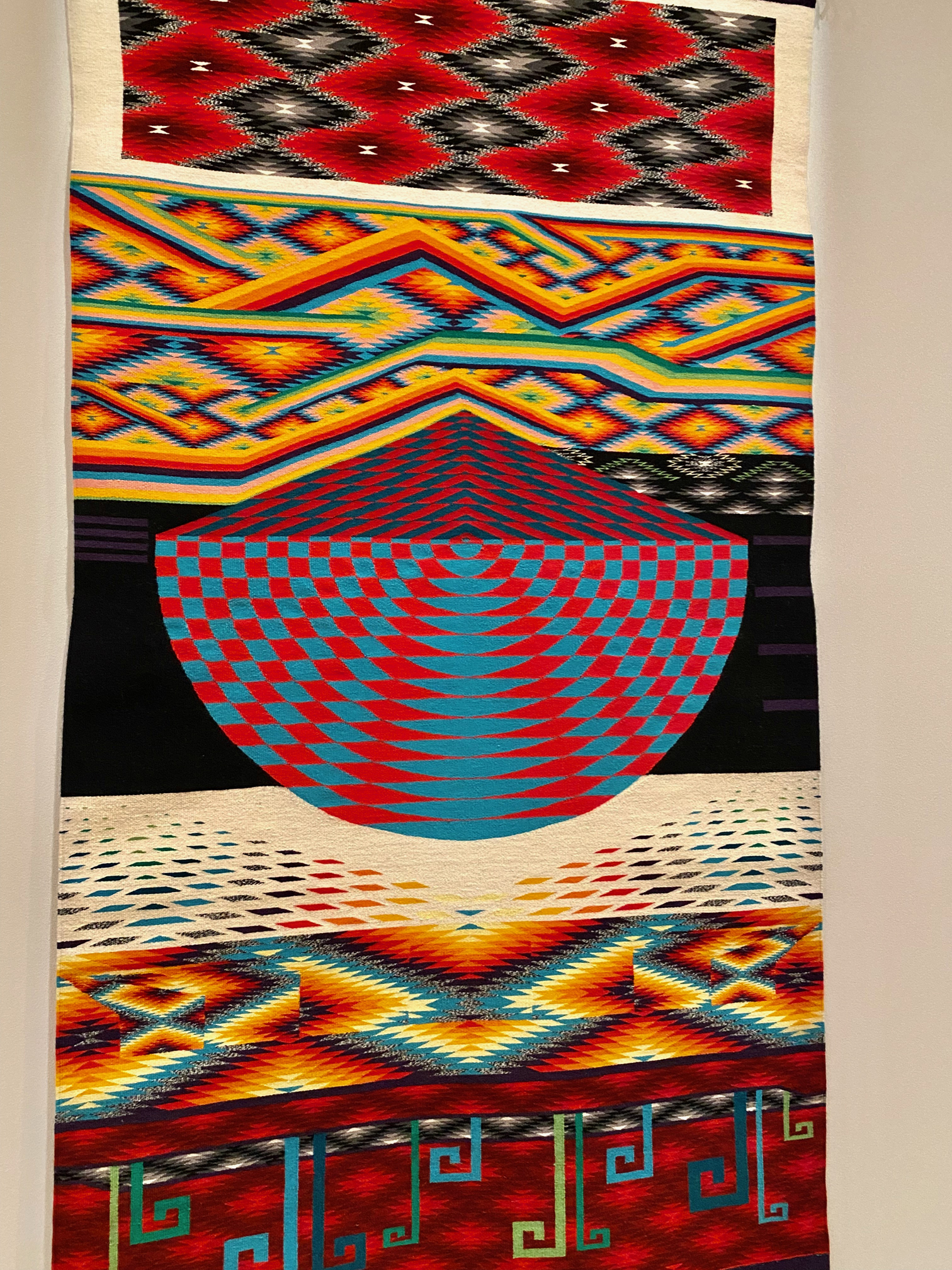
2014 wool weaving World Traveler by Melissa Cody (Navajo). Courtesy: Stark Museum of Art.

Smith, whose own artistic achievement was honored most recently in a three-museum retrospective in 2023-2024, became the first artist invited to curate a show at the National Gallery.

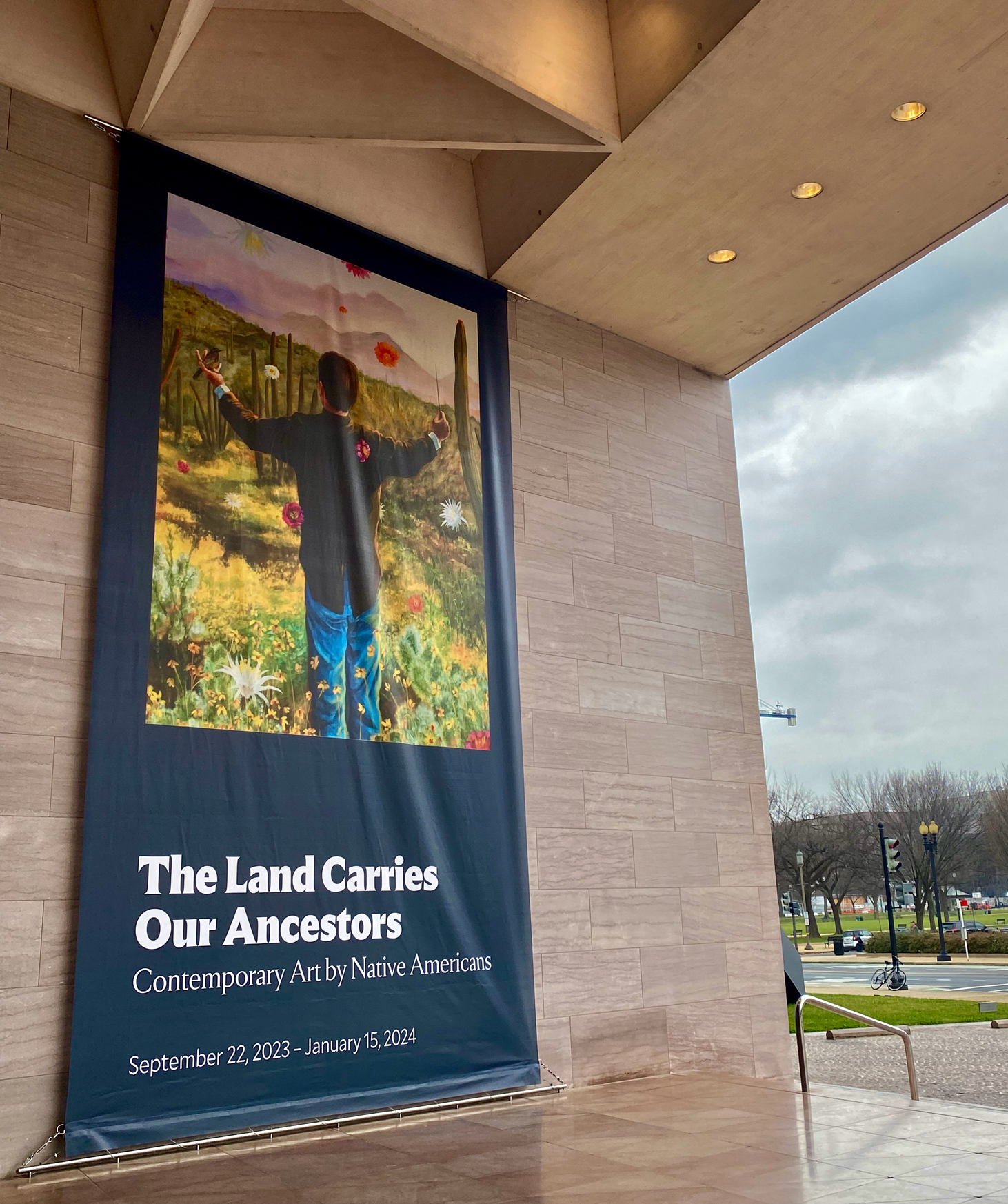
Entrance banner features Orchestrating a Blooming Desert by Steven Yazzie (Diné/Laguna Pueblo).

Smith has always done whatever possible to increase the visibilty of Native artists in the contemporary art world. For this exhibition, she chose 50 intergenerational artists from diverse regions, cultures, and artistic practices. Look at our Flickr album of the National Gallery installation to see some of our favorites.

All of the works reflect the artists’ deep connection to the land, especially Orchestrating a Blooming Desert by Steven Yazzie (Diné/Laguna Pueblo), a painting that reflects one man’s joyful encounter with a lush landscape.

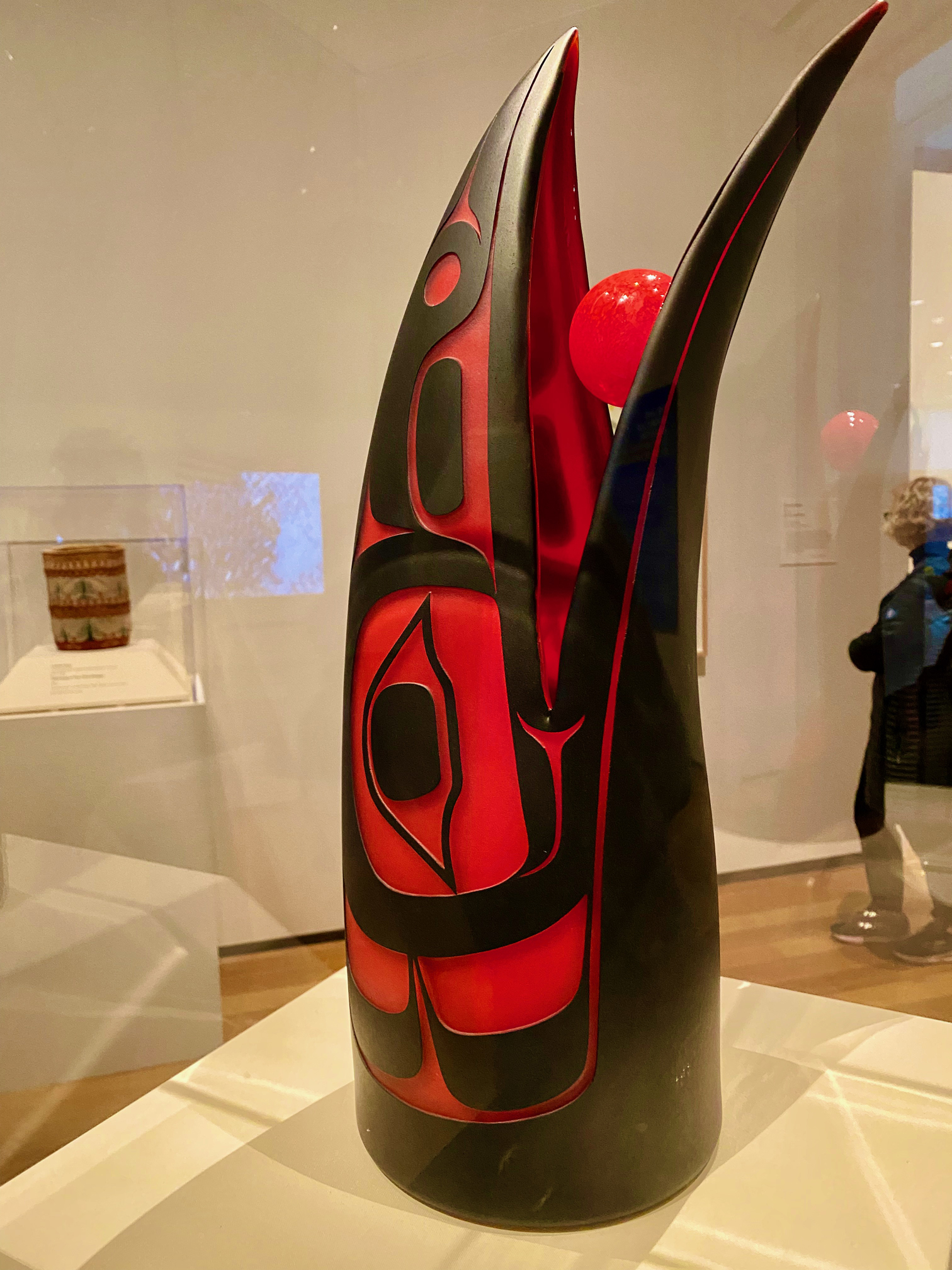
Some works depict a tribe’s link to the natural world through origin stories. Visitors are mesmerized by Preston Singletary’s exquisite sculpture of Tlingit creation-myth legend, Raven stealing the Sun. It’s glorious to admire this dramatic icon fully realized in a distinctly nontraditional medium – blown and sand-carved glass.

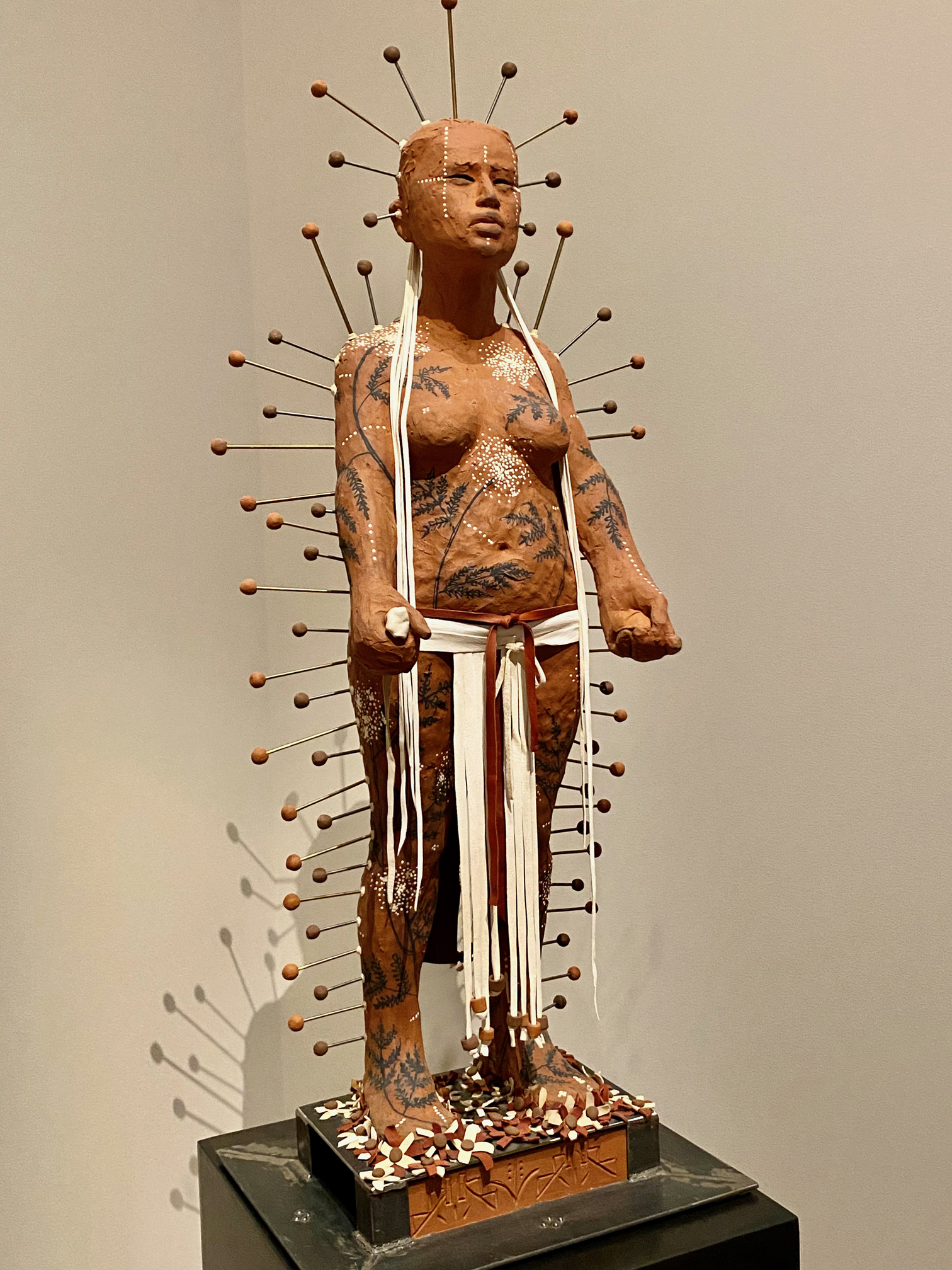
Experiencing the large, spiritual earth-colored ceramic figure by Rose B. Simpson (Santa Clara Pueblo) harkens back to eras when people had a more integral connection to the earth. Simpson calls her figure Tonantzin, an Aztec name for earth mothers, corn mothers, and even the Virgin of Guadalupe.

2017 blown and sand-carved glass Raven Steals the Sun by Preston Singletary (Tlingit). Courtesy: private collector.
2021 ceramic, steel, leather, and brass Tonantzin by Rose B. Simpson (Santa Clara Pueblo). Courtesy: Tia Collection.

Smith has chosen to hang many smaller two-dimensional works across a long wall in a checkerboard to suggest that visitors reflect on the impact of 1887 Dawes Act upon Native lands – a law that cut Native territory into “checkerboard” lots to facilitate private ownership.

At the National Gallery, Jeffrey Gibson’s punching bag (all made of found materials) was hung nearby, reminding us of the delicate balance that has to be struck by simultaneously caring for and taking gifts from the earth.

Next to checkerboard wall, the 2020 beaded punching bag To Feel Myself Loved On the Earth by Jeffrey Gibson (Mississippi Band of Choctaw Indians/Cherokee Nation). Courtesy: Hirschhorn Museum.

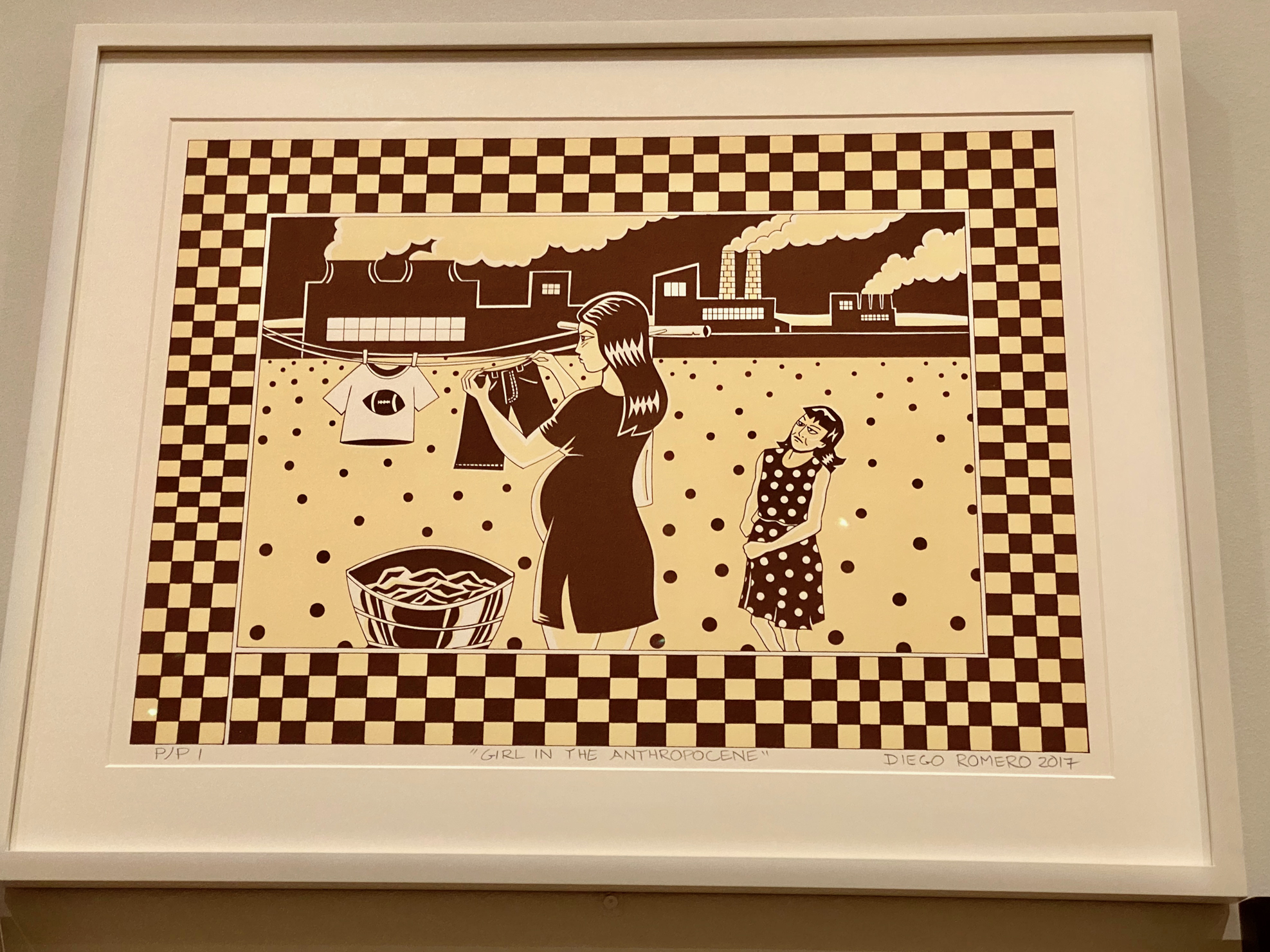
Some artists mix impressions of modern life with tribal lands, such as satiric works by Diego Romero (Cochiti Pueblo) and stylized symbols in a monoprint by Joe Fedderson (Colville Confederated Tribes).

2017 lithograph Girl in the Anthropocene by Diego Romero (Cochiti Pueblo). Private collection

In addition to sculptures, paintings, and photos, Smith has also included pieces made for fashion runways, live performances, and social protests.

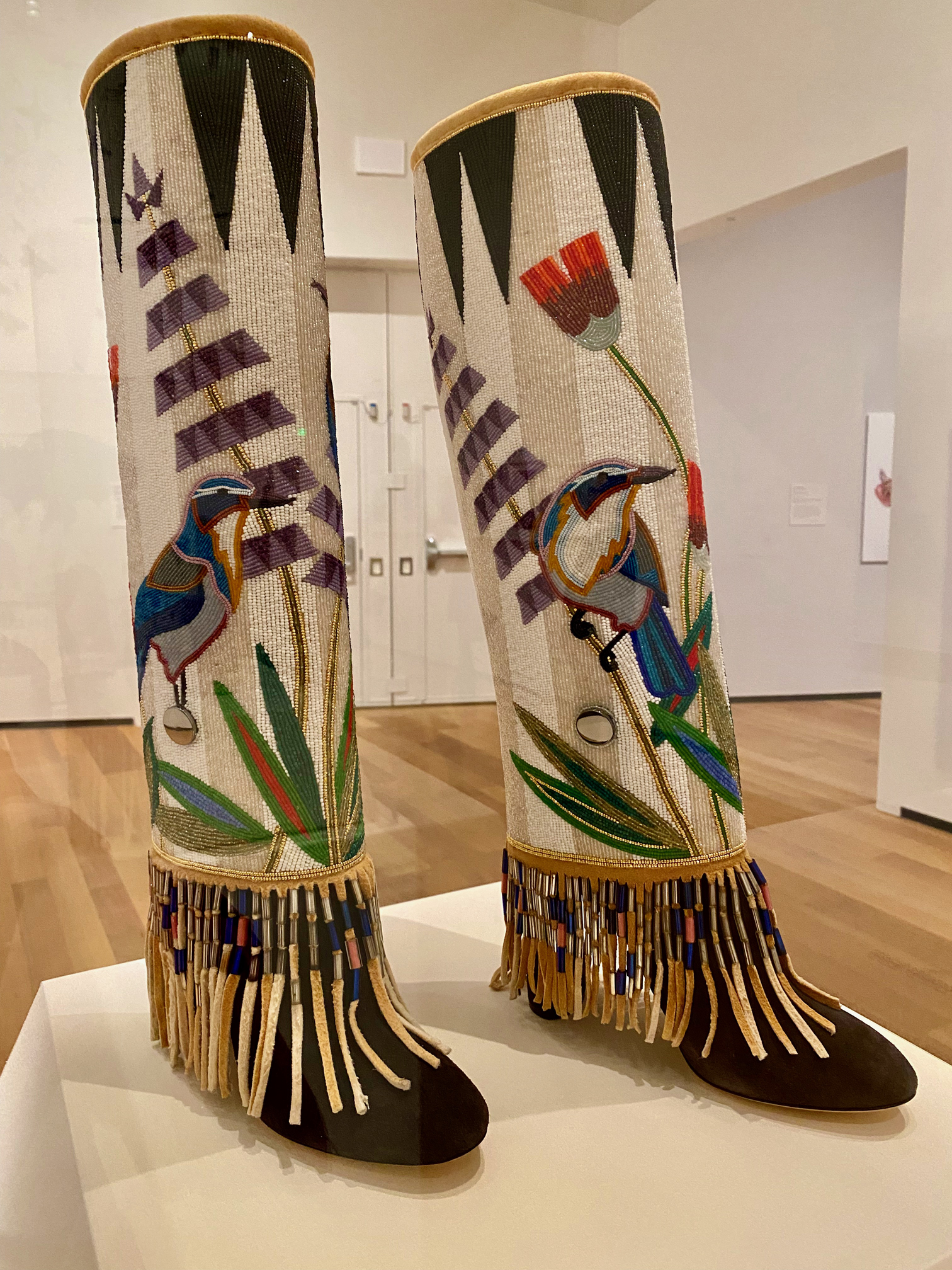
Fashion designer Jamie Okuma (La Jolla Band of Luiseno Indians) beaded her fringed fashion boots with a portrait of her family’s pet scrub jay.

Ten foot-long fiber seashell earrings designed for an interactive video and gallery performance by fiber and performance artist Eric-Paul Riege (Diné) are a reminder of the ancient trade networks that brought trade items from the ocean to the interior deserts.

2021 beaded and fringed Casedei boots by Jaime Okuma (La Jolla Band of Luiseno Indians). Courtesy: Dartmouth College’s Hood Museum
2020 mixed-fiber installation jaatloh4Ye’iitosoh [3-4] by Eric-Paul Riege (Diné). Courtesy: Tia Collection.

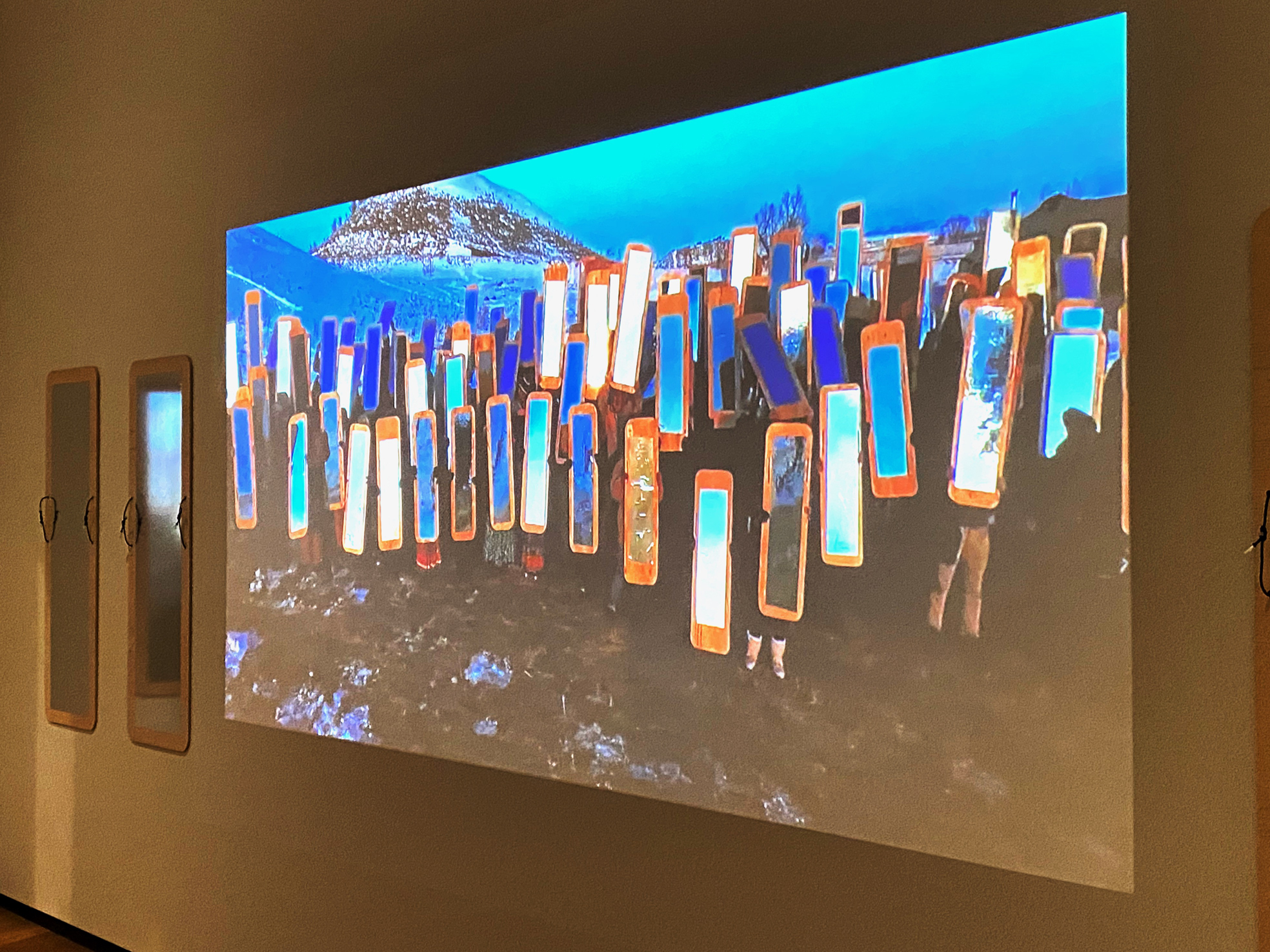
A wall of “mirror shields” were mounted by artist-activist Cannupa Hanska Luger (Mandan/Hidatsa/Arikara/Lakota), showing just a small sample of the 1,000 protective and reflective shields made by people to help water protectors during thre 2016 pipeline intervention at Standing Rock Sioux Tribe Reservation, Luger’s childhood home. Take a look at Luger’s instruction video here.

The shields served to protect the peaceful protesters from rubber bullets and water cannons, and reflected images of the security forces back to them. The crowd-sourced shields were also used in a social-action performance piece at Standing Rock.

2016 mirror shields and video for Mirror Shield Project – River (The Water Spirit) by Cannupa Hanska Luger (Mandan/Hidatsa/Arikara/Lakota). Courtesy: the artist, Garth Greenan Gallery.

Textiles and vinyl drawings also pack a punch in this show. Take a look at the dazzler woven by Melissa Cody (Diné), who draws inspiration from video gaming and the matriarchs of Navajo Nation. Watch her interview from her recent exhibition at MoMA PS1.

Here, John Hitchcock explains how his room-sized drawing, Impact vs. Influence, incorporates his influences – nature, family, Native beadwork, and the next-door military base:

Take a look the National Gallery’s trailer and meet the 50 contemporary artists whose work and relationship to the land is celebrated in the show:

Transgressive Photography Shown in Santa Fe

Want to meet some people who enjoy breaking the rules?  You’ll meet plenty of mavericks who challenged the norm in Transgressions and Amplifications: Mixed-Media Photography of the 1960s and 1970s, an exhibition on view at the New Mexico Museum of Art in Santa Fe through January 8, 2023.

Edward Weston and Ansel Adams set a high bar for classic, modernist photography, but the generation of image-makers who followed were driven to experiment, shake things up, and see where it all led. 

Detail of 1983 Joyce Niemanas Grandfather Polaroid collage
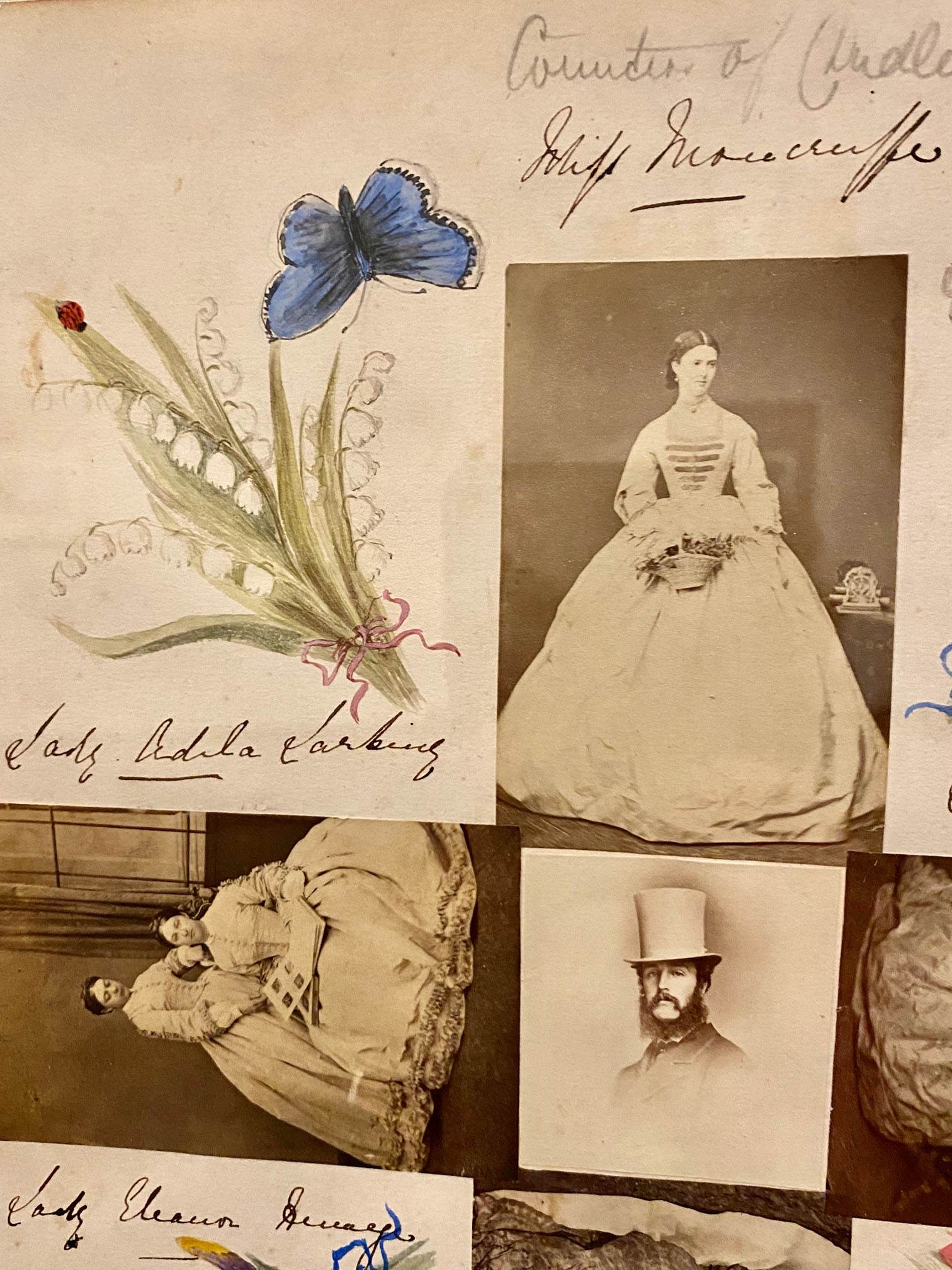
Detail of 1864 Lady Filmer’s album mixing watercolor and albumen print collage. Courtesy: UNM Art Collection.

Why not go back a hundred years and make new images with historic photo techniques (sun prints, anyone)? Has anyone tried embroidering photos? What about mashing up photo-silkscreen prints with readymade collages decorated with rubber stamps?

Can Polaroids be turned into fine art? Or making a sculpture or kitch card deck out of photos?  What about dreamscapes? What about creatively repurposing magazine photos or TV images?

A stroll through the gallery shows a broad range of creative 20th-century minds at work, with at least one case showcasing some 19th century pioneers.

Meet Lady Mary Georgina Filmer, a London society gal who mastered the art of photocollage as early as the 1860s. A page from one of her albums shows how she merged topsy-turvey photo images, botanical watercolors, and text to tell stories her own way – a true stay-at-home pioneer!

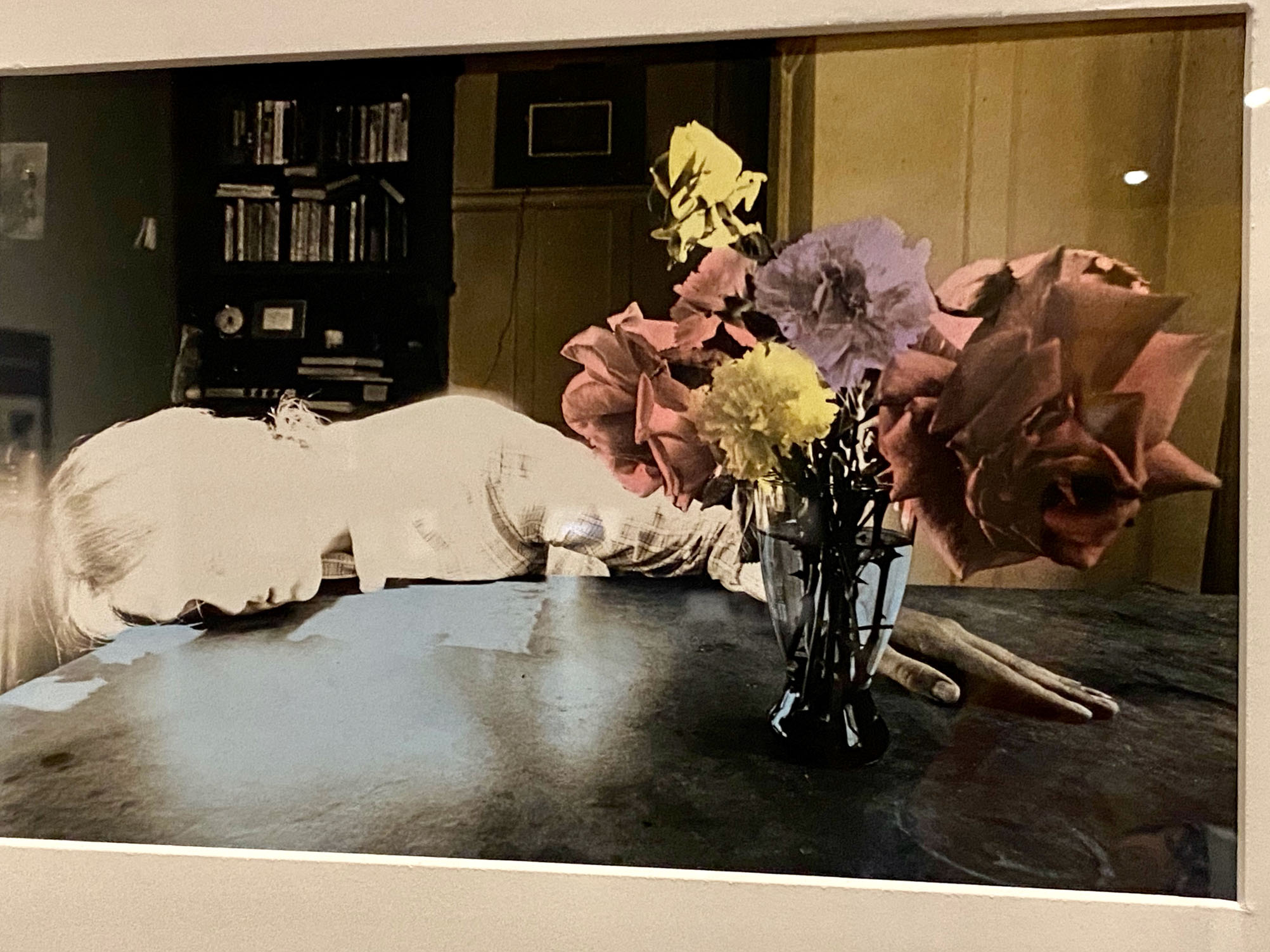
Lady Filmer’s album looks out on dozens of other Americans who went back into the time machine to toy with making albumen prints, stereographs, hand-colored photos, drawing, and cyanotypes. Example: the arresting 1970s hand-colored gelatin silver print by Karen Truax where she ghosts-out her central figure.

1970-1974 gelatin silver print Supernal by Karen Truax, featuring a bleached-out central figure and hand-colored domestic interior

For anyone curious about these old-timey methods, the curators have provided visitors with a place to relax, leaf through books about it, and watch YouTube videos on the gallery iPad.

Another gallery features artists who took photography mixed-media to the next level, like Rauchenburg’s litho that appropriates Bonnie and Clyde movie stills and an over-the-top abstraction by Thomas Barrow that combines gelatin silver print technique with a crazy-quilt of stencils, spray paint, and objects. So totally Eighties!

Detail of Thomas Barrow’s 1980 gelatin silver print Discrete Multivariate Analysis, mixing lights, objects, stencils, and spray paint

The third gallery displays lots of fool-the-eye and 3-D delights. What’s the most fun? Jerry McMillan’s photo-offset inside a “paper bag?” Betty Han’s Soft Daguerreotype of Xeroxed weeds on fabric? Probably Robert Heinecken’s T.V. Dinner/Shrimp. Hard to choose.

Robert Heinecken’s 1971 Van Dyke print T.V. Dinner/Shrimp, #1C. Courtesy: University of Arizona’s Center for Creative Photography.

Other sections of the exhibition show how 1970s photographers made images in which photography itself was the subject and told highly personal stories.

Take a look at some of our favorites in our Flickr album.

Artist book: Keith Smith’s 1972 gelatin silver print Book 32 – a 3D take on photography.

And don’t forget the coda that features a dramatic images by more recent photographers that make provocative social statements and represent voices that were not fully represented within the university system during the 1960s and 1970s.

Lorna Simpson’s 1991 Black, a dye diffusion transfer print with engraved plastic plaques

Artists Call to Action for Central America

In the early 1980s, socially minded artists living downtown in New York couldn’t handle the news coming out of Central America and did something about it. The United States government was intervening in the affairs of Nicaragua, El Salvador, and Guatemala, and everyone was worried that the situation was going to devolve into another Vietnam.

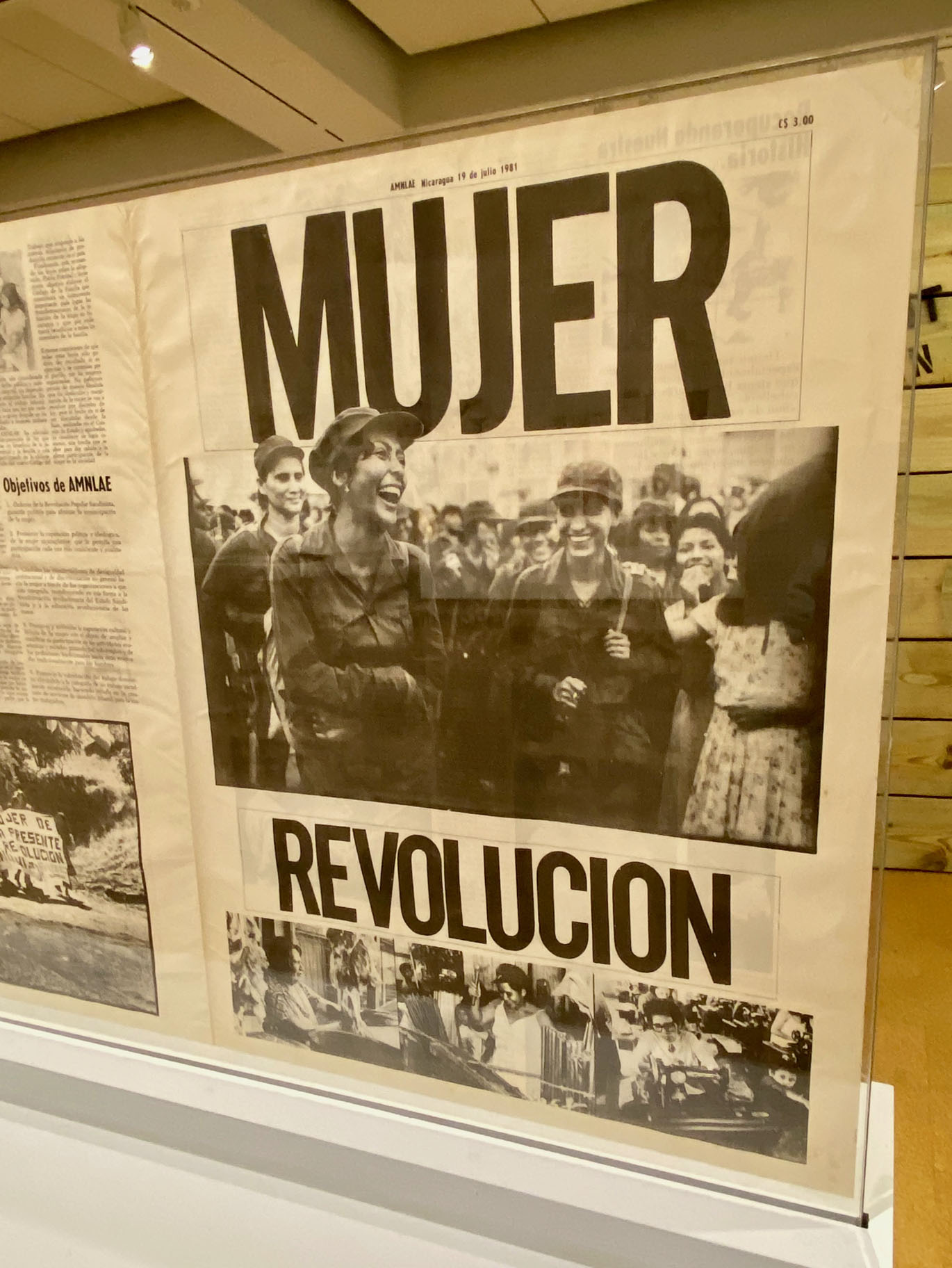
This is just one part of the story told by the dynamic, timely, informative exhibition, Art for the Future: Artists Call and Central American Solidarities, on view at the University of New Mexico Museum of Art in Albuquerque through December 3.

1981 pamphlet Mujer Revolución by Association of Nicaraguan Women. Private collection
1983 Print of Contra (after a drawing in Rock Comics, 1979) by Jerry Kearns, depicting communist fears stoked by the US government

In 1982, a group of New York artists collaborated with Latin American artists to create a show with contemporary art and cultural artifacts to draw attention to the escalating crises in Latin America. By 1984, organizers launched a national call to artists to raise money and awareness of what was happening.

Artists responded with performances, music concerts, films, poetry readings, and exhibition. In New York alone, over 1,100 artists participated in over 30 exhibitions.

Nationally, artists in 27 cities organized chapters and events and tried to build alliances in Latin America.

Videos, photographs, sculptures, paintings, and ephermera pulled from archives (like posters, buttons, mail art, and pamphlets) bring the story of artist-activists to life – their concerns about US government intervention, their efforts to organize artists across the United States, and their attempts to help artists living in oppressed Central American countries.

The Tufts University-organized show resurrects a largely forgotten story of artist activism, illuminates the tribulations of indigenous communities in Central America at the time, introduces us to contemporary works from artists inspired by their indigenous heritage, and gives us an idea of what’s happening in those countries now.

Two contributions to Solidarity Art by Mail project, a fast, cheap solution to boost Latin American and Caribbean participation in a 1984 New York exhibit at Judson Memorial Church. Private collection.

The three-floor show is packed with arresting images, works, and histories. The art work and documentation push and pull visitors between the international political crises of the 1980s and social-justice issues being addressed by artists today.

Take a look at the show on our Flickr site.

The installation features work by heavy hitters of the 1980s New York art scene – wall-size Vietnam-era work by Leon Golub, images documenting Ana Mendieta’s performance pieces, and Claes Oldenburg and Coosje van Bruggen’s sketches, maquettes, and exploding-banana image that branded the Artists Call Against US Intervention initiative.

The first-floor exhibition area includes Nancy Spero’s dramatic scroll-like drawing that calls attention to the oppression of Salvadorean women.

1984 Arts Magazine cover with Oldenburg’s image promoting Artists Call. Private collection

Downstairs, there’s another 1984 work that similarly unfurls the length of the gallery – an accordian-book project led by Sabra Moore that is a collaborative reconstruction of a rare 16th-century Mayan codex by 22 women. It’s the first time the codex has been displayed since 1984.

1984 “Reconstructed Codex,” a project organized by Sabra Moore with contributions from 22 diverse female Latin American and US artists. Courtesy: Barnard

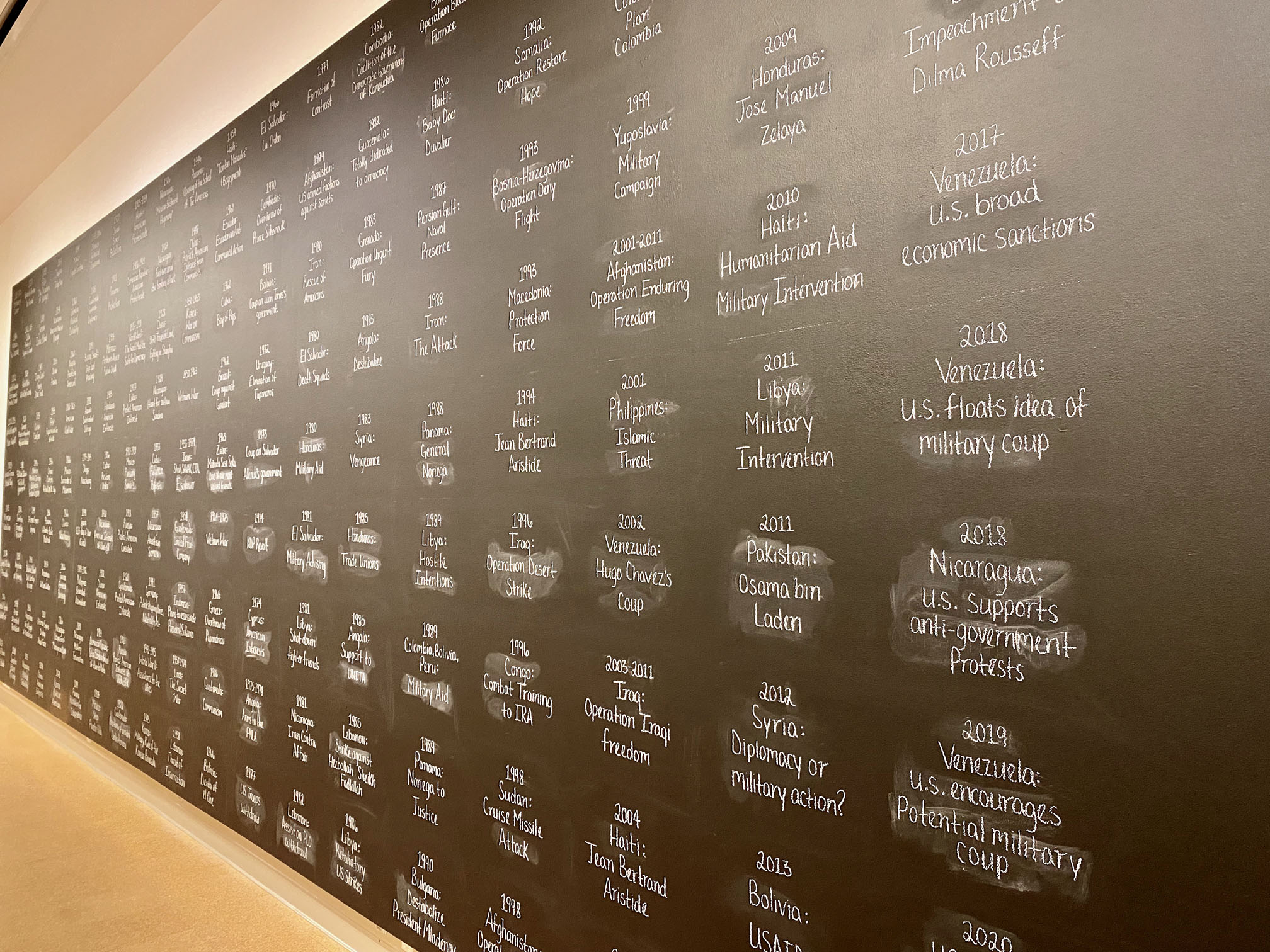
The third floor packs a punch, installing revolutionary images and publications around the infamous (and censored) Hans Haacke piece that questions the aftermath of the 1983 US invasion of Grenada.  Across the room, visitors pour over Carlos Motta’s 2005 wall-sized chalkboard installation Brief History of US Interventions in Latin America since 1946. 

Although the 1980 artist-activists did not achieve all of their utopian goals, the contemporary selections show that social consciousness, pride in indigenous heritage, and artistic futures are still alive – including a beautiful feathered immigrant history dome by Batriz Cortez, stitched by a team of immigrant collaborators.

2021 sculpture 1984: Space-Time Capsule by Salvadorian artist Batriz Cortez and immigrant collaborators – a shelter for immigrant histories.

Learn more about how the curator Erina Duganne and her collaborator Abigail Satinsky created this remarkable show:

Art for the Future will be on display at Chicago’s DePaul Art Museum from March to August 2023.

Carlos Motta’s 2005 detailed chalkboard installation Brief History of US Interventions in Latin America since 1946. Courtesy: the artist