Andre Leon Talley and Darren Walker at MAD on Tuesday
Nearly all of this week’s virtual museum events in New York are packed into Tuesday, Thursday, and Friday to make way for Martin Luther King’s birthday and the inauguration. So, check the daily listings on our virtual events page and dive into interesting sessions on African-American innovators and artists, art with a conscience, and flat-out fun.
1969 anti-Nixon poster from the Poster House archive
On Tuesday (January 19), it will be hard to choose: At 5pm, you can join MAD Museum at 5pm to hear a conversation on equity and design between author and style guru Andre Leon Talley and Ford Foundation president Darren Walker.
At 5:30pm, you can join Poster House and NY Adventure Club for Democracy on Paperto review political posters from the Sixties and Seventies from the museum archives.
At 6pm, New-York Historical Society hosts an in-depth look at Harriet Tubman’s life with biographer Erica Armstrong Dunbar, and the Whitney offers a program on art and social change, illustrated with works from its collection.
Book discussion on Tuesday at the Schomburg Center
At 6:30pm, join author Catherine E. McKinley at NYPL’s Schomburg Center for Research in Black Culture to see and hear about 100 years of African women’s style and looks, as featured in The African Lookbook.
At 8pm, join the Museum of the City of New York for a special trivia contest with the MCNY curators.
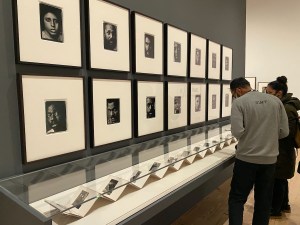
On Thursday (January 21), several programs begin at noon – a lunch hour session at the Staten Island Museum on the work of famed social realist artist Raphael Soyer; a tour of the Georgia O’Keeffe Museum in Santa Fe, courtesy of the Newark Museum of Art; and a tour of the Whitney’s amazing photography exhibition, Working Together: The Photographers of the Kamoinge Workshop.
Take a tour of the Whitney’s Kamoinge Workshop show on Thursday
At 2pm, meet the New York Transit museum for Underground Heroes – a look at how transit was portrayed in satirical cartoons, comic strips, and comic books.
At 6pm, join the American Folk Art Museum for a fun “drink and draw” session on New York landmarks.
There’s a lot more, so check our complete schedule. Most of the events are free, but it’s always nice to add a thank-you donation.
Museum Updates
We joined the marathon on-line session with Neil deGrasse Tyson this week to hear his year-in-review on astronomical and planetary science. The AMNH chose to produce this via Zoom, so everyone was able to see who was asking the fascinating questions and allowed Neil to have some fun interactions, just as he does at his sold-out events. Lots of geeky questions and answers for over two hours!
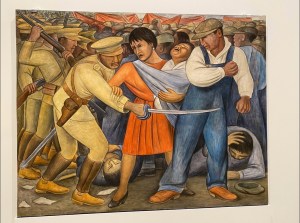
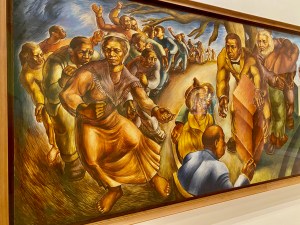
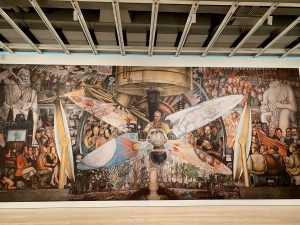
Diego Rivera’s 1931 fresco “The Uprising” in the Whitney’s Vida Americana: Mexican Muralists Remake American Art, 1925-1945
We also joined the weekend crowds at The Whitney to see the epic work again in Vida Americanaand see the beautiful photographs of the Kamoinge Workshop.
To end the week, we watched Andrew Bolton describe the work behind creating the Met’s unusually prescient fashion exhibition, About Time: Fashion and Duration. Check out the YouTube (already posted!) on what it took to design this unforgettable exhibition.
It’s a packed week with over 35 virtual events planned by New York City museums, featuring evenings with celebrities, conversations about society, the future of museums, and even an escape game. Find the daily listings for everything on our virtual events page.
Scandals recounted in the Tenement Museum’s Tuesday YouTube Live book talk
Tomorrow afternoon (January 12) at 6:30pm, the Fraunces Tavern Museum again collaborates with the Keeler Tavern Museum & History Center to explore the role apples played in food, drink, and the economy of colonial and revolutionary America in the continuing “Tavern Tastings” series.
At 7pm, the Tenement Museum hosts Tyler Anbinder, to talk about his book, Five Points: The 19th Century New York City Neighborhood that Invented Tap Dance, Stole Elections, and Became the World’s Most Notorious Slum.
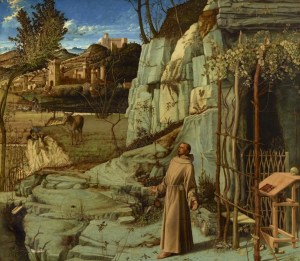
Mystical transformation with St. Francis and the Morgan Library on Wednesday
At 8pm, travel to the mountains of Arizona with the Newark Museum, whose planetarium experts host an evening of stargazing with Steward Observatory’s Mt. Lemmon SkyCenter.
On Wednesday (January 13) at 2pm, train fans can take a rare trip deep into the Transit Museum archives.
At 5pm, art fans can travel back to the 15th century with the Frick Collection to explore Bellini’s paintingSt. Francis in the Desert.
At 6:30pm, the Center for Brooklyn History (formerly Brooklyn Historical Society) hosts a discussion and book talk “The Authoritarian’s Playbook,” which links 20th century history with the events of the last week.
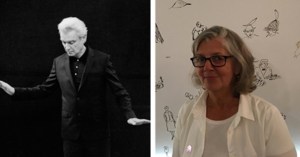
A talk with David Byrne and Maira Kalman about their new American Utopia book at the Museum of the City of New York
The “standing ovation” meet-up at Poster House featuring an array of posters of the world’s most celebrated theatrical performers and five cocktails to match.
MCNY hosts collaborators David Byrne and Maira Kalman on Wednesday. Photos: Jody Rogac, Cyndi Stivers
On Thursday (January 14) at noon, visit the Salman Toor painting exhibition at the Whitney, and at 3pm, see (and hear about) nature paintings in the collection of the New-York Historical Society.
There’s more on Friday and Saturday, so register for as many of the topics and events that you can fit into your schedule.
On Saturday at 2pm, be sure to join MAD to meet acclaimed architectural artist Brian Clarke, whose work is on display for the next month. Don’t pass up this chance to encounter a legend and hear about the entire scope of his incredible international body of work.
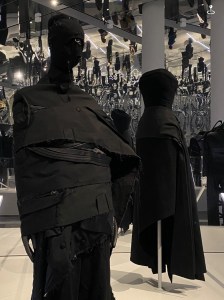
And a reminder for Sunday (January 17): at 1pm, take a tour of the incredible costume exhibition at the Metropolitan, About Time: Fashion and Duration. Even if you’re in New York, it’s not easy to snag a ticket to this show, so the virtual visit is the next best thing.
Most of the events are free, but it’s always nice to add a thank-you donation.
At MoMA, 1923 Gum department store lightbulb ad by Rodchenko and Mayakovsky’s ad agency
Museum Updates
We visited MoMA this past week for last looks at the Felix Feneon, textile, and Judd exhibitions. The galleries were full of visitors looking at the Parisian posters, African carvings, Seurat and Matisse paintings, Anni’s loom, and Judd’s super-slick sculptures.
Lots of Russian avant-garde, typography and collage running wild, and branding in the early 20th century that you’ve never seen quite like this. The extensive exhibition uses many works from the little-seen Berman collection, so you’ll be in for some surprises when you see it.
Although its virtual events are still happening, the Museum of the City of New York has announced a temporarily closure on Fifth Avenue for some emergency construction work.
Poster by Bonnie McLean for Fillmore Auditorium July 1967. Courtesy: Bahr Gallery
New York City museums are kicking off the first week of the New Year with a look at music and transportation history, far-away places (on Earth and beyond), and artist hang-outs. Find the daily listings for everything on our virtual events page.
Tomorrow afternoon (January 5) there are two fun historical programs: at 4pm, you can take one last look at the New-York Historical Society’s great rock-and-roll extravaganza (which ended yesterday!), Bill Graham and the Rock & Roll Revolution. If you did not get to see the exhibition, don’t miss this … psychedelic posters, the story of the Fillmore East and West, how Bill’s artists got booked for Woodstock, how The Last Waltz concert happened, and lots of photos of the legendary stars he promoted.
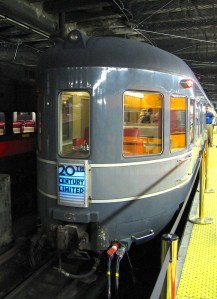
The streamlined 1947 lounge car for the 20th Century Limited.
At 5:30pm, you go back a little further in time. Join New York Transit Museum educator Joe Hartman to hear the incredible story of the legendary 20th Century Limited luxury train that ferried celebrities between New York’s Grand Central and Chicago’s LaSalle Street Station in high style for decades. Learn all about how red-carpet obsessions were born.
On Wednesday (January 6) at 7pm, hang out with a few hundred science geeks at the monthly SciCafe at the American Museum of Natural History. This month’s topic is Arctic Dragonflies with museum curator Jessica Ware, who will explain how these little guys keep from freezing. The Q&A is always fascinating with this group, so stick around for that part of the program, too!
Reproduction of Orozco’s 1930 Prometheus mural at The Whitney
On Thursday, (January 7), delve into great art: at Noon, the Whitney presents a look at the three Mexican muralists – Orozco, Rivera, and Siqueiros – whose passion and techniques inspired a generation of socially conscious artists of the Thirties and Forties. Find out more about their work in the United States and hear how Pollack, Benton, Noguchi, Lawrence, and many others learned at the feet of the masters in this talk about the blockbuster Vida Americanaexhibition.
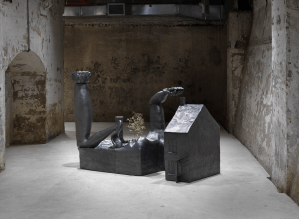
Jesse Wine, 11:10 am / 15.10.1983 / 75 Heath Lane / Chester / United Kingdom / CH3 5SY, 2020, installation view
At 7pm, take a trip to the Sculpture Center to meet Jesse Wine, see highlights of his solo show in Long Island City, and hear about his past work and inspirations.
Many more programs are on the schedule, so register for as many of the topics and events that you can fit into your schedule. Many of the events are free, but it’s always nice to add a thank-you donation.
Eliza Gordon, as she arrived in 1833 for her first job at a New Hampshire textile mill
When you enter the exhibition American Perspectives: Stories from the American Folk Art Museum Collection, on view at Lincoln Square through January 3, you may experience a nostalgic feeling seeing images of early Americans, spectacularly pieced quilts, and finely carved wooden relics of bygone eras.
But the purpose in bringing all of these small masterpieces together is to present the in-depth stories behind the creators and subjects, which adds a completely different, lively layer to the journey through the three galleries – tales of itinerant portrait painters, stagecoaches along America’s first turnpikes, independent women surviving husbands and adventures in the Wild West, and back-country singing masters making their own teaching tools from roots and berries.
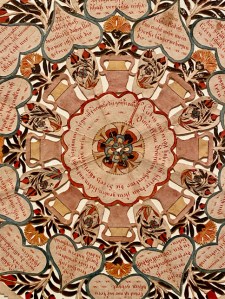
1790 love letter drawn by Christian Strenge, a former Hessian mercenary who settled in Pennsylvania
The stories make each work come alive, taking you back to the founding of America, looking at how people moved around in the Nation’s early years, made social-justice and political statements through their art, and used their artistic skills to transform their lives.
The first section of the show has several works with early German immigrants, many of whom came to America as Hessian mercenaries fighting for the British and stayed as citizens, using their artistic skills to pen intricate love letters and embellish important documents.
Portraits come alive as you see the fresh face of a 20-year-old mill worker (Eliza Gordon) who just arrived to take on her first independent job after leaving the family farm, portraits of new arrivals from the East Coast (the Bosworth siblings) who were starting new lives in up-and-coming Illinois, or a wife (Mrs. Bentley) committed to abolition who ran a famous spa in upstate New York in the early 1800s.
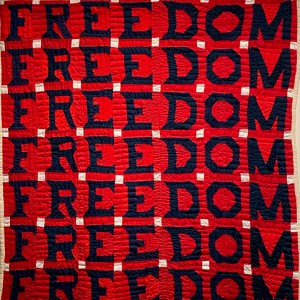
1983 Freedom quilt by Jessie B. Telfair of Parrott, Georgia
It’s not always easy to tell just from looking when works were made, and many come from the 20th century, often from a period later in the artist’s life – the drawing made by a Romanian immigrant (Ionel Talpazan) who used his art to work out his experience with a UFO as a child, the artist (Jessie B. Telfair) who made quilts in the Eighties to channel her feelings about being punished for registering to vote in Georgia in the Sixties, and a painter (Lorenzo Scott) whose portraits cast Atlanta beauties as Renaissance royalty whose style impressed him when he hung out at the Met in the years he lived in New York.
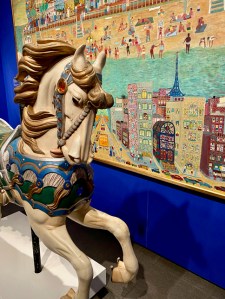
1918 Coney Island carousel horse by Charles Carmel and 1965 Workers’ Holiday by Ralph Fasanella
In the stories told about artworks involving far-away destinations, we learn that sea captain portraits were used as substitutes for husbands gone for years at a time, that many 18th-century students learned geography by copying intricate maps of exotic animal habitats, and that overhead rail was the magical mechanism that brought working-class people to the over-the-top fantasy destination of Coney Island.
The curators point out that the grand 1888 Grover Cleveland quilt was created by a woman who was a passionate political supporter. The quilt was her way of casting a vote for her favorite candidate, even though she did not yet have the right to vote. She even used the red-bandana campaign swag as the center!
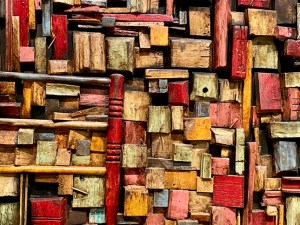
Next to this, there’s a masterful “quilt” made out of wood by New Orleans artist Jean-Marcel St. Jacques, an Afro-Creole artist living in Treme.
Detail of 2014 wood “quilt” by Katrina survivor Jean-Marcel St. Jacques, Mother Sister May Have Sat in That Chair When She Lived in This House Before Me
The spectacular wall-sized work is pieced together from pieces of furniture that he salvaged from his home following his neighborhood’s devastation by Hurricane Katrina. Some of it pre-dated his residency, so the assemblage contains layers and layers of local history.
The final gallery contains works by people who used art to transform their lives – one of the thousands of abstract drawings made each night in West Virginia by Eugene Andolsek to relieve his workplace stress, and a large tiger with a personality carved and painted by Felipe Benito Archuleta, who was out of work in the Sixties and began carving animals to sell in Santa Fe.
1977 Tigere by Felipe Benito Archuleta
His whimsical creations not only led to a wildly lucrative art career, but jump-started an entirely new direction for the New Mexico art market.
These tales are only a few of the 85 told by this exhibition. Download all the stories here, and enjoy some of our favorite works of art in our Flickr album.
Exhibition curator Stacy C. Hollander provides a virtual tour and shares some of her favorite stories about early-American artists and 19th-century travelers in this video below.
Stacy provides lots of background on Eliza Gordon and what her work was like in the textile industry. The video also tells the incredible story of Emma Rebecca Cummins (maker of the crazy-quilt trousseau robe), who was married four times, lived in five Eastern and frontier states (also Canada!), and worked as one of the first female Western Union telegraphers out West.
Enjoy getting to know the backstories of some of the incredible artists among the 85 featured in this tribute to American working artists, activists, and visionaries:
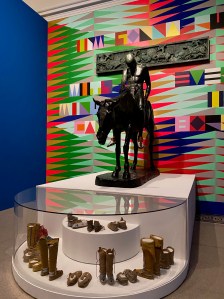
Moccasins at the feet of 1904 Dying Indian sculpture by Charles Cary Rumsey. On Gibson’s mural, a study for Rumsey’s Manhattan Bridge buffalo-hunt frieze.
The Brooklyn Museum invited a MacArthur genius to dig through its vast Native American collection and archives, use it alongside his own thought-provoking contemporary art work, and take visitors minds for a spin. The colorful, creative, memorable results are on display across three galleries in Jeffrey Gibson: When Fire Is Applied to a Stone It Cracks, on view through January 10. Take a look in our Flickr album.
Gibson, a big thinker whose heritage is Choctaw/Cherokee, does work that challenges people to think differently about Native Americans today and to question the assumptions about their “disappearance” from the national dialogue. Flying above art-world silos, he works at large and small scales, employs colleagues who are experts in beadwork and mural making, and shows art-gallery works as well as more conceptual projects.
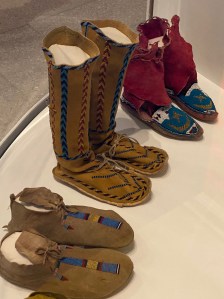
Custom 19th and early 20th-century moccasins from the Brooklyn Museum collection.
His Brooklyn show begins by presenting a monumental 1904 “Dying Indian” bronze by Victorian-era classical artist, Charles Cary Rumsey, and an array of moccasins from the museum’s collections made by unknown tribal artists in the late 19th and early 20th centuries.
To the right, there’s a giant stained-glass work that says, “Whose World Is This? It’s Yours It’s Mine.” To the left, there’s a colorful gallery packed with Gibson’s contemporary art work, and historic beaded, painted, and pieced items made by tribal artists.
Scores of museum visitors who exited Brooklyn’s Studio 54 show were captivated by Gibson’s dynamic installation, entered, and explored.
Gibson’s stained-glass Whose World Is This? It’s Yours It’s Mine. Private collection.
Below the massive statue, Gibson wants us to witness how carefully Native American makers created and customized footwear for specific practical purposes and ceremonial occasions for specific individuals. Unfortunately, the beautiful beadwork and deft, custom designs by tribal craftsmen are unattributed – a contrast to the society artist’s imposing vision of Native Americans who are sad, vanquished, and gone.
To change the statue’s narrative, Gibson asked contemporary Pawnee/Cree artist John Little Sun Murie to design moccasins for the figure atop Rumsey’s horse, so the rider is now presented as an individual member of an historic tribe – not just a generalized stereotype. Listen as Jeffrey talks about moccasins:
To drive home the point that Victorian-era artists and anthropologists incorrectly generalized and romanticized Native Americans, Gibson adds two other small bronzes and a study for Rumsey’s buffalo-hunting frieze made to embellish the entrance to the Manhattan Bridge. (Just ignore the fact that the Lenape didn’t hunt buffalo on our shores!) His beaded works say it all – “I Don’t Belong to You” and “You Don’t Belong to Me.”
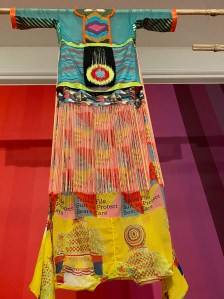
Gibson’s 2018, Tribes File Suit to Protect Bears Ears.
In the second gallery, Gibson shows his own recent creations with those bought on early 20th-century expeditions and added to Brooklyn’s ethnographic collection.
Gibson’s bright, geometric murals – which complement the museum’s vintage geometric-patterned tiled floors – provide a joyful backdrop for a brightly colored Seminole jacket, beaded hats, and other art. Gibson’s new paintings, sculptures, and patchwork garments use beads, colors, and messages on fabric – contemporary statements that hearken to the creativity and innovation of these unattributed artists. Take a look:
Ba:lawahdiwa, Zuni’s governor, and his family in 1890
The final gallery presents other artifacts and art that Gibson curated from museum’s vast Native American holdings, expedition records, and archives, and contrasts them with some of Gibson’s recent photography.
A large case displays a range of commercial, ancient, and ceremonial pots, expedition photographs, and drawings of Pueblo life made by expedition artists over 100 years ago. In one instance, Gibson reunites several photos of a Zuni family, normally stored apart from one another the museum’s archives.
Gibson relishes showing how Native American artists still thrive today and how over the centuries they have adapted their materials and creativity for both commercial art-markets and their own expressive purposes.
For example, he features a photograph of a young early 20th-century Navajo weaver, creating traditional Indian” rugs for a trading post with new, more colorful materials that Mr. Hubbell supplied. Gibson also unearthed a tourist map on where to find different California tribes and buy their wares – a direct rebuke to the concept that all these people “vanished.”
Best of all, Gibson also features several gorgeous recent photographs, including tribal artist-activists.
Visit Jeffery’s studio in this video produced for the 2019 Whitney Biennial. Hear him talk about his evolution, his creative process, and his team up in Hudson:
Entrance with Noguchi’s 1945 Kouros and Rodin’s controversial 1876 sculpture
The Met has pulled out all the stops on its 150th birthday show, Making the Met, 1870-2020, on view at Fifth Avenue through January 3 – incredible installation, intriguing stories, and a phenomenal digital showcase. So even if you can’t come to New York to see it in person, the Met website has it all!
The exhibition tells the story of the Met over the last 150 years – from its first incarnation in a house on 14th Street to its ever-expanding footprint in Central Park – shows the incredible art that benefactors donated, and relays the stories of the men and women who made it happen.
Head of a Hindu god, Bhairava, made by 16th c. Nepalese artists
Walking into the dramatic exhibition entrance, you’re surrounded by figures from different eras and cultures – a little girl from 5th century Greece holding two doves, a gilded mask of a Hindu god beautifully crafted by Nepalese masters of the 16th century, and Avedon’s 1957 portrait of a pensive Marilyn Monroe.
At the press opening, senior researcher associate Laura Corey explained that these were chosen to encourage visitors to think about the people behind the Met – collectors, curators, artists, restoration experts, and other staff. According to Laura, the African power figure from the Republic of Congo was one of the first artworks chosen for the welcome gallery. He’s looking right across to Marilyn, and they are sharing a similar expression and mood.
1906 photo of The Great Hall
At Noguchi’s Kouros sculpture, you can look left or right down a “street” lined with arches – portals that beckon you to step into different chapters of the Museum’s history. Each arch proclaims the decade and the theme. In between, there are huge slideshows from the museum’s past – how the Great Hall used to look, ladies in turn-of-the-century hats taking their art appreciation classes, Fifties moms and kids looking at art.
We’ve included our favorite artworks in our Flickr album, but the Met has produced a spectacular multimedia walk-through (posted on Google Arts & Culture), where you can experience all ten stories through photos, films, and links to blogs. Definitely watch the silent 1928 “Behind the Scenes” film showing museum shops, painters, gilders, and photographers at work. No surprise that the museum was into multimedia way back then!
Houdon’s 1778 bust of Franklin and reflection of Manet’s Young Lady in 1866
Through the first arch titled “The Founding” (the 1870s), you pass a huge Cypriot head (the first director was into archaeology) and the first paintings donated by the founding trustees. Houdon’s spectacular Ben Franklin gazes quietly (and slyly) at Manet’s Young Lady in 1866 – the first contemporary painting in the Met’s collection. It depicts a life-size, modern gal in her dressing gown – an image that shocked early visitors to the Met’s classical galleries! Of course, Ben looks on approvingly.
Next, you’ll see a 15th-century Turkish turban helmet and 17th-century Japanese armor. The story here is that the Met green-lighted Bashford Dean, a zoologist and world traveler working at the AMNH, to begin the arms and armor collection. Other curators began collecting works on paper, textiles, lace, wallpaper, musical instruments, and contemporary designs. In the Twenties, curators headed straight to the UK to scoop up samples from Morris & Company.
1479-1458 B.C. statue of Hatshepsut, and Cleopatra’s Needle (1450 B.C.) in Central Park
Around the corner is a tribute to the deep-pocketed donors like Morgan and B. Altman, who gave the Met lots of upscale, princely treasures – paintings by Vermeer and Ingres, fancy furniture, and tapestries. A treasure trove gifted by generous benefactors fills a wall – pistols for kings, cosmetic cases for Egyptians, bedazzled tablewear, and Middle Eastern glass.
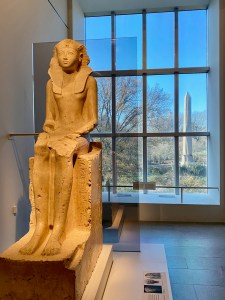
Back into the main “street,” you’re right next to an imposing, reconstructed sculpture of Egypt’s female pharaoh Hatshepsut with a stunning view of Central Park’s Egyptian obelisk through the window.
These lead to the stories of how the Met collected art via excavations of archaeological sites – the Kharga Oasis (1908), Egypt (1880-1931) with Wah’s tomb stuff, Nimrud (Iraq), and along an ancient trade route (1934). The intrepid Bashford Dean enters the story again – excavating a Crusader castle, but only bringing back “dismal finds,” such as Crusader lamps, melted chain mail, and shards of stained glass, and (our favorite!) a projectile from a Crusades-era catapult (1250).
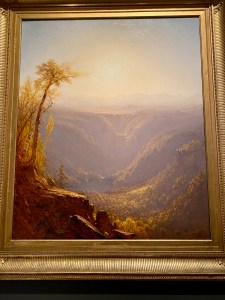
1864 A Gorge in the Mountains by Sanford Robinson Gifford
Apparently, it took a lot for a fancy museum to turn its attention from Europe to collecting art from the Western Hemisphere, but wealthy patrons had the goods. The American room features Sargent’s best-dressed “Madame X” and an enormous 1830 honeycomb quilt by Elizabeth Clarkson, the first quilt to enter the Met’s collection in 1923. There’s also a gorgeous Catskill Mountain landscape by Sanford Robinson Gifford, once owned by AMNH’s long-serving president, Mr. Jessup.
A gallery packed with work by Degas, Monet, Cassatt, Cezanne, and their Japanese masters tells the story of the Havemeyers, the Met patrons who lavished the museum with Tiffany glass (likely picked out by Mr. Tiffany himself), impressionist masters (picked out by Ms. Cassatt herself), and much more.
I Saw the Figure 5 in Gold (1928) by Demuth
At the midpoint of the exhibition, you learn that Stieglitz had a rough time trying to convince the Met to honor contemporary photography. The Met also refused Ms. Whitney’s collection in 1929. Gertrude’s response was to start her own museum, which joined MoMA (which debuted in 1929) in celebrating modernism. The Met finally did accept modern works through Georgia O’Keeffe’s 1949 gift, and proudly displays a Demuth and Kandinsky in the show.
The Monuments Men story looms large, with Met curators playing a major role in discovering and returning art looted during World War II. There’s a 1945 model of an Army helmet prototype designed by the Met’s armor expert, hand-crafted in solid aluminum.
1965 Yves Saint Laurent Mondrian dress and 1966 Balenciaga coat
The largest gallery in the show tells the story of how the Met beefed up its collections and expanded gallery space during what it calls “The Centennial Era” – Islamic art, fashion, Asian and African art, and modern art from the 20th century.
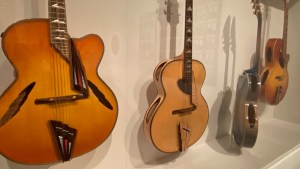
The final story about the Museum’s current focus – adding works by artists and from regions that are underrepresented in its collections – is represented by a large El Anatsui piece, an embellished Tibetan saddle, a wall of art guitars, a large Faith Ringgold story quilt, and other intriguing works.
The museum’s done a tremendous job online telling all the stories via its digital primer. Click here to hear in-depth stories on the Met’s audio guide with Steve Martin, check out this video with his narration, get the backstory on every artwork in the show, and definitely visit the multimedia walk-through .
And check out this exhibition video showing how the museum’s architecture evolved to house these growing collections. In the 1880s, Olmstead and Vaux assigned a spot in Central Park for the Met. It’s interesting that one of the initial designs (which no one liked) was not scheduled for completion until 1990!! It’s a microcosm of 150 years of architecture and history.
If you can’t do an in-person trip to your favorite museums just yet, why not walk some terrific exhibitions with curators at the Guggenheim, Merchant’s House, Poster House, the Morgan Library, and the Whitney. The links to this program and other museum events are on our virtual events page here.
Chen Zhen’s 1999 Precipitous Parturition installed inside the Guggenheim in 2017
Some of the highlights we think you’ll enjoy:
Today (November 30) at 5:00pm, visit the Guggenheim for a conversation about art, exhibitions, and installations in the iconic building. The Zoom session will feature works by Hilma af Klint, Felix Gonzales-Torres, and Pipilotti Rist to get the discussion rolling.
Hear jazz on The Four Seasons guitars by John Monteleone December 1 at the Met
Tomorrow (December 1) at 7:00pm, you will not want to miss the guitar quartet concert from the Metropolitan Museum’s MetLiveArts. It’s going to feature four acclaimed jazz guitarists playing the spectacular “Four Seasons” set of guitars made by master luthier John Monteleone, which are currently featured in the finale gallery of the Met’s 150th anniversary spectacular, Making the Met, 1870-2020.
Learn about 19th century lighting inside the Merchant’s House Museum on December 2
Of, if you haven’t had enough of feasting, join the Tenement Museum at the same time to hear from Leah Koenig about making holiday treats and her book Little Book of Jewish Sweets.
On Wednesday (December 2) at 6:00pm, take a trip back to the past with Merchant’s House Museum to experience 19th-century domestic lighting and talk about how home lighting has changed in the last 100 years.
Artists Kay WalkingStick and Jaune Quick-to-See Smith discuss contemporary art at NMAI on December 3
Thursday (December 3) events include:
A 6:00pm discussion of contemporary art at the Museum of the American Indian with Kay WalkingStick and Jaune Quick-to-See Smith.
At 6:30pm, an evening at Poster House that provides an insider’s look at collecting Swiss posters.
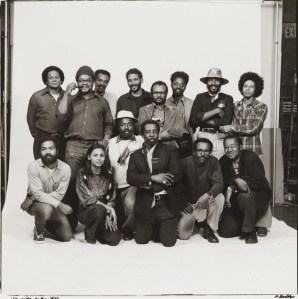
Photographers of Brooklyn’s Kamoinge Workshop, honored in the Whitney’s new show
At 7pm, a curator’s tour of the Whitney’s latest exhibition about the photographers of the Kamoinge Workshop in Brooklyn.
We’re particularly excited about the special free program that the Tenement Museum is hosting next Saturday (December 5) at 1pm with I.NY, a virtual celebration of connection between Ireland and New York, featuring a tour of an Irish family’s home on the Lower East Side in 1860 and a discussion with the University of Limerick’s Professor David Coughlan.
Visit the Moore family home with the Tenement Museum and I.NY on December 5
Many more programs are on the schedule, so register for as many of the topics and events that you can fit into your schedule.
Most of the events are free, but it’s always nice to add a thank-you donation.
Museum Updates
Just a reminder that MoMA has just reinstalled its permanent collection in its new building. When the museum re-opened a year ago, the intent was to keep its collection moving, with refreshed galleries several times a year. Be sure to visit and see what’s new!
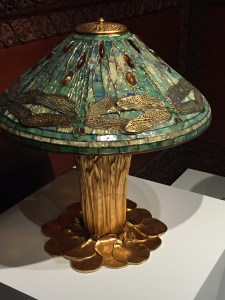
Dragonfly Lamp (1900-1910), by Clara Driscoll of Tiffany’s Women’s Glass Cutting Department (Cooper-Hewitt)
With Thanksgiving festivities this week, the list of virtual live events happening at NYC museums is a bit shorter. Find the links to these and other museum events on our virtual events page here. Some of the highlights we think you’ll enjoy:
Have you heard the story about the women of Tiffany & Co, who were so integral to the success of the design lab in the early 20th century? If not, you owe it to yourself to join the Queens Museum today (November 23) at 12pm to hear the talk by the Queens Public Library on Women at the Tiffany Studios in Queens.
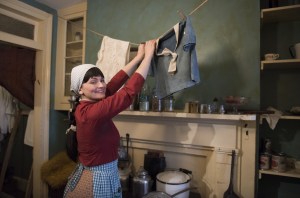
Gather the family around tomorrow (November 24) at 5pm for a special live event at the Tenement Museum. Meet Victoria Confino, a 14-year-old girl living on the Lower East Side in 1916. Hear about her story of immigration in 1913 and take a tour of her apartment on Orchard Street – all based on the story of the actual young woman who grew up there.
Actress portraying Victoria Confino in her Orchard Street apartment
If you using the weekend to catch up on hand-craft projects, be sure to take advantage of this special behind-the-scenes tour of the lace collection in the textile department of the Met on Saturday (November 28) at 10am. Their collection spans centuries, and it’s a rare chance to poke through all the drawers with one of the curators. (If you want to see what we’re talking about, check out our Flickr album on a past Met exhibition on Fashion and Virtue that featured this amazing collection.)
1910-15 lace evening pouch by Callot Soeurs (The Met)
Check out this week’s schedule and register for as many of the topics and events that you can fit into your schedule. Most of the events are free, but it’s always nice to add a thank-you donation.
Museum Updates
This week, we got in to see the Met’s fashion exhibition About Time: Fashion and Duration, which was delayed for months by the citywide museum shut down. Fortunately, it gave Andrew Bolton time to tweak the display, which presents a mesmerizing, time-shifting look at the past and present of fashion. If you want to see this, be sure to get to the Met before 11:30am, since tickets are distributed on a first-come, first-served basis. Plan to spend your day inside the museum, since your ticket may not grant you access until late in the afternoon.
#ICPConcerned – what photographers were seeing around the world in March 2020
There are two must-see exhibitions at the new Essex Street home of the International Center of Photography. If you are in New York, go down ASAP to experience Tyler Mitchell’s installation, I Can Make You Feel Good, and to look through the global response to #ICPConcerned: Global Images for Global Crisis. The walls of images from around the world is a time-warp experience that is no less affecting than the more elaborate, theatrical About Time galleries at The Met.
We also attended the press briefing at The Whitney this week on its new photography retrospective, originally mounted by the Virginia Museum of Fine Arts in Richmond – Working Together: The Photographers of the Kamoinge Workshop, which looks back at the work of its 14 founding members back in the Sixties at the birth of the Black arts movement in New York. Go see it.
Politics and rage all laid out in cartoony form in Peter Saul’s retrospective at New Museum
Congratulations are also in order to the New Museum of its two hit shows – Peter Saul’s first-ever NYC retrospective Crime and Punishment(two floors of off-the-charts social and political commentary) and Jordan Casteel’s first solo museum exhibition in NYC Within Reach, filled with her masterful uptown portraits. Visitors linger in the galleries in an effort to digest the rich experience.
And if you are binge-watching The Crown, we’ll again plug the Brooklyn Museum virtual exhibition with Netflix, where you can examine all the fashion up close in virtual reality.
1890 pointillist portrait of Fénéon by Paul Signac
He wasn’t an artist, but MoMA has given him a show that has everything – joyous post-Impressionist canvases, Moulin Rouge posters, color wheels, African masterworks, Italian futurists, street riots, manifestos, explosions, and mug shots.
Félix Fénéon: The Anarchist and the Avant-Garde – From Signac to Matisse and Beyond, an exhibition on view through January 2, will introduce you to a writer, critic, anarchist, and dealer living in turn-of-the-century Paris who championed Seurat, gave Matisse his start, coined the term neo-Impressionism, and went to jail for a few months after he was accused of setting off a bomb in a restaurant frequented by government big shots.
1891 painting by Paul Signac, Setting Sun, Sardine Fishing, Adagio, Opus 221
This gorgeous show was inspired by Signac’s pointillist portrait of Fénéon, which features swirling color wheels referencing their shared passion for Japanese design, pattern, and the science behind art. Books and ephemera by influential color theorists are displayed nearby, but it’s hard to keep your attention there when paintings by so many modernist masters are vying for your attention around every turn.
1894 Bonnard poster for the avant-garde journal Fénéon edited
Fénéon used his critical bullhorn to turn many artists into household names. Think Seurat and Signac, two of Fénéon’s early favorites. The first gallery is full of their beautiful seascapes and figurative work. Read the curator’s essay about the artists he promoted, and see our favorites in our Flickr album.
The curators let us know that these peaceful images and exuberant dance-hall posters were made at a time of serious social unrest and profound economic hardship for working-class Parisians by interspersing Fénéon politics-charged writings and socially conscious works by Vallottin and Pissarro. Disruptive protests, nightlife, zines, and art all went hand-in-hand during the 1890s.
1905-1906 painting by Matisse Interior with a Young Girl (Girl Reading)
Fénéon spent several years as the editor-in-chief of a leading avant-garde journal, orchestrating contributors such as Bonnard, Toulouse-Lautrec, and Vallotton, and collecting their work along the way. So, it came as quite a shock to everyone when the independent critic announced that he was taking a full-time job with a prestigious but conservative gallery in Paris.
Entering the second gallery of the exhibition, you see immediately how Fénéon used his notoriety and avant-garde chops to build up a contemporary art business and lure old-line clients into taking a chance on something new and modern. He signed contracts with artists he had long championed, and gave an up-and-comer named Henri Matisse his first show in 1910.
Late 19th-c mask by a Guro artist from Cote d’Ivoire with 1920 Bonnard. Private collection; Musee d’Orsay.
It’s exciting to see a room full Matisse’s early work (including three that were in that initial show) and work by other artists that Fénéon both collected and sold, including a wall full of ethereal Seurat drawings.
Like many others in the avant-garde, Fénéon was a passionate collector of art from Africa and Oceana, and it’s thrilling to see so much of his original collection – now scattered throughout the world – reassembled inside MoMA.
Fénéon hated colonialism and railed against calling this portion of his collection “primitive art.” He lamented that the names of the artists who created such dynamic, inventive work were unknown and disliked having such evocative pieces relegated to ethnographic museums.
19th-c cap by Tin Dama artist from Papua New Guinea (Musée du quai Branly-Jacques Chirac) and Balla’s 1910-1911 futurist work.
He hoped that one day “art from faraway places” could take its place in the art pantheon right up there with works in the Louvre.
The worlds of ancient mythic power, modernism, and emotive color seem to be spending their time at MoMA having an active conversation – just the way Fénéon would have wanted.
Enjoy MoMA’s fast-pace introduction to this revolutionary modernist:
And now meet MoMA director Glenn Lowry and Starr Figura, curator of the exhibition, who show works from the exhibition and discuss why they mounted this show:
If you can’t get to MoMA, listen to the audio guide here, and enjoy the “colors” playlist that MoMA designed.
Enhanced image of Pluto’s ice plains from NASA’s New Horizons. Courtesy: NASA/Johns Hopkins Applied Physics Laboratory/Southwest Research Institute
If you’ve wanted to get far, far away but reckon you’re going not going anywhere for Thanksgiving, New York museums are offering some exciting virtual trips as well as comforting at-home activities:
Do you want to get away? Is Pluto far enough? At 7pm on Wednesday (November 18), join the astro-visualization crew at the Hayden Planetarium for a close-up look (using genuine images from the New Horizons spacecraft) to explore glaciers, mountains, and dunes on the little planet. Just a $15 ticket for a trip you won’t get anywhere else.
Behind the scenes with New York’s most celebrated dim sum restaurant with Poster House Nov 19
If staying near the kitchen is more your thing, this week offers a few different options for cooking and looking:
Want to visit New York to enjoy that amazing dim sum? Here’s your chance to do it virtually. At 6pm on November 19, step into the world of Chinese cuisine at Poster House with the program, Stories & Recipes From Nom Wah. Get inside one of New York City’s oldest dim sum houses as part of the museum’s programming in honor of its exhibition The Sleeping Giant: Posters and The Chinese Economy.
On November 19 at 8pm, the Old Stone House and Brooklyn Brainery are offering an evening on the history of pies, including pumpkin pie, meat pies and baked “coffins.”
History of pies event on Nov 19, hosted by Brooklyn’s Old Stone House
Maybe you just want to look at kitchens and not cook. On Tuesday (November 17) at 3:30pm, the Tenement Museum is offering a tour of a 1930s working-class family apartment. Or at 6pm, you can join Merchant’s House Museum to walk with an historian through New York City’s only intact nineteenth-century family home (much more upscale!). Tenement Museum is also offering tours into other eras (1910 and 1870) later in the week. Check out the listing.
Roseanne Cash performs with Met Live Arts Nov 17 in a tribute to the eye of the collector
Find the links to these and other museum events on our virtual events page here. Other highlights of the coming week:
Beautiful music from singer-songwriter Roseanne Cash from Met Live Arts tomorrow (November 17) at 7pm in honor of the Met’s exhibition (and gift) Photography’s Last Century. Hear the music and poetry reading streamed live free on the Met’s Facebook and YouTube channels (no advance registration).
Young Hamilton featured on Nov 19 at Fraunces Tavern Museum (Image: NYPL collection)
Ham fans can get their fix at his old hang-out, Fraunces Tavern on Thursday November 19, with a 6pm program, Hamilton: Man, Myth, Musical…Mensch. The talk will feature facts about his early life and a fun fact-check on the musical.
Or (same date and time), join young New York muralists to hear their reactions Whitney’s blockbuster exhibition, Vida Americana: Mexican Muralists Remake American Art, 1925–1945. See how the past influences their approach.
Take a look and register for as many of the topics and events that you can fit into your schedule. Most of the events are free, but it’s always nice to add a thank-you donation.
Museum Updates
One of Salman Toor’s narratives at The Whitney
This week, we attended the Whitney’s virtual press conference on Salman Toor’s new exhibition. To get a preview and meet the artist himself, check out his conversation at 6pm tonight (November 16) with another New York/South Asian artist, Chitra Ganesh.
It’s good to see that our Revolutionary friends at Fraunces Tavern Museum are now re-opened in Lower Manhattan. They are hosting several Evacuation Day (outdoors) walking tours and upcoming virtual events depicting how the General said good-bye in the Long Room nine days after the British fled New York.
Cooper-Hewitt hosts Nov 17 working group on transforming museums
Are you a museum professional interested in the future of the visitor experience? Tomorrow (November 17) at 3:00pm, the Smithsonian’s Cooper-Hewitt is convening a virtual working interactive event for you – Discussions on Transforming the Museum Experience. Small groups will convene to generate ideas and tools (to be published), led by an impressive roster of international museum representatives.
If you’re a student, thinking about going into museum studies, check out the same-day college-night get-together at Poster House at 6:30pm.