Mondrian Goes Digital Electronic at MoMA

Mondrian’s Composition in Yellow, Blue, and White, I inside Haroon Mizra's installation Frame for a Painting

Mondrian’s Composition in Yellow, Blue, and White, I is framed in LEDs inside Haroon Mizra’s sound installation Frame for a Painting

Mondrian’s in the house (literally), starring in a fun interactive installation tucked away near the exit to Soundings: A Contemporary Score, MoMA’s first exhibition devoted entirely to the work of creative contemporary artists working in sound.

The show, which runs through November 3, has plenty of fascinating, thoughtful works in hallways, around bends, and in darkened galleries, such as Tristan Perich’s Microtonal Wall in the entrance hallway, which lets you experience the sound of 1,500 1-bit speakers up close and personal. Listen to it at the bottom of his MoMa artist page.
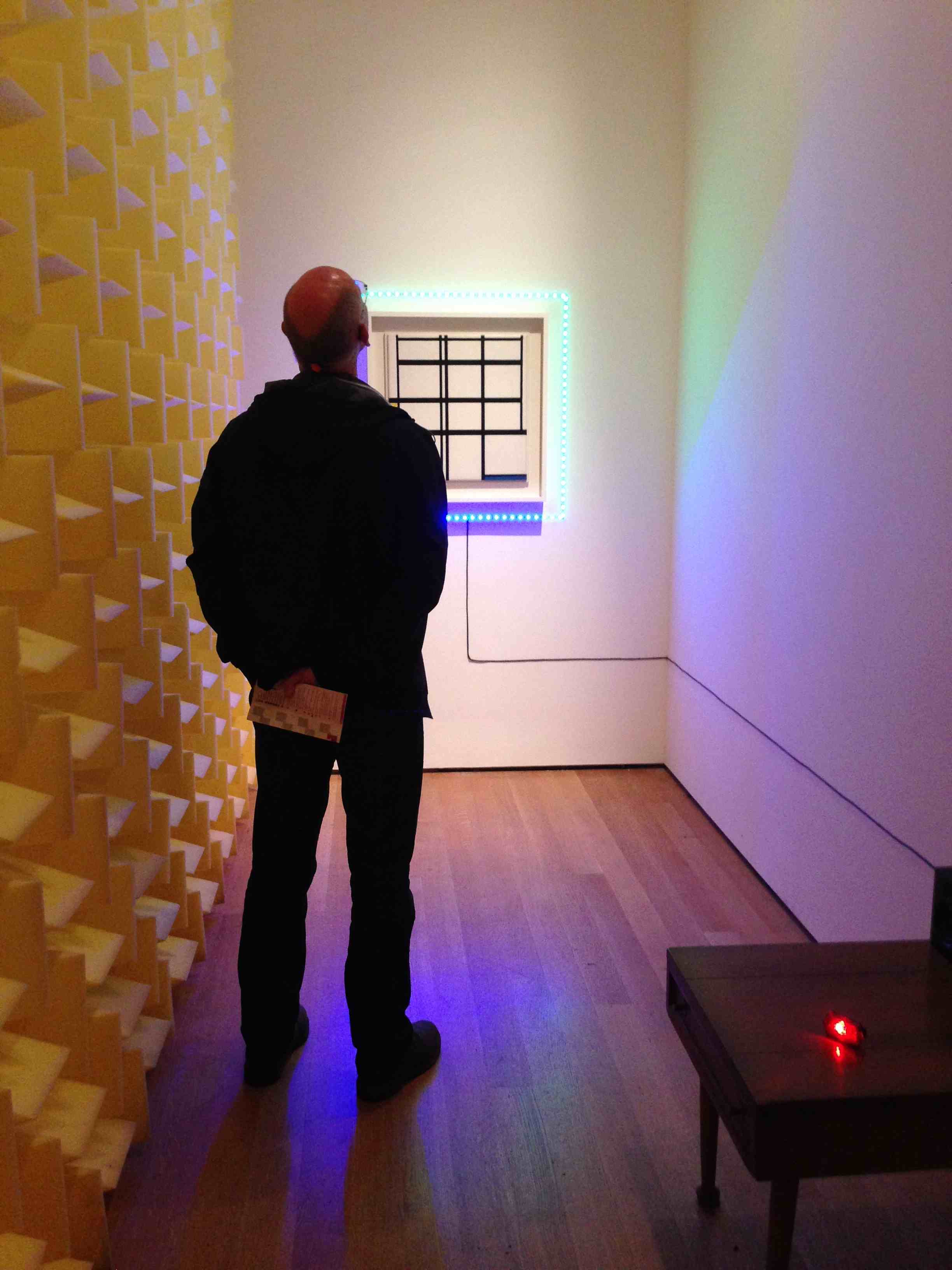
IMG_2939But the delightful surprise installation is a long, narrow almost hidden room, where Haroon Mizra has installed his ever-changing Frame for a Painting. On the occasion of being at MoMA, he’s chosen Mr. Mondrian’s Composition in Yellow, Blue, and White, I from MoMA’s collection and given this small, jazzy gridwork its own ultra-modern, swinging London, mid-century electro-pad. See it on our Flickr feed.

The narrow room has pointy yellow acoustic foam covering the tall walls. At the far end, you see Composition framed in a rectangle of electric blue LED lights that flash in sync to a pulsing electronic sound track. You have to maneuver around a low Danish modern side table from which a bright red bicycle light pulses and bleeps.

It’s a nice tribute to this favorite Modern master, and one of the few nooks in the show where visitors are taking photos and making little Vine videos like crazy. Composition harkens back to 1937, the table to the 1950s, and the sounds to the dawn of electronic music. It feels like a crazy time machine in an over-the-top conceptual 1960s living room.  Surely Mr. Mondrian would approve of the precision and interrupted rhythm. In any case, Composition certainly seems to enjoy being liberated from the white-wall treatment upstairs.
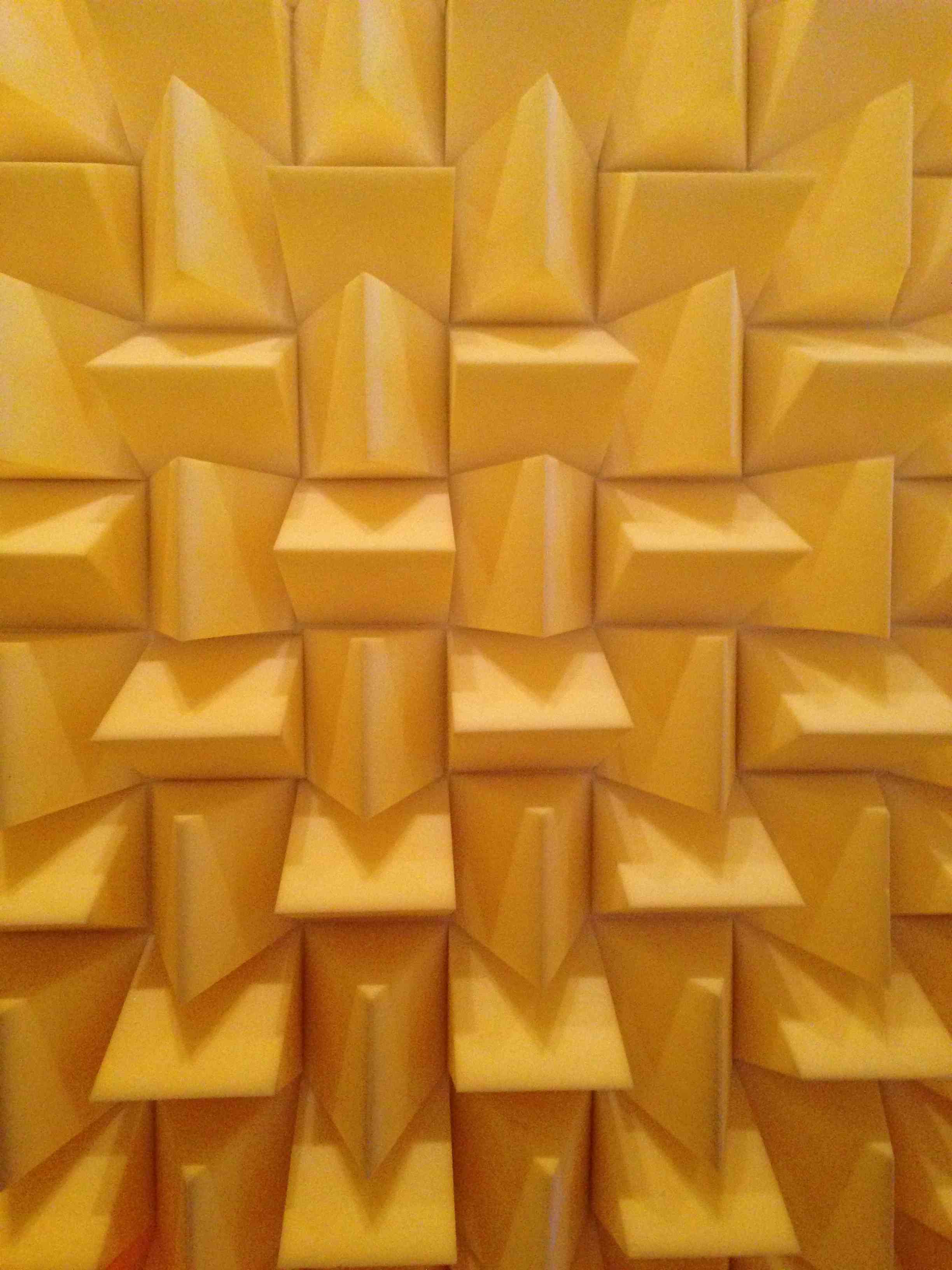
Close-up of the foam lining all the walls of Mondrian's slim room

Close-up of the foam lining all the walls of Mondrian’s slim room

Another work in the show that you might remember is a sound piece that used to be installed on the High Line in 2010 – Stephen Vitiello’s A Bell for Every Minute, which features New York City bells that he recorded and are heard every 60 seconds. You can get a taste of the experience listening to Bell Study, an audio track embedded at the bottom of his artist page used as an underlay in his longer audio piece.

Also check out the track from Jana Winderen’s Ultrafield, which slows down the ultrasound communications of bats, fish, and underwater insects so that we can hear the “hidden” sounds of our fellow species for the first time. Listen in to Jana’s work and check out the other artists on MoMA’s interactive show site.

And feel free to record and add your own everyday sounds to MoMA’s show site.
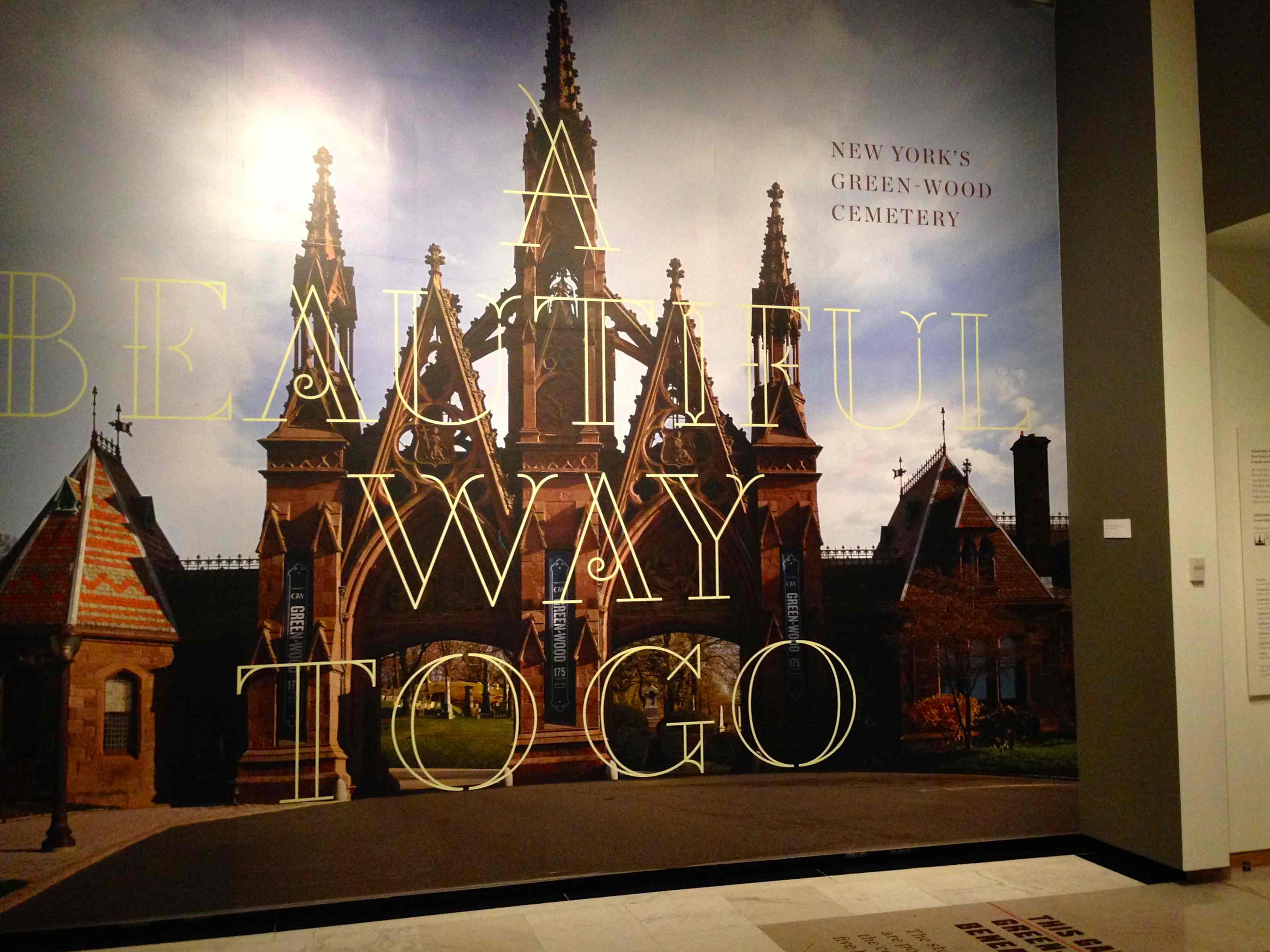
Rich & Famous at Green-Wood’s 175th Anniversary

Show entrance featuring Green-Wood’s spectacular Gothic architecture.

Show entrance featuring Green-Wood’s spectacular Gothic architecture.

It’s big, green, historic, beautiful, and has more celebrities inside than you could ever imagine possible in an out-of-the-way spot in Brooklyn. Any day of the week, you can take a trip out to the lush woodlands, hills, and statuary gardens of Green-Wood Cemetery (and you should!), but every NYC history geek needs to visit the Museum of the City of New York’s A Beautiful Way to Go: New York’s Green-Wood Cemetery before October 13 to plumb the riches that have been assembled to celebrate its 175-year history.

We’re providing a walk-through on our Flickr feed, but the virtual experience is no match for the first-hand encounters with objects associated with the New York titans that are interred within the 478 acres of hills and countryside of Green-Wood itself – Tiffany, Duncan Phyfe, Boss Tweed, and even The Little Drummer Boy.

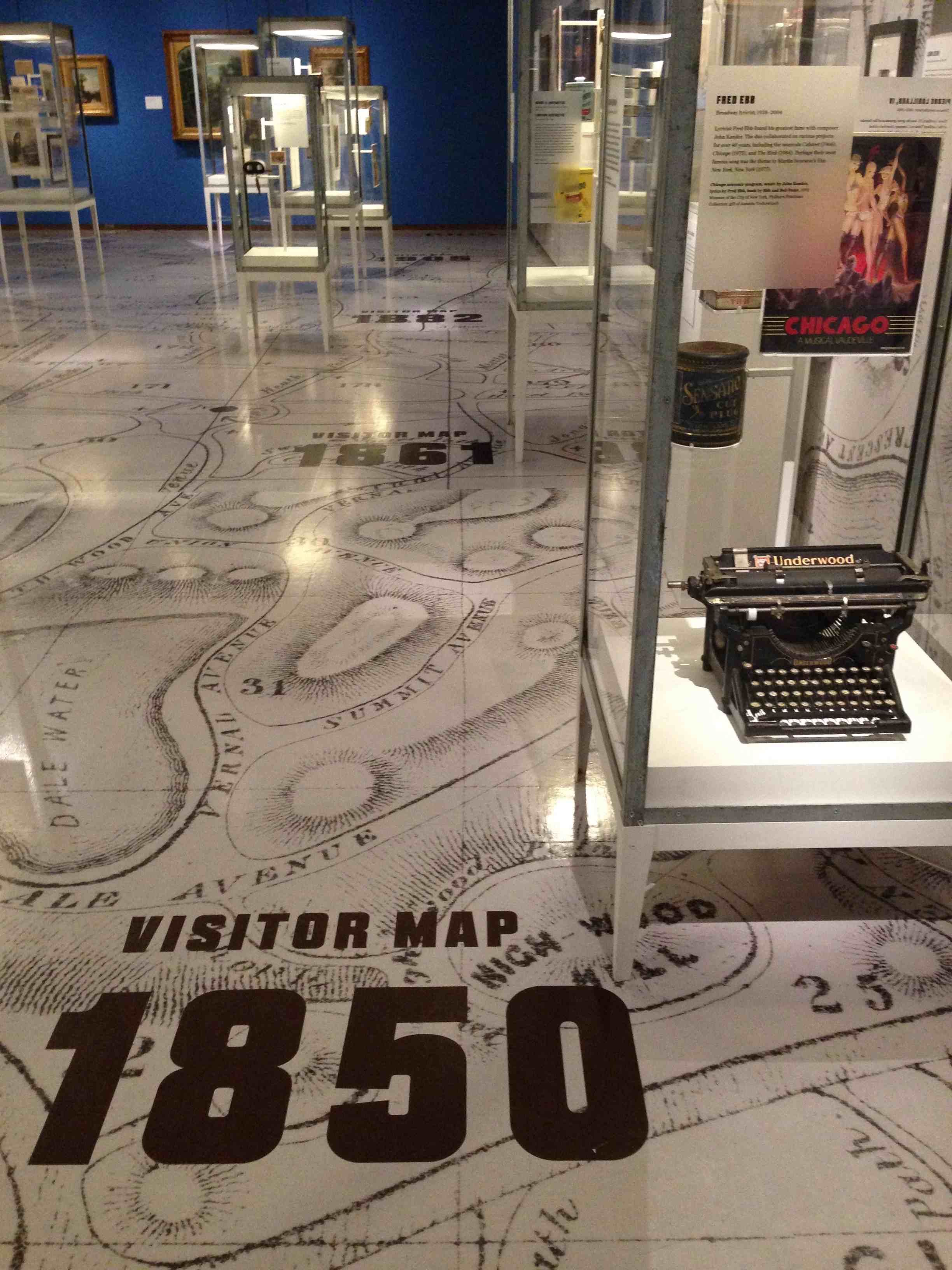
The floor map and vitrines with items associated with Green-wood’s most famous

The floor map and vitrines with items associated with Green-wood’s most famous

Consider the retail giants and brands: All five Brooks Brothers (who invented ready-made suits in 1849), the six Steinways who made pianos in Queens, Ebhard Faber (remember pencils?), the Domino Sugar owners (who once had 98% of the entire US market and who gave most of their vast art collection to the Met), the creator of Chiclets, the founder of Pan Am, and even F.A.O. Schwartz (yes, it’s a person).

MCNY has put the map of Green-wood on the floor of the gallery and has placed vitrines with objects associated with the rich and famous sort-of where they would be in the actual cemetery. Walking through the show is like random-access memory. You don’t know what or who you’ll stumble upon.

The tribute includes artists (from Currier & Ives and Asher Durand to Leon Golub, Nancy Spero, and Jean-Michel Basquiat); composers (Frank Ebb, Mr. Bernstein, and disco legend Paul Jibara); and inventors of things like the safety razor, the sewing machine, soda fountains, and the safety pin (think about that). Yes, it all happened in New York.

Spanish-language poster for "The Wizard of Oz" as a tribute to Frank Morgan, who played The Wizard

Spanish-language poster for “The Wizard of Oz” as a tribute to Frank Morgan, who played The Wizard

Green-wood is New York’s equivalent of the Pere Lachaise Cemetery in Paris, full of vistas, trees, paths, lakes, works by celebrity sculptors, military memorials, and elaborate, ornate above-ground tombs. Lachaise spawned an international mania for sylvan-glade cemeteries when it opened in 1804, and when Mr. Pierrepont was laying out the Brooklyn street system in the early 1800s, he left a big, open green spot in the plan, where Green-Wood is today. It opened in 1838, predating Central Park, and grew into the No. 2 tourist attraction in the United States (after Niagara) by the 1850s.

An 1875 Howe Sewing Machine by the inventor of the sewing machine, Elias Howe.

An 1875 Howe Sewing Machine by the inventor of the sewing machine, Elias Howe.

The show’s front hall has spectacular landscape photos taken last year by Jeff Chien-Hsing Liao, serving as luring calling cards to take the actual expedition to Green-Wood and its celebrated trolley tours led by uber-historian Jeff Richman.

See New York Through Hopper’s Eyes

Hopper’s easel holds his painting, Early Sunday Morning (1930) at the Whitney.

Hopper’s easel holds his painting, Early Sunday Morning (1930) at the Whitney.

If you thought you knew about Edward Hopper, think again. The Whitney’s show, Hopper Drawing, provides surprises galore from curator Carter Foster, who has presented the museum’s trove of Hopper drawings in a fresh, new context. The Whitney has more Hopper drawings (made for his private use) than any other museum in America, and about half are up on the walls. Go before October 6.

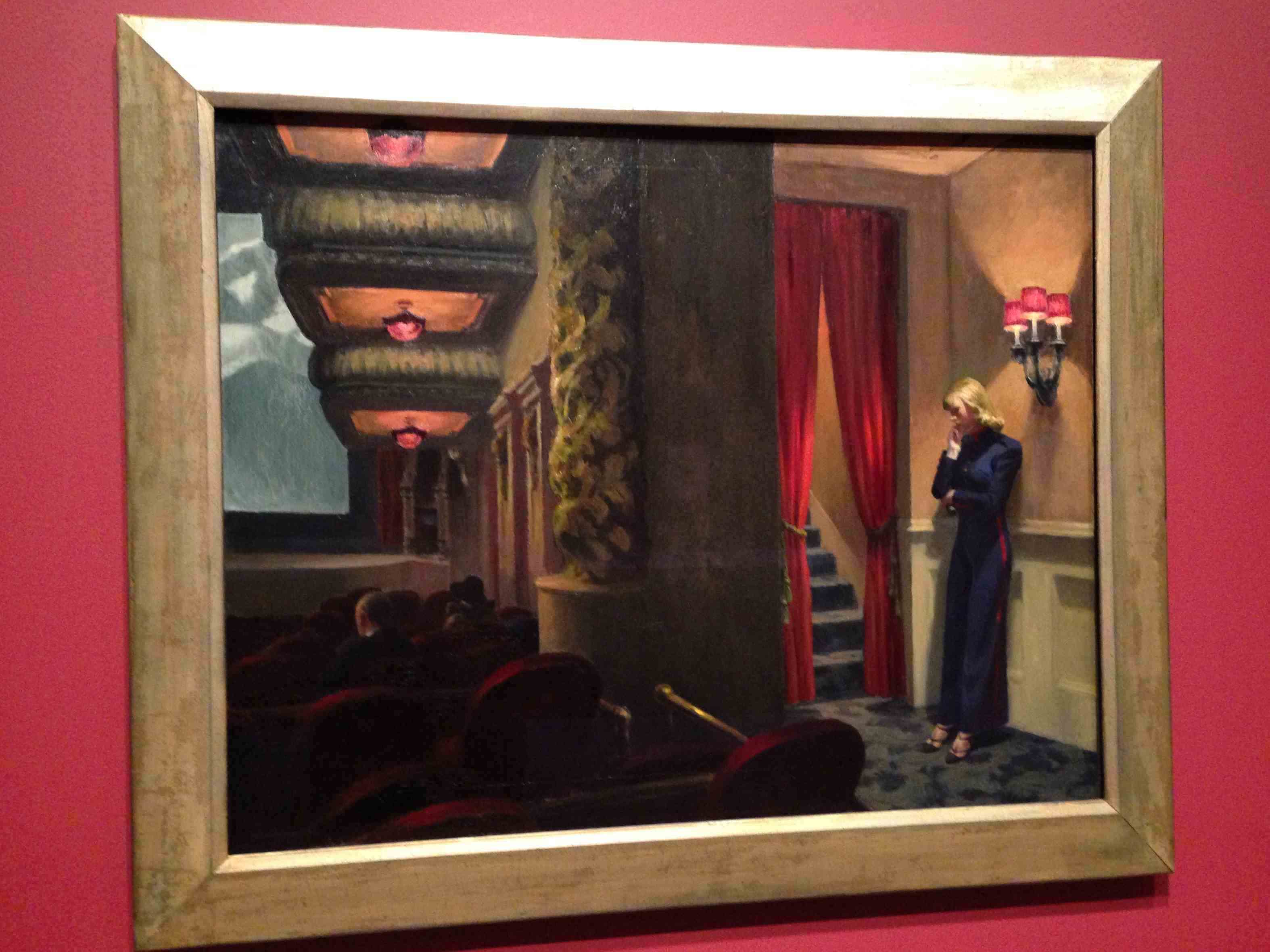
Although Hopper’s representational work is considered by his fans to signify “realism”, Foster has unearthed and organized zillions of preparatory drawings that demonstrate that this is hardly the case. Hopper, as he often said, worked “from fact” but added improvisational touches that pretty much made the canvases perfect. A case in point is New York Movie, where one side of the canvas is “real”, and the other side is completely imaginary. His sketchbook from the Palace Theater proves it.

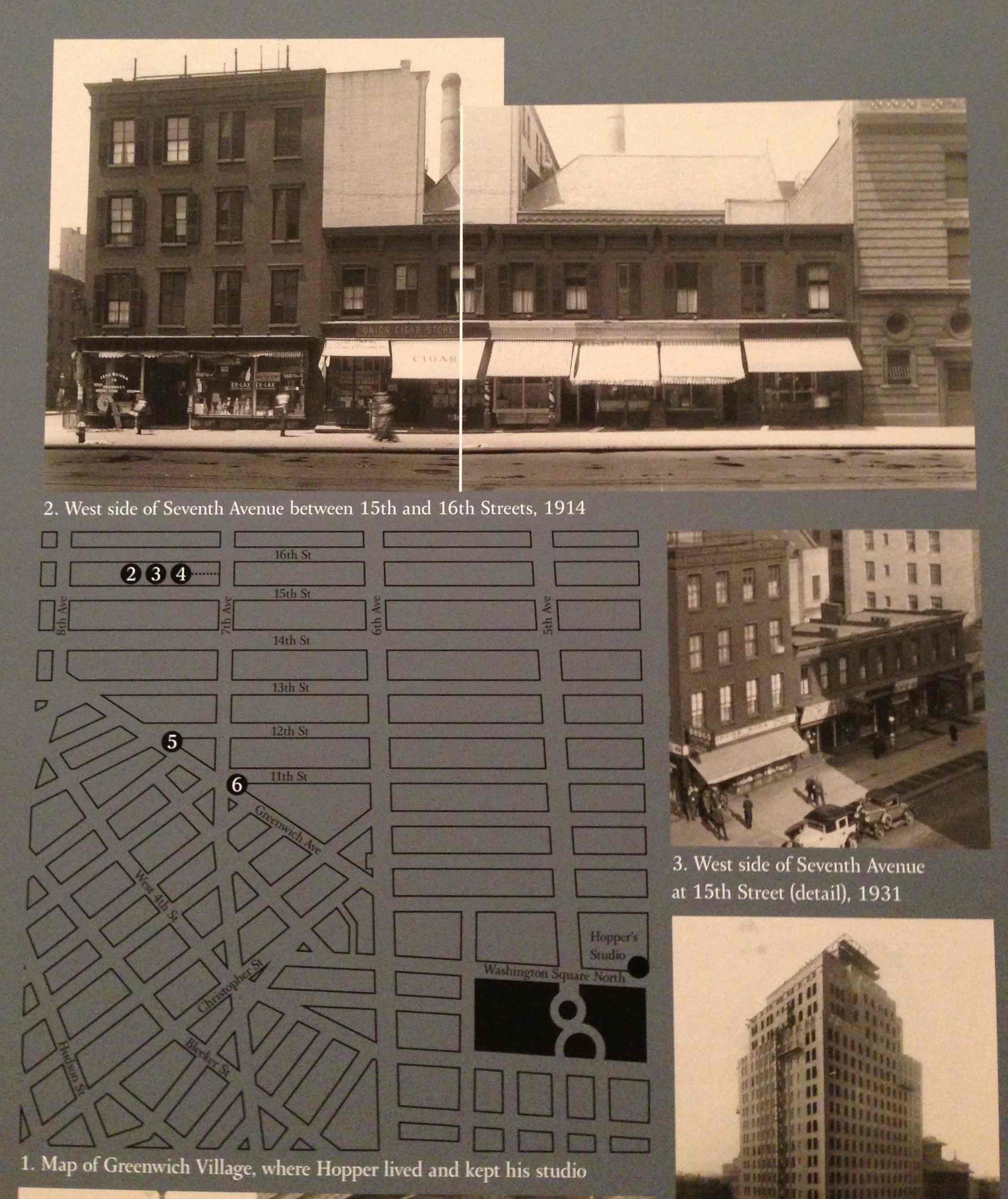
Whitney exhibition card showing map and 1914 photograph of the West Village storefronts depicted in the above oil painting

Whitney exhibition card showing map and 1914 photograph of the West Village storefronts depicted in the above oil painting

To prove this point, you’ll see the most famous Hopper paintings right alongside his preparatory sketches and sketchbooks to see his meticulous decision making process. Go to the exhibition web site (or our Flickr feed) and flip through images of Hopper’s iconic oils (such as New York Movie  and Chicago’s Nighthawks), followed by sketches and studies where Hopper worked out all the compositional kinks.

Hopper lived and worked right inside the row of gorgeous 1830s townhouses along Washington Square North. It’s a complete surprise to find that NYU still preserves Hopper’s studio intact, complete with his print press and easel.

Foster convinced NYU to loan it to the show, and it’s an electrifying reminder that artists once walked the streets of the Village and then came back to paint. You’ll stand face-to-face with the working easel that Hopper used to paint every one of his great works. Early Sunday Morning is perched, right where it sat in 1930, facing the Hopper’s other icon Nighthawks, on loan from Chicago’s Art Institute. The width of those canvases precisely matches the width of the easel.

Installation view of Hopper’s New York Movie (1939), on loan from MoMA

Installation view of Hopper’s New York Movie (1939), on loan from MoMA

So, that left a question: Where these real places, or fictions made up entirely in Hopper’s mind? Foster spent time trying to figuring it out, and thankfully the Whitney recorded the answers on its YouTube video. Take a walk with him and see the Village and the Flatiron through Hopper’s eyes back in the 1930s. You’ll never look at Nighthawks the same way again. Genius.

For theater fans: It’s not in the video, but Hopper’s sketchbooks are also filled with drawings of Times Square theaters — the Palace, the Globe (now the Lunt-Fontanne), the Republic (now the New Victory; formerly Minsky’s Burlesque),  and the Strand (where Morgan Stanley now sits).

Water, Water Everywhere at the Academy

Tintagel, 1881. Large, masterful watercolor depicting castle ruins on the Cornwall coast of England, which Richards associated with the legends of King Arthur.

Tintagel, 1881. Large, masterful watercolor by William Trost Richards depicting castle ruins on the Cornwall coast of England, which Richards associated with the legends of King Arthur. Who needs to mess with oil paint and build big canvases when you can do this with water and paper?

In a brilliant pairing, the National Academy Museum has mounted dual shows by artists who draw their greatest inspiration from water. There’s no need for a trip out of town to experience crashing waves, monumental waterfalls, and wide expanses of sea and sky done by one of America’s greatest watercolorists of all time and a celebrated 21st century painter.

William Trost Richards: Visions of Land and Sea features 60 works from the Academy’s collection – early graphite sketches, oil paintings, and beautiful, grand, sweeping watercolor vistas that are some of the tiniest, most meticulous works you’ll see anywhere. Some are on display for the first time, which is remarkable considering that critics believe WTR to be among the greatest American landscape painters of the 19th century.

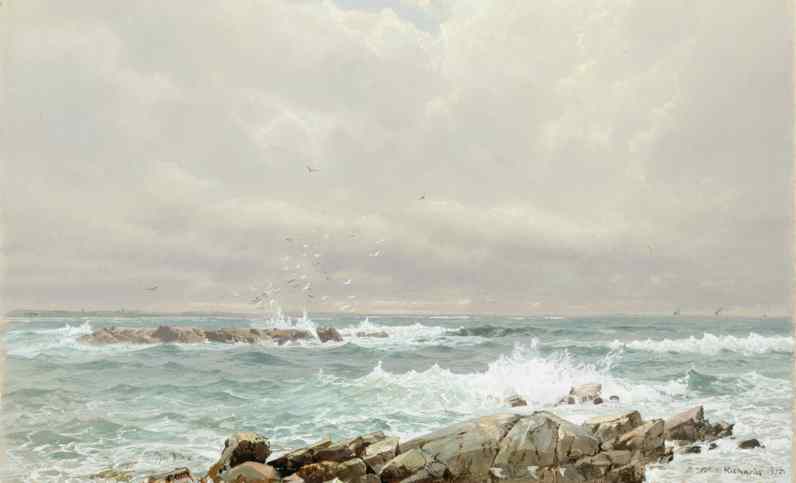
Seascape (1875), a watercolor on cream paper that’s only 9 X 14 inches. Source: National Academy

Seascape (1875), a tiny but monumental watercolor by William Trost Richards on cream paper. It’s only 9 X 14 inches. Source: National Academy

Inspired by Ruskin and the Pre-Raphaelites early in his career, WTR began documenting the intricacies of the Wissahickon River paths near Germantown, on the outskirts of Philadelphia. He soon became part of the American watercolor movement that began making works that were just as grand, romantic, and full of transcendence as anything by Church or Bierstadt. Quite a feat, when you’re working on such a tiny scale.

He spent years perfecting vistas of the ocean and sky from his home near Newport and on travels to the edges of the British Isles. Remarkably, he kept the horizon low to showcase the sky, all meticulously painted and built up from a ground of blue-gray wove paper. It’s remarkable how he evokes mood, rocks, night, dusk, and pale sky from that gray. Click here for more.

Steir’s monumental Blue River (2005) – one of her celebrated Waterfall series. Steir’s monumental Blue River (2005) – one of her celebrated Waterfall series. The video shows it’s true scale.

Steir’s monumental Blue River (2005) – one of her celebrated Waterfall series. Steir’s monumental Blue River (2005) – one of her celebrated Waterfall series. The video shows its true scale.

Pat Steir’s paintings, on the other hand, feature an opposite approach. Like Sam Francis or early post-Pop color-field painters, she pours, splatters, and drips her paint across canvases that seem a mile high and a block long. The masterwork on display at the Academy is Blue River, a virtual waterfall that’s just as mesmerizing as any of WTR’s watercolors, but done in bold, wide strokes on a larger-than-life canvas.

Go this weekend and delight in the masterful scenery. Pat herself indulges in the joy right here.

If you miss the Academy show, be sure to look for Pat’s Everlasting Waterfall hanging on the Fifth Floor of the Brooklyn Museum right next to Church.

African Art – 20th-c Modern Master Collectables

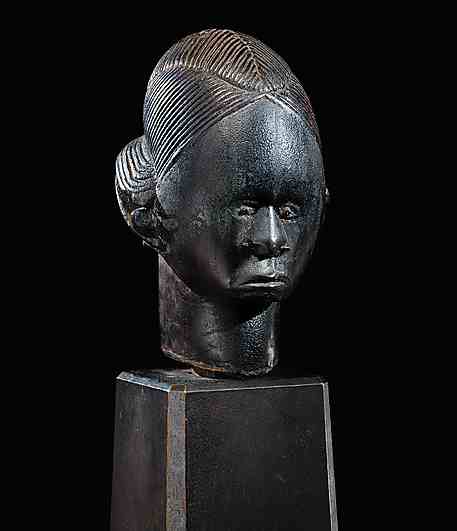
Sculptural Element from a Reliquary Ensemble: Head. The first African sculpture to be exhibited with modern masters in NY at Robert Coady’s Washington Square Gallery. This pre-1914 wood sculpture is from Gabon. Source: Curtis Galleries, Inc.

The first African sculpture to be exhibited with modern masters in NY at Coady’s Washington Square Gallery in 1914. From Gabon. Source: Curtis Galleries, Inc.

The show closing at the Metropolitan Museum of Art this weekend, African Art, New York, and the Avant-Garde, is a love letter to the advent of modernist art in New York 100 years ago. In the early 1900s, artists like Picasso and Matisse began looking more closely at the exotic shapes and forms pouring out of Gabon and Cote d’Ivoire – the primary sources of wooden African statuary at the time in Europe.

The Armory Show in 1913, rocked New York, where crowds viewed disruptive cubist works by Picasso, Duchamp, and Braque. Although the edgy work startled New Yorkers and the press, American modern artists and connoisseurs went crazy for African art because it looked so “modern”.

Sensing an opportunity, Stieglitz sent his friend, Marius de Zayas, to Europe to bring back more. Good thing, since Europe was soon at war and the global art scene shifted to New York. Stieglitz’s 291 Gallery and the Washington Square Gallery in the Village became leaders of the new trend, mounting a series of shows. De Zayas had to push Stieglitz to mix African art with Picasso, and it worked. One critic looked and said, “Here are the fathers of Gaugin, Matisse, and Picasso!”

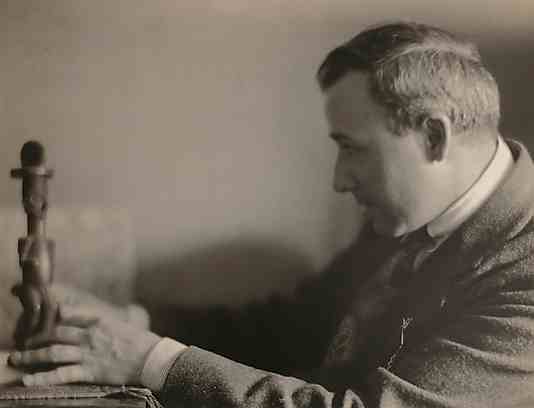
Clara Sipprell’s 1916 Portrait of Max Weber, where the artist holds a wooden figure from the Democratic Republic of the Congo. He bought it in 1906, the first African sculpture to be brought back to the City by a New York art-lover. Source: Museum of Fine Arts, Boston.

Clara Sipprell’s 1916 Portrait of Max Weber, where the artist holds a wooden figure from the Democratic Republic of the Congo. He bought it in 1906, the first African sculpture to be brought back to the City by a New York art-lover. Source: Museum of Fine Arts, Boston.

This show is special because the curators really went all out – huge photo-murals of the ground-breaking shows, the actual works you see in the photos, and photos of same from the magazines and newspapers of the day. It’s an art-history, primitive art, and modernist master trifecta.

Visitors feel like they’re stepping right into 291 itself, seeing mash-ups of African art, nature objects, and European cubist works. Poking through the vitrines, you’ll see works appearing in New York for the first time since 1914, gorgeous Sheeler photos of early exhibitions, and lots of work collected by Mr. Schamberg (for whom NYPL’s Harlem library/collection/study center is named).

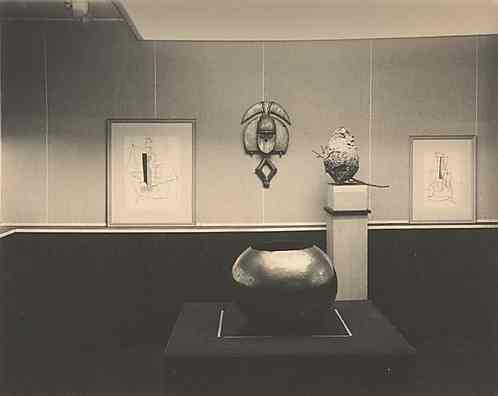
Stieglitz’s Picasso and Braque show at 291 Gallery (Dec 1914-Jan 1915). This features a Kota reliquary statue hung as art, like the fine Picasso nearby, a brass bowl, and a wasp nest. Source: Stieglitz photo from The Met.

Stieglitz’s Picasso and Braque show at 291 Gallery (Dec 1914-Jan 1915). This features a Kota reliquary statue hung as art, like the fine Picasso nearby, a brass bowl, and a wasp nest. Source: Stieglitz photo from The Met.

Since Georgia O’Keefe gave Mr. Stieglitz’s entire collection to the Met, the show packs in many surprises — his African works, his Matisse and Rivera paintings, and issues of Camera Work. There are key pieces from the Smithsonian’s National Museum of African Art and loans from Philadelphia’s Arnesberg collection.

In 1923, the Brooklyn Museum was the first museum in the West to show African art as “art” (versus “anthropology”), Penn was the first museum to actively collect it, and we all know what Mr. Barnes did when he displayed his magnificent modernist collection.

Check out all the objects in this amazing exhibition, but walk through the show in person if you can.

If you have some time, sit in on the curator’s talk via YouTube. Around 33:00 they start talking about the works in the show with a nice split screen that shows the speakers and the slides, so skip ahead and take a provocative, virtual tour.

I, YOU, WE: Art on the Front Lines of the 80s Culture Wars

Les Levine mounted his poster everywhere in the subway in 1981, a tough time in New York. Source: The Whitney © Les Levine for The Museum of Mott Art, Inc.

Les Levine mounted his poster everywhere in the subway in 1981, a tough time in New York. Source: The Whitney © Les Levine for The Museum of Mott Art, Inc.

It’s not a comfortable art show, but the 1980s weren’t comfortable times. The Whitney Museum of American Art’s show I, YOU, WE resurrects art from a time when artists were protesting inequality and gentrification, the AIDS epidemic was raging, Wigstock brought gender shifting into the open air, and New York’s downtown community waited apprehensively for the next police crackdown on squatters, community gardens, and anyone flaunting an alternative lifestyle.

As it prepares to move to the High Line in 2015, The Whitney asked its curators to mine its permanent collection to see if there were periods of time that might have been overlooked in the shows of recent years.

I, YOU, WE is the answer: the difficult, searching, and searing work produced by the passionate and disenfranchised denizens of New York’s tumultuous 1980s and early 1990s.

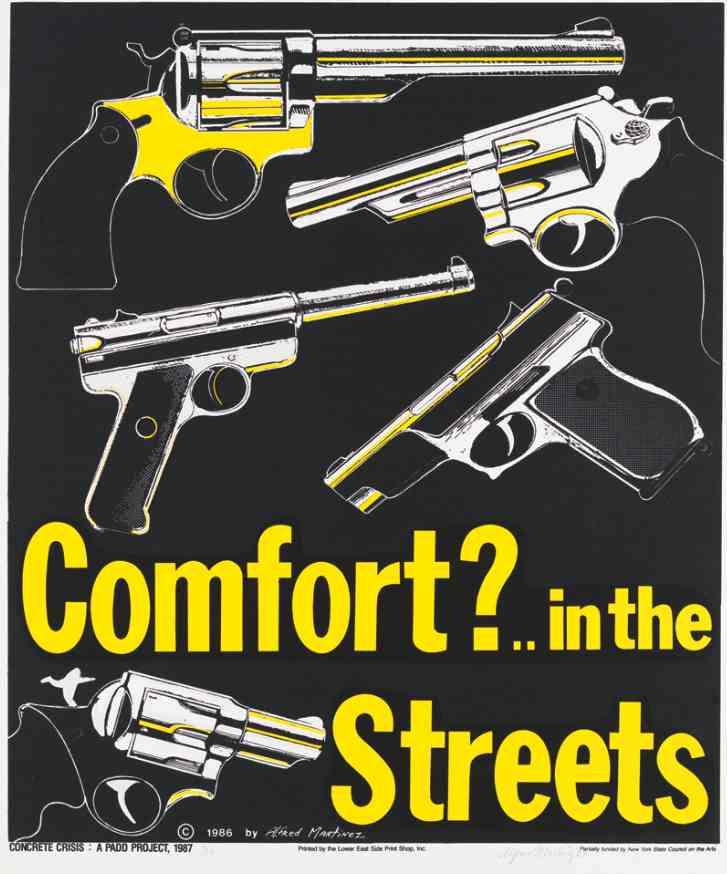
No one could miss Alfred Martinez’s 1987 screenprint. Source: The Whitney. © 1986 by Alfred Martinez

No one could miss Alfred Martinez’s 1987 screenprint. Source: The Whitney. © 1986 by Alfred Martinez

Works feature the flip side of Warhol’s Interview magazine and Studio 54 – people struggling with identities, illness, injustice, and the consequences of Washington’s culture wars against edgy art.

The Whitney produced this video about the “WE” section of the show, when artists began protesting gentrification, how they used art as the lever to galvanize the East Village, and the battles that raged for the community. Other sections of the Whitney show focus on artists’ exploration of race, gender, religion, and the AIDS crisis.

Revisit the emerging street styles – graffiti, comics-inspired drawings, stencils, and posters – as Andrew Castrucci of Bullet Space leafs through one of the seminal art-protest pieces.

When you visit, make enough time to Nan Goldin’s 700-slide extravaganza that documents everything.  Scroll down here to see installation views and  other works in the show by Mapplethorpe, Basquiat, Currin, Wojnarowicz, and Ligon. Tough stuff, but not tougher than the lives these artists lived during that decade.

Congratulations to the Whitney for not forgetting, presenting this work to the next generation, and testing if the work still sticks 20 to 30 years later. The show runs through September 1.

Brooklyn Museum Reveals Sargent’s Master Strokes

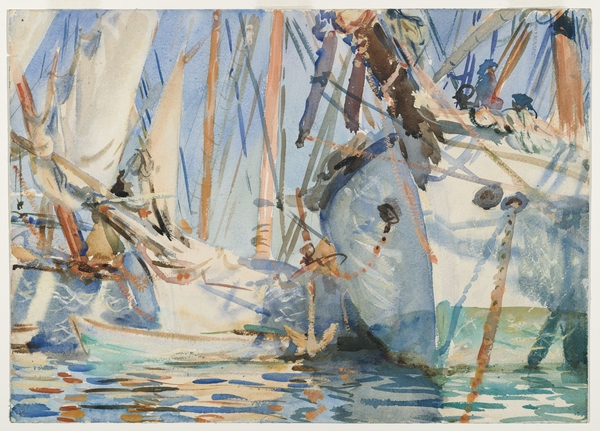
Sargent’s masterful 1908 White Ships. Translucent and opaque watercolor and wax resist with graphite underdrawing, Source: Brooklyn Museum.

Sargent’s masterful 1908 White Ships that he likely painted in a day. Translucent and opaque watercolor and wax resist with graphite underdrawing, Source: Brooklyn Museum.

Back in 1909, John Singer Sargent’s watercolor show at Knoedler was considered a knockout, drawing discerning crowds in awe of his sensational technique. The images of Bedouin life, Venice, and boats on the Mediterranean were so compelling that the Brooklyn Museum raced in to buy 83 (nearly all of them), forcing Boston’s Museum of Fine Arts to wait until 1912, when they could clean out his entire next watercolor show.

Bedouins

Bedouins (c.1905–6). Opaque and translucent watercolor, Source: Brooklyn Museum.

Walking into John Singer Sargent Watercolor on Brooklyn’s Fourth Floor, you can see why the two great institutions went crazy. With 93 of their finest Sargent purchases collectively displayed, it’s impossible for visitors to pick the most spectacular. They’re all exceptional – the Bedouin horses at rest inside the tent, Sargent’s niece wrapped in her cashmere shawl, the cliffs of the Carrara quarries, and the lush Medici gardens.

How did he make such magnificent work with such an unforgiving medium? How did he whip them out? The two museums asked a team of conservators and curators to put the works under the microscope and ultraviolet light to discern more about the master’s process – the sequence of paint application, the types of paint used, and whether he did a pencil sketch before applying paint to paper.

The team gives visitors insights to the scientific process used — an unusual twist at the back of the gallery that visitors poured through enthusiastically. Brooklyn’s digital team installed a 30-second video in which paper conservator Toni Owen asks visitors what more they’d like to know. Here’s the site where she answers with comments on Sargent’s use of gouache, soft-wax resist, yellow paints, and the difficulties of explaining false-color infrared imaging (FCIR) in limited-space wall text in the gallery.

Carrara: A Quarry (1911). Translucent and opaque watercolor and wax resist with graphite underdrawing, Photo: © 2013 Museum of Fine Arts, Boston

Carrara: A Quarry (1911). Translucent and opaque watercolor and wax resist with graphite underdrawing, Photo: © 2013 Museum of Fine Arts, Boston

You’ll learn that Mr. Sargent painted very fast, did not rely on photographs, and did at least one watercolor sitting in a gondola.

Brooklyn’s integrating much more media into its visual art shows, and they’ve hit upon a winning combination here. Some videos show the gardens that were the subjects of Sargent’s work in Italy. Others explain the techniques that Sargent used in the painting next to it.

Listen as artist Monika deVries Gohlke reflects on the type of day Mr. Sargent might have experienced working on his 1908 Melon Boat painting. Watch as she prepares the watercolors, selects his colors, chooses his brushes, and attempts to recreate his “jungle” of shapes and impressions. Does her painting look like his? You be the judge and go get your own paintbox.

More Time Tripping at Grand Central

Annex window view of Lothar Osterburg’s model of his dream of Grand Central as a zeppelin docking station back in the 1930s

Annex window view of Lothar Osterburg’s model of his dream of Grand Central as a zeppelin docking station back in the 1930s

Even if you didn’t manage to board the historic train cars at Grand Central in May, you can still go back in time, courtesy of 18 artists featured in the GCT exhibition in the New York Transit Museum Annex, On Time: Grand Central at 100.

Inspired by The Clock and the continual flow of people and trains through Grand Central, MTA Arts for Transit cooked up a delightful mix of contemporary 2D works, models, videos, and digital art that puts a smile on the face of every commuter, tourist, and art-seeker that we’ve seen inside the tiny Annex.

Look closely to find this minute secret portal: Ledge with Lunette, 2013 by Patrick Jacobs

Look closely to find this minute secret portal: Ledge with Lunette by Patrick Jacobs

Have you seen the mysterious Zeppelin posters by Lothar Osterburg on the subway? Right in the Annex window you’ll see the gigantic, fun-house model that he created to photograph as one step in the process of making the photogravure you see on the A train. Kids and parents can’t resist Lothar’s newspaper-covered multi-story GCT impression and the funny, fat yellow old-time taxis and zeppelin ends that poke out. Right next to it, you can examine his resulting print, Zeppelins Docking on Grand Central.

People are usually transfixed by the 2008 video documenting Frozen Grand Central, where Improv Everywhere staged a 250-person flash mob, where people “froze” for 5 minutes as commuters, tourists, and workers wondered what was going on.

Another hit is Grand Central Diary. London Squared Productions interviewed tourists and commuters about GCT, animated the furniture and items around the terminal, and…well, just watch The Clock and the Maintenance Cart speak for themselves:

Nearby, several small digital screens show Alexander Chen’s Conductor, a 15-minute video loop that animates the subway lines, suggesting trains moving through the system. He turns the subway lines into an animated stringed instrument. No wonder he’s working for Google Creative Labs. Spend a few moments, take a look, and experience it here.

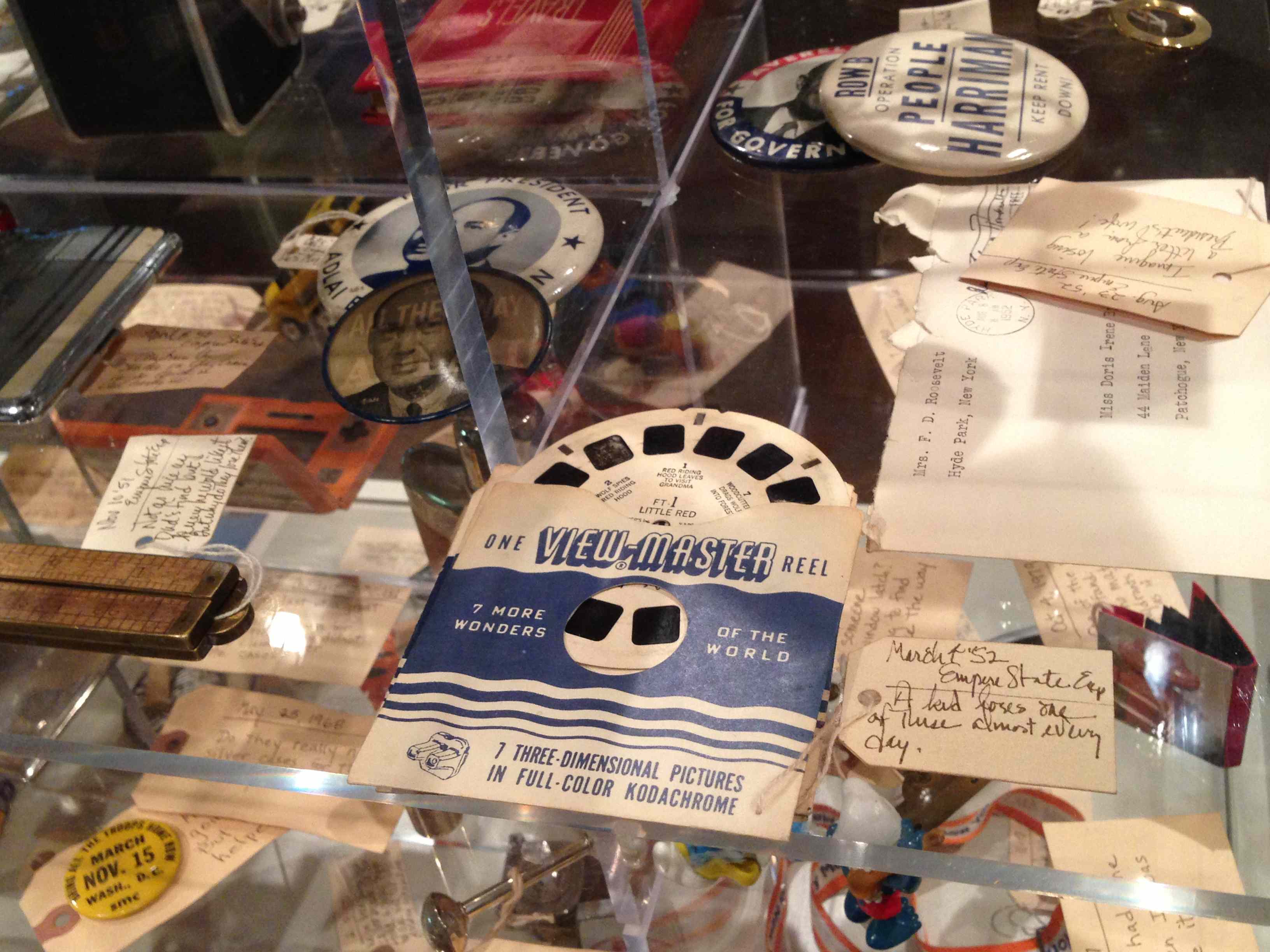
Close-up of Viewmasters and other leave-behinds inside Jane Greengold’s Lost and Found.

Close-up of Viewmasters and other leave-behinds inside Jane Greengold’s Lost and Found.

Another must-see piece (among many) is Jane Greengold’s Lost and Found. She’s created a sort-of fiction about the dozens of tagged items in the vitrine, evoking the memories and observations of generations of conductors who found items that train passengers left behind. Actually, the items you’re looking at are actual leave-behinds collected by real-life conductors, so Jane’s work isn’t entirely made up. The archeological discoveries include things from the old Lake Shore Limited on the NY Central, a 1948 boxed baby tooth, 1943 ration cards, 1952 Viewmasters, a Kennedy campaign button, and a Kindle.

Get to the Annex before July 7. In the meantime, check out curator Amy Hausmann and her artists telling about the fun they had contemplating time, architecture, fashion, and Jackie O.

Bird Watching Opportunity at The Met

1-4 Birds in Japan

Detail from Flock of Cranes (1767-1784) by Ishida Yutei, a six-panel folding screen

An avian free-for-all is happening on the second floor of the Met’s Asian Wing, with a lot of flapping, stalking, crowing, and displaying for all the world to see through July 28.

The birds (and one big, hairy deer) really come alive in the Sackler Wing show, Birds in the Art of Japan, The curators went into the collections to dig out masterworks featuring dozens of species of birds native to Japan, including medieval to modern clothing, jewelry, paintings, sculptures, ceramics, and baskets. If you’re a bird-lover still wondering whether the AMNH will ever bring back the Birds of the World dioramas in all their splendor, you’ll find comfort on examining all these species close up in the quietude of the Met,

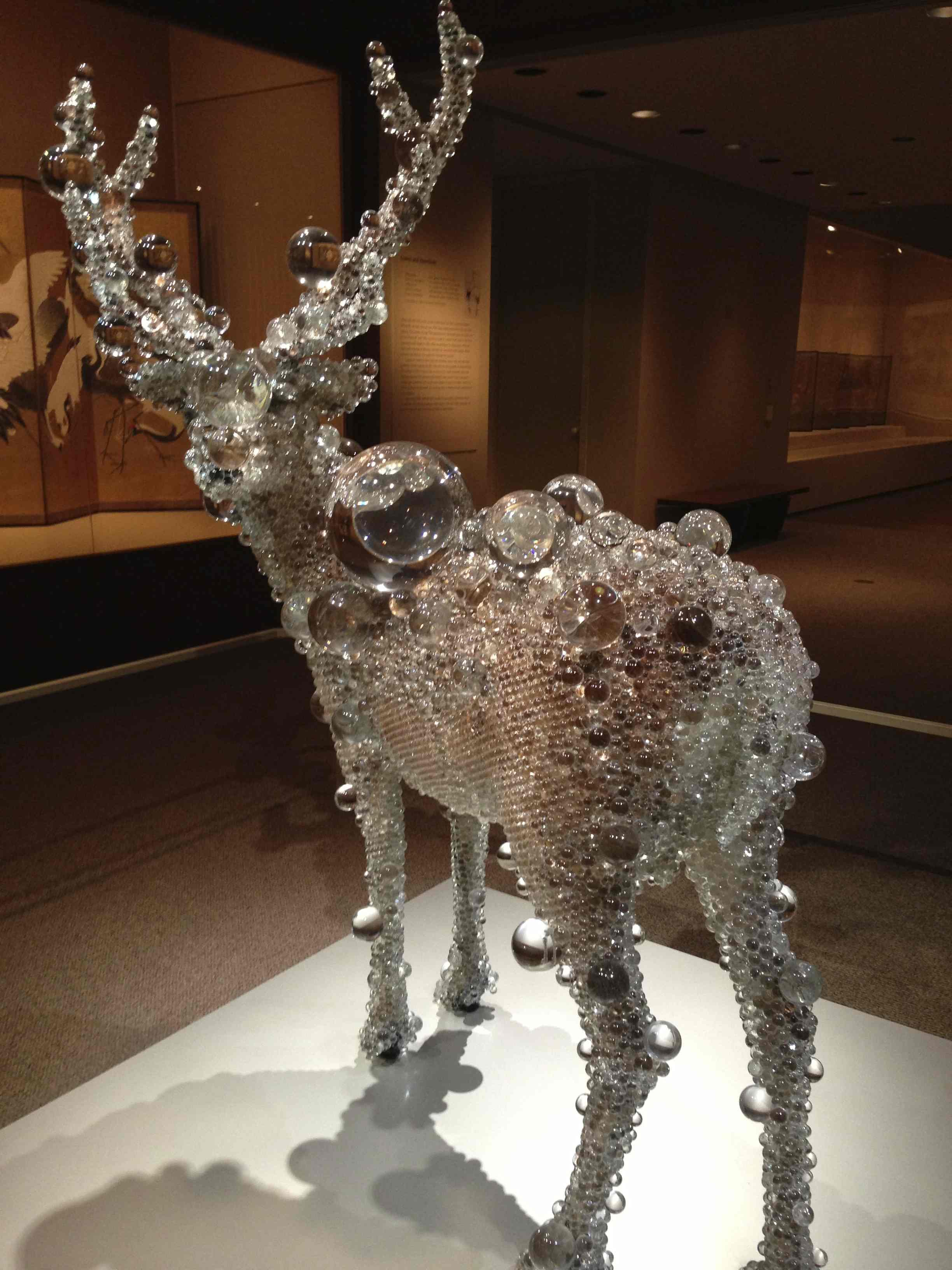
The exhibition starts behind the 12th century Buddhist temple platform and just past the 13th Century Bodhisattvas, where you’re greeted by a charming rooster that’s actually an 18th century incense burner. Turn the corner and you’ll come face to face with a startling 2011 Japanese sculpture — Kohei Nawa’s PixCell-Deer#24, an auspicious presence (ref. the messenger animal of the Shinto deities) in the form of a taxidermy specimen that Kohei creativly covered in glass bubbles.

How did Kohei Nawa’s deer get in here?

How did Kohei Nawa’s deer get in here?

Every gallery delivers a surprise, from the water birds area right through to the “exotics”. Exquisite paintings of the 1700 are interspersed with startling realistic works by the masters of the forge. One of the show-stoppers is a spectacular life-size iron eagle hovering from his perch in the raptor gallery that the curators reckon was made for display at one of the late 19th century world expositions. The detail is amazing. Each feather was forged and riveted individually onto the bird’s metal body. It’s no wonder that the eagle, a nearby raven, and another headdress normally live in the Arms and Armor Department at The Met. Nice collaboration!

Check out our Flickr site for a walk-through of some of our favorite works, including the embroidered Phoenix-covered kimono, the 1908 Peafowl painting/screen by Mochizuki Gyokkei, Asano Toshichi’s hawk-shaped zither, and Kamisaka Sekka’s artistic book, which is brilliantly displayed in interactive form by the Met’s digital team.

Spectacular iron eagle lent by Arms & Armor Department

Spectacular iron eagle lent by Arms & Armor Department

Enjoy this wildlife walk through the eyes of artists on the other side of the world, and be sure to relax in the George Nakashima reading room – a kind of “fire pit” roundtable where we found visitors sharing their impressions of the show. Check out the Met’s on-line catalog of the exhibition, but do yourself a favor and hike over to the Met in the next month before these birds fly away back to the collections.

You won’t be seeing the birds in the wild, but it’s likely that J.J. Audubon would approve. You’ll find joy in getting to know your new Asian friends, who you will likely spot in future exhibitions or in the aviary at the zoo.

Kimono embroidery detail. What did the Phoenix signify to this 19th c. bride?

Kimono embroidery detail. What did the Phoenix signify to this 19th c. bride?

Enter House of Memory at The Customs House

Detail of Dad’s House, (2012). Horse hair, feathers, cotton cloth, Photo by Clarissa Rose Pepper.

Detail of Dad’s House (2012). Installation with horse hair, feathers, cotton cloth, Photo by Clarissa Rose Pepper.

What do you remember about where you grew up? About your family when you were young? C. Maxx Stevens, an artist of the Seminole/Muscogee Nation of Oklahoma, answers these questions for herself (and us) in the evocative show, House of Memory, in its final weeks at the Customs House at the Smithsonian’s National Museum of the American Indian in New York.

Stevens, currently teaching art at University of Colorado-Boulder, scrounges around in junk stores and yard sales out west to find the ephemeral materials for her installations – slightly transparent gauze made into hoop-skirt structures and large multimedia recreations of 1950s homes with floating scrims. Can you see through the haze?

The experience of walking around the show takes you back to corners of Stevens’ memory growing up in a multitribal community of Plainview, Kansas, just outside Wichita. It may not be like your own experience, but the stuff she weaves, scatters, and constructs will cause you to tap into your own memories.

Three Graces (2004) installation. Source: Eitelijorg Museum of American Indians and Western Art, Indianapolis

Three Graces (2004) mixed-media installation. Source: Eitelijorg Museum of American Indians and Western Art, Indianapolis

The first gallery with The Three Graces is a tribute to her relationships with her sisters, and a must-see for lovers of fabrics, textiles, and interwoven mixed media.

The second gallery has several installation that resemble mini-stage sets that trigger memories through scattered photos, altered clothing, suspended objects, horse hair, garden stakes, and evocative combinations of other props – Dad’s House, Mum’s House, Sister’s House, Four Directions House, and House of Transitions.

Detail of Cultural Landscape installation of 1950s houses (2012). Photo: Clarissa Rose Pepper

Detail of Cultural Landscape installation of 1950s houses (2012). Photo: Clarissa Rose Pepper

Cultural Landscape is an immersive installation with tiny illuminated homes (found in thrift stores), scrims, and multimedia that “remembers” the 1950s streets of her suburban Kansas community.

The Smithsonian chose to publish black-and-white photos of the installations, which we’re using here. It’s kind of fitting…not quite of-the-moment and a little back-in-time feeling.

Want to reflect more about your own childhood home, your grandparents, and your neighborhood? Take a trip down to the Customs House before June 16, and let Stevens take you on that journey.

NMAI is making the leap into downloadable digital media with this show, so go to the iTunes U store, type in “NMAI-NY” and download the app, which contains an audio guide for this show. If you’d prefer to read about Stevens and her work, download the PDF.