How di Suvero Makes Steel Move

Rust Angel sculpture (1995) by Mark di Suvero at the edge of the Parade Ground at Governors Island

Even if you haven’t caught the monumentally good outdoor installation of Mark di Suvero’s work on Governors Island (check out the photos), the folks at Storm King Art Center are making sure that you don’t miss it.

Thankfully they asked filmmaker Dirk Van Dall to capture how it was all transported down the Hudson from Storm King’s 500-acre campus an hour north of the City. The short film follows di Suvero around the Island to inspect the (literal) heavy lifting.

In 2010, di Suvero won National Medal of Arts, and in the film he talks about his lifelong fascination with steel, his early employment at the Fulton Fish Market, how neighborhood kids inspired him to begin creating large-scale fun works, and how he makes the seemingly immobile move. Listen in.

Drop in at the Governors Galleries this weekend to talk with the Storm King folks, and join their walking tour of the works at 2pm.

Disturbed Bird Watching on The Bowery

You don’t need binoculars at the slightly subversive installation at The New Museum featuring dozens of fantastical avian creatures.

The Parade is Nathalie Djurberg’s collaboration with musician Hans Berg, which fills the space at Studio 231 (to the right of the museum’s main entrance). As you poke and pick your way among the feathered flock (actually painted canvas, wire, and other assembled materials), you may feel a little unsettled.  Then you’ll notice several video screens on the walls in which the animated people and creatures do, well….not so nice things.

Djurberg’s known for her animated films in which her animated clay sculptures do horrible things. She says that in order to position her little characters correctly, she often has to act out the parts so she can understand how to portray the movements during the tedious shot-by-shot animation process.

As you watch surrounded by the bird parade, Berg’s music often layers sweet sounds on top of some disturbing candy-colored images, making your safari through 231 more than a little unnerving.

This Swedish team was originally commissioned by the Walker in Minneapolis. Download the audio guide to The Parade and take the journey.

Cool Off in Dublin Water Works

During the summer heat wave, there’s a way to cool down in Chelsea and let the team from the Science Gallery at Trinity College challenge you to think differently about the splashing water you take for granted.

Take advantage of the final weeks of Surface Tension: The Future of Water at Eyebeam Art & Technology Center on West 21st Street, an incubator for digital art/design experimentation. For the past two-plus months, they’ve hosted an exhibition (first curated in Dublin) on the social-economic-political tensions created by water scarcity.

As soon as you walk into Eyebeam, you’ll be struck by the plethora of infographics that show you just how much water bounty that we have in the United States versus the availability and consumption per capita in the rest of the world. What’s your water footprint?

One of the ways you’ll find out is by looking at The Virtual Water Project, a celebrated infographic by German designer Tim Kekeritz, that depicts everyday objects and the amount of water required to produce them. Download the iPhone app. For $1.99, it will blow your mind (but not your budget) and continue to deliver a truly a conscious-raising experience of epic proportion.

Another unforgettable experience is Bit.Fall by artist Julius Popp, an installation that translates words from Internet newsfeeds into bits that are reconverted into a stunning waterfall of words:

There’s so much great stuff: multiple takes on water consumption, conservation, next-gen thinking, third-world innovations, and art-meets-technology solutions. Like Tele-Present Water by David Bowen, which recreates actual water movements from NOAA data being collected from a random buoy out in the ocean.

If you can’t get over to Chelsea for an hour, just click through the thought-provoking objects, artworks, design solutions, documentaries, and thought pieces by the scientists, artists, engineers, and designers whose works are on display on the Dublin microsite.

Egyptian Animal Planet at The Met

Animal lovers, rush to see the final days of a truly spectacular journey back in time to experience the African wildlife that bounded across the still-lush lands surrounding the Nile. Tucked back into the lower level of the Met’s Lehman Wing, it may be easy to miss The Dawn of Egyptian Art, but don’t!

The items in this show are embellished with some of the liveliest, whimsical, and dramatic creatures, big and small, that entranced the citizens of Dynasties I and II, over five millennia ago.

Back in 3300 B.C., it was all about the animals – carvings of sleek and savvy jackals, mehen game boards in the shapes of snakes and turtles, fat bird jars, and frog containers that would make 14th century Mesoamerican artists jealous.  Who knew that you’d carry your stuff around in ostrich-egg containers? Or use palettes adorned with antelopes and turtles? Or have hair combs decorated with giraffes, hippos, and wildebeest? (Pre-dating Hello Kitty by about 5,000 years.)

It’s as if the curators were mounting a show for the AMNH, because they clearly have an eco-anthro explanation about the hottest trends. Examples: elephants were commonly seen in the lands around the Nile around 3700 B.C., but they vanished from the desert (and thus, from the art) by 2649 B.C.

Also, around 3300 B.C., there was art trend to portray some animals as sacred. But it wasn’t until the Upper and Lower Egyptian kingdoms were united in 2150 B.C. that animals were used as royal symbols and the well-known style of animal-head-on-human-body became the thing.

Jackal (ca. 3300-3100 B.C.)

Other highlights of this show include the Two-Dog Palette (which gives the famous Narmar Palette a run for its money) and a seemingly unremarkable ceramic bowl that documents a time of unprecedented high-tech innovation in 3700-3450 B.C. textile making: a new technique with ground looms that enabled the ancient Egyptians to weave the strongest, widest linen in the world (ever).

Join this safari and go spot some big game through the eyes of the ancient Egyptians.

Daring Sea Rescue Yields Treasure

Treasure is what you’ll find in the upstairs galleries of The South Street Seaport Museum in Lower Manhattan, following its daring rescue by The Museum of the City of New York.

Armed with a two-year plan, a dedicated team, and construction crews, MCNY figured out how to transform former storage areas into sixteen beautiful galleries, re-open, and give new life to the museum and iconic tall ships anchored downtown.
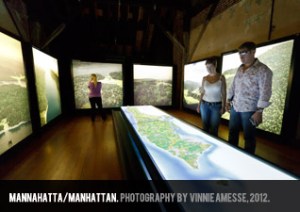
In a brilliant use of space, MCNY enables us now to enter three separate time machines that should warm the heart of any NYC booster, particularly the side-by-side installation of two versions of Manhatta (the original name of our island community). The first is the (slightly reduced) reinstallation of the acclaimed Manhatta exhibition (and scientific project), which shows you visions of the island, inhabitants, geology, river systems, and fauna that Henry Hudson would have seen in 1609. (Crowds flocked to this uptown in 2009, so you here’s your second chance.)

The second is the adjacent gallery, where you can sit down and contemplate three stunning simultaneous views of our waterfront — Paul Strand’s famous 1921 documentary of our waterfront (Manhatta), Edison’s early 1900s views of our water’s edge, and a contemporary visual meditation. Time travel doesn’t get any better than this!

The third view, MCNY’s Timescapes film, sweeps more grandly over time and history. Images pop onto three screens as Stanley Tucci narrates the whole, complete story, from forested island to home of the High Line. It’s hard to take it all in, but you’ll be swept away and seriously, it will make you proud.

Although these shows are in open-ended runs, check them out sooner rather than later. Although the Seaport Museum has been thrown a lifeline, it’s only temporary. MCNY only has 18 months to demonstrate that these stories, ships, artifacts, buildings, Bowne & Co. Stationers, and galleries are worth saving.

Be part of the rescue. Shop at Bowne, bring your friends, and step back in time.

Venus in Transit or Fur

In an out-of-this-world coincidence, Venus (the planet) gave Venus in Fur (the play) a run for its money yesterday, pulling in gigantic audiences in New York City just a few days before the Tony Awards.

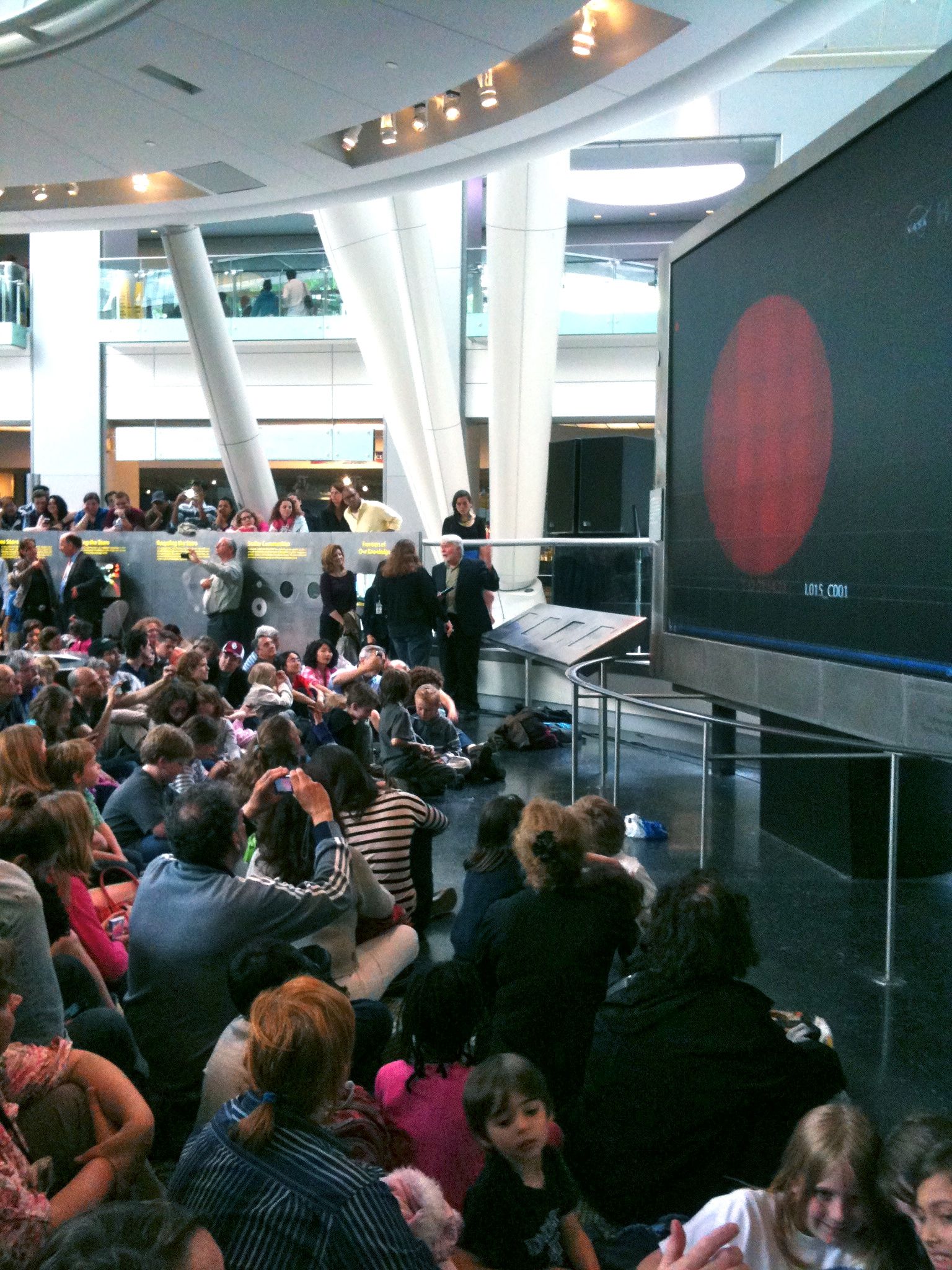
On an intermittently cloudy day, crowds flocked to the Hayden Planetarium (AMNH) to watch Venus (the planet) begin its stroll across the face of the Sun via the NASA feed projected on the giant screen in the Cullman Hall of the Universe. Venus put on similar shows in 1882 and 2004. Hundreds of science geeks heard astronomer Steve Bayer interpret what they were seeing on the live simulcast generated from Hawaii’s Mauna Kea Observatory.

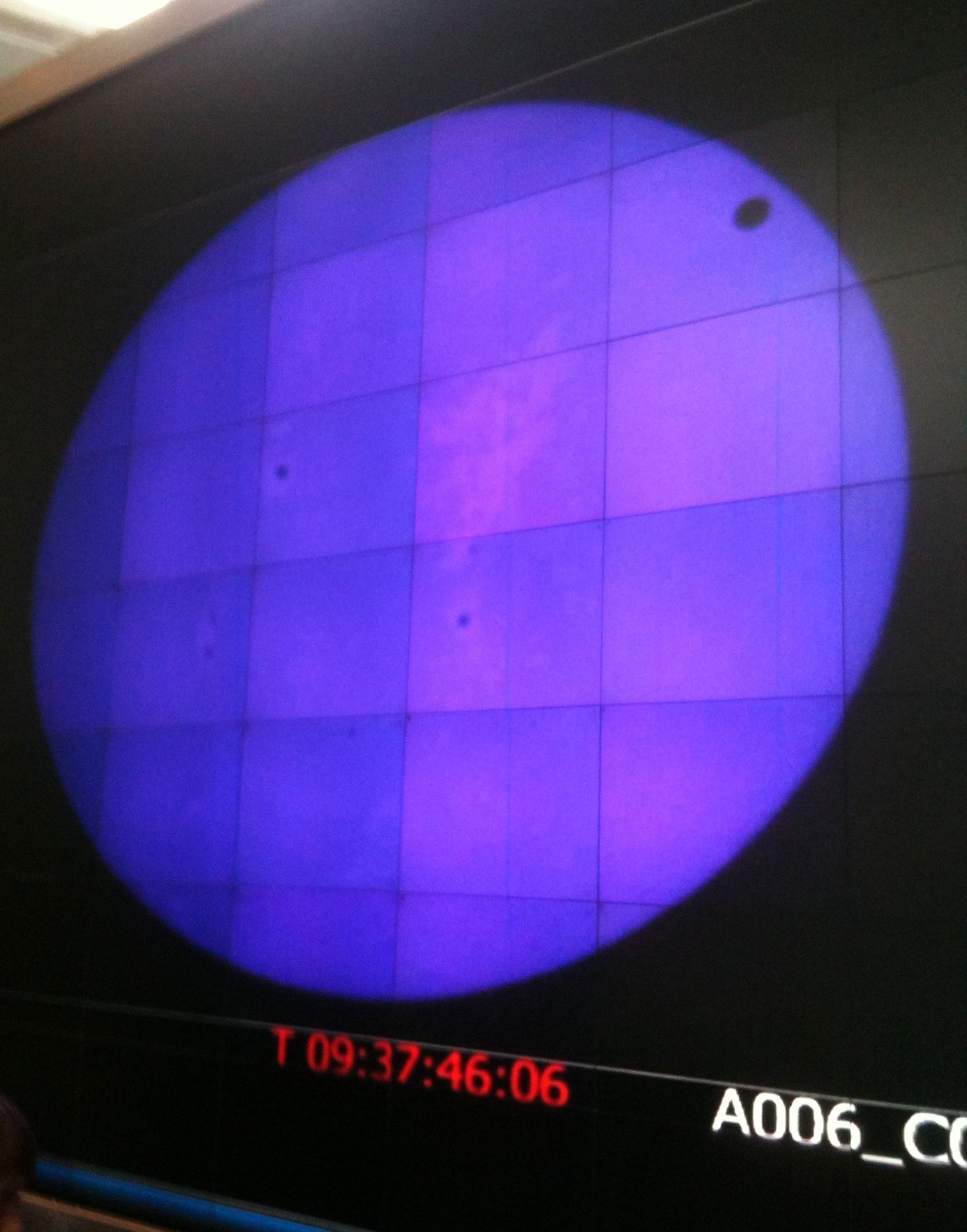
Venus (the planet) appeared as a tiny dot at the “8 o’clock” position on the Sun’s disk and kept on moving across until well after midnight (like the movements of Tony Award and theater attendees). The AMNH cut the live feed around 7pm, but not before the planetarium paparazzi snapped photos of the disk, and the diminutive moving Venus dot with and without friends, families, and kids in front of the giant screen to commemorate this once-in-a-lifetime event. Check out the photos.

Our only questions are 1) will Venus in Fur favorite Nina Arianda get similar attention at the Tony Awards next Sunday a few blocks south at the Beacon, and 2) will you see Venus in Fur before it completes its Broadway transit in two weeks?

Venus begins its journey across the Sun

Manhattan’s Digital Grid

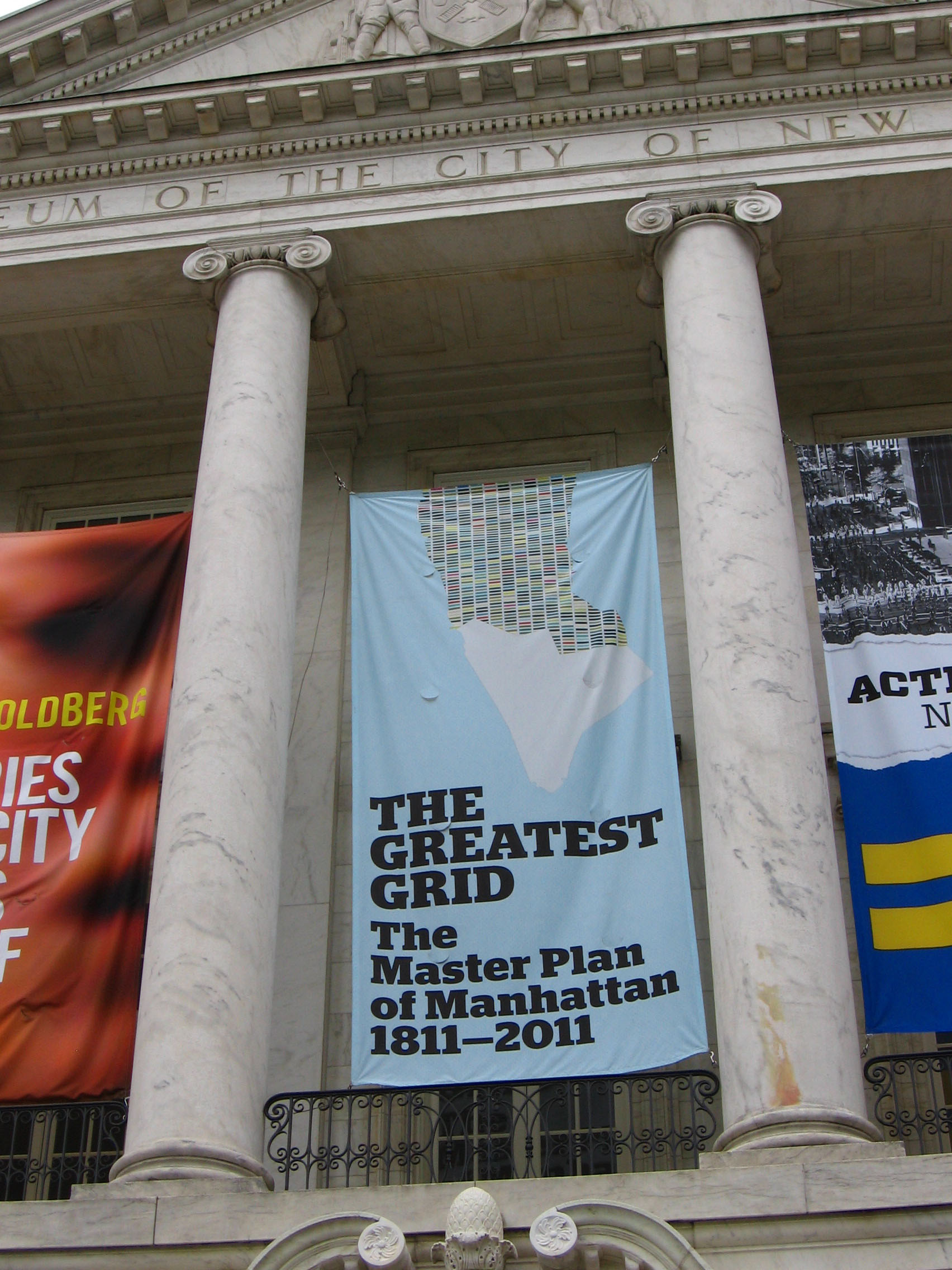
How much fun can you have with the Manhattan Grid? Plenty, if you have computer access and can make a trip (before July 15) to the The Greatest Grid exhibition at the Museum of the City of New York.

Plan to spend a couple of hours wrapping your mind around how the farmland in your neighborhood was leveled by hand and horse cart to make the wide, smooth streets and sidewalks we’re used to today. (You’ll quickly see that the East Side’s Second Avenue Subway construction isn’t that big a disruption after all!)

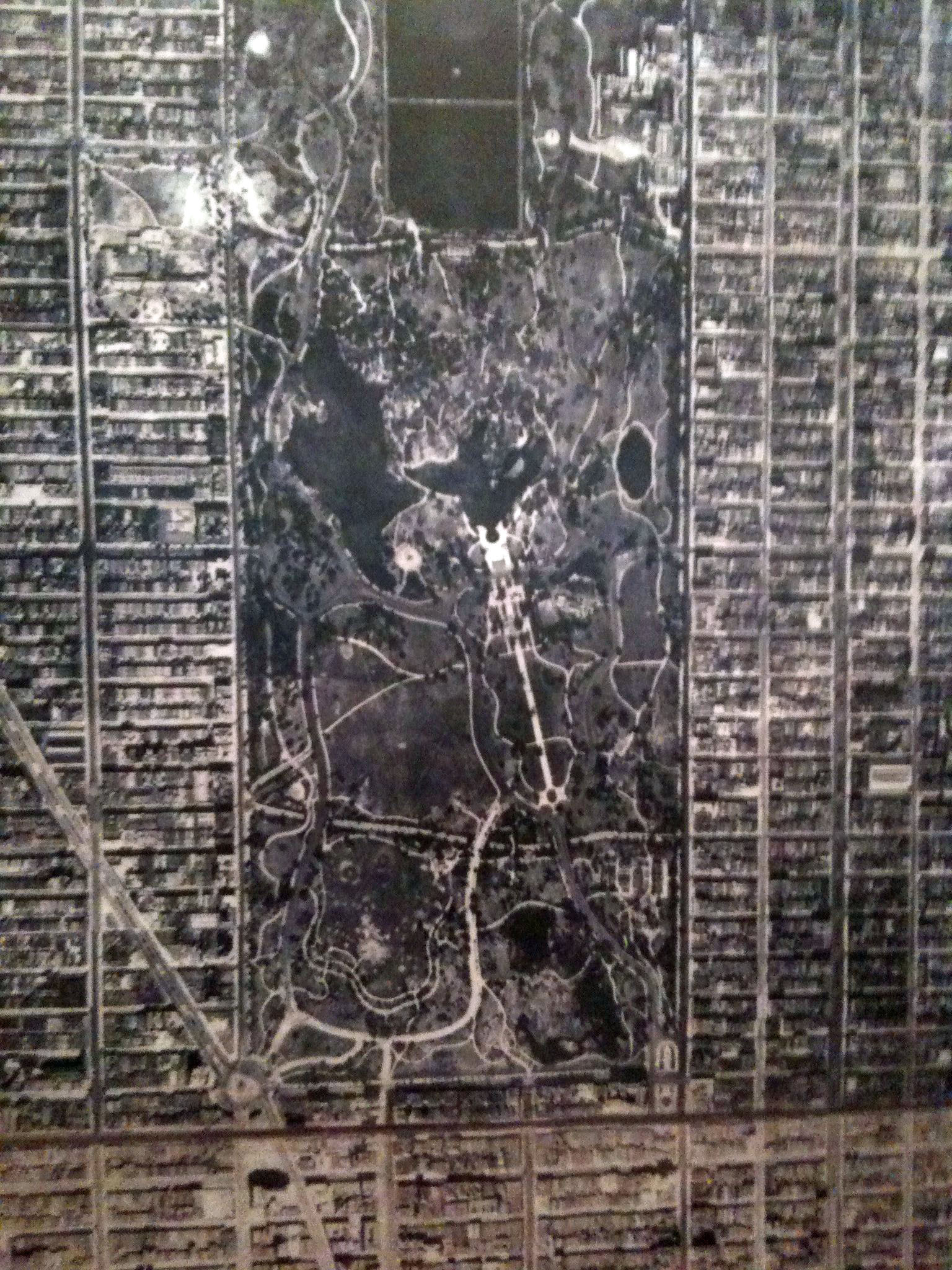
Go online and check out one of the exhibit’s highlights – a digital composite of 92 farm maps drafted in 1818-1820 by John Randel, Jr. to show how the grid would bisect various hills, rivers, streams, swamps and pastures in years to come. Zoom in on your street and see who owned your property in the early 1800s, and read how MCNY worked with the City create this cool online map.

Also, take a look at the digital maps posted by The New York Times, including Randel’s big 1811 map of the grid (the centerpiece of the MCNY show), the 1836 farm map, and other interactive images created by the NYT team. Clicking through the views on the left will reveal all sorts of interesting history.

Check out the Channel 7 Eyewitness News video, featuring an interview with the curator (NYU’s Hillary Ballon) and a peek inside the show.

Want to do a little time travel on the modern version of the Manhattan grid or another borough? It’s easy. Go to NYCityMap and type in an address. When the schematic map appears, clock on the “Photo Camera” icon at the top of the map and you’ll see an aerial view of the neighborhood. Move the slide bar to enjoy the view to any time between 1924 and today to see what the block was like way back when.

Bioluminescent Superstars

You don’t need to be James Cameron or build your own submersible to peek in at the amazing stuff in the deep, deep ocean. The American Museum of Natural History has pulled together a gallery of some of the strangest creatures of all time for its Creatures of Light: Nature’s Bioluminescenceshow.

Credit: AMNH/E. Grosch

In the deep, black depths of the ocean, several varieties of Anglerfish have strange bodies, heads, and hunting apparatus – bioluminescent fishing lures. They can light up these lures and also affect a strange glow due to the presence of their own colonies of bioluminescent bacteria.  You can’t make this up.

Want to catch a glimpse fast? Look at the Anglerfish video.

If you want to linger over these unbelievable deep-water superstars, go right to the Flickr Luminous Lures page.

Hey, Socrates, What Do You See?

If you’re hankering for last summer’s BMW Idea Lab, zoom in on the conversation on the future of Long Island City and the shoreline near Socrates Sculpture Park at the Noguchi Museum’s visionary show Civic Action.

Noguchi and Socrates have commissioned four artists to work with architects, designers, and urban planners to reimagine the surrounding neighborhood, a mélange of homes, high rises, light industry, and Costco. The proposals by Mary Miss, George Trakas, Natalie Jeremijenko, and Rirkrit Tiraanija are on display at the Noguchi for a few more days. Other related installations will appear at Socrates in May.

If you can’t get to Queens, go virtual by checking out three videos and watch the brainstorming among artists and planners:

Enjoy the discussion and contemplate some exciting futures.

Farming The Grid

Did anyone notice that there’s new land and a farm just east of First Avenue and 29th Street? It used to be a dirt-road exit from the FDR, but not anymore.

If you’ve visited the blockbuster show The Greatest Grid at The Museum of the City of New York, you know that around 1804 this section of Kip’s Bay was being homesteaded by the various Kips relatives before their land got gridded.

Well, the farm has come back, courtesy of Tom Colicchio’s protégé, Sisha Ortuzar, the top chef at Riverpark restaurant tucked back behind Bellevue in the ground floor of the glamorous new Alexandria Center – a biotech high-rise whose tenants include Pfizer and ImClone (remember them?).

Because scientists can get hungry, too, Colicchio opened up his ‘Wichcraft sandwich shop right next door in the plaza inside a bright, shiny, Apple-worthy glass cube.

The farm is producing fresh produce for the Colicchio businesses on site (look at the crop list), and his crew is also giving tours and workshops on urban farming.

Check out the photos of the new land and spring crops. And drop by the farm the next time you’re on the M-15.