Visionary Collector Amasses Trove of Radical Works

It’s quite a leap from taking an art appreciation class with your daughter in your mid-thirties to assembling an enormous collection of paintings by radical art-world revolutionaries and anarchists. But that’s what one woman did and and the work is on display in Radical Harmony: Helene Kröller-Müller’s Neo-Impressionists, on view at the National Gallery in London through February 8, 2026.

Crowds have been flocking to see incredible works by Seurat, Signac, and Van Gogh, and meet the Dutch and Belgian painters who adopted their breakthroughs and ran with these innovations for two decades at the end of the 19th century. 
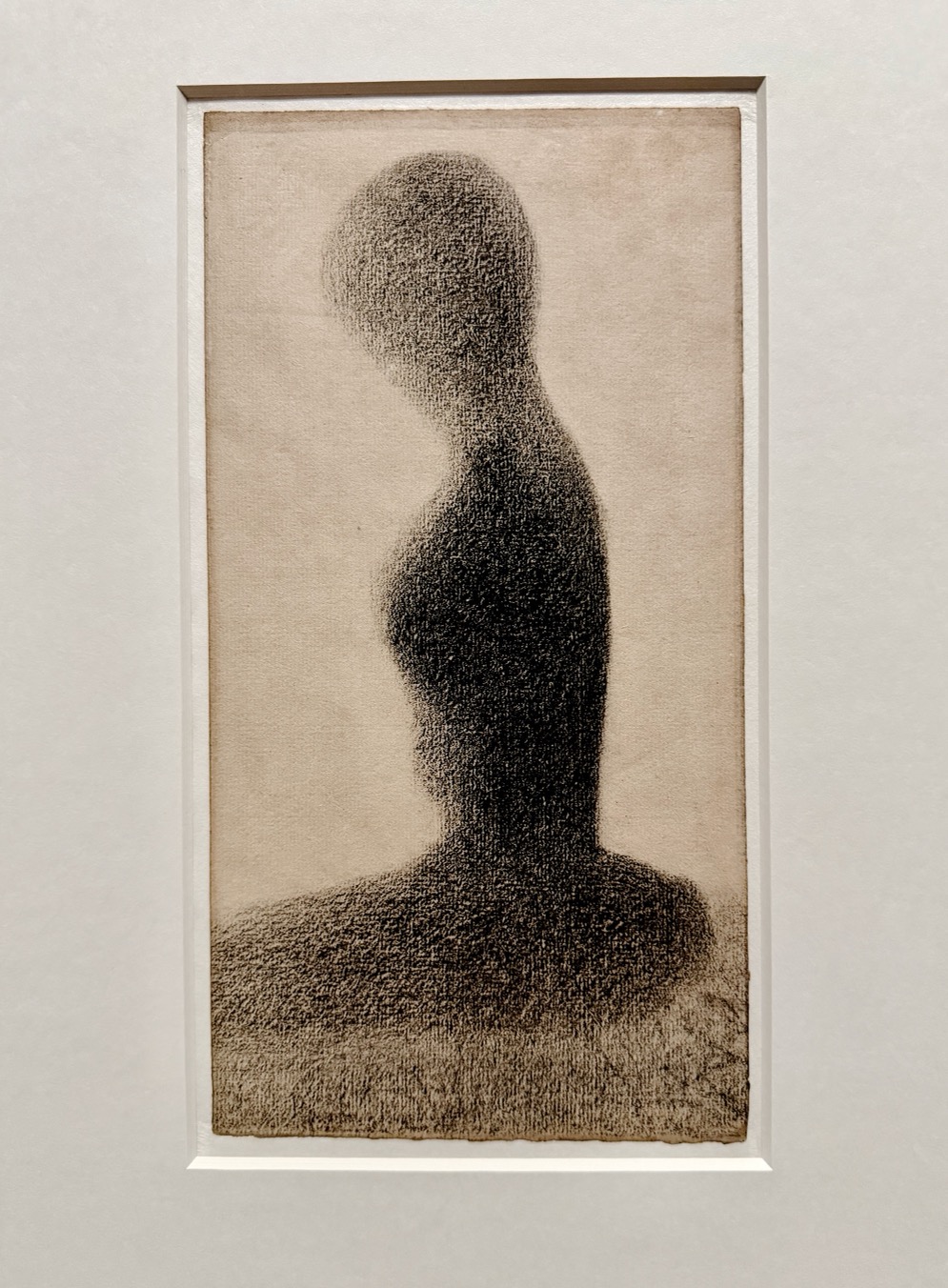
Seurat’s 1884-1885 Young Woman: Study for ‘A Sunday on Le Grande Jatte’” – a radical abstracted, dematerialized image. Courtesy: Kröller-Müller Museum

Maginificent, much-loved works were collected in the early 20th century by Helene Kröller-Müller, the daughter of a wealthy German industrialist.  Her husband ran businesses for her father (and eventually his entire company) in Rotterdam, where they lived.

Helene was always encouraged to follow her intellectual interests, and new ideas. After taking a class about art in 1905 from Dutch artist/dealer/critic H.P. Bremmer, Helene began to understand why the radical colors, compositions, and subjects in paintings by Van Gogh, Seurat, and others moved her so deeply. Working with Bremmer as an advisor, Helene eventually amassed the largest collection of Van Gogh paintings and drawings in the world (outside of the Van Gogh Museum itself).
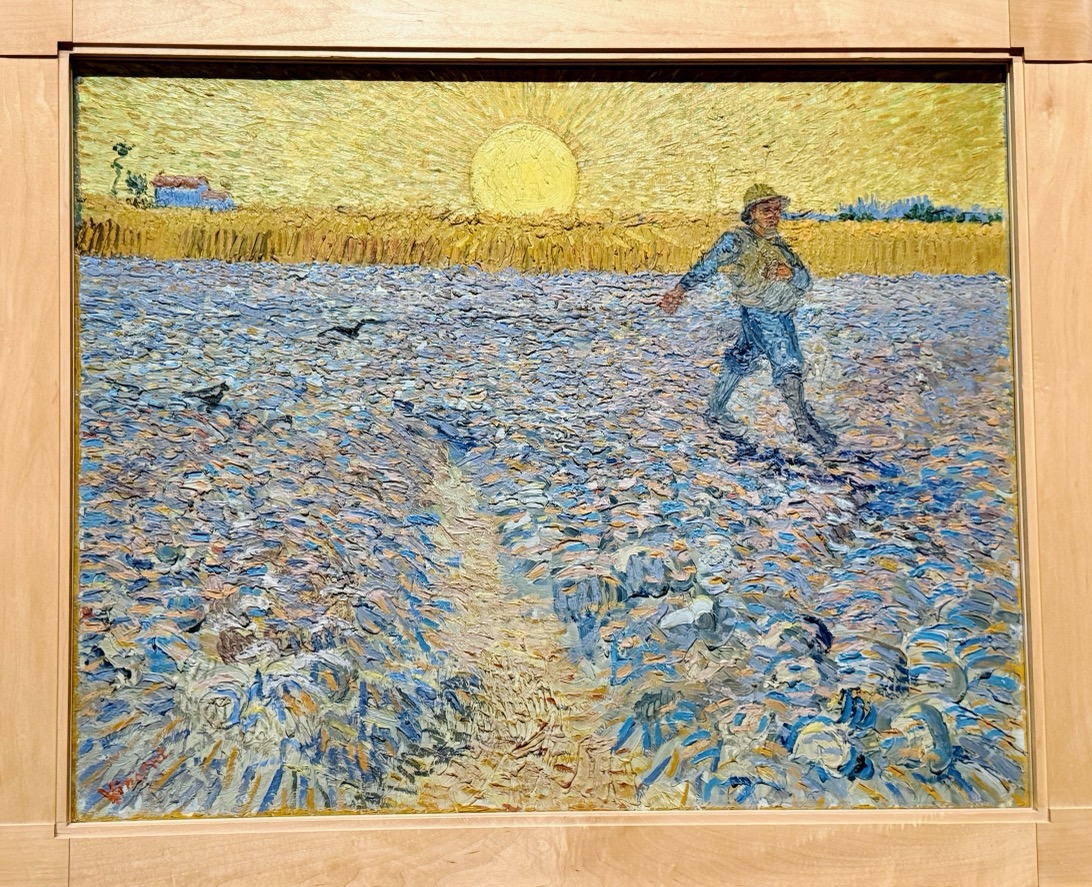
Van Gogh’s 1888 oil The Sower with the Sun rising hopefully over a rural worker. Courtesy: Kröller-Müller Museum

Helene sometimes accompanied Bremmer on buying trips with the goal of creating a public collection where people could see and experience the genesis of modern art.  In 1912, they even visited Signac in his studio, where Helene purchases two magnificent tranquil harbor views – one by Signac and one by his late friend, Seurat.
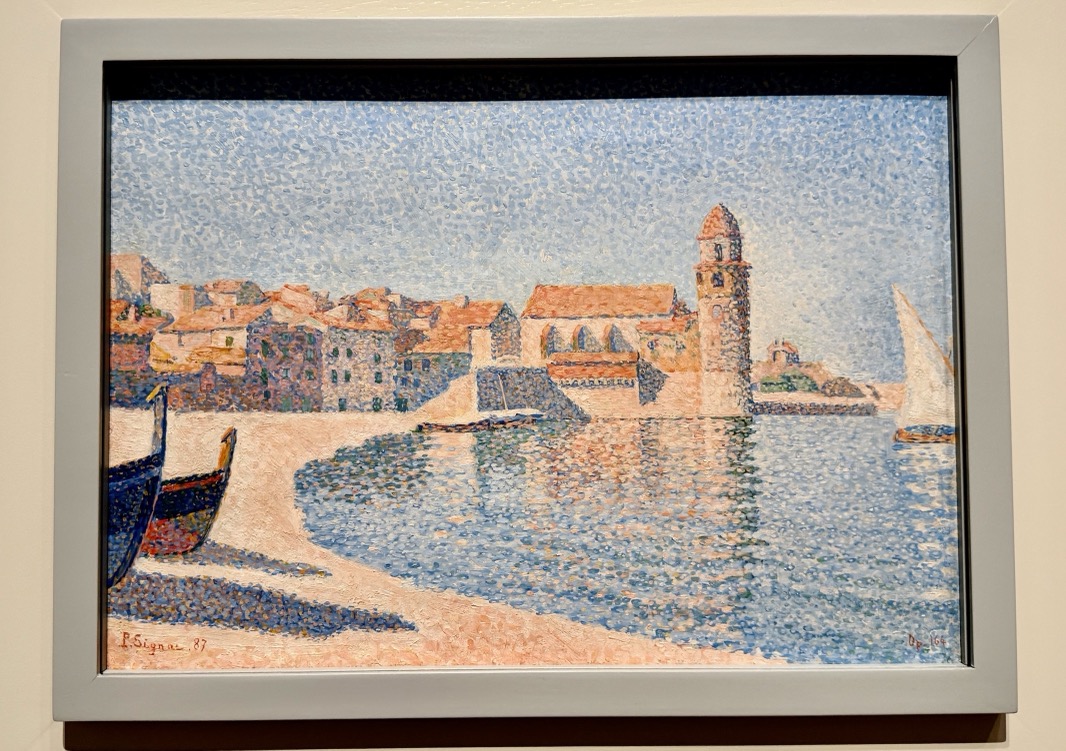
One of Helene’s first “new art” purchases on a buying trip to Paris: Signac’s 1887 oil pof the French Riviera capturing the Sun’s reflected light – Collioure, The Bell Tower, Opus 164. Courtesy: Kröller-Müller Museum

Here’s a brief video about Helene Kröller-Müller’s passion for art, how she built her massive collection, and the beautiful museum in the Netherlands countryside that should be on every art lover’s bucket list :

This gorgeous exhibition in central London shines a light on this visionary collector, but the focus is less on Helene’s history and fully on her stellar collection of Neo-impressionist painting and related works from the National Gallery and other collections. See some of our favorites in our Flickr album.

The exhibition begins with paintings by Seurat and Signac, who adopted color theory for their pointillist techniques to create shimmering images of simplified, tranquil harbors and seascapes. This new radical painting approach electrified artists across Europe, such as Belgian painter Theo van Rysselberghe and Dutch artist Jan van Toroop, whose works are also hung in the first gallery.
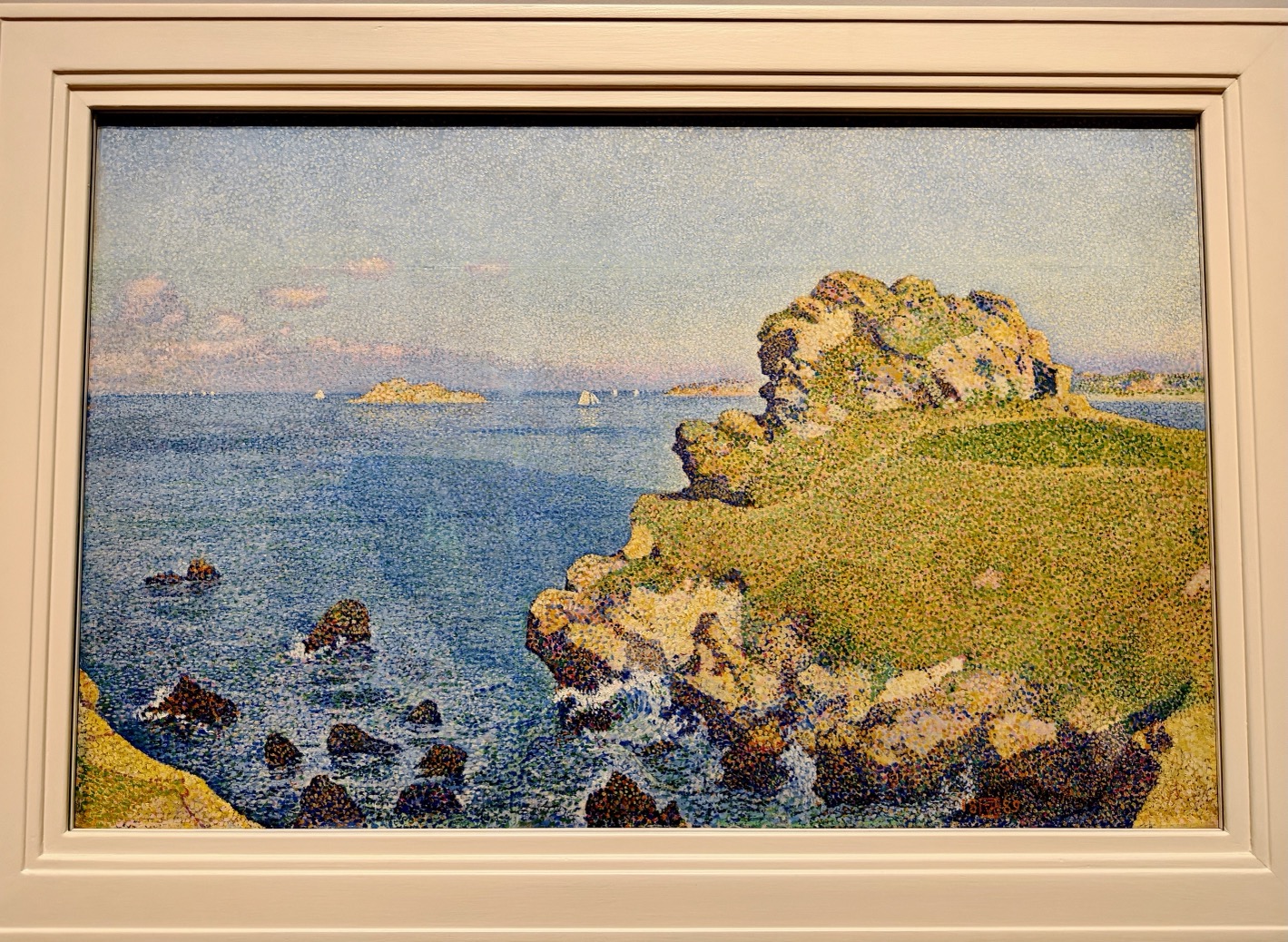
Van Rysselberghe’s 1889 oil inspired by Seurat ‘Per-Kiridy’ at High Tide. Courtesy: Kröller-Müller Museum

At a time when industrialization was transforming life, Helene did not shy away from acquiring works made by artists proud of their radical, progressive politics. Many of the artists featured in the exhibition were proud to call themselves anarchists – passionate radicals who used art to advocate for workers’ rights, elevate the image of working people, and create a hope of increasing harmony with nature.
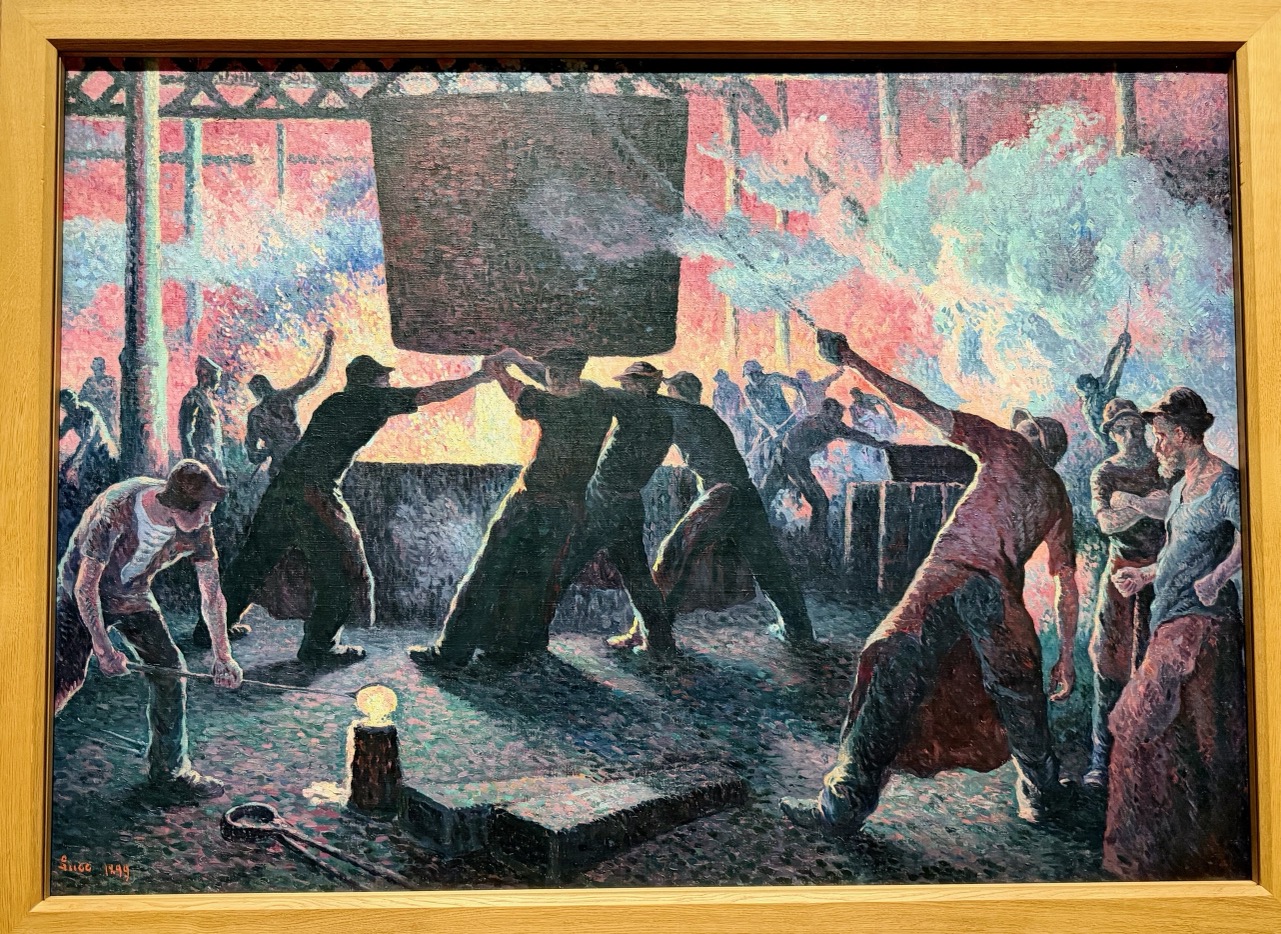
Maximilien Luce’s 1899 The Iron Foundry showing strength and integrity of Belgian steel workers amid dangerous conditions – an acquisition that hung in the office of Helene’s industrialist husband. Courtesy: Kröller-Müller Museum

To create the pictoral harmony that they sought, these painters often stripped details out of landscapes. When people are present, they are depicted with highly simplified, streamlined faces – pleasing, but impersonal. These stand in contrast to paintings by Belgian and Dutch painters who applied their new color techniques to beautiful large portraits of their politically progressive friends and patrons.
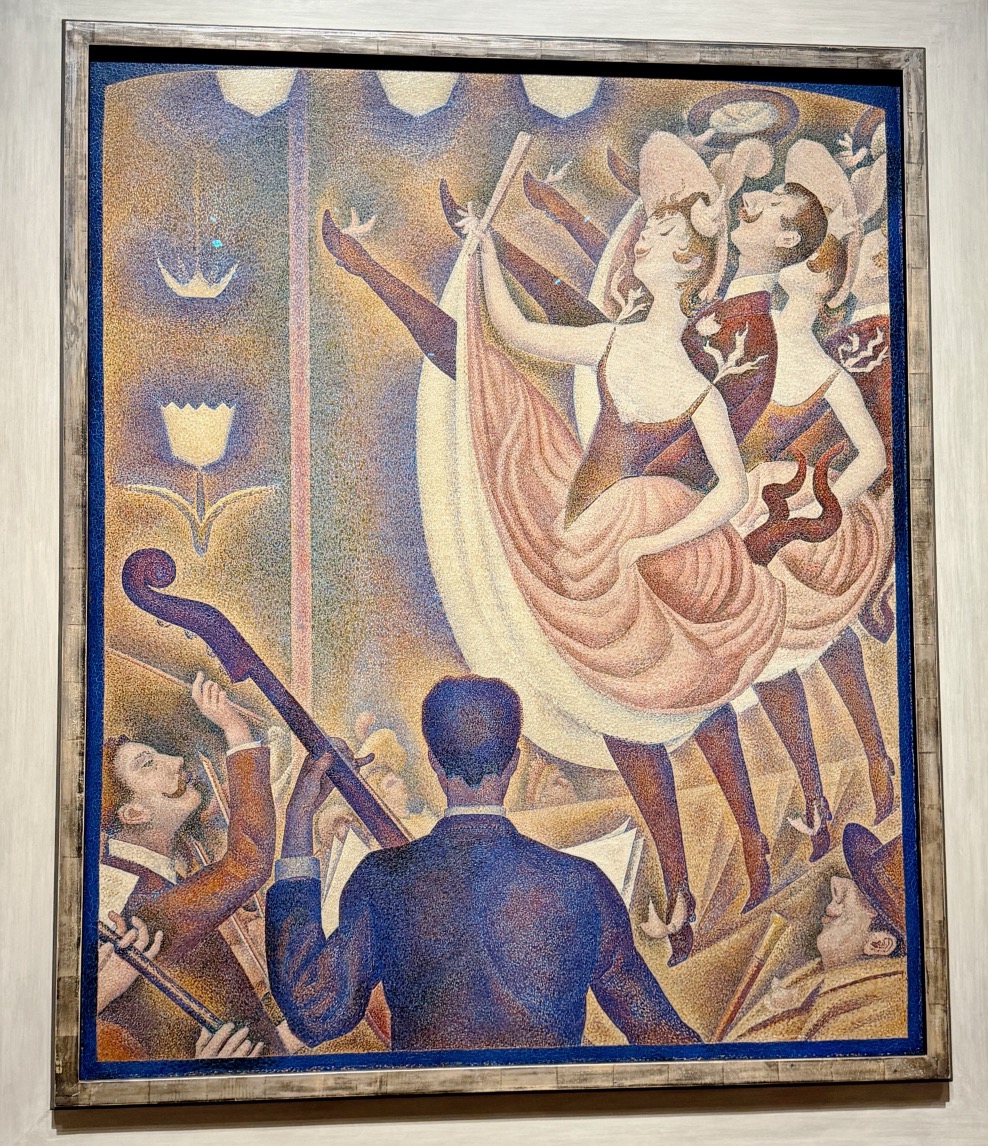
Seurat’s 1889-1890 grand Chahut – a stylized manifesto of his painting philosophy; features artificial, compressed, stylized figures and space. Courtesy: Kröller-Müller Museum

The centerpiece of the show is Seurat’s enormous painting of the scandalous can-can dance at a raucous late-night Paris venue. It’s the biggest, baddest, Neo-Impressionist work in Helene’s collection. The curators surrounded it with works showing how much other radical painters enjoyed music and nightlife.

But just beyond this gallery, you’re surrounded by still, quiet domestic interiors and sun-dappled garden scenes in a gallery titled “The Silent Picture.” People are introspective, lost in thought, or lost in a book. Helene loved collecting large-scale works that seem to envelope viewers with stillness and calm.

And she truly loved the serene, nearly empty landscapes that this group of painters created. The long horizon of the sea only adds to these works’ peaceful presence.  Helene wanted her museum to have clean lines, and unadorned galleries so that visitors could stand, contemplate, and find peace with these works. She truly felt these new, modern paintings had the ability to provide respite and even feel something spiritual.
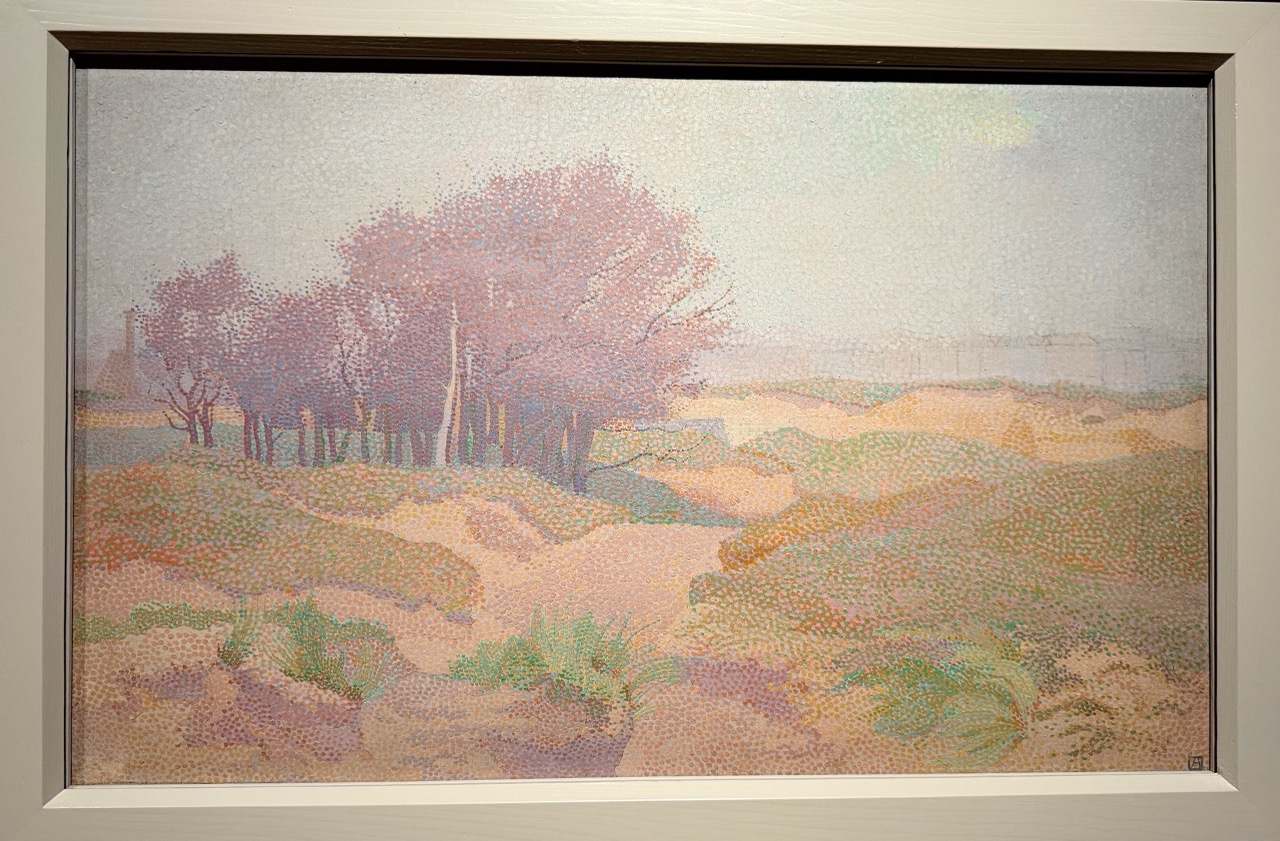
Johann Aarts’s 1895 oil Landscape with Dunes – a tranquil, simplified view of an urban seaside town, indicated by faint buildings on the horizon. Courtesy: Kröller-Müller Museum
Signac’s 1890 Saint-Briac, The Beacons, Opus 120 – the most radical of his four views of the River Fémur along the Breton coast. Courtesy: private collection

Take a walk through this incredible show with the curators from the National Gallery, and hear how Seurat, Signac, and their contemporaries broke the rules and made history:
National Gallery Celebrates 50 Contemporary Native Artists

If you want to take a trip across American land with 50 living Native artists, there’s still time to catch the ground-breaking exhibition, The Land Carries Our Ancestors: Contemporary Art by Native Americans, at Connecticut’s New Britain Museum of American Art through September 15, 2024.

The National Gallery of Art in Washington, D.C. asked Jaune Quick-to-See Smith (Citizen of the Confederated Salish and Kootenai Nation) to survey the United States and create an exhibition reflecting the diversity of the living Native American artists.

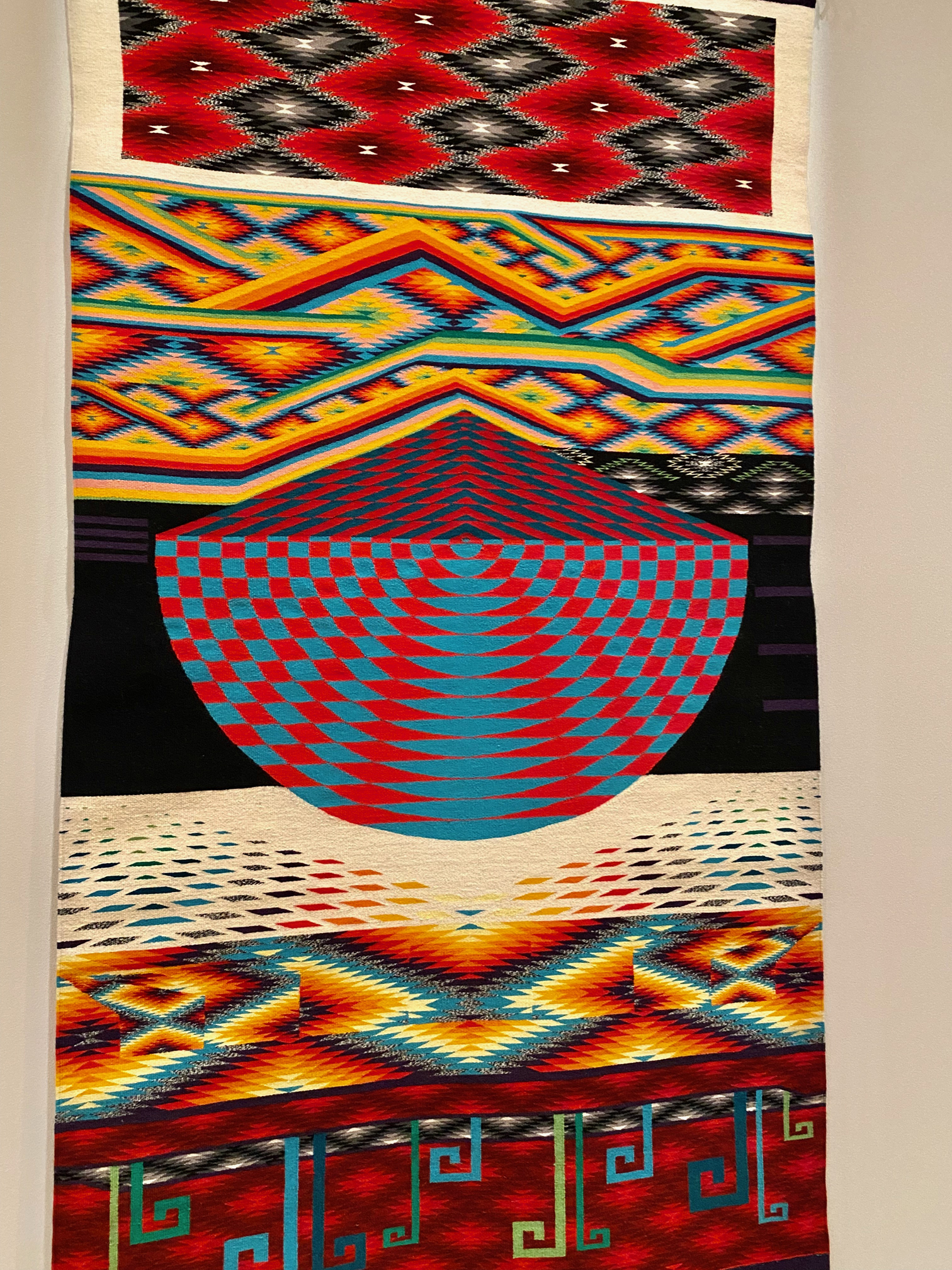
2014 wool weaving World Traveler by Melissa Cody (Navajo). Courtesy: Stark Museum of Art.

Smith, whose own artistic achievement was honored most recently in a three-museum retrospective in 2023-2024, became the first artist invited to curate a show at the National Gallery.

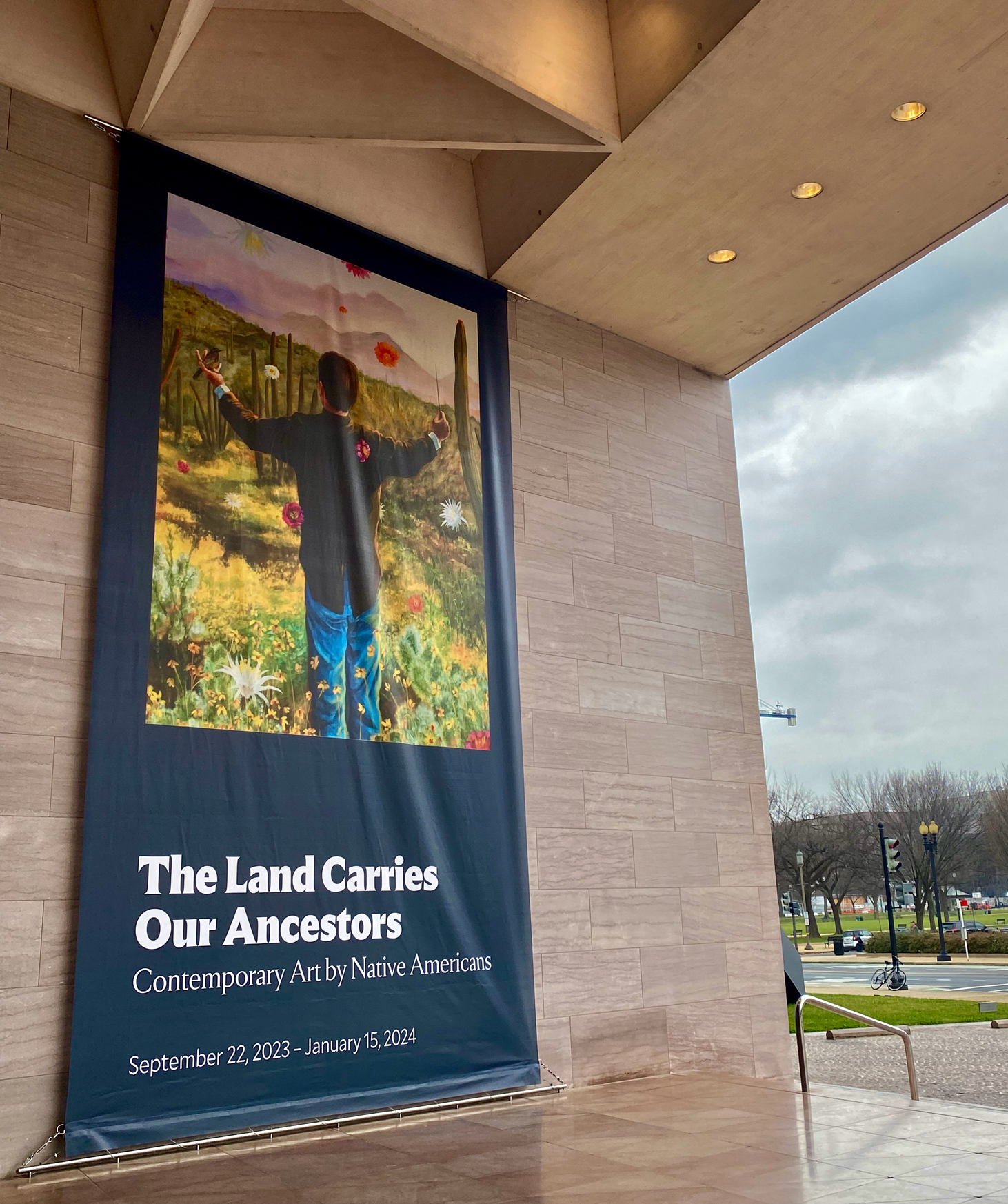
Entrance banner features Orchestrating a Blooming Desert by Steven Yazzie (Diné/Laguna Pueblo).

Smith has always done whatever possible to increase the visibilty of Native artists in the contemporary art world. For this exhibition, she chose 50 intergenerational artists from diverse regions, cultures, and artistic practices. Look at our Flickr album of the National Gallery installation to see some of our favorites.

All of the works reflect the artists’ deep connection to the land, especially Orchestrating a Blooming Desert by Steven Yazzie (Diné/Laguna Pueblo), a painting that reflects one man’s joyful encounter with a lush landscape.

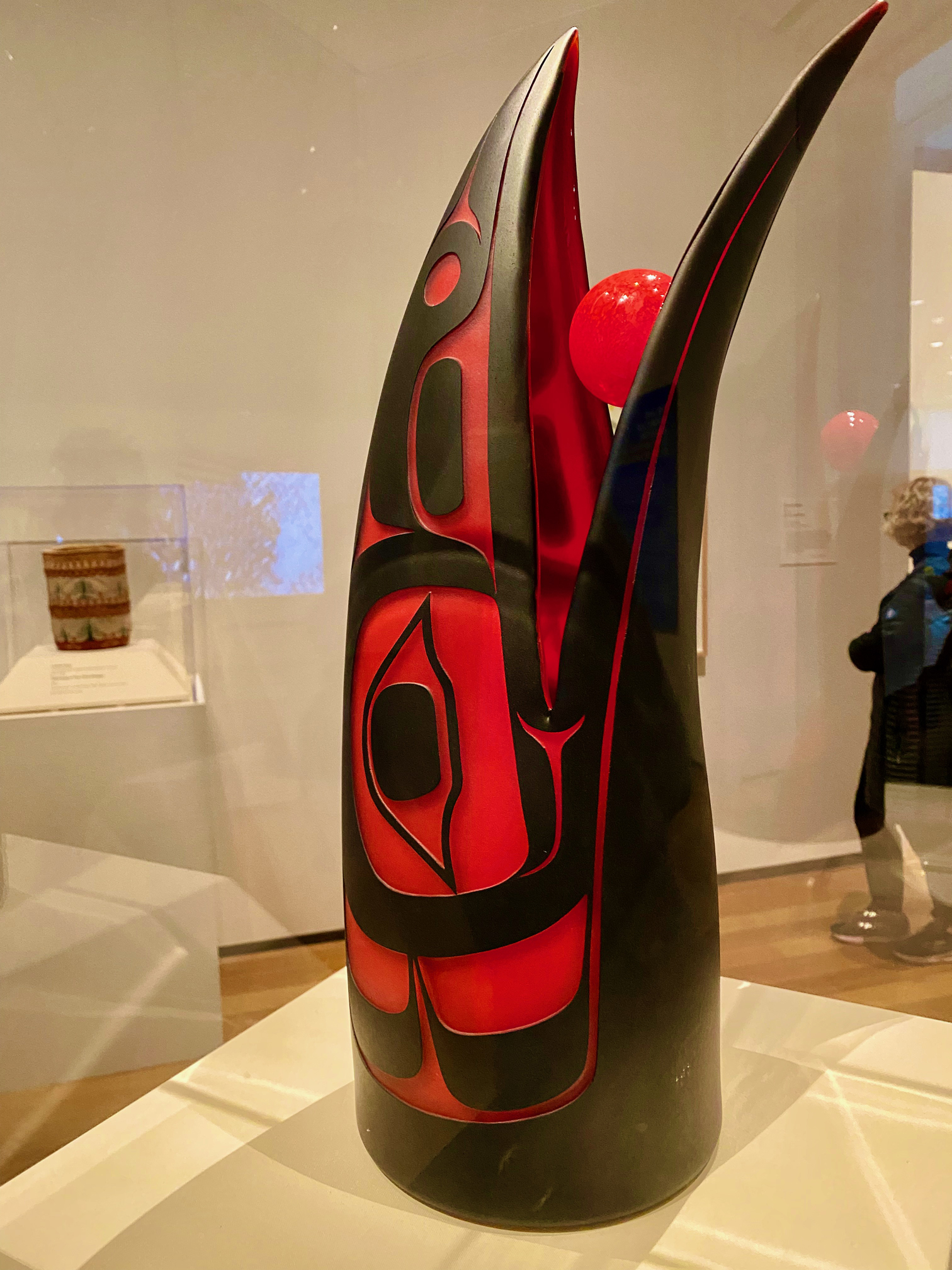
Some works depict a tribe’s link to the natural world through origin stories. Visitors are mesmerized by Preston Singletary’s exquisite sculpture of Tlingit creation-myth legend, Raven stealing the Sun. It’s glorious to admire this dramatic icon fully realized in a distinctly nontraditional medium – blown and sand-carved glass.

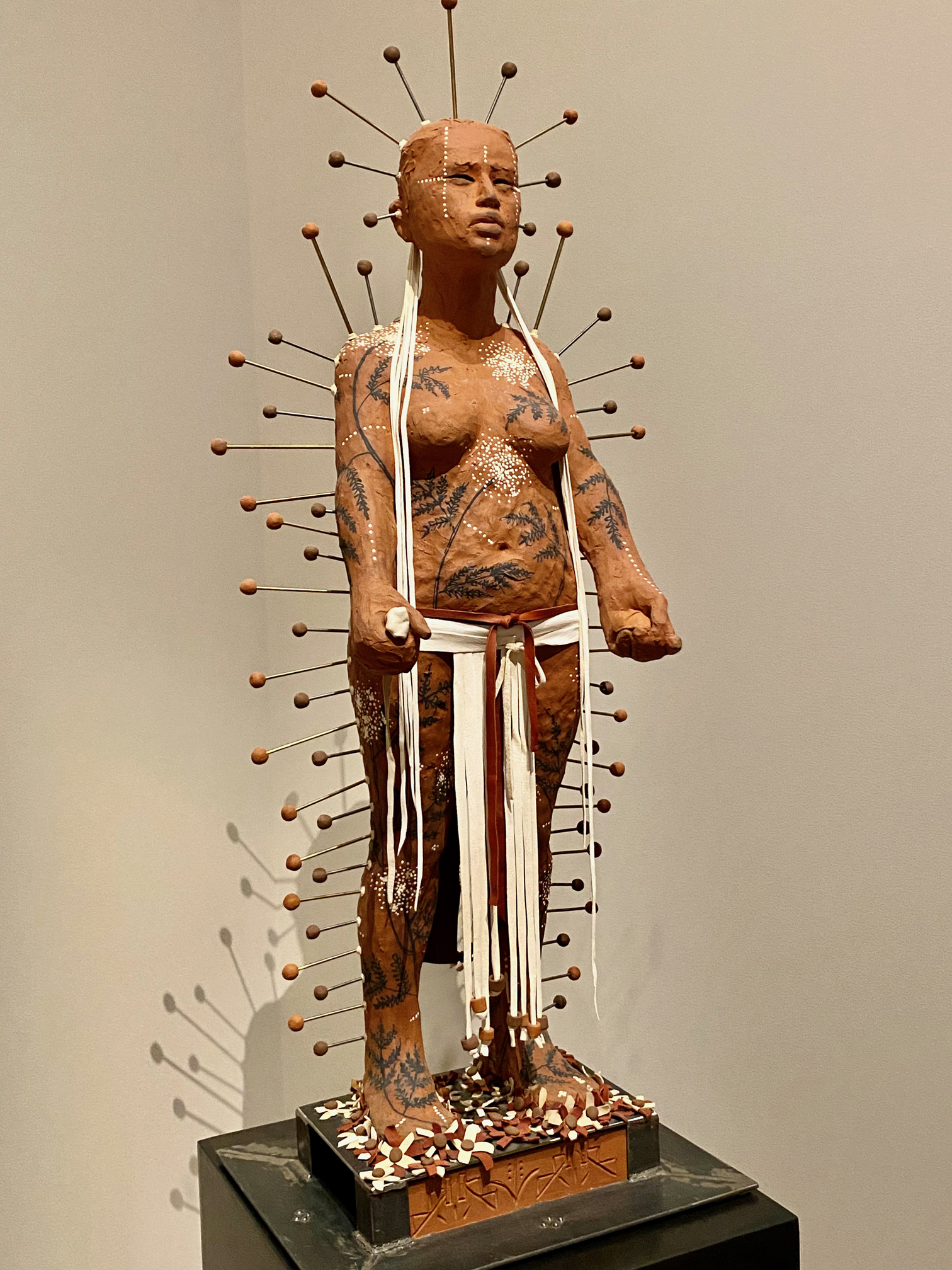
Experiencing the large, spiritual earth-colored ceramic figure by Rose B. Simpson (Santa Clara Pueblo) harkens back to eras when people had a more integral connection to the earth. Simpson calls her figure Tonantzin, an Aztec name for earth mothers, corn mothers, and even the Virgin of Guadalupe.

2017 blown and sand-carved glass Raven Steals the Sun by Preston Singletary (Tlingit). Courtesy: private collector.
2021 ceramic, steel, leather, and brass Tonantzin by Rose B. Simpson (Santa Clara Pueblo). Courtesy: Tia Collection.

Smith has chosen to hang many smaller two-dimensional works across a long wall in a checkerboard to suggest that visitors reflect on the impact of 1887 Dawes Act upon Native lands – a law that cut Native territory into “checkerboard” lots to facilitate private ownership.

At the National Gallery, Jeffrey Gibson’s punching bag (all made of found materials) was hung nearby, reminding us of the delicate balance that has to be struck by simultaneously caring for and taking gifts from the earth.

Next to checkerboard wall, the 2020 beaded punching bag To Feel Myself Loved On the Earth by Jeffrey Gibson (Mississippi Band of Choctaw Indians/Cherokee Nation). Courtesy: Hirschhorn Museum.

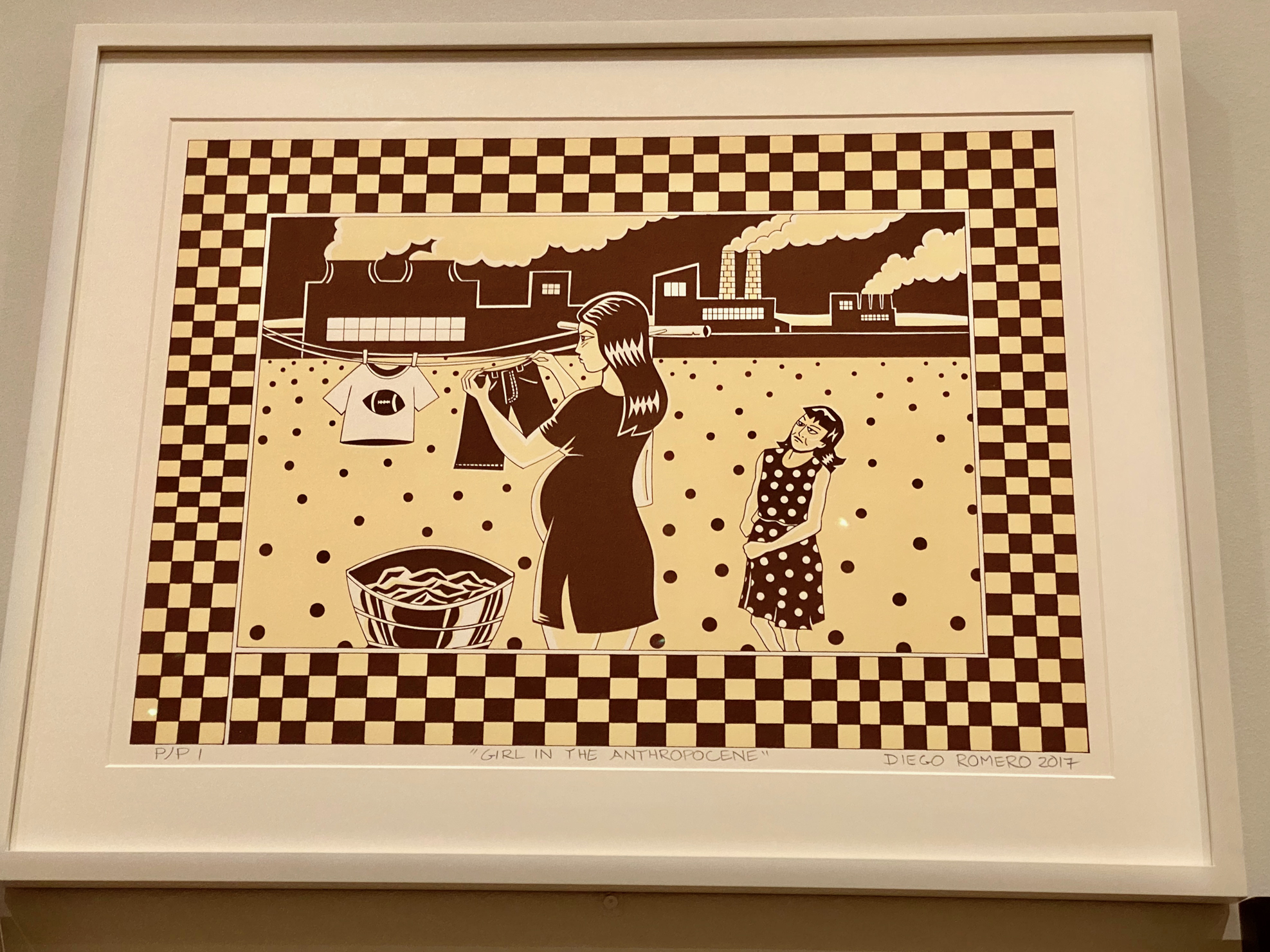
Some artists mix impressions of modern life with tribal lands, such as satiric works by Diego Romero (Cochiti Pueblo) and stylized symbols in a monoprint by Joe Fedderson (Colville Confederated Tribes).

2017 lithograph Girl in the Anthropocene by Diego Romero (Cochiti Pueblo). Private collection

In addition to sculptures, paintings, and photos, Smith has also included pieces made for fashion runways, live performances, and social protests.

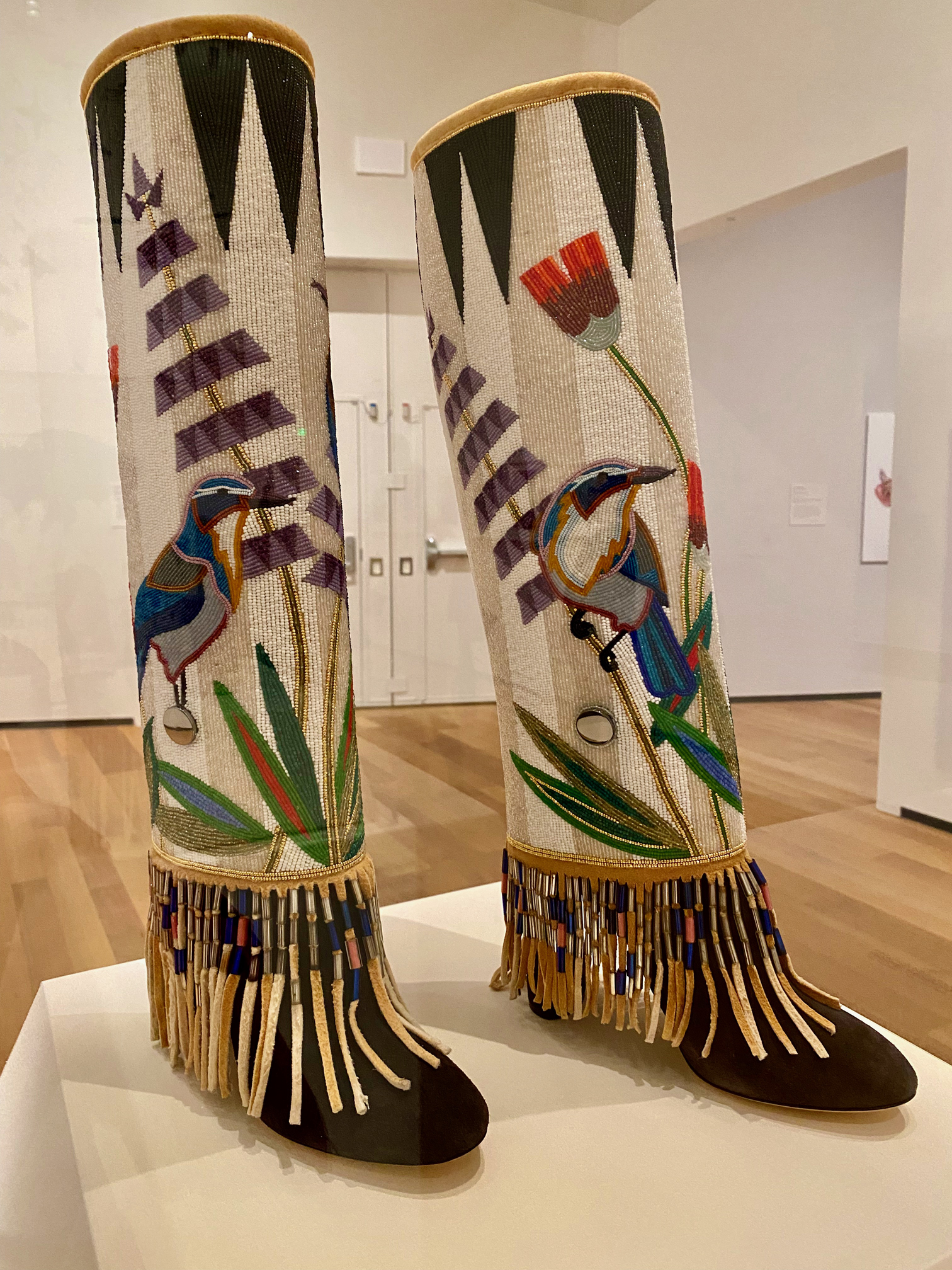
Fashion designer Jamie Okuma (La Jolla Band of Luiseno Indians) beaded her fringed fashion boots with a portrait of her family’s pet scrub jay.

Ten foot-long fiber seashell earrings designed for an interactive video and gallery performance by fiber and performance artist Eric-Paul Riege (Diné) are a reminder of the ancient trade networks that brought trade items from the ocean to the interior deserts.

2021 beaded and fringed Casedei boots by Jaime Okuma (La Jolla Band of Luiseno Indians). Courtesy: Dartmouth College’s Hood Museum
2020 mixed-fiber installation jaatloh4Ye’iitosoh [3-4] by Eric-Paul Riege (Diné). Courtesy: Tia Collection.

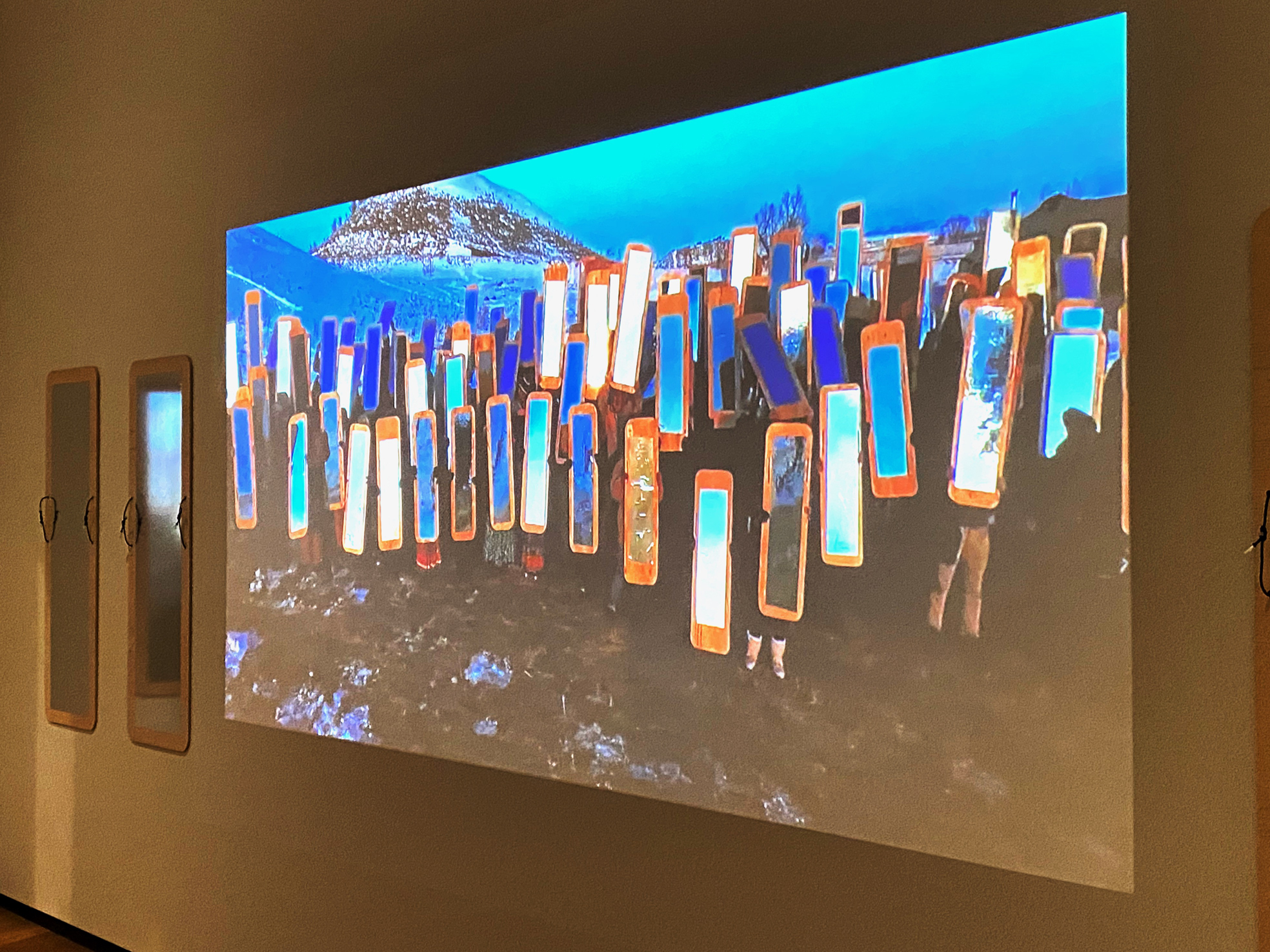
A wall of “mirror shields” were mounted by artist-activist Cannupa Hanska Luger (Mandan/Hidatsa/Arikara/Lakota), showing just a small sample of the 1,000 protective and reflective shields made by people to help water protectors during thre 2016 pipeline intervention at Standing Rock Sioux Tribe Reservation, Luger’s childhood home. Take a look at Luger’s instruction video here.

The shields served to protect the peaceful protesters from rubber bullets and water cannons, and reflected images of the security forces back to them. The crowd-sourced shields were also used in a social-action performance piece at Standing Rock.

2016 mirror shields and video for Mirror Shield Project – River (The Water Spirit) by Cannupa Hanska Luger (Mandan/Hidatsa/Arikara/Lakota). Courtesy: the artist, Garth Greenan Gallery.

Textiles and vinyl drawings also pack a punch in this show. Take a look at the dazzler woven by Melissa Cody (Diné), who draws inspiration from video gaming and the matriarchs of Navajo Nation. Watch her interview from her recent exhibition at MoMA PS1.

Here, John Hitchcock explains how his room-sized drawing, Impact vs. Influence, incorporates his influences – nature, family, Native beadwork, and the next-door military base:

Take a look the National Gallery’s trailer and meet the 50 contemporary artists whose work and relationship to the land is celebrated in the show: