Tour “Sahel: Art and Empires on the Shores of the Sahara” at The Met this week
Are you missing your favorite New York museums? We’re happy to report that many of the cultural powerhouses, like the Whitney, The Met, and MoMA have reopened, although timed tickets in the opening weeks have been a little hard to get.
There’s a quick and easy way to get inside, however, by attending one of the live virtual programs being offered. Check out our new page on events! As you can see, there’s a lot of opportunities to connect.
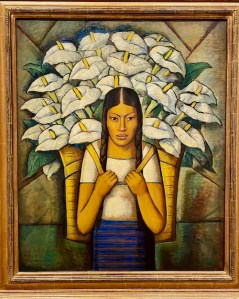
1929 “Calla Lily Vendor” by Alfredo Ramos Martinez in The Whitney’s must-see exhibition “Vida Americana”
New York museums have been keeping their events going online, and joining in is a great way to meet curators, docents, tour some blockbuster shows, and join in on the discussions happening around town about art and the social-justice movement (past and present), women’s issues and history, and even listen to ETHEL play classical music from the virtual Met balcony on Friday night.
For smaller museums, the virtual events have been a great way to broaden programming to a national or international audience. In recent on-line programs produced by Fraunces Tavern, it’s been nice to see colonial history buffs from Virginia and New England join in on the discussion. At last week’s New York Transit Museum’s talk on the 20th Century Limited, a few UK railroad enthusiasts joined in the chat room!
Hear about the preservation of Washington and Hamilton’s hangout, Fraunces Tavern, one of NYC’s oldest buildings this week
So, it’s a great way to be in the virtual room where it’s happening with others who love history and conversation as much as you do! Take a look at the array of topics and events and register.
Most of the events are free, although after the months-long shut down here, it’s always nice to give a thank-you donation.
Reopening Update
This week, we’ll welcome the opening of the Guggenheim and Jewish Museum along Fifth Avenue and the International Center of Photography at its new home on Essex on the Lower East Side, where the Tenement Museum has begun neighborhood walking tours again.
Welcome back!!
Enjoy this beautiful four-hour meditative Met Live Arts performance by Lee Mingwei and Bill T. Jones at The Met this week
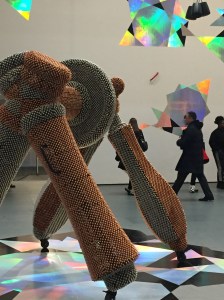
MoMA’s open again, and as the sun comes down daily, a sparkling, tinkling, gleaming landscape created by Korean multimedia artist Haegue Yang comes alive in the Museum of Modern Art’s multistory atrium.
Giant, stylized animalistic sculptures glide across the space, carefully guided by a black-clad dozen performers who appear every day at 4 p.m. for the one-hour activation.
Handles is a dreamscape world, where six large sculptural pieces inhabit an atrium enlivened by reflective biomorphic shapes climbing playfully up the walls.
When the performers move them, the giant sculptures, sheathed in a neat layer of bells, subtly chime to a soundtrack of tweeting birds and a tranquil symphony. Magic that soothes museum goers into a contemplative state.
A team of performers activate the installation daily
The piece reflects Haegue’s growing interest in using choreography and sound to build a sensory experience for art viewers. Gradually, she’s incorporated performers moving in geometric patterns, pulling oversized sculptures across and around the space, in a modern take on utopian Triadic Ballet-style movement.
Environmental phenomenon, geopolitical stresses, and modern art pioneers all factor into her work. Read MoMA’s interview with her here.
There’s plenty of time to see Handles, which will be activated for MoMA visitors through April 12, 2020.
See more photos of the installation on Flickr and watch a few moments of the performance here.
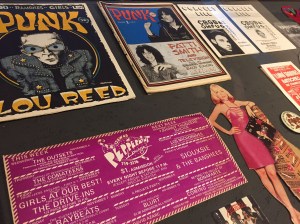
The vibrant, irreverent, and rule-breaking cacophony of the London and downtown New York punk scenes is brought to life in the Too Fast to Live, Too Young to Die: Punk Graphics, 1976 – 1986exhibition, residing on two full floors of the Museum of Art and Design through August 18.
Being surrounded by black walls plastered with DIY flyers and silkscreened posters of famous acts in long-gone clubs brings back memories of prowling CBGBs in the 70s and 80s, leaning about the next great act playing in a hole-in-the-wall club from a screaming poster, and getting grimy from paging through cheap, low-budget music zines on newsprint.
1974 poster for Patti Smith’s six-night run at Max’s and Gary Panter’s logo on a 1978 poster for the LA electro-punk group Screamers
Looking around the room, you’ll see posters and flyers for Patti Smith at Max’s, Pere Ubu at Harrah’s, and an array of bands at Amsterdam’s Paradiso – some handmade, some barely drawn, and others that you’ll recollect as stand-out graphic signs of the times, like Gary Panter’s iconic logo for the Screamers.
In the center of the room, MAD has thoughtfully presented boxes of albums and turntables, allowing every visitor to experience the ultimate 1970s interactive music experience. Just flipping through the albums covers brings the excitement and wonder of this pre-Internet music era roaring back to life.
Cover of 1978 Punk Magazine Calendar designed by John Holmstrom and Legs McNeil
The show presents Andrew Krivine’s extensive collection of punk posters, buttons, and other stuff that he began as a teenager hanging out in his cousin’s punk shop Boy on the King’s Road in London. Fascinated by arresting designs and wild typography, his collection expanded beyond the DIY ethos of the early punk aesthetic to more thoughtfully designed creations by emerging graphic-design stars in the UK.
Take a look at some of our favorites in this Flickr album.
It’s easy to enjoy this show, which is not grouped by history or music styles; rather, it’s a celebration of the vast influences on graphic practice during the punk and New Wave era – newsprint, cut-and-paste collage, hand-crafted designs with rub-off Letraset letters, and high-art references to Russian Constructivist, Bauhaus, and Pop Art masters.
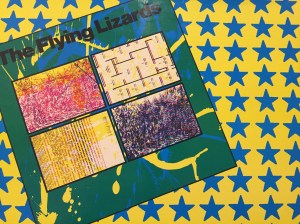
1979 album cover by Jill Mumford
Listening in to conversations among rapt visitors in the busy gallery provides additional reference to anyone too young to have lived through this era in New York. Music connoisseurs will point toward a poster and inform anyone listening, “That’s more ‘New Wave’ than ‘punk’…I don’t know why this is all on the same wall.”
But everyone is having a grand time seeing images, hearing the bands’ music, and watching film footage of this rebellious period that left its mark on music, fashion, and culture at large.
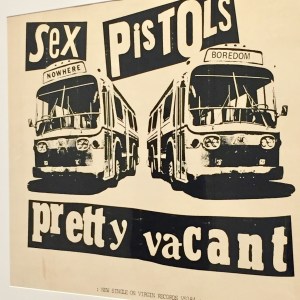
1977 poster by Jamie Reid and David Jacobs
The Sex Pistols, who started it all in 1976, are well represented in the show. John (“Johnny Rotten”) Lydon, who spoke at the opening, reflected back on the days when rule-breaking start-ups like his had no advance men, no tour promoters, no corporate backers, and created all their own posters, graphics, and flyers.
Forty years ago, he reminded, there were no computers or Google searches, so you had to be able to hand-stencil and hand-draw everything yourself. “I went to the library and learned how to draw and paint and read,” he added, “and best of all, the library was free!”
1978 record cover by Laurie Rae Chamberlain using Xerox images
By the time bands from this era “grew up” and moved toward world tours and more commercial success, innovative graphic artists were tapped to create thought-provoking, stand-out work – Peter Saville, Malcolm Garrett, Tibor Kalman, and Barney Bubbles all have multiple works in the show.
Be sure to hang out and enjoy the raw energy bursting forth in the clips from the 16mm documentary “The Blank Generation,” featuring live 1976 club performances by the downtown legends who defined New York punk.
Jarring type and photo defacement on edgy 1983 Talking Heads poster
Thanks to MAD and Andrew Krivine, who let Cranbrook Art Museum curator Andrew Blauvelt bring his collection to life for an appreciative audience.