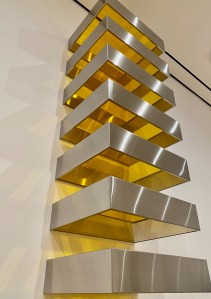
1968 stainless steel and Plexiglass tower (Froehlich Collection)
For anyone lamenting the disappearance of the Monolith and yearning to experience its minimalist magic, walk through MoMA’s Donald Judd retrospective before January 3 to understand how big, gleaming, super-sleek objects create such electrifying force fields.
Initially, journalists speculated that the Utah Monolith was the work of West Coast artist John McCracken. It wasn’t, but Judd was one of McCracken’s art-world heroes – a master who reveled in pure shape, pure color, and (when he wanted to) pure transparency. Judd also built repeating rectangles (seemingly not created by human hands) in remote western landscapes (Marpha, Texas).
On MoMA’s top floor, you’ll encounter wide, open spaces with spare, clean hard-edged objects inhabiting four galleries.
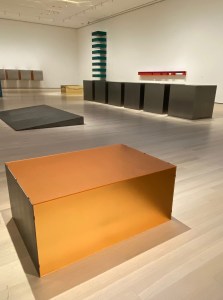
1964 construction of orange pebbled Plexiglass and hot-rolled steel. Private collection.
In the first room, you’ll see cadmium-red shapes from the early Sixties that Judd made in his Soho studio. The idea was to remove any gestures or evidence of craft in the work – just present the pure painted shape.
But to get the perfection he craved, Judd went one step further – engaging industrial fabricators to create large-scale works from his meticulous drawings. Industrial materials like aluminum, iron, and Plexiglass are transformed into magical rectangles, epic towers, and airy channels. See our favorites in our Flickr album.
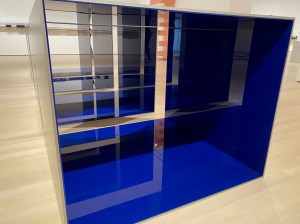
In each gallery, visitors are invited to circumnavigate and explore the monumental works. One orange box seems to glow; another has a transparent surface that lets you peer inside. An enticing series of blue and silver boxes seem to let you peek through to an entirely different dimension.
1969 “channel” of aluminum and Plexiglass units (Saint Louis Art Museum)
Towers emerge from walls in each room – neat stacks of monumental rectangles, separated by exact amounts of space. It’s quite a sensation to approach one, look up, and feel its commanding presence. One silver tower seems to be emitting yellow light. A copper tower gleams a little from a subtle spotlight.
Judd wanted it this way – no interpretation. Just you and the large, beautiful, perfect form, as this short video demonstrates:
MoMA cautions visitors to remain at least six feet away from each of the works, but most admirers are cautious and reverent, taking it all in and giving everything its space.
Here, curator Ann Temkin talks about Judd’s work and the joy of bringing such a monumental exhibition to New York:
Take a trip through the installation on MoMA’s website here, and hear artists describe their experience of the show here.
Entrance with Noguchi’s 1945 Kouros and Rodin’s controversial 1876 sculpture
The Met has pulled out all the stops on its 150th birthday show, Making the Met, 1870-2020, on view at Fifth Avenue through January 3 – incredible installation, intriguing stories, and a phenomenal digital showcase. So even if you can’t come to New York to see it in person, the Met website has it all!
The exhibition tells the story of the Met over the last 150 years – from its first incarnation in a house on 14th Street to its ever-expanding footprint in Central Park – shows the incredible art that benefactors donated, and relays the stories of the men and women who made it happen.
Head of a Hindu god, Bhairava, made by 16th c. Nepalese artists
Walking into the dramatic exhibition entrance, you’re surrounded by figures from different eras and cultures – a little girl from 5th century Greece holding two doves, a gilded mask of a Hindu god beautifully crafted by Nepalese masters of the 16th century, and Avedon’s 1957 portrait of a pensive Marilyn Monroe.
At the press opening, senior researcher associate Laura Corey explained that these were chosen to encourage visitors to think about the people behind the Met – collectors, curators, artists, restoration experts, and other staff. According to Laura, the African power figure from the Republic of Congo was one of the first artworks chosen for the welcome gallery. He’s looking right across to Marilyn, and they are sharing a similar expression and mood.
1906 photo of The Great Hall
At Noguchi’s Kouros sculpture, you can look left or right down a “street” lined with arches – portals that beckon you to step into different chapters of the Museum’s history. Each arch proclaims the decade and the theme. In between, there are huge slideshows from the museum’s past – how the Great Hall used to look, ladies in turn-of-the-century hats taking their art appreciation classes, Fifties moms and kids looking at art.
We’ve included our favorite artworks in our Flickr album, but the Met has produced a spectacular multimedia walk-through (posted on Google Arts & Culture), where you can experience all ten stories through photos, films, and links to blogs. Definitely watch the silent 1928 “Behind the Scenes” film showing museum shops, painters, gilders, and photographers at work. No surprise that the museum was into multimedia way back then!
Houdon’s 1778 bust of Franklin and reflection of Manet’s Young Lady in 1866
Through the first arch titled “The Founding” (the 1870s), you pass a huge Cypriot head (the first director was into archaeology) and the first paintings donated by the founding trustees. Houdon’s spectacular Ben Franklin gazes quietly (and slyly) at Manet’s Young Lady in 1866 – the first contemporary painting in the Met’s collection. It depicts a life-size, modern gal in her dressing gown – an image that shocked early visitors to the Met’s classical galleries! Of course, Ben looks on approvingly.
Next, you’ll see a 15th-century Turkish turban helmet and 17th-century Japanese armor. The story here is that the Met green-lighted Bashford Dean, a zoologist and world traveler working at the AMNH, to begin the arms and armor collection. Other curators began collecting works on paper, textiles, lace, wallpaper, musical instruments, and contemporary designs. In the Twenties, curators headed straight to the UK to scoop up samples from Morris & Company.
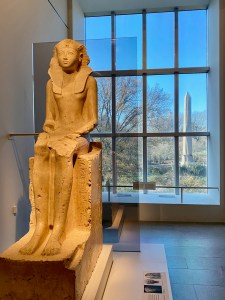
1479-1458 B.C. statue of Hatshepsut, and Cleopatra’s Needle (1450 B.C.) in Central Park
Around the corner is a tribute to the deep-pocketed donors like Morgan and B. Altman, who gave the Met lots of upscale, princely treasures – paintings by Vermeer and Ingres, fancy furniture, and tapestries. A treasure trove gifted by generous benefactors fills a wall – pistols for kings, cosmetic cases for Egyptians, bedazzled tablewear, and Middle Eastern glass.
Back into the main “street,” you’re right next to an imposing, reconstructed sculpture of Egypt’s female pharaoh Hatshepsut with a stunning view of Central Park’s Egyptian obelisk through the window.
These lead to the stories of how the Met collected art via excavations of archaeological sites – the Kharga Oasis (1908), Egypt (1880-1931) with Wah’s tomb stuff, Nimrud (Iraq), and along an ancient trade route (1934). The intrepid Bashford Dean enters the story again – excavating a Crusader castle, but only bringing back “dismal finds,” such as Crusader lamps, melted chain mail, and shards of stained glass, and (our favorite!) a projectile from a Crusades-era catapult (1250).
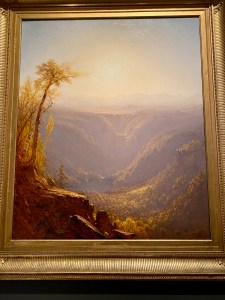
1864 A Gorge in the Mountains by Sanford Robinson Gifford
Apparently, it took a lot for a fancy museum to turn its attention from Europe to collecting art from the Western Hemisphere, but wealthy patrons had the goods. The American room features Sargent’s best-dressed “Madame X” and an enormous 1830 honeycomb quilt by Elizabeth Clarkson, the first quilt to enter the Met’s collection in 1923. There’s also a gorgeous Catskill Mountain landscape by Sanford Robinson Gifford, once owned by AMNH’s long-serving president, Mr. Jessup.
A gallery packed with work by Degas, Monet, Cassatt, Cezanne, and their Japanese masters tells the story of the Havemeyers, the Met patrons who lavished the museum with Tiffany glass (likely picked out by Mr. Tiffany himself), impressionist masters (picked out by Ms. Cassatt herself), and much more.
I Saw the Figure 5 in Gold (1928) by Demuth
At the midpoint of the exhibition, you learn that Stieglitz had a rough time trying to convince the Met to honor contemporary photography. The Met also refused Ms. Whitney’s collection in 1929. Gertrude’s response was to start her own museum, which joined MoMA (which debuted in 1929) in celebrating modernism. The Met finally did accept modern works through Georgia O’Keeffe’s 1949 gift, and proudly displays a Demuth and Kandinsky in the show.
The Monuments Men story looms large, with Met curators playing a major role in discovering and returning art looted during World War II. There’s a 1945 model of an Army helmet prototype designed by the Met’s armor expert, hand-crafted in solid aluminum.
1965 Yves Saint Laurent Mondrian dress and 1966 Balenciaga coat
The largest gallery in the show tells the story of how the Met beefed up its collections and expanded gallery space during what it calls “The Centennial Era” – Islamic art, fashion, Asian and African art, and modern art from the 20th century.
The final story about the Museum’s current focus – adding works by artists and from regions that are underrepresented in its collections – is represented by a large El Anatsui piece, an embellished Tibetan saddle, a wall of art guitars, a large Faith Ringgold story quilt, and other intriguing works.
The museum’s done a tremendous job online telling all the stories via its digital primer. Click here to hear in-depth stories on the Met’s audio guide with Steve Martin, check out this video with his narration, get the backstory on every artwork in the show, and definitely visit the multimedia walk-through .
And check out this exhibition video showing how the museum’s architecture evolved to house these growing collections. In the 1880s, Olmstead and Vaux assigned a spot in Central Park for the Met. It’s interesting that one of the initial designs (which no one liked) was not scheduled for completion until 1990!! It’s a microcosm of 150 years of architecture and history.
If you can’t do an in-person trip to your favorite museums just yet, why not walk some terrific exhibitions with curators at the Guggenheim, Merchant’s House, Poster House, the Morgan Library, and the Whitney. The links to this program and other museum events are on our virtual events page here.
Chen Zhen’s 1999 Precipitous Parturition installed inside the Guggenheim in 2017
Some of the highlights we think you’ll enjoy:
Today (November 30) at 5:00pm, visit the Guggenheim for a conversation about art, exhibitions, and installations in the iconic building. The Zoom session will feature works by Hilma af Klint, Felix Gonzales-Torres, and Pipilotti Rist to get the discussion rolling.
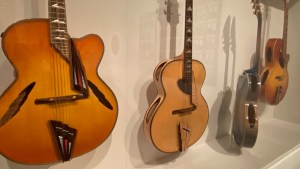
Hear jazz on The Four Seasons guitars by John Monteleone December 1 at the Met
Tomorrow (December 1) at 7:00pm, you will not want to miss the guitar quartet concert from the Metropolitan Museum’s MetLiveArts. It’s going to feature four acclaimed jazz guitarists playing the spectacular “Four Seasons” set of guitars made by master luthier John Monteleone, which are currently featured in the finale gallery of the Met’s 150th anniversary spectacular, Making the Met, 1870-2020.
Learn about 19th century lighting inside the Merchant’s House Museum on December 2
Of, if you haven’t had enough of feasting, join the Tenement Museum at the same time to hear from Leah Koenig about making holiday treats and her book Little Book of Jewish Sweets.
On Wednesday (December 2) at 6:00pm, take a trip back to the past with Merchant’s House Museum to experience 19th-century domestic lighting and talk about how home lighting has changed in the last 100 years.
Artists Kay WalkingStick and Jaune Quick-to-See Smith discuss contemporary art at NMAI on December 3
Thursday (December 3) events include:
A 6:00pm discussion of contemporary art at the Museum of the American Indian with Kay WalkingStick and Jaune Quick-to-See Smith.
At 6:30pm, an evening at Poster House that provides an insider’s look at collecting Swiss posters.
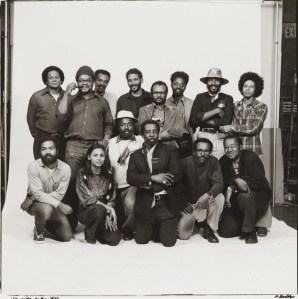
Photographers of Brooklyn’s Kamoinge Workshop, honored in the Whitney’s new show
At 7pm, a curator’s tour of the Whitney’s latest exhibition about the photographers of the Kamoinge Workshop in Brooklyn.
We’re particularly excited about the special free program that the Tenement Museum is hosting next Saturday (December 5) at 1pm with I.NY, a virtual celebration of connection between Ireland and New York, featuring a tour of an Irish family’s home on the Lower East Side in 1860 and a discussion with the University of Limerick’s Professor David Coughlan.
Visit the Moore family home with the Tenement Museum and I.NY on December 5
Many more programs are on the schedule, so register for as many of the topics and events that you can fit into your schedule.
Most of the events are free, but it’s always nice to add a thank-you donation.
Museum Updates
Just a reminder that MoMA has just reinstalled its permanent collection in its new building. When the museum re-opened a year ago, the intent was to keep its collection moving, with refreshed galleries several times a year. Be sure to visit and see what’s new!
1890 pointillist portrait of Fénéon by Paul Signac
He wasn’t an artist, but MoMA has given him a show that has everything – joyous post-Impressionist canvases, Moulin Rouge posters, color wheels, African masterworks, Italian futurists, street riots, manifestos, explosions, and mug shots.
Félix Fénéon: The Anarchist and the Avant-Garde – From Signac to Matisse and Beyond, an exhibition on view through January 2, will introduce you to a writer, critic, anarchist, and dealer living in turn-of-the-century Paris who championed Seurat, gave Matisse his start, coined the term neo-Impressionism, and went to jail for a few months after he was accused of setting off a bomb in a restaurant frequented by government big shots.
1891 painting by Paul Signac, Setting Sun, Sardine Fishing, Adagio, Opus 221
This gorgeous show was inspired by Signac’s pointillist portrait of Fénéon, which features swirling color wheels referencing their shared passion for Japanese design, pattern, and the science behind art. Books and ephemera by influential color theorists are displayed nearby, but it’s hard to keep your attention there when paintings by so many modernist masters are vying for your attention around every turn.
1894 Bonnard poster for the avant-garde journal Fénéon edited
Fénéon used his critical bullhorn to turn many artists into household names. Think Seurat and Signac, two of Fénéon’s early favorites. The first gallery is full of their beautiful seascapes and figurative work. Read the curator’s essay about the artists he promoted, and see our favorites in our Flickr album.
The curators let us know that these peaceful images and exuberant dance-hall posters were made at a time of serious social unrest and profound economic hardship for working-class Parisians by interspersing Fénéon politics-charged writings and socially conscious works by Vallottin and Pissarro. Disruptive protests, nightlife, zines, and art all went hand-in-hand during the 1890s.
1905-1906 painting by Matisse Interior with a Young Girl (Girl Reading)
Fénéon spent several years as the editor-in-chief of a leading avant-garde journal, orchestrating contributors such as Bonnard, Toulouse-Lautrec, and Vallotton, and collecting their work along the way. So, it came as quite a shock to everyone when the independent critic announced that he was taking a full-time job with a prestigious but conservative gallery in Paris.
Entering the second gallery of the exhibition, you see immediately how Fénéon used his notoriety and avant-garde chops to build up a contemporary art business and lure old-line clients into taking a chance on something new and modern. He signed contracts with artists he had long championed, and gave an up-and-comer named Henri Matisse his first show in 1910.
Late 19th-c mask by a Guro artist from Cote d’Ivoire with 1920 Bonnard. Private collection; Musee d’Orsay.
It’s exciting to see a room full Matisse’s early work (including three that were in that initial show) and work by other artists that Fénéon both collected and sold, including a wall full of ethereal Seurat drawings.
Like many others in the avant-garde, Fénéon was a passionate collector of art from Africa and Oceana, and it’s thrilling to see so much of his original collection – now scattered throughout the world – reassembled inside MoMA.
Fénéon hated colonialism and railed against calling this portion of his collection “primitive art.” He lamented that the names of the artists who created such dynamic, inventive work were unknown and disliked having such evocative pieces relegated to ethnographic museums.
19th-c cap by Tin Dama artist from Papua New Guinea (Musée du quai Branly-Jacques Chirac) and Balla’s 1910-1911 futurist work.
He hoped that one day “art from faraway places” could take its place in the art pantheon right up there with works in the Louvre.
The worlds of ancient mythic power, modernism, and emotive color seem to be spending their time at MoMA having an active conversation – just the way Fénéon would have wanted.
Enjoy MoMA’s fast-pace introduction to this revolutionary modernist:
And now meet MoMA director Glenn Lowry and Starr Figura, curator of the exhibition, who show works from the exhibition and discuss why they mounted this show:
If you can’t get to MoMA, listen to the audio guide here, and enjoy the “colors” playlist that MoMA designed.
There’s no fashion designer more rock-and-roll than Anna Sui, who will be (virtually) at Poster House tonight (October 19) to show posters from the Sixties and Seventies and explain how they’ve inspired her eye-popping, fun, funny, and magical runway looks. Take a peek at our Flickr album of her retrospective this year at MAD Museum, and you’ll see what we’re talking about.
Poster House, New York’s newest museum, has one of the best line-ups of virtual events in the City, so get in on this special “Poster Inspiration” event with Anna tonight at 6:30pm. Tickets are only $5, so chip in a few dollars extra to keep their programming rolling. This week, Poster house is also hosting “Lippert & Lowry: Fireside Chats” on Instagram (October 21) and a virtual tour of their fantastic poster archive on October 22.
Anna Sui channels Sixties Fillmore psychedelic in her MAD Museum show this year
Continue the rock-and-roll vibe with Thursday’s morning virtual tour of “Bill Graham and the Rock & Roll Revolution” by the New-York Historical Society (October 22). Revisit the legendary Fillmore East and West. Find the links to this and so many other great museum events on our virtual events page here. Here’s a few:
A double header on Agnes Pelton’s show at the Whitney: On October 20, curator Barbara Haskell will answer your questions live, and she’ll be back on October 22 with the panel that had been postponed, “Seeing Agnes Pelton.”
On October 20, makers are invited to a panel at the Cooper-Hewitt on to learn how to launch a design project, which is part of National Design Month.
On October 23, the Met will host artist Dred Scott speaking about Jacob Lawrence.
On October 24, horticulturalists can get an insider’s look at the medieval gardens as the Fall season begins at the Met Cloisters.
Gardens at the Met Cloisters
There are also more chances to catch the Morgan Library’s virtual tour of the Hockney show, a full line-up of paranormal goings on at the Merchant’s House Museum, and more tours at the Tenement Museum. Take a look and register for as many of the topics and events that you can fit into your schedule.
Most events are free, but an extra thank-you donation helps everyone, big and small.
Reopening Update
Just a reminder to fashion fans that the Met will soon open its much-delayed fashion extravaganza, which should have debuted the first Monday in May. It’s coming and we’ll keep you posted about a virtual event the Met has planned to give everyone a preview.
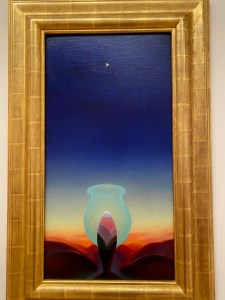
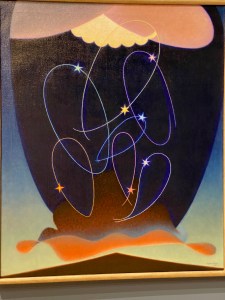
Agnes Pelton’s 1929 Star Gazer, suggesting rebirth in a desert landscape. Private collection.
Have you wanted to enter a light-filled, spiritual place and be transported to another realm? Get a ticket to the Whitney Museum of American Art enter the Agnes Pelton: Desert Transcendentalist, on view through November 1.
You’ll experience six decades of abstract paintings whose shapes fly, hover, and float above desert mountains and in deep space – another dimension that feels light, otherworldly, and pure. Take a look at our Flickr album.
She began developing her style in the early years of the 20th century when abstraction, the symbolic meaning of color, and spiritualism were being explored in the New York art world, and she took to heart what she read in Kandinsky’s influential 1910 treatise, On the Spiritual in Art.
1926 Meadowlark’s Song, Winter. Courtesy: Maurine St. Gaudens.
The exhibition opens with a figurative work in the style for which Agnes was first known to the New York art scene – an ethereal artistic woman inhabiting a dreamy, semi-abstract, soft-colored landscape. Her work earned her inclusion in New York’s landmark 1913 Armory Show – the exhibition that introduced “modernism” to America – in Gallery D alongside other young American artists experimenting with bold color and abstraction.
But the Whitney exhibition (originally mounted by the Phoenix Art Museum) is actually focused on the next phase of Alice’s abstract work, which reflects her embrace of spiritualism, experience with New Mexico’s desert landscapes, and interaction with creative, like-minded thinkers in and around Taos in the Twenties. Although she often accepted commissions for portraits or landscapes throughout her life, she considered the abstract works the core of her artistic journey.
1934 Orbits. Courtesy: Oakland Museum.
Like her contemporary, Georgia O’Keeffe, Agnes found inspiration in the Southwest desert. However, Agnes had a different artistic approach, using color, natural form, and abstract shapes to lead viewers into another realm of consciousness that exists beyond the natural world.
Agnes’s journals and notebooks are filled with lessons from spiritual teachers and with sketches for paintings with notes on what the different forms and colors mean.
Visitors to the Whitney show move slowly, taking time to digest each canvas and to appreciate the artist’s care and thought. Swooping shapes, illuminated portals, and clusters of abstracted forms take center stage, posing questions, and leading you into another dimension.
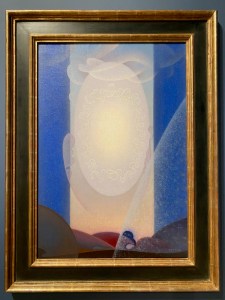
1947 Light Center, evoking one’s ability to transform. Private collection.
The center gallery features work done after Agnes moved to her desert home near Palm Springs in the Thirties, where she was transfixed by the quality of desert light. She loved incorporating water and light into her works – two natural phenomenon that symbolize transformation and change.
The dark walls of the center gallery enhance the glowing nature of her spiritual canvases. Her technique is masterful, with layers of translucent washes applied to give the white ovals nearly a three-dimensional feel, like looking into the void of an Anish Kapoor sculpture, except that Agnes achieves the effect with simply a canvas.
Here’s a talk recorded last year at the Phoenix Art Museum in which Notre Dame professor Erika Doss explains Agnes Pelton’s spirituality and puts her work in the context of the modernist movement:
Reopening News
The Whitney has just announced that the large outdoor public project on the Hudson waterfront by David Hammons will open this fall. The other big announcement is that a one-year Biennial postponement will give artists and curators more time to view and prepare work that was put on hold by the shutdown. Read more about upcoming shows here.
At 7:00pm on October 20, Whitney curator Barbara Haskell will take your questions about Agnes in an online “Ask a Curator” event. Check our Virtual Museum Event page for all of the museum’s nearly daily virtual tours, talks, and walks on this and other exhibitions.
If you’re in New York, you can visit the Whitney five days each week, Thursday through Monday, with extended hours every Friday until 9:00pm. All exhibition spaces are open, including the magnificent collection show, which features mini-shows by Jacob Lawrence, Hopper, and Calder. Here’s our previous post about this fantastic exhibition.
1957 Arp sculpture and view of works by Leger, Frankenthaler and Bonticou
A big, red blob on the fifth floor at MoMA is the welcome sign to one of the most engaging exhibitions in New York – the come-hither array of modern artworks in the latest Artist’s Choice show, Amy Sillman: The Shape of Shape, on display through October 4.
But here’s the catch for MoMA visitors – the show has more than 75 works but no labels, no identification, no dates. Just the clue that Amy chose works to explore the role of “shape” in modern art. Small artworks are arranged knee-level on risers (kind of like stadium seating), with larger paintings tilted against the wall. A few are hung in the traditional way, but it feels as if MoMa’s collection is looking at you and hankering for a conversation. Check it out in our Flickr album.
Rectilinear frame conversation between 1989 Albert Oehlen painting and 1935 “Construction” by Gertrude Green
In our first visit back to the re-opened MoMA, visitors circulated through the room, looking intensively, talking about what they saw, and discussing how pieces might be connected. Although the gallery guide was available via QR code, no one during our visit appeared to seek it out. Everyone seemed quite content to parachute into 110 years of modern visuals and just go for the ride.
What did Amy choose? Abstracted forms, organic shapes, human bodies, and not-bodies – all arranged in a way that makes you feel that one is somehow related to its neighbor. You can’t quite describe why the entire room felt like a tight ensemble, even though one piece might feel like fun and the next a little scary.
It was interesting how unsettled visitors felt by 1970s works by Christina Ramburg and Julian Schnabel. This is exactly what Amy was going for, according to what we overheard her tell students in the gallery yesterday. She wanted to evoke the anxious feelings that most artists experience as they paint, draw, and sculpt and to reflect the times today without being didactic.
Along the east wall – 2008 acrylic by Charline von Heyl, 1920 Arp sculpture, and 1976 drawing by Jay DeFeo
Amy came of age during the Seventies when museums and intellectuals had given abstract expressionism its “heroic” status and crowned minimalists and conceptual artists as successors in the march of modernism. For this Artist’s Choice exhibition, Amy examined MoMA’s vast archive from a different perspective, looking at famous and not-so-famous creators whose work evoked myths, an interest in shadows, tension, anxiety, bodies, and whimsey.
Shadowy Black figures in a dark painting by Zimbabwean artist Thomas Mukarobgwa are echoed by a shadowy figure in a work by Leger. The tiny 1920 stacked Arp sculpture seems to be playing a “Mini-Me” role next to the large, layered 2008 Charline von Heyl acrylic.
Shadows also play key roles in a Lois Lane painting paired with a Kirschner wooduct. See for yourself and make a connection. Download Amy’s zine here to learn more about the works she chose and how she installed them. (She designed it during the quarantine months when the show was shut down.)
Here’s a short overview of the show hosted by MoMA painting/sculpture curator Michelle Kuo:
But you should really dig into the in-depth conversation (with over 10,000 views!) between Amy and Michelle, if you’ve ever been to art school or painted. They talk about art making, art history, Amy’s inspiration from Munch’s little-known litho of a woman hugging a bear, and the way she chose lesser-known works that could have a conversation with you in 2020:
More on MoMA’s reopening
MoMA on 53rd Street is open every day with timed ticketing, and now that the free-ticket offer has concluded, it seems easy to find a time to visit. The Queens outpost at P.S.1 is open until 8:00pm Thursday through Sunday, and is currently showing the acclaimed (and long-anticipated exhibition) Marking Time: Art in the Age of Mass Incarceration through April 4.
1957-58 satin “Du Barry” evening dress by Christian Dior
Walking through the Costume Institute’s show, In Pursuit of Fashion: The Sandy Schreier Collection, closing September 27, you can feel the care and attention that Sandy gave to choosing exquisite fabrics and impossibly precise handwork in the pieces she chose for her archive.
The dresses and accessories that Sandy’s chosen to donate to the Met are pristine – a tribute to her true love, appreciation, and care for couture masterworks. She didn’t collect to wear the clothes, but to preserve and admire them as genuine works of art – duchess satins, intricately painted velvets, and incredible beadwork from the best French embroidery houses. Take a look some of the details close-up in our Flickr album.
A transition to ease – a lavish 1913 evening dress by Jean Victorine Margaine-Lacroix for the House of Margaine-Lacroix
The beautiful show opens with an array of postwar couture by superstar designers Dior, Balenciaga, and Saint Laurent alongside creations by less shown couturiers, such as Jean Dessès and Jacques Griffe. It’s a joy to behold Sandy’s reverence for sumptuous fabrics and dramatic silhouettes.
It’s equally exciting to encounter lavish early 20th century gowns and discover new names, such as Madeline & Madeline or Jean Victorine Margaine-Lacroix, who were blazing the trail for a new kind of liberating dress for women at the same time that suffragettes were marching to gain the vote. Sandy’s gift brings these ground-breaking female designers into the Met’s collection for the first time, too.
The show also calls attention to at-home ease and glamour of the Thirties from innovative, sought-after American female designers – a tea gown of simplified perfection by Jessie Franklin Turner (who Poiret called “a genius”) and a virtually sheer dinner dress by Valentina created from layers and layers of netting.
1939 chiffon tea gown by Jessie Franklin Turner and 1940 net dinner dress by Valentina
Both pieces show masterful construction, nearly invisible handwork, and style that enabled an understated hostess to sweep through her own private event like a movie star.
The back of the gallery showcases some of Sandy’s earliest acquisitions – nearly a dozen coats, dresses, and capes from the Twenties by two legends of textile magic – Fortuny and Maria Monaci Gallenga. Each had their own secrets techniques for applying intricate, metallic Renaissance-inspired patterns on lush velvet and silk. The creations are a master class in artistic dressing.
Many couture feats demanding close examination are encountered in the third major portion of the show – delicate flowers on a tulle dress by Vionnet, diaphanous, layered embroidered chemises by Boué Soeurs, and sparkly flapper dresses by Poiret and others that are beaded beyond belief and look as if they were made yesterday.
1925 lame and lace dress by Paul Poiret and 1925-28 evening dress with paillettes, beads, and crystals
There’s a tongue-in-cheek gallery with Sandy’s collection of sartorial puns from the Eighties by Stephen Sprouse and Patrick Kelly, alongside and fool-the-eye hats and accessories by Stephen Jones and Philip Treacy. (Turkey feathers painted to look like butterflies, anyone?)
Alongside a watercolor portrait of Sandy, there’s another hint to what her collecting will add to the Met – a works-on-paper collection from the early 20th century, featuring pen-and-ink illustrations that were how fashion houses showed their clients what each season had to offer. It will be exciting to see more from the print portfolio that Poiret created with star illustrator Georges Lepape for his best clients.
Enjoy this brief glimpse into a space where Ms. Schreier’s gift provides beauty, delight, and reverence for masterful makers around every corner.
Vera’s 1950 silk “Fish Scroll” scarf, featured on the cover Harper’s
So many of the great female entrepreneurial success stories begin at the kitchen table, and the story currently being told by the Museum of Arts and Design (MAD) inVera Paints a Scarf: The Art and Design of Vera Neumann, on view through January 26, is no exception.
Fashionistas today may be too young to remember when the American height of chic was to sport a scarf by Vera. Back in the Sixties and Seventies, Vera pretty much had a lock on the retail market for bold, colorful silk scarves through major department-store behemoths.
The exhibition is a tribute to a woman who took her love of painting, travel, nature, and culture to the wardrobe and accessory drawers of all fashionable American households, and ended up partnering with many top manufacturers to push her aesthetic and flare into mid-century modern homes.
Vera’s silk scarves, based upon watercolors, hung as art at MAD
Although her name is not well known by young people today, MAD’s exhibition is a fitting tribute to a woman who virtually invented the concept of “lifestyle” brand. It’s hard to believe that an aspiring artist born in Connecticut in 1907 would grow up and develop her company to pack such a punch in retail.
A graduate of Cooper Union and Traphagen in the 1920s, during the Depression, Vera and her husband set up a silkscreen on their little Manhattan kitchen table and began printing her paintings on surplus parachute silk. Within a few years, her beautiful silks were being retailed at B. Altman, Lord & Taylor, and other nice shops in the city. Her joyous prints were a success!
Vera’s 1960-1965 silk blouses with paintings of blue poppies and woodland images
Building her business through the war years, Vera took her first foray into fashion in the 1950s, creating tops and blouses that she came to market as “wearable art.” Rather than simply printing yards of repeating patterns, she went a step further – engineering prints in panels, so when pattern cutters and sewers assembled her shirts, her beautiful patters would strategically appear in the final product, enhancing cuffs, collars, edges, and hems.
Of course, everything was priced for the widest possible market, so a woman seeking a bit of fashion flair could buy a Vera without blowing her budget. She followed the art-plus-commerce philosophy – a Bauhaus innovation – and maximized accessibility of mid-century modern design by expanding into home textiles, tabletop accessories, and dishes.
1979 “The Birches” china dining set for Mikasa with matching tablecloth
As her business grew, Vera came to rely upon the next generation (Perry Ellis got his start with her) to keep the design development chugging along while she traveled to Asia and other parts of the world to feed the constant demand for new inspiration for her collections.
MAD has assembled a beautiful, loving exhibition of Vera’s output, showing how her original watercolor work made its way into her commercial ventures – scarves, clothes, and home décor. Perhaps most remarkable is that this powerhouse kept traveling, painting, and channeling joy into her textiles well into her eighties – an inspirational lesson in love of life, art, craft, and culture.
1971 “Northwest Coast” silk scarf
Thank you, Vera! Long may your prints wave!
And thank you to MAD for sharing Vera’s lifetime of creations and inspiring story!
See more photos of this wonderful exhibition in our Flickr album.
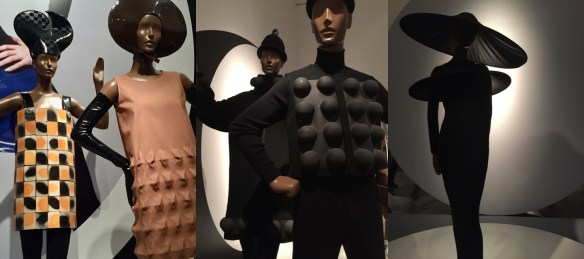
The Brooklyn Museum’s latest blockbuster fashion exhibition Pierre Cardin: Future Fashion, open through January 5, presents the work of a French designer who continues to be inspired by the belief that simplicity, design, and science are essential ingredients for a world that lives in peace, treats men and women equally, and looks to the horizon.
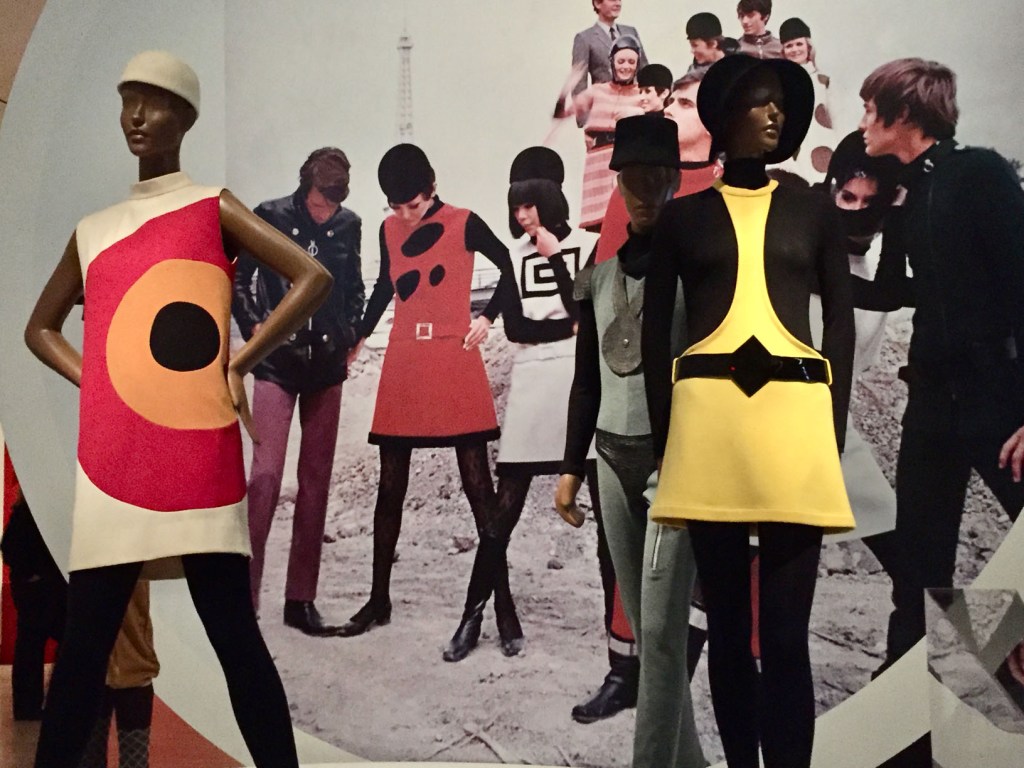
Geometric minidresses and men’s ensembles worn with tights and over bodysuits from the revolutionary 1964 Cosmocorps collection
Cardin came of age as a designer in the 1950s creating luscious swing coats, lasso-backed draped suits, and prim (but red-hot) looks for Jackie Kennedy. But he shot to “influencer” status in the early 1960s with unisex looks, bodysuits, collarless jackets for the Beatles, reliance on a fashion-forward Japanese model, turtlenecks (for men and women), hoods, felt helmets, and body jewelry – in other words, all the basic building blocks that would be used to clothe the crew of the Starship Enterprise.
1957 “lasso back” suit, 1968 bodysuit ensemble, and Cosmocorps photo with video showing the unisex Star Trek costumes it inspired in 1966
The Brooklyn show begins with a chronology of Cardin’s young life – soldier, costumer, and Christian’s first employee at the House of Dior in 1946 – but rapidly gives way to a sensational array of tubular, unisex clothing from his mind-blowing Cosmocorps collection, which had so much impact on Sixties culture. Take a look at our favorites in Flickr album.
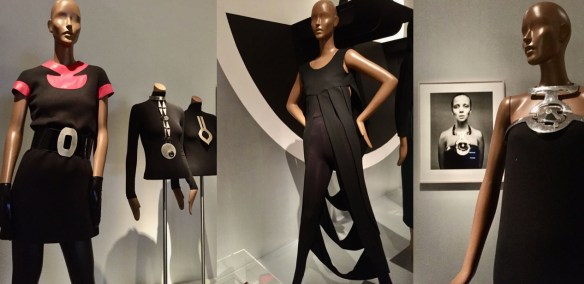
1968 wool and vinyl minidress, 1966 aluminum statement jewelry, a 1970 wool crepe “Kinetic” dress, and Avedon photo of Penelope Tree wearing a 1968 evening dress and collar
Although several other European designers could be credited with the evolution of the miniskirt, no one channeled the Space Age like Pierre Cardin when it came to shape, form, and use of new fabrics and materials – lenticular plexiglass, vinyl, Dynel pressed into 3D forms and shaped for the body, and parabolic structures that underpinned evening gowns, men’s jackets, and skirts. Pierre even went so far as to visit Houston and slip on an Apollo 11 astronaut’s suit.
1969 lenticular plexiglass and vinyl “armor” dress, 1968 heat-molded Dynel dress, 2007 jersey coat and suit with rubber, and 1991 jersey evening ensemble with parabolic shoulders and hat
It’s clear that the Sixties and Seventies fashions in the show reflect what was going on in the art world at the time – bright, bold colors of Pop Art, pared-down minimalism, an embrace of non-traditional materials, and kinetic art. (Carwash dresses, anyone?)
Even Cardin’s forays into furniture design reflect his belief that his hand-made contemporary works genuinely functioned as art first and utilitarian additions to the home second.
1968 circle coat and hat, next to 1979 Junior Unit, and 1977 Serge Manzon lamp
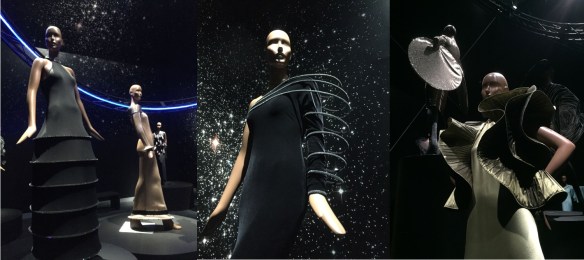
The final gallery in the Brooklyn show is a darkened room populated with mannequins in shimmering gowns and suits, electrified dresses and sportswear, and pieces embellished with parabolic hoops and flourishes – sheer Space Age magic. Slight swoops across the space, framing the last 20 years of Cardin’s output with an other-worldly, visionary feel.
2008 evening dress with parabolic hem, 2003 evening gown with plastic tubes, 1994/2000 velvet evening dress with Swarovski crystals on the orbital sleeves, and 2013 silk/lame evening dress with Swarovski crystals
A surprise inspiration is the revelation that Cardin at 97 is still designing and looking toward the future. His predictions? That people will be on the Moon in 2069 wearing his Cosmocorps look, women will be sporting tube clothing and Plexiglass cloche hats, and that men will be wearing kinetic tunics and elliptical trousers. Why not?
Watch as the curator explains how Cardin envisioned the future…
…and why this retrospective of his work is just right right now:














 itsnewstoyou