Is David Roentgen the 18th Century Steve Jobs?

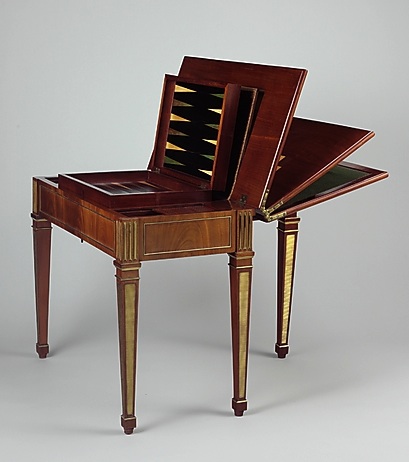
David Roentgen’s Game Table (ca. 1780–83). Oak, walnut, veneered with mahogany, maple, stained maple, holly, stained holly; felt; leather, partially tooled and gilded; iron and steel fittings; brass and gilt bronze mounts. Source: Metropolitan Museum, Pfeiffer Fund, 2007.

David Roentgen’s Game Table (ca. 1780–83). Oak, walnut, veneered with mahogany, maple, stained maple, holly, stained holly; felt; leather, partially tooled and gilded; iron and steel fittings; brass and gilt bronze mounts. Source: Metropolitan Museum, Pfeiffer Fund, 2007.

Even if David Roentgen didn’t produce for the mass-market, he certainly seemed to have written Steve’s playbook  — wow them with innovative design, refined surfaces, exacting craftsmanship, playful art, and sophisticated multimedia integration. Oh, and if that’s not enough, why not make it passkey protected and portable, too? Like Steve, David knew how to turn engineering into art and ka-ching.

Experience out-of-the-box design innovation in the closing week of the Metropolitan Museum’s unforgettable show, Extravagant Inventions, Princely Furniture of the Roentgens. The beauty of the marquetry and fittings on the displayed desks, sofas, clocks, commodes, and rolltop desks would be enough, even if they simply occupied a quiet corner of a drawing room or boudoir.

But if an 18th-century king, queen, or royal saw them in action – revealing hidden apps for writing, reading, drawing, music, games, curios, and hiding the desktop – there was no turning back. The mechanical furniture was so desirable that wealthy trend-setters just had to have it (like iPads).

What social-minded gamer could resist Roentgen’s 1780s Game Table if they saw David’s demo?

The desire to own and show off the most up-to-date artistic engineering marvel had royals running for their strongboxes to put down deposits on anything Roentgen could produce. In fact, the Met tells us that the Berlin Secretary Cabinet, the star of the show, is probably the most expensive piece of furniture ever produced. And we can’t even begin to discuss robot Marie Antoinette playing the dulcimer, or the clocks that turn into orchestras.

When the French Revolution put an end to sales at Versailles, Roentgen cut out the curliques, tailored the outer design to a sleeker look, and shifted his retail operations to Russia. Catherine and her court bought the newer stuff by the cartload.

The Met has an entire YouTube playlist devoted to these 18th century wonders, and you really should peruse them all. Get to the show in the final week and see what another style and multimedia-obsessed generation spent their money on.

And lest it slipped your mind, Steve and Woz’s first Apple 1 computer was assembled within a wooden case. Maybe it’s good that David and his engineering/sales team weren’t around to critique it.

Ivy Style or Gangnam Style?

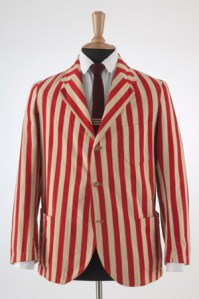
Red and white cotton flannel blazer, c.1928. Museum at FIT purchase.

Red and white cotton flannel blazer, c.1928. Museum at FIT purchase.

It’s hard to remember a time without Gangnam Style, but it’s even harder to remember before there was Ivy (as in Preppie) Style. There’s just a few more days to trek to The Museum at FIT for its revealing show on the roots of American menswear, Ivy Style.

Sure, the show is peppered with references and examples of the current Kings of Prep –Lauren, Hilfiger, and (prep with a twist) Thom Browne. But the real eye-opener here is the manner in which the curators journey back in time to show you how something so familiar today was once so radical – how “Ivy” got its name in 1876, how students set the sportswear trends before WWI, and the debut of the now-forgotten (but influential) “beer suits” at Princeton in 1912.

It’s also startling to learn that Brooks Brothers industrialized wardrobes as far back as 1818, and that J. Press “owned” the market for natural-shoulder jackets for pretty much the entire 20th Century.

1937 illustration of college men’s fashions from FIT Library and Archives.

1937 illustration of college men’s fashions from FIT Library and Archives.

Thankfully, FIT has packed enormous amounts of menswear history on its special exhibition web site, so work your way through it and mine it for your own favorite tidbits (e.g. origins of saddle shoes, polo coats, and blazers).

Favorite factoid: In 1931, the average college student spent 51% more on clothes than the average man-on-the-street – a college trend that kept going right through the Great Depression. So, maybe it’s like Gangnam Style, after all? Psy sports it too, you know.

If you can’t get to the show in the next few days, take the virtual walkthrough with the Richard Press, the former President of J. Press, who interprets the who, what, why, and when of menswear history (including the roots of the most memorable scene in Animal House). Don’t ask, just watch:

What’s Up with Those Dots, Yayoi?

You’ve seen them everywhere over town…the enigmatic dotted signs with the face of Yayoi Kusama peering out. During Fashion’s Night Out, the Vuitton store was ablaze in polka dots, all a tribute to this reclusive Japanese pop-art sensation who burst upon the Manhattan art scene in the 1960s.

This is the last weekend to see her retrospective in person at The Whitney, but if you can’t make it, enjoy the Vuitton collection that she inspired (they’ve created a whole website).

Take a peek into the show.

And click on this link to see a documentary clip about this Kusama’s life. Be surprised and find out how to merge into infinity!

Girls Who Wear (Google) Glasses

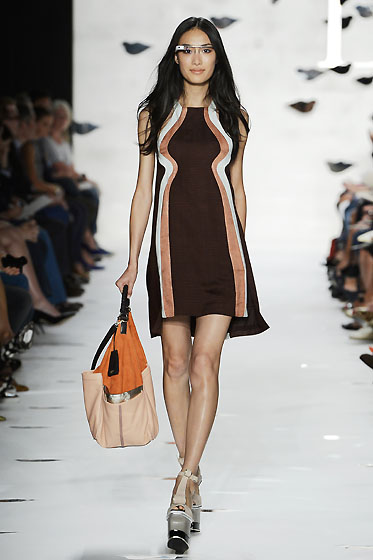
DVF’s Look #17 for Spring/Summer 2013

When Diane von Furstenberg and her models walked the runway at NYC’s recently concluded Fashion Week, they decided to give the world an inside peek at how it feels by recording the experience with Google Glass, the still-in-Beta avant-eyewear.

The innovative accessory shoots video, snaps pix, streams messages, and apparently looks good, so Diane decided to snap on the specs and take you with her (and her posse) on a fashion-tech flashbulb-popping stroll.

What’s cooler than Diane’s embrace of the new? Her Spring/Summer 2013 collection and her attitudes about life, potential, and empowerment. Take a look. Thanks, Diane!

Virtual Trip to Design Island

Let me guess. You didn’t get to see the spectacular design show that ended yesterday on Governor’s Island. While their mansion up on 91st Street is being renovated, The Cooper-Hewitt (a.k.a. Smithsonian) outdid itself by mounting a show inside Building 110 on New York Harbor’s hottest party-picnic location.

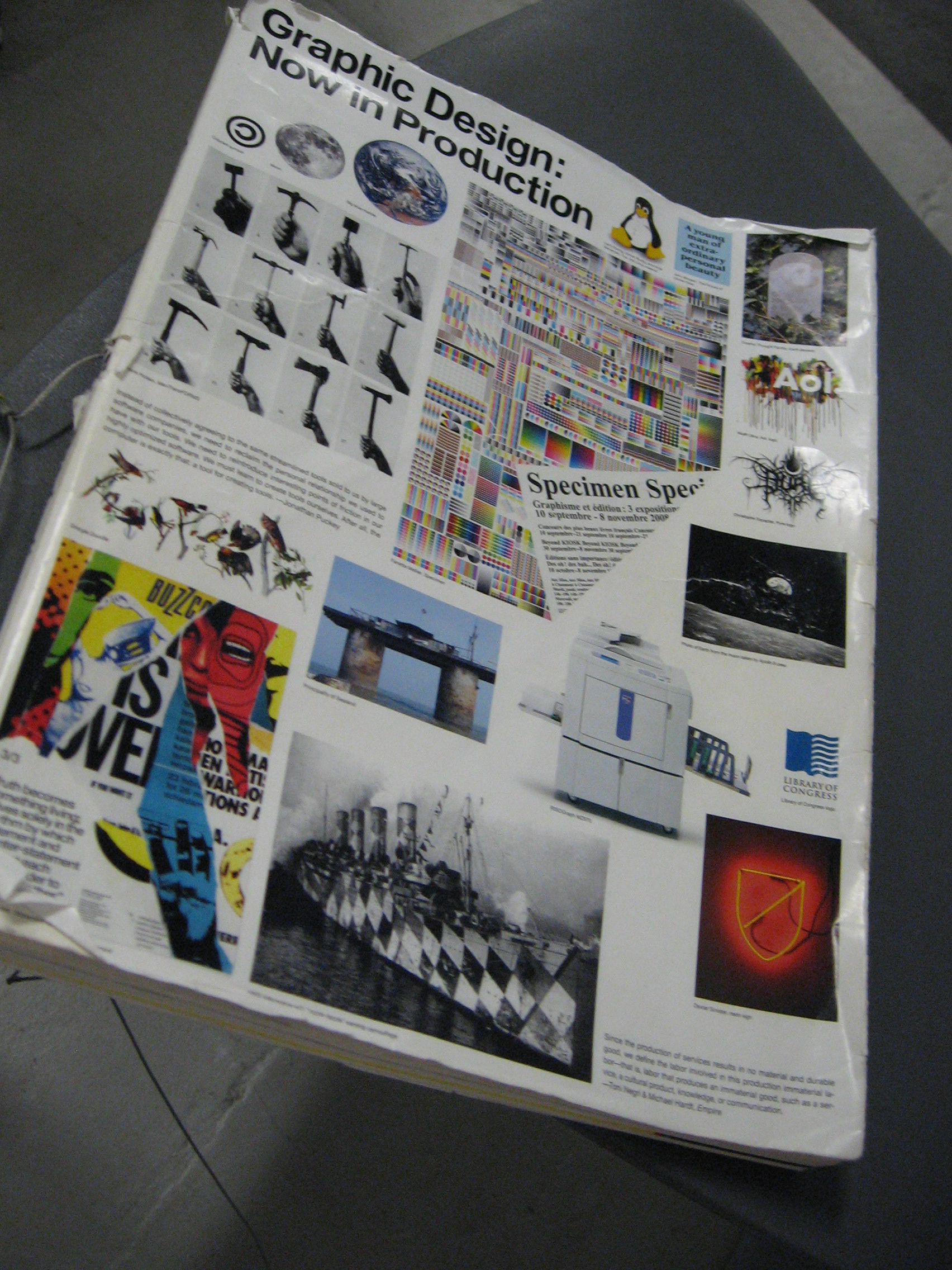
Graphic Design: Now in Production gathers great design produced since 2000 to feature what creative minds are offering. The summertime crowd loved it, and people flowed right from the ferry into the show and through the aisles where works were grouped around themes like storefronts, branding, typography, and print (it lives!). Check out the action on the Flickr feed.

The show is vibrant, interactive, mind-blowing, provocative, and fully documented in a 10-minute walk-through video with the curator Elleln Lupton that pretty much replicates the experience.

If you’re in LA, the show opens September 30 at UCLA’s Hammer Museum before migrating in 2013-2014 to Grand Rapids, Houston, Winston-Salem, and RISD.

Among our favorites are Brand New’s display, which asks visitors to vote (“before” or “after”) on redesigned corporate logos, and CognitiveMedia’s “RSA Animate: Changing Education Paradigms.”

Oil Drills in Manhattan

 Have you seen the latest art installation in the Theater District? It’s Josephine Mecksper’s Manhattan Oil Project – two 25-foot tall oil pumps churning away 4 hours a day (twice a day) weekdays and 8 full hours each weekend.

Go to the undeveloped land on the southeast corner of Eighth Avenue and 46th Street and bring your friends (and camera) before it’s gone.

Sponsored by Yvonne Force Villareal’s Art Production Fund, which produces hard-to-produce artist installations, this one had special help from Sotheby’s and The Shubert Organization, which know a thing or two about mining riches in Manhattan.

Is it actually pumping oil? Feel free to stand there and answer out-of-towners questions on that one.


Where is Social Media Trending?

Our continued Social Media Week wrap-up summarizes the top consumer trends identified by Ann Mack, a professional trend-spotter with JWT North America:

Internet + smartphones + social media have turned information into a constantly updated stream that we take wherever we go. We’ve become hyper-documentarians:

  • We upload the equivalent of eight years of content every 24 hours.
  • Over 845 million people are now on Facebook uploading 250 million photos each day.
  • 200 million daily Tweets is the equivalent a 10-million page book every 24 hours.

The extreme social transparency that this flow generates is creating a type of social angst – the Fear of Missing Out (FOMO), which will likely increase.

Social networks will figure out ways to fine-tune our personal data and further customize ads, content, search results, and shopping choices that we see; however, some users will say things have gone too far and push back against personalization.

In the future, consumers may trend toward more random on-line experience…the way things used to be when we first “discovered” the Internet. It’s possible that some, especially Millennials, will unplug and just go back to connecting with pals face-to-face. On the other hand, more digital tools will be used as “butlers”.

In the meantime, brands might be able to tap into social-media users’ interest in “doing good”, collaborating, and being part of a bigger network. The challenge for marketers will be to figure out how to harness FOMO to drive spending while doing more social good.

Your thoughts? To be continued…