The Corset that Changed Cultural History and the Man Who Made It

JPG’s creation for Madonna’s “Like a Virgin” segment of her 1990 tour. Made from vintage 1930s lame

JPG’s creation for Madonna’s “Like a Virgin” segment of her 1990 tour. Made from vintage 1930s lame

Amidst the light, glamour, glitter, and mystery sending shock waves and awe through the masses crowding into the Brooklyn Museum’s show, The Fashion World of Jean Paul Gaultier: From the Sidewalk to the Catwalk, a hush falls as each person realizes they’re only an arm’s length away from the Icon’s icon. Lovingly crafted from vintage lame, JPG and Madonna had no idea (according to Madonna) what a sensation their underwear-as-outerwear statement would create in fashion, performance, pop, and culture when JPG designed her get-ups for the Blond Ambition World Tour. Get out to Brooklyn to experience this über-tribute before Feb 23.

Madonna’s lent her JPG corsets to the section of the show where the walls are covered in quilted satin, and JPG dug into his archives, too: You’ll see the series of illustrations he did to show the looks he would create for the tour, as well as JPG’s personal Polaroids shot during the initial fittings. If you’re very quiet in this part of the show, you’ll also hear visitors gasp when they realize that they’re looking back at artifacts from 1990!

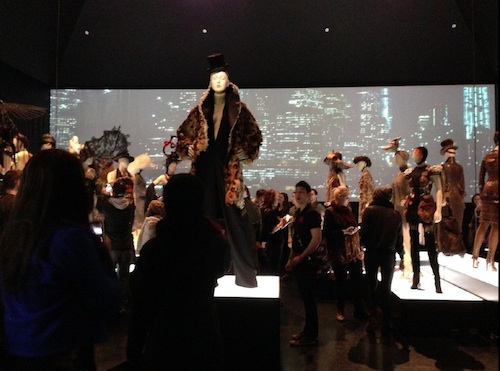
Crowds listen to the mannequin sing in the Metropolis gallery during the show’s final week.

Crowds listen to the mannequin sing in the Metropolis gallery during the show’s final week.

This genuinely theatrical tribute to JPG is chock full of corsets and cages made from silk, leather, raffia, wheat, and enough other stuff to win the Unconventional Materials challenge hands-down. O ye of Project Runway, worship at the mannequins of the Master!

At the entrance to the show, there are two small photo portraits of JPG taken by Mr. Warhol himself. They’re at a dance club in 1984 and JPG is in one of his Boy Toy collection outfits. Andy is quoted as saying, “What he does is really art.” It’s a curatorial anointment that offers a subtle, quiet, reflective moment to what you’re about to experience.

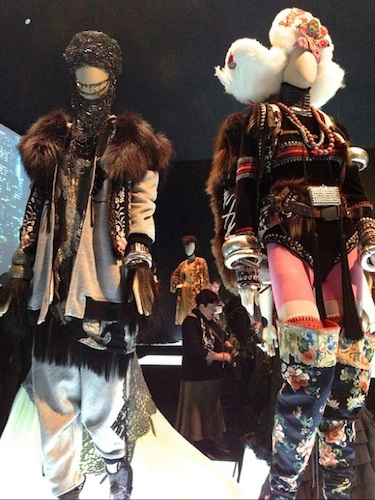
Dealing with the recent blizzards would have been more fun if you had shopped JPG’s Voyage Voyage ready-to-wear collection (2010-2011). These are styled with pieces from older collections.

Dealing with the recent blizzards would have been more fun if you had shopped JPG’s Voyage Voyage ready-to-wear collection (2010-2011). These are styled with pieces from older collections.

Room after room of gender-bending, mind-altering, color-crazy, history-twisting looks, gowns, shoes, bodysuits, and haute handwork reminds us that JPG has been pushing the boundaries for over 40 years, inspired by French sailors, French culture, 50s TV, global culture, his grandmothers unmentionables drawer, and the ever-inspiring gritty street. How do you use embroidery, neoprene, stuffed silk tubes, tulle, and illusion in a subversive manner? Take a stroll through JPG’s master class.

You’ll find mermaids worn by Beyoncé, a French sailor-striped gown worn by Princess Caroline, red carpet looks worn by Ms. Cotillard, a Mongolian shearing coat sported by Bjork, and photos of supermodels and superstars sporting outrageous and inventive looks. The names of the collections alone tell you the scope of his interests – Haute Couture Salon Atmosphere, Ze Parisienne, Flower Power and Skinheads, Paris and Its Muses, So British, Forbidden Gaultier, and Great Journey collections.

Close-up of corset from JPG’s Countryside Babes collection, prêt-à-porter spring/summer 2006. Made of wheat and braided straw, created in 84 hours

Close-up of corset from JPG’s Countryside Babes collection, prêt-à-porter spring/summer 2006. Made of wheat and braided straw, created in 84 hours

The show features 140 ensembles in all, enough to fill the entire wing. Mr. Gaultier even tells us that he expanded it a little for Brooklyn’s gigantic space, adding a “Muses” section with American icons and runway looks for big-boned, curvy girls.

Oh, and did I mention that the mannequins talk? (We can’t even begin on that, so here’s a video to explain how that magic happened.)

Brooklyn is the last stop on JPG’s North American tour, which was organized by the Montreal Museum of Fine Arts and Maison Jean Paul Gaultier.

If you can’t visit, take a walk through the show via our Flickr photos, and listen in on an hour-long discussion between JPG himself and the show’s curator Thierry-Maxime Lorio, where they talk about his “express yourself” philosophy.

The special promo video will give you a taste of the creative genius behind 40 years of memorable, challenging fashion as art:

Brooklyn Museum Shows What Rich Americans Buy to Impress

Cabrera

Miguel Cabrera oil (1760) of Dona Maria de la Luz Padilla y Gomez de Cervantes sporting velvet beauty marks and bling

Conspicuous consumptions is nothing new, according to the Brooklyn Museum’s spectacular show, Behind Closed Doors: Art in the Spanish American Home 1492-1898, and they’ve gathered (mostly from their collection) four centuries of blindingly beautiful stuff to show how earlier generations of status-seekers showed off how special and rich they were. Catch it before January 12.

The Fourth-Floor show fills two huge galleries that have been partitioned by the curators into areas corresponding to rooms in a traditional Spanish-American home, where they’ve displayed the stuff that the colonial high and mighty would have put there.  Although two-thirds of the United States was once under Spanish rule, the paintings, furniture, textiles, and other treasures you’ll see are from homes south of the border, including the Caribbean and south of the Isthmus. Check out our Flickr feed.

Silver Pins

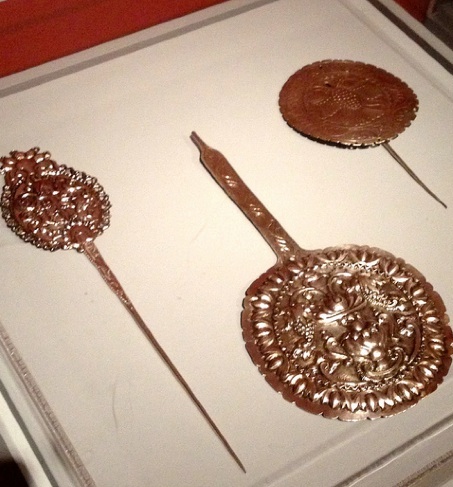
Giant 18th century silver status pins for women, slightly Incan-style

First, you’d dress to impress and make sure that everyone knew that you were somehow aligned with the upper classes back in Spain. The show puts English and Spanish-American portraits side-by-side in the first gallery to illustrate that the latter weren’t shy about applying ostentatious tiaras and pearls to themselves, slapping on the velvet faux-beauty marks, and shoving royal proclamations into the frame to convey your wealth, status, and privilege. Wealthy English colonials and their portrait painters took a more austere, understated approach.

Second, if you were of mixed race but possibly had some Incan royalty in your blood, you’d hang gold-flecked portrait series of Incan chieftains where everybody could see them in your home. The lady of the house might wrap herself in a locally woven textile sporting mixes of South American deities with that oh-so-familiar-to-Europeans Hapsburg double eagle. Then she’d bling it up with a giant oversize pin made out of solid silver.

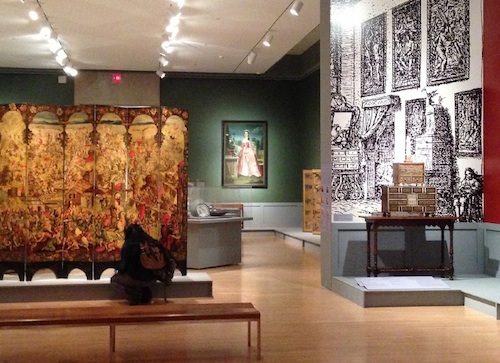
Visitor inspects painted screen in exhibit area with the objects from the grand reception room of an upscale home.

Visitor inspects painted screen in exhibit area with the objects from the grand reception room of an upscale home.

Third, you’d emphasize your casual elegance by actually draping the rugs and tapestries all over the floor, stairs, and risers in the ladies’ sitting room.  After gold, silver, and jewels, textiles were about the biggest luxury anyone could find, and Spanish Americans made and bought a lot. In British America, carpets were only used to cover tables, so the casual distribution of so much wealth below your feet was something only Spanish Americans could afford.

Because the Caribbean and coastal cities of South and Central America were right in the center of shipping and trade routes for centuries, wealthy people could buy pretty much anything they wanted and the curators show it to us – gorgeous Japanese screens, custom-printed Chinese porcelain, English-style sitting chairs, and Turkish rugs. No pennies were pinched in upwardly mobile, Spanish-speaking homes.

Peruvian bed of gilt wood (1700-1760) that would be shown off in a state bedroom.

Peruvian bed of gilt wood (1700-1760) that would be shown off in a state bedroom.

And let’s not forget what treasures were produced right inside the Spanish protectorates – silver shaving basins, polychromed statues of the saints, gigantic gold-framed “statue paintings”, gilded beds, embellished leather traveling trunks (to go to your country home), solid mahogany furniture, and custom-made books of your family’s geneaology. We won’t even get started on the private chapel décor.

This show throws open a window on the first wave of high-status interior design and decoration – a story that is normally confined to the castles in Europe or the palace at Versailles, and one that is perfectly suited to be told by Brooklyn’s extensive Latin American holdings with a couple of key pieces from the sumptuous collections uptown at the Hispanic Society of America.

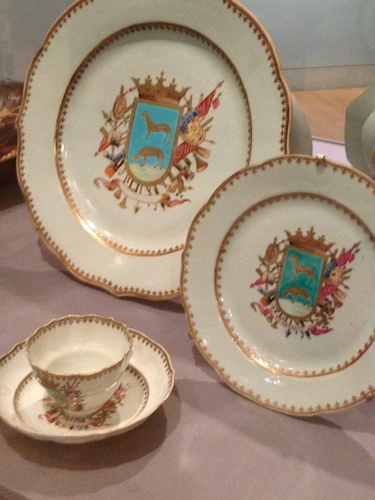
Chinese import: 1770 porcelain featuring South American animals, purchased by Ignazio Lemez de Cervantes

Chinese import: 1770 porcelain featuring South American animals, purchased by Ignazio Lemez de Cervantes

If you want to do a deep dive into upscale living of past centuries, visit the exhibition archive on the Museum’s website and click on the Objects tab. Or, see it all in person when it goes on the road: it opens at the Albuquerque Museum on February 16, the New Orleans Museum of Art on June 20, and the Ringling Museum in Sarasota on October 17.

And congratulations to Brooklyn for making it onto the cover of the winter edition of Humanties, the NEH magazine.

World Wide Web (and Weft) of Past Centuries at The Met

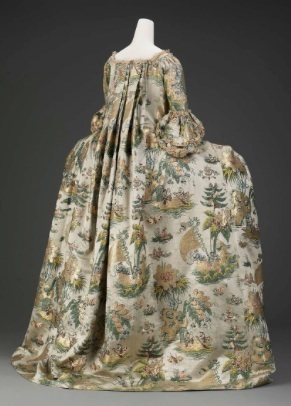
1730s Dutch brocaded satin, featuring exotic Asian islands and fauna, was refashioned into a more fashionable French frock in 1770. Source: Museum of Fine Arts, Boston. The Elizabeth Day McCormick Collection

1730s Dutch brocaded satin showing exotic Asian islands and fauna was refashioned in 1770 into a more fashionable French look. Source: Museum of Fine Arts, Boston.

A joyous collaboration among eight departments of the Metropolitan Museum of Art has written a new history of how a global network of fabric trade and manufacture once served the same purpose that YouTube, music videos, shelter magazines, Vogue, and The New York Times Style section do today – to present images of the latest trends and make anyone in the world that sees them understand the clothes or accessories needed to be “on trend” with other sophisticates.

Interwoven Globe: The Worldwide Textile Trade, 1500–1800, running through January 5, tells a monumental story about how trends went viral pre-Internet. It was a slower world dominated by sailing ships versus transoceanic cables, but the tale spanning centuries, continents, and cultures shows how gorgeous garments, incredible tapestries, bedazzled church vestments, quilted bedding, luxurious wall hangings, tour-de-force printed fabrics, and royal furniture telegraphed “trend” in a different way.

Embroidered muslin dress and fichu. The 18th c. craze for Neoclassical across Europe drove massive imports of lighter-than-air Bengali muslin. Source: The Met

Embroidered muslin dress. The 18th c. European Neoclassical craze drove massive imports of airy Bengali muslin. Source: The Met

The show can’t fully be appreciated in just one walk-through. Each textile and garment is incredible to behold, and the network of interrelationships among craftsmen, artisans, tradesmen, royal buyers, rich merchants, and brave sailors traversing strange shores is equally rich, complex, and layered.

This two-dimensional pageant, enhanced by exquisite gowns and garments whose fabrics were sourced from the four corners of the globe, is given the full-bore treatment in the top-floor galleries reserved for blockbusters.

How do you tell a story this big? The curators decided to put a large interactive map of the 16th- to 18th-century trade routes right inside the door, which brings you up to speed on the French, Portuguese, Spanish, Dutch, and British trade routes linking the Americas, India, the Orient, and islands.

Then come the galleries dedicated to the styles and fiber-tech associated with each – silks woven in China for Europe and Japan, Spanish embroideries that reference Islamic carpet borders, weavings made by Peruvian grand masters of the art, and Indian resist-dye masterpieces that turned into English chintz and fabrics for the King of Siam.

Japanese Jinbaori made from Dutch 17th century wool and Chinese silk, a luxury item worn over samurai armor. Source: John C. Weber Collection

17th c. Japanese Jinbaori made from Dutch wool and Chinese silk, a luxury item worn over samurai armor. Source: John C. Weber Collection

In the Spanish gallery, you’ll see how the crowned double-headed eagles of the Hapsburgs adopt kind of a Chinese-phoenix look when 16th-century Iberian traders commissioned silk artists in Macau to create silk they could sell back home. By the 17th century, everyone – East and West – had become accustomed to enjoying “exotic” images from halfway around the world – birds, animals, architecture, flowers, and landscapes. It had the same impact as Google Earth and World Wide Web access today.

One of the more startling facts is that before Commodore Perry “opened” Japan to the West (ref. Sondheim’s Pacific Overtures, the musical), Japan was more into luxury-goods consumption than production. Apparently, the trend was to import the ultra-luxury, Dutch wool, and make it into topcoats that Samurai warriors could drape over their armor.

If you don’t see this in person, visit the online exhibition site for an encounter that’s a real treat: You’ll get to zoom into each quilt, drape, embroidery, dress, shawl, and piece of fabric to see it all super-close.

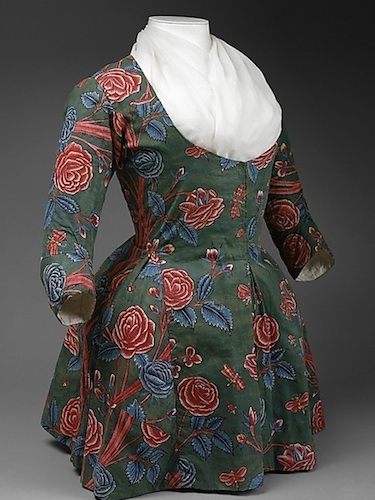
A late-18th century Indian-chintz Dutch jacket that knocked-off a French designer jacket in pink French fabric. Both have similar exotic floral prints. Source: The Met

A late-18th century Indian-chintz Dutch jacket that knocked-off a French designer jacket in pink French fabric. Both have similar exotic floral prints. Source: The Met

Click on the “full screen” button on each and toggle in to examine all of the glorious detail. The web site will tell you the story and show you the items in each gallery. You’ll be surprised to find the genesis of the fabrics-on-walls interior-decorating craze for country homes in the late 1700s and how men-only clubs adopted both plain and exotic dressing-gown dress from the Orient (a style also featured prominently in the current FIT show).

The King of Siam’s royal 18th century guard wore these resist-dye tunics. Fabrics were made in India and tailored in Siam. Source: Royal Ontario Museum, Toronto

The King of Siam’s royal 18th century guard wore these resist-dye tunics. Fabrics were made in India and tailored in Siam. Source: Royal Ontario Museum, Toronto

FIT’s Fresh Take on History via Monocles, Wigs, and Gowns

1924 short-hair, no-hips “boy” look with the signifying monocle.

1924 short-hair, no-hips “boy” look with the signifying monocle.

FIT’s powerful exhibition, A Queer History of Fashion: From the Closet to the Catwalk, throws open the window on what the curators felt was an untold story, and they’ve done history proud — creating a show and website featuring key clothing, points of view, and socio-political breakthroughs during more than 250 years of LGBT history. Visit before January 4.

If you think you know everything about fashion, peruse FIT’s downstairs gallery (or the website) and see how quickly you learn a new angle, a clue, or an insight from the context in which the curators tell their story – a style, epaulet, pattern, tie, mod look, or detail that conveys entirely new meaning.

Right at the foot of the stairs, you’re confronted with side-by-side late 19th century and early 20th sartorial clues sported by the era’s elegant lesbians and gay dandies – shirt collars and ties and Mr. Wilde’s telltale green carnation.

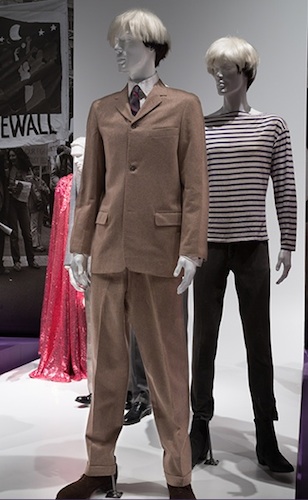
The suit that Andy had made in Hong Kong in 1956 on his first trip abroad compared to his super-hip King of Pop 1960s uniform.

The suit that Andy had made in Hong Kong in 1956 on his first trip abroad compared to his super-hip King of Pop 1960s uniform.

Entering the main gallery, you’ll meet monocled ladies of 1920s Montmartre posing in the “boy look” that went viral throughout the Twenties. Yes, the short hair and mode de le garçonne was adopted by every flapper in the world, but the curators link these changes to trends first sported in scandalous Parisian same-sex clubs.

The clothes tell story after story of how iconic fashion trends were first incubated within gay subcultures – Gernreich’s unisex caftans in the 1960s, YSL channeling Marlene’s tuxes into his 70s “Le Smoking” looks, leather trends in the 80s, and Versace’s bondage dresses in the 90s.

The mannequins have often been touched up with accessories and wigs to evoke innovators and eras, such as the two wigged Warhols, including his striped T and skinny jeans look that seems so “now”.

Other clothes suggest additional narratives: slinky glamour gowns channeling a gay designer’s obsession with feminine ideals, camp queen adaptation of exaggerated feminine points of glory, pre- and post-Stonewall sartorial identity, and even what people are wearing today for their same-sex wedding ceremonies.

Naomi flaunting Gianni’s 1992 bondage-inspired leather couture.

Naomi flaunting Gianni’s 1992 bondage-inspired leather couture.

So many stories, so little time. The security guards literally had to turn the lights off last Saturday night (when FIT closes at 5pm) because the throngs of captivated museum-goers simply didn’t want to leave with so much yet to absorb – Dietrich’s cross-dressing wardrobe on loan from Berlin’s film museum, a Charles James gown from Doris Duke, a Halston provided by Lauren Bacall, the iconic CK underwear billboard image from Times Square, Larry Kramer’s YSL Rive Gauche suit from the 70s, a Mugler-designed gown for chanteuse Joey Arias, and Ru Paul’s red vinyl…well, outfit.

And we haven’t even touched upon the Versace section filled with his Warhol patterns, studded leather, and Baroque-print fantasies. One fan confided that it was her second time because the visuals, details, and narratives were so much to take in.

If you can’t get there before January 4, check out the clothing, concepts, oral histories, and historic timeline on line and yak about it on Facebook.

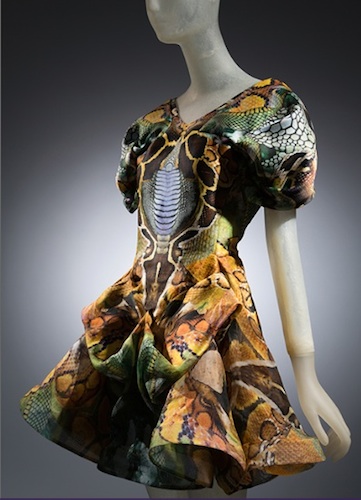
From Mr. McQueen’s Plato’s Atlantis collection, 2010.

From Mr. McQueen’s Plato’s Atlantis collection, 2010.

Hear what inspired curators Valerie Steele and Fred Dennis in this 6-minute Culture Beat episode, and go to FIT’s YouTube site to hear what 20 designers, celebs, and academics had to say at FIT’s symposium on the queer history of fashion.

Here’s Simon Doonan of Barney’s (think windows) talking about how gay style had an impact on the 1960s look on Carnaby Street (so, that’s where those flowered shirts came from!), why overt visual influences are not so evident today, and why the next generation needs to learn about the “fallen heroes” of the late 20th century design community.

Making Yesterday’s Fashion Totally Now

History repeats – a silk Robe d’anglaise from 1765 and a 2009 ribbon-and-wire creation by Agatha Ruiz de la Prada

History repeats – a 1765 silk Robe d’anglaise with Agatha Ruiz de la Prada’s 2009 ribbon-and-wire runway creation

Within FIT’s upstairs gallery, you’ll receive a master class (from the masters) on how to take something old, inject it with an inspired twist, and create Vogue-ready looks ready for the modern world in FIT’s show RetroSpective, running through November 16.

FIT curator Jennifer Farley did an outstanding job of selecting iconic looks associated with well-dressed woman from previous centuries and pulling interpretation after interpretation on that theme from FIT’s collection. Historical references, empire waists, hoop skirts, and leg-o-mutton sleeves all get the old/new side-by-side treatment in the galleries.

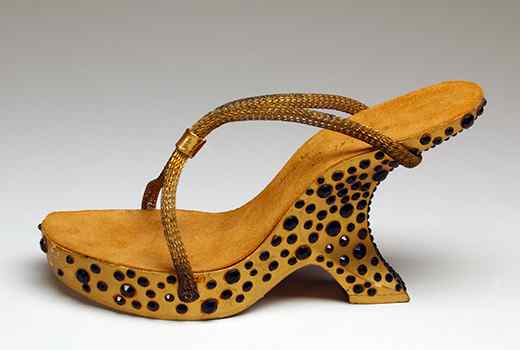
History reinterpreted –elevated sandal created by David Evins for Elizabeth Taylor in her 1961 epic, Cleopatra

History reinterpreted –elevated sandal created by David Evins for Elizabeth Taylor in her 1961 epic, Cleopatra

How did forward-looking designers mine ancient cultures, textures, and materials and make them look current? Look no further than the Grecian evocation of Madame Grés, sandals designed by David Evins for Liz’s 1961 Cleopatra look, Valerie Porr’s 1960s take on Guinevere, and Versace gone baroque. Click on the links to see the pieces on the show’s website.

Was there ever a time that rhinestone buckles weren’t applied to dainty evening shoes? Apparently not in the last several centuries, since examples from the 1740s are displayed alongside Peter Yapp 1910 satin pumps, 1959 Julianelli suede pumps, and 1995 red-velvet Manolos.

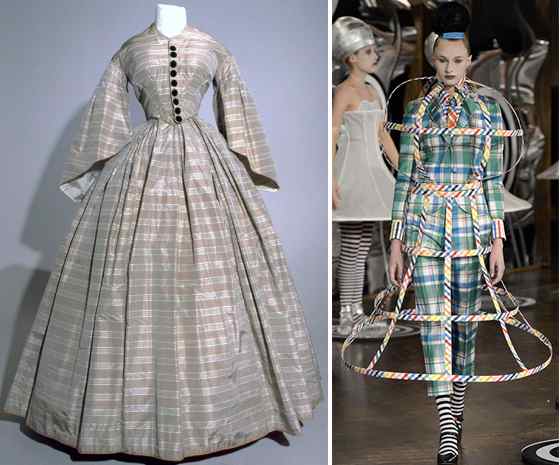
Hoop dreams from 1860 and Thom Browne’s Spring 2013 collection

Hoop dreams from 1860 and Thom Browne’s Spring 2013 collection

In the section on bustles, you’ll see beautiful 1870s creations alongside bustle-inspired works by Schiaparelli (1939), Herrera (1988), and Anna Sui (1999). But across the aisle in the section on hoop skirts, you expect to see 1860s dresses next to more modern works by Hishinuma (1996), Rochas (2004), and Thom Browne (2013). But who could expect to see hoops from the Fifties – Hoop-la (1956), which kept your bouffant skirt fluffed out, and the amazing Belle O’ the Ball collapsible skirt hoop (in its original box!), which allowed every girl-on-the-go to sleep easier knowing that her bouffant could be perfectly pouffed wherever she travelled.

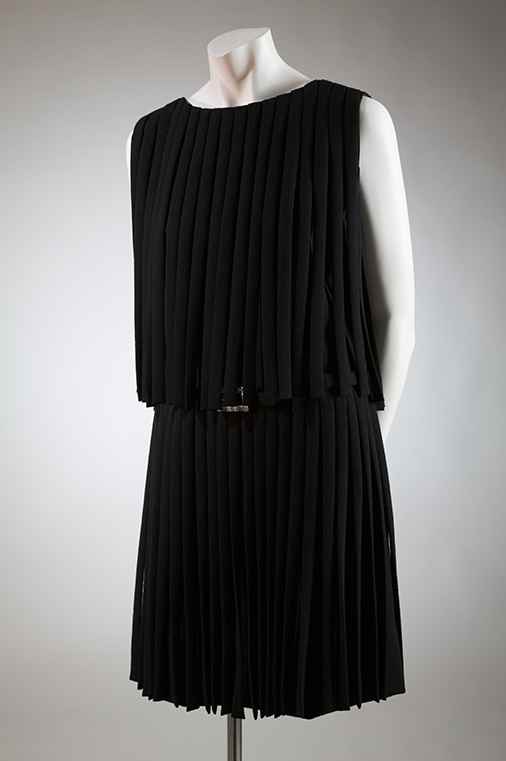
Lauren Bacall’s wool crepe 1965 flapper-inspired dress by Norman Norell

Lauren Bacall’s wool crepe 1965 flapper-inspired dress by Norman Norell

If you love fashion, get to this show and enjoy additional meditation on the decades of transformations associated with the New Look, corsets, platform pumps, playsuits, paper dresses, clogs, grunge, and graffiti. If you can’t get to the show, take some time to look through the show’s website to see about a third of what’s there and to read more about each concept and creation. FIT did a beautiful job on it.

And maybe someone from FIT can explain how Norell made such a perfectly pleated 1965 flapper dress for Lauren Bacall out of wool crepe?

Shanghai Glamour Tribute in NYC Chinatown

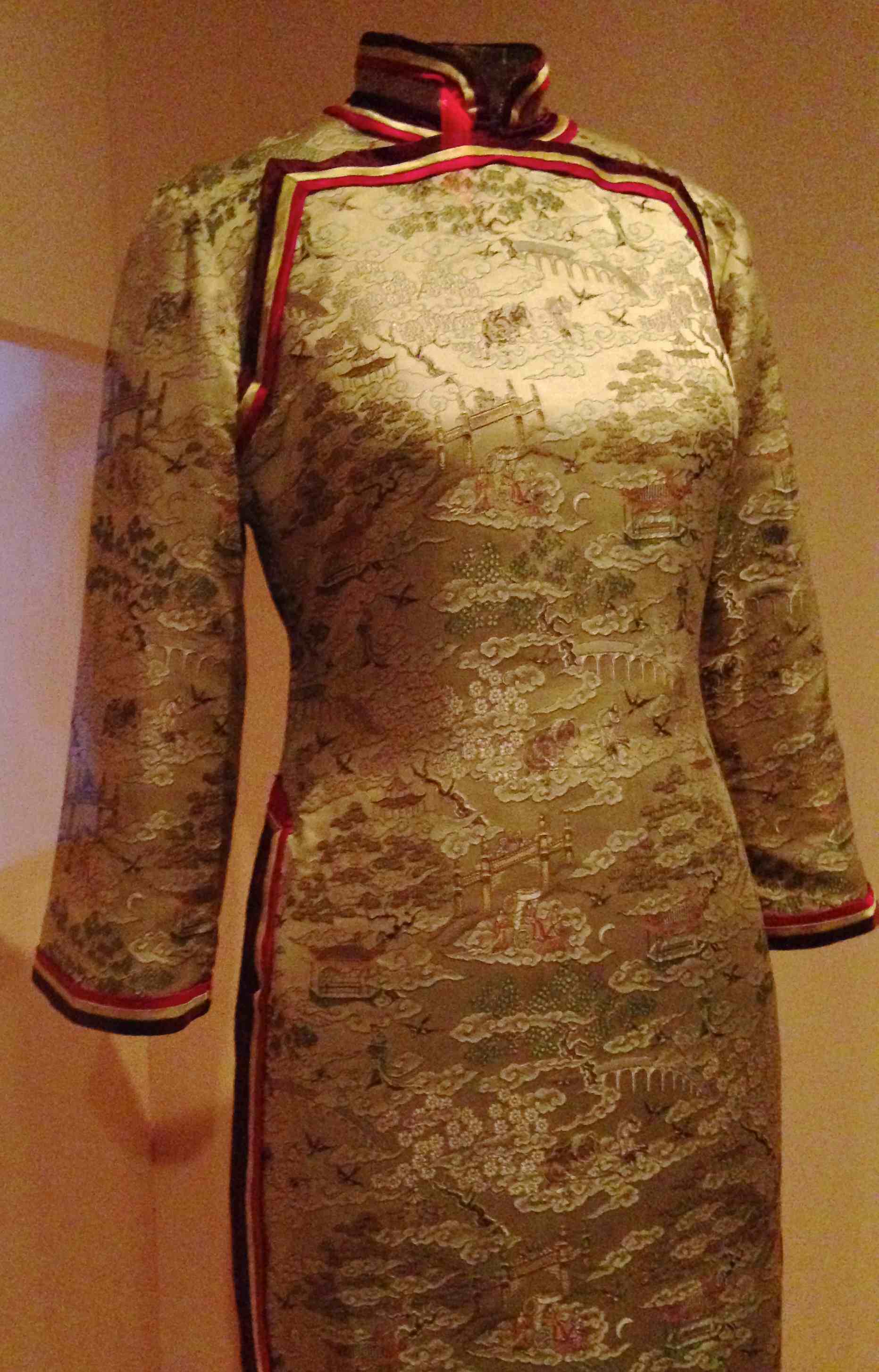
1940 Qipao (cheongsam) designed and worn by Madame Wellington Koo, the wife of China's ambassador to France. Note the tricolor piping.

1940 Qipao (cheongsam) designed and worn by Madame Wellington Koo, the wife of China’s ambassador to France. Note the tricolor piping.

If you think Shanghai is the most modern city in China today, its association with forward-looking design and trend is nothing new. It’s been on the vanguard of style back for over 100 years, and the Museum of Chinese in America is paying tribute by looking back to the 1920s, when it was called the “Paris of the East”.

MoCA’s fashion history tribute, Shanghai Glamour: New Women 1910s-40s, is mounted in an intimate gallery on the first floor, right next to it’s acclaimed show of contemporary Chinese-American fashion designers, Front Row. But this show takes you back to a time when women in Shanghai began breaking out of traditional roles, pursuing academic careers, and sporting unique, cutting-edge fashion that was all their own.

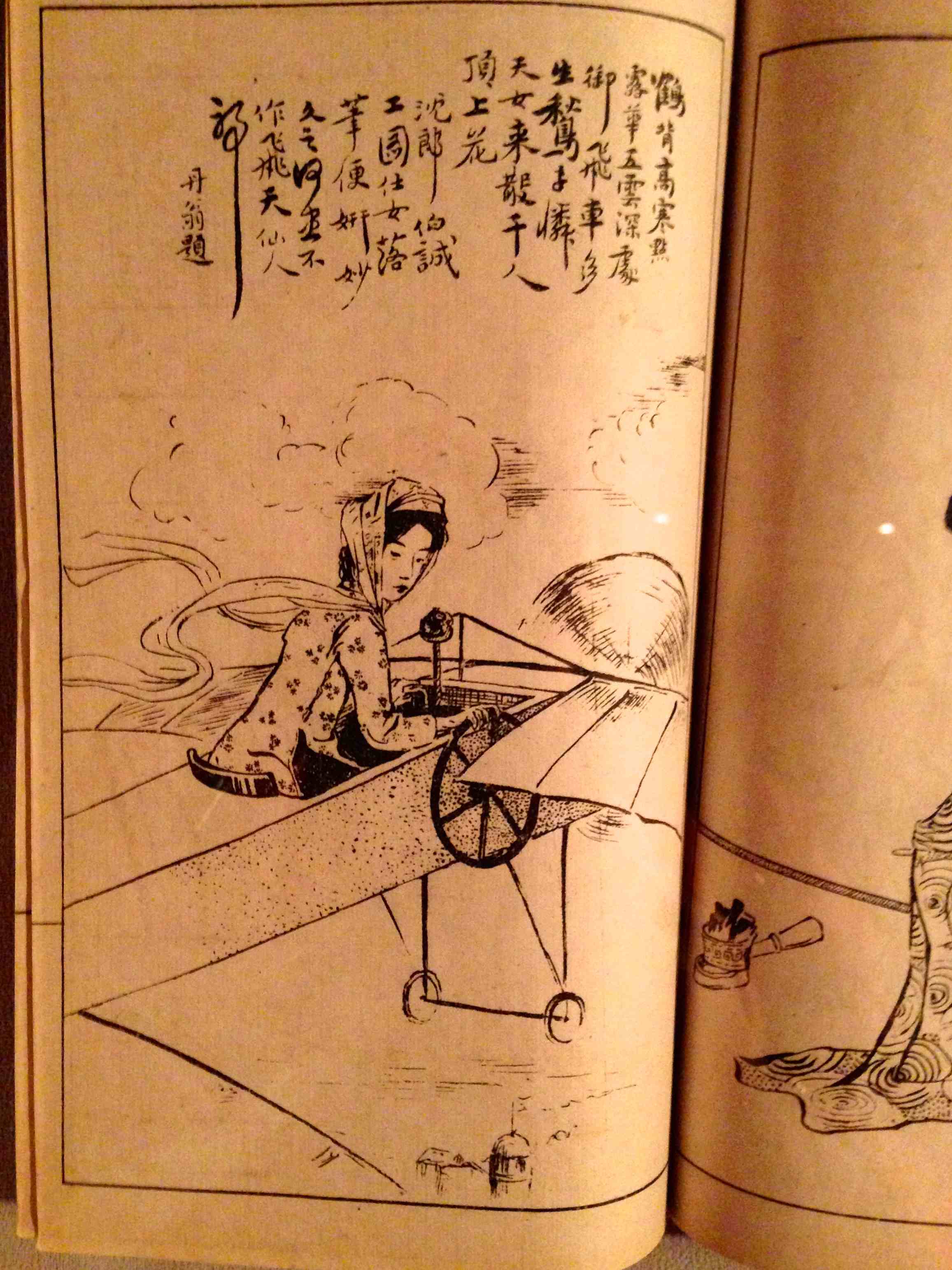
Dance-hall hostesses and courtesans in Shanghai led the charge toward 20th-century fashions as early as the 1910s, and other “modern” women didn’t want to be left behind. Shorter dresses and more fitted styles were leaving behind the traditional wide-cut Manchu cover-ups. Check out the slim look of the aviatrix depicted in this 1918 magazine. Whether Shanghai women were flying planes back then or not, Shen Bochen’s magazine illustration indicated the shape of things to come.

Modern 1918 aviatrix, as illustrated by China's leading socio-political cartoonist Shen Boehen

Modern 1918 aviatrix, as illustrated by China’s leading socio-political cartoonist Shen Boehen

Although it was a time when coquettes still flirted with ostrich feather fans, modern Shanghai women were being celebrated in special issues of Vogue and other pop culture magazines. It’s nice that MoCA’s curator has featured a few magazines right alongside the fashions, which are no loan from the China National Silk Museum in Hangzhou.

Take a look at the installation on our Flickr feed, where you can glimpse the evolution of Shanghai’s famous form-fitting qipao, or cheongsam, one of China’s most iconic contributions to world of fashion.

By the Twenties, cheongsams got tighter and more embellished as they were adopted by movie stars, daughters of the rich and powerful, diplomats’ wives, really smart women, and other over-achievers. Throughout the 20th century, Hollywood appropriated Shanghai’s sleek invention to represent exotic beauty, intrigue, cunning, and glamour.

Green silk and black velvet evening shoes worn by fashionable women in the Twenties, lent by FIT

Green silk and black velvet evening shoes worn by fashionable women in the Twenties, lent by FIT

Get downtown to Centre Street before November 3 to go back in time with dancing dresses of silk georgette, embroidered and embellished silk silhouettes, colorful silks, vintage films of Shanghai style, and several pair of stylish strappy silk shoes on loan from FIT’s collection.

Down-to-Earth Women and Space

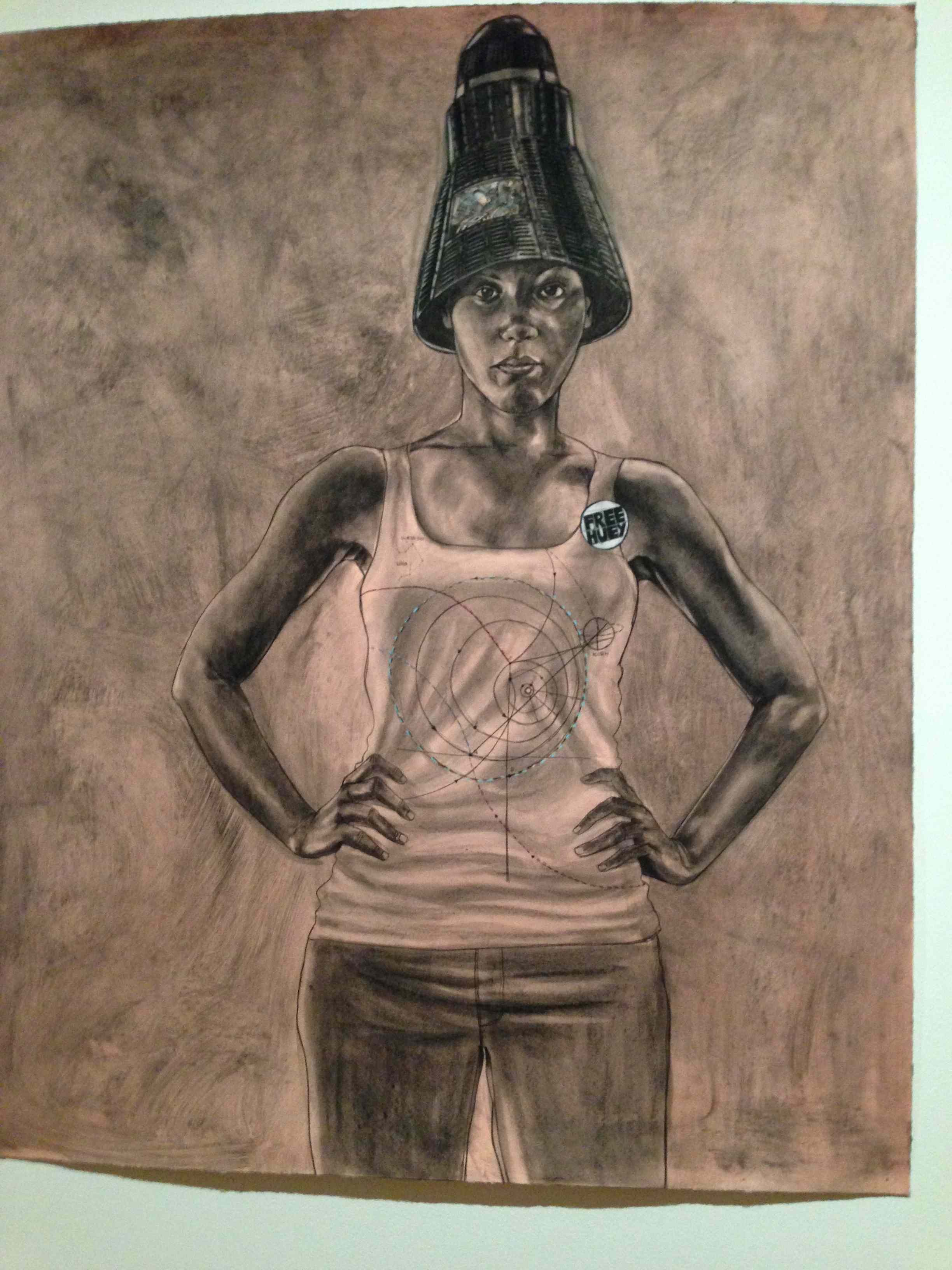
Installation view of Pruitt’s 2012 drawing, Diasporic Leaps and Bounds, courtesy of the Koplin Del Rio Gallery in Culver City, CA

Installation view of Pruitt’s 2012 drawing, Diasporic Leaps and Bounds, courtesy of the Koplin Del Rio Gallery in Culver City, CA

At the Studio Museum in Harlem’s current show, Robert Pruitt: Women, you’ll get to meet some regal-looking smarties who have a handle on art, space, and day-to-day life. Sandra Bullock’s astro-surfer is the talk of the town, but it’s these dozen-plus beauties, with their feet on the ground, who are soaring into the stratosphere with their intellectual firepower, accessories, and hairdos.

We’re talking about the stunning portraits on display through October 27. Click on the link to see more views of the installation, courtesy of photographer Adam Reich, but you need to get up to 125th Street to meet them in person.

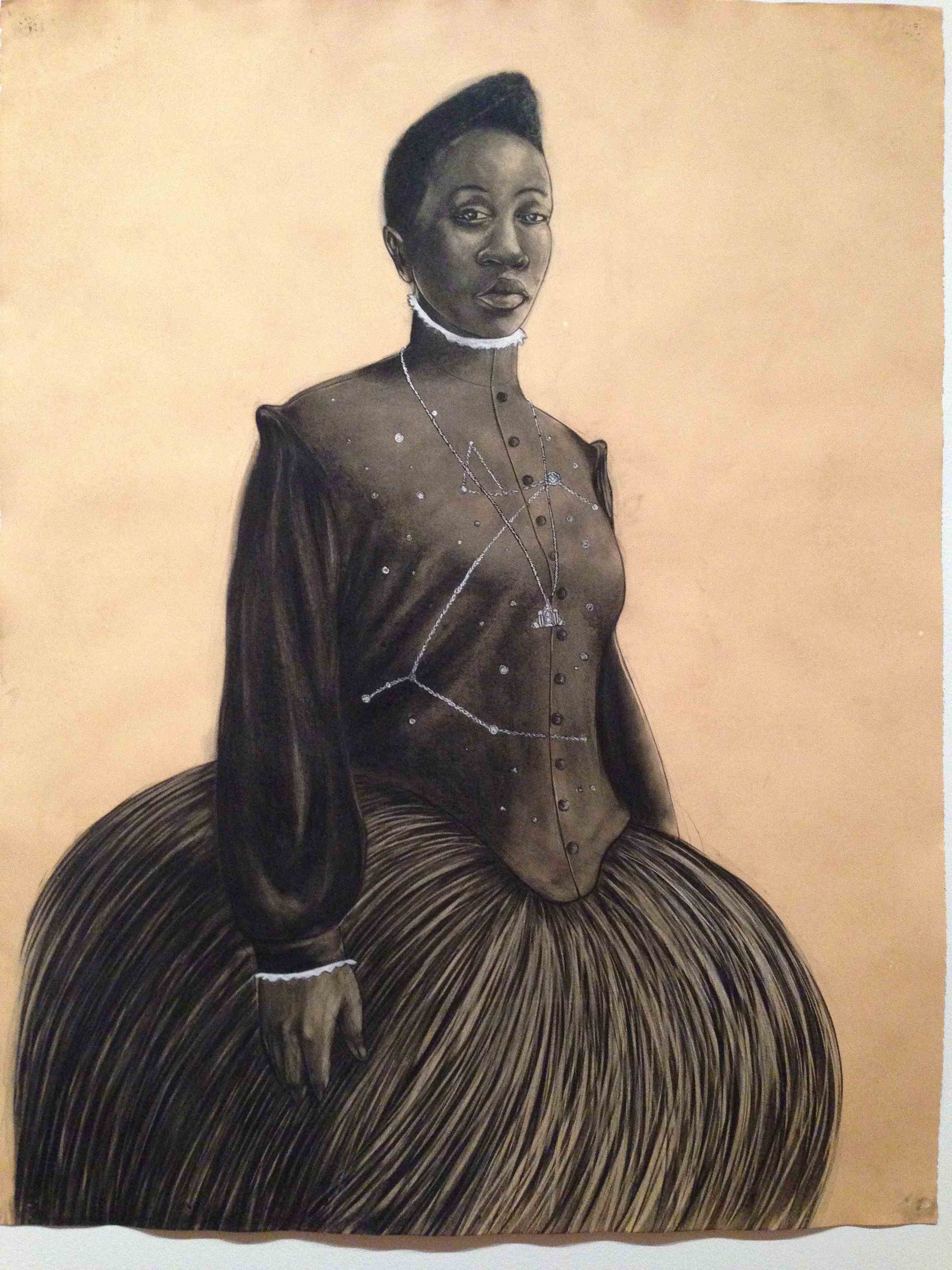
First, it’s astonishing that these grand portraits are done with those first-year art school staples – conté crayon and brown butcher-block paper. Pruitt’s a master of the medium, and the women in his series can definitely hold their own against any Dutch Renaissance doyenne. They’re calm, cool, and collected. Yes, he’s added a touch of color or glint of gold to some detail or another, but it’s the fine hand and the technical mastery that gives each ethereal woman such large-format presence.

Pruitt’s 2011 Dreaming Celestial, featuring a Shuttle pendant suspended against a constellation bodice.

Pruitt’s 2011 Dreaming Celestial, featuring a Shuttle pendant suspended against a constellation bodice.

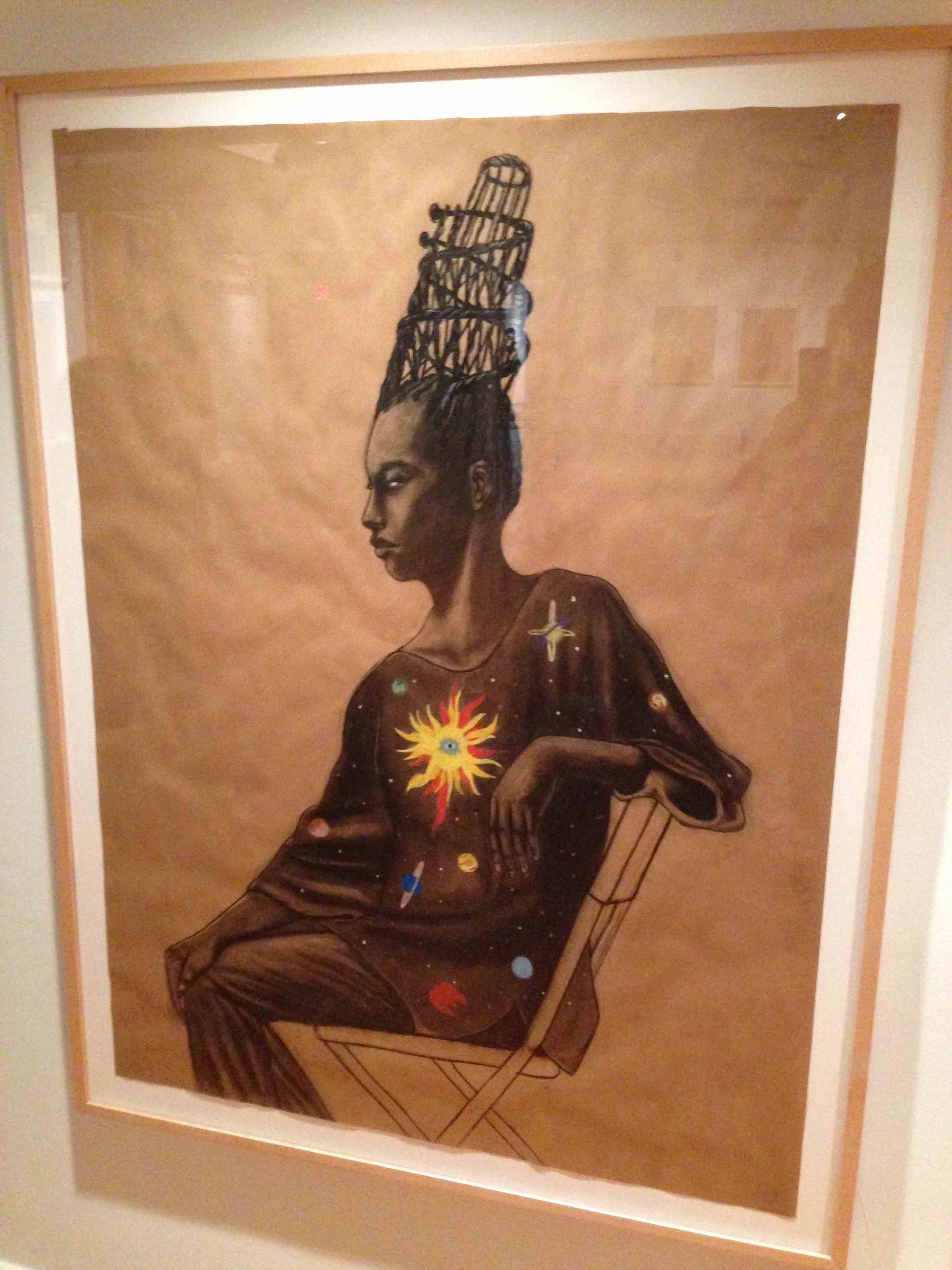
But there’s another dimension going on, too. Pruitt goes one step further by creating headpieces, outfits and accessories that tantalize art-lovers and science buffs with references to sometimes unknowable realms — art and astrophysics.

Consider the Tatlin-inspired updo coupled with the solar-system tunic in Be of Our Space World, the tiny Space Shuttle pendant and constellation bodice in Dreaming Celestial, the planetary tank top in Sun Fired, the Suprematist-inspired T in El Saturn, the space capsule chapeau and orbit diagram T sported in Diasporic Leaps and Bounds, and those choir-robe-looking outfits embellished with the tiniest of Star Trek logos for the sisters in the corner.

Yes, there are other political and pop references, but the space spin is pretty satisfying, particularly considering that Pruitt’s hometown is Houston.

Installation view of Be of Our Space World, a 2010 work featuring braids fashioned into Tatlin’s Monument to the Third International, courtesy of Houston’s Hooks-Epstein Gallery

Installation view of Be of Our Space World, a 2010 work featuring braids fashioned into Tatlin’s Monument to the Third International, courtesy of Houston’s Hooks-Epstein Gallery

Pruitt’s women are real-world and smart beyond belief — just the type of people we’d like to meet at the next SciCafe or have Dr. Neil interview at an upcoming panel at the planetarium – women whose look tells us they have some super-big insights to share.

Front Row at Chinese Fashion Runway

Vivienne Tam’s 2007 embroidered/quilted silk cheongsam and Peter Som’s 2010 chartreuse and yellow silk dress.

Silk dresses from Vivienne Tam’s 2007 and Peter Som’s 2010 collections

In a brilliant move to honor some of the City’s fashion favorites, the Museum of Chinese in America is welcoming everyone downtown to see their bright, joyful tribute, Front Row: New York City’s Chinese-American Designers, which they’ve extended until December 1.

The show’s been a hit, with many museumgoers and fashion insiders making the trek downtown to wonderfully welcoming MOCA.

Inside the gallery, you’ll see a grand celebration of the contributions made to NYC’s fashion scene by a host of greats– the irrepressible Anna Sui, evocative Vivienne Tam, minimalist superstar Yeohlee, sumptuous Vera Wang, Jason Wu (one of Michelle Obama’s favorite), and eleven others.

Take a look at what we saw on our Flickr feed.

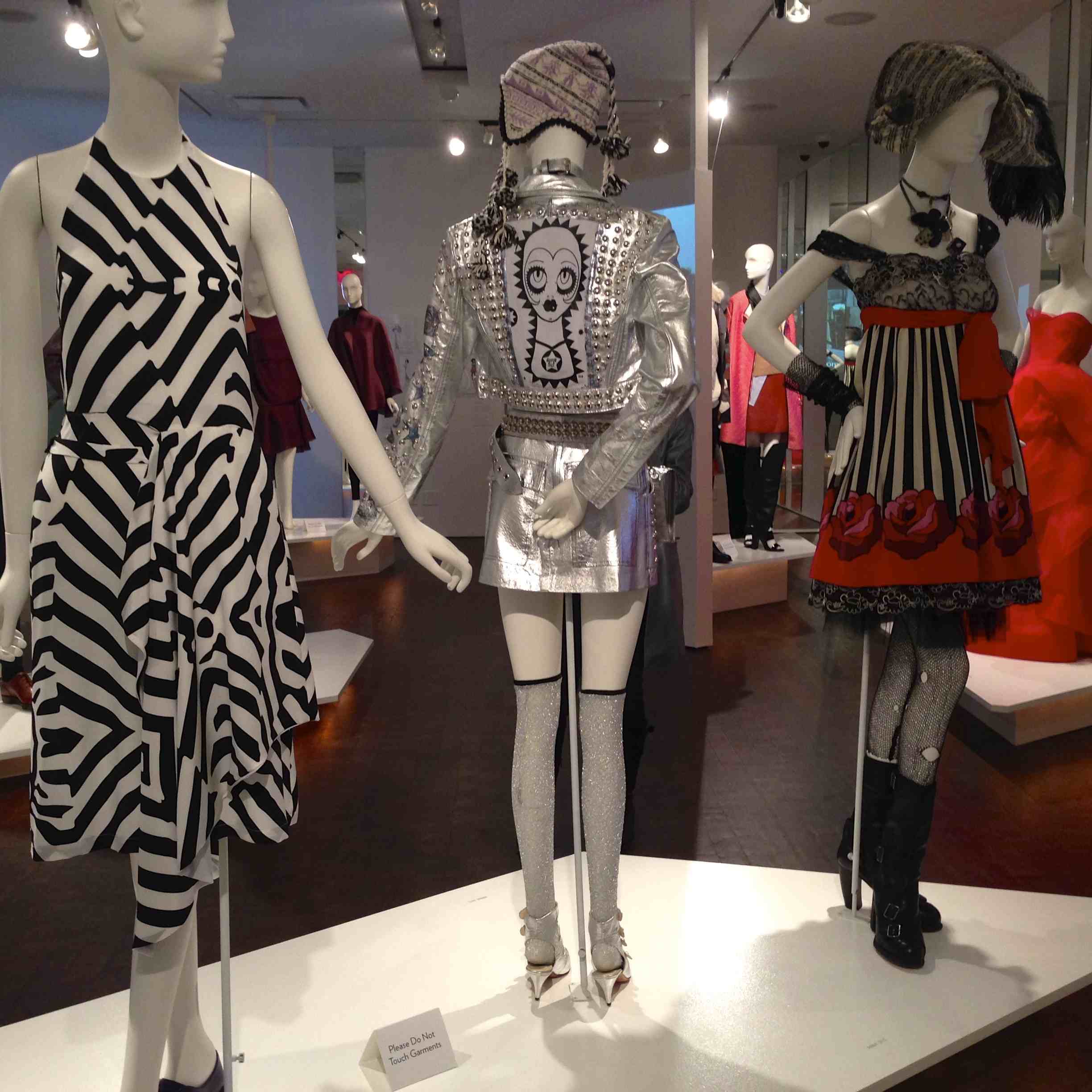
Striped dress by Wayne Lu and two by Anna Sui

Striped dress by Wayne Lu and two by Anna Sui

Some of the dazzlers include Vera Wang’s cardinal red ballgown embellished with horsehair trim, Zang Toi’s red knit embroidered red-carpet gown, and Anna Sui’s silver leather punk ensemble first seen on the runway on Linda Evangelista back in 1993. Take a look. It easily holds up today, particularly with the addition of the Peruvian tassel cap. For a bit of nostalgia, check out the vintage New York Times coverage of that show, which also features great reviews of Zang Toi and Yeohlee, too.

Curator and featured designer Mary Ping did a great job showcasing iconic looks, video clips of memorable runway shows, and video interviews with the designers. She worked with an advisory committee from the Met, FIT, and Parsons, and the overall effect is top-class – smaller than shows that the Costume Institute or FIT mount in their main galleries, but every bit as thoughtful, well documented, and illuminating.

Organza and horsehair trim on Vera Wang's Spring 2013 gown.

Organza and horsehair trim on Vera Wang’s Spring 2013 gown.

At a time when the Garment Center has gotten a little quiet and most manufacturing has shifted to China and other Asian countries, it’s a nice touch just to include just a sampling of the behind-the-scenes work of this illustrious and talented group – a few notebook sketches and some of the paper patterns from Yeohlee’s 38th Street atelier.

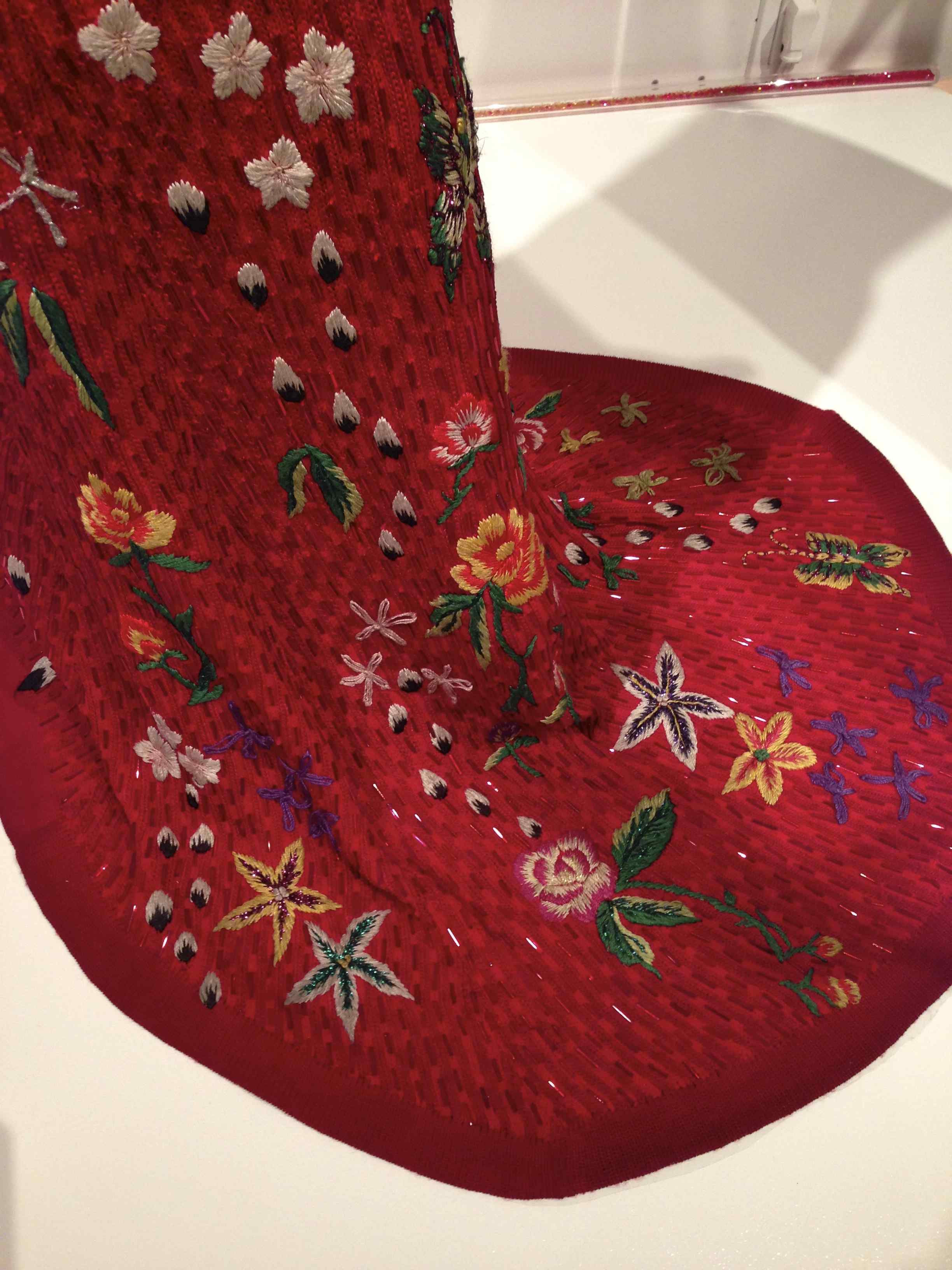
Embroidered train of Zang Toi’s 1991 red-carpet knit dress worn by Gong Li

Embroidered train of Zang Toi’s 1991 red-carpet knit dress worn by Gong Li

As Tim Gunn would say, “Go, go, go!”

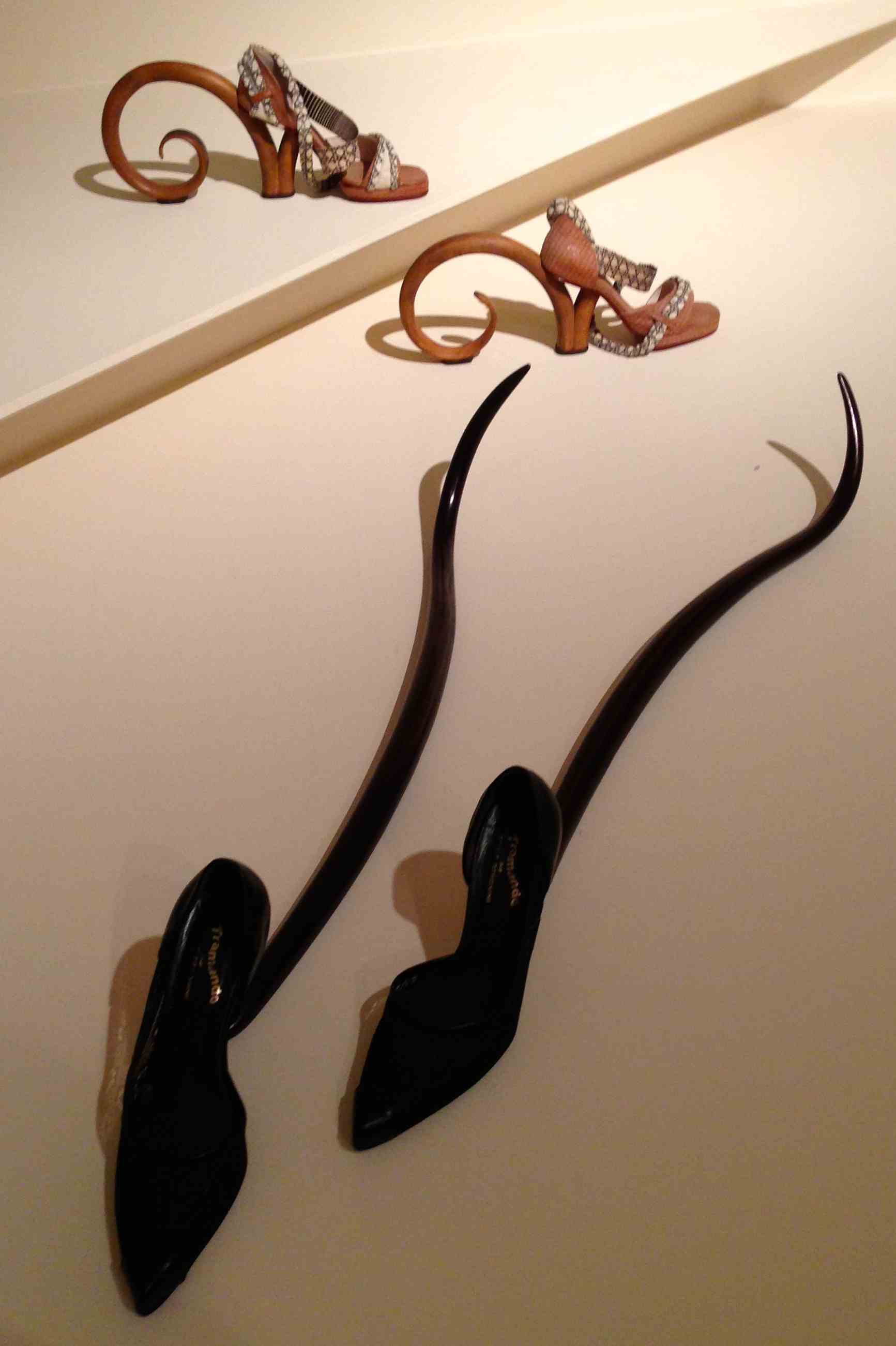
Wood Goes Against Grain at MAD

Pablo Reinoso's whimsical wooden shoes

Pablo Reinoso’s whimsical wooden shoes

All those years walking up and down the aisles at craft fairs may have you convinced that there’s nothing new in wood art. Get over to the final days of Against the Grain: Wood in Contemporary Art, Craft, and Design at the Museum of Art and Design.

It’s not what you’d expect, and curator Lowery Stokes Sims has done a magnificent job in telling us what’s trending now with forward-looking artists on the scene.

In short, she focuses her two-floor exhibition on seven trends that she sees: Artists, like Ai Weiwei, working on socio-political themes, whimsical designers who make us smile, digital artists pushing the envelope with wood, collages, virtuoso technique, takes on trees, and works that just capitalize on the beautiful texture in the wood itself.

Check out our Flickr feed for views of some of our favorite works, and MAD’s four-minute video as Sims herself walks you through the show, the artists, and her thinking about the pieces and themes.

Steam-bent ash chairs by Christopher Kurtz

Steam-bent ash chairs by Christopher Kurtz

But let’s focus on some of our favorites, which you can see on Flickr.

Wood as fashion: What about these shoes by Pablo Reinoso? If you’re thinking Dutch wooden shoes, think again, because these dainties are inspired by Thonet chairs, that he’s embellished with long, wooden “tails”. Or wooden hats by fashionable Moody & Farrell of London.

Music: How did Maria Elena Gonzalez go from looking at a fallen birch tree to creating paper-thin birch rolls that can create stunning music on a player piano? Watch and hear it all on this video of her player piano in action.

Laurel Roth's Hominid Chimpanze (2011) from vere wood with Swarovsky crystals in the teeth

Laurel Roth’s Hominid: Chimpanze (2011) from vere wood with Swarovsky crystals in the teeth

How-did-they-do-that category: Bud Latvin’s gravity-defying wooden spiral sculptures, Christopher Kurtz’s impossible steam-bent chairs, and Elisa Strozyk’s wooden textile.

Recycled surprises: Think about what it took to turn 8,000 recycled chopsticks into a collapsible sofa. Good going, Yuya Yoshida.

If you can get to this show today or tomorrow, go. If not, take time to meet Leonard Drew in his studio, see his wood works in progress, and hear what success in wood feels like:

Amazing Baby Shoes Under the Met’s Stairs

Infant-size palm leaf sandals (only 2 x 5 in.) made at the Kharga Oasis, Byzantine-era Egypt (4th-7th c.)

Infant-size palm leaf sandals (only 2 x 5 in.) made at the Kharga Oasis, Byzantine-era Egypt (4th-7th c.)

Will all the excitement over babies this week (the Royals and the Fallons), you might want to sneak a peak at some of the most perfect infant shoes ever, on display at the Met’s micro-exhibit, Objects from the Kharga Oasis, right under the grand staircase just past security until August 4.

Back in the 1930s, Metropolitan Museum archaeologists found this pair of infant sandals crafted beautifully from palm leaves at an oasis in the western Egyptian desert that was one of the earliest frontier Christian communities serving the trans-Saharan caravan routes.

The shoes are tiny – only about 2 x 5 inches – and were made during the Coptic (Byzantine) era sometime between 300 AD and 600 AD. There are also 1,500 year-old linen tunics and caps for kids and adults nearby, too. It’s amazing that the clothing survived at all.

Totally wearable Kharga bracelet. Iron from 4th-7th c. Egypt. Source: Met

Totally wearable Kharga bracelet. Iron from 4th-7th c. Egypt. Source: Metropolitan Museum of Art

Besides building churches (and there are plenty of photos and illustrations in the show), the communities around Kharga were busy growing grains, sesame, olives, and grapes. They apparently had a huge business making and exporting wine to the thirsty Egyptians 150 miles east along the Nile and 400 miles northeast in Cairo.

Drawing upon a ceramic craft tradition that was happening at the oasis since Old Kingdom times (2600 BC), potters cranked out transport jugs for the vino (shown here) and decorated them with grapevine paintings. The show has jewelry, tombstones, and photos of early Christian churches, but the brand-new-looking baby shoes are really the stars of the show.

Among dozens of ceramic items dug up by the Met are grapevine-decorated earthenware jugs to transport locally made wine from the Oasis to the Nile and upriver to Cairo.

Among dozens of ceramic items dug up by the Met are grapevine-decorated earthenware jugs to transport locally made wine from the Oasis to the Nile and upriver to Cairo.