National Gallery Celebrates 50 Contemporary Native Artists

If you want to take a trip across American land with 50 living Native artists, there’s still time to catch the ground-breaking exhibition, The Land Carries Our Ancestors: Contemporary Art by Native Americans, at Connecticut’s New Britain Museum of American Art through September 15, 2024.

The National Gallery of Art in Washington, D.C. asked Jaune Quick-to-See Smith (Citizen of the Confederated Salish and Kootenai Nation) to survey the United States and create an exhibition reflecting the diversity of the living Native American artists.
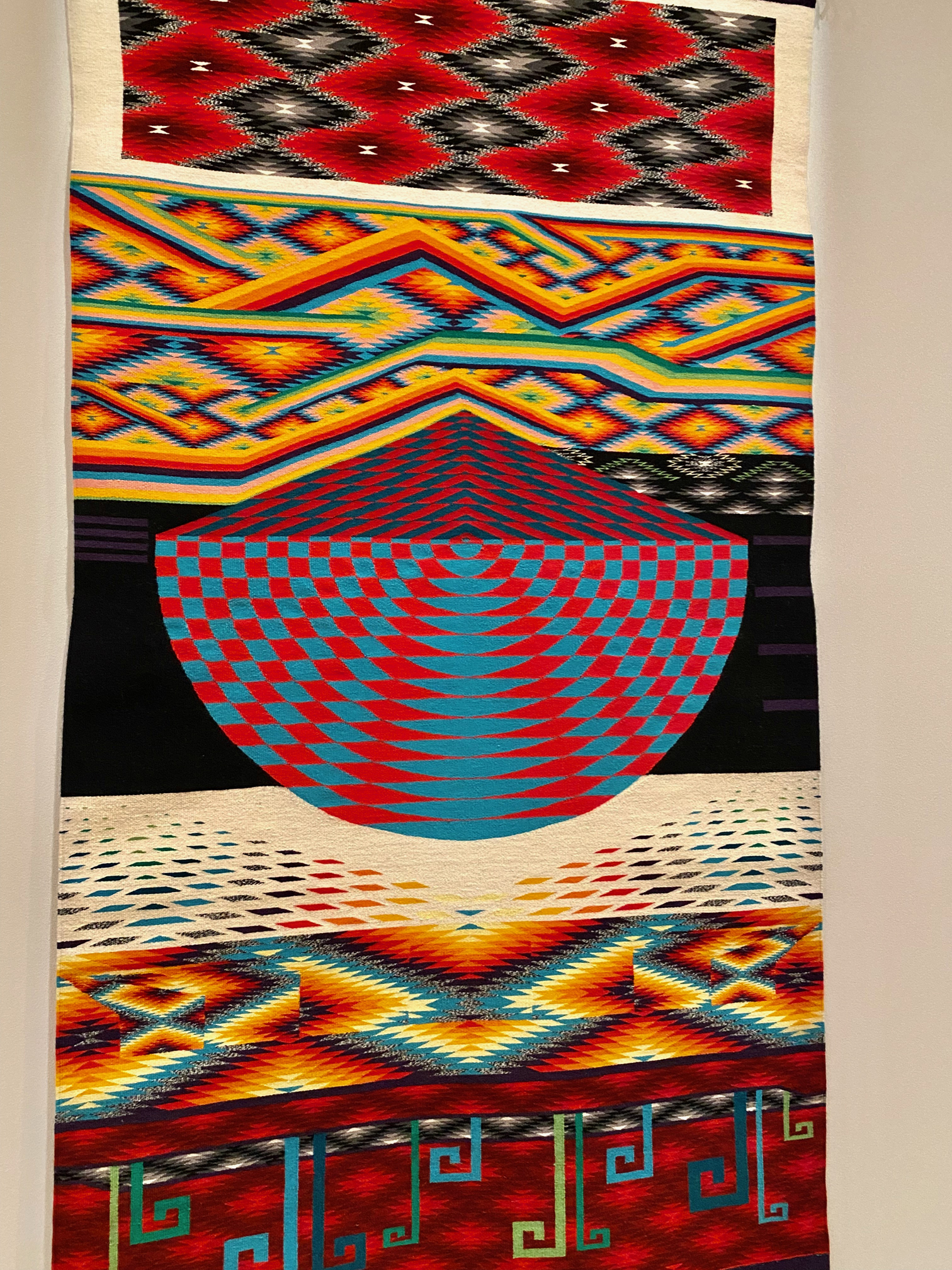
2014 wool weaving World Traveler by Melissa Cody (Navajo). Courtesy: Stark Museum of Art.

Smith, whose own artistic achievement was honored most recently in a three-museum retrospective in 2023-2024, became the first artist invited to curate a show at the National Gallery.
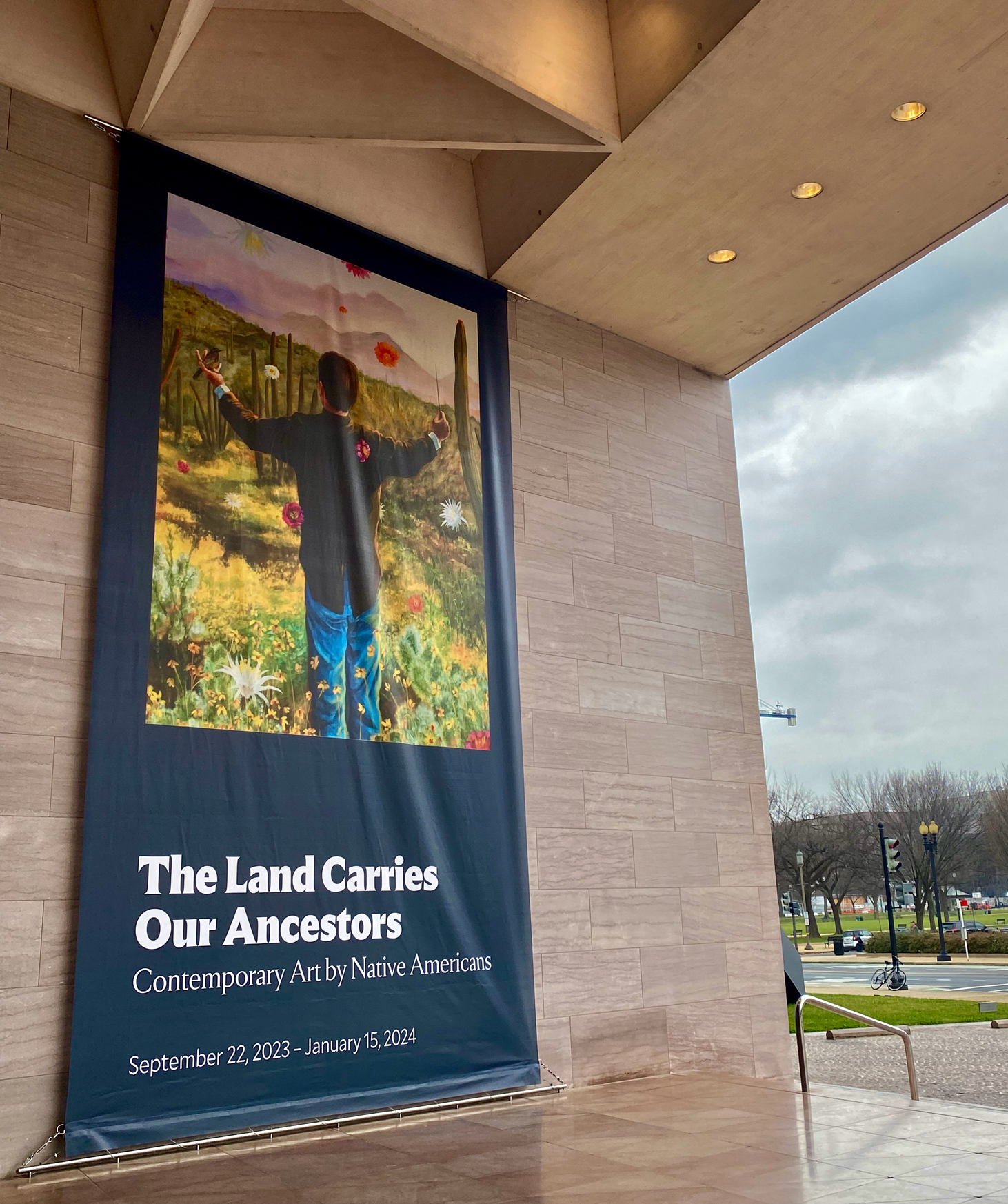
Entrance banner features Orchestrating a Blooming Desert by Steven Yazzie (Diné/Laguna Pueblo).

Smith has always done whatever possible to increase the visibilty of Native artists in the contemporary art world. For this exhibition, she chose 50 intergenerational artists from diverse regions, cultures, and artistic practices. Look at our Flickr album of the National Gallery installation to see some of our favorites.

All of the works reflect the artists’ deep connection to the land, especially Orchestrating a Blooming Desert by Steven Yazzie (Diné/Laguna Pueblo), a painting that reflects one man’s joyful encounter with a lush landscape.

Some works depict a tribe’s link to the natural world through origin stories. Visitors are mesmerized by Preston Singletary’s exquisite sculpture of Tlingit creation-myth legend, Raven stealing the Sun. It’s glorious to admire this dramatic icon fully realized in a distinctly nontraditional medium – blown and sand-carved glass.

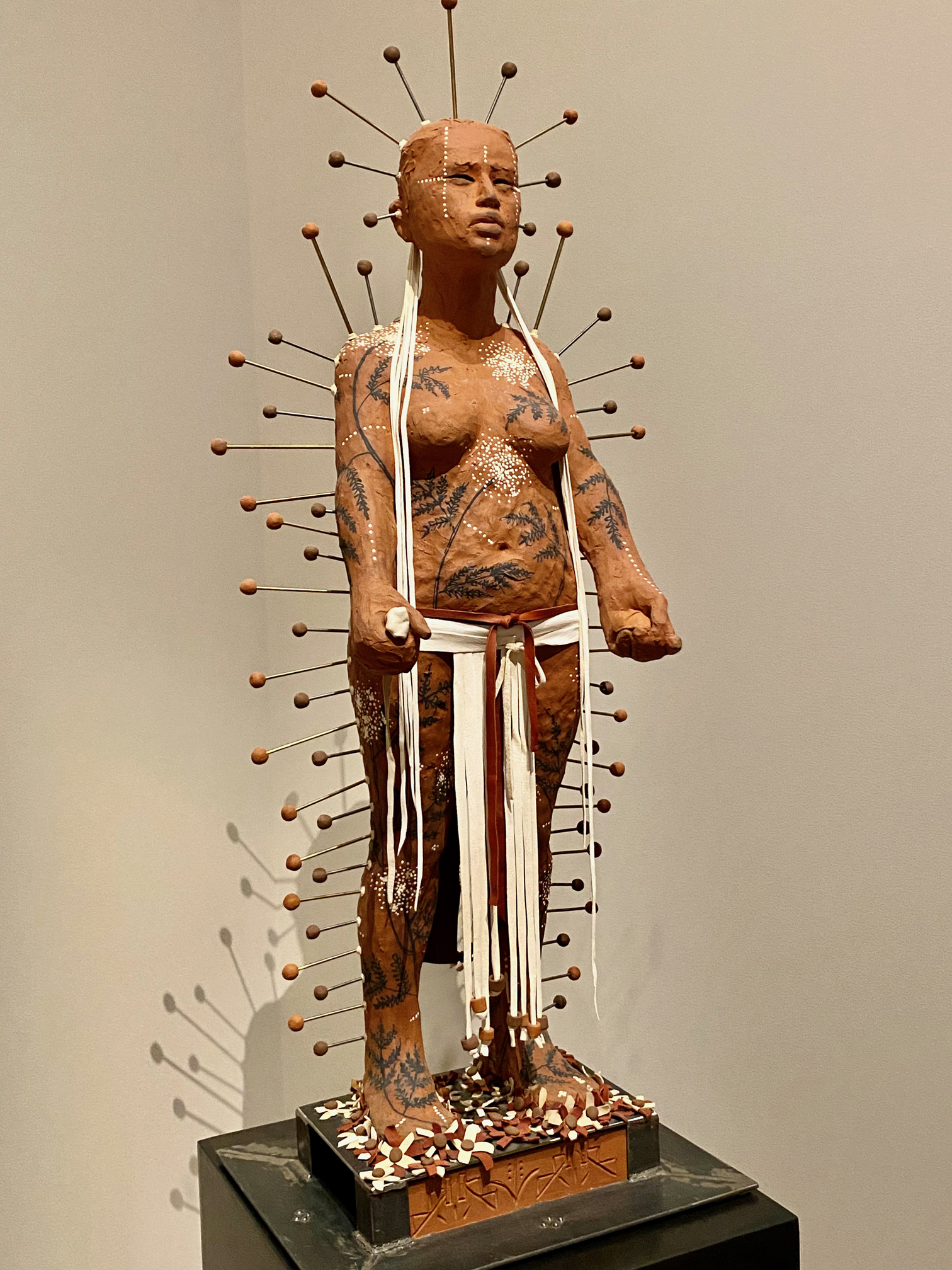
Experiencing the large, spiritual earth-colored ceramic figure by Rose B. Simpson (Santa Clara Pueblo) harkens back to eras when people had a more integral connection to the earth. Simpson calls her figure Tonantzin, an Aztec name for earth mothers, corn mothers, and even the Virgin of Guadalupe.
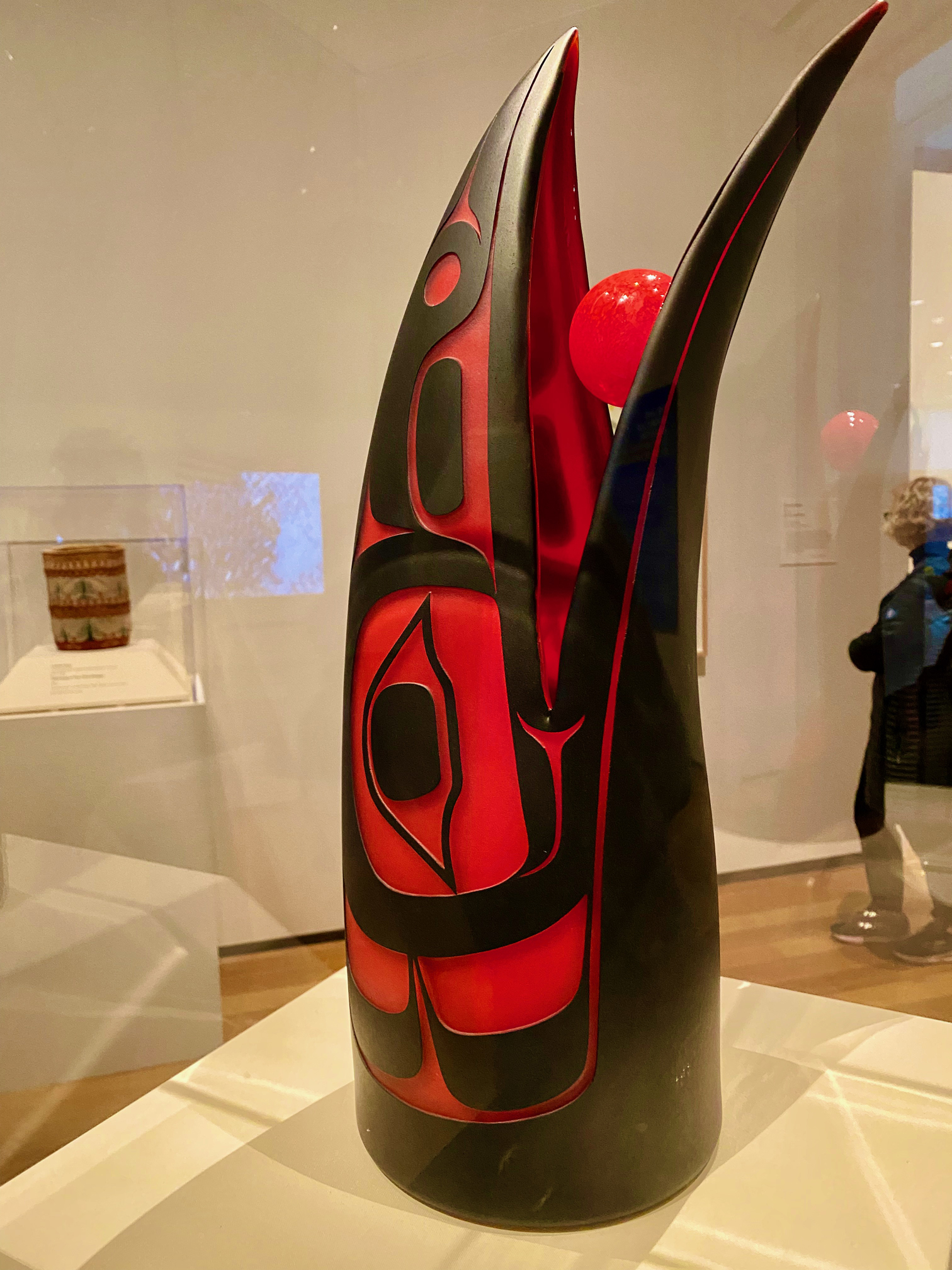
2017 blown and sand-carved glass Raven Steals the Sun by Preston Singletary (Tlingit). Courtesy: private collector.
2021 ceramic, steel, leather, and brass Tonantzin by Rose B. Simpson (Santa Clara Pueblo). Courtesy: Tia Collection.

Smith has chosen to hang many smaller two-dimensional works across a long wall in a checkerboard to suggest that visitors reflect on the impact of 1887 Dawes Act upon Native lands – a law that cut Native territory into “checkerboard” lots to facilitate private ownership.

At the National Gallery, Jeffrey Gibson’s punching bag (all made of found materials) was hung nearby, reminding us of the delicate balance that has to be struck by simultaneously caring for and taking gifts from the earth.

Next to checkerboard wall, the 2020 beaded punching bag To Feel Myself Loved On the Earth by Jeffrey Gibson (Mississippi Band of Choctaw Indians/Cherokee Nation). Courtesy: Hirschhorn Museum.

Some artists mix impressions of modern life with tribal lands, such as satiric works by Diego Romero (Cochiti Pueblo) and stylized symbols in a monoprint by Joe Fedderson (Colville Confederated Tribes).
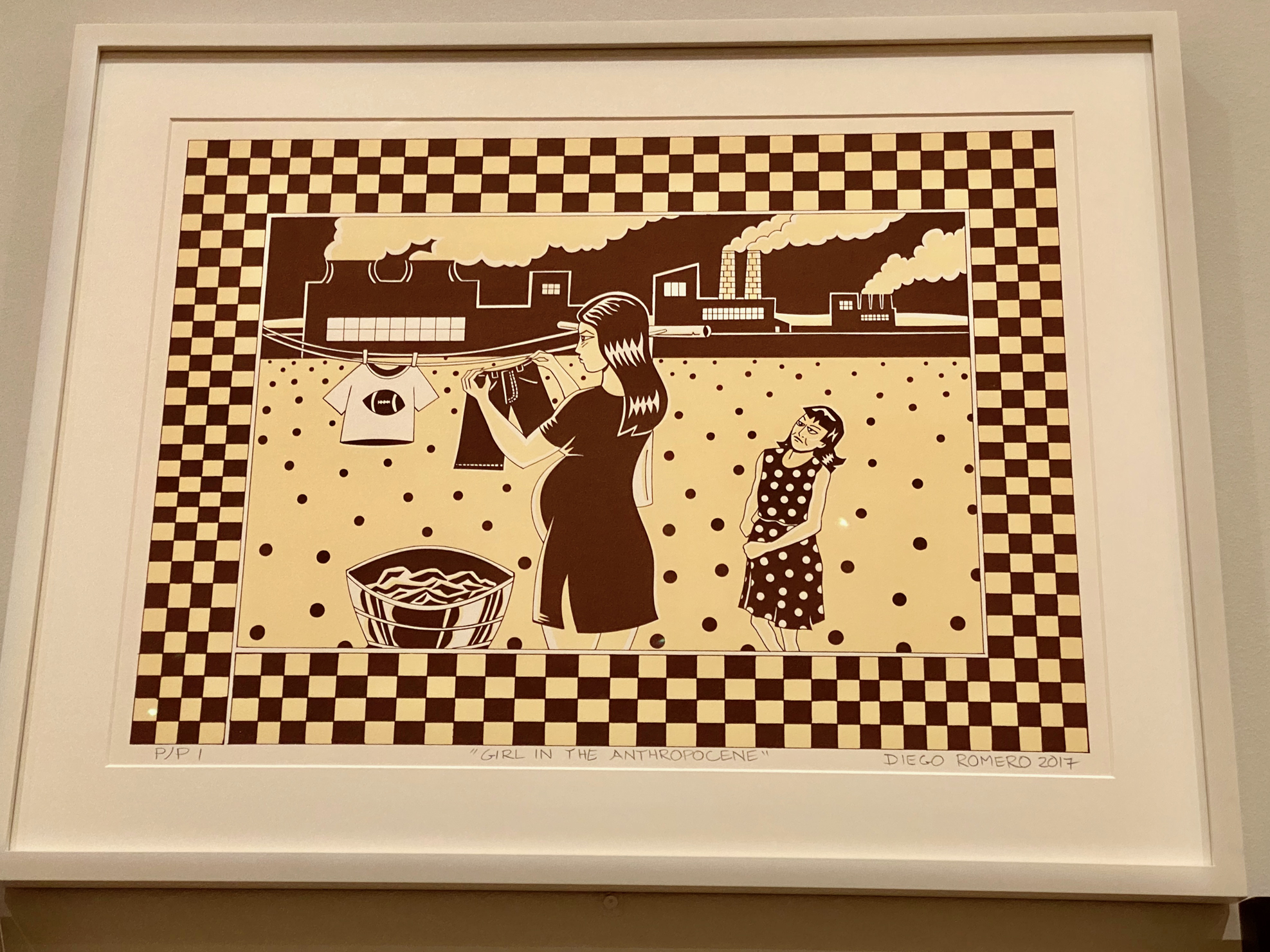
2017 lithograph Girl in the Anthropocene by Diego Romero (Cochiti Pueblo). Private collection

In addition to sculptures, paintings, and photos, Smith has also included pieces made for fashion runways, live performances, and social protests.

Fashion designer Jamie Okuma (La Jolla Band of Luiseno Indians) beaded her fringed fashion boots with a portrait of her family’s pet scrub jay.

Ten foot-long fiber seashell earrings designed for an interactive video and gallery performance by fiber and performance artist Eric-Paul Riege (Diné) are a reminder of the ancient trade networks that brought trade items from the ocean to the interior deserts.
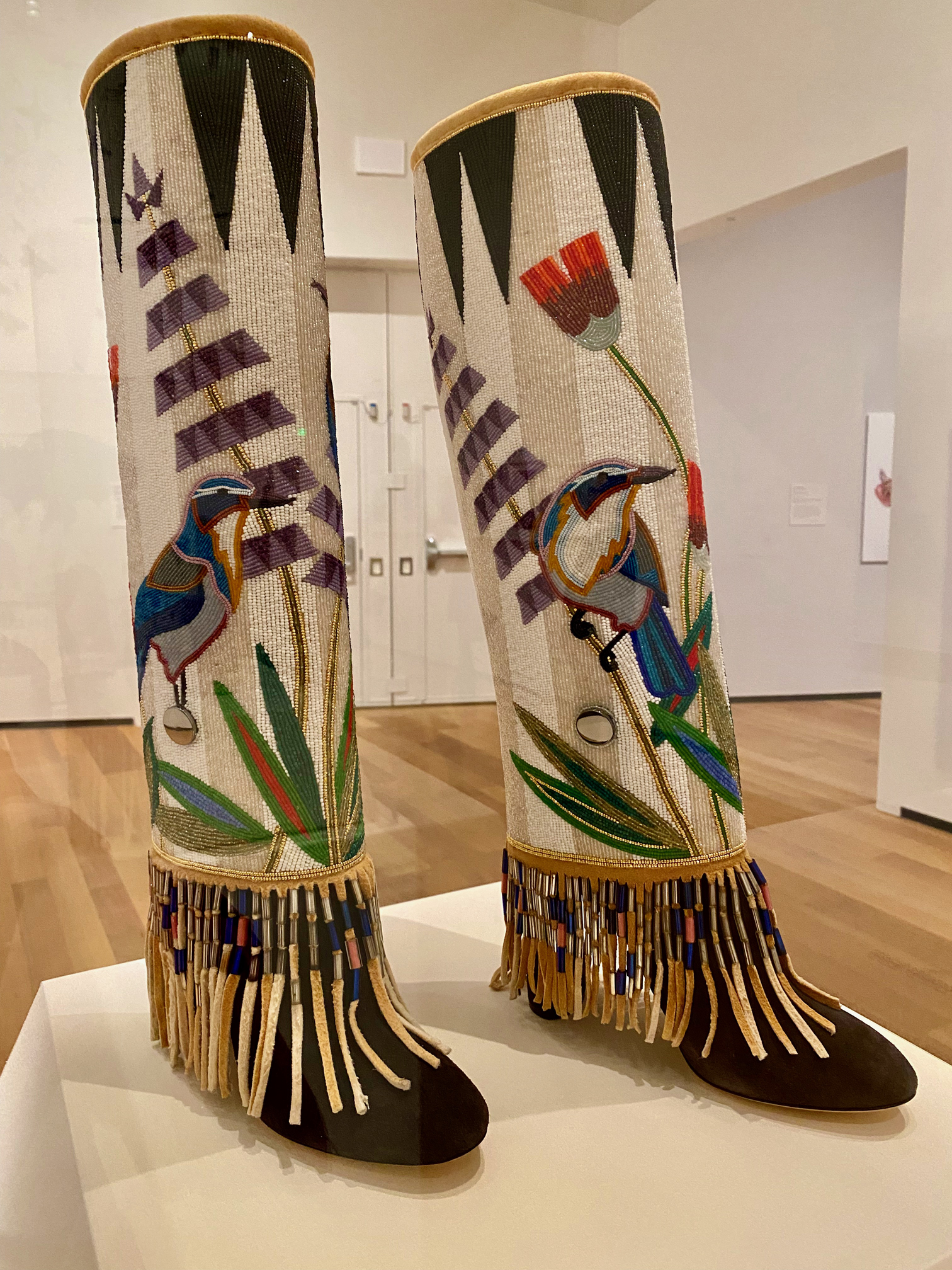
2021 beaded and fringed Casedei boots by Jaime Okuma (La Jolla Band of Luiseno Indians). Courtesy: Dartmouth College’s Hood Museum
2020 mixed-fiber installation jaatloh4Ye’iitosoh [3-4] by Eric-Paul Riege (Diné). Courtesy: Tia Collection.

A wall of “mirror shields” were mounted by artist-activist Cannupa Hanska Luger (Mandan/Hidatsa/Arikara/Lakota), showing just a small sample of the 1,000 protective and reflective shields made by people to help water protectors during thre 2016 pipeline intervention at Standing Rock Sioux Tribe Reservation, Luger’s childhood home. Take a look at Luger’s instruction video here.

The shields served to protect the peaceful protesters from rubber bullets and water cannons, and reflected images of the security forces back to them. The crowd-sourced shields were also used in a social-action performance piece at Standing Rock.
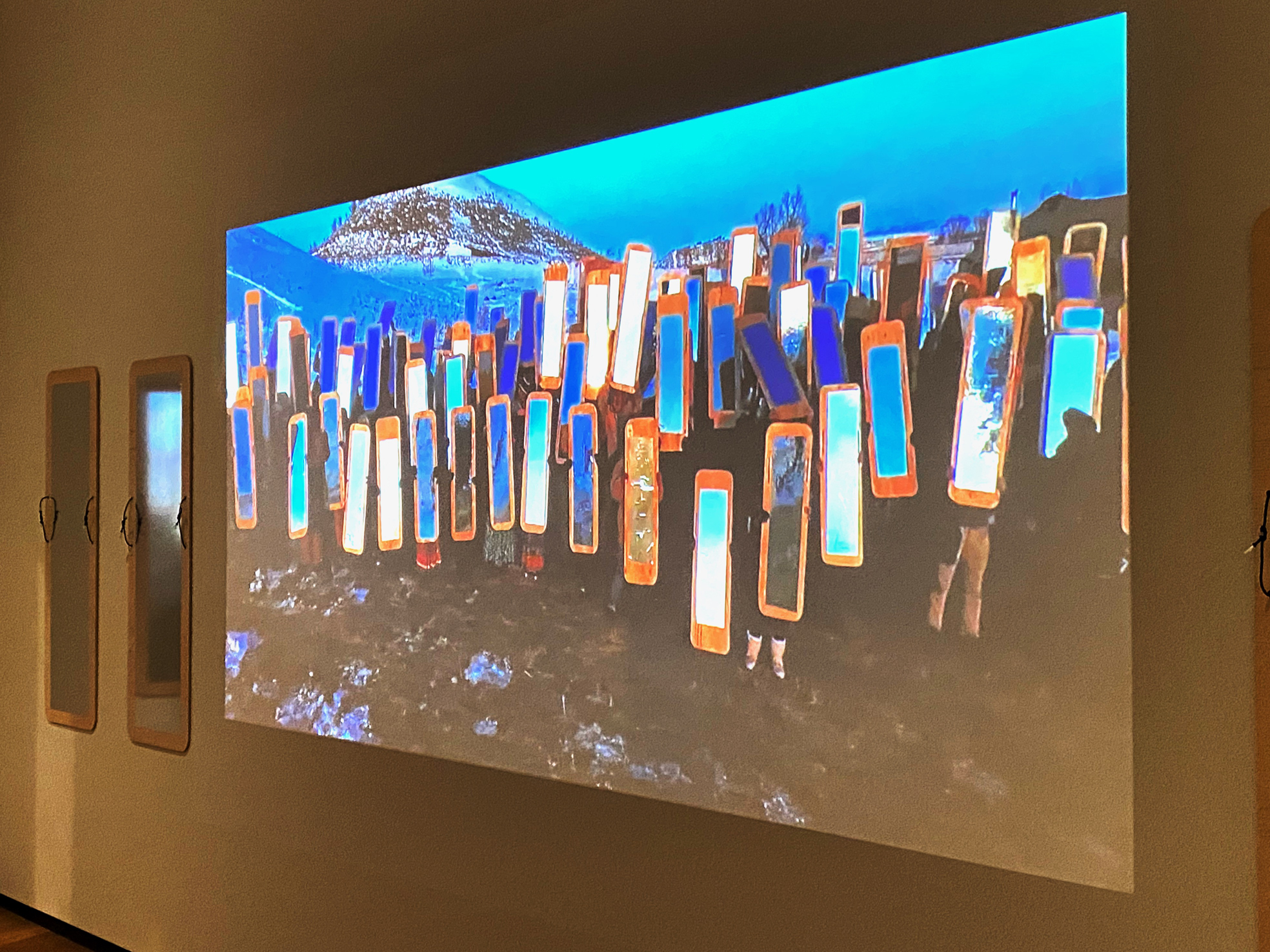
2016 mirror shields and video for Mirror Shield Project – River (The Water Spirit) by Cannupa Hanska Luger (Mandan/Hidatsa/Arikara/Lakota). Courtesy: the artist, Garth Greenan Gallery.

Textiles and vinyl drawings also pack a punch in this show. Take a look at the dazzler woven by Melissa Cody (Diné), who draws inspiration from video gaming and the matriarchs of Navajo Nation. Watch her interview from her recent exhibition at MoMA PS1.

Here, John Hitchcock explains how his room-sized drawing, Impact vs. Influence, incorporates his influences – nature, family, Native beadwork, and the next-door military base:

Take a look the National Gallery’s trailer and meet the 50 contemporary artists whose work and relationship to the land is celebrated in the show:

Out West in New Mexico

The artist stories and works presented in Out West: Gay and Lesbian Artists in the Southwest 1900-1969, at the New Mexico Museum of Art through September 2, 2023, shed light on artists who lived a bit more “under the radar” in the early 20th century, compared to the post-1969 era when loud and proud artists unleashed their voices in response to the Stonewall Riots.
The exhibition focuses on how early modernists used “coded” symbols in their work, explores the legacies of two-gendered Native American artists, and introduces mid-century work by mid-century contemporary artists working.

Marsden Hartley’s 1919 still life El Santo, featuring Hispanic Catholic objects of northern New Mexico.
Russel Cheney’s 1929 New Mexico/Penitente showing a bulto, axe, and flowers associated with the Penitente brotherhood.

Take a look at our favorites in our Flickr album.

The show opens with works by Marsden Hartley and Russell Cheney – painted 10 years apart (1919 and 1929) that feature items associated with rituals by Northern New Mexico’s Penitentes – Catholic men’s associations that kept faith alive during the 19th century when clergy were scarce in their remote mountain towns.

Hartley and Cheney were captivated by the religious rituals of these mysterious, faithful “brotherhoods” that persevered for centuries, despite periodic bans by New Mexico’s Catholic Church – not unlike the early 20th century gay men’s associations whose underground culture gave rise to “coded” rituals and language.

Hence, these works feature images of the suffering Christ, yucca plants used for self-mortification rituals, adobe churches, and props associated with processional death carts – symbols of religious brotherhood that represent the importance of brotherhood among the early 20th century gay community.

The second portion of the show introduces us to the many painters, photographers, and sculptors who not only drew artistic inspiration from the Southwest, but found communities that welcomed gay and lesbian artists. Works by artists, such as Agnes C. Sims and Cady Wells, are paired with portraits by a Southwestern who’s who of modern portraiture and photography – Will Shuster, Laura Gilpin, Ansel Adams, and Anne Noggle.

Modernist Deer Dance cedar sculptures carved in 1945 by Agnes C. Sims, a tribute to native cultures
Laura Gilpin’s 1942 photographic portrait of artist Agnes C. Sims

There’s even a “portrait” stitched by maverick Cady Wells of his very best friend, modernist Rebecca James. Well known for his expressionist paintings and his large collection of Northern New Mexican religious art, Wells subversively went all in on petit-point – an art form traditionally associated with “women’s work” and beloved by Ms. James.

Detail of 1953 petit-point stitchery “portrait” of Rebecca S. James by her friend, Cady Wells – his work in a traditional “feminine” genre of craft.
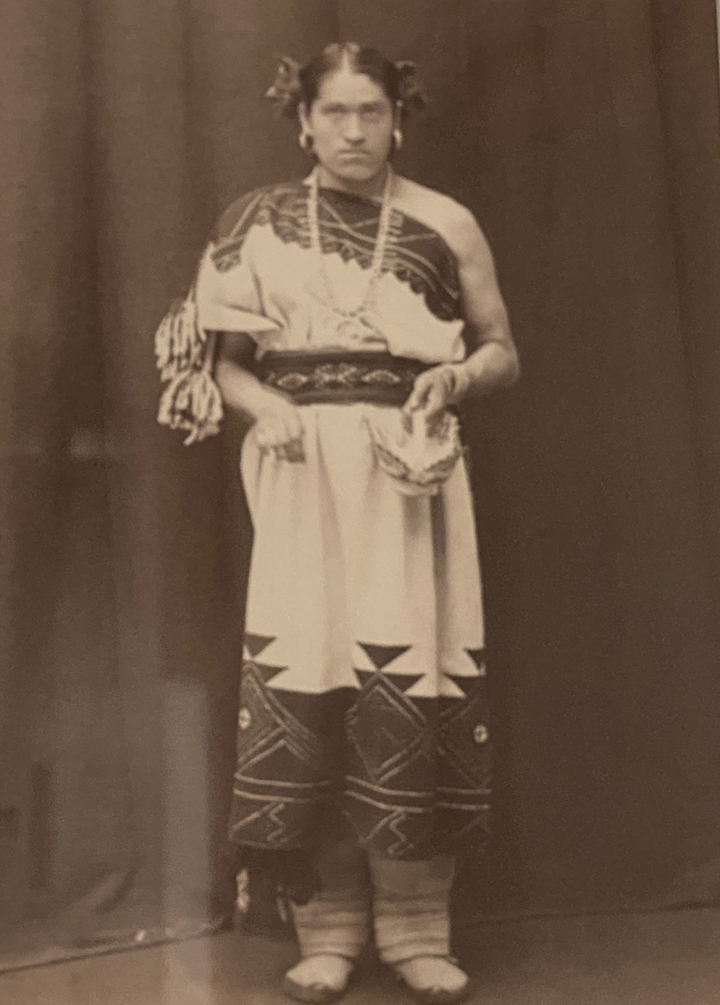
John K. Hillers’ 1879-1880 albumen portrait of Lahmana We’wha of Zuni Pueblo. Courtesy: Palace of the Governors Photo Archive.

This section also includes the stories of important two-spirit Native American artists – individuals who are born “male” but who take on spiritual and other tribal roles traditionally associated with women. The first is We’wha, a respected 19th-century expert in and advocate for Zuni arts and traditions– a favorite of Smithsonian anthropologists who demonstrated weaving in D.C. and even presented a special work directly to President Grover Cleveland as a wedding gift.

Another is R.C. Gorman’s portrait of Hosteen Klah, a Navajo two-spirit, one of the the Wheelwright Museum’s co-founders. Gorman, one of the best recognized and flamboyant 20th century contemporary Native artists, excelled in colorful mid-century works. Gorman made history in Taos by opening the first Native-owned gallery in the United States.

Navajo artist R.C. Gorman’s 1960 painting Night of the Yei – a celebration of Navajo spiritual traditions.

The final portion of the show includes two works by female rule-breakers. The first is a rare Agnes Martin 1954 abstract-expressionist work typical of her experimentation prior to her acclaimed grid series. It’s much more aligned to the biomorphic symbolism of early Pollack and Rothko – reflecting what was happening earlier in her New York career during the heyday of the Cedar Street Tavern crowd.

Agnes Martin’s untitled 1954 painting. Courtesy: University of New Mexico Art Museum.

Second ia a never-before-seen 1997 installation by feminist-art innovator Harmony Hammond, who was also represented in this year’s Whitney Biennial. Hammond, who curated one of Santa Fe’s first LGBTQ exhibitions back in 1999, used to travel backroads of the Southwest, finding abandoned towns and homesteads and collecting left behinds. In this show, she presents What Have You Done With Our Desire, a mixed-media piece using ancient kitchen linoleum – an allusion to circumstances leading to repression of gay women’s sexuality.

Harmony Hammond’s never-before-seen 1997 mixed-media installation What Have You Done with Our Desire. Courtesy: the artist.

For more about these and other artists, listen to curator Christian Waguespak’s talk about LGBTQ artists in the Southwest at the Harwood Museum in Taos.

Why Do People Like Folk Art So Much?

It wasn’t a scientific survey, but Santa Fe’s Museum of International Folk Art asked each museum staff member to select a favorite piece from the collection, explain why, and then mounted an entire exhibition about the love of folk art – Staff Picks: Favorites from the Collection at MoIFA through August 18.

Everyone knows about the 10,000 objects displayed in the museum’s Girard wing, but MoIFS houses over 150,000 additional works from over 100 countries. Given the vast scope of the collection, how did everyone choose one special item to be featured in the show?

2010 Alligator with Ice Cream carved by Joe Ortega of Tesuque, New Mexico welcomes everyone to the exhibition.

Some of the security staff remembered works from past shows that they loved, and some working in the collections had favorites hidden in the archives. To make it a little easier, the exhibitions team divided the task up into different regions of the world (to give a sense of the global extent of the collection), and asked some colleagues to pick a specific region, including the folk-art rich environs of Northern New Mexico.

1960 Noah’s Ark by Chimayo, New Mexico carver Jose Mandragon – an inspiration to take an adventure.

So why did different staff members choose what they did? The exhibition (and our Flickr album) states the reason that each was selected.

Sometimes a painting, sculpture, or necklace reminded them of places they’ve visited or cultures they loved – like the painting that evoked the tropical vibe of rural Cuba by Joe Ortega, or the cart direct from a colorful folk festival in Sicily, or intricate, bejeweled work from artists of Nepal in the high Himalayas.

2014 painting San Lazaro by Cuban artist Luis Rodriguez Ricardo.

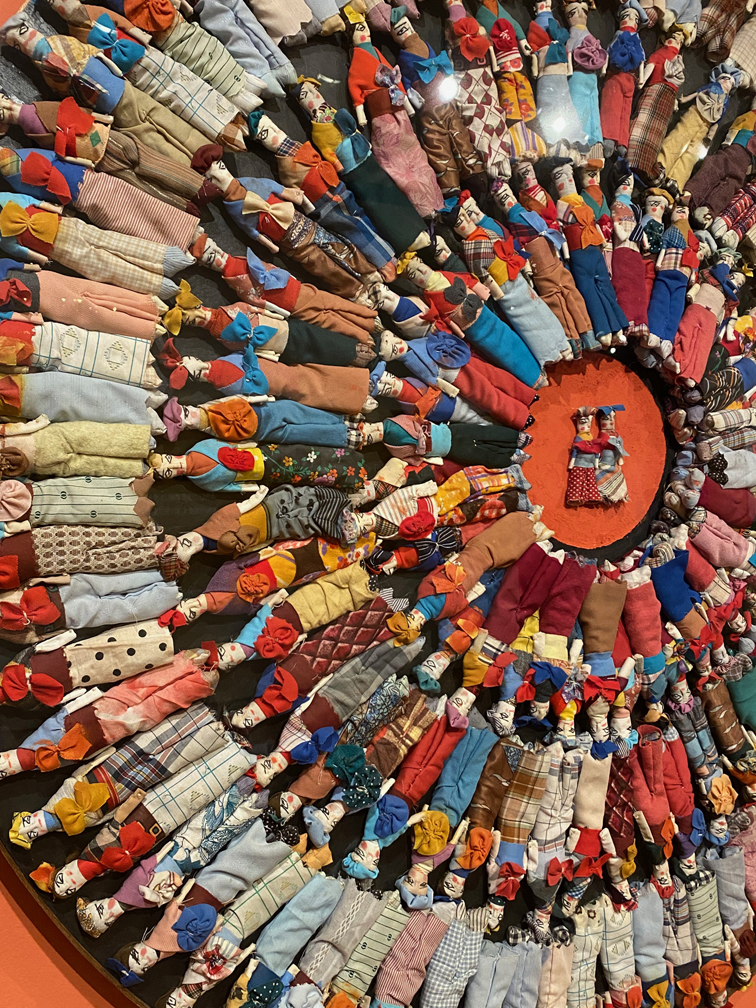
And who doesn’t love work that is pure whimsey and telegraphs sheer joy? Several staff members said they couldn’t resist works that just made them smile – the whimsical alligator sitting above the entry with his huge tri-color ice-cream cone, the recycled robot from California relaxing in his lounge chair with a drink in hand (summer fun!), and a super-happy circle of tiny Ecuadorian dolls, dolls, dolls!

Close-up of Ecuadorian artist Osvaldo Viteri’s 1980 doll sculpture Se Nos Cayo La Luna Para Amar La Tierra (The Moon Fell So We Could Love the Earth).
BoBo bu Ko, a 1994 recycled materials sculpture by Alameda, California artist James Bauer

Sometimes you just have to stand back and admire the sheer determination, precision, and willpower of a particular artist. How did Rhode Island artist Henry Patrick Neugent collect and take apart all those cigar boxes and create two intricate tramp art cabinets with secret compartments?

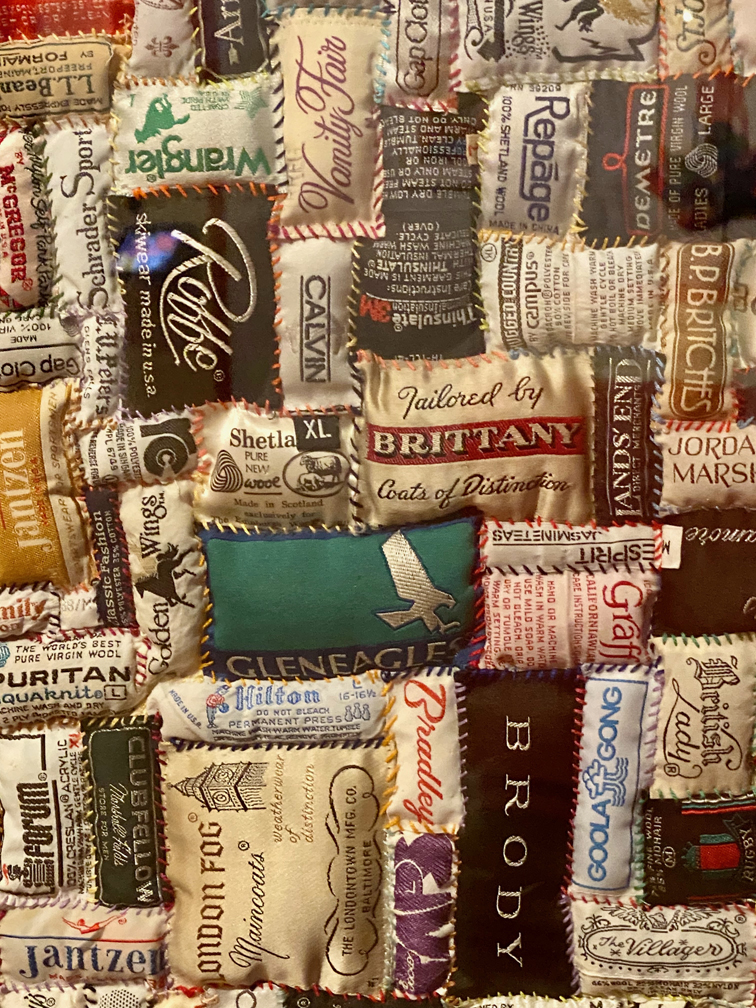
And what about the gigantic quilt made by New York textile artist Susie Brandt – she removed zillions of tiny tags from vintage shirt collars and jacket breast pockets and worked them into a log-cabin sort-of pattern. You could spend hours just reading and reflecting on the memories behind those tags – Jordan Marsh, B.P. Britches, and old Wrangler or L.L. Bean tags.

Top of early 20th century tramp art whimsey table from cigar boxes by Portsmouth, Rhode Island artist Henry Patrick Neugent
Detail of large quilt Sleep Product made of garment labels collected by New York artist Susie Brandt in 1986-1989.

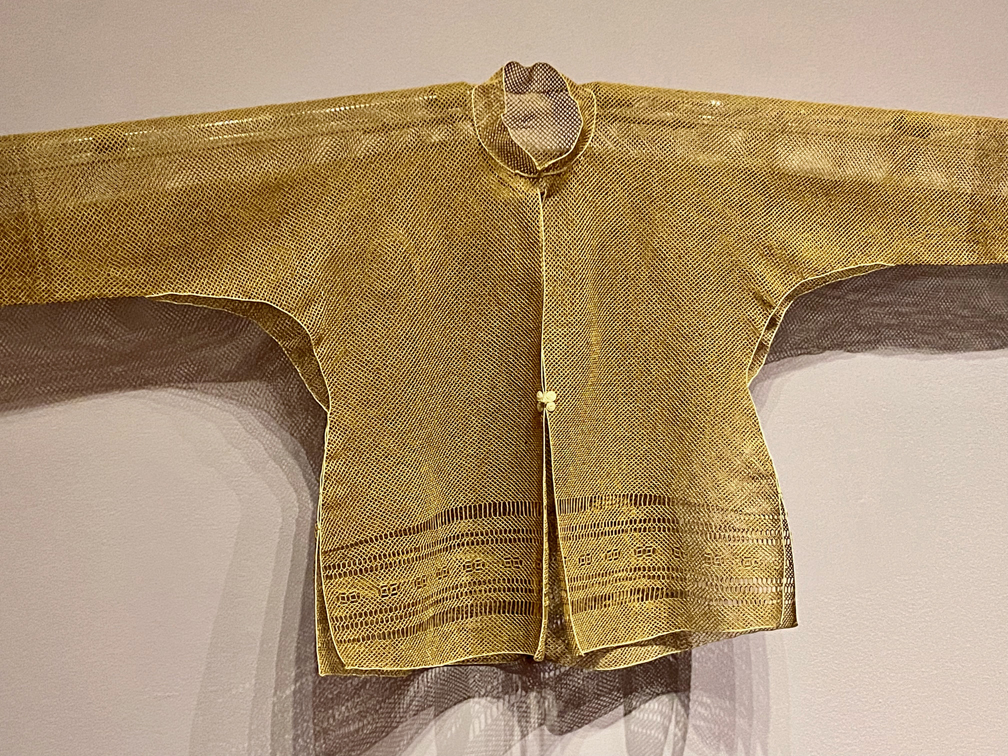
One collections manager picked hers for the sheer technical genius.  Check out the 19th century Chinese undershirt designed to keep you cool under the heavier, decorated silk robes. It’s woven in a clever, open diamond pattern from bamboo and cotton!

Innovative “cooling” 19th century Chinese bamboo and cotton undershirt.

An anthropologist on the team paid tribute to craft excellence is carried on generation to generation in North Carolina’s historic ceramic-making communities. She selected two pots by a father and son – Matt Luck’s corncob-stopper jug and a show-stopping double-faced jug created by his dad, Sid Luck (a fifth generation Seagrove potter), to commemorate the experience of living through Hurricane Fran.

The museum’s director selected a Zimbabwe thumb piano sheerly for its beautiful sound!

Two generations of Seagrove NC potters – Matt Luck’s 2012 pot with corncob stopper and Sid Luck’s 1996 double-faced jug
1992 thumb piano (mbira of the ancestors) made by a Shona artist from Zimbabwe.

The show is a tribute to the teamwork it takes to welcome the world to a popular folk-art destination and a delight to behold. A selection of these works will be on display at New Mexico’s Roundhouse in the Governor’s Gallery through April 25, 2025.

Take a Google walk through MoIFA’s massive Girard Wing here.

Exploring New York with Painter Alice Neel

The sights you’ll see! The people you’ll meet!  There’s nothing like seeing 20th-century New York through the eyes of one of most astute observers of the human condition. It’s why people have been flocking to The Met to see Alice Neel: People Come First, on view through August 1.

Considered one of America’s greatest figurative painters, Alice herself considered her relentless artistic pursuit more in line with history painting.  And what a history you’ll experience, walking through room after room of insightful portraits and cityscapes.

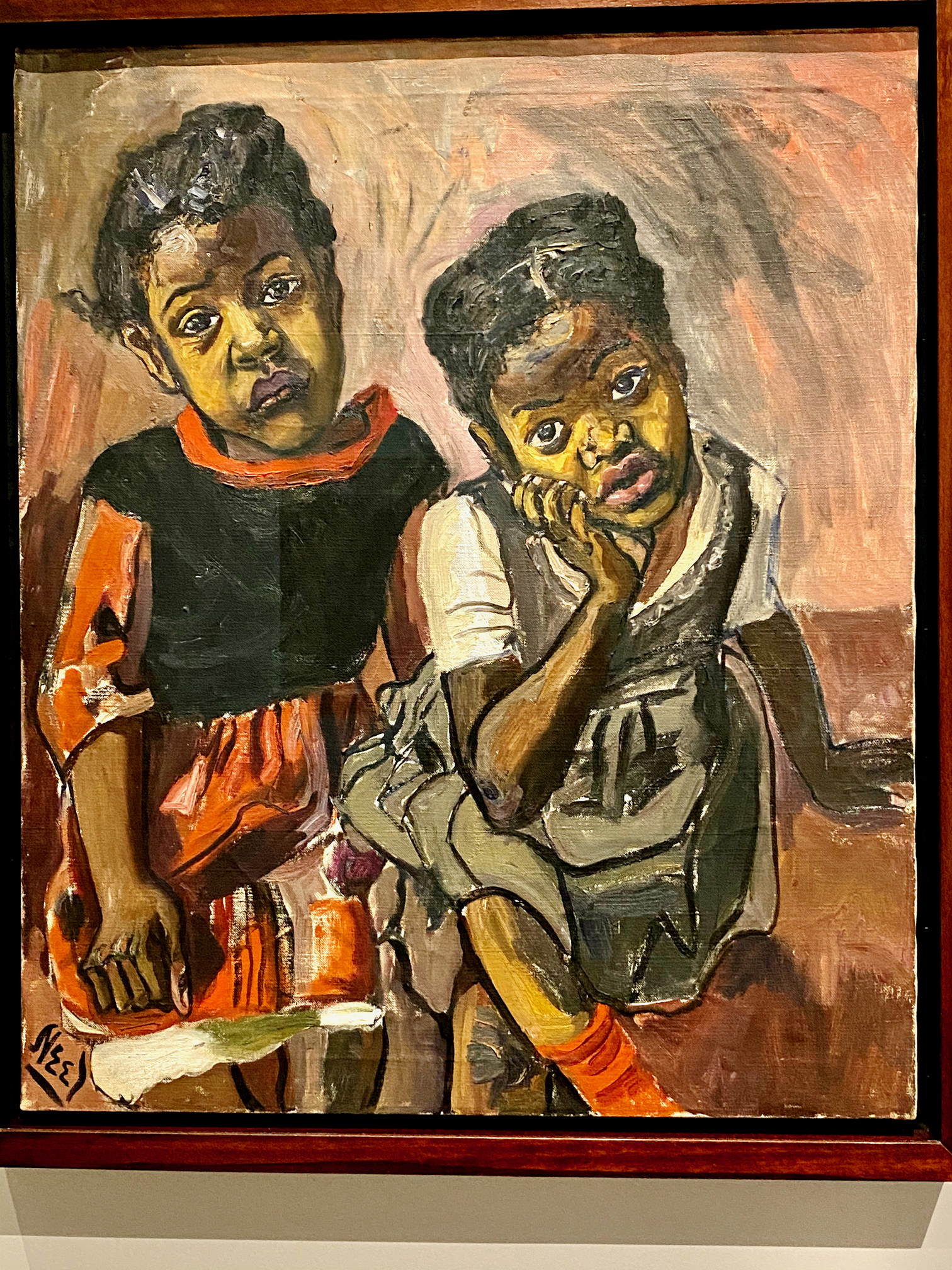
1958 Two Girls, Spanish Harlem with Alice’s neighbors Antonia and Carmen Encarnación. Courtesy: Boston Museum of Fine Arts
1972 portrait depicting Irene Peslikis, a leading Seventies feminist activist. Private collecdtion.

Alice’s colorful, insightful works introduce you first-hand to bohemian life post-WWI, the Great Depression, the socialist fight for workers’ and artists’ rights, the push for civil rights, the art underground, and the rise of feminism.

Through it all, Alice kept raising her family and painting in her home studio, sparing nothing in her portrayals of kids experiencing the world, families just trying to make ends meet in Harlem, marriages, births, and annual trips to the country.

Her earliest artistic influence was her early 20th-century academy training, in which the bravura brushwork of Robert Henri was admired – merging virtuoso painting with unfiltered views of everyday people and sights. Alice drew and painted like a virtuoso herself, sure of her ability of laying down an expressive line. 

Neel’s 1955 A Spanish Boy with Henri’s 1907 Dutch Girl in White.

Throughout her life, her frequent trips to the Metropolitan Museum bolstered her work with the continued influence Cassatt, Soutine, and other grand masters of the brush and the masters of social commentary, like Jacob Lawrence or Daumier.

The result is a decade-by-decade window into the life, times, struggles, and perseverance of a working mother-artist who took the same master, unflinching approach to documenting her pregnant daughter-in-law, civil rights leaders, Andy Warhol, and her own aging body.

Take a look at our favorites in our Flickr album.

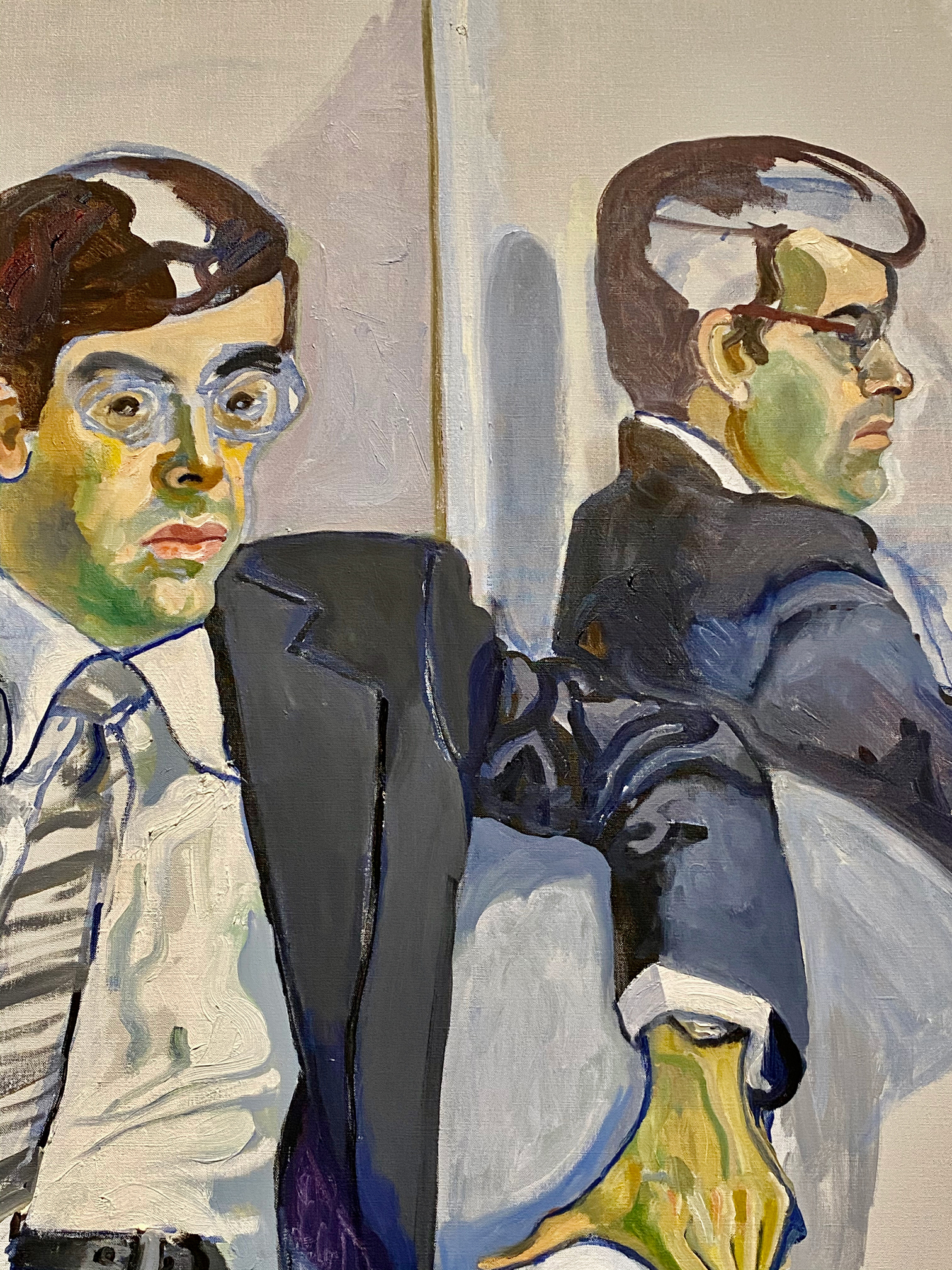
Detail of 1978-79 portrait of her son when he worked for Pan Am, Richard in the Era of the Corporation.

Alice and the curators keep the surprises coming through the exhibition, but why not hear from her yourself?  Here is Alice’s own description of her life, times, and what inspired her:

Experience Alice Neel’s New York in the Met’s multimedia primer here, and see all of the works assembled for her incredible exhibition.

1984 photo of Neel as a guest on The Tonight Show Starring Johnny Carson. Courtesy: Neel estate

Hockney’s Personal Drawings at The Morgan

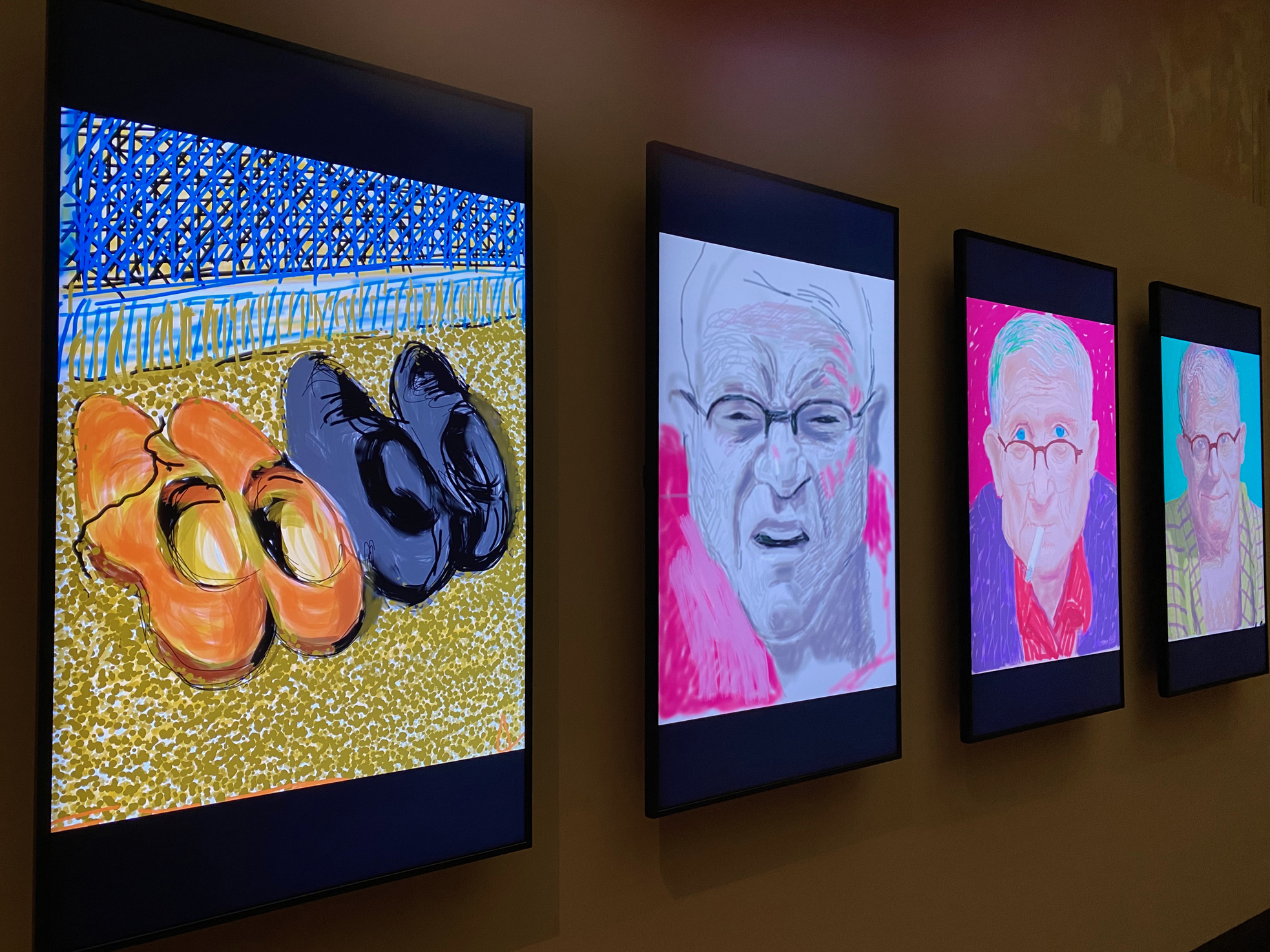
The drawings at the Morgan, David Hockney: Drawing from Life, on view through May 30, are a tribute to the friendships maintained and the artistic experimentations sustained over the artist’s 83-year lifetime.

Hockney self-portraits through the years.

The show was created by the National Portrait Gallery in London and centers on 100 portraits of five people who sat for Hockney across the decades – his mother and several close friends.

The exhibition is organized by person, so you can compare how each person looked from the beginning of Hockney’s studies, across the years, and most recently when they came to visit him in Normandy, where he lives now.

Most of the works are from the Hockney Foundation or from the artist’s own personal collection, which makes the show extra-special.

The exhibition begins with a series of self-portraits that Hockney did as a teen, and features his etching series about his first trip to America in the early 60s. Then it jumps to the many portraits he did of his mother in England.

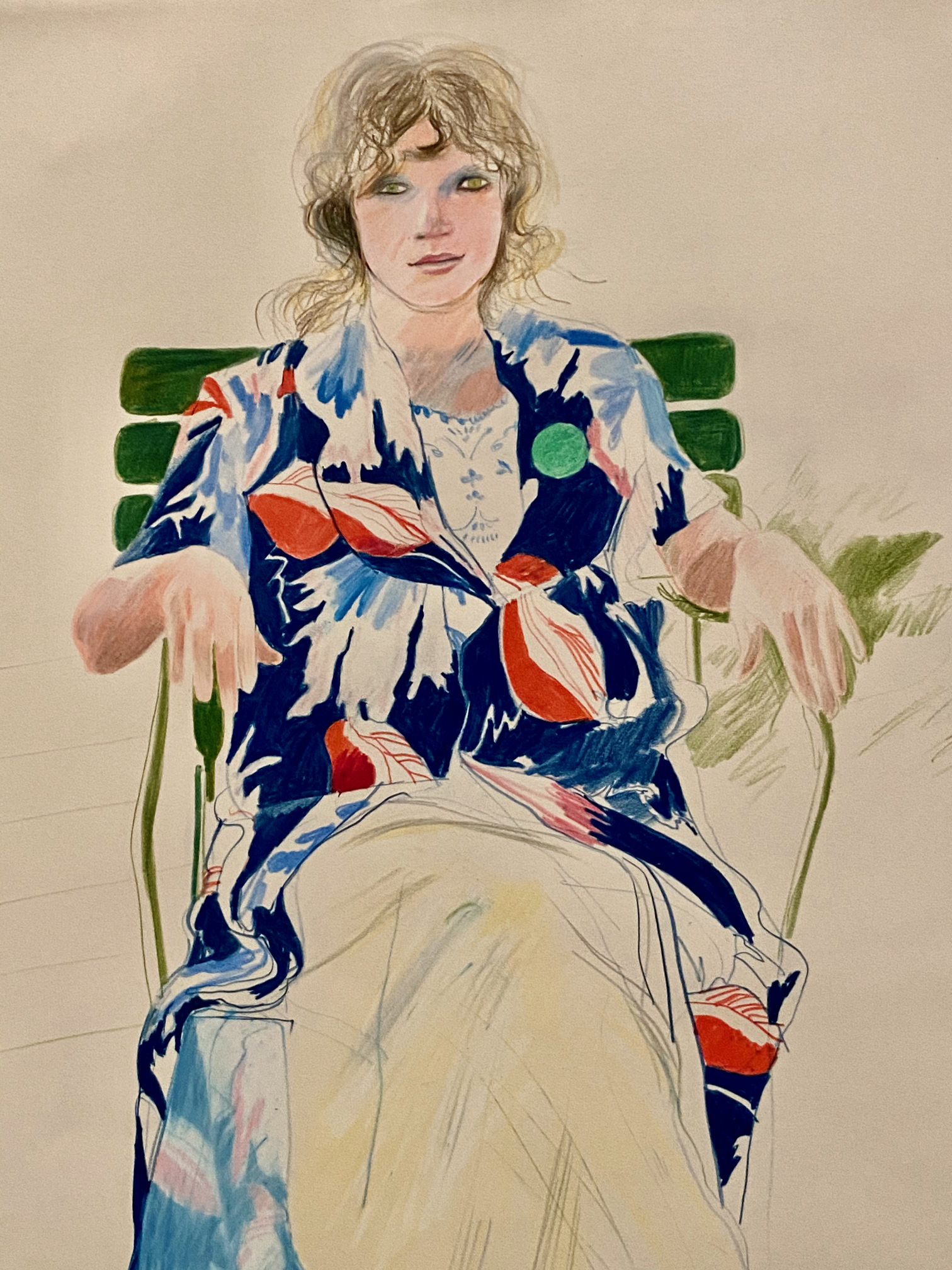
Colored pencil portrait, Celia, Carennac, August 1971
Digital wall of Hockney 2010 iPad drawings
Charcoal drawing Maurice Payne, October 9, 2000

Each series shows off his masterful accomplishments in precise colored pencil, mixed-media collage, watercolor, crayon, arranged Polaroid mosaics, etchings, ink washes, tight pencil sketches, and the biggest leap of all – digital drawings from his iPad.

Walking past the portraits, self-portraits, sketchbooks, and digital drawings, it’s quite a tribute to an artist who never stopped looking, wanting to sit with his favorite people, and slowed down to adopt techniques by other masters that he admired.

Take a look at works by a pop-culture virtuoso. Here’s a brief introduction to the exhibition by the Morgan’s director:

Take a walk through the exhibition on the Morgan’s website here, and join a YouTube tour with the curator here.

And see our favorites in our Flickr album here.

Gilded Age Treasure Hunt at The Met

Once you navigate the twists and turns of one of the furthest reaches of the Metropolitan Museum of Art’s American Wing (past the Versailles panorama and past the Rockefeller room), you’ll come to a treasure trove of Gilded Age interior design – Aesthetic Splendors: Highlights from the Gift of Barrie and Deedee Wigmore, on view through April 18.

What did rich people in the 1880s and 1890s want? The exhibition will show you.

1880s Herter Brothers cabinet, Britcher landscape, and reproduction wallpaper evoke the Wigmore’s home

You’ll find lush landscapes by second-generation Hudson River painters and first-generation romantic painters of the American West, elaborate furniture and decorative pieces embellished with tributes to Asian style, and bedazzled masterpieces from the Tiffany workshops.

Sanford Gifford’s 1879 An Indian Summer Day in Claverack Creek

The curators pay tribute to these avid Aesthetic Movement collectors by framing these promised gifts with reproduction period wallpaper and fixtures, and it’s hard to decide where to look first.

The approach to this marvelous exhibition gives modern gallery-goers an experience of what Gilded Age interior designers had in mind – cramming foyers and drawing rooms with lush paintings, flashy techno brass furniture, Japanese-style ceramics, art pottery, and fringed upholstered seats decorated with Arts & Crafts tiles that throwback to mythical times.

The mix of styles and techniques – some old and some new – reflect a time when consumption of luxury goods ran wild with the ascension of New York City as the trading and shipping capital of the world.  Many of the pieces reflect new machine-made technology mixed in with a bit of medieval nostalgia via the British Arts and Crafts movement.

Look closely at all these showstoppers in our Flickr album.

Detail of 1880 Modern Gothic cabinet by Kimbel and Cabus with tile by Minton & Co.

Although the exhibition is slightly hidden away, the landscapes appearing throughout the show provide windows to lush valleys of the Rockies (thank you, Mr. Bierstadt!), autumn colors of the Catskills, and spectacular, tranquil shorelines on Maine’s rocky coast.  All are either in their original fancy frames or reproductions from the era.

Alfred Thompson Bricher’s 1899 Low Tide, Hetherington’s Cove, Grand Manan in Maine

Most of the works are oil paintings, but (in case you didn’t know) New York was also the epicenter of the movement to make watercolor paintings the equal of any fine salon work.  The curators have included work by the masterful William Trost Williams, so you can enjoy a side-by-side comparison of the techniques he used to give those oil painters a run for their money. Every time we’ve visited this show, visitors simply stand transfixed, drinking in the saturated, tranquil views of the faraway.

The ceramics, cloisonné tabletops, andirons, and many large-scale pieces reflect the period’s mania for anything with a hint of Japanese or Chinese style – delicate birds flitting through bamboo and fierce dragons swirling in magical space. Designers for the upper classes were captivated by images from kimonos, scrolls, screens, and ceramics from the East and made sure that custom commissioned pieces were on trend.

Bradley & Hubbard’s 1895 phoenix andirons
Sapphire encircled by grapevines on 1910 gold and platinum Tiffany necklace

The mesmerizing beacon within the show is the spectacular array of Tiffany necklaces in the center – dramatic opals and sapphires, often encircled by intricate grapevines in gold or another nod to nature-by-design. The effect of these beauties side by side is magical, and you can imagine a Gilded Age beauty making an entrance with one of these dazzlers.

The Met just announced that its September 2022 Costume Institute exhibition would be displayed in the period rooms of the American Wing, so we’ll see if Mr. Bolton and his team deploy any period finery in the more-is-more 19th-century area.

Read more about pieces in this fantastic donation on the MetCollects blog and flip through close-ups of some the featured works.

When Advertising was Revolutionary

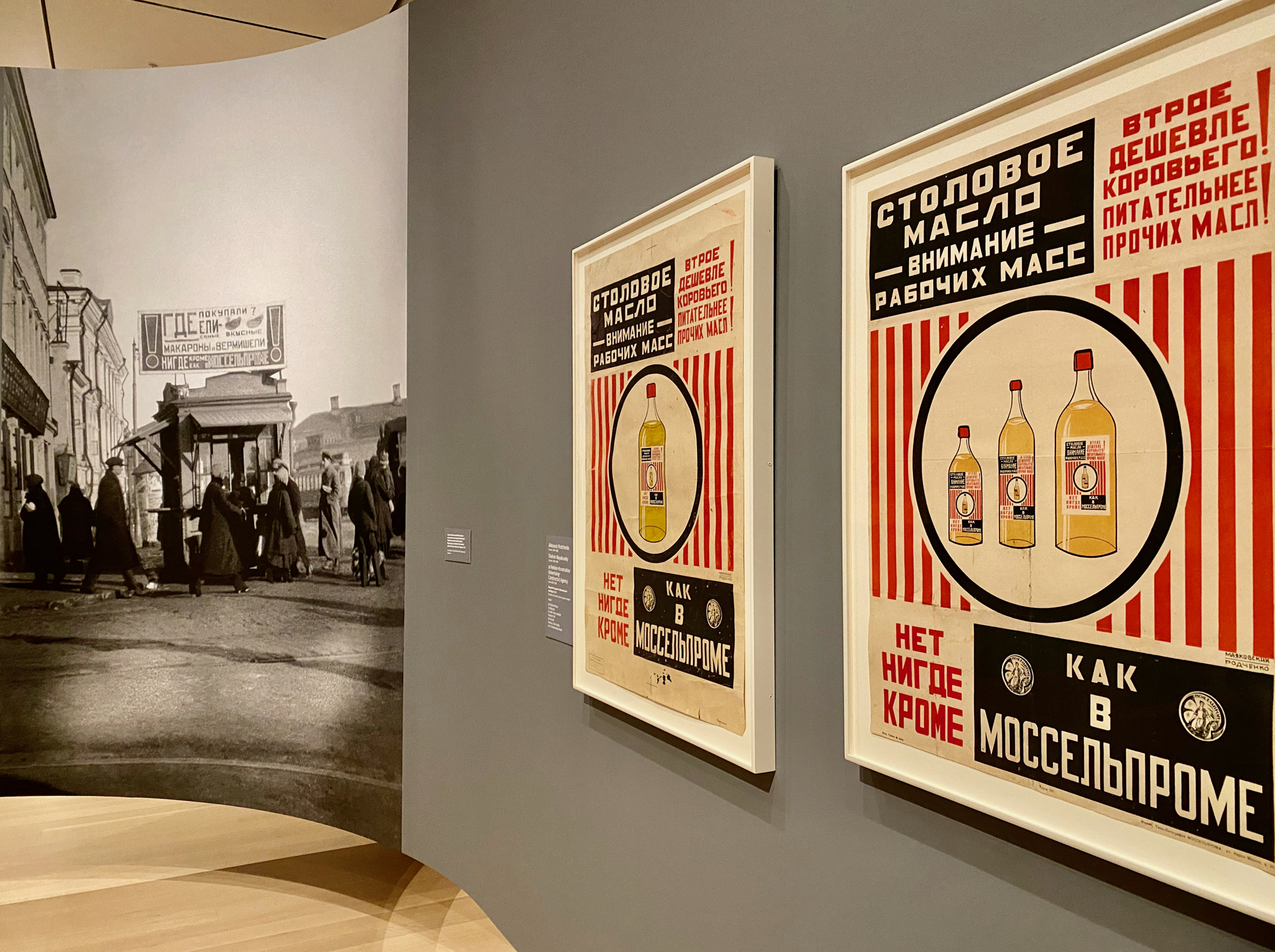
Abstraction was being invented, monarchies were falling, wars were raging, and modern 20th century artists decided to turn advertising on its head, too. Artists left studios in droves and began making posters, brochures, billboards, traveling agit-prop theater wagons, and new-fangled telecommunications towers.

1-11 Engineers Agitators Reconstructors at MoMA
Modernist Russian billboards and works from Rodchenko and Mayakovsky’s 1923-1925 Advertising-Constructor agency

That’s just the first gallery of Engineer, Agitator, Constructor: The Artist Reinvented, on view at MoMA through April 10 – a show that investigates how artists change their focus to meet the moment of social, technical, commercial, and political change.

The focus is the period between WWI and WWII, when the avant-garde began mixing it up to bring about a whole new world for consumers, city planners, publishers, and the proletariat. Take a look at our favorite works in our Flickr album.

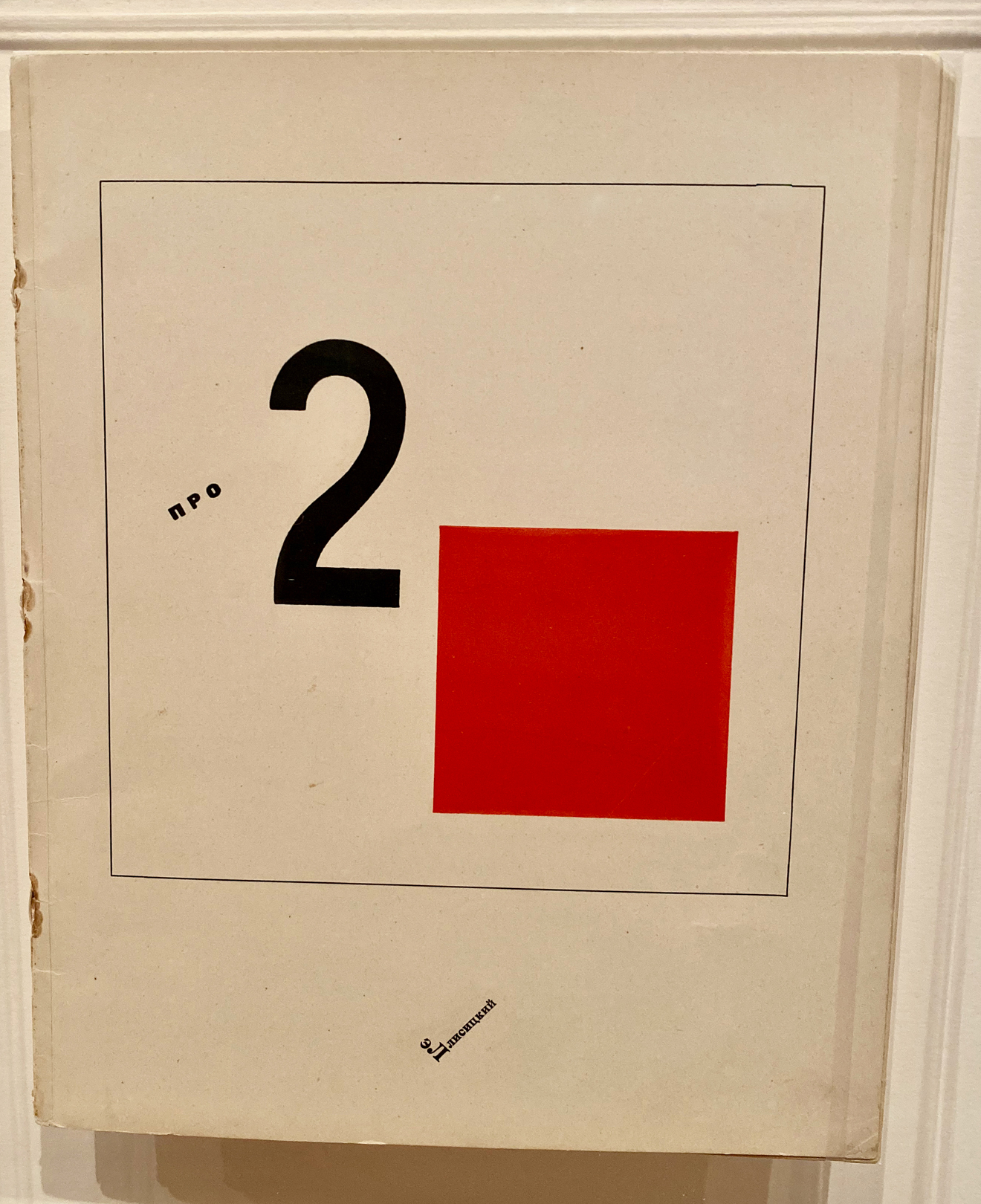
The first gallery provides a broad view of how other avant-garde abstractionists first inspired by Malevich’s Suprematism experimented now used pure, kinetic shapes to dance across children’s books, pavilions, costumes, and posters in the earliest days after the Russian Revolution.

El Lissitzky’s 1922 book About Two Squares: A Suprematist Tale of Two Squares in Six Constructions

The 300 works in the show are principally works on paper, collected by and donated to MoMA by Merrill Berman – a treasure trove that includes particularly rare and unique items that the curators use to tell quite a story.

A 1922 costume design by Popova, inspired by workers’ uniforms

One entire wall is dedicated to Ms. Popova, where you can stroll by paintings, covers for sheet music, and prints – all the ways she applied her genius. Another long wall displays dynamic work by Rodchenko and Mayakovsky, whose Advertising-Constructor agency mixed poetry and innovative, angled constructivist style to sell chocolate and other consumer products.

Mixed-media plays a major role in the exhibition, with several galleries showing how European artists embraced collage and photomontage both in their personal studio work and in graphic designs that shook up the look of mass market publications, industrial marketing, postcards, and political posters.

Dynamic photo montage 1928 postcards by Gustav Klutsis to promote the All-Union Spartaklada Sporting Event

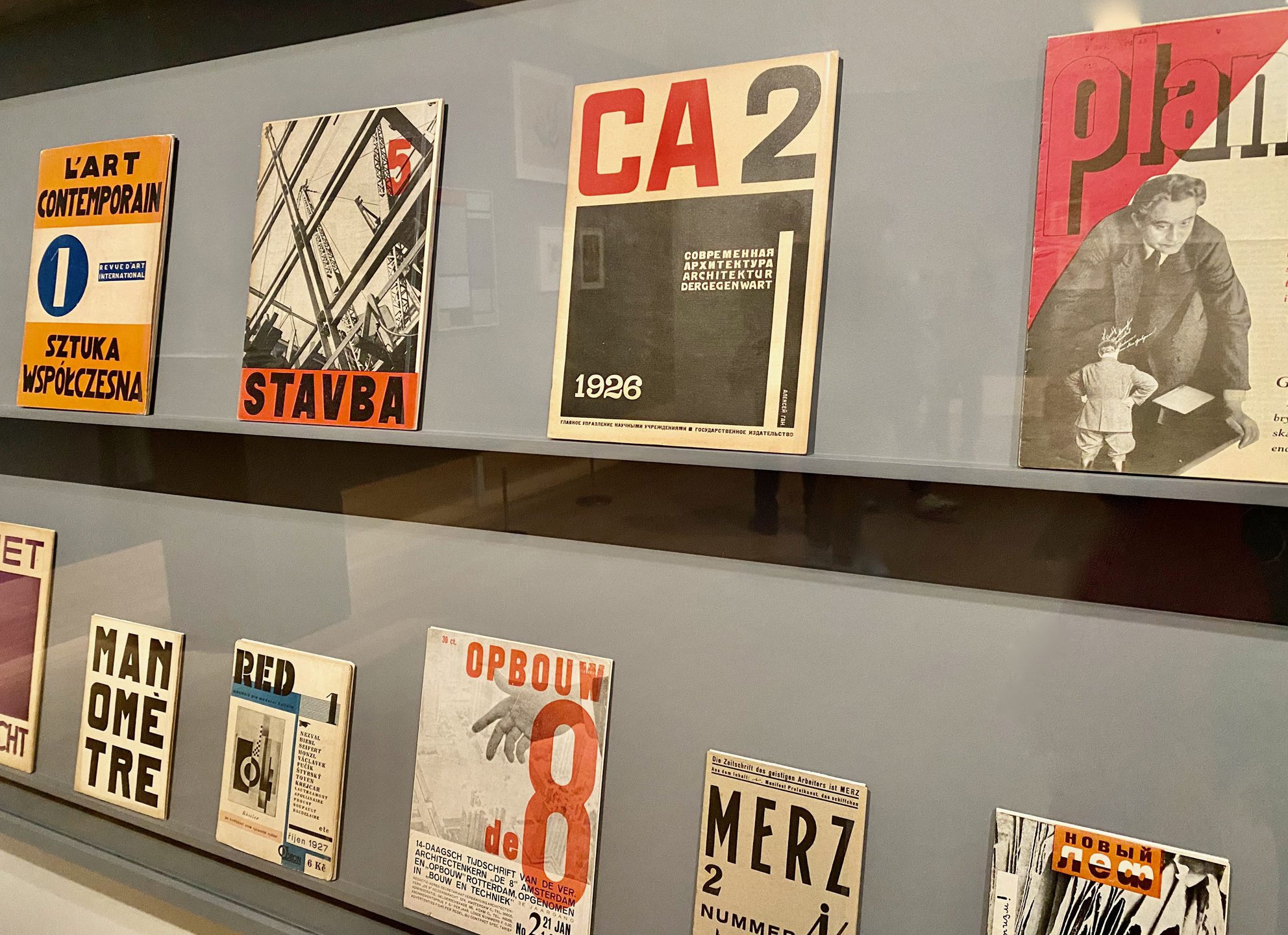
Another section of the show provides an introduction to innovative Polish, Hungarian, and Dutch indie zines shared, collected, and treasured by cutting-edge writers and designers excited by possibilities of the early 20th century.

Creative European magazines published in the late Twenties

Angled, geometric, and loaded with innovative typography, these rare magazines share the space with paintings by Mondrian, sculpture by Moholy-Nagy, and other geometric shape-shifters.

1924 photo of Henryk Berlewi and his exhibition at a Warsaw Austro-Daimler showroom with works from his Mechano Facture series, inspired by industrial technology

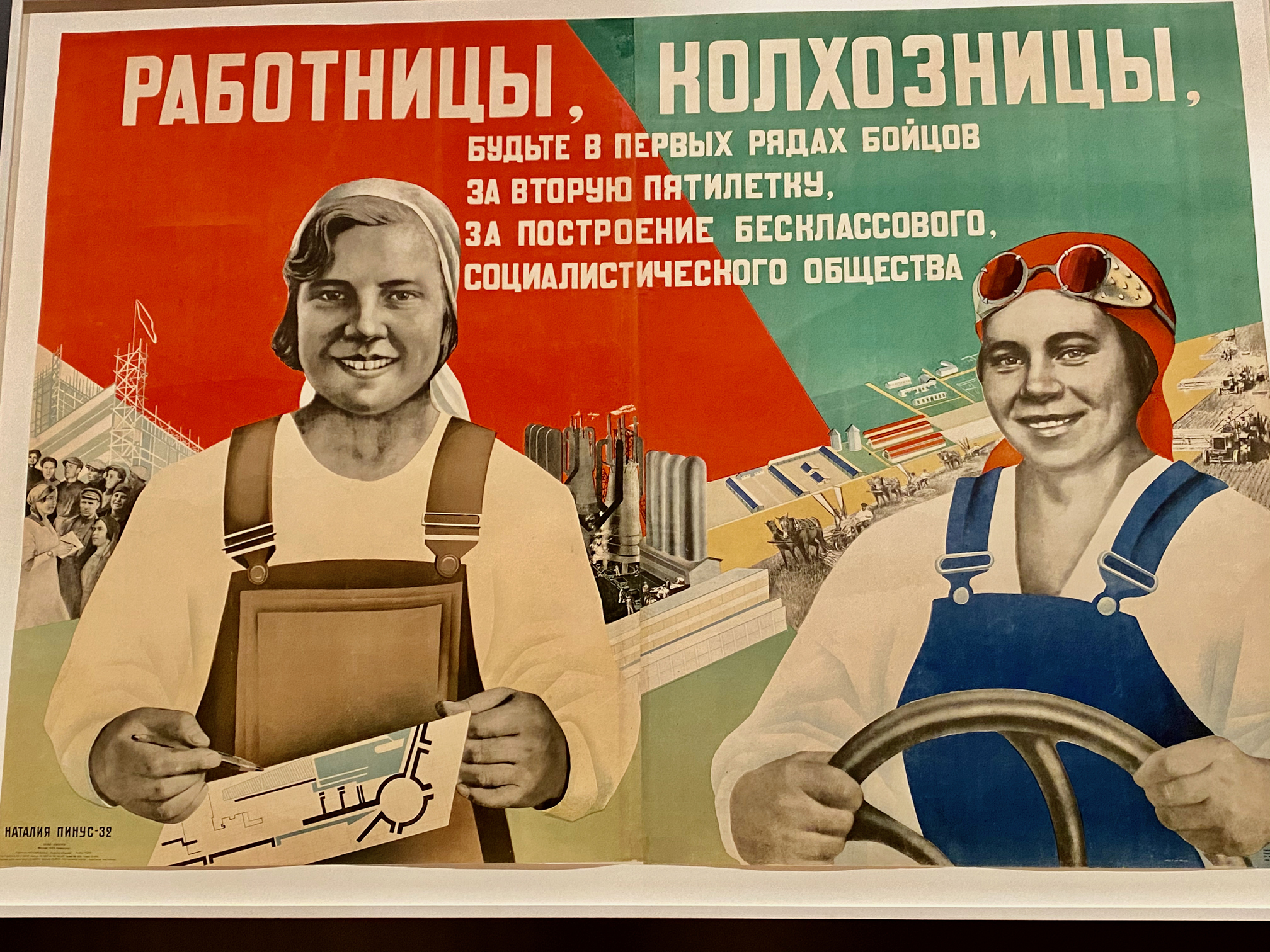
Women are prominently showcased in every gallery of the exhibition, including the massive wall of Soviet posters by female designers whose images celebrate the contributions of women to the industrial workforce.

1931 poster by Natalia Pinus acknowledging female farmers and other collective workers

Visionary drawings, watercolors, and poster posters are around every corner – and most are never-before-seen surprises. Before WWII brought it all to an end, the curators show the modern innovations that these creatives had in mind – new architecture, advertising constructions, and modern furniture fairs.

Walter Dexel’s 1928 design combines an airshaft, ad kiosk, and telephone booth. Herbert Bayer’s design for an electrified ad tower for an electricity company, done when he was just a student at the Bauhaus. Willi Baumeister’s 1927 poster that directly declares interior designs of the past are over.

Elena Semenova’s 1926 design sketch for a Russian worker’s lounge looks like a precursor to WeWork.

1927 poster by Willi Baumeister promoting a modern furniture exhibition in Stuttgart
Vision for model communal space: Elena Semenova’s 1926 design watercolor for a Russian worker’s club lounge

Enjoy this special program with Ellen Lupton and curator Jodi Hauptman in a fascinating discussion about work by several revolutionary designers and how so many intermingled careers in graphic and fine arts during tumultuous times: