Artistic and Ethnic Identities Explored in La Bienal at El Museo

Ethno Portrait Cultural Test Shot by Sean Paul Gallegos alongside Reserved Ancestry made from Air Jordans, Arrow collars, and fur.

Indian Removal Act Skeuomorph by Sean Paul Gallegos wearing Reserved Ancestry (on right) sculpted from Air Jordans, Arrow collars, and fur.

Get to know some of NYC’s best new artists by strolling through El Museo del Barrio’s La Bienal 2013 on the Upper East Side before January 4.

Full of fun, reality, street life, high-art provocation, and what it’s like to be an artist in 2013, the show has it all – installations, videos, performance-art artifacts, photographs, sculptures and even a tintype. Take a look at some of our favorites on the Flickr feed, and go to the excellent website for El Museo La Bienal 2013: Here is Where We Jump, the seventh edition of this working contemporary artist showcase, which explores both formal-art and ethnic identity issues.

Small detail of Ignazio Gonzalez-Lang’s “Guess Who” – a grid of 100 inkjet prints of police sketches that appeared in NYC newspapers papers. In this 2012 work, he arranged very similar portraits side by side.

Small detail of Ignazio Gonzalez-Lang’s Guess Who – a grid of 100 inkjet prints of police sketches that appeared in NYC newspapers papers. In this 2012 work, he arranged very similar portraits side by side.

Look closely at the pieces by Sean Paul Gallegos, an artist who considers himself a product of colonial ancestry (his father is Tiwa and Spanish from New Mexico and his mother is Cree and French from Canada). Gallegos juxtaposes his “anthropological” self-portrait with his Native American-inspired headdress made entirely out of cut-up Air Jordan sneakers, Arrow shirt collars, and fur.

A grid of 100 inkjet prints of police sketches by Ignazio Gonzalez-Lang, an NYC Puerto Rican artist, also puts identity to the test. For Guess Who, he’s collected police sketches that have appeared in New York City newspapers, slapped them into a grid, and arranged them in pairs that look all-too-similar. Super thought-provoking.

The Cortez Killer Cutz Radio installation by Eric Ramos Guerrero, a Philippines-born artist, also gets into your head but out of your comfort zone. It’s a full-size, two-room simulation of a Southern California hip hop/R&B radio station streaming late-night song dedications by girlfriends to their incarcerated boyfriends.
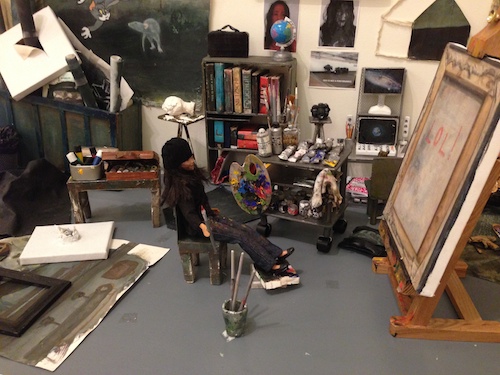
Close-up of the doll-artist contemplating her studio output in Julia San Martin’s Dollhouse

Close-up of the doll-artist contemplating her studio output in Julia San Martin’s Dollhouse

Julia San Martín’s Dollhouse, on the other hand, is a very tiny, detailed installation of a look into the mind and work of the artist. On a miniscule set of her studio, a doll-size painter works on her paintings and drawings, which the Chilean-born artist often rearranges and reshuffles to mimic the working life and consternation of deciding what to paint and what to show.

RISD-trained Gabriela Salazar also looks inward to her studio experience, but in a more formal way. As an artist that often creates large-scale constructed works in the community, she’s taken the remainders of some of her projects – wood shims, foam, cardboard, felt, rope, and wire – and turned them into tiny-scale minimal masterworks, all displayed in a type of “gallery show within a show.”
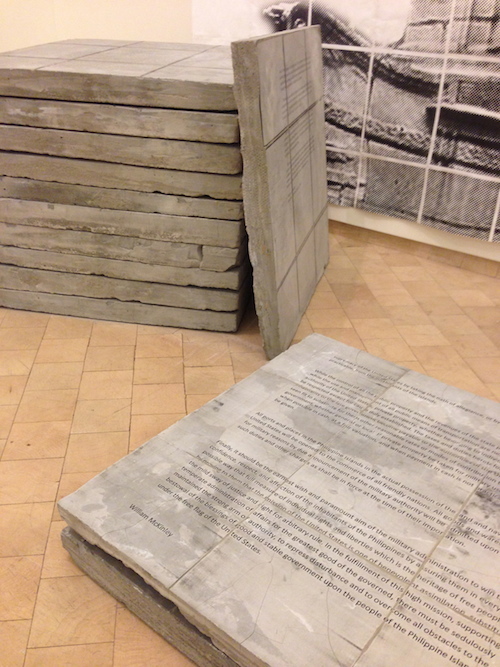
Ramón Miranda Beltrán’s historic documents cast in concrete, featuring President McKinley’s treaties that gave Guam and the Philippines to the US after the Spanish-American War

Ramón Miranda Beltrán’s historic documents cast in concrete, featuring President McKinley’s treaties that gave Guam and the Philippines to the US after the Spanish-American War

And be sure to look for Gabriela Scopazzi’s hilarious Amarilla video where she seranades a captivated group of llamas with an aria. (Sorry, it’s for in-person viewing only and not on the web.)

Work through the show’s website to see more of each artist’s work and learn more about what makes them tick.

NYU Shows How Modern Art Popped in 1960s Iran

Zarrine-Asfar’s 1970s Black Plaster Hand in oil and pencil on canvas with plaster. Source: Grey

Zarrine-Asfar’s 1970s Black Plaster Hand in oil and pencil on canvas with plaster. Source: Grey

If you go downstairs at NYU’s Grey Art Gallery, a collection of seemingly quiet works will show you how a cadre of avant-Garde painters injected the spirit of 1960s downtown New York into Iran’s gallery scene just before the 1979 revolution transformed Persian society. Get down to Washington Square to contemplate Modern Iranian Art before December 7.

Gallery founder and woman-about-the-world, Abby Weed Grey, made it her priority to collect modern-influenced Iranian artists in the 1960s and 1970s just before the transition from the Shah to the Ayatollah, amassing (and ultimately bequeathing to NYU) the largest Iranian modern art collection outside the country.

Tanavoli’s Persian Telephone I, a 1963 bronze sculpture inspired by Johns and Warhol. Source: Grey

Tanavoli’s Persian Telephone I, a 1963 bronze sculpture inspired by Johns and Warhol. Source: Grey

This show and its scholarship is first rate, hitting a home run with Sixties connoisseurs. Good job, Grey team, with your first-ever e-book on the web site, which connects the dots in some unexpected places.

Consider Parviz Tanavoli, who experimented with some Jasper Johns techniques — incorporating dishes into ceramics and playing with bronzed objects. Hamid Zarrine-Asfar was also experimenting with whitewashed 3D grids in a refined, painterly, and Johns-like way. Not copies, but reinterpretations that resonated with cosmopolitan Persians. Abby bought 35 of his works.

Robert Indiana wasn’t the only one playing with letters-as-art during the Sixties.  Abby collected work by a lot of artists who used the calligraphy of their own culture in their work — a more lyrical, poetic approach than the brash American appropriations.

Two extremely understated painting in the show were influenced by one artist’s interest in Cage and Duchamp. Read the label copy, and you’ll learn that they were done by a young revolutionary artist, Mir-Hossein Mousavi, fresh out of school, who later served as Iran’s Prime Minister in the 1980s and challenged Ahmadinejad in a run for president in 2009. He lost, but the work makes you wonder about the number of political candidates (anywhere in the world), who are trained architects interested in channeling the I Ching, playing with alt notation, or using chess as a visual metaphor.

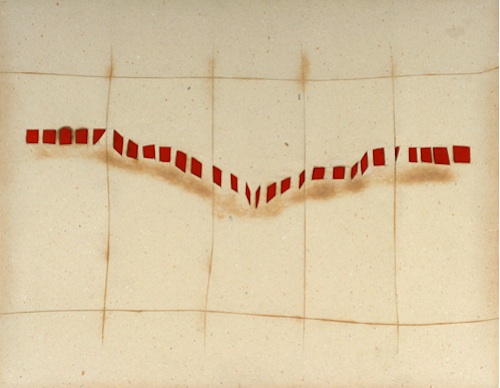
Mir-Hossein Mousavi (Khameneh), Musical Notations, a 1967 mixed media work inspired by Cage. Source: Grey

Mir-Hossein Mousavi (Khameneh), Musical Notations, a 1967 mixed media work inspired by Cage. Source: Grey

The startling image of Kamran Diba’s Diver at the foot of the stairs debuted as part of a multimedia piece, with two actors’ voices repeating the “conversation” that appears on the canvas – a reminder of performance mash-ups that young Yoko Ono might experimenting with around the same time.

The more you probe, the more you’ll see. No Ben Day dots or photo imagery — just glimmers of interdisciplinary thought normally associated with that boundary-pushing Black Mountain crowd.

Abby, you wanted your Middle East buying spree to inspire cross-cultural associations among generations of US scholars. Grey Gallery team, you did your founder proud. Well done in supplying this special lens.

Kamran Diba’s Diver, a 1967 oil that originally included an audio track with two actors’ voices. Source: Grey

Kamran Diba’s 1967 Diver,  whch originally included an audio track with two actors’ voices. Source: Grey

If you can’t get there, browse the e-book and photos of the work here. Abby’s collection of Iranian modern art has its own website, and you can browse through dozens of examples by each of her favorite artists.

If you’re up on Park Avenue, works that Abby collected are also at the Asia Society until January 5 in another exhibition shining the light on Iranian modernism.

Down-to-Earth Women and Space

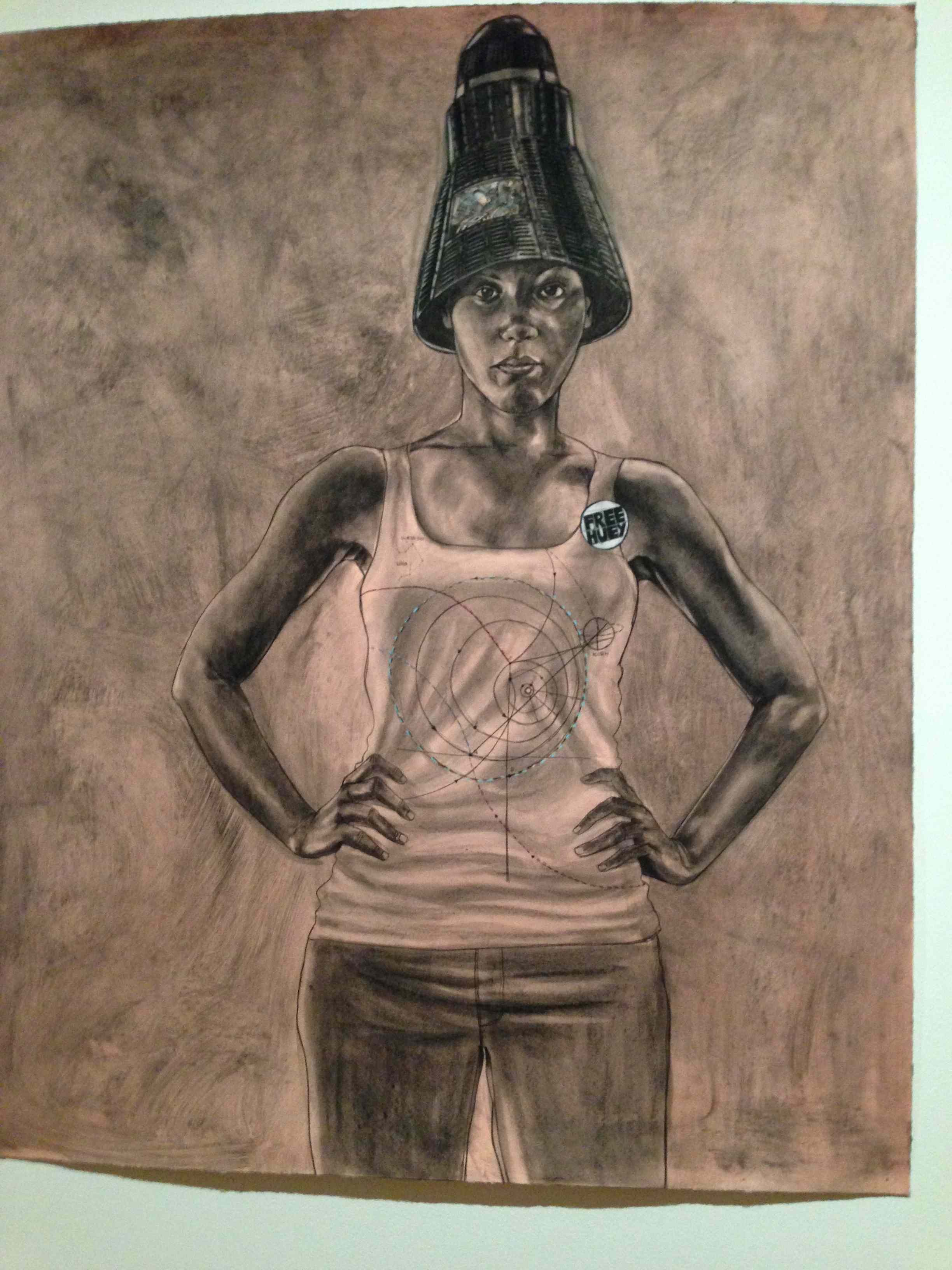
Installation view of Pruitt’s 2012 drawing, Diasporic Leaps and Bounds, courtesy of the Koplin Del Rio Gallery in Culver City, CA

Installation view of Pruitt’s 2012 drawing, Diasporic Leaps and Bounds, courtesy of the Koplin Del Rio Gallery in Culver City, CA

At the Studio Museum in Harlem’s current show, Robert Pruitt: Women, you’ll get to meet some regal-looking smarties who have a handle on art, space, and day-to-day life. Sandra Bullock’s astro-surfer is the talk of the town, but it’s these dozen-plus beauties, with their feet on the ground, who are soaring into the stratosphere with their intellectual firepower, accessories, and hairdos.

We’re talking about the stunning portraits on display through October 27. Click on the link to see more views of the installation, courtesy of photographer Adam Reich, but you need to get up to 125th Street to meet them in person.

First, it’s astonishing that these grand portraits are done with those first-year art school staples – conté crayon and brown butcher-block paper. Pruitt’s a master of the medium, and the women in his series can definitely hold their own against any Dutch Renaissance doyenne. They’re calm, cool, and collected. Yes, he’s added a touch of color or glint of gold to some detail or another, but it’s the fine hand and the technical mastery that gives each ethereal woman such large-format presence.

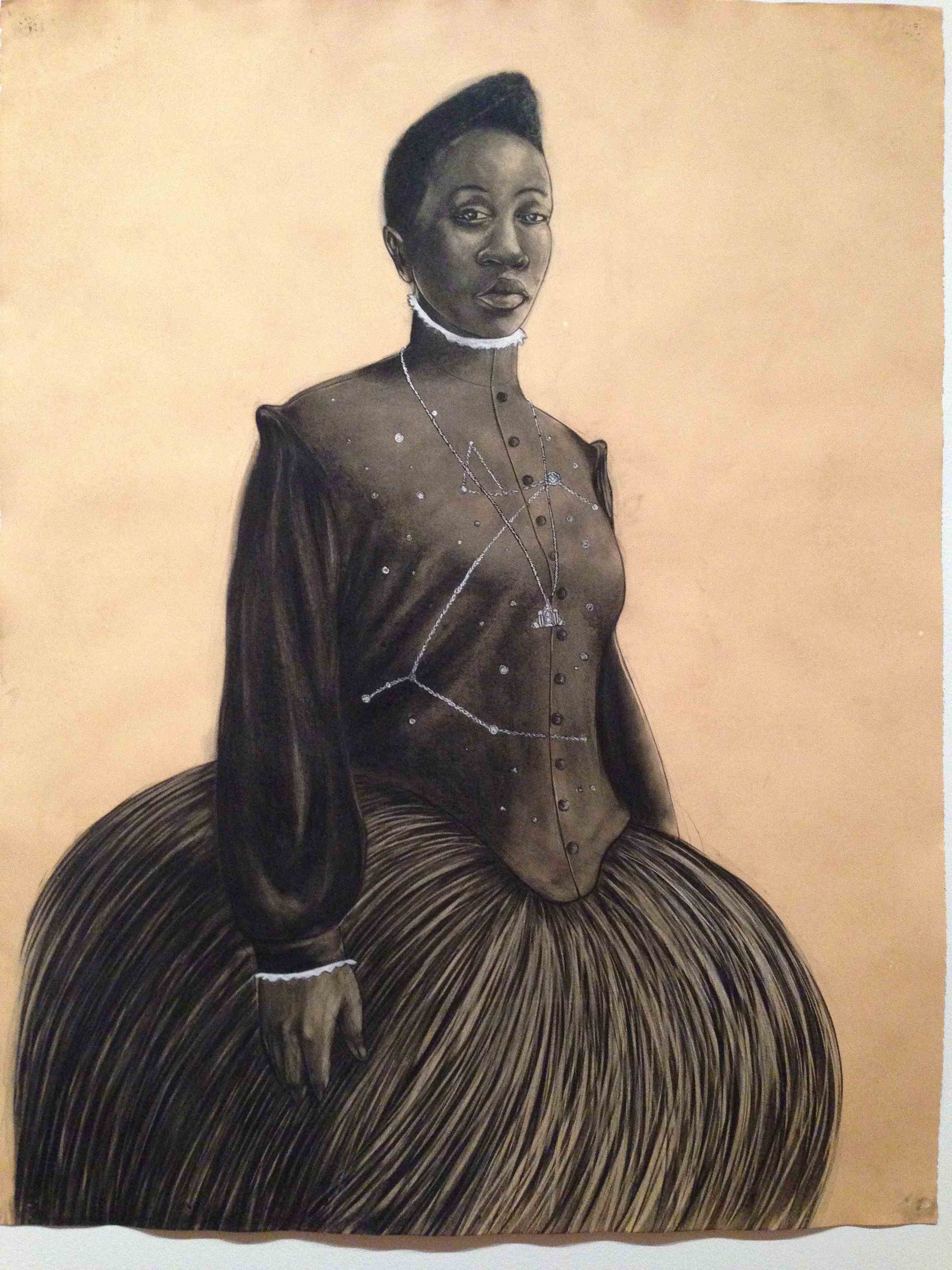
Pruitt’s 2011 Dreaming Celestial, featuring a Shuttle pendant suspended against a constellation bodice.

Pruitt’s 2011 Dreaming Celestial, featuring a Shuttle pendant suspended against a constellation bodice.

But there’s another dimension going on, too. Pruitt goes one step further by creating headpieces, outfits and accessories that tantalize art-lovers and science buffs with references to sometimes unknowable realms — art and astrophysics.

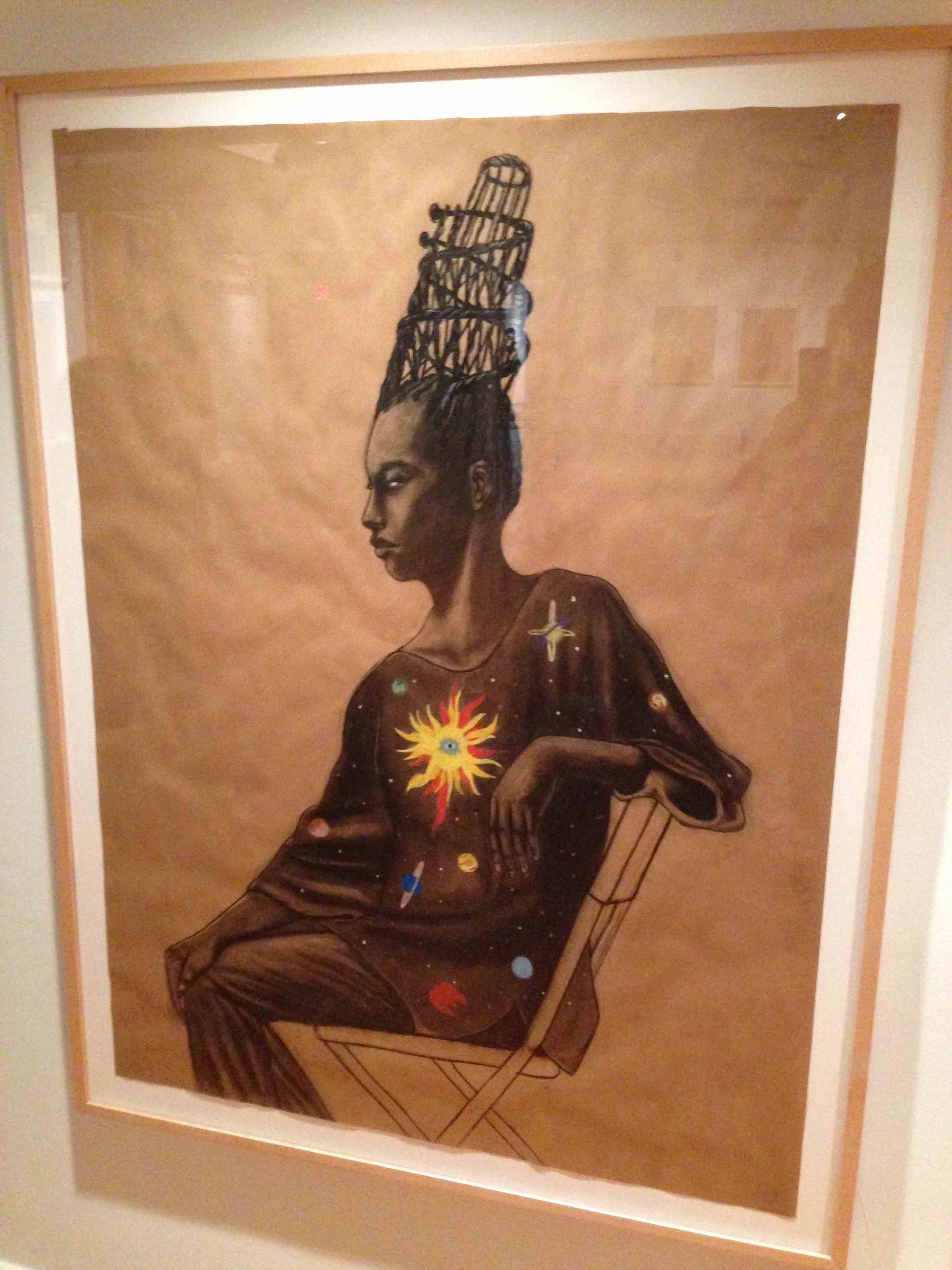
Consider the Tatlin-inspired updo coupled with the solar-system tunic in Be of Our Space World, the tiny Space Shuttle pendant and constellation bodice in Dreaming Celestial, the planetary tank top in Sun Fired, the Suprematist-inspired T in El Saturn, the space capsule chapeau and orbit diagram T sported in Diasporic Leaps and Bounds, and those choir-robe-looking outfits embellished with the tiniest of Star Trek logos for the sisters in the corner.

Yes, there are other political and pop references, but the space spin is pretty satisfying, particularly considering that Pruitt’s hometown is Houston.

Installation view of Be of Our Space World, a 2010 work featuring braids fashioned into Tatlin’s Monument to the Third International, courtesy of Houston’s Hooks-Epstein Gallery

Installation view of Be of Our Space World, a 2010 work featuring braids fashioned into Tatlin’s Monument to the Third International, courtesy of Houston’s Hooks-Epstein Gallery

Pruitt’s women are real-world and smart beyond belief — just the type of people we’d like to meet at the next SciCafe or have Dr. Neil interview at an upcoming panel at the planetarium – women whose look tells us they have some super-big insights to share.

See New York Through Hopper’s Eyes

Hopper’s easel holds his painting, Early Sunday Morning (1930) at the Whitney.

Hopper’s easel holds his painting, Early Sunday Morning (1930) at the Whitney.

If you thought you knew about Edward Hopper, think again. The Whitney’s show, Hopper Drawing, provides surprises galore from curator Carter Foster, who has presented the museum’s trove of Hopper drawings in a fresh, new context. The Whitney has more Hopper drawings (made for his private use) than any other museum in America, and about half are up on the walls. Go before October 6.

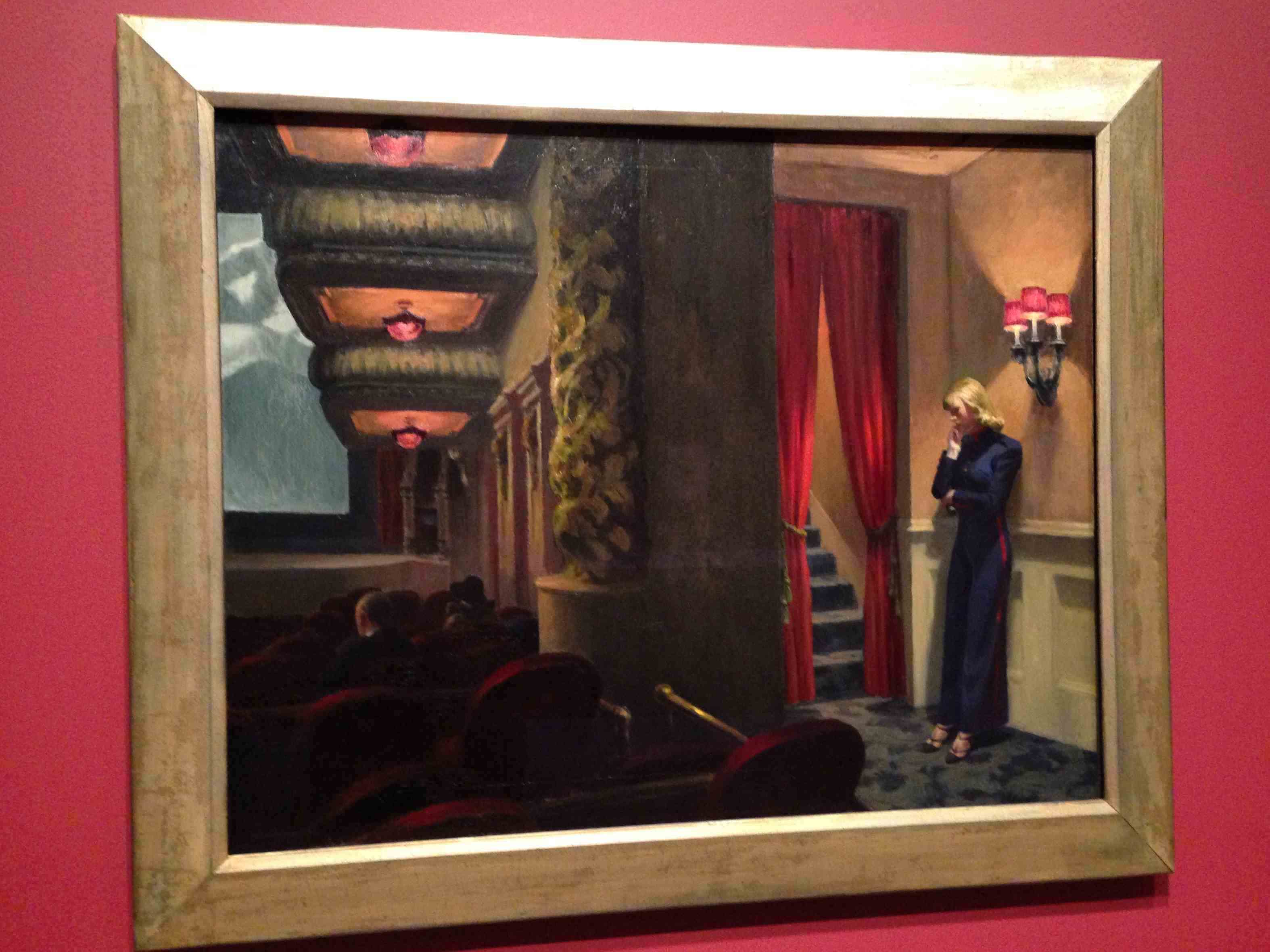
Although Hopper’s representational work is considered by his fans to signify “realism”, Foster has unearthed and organized zillions of preparatory drawings that demonstrate that this is hardly the case. Hopper, as he often said, worked “from fact” but added improvisational touches that pretty much made the canvases perfect. A case in point is New York Movie, where one side of the canvas is “real”, and the other side is completely imaginary. His sketchbook from the Palace Theater proves it.

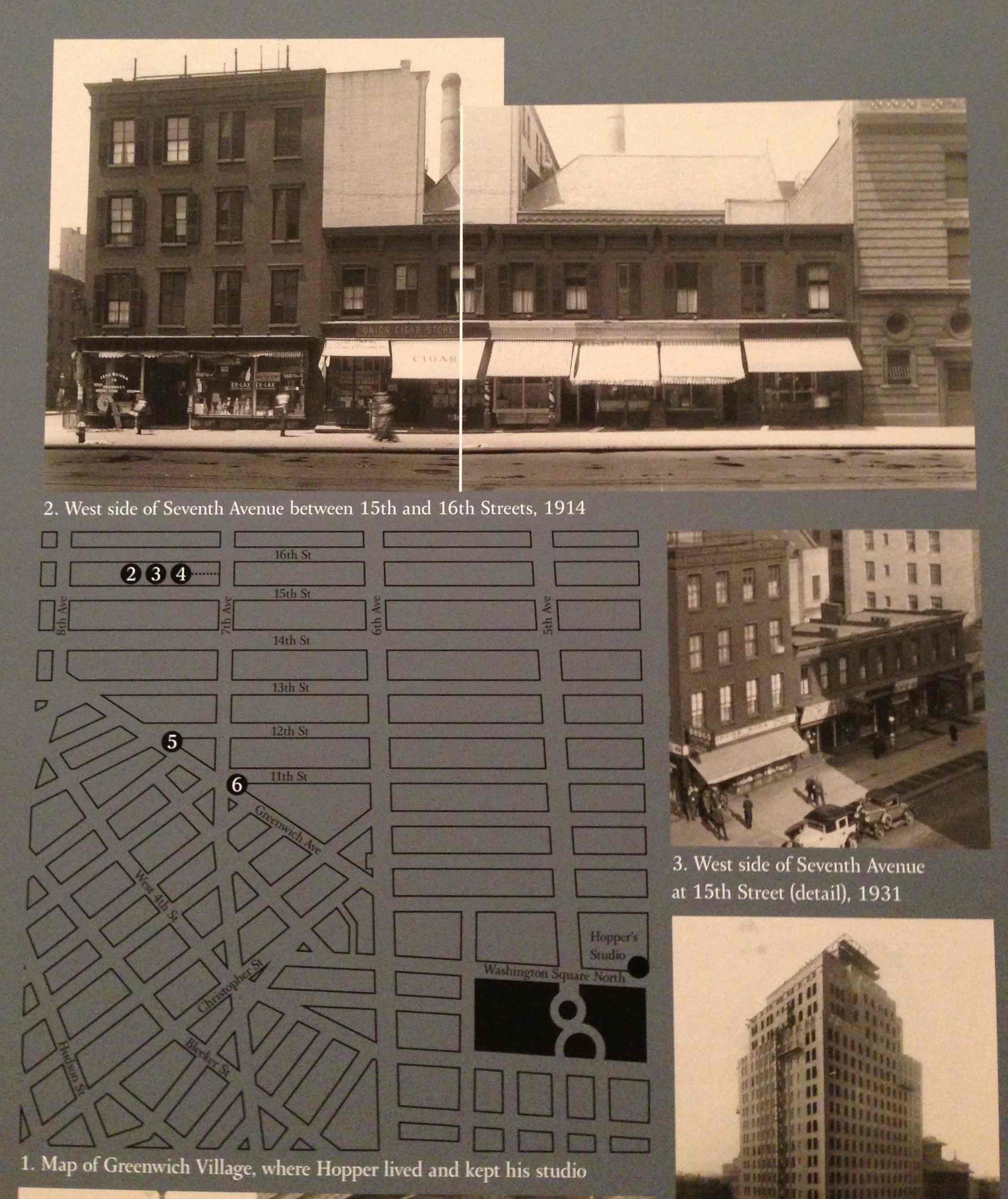
Whitney exhibition card showing map and 1914 photograph of the West Village storefronts depicted in the above oil painting

Whitney exhibition card showing map and 1914 photograph of the West Village storefronts depicted in the above oil painting

To prove this point, you’ll see the most famous Hopper paintings right alongside his preparatory sketches and sketchbooks to see his meticulous decision making process. Go to the exhibition web site (or our Flickr feed) and flip through images of Hopper’s iconic oils (such as New York Movie  and Chicago’s Nighthawks), followed by sketches and studies where Hopper worked out all the compositional kinks.

Hopper lived and worked right inside the row of gorgeous 1830s townhouses along Washington Square North. It’s a complete surprise to find that NYU still preserves Hopper’s studio intact, complete with his print press and easel.

Foster convinced NYU to loan it to the show, and it’s an electrifying reminder that artists once walked the streets of the Village and then came back to paint. You’ll stand face-to-face with the working easel that Hopper used to paint every one of his great works. Early Sunday Morning is perched, right where it sat in 1930, facing the Hopper’s other icon Nighthawks, on loan from Chicago’s Art Institute. The width of those canvases precisely matches the width of the easel.

Installation view of Hopper’s New York Movie (1939), on loan from MoMA

Installation view of Hopper’s New York Movie (1939), on loan from MoMA

So, that left a question: Where these real places, or fictions made up entirely in Hopper’s mind? Foster spent time trying to figuring it out, and thankfully the Whitney recorded the answers on its YouTube video. Take a walk with him and see the Village and the Flatiron through Hopper’s eyes back in the 1930s. You’ll never look at Nighthawks the same way again. Genius.

For theater fans: It’s not in the video, but Hopper’s sketchbooks are also filled with drawings of Times Square theaters — the Palace, the Globe (now the Lunt-Fontanne), the Republic (now the New Victory; formerly Minsky’s Burlesque),  and the Strand (where Morgan Stanley now sits).

Stylish NYC Micro-Housing Showcased at MCNY

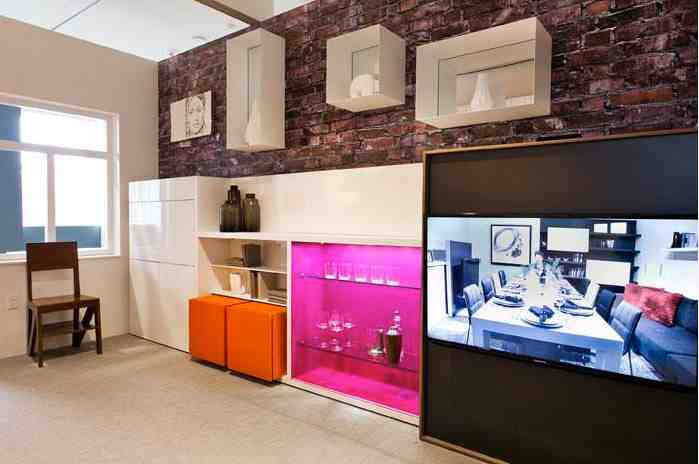
The TV wall slides away to reveal storage shelves

The 325 square-foot solution on display at MCNY: the TV wall slides away to reveal storage shelves. Source: MCNY

With all the single people living in Manhattan and the outer boroughs, it’s kind of shocking to find that building stylish, affordable micro-units is still illegal in most of the City. What’s a renter to do?

Get over to Museum of the City of New York pronto and take a look at the future in the hugely popular show, Making Room: New Models for Housing New Yorkers.

It’s no surprise that the housing stock here doesn’t match the demand. MCNY and the Citizens Housing & Planning Council got together to put on a show that raises the possibility of change, showcases several innovative solutions proposed by design teams, and presents a full-scale, walk-through model apartment: a 325 square-foot micro-space (built and furnished by Clei and Resource Furniture).

The sofa turns into a bed

The sofa turns into a bed. Source: MCNY

Apparently our City’s is due to grow by 600,000 people over the next 20 years, so the question becomes – where is everyone going to live? How can people live affordably? Is there a way to create living spaces that are flexible as families grow? Listen as CHPC’s Jerilyn Perine lays it all out in this fascinating 11-minute presentation at the 2011 kick-off to the project, focusing on housing demand, illegal rentals, and rental history in New York.

Currently, the City regulates things such as occupancy, density, minimum room size, parking areas, lot coverage, the number of dwelling units that can be on a single lot, and the proportion of living vs. working space in some parts of town. And, yes, most neighborhoods prohibit building spaces like the micro-studio at the center of the MCNY show. CHPC’s projects imagined what could be if some of those regulations (well intended) were relaxed.

Read about the background of CHPC’s Making Room project and design competition and find links to related TED talks, sites, and the proposed design solutions – stacks of prefabricated apartments, mini-bungalows for the Bronx, and repurposed industrial spaces in Brooklyn. The CHPC site shows details of each of the five featured plans.

But the star of the MCNY show is the model studio. Here’s a video of what you can experience for a few more days. (The show was held over by popular demand.) Note the transformation of the Cubista (the ottoman-looking piece of furniture that unfolds), and so many other smart small-space design choices.

Water, Water Everywhere at the Academy

Tintagel, 1881. Large, masterful watercolor depicting castle ruins on the Cornwall coast of England, which Richards associated with the legends of King Arthur.

Tintagel, 1881. Large, masterful watercolor by William Trost Richards depicting castle ruins on the Cornwall coast of England, which Richards associated with the legends of King Arthur. Who needs to mess with oil paint and build big canvases when you can do this with water and paper?

In a brilliant pairing, the National Academy Museum has mounted dual shows by artists who draw their greatest inspiration from water. There’s no need for a trip out of town to experience crashing waves, monumental waterfalls, and wide expanses of sea and sky done by one of America’s greatest watercolorists of all time and a celebrated 21st century painter.

William Trost Richards: Visions of Land and Sea features 60 works from the Academy’s collection – early graphite sketches, oil paintings, and beautiful, grand, sweeping watercolor vistas that are some of the tiniest, most meticulous works you’ll see anywhere. Some are on display for the first time, which is remarkable considering that critics believe WTR to be among the greatest American landscape painters of the 19th century.

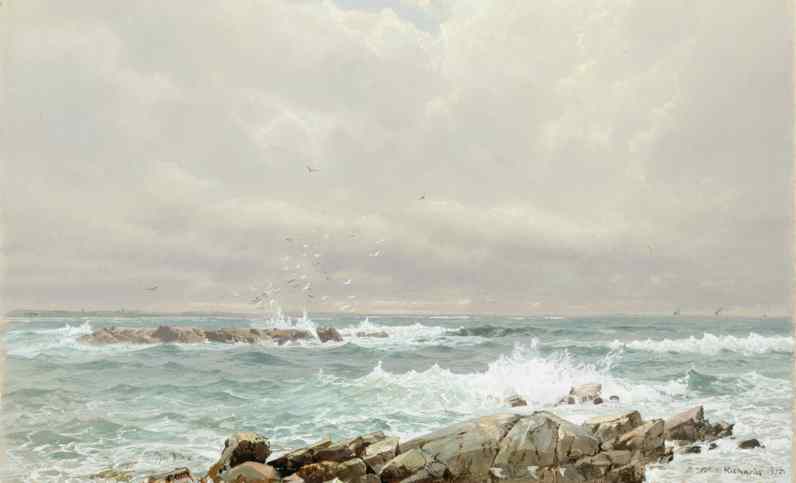
Seascape (1875), a watercolor on cream paper that’s only 9 X 14 inches. Source: National Academy

Seascape (1875), a tiny but monumental watercolor by William Trost Richards on cream paper. It’s only 9 X 14 inches. Source: National Academy

Inspired by Ruskin and the Pre-Raphaelites early in his career, WTR began documenting the intricacies of the Wissahickon River paths near Germantown, on the outskirts of Philadelphia. He soon became part of the American watercolor movement that began making works that were just as grand, romantic, and full of transcendence as anything by Church or Bierstadt. Quite a feat, when you’re working on such a tiny scale.

He spent years perfecting vistas of the ocean and sky from his home near Newport and on travels to the edges of the British Isles. Remarkably, he kept the horizon low to showcase the sky, all meticulously painted and built up from a ground of blue-gray wove paper. It’s remarkable how he evokes mood, rocks, night, dusk, and pale sky from that gray. Click here for more.

Steir’s monumental Blue River (2005) – one of her celebrated Waterfall series. Steir’s monumental Blue River (2005) – one of her celebrated Waterfall series. The video shows it’s true scale.

Steir’s monumental Blue River (2005) – one of her celebrated Waterfall series. Steir’s monumental Blue River (2005) – one of her celebrated Waterfall series. The video shows its true scale.

Pat Steir’s paintings, on the other hand, feature an opposite approach. Like Sam Francis or early post-Pop color-field painters, she pours, splatters, and drips her paint across canvases that seem a mile high and a block long. The masterwork on display at the Academy is Blue River, a virtual waterfall that’s just as mesmerizing as any of WTR’s watercolors, but done in bold, wide strokes on a larger-than-life canvas.

Go this weekend and delight in the masterful scenery. Pat herself indulges in the joy right here.

If you miss the Academy show, be sure to look for Pat’s Everlasting Waterfall hanging on the Fifth Floor of the Brooklyn Museum right next to Church.

I, YOU, WE: Art on the Front Lines of the 80s Culture Wars

Les Levine mounted his poster everywhere in the subway in 1981, a tough time in New York. Source: The Whitney © Les Levine for The Museum of Mott Art, Inc.

Les Levine mounted his poster everywhere in the subway in 1981, a tough time in New York. Source: The Whitney © Les Levine for The Museum of Mott Art, Inc.

It’s not a comfortable art show, but the 1980s weren’t comfortable times. The Whitney Museum of American Art’s show I, YOU, WE resurrects art from a time when artists were protesting inequality and gentrification, the AIDS epidemic was raging, Wigstock brought gender shifting into the open air, and New York’s downtown community waited apprehensively for the next police crackdown on squatters, community gardens, and anyone flaunting an alternative lifestyle.

As it prepares to move to the High Line in 2015, The Whitney asked its curators to mine its permanent collection to see if there were periods of time that might have been overlooked in the shows of recent years.

I, YOU, WE is the answer: the difficult, searching, and searing work produced by the passionate and disenfranchised denizens of New York’s tumultuous 1980s and early 1990s.

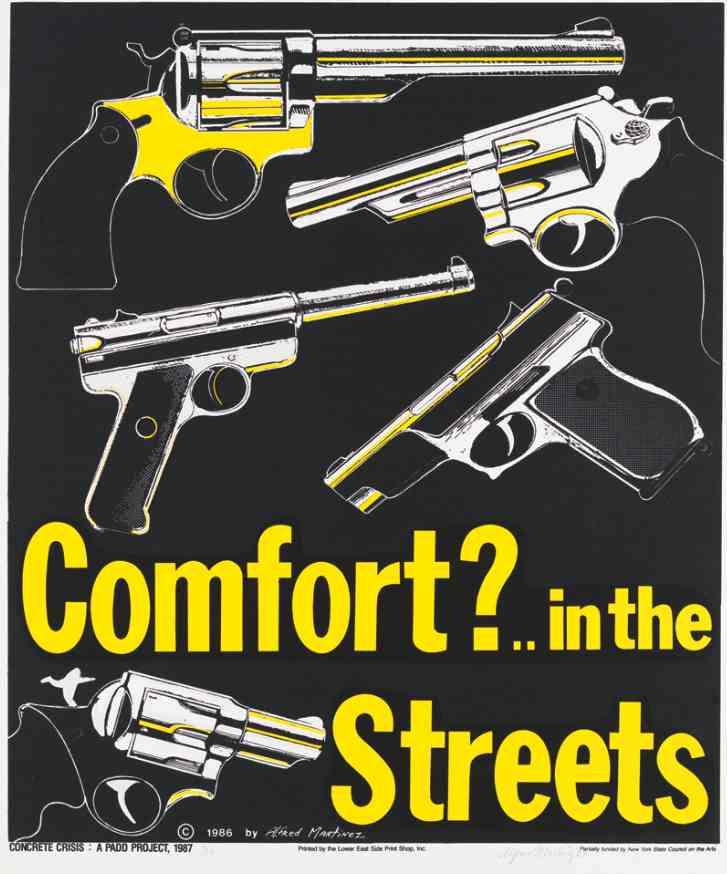
No one could miss Alfred Martinez’s 1987 screenprint. Source: The Whitney. © 1986 by Alfred Martinez

No one could miss Alfred Martinez’s 1987 screenprint. Source: The Whitney. © 1986 by Alfred Martinez

Works feature the flip side of Warhol’s Interview magazine and Studio 54 – people struggling with identities, illness, injustice, and the consequences of Washington’s culture wars against edgy art.

The Whitney produced this video about the “WE” section of the show, when artists began protesting gentrification, how they used art as the lever to galvanize the East Village, and the battles that raged for the community. Other sections of the Whitney show focus on artists’ exploration of race, gender, religion, and the AIDS crisis.

Revisit the emerging street styles – graffiti, comics-inspired drawings, stencils, and posters – as Andrew Castrucci of Bullet Space leafs through one of the seminal art-protest pieces.

When you visit, make enough time to Nan Goldin’s 700-slide extravaganza that documents everything.  Scroll down here to see installation views and  other works in the show by Mapplethorpe, Basquiat, Currin, Wojnarowicz, and Ligon. Tough stuff, but not tougher than the lives these artists lived during that decade.

Congratulations to the Whitney for not forgetting, presenting this work to the next generation, and testing if the work still sticks 20 to 30 years later. The show runs through September 1.

Brooklyn Museum Reveals Sargent’s Master Strokes

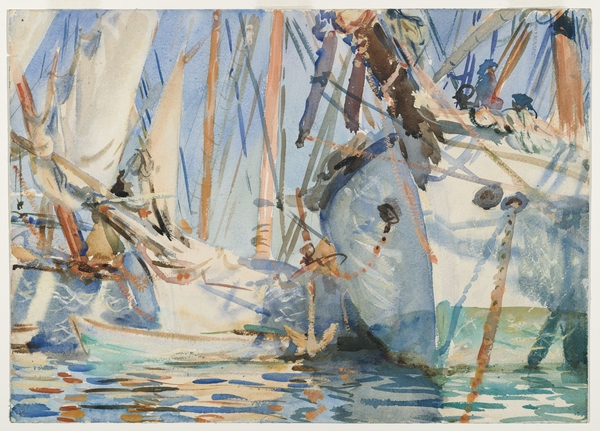
Sargent’s masterful 1908 White Ships. Translucent and opaque watercolor and wax resist with graphite underdrawing, Source: Brooklyn Museum.

Sargent’s masterful 1908 White Ships that he likely painted in a day. Translucent and opaque watercolor and wax resist with graphite underdrawing, Source: Brooklyn Museum.

Back in 1909, John Singer Sargent’s watercolor show at Knoedler was considered a knockout, drawing discerning crowds in awe of his sensational technique. The images of Bedouin life, Venice, and boats on the Mediterranean were so compelling that the Brooklyn Museum raced in to buy 83 (nearly all of them), forcing Boston’s Museum of Fine Arts to wait until 1912, when they could clean out his entire next watercolor show.

Bedouins

Bedouins (c.1905–6). Opaque and translucent watercolor, Source: Brooklyn Museum.

Walking into John Singer Sargent Watercolor on Brooklyn’s Fourth Floor, you can see why the two great institutions went crazy. With 93 of their finest Sargent purchases collectively displayed, it’s impossible for visitors to pick the most spectacular. They’re all exceptional – the Bedouin horses at rest inside the tent, Sargent’s niece wrapped in her cashmere shawl, the cliffs of the Carrara quarries, and the lush Medici gardens.

How did he make such magnificent work with such an unforgiving medium? How did he whip them out? The two museums asked a team of conservators and curators to put the works under the microscope and ultraviolet light to discern more about the master’s process – the sequence of paint application, the types of paint used, and whether he did a pencil sketch before applying paint to paper.

The team gives visitors insights to the scientific process used — an unusual twist at the back of the gallery that visitors poured through enthusiastically. Brooklyn’s digital team installed a 30-second video in which paper conservator Toni Owen asks visitors what more they’d like to know. Here’s the site where she answers with comments on Sargent’s use of gouache, soft-wax resist, yellow paints, and the difficulties of explaining false-color infrared imaging (FCIR) in limited-space wall text in the gallery.

Carrara: A Quarry (1911). Translucent and opaque watercolor and wax resist with graphite underdrawing, Photo: © 2013 Museum of Fine Arts, Boston

Carrara: A Quarry (1911). Translucent and opaque watercolor and wax resist with graphite underdrawing, Photo: © 2013 Museum of Fine Arts, Boston

You’ll learn that Mr. Sargent painted very fast, did not rely on photographs, and did at least one watercolor sitting in a gondola.

Brooklyn’s integrating much more media into its visual art shows, and they’ve hit upon a winning combination here. Some videos show the gardens that were the subjects of Sargent’s work in Italy. Others explain the techniques that Sargent used in the painting next to it.

Listen as artist Monika deVries Gohlke reflects on the type of day Mr. Sargent might have experienced working on his 1908 Melon Boat painting. Watch as she prepares the watercolors, selects his colors, chooses his brushes, and attempts to recreate his “jungle” of shapes and impressions. Does her painting look like his? You be the judge and go get your own paintbox.

Warhol, The Queen, Madonna, and The Scream

Warhol’s 1984 silkscreen, The
Scream
(After
Munch). Source: Part of the founding collection contributed
by
The
Andy
Warhol
Foundation
for
the
Visual Arts to The Andy Warhol Museum;  ©2013
AWFVA/ ARS, NY

Warhol’s 1984 silkscreen, The
Scream
(After
Munch). Source: Part of the founding collection contributed
by
The
Andy
Warhol
Foundation
for
the
Visual Arts to The Andy Warhol Museum; ©2013
AWFVA/ ARS, NY

Andy is kicking Mr. Munch’s Scream up a notch on Park Avenue, all to the delight of the Queen of Norway, in the Scandinavia House’s stellar exhibition, Munch, Warhol, and the Multiple Image through July 27.

Actually, Queen Sonja herself was one of Andy’s subjects in his Celebrity series, so it’s no wonder that she flew in to preside over Mr. Munch’s 150th birthday at a New York show where his most iconic work is appropriated and reimagined by the Master of Pop.

Andy first encountered Munch’s woodcuts in Oslo in the 1970s, and took home reproductions. So, when a now-defunct 57th Street gallery invited him to their 1982 Munch exhibition and offered him a commission to make 15 paintings and 30 silkscreens about the work, Warhol accepted.

The Scream was so iconic, Andy considered it almost a “ready made”, as ripe as any other pop culture image for his flat, unemotional, Day-Glo serial treatment. Ditto for Munch’s Madonna and Self Portrait with Skeleton Arm. He photographed reproductions of four Munch works, blew them up, traced on them, and rephotographed what he had traced. And then he turned it all over to a master silkscreen printer with suggested colors. So totally Andy.

Room full of Munch Madonna prints seen from gallery with Warhol silkscreens of same. Eileen Travell’s photo for Scandinavia House/The American-Scandinavian Foundation, 2013

Room full of Munch Madonna prints seen from gallery with Warhol silkscreens of same. Eileen Travell’s photo for Scandinavia House/The American-Scandinavian Foundation, 2013

With all the commotion earlier this year at MoMA over The Scream (like fans along the red carpet, jockeying to get their photographs taken with the world’s-most-anxious celebrity-on-a-bridge), this show deserves similar crowds. Because Warhol’s prints were never published, you’re seeing one-of-a-kind prints that are dispersed around the world and rarely on view.

The curators have also brought together (with the help of The Munch Museum in Norway) multiples created by Munch. It’s fascinating to compare the five controversial Madonna prints side by side, walk into the first Warhol gallery, turn around, and see both Munch and Warhol Madonna interpretations right in front of you. It’s a smart, immensely satisfying installation.

You’ll enjoy listening to what the Queen had to say (first 8 minutes of the video) and see photos of her younger self at The Factory with Andy and Mr. Rosenquist.

Oh, and the photo below isn’t a disco queen from Studio 54. It’s Andy’s wall-sized reinterpretation of Munch’s The Brooch, Eva Mudocci, a lithograph originally done in 1903 to celebrate the beautiful, talked-about violinist.

The last 15 minutes of the video features the curator showing the work of the two Modern masters who knew how to leverage print technology and multiples into fame, fortune, and icon status.

Matthew Barney Digs Up Morgan Treasures

Barney’s show entrance at the Morgan, as photographed by Graham S. Haber. Courtesy: Matthew Barney, Morgan Library.

Barney’s storyboard case for River of Fundament in the entrance to his show at the Morgan. Photo: Graham S. Haber. Courtesy: Matthew Barney, Morgan Library.

The brilliant, perplexing, and mysterious Matthew Barney has combed through the Morgan’s collection to curate mini-collections for the first-ever retrospective of his drawings — Subliming Vessel: The Drawings of Matthew Barney (on view through September 8).

Whether you enjoy his work or not, you can’t deny that he and his curators did a bang-up job of presenting his works-on-paper. Get over to enjoy highlights of the Morgan’s collection in an entirely new way – a mash-up of controversial contemporary work with infrequently seen gems, many collected by J.P. himself.

Barney’s
CREMASTER 4: Manx Manual (1994-95)
Graphite, lacquer, and petroleum jelly on paper framed in cast epoxy, prosthetic plastic, and Manx tartan. Source: Private collection. Courtesy: Matthew Barney, Gladstone Gallery.

Barney’s
CREMASTER 4: Manx Manual (1994-95)
Graphite, lacquer, and petroleum jelly on paper framed in cast epoxy, prosthetic plastic, and Manx tartan. Source: Private collection. Courtesy: Matthew Barney, Gladstone Gallery.

There’s real fun to be had by examining the flat waist-high cases in chronological order (clue: they are marked with the letters A to O). Your walk will take you through Barney’s storyboards for his early works, through Cremaster, and to his current project – River of Fundament, a seven-act opera combining film and live performance.

The cases contain stuff from the Morgan Library interspersed with the props, photos, drawings, and other images that inspired Barney’s extravaganzas. In order to enjoy this to the max, take a guidebook (in a stack right inside the gallery door). Even if you’re a Barney connoisseur, you’ll need the gallery guide to ID the great picks from the Library.

Case C is very satisfying to anyone who’s followed Barney’s career from his satyr-prancing videos at his first Biennials – you’ll see an 18th-century satyr drawing from Italy and the 1290 Persian blockbuster, The Benefits of Animals, opened right to the page with two crazy mountain goats. (And, yes, they’re standing in trees!).

Barney’s Ancient Evenings: Ba Libretto, 2009. Ink, graphite and gold leaf on paperback copy of Norman Mailer’s Ancient Evenings, on carved salt base, in nylon and acrylic vitrine. Courtesy: Marguerite Steed Hoffman and Matthew Barney

Barney’s Ancient Evenings: Ba Libretto, 2009. Ink, graphite and gold leaf on paperback copy of Mailer’s Ancient Evenings, on carved salt base, in nylon and acrylic vitrine. Courtesy: Marguerite Steed Hoffman and Matthew Barney

The Cremaster 2 storyboard in Case F has an Goya drawing and the original edition of one of New York’s most popular entertainments – Joseph Smith’s 1830 The Book of Mormon. (Trust me, you won’t find it without the guidebook.)

Cases K-O contain the River of Fundament storyboards, which were inspired by Norman Mailer’s book, Ancient Evenings, Egyptian reincarnation myths, and the Chrysler bankruptcy. Alongside Barney’s props and things, you’ll glimpse sky burials documented by Curtis, Whitman’s original Leaves of Grass, and a Diane Arbus portrait of Mailer.

Look at the slide show from the exhibition, but know that Barney’s drawings are best enjoyed in person. They’re tiny, detailed, and often disturbing. With many references to Egyptian deities, Renaissance drawings, and cars, each is a tiny world unto itself.

Will you ever understand what those iconic self-lubricating frames are about? It doesn’t matter. It’s just nice to dive into an alternate, mysterious universe and simply swim around in Barney’s non-linear excavation of similarly provocative illuminations and page-turners from Mr. Morgan’s stacks.