Folk Art Museum Tells 85 American Stories

Eliza Gordon, as she arrived in 1833 for her first job at a New Hampshire textile mill

When you enter the exhibition American Perspectives: Stories from the American Folk Art Museum Collection, on view at Lincoln Square through January 3, you may experience a nostalgic feeling seeing images of early Americans, spectacularly pieced quilts, and finely carved wooden relics of bygone eras.

But the purpose in bringing all of these small masterpieces together is to present the in-depth stories behind the creators and subjects, which adds a completely different, lively layer to the journey through the three galleries – tales of itinerant portrait painters, stagecoaches along America’s first turnpikes, independent women surviving husbands and adventures in the Wild West, and back-country singing masters making their own teaching tools from roots and berries.
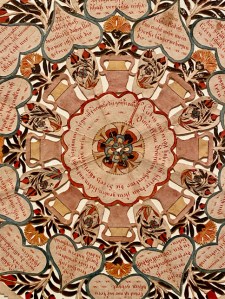
1790 love letter drawn by Christian Strenge, a former Hessian mercenary who settled in Pennsylvania

The stories make each work come alive, taking you back to the founding of America, looking at how people moved around in the Nation’s early years, made social-justice and political statements through their art, and used their artistic skills to transform their lives. 

The first section of the show has several works with early German immigrants, many of whom came to America as Hessian mercenaries fighting for the British and stayed as citizens, using their artistic skills to pen intricate love letters and embellish important documents.

Portraits come alive as you see the fresh face of a 20-year-old mill worker (Eliza Gordon) who just arrived to take on her first independent job after leaving the family farm, portraits of new arrivals from the East Coast (the Bosworth siblings) who were starting new lives in up-and-coming Illinois, or a wife (Mrs. Bentley) committed to abolition who ran a famous spa in upstate New York in the early 1800s.
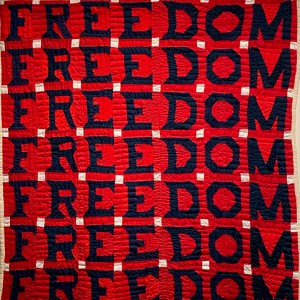
1983 Freedom quilt by Jessie B. Telfair of Parrott, Georgia

It’s not always easy to tell just from looking when works were made, and many come from the 20th century, often from a period later in the artist’s life – the drawing made by a Romanian immigrant (Ionel Talpazan) who used his art to work out his experience with a UFO as a child, the artist (Jessie B. Telfair) who made quilts in the Eighties to channel her feelings about being punished for registering to vote in Georgia in the Sixties, and a painter (Lorenzo Scott) whose portraits cast Atlanta beauties as Renaissance royalty whose style impressed him when he hung out at the Met in the years he lived in New York.
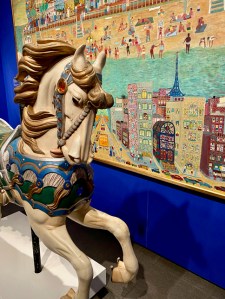
1918 Coney Island carousel horse by Charles Carmel and 1965 Workers’ Holiday by Ralph Fasanella

In the stories told about artworks involving far-away destinations, we learn that sea captain portraits were used as substitutes for husbands gone for years at a time, that many 18th-century students learned geography by copying intricate maps of exotic animal habitats, and that overhead rail was the magical mechanism that brought working-class people to the over-the-top fantasy destination of Coney Island.  

The curators point out that the grand 1888 Grover Cleveland quilt was created by a woman who was a passionate political supporter. The quilt was her way of casting a vote for her favorite candidate, even though she did not yet have the right to vote. She even used the red-bandana campaign swag as the center!

Next to this, there’s a masterful “quilt” made out of wood by New Orleans artist Jean-Marcel St. Jacques, an Afro-Creole artist living in Treme.
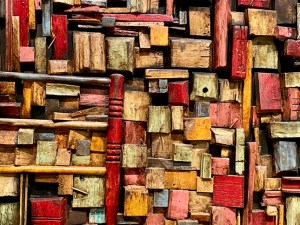
Detail of 2014 wood “quilt” by Katrina survivor Jean-Marcel St. Jacques, Mother Sister May Have Sat in That Chair When She Lived in This House Before Me

The spectacular wall-sized work is pieced together from pieces of furniture that he salvaged from his home following his neighborhood’s devastation by Hurricane Katrina. Some of it pre-dated his residency, so the assemblage contains layers and layers of local history.

The final gallery contains works by people who used art to transform their lives ­– one of the thousands of abstract drawings made each night in West Virginia by Eugene Andolsek to relieve his workplace stress, and a large tiger with a personality carved and painted by Felipe Benito Archuleta, who was out of work in the Sixties and began carving animals to sell in Santa Fe.

1977 Tigere by Felipe Benito Archuleta

His whimsical creations not only led to a wildly lucrative art career, but jump-started an entirely new direction for the New Mexico art market.

These tales are only a few of the 85 told by this exhibition.  Download all the stories here, and enjoy some of our favorite works of art in our Flickr album.

Exhibition curator Stacy C. Hollander provides a virtual tour and shares some of her favorite stories about early-American artists and 19th-century travelers in this video below.

Stacy provides lots of background on Eliza Gordon and what her work was like in the textile industry. The video also tells the incredible story of Emma Rebecca Cummins (maker of the crazy-quilt trousseau robe), who was married four times, lived in five Eastern and frontier states (also Canada!), and worked as one of the first female Western Union telegraphers out West.

Enjoy getting to know the backstories of some of the incredible artists among the 85 featured in this tribute to American working artists, activists, and visionaries:
Genius Artist Reinterprets Brooklyn’s Native American Archives

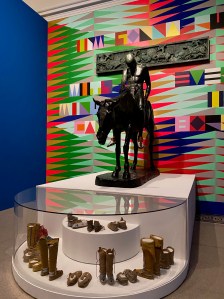
Moccasins at the feet of 1904 Dying Indian sculpture by Charles Cary Rumsey. On Gibson’s mural, a study for Rumsey’s Manhattan Bridge buffalo-hunt frieze.

The Brooklyn Museum invited a MacArthur genius to dig through its vast Native American collection and archives, use it alongside his own thought-provoking contemporary art work, and take visitors minds for a spin. The colorful, creative, memorable results are on display across three galleries in Jeffrey Gibson: When Fire Is Applied to a Stone It Cracks, on view through January 10. Take a look in our Flickr album.

Gibson, a big thinker whose heritage is Choctaw/Cherokee, does work that challenges people to think differently about Native Americans today and to question the assumptions about their “disappearance” from the national dialogue. Flying above art-world silos, he works at large and small scales, employs colleagues who are experts in beadwork and mural making, and shows art-gallery works as well as more conceptual projects.

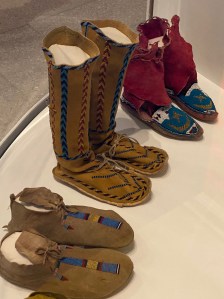
Custom 19th and early 20th-century moccasins from the Brooklyn Museum collection.

His Brooklyn show begins by presenting a monumental 1904 “Dying Indian” bronze by Victorian-era classical artist, Charles Cary Rumsey, and an array of moccasins from the museum’s collections made by unknown tribal artists in the late 19th and early 20th centuries.

To the right, there’s a giant stained-glass work that says, “Whose World Is This? It’s Yours It’s Mine.” To the left, there’s a colorful gallery packed with Gibson’s contemporary art work, and historic beaded, painted, and pieced items made by tribal artists.

Scores of museum visitors who exited Brooklyn’s Studio 54 show were captivated by Gibson’s dynamic installation, entered, and explored.

Gibson’s stained-glass Whose World Is This? It’s Yours It’s Mine. Private collection.

Below the massive statue, Gibson wants us to witness how carefully Native American makers created and customized footwear for specific practical purposes and ceremonial occasions for specific individuals. Unfortunately, the beautiful beadwork and deft, custom designs by tribal craftsmen are unattributed – a contrast to the society artist’s imposing vision of Native Americans who are sad, vanquished, and gone.

To change the statue’s narrative, Gibson asked contemporary Pawnee/Cree artist John Little Sun Murie to design moccasins for the figure atop Rumsey’s horse, so the rider is now presented as an individual member of an historic tribe – not just a generalized stereotype. Listen as Jeffrey talks about moccasins:

To drive home the point that Victorian-era artists and anthropologists incorrectly generalized and romanticized Native Americans, Gibson adds two other small bronzes and a study for Rumsey’s buffalo-hunting frieze made to embellish the entrance to the Manhattan Bridge. (Just ignore the fact that the Lenape didn’t hunt buffalo on our shores!) His beaded works say it all – “I Don’t Belong to You” and “You Don’t Belong to Me.”

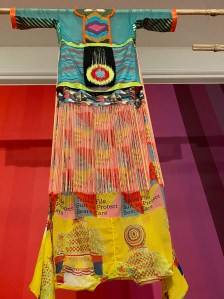
Gibson’s 2018, Tribes File Suit to Protect Bears Ears.

In the second gallery, Gibson shows his own recent creations with those bought on early 20th-century expeditions and added to Brooklyn’s ethnographic collection.

Gibson’s bright, geometric murals – which complement the museum’s vintage geometric-patterned tiled floors – provide a joyful backdrop for a brightly colored Seminole jacket, beaded hats, and other art. Gibson’s new paintings, sculptures, and patchwork garments use beads, colors, and messages on fabric – contemporary statements that hearken to the creativity and innovation of these unattributed artists. Take a look:

Ba:lawahdiwa, Zuni’s governor, and his family in 1890

The final gallery presents other artifacts and art that Gibson curated from museum’s vast Native American holdings, expedition records, and archives, and contrasts them with some of Gibson’s recent photography.

A large case displays a range of commercial, ancient, and ceremonial pots, expedition photographs, and drawings of Pueblo life made by expedition artists over 100 years ago. In one instance, Gibson reunites several photos of a Zuni family, normally stored apart from one another the museum’s archives.

Gibson relishes showing how Native American artists still thrive today and how over the centuries they have adapted their materials and creativity for both commercial art-markets and their own expressive purposes.

Gibson’s 2019 photo Regan De Loggans. Courtesy: Gibson & Sikkema Jenkins

For example, he features a photograph of a young early 20th-century Navajo weaver, creating traditional Indian” rugs for a trading post with new, more colorful materials that Mr. Hubbell supplied. Gibson also unearthed a tourist map on where to find different California tribes and buy their wares – a direct rebuke to the concept that all these people “vanished.”

Best of all, Gibson also features several gorgeous recent photographs, including tribal artist-activists.

Visit Jeffery’s studio in this video produced for the 2019 Whitney Biennial. Hear him talk about his evolution, his creative process, and his team up in Hudson:

150 Years of Splendor at The Met

Entrance with Noguchi’s 1945 Kouros and Rodin’s controversial 1876 sculpture

The Met has pulled out all the stops on its 150th birthday show, Making the Met, 1870-2020, on view at Fifth Avenue through January 3 – incredible installation, intriguing stories, and a phenomenal digital showcase. So even if you can’t come to New York to see it in person, the Met website has it all!

The exhibition tells the story of the Met over the last 150 years – from its first incarnation in a house on 14th Street to its ever-expanding footprint in Central Park – shows the incredible art that benefactors donated, and relays the stories of the men and women who made it happen.

Head of a Hindu god, Bhairava, made by 16th c. Nepalese artists 

Walking into the dramatic exhibition entrance, you’re surrounded by figures from different eras and cultures – a little girl from 5th century Greece holding two doves, a gilded mask of a Hindu god beautifully crafted by Nepalese masters of the 16th century, and Avedon’s 1957 portrait of a pensive Marilyn Monroe.

At the press opening, senior researcher associate Laura Corey explained that these were chosen to encourage visitors to think about the people behind the Met – collectors, curators, artists, restoration experts, and other staff. According to Laura, the African power figure from the Republic of Congo was one of the first artworks chosen for the welcome gallery.  He’s looking right across to Marilyn, and they are sharing a similar expression and mood.

1906 photo of The Great Hall 

At Noguchi’s Kouros sculpture, you can look left or right down a “street” lined with arches – portals that beckon you to step into different chapters of the Museum’s history. Each arch proclaims the decade and the theme. In between, there are huge slideshows from the museum’s past ­– how the Great Hall used to look, ladies in turn-of-the-century hats taking their art appreciation classes, Fifties moms and kids looking at art.

We’ve included our favorite artworks in our Flickr album, but the Met has produced a spectacular multimedia walk-through (posted on Google Arts & Culture), where you can experience all ten stories through photos, films, and links to blogs. Definitely watch the silent 1928 “Behind the Scenes” film showing museum shops, painters, gilders, and photographers at work. No surprise that the museum was into multimedia way back then!

Houdon’s 1778 bust of Franklin and reflection of Manet’s Young Lady in 1866

Through the first arch titled “The Founding” (the 1870s), you pass a huge Cypriot head (the first director was into archaeology) and the first paintings donated by the founding trustees. Houdon’s spectacular Ben Franklin gazes quietly (and slyly) at Manet’s Young Lady in 1866 – the first contemporary painting in the Met’s collection. It depicts a life-size, modern gal in her dressing gown – an image that shocked early visitors to the Met’s classical galleries! Of course, Ben looks on approvingly.

Next, you’ll see a 15th-century Turkish turban helmet and 17th-century Japanese armor. The story here is that the Met green-lighted Bashford Dean, a zoologist and world traveler working at the AMNH, to begin the arms and armor collection. Other curators began collecting works on paper, textiles, lace, wallpaper, musical instruments, and contemporary designs. In the Twenties, curators headed straight to the UK to scoop up samples from Morris & Company.

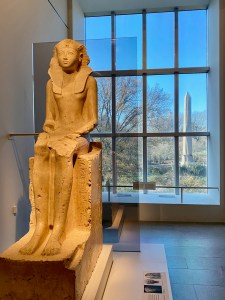
1479-1458 B.C. statue of Hatshepsut, and Cleopatra’s Needle (1450 B.C.) in Central Park

Around the corner is a tribute to the deep-pocketed donors like Morgan and B. Altman, who gave the Met lots of upscale, princely treasures ­– paintings by Vermeer and Ingres, fancy furniture, and tapestries. A treasure trove gifted by generous benefactors fills a wall – pistols for kings, cosmetic cases for Egyptians, bedazzled tablewear, and Middle Eastern glass.

Back into the main “street,” you’re right next to an imposing, reconstructed sculpture of Egypt’s female pharaoh Hatshepsut with a stunning view of Central Park’s Egyptian obelisk through the window.

These lead to the stories of how the Met collected art via excavations of archaeological sites – the Kharga Oasis (1908), Egypt (1880-1931) with Wah’s tomb stuff, Nimrud (Iraq), and along an ancient trade route (1934). The intrepid Bashford Dean enters the story again – excavating a Crusader castle, but only bringing back “dismal finds,” such as Crusader lamps, melted chain mail, and shards of stained glass, and (our favorite!) a projectile from a Crusades-era catapult (1250).

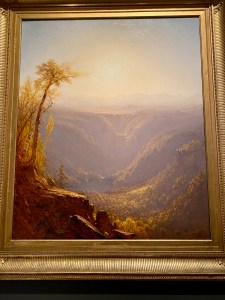
1864 A Gorge in the Mountains by Sanford Robinson Gifford

Apparently, it took a lot for a fancy museum to turn its attention from Europe to collecting art from the Western Hemisphere, but wealthy patrons had the goods. The American room features Sargent’s best-dressed “Madame X” and an enormous 1830 honeycomb quilt by Elizabeth Clarkson, the first quilt to enter the Met’s collection in 1923. There’s also a gorgeous Catskill Mountain landscape by Sanford Robinson Gifford, once owned by AMNH’s long-serving president, Mr. Jessup.

A gallery packed with work by Degas, Monet, Cassatt, Cezanne, and their Japanese masters tells the story of the Havemeyers, the Met patrons who lavished the museum with Tiffany glass (likely picked out by Mr. Tiffany himself), impressionist masters (picked out by Ms. Cassatt herself), and much more.

I Saw the Figure 5 in Gold (1928) by Demuth

At the midpoint of the exhibition, you learn that Stieglitz had a rough time trying to convince the Met to honor contemporary photography. The Met also refused Ms. Whitney’s collection in 1929. Gertrude’s response was to start her own museum, which joined MoMA (which debuted in 1929) in celebrating modernism. The Met finally did accept modern works through Georgia O’Keeffe’s 1949 gift, and proudly displays a Demuth and Kandinsky in the show.

The Monuments Men story looms large, with Met curators playing a major role in discovering and returning art looted during World War II. There’s a 1945 model of an Army helmet prototype designed by the Met’s armor expert, hand-crafted in solid aluminum.

1965 Yves Saint Laurent Mondrian dress and 1966 Balenciaga coat

The largest gallery in the show tells the story of how the Met beefed up its collections and expanded gallery space during what it calls “The Centennial Era” – Islamic art, fashion, Asian and African art, and modern art from the 20th century.

The final story about the Museum’s current focus ­– adding works by artists and from regions that are underrepresented in its collections – is represented by a large El Anatsui piece, an embellished Tibetan saddle, a wall of art guitars, a large Faith Ringgold story quilt, and other intriguing works.

The museum’s done a tremendous job online telling all the stories via its digital primer.  Click here to hear in-depth stories on the Met’s audio guide with Steve Martin, check out this video with his narration, get the backstory on every artwork in the show, and definitely visit the multimedia walk-through .

And check out this exhibition video showing how the museum’s architecture evolved to house these growing collections. In the 1880s, Olmstead and Vaux assigned a spot in Central Park for the Met. It’s interesting that one of the initial designs (which no one liked) was not scheduled for completion until 1990!! It’s a microcosm of 150 years of architecture and history.

The Man Who Revolutionized US Rock

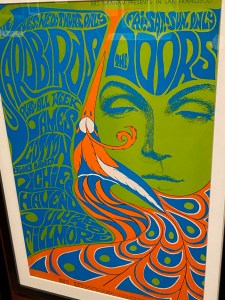
Bonnie McLean poster for Fillmore Auditorium July 1967. Courtesy: Bahr Gallery

It’s a trip back to the birth of Sixties youth culture, guitar virtuosos, the Fillmore, and multimedia extravaganzas in the New-York Historical Society exhibition, Bill Graham and the Rock & Roll Revolution, on display through January 3.

The show, originally organized by LA’s Skirball Cultural Center, tells the story of the man who created the Fillmore, catapulted legendary bands to fame, grew concert audiences to stadium size, and gave back to society by organizing once-in-a-lifetime benefit concerts televised throughout the world.

Photos, show posters, videos, rock and soul music, and even a wall from the legendary Joshua Light Show bring the story of Bill Graham to life.

Bill Graham in 1968 Fillmore Auditorium office. Gene Anthony photo in Graham collection

Graham’s life was saved by Kindertransport during World War II – a dramatic story told inside the entry to the exhibition. He was adopted and grew up in the Bronx, moved to San Francisco, and had the right skills in the right place at the right time to bring bands like Jefferson Airplane, The Grateful Dead, Hendrix, and Big Brother and the Holding Company to a larger audience.

In preparing the exhibition, the curators did original research into Graham’s early life and pulled artifacts, paraphernalia, and stories related to each decade of his concert-promotion career – leasing the Fillmore Auditorium in a largely African-American neighborhood, creating events that interspersed rock-and-roll acts with poets and new-age philosophers, securing larger venues in the Bay Area, opening the Fillmore East in 1968 in New York inside a former Yiddish vaudeville house on Second Avenue.

Joshua Light Show backs 1968 Mothers of Invention at Fillmore East. Courtesy: Joshua White

The show has plenty of the Fillmore’s promotional posters, and pays tribute to the artists who created them, such as Wes Wilson and Graham’s wife, Bonnie McLean. The curators also provide a few side-by-side displays of the original ink drawings for the psychedelic broadsides with the full-color printed versions. See some of our favorites in our Flickr album.

Despite the legendary status of the Graham’s two Fillmore stages, they only lasted until 1971. Although they were highly profitable, the writing was on the wall – the demand (particularly after Woodstock) to see the Stones, The Who, Santana, and other frenzy-inducing performers was too big to be satisfied inside the constraints of traditional theaters.

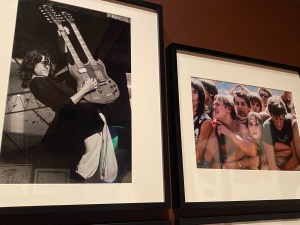
Led Zeppelin’s Jimmy Paige in 1977 and 1985 Metallica fans. Photos: Michael Zagaris and Ken Friedman

Through it all, Graham managed some stars, like Santana; created festivals featuring bands like Fleetwood Mac, Led Zeppelin, Metallica, the Eagles in the Seventies; organized Dylan’s historic 1974 tour; and produced The Last Waltz for The Band’s farewell.

The exhibition lets visitors savor these memories and moments through behind-the-scenes stories about Bill’s relationships with the artists, who often said yes to Bill’s ideas because they knew he was a perfectionist who would deliver his promises, understood what made fans happy, and always saw the epic, historic perspective behind that moment in culture.

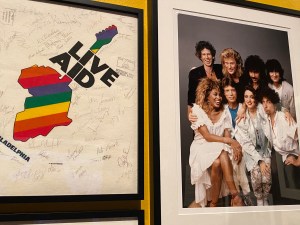
1986 Live Aid T-shirt with Ken Regan’s photo of US benefit stars. Graham and Regan collections

The exhibition puts special focus on Bill’s willingness to tackle the monumental challenges of producing nationally televised benefit concerts, such as Live Aid, and taking tours and bands to places in the world that had never seen super-sized rock events before – Moscow’s 1987 concert for peace and the 1988 five-continent tour for Amnesty International with Bruce Springsteen, Peter Gabriel, and Sting to commemorate the 40th anniversary of the Universal Declaration of Human Rights.

Watch the trailer for the show:

If you’re in NYC, go over to hear the music and see the show before it closes January 3.  If not, take this “Curator Confidential” walk through the exhibition with the people behind the Bill Graham Memorial Foundation, who talk about the life of Bill Graham and the history they lived with him – a Zoom session produced by NYHS last August while the museum was still closed.

Anarchist Revolutionizes Modern Art at MoMA

1890 pointillist portrait of Fénéon by Paul Signac

He wasn’t an artist, but MoMA has given him a show that has everything – joyous post-Impressionist canvases, Moulin Rouge posters, color wheels, African masterworks, Italian futurists, street riots, manifestos, explosions, and mug shots. 

Félix Fénéon: The Anarchist and the Avant-Garde – From Signac to Matisse and Beyond, an exhibition on view through January 2, will introduce you to a writer, critic, anarchist, and dealer living in turn-of-the-century Paris who championed Seurat, gave Matisse his start, coined the term neo-Impressionism, and went to jail for a few months after he was accused of setting off a bomb in a restaurant frequented by government big shots.

1891 painting by Paul Signac, Setting Sun, Sardine Fishing, Adagio, Opus 221

This gorgeous show was inspired by Signac’s pointillist portrait of Fénéon, which features swirling color wheels referencing their shared passion for Japanese design, pattern, and the science behind art. Books and ephemera by influential color theorists are displayed nearby, but it’s hard to keep your attention there when paintings by so many modernist masters are vying for your attention around every turn.

1894 Bonnard poster for the avant-garde journal Fénéon edited

Fénéon used his critical bullhorn to turn many artists into household names. Think Seurat and Signac, two of Fénéon’s early favorites. The first gallery is full of their beautiful seascapes and figurative work. Read the curator’s essay about the artists he promoted, and see our favorites in our Flickr album.

The curators let us know that these peaceful images and exuberant dance-hall posters were made at a time of serious social unrest and profound economic hardship for working-class Parisians by interspersing Fénéon politics-charged writings and socially conscious works by Vallottin and Pissarro.  Disruptive protests, nightlife, zines, and art all went hand-in-hand during the 1890s.

1905-1906 painting by Matisse Interior with a Young Girl (Girl Reading)

Fénéon spent several years as the editor-in-chief of a leading avant-garde journal, orchestrating contributors such as Bonnard, Toulouse-Lautrec, and Vallotton, and collecting their work along the way.  So, it came as quite a shock to everyone when the independent critic announced that he was taking a full-time job with a prestigious but conservative gallery in Paris.

Entering the second gallery of the exhibition, you see immediately how Fénéon used his notoriety and avant-garde chops to build up a contemporary art business and lure old-line clients into taking a chance on something new and modern.  He signed contracts with artists he had long championed, and gave an up-and-comer named Henri Matisse his first show in 1910.

Late 19th-c mask by a Guro artist from Cote d’Ivoire with 1920 Bonnard. Private collection; Musee d’Orsay.

It’s exciting to see a room full Matisse’s early work (including three that were in that initial show) and work by other artists that Fénéon both collected and sold, including a wall full of ethereal Seurat drawings.

Like many others in the avant-garde, Fénéon was a passionate collector of art from Africa and Oceana, and it’s thrilling to see so much of his original collection – now scattered throughout the world – reassembled inside MoMA.

Fénéon hated colonialism and railed against calling this portion of his collection “primitive art.” He lamented that the names of the artists who created such dynamic, inventive work were unknown and disliked having such evocative pieces relegated to ethnographic museums. 

19th-c cap by Tin Dama artist from Papua New Guinea (Musée du quai Branly-Jacques Chirac) and Balla’s 1910-1911 futurist work.

He hoped that one day “art from faraway places” could take its place in the art pantheon right up there with works in the Louvre.

It’s satisfying to examine dramatic, powerful sculptures and masks from Burkina Faso, Côte d’Ivoire, and Democratic Republic of the Congo against the backdrop of Modigliani, Matisse, and Italian Futurist paintings.

The worlds of ancient mythic power, modernism, and emotive color seem to be spending their time at MoMA having an active conversation – just the way Fénéon would have wanted.

Enjoy MoMA’s fast-pace introduction to this revolutionary modernist:

And now meet MoMA director Glenn Lowry and Starr Figura, curator of the exhibition, who show works from the exhibition and discuss why they mounted this show:

If you can’t get to MoMA, listen to the audio guide here, and enjoy the “colors”  playlist that MoMA designed.

Selfies for the 99%

1800 black-ink portrait of Alexander Hamilton painted by itinerant silhouettist William Bache

Before cameras or iPhones were invented, Americans yearned for a cheap, quick way to record an image of themselves.  Enter the 18th-century physiognotrace invention and masterful cutter, who could produce a likeness in just a few seconds with a flick of the scissors.

It’s the story told by the New-York Historical Society in its exhibition, In Profile: A Look at Silhouettes, on display through November 29.

Drawn from the NYHS collection, the show tells the story of how the mania for classical images (think Greek urns) morphed into a democratic art form practiced by itinerant artists, French Revolution expats, showy raconteurs, and everyday people in the early part of the 18th century.

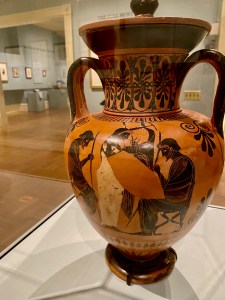
510-510 B.C. Greek amphora – a classical inspiration for 18th c. artists in a new democracy.

Silhouettes were cheaper than having your portrait painted, so nearly everyone could afford to have one.  In the beginning, 18th-century painters painted black-on-white silhouettes, but later moved toward cutting profiles into white paper and backing the cut-out with black paper. The show’s first gallery presents a who’s who of early America – Alexander Hamilton, Colonel Henry Luddington on horseback (who helped create General Washington’s “secret service”), and memorials of the General himself.

But a close read of the label copy reveals a greater surprise – the artists creating the images, including Robert Fulton (later inventor of the steamship) and Major John André, the popular party-circuit man-about-town in British-occupied New York and Philadelphia who was famously hanged as a spy by the Continentals.

1795 painted portrait by French expats Valdenuit and Saint-Mémin, pioneers in using the physiognotrace

The emphasis here is on inexpensive, everyday art for the 18th and 19th-century home. A contraption invented in France by a court musician, and brought to America by two noblemen-engineers fleeing the revolution in their home country, captivated the attention of the newly democratized land.

The physiognotrace machine illuminated the shadow of a sitter’s profile on a wall. Using a pantograph, the artist could quickly scale down the life-size image, trace it, and deftly cut four silhouettes at once from folded paper.  What a performance!

Famed portraitist, naturalist, and museum-creator Charles Wilson Peale, whose natural history museum was located on the second floor of Independence Hall in Philadelphia, just had to have it.  From 1802 on, crowds flocked to the museum, paid 25 cents admission, and created their own selfies amidst the mammoth skeleton, minerals, wax figures, Indian artifacts, and fossils on display.

1802-1815 album from the Peale Museum

Mr. Peale charged one penny for the paper, and if you wanted a professionally cut small silhouette, you paid an additional 6 cents to Moses Williams, one of Peale’s sons, or a visiting silhouette virtuoso. Museum visitors would gather to watch the show and marvel at the furiously fast likenesses. In his first year, Willliams cut about 8,000 silhouettes, providing a really decent income for the former slave.

1824 portrait by famed freehand scissors artist William James Hubard

Since four images were made at each 6-cent sitting, the Peale Museum often asked to keep one of the duplicates. A full album of these is displayed in the second gallery, with names, dates, and likenesses of what could be called America’s first selfies.

Before photography’s invention in the 1840s, silhouettes were considered the way to go for inexpensive likenesses, and several cutting virtuosos received national acclaim, commissions, and fame.

Master Hubard, a renowned child-artist prodigy, built a highly successful gallery business cutting silhouettes and painting portraits, and William Bache, who roamed from Maine to New Orleans, offering a sliding scale of options to patrons from the most basic silhouette portrait to embellished works in gilded frames.

1841 Édouart portrait of congressman Millard Fillmore, later the US president

NYHS devotes an entire gallery to the master silhouettist of all time,  Augustin Édouart, who specialized in cutting full-length silhouette portraits freehand. His artworks placed the figures into painted settings, and the most spectacular works depicted rooms in the grand salons of America, populated with up to a dozen figures, including visiting celebrities.

The illusions and details were celebrated by art critics and the public, and ranked on a par with the most skillful portrait painters of his day. Unfortunately, just as he was concluding his US tour, photography was catching the public’s eye and the mania for black-and-white likenesses began to fade.

1870 machine-cut silhouette created for tourists flocking to Saratoga Springs

The exhibition concludes with a nod to the last wave of silhouette-making in America ­– a revival of interest in European folk-art paper cutting, the introduction of inexpensive black-on-white machine-cut silhouettes for the tourist trade, and work by contemporary artists who use silhouettes.

Enjoy looking through our Flickr album to see some of our favorites, including the epic wall-sized silhouettes of the five NYC boroughs cut by Béatrice Coron.

1870 machine-cut silhouette created for tourists flocking to Saratoga Springs

NYHS is to be congratulated on this fun, revealing presentation of this forgotten art form in the context of country’s growth into a vibrant democracy – likenesses of everyday people that could be had by anyone with either a penny or 25 cents to spare.

Studio 54 Designers Turn Swimsuits into Evening Wear

Studio 54 fashion: Fiorucci blouse by Antonio, Stephen Burrows dress, and Zandra Rhodes gown. Courtesy: Pat Cleveland

The Seventies fashions in Studio 54: Night Magic, on display through November 8 at the Brooklyn Museum, slip, slide, drape, glitter, and sometimes seem like they’re not even there.

The entire point of going to the Studio 54 nightclub – assuming you could get in – was to shimmer, startle, reveal, exude fabulousness, and shine, shine, shine in the crowd and on the dance floor.

The Brooklyn Museum exhibition, a masterful curatorial achievement, pumps the music, flashes the lights, and runs the videotape while showing off the wunderkinds that made the Seventies 54 scene drip with glamour – Halston, Calvin, Kamali, and Burrows.

See our photos in our Flickr album.

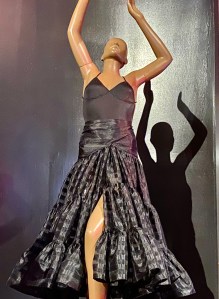
Norma Kamali’s swimsuit top and skirt made for dancing

Although Halston and others made custom gowns for clients (and there are plenty for Liza and Liz in the exhibition), the show highlights one of their other fashion innovations that the 99 percent adopted in the Seventies ­– the swimsuit. If you had a great body, fantastic hair, and dramatic make-up, you could just throw on a bathing suit, tie on a net skirt with little sparkle, and you were ready for the club!

Designers like Kamali and Sant’Angelo partnered with fabric companies to innovate body-hugging solutions, and turned out sexy bathing suits that doubled as disco-ready separates.

One of the galleries features the fun, transparent dance skirts Antonio designed for Fiorucci that he featured in the 1977 “Fiorucci Fantasy” event he staged at Rubell and Schrager’s Queens club, The Enchanted Garden, which predated Studio 54. A video shows how Antonio’s supermodels set the New York fashion and nightlife scene ablaze.

Studio 54 coverage in the Daily News, May 4, 1977. Courtesy: Ian Schrager

For all of its influence in pop culture, it’s hard to think that Studio 54 had a lifespan of only 33 months between 1977 and 1979. The exhibition explores all of facets of the phenomenon – paparazzi, the daily tabloid fodder, Grace Jones, Andy Warhol’s goings-on, disco jeans, Interview magazine, fashion shows, and product launches.

It’s surprising to think that Doris Duke, Alan Greenspan, Lillian Carter, and Bella Abzug were just as likely to be in the club as street performance artists, Bianca Jagger, and Yves Saint Laurent.

Halston’s 1979 beaded chiffon ensemble for Liza Minelli.

To transform the old Twenties theater and TV studio into Studio 54, Schrager and Rubell tapped into the technical and artistic community to figure out how flying disco poles, set changes, and special effects could be orchestrated into a continual surprise for the partygoers. When the musical Chicago closed, designer Tony Walton repurposed his dramatic neon “Roxy” sign as a centerpiece for 54’s stage.

Some of our favorite items are the opening night guest list, Ron Galella’s celebrity photos, Antonio’s costume sketches for opening-night show by the Alvin Ailey dancers, the slideshow of their rehearsal by Juan Ramos, and the giant sapphire that Elizabeth Taylor famously wore to the club in 1979 (it’s in a safe).

Original celebrity photo portraits and Richard Bernstein illustrations for Warhol’s Interview magazine covers

Congratulations to the Brooklyn Museum staff who found and presented this amazing exhibition that lets everyone into Studio 54 to celebrity-watch nearly 40 years after the door closed on the party, and to show us how its influence still reverberates today.

NYC Museum Virtual Events on Hockney, Pelton, and Design

David Hockney, Self Portrait with Red Braces, 2003. © David Hockney. Photography by Richard Schmidt. Courtesy: The Morgan

This week has a full line-up of (mostly free) programs featuring new exhibitions and topical issues from the art world and beyond. See the list of everything you can participate in on our virtual events page.

We welcome the reopening of the Morgan Library with this week’s most-talked-about exhibition on David Hockney’s portrait drawings from the National Gallery in London. This week’s virtual schedule gives you two opportunities (October 6 and 9) to take a virtual tour, but get the free tickets now since they are going fast!

This week on October 8, you’ll also get an opportunity to learn more from the Whitney about Agnes Pelton and her transcendentalist work from the curator herself, Barbara Haskell. Although the show originated in Phoenix and went to Santa Fe before its New York stop, the Whitney’s given over an entire floor to for you to enjoy the tranquility, spiritualism, and meditative power of Ms. Pelton’s works. Although Ms. Pelton participated in the historic 1913 Amory Show, she’s had zero recognition until now.

Agnes Pelton, Day, 1935. Courtesy: Phoenix Art Museum

Although the Cooper-Hewitt still hasn’t opened its doors, you’ll have an opportunity to celebrate the National Design Awards and National Design Month on line. This week features a virtual salon on October 8, but their website has a full roster of design, education, and maker events, too.

We also want to draw your attention to:

  • New-York Historical Society’s evening with Carl Bernstein and Maggie Haberman ($20 on October 8)
  • A live encore presentation from the New York Transit Museum on the cultural history of the 20th Century Limited (free on October 9)
  • October’s Sci Café from AMNH on hive minds and politics (free on October 8)

For Hamilton fans on October 8, Fraunces Tavern Museum will host an author who will dig up all the dirt between General Washington and his nemesis, General Charles Lee.

Last week, we joined ETHEL on the Met’s balcony on Friday night (a weekly digital event), and really enjoyed the digital effects that were added to a beautiful performance. We also dropped into the Brooklyn Book Fair courtesy of the Brooklyn Historical Society.

Take a look and register for as many of the topics and events that you can fit into your schedule. Most of the events are free, but it’s always nice to add a thank-you donation.

Reopening Update

Dancing dress by Giorgio di Sant’Angelo, as shown in Studio 54: Night Magic

It was great to be back at the Brooklyn Museum this week, where the community was enjoying the sunshine on the front plaza while waiting for timed ticket entry to the fantastic exhibition, Studio 54: Night Magic.  If you plan to go, budget enough time, because the time-capsule exhibition is massive.

For budget and safety reasons, only two floors of the museum are open, but that did not stop any of the art-seekers from checking out many of the special shows, study center, and permanent American gallery works. The first floor features an installation filled with amazing, inspiring photographs by a ground-breaking Parisian artist. Wow! Do not miss JR: Chronicles or Studio 54!!

Welcome back, Brooklyn!!

Amy Sillman Gets Shapes to Talk at MoMA

1957 Arp sculpture and view of works by Leger, Frankenthaler and Bonticou

A big, red blob on the fifth floor at MoMA is the welcome sign to one of the most engaging exhibitions in New York ­– the come-hither array of modern artworks in the latest Artist’s Choice show, Amy Sillman: The Shape of Shape, on display through October 4.

But here’s the catch for MoMA visitors – the show has more than 75 works but no labels, no identification, no dates. Just the clue that Amy chose works to explore the role of “shape” in modern art. Small artworks are arranged knee-level on risers (kind of like stadium seating), with larger paintings tilted against the wall.  A few are hung in the traditional way, but it feels as if MoMa’s collection is looking at you and hankering for a conversation. Check it out in our Flickr album.

Rectilinear frame conversation between 1989 Albert Oehlen painting and 1935 “Construction” by Gertrude Green

In our first visit back to the re-opened MoMA, visitors circulated through the room, looking intensively, talking about what they saw, and discussing how pieces might be connected. Although the gallery guide was available via QR code, no one during our visit appeared to seek it out. Everyone seemed quite content to parachute into 110 years of modern visuals and just go for the ride.

What did Amy choose? Abstracted forms, organic shapes, human bodies, and not-bodies – all arranged in a way that makes you feel that one is somehow related to its neighbor. You can’t quite describe why the entire room felt like a tight ensemble, even though one piece might feel like fun and the next a little scary.

It was interesting how unsettled visitors felt by 1970s works by Christina Ramburg and Julian Schnabel. This is exactly what Amy was going for, according to what we overheard her tell students in the gallery yesterday. She wanted to evoke the anxious feelings that most artists experience as they paint, draw, and sculpt and to reflect the times today without being didactic.

Along the east wall – 2008 acrylic by Charline von Heyl, 1920 Arp sculpture, and 1976 drawing by Jay DeFeo

Amy came of age during the Seventies when museums and intellectuals had given abstract expressionism its “heroic” status and crowned minimalists and conceptual artists as successors in the march of modernism. For this Artist’s Choice exhibition, Amy examined MoMA’s vast archive from a different perspective, looking at famous and not-so-famous creators whose work evoked myths, an interest in shadows, tension, anxiety, bodies, and whimsey.

Shadowy Black figures in a dark painting by Zimbabwean artist Thomas Mukarobgwa are echoed by a shadowy figure in a work by Leger. The tiny 1920 stacked Arp sculpture seems to be playing a “Mini-Me” role next to the large, layered 2008 Charline von Heyl acrylic.

Shadows also play key roles in a Lois Lane painting paired with a Kirschner wooduct. See for yourself and make a connection. Download Amy’s zine here to learn more about the works she chose and how she installed them. (She designed it during the quarantine months when the show was shut down.)

Here’s a short overview of the show hosted by MoMA painting/sculpture curator Michelle Kuo:

But you should really dig into the in-depth conversation (with over 10,000 views!) between Amy and Michelle, if you’ve ever been to art school or painted. They talk about art making, art history, Amy’s inspiration from Munch’s little-known litho of a woman hugging a bear, and the way she chose lesser-known works that could have a conversation with you in 2020:

More on MoMA’s reopening
MoMA on 53rd Street is open every day with timed ticketing, and now that the free-ticket offer has concluded, it seems easy to find a time to visit. The Queens outpost at P.S.1 is open until 8:00pm Thursday through Sunday, and is currently showing the acclaimed (and long-anticipated exhibition) Marking Time: Art in the Age of Mass Incarceration through April 4.

Building a Retail Empire on Wearable Art

Vera’s 1950 silk “Fish Scroll” scarf, featured on the cover Harper’s

So many of the great female entrepreneurial success stories begin at the kitchen table, and the story currently being told by the Museum of Arts and Design (MAD) in Vera Paints a Scarf: The Art and Design of Vera Neumann, on view through January 26, is no exception.

Fashionistas today may be too young to remember when the American height of chic was to sport a scarf by Vera. Back in the Sixties and Seventies, Vera pretty much had a lock on the retail market for bold, colorful silk scarves through major department-store behemoths.

The exhibition is a tribute to a woman who took her love of painting, travel, nature, and culture to the wardrobe and accessory drawers of all fashionable American households, and ended up partnering with many top manufacturers to push her aesthetic and flare into mid-century modern homes.

Vera’s silk scarves, based upon watercolors, hung as art at MAD

Although her name is not well known by young people today, MAD’s exhibition is a fitting tribute to a woman who virtually invented the concept of “lifestyle” brand. It’s hard to believe that an aspiring artist born in Connecticut in 1907 would grow up and develop her company to pack such a punch in retail.

A graduate of Cooper Union and Traphagen in the 1920s, during the Depression, Vera and her husband set up a silkscreen on their little Manhattan kitchen table and began printing her paintings on surplus parachute silk. Within a few years, her beautiful silks were being retailed at B. Altman, Lord & Taylor, and other nice shops in the city. Her joyous prints were a success!

Vera’s 1960-1965 silk blouses with paintings of blue poppies and woodland images

Building her business through the war years, Vera took her first foray into fashion in the 1950s, creating tops and blouses that she came to market as “wearable art.” Rather than simply printing yards of repeating patterns, she went a step further – engineering prints in panels, so when pattern cutters and sewers assembled her shirts, her beautiful patters would strategically appear in the final product, enhancing cuffs, collars, edges, and hems.

Of course, everything was priced for the widest possible market, so a woman seeking a bit of fashion flair could buy a Vera without blowing her budget. She followed the art-plus-commerce philosophy – a Bauhaus innovation – and maximized accessibility of mid-century modern design by expanding into home textiles, tabletop accessories, and dishes.

1979 “The Birches” china dining set for Mikasa with matching tablecloth

As her business grew, Vera came to rely upon the next generation (Perry Ellis got his start with her) to keep the design development chugging along while she traveled to Asia and other parts of the world to feed the constant demand for new inspiration for her collections.

MAD has assembled a beautiful, loving exhibition of Vera’s output, showing how her original watercolor work made its way into her commercial ventures – scarves, clothes, and home décor. Perhaps most remarkable is that this powerhouse kept traveling, painting, and channeling joy into her textiles well into her eighties – an inspirational lesson in love of life, art, craft, and culture.

1971 “Northwest Coast” silk scarf

Thank you, Vera! Long may your prints wave!

And thank you to MAD for sharing Vera’s lifetime of creations and inspiring story!

See more photos of this wonderful exhibition in our Flickr album.