Coqui is fun to make and delicious! Try it Tuesday with El Museo del Barrio
New York City museums are pulling out the stops on their pre-Christmas on-line offerings with craft workshops, food tastings, and pub history. Find the daily listings for everything on our virtual events page.
El Museo del Barrio hosts several bilingual events this week as part of the new series, El Barrio en Tu Casa, including a cooking class (direct from Puerto Rico!) with Chopped Chef Santana Benitez (6pm today Dec. 14) and a coquito-making workshop and social with Jonathan Rivera (Thursday, Dec. 17).
Join the Noguchi and Buckminster Fuller event on Monday
Why not mix food, architecture, and design? At 7:30pm today, the Noguchi Museum will host a session on the “Dymaxion Dining” cookbook that honors Buckminster Fuller, talk about baking Geodesicandy, and show how to make Cheese Tetrahedrons. Bring your own knife, block of cheese, ruler, and cutting board!
MetLiveArts presents the beautiful Monteverdi Vespers of 1610 with the Handel and Haydn Society at 7pm on Tuesday (December 15), and follows up with its regularly scheduled Friday concert with ETHEL (virtual music on the balcony).
Kepler-1652 b, a super-Earth exoplanet [JPL-Caltech/T. Pyle/NASA]
On Wednesday (December 16) at noon, you can join the cool kids at the Hayden Planetarium in “Hot Takes on Cool Worlds” to find out the latest on exoplanets (4,000 and counting!). The program will feature planetary atmosphere expert Laura Kreidberg of Heidelberg’s Max Planck Institute for Astronomy (MPIA), who will discuss whether planets (like Kepler-1652 b) are habitable and explain approaches to future research.
Later that day at 8pm, you can join the Museum of Food & Drink and WNYC’s The Green Space for a super-fun holiday-themed Filipinx cooking demonstration, conversation, and a little Karaoke (a revered Filipino holiday tradition) – all part of MOFAD’s Food for Thought speaker series.
Serving it up at Charlie’s Tavern, New York in 1946
You can close out the week with a Friday night virtual holiday pub crawl with pub buffs from the New-York Historical Society. They’ll send you a list of libation recipes spanning New York’s 400-year history, and spin you off into hang-outs to discuss, compare, and tell tales of favorite bars.
Many more programs are on the schedule, so register for as many of the topics and events that you can fit into your schedule. Most of the events are free, but it’s always nice to add a thank-you donation.
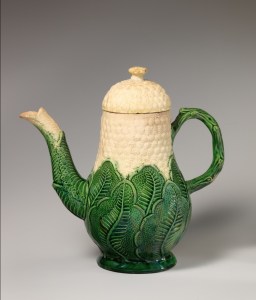
Everyone loves chocolate. Here, a Staffordshire chocolate pot (1755-1770). Collection: The Met
Ramp up for the holidays by joining in some special (and delicious) virtual events hosted this week by New York City museums. Find the daily listings for everything on our virtual events page.
Tomorrow (December 8) at 6:30pm, come to a tavern tasting with chocolate! Join the program by Keeler Tavern Museum in Ridgefield, Connecticut (co-hosted by Fraunces Tavern Museum), who will explain the history of chocolate in the colonies (and beyond!) and share a recipe you can make and sip during the program. Be sure to sign up a day ahead of time.
Illustration of 19th c. holiday food to be discussed at Merchant’s House Museum
On Wednesday (December 9) at 6pm, travel back to 1843 with the Merchant’s House Museum to see how holiday food cited in A Christmas Carol was adapted to 19th century American kitchens. In “From the Kratchit’s Kitchen,” you’ll not only meet a food historian but hear selected readings by Mr. Dickens himself!!
Poster House virtual event held inspired by The Swiss Grid exhibition
At 7pm, take a winter break with the crew at Poster House, featuring a scintillating blend of mixology and posters! In honor of the exhibition, The Swiss Grid, you’ll be whisked away to fabulous Alpine ski chalets (via posters), while you learn how to create four great cocktails. Everything you need to mix cocktails is posted on the event page.
Also at 7pm – the Museum of Food & Drink hosts “A Sweet Mexican Hanukkah” with chef Fany Gerson (the artist behind Fan-Fan Doughnuts), who will share the culinary connections between her Mexican and Eastern European heritage, and show how to make strawberry jelly doughnuts.
1930s Macy’s Christmas truck toy at NYHS
Are you wishing you could visit New York for the holidays to see the decorations? At 8pm (December 9) sign up with the New-York Historical Society and let the Bowery Boys lead you on a virtual tour to explore how people celebrated the holidays in old New York at all the familiar places – department store windows, ice rinks, and Times Square.
If you want to participate in virtual events on a more serious note:
Today (December 7) at 5pm, the New-York Historical Society is hosting a discussion on how revising “American history” while the American revolution was happening affected the course of events.
Climate change wall at AMNH, which hosts a panel on the Paris accord on Wednesday
At noon on Wednesday (December 9), the American Museum of Natural History hosts an international powerhouse panel on climate change, climate goals, and the Paris agreement. Don’t miss this global discussion with Mary Robinson, the former president of Ireland, and performance by music icon-activist Patti Smith.
Many more programs are on the schedule, so register for as many of the topics and events that you can fit into your schedule.
Most of the events are free, but it’s always nice to add a thank-you donation.
1928 Demuth painting, I Saw the Figure 5 in Gold, part of the Alfred Stieglitz Collection at The Met – which resisted modernism for a long time
Museum Updates
This week online, we went to the premiere of the film that portrays Washington’s farewell at Fraunces Tavern, and got to meet the director and from three amazing Revolutionary actors who portrayed Washington, Knox, and Tallmadge.
We also attended the Tenement Museum’s program discussing the lives of an Irish family living on the Lower East Side in the 1860s, the Met’s Making the Met discussion on 1929 and modernism (now on YouTube), and a special members-only event on the Rubin’ Museum’s new online digital collection of Himalayan art. Check it all out.
For months, people have noticed that days get blurred, months speed by, and time feels warped. Why is this happening? The answer is on the walls of the International Center of Photography in a must-see exhibition, #ICPConcerned: Global Images for Global Crisis, on view through December 31.
You’ll see images contributed from 70 countries between March and October 2020. ICP simply reached out to its network in March and April (when the museum had to close) to request images via the hashtag that showed was happening in their part of the world.
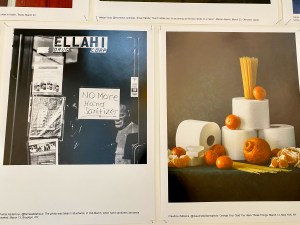
March images by Brooklyn’s Farras Abdelnour and NYC’s Claudine Williams
By April, 10,000 images had been submitted to ICP, mostly dealing with pandemic response, adjustments to routines, the need to quarantine, and at-home isolation pods. By May, the number of submissions had doubled.
But in the coming months, social-justice protests filled the streets, hurricanes swept shores, wildfires turned night skies orange, Beirut exploded, the pandemic kept grinding on, and the photos just kept flowing to the inbox at 79 Essex and onto the Instagram page.
Artists contributed thousands of photographs illustrating the ways COVID has changed life around the world, and images of hospital workers, families cocooning at home, and life in the public space. The exhibition is an affirmation how artists sustain creativity in troubled times and during protest.
Listen to David Campany, managing director of ICP’s programs, explain:
If you visit the museum in person at 79 Essex, you’ll experience why you’ve been feeling a little time-disoriented. As you walk through the months, you’ll be amazed to see how many disruptive or charming events everyone has been experiencing on an extremely compressed time scale.
April images from Karen Epstein (Kingston, NY), Morfi Jiménez Mercado (Lima, Peru), René Treece Roberts (Ashville, NC), and Lisa Sorgini (Australia)
It’s enormously satisfying to look through the #ICPConcerned images on ICP’s website and Instagram feed, but visiting the exhibit in person is the only way to experience fully the time-compression effect – walking, seeing, reading, reflecting, letting your eyes scan floor to ceiling, noting the places and dates. By the time you hit August and September, you’ll wonder, “Did all of that really happen since May?”
See the ICP installation of 1,000 contributed photos in our Flickr album.
#ICPConcerned has such a simple installation, but walking through it has a powerful effect. The only other museum installation that offers this much temporal disassociation is the Met’s About Time, but that’s done with a giant pendulum, hall of mirrors, a Phil Glass score, and intonations by renowned actresses.
It’s quite a credit to the ICP and the thousands of sharing photographers that they’re able show the weight (and whimsey) of the world as we’re living it in such spectacular form with just a hashtag, a free-spirited community deep-dive, and a push-pin budget.
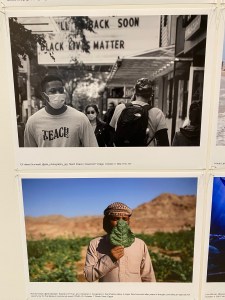
In October – Teach Peace | Greenwich Village by Eli Haies-Grunwald and Keepers of the Land by Rehab Eldalil of South Sinai, Egypt
See all the captions and images on the exhibition website. Have fun looking at the submissions by country here.
Many photographers contributed stories about their images and experiences. See and hear them here.
Want to be part of it all? Share your own images on Instagram with the tag #ICPConcerned
Entrance with Noguchi’s 1945 Kouros and Rodin’s controversial 1876 sculpture
The Met has pulled out all the stops on its 150th birthday show, Making the Met, 1870-2020, on view at Fifth Avenue through January 3 – incredible installation, intriguing stories, and a phenomenal digital showcase. So even if you can’t come to New York to see it in person, the Met website has it all!
The exhibition tells the story of the Met over the last 150 years – from its first incarnation in a house on 14th Street to its ever-expanding footprint in Central Park – shows the incredible art that benefactors donated, and relays the stories of the men and women who made it happen.
Head of a Hindu god, Bhairava, made by 16th c. Nepalese artists
Walking into the dramatic exhibition entrance, you’re surrounded by figures from different eras and cultures – a little girl from 5th century Greece holding two doves, a gilded mask of a Hindu god beautifully crafted by Nepalese masters of the 16th century, and Avedon’s 1957 portrait of a pensive Marilyn Monroe.
At the press opening, senior researcher associate Laura Corey explained that these were chosen to encourage visitors to think about the people behind the Met – collectors, curators, artists, restoration experts, and other staff. According to Laura, the African power figure from the Republic of Congo was one of the first artworks chosen for the welcome gallery. He’s looking right across to Marilyn, and they are sharing a similar expression and mood.
1906 photo of The Great Hall
At Noguchi’s Kouros sculpture, you can look left or right down a “street” lined with arches – portals that beckon you to step into different chapters of the Museum’s history. Each arch proclaims the decade and the theme. In between, there are huge slideshows from the museum’s past – how the Great Hall used to look, ladies in turn-of-the-century hats taking their art appreciation classes, Fifties moms and kids looking at art.
We’ve included our favorite artworks in our Flickr album, but the Met has produced a spectacular multimedia walk-through (posted on Google Arts & Culture), where you can experience all ten stories through photos, films, and links to blogs. Definitely watch the silent 1928 “Behind the Scenes” film showing museum shops, painters, gilders, and photographers at work. No surprise that the museum was into multimedia way back then!
Houdon’s 1778 bust of Franklin and reflection of Manet’s Young Lady in 1866
Through the first arch titled “The Founding” (the 1870s), you pass a huge Cypriot head (the first director was into archaeology) and the first paintings donated by the founding trustees. Houdon’s spectacular Ben Franklin gazes quietly (and slyly) at Manet’s Young Lady in 1866 – the first contemporary painting in the Met’s collection. It depicts a life-size, modern gal in her dressing gown – an image that shocked early visitors to the Met’s classical galleries! Of course, Ben looks on approvingly.
Next, you’ll see a 15th-century Turkish turban helmet and 17th-century Japanese armor. The story here is that the Met green-lighted Bashford Dean, a zoologist and world traveler working at the AMNH, to begin the arms and armor collection. Other curators began collecting works on paper, textiles, lace, wallpaper, musical instruments, and contemporary designs. In the Twenties, curators headed straight to the UK to scoop up samples from Morris & Company.
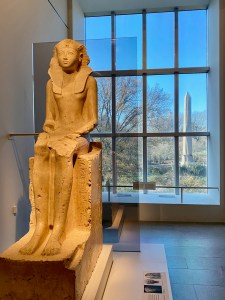
1479-1458 B.C. statue of Hatshepsut, and Cleopatra’s Needle (1450 B.C.) in Central Park
Around the corner is a tribute to the deep-pocketed donors like Morgan and B. Altman, who gave the Met lots of upscale, princely treasures – paintings by Vermeer and Ingres, fancy furniture, and tapestries. A treasure trove gifted by generous benefactors fills a wall – pistols for kings, cosmetic cases for Egyptians, bedazzled tablewear, and Middle Eastern glass.
Back into the main “street,” you’re right next to an imposing, reconstructed sculpture of Egypt’s female pharaoh Hatshepsut with a stunning view of Central Park’s Egyptian obelisk through the window.
These lead to the stories of how the Met collected art via excavations of archaeological sites – the Kharga Oasis (1908), Egypt (1880-1931) with Wah’s tomb stuff, Nimrud (Iraq), and along an ancient trade route (1934). The intrepid Bashford Dean enters the story again – excavating a Crusader castle, but only bringing back “dismal finds,” such as Crusader lamps, melted chain mail, and shards of stained glass, and (our favorite!) a projectile from a Crusades-era catapult (1250).
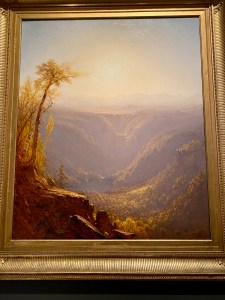
1864 A Gorge in the Mountains by Sanford Robinson Gifford
Apparently, it took a lot for a fancy museum to turn its attention from Europe to collecting art from the Western Hemisphere, but wealthy patrons had the goods. The American room features Sargent’s best-dressed “Madame X” and an enormous 1830 honeycomb quilt by Elizabeth Clarkson, the first quilt to enter the Met’s collection in 1923. There’s also a gorgeous Catskill Mountain landscape by Sanford Robinson Gifford, once owned by AMNH’s long-serving president, Mr. Jessup.
A gallery packed with work by Degas, Monet, Cassatt, Cezanne, and their Japanese masters tells the story of the Havemeyers, the Met patrons who lavished the museum with Tiffany glass (likely picked out by Mr. Tiffany himself), impressionist masters (picked out by Ms. Cassatt herself), and much more.
I Saw the Figure 5 in Gold (1928) by Demuth
At the midpoint of the exhibition, you learn that Stieglitz had a rough time trying to convince the Met to honor contemporary photography. The Met also refused Ms. Whitney’s collection in 1929. Gertrude’s response was to start her own museum, which joined MoMA (which debuted in 1929) in celebrating modernism. The Met finally did accept modern works through Georgia O’Keeffe’s 1949 gift, and proudly displays a Demuth and Kandinsky in the show.
The Monuments Men story looms large, with Met curators playing a major role in discovering and returning art looted during World War II. There’s a 1945 model of an Army helmet prototype designed by the Met’s armor expert, hand-crafted in solid aluminum.
1965 Yves Saint Laurent Mondrian dress and 1966 Balenciaga coat
The largest gallery in the show tells the story of how the Met beefed up its collections and expanded gallery space during what it calls “The Centennial Era” – Islamic art, fashion, Asian and African art, and modern art from the 20th century.
The final story about the Museum’s current focus – adding works by artists and from regions that are underrepresented in its collections – is represented by a large El Anatsui piece, an embellished Tibetan saddle, a wall of art guitars, a large Faith Ringgold story quilt, and other intriguing works.
The museum’s done a tremendous job online telling all the stories via its digital primer. Click here to hear in-depth stories on the Met’s audio guide with Steve Martin, check out this video with his narration, get the backstory on every artwork in the show, and definitely visit the multimedia walk-through .
And check out this exhibition video showing how the museum’s architecture evolved to house these growing collections. In the 1880s, Olmstead and Vaux assigned a spot in Central Park for the Met. It’s interesting that one of the initial designs (which no one liked) was not scheduled for completion until 1990!! It’s a microcosm of 150 years of architecture and history.
If you can’t do an in-person trip to your favorite museums just yet, why not walk some terrific exhibitions with curators at the Guggenheim, Merchant’s House, Poster House, the Morgan Library, and the Whitney. The links to this program and other museum events are on our virtual events page here.
Chen Zhen’s 1999 Precipitous Parturition installed inside the Guggenheim in 2017
Some of the highlights we think you’ll enjoy:
Today (November 30) at 5:00pm, visit the Guggenheim for a conversation about art, exhibitions, and installations in the iconic building. The Zoom session will feature works by Hilma af Klint, Felix Gonzales-Torres, and Pipilotti Rist to get the discussion rolling.
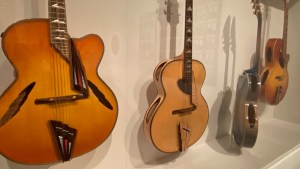
Hear jazz on The Four Seasons guitars by John Monteleone December 1 at the Met
Tomorrow (December 1) at 7:00pm, you will not want to miss the guitar quartet concert from the Metropolitan Museum’s MetLiveArts. It’s going to feature four acclaimed jazz guitarists playing the spectacular “Four Seasons” set of guitars made by master luthier John Monteleone, which are currently featured in the finale gallery of the Met’s 150th anniversary spectacular, Making the Met, 1870-2020.
Learn about 19th century lighting inside the Merchant’s House Museum on December 2
Of, if you haven’t had enough of feasting, join the Tenement Museum at the same time to hear from Leah Koenig about making holiday treats and her book Little Book of Jewish Sweets.
On Wednesday (December 2) at 6:00pm, take a trip back to the past with Merchant’s House Museum to experience 19th-century domestic lighting and talk about how home lighting has changed in the last 100 years.
Artists Kay WalkingStick and Jaune Quick-to-See Smith discuss contemporary art at NMAI on December 3
Thursday (December 3) events include:
A 6:00pm discussion of contemporary art at the Museum of the American Indian with Kay WalkingStick and Jaune Quick-to-See Smith.
At 6:30pm, an evening at Poster House that provides an insider’s look at collecting Swiss posters.
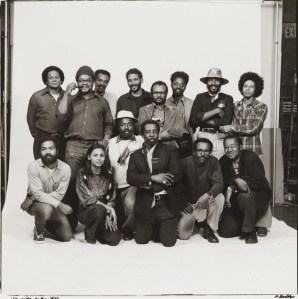
Photographers of Brooklyn’s Kamoinge Workshop, honored in the Whitney’s new show
At 7pm, a curator’s tour of the Whitney’s latest exhibition about the photographers of the Kamoinge Workshop in Brooklyn.
We’re particularly excited about the special free program that the Tenement Museum is hosting next Saturday (December 5) at 1pm with I.NY, a virtual celebration of connection between Ireland and New York, featuring a tour of an Irish family’s home on the Lower East Side in 1860 and a discussion with the University of Limerick’s Professor David Coughlan.
Visit the Moore family home with the Tenement Museum and I.NY on December 5
Many more programs are on the schedule, so register for as many of the topics and events that you can fit into your schedule.
Most of the events are free, but it’s always nice to add a thank-you donation.
Museum Updates
Just a reminder that MoMA has just reinstalled its permanent collection in its new building. When the museum re-opened a year ago, the intent was to keep its collection moving, with refreshed galleries several times a year. Be sure to visit and see what’s new!
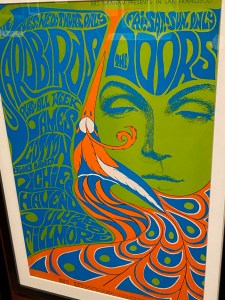
Bonnie McLean poster for Fillmore Auditorium July 1967. Courtesy: Bahr Gallery
It’s a trip back to the birth of Sixties youth culture, guitar virtuosos, the Fillmore, and multimedia extravaganzas in the New-York Historical Society exhibition, Bill Graham and the Rock & Roll Revolution, on display through January 3.
The show, originally organized by LA’s Skirball Cultural Center, tells the story of the man who created the Fillmore, catapulted legendary bands to fame, grew concert audiences to stadium size, and gave back to society by organizing once-in-a-lifetime benefit concerts televised throughout the world.
Photos, show posters, videos, rock and soul music, and even a wall from the legendary Joshua Light Show bring the story of Bill Graham to life.
Bill Graham in 1968 Fillmore Auditorium office. Gene Anthony photo in Graham collection
Graham’s life was saved by Kindertransport during World War II – a dramatic story told inside the entry to the exhibition. He was adopted and grew up in the Bronx, moved to San Francisco, and had the right skills in the right place at the right time to bring bands like Jefferson Airplane, The Grateful Dead, Hendrix, and Big Brother and the Holding Company to a larger audience.
In preparing the exhibition, the curators did original research into Graham’s early life and pulled artifacts, paraphernalia, and stories related to each decade of his concert-promotion career – leasing the Fillmore Auditorium in a largely African-American neighborhood, creating events that interspersed rock-and-roll acts with poets and new-age philosophers, securing larger venues in the Bay Area, opening the Fillmore East in 1968 in New York inside a former Yiddish vaudeville house on Second Avenue.
Joshua Light Show backs 1968 Mothers of Invention at Fillmore East. Courtesy: Joshua White
The show has plenty of the Fillmore’s promotional posters, and pays tribute to the artists who created them, such as Wes Wilson and Graham’s wife, Bonnie McLean. The curators also provide a few side-by-side displays of the original ink drawings for the psychedelic broadsides with the full-color printed versions. See some of our favorites in our Flickr album.
Despite the legendary status of the Graham’s two Fillmore stages, they only lasted until 1971. Although they were highly profitable, the writing was on the wall – the demand (particularly after Woodstock) to see the Stones, The Who, Santana, and other frenzy-inducing performers was too big to be satisfied inside the constraints of traditional theaters.
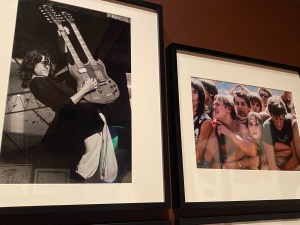
Led Zeppelin’s Jimmy Paige in 1977 and 1985 Metallica fans. Photos: Michael Zagaris and Ken Friedman
Through it all, Graham managed some stars, like Santana; created festivals featuring bands like Fleetwood Mac, Led Zeppelin, Metallica, the Eagles in the Seventies; organized Dylan’s historic 1974 tour; and produced The Last Waltz for The Band’s farewell.
The exhibition lets visitors savor these memories and moments through behind-the-scenes stories about Bill’s relationships with the artists, who often said yes to Bill’s ideas because they knew he was a perfectionist who would deliver his promises, understood what made fans happy, and always saw the epic, historic perspective behind that moment in culture.
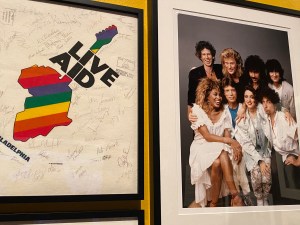
1986 Live Aid T-shirt with Ken Regan’s photo of US benefit stars. Graham and Regan collections
The exhibition puts special focus on Bill’s willingness to tackle the monumental challenges of producing nationally televised benefit concerts, such as Live Aid, and taking tours and bands to places in the world that had never seen super-sized rock events before – Moscow’s 1987 concert for peace and the 1988 five-continent tour for Amnesty International with Bruce Springsteen, Peter Gabriel, and Sting to commemorate the 40th anniversary of the Universal Declaration of Human Rights.
Watch the trailer for the show:
If you’re in NYC, go over to hear the music and see the show before it closes January 3. If not, take this “Curator Confidential” walk through the exhibition with the people behind the Bill Graham Memorial Foundation, who talk about the life of Bill Graham and the history they lived with him – a Zoom session produced by NYHS last August while the museum was still closed.
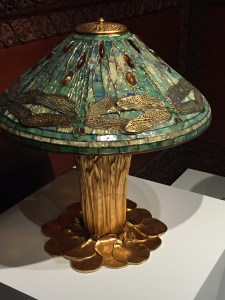
Dragonfly Lamp (1900-1910), by Clara Driscoll of Tiffany’s Women’s Glass Cutting Department (Cooper-Hewitt)
With Thanksgiving festivities this week, the list of virtual live events happening at NYC museums is a bit shorter. Find the links to these and other museum events on our virtual events page here. Some of the highlights we think you’ll enjoy:
Have you heard the story about the women of Tiffany & Co, who were so integral to the success of the design lab in the early 20th century? If not, you owe it to yourself to join the Queens Museum today (November 23) at 12pm to hear the talk by the Queens Public Library on Women at the Tiffany Studios in Queens.
Gather the family around tomorrow (November 24) at 5pm for a special live event at the Tenement Museum. Meet Victoria Confino, a 14-year-old girl living on the Lower East Side in 1916. Hear about her story of immigration in 1913 and take a tour of her apartment on Orchard Street – all based on the story of the actual young woman who grew up there.
Actress portraying Victoria Confino in her Orchard Street apartment
If you using the weekend to catch up on hand-craft projects, be sure to take advantage of this special behind-the-scenes tour of the lace collection in the textile department of the Met on Saturday (November 28) at 10am. Their collection spans centuries, and it’s a rare chance to poke through all the drawers with one of the curators. (If you want to see what we’re talking about, check out our Flickr album on a past Met exhibition on Fashion and Virtue that featured this amazing collection.)
1910-15 lace evening pouch by Callot Soeurs (The Met)
Check out this week’s schedule and register for as many of the topics and events that you can fit into your schedule. Most of the events are free, but it’s always nice to add a thank-you donation.
Museum Updates
This week, we got in to see the Met’s fashion exhibition About Time: Fashion and Duration, which was delayed for months by the citywide museum shut down. Fortunately, it gave Andrew Bolton time to tweak the display, which presents a mesmerizing, time-shifting look at the past and present of fashion. If you want to see this, be sure to get to the Met before 11:30am, since tickets are distributed on a first-come, first-served basis. Plan to spend your day inside the museum, since your ticket may not grant you access until late in the afternoon.
#ICPConcerned – what photographers were seeing around the world in March 2020
There are two must-see exhibitions at the new Essex Street home of the International Center of Photography. If you are in New York, go down ASAP to experience Tyler Mitchell’s installation, I Can Make You Feel Good, and to look through the global response to #ICPConcerned: Global Images for Global Crisis. The walls of images from around the world is a time-warp experience that is no less affecting than the more elaborate, theatrical About Time galleries at The Met.
We also attended the press briefing at The Whitney this week on its new photography retrospective, originally mounted by the Virginia Museum of Fine Arts in Richmond – Working Together: The Photographers of the Kamoinge Workshop, which looks back at the work of its 14 founding members back in the Sixties at the birth of the Black arts movement in New York. Go see it.
Politics and rage all laid out in cartoony form in Peter Saul’s retrospective at New Museum
Congratulations are also in order to the New Museum of its two hit shows – Peter Saul’s first-ever NYC retrospective Crime and Punishment(two floors of off-the-charts social and political commentary) and Jordan Casteel’s first solo museum exhibition in NYC Within Reach, filled with her masterful uptown portraits. Visitors linger in the galleries in an effort to digest the rich experience.
And if you are binge-watching The Crown, we’ll again plug the Brooklyn Museum virtual exhibition with Netflix, where you can examine all the fashion up close in virtual reality.
1890 pointillist portrait of Fénéon by Paul Signac
He wasn’t an artist, but MoMA has given him a show that has everything – joyous post-Impressionist canvases, Moulin Rouge posters, color wheels, African masterworks, Italian futurists, street riots, manifestos, explosions, and mug shots.
Félix Fénéon: The Anarchist and the Avant-Garde – From Signac to Matisse and Beyond, an exhibition on view through January 2, will introduce you to a writer, critic, anarchist, and dealer living in turn-of-the-century Paris who championed Seurat, gave Matisse his start, coined the term neo-Impressionism, and went to jail for a few months after he was accused of setting off a bomb in a restaurant frequented by government big shots.
1891 painting by Paul Signac, Setting Sun, Sardine Fishing, Adagio, Opus 221
This gorgeous show was inspired by Signac’s pointillist portrait of Fénéon, which features swirling color wheels referencing their shared passion for Japanese design, pattern, and the science behind art. Books and ephemera by influential color theorists are displayed nearby, but it’s hard to keep your attention there when paintings by so many modernist masters are vying for your attention around every turn.
1894 Bonnard poster for the avant-garde journal Fénéon edited
Fénéon used his critical bullhorn to turn many artists into household names. Think Seurat and Signac, two of Fénéon’s early favorites. The first gallery is full of their beautiful seascapes and figurative work. Read the curator’s essay about the artists he promoted, and see our favorites in our Flickr album.
The curators let us know that these peaceful images and exuberant dance-hall posters were made at a time of serious social unrest and profound economic hardship for working-class Parisians by interspersing Fénéon politics-charged writings and socially conscious works by Vallottin and Pissarro. Disruptive protests, nightlife, zines, and art all went hand-in-hand during the 1890s.
1905-1906 painting by Matisse Interior with a Young Girl (Girl Reading)
Fénéon spent several years as the editor-in-chief of a leading avant-garde journal, orchestrating contributors such as Bonnard, Toulouse-Lautrec, and Vallotton, and collecting their work along the way. So, it came as quite a shock to everyone when the independent critic announced that he was taking a full-time job with a prestigious but conservative gallery in Paris.
Entering the second gallery of the exhibition, you see immediately how Fénéon used his notoriety and avant-garde chops to build up a contemporary art business and lure old-line clients into taking a chance on something new and modern. He signed contracts with artists he had long championed, and gave an up-and-comer named Henri Matisse his first show in 1910.
Late 19th-c mask by a Guro artist from Cote d’Ivoire with 1920 Bonnard. Private collection; Musee d’Orsay.
It’s exciting to see a room full Matisse’s early work (including three that were in that initial show) and work by other artists that Fénéon both collected and sold, including a wall full of ethereal Seurat drawings.
Like many others in the avant-garde, Fénéon was a passionate collector of art from Africa and Oceana, and it’s thrilling to see so much of his original collection – now scattered throughout the world – reassembled inside MoMA.
Fénéon hated colonialism and railed against calling this portion of his collection “primitive art.” He lamented that the names of the artists who created such dynamic, inventive work were unknown and disliked having such evocative pieces relegated to ethnographic museums.
19th-c cap by Tin Dama artist from Papua New Guinea (Musée du quai Branly-Jacques Chirac) and Balla’s 1910-1911 futurist work.
He hoped that one day “art from faraway places” could take its place in the art pantheon right up there with works in the Louvre.
The worlds of ancient mythic power, modernism, and emotive color seem to be spending their time at MoMA having an active conversation – just the way Fénéon would have wanted.
Enjoy MoMA’s fast-pace introduction to this revolutionary modernist:
And now meet MoMA director Glenn Lowry and Starr Figura, curator of the exhibition, who show works from the exhibition and discuss why they mounted this show:
If you can’t get to MoMA, listen to the audio guide here, and enjoy the “colors” playlist that MoMA designed.
Enhanced image of Pluto’s ice plains from NASA’s New Horizons. Courtesy: NASA/Johns Hopkins Applied Physics Laboratory/Southwest Research Institute
If you’ve wanted to get far, far away but reckon you’re going not going anywhere for Thanksgiving, New York museums are offering some exciting virtual trips as well as comforting at-home activities:
Do you want to get away? Is Pluto far enough? At 7pm on Wednesday (November 18), join the astro-visualization crew at the Hayden Planetarium for a close-up look (using genuine images from the New Horizons spacecraft) to explore glaciers, mountains, and dunes on the little planet. Just a $15 ticket for a trip you won’t get anywhere else.
Behind the scenes with New York’s most celebrated dim sum restaurant with Poster House Nov 19
If staying near the kitchen is more your thing, this week offers a few different options for cooking and looking:
Want to visit New York to enjoy that amazing dim sum? Here’s your chance to do it virtually. At 6pm on November 19, step into the world of Chinese cuisine at Poster House with the program, Stories & Recipes From Nom Wah. Get inside one of New York City’s oldest dim sum houses as part of the museum’s programming in honor of its exhibition The Sleeping Giant: Posters and The Chinese Economy.
On November 19 at 8pm, the Old Stone House and Brooklyn Brainery are offering an evening on the history of pies, including pumpkin pie, meat pies and baked “coffins.”
History of pies event on Nov 19, hosted by Brooklyn’s Old Stone House
Maybe you just want to look at kitchens and not cook. On Tuesday (November 17) at 3:30pm, the Tenement Museum is offering a tour of a 1930s working-class family apartment. Or at 6pm, you can join Merchant’s House Museum to walk with an historian through New York City’s only intact nineteenth-century family home (much more upscale!). Tenement Museum is also offering tours into other eras (1910 and 1870) later in the week. Check out the listing.
Roseanne Cash performs with Met Live Arts Nov 17 in a tribute to the eye of the collector
Find the links to these and other museum events on our virtual events page here. Other highlights of the coming week:
Beautiful music from singer-songwriter Roseanne Cash from Met Live Arts tomorrow (November 17) at 7pm in honor of the Met’s exhibition (and gift) Photography’s Last Century. Hear the music and poetry reading streamed live free on the Met’s Facebook and YouTube channels (no advance registration).
Young Hamilton featured on Nov 19 at Fraunces Tavern Museum (Image: NYPL collection)
Ham fans can get their fix at his old hang-out, Fraunces Tavern on Thursday November 19, with a 6pm program, Hamilton: Man, Myth, Musical…Mensch. The talk will feature facts about his early life and a fun fact-check on the musical.
Or (same date and time), join young New York muralists to hear their reactions Whitney’s blockbuster exhibition, Vida Americana: Mexican Muralists Remake American Art, 1925–1945. See how the past influences their approach.
Take a look and register for as many of the topics and events that you can fit into your schedule. Most of the events are free, but it’s always nice to add a thank-you donation.
Museum Updates
One of Salman Toor’s narratives at The Whitney
This week, we attended the Whitney’s virtual press conference on Salman Toor’s new exhibition. To get a preview and meet the artist himself, check out his conversation at 6pm tonight (November 16) with another New York/South Asian artist, Chitra Ganesh.
It’s good to see that our Revolutionary friends at Fraunces Tavern Museum are now re-opened in Lower Manhattan. They are hosting several Evacuation Day (outdoors) walking tours and upcoming virtual events depicting how the General said good-bye in the Long Room nine days after the British fled New York.
Cooper-Hewitt hosts Nov 17 working group on transforming museums
Are you a museum professional interested in the future of the visitor experience? Tomorrow (November 17) at 3:00pm, the Smithsonian’s Cooper-Hewitt is convening a virtual working interactive event for you – Discussions on Transforming the Museum Experience. Small groups will convene to generate ideas and tools (to be published), led by an impressive roster of international museum representatives.
If you’re a student, thinking about going into museum studies, check out the same-day college-night get-together at Poster House at 6:30pm.
1927-1929 reverse-print experimentation by Bauhaus master Lazlo Moholy-Nagy
Although the Metropolitan Museum’s 150th anniversary year did not go as planned during the months-long shutdown of 2020, there’s a silver lining that you can experience for yourself – sixty important promised gifts to honor the occasion in Photography’s Last Century: The Ann Tenenbaum and Thomas H. Lee Collection, on view at Fifth Avenue through November 30 and available for viewing in the Met’s online gallery.
If you go in person, there’s lots of space to wander, relax, and look through three large galleries. It’s a who’s who of 20th century photography – everyone from Stieglitz, Weston, Atget, and Arbus to more contemporary photographers like Cindy Sherman, Nan Goldin, and collaborators Fischli & Weiss.
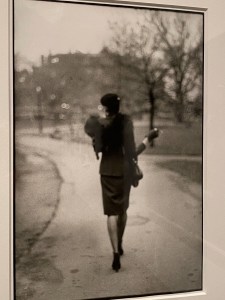
One of Nan Goldin’s earliest photographs, a 1973 study of her performer friend Ivy strolling home from a drag bar
The show isn’t hung chronologically, but that works to the exhibition’s advantage. You’ll required to approach each piece more or less like the collectors did – meeting each image on its own terms and enjoying what you see.
Each work is accompanied by a short text that puts the photographer into the context of art history and explains how this particular work relates to the artist’s best-known work. Read each one on the Met’s website.
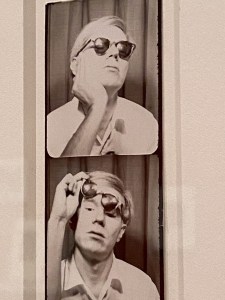
Often, Ann Tenenbaum and Thomas H. Lee collected work from the start of an artist’s career, or an image that’s goes against the grain of what we’ve come to expect – Avedon’s early work, Mapplethorpe’s ocean image of the aircraft carrier Midway, and Andy’s first foray into a photo booth for magazine piece on emerging New York artists for Harper’s Bazaar.
Two of Andy Warhol’s 1963-64 photo booth self-portraits
It’s almost as if you are walking through the last 100 years of photography with the collectors themselves, understanding why they collected certain works and the reason that this is such a phenomenal addition to the Met’s holdings.
Tenenbaum and Lee also paid attention to filling out the ranks of less-well-known female photographers, such as Florence Henri who studied at the Bauhaus, Ilse Bing, Bunny Yeager, and New York’s own Mickalene Thomas.
The collectors are also providing the Met with attention-grabbing, large-scale works that show that artists are still experimenting with this art form.
2015 inkjet print by Daisuke Yokota
Met visitors were taking selfies in front of the gigantic digitally manipulated print by Andreas Gursky that uses a Prada in-store display as its jumping-off point. Visitors were also stopped in their tracks by Daisuke Yokota’s colorful abstraction so big and spectacular that it had to be mounted in the hallway! Avoiding even a camera or lens, Daisuke just manipulated the layers of pigment.
The exhibition is a loving tribute to these collectors’ passion for artists and image making.
Enjoy some of the highlights with the Met’s curator of photography, Jeff Rosenheim:



 Later that day at 8pm, you can join the Museum of Food & Drink and WNYC’s The Green Space for a super-fun holiday-themed Filipinx cooking demonstration, conversation, and a little Karaoke (a revered Filipino holiday tradition) – all part of MOFAD’s Food for Thought speaker series.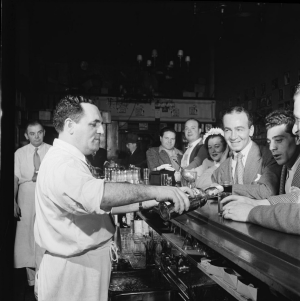




















 itsnewstoyou