Crowds surround Kara Walker’s monumental sugar sculpture
The crowds lined up yesterday on Kent Avenue all the way beyond the Williamsburg Bridge, almost to Schaeffer’s Landing, waiting to enter the rusted, aromatic, tumble-down confines of the old Domino Sugar Factory on one of the last days to see Kara Walker’s “A Subtlety, or The Marvelous Sugar Baby”, commissioned by Creative Time.
Today is the last day, so take a look at history in person, on our Flickr page, or in the video below.
Security was in full force to keep the Williamsburg bike path clear and drivers were slowing down to ask, “What’s going on and what are people waiting for?” only to be told by patient fans, “They’re lined up to see art!”
Once inside, the marvelous, gigantic Sugar Baby sculpture was on hand to preside over the far end of the abandoned several-block-long 1851 industrial space that once refined over half the sugar consumed in the entire United States.
One of her many attendants throughout the factory
As readers of Friday’s front-page article in The New York Times knew, Walker was again pushing the buttons with her homage to the brutal history of the sugar trade from the 1700s until today by giving us an experience that isn’t really all that sweet. Witnessing Kara’s witnessing is what had people – including some elderly visitors on canes — flocking to the sticky-floored, slightly ominous space. You could smell the sugar and molasses before you even entered the door.
Leading up to the gigantic white sculpture, people encountered all sorts of molasses-children, toting baskets full of…well…looks/smells like molasses. The experience evokes everything that Kara wished for…history, economics, society, race, abuse, industrial profit, and industrial scale.
Take a look at how it was made, and read about the history behind her thinking. Click on this link to Vimeo, look on the Creative Time website to see her sketches and graphic inspirations, and be sure to check out the various stages of Kara’s 3D digital sphinx up close.
If you go to Brooklyn today, expect to wait about an hour in line; once inside, there’s plenty to think about.
The 1980 version of The Perfecto, which debuted in 1928 and is still sold by Schott Bros. Source: FIT
The FIT fashion and textile grad students always pull out the stops on their shows in the Museum at FIT’s side gallery, turning mini-shows into main events, as in their current exhibition, Beyond Rebellion: Fashioning the Biker Jacket. The gallery installation highlights the jacket’s role in history, culture, couture, and street fashion, but the team makes its history come alive even further on their superb companion digital site featuring photos, videos, and the historical context. See the jackets in person and touch the leather swatches before April 5, and go play with the web site at any time.
The digital timeline begins with the birth of the motorcycle in the UK in 1902, but the fashion story starts in 1928 with the debut of the leather riding jacket, The Perfecto by the Schott Bros. It’s the template upon which all other cool looks – street, couture, punk, ready-to-wear – are based. It combines the swag of a WWI aviator jackets with the utility and protection needed by one of the original road warriors. Retail: $5.50.
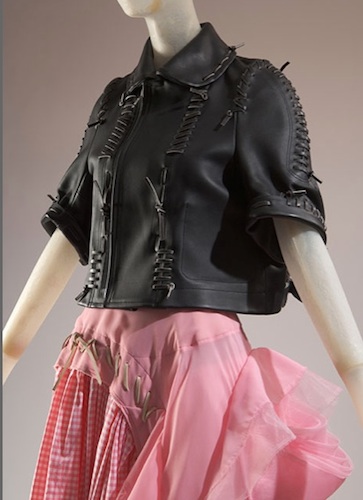
From Rei Kawakubo’s 2005 Biker + Ballerina collection (leather, gingham, and tulle) for Comme des Garcons. Source: FIT.
In the first gallery next to The Perfecto, fashionable visitors were hovering to take in all the information in Paula Sim’s excellent illustrated deconstruction of the jacket’s iconic design features as if it were the Rosetta Stone. How and why did the details we know so well all originate? The asymmetrical zip thwarts wind, epaulets secure riding gloves during breaks, the belt keeps wind from whistling up your back, and zips at the wrist do the same for the glove-sleeve juncture. The extensive use of hardware was a desirable touch inspired by chrome and metal features on the just-taking-off auto industry. Want or need?
It didn’t take long for motorcycle-loving vets to start applying patches and insignias to the aviator-inspired jackets, just as they had done with patches, insignias, and pins during the war. By the 1930s, as shown on the timeline, club patches gradually became associated with “outlaw” clubs. Nevertheless, the popularity of motorcycle riding grew, documented by the curators with a 1951 Sears catalog showing a premium $33.95 leather moto jacket featuring a snap-off lamb collar and “built-in kidney support”.
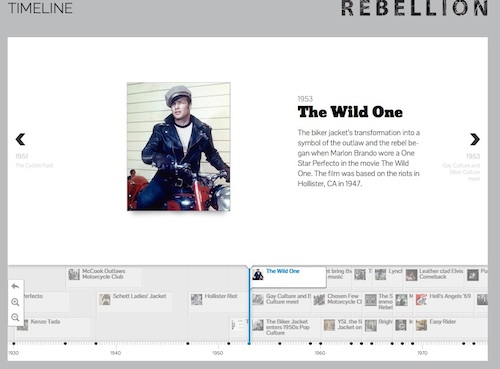
Screenshot from the FIT show timeline
As the curators note, the watershed year for this utility bomber was 1953, when Brando sported cuffed-jeans-and-jacket attire in The Wild One. Banned initially in the UK, the film (and Brando) became a sensation, giving mass audiences a pop-culture version of what happened in the 1947 Hollister, California motorcycle club riots.
The style went viral, pushed further into street-style consciousness by emerging rock-and-rollers and The King himself, Elvis. Take a look at some iconic 50s performances that the digital curators included on the show’s website. Scroll up to 1956 in the timeline to see Gene Vincent tear it up onstage and to 1968 to see Elvis rocking his leather look doing Jailhouse Rockin his NBC comeback special.
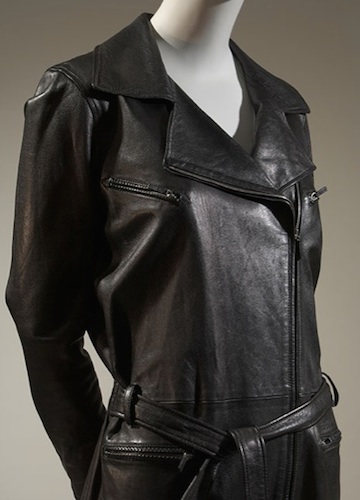
It’s so Schott: Stefano Pilati’s Fall 2009 jumpsuit for YSL. Source: FIT, gift of YSL.
In 1960, YSL became the first high-fashion designer to bring the biker look to the runway – a move that contributed to his exit from the House of Dior. Never mind, though. When he opened his own house two years later, he continued riffing on the bad-girl theme. The rest was history, with plenty of rock musicians, high-end designers, and Vogue stylists following suit.
The curators feature New York’s own Ramones as the epitome of the 1970s motorcycle-jacket-wearing punk-music rebels, and present lots of album covers as evidence of the jacket’s enduring presence.
As for fashion from the FIT collections, the team has pulled together a dozen high-end interpretations, beginning with Mr. Versace’s 1993 gold-stitched biker jacket with pull-tab logo hardware and a more subdued version by Emporio Armani. Fashion lovers have plenty of other versions to savor from Ms. Herrera, Rick Owens, JPG, Rei Kawakubo, and others.
All the techniques rolled into one: Jean Paul Gaultier’s 1987 leather, fake fur, suede, and wool jacket with trapunto, elbow studs, fringe, and pin stripes. Source: FIT, gift of Anne Zartaian.
In the far corner, the team offers a wall where you can touch and compare different types of hides and treatments used for jackets, marvel at the trapunto-on-leather techniques Mr. Versace and JPG used so extensively, and learn that patent leather was invented in 1811.
As for the current popularity of the biker jacket on the Streets of New York, enjoy the slide show by the FIT student team, shot on the only warm weekend day so far this year in Williamsburg:
The Saturday night crowd at the Brooklyn Museum was intent on exploring every inch, sketchbook, plastic-wrapped ball, and cut-out supplied by the born-in-Kenya Brooklyn vision-artist in her one-woman show, Wangechi Mutu: A Fantastic Journey. Explore her world (installed right next to The Dinner Party) before March 9.
Wangechi has been turning out thought-provoking work for the last 15 years, and the show, originally created by the Nasher Museum on the Duke University campus, presents the gigantic collage images that made her famous with collectors as well as a brand-new video and on-site installation.
Ladies’ fashion lips, stiletto-heeled shoes, African totems, African animals, high-fashion eyes, and magical shapes and patterns are interworked onto large-scale pieces portraying Amazons that are pushed, puzzled, and probed in fantasy landscapes, surrounded by plants and creatures from different worlds.
She’s a visual virtuoso who knows that how things look from a distance are nothing like what you’ll see when you get up to her images very, very close. For example, when you come into the gallery, you see a wall-sized work that Wangechi created that looks like a she-centaur being chased by who-knows-what-in-3D flying into the frame. Up close, you’ll see that her “hooves” are collages of African sculptures and engine parts. The furtive creature flees atop a huge root system of “earth” created out of masses of folded felt. Take a look at how she assembled it:
Walking up to each piece, shapes shift right in front of you, conjuring mixed messages and forms associated with female beauty, African “otherness”, the fallout from colonialism, and the disassociation with the natural world. Wangechi wants everyone and everything to exist harmoniously, but her techniques constantly remind you of the dissonance and difficulty in achieving this.
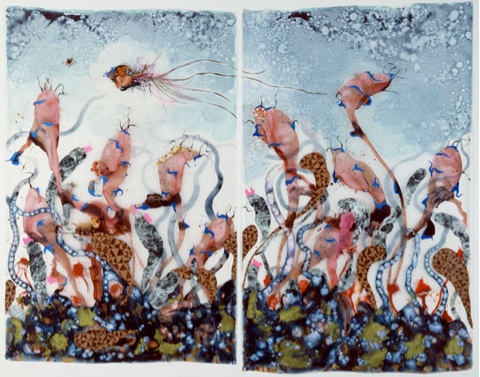
In a 2007 piece titled Funkalicious fruit field, the far-away feeling is organic, dense, watery, and surreal. But when you get right up close, you’ll discover three jackals, a sacred cow, and a white rhino floating around, and you’ll start scouring the weeds for more surprises. Her female portraits can sometimes feel scary as you recognize the genesis of some of the cut-up images creating the illusion – medical textbooks whose components aren’t pretty.
The crowd was captivated by her first animated film, The End of eating Everything. A female-headed magical creature belches volcano steam from her misshapen body, eating everything in sight. Thankfully, it has a bit of a surreal, happy ending as hopeful, intelligent heads eventually prevail, framed by a cloud-filled blue sky.
Listen to a discussion of her work at the Brooklyn Museum via YouTube, and enjoy this beautiful 9-minute documentary produced by Arise Entertainment 360. You’ll meet this fascinating artist, see close-ups of her collages, and experience what’s so great about this show:
JPG’s creation for Madonna’s “Like a Virgin” segment of her 1990 tour. Made from vintage 1930s lame
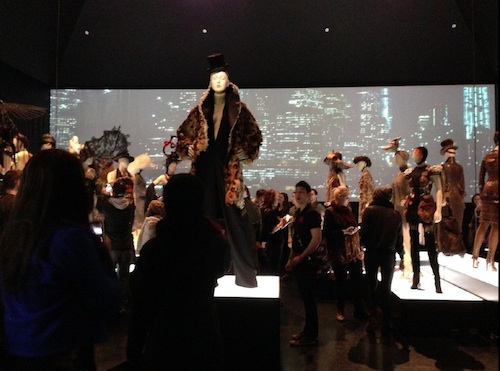
Amidst the light, glamour, glitter, and mystery sending shock waves and awe through the masses crowding into the Brooklyn Museum’s show, The Fashion World of Jean Paul Gaultier: From the Sidewalk to the Catwalk, a hush falls as each person realizes they’re only an arm’s length away from the Icon’s icon. Lovingly crafted from vintage lame, JPG and Madonna had no idea (according to Madonna) what a sensation their underwear-as-outerwear statement would create in fashion, performance, pop, and culture when JPG designed her get-ups for the Blond Ambition World Tour. Get out to Brooklyn to experience this über-tribute before Feb 23.
Madonna’s lent her JPG corsets to the section of the show where the walls are covered in quilted satin, and JPG dug into his archives, too: You’ll see the series of illustrations he did to show the looks he would create for the tour, as well as JPG’s personal Polaroids shot during the initial fittings. If you’re very quiet in this part of the show, you’ll also hear visitors gasp when they realize that they’re looking back at artifacts from 1990!
Crowds listen to the mannequin sing in the Metropolis gallery during the show’s final week.
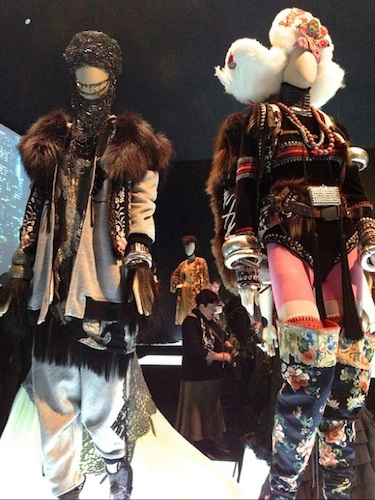
This genuinely theatrical tribute to JPG is chock full of corsets and cages made from silk, leather, raffia, wheat, and enough other stuff to win the Unconventional Materials challenge hands-down. O ye of Project Runway, worship at the mannequins of the Master!
At the entrance to the show, there are two small photo portraits of JPG taken by Mr. Warhol himself. They’re at a dance club in 1984 and JPG is in one of his Boy Toy collection outfits. Andy is quoted as saying, “What he does is really art.” It’s a curatorial anointment that offers a subtle, quiet, reflective moment to what you’re about to experience.
Dealing with the recent blizzards would have been more fun if you had shopped JPG’s Voyage Voyage ready-to-wear collection (2010-2011). These are styled with pieces from older collections.
Room after room of gender-bending, mind-altering, color-crazy, history-twisting looks, gowns, shoes, bodysuits, and haute handwork reminds us that JPG has been pushing the boundaries for over 40 years, inspired by French sailors, French culture, 50s TV, global culture, his grandmothers unmentionables drawer, and the ever-inspiring gritty street. How do you use embroidery, neoprene, stuffed silk tubes, tulle, and illusion in a subversive manner? Take a stroll through JPG’s master class.
You’ll find mermaids worn by Beyoncé, a French sailor-striped gown worn by Princess Caroline, red carpet looks worn by Ms. Cotillard, a Mongolian shearing coat sported by Bjork, and photos of supermodels and superstars sporting outrageous and inventive looks. The names of the collections alone tell you the scope of his interests – Haute Couture Salon Atmosphere, Ze Parisienne, Flower Power and Skinheads, Paris and Its Muses, So British, Forbidden Gaultier, and Great Journey collections.
Close-up of corset from JPG’s Countryside Babes collection, prêt-à-porter spring/summer 2006. Made of wheat and braided straw, created in 84 hours
The show features 140 ensembles in all, enough to fill the entire wing. Mr. Gaultier even tells us that he expanded it a little for Brooklyn’s gigantic space, adding a “Muses” section with American icons and runway looks for big-boned, curvy girls.
Oh, and did I mention that the mannequins talk? (We can’t even begin on that, so here’s a video to explain how that magic happened.)
Brooklyn is the last stop on JPG’s North American tour, which was organized by the Montreal Museum of Fine Arts and Maison Jean Paul Gaultier.
If you can’t visit, take a walk through the show via our Flickr photos, and listen in on an hour-long discussion between JPG himself and the show’s curator Thierry-Maxime Lorio, where they talk about his “express yourself” philosophy.
The special promo video will give you a taste of the creative genius behind 40 years of memorable, challenging fashion as art:
Miguel Cabrera oil (1760) of Dona Maria de la Luz Padilla y Gomez de Cervantes sporting velvet beauty marks and bling
Conspicuous consumptions is nothing new, according to the Brooklyn Museum’s spectacular show, Behind Closed Doors: Art in the Spanish American Home 1492-1898, and they’ve gathered (mostly from their collection) four centuries of blindingly beautiful stuff to show how earlier generations of status-seekers showed off how special and rich they were. Catch it before January 12.
The Fourth-Floor show fills two huge galleries that have been partitioned by the curators into areas corresponding to rooms in a traditional Spanish-American home, where they’ve displayed the stuff that the colonial high and mighty would have put there. Although two-thirds of the United States was once under Spanish rule, the paintings, furniture, textiles, and other treasures you’ll see are from homes south of the border, including the Caribbean and south of the Isthmus. Check out our Flickr feed.
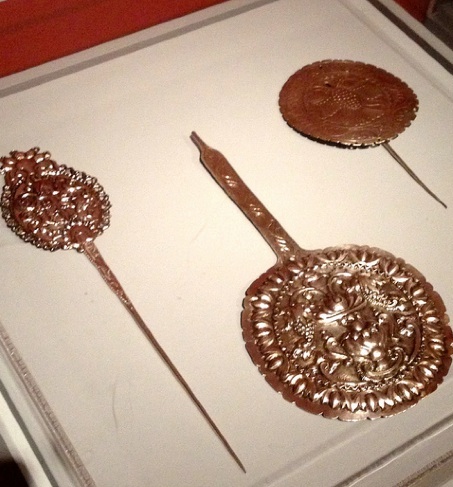
Giant 18th century silver status pins for women, slightly Incan-style
First, you’d dress to impress and make sure that everyone knew that you were somehow aligned with the upper classes back in Spain. The show puts English and Spanish-American portraits side-by-side in the first gallery to illustrate that the latter weren’t shy about applying ostentatious tiaras and pearls to themselves, slapping on the velvet faux-beauty marks, and shoving royal proclamations into the frame to convey your wealth, status, and privilege. Wealthy English colonials and their portrait painters took a more austere, understated approach.
Second, if you were of mixed race but possibly had some Incan royalty in your blood, you’d hang gold-flecked portrait series of Incan chieftains where everybody could see them in your home. The lady of the house might wrap herself in a locally woven textile sporting mixes of South American deities with that oh-so-familiar-to-Europeans Hapsburg double eagle. Then she’d bling it up with a giant oversize pin made out of solid silver.
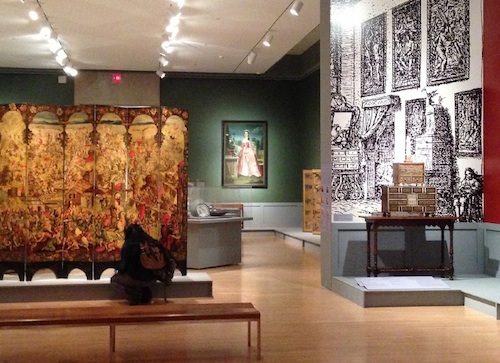
Visitor inspects painted screen in exhibit area with the objects from the grand reception room of an upscale home.
Third, you’d emphasize your casual elegance by actually draping the rugs and tapestries all over the floor, stairs, and risers in the ladies’ sitting room. After gold, silver, and jewels, textiles were about the biggest luxury anyone could find, and Spanish Americans made and bought a lot. In British America, carpets were only used to cover tables, so the casual distribution of so much wealth below your feet was something only Spanish Americans could afford.
Because the Caribbean and coastal cities of South and Central America were right in the center of shipping and trade routes for centuries, wealthy people could buy pretty much anything they wanted and the curators show it to us – gorgeous Japanese screens, custom-printed Chinese porcelain, English-style sitting chairs, and Turkish rugs. No pennies were pinched in upwardly mobile, Spanish-speaking homes.
Peruvian bed of gilt wood (1700-1760) that would be shown off in a state bedroom.
And let’s not forget what treasures were produced right inside the Spanish protectorates – silver shaving basins, polychromed statues of the saints, gigantic gold-framed “statue paintings”, gilded beds, embellished leather traveling trunks (to go to your country home), solid mahogany furniture, and custom-made books of your family’s geneaology. We won’t even get started on the private chapel décor.
This show throws open a window on the first wave of high-status interior design and decoration – a story that is normally confined to the castles in Europe or the palace at Versailles, and one that is perfectly suited to be told by Brooklyn’s extensive Latin American holdings with a couple of key pieces from the sumptuous collections uptown at the Hispanic Society of America.
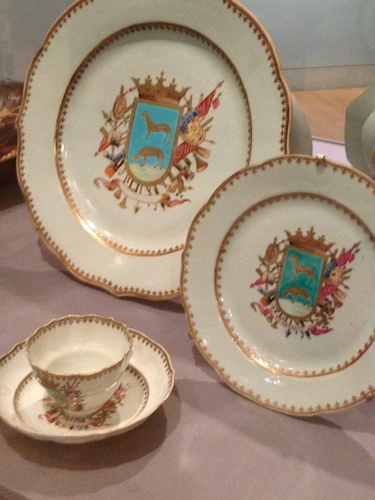
Chinese import: 1770 porcelain featuring South American animals, purchased by Ignazio Lemez de Cervantes
If you want to do a deep dive into upscale living of past centuries, visit the exhibition archive on the Museum’s website and click on the Objects tab. Or, see it all in person when it goes on the road: it opens at the Albuquerque Museum on February 16, the New Orleans Museum of Art on June 20, and the Ringling Museum in Sarasota on October 17.
And congratulations to Brooklyn for making it onto the cover of the winter edition of Humanties, the NEH magazine.
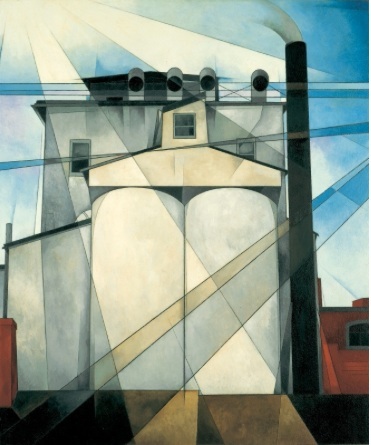
Charles Demuth’s precisionist take on the grain elevators in his hometown, My Egypt, 1927.
Five reasons to cozy up with the stars in the American Art Walk of Fame in the Whitney’s top-floor show, American Legends: From Calder to O’Keefe before December 15 when they come down to make room for the next batch of legends from the Whitney’s massive collection:
#1: Charles Demuth. See how he turned the industrial landscape of his Lancaster, Pennsylvania hometown and flowers from his garden into magic. Experience Demuth’s oil, My Egypt, a pristine oil that looks like it was painted yesterday. He captures the monumentality of the local grain elevators and uses his title to channel the greatest architectural feats of the ancient world. The beautiful floral watercolors were some of Ms. Whitney’s favorites.
A Joseph Stella masterpieces: The Brooklyn Bridge: Variation on an Old Theme, 1939.
#2: Joseph Stella’s interpretation of 1930s New York, including one of his best-known works, The Brooklyn Bridge: Variation on an Old Theme, 1939. Here, the painting evokes a cathedral’s stained glass window but it’s actually a love letter to the iconic structure that he painted so many times in his career.If you’ve never walked across this bridge, listen to a civil engineer interpret Mr. Stella’s work on the Whitney’s audio guide.
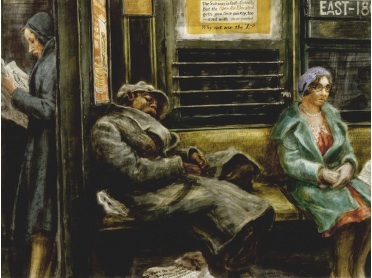
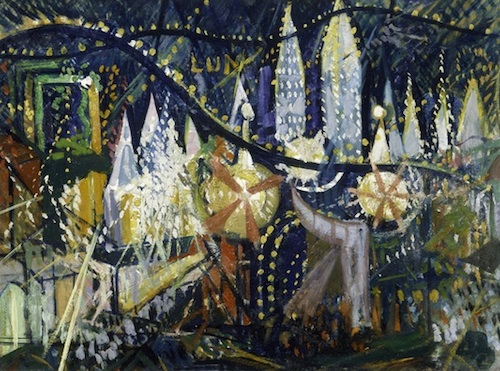
#3: Immersion into bygone New York. Check out Coney Island’s main attraction in 1913 via Mr. Stella’s Luna Park (here’s the audio). Also, the show has many Reginald Marsh works of life during the depression, including Why Not Take the “L”?,and the original “ten cents a dance” girls in his 1933 portrait of taxi dancers.
#4: The whimsy of sculptor Elie Nadelman, whose large, rounded, folk-art-inspired figurative sculptures could certainly work in Mr. Calder’s crazy circus (which is here, too), if they could only be shrunk down to fit into his tiny, tiny circus ring.
Reginald Marsh asks commuters a question in Why Not Use the “L”?, 1930
Mr. Nadelman looms large in the Whitney collection, and it’s nice to have a great, big room to dance around all his sculpted people.
#5: Georgia O’Keefe shares a gallery room with Marsden Hartley, a nice pairing of visual mystics captivated by symbols, nature, mysterious abstractions, and the evocative power of landscapes.
There’s a lot to enjoy about many of the other featured legends, so hurry over to drink in the colors of Stuart Davis, watercolors of John Marin, the sharp visions of Ralston Crawford, and eight other anchors of the Whitney collection.
Stella’s 1913 take on the magic of Coney Island’s main attraction, Luna Park
Who will be featured next on the top floor? We’ll see who the curators pick on December 21, when they reveal their next group of Legends.
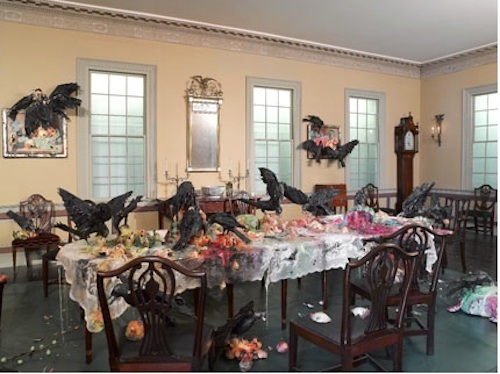
Hegarty’s “activation” of the Cane Acres Plantation dining room including Still Life with Watermelon, Peaches and Crows. Photo: Brooklyn Museum
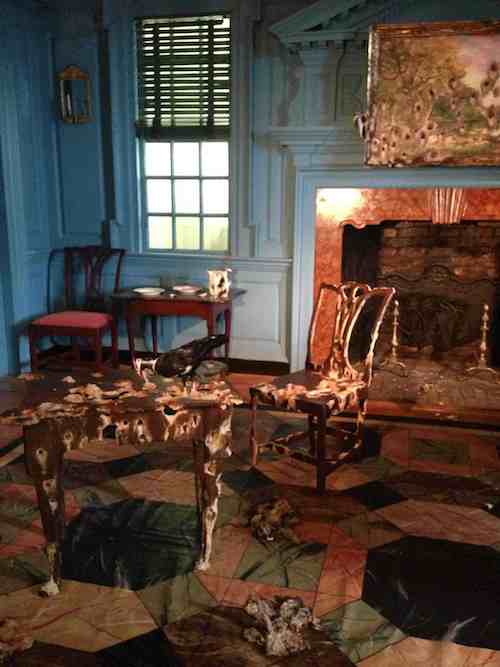
The Brooklyn Museum’s Period Rooms are again the focus of a rip-roaring, history-tearing, upside-down interpretation by an installation artist. Go before December 1 to see what’s happened to three rooms up on the museum’s Fourth Floor in Valerie Hegarty: Alternative Histories.
The dining room from the South Carolina’s Cane Acres Plantation is alive with dozen or so papier-mâché crows that are chowing down on the faux watermelons and peaches that you imagine to have been so beautifully arranged on the long, grand table.
Peering into either of the two plantation doorways, it’s disconcerting to see how the delicacies are being ripped apart and strewn about. The fruit literally pops out of the frames in this cross-referenced mash-up of Hitchcock terror, racial segregation issues, and classic still life painting.
Hegarty’s Pendleton carpet is growing in the Cupola House parlor.
See how Hegarty created it all out of wire, glue, foil, foam, and everything else you can purchase at Michael’s on the Brooklyn Museum’s Flickr feed.
She was equally ambitious in two other rooms from the Cupola House, originally built in Edenton, North Carolina: The 1725 parlor room focuses on a visual “conversation” between General George Washington and Pawnee Chief Sharitarish, featuring a Native American-style Pendleton parlor rug that is “growing” grass, flowers, and roots to make you think about what happened to the native culture over the last few centuries.
She kicks the Manifest Destiny discussion right where it hurts in the Cupola House “hall” (where guests socialized) by letting two Pileated and Downy Woodpeckers have their way with everything valuable in the room, including (a reproduction of) Thomas Cole’s 1846 painting The Pic-Nic. Nature is getting out of hand.
The Downey Woodpeckers take over the Cupola House hall. Photo: Brooklyn Museum
Get over to Brooklyn and encounter a new twist on what you were taught in grade school history, but watch out for Hegarty’s flying bullets and birds.
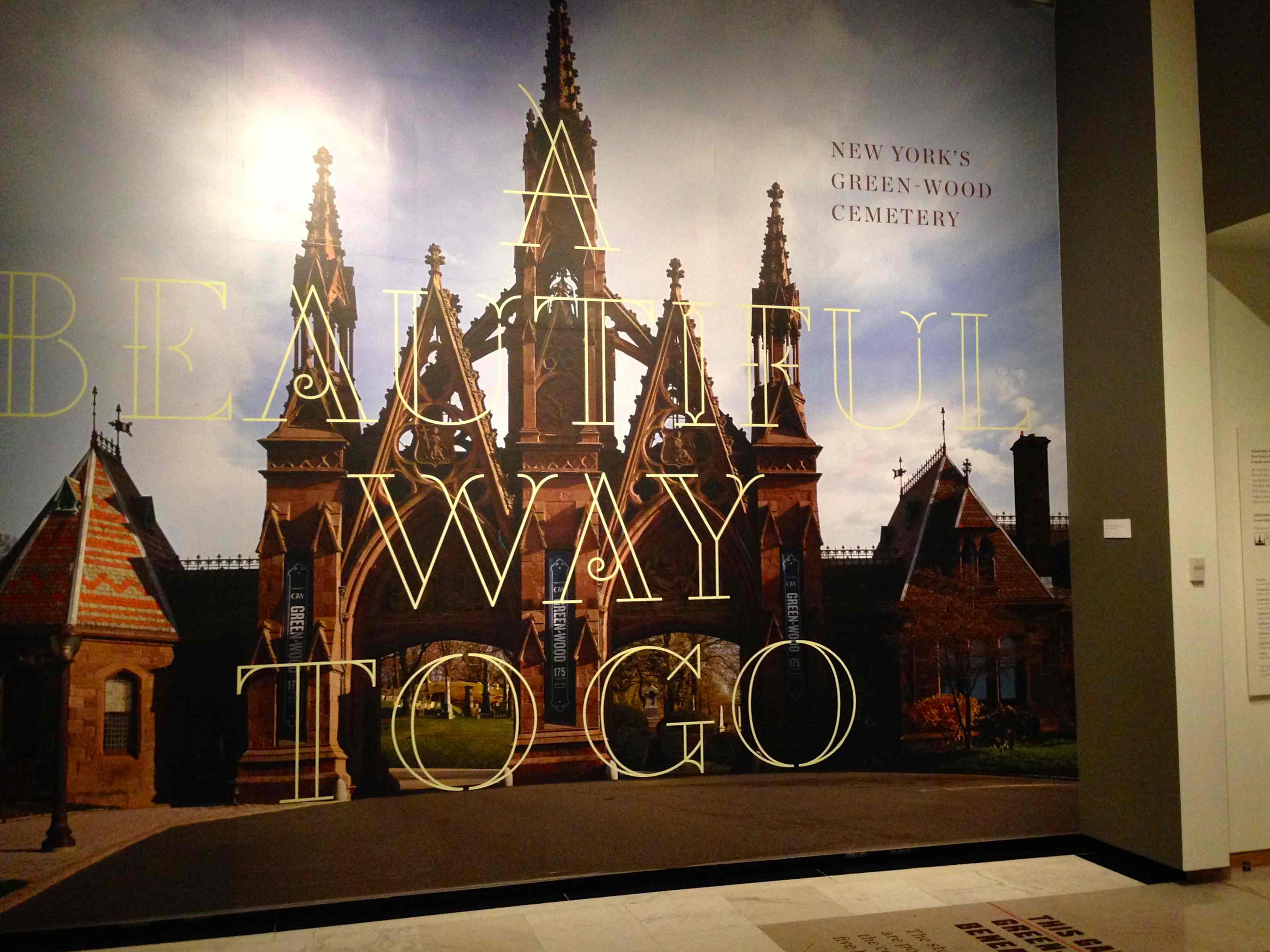
Show entrance featuring Green-Wood’s spectacular Gothic architecture.
It’s big, green, historic, beautiful, and has more celebrities inside than you could ever imagine possible in an out-of-the-way spot in Brooklyn. Any day of the week, you can take a trip out to the lush woodlands, hills, and statuary gardens of Green-Wood Cemetery (and you should!), but every NYC history geek needs to visit the Museum of the City of New York’s A Beautiful Way to Go: New York’s Green-Wood Cemeterybefore October 13 to plumb the riches that have been assembled to celebrate its 175-year history.
We’re providing a walk-through on our Flickr feed, but the virtual experience is no match for the first-hand encounters with objects associated with the New York titans that are interred within the 478 acres of hills and countryside of Green-Wood itself – Tiffany, Duncan Phyfe, Boss Tweed, and even The Little Drummer Boy.
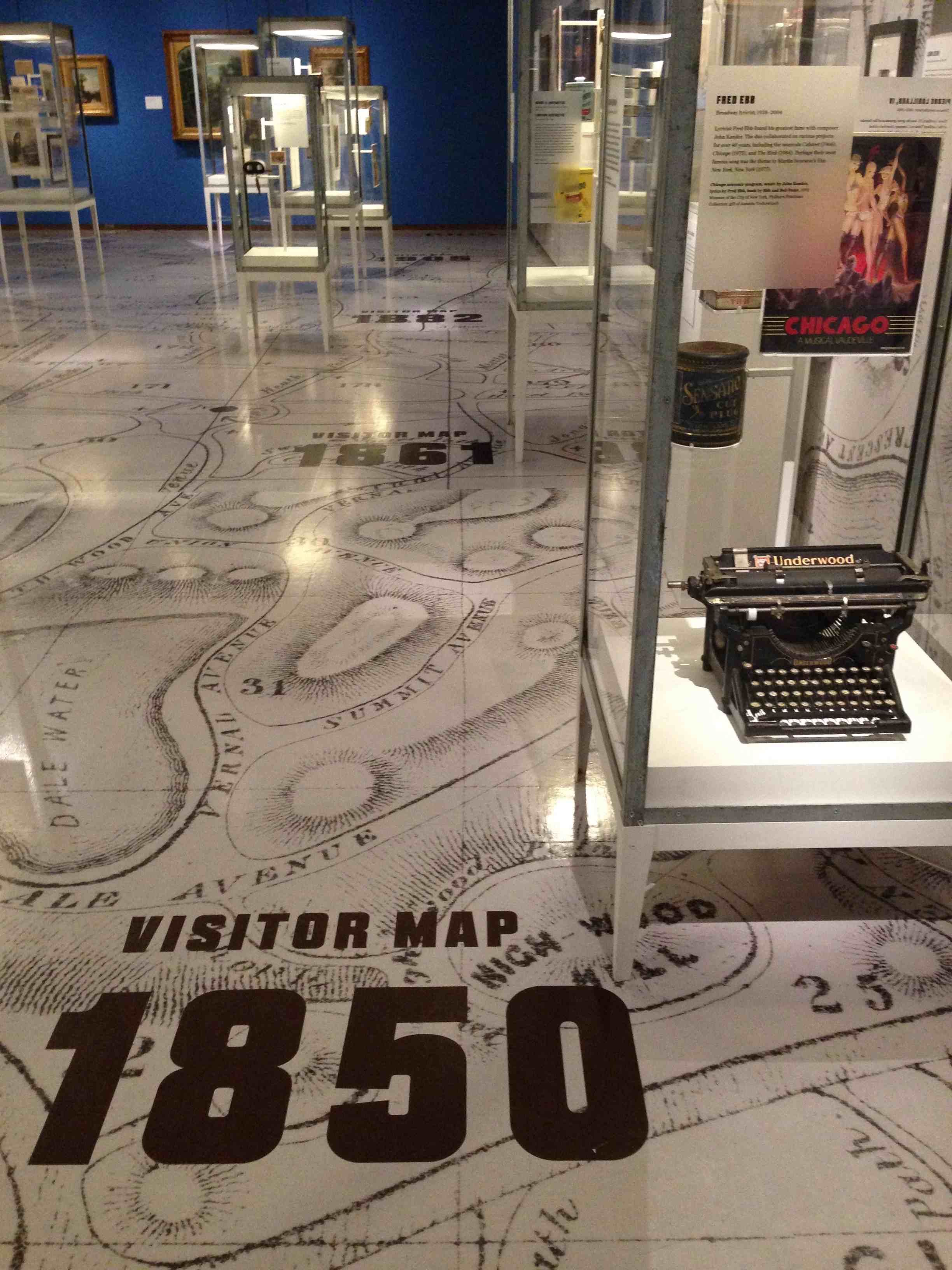
The floor map and vitrines with items associated with Green-wood’s most famous
Consider the retail giants and brands: All five Brooks Brothers (who invented ready-made suits in 1849), the six Steinways who made pianos in Queens, Ebhard Faber (remember pencils?), the Domino Sugar owners (who once had 98% of the entire US market and who gave most of their vast art collection to the Met), the creator of Chiclets, the founder of Pan Am, and even F.A.O. Schwartz (yes, it’s a person).
MCNY has put the map of Green-wood on the floor of the gallery and has placed vitrines with objects associated with the rich and famous sort-of where they would be in the actual cemetery. Walking through the show is like random-access memory. You don’t know what or who you’ll stumble upon.
The tribute includes artists (from Currier & Ives and Asher Durand to Leon Golub, Nancy Spero, and Jean-Michel Basquiat); composers (Frank Ebb, Mr. Bernstein, and disco legend Paul Jibara); and inventors of things like the safety razor, the sewing machine, soda fountains, and the safety pin (think about that). Yes, it all happened in New York.
Spanish-language poster for “The Wizard of Oz” as a tribute to Frank Morgan, who played The Wizard
Green-wood is New York’s equivalent of the Pere Lachaise Cemetery in Paris, full of vistas, trees, paths, lakes, works by celebrity sculptors, military memorials, and elaborate, ornate above-ground tombs. Lachaise spawned an international mania for sylvan-glade cemeteries when it opened in 1804, and when Mr. Pierrepont was laying out the Brooklyn street system in the early 1800s, he left a big, open green spot in the plan, where Green-Wood is today. It opened in 1838, predating Central Park, and grew into the No. 2 tourist attraction in the United States (after Niagara) by the 1850s.
An 1875 Howe Sewing Machine by the inventor of the sewing machine, Elias Howe.
The show’s front hall has spectacular landscape photos taken last year by Jeff Chien-Hsing Liao, serving as luring calling cards to take the actual expedition to Green-Wood and its celebrated trolley tours led by uber-historian Jeff Richman.
The 325 square-foot solution on display at MCNY: the TV wall slides away to reveal storage shelves. Source: MCNY
With all the single people living in Manhattan and the outer boroughs, it’s kind of shocking to find that building stylish, affordable micro-units is still illegal in most of the City. What’s a renter to do?
It’s no surprise that the housing stock here doesn’t match the demand. MCNY and the Citizens Housing & Planning Council got together to put on a show that raises the possibility of change, showcases several innovative solutions proposed by design teams, and presents a full-scale, walk-through model apartment: a 325 square-foot micro-space (built and furnished by Clei and Resource Furniture).
The sofa turns into a bed. Source: MCNY
Apparently our City’s is due to grow by 600,000 people over the next 20 years, so the question becomes – where is everyone going to live? How can people live affordably? Is there a way to create living spaces that are flexible as families grow? Listen as CHPC’s Jerilyn Perine lays it all out in this fascinating 11-minute presentation at the 2011 kick-off to the project, focusing on housing demand, illegal rentals, and rental history in New York.
Currently, the City regulates things such as occupancy, density, minimum room size, parking areas, lot coverage, the number of dwelling units that can be on a single lot, and the proportion of living vs. working space in some parts of town. And, yes, most neighborhoods prohibit building spaces like the micro-studio at the center of the MCNY show. CHPC’s projects imagined what could be if some of those regulations (well intended) were relaxed.
Read about the background of CHPC’s Making Room project and design competition and find links to related TED talks, sites, and the proposed design solutions – stacks of prefabricated apartments, mini-bungalows for the Bronx, and repurposed industrial spaces in Brooklyn. The CHPC site shows details of each of the five featured plans.
But the star of the MCNY show is the model studio. Here’s a video of what you can experience for a few more days. (The show was held over by popular demand.) Note the transformation of the Cubista (the ottoman-looking piece of furniture that unfolds), and so many other smart small-space design choices.
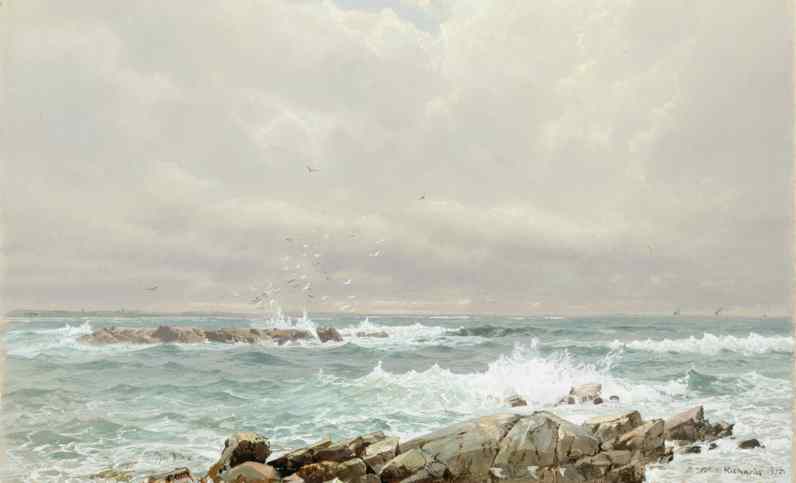
Tintagel, 1881. Large, masterful watercolor by William Trost Richards depicting castle ruins on the Cornwall coast of England, which Richards associated with the legends of King Arthur. Who needs to mess with oil paint and build big canvases when you can do this with water and paper?
In a brilliant pairing, the National Academy Museum has mounted dual shows by artists who draw their greatest inspiration from water. There’s no need for a trip out of town to experience crashing waves, monumental waterfalls, and wide expanses of sea and sky done by one of America’s greatest watercolorists of all time and a celebrated 21st century painter.
William Trost Richards: Visions of Land and Sea features 60 works from the Academy’s collection – early graphite sketches, oil paintings, and beautiful, grand, sweeping watercolor vistas that are some of the tiniest, most meticulous works you’ll see anywhere. Some are on display for the first time, which is remarkable considering that critics believe WTR to be among the greatest American landscape painters of the 19th century.
Seascape (1875), a tiny but monumental watercolor by William Trost Richards on cream paper. It’s only 9 X 14 inches. Source: National Academy
Inspired by Ruskin and the Pre-Raphaelites early in his career, WTR began documenting the intricacies of the Wissahickon River paths near Germantown, on the outskirts of Philadelphia. He soon became part of the American watercolor movement that began making works that were just as grand, romantic, and full of transcendence as anything by Church or Bierstadt. Quite a feat, when you’re working on such a tiny scale.
He spent years perfecting vistas of the ocean and sky from his home near Newport and on travels to the edges of the British Isles. Remarkably, he kept the horizon low to showcase the sky, all meticulously painted and built up from a ground of blue-gray wove paper. It’s remarkable how he evokes mood, rocks, night, dusk, and pale sky from that gray. Click here for more.
Steir’s monumental Blue River (2005) – one of her celebrated Waterfall series. Steir’s monumental Blue River (2005) – one of her celebrated Waterfall series. The video shows its true scale.
Pat Steir’s paintings, on the other hand, feature an opposite approach. Like Sam Francis or early post-Pop color-field painters, she pours, splatters, and drips her paint across canvases that seem a mile high and a block long. The masterwork on display at the Academy is Blue River, a virtual waterfall that’s just as mesmerizing as any of WTR’s watercolors, but done in bold, wide strokes on a larger-than-life canvas.
Go this weekend and delight in the masterful scenery. Pat herself indulges in the joy right here.
If you miss the Academy show, be sure to look for Pat’s Everlasting Waterfall hanging on the Fifth Floor of the Brooklyn Museum right next to Church.

















 itsnewstoyou