Astonishing Colorful Carved Stone Collections in The Met

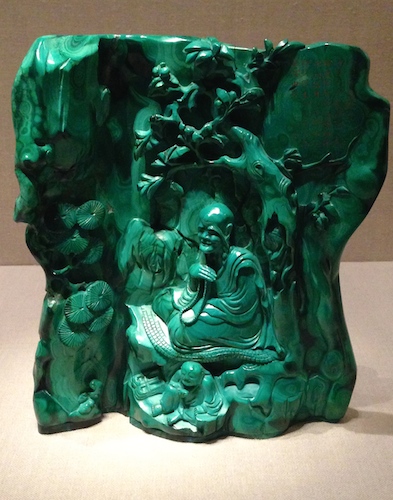
Converse had to have this tiny green malachite sculpture of a teacher seated in a grotto.

Converse had to have this tiny green malachite sculpture of a teacher seated in a grotto.

The tiny show in the upper gallery at the far, far end of the Metropolitan Museum’s Asian Wing shows just how far two industrialists would go to collect eye-popping dazzlers from 18th and 19th century China. Colors of the Universe: Chinese Hardstone Carvings runs through October 9, 2017.

The curators want you to now that intricately carved and polished stones from China’s Qing Dynasty go way beyond green and white jade to the blacks, tans, reds, oranges, roses, and blues of a wide variety of stones available to the Chinese 18th and 19th century artisans — malachite, chalcedony, amethyst, coral, lapis, and carnelian. See them all lovingly displayed in Gallery 222.

Look at our Flickr page, and check out other images in the Met’s photo gallery. If you can get to the Met, walk all the way to the end of the Asian wing on the Second Floor and take the stairs or elevator up. When we visited, there were no shortage of Asian tour groups filing through and snapping photos.

Who wouldn’t want to have a miniature Peanuts and Jujube Dates carved from chalcedony in 18th century China? Heber Bishop bought it

Who wouldn’t want to have a miniature Peanuts and Jujube Dates carved from chalcedony? Heber Bishop bought this. It’s just over one inch high. 18th c. China

The ancient art of Chinese stone carving reached its zenith during the Qing (1644-1911), known in movies and pop culture as the Manchu Dynasty. It was a time when emperors painted and wrote poems, the Peking opera was born, and culinary culture (tea ceremonies and gourmet dishes) rivaled today’s elevation of foodie culture. Scholars and the highly educated upper classes went to town outdoing one another with ink, paper, and acquisitions.

Qing craftsmen enjoyed lots of royal patronage, and any materials required to produce something fantastic – including colorful stones — were available. Although this show includes personal jewelry and a few carved pots and brushes used by high-end scholars, the focus is really on the “look at this” display pieces.
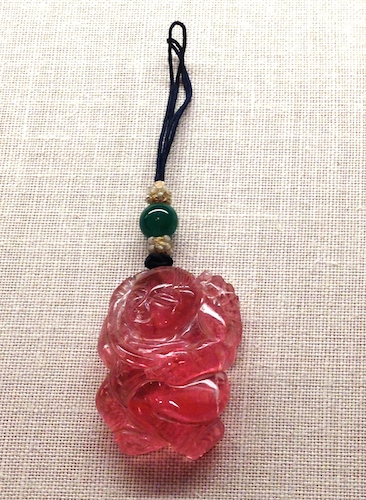
Tiny pendant in the Shape of a Boy, carved and polished tourmaline

Tiny pendant in the Shape of a Boy, carved and polished tourmaline

These fantastic pieces were mostly acquired by two powerful industrialists of 19th century and early 20th century New York. Colorful miniature landscapes, lions, kids, fruits, vegetables, and seafood were irresistible.

Several stunning pieces were bequeathed by Edmund Converse, an industrialist-collector who otherwise focused on big jade and European oil paintings. But even when his stuff went to the Met in 1921, the curators noted that the quality and delight of his assemblage of little colorful non-jade Chinese hardstones.

But most of what you’ll see in Gallery 222 was collected and given to the Met by Heber Bishop, an industrialist who began in the Cuban sugar business in the 1860s, but later went on to many other industries (gas, iron, and railways) and was one of the backer-builders of New York’s Third Avenue El.

Bishop could not resist a tiny polished lapis lion with a little cub peeking out. Its about 2 inches high

Bishop could not resist a tiny polished lapis lion with a little cub peeking out. It’s just over 2 inches high.

Like many cultured gentlemen of his time, his passion for anthropology and collecting found its end-point in many NYC institutions. He went everywhere and bought everything, including vast amounts of Asian textiles, lacquers, bronzes, swords, and ironwork, but he was crazy for jade. Eventually his collection surpassed any of the jade collections of European museums, and he decided to make a big donation to the Met.

Although there doesn’t seem to be any sign of it now, he made the donation on one condition – that the magnificent pieces be housed in a room that was an exact reproduction of his ballroom at home where it had been so lovingly housed.
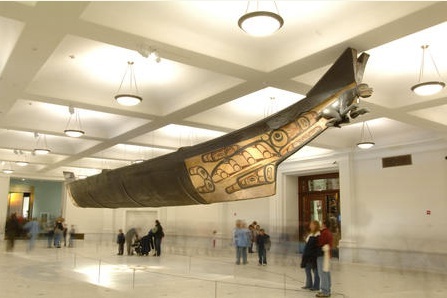
Bishop’s room-size Great Canoe donation across town. Photo: © AMNH/R. Mickens

Bishop’s room-size Great Canoe donation across town. Photo: © AMNH/R. Mickens

Who knows what became of that idea 100 years later, but we know that one of Bishop’s biggest buys did get it’s own room across town: Any day of the week at the American Museum of Natural History you can admire the spectacular 64-foot Haida canoe transported from Bella Bella, suspended in the recently spiffed-up Grand Gallery on AMNH’s First Floor. Although it’s wood, it’s carved from a single piece, just like his little Chinese stones.

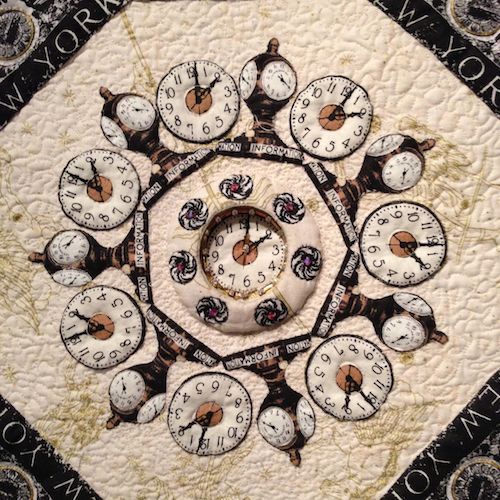
Little Quilts Honor Grand Central’s Big Sky

Center detail of Grand Prize quilt by Baltimore’s Amy Krasnarsky, Time Flies, But We Take the Train

Center detail of Grand Prize quilt by Baltimore’s Amy Krasnarsky, Time Flies, But We Take the Train

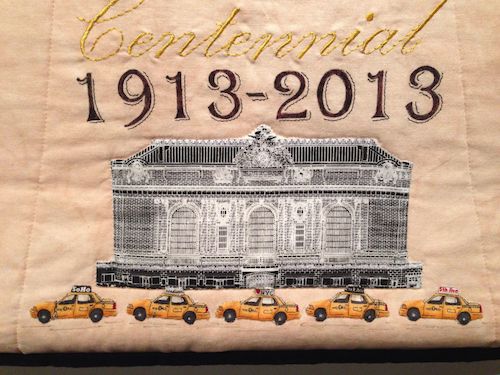
When you’re used to seeing large, magnificent quilts at the American Folk Art Museum, it’s a bit of a surprise to confront so many small ones as you walk through the doors of the New York Transit Museum’s annex to view the Grand Central Centennial Quilts exhibition (through July 6). But they’ve arrived from 15 states as part of a nationwide challenge to quilters to use some custom-designed fabric featuring Grand Central’s zodiac sky to say “Happy 100th Birthday” to our favorite transit hub.

A competition run by The City Quilter, a gallery and quilting emporium on West 25th Street, and American Patchwork & Quilting Magazine, inspired more than 80 quilters from 25 states to design, piece, stitch, and embellish creations that evoke the historic space. Everyone had to make a quilt to the same dimensions and incorporate the custom-patterned fabric designed by The City Quilter, “GCT Constellations” (the zodiac ceiling) and “Grand Central” with many of the terminal’s most iconic architectural elements.

Center detail of First Prize quilt, Grand Central Terminal Mandala, by Ligaya Siachongco

Center detail of First Prize quilt, Grand Central Terminal Mandala, by Ligaya Siachongco

You’ll see 30 of the best – three winners, nine honorable mentions, and other top finalists. Pop into the Annex and take a look.

The Grand Prize went to Baltimore’s Amy Krasnarsky, who used Beauty Blocks, sequins and trapunto to evoke the people who have trod those marble floors over the last 100 years. Amy worked in the acorns and oak leaves, which the Vanderbilt family chose to be their symbols and which are embedded in every nook and cranny of the lavish terminal. Once you begin looking, you’ll see them everywhere.

Ligaya Siachongco of Woodside, Queens, won First Prize by creating a mandala from the terminal’s architectural elements. Look carefully and you’ll see the exacting bead and applique work. The central clock appears “hidden” within a mysterious, secret space.

Abstract Second Prize quilt by Beth Carney of Yonkers, Chasms 16: Under the Stars

Abstract Second Prize quilt by Beth Carney of Yonkers, Chasms 16: Under the Stars

Abstraction was rewarded in Beth Carney’s lyrical interpretation, Chasms 16: Under the Stars.

She used sinuous, meandering stitched lines to evoke the passersby, train lines, veins of marble, tracks and tunnels – everything she sees when she travels down to the City and through the GCT from her home in Yonkers.

Hudon, Ohio’s Nancy Gary received an Honorable Mention, but achieved something quite unique – simultaneous views of the interior and exterior of GCT. Her quilt accurately conveys the dramatic interior of the terminal and those magnificent windows while also showing us the line-up of taxis along the 42nd Street stand. Everything is where it should be, including the black square on the ceiling – the tiles left by the restoration crew to show just how sooty the interior marble and zodiac ceiling used to be.

Kim Gimblette's quilt was one of the few to focus on the track diagrams and East Side Access

Detail of Kim Gimblette’s quilt, focusing on GCT’s track diagrams and the future East Side Access

Kim Gimblette of Ossining, New York, was one of the few that paid tribute to the track diagrams. She even added one in a different shade to represent the future of the station – the mighty East Side Access project that will eventually bring the Long Island Rail Road trains into Grand Central.

We couldn’t resist posting photos some of these amazing details here on the blog page, so go to our Flickr album to see the full-scale designs. The City Quilter’s Flickr page shows each of the artists next to their work. Click here to read each artist’s comments about their quilts.

Does this make you nostalgic for New York and wonder about what you’d create? If you have some time to sew, go to City Quilter’s on-line shop and order some NYC-themed fabrics. Get inspired by cotton yardage featuring the Big Sky of Grand Central (two color ways), architectural landmarks, the skyline at night, subway train cars, and – in case you wanted to channel a little Damien Hirst crossed with NYCT – subway dots of all the lettered and numbered lines.

Detail from Nancy Gary's quilt, featuring the taxi stand and so much more

Detail from Nancy Gary’s quilt, featuring the taxi stand and so much more

Vintage Attire on NYC Mean Streets

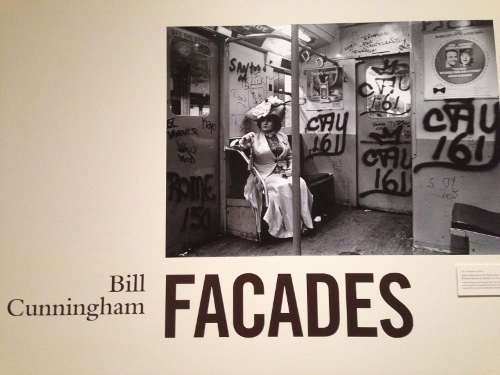
Editta Sherman in period dress on a graffiti-covered subway car to the Brooklyn Botanic Gardens

Cunningham’s photo of Editta Sherman in period dress on a 70s graffiti-covered subway car going to a shoot at the Brooklyn Botanic Gardens

Uber-fashion documentarian Bill Cunningham had a great idea in 1968, just as NYC was sliding toward financial crisis, crime, and (goes without saying) neglect of architectural sites, like Grand Central. Why not celebrate two centuries of NYC fashion and splendor on the street?

What were people wearing when some of the City’s most iconic homes, churches, and public buildings were built? Was it possible for a black-and-white photograph to reveal some new insight about the City from combining fashion, architecture, and a little fashion flair and attitude?

Editta poses for Bill  in embroidered frock coat and breeches  in front of St. Paul’s Chapel, the oldest church building (1766) in Manhattan

Editta poses for Bill in embroidered frock coat and breeches in front of St. Paul’s Chapel, the oldest church building (1766) in Manhattan

Results of Bill’s eight-year project are on display through July 15 in the Bill Cunningham: Facades photo exhibition on the second floor of the New-York Historical Society.

Without the aid of Wikipedia, he researched the years that some of his favorite historic places were built, and began scouring thrift stores for get-ups from the matching decade. He enlisted his muse, Editta Sherman, a fellow photographer and neighbor at the Carnegie Hall studios. For the next eight years, Editta and Bill went on weekend odysseys throughout the City, modeling and documenting over 500 historic outfits in front of interesting but sometimes forgotten facades.

In 1976, Bill gave 88 of his silver-gelatin prints to NYHS – the core of the current show, which is hung to emphasize the chronology of fashion and architectural style. The show was jammed with fashion lovers last weekend, soaking in the details from Bill and Eddita’s journey back in time.

Editta dresses for Bill in Gertrude Vanderbilt Whitney’s own Callot Soeurs at the 1904 Harry Payne Whitney House

Editta dresses for Bill in Gertrude Vanderbilt Whitney’s own Callot Soeurs at the 1904 Harry Payne Whitney House

It starts with Editta dressed in an 18th c. embroidered coat and breeches in front of the 1766 tower of St. Paul’s Chapel at Broadway and Fulton – the oldest church building in Manhattan that was considered “suburban” when President Washington lived here. Remarkably, they discovered this satorial gem in a Ninth Avenue second-hand store.

The visual treats just keep coming – a diaphanous Empire muslin on a model in front of City Hall (1803), Civil War-era frocks at Sniffen Court in Murray Hill, bustles and parasols at the 1884 Villard Houses (Helmsley Palace), and many spectacular gowns from the Gilded Age. Consider Eddita channeling “Diamond Lil” in front of 1891 Delmonico’s, the first modern American restaurant that innovated a la carte dining, private dining rooms, Lobster Newberg, and Baked Alaska.

In two photos, the team managed to borrow some historically relevant gowns – Gertrude Whitney’s Callot Soeurs frock for the shoot at the 1906 Payne Whitney home by Stanford White (Fifth & 79th) and Mrs. J.P. Morgan’s Worth gown at the gazelle gates of the Apthorp.

Bill Cunningham's take on modern fashions at the 1968 GM Building

Bill Cunningham’s take on modern fashions at the 1968 GM Building

The curators note that although women’s fashion in the early 20th century was fairly liberating, the public architecture of New York remained tightly classical. The show’s final shots soar with the optimism of the modern – the “New Look” in front of the Paris Theater (1948), full-skirted flair on Park Avenue by the Lever House (1952), Givenchy at the Guggenheim (1959), and mod looks at the GM Building (1968).

You will savor every minute of your journey with these creative geniuses. Check out a few photos on the NYHS web site, find a copy of the 1978 book Facades, or get to the show.

If you didn’t see the film about Bill, rent it from iTunes or Netflix or buy the DVD. You can glimpse  Eddita (a.k.a. The Dutchess) in the movie trailer below:

Trending in Fashion at FIT

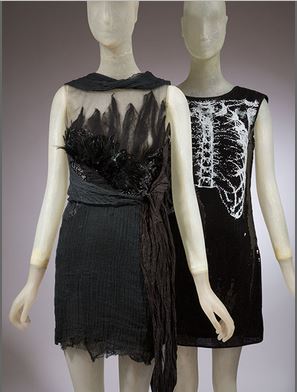
Rodarte’s California condor-inspired evening dress (2010) (left) next to their chest X-ray dress for Target (2011) (right)

Rodarte’s California condor-inspired evening dress (2010) (left) next to their chest X-ray dress for Target (2011) (right)

In contemporary times, you can’t really have a fashion trend unless you can get the items for your total “look” at H&M, Topshop, Macy’s, Nordstrom Rack, or another mass-market ready-to-wear site. Not everyone is fortunate enough to have designers send stuff over for a red-carpet look.

FIT’s wonderful Trend-ology exhibition acknowledges that although trends today may start from celebrity looks in magazines or on TV, they often arrive fairly quickly at Target, Zara, Express, and other shops. The pace of knock-offs has increased due to the mania for trend, faster speeds in shipping containers across oceans, and “instant” digital media.

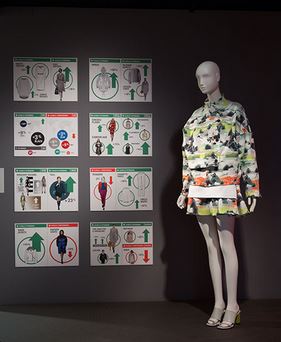
As soon as you enter the upstairs gallery, FIT features a wall of 2014 trend data from consultant WGSN right next to an “on trend” ensemble from Opening Ceremony.

WSGN trend analysis and “on trend” Opening Ceremony ensemble (2014)

WSGN trend analysis and “on trend” Opening Ceremony ensemble (2014)

You see at a glance how WGSN parses global runway shows each season into key looks, colors, tones, flower shapes, and skirt lengths for ready-to-wear company clients. Without detailed Paris-NY-Milan-London catwalk analysis, how would anyone know what was “trending”?

Spoiler alert: from the analysis depicted here, autumn/winter 2014 is all going to be all about pastel blue, the slip dress, hand-drawn patterns, and midi-length skirts.

There’s also an iPad streaming coverage of the latest award-show red carpet right in front of side-by-side ensembles by the Rodarte sisters – one from their 2010 high-end couture line and one from their sold-out line for Target in 2011.

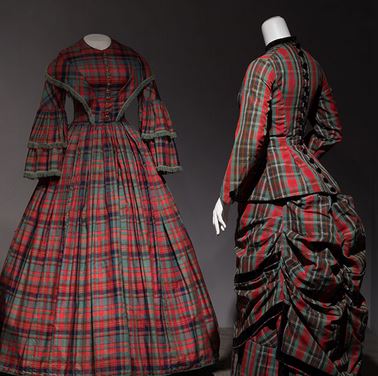
19th century passion for plaid in silk dress (1852) and wool bustle dress (1880).

19th century passion for plaid in silk dress (1852) and wool bustle dress.

The curators have stuck two former “it” bags in front of you, too – one from Fendi and the other from Murakami’s colorful collection for Vuitton.

A photograph from a look at Celine’s Fall 2013 collection is mirrored on the mannequin behind, who sports an identical look that’s being marketed to the masses at Zara.

From the vintage looks in the rest of the galleries, the curators prove that trends mattered in the last few centuries, too. Neon yellow hues became the rage in the late 1700s due to the proliferation of imported Chinese silks.

Plaid mania was inspired by Queen Victoria’s Highlands flings at Balmoral Castle in the 1850s, and the craze for mass-produced paisley proliferated throughout the 19th century, following the invention of the Jacquard loom.

Dior “New Look” (1950) (left) inspired Anne Fogarty to create a full-skirt dress for budget-conscious homemakers in 1954 (right)

Dior “New Look” (1950) (left) inspired Anne Fogarty to create a full-skirt dress for budget-conscious homemakers in 1954 (right)

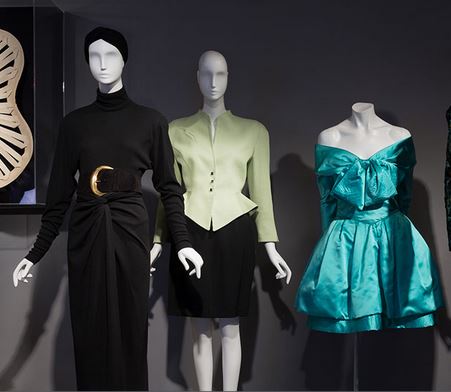
Of course, most of the galleries showcase trends from FIT’s vast archive of more recent fashions – Hollywood bias-cut silks, jet-set fashions following the British Invasion, disco-era menswear (the wide pant legs and patterned shirts seemed to baffle younger male gallery goers), Donna Karen’s iconic 1980s wrap-skirt-bodysuit, and fashions covered in designer logos from the 90s.

The biggest surprise: That Anne Fogarty’s “housewife” dress owes its genesis to Dior’s New Look. Hey, Lucy! Hey, Ethel!

Strangest item: Halston’s uncharacteristic tie dye ensemble that looks more like a Giorgio di Sant’Angelo than the nearby Giorgio di Sant’Angelo.

Greatest pleasure: Seeing the mini-documentary about the first days of Vogue magazine location shoots in the 1960s, surrounded by mod, space-age Carnaby Street looks.

Eighties trends: Donna’s wrap, Thierry’s cut, and an absolutely fabulous Lacroix

Eighties trends: Donna’s wrap, Thierry’s cut, and an absolutely fabulous Lacroix

Take a tour of 250 years of trends on FIT’s engaging, dazzling web site.

Folk Art Couture

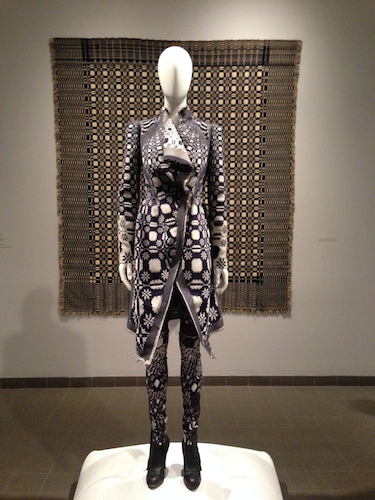
Gary Graham’s coat of wool/cotton jacquard in front of his inspiration — an 1810 Ann Carll Coverlet: “Blazing Star and Snowball.”

Gary Graham’s coat of wool/cotton jacquard in front of his inspiration — an 1810 Ann Carll Coverlet: “Blazing Star and Snowball.”

Delightful, whimsical carved animals from New Mexico don’t often appear on the runway with couture, but they certainly take center stage in the American Folk Art Museum’s fantastic show, Folk Couture: Fashion and Folk Art, which closes today.

No worries, though, the museum has created a detailed, media-rich exhibition site on Tumblr that gives you a close-up look at the fabrics, fashions, and folk art that inspired these fun, creative looks.

The museum pulled 100 of works from its collection and asked thirteen
designers to create clothes – wearable or not – that would reflect the scope, spontaneity, and sheer funkiness of folk art.

A steady stream of fashion-lovers worked their way through three galleries of beautiful clothes and creations inspired by collection pieces from across America — New Mexico folk-art porcupines inspired Jean Yu to make a straw-chiffon cocktail ensemble; an 1810 coverlet from Westbury, Long Island inspired Gary Graham to create a gorgeous jacquard-pattern coat and leggings; a religious sculpture made by German immigrants in North Dakota inspired Brazilian designer Fabio Costa to create an other-worldly white ensemble that would look at home in any avant-garde collection.

Closep-up of Michael Bastian’s sweater icon based upon an 1840s weathervane of the Archangel Gabriel. The look also features a hood with built-in earmuffs.

Closep-up of Michael Bastian’s sweater icon based upon an 1840s weathervane of the Archangel Gabriel. The look also features a hood with built-in earmuffs.

Apparently menswear designer Michael Bastian is a fan of this museum and loves its collection, so he fairly faithfully replicated an angel-weathervane icon on the front of his guy sweater and thought it would be fun (which it is!) to take the top hat and eyewear from a Michigan folk-art sculpture and put them right onto his mannequin’s head. The look is great — modern artist and old-fashioned at the same time.

Visit our Flickr album and the exhibition site to see all of the inspirations from the museum collection and learn more about each designer’s working process. We particularly liked the inspiration board in the gallery, which showed some of the process from art to reimagination to finished gown, coat, and dress.

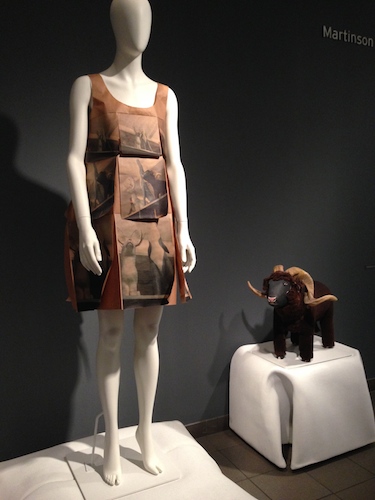
You can’t really beat Yeohlee’s paper dress, featuring images of New Mexico folk-art animals printed on Kraft paper and made into a modern and mod shaman ensemble. Chic and magical at the same time, just like her all of her collections and fans.

Yeohlee’s dress — Shamanistic Printed Prayer Flag Dress from Brown Kraft Paper. Among her whimsical inspirations — a ram carved in 1988 by New Mexico artist Johnson Antonio

Yeohlee’s dress — Shamanistic Printed Prayer Flag Dress from Brown Kraft Paper. Among her whimsical inspirations — a ram carved in 1988 by New Mexico artist Johnson Antonio

We’ve heard that this inspirational show will tour and we’ll keep you posted.

Subversive Chinese Brush-Up at the Met

Yang Jiechang’s Crying Landscape (2003) shares the Gallery for Art of Ancient China with a sandstone stele from the Northern Wei dynasty (489-495) and the 1319 Buddha of Medicine.

Yang Jiechang’s Crying Landscape (2003) shares the Gallery for Art of Ancient China with a sandstone stele from the Northern Wei dynasty (489-495) and the 1319 Buddha of Medicine.

Normally, the galleries for Asian Art at the Metropolitan Museum of Art are pretty tranquil. But through April 6, you’ll find them buzzing with contemporary art lovers reveling in the hunt to find the most famous, subversive, subtle works by Chinese painters, sculptors, and digital artists residing amidst centuries-old treasures in the widely popular exhibition, Ink Art: Past as Present in Contemporary China.

The Met gave the Chinese art curators free reign to pluck sly works from the in-house contemporary collections created by Chinese artists over the last 20 years, grab monumental works from private collectors, and mount a tribute to how post-Cultural Revolution innovators parse the traditions associated with centuries-old art making in their ancestral country.

How do the hottest artists on the planet turn calligraphy and inked woodblocks into biting social commentary? Take a stroll through the second floor Asian art wing.

Inspired by Cultural Revolution posters, the letters in Wu Shanzhuan’s Character Image of Black Character Font (1989) have no meaning.

Inspired by Cultural Revolution posters, the letters in Wu Shanzhuan’s Character Image of Black Character Font (1989) have no meaning. Courtesy: Private collector, the artist.

Just past the balcony-bar area, the monumental 1319 Buddha of Medicine mural from Shanxi Province, China, casts a benign presence over the Gallery for Art of Ancient China. But just stage right, two larger-than-life works on paper preview how Chinese artists twist the “then” into the “now”.

Yang Jiechang’s Crying Landscape panels are painted in the beautiful, colorful “old school” flat Asian style but depict decidedly unbeautiful industrial and political subjects. Similarly, Qiu Zhirie’s Nanjing Yangzi River Bridge ink triptych features masterful, large-scale ink-brush technique but uses art-world icons to relay a disturbing story. It’s an installation triumph that will haunt you every time you pass through that room again.

Large-scale calligraphy by many of the artists makes ink-pot-and-brush tradition echo with gestures as large as Rothko’s. In the galleries with meticulously crafted “landscape” drawings and images, you’ll ask how this modern crew managed to produce scrolls with such heft and detail. Take a walk-through of the show through our Flickr site.

In 1995, Ai Weiwei corporatized a Han Dynasty (206 B.C. – 9 A.D.) earthenware jar.

In 1995, Ai Weiwei corporatized a Han Dynasty (206 B.C. – 9 A.D.) earthenware jar. Courtesy: M + Sigg, the artist

Along the way to back of the wing, the curators play hide-and-seek, putting Ai Weiwei’s “enhanced” Han Dynasty jar right in the aisle with the “unmodernized” earthenware vessels, and mounting Hong Hoo’s subtly colored, hilarious historical “atlas” silkscreens in a case that practically dares unfocused visitors to pass them by as they drift toward the Astor Court.

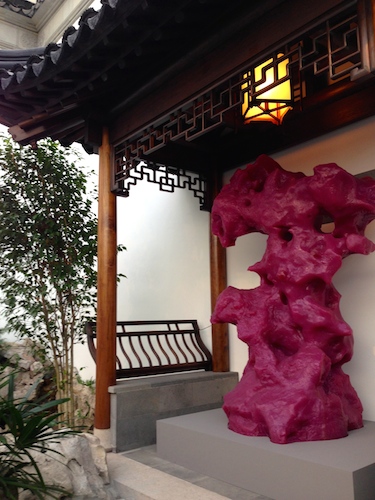
Hopefully by the time they get to the rock garden they will notice Zhang Jianjun’s crazy pink silicone rubber “scholar rock” right next to the real ones. Zhan Wang’s stainless steel scholar rock and Shou Fan’s side chairs are beautifully arranged in the Ming Dynasty room just off the Court, along with more of Ai Weiwei’s furniture hijinx.

After you’re done getting a feel for how the galleries have been transformed, go back into the Met’s exhibition web site to study the brushwork and details and get to know some of the artists.

Zhang Jianjun’s 2008 silicone rubber Scholar Rock (The Mirage Garden) sits in a 17th-century pagoda in the Met’s Astor Court

Zhang Jianjun’s 2008 silicone rubber Scholar Rock (The Mirage Garden) sits under a 17th-century pagoda in the Met’s Astor Court. Courtesy: Sigg Collection, the atist

Although the web site appears to be more plain-vanilla than jazzy, you’ll be surprised to see that the digital back-end of the Met archives lets you zoom into each of the paintings to see the handsome handwork of each of these wunderkinds from each thematic section of the show. You can even peruse the gigantic scrolls up close, section by section.

The video room, where art lovers can relax and watch a rotating collection of work, is a nice touch. The modern digital sign to the side tells you exactly where you are in the rotation.

Here’s a link to one of the featured videos: Get to know the constantly transforming cityscape of Beijing through Chen Shaoxiong’s 2005  Ink City, and see what happens when a contemporary artist paints daily life in Beijing with traditional tools and ports his day-to-night experience to video.

FIT Students Digitize and Unzip Biker Jacket History

The 1980 version of The Perfecto, which debuted in 1928 and is still sold by Schott Bros. Source: FIT

The 1980 version of The Perfecto, which debuted in 1928 and is still sold by Schott Bros. Source: FIT

The FIT fashion and textile grad students always pull out the stops on their shows in the Museum at FIT’s side gallery, turning mini-shows into main events, as in their current exhibition, Beyond Rebellion: Fashioning the Biker Jacket. The gallery installation highlights the jacket’s role in history, culture, couture, and street fashion, but the team makes its history come alive even further on their superb companion digital site featuring photos, videos, and the historical context. See the jackets in person and touch the leather swatches before April 5, and go play with the web site at any time.

The digital timeline begins with the birth of the motorcycle in the UK in 1902, but the fashion story starts in 1928 with the debut of the leather riding jacket, The Perfecto by the Schott Bros. It’s the template upon which all other cool looks – street, couture, punk, ready-to-wear – are based. It combines the swag of a WWI aviator jackets with the utility and protection needed by one of the original road warriors. Retail: $5.50.

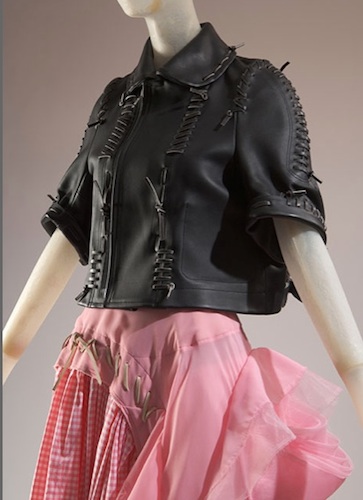
From Rei Kawakubo’s 2005 Biker + Ballerina collection (leather, gingham, and tulle) for Comme des Garcons. Source: FIT.

From Rei Kawakubo’s 2005 Biker + Ballerina collection (leather, gingham, and tulle) for Comme des Garcons. Source: FIT.

In the first gallery next to The Perfecto, fashionable visitors were hovering to take in all the information in Paula Sim’s excellent illustrated deconstruction of the jacket’s iconic design features as if it were the Rosetta Stone. How and why did the details we know so well all originate? The asymmetrical zip thwarts wind, epaulets secure riding gloves during breaks, the belt keeps wind from whistling up your back, and zips at the wrist do the same for the glove-sleeve juncture. The extensive use of hardware was a desirable touch inspired by chrome and metal features on the just-taking-off auto industry. Want or need?

It didn’t take long for motorcycle-loving vets to start applying patches and insignias to the aviator-inspired jackets, just as they had done with patches, insignias, and pins during the war. By the 1930s, as shown on the timeline, club patches gradually became associated with “outlaw” clubs. Nevertheless, the popularity of motorcycle riding grew, documented by the curators with a 1951 Sears catalog showing a premium $33.95 leather moto jacket featuring a snap-off lamb collar and “built-in kidney support”.

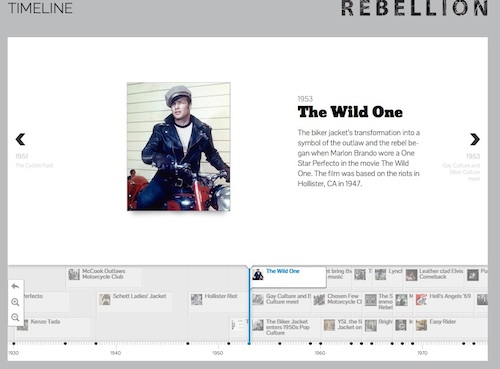
Screenshot from the FIT show timeline

Screenshot from the FIT show timeline

As the curators note, the watershed year for this utility bomber was 1953, when Brando sported cuffed-jeans-and-jacket attire in The Wild One. Banned initially in the UK, the film (and Brando) became a sensation, giving mass audiences a pop-culture version of what happened in the 1947 Hollister, California motorcycle club riots.

The style went viral, pushed further into street-style consciousness by emerging rock-and-rollers and The King himself, Elvis. Take a look at some iconic 50s performances that the digital curators included on the show’s website. Scroll up to 1956 in the timeline to see Gene Vincent tear it up onstage and to 1968 to see Elvis rocking his leather look doing Jailhouse Rock in his NBC comeback special.

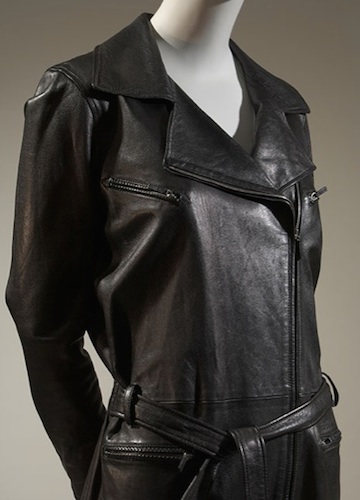
It's so Schott: Stefano Pilati’s Fall 2009 jumpsuit for YSL. Source: FIT, gift of YSL.

It’s so Schott: Stefano Pilati’s Fall 2009 jumpsuit for YSL. Source: FIT, gift of YSL.

In 1960, YSL became the first high-fashion designer to bring the biker look to the runway – a move that contributed to his exit from the House of Dior. Never mind, though. When he opened his own house two years later, he continued riffing on the bad-girl theme.  The rest was history, with plenty of rock musicians, high-end designers, and Vogue stylists following suit.

The curators feature New York’s own Ramones as the epitome of the 1970s motorcycle-jacket-wearing punk-music rebels, and present lots of album covers as evidence of the jacket’s enduring presence.

As for fashion from the FIT collections, the team has pulled together a dozen high-end interpretations, beginning with Mr. Versace’s 1993 gold-stitched biker jacket with pull-tab logo hardware and a more subdued version by Emporio Armani. Fashion lovers have plenty of other versions to savor from Ms. Herrera, Rick Owens, JPG, Rei Kawakubo, and others.

All the techniques rolled into one in Jean Paul Gaultier’s 1987 creation of leather, fake fur, suede, and wool. Note the trapunto, elbow studs, fringe, and pin stripes. Source: FIT, gift of Anne Zartaian.
All the techniques rolled into one: Jean Paul Gaultier’s 1987 leather, fake fur, suede, and wool jacket with trapunto, elbow studs, fringe, and pin stripes. Source: FIT, gift of Anne Zartaian.
In the far corner, the team offers a wall where you can touch and compare different types of hides and treatments used for jackets, marvel at the trapunto-on-leather techniques Mr. Versace and JPG used so extensively, and learn that patent leather was invented in 1811.

If you can’t get to FIT in person, browse through the fantastic exhibition site, listen to the nine-minute audio tour, and download the exhibition brochure. Better yet, do both.

As for the current popularity of the biker jacket on the Streets of New York, enjoy the slide show by the FIT student team, shot on the only warm weekend day so far this year in Williamsburg:

The Most Lavish Natural History Show in the World

Remember 17th c. Dutch tulipmania? JAR
Tulip Brooch 2008 made of
rubies, diamonds, pink sapphires, garnets, silver, gold, and enamel. Private collection.
Photo: Jozsef Tari. Courtesy: JAR, Paris.

Remember 17th c. Dutch tulipmania? JAR
 Tulip Brooch 2008. Rubies, diamonds, pink sapphires, garnets, silver, gold, and enamel. Private collection.
Photo: Jozsef Tari. Courtesy: JAR, Paris.

If you took the detailed observational field skills and plant-and-animal artistry of JJ Audubon and crossed them with the gold-and-jewels precision of a Fabergé master, you can understand the enjoyment, beauty, and wonder that await the luxury-lovers crowding into Jewels by JAR, the Metropolitan Museum of Art’s tribute to the world’s most exclusive and reclusive jewelry artist. Meditate on his exquisite take on the natural world before it all goes back to the vaults on March 9.

Plenty of worshippers were wielding tiny flashlights last Saturday night, working their way meticulously through the darkened gallery perusing every detail of 400 tiny, sparkling, jewel-encrusted pieces by JAR (or, Joel A. Rosenthal as he was known growing up in the Bronx). He’s one of the world’s experts in the pavé technique and achieves subtle effects by painstakingly arranging miniscule diamonds, rubies, opals, and amethysts across gold, platinum, and silver surfaces.

JAR’s 2010 bracelet evokes snow on branches. Diamonds, silver, and platinum.
Private collection.
 Photo: Jozsef Tari. Courtesy: JAR, Paris.

JAR’s 2010 bracelet evokes snow on branches. Diamonds, silver, and platinum.
Private collection.
 Photo: Jozsef Tari. Courtesy: JAR, Paris.

Despite being one of the most sought-after jewelers in the world, JAR will not do commissions. Each piece is one of a kind, so the subjects that he chooses tell you a lot about him. Look closely.

The first case features bracelets, earrings, brooches, and necklaces fashioned into exact, delicate replicas of just about anything you can find at the New York Botanical Garden on a spring day — gardenias, roses, camellias, tulips, lilacs,  carnations, wisteria, pansies, and even wild oats. Across the room, you’ll see perfect oak leaves and acorns (made from diamonds, platinum, silver, and gold) formed into dramatic rings, cufflinks, necklaces, and earrings.

Growing up, JAR loved roaming the halls of the American Museum of Natural History and the Met, which shows. He’s made one pair of pendant earrings (No. 83) from iridescent beetle wings, married with tiny emeralds, garnets, and diamonds set into silver and platinum.

JAR
Butterfly Brooch
1994.
Sapphires, fire opals, rubies, amethyst, garnets, diamonds, silver, and gold.
Private collection.
Photo: Katharina Faerber. Courtesy: JAR, Paris

JAR 
Butterfly Brooch
1994.
 Sapphires, fire opals, rubies, amethyst, garnets, diamonds, silver, and gold.
Private collection.
Photo: Katharina Faerber. Courtesy: JAR, Paris

Right next to that (No. 84) you’ll see his 1981 Egyptian-style faience earrings with emeralds, coral, and gold — a 20th century take on the Middle Kingdom. He’s crafted stalactite earrings (No. 93) from diamonds and silver and found a heart-shaped pebble into which he’s set a perfect ruby surrounded by silver and gold (No. 283).

In the center of the room there are moon and stars pendant earrings (a tribute to Cole Porter) made of sapphires and diamonds (No. 274), and a box (No. 260) inspired by lightning (rock crystal and diamonds). JAR’s 1991 Phases of the Moon Bracelet, made of basalt, diamonds, silver, and platinum, makes you think he probably also hung out at the Hayden in his youth.

The finale to the gallery is the Met’s jeweled twin to the AMNH Butterfly Conservatory – a wall in which 22 of JAR’s beautiful butterflies take flight. OK, there are 2 dragonflies in there, too, but the overall message is butterflies.

A few animals are in the show, too. JAR
Zebra Brooch
1987
made of agate, diamonds, a sapphire, silver, and gold.
Private collection.
 Photo: Katharina Faerber. Courtesy: JAR, Paris

A few animals are in the show, too. JAR Zebra Brooch 1987
made of agate, diamonds, a sapphire, silver, and gold.
Private collection.
 Photo: Katharina Faerber. Courtesy: JAR, Paris

Every person in the crowd seemed to pause here in the dark to choose which creature was the most beautiful before entering the bright, unforgiving lights of the gift shop. A personal favorite was the 1987 Dragonfly Brooch (No. 378) with double-layered rock crystal wings.

If you love nature, wit, color, and fool-the-eye magic, you’ll like getting lost in the dark among the billions of points of light that JAR has created in his glittering universe.

Exquisite Journey Through Time via Modern Venetian Glass

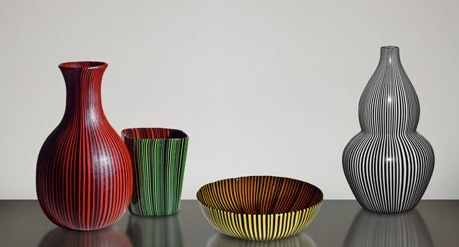
Scarpa’s striped Rigati e tessuti glass pieces (1938–1940). Sources: private collection; Carraro Collection (Venice); European Collection

Scarpa’s striped Rigati e tessuti glass pieces (1938–1940). Sources: private collection; Carraro Collection (Venice); European Collection

The gorgeous art and design show at the Metropolitan Museum of Art, Venetian Glass by Carlo Scarpa: The Venini Company, 1932–1947, is deceptive.

It’s a tribute to one of the top innovators in Murano glass, stepping visitors through more than two dozen styles and innovations that he brought to glass-making, but it also provides a brilliant introduction to the virtuosity that characterized decorative luxury items as far back as the first century B.C. See it before March 2.

Scarpa was inspired by 18th c. Chinese porcelain. Source: The Met

Scarpa was inspired by 18th c. Chinese porcelain. Source: The Met

Scarpa, a trained architect, began working as an artistic consultant at Paolo Venini’s glass factory in Venice right after he graduated, but soon his creativity and vision catapulted him into the job of artistic director and into the spotlight with every new collection he debuted at the Venice Biennale.

At the start of the show, you’ll see his Bollicine group (1932-1933) with tiny air bubbles incorporated into each white, blue, black, and green piece. In awe of the artistry of Eastern Asia, he fused this modern technique with a reliance on traditional shapes from one of his favorite periods of Chinese porcelain – the Qing dynasty (1644-1911), where ceramic artists crafted bold, dramatic single-color works. Check. Let’s take a page out of that book and put it to use in creating sleek, modern icons of Italian design.

At the far side of the circular Lehman Wing gallery, the Met curators have put together a shelf that fools you from a distance. You’ll think that the gorgeously modern works are all opaque glass masterpieces by Scarpa, but only half are. The rest are beautifully arranged works from 18th and 19th century China from the Met’s own collection.

Scarpa’s bubble-glass liqueur set (1935). Source: The Met.

Scarpa’s bubble-glass liqueur set (1935). Source: The Met.

Venini and Scarpa felt it was important to document the specific silhouettes that they created, and the Met has matched the archive shape with many of the modern glass works in the collection.

Just look at each label and wonder what the 18th century Chinese ceramicists would think of their shapes being transformed into glass marvels.

Working your way around the gallery, you’ll experience astonishing artistry resulting from dozens of technical approaches – for example, glass with rough, irregular surfaces (Corrosi 1936-1938), glass blown from thin slabs made of alternating clear and colored glass rods (Mecca filigrana 1934-1936), boldly striped pieces, and iridescent glass (Iridati, 1940). The variety and effects are astonishing and it’s easy to float dreamily through this art for art’s sake show.

Luxury Italian modern glass from the early 1st century A.D. Source: The Met, gift of Henry G. Marquand, 1881

Luxury Italian modern glass from the early 1st century A.D. Source: The Met

The curators also make use of the Met’s vast collection of ancient glass to remind modernists that the glassmaking tradition extends back nearly two millennia along the Mediterranean and Adriatic shores.

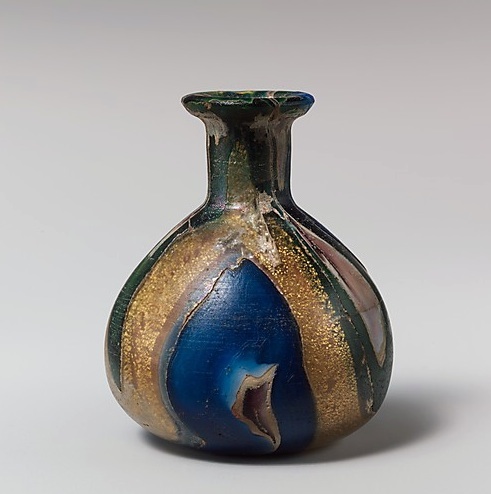
Be sure to look for the Met’s cast glass created in Greece between the 2nd century and 1st century B.C. and in Rome from the late 1st century B.C. to the early 1st century A.D. Glass was a super-high-end luxury item back in those days.

You’ll be blown away by how modern it all looks.

This mosaic glass dish may look like Italian 1980s, but it’s Greek from the 2nd-1st century B.C. Source: The Met

This mosaic glass dish may look like Italian 1980s, but it’s Greek from the 2nd-1st century B.C. Source: The Met

The Art of ElBulli’s Culinary Genius

Notebooks and menu drawings from ElBulli’s kitchen displayed in front of a mural of Ferran Adrià and staff in Roses, Spain in the most famous kitchen in the world. Courtesy: elBullifoundation, The Drawing Center

Notebooks and menu drawings from ElBulli’s kitchen displayed in front of a mural of Ferran Adrià and staff in Roses, Spain in the most famous kitchen in the world. Courtesy: elBullifoundation, The Drawing Center

If you weren’t able to visit the famed ElBulli restaurant on the coast of Spain before it closed two years ago, don’t worry. Pop down to Soho to meet the man, his team, and his legacy through The Drawing Center’s provocative show, Ferran Adrià: Notes on Creativity, running through February 28.

Even if you can’t taste the world-renowned creations, you’ll feel as though you’ve entered his kitchen during the six months per year that his team worked on R&D through up-close looks at experiments, plating, techniques, codes, inventions, and graphic treatises. Take a look at the installation on our Flickr feed.

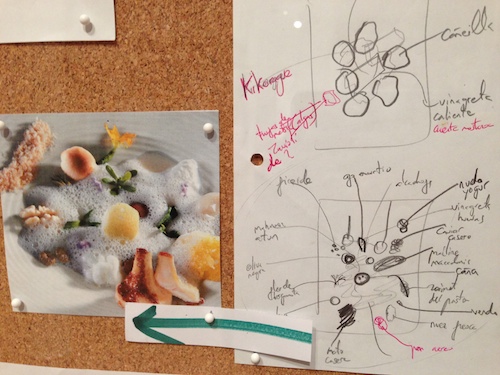
Close-up of large working board of photo and diagrams document the plating and components of each dish. Courtesy: elBullifoundation

Close-up of large working board of photo and diagrams document the plating and components of each dish. Courtesy: elBullifoundation

Last weekend, the Wooster Street space was jammed with visitors eager to see glimpse the genius behind the magic of the famed elBulli – notebooks filled with diagrams of exacting platings of food, a room inside the gallery evoking elBulli’s Barcelona archive, huge storyboards pinned with drawings and photographs of artist-inspired dishes, and glass-topped tables containing inventions that created some of the most amazing food–art in the world.

Examples: the apparatus that turns cheese into “spaghetti”, the glass bowls used to serve diners “edible air”, or the cocktail device that literally sprays a dry martini right into a diner’s mouth.

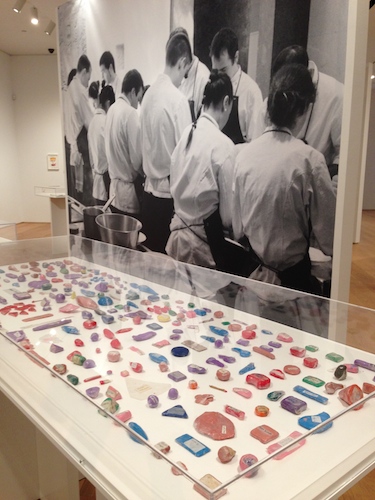
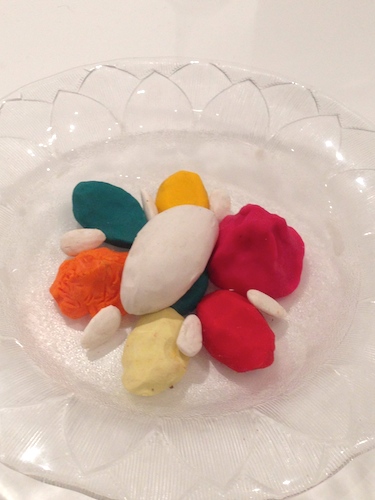
240 plasticine models used to standardize recreation of the sizes and shapes of various portions of food used as components in his highly inventive, artistic dishes. Courtesy: elBullifoundation, The Drawing Center

240 plasticine models used by staff to recreate precise shapes and portions of artistic dish components.

And how do you keep the beautiful dishes consistent? By making little plastic sculptures so that the kitchen crew knows how to duplicate forms for delicate platings precisely on everyone’s plate. When you’re delivering identical 40-course dinners to guests who have flown halfway around the world to join you for dinner, precision counts.

Improvisation may have happened during the six months of the year that elBulli shut down to devote itself to R&D, but not so much during dining-season crunch time. Just look at the large wall drawing that Adrià sketched for this show — Map of the Creative Process: Decoding the Genome of Creativity. Organization is key.

Last weekend, there were no empty seats in the downstairs video viewing gallery, as visitors sat mesmerized by 1846, the 90-minute film co-produced by The Drawing Center, showing every dish Adriá ever served at elBulli (1987 – 2011).

Plasticine model of the 1994 Le Menestra dish composed only of textures, including cauliflower mousse, basil jelly, almond sorbet, avocado, and numerous other components. Courtesy: elBullifoundation

Plasticine model of the 1994 Le Menestra dish composed only of textures, including cauliflower mousse, basil jelly, almond sorbet, avocado, and numerous other components.

Photos of gorgeous, glistening food on plates, rocks, and wood lilted by to an opera soundtrack punctuated by the sounds of water lapping on the shore near the restaurant.  Plates of vegetables, seafood slices, sprigs, and flowers wafted by. What are those spoons filled with? What appeared to be “hatching” out of that egg? What was the egg? What was perching on a stalk like an insect? The effect made you feel as if you were seeing life on Earth evolve…biomorphic shapes surrounded by foam.

You could tell that these art-and-food lovers had absorbed the exhibit upstairs when there was a collective gasp of recognition when the real-life version of La Menestra (accurately and lovingly represented in plascticene upstairs) floated onto the screen.

Since he shut the most desired and famous restaurant in the world, Adrià has been hard at work making sure that his thoughts, processes, philosophy, and research were well documented and translated to digital form. Although it’s still in beta, he’s incorporating it all into an online encyclopedia of gastronomic knowledge.

Kudos to Brett Littman and his team at The Drawing Center for mounting a show that pays tribute to food-as-art and shows us how creativity, inspiration, and documentation (in the hands of an genius, or team of geniuses) can turn experiments in a kitchen on a small Spanish seaside cove into a global digital export of wisdom and innovation for the next generation of chefs.

Take a look at Bullifoundation’s promo video to see what’s in store:

Happily, this show is going on the road in the United States before it leaves for The Netherlands in 2016:  See it at the ACE Museum in LA (May 4-July 31), Museum of Contemporary Art in Cleveland (September 26-January 18, 2015), or Minneapolis Institute of Art (September 17, 2015-January 3, 2016).

Here’s a link to Documenting Documenta, a 2011 film about Adrià’s life, inspiration, work, and participation in Documenta 12, an international cultural festival in Kassel, Germany that happens every five years.