Find Lightness of Being at City Hall

Alicja Kwade’s bicycle sculpture, Journey without arrival (Ralegh), 2012/2013

Alicja Kwade’s bicycle sculpture, Journey without arrival (Ralegh), 2012/2013

No, it’s not the mayoral race. As long as the nice weather holds up, get down to City Hall Park and poke around among the trees and plaza to see the whimsical sculpture that the Public Art Fund has on display in Lightness of Being. There’s plenty of time before the show closes December 13.

Take a look at what you can find on our Flickr feed.

Everyone will have their own favorites, but you’ll have to look closely to catch some of the work, since you can easily walk by and not notice – David Shrigley’s nearly hidden Metal Flip Flops near the fountain and Alicja Kwade’s delightfully twisted bicycle sculpture that’s hopefully not how your Citibike is going to end up. People walk right by them and then do a double-take.

At the foot of the park, Dalniel Buren’s Suncatcher functions more like an impromptu stage for fun-loving toddlers, but the true stars of the show are the six fantasty characters holding court nearby.

Buzzing it Down, 2012, by UK artist Gary Webb

Buzzing it Down, 2012, by UK artist Gary Webb

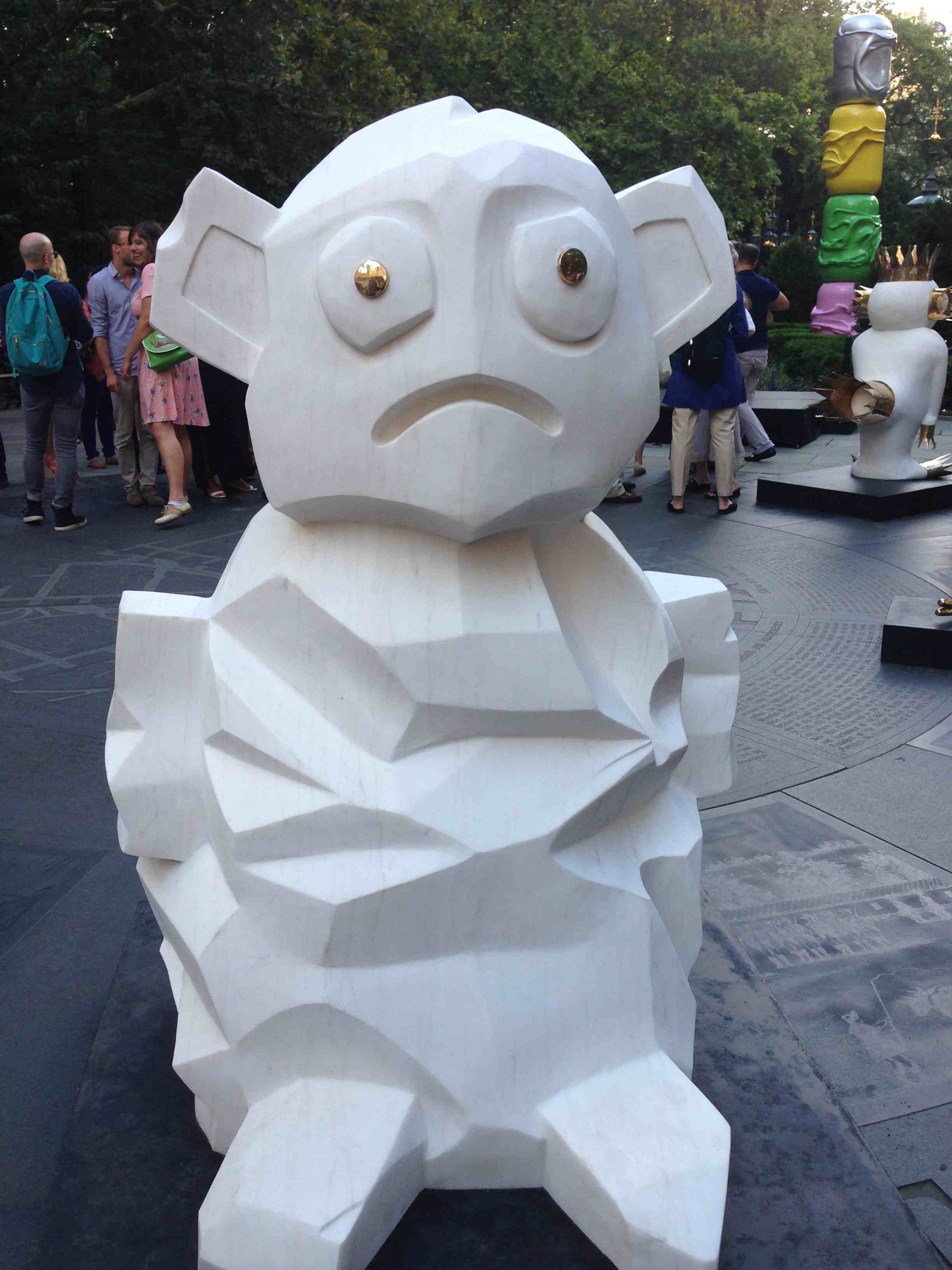
Get out your cameras for Olaf Breuning’s installation, The Humans. They’re some of the craziest marble statues you’ll ever meet, forming a circle to evoke the human evolution from “fish” to “fisher king.” Enjoy the contrast they make to the Park’s other, more traditional marbled details.

Poke around behind Nathan Hale to see Franz West’s whimsical forest of bulbous growths, and don’t miss the super-intriguing sculpture by James Angus. He’s made a full-scale John Deere tractor in steel and cast iron, but instead of being a faithful reproduction, he stretched it digitally and left it toppled among the trees near Broadway. It makes you think back to the pre-industrial 1660s when this land was used as a livestock pasture, and reflect on where agriculture is today.

One of six fantasy characters in Olaf Bruening’s installation, The Humans, 2007.

One of six fantasy characters you’ll meet in Olaf Bruening’s  The Humans, 2007.

The show will delight, make you think, and turn you into an urban explorer probing the nooks and crannies of the southern portion of the park’s nine acres.

And if you take your camera and get any good shots, you can contribute them to the Gallery on the Pubic Art Fund’s site.

See New York Through Hopper’s Eyes

Hopper’s easel holds his painting, Early Sunday Morning (1930) at the Whitney.

Hopper’s easel holds his painting, Early Sunday Morning (1930) at the Whitney.

If you thought you knew about Edward Hopper, think again. The Whitney’s show, Hopper Drawing, provides surprises galore from curator Carter Foster, who has presented the museum’s trove of Hopper drawings in a fresh, new context. The Whitney has more Hopper drawings (made for his private use) than any other museum in America, and about half are up on the walls. Go before October 6.

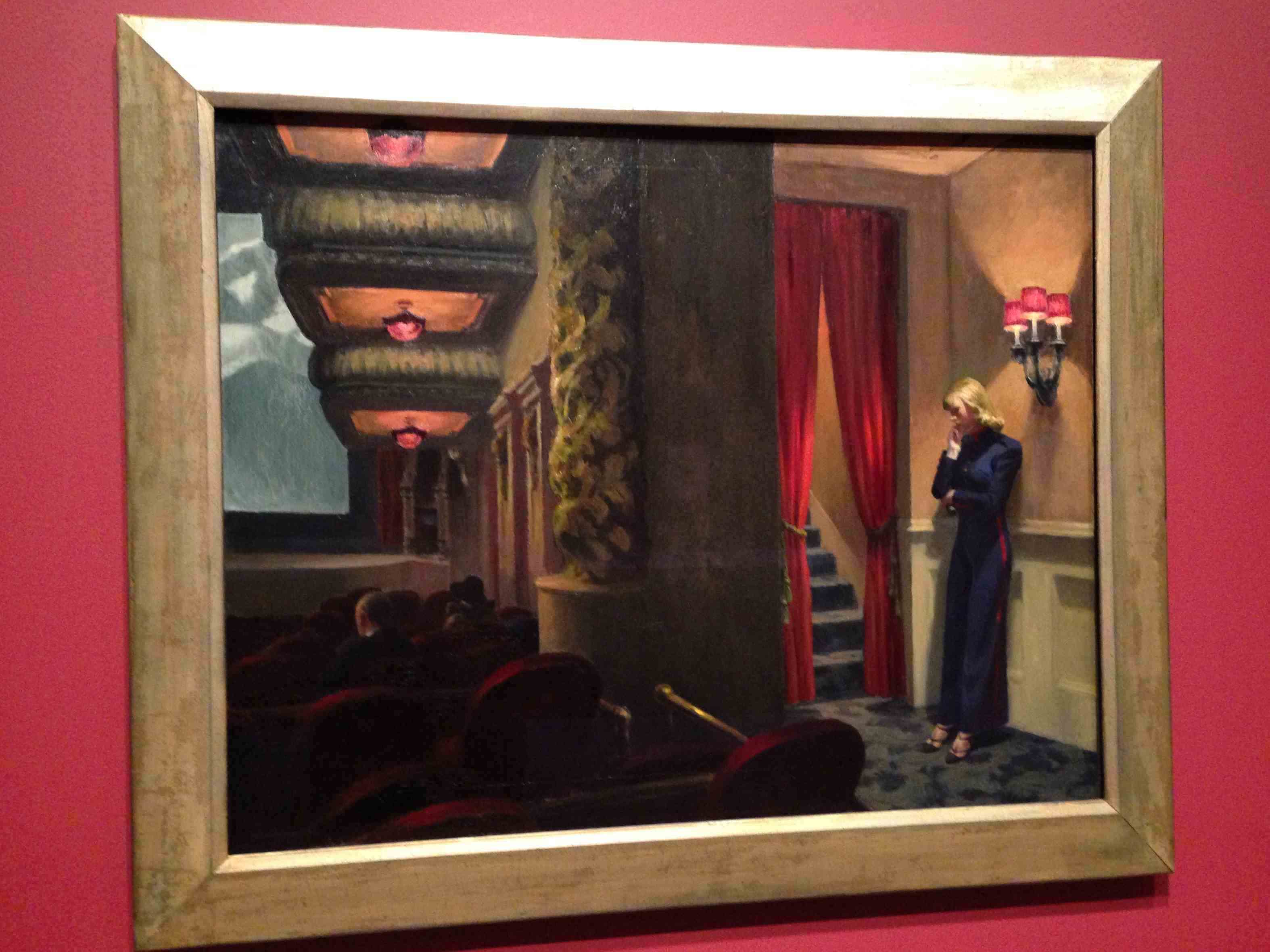
Although Hopper’s representational work is considered by his fans to signify “realism”, Foster has unearthed and organized zillions of preparatory drawings that demonstrate that this is hardly the case. Hopper, as he often said, worked “from fact” but added improvisational touches that pretty much made the canvases perfect. A case in point is New York Movie, where one side of the canvas is “real”, and the other side is completely imaginary. His sketchbook from the Palace Theater proves it.

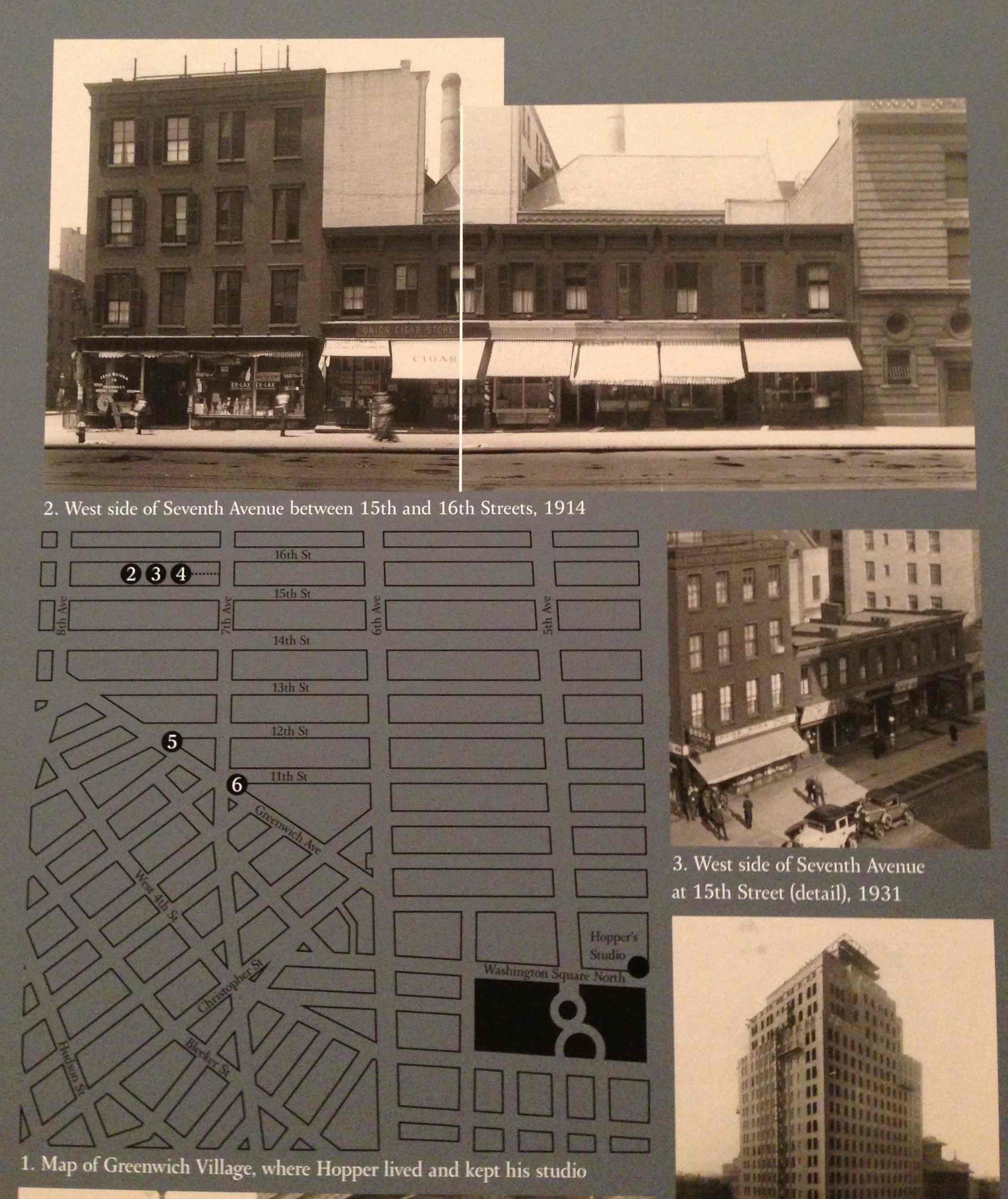
Whitney exhibition card showing map and 1914 photograph of the West Village storefronts depicted in the above oil painting

Whitney exhibition card showing map and 1914 photograph of the West Village storefronts depicted in the above oil painting

To prove this point, you’ll see the most famous Hopper paintings right alongside his preparatory sketches and sketchbooks to see his meticulous decision making process. Go to the exhibition web site (or our Flickr feed) and flip through images of Hopper’s iconic oils (such as New York Movie  and Chicago’s Nighthawks), followed by sketches and studies where Hopper worked out all the compositional kinks.

Hopper lived and worked right inside the row of gorgeous 1830s townhouses along Washington Square North. It’s a complete surprise to find that NYU still preserves Hopper’s studio intact, complete with his print press and easel.

Foster convinced NYU to loan it to the show, and it’s an electrifying reminder that artists once walked the streets of the Village and then came back to paint. You’ll stand face-to-face with the working easel that Hopper used to paint every one of his great works. Early Sunday Morning is perched, right where it sat in 1930, facing the Hopper’s other icon Nighthawks, on loan from Chicago’s Art Institute. The width of those canvases precisely matches the width of the easel.

Installation view of Hopper’s New York Movie (1939), on loan from MoMA

Installation view of Hopper’s New York Movie (1939), on loan from MoMA

So, that left a question: Where these real places, or fictions made up entirely in Hopper’s mind? Foster spent time trying to figuring it out, and thankfully the Whitney recorded the answers on its YouTube video. Take a walk with him and see the Village and the Flatiron through Hopper’s eyes back in the 1930s. You’ll never look at Nighthawks the same way again. Genius.

For theater fans: It’s not in the video, but Hopper’s sketchbooks are also filled with drawings of Times Square theaters — the Palace, the Globe (now the Lunt-Fontanne), the Republic (now the New Victory; formerly Minsky’s Burlesque),  and the Strand (where Morgan Stanley now sits).

Thousands Flock to the Light

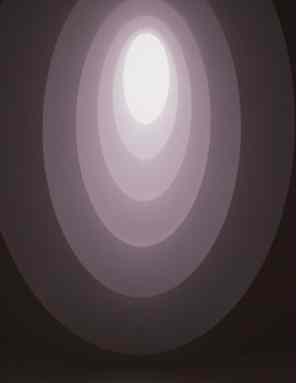
Imagine you are laying on the floor of the Guggenheim rotunda and that you are looking up at James Turrell’s new work. This is what you’d see.

James Turrell’s Aten Reign. Source: Guggenheim

The colors slowly, slowly morph for the next hour, changing from pink to green to yellow until they work through the entire color cycle. As yellow fades, you see the white, glowing sun…or is it the moon?

Aten Reign moment in the Guggenheim atrium, James Turrell’s site-specific spectacular. Source: Guggenheim

Aten Reign moment in the Guggenheim atrium, James Turrell’s site-specific spectacular. Source: Guggenheim

You need to get there to experience the spectacular light before September 25, when James Turrell takes his leave of New York, the end of his first major show here. The museum’s exhibition site is wonderful, but it’s no match for the out-of-this-world, cosmic experience of his masterful Aten Reign.

The Guggenheim has blocked off the famous skylight and any view of the atrium from its gallery spiral. Viewing the light show from the ground floor, all viewers see are these rings of slowly changing light with an oval center – a natural shape that Mr. Turrell loves.

Out-of-towners expecting to have the fun of walking up the ramp and looking down on ever-tinier ground-floor visitors will be disappointed. But other magical Turrell encounters await.

On Level 2, we found celebrated security guard, Jeffrey Martinez (see this week’s New York Times profile on him) holding throngs in rapt attention explaining the magic wrought by Mr. Turrell with his corner floor-to-ceiling strip of light. Martinez told us that although it appeared to be a vertical “light”, we were actually seeing an illumination emanating from behind the false wall. The New York Times was right to single him out for a story, because it felt like we were meeting a celebrity with art-world smarts, gently cautioning people against trying to touch and asking them to “stand back” to give the piece some space.

Afrum I (White), 1967, one of Mr. Turrell’s early cross-corner projections. Source: Guggenheim

Afrum I (White), 1967, one of Mr. Turrell’s early cross-corner projections. Source: Guggenheim

Upstairs, the show presents two more light installations that mimic two of the twenty 2D etchings precisely ringing a small gallery. Mr. Turrell creates the illusion, on paper, of light glowing from the white cubes surrounded by the ink. You just have to see them and then turn the corner to see “square” beams of light illuminating two walls. In the second room, Afrum I (White) astounds. You think you’re seeing a levitating white cube of light. Magical.

Hear him talk about his view of Mr. Wright’s philosophy and building and why they are so right for one another:

Enough said. Go see it.

Spoiler alert: The Guggenheim’s YouTube site has several videos about how Turrell and the team created the magic on the spiral.

Water, Water Everywhere at the Academy

Tintagel, 1881. Large, masterful watercolor depicting castle ruins on the Cornwall coast of England, which Richards associated with the legends of King Arthur.

Tintagel, 1881. Large, masterful watercolor by William Trost Richards depicting castle ruins on the Cornwall coast of England, which Richards associated with the legends of King Arthur. Who needs to mess with oil paint and build big canvases when you can do this with water and paper?

In a brilliant pairing, the National Academy Museum has mounted dual shows by artists who draw their greatest inspiration from water. There’s no need for a trip out of town to experience crashing waves, monumental waterfalls, and wide expanses of sea and sky done by one of America’s greatest watercolorists of all time and a celebrated 21st century painter.

William Trost Richards: Visions of Land and Sea features 60 works from the Academy’s collection – early graphite sketches, oil paintings, and beautiful, grand, sweeping watercolor vistas that are some of the tiniest, most meticulous works you’ll see anywhere. Some are on display for the first time, which is remarkable considering that critics believe WTR to be among the greatest American landscape painters of the 19th century.

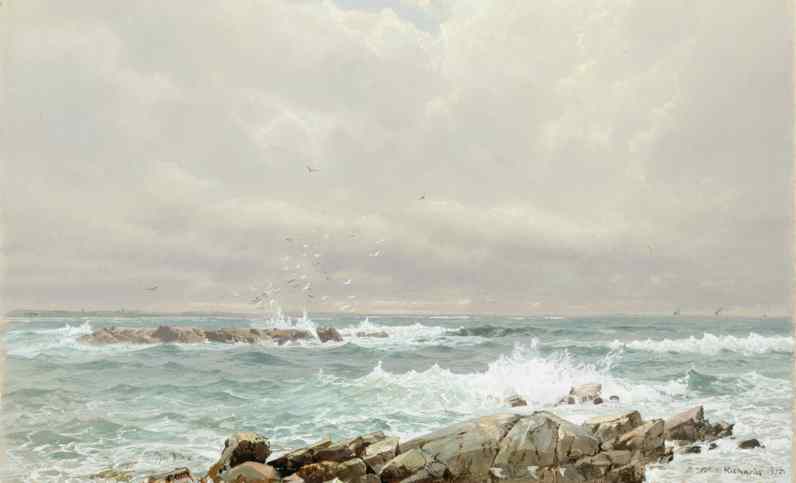
Seascape (1875), a watercolor on cream paper that’s only 9 X 14 inches. Source: National Academy

Seascape (1875), a tiny but monumental watercolor by William Trost Richards on cream paper. It’s only 9 X 14 inches. Source: National Academy

Inspired by Ruskin and the Pre-Raphaelites early in his career, WTR began documenting the intricacies of the Wissahickon River paths near Germantown, on the outskirts of Philadelphia. He soon became part of the American watercolor movement that began making works that were just as grand, romantic, and full of transcendence as anything by Church or Bierstadt. Quite a feat, when you’re working on such a tiny scale.

He spent years perfecting vistas of the ocean and sky from his home near Newport and on travels to the edges of the British Isles. Remarkably, he kept the horizon low to showcase the sky, all meticulously painted and built up from a ground of blue-gray wove paper. It’s remarkable how he evokes mood, rocks, night, dusk, and pale sky from that gray. Click here for more.

Steir’s monumental Blue River (2005) – one of her celebrated Waterfall series. Steir’s monumental Blue River (2005) – one of her celebrated Waterfall series. The video shows it’s true scale.

Steir’s monumental Blue River (2005) – one of her celebrated Waterfall series. Steir’s monumental Blue River (2005) – one of her celebrated Waterfall series. The video shows its true scale.

Pat Steir’s paintings, on the other hand, feature an opposite approach. Like Sam Francis or early post-Pop color-field painters, she pours, splatters, and drips her paint across canvases that seem a mile high and a block long. The masterwork on display at the Academy is Blue River, a virtual waterfall that’s just as mesmerizing as any of WTR’s watercolors, but done in bold, wide strokes on a larger-than-life canvas.

Go this weekend and delight in the masterful scenery. Pat herself indulges in the joy right here.

If you miss the Academy show, be sure to look for Pat’s Everlasting Waterfall hanging on the Fifth Floor of the Brooklyn Museum right next to Church.

African Art – 20th-c Modern Master Collectables

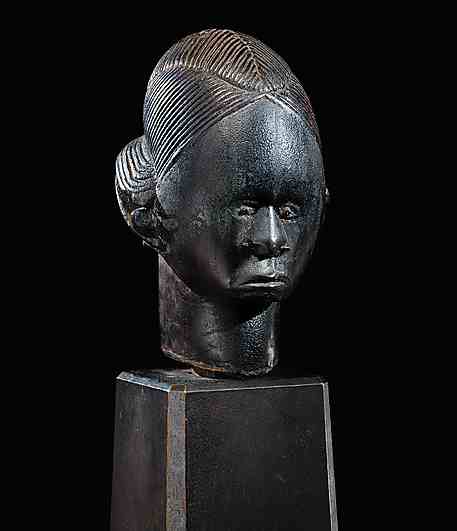
Sculptural Element from a Reliquary Ensemble: Head. The first African sculpture to be exhibited with modern masters in NY at Robert Coady’s Washington Square Gallery. This pre-1914 wood sculpture is from Gabon. Source: Curtis Galleries, Inc.

The first African sculpture to be exhibited with modern masters in NY at Coady’s Washington Square Gallery in 1914. From Gabon. Source: Curtis Galleries, Inc.

The show closing at the Metropolitan Museum of Art this weekend, African Art, New York, and the Avant-Garde, is a love letter to the advent of modernist art in New York 100 years ago. In the early 1900s, artists like Picasso and Matisse began looking more closely at the exotic shapes and forms pouring out of Gabon and Cote d’Ivoire – the primary sources of wooden African statuary at the time in Europe.

The Armory Show in 1913, rocked New York, where crowds viewed disruptive cubist works by Picasso, Duchamp, and Braque. Although the edgy work startled New Yorkers and the press, American modern artists and connoisseurs went crazy for African art because it looked so “modern”.

Sensing an opportunity, Stieglitz sent his friend, Marius de Zayas, to Europe to bring back more. Good thing, since Europe was soon at war and the global art scene shifted to New York. Stieglitz’s 291 Gallery and the Washington Square Gallery in the Village became leaders of the new trend, mounting a series of shows. De Zayas had to push Stieglitz to mix African art with Picasso, and it worked. One critic looked and said, “Here are the fathers of Gaugin, Matisse, and Picasso!”

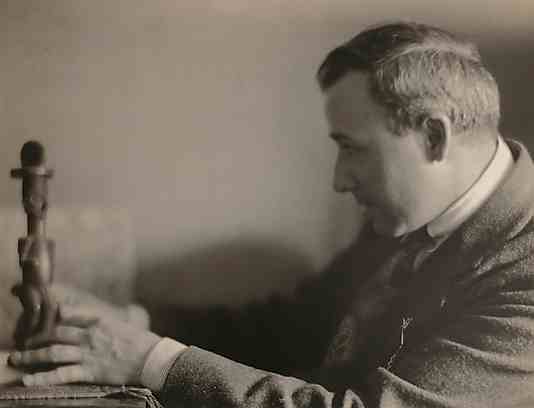
Clara Sipprell’s 1916 Portrait of Max Weber, where the artist holds a wooden figure from the Democratic Republic of the Congo. He bought it in 1906, the first African sculpture to be brought back to the City by a New York art-lover. Source: Museum of Fine Arts, Boston.

Clara Sipprell’s 1916 Portrait of Max Weber, where the artist holds a wooden figure from the Democratic Republic of the Congo. He bought it in 1906, the first African sculpture to be brought back to the City by a New York art-lover. Source: Museum of Fine Arts, Boston.

This show is special because the curators really went all out – huge photo-murals of the ground-breaking shows, the actual works you see in the photos, and photos of same from the magazines and newspapers of the day. It’s an art-history, primitive art, and modernist master trifecta.

Visitors feel like they’re stepping right into 291 itself, seeing mash-ups of African art, nature objects, and European cubist works. Poking through the vitrines, you’ll see works appearing in New York for the first time since 1914, gorgeous Sheeler photos of early exhibitions, and lots of work collected by Mr. Schamberg (for whom NYPL’s Harlem library/collection/study center is named).

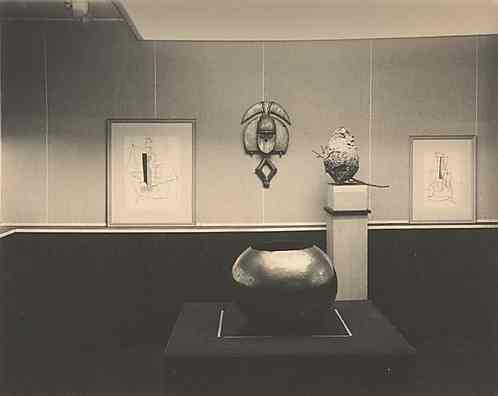
Stieglitz’s Picasso and Braque show at 291 Gallery (Dec 1914-Jan 1915). This features a Kota reliquary statue hung as art, like the fine Picasso nearby, a brass bowl, and a wasp nest. Source: Stieglitz photo from The Met.

Stieglitz’s Picasso and Braque show at 291 Gallery (Dec 1914-Jan 1915). This features a Kota reliquary statue hung as art, like the fine Picasso nearby, a brass bowl, and a wasp nest. Source: Stieglitz photo from The Met.

Since Georgia O’Keefe gave Mr. Stieglitz’s entire collection to the Met, the show packs in many surprises — his African works, his Matisse and Rivera paintings, and issues of Camera Work. There are key pieces from the Smithsonian’s National Museum of African Art and loans from Philadelphia’s Arnesberg collection.

In 1923, the Brooklyn Museum was the first museum in the West to show African art as “art” (versus “anthropology”), Penn was the first museum to actively collect it, and we all know what Mr. Barnes did when he displayed his magnificent modernist collection.

Check out all the objects in this amazing exhibition, but walk through the show in person if you can.

If you have some time, sit in on the curator’s talk via YouTube. Around 33:00 they start talking about the works in the show with a nice split screen that shows the speakers and the slides, so skip ahead and take a provocative, virtual tour.

Anxious, Turbulent Skies in Masterful Landscapes

Frederic Edwin Church’s depiction of the volcanic eruption in Ecuador -- Cotopaxi, painted in 1862 and exhibited the following year. Source: Detroit Institute of Arts.

Frederic Edwin Church’s depiction of the volcanic eruption in Ecuador — Cotopaxi, painted in 1862 and shown the following year. Source: Detroit Institute of Arts.

Who expects that gigantic, bold 18th-century people-free landscapes by Bierstadt and Church to bear the heft of telling the anxious backstory of America before, during, and after the Civil War?

It’s true. Big landscapes are the booknds to the dramatic story told by the Smithsonian Museum of American Art’s exhibition to honor the 150th anniversary of Gettysburg, American Painting and the Civil War, installed through September 2 on the upper and lower levels of the Met’s Lehman Wing.

Seeing the stunning upper-gallery works within the context of America’s troubled times is a must. You’ll never look again at a Bierstadt or Church again without checking its date to see if it was painted in the 1859-1865 range.

Sanford R. Giffins’s 1863 oil, A Coming Storm, says it all. Retouched by the artist in 1880. Source: Philadelphia Museum of Art.

Sanford R. Giffins’s 1863 oil, A Coming Storm, says it all. Retouched by the artist in 1880. Source: Philadelphia Museum of Art.

Hear Smithsonian curator Eleanor Jones Harvey’s three-minute introduction to how these magnificent landscapes became the “emotional barometer” of the country and what approach genre painters took in the midst of changing times. Then, check out the Smithsonian’s nice timeline and click on Church’s Meteor of 1860 and Our Banner in the Sky from 1861 to see what was in the news while these were being created in the studio.

You’ll find Sanford Gilfford’s A Coming Storm (1863) in the timeline in 1865. Ironically, this was owned by Shakespearean superstar Edwin Booth right after it was painted, but before his brother actor John Wilkes changed history and trashed the family name. When Melville saw the painting in a New York gallery a few weeks later in April 1865, he felt the tragic irony so profoundly that he had to write a poem to process it all.

Bierstadt’s Looking Down Yosemite Valley, California, exhibited in 1865, one year after Lincoln signed legislation declaring this a public reserve. Source: Birmingham Museum of Art.

Bierstadt’s Looking Down Yosemite Valley, California, exhibited in 1865, one year after Lincoln signed legislation declaring this a public reserve. Source: Birmingham Museum of Art.

Church, Homer, and Gifford also painted camp life during the War, and those up-close-and-personal works are also featured in the show, alongside very precise oils of Confederate encampments by Conrad Wise Chapman. Thanks to Richmond’s Museum of the Confederacy, which loaned the works by Chapman, you’ll get to see the famous experimental submarine, The Hunley as it was in 1863. The submersible was raised from the depths near Charleston in 2000 with the tar bucket you’ll see in Chapman’s oil painting

But back to the giant landscape that closes the show upstairs. Bierstadt paid someone to take his place in the Union Army, so maybe that’s why his mind was free concentrate on more placid, ethereal works, such as the show’s finale, Looking Down Yosemite Valley, California of 1865 – a immersive look into the California Eden that Lincoln’s signature in 1864 preserved as public land and away from scarred landscapes of the battlefield states.

What’s the connection between Arctic exploration and unusual nighttime phenomenon of 1864? Watch this video to see how Church used them to convey the mood of the country through his powerful, gigantic, beautiful Aurora Borealis.

See a slide show of 34 paintings in the show and access the full set of video podcasts on the Smithsonian’s web site.

I, YOU, WE: Art on the Front Lines of the 80s Culture Wars

Les Levine mounted his poster everywhere in the subway in 1981, a tough time in New York. Source: The Whitney © Les Levine for The Museum of Mott Art, Inc.

Les Levine mounted his poster everywhere in the subway in 1981, a tough time in New York. Source: The Whitney © Les Levine for The Museum of Mott Art, Inc.

It’s not a comfortable art show, but the 1980s weren’t comfortable times. The Whitney Museum of American Art’s show I, YOU, WE resurrects art from a time when artists were protesting inequality and gentrification, the AIDS epidemic was raging, Wigstock brought gender shifting into the open air, and New York’s downtown community waited apprehensively for the next police crackdown on squatters, community gardens, and anyone flaunting an alternative lifestyle.

As it prepares to move to the High Line in 2015, The Whitney asked its curators to mine its permanent collection to see if there were periods of time that might have been overlooked in the shows of recent years.

I, YOU, WE is the answer: the difficult, searching, and searing work produced by the passionate and disenfranchised denizens of New York’s tumultuous 1980s and early 1990s.

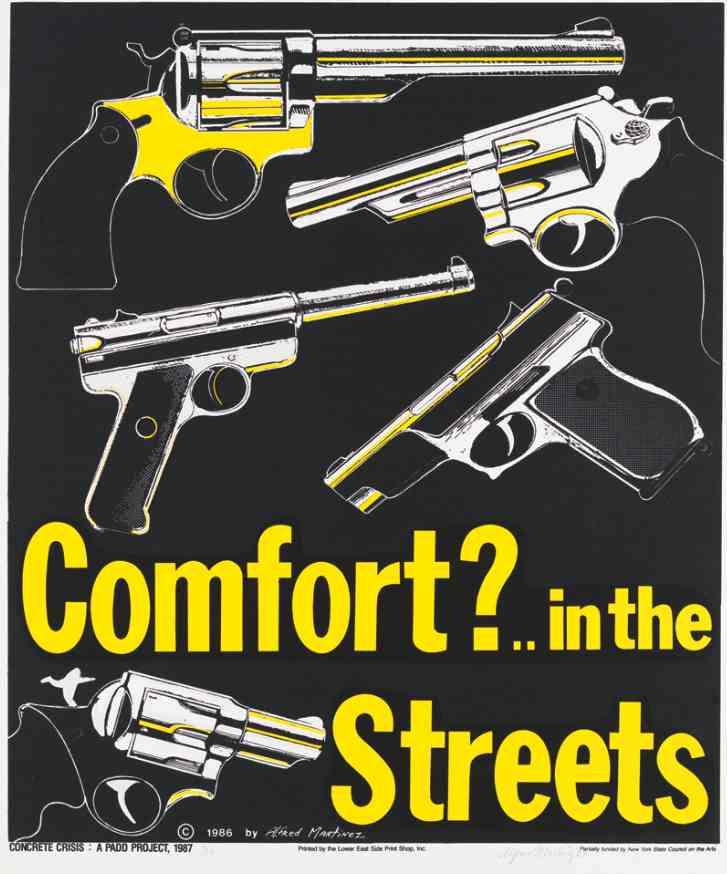
No one could miss Alfred Martinez’s 1987 screenprint. Source: The Whitney. © 1986 by Alfred Martinez

No one could miss Alfred Martinez’s 1987 screenprint. Source: The Whitney. © 1986 by Alfred Martinez

Works feature the flip side of Warhol’s Interview magazine and Studio 54 – people struggling with identities, illness, injustice, and the consequences of Washington’s culture wars against edgy art.

The Whitney produced this video about the “WE” section of the show, when artists began protesting gentrification, how they used art as the lever to galvanize the East Village, and the battles that raged for the community. Other sections of the Whitney show focus on artists’ exploration of race, gender, religion, and the AIDS crisis.

Revisit the emerging street styles – graffiti, comics-inspired drawings, stencils, and posters – as Andrew Castrucci of Bullet Space leafs through one of the seminal art-protest pieces.

When you visit, make enough time to Nan Goldin’s 700-slide extravaganza that documents everything.  Scroll down here to see installation views and  other works in the show by Mapplethorpe, Basquiat, Currin, Wojnarowicz, and Ligon. Tough stuff, but not tougher than the lives these artists lived during that decade.

Congratulations to the Whitney for not forgetting, presenting this work to the next generation, and testing if the work still sticks 20 to 30 years later. The show runs through September 1.

Unicorn Natural History

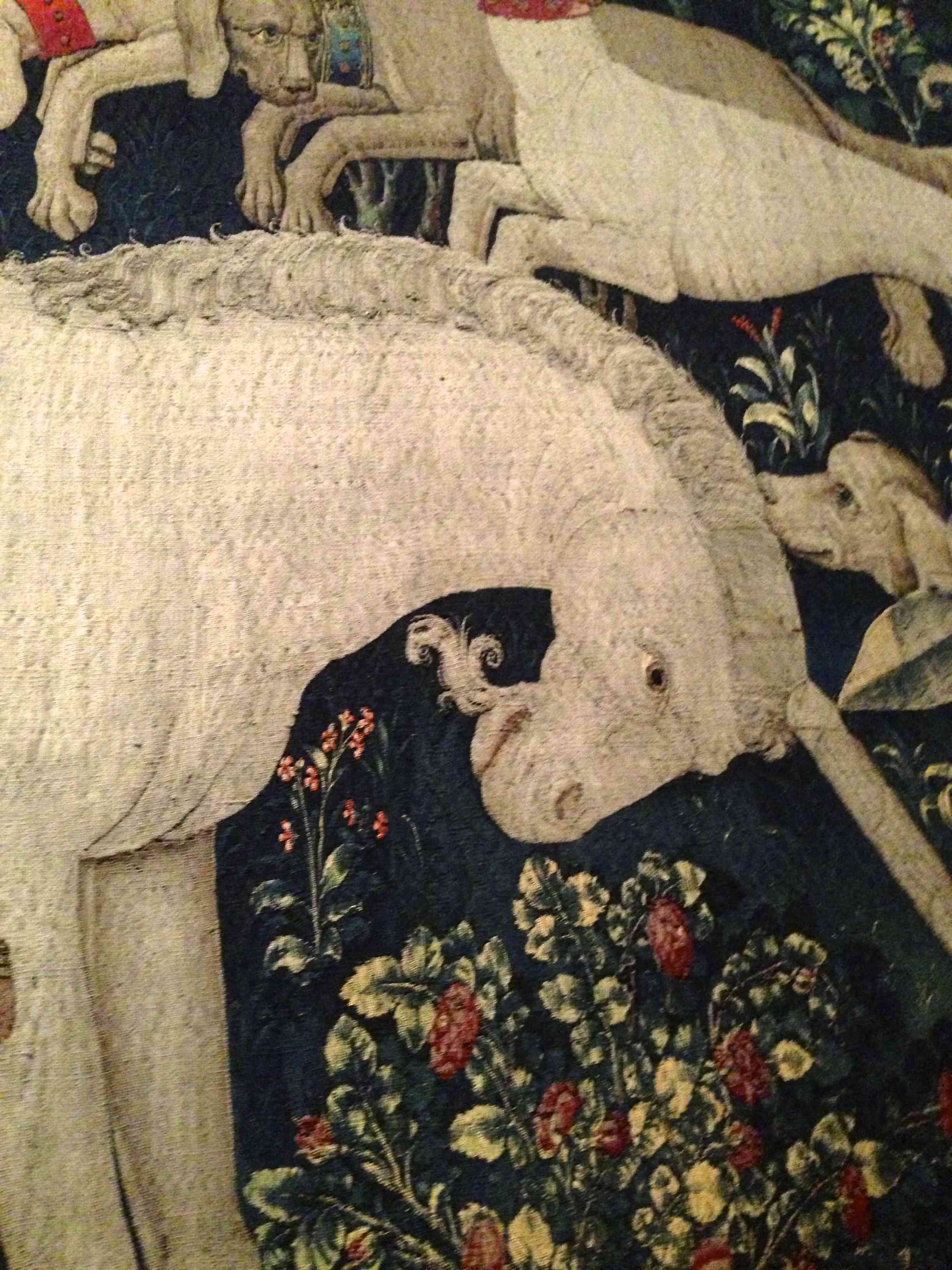
Detail from "The Unicorn Defends Itself" (1495-1505), a large tapestry in the main gallery.

Detail from The Unicorn Defends Itself (1495-1505), a large tapestry in the main gallery.

Who says unicorns aren’t real? Mr. Rockefeller’s tapestry unicorns have been the celebrity draw for the last 75 years uptown at The Cloisters, and are the cavorting centerpieces of the show, Search for the Unicorn. But it took some brave curators to finally display all the unicorn-themed stuff in the Met’s collection and truly reveal the place this beloved icon has held in science, medicine, and art for the last 2,000 years.

The small micro-show in the Romanesque gallery just inside the entrance presents ivory coffers, playing cards, etchings, a carved-bone parade saddle, and coats of arms featuring unicorns in all manner of activity.

But the surprises are loans from NYPL and the National Library of Medicine in Bethesda showing the unicorn’s inclusion in scientific texts, which attest to sightings and miracle cures from the impressive cloven-hoofed trotter.

Pome’s 1694 identification of species in General History of Drugs. Courtesy: US National Library of Medicine, Bethesda.

Pome’s 1694 identification of species in General History of Drugs. Courtesy: US National Library of Medicine, Bethesda.

Conrad Gesner’s Histories of the Animals (1551), the most popular natural history book during the Renaissance, included the unicorn among its 1,200 woodcut images of the world’s quadrupeds. Gesner, who also published images of fossils for the first time here, was a stickler for documentation, and asserts that unicorns had been seen in Mecca by a reliable source. He wrote several pages about how to discern real from fake unicorn horns and told how it should be used to purify water, counteract poisons, and treat epilepsy.

General History of Drugs, which achieved global circulation after it was published in 1694, was written by Pierre Pome, the pharmacist to Louis XIV known for his expertise in medicines and treatments from exotic cultures. Pome gave unicorns their own chapter and described five species living in the Arabian desert and in proximity to the Red Sea. In Chapter 33, he correctly proclaimed “unicorn horn” to be narwhal tusk.

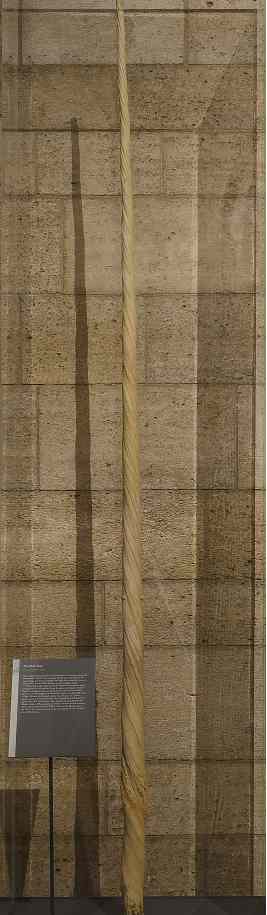
Narwahl tooth (a.k.a. unicorn horn). Source: Metropolitan Museum of Art.

Narwahl tooth (a.k.a. unicorn horn). Source: Metropolitan Museum of Art.

The narwhal’s gracefully shaped, unicorn-looking incisor tooth is given a place in the show, too. One from a private collector is in the Romanesque gallery alongside one of the tapestries, The Unicorn in Captivity (the one in the fenced-in pasture); the second stands behind glass opposite the rest of the tapestries in their usual gallery.

Fancied by rich and powerful in years gone by, Charlemagne, Suleyman the Magnificent, Charles VI of France, and Lorenzo de Medici all owned this Arctic collectible.

We couldn’t take photos inside the show, but don’t worry. The Met’s done a fantastic job documenting everything online, so take time to peruse all the items in the show. Then click on our Flickr site to see the famous Unicorn gallery and glimpse the Cloisters on a perfect summer day.

Do you have 13 minutes? If so, you’ll enjoy the hilarious introduction to the show by curator Barbara Drake Boehm and her speculation on why it took the Cloisters 75 years to mount a show on unicorns. The natural history of unicorns starts around 3:40, and she’ll take you through all the key library materials. Watch to the end to find out where the unicorn was last sighted in the 21st century. It wasn’t Toys ‘R’ Us.

All Smiles at The Mouse Museum on 53rd St

View of Oldenburg’s Mouse Museum/Ray Gun Wing at MoMA. Photo: Jason Mandella. © 2013 The Museum of Modern Art

View of Oldenburg’s Mouse Museum/Ray Gun Wing at MoMA. Photo: Jason Mandella. © 2013 The Museum of Modern Art

Is it the best museum in the world? One of the happiest places to be in New York right now is Claes Oldenburg’s Mouse Museum and Ray Gun Wing, currently installed in MoMA’s atrium as the scene-stealing companion to the Fifth Floor exhibit, Claes Oldenburg: The Street and The Store, which ends August 5.

You’ll want to take your time contemplating the Pop master’s 1970s curated collection of average, everyday stuff that he showcased inside a geometric mouse-head structure, originally a design he proposed for Chicago’s (then unbuilt) Museum of Contemporary Art.

In the mid-1960s, Oldenburg began collecting souvenirs, rubber toys, and crazy stuff he found on his wanderings and storing them on shelves of his 14th Street studio. An early idea was a display of artificial vegetables and other food with Fluxus genius George Maciunas. It never happened, but luckily some of the 1960s-style replicas repurposed here in the Mouse collection.

Inside view. On loan from the Austrian Ludwig Foundation, since 1991. © 1965–77 Claes Oldenburg. Photo by MoMA Imaging Services Dept. © 2013 The Museum of Modern Art

Inside view. On loan from the Austrian Ludwig Foundation, since 1991. © 1965–77 Claes Oldenburg. Photo by MoMA Imaging Services Dept. © 2013 The Museum of Modern Art

Oldenburg decided to submit his museum to Documenta 5, whose theme was “inquiry into reality—today’s imagery.” He washed off his dusty collection (you can hear the tape of that inside) and he and some friends organized 367 objects into display categories. For Documenta, the little building itself was fabricated in Germany.

What’s really inside? In a riff on the classification systems that were then in vogue by conceptual artists, Oldenburg “classified” all his fun stuff – landscape, human beings, food, body parts, clothing (including makeup), tools, animals, buildings (including monuments and souvenirs), money containers, smoking articles, and studio remnants.

Here’s MoMA’s take on the importance of this little museum and its Ray Gun Wing:

Now, enjoy a virtual walk-through to examine this tiny museum’s treasures, shot by Christian Zurn when it was on display at MUMOK in Vienna last year. Do yourself a favor and go see this spectacularly funny, whimsical collection for yourself.

Want to spend some time with Claes himself? Here’s a YouTube of the master recollecting his life in the Sixties, travels to LA with Warhol, and how his soft sculptures came to be, click here.

Shimmering Curtains of Liquor-Bottle Caps Hung in Brooklyn

Installation view in the Iris and B. Gerald Cantor Gallery on the Fifth Floor. Brooklyn Museum photo: JongHeon Martin Kim.

Installation view in the Iris and B. Gerald Cantor Gallery on the Fifth Floor. Brooklyn Museum photo: JongHeon Martin Kim.

They’re big, they’re from Africa, they’re hung in one of the most spectacular art spaces in the City, and you need to see them before August 18. If you’re going out to Brooklyn to see the Sargent show, be sure to see the spectacular contemporary installation, Gravity and Grace: Monumental Works by El Anatsui.

The one-man retrospective of London-trained Ghanaian artist El Anatsui (his first) takes up half of the Brooklyn Museum’s Fifth Floor, but really shines under the skylight in the Iris and B. Gerald Gallery.

DetailYou might have seen his large piece hung in the African gallery on the First Floor of the Met or his installation in the 20s on the High Line, but in Brooklyn you’ll see 30 big, shimmering pieces arranged on walls and suspended under the dome. They’re all made out of scrounged metal material and wire from garbage dumps near his home, but the experience of seeing these big, beautiful pieces could not feel further from the source.

Hung from the ceiling, the metal-and-wire pieces look like open-weave textiles fabricated on a grand scale. Visitors wander through Anatsui’s hangings, silently gazing, stepping up to look close, and then move further back to wonder how he creates such a lightweight, effortless illusion from years of collected, flattened, punched bottle caps and stuff.

Earth's SkinTwo more galleries feature other large-scale works, arranged and pinned on walls, bunched like beautiful fabrics. Anatsui creates his gigantic constructions, carefully sorting the different colors of metal from the various brands of beverages. He says it’s like doing a watercolor wash, and when you view the work in person, you’ll be stunned by the variety of color, pattern, and lovingly arranged metal tapestries.

Here’s a time-lapse video of the Brooklyn crew installing the show, initially mounted at the Akron Art Museum. Anatsui says that he enjoys giving installation crews and curators a lot of leeway in how they hang his work, and he was a little surprised (in a good way) about some of the choices by the crew in Brooklyn. See for yourself. The big, shiny silver sculptures snaking across the floor are made of milk tin lids.