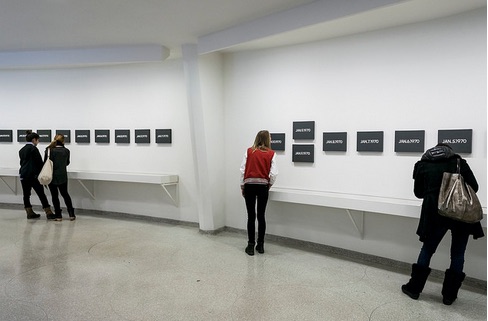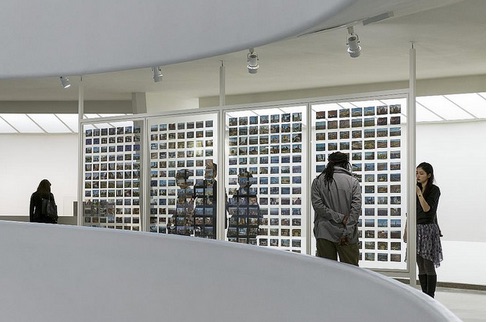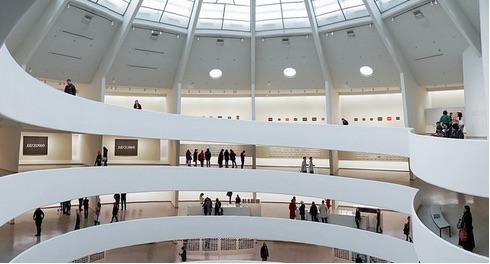
Sturtevant interprets Gonzalez-Torres Untitled (America) (2004). On far wall, Study for Rosenquist’s Spaghetti & Glass, an oil painted in 1965-1966
The free Friday night crowd at MoMA could not get enough of the Elaine Sturtevant tribute, Double Trouble, closing this weekend. Sturtevant spent her long career creating ready-mades out of other people’s art.
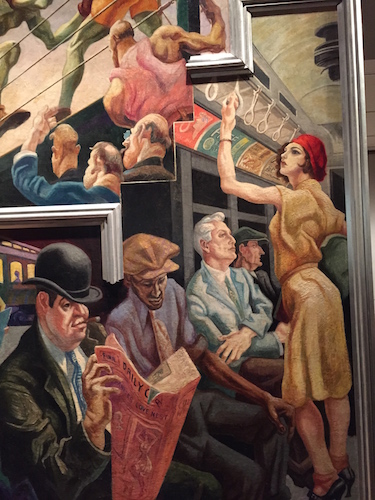
The show is a who’s who of 20th century art, except that all the pieces were done by Ms. Sturtevant. The show has it all – an entryway plastered with Warhol’s cow wallpaper (done by her), Lichtensteins, Rosenquists, Johns oil paintings – all done in her hand. Take a walk through our Flickr site and see more in the photos on the curator’s blog.
It’s all imitation, except that Elaine’s versions are really, really good. It’s hard to tell them from the originals displayed through the rest of the museum. Nothing in the show is a line-by-line copy, but you’ll have to go MoMA’s permanent galleries to compare them with the real thing.
Sturtevant’s 1967-1968 oil on canvas, Study for LIchtenstein’s ‘Happy Tears’
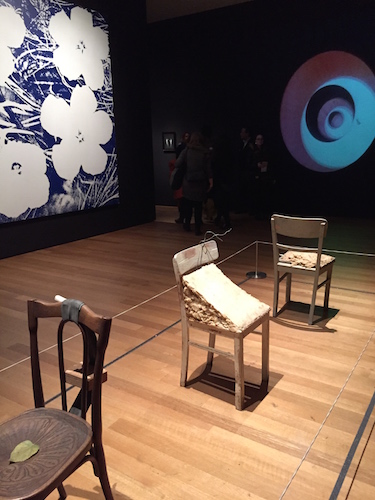
In fact, MoMA encourages a trek upstairs to compare Duchamp’s own ready-mades and whirligig. Or Mr. Beuys slabs of fat with those sitting on Sturtevant’s chairs in the darkened gallery.
Can anyone distinguish the Warhol Wall Flowers that Elaine made from the reproduced images of the originals on the stuff all over the gift shop?
The Gonzalez-Torres installation was the dramatic high point, all flashy bulbs in a charismatic, mysterious circle near the pretty perfect interpretations of early video games. Everyone is having a blast lining up to contemplate Sturtevant’s walk down digital memory lane with her interpretation of Pacman 1.0.
Is that Sturtevant’s Duane Hanson museum security guard reproduction in the corner? Oh, no, it’s an actual MoMa guard! Sorry. Just about everything else is a fool-the-eye art encounter. Total fun in the white cube.
Sturtevant’s 1990 vision of Warhol’s Flowers alongside her 1968 Duchamp film with interpretations of three Beuys chairs
Katrín Sigurðardóttir, Haul IV (2004) travelling landscape-in-a-box on loan from private collector. Courtesy: The artist.
When the weather dips below freezing and people think they’re in the Arctic, there’s no better place to get out of the elements and meditate on the landscapes of long, dark winters than the third floor of Scandinavia House on Park Avenue. Until tomorrow, January 10, you’ll join eleven contemporary artists from the sub-arctic on their journeys in a show mounted by the Katonah Museum of Art, Iceland Artists Respond to Place.
Bjork may get all the media attention, but do yourself a favor and walk through this three-gallery show, which beautifully and simply presents the work of Iceland’s other leading visual artists. See the land of fire and ice through their eyes.
Olafur Eliasson, The Aerial River Series, 2000 on loan from private collector. Courtesy: The artist. Photo: Ben Blackwell
Olafur Eliasson takes you on an aerial journey along a 60-mile meltwater river, from the mouth to the source. Ragna Róbertsdóttir splatters miniscule lava rocks against a wall but it’s not what it sounds like. Far from a violent eruption, it’s an undulating, mesmerizing meditation that you’ll spend time contemplating.
For sheer romantic and modernist punch, enjoy Georg Guðni Hauksson’s two works – a large landscape memory and a solid dark blue canvas evoking the long winter nights (like an emotional Ad Reinhardt).
Lava rocks “talk” in Egill Sæbjörnsson’s Pleasure Stones installation (2008) on loan from private collector. Courtesy: The artist.
Egill Saebjornsson takes home the whimsy award with a multimedia installation in which rocks speak (seriously!). Eggert Pétursson zeros in the microscopic natural phenomenon – painting flowers (life sized) in patterns that read like tapestries. You’ll wish you were on some hikes with him. Katrín Sigurðardóttir simply packs up her landscapes into boxes. Tiny, tiny recreations of vast, romantic landscapes.
When we visited the galleries this week, visitors were asking if there was more they could see. Scandinavia House always hosts classy, elegant shows, so although the exhibition space is limited, we have to admit they always leave us wanting to see what’s next from that part of the world.
Seth Myers was recounting his Icelandic adventures this week on Late Night. If you can’t get to the country like Seth or visit the show, at least you can spend chilly days and nights like the natives do, courtesy of this instructional video produced by Scandinavia House:
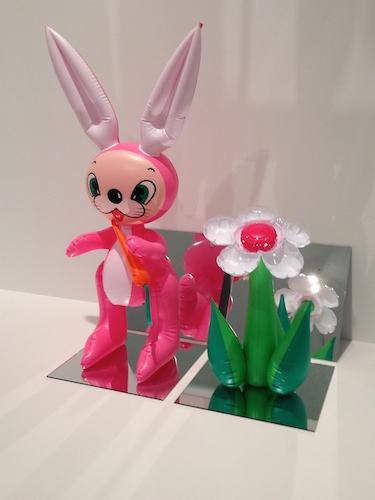
Inflatable Flower and Bunny, a cheeky take on minimalist work NYC galleries showcased in the 1970s
It’s the last 36 hours, and the Whitney is taking it’s Jeff Koons retrospective out with a bang – all day, all night fun-filled wonder on all four floors, letting the crowds take in his irreverent porcelains, 70s inflatables, whimsical fool-the-eye aluminum sculptures, and giant billboards. It’s the first proper retrospective that Koons has had in New York and the last show to be mounted on Madison Avenue before the Whitney moves to the High Line.
Any day of the week, lines of art-seekers have snaked out the door of the Whitney, past the pretzel carts on Madison and around the corner along 75th Street, waiting for admission into this no-holes-barred finale.
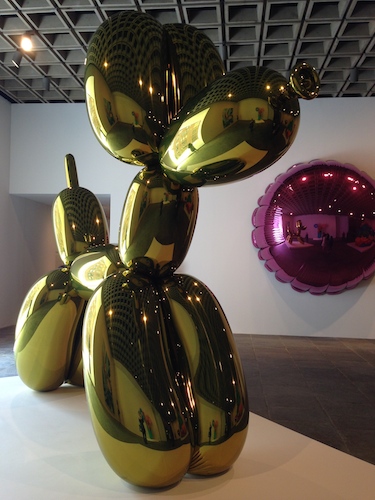
The curators and crew have done a spectacular job with the installation – no mean feat, since those big bulbous “inflatables” on the top floor are really highly polished, super-heavy hunks of stainless steel. Oh, and don’t get any fingerprints or scratches on the highly polished surfaces…it will break the illusion that these are just Mylar balloons!
Ten-ton stainless steel Balloon Dog with Moon (Light Pink) (1994-2000)
The show starts strong on the second floor with a light-filled room of recreated works from the late Seventies – actually inflatable flowers, bunnies, and what-not. Everything uses angled mirrors.
You can’t get the joke unless you trod the floors of those West Broadway galleries in Soho way back then and saw the Minimalists and Earth Works guys in full force.Think Barry Le Va, Heizer, and Smithson who arranged rocks or dirt in a few square feet of gallery space and added a mirror or two to make a statement about nature, art, reflection (i.e. art viewing), and formal criticism inside the art world.
Koons turns all this on its head with silly found inflatables and similarly formalist presentation. It’s kitchen sponges instead of Richard Long’s rocks! Thanks, Whitney and Mr. Koons, for giving us this walk down memory lane.
The main space on Floor 2 is devoted to a spectacular low-light installation of favorite Koons pieces from the early Eighties. Several double-decker and triple-decker vitrines house illuminated and never-used Hoover vacuum cleaners, which Koons assembled to illustrate the feeling of “newness” in American society.
Billboard and illuminated Hoover vacuum cleaners, the essence of “newness” from 1983
It’s a beautiful, magical room dominated by a gigantic billboard on The New, all of it from his first window-display installation on 14th Street and Fifth, when Marcia Tucker had her New Museum there back in 1983, just before the move to Soho.
Speaking of moves, it seems fitting to come full circle – spectacular early works by Mr. Koons that debuted on 14th Street as the finale to the Whitney’s long run on Madison Avenue, just prior to its move back to its new 14th Street neighborhood.
Gertrude Stein is holding court in the far back gallery with some of Mr. Stieglitz’s treasures, but on your way to see them, check out the high-class, high-gloss presentation of masterworks of wearable art from the 1960s through today.
The thesis of the show is contemporary jewelry doesn’t exist in a vacuum and often reflects the prevailing art of the day — Pop, Minimalism, Abstraction, and so forth.
In 2007, Ms. Schneier donated 130 of her favorite pieces to the Met – just a small fraction of the collection she has been building for over 30 years. Here, these gleaming, surprising, artful, fun pieces are grouped to highlight their context within various themes of recent contemporary art.
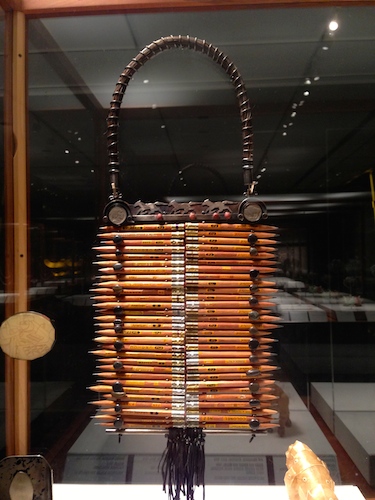
Kiff Slemmonds Sticks and Stones and Words
As you marvel at each one, you’ll be thinking back across decades of gallery shows and installations of minimalist art, performance art, funky found art, and 3D printing.
Check out the gold neckpiece right inside the door. You might think it’s a riff on the Met’s room full of Columbian gold across the hall, but this treasure is actually made of paper and canvas by the Pijanowskis (Eugene and Hiroko).
Marvel at what seems to be Native American-inspired breastworks by Kiff Slemmonds. Her art piece is fabricated with a lot of stuff but mainly No. 2 pencils in the “narrative” portion of the show.
If you like self-referential playfulness, consider Gijs Bakker’s piece – a real diamond mounted on a PVC-laminated photo of a diamond. Recyclable art? Check out Robert Ebendorf’s brooch made from crushed auto window glass, beach glass, and a vinyl record.
Ted Noten’s clever Fashionista necklace made of tiny resin high-heeled shoes
And if you think it’s fun to poke around the history of contemporary art through jewelry that’s neatly tucked inside a single room, don’t ignore the fact that right beyond this gallery door is another art-history tour-de-force-in-a-box: The Met is displaying Mr. Duchamp’s famous green case, which is full of many of the same visual and conceptual challenges – “what is art?”, “what is play?” “what is hidden?”, and “everything you see is not as it appears.”
What would Rose Sélavy herself choose to don from the next room if the Met and Ms. Schneier gave her chance?
Peek at a few of the choices on our Flickr site, but enjoy wandering through the gallery and deciding for Rose and yourself.
The tree touches the top of the Cantor Gallery. Photos: Brooklyn Museum
The view is dramatic, but the story is it evokes is even bigger than what’s in the room. There’s still time to travel out to the Brooklyn Museum to have the immersive experience of Swoon’s Submerged Motherlands, closing August 24.
The pictures here just don’t do justice to the super-high wrap-around effect of this walk-through take on the emotional side of rising tides throughout the world. A photo can’t take it all in — a sheltering, 60-foot tree with cut-out paper leaves with some day-after-the-Flood rafts parked down below, all decorated with sketches of the peoples and mothers of the world.
And did we mention that Brooklyn visionary Callie Curry (a.k.a. Swoon) actually built and lived on those rafts for a while? Several years ago, she sailed them up and down the Hudson, on the Mississippi, and across the Adriatic.
Close-up of one of Callie’s rafts.
You’ll get to see these jerry-rigged but seaworthy concoctions up close, and examine the drawings, cut paper, and torn, coffee-stained textiles draping walls, floor, and shelters in this dramatic space.
The feeling it evokes makes you wonder if we’re ready for rising seas and climate change. It’s beautiful, monumental, and reminiscent of our recent lights-out experience of Hurricane Sandy, which tore at the edges of Brooklyn, Long Island, and Staten Island just two years ago – exactly what inspired Callie to take this work in this direction.
Hear what it took for Callie to create this fantastic walk-through installation on Brooklyn’s top floor:
You may also want to hear what Callie has to say about being a working artist in the real world – outside the four walls of a gallery – in her talk from TEDxBrooklyn in 2010. She will show you her rafts in action at Minute 5 and tell you what it felt like to arrive on a hand-built raft in Venice, her projects in post-earthquake Haiti, and interacting with people from the neighborhood as she creates art on the sides of Brooklyn buildings. Truly inspirational.
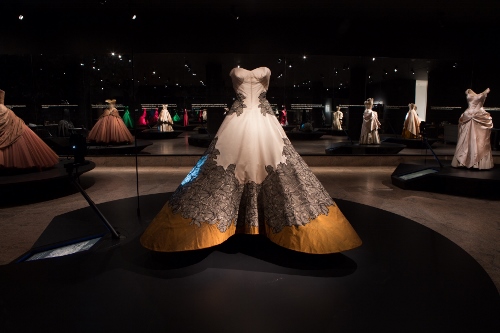
Clover Leaf Ball Gown – a 1953 silk faille, shantung, and black lace sculpture by Mr. James. Part of the Brooklyn Collection at The Met
When the Brooklyn Museum handed its fashion archive over to the Met in January 2009, the first thought that crossed everyone’s mind was the mind-bending masterworks that would now be sheltered under the protective wing of the Costume Institute’s crack conservation team — “Oooh, maybe the Met will do a Charles James show!”
We’re glad to report that the Met has done this master proud and given his humble admirers a fitting place to worship in its triumphant two-gallery show, Charles James: Beyond Fashion, which ends this weekend, August 10.
1952 portrait by Michael A. Vaccaro / LOOK Magazine. Courtesy: The Met; Library of Congress
Mr. James is credited with being among the first to perfect the strapless gown in the 1930s, an inspiration for Mr. Dior’s “New Look” in the 1940s, and the epitome of Vogue glamour dressing in the 1950s. He could do things with fabric that others simply couldn’t do or wouldn’t dare…well, maybe except for Madame Gres. He pushed silhouettes and fabrics further than most anyone could conceive and had the temperamental nature, drive for perfection, and uncompromising attention to detail that characterize any of history’s greatest, most passionate artists.
You always look at his creations and ask yourself, “How did he do it?” How did he get a spiral of fabric to stand out as it wraps sinuously around a sleek, strapless electric green silk mermaid dress? Is that sexy Thirties frock actually cut from one scarf? How did he create virtual moving sculptures from the world’s most expensive fabric?
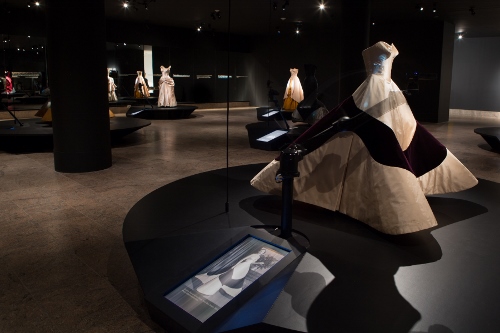
Innovative digital display tells the back story of Mrs. Hearst’s Clover Leaf Gown – too big for Ike’s inaugural, but just right for Queen Elizabeth II’s coronation
Long known for his innovative engineering, the Met came to a brilliant solution to explain the magic that Mr. James wrought over his decades of no-two-alike work – hire an architectural firm to show us.
Enter Diller Scofidio + Renfro, who have mounted these sculptures in silk inside an infinity-room gallery and paired each masterpiece with its own personal robot and humongous iPad-type display. Look at the dress and refer to the screen as the dress digitally deconstructs and is assembled again.
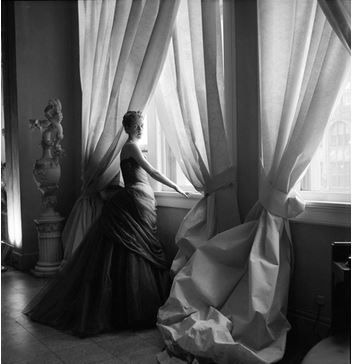
Cecil Beaton’s 1955 photo of Nancy James in the Swan Gown. Courtesy: The Met; Cecil Beaton Studio Archive at Sotheby’s
The crowds waft from dress to dress in no particular order, clustering silently to watch digital magic, see where the robot is pointing, and view photos of Mrs. Randolph Heart, Jr., Gypsy Rose Lee, or Josephine Abercrombie in said gown. The robot with the 1954 Swan Ball Gown captivates viewers by moving underneath to televise close-up views of some of the 1,080 square feet of tulle that Mr. James used to create the oomph.
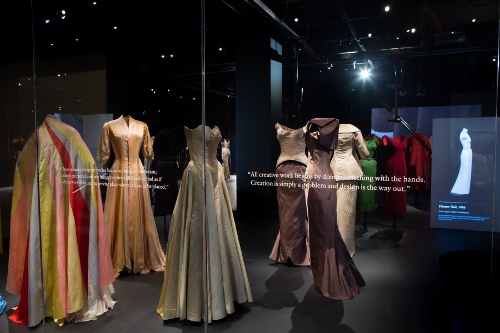
The mirrored walls of the upstairs gallery and the see-through dividers downstairs are emblazoned with the wisdom of the man himself. He seems to be talking right to you as you wonder how he made the fabric do what it’s doing (“It’s the air that’s sculpted, not the silk”) or how he thought about the world of fashion (“We who have been ahead in style have usually been ahead in our thinking”).
Downstairs gallery, newly named for Ms. Wintour, filled with James creations
The second gallery (welcome back, ground floor Costume Institute!) displays his wool creations and sharply shaped cocktail wear. It’s interesting that James considered some of these genuinely more innovative than his often-photographed gowns. The curators have placed another of his “first” in a room at the back – the predecessor of today’s puffer coat. On loan from the V&A, it remarkably dates from the 1930s – his soft, sensual, silky answer to the boxy fur jackets that Ms. Schiaparelli was showing in Europe at the time.
We have to thank Mr. James for his vision and for making sure the Brooklyn design lab had so many examples of his masterpieces to teach and inspire future generations of Seventh Avenue designers. As he says, “In fashion, even what seems most fragile must be built on cement.” Lesson learned.
The Met’s a great steward. Just listen to the love in the tour of the show by its curators:
If you have more time, hear what Zac Posen has to say to the co-curator about The Master:
Crowds surround Kara Walker’s monumental sugar sculpture
The crowds lined up yesterday on Kent Avenue all the way beyond the Williamsburg Bridge, almost to Schaeffer’s Landing, waiting to enter the rusted, aromatic, tumble-down confines of the old Domino Sugar Factory on one of the last days to see Kara Walker’s “A Subtlety, or The Marvelous Sugar Baby”, commissioned by Creative Time.
Today is the last day, so take a look at history in person, on our Flickr page, or in the video below.
Security was in full force to keep the Williamsburg bike path clear and drivers were slowing down to ask, “What’s going on and what are people waiting for?” only to be told by patient fans, “They’re lined up to see art!”
Once inside, the marvelous, gigantic Sugar Baby sculpture was on hand to preside over the far end of the abandoned several-block-long 1851 industrial space that once refined over half the sugar consumed in the entire United States.
One of her many attendants throughout the factory
As readers of Friday’s front-page article in The New York Times knew, Walker was again pushing the buttons with her homage to the brutal history of the sugar trade from the 1700s until today by giving us an experience that isn’t really all that sweet. Witnessing Kara’s witnessing is what had people – including some elderly visitors on canes — flocking to the sticky-floored, slightly ominous space. You could smell the sugar and molasses before you even entered the door.
Leading up to the gigantic white sculpture, people encountered all sorts of molasses-children, toting baskets full of…well…looks/smells like molasses. The experience evokes everything that Kara wished for…history, economics, society, race, abuse, industrial profit, and industrial scale.
Take a look at how it was made, and read about the history behind her thinking. Click on this link to Vimeo, look on the Creative Time website to see her sketches and graphic inspirations, and be sure to check out the various stages of Kara’s 3D digital sphinx up close.
If you go to Brooklyn today, expect to wait about an hour in line; once inside, there’s plenty to think about.
You can almost hear the rustling pandan leaves, waterfalls rushing into exotic coves, and the drums and chants of fiery Tahitian rituals around powerful idols long since banned by the Christian missionaries…but only if you take the time to get close to the smaller works in MoMA’s revealing sixth-floor show, Gauguin: Metamorphosesthrough June 8.
Yes, Gauguin’s bright, colorful paintings of island life are displayed, but the show is really about the darker, more primitive experience expressed in Mr. Gauguin’s ceramics, woodcuts, carvings, and monoprints – the works that we rarely get to see en masse.
After nearly two decades plugging away at his day job, weathering a stock-market crash, struggling to stay in the middle class, cranking out artworks in his spare time, and showing with the Impressionists, he just chucked it all, packed a bag, and went to Tahiti in 1891. From his young-adult years working in the merchant marine, he figured Tahiti was as far away as he could get from his family, responsibilities, and the frustrating Paris art scene where others were making it besides him.
Nothing’s perfect, and the Tahiti he arrived in was already changing from contact with the global trade networks of industrialized countries. No matter. Gauguin was captivated by the thought of connecting with the “true” primitive and savage that lived in the myths, lore, and natural beauty of Polynesia and shoving it all into the face of the avant-garde and art-buying public back home.
The curators have assembled all the images Gauguin created for three dramatic series of woodcuts. The rough edges really come out in Noa Noa (1893) and The Vollard Suite, with a few of the gouged-out woodblocks exhibited right next to several states of the same image.
Black, dark, primitive, edgy – too edgy, in fact, for his dealer, Mr. Vollard, who felt that the prettier oil paintings were a lot more palatable to his clients. (Vollard kept the more expressive primitive prints in the drawer.)
Take a look on MoMA’s special website for the show, which has a detailed timeline for Gauguin’s travels. Clicking on images on the site allows you to zoom in closely on each work. A particularly nice touch is the full digitized version of Gauguin’s unpublished Noa Noa manuscript, which he assembled (but never published) to interpret all the exotic images and symbols of the series for the public and his hoped-for fans. Scroll down to the bottom of this page to see the manuscript, page by page.
So here’s your chance to examine what was boxed up for so long along alongside magnificently disturbing sculptures, panels, and reliefs of goddesses, devils, spirits, waves, women, and mountains created out of tamanu and pua wood with the occasional daubs of colored paint. It’s clear that the design and detail of Gauguin’s beautiful symbolist color paintings got a further workout through all of these other works portraying the dark, mysterious side of life forces emanating from the mind of a struggling artist obsessed with the uber-primitive.
Some say that Picasso was inspired to transform his Demoiselles after seeing some of this raw work (exhibited after Gauguin’s death). Say hello to them seven days a week on MoMA’s 5th Floor.
Audubon’s Great Blue Heron (Ardea herodias), Study for Havell pl. 281 (1832). Watercolor, graphite, and pastel on paper, laid on thin board. Courtesy NYHS and Mrs. Audubon
If you need to get out of town Memorial Day weekend, there’s no better traveling companion than J.J. Audubon, whose original watercolors will transport you to another time and place better than any plane, car, or train. Experience his spectacular show at the New-York Historical Society, Audubon’s Aviary: Parts Unknown: Part II of the Complete Flock today and tomorrow.
Can’t make it in person to New York? Not a problem, because you can tour Mr. Audubon’s show (and more) on a fantastic website that shows you his birds, provides the maps of your journey, and more. True, you won’t enjoy the life-size paintings – shocking when you see them in person – but you’ll learn the entire backstory of JJ’s trips through the Southeast US and Northeast Canada as he did the best-job-ever for his epic Birds of Americafour-volume series.
In the NYHS gallery in the last several weeks, visitors have been running up to the second floor and grabbing the magnifying glasses to study each brushstroke of these magnificent works. Although they’re mostly watercolor, each painting is enhanced with graphite, pastel, gouache, and ink. Because no one’s perfect, a few have birds pasted in from other pieces of paper, but you really can’t tell unless you study them closely.
A second Great Blue Heron (1834), thought to be another species at the time, with the skyline of Key West, Florida. Courtesy NYHS and Mrs. Audubon
It’s the first time that NYHS has exhibited JJ’s complete watercolor series, but it’s so big – 474 original watercolors – that they had to break it into three separate shows.
Mrs. Audubon presented JJ’s entire set of original work to NYHS in1862. Her husband had worked so hard on these works of art (he didn’t consider them “scientific”) that she commented that sometimes the birds felt like “her rivals.” Better that NYHS preserve them for posterity.
The museum decided to mount the watercolors in the order in which JJ painted them. On the website, you can revisit Part I, but let’s turn our attention to Part II.
As you’d expect from his trips to the Carolinas, Georgia, Florida, Labrador, and Newfoundland in 1831-33, the majority of the birds you’ll see live in and around the water. Two spectacular works are of the Great Blue Heron in two color ways. In JJ’s lifetime, the white- and bluish-colored herons were thought to be two separate species (which they’re not), so we’re treated two very large paintings of one fishing from shore and the other enjoying a meal in sight of the Key West skyline across the bay.
Carte–de–visite of John James Audubon. The legacy lives. Courtesy: NYHS
It’s amazing to consider that JJ started many of these while he was on his journeys, totally outdoing Banksy as a premiere peripetatic creating-art-wherever road warrior. Of course, he did it all without electricity and frequent-flyer miles hauling around gigantic pieces of perfect paper.
Through it’s collaboration with the Cornell Ornithology Lab, the NYHS provides (on the web and on the gallery audio guides) clips of each bird’s distinctive voice. Another nice in-gallery touch is an iPad app that allows visitors to compare each watercolor with the engraved print made in London by Robert Havell, Jr. for the printed books.
Detail of Elijah Burgher’s The Pattern of All Patience 1 (2014), featuring magical symbols, installed on the second floor
It’s the last time the Whitney Biennial is holding its big, expansive, colorful, and provocative shindig on the Upper East Side, since it will decamp to its new riverside home at the foot of the High Line next year. Go before it ends on May 25.
It’s amazing to think that this is the 77th time that the Whitney has hosted either an annual or biennial show to showcase the best of American art, as controversial and impossible a task as that may be. This year, the Whitney threw in the towel in trying to showcase “the best” of what’s going on in contemporary art coast to coast. It just wasn’t possible given the expanse, diversity, and barrier-breaking works that American artists are cranking out right now.
Instead, the Whitney invited three innovative curators to choose what should be shown on each of three floors and around town. (Yes, there are offsite works, too.)
Pillar of Inquiry/Supple Column (2013-2014) by fiber artist superstar Sheila Hicks
The divide-and-conquer approach works, resulting in a fun variety of media, installations, paintings, sculptures, textile art, performance, and collections-as-art. The team pulled it all together in only 18 months while still doing their day jobs at Chicago’s Art Institute, London’s Tate Modern, and Philadelphia’s ICA.
Visit our Flickr album and walk through the press preview with us, where several artists were on hand in the galleries with their work.
It’s a happier, lighter show compared to past Biennials, but that doesn’t mean that the artists ignore social commentary or darker sides of human nature. It just means that you won’t feel as though you need a graduate degree in Conceptual Art to enjoy and ponder the work you’ll encounter.
Highlights: Charlemagne Palestine has created a surprisingly spooky installation in the stairwell that features sonorous sounds emanating from speakers adorned with stuffed animals. LA painter Rebecca Morris has two bright, gigantic delightful paintings on the second floor, curated by Philadelphia’s Anthony Elms, which features several satisfying collections-as-art installations by Julie Ault, Richard Hawkins, and Catherine Opie.
Pterosaur and giant theropod are featured in Shio Kusaka’s fourth-floor ceramics display
Fans of NYC’s 1970s art scene (when Soho was still industrial) will be captivated by The Gregory Battcock Archive, peering at the ephemera collected by one of the decade’s most prominent art critics who died under mysterious circumstances in 1980. Amazingly, it was all found by artist Joseph Grigley wafting around garbage bins in an abandoned storage facility. Grigley’s created a disciplined, loving, and intimate installation of reclaimed Battcock mementos, memories, and letters with Cage, Warhol, Moorman, Paik, Ono, and other 70s superstars.
The top floor takes a down-home approach to some very enjoyable paintings, sculptures, installations, and ceramics. Midwest curator Michelle Grabner said that she wishes she could just camp out there for the run of the show. You’ll enjoy it, too — a dreamy installation by Joel Otterson, a monumental yarn pillar by uber-fiber-artist Sheila Hicks, a witty desk and bookcase by master woodsman-sculptor David Robbins, and shelf of delicate and whimsical ceramics by Shio Kusaka.
Knits with commentary by Lisa Anne Auerbach, including WeAreAllPussyRiot
The third floor, curated by Stuart Comer (who’s recently moved to MoMA), features a lot of screens and digital media, essentially making you think about art in the age of the iPhone. As you step out of the elevator, you’ll encounter Ken Okiishi’s series of painted panels. Oh, wait! They’re actually abstract paintings on upended flat-screen TV displays – sort of like what would happen if Kandinsky’s Seasons were done at the Samsung plant.
The mixing of media keeps morphing in room after room of clever installations by Triple Canopy (antiques meet 3D printing) and Lisa Anne Auerbach (knitting meets social commentary, and zines meet the Giant in Jack and the Beanstalk). See Lisa’s work and listen to her explain her knitting:
There are dozens of other videos and audio guide stops posted on the Biennial web site (click on “watch and listen”), as well as bios of all the artists.