Down-to-Earth Women and Space

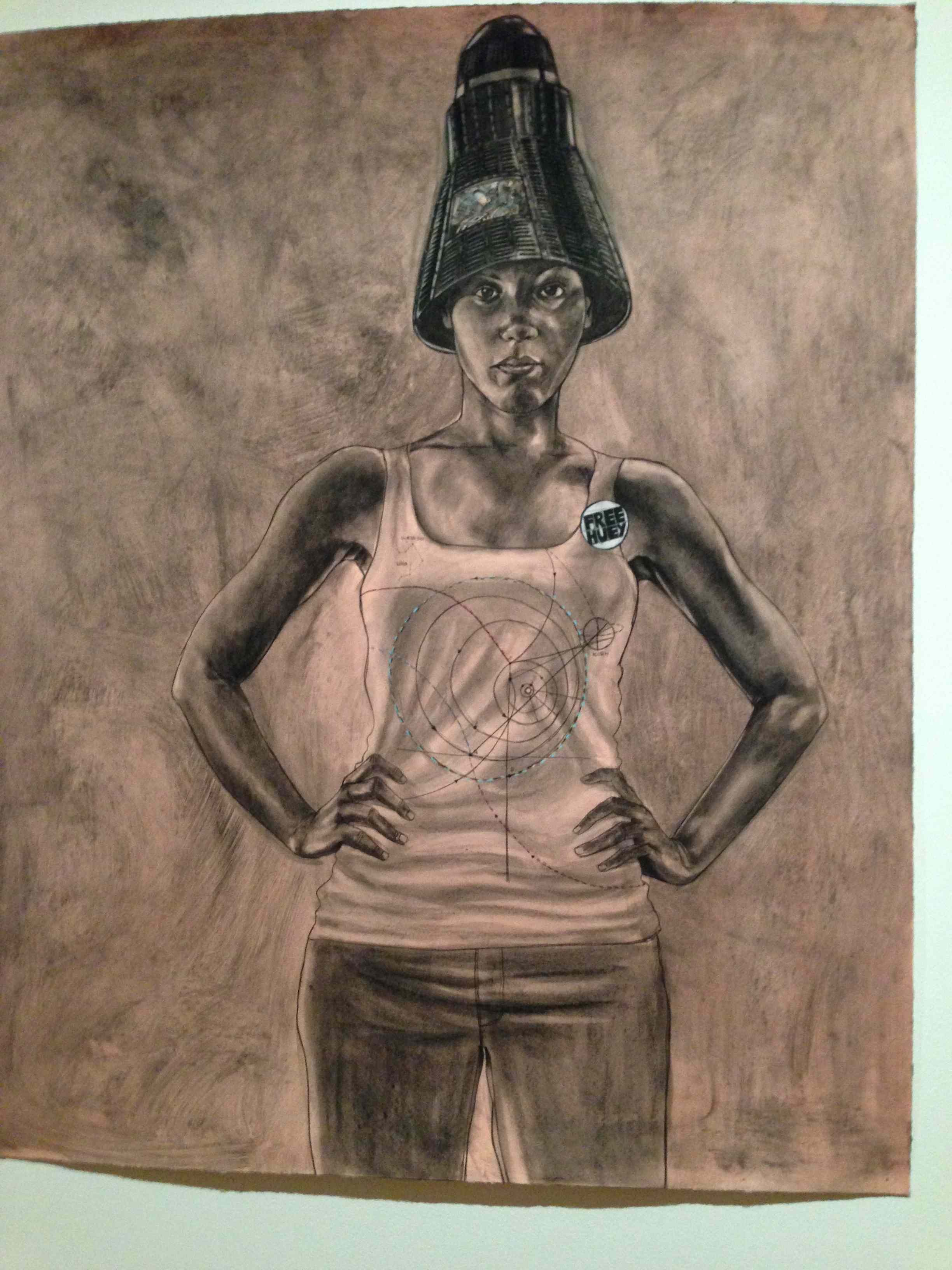
Installation view of Pruitt’s 2012 drawing, Diasporic Leaps and Bounds, courtesy of the Koplin Del Rio Gallery in Culver City, CA

Installation view of Pruitt’s 2012 drawing, Diasporic Leaps and Bounds, courtesy of the Koplin Del Rio Gallery in Culver City, CA

At the Studio Museum in Harlem’s current show, Robert Pruitt: Women, you’ll get to meet some regal-looking smarties who have a handle on art, space, and day-to-day life. Sandra Bullock’s astro-surfer is the talk of the town, but it’s these dozen-plus beauties, with their feet on the ground, who are soaring into the stratosphere with their intellectual firepower, accessories, and hairdos.

We’re talking about the stunning portraits on display through October 27. Click on the link to see more views of the installation, courtesy of photographer Adam Reich, but you need to get up to 125th Street to meet them in person.

First, it’s astonishing that these grand portraits are done with those first-year art school staples – conté crayon and brown butcher-block paper. Pruitt’s a master of the medium, and the women in his series can definitely hold their own against any Dutch Renaissance doyenne. They’re calm, cool, and collected. Yes, he’s added a touch of color or glint of gold to some detail or another, but it’s the fine hand and the technical mastery that gives each ethereal woman such large-format presence.
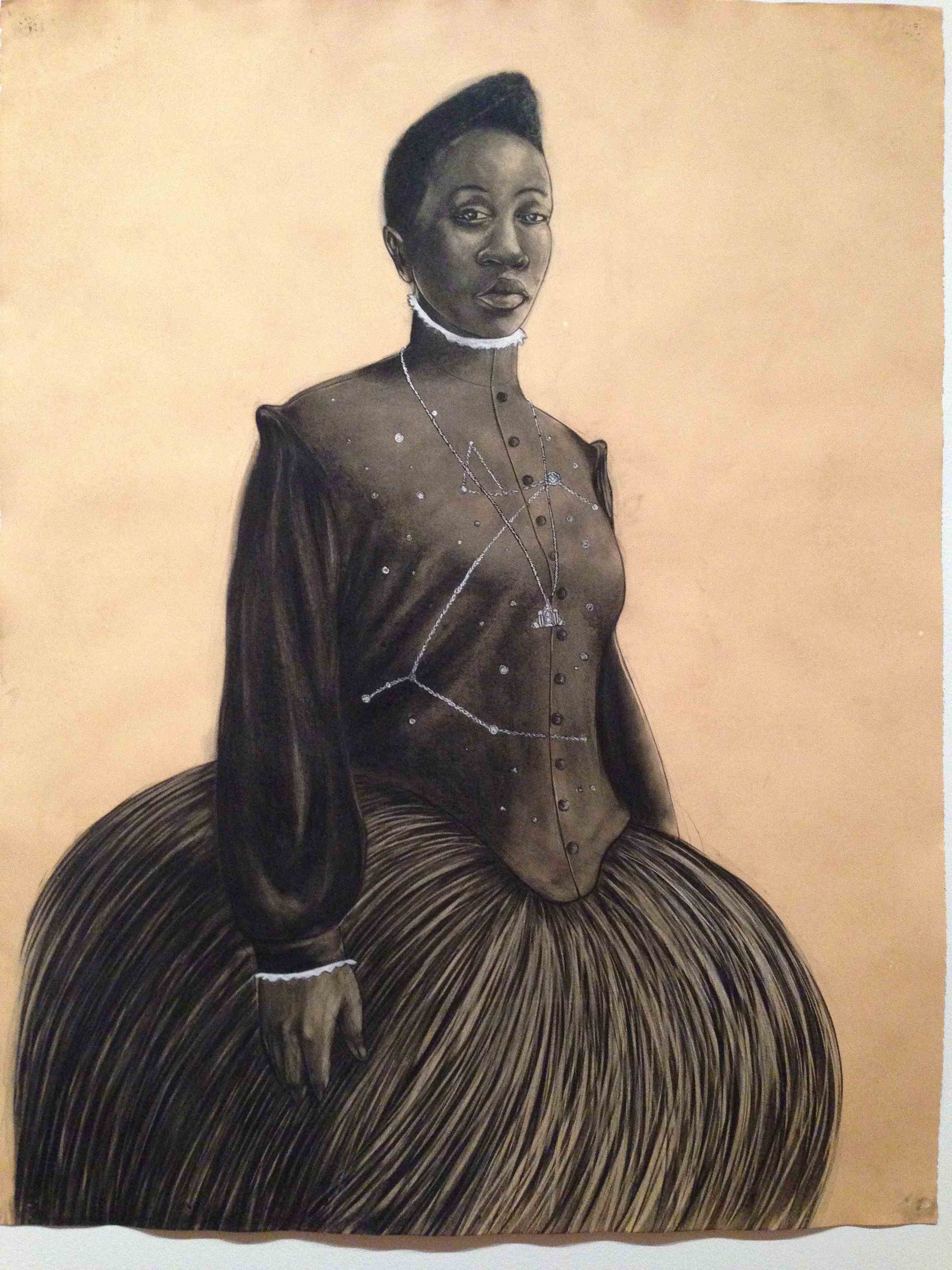
Pruitt’s 2011 Dreaming Celestial, featuring a Shuttle pendant suspended against a constellation bodice.

Pruitt’s 2011 Dreaming Celestial, featuring a Shuttle pendant suspended against a constellation bodice.

But there’s another dimension going on, too. Pruitt goes one step further by creating headpieces, outfits and accessories that tantalize art-lovers and science buffs with references to sometimes unknowable realms — art and astrophysics.

Consider the Tatlin-inspired updo coupled with the solar-system tunic in Be of Our Space World, the tiny Space Shuttle pendant and constellation bodice in Dreaming Celestial, the planetary tank top in Sun Fired, the Suprematist-inspired T in El Saturn, the space capsule chapeau and orbit diagram T sported in Diasporic Leaps and Bounds, and those choir-robe-looking outfits embellished with the tiniest of Star Trek logos for the sisters in the corner.

Yes, there are other political and pop references, but the space spin is pretty satisfying, particularly considering that Pruitt’s hometown is Houston.
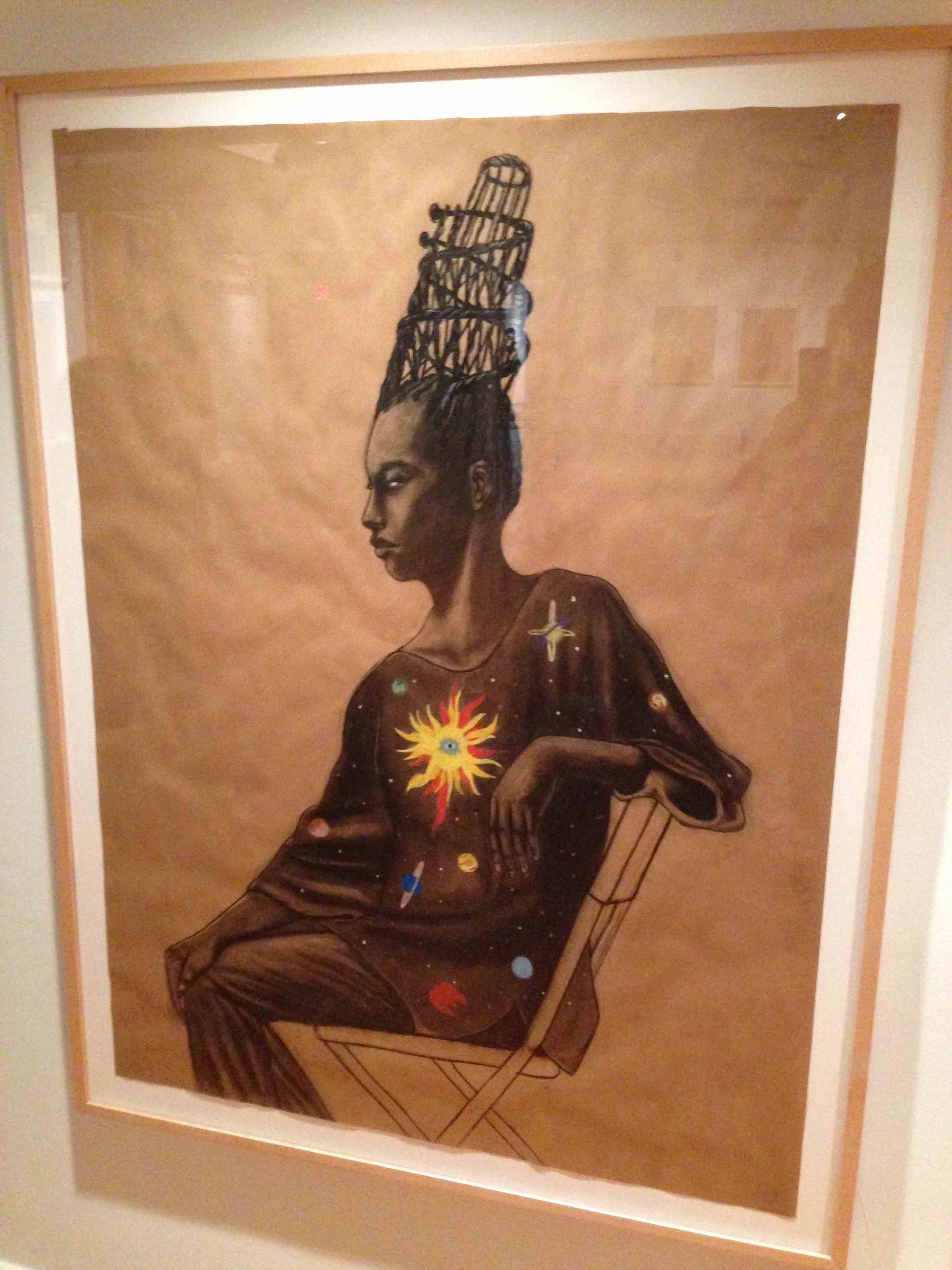
Installation view of Be of Our Space World, a 2010 work featuring braids fashioned into Tatlin’s Monument to the Third International, courtesy of Houston’s Hooks-Epstein Gallery

Installation view of Be of Our Space World, a 2010 work featuring braids fashioned into Tatlin’s Monument to the Third International, courtesy of Houston’s Hooks-Epstein Gallery

Pruitt’s women are real-world and smart beyond belief — just the type of people we’d like to meet at the next SciCafe or have Dr. Neil interview at an upcoming panel at the planetarium – women whose look tells us they have some super-big insights to share.
Rich & Famous at Green-Wood’s 175th Anniversary

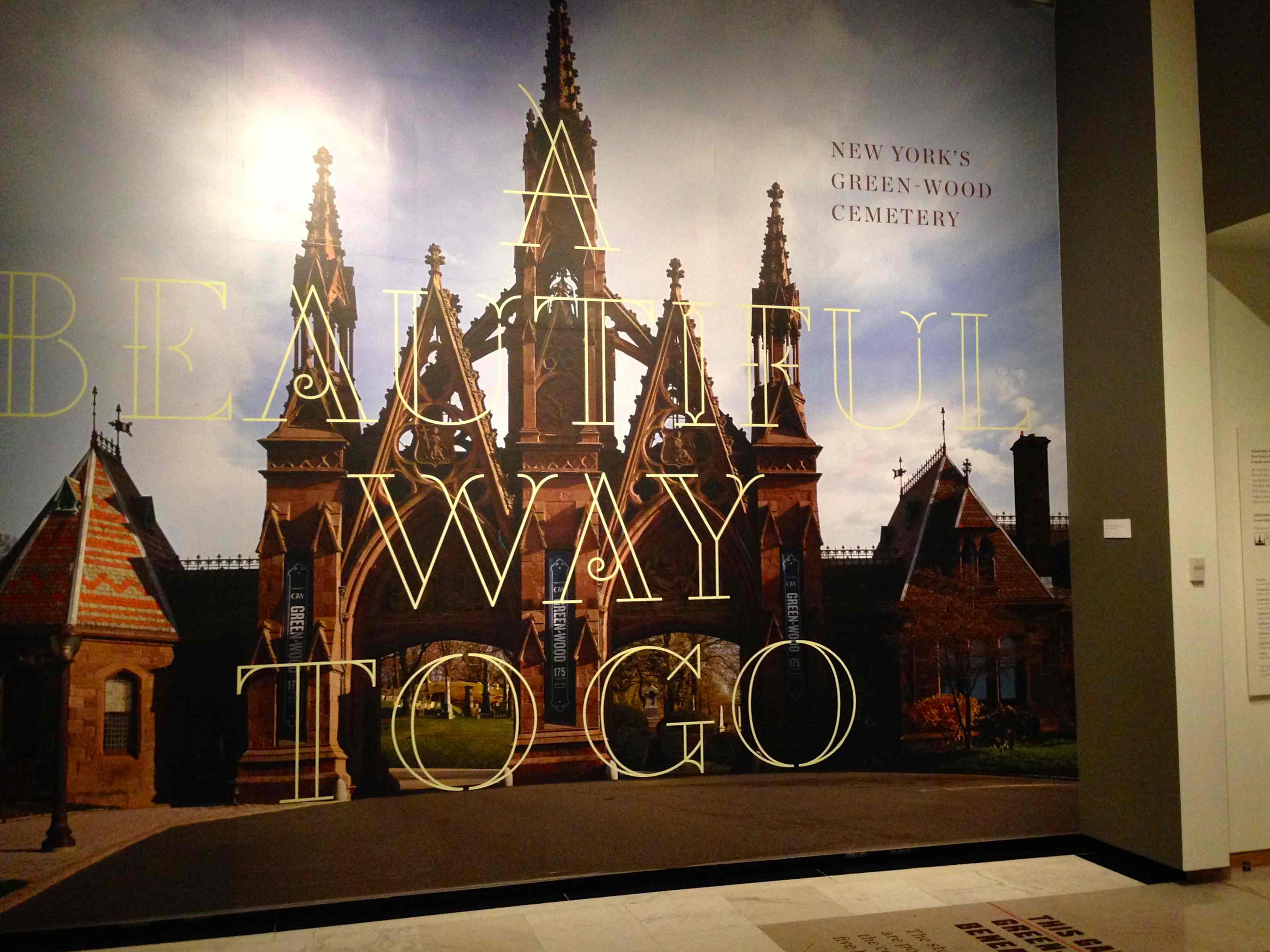
Show entrance featuring Green-Wood’s spectacular Gothic architecture.

Show entrance featuring Green-Wood’s spectacular Gothic architecture.

It’s big, green, historic, beautiful, and has more celebrities inside than you could ever imagine possible in an out-of-the-way spot in Brooklyn. Any day of the week, you can take a trip out to the lush woodlands, hills, and statuary gardens of Green-Wood Cemetery (and you should!), but every NYC history geek needs to visit the Museum of the City of New York’s A Beautiful Way to Go: New York’s Green-Wood Cemetery before October 13 to plumb the riches that have been assembled to celebrate its 175-year history.

We’re providing a walk-through on our Flickr feed, but the virtual experience is no match for the first-hand encounters with objects associated with the New York titans that are interred within the 478 acres of hills and countryside of Green-Wood itself – Tiffany, Duncan Phyfe, Boss Tweed, and even The Little Drummer Boy.

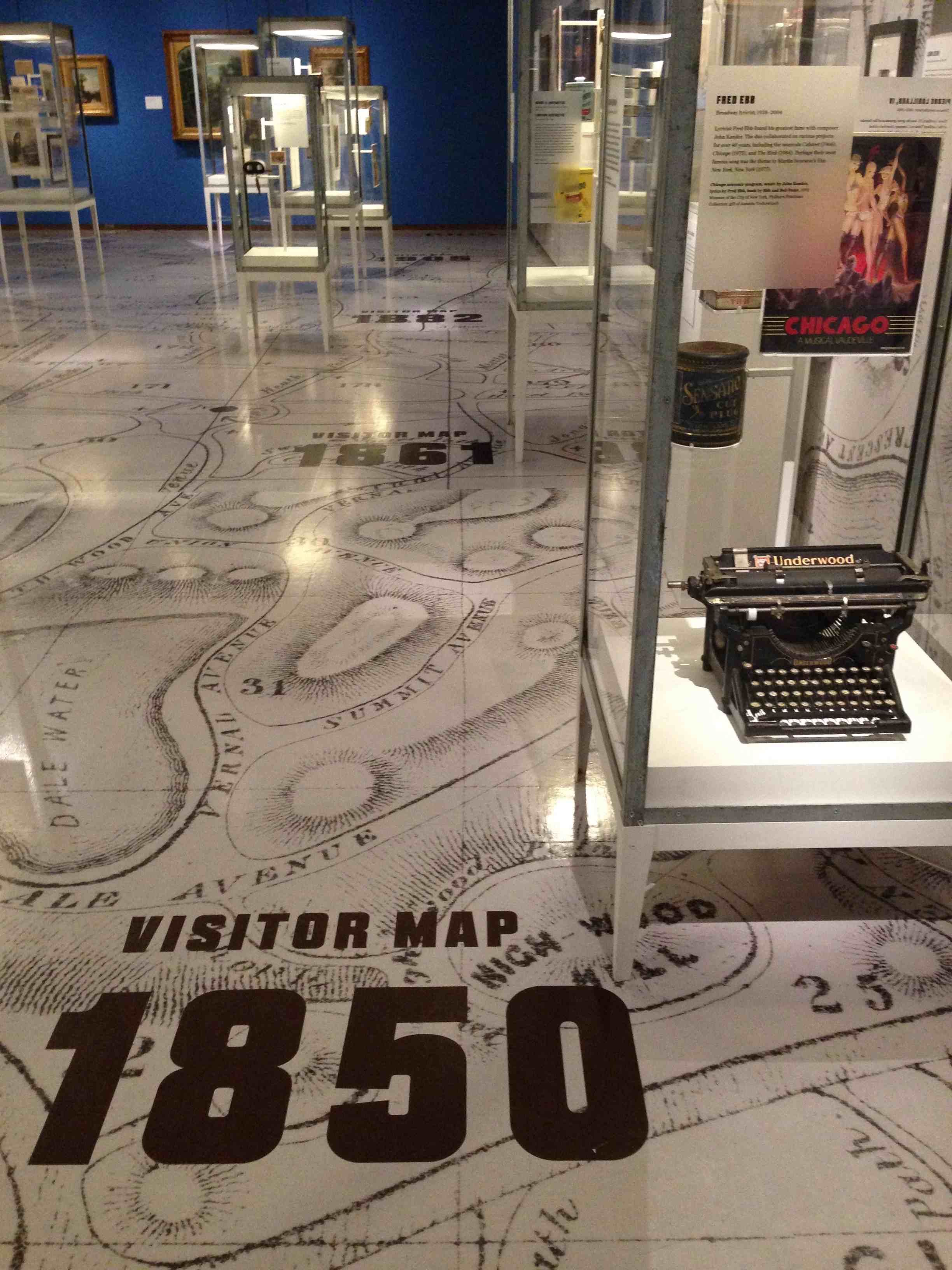
The floor map and vitrines with items associated with Green-wood’s most famous

The floor map and vitrines with items associated with Green-wood’s most famous

Consider the retail giants and brands: All five Brooks Brothers (who invented ready-made suits in 1849), the six Steinways who made pianos in Queens, Ebhard Faber (remember pencils?), the Domino Sugar owners (who once had 98% of the entire US market and who gave most of their vast art collection to the Met), the creator of Chiclets, the founder of Pan Am, and even F.A.O. Schwartz (yes, it’s a person).

MCNY has put the map of Green-wood on the floor of the gallery and has placed vitrines with objects associated with the rich and famous sort-of where they would be in the actual cemetery. Walking through the show is like random-access memory. You don’t know what or who you’ll stumble upon.

The tribute includes artists (from Currier & Ives and Asher Durand to Leon Golub, Nancy Spero, and Jean-Michel Basquiat); composers (Frank Ebb, Mr. Bernstein, and disco legend Paul Jibara); and inventors of things like the safety razor, the sewing machine, soda fountains, and the safety pin (think about that). Yes, it all happened in New York.

Spanish-language poster for "The Wizard of Oz" as a tribute to Frank Morgan, who played The Wizard

Spanish-language poster for “The Wizard of Oz” as a tribute to Frank Morgan, who played The Wizard

Green-wood is New York’s equivalent of the Pere Lachaise Cemetery in Paris, full of vistas, trees, paths, lakes, works by celebrity sculptors, military memorials, and elaborate, ornate above-ground tombs. Lachaise spawned an international mania for sylvan-glade cemeteries when it opened in 1804, and when Mr. Pierrepont was laying out the Brooklyn street system in the early 1800s, he left a big, open green spot in the plan, where Green-Wood is today. It opened in 1838, predating Central Park, and grew into the No. 2 tourist attraction in the United States (after Niagara) by the 1850s.

An 1875 Howe Sewing Machine by the inventor of the sewing machine, Elias Howe.

An 1875 Howe Sewing Machine by the inventor of the sewing machine, Elias Howe.

The show’s front hall has spectacular landscape photos taken last year by Jeff Chien-Hsing Liao, serving as luring calling cards to take the actual expedition to Green-Wood and its celebrated trolley tours led by uber-historian Jeff Richman.

Find Lightness of Being at City Hall

Alicja Kwade’s bicycle sculpture, Journey without arrival (Ralegh), 2012/2013

Alicja Kwade’s bicycle sculpture, Journey without arrival (Ralegh), 2012/2013

No, it’s not the mayoral race. As long as the nice weather holds up, get down to City Hall Park and poke around among the trees and plaza to see the whimsical sculpture that the Public Art Fund has on display in Lightness of Being. There’s plenty of time before the show closes December 13.

Take a look at what you can find on our Flickr feed.

Everyone will have their own favorites, but you’ll have to look closely to catch some of the work, since you can easily walk by and not notice – David Shrigley’s nearly hidden Metal Flip Flops near the fountain and Alicja Kwade’s delightfully twisted bicycle sculpture that’s hopefully not how your Citibike is going to end up. People walk right by them and then do a double-take.

At the foot of the park, Dalniel Buren’s Suncatcher functions more like an impromptu stage for fun-loving toddlers, but the true stars of the show are the six fantasty characters holding court nearby.

Buzzing it Down, 2012, by UK artist Gary Webb

Buzzing it Down, 2012, by UK artist Gary Webb

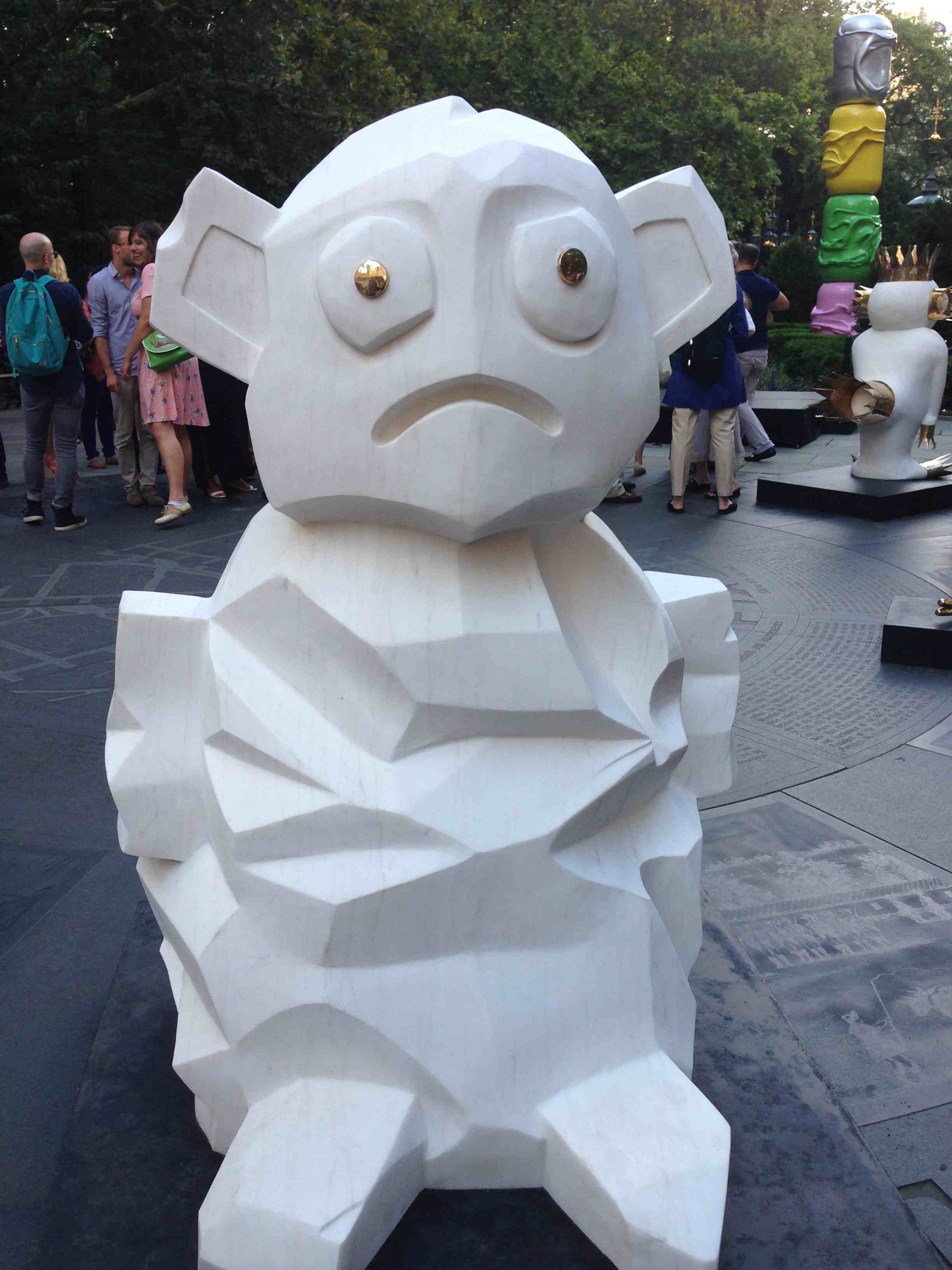
Get out your cameras for Olaf Breuning’s installation, The Humans. They’re some of the craziest marble statues you’ll ever meet, forming a circle to evoke the human evolution from “fish” to “fisher king.” Enjoy the contrast they make to the Park’s other, more traditional marbled details.

Poke around behind Nathan Hale to see Franz West’s whimsical forest of bulbous growths, and don’t miss the super-intriguing sculpture by James Angus. He’s made a full-scale John Deere tractor in steel and cast iron, but instead of being a faithful reproduction, he stretched it digitally and left it toppled among the trees near Broadway. It makes you think back to the pre-industrial 1660s when this land was used as a livestock pasture, and reflect on where agriculture is today.

One of six fantasy characters in Olaf Bruening’s installation, The Humans, 2007.

One of six fantasy characters you’ll meet in Olaf Bruening’s  The Humans, 2007.

The show will delight, make you think, and turn you into an urban explorer probing the nooks and crannies of the southern portion of the park’s nine acres.

And if you take your camera and get any good shots, you can contribute them to the Gallery on the Pubic Art Fund’s site.

See New York Through Hopper’s Eyes

Hopper’s easel holds his painting, Early Sunday Morning (1930) at the Whitney.

Hopper’s easel holds his painting, Early Sunday Morning (1930) at the Whitney.

If you thought you knew about Edward Hopper, think again. The Whitney’s show, Hopper Drawing, provides surprises galore from curator Carter Foster, who has presented the museum’s trove of Hopper drawings in a fresh, new context. The Whitney has more Hopper drawings (made for his private use) than any other museum in America, and about half are up on the walls. Go before October 6.

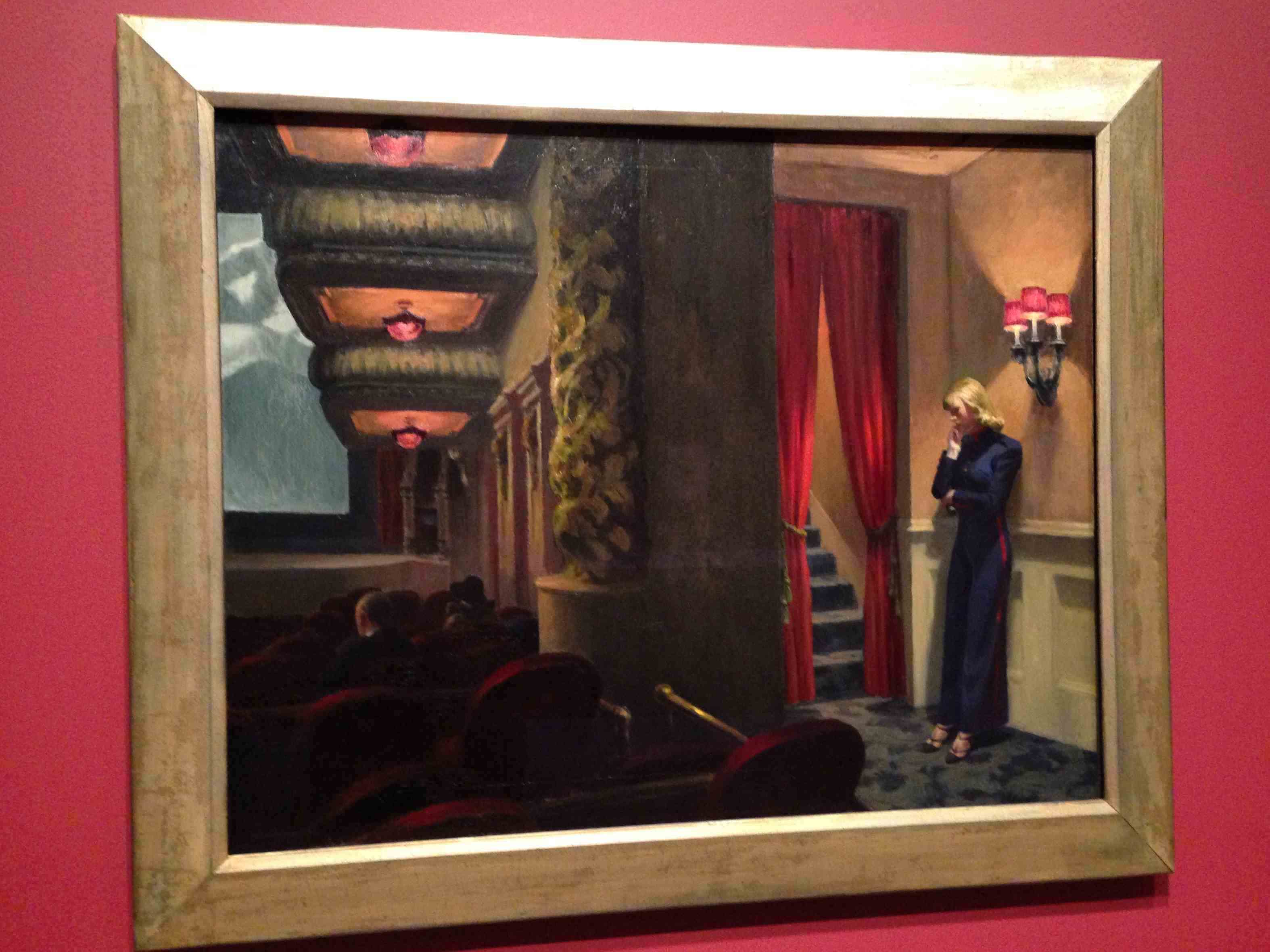
Although Hopper’s representational work is considered by his fans to signify “realism”, Foster has unearthed and organized zillions of preparatory drawings that demonstrate that this is hardly the case. Hopper, as he often said, worked “from fact” but added improvisational touches that pretty much made the canvases perfect. A case in point is New York Movie, where one side of the canvas is “real”, and the other side is completely imaginary. His sketchbook from the Palace Theater proves it.

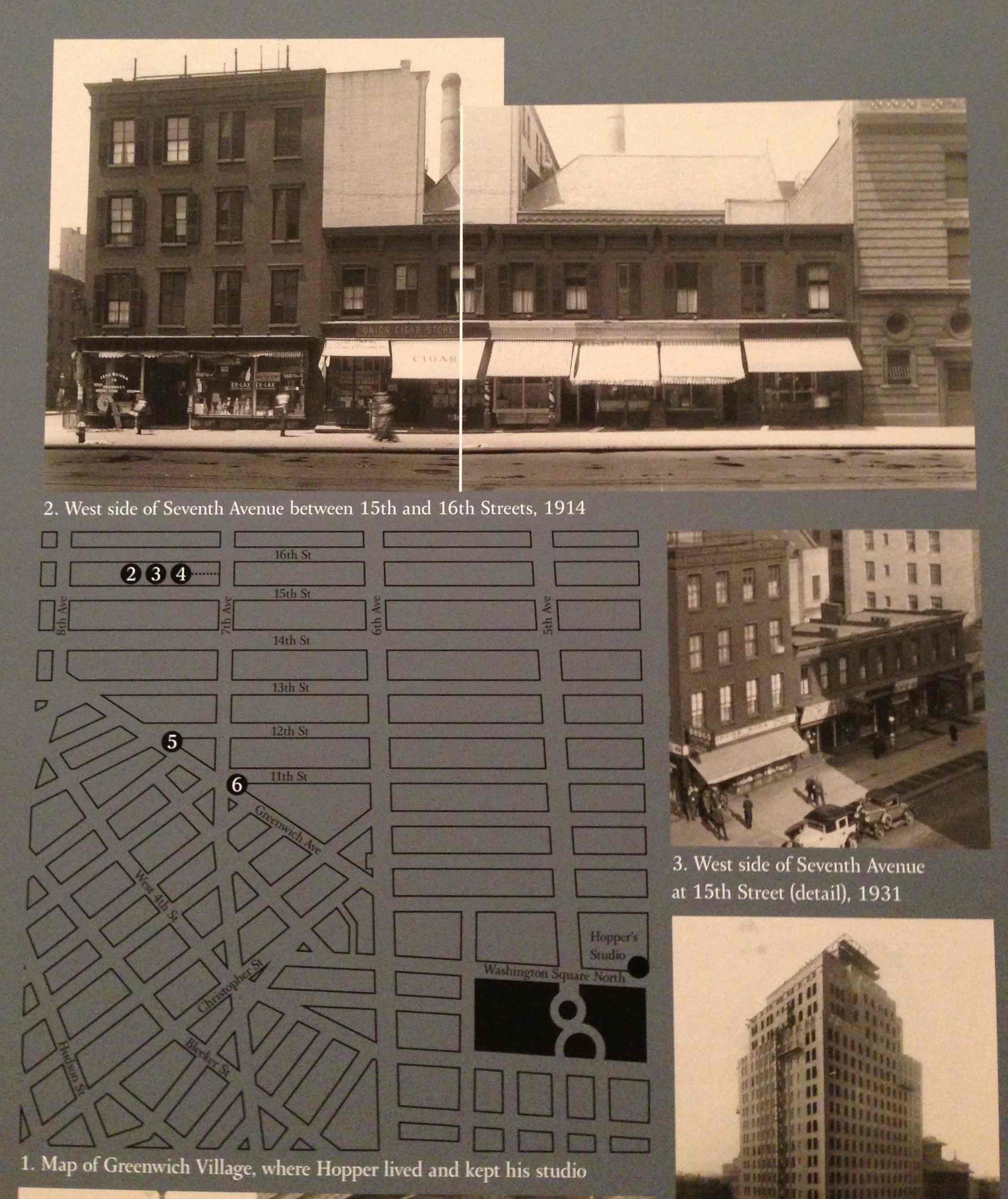
Whitney exhibition card showing map and 1914 photograph of the West Village storefronts depicted in the above oil painting

Whitney exhibition card showing map and 1914 photograph of the West Village storefronts depicted in the above oil painting

To prove this point, you’ll see the most famous Hopper paintings right alongside his preparatory sketches and sketchbooks to see his meticulous decision making process. Go to the exhibition web site (or our Flickr feed) and flip through images of Hopper’s iconic oils (such as New York Movie  and Chicago’s Nighthawks), followed by sketches and studies where Hopper worked out all the compositional kinks.

Hopper lived and worked right inside the row of gorgeous 1830s townhouses along Washington Square North. It’s a complete surprise to find that NYU still preserves Hopper’s studio intact, complete with his print press and easel.

Foster convinced NYU to loan it to the show, and it’s an electrifying reminder that artists once walked the streets of the Village and then came back to paint. You’ll stand face-to-face with the working easel that Hopper used to paint every one of his great works. Early Sunday Morning is perched, right where it sat in 1930, facing the Hopper’s other icon Nighthawks, on loan from Chicago’s Art Institute. The width of those canvases precisely matches the width of the easel.

Installation view of Hopper’s New York Movie (1939), on loan from MoMA

Installation view of Hopper’s New York Movie (1939), on loan from MoMA

So, that left a question: Where these real places, or fictions made up entirely in Hopper’s mind? Foster spent time trying to figuring it out, and thankfully the Whitney recorded the answers on its YouTube video. Take a walk with him and see the Village and the Flatiron through Hopper’s eyes back in the 1930s. You’ll never look at Nighthawks the same way again. Genius.

For theater fans: It’s not in the video, but Hopper’s sketchbooks are also filled with drawings of Times Square theaters — the Palace, the Globe (now the Lunt-Fontanne), the Republic (now the New Victory; formerly Minsky’s Burlesque),  and the Strand (where Morgan Stanley now sits).

Medieval Foodies

Cooking ScrollWhen you enter Mr. Morgan’s Library, you never know what you’re going to find, since the curators are always surprising us with treasures from the archives. Remember when the volcano spit ash all over Europe several years ago and all the flights were grounded?  The Magna Carta couldn’t get home, so it took up residence for a few months right in front of Mr. Morgan’s big fireplace in the East Room.

If you get over there before October 6, you’ll get to see something just as unique – a scroll from the mid-1400s containing 200 recipes (in Middle English, of course) that are fit for a king or royal lord. Move over, Smorgasburg!

The scroll would have been created by foodies some time around the reign of Henry VI (1422-1461) or Edward IV (1461-1483) during the War of the Roses. Henry’s objections to the aristocrats’ rights protected by the Magna Carta led to civil war, which was won by Edward, his successor from the House of York. At least someone was eating well and practicing penmanship during this tumultuous time in Merry Olde England.

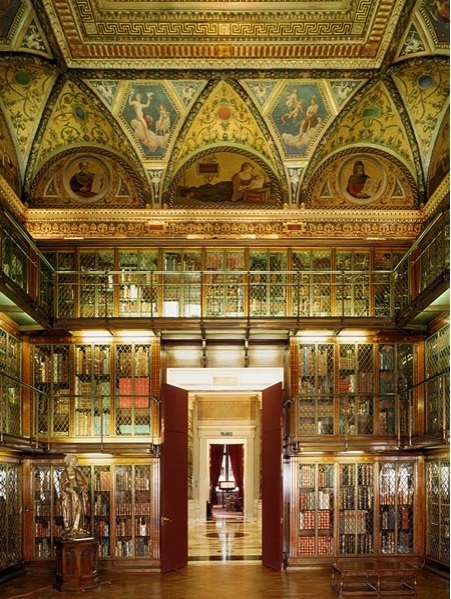
30-foot walls of Mr. Morgan’s Library have three stories of inlaid Circassian walnut bookcases with treasures of world literature. Photo © 2006 Todd Eberle

30-foot walls of Mr. Morgan’s Library have three stories of inlaid Circassian walnut bookcases with treasures of world literature. Photo © 2006 Todd Eberle

The cookery scroll is displayed right inside the library door, past the historic marbled rotunda, keeping company with one of Mr. Morgan’s three Gutenberg bibles just opposite. It’s fitting that these two treasures are holding court together: one showing the hand-crafted way that oral traditions of the one percent were being preserved; the other suggesting the revolution that was about to unfold as movable type and printing presses made the printed word universally accessible. Check out the amazing digital facsimile of Mr. Morgan’s printed treasure.

The scroll is part of an ongoing exhibition series, Treasures from the Vault, which also features music, letters, and manuscripts from the greats of Western culture. Check out the surroundings.

Here’s a video of everyone’s favorite still-working Tudor kitchen at Hampton Court Palace. The palace wasn’t built until 1529, but it will give you a visual on how some high-end cooks could have been using the scroll 550 years ago.

For more detailed 14th century cooking techniques, check out the YouTube by MedievalArtScience.


Front Row at Chinese Fashion Runway

Vivienne Tam’s 2007 embroidered/quilted silk cheongsam and Peter Som’s 2010 chartreuse and yellow silk dress.

Silk dresses from Vivienne Tam’s 2007 and Peter Som’s 2010 collections

In a brilliant move to honor some of the City’s fashion favorites, the Museum of Chinese in America is welcoming everyone downtown to see their bright, joyful tribute, Front Row: New York City’s Chinese-American Designers, which they’ve extended until December 1.

The show’s been a hit, with many museumgoers and fashion insiders making the trek downtown to wonderfully welcoming MOCA.

Inside the gallery, you’ll see a grand celebration of the contributions made to NYC’s fashion scene by a host of greats– the irrepressible Anna Sui, evocative Vivienne Tam, minimalist superstar Yeohlee, sumptuous Vera Wang, Jason Wu (one of Michelle Obama’s favorite), and eleven others.

Take a look at what we saw on our Flickr feed.

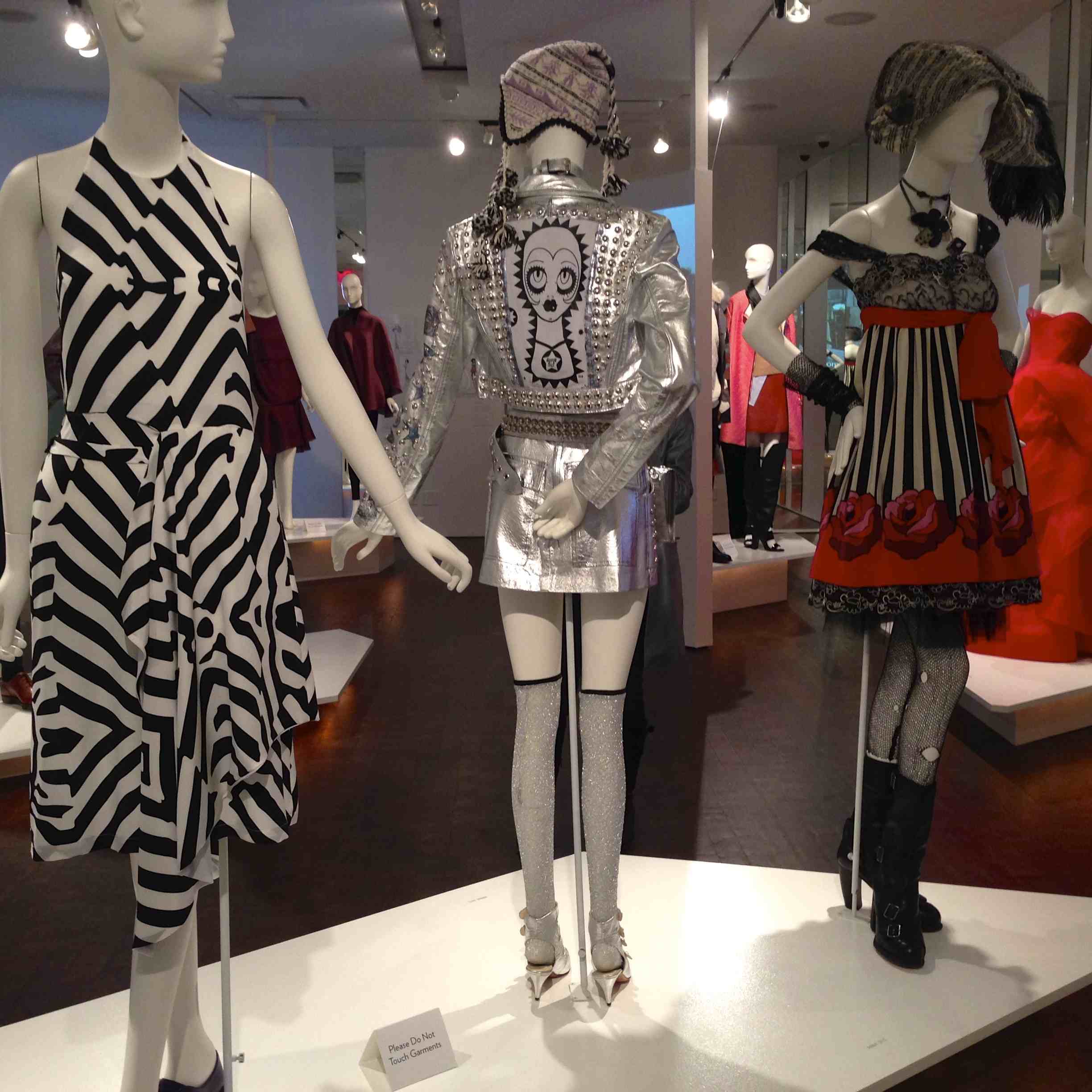
Striped dress by Wayne Lu and two by Anna Sui

Striped dress by Wayne Lu and two by Anna Sui

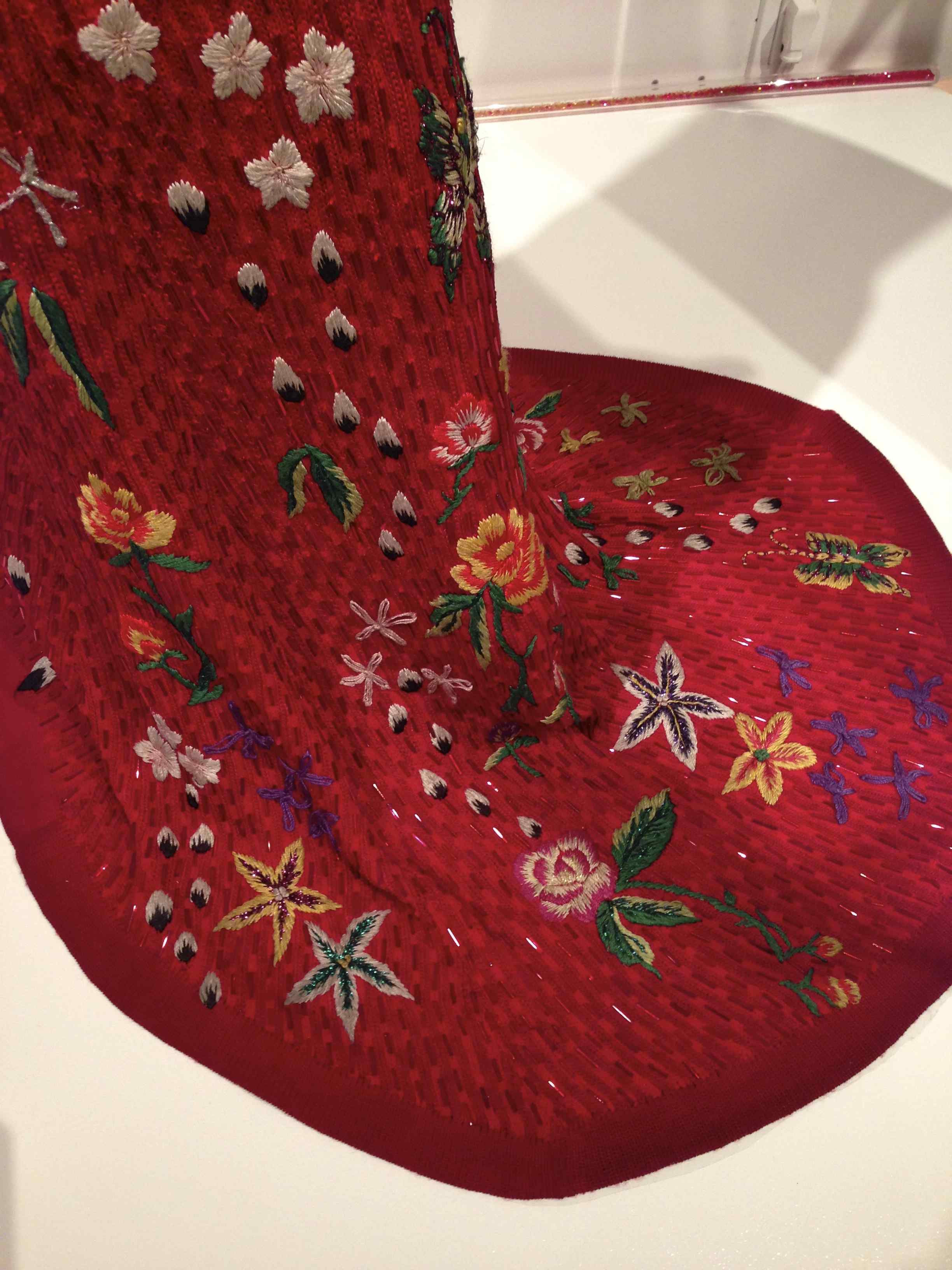
Some of the dazzlers include Vera Wang’s cardinal red ballgown embellished with horsehair trim, Zang Toi’s red knit embroidered red-carpet gown, and Anna Sui’s silver leather punk ensemble first seen on the runway on Linda Evangelista back in 1993. Take a look. It easily holds up today, particularly with the addition of the Peruvian tassel cap. For a bit of nostalgia, check out the vintage New York Times coverage of that show, which also features great reviews of Zang Toi and Yeohlee, too.

Curator and featured designer Mary Ping did a great job showcasing iconic looks, video clips of memorable runway shows, and video interviews with the designers. She worked with an advisory committee from the Met, FIT, and Parsons, and the overall effect is top-class – smaller than shows that the Costume Institute or FIT mount in their main galleries, but every bit as thoughtful, well documented, and illuminating.

Organza and horsehair trim on Vera Wang's Spring 2013 gown.

Organza and horsehair trim on Vera Wang’s Spring 2013 gown.

At a time when the Garment Center has gotten a little quiet and most manufacturing has shifted to China and other Asian countries, it’s a nice touch just to include just a sampling of the behind-the-scenes work of this illustrious and talented group – a few notebook sketches and some of the paper patterns from Yeohlee’s 38th Street atelier.

Embroidered train of Zang Toi’s 1991 red-carpet knit dress worn by Gong Li

Embroidered train of Zang Toi’s 1991 red-carpet knit dress worn by Gong Li

As Tim Gunn would say, “Go, go, go!”

Thousands Flock to the Light

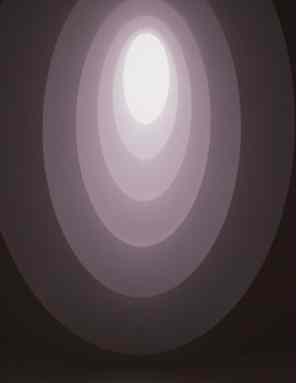
Imagine you are laying on the floor of the Guggenheim rotunda and that you are looking up at James Turrell’s new work. This is what you’d see.

James Turrell’s Aten Reign. Source: Guggenheim

The colors slowly, slowly morph for the next hour, changing from pink to green to yellow until they work through the entire color cycle. As yellow fades, you see the white, glowing sun…or is it the moon?

Aten Reign moment in the Guggenheim atrium, James Turrell’s site-specific spectacular. Source: Guggenheim

Aten Reign moment in the Guggenheim atrium, James Turrell’s site-specific spectacular. Source: Guggenheim

You need to get there to experience the spectacular light before September 25, when James Turrell takes his leave of New York, the end of his first major show here. The museum’s exhibition site is wonderful, but it’s no match for the out-of-this-world, cosmic experience of his masterful Aten Reign.

The Guggenheim has blocked off the famous skylight and any view of the atrium from its gallery spiral. Viewing the light show from the ground floor, all viewers see are these rings of slowly changing light with an oval center – a natural shape that Mr. Turrell loves.

Out-of-towners expecting to have the fun of walking up the ramp and looking down on ever-tinier ground-floor visitors will be disappointed. But other magical Turrell encounters await.

On Level 2, we found celebrated security guard, Jeffrey Martinez (see this week’s New York Times profile on him) holding throngs in rapt attention explaining the magic wrought by Mr. Turrell with his corner floor-to-ceiling strip of light. Martinez told us that although it appeared to be a vertical “light”, we were actually seeing an illumination emanating from behind the false wall. The New York Times was right to single him out for a story, because it felt like we were meeting a celebrity with art-world smarts, gently cautioning people against trying to touch and asking them to “stand back” to give the piece some space.

Afrum I (White), 1967, one of Mr. Turrell’s early cross-corner projections. Source: Guggenheim

Afrum I (White), 1967, one of Mr. Turrell’s early cross-corner projections. Source: Guggenheim

Upstairs, the show presents two more light installations that mimic two of the twenty 2D etchings precisely ringing a small gallery. Mr. Turrell creates the illusion, on paper, of light glowing from the white cubes surrounded by the ink. You just have to see them and then turn the corner to see “square” beams of light illuminating two walls. In the second room, Afrum I (White) astounds. You think you’re seeing a levitating white cube of light. Magical.

Hear him talk about his view of Mr. Wright’s philosophy and building and why they are so right for one another:

Enough said. Go see it.

Spoiler alert: The Guggenheim’s YouTube site has several videos about how Turrell and the team created the magic on the spiral.

LA Whimsy Runs Riot at The Met

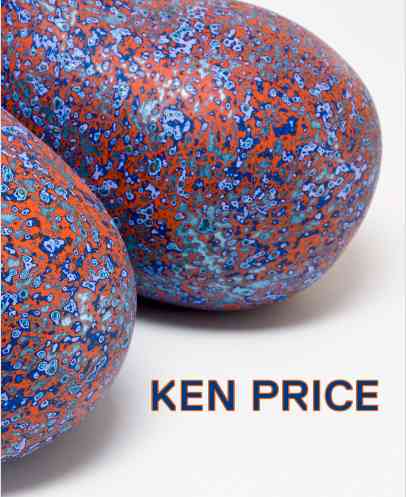
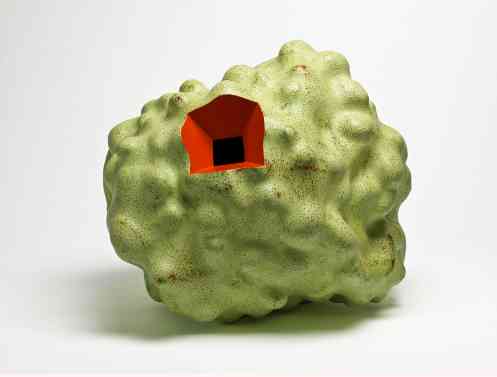
The catalog cover shows a close-up of Price’s finely sanded surface

Catalog cover close-up of Price’s finely sanded ceramic surfaces

If you want to feel happy, step into the Frank Gehry-designed space at the back of the first floor of the Metropolitan Museum of Art before September 22 to see Ken Price Sculpture: A Retrospective. You’ll find colorful abstract ceramic sculptures that absolutely defy you to smile.

Blobs, twists, eggs with things popping out, and joyful fantasy shapes abound in the clean, white space. It’s impossible to make sense out of any of it, except the feeling that you are let loose inside the mind of a California artist, who claimed to have a “highway to the unconscious.”

Price, a superstar on the West Coast, is fairly unknown here in the East, so it’s nice to get to know him. As a student, he was tutored by legendary ceramic artist Peter Voulkos and then worked mostly around Venice, California (and occasionally Taos) for the next 50 years, producing delightful, collectable pieces, and hanging out with LA greats Rusha, Irwin, Keinholz, Bell, and Bengston.

Pastel, 1995, fired and painted clay. Courtesy: James Corcoran Gallery. © Ken Price. Photo: © Fredrik Nilsen.

Pastel, 1995, Ken Price’s fired and painted clay sculpture, courtesy of the James Corcoran Gallery. © Ken Price. Photo: © Fredrik Nilsen.

The show begins with Price’s most recent work and works back through time, so you’ll encounter some of the larger, crazier, colorful pieces right as you walk in. Some of the ceramic surfaces of look pebbly and coarse, but this is right where Price worked his magic. He painted coat after coat atop his fired pieces, and then meticulously sanded it all down to make a silky smooth surface. You really can’t tell unless you’re eyeball-to-eyeball with the blob sculptures, but the cover of the catalog (top left) gives you a hint.

This experience suggests the type of fun, contemporary shows that The Met will mount when it takes up residence at the Whitney’s building on Madison, once that institution decamps for the High Line in 2015.

Take 3 minutes to let curator Stephanie Barron walk you through LACMA’s installation earlier this year, which is pretty much what you’ll experience on Fifth Avenue. She tells you a little about Gehry’s gallery approach and talks about her relationship with the fun, fabulous Ken Price. Enjoy the spin, and get over to The Met for some real California fun.

Wood Goes Against Grain at MAD

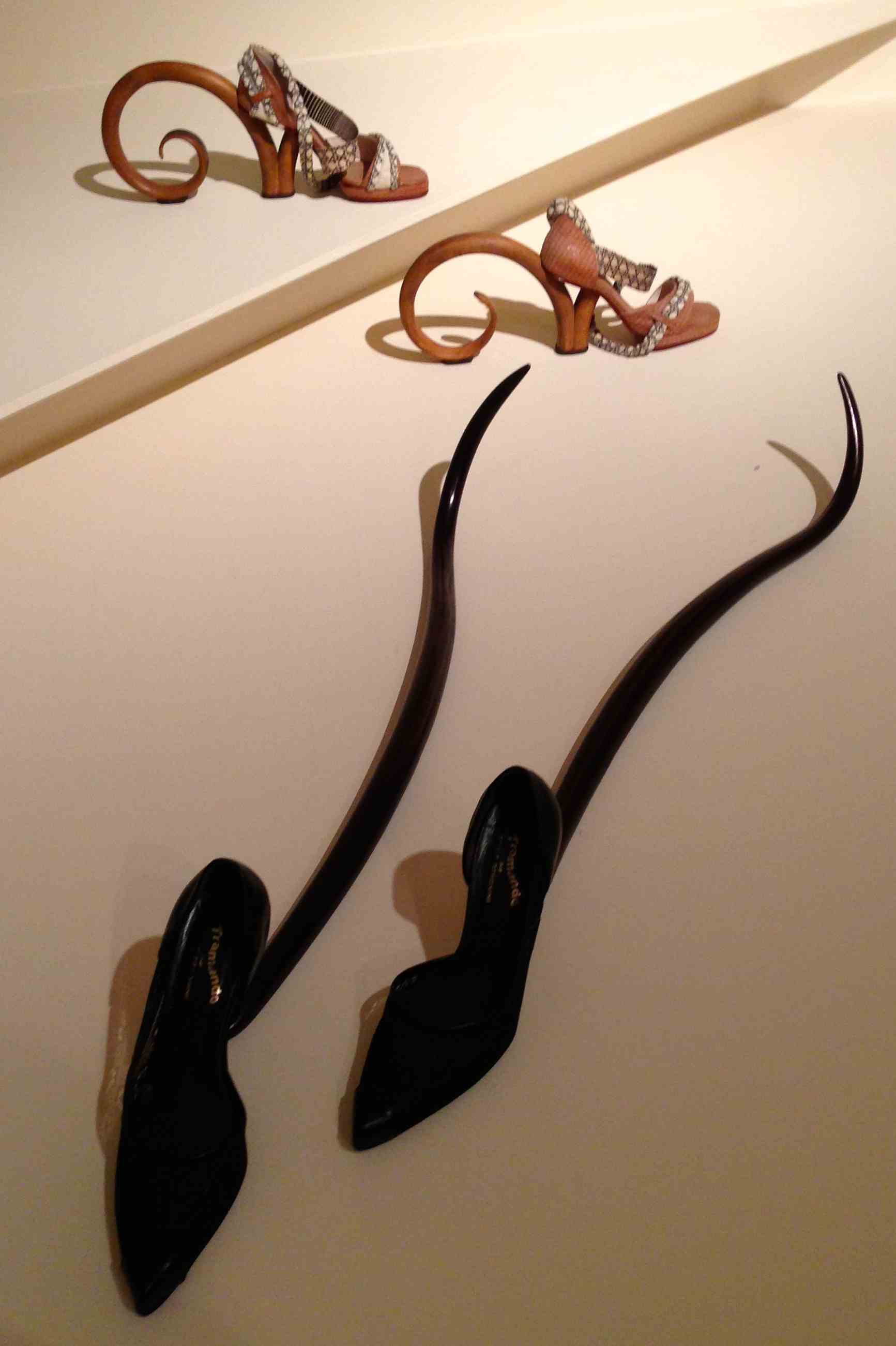
Pablo Reinoso's whimsical wooden shoes

Pablo Reinoso’s whimsical wooden shoes

All those years walking up and down the aisles at craft fairs may have you convinced that there’s nothing new in wood art. Get over to the final days of Against the Grain: Wood in Contemporary Art, Craft, and Design at the Museum of Art and Design.

It’s not what you’d expect, and curator Lowery Stokes Sims has done a magnificent job in telling us what’s trending now with forward-looking artists on the scene.

In short, she focuses her two-floor exhibition on seven trends that she sees: Artists, like Ai Weiwei, working on socio-political themes, whimsical designers who make us smile, digital artists pushing the envelope with wood, collages, virtuoso technique, takes on trees, and works that just capitalize on the beautiful texture in the wood itself.

Check out our Flickr feed for views of some of our favorite works, and MAD’s four-minute video as Sims herself walks you through the show, the artists, and her thinking about the pieces and themes.

Steam-bent ash chairs by Christopher Kurtz

Steam-bent ash chairs by Christopher Kurtz

But let’s focus on some of our favorites, which you can see on Flickr.

Wood as fashion: What about these shoes by Pablo Reinoso? If you’re thinking Dutch wooden shoes, think again, because these dainties are inspired by Thonet chairs, that he’s embellished with long, wooden “tails”. Or wooden hats by fashionable Moody & Farrell of London.

Music: How did Maria Elena Gonzalez go from looking at a fallen birch tree to creating paper-thin birch rolls that can create stunning music on a player piano? Watch and hear it all on this video of her player piano in action.

Laurel Roth's Hominid Chimpanze (2011) from vere wood with Swarovsky crystals in the teeth

Laurel Roth’s Hominid: Chimpanze (2011) from vere wood with Swarovsky crystals in the teeth

How-did-they-do-that category: Bud Latvin’s gravity-defying wooden spiral sculptures, Christopher Kurtz’s impossible steam-bent chairs, and Elisa Strozyk’s wooden textile.

Recycled surprises: Think about what it took to turn 8,000 recycled chopsticks into a collapsible sofa. Good going, Yuya Yoshida.

If you can get to this show today or tomorrow, go. If not, take time to meet Leonard Drew in his studio, see his wood works in progress, and hear what success in wood feels like:

Stylish NYC Micro-Housing Showcased at MCNY

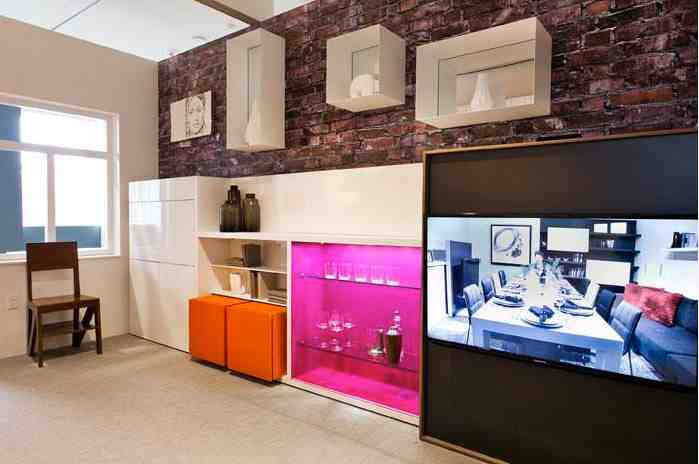
The TV wall slides away to reveal storage shelves

The 325 square-foot solution on display at MCNY: the TV wall slides away to reveal storage shelves. Source: MCNY

With all the single people living in Manhattan and the outer boroughs, it’s kind of shocking to find that building stylish, affordable micro-units is still illegal in most of the City. What’s a renter to do?

Get over to Museum of the City of New York pronto and take a look at the future in the hugely popular show, Making Room: New Models for Housing New Yorkers.

It’s no surprise that the housing stock here doesn’t match the demand. MCNY and the Citizens Housing & Planning Council got together to put on a show that raises the possibility of change, showcases several innovative solutions proposed by design teams, and presents a full-scale, walk-through model apartment: a 325 square-foot micro-space (built and furnished by Clei and Resource Furniture).

The sofa turns into a bed

The sofa turns into a bed. Source: MCNY

Apparently our City’s is due to grow by 600,000 people over the next 20 years, so the question becomes – where is everyone going to live? How can people live affordably? Is there a way to create living spaces that are flexible as families grow? Listen as CHPC’s Jerilyn Perine lays it all out in this fascinating 11-minute presentation at the 2011 kick-off to the project, focusing on housing demand, illegal rentals, and rental history in New York.

Currently, the City regulates things such as occupancy, density, minimum room size, parking areas, lot coverage, the number of dwelling units that can be on a single lot, and the proportion of living vs. working space in some parts of town. And, yes, most neighborhoods prohibit building spaces like the micro-studio at the center of the MCNY show. CHPC’s projects imagined what could be if some of those regulations (well intended) were relaxed.

Read about the background of CHPC’s Making Room project and design competition and find links to related TED talks, sites, and the proposed design solutions – stacks of prefabricated apartments, mini-bungalows for the Bronx, and repurposed industrial spaces in Brooklyn. The CHPC site shows details of each of the five featured plans.

But the star of the MCNY show is the model studio. Here’s a video of what you can experience for a few more days. (The show was held over by popular demand.) Note the transformation of the Cubista (the ottoman-looking piece of furniture that unfolds), and so many other smart small-space design choices.