Gauguin’s Primitive Universe at MoMA

Be Mysterious (1890) Carved and painted lime wood from Musée d’Orsay, Paris. © RMN-Grand Palais /Art Resource NY.

Be Mysterious (1890) Carved and painted lime wood from Musée d’Orsay, Paris. © RMN-Grand Palais /Art Resource NY.

You can almost hear the rustling pandan leaves, waterfalls rushing into exotic coves, and the drums and chants of fiery Tahitian rituals around powerful idols long since banned by the Christian missionaries…but only if you take the time to get close to the smaller works in MoMA’s revealing sixth-floor show, Gauguin: Metamorphoses through June 8.

Yes, Gauguin’s bright, colorful paintings of island life are displayed, but the show is really about the darker, more primitive experience expressed in Mr. Gauguin’s ceramics, woodcuts, carvings, and monoprints – the works that we rarely get to see en masse.

Hina and Fatu (c. 1892) Carved tamanu wood. Courtesy: Art Gallery of Ontario, Toronto © 2013 AGO

Hina and Fatu (c. 1892) Carved tamanu wood. Courtesy: Art Gallery of Ontario, Toronto © 2013 AGO

After nearly two decades plugging away at his day job, weathering a stock-market crash, struggling to stay in the middle class, cranking out artworks in his spare time, and showing with the Impressionists, he just chucked it all, packed a bag, and went to Tahiti in 1891. From his young-adult years working in the merchant marine, he figured Tahiti was as far away as he could get from his family, responsibilities, and the frustrating Paris art scene where others were making it besides him.

Nothing’s perfect, and the Tahiti he arrived in was already changing from contact with the global trade networks of industrialized countries. No matter. Gauguin was captivated by the thought of connecting with the “true” primitive and savage that lived in the myths, lore, and natural beauty of Polynesia and shoving it all into the face of the avant-garde and art-buying public back home.

The curators have assembled all the images Gauguin created for three dramatic series of woodcuts. The rough edges really come out in Noa Noa (1893) and The Vollard Suite, with a few of the gouged-out woodblocks exhibited right next to several states of the same image.

Mahna no varua ino (The Devil Speaks), state IV / IV, from the suite Noa Noa (Fragrant Scent). (1893–94). Woodcut from private collection. Courtesy: Galleri K, Oslo. © Reto Rodolfo Pedrini, Zurich

Mahna no varua ino (The Devil Speaks), state IV / IV, from the suite Noa Noa (Fragrant Scent).
(1893–94). Woodcut from private collection. Courtesy: Galleri K, Oslo. © Reto Rodolfo Pedrini, Zurich

Black, dark, primitive, edgy – too edgy, in fact, for his dealer, Mr. Vollard, who felt that the prettier oil paintings were a lot more palatable to his clients. (Vollard kept the more expressive primitive prints in the drawer.)

Take a look on MoMA’s special website for the show, which has a detailed timeline for Gauguin’s travels. Clicking on images on the site allows you to zoom in closely on each work. A particularly nice touch is the full digitized version of Gauguin’s unpublished Noa Noa manuscript, which he assembled (but never published) to interpret all the exotic images and symbols of the series for the public and his hoped-for fans. Scroll down to the bottom of this page to see the manuscript, page by page.

Oviri (Savage). (1894) Partly enameled stoneware, from Musée d’Orsay, Paris. © RMN-Grasnd Palais /Art Resource NY

Oviri (Savage). (1894) Partly enameled stoneware, from Musée d’Orsay, Paris. © RMN-Grasnd Palais /Art Resource NY

So here’s your chance to examine what was boxed up for so long along alongside magnificently  disturbing sculptures, panels, and reliefs of goddesses, devils, spirits, waves, women, and mountains created out of tamanu and pua wood with the occasional daubs of colored paint. It’s clear that the design and detail of Gauguin’s beautiful symbolist color paintings got a further workout through all of these other works portraying the dark, mysterious side of life forces emanating from the mind of a struggling artist obsessed with the uber-primitive.

Some say that Picasso was inspired to transform his Demoiselles after seeing some of this raw work (exhibited after Gauguin’s death). Say hello to them seven days a week on MoMA’s 5th Floor.

Get Out of Town with JJ Audubon

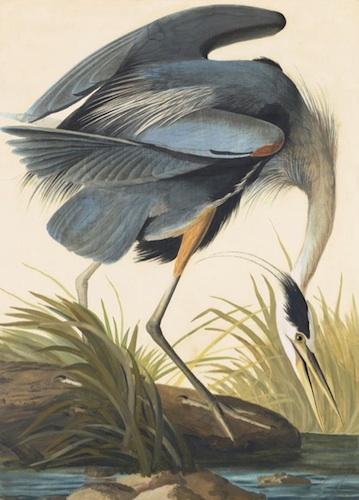
Audubon’s Great Blue Heron (Ardea herodias), Study for Havell pl. 281 (1832). Watercolor, graphite, and pastel on paper, laid on thin board. Courtesy NYHS and Mrs. Audubon

Audubon’s Great Blue Heron (Ardea herodias), Study for Havell pl. 281 (1832). Watercolor, graphite, and pastel on paper, laid on thin board. Courtesy NYHS and Mrs. Audubon

If you need to get out of town Memorial Day weekend, there’s no better traveling companion than J.J. Audubon, whose original watercolors will transport you to another time and place better than any plane, car, or train. Experience his spectacular show at the New-York Historical Society, Audubon’s Aviary: Parts Unknown: Part II of the Complete Flock today and tomorrow.

Can’t make it in person to New York? Not a problem, because you can tour Mr. Audubon’s show (and more) on a fantastic website that shows you his birds, provides the maps of your journey, and more. True, you won’t enjoy the life-size paintings – shocking when you see them in person – but you’ll learn the entire backstory of JJ’s trips through the Southeast US and Northeast Canada as he did the best-job-ever for his epic Birds of America four-volume series.

In the NYHS gallery in the last several weeks, visitors have been running up to the second floor and grabbing the magnifying glasses to study each brushstroke of these magnificent works. Although they’re mostly watercolor, each painting is enhanced with graphite, pastel, gouache, and ink. Because no one’s perfect, a few have birds pasted in from other pieces of paper, but you really can’t tell unless you study them closely.

A second Great Blue Heron (1834), thought to be another species at the time, with the skyline of Key West, Florida. Courtesy NYHS and Mrs. Audubon

A second Great Blue Heron (1834), thought to be another species at the time, with the skyline of Key West, Florida. Courtesy NYHS and Mrs. Audubon

It’s the first time that NYHS has exhibited JJ’s complete watercolor series, but it’s so big – 474 original watercolors – that they had to break it into three separate shows.

Mrs. Audubon presented JJ’s entire set of original work to NYHS in1862. Her husband had worked so hard on these works of art (he didn’t consider them “scientific”) that she commented that sometimes the birds felt like “her rivals.” Better that NYHS preserve them for posterity.

The museum decided to mount the watercolors in the order in which JJ painted them. On the website, you can revisit Part I, but let’s turn our attention to Part II.

As you’d expect from his trips to the Carolinas, Georgia, Florida, Labrador, and Newfoundland in 1831-33, the majority of the birds you’ll see live in and around the water. Two spectacular works are of the Great Blue Heron in two color ways. In JJ’s lifetime, the white- and bluish-colored herons were thought to be two separate species (which they’re not), so we’re treated two very large paintings of one fishing from shore and the other enjoying a meal in sight of the Key West skyline across the bay.

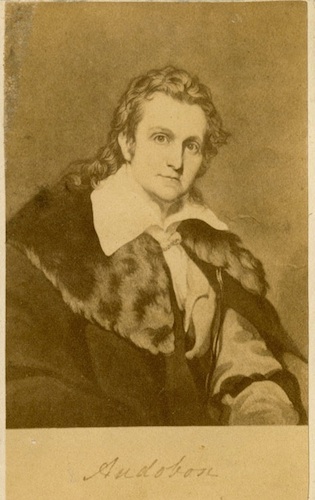
Carte–de–visite of John James Audubon. The legacy lives. Courtesy: NYHS

Carte–de–visite of John James Audubon. The legacy lives. Courtesy: NYHS

It’s amazing to consider that JJ started many of these while he was on his journeys, totally outdoing Banksy as a premiere peripetatic creating-art-wherever road warrior. Of course, he did it all without electricity and frequent-flyer miles hauling around gigantic pieces of perfect paper.

Through it’s collaboration with the Cornell Ornithology Lab, the NYHS provides (on the web and on the gallery audio guides) clips of each bird’s distinctive voice. Another nice in-gallery touch is an iPad app that allows visitors to compare each watercolor with the engraved print made in London by Robert Havell, Jr. for the printed books.

Enjoy JJ’s images here.

Subversive Chinese Brush-Up at the Met

Yang Jiechang’s Crying Landscape (2003) shares the Gallery for Art of Ancient China with a sandstone stele from the Northern Wei dynasty (489-495) and the 1319 Buddha of Medicine.

Yang Jiechang’s Crying Landscape (2003) shares the Gallery for Art of Ancient China with a sandstone stele from the Northern Wei dynasty (489-495) and the 1319 Buddha of Medicine.

Normally, the galleries for Asian Art at the Metropolitan Museum of Art are pretty tranquil. But through April 6, you’ll find them buzzing with contemporary art lovers reveling in the hunt to find the most famous, subversive, subtle works by Chinese painters, sculptors, and digital artists residing amidst centuries-old treasures in the widely popular exhibition, Ink Art: Past as Present in Contemporary China.

The Met gave the Chinese art curators free reign to pluck sly works from the in-house contemporary collections created by Chinese artists over the last 20 years, grab monumental works from private collectors, and mount a tribute to how post-Cultural Revolution innovators parse the traditions associated with centuries-old art making in their ancestral country.

How do the hottest artists on the planet turn calligraphy and inked woodblocks into biting social commentary? Take a stroll through the second floor Asian art wing.

Inspired by Cultural Revolution posters, the letters in Wu Shanzhuan’s Character Image of Black Character Font (1989) have no meaning.

Inspired by Cultural Revolution posters, the letters in Wu Shanzhuan’s Character Image of Black Character Font (1989) have no meaning. Courtesy: Private collector, the artist.

Just past the balcony-bar area, the monumental 1319 Buddha of Medicine mural from Shanxi Province, China, casts a benign presence over the Gallery for Art of Ancient China. But just stage right, two larger-than-life works on paper preview how Chinese artists twist the “then” into the “now”.

Yang Jiechang’s Crying Landscape panels are painted in the beautiful, colorful “old school” flat Asian style but depict decidedly unbeautiful industrial and political subjects. Similarly, Qiu Zhirie’s Nanjing Yangzi River Bridge ink triptych features masterful, large-scale ink-brush technique but uses art-world icons to relay a disturbing story. It’s an installation triumph that will haunt you every time you pass through that room again.

Large-scale calligraphy by many of the artists makes ink-pot-and-brush tradition echo with gestures as large as Rothko’s. In the galleries with meticulously crafted “landscape” drawings and images, you’ll ask how this modern crew managed to produce scrolls with such heft and detail. Take a walk-through of the show through our Flickr site.

In 1995, Ai Weiwei corporatized a Han Dynasty (206 B.C. – 9 A.D.) earthenware jar.

In 1995, Ai Weiwei corporatized a Han Dynasty (206 B.C. – 9 A.D.) earthenware jar. Courtesy: M + Sigg, the artist

Along the way to back of the wing, the curators play hide-and-seek, putting Ai Weiwei’s “enhanced” Han Dynasty jar right in the aisle with the “unmodernized” earthenware vessels, and mounting Hong Hoo’s subtly colored, hilarious historical “atlas” silkscreens in a case that practically dares unfocused visitors to pass them by as they drift toward the Astor Court.

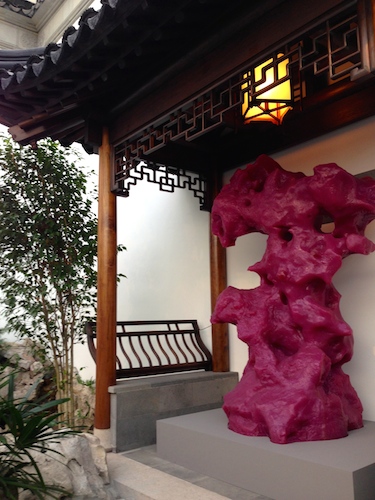
Hopefully by the time they get to the rock garden they will notice Zhang Jianjun’s crazy pink silicone rubber “scholar rock” right next to the real ones. Zhan Wang’s stainless steel scholar rock and Shou Fan’s side chairs are beautifully arranged in the Ming Dynasty room just off the Court, along with more of Ai Weiwei’s furniture hijinx.

After you’re done getting a feel for how the galleries have been transformed, go back into the Met’s exhibition web site to study the brushwork and details and get to know some of the artists.

Zhang Jianjun’s 2008 silicone rubber Scholar Rock (The Mirage Garden) sits in a 17th-century pagoda in the Met’s Astor Court

Zhang Jianjun’s 2008 silicone rubber Scholar Rock (The Mirage Garden) sits under a 17th-century pagoda in the Met’s Astor Court. Courtesy: Sigg Collection, the atist

Although the web site appears to be more plain-vanilla than jazzy, you’ll be surprised to see that the digital back-end of the Met archives lets you zoom into each of the paintings to see the handsome handwork of each of these wunderkinds from each thematic section of the show. You can even peruse the gigantic scrolls up close, section by section.

The video room, where art lovers can relax and watch a rotating collection of work, is a nice touch. The modern digital sign to the side tells you exactly where you are in the rotation.

Here’s a link to one of the featured videos: Get to know the constantly transforming cityscape of Beijing through Chen Shaoxiong’s 2005  Ink City, and see what happens when a contemporary artist paints daily life in Beijing with traditional tools and ports his day-to-night experience to video.

The Most Lavish Natural History Show in the World

Remember 17th c. Dutch tulipmania? JAR
Tulip Brooch 2008 made of
rubies, diamonds, pink sapphires, garnets, silver, gold, and enamel. Private collection.
Photo: Jozsef Tari. Courtesy: JAR, Paris.

Remember 17th c. Dutch tulipmania? JAR
 Tulip Brooch 2008. Rubies, diamonds, pink sapphires, garnets, silver, gold, and enamel. Private collection.
Photo: Jozsef Tari. Courtesy: JAR, Paris.

If you took the detailed observational field skills and plant-and-animal artistry of JJ Audubon and crossed them with the gold-and-jewels precision of a Fabergé master, you can understand the enjoyment, beauty, and wonder that await the luxury-lovers crowding into Jewels by JAR, the Metropolitan Museum of Art’s tribute to the world’s most exclusive and reclusive jewelry artist. Meditate on his exquisite take on the natural world before it all goes back to the vaults on March 9.

Plenty of worshippers were wielding tiny flashlights last Saturday night, working their way meticulously through the darkened gallery perusing every detail of 400 tiny, sparkling, jewel-encrusted pieces by JAR (or, Joel A. Rosenthal as he was known growing up in the Bronx). He’s one of the world’s experts in the pavé technique and achieves subtle effects by painstakingly arranging miniscule diamonds, rubies, opals, and amethysts across gold, platinum, and silver surfaces.

JAR’s 2010 bracelet evokes snow on branches. Diamonds, silver, and platinum.
Private collection.
 Photo: Jozsef Tari. Courtesy: JAR, Paris.

JAR’s 2010 bracelet evokes snow on branches. Diamonds, silver, and platinum.
Private collection.
 Photo: Jozsef Tari. Courtesy: JAR, Paris.

Despite being one of the most sought-after jewelers in the world, JAR will not do commissions. Each piece is one of a kind, so the subjects that he chooses tell you a lot about him. Look closely.

The first case features bracelets, earrings, brooches, and necklaces fashioned into exact, delicate replicas of just about anything you can find at the New York Botanical Garden on a spring day — gardenias, roses, camellias, tulips, lilacs,  carnations, wisteria, pansies, and even wild oats. Across the room, you’ll see perfect oak leaves and acorns (made from diamonds, platinum, silver, and gold) formed into dramatic rings, cufflinks, necklaces, and earrings.

Growing up, JAR loved roaming the halls of the American Museum of Natural History and the Met, which shows. He’s made one pair of pendant earrings (No. 83) from iridescent beetle wings, married with tiny emeralds, garnets, and diamonds set into silver and platinum.

JAR
Butterfly Brooch
1994.
Sapphires, fire opals, rubies, amethyst, garnets, diamonds, silver, and gold.
Private collection.
Photo: Katharina Faerber. Courtesy: JAR, Paris

JAR 
Butterfly Brooch
1994.
 Sapphires, fire opals, rubies, amethyst, garnets, diamonds, silver, and gold.
Private collection.
Photo: Katharina Faerber. Courtesy: JAR, Paris

Right next to that (No. 84) you’ll see his 1981 Egyptian-style faience earrings with emeralds, coral, and gold — a 20th century take on the Middle Kingdom. He’s crafted stalactite earrings (No. 93) from diamonds and silver and found a heart-shaped pebble into which he’s set a perfect ruby surrounded by silver and gold (No. 283).

In the center of the room there are moon and stars pendant earrings (a tribute to Cole Porter) made of sapphires and diamonds (No. 274), and a box (No. 260) inspired by lightning (rock crystal and diamonds). JAR’s 1991 Phases of the Moon Bracelet, made of basalt, diamonds, silver, and platinum, makes you think he probably also hung out at the Hayden in his youth.

The finale to the gallery is the Met’s jeweled twin to the AMNH Butterfly Conservatory – a wall in which 22 of JAR’s beautiful butterflies take flight. OK, there are 2 dragonflies in there, too, but the overall message is butterflies.

A few animals are in the show, too. JAR
Zebra Brooch
1987
made of agate, diamonds, a sapphire, silver, and gold.
Private collection.
 Photo: Katharina Faerber. Courtesy: JAR, Paris

A few animals are in the show, too. JAR Zebra Brooch 1987
made of agate, diamonds, a sapphire, silver, and gold.
Private collection.
 Photo: Katharina Faerber. Courtesy: JAR, Paris

Every person in the crowd seemed to pause here in the dark to choose which creature was the most beautiful before entering the bright, unforgiving lights of the gift shop. A personal favorite was the 1987 Dragonfly Brooch (No. 378) with double-layered rock crystal wings.

If you love nature, wit, color, and fool-the-eye magic, you’ll like getting lost in the dark among the billions of points of light that JAR has created in his glittering universe.

Must-See Skytop Panorama of NYC Past & Present at The Whitney

The installation view of T. J. Wilcox: In the Air, 2013. Photo: Bill Orcutt

The installation view of T. J. Wilcox: In the Air, 2013. Photo: Bill Orcutt

If you want to enjoy a beautiful view of Manhattan from the roof, don’t worry about the snow, rain, or cold weather. Go over to the Whitney Museum before February 9 and take in the film installation T.J. Wilcox, In the Air, that features a beautiful panorama (from the roof of Wilcox’s Union Square studio) that dreamily introduces six stories about the past and present of life, art, energy, fame, events, and cosmic forces that ebb and flow continuously below.

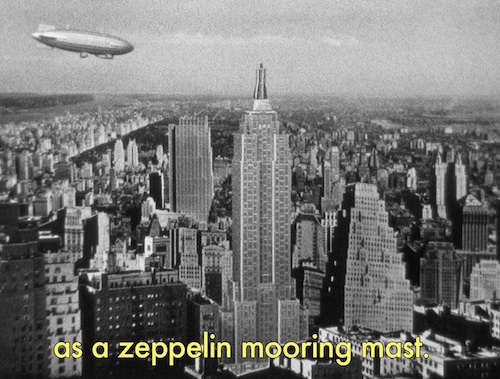
The big, in-the-round screen circles around you (duck and just walk into it), so you can really take in the view, all the way from the Battery to beyond the Empire State Building.

Still from T.J. Wilcox’s panoramic 2013 silent film installation, In the Air. Image courtesy of the artist and Metro Pictures.

Still from T.J. Wilcox’s panoramic 2013 silent film installation, In the Air. Image courtesy of the artist and Metro Pictures.

The film cycles from dawn to dusk, but along the way, Mr. Wilcox takes you on little journeys as you enjoy his movie panorama. The experience is one where you begin to see New York through his eyes, past and present together.

After a few minutes, one of his panorama screens fades you see a short, reflective, poetic, subtitled NYC story-movie. It’s a quiet experience — bringing you back to the Thirties when the Empire State Building was contemplated to be used as a zeppelin-docking station, to the present when 14th Street is one of the best vantage points to contemplate the out-of-this-world spectacle of Manhattanhenge, and the days of glitter, glamour, and grit of Warhol, Gloria Vanderbilt, and fashion-industry icon, Antonio Lopez.

Watching Wilcox’s Gloria Vanderbilt vignette from outside the installation. Photo: Bill Orcutt.

Watching Wilcox’s Gloria Vanderbilt vignette from outside the installation. Photo: Bill Orcutt.

He reminds you that Gertrude Whitney, the museum’s founder, long ago succeeded in a custody battle to care for little Gloria. The film takes you to her apartment and reflects on the fact that Gloria was “in the public eye from birth” and celebrates her vibrant artistic, business, and family accomplishments (re: plenty of shots of Anderson Cooper). Another mini-film focuses upon a nano-second in Warhol’s life, when his Factory crew unfurled Mylar balloons to welcome the arrival of the pope-mobile to New York City in 1965.

Weegee’s Variant of Untitled (Striking Beauty) is hung in an adjacent gallery. Courtesy: Whitney Museum

Weegee’s Variant of Untitled (Striking Beauty) is hung in an adjacent gallery. Courtesy: Whitney Museum

In his musing on the film about fashion-illustrator extraordinaire, Antonio, Wilcox reveals his surprise that Antonio’s studio was located right next to his own building, takes pleasure in asking us to gaze out over the community where so much magnificent art was made, careers enlivened, and life lived.

In a tiny back-room gallery, the Whitney has installed a few other reflections on skies over the City – Weegee’s lightening strike behind the Empire State Building and Yoko’s Sky TV, are two – but the big “wow” here is Mr. Wilcox’s ability to take us on a 35-minute journey in and among the streets and skyline that from his quiet, contemplative perch.

It’s quite a collage of memory, reflection, mythologies, politics, history, and beauty. Click here to see the Whitney’s slide show of the storyboards in Wilcox’s studio, and listen to him talk about it this beautiful work in this YouTube video:

Tiny Natural History Show Has Eyes Bugging Out

Asaphus, from St. Petersburg, has eyes bugging out (Ordovidian, 490-440 mya). Photo: ©AMNH/R.Mickens)

Asaphus, from St. Petersburg, has eyes bugging out (Ordovidian, 490-440 mya). Photo: ©AMNH/R.Mickens)

Confined to a tiny case in the “canoe” rotunda at the American Museum of Natural History, some extinct species from more than 400 million years ago are putting on quite a show, thanks to two trilobite lovers from the heavy-metal music and vert paleo worlds.

Andy Secher and Martin Shugar went through their massive trilobite collections (Andy has 4,000 in his Manhattan apartment and Martin turned over 200,000 fossils and shells to AMNH) and picked out fifteen “best of the best” from each of the six geologic periods that hosted these little waterway critters – from the Cambrian to the Permian (521 to 240 million years ago). It’s quite something, considering there are over 20,000 recognized species lingering in 281 million years of rocks around the world!

When the exoskeleton of Dicranurus disintegrated in the Lower Devonian, it left a fossilized cast that is so perfectly prepared you think you’re watching him in action

When the exoskeleton of Dicranurus disintegrated in the Lower Devonian, it left a fossilized cast so perfectly prepared you think you’re watching him in action

The tiny show, which is in an open-ended run,  is a “wow” due to the spectacular preservation and preparation of each of these little snubs of rock containing fossilized “casts” of animals whose exoskeletons disintegrated soon after they expired millions of years ago. The state of preservation of even the most delicate features is pretty remarkable.

Consider Asaphus kowalewskii from Ordivician rocks near St. Petersburg (490-440 mya), whose long eye stalks are truly a wonder of nature, evolution, and behind-the-scenes prep that make this character’s eyes pop. Trilobites invented complex, multi-lens eyes, and this Asaphus provocatively suggests the ability to check things out above the sediments where they burrowed, sort of like a horseshoe crab equipped with a modern submarine periscope.

The little Olenoides on display hails from British Columbia’s famous Burgess Shale and has long antenna curving back along its sides. He’s also found in New York, Pennsylvania, Virginia, Utah, and other places in Cambrian rocks 450-490 million years old.  For all those AMNH visitors asking where they can see the Burgess Shale, here’s your chance to commune with a critter and some rock from the same formation that so inspired uber-naturalist Stephen Jay Gould.

Olenoides of British Columbia’s Burgess Shale (Cambrian 450-490 mya) has curve-back spines

Olenoides of British Columbia’s Burgess Shale (Cambrian 450-490 mya)

Walliserops has a full trident sprouting out of his head –a unique apparatus that adapted him for who-knows-what in Devonian life in what-is-now Morocco. Is this where Neptune got the idea of what works best down under the sea?

The hometown favorite is Arctinurus boltoni, first found in upstate New York in the early 1800s during the construction of the Erie Canal. The AMNH has an entire website showcasing these upstate wonders from the Rochester Shale. See them all and take a peek behind the scenes into the AMNH collection drawers on the image gallery.

Andy and Martin’s enthusiasm for trilobites puts them in good company. Tom Jefferson and Ben Franklin are said to have collected them. Trilobite fossils were hawked on 15th century European streets and several trilobite websites say that 25,000-year-old European burials were found with these fossils, too.

Trilobites with tridents and horns. Walliserops is found in Morocco’s Lower to Middle Devonian strata.

Trilobites with tridents and horns. Walliserops is found in Morocco’s Lower to Middle Devonian strata.

Although AMNH has terrific trilobite blog and a page with “Twenty Trilobite Fast Facts,” why not go for the slick YouTube video tour? Watch as AMNH’s Neil Landman, Andy, and Martin talk about their passion and show the cabinet-sized exhibit in close-up.  You really need to come, meet the trilobites, and journey back to a time on Earth before animals had even colonized land.


AMNH Honors America’s Super-Early Explorers

Ronnie Cachini’s 2006 acrylic, Ho’n A:wan Dehwa:we/(Our Land), Source: AMNH/ of A:Shiw A:Wan Museum and Heritage Center

Ronnie Cachini’s 2006 acrylic, Ho’n A:wan Dehwa:we/(Our Land), Source: AMNH/ of A:Shiw A:Wan Museum

Long before John Wesley Powell steered his boats down the rapids and mapped the Grand Canyon for the US Geological Survey, another set of intrepid explorers had walked, mapped, documented, and guided travelers through the entire Colorado River system. Climb up to the hidden Audubon Gallery on the Fourth Floor of the American Museum of Natural History before January 12 and get a fresh perspective on pueblo cartography in the special exhibition, A:shiwi A:wan Ulohnanne: Zuni World.

 The show features 31 paintings by seven contemporary painters from the Zuni Pueblo of New Mexico – one of the ancient tribes whose ancestors built the cliff dwellings and multistory wonders of the Four Corners.

Installation view in the “quiet gallery” on the Fourth Floor of AMNH

Installation view in the “quiet gallery” on the Fourth Floor of AMNH

After 500 years of seeing their sacred places renamed by the conquistadors, Spanish land owners, government mapmakers, and the National Park Service, Zuni cultural leaders thought it was high time to start creating maps that reflected traditional Zuni place names, stories, and symbols. They asked some leading Zuni artists to choose the story, sacred sites, and landscapes that would “map” Zuni cultural history. According to some of the artists in the show, the exercise required them to look at what they knew in an entirely different way.

The Zuni people consider their place of origin to be the Grand Canyon. Back in deep time, the Zuni ancestors were instructed to find “the Middle Place”, so groups set out in journeys to the north, south, east, and west. The northern group, for example, settled in what is now called “Navajo National Monument” and eventually built multistoried dwellings inside the most spectacular red-rock shelter in the American Southwest.

Cliff dwellings in Betatakin alcove, a NPS site at Navajo National Monument where pueblo elders continue to hold sacred ceremonies. Photo: Dan Boone/Ryan Belnap, Bilby Research Center, Northern Arizona University

Cliff dwellings in Betatakin alcove at Navajo National Monument, where pueblo elders travel to hold sacred ceremonies. Photo: Dan Boone/Ryan Belnap, Bilby Research Center, Northern Arizona University

Each painter’s style is different, but when you take it all in, the exploration story is one of fairly mind-blowing proportions – the Zuni ancestors explored the entire Colorado River system, carved petroglyphs in canyons to point travelers to nearby communities, and even journeyed south to the “land of endless summer” –Central America’s coastal communities.

Although the paintings depict myths and symbols in the Southwestern landscapes, East Coast art-lovers should be aware that the Zuni expedition story isn’t fiction: Chaco Canyon’s great archeological sites contain the evidence — tropical shells, stones, Scarlet macaw skeletons, cacao, and the network of banked, engineered roads (circa 850 – 1100 A.D.) that actually lead to many of the places depicted by the Zuni painters.

Geddy Epaloose’s 2006 acrylic, The Middle Place. Source: AMNH/ of A:Shiw A:Wan Museum and Heritage Center

Geddy Epaloose’s 2006 acrylic, The Middle Place. Source: AMNH/ of A:Shiw A:Wan Museum and Heritage Center

Geddy Epaloose’s 2006 painting The Middle Place features an aerial view of Zuni’s Middle Village with sacred trails spiking out in all directions. Colorado River by Ronnie Cachini includes the edge of the distant ocean. Other paintings include the Zuni’s version of their Great Flood, the spiritual importance of their salt lake, and even unmarked lines representing some modern paved roads. Unless you’re Zuni, you’ll have to read the captions on each of the paintings.

Hunted deer is honored with a Zuni necklace

Hunted deer is honored with a Zuni necklace

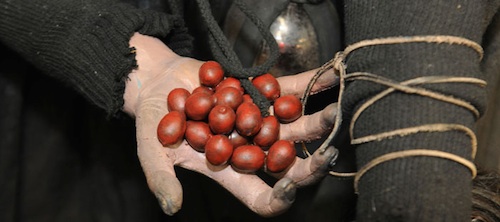
AMNH has one of the largest collections of Zuni artifacts in the country, and has a good, close working relationship with that pueblo. Entering the Audubon Gallery on the Fourth Floor feels like a sacred space. You’ll be greeted by a hunted deer honored with a necklace of precious stones and ceremonial rods festooned with pieces of traditional Zuni clothing loaned by the painters and their children for us to see while their work is on display in New York.

Make a pilgrimage to this hidden gallery on AMNH’s Fourth Floor and learn about some remarkable people, places, origins, and cartography. (And stop into the First Floor rotunda to see some of the museum’s Chaco Canyon treasures.)

Enjoy this short YouTube video featuring Jim Enote, the director of A:Shiw A:Wan Museum and Heritage Center, who describes the exhibition when it debuted iat the Indian Pueblo Cultural Center.

Magritte’s Surrealist Train Departing MoMA for Houston

Magritte’s 1938 oil, La durée poignardée (Time Transfixed) from The Art Institute of Chicago’s Winterbotham Collection. © Charly Herscovici ADAGP–ARS, 2013

Magritte’s 1938 oil, La durée poignardée (Time Transfixed) from The Art Institute of Chicago’s Winterbotham Collection. © Charly Herscovici ADAGP–ARS, 2013

One of the most recognizable trains in the history of modern art hasn’t left the station. It’s coming out of the wall at MoMA until January 12 as part of the tribute to Belgium’s only big-time Surrealist painter, Magritte: The Mystery of the Ordinary, 1926–1938. But don’t worry – this intriguing tribute chugs on, arriving at The Menil in Houston on Valentine’s Day (February 14) and at Chicago’s Art Institute on June 25. Catch it, because it’s loaded with new revelations, in person and on line.

In person: So many of paintings are icons of 20th century art, that it’s shocking to think that one anarchic visual artist had the chops to turn out so many great works in such a relatively short period of time. Walking through the first couple of galleries, you’ll recognize many famous images, but check out the dates on the labels: 40 were done in just his first three years in Paris between 1927 and 1929! He was so prolific, it makes you wonder when he made time to hang out at cafes, discuss dreams, and publish with Breton and the rest of the crew.

Jasper Johns owns the small version of Magritte’s 1935 oil La clef des songes (The Interpretation of Dreams), which uses English. © Charly Herscovici ADAGP–ARS, 2013. Photograph: Jerry Thompson

Jasper Johns owns the small English version of Magritte’s 1935 oil La clef des songes (The Interpretation of Dreams). © Charly Herscovici ADAGP–ARS, 2013. Photo: Jerry Thompson

Magritte liked making the familiar unfamiliar, playing with fact and fiction, probing dreams and reality, and appropriating pop culture into an art context.

Like Andy Warhol, Magritte began as an ad illustrator, and MoMA’s curators have included a few of his early fashion illustrations. It’s surprising to know that phrases that he injected onto his canvas (like “Ceci n’est pas une pipe”) were written in a script that was one of the most recognizable fonts used in European newspaper and magazine ads in the Twenties.

Was appreciation of Magritte’s ground-breaking cultural appropriation and subversion lost on our own American Pop pantheon? Not really, and the evidence is that one of the best examples of Magritte’s sly presentation of an everyday-object grid with ironic words was lent by the midcentury grandmaster, Jasper Johns.

So much contemporary pop culture and advertising art has reinterpreted, reimagined, and referenced Mr. Magritte’s images that it’s easy to forget that they rocked the world in the Twenties. His reverberation with our beloved 1960s Pop masters (and this show) reminds us that Mr. Magritte truly blazed an innovation pathway in taking the everyday and turning it into art.

MoMA discovered something lurking beneath the surface of its Magritte’s 1936 oil, Le portrait (The Portrait). Gift of Kay Sage Tanguy. © Charly Herscovici ADAGP–ARS, 2013

MoMA discovered something historic lurking under Magritte’s 1936 , Le portrait (The Portrait). Gift of Kay Sage Tanguy. © Charly Herscovici ADAGP–ARS, 2013

And speaking of pioneering, check out the amazing interactive site that lets us enter Magritte’s mind; learn how he turned nature, desire, dreams, language, and symbols into troubling, evocative, subversive works; and see the behind-the-scenes conservation and curatorial work. The beautiful, musical experience is designed by Hello Monday, and should probably win a Webby Award. See it now.

You’ll see how MoMA took off the old varnish, examined the canvases under ultra-violet light, and did detective work of which Magritte and his silent-movie-icon inspiration, Fantômas, would be proud.

Spend time letting each painting’s mini-site load into your browser window, click to hear the curators talk, and keep scrolling down to see what the conservators discovered. You can even toggle back and forth to see the surface of the painting and X-ray.

As a preview, here’s the YouTube video about the “lost” Magritte painting that conservator Cindy Albertson found lurking underneath The Portrait.

And while you’re at it, you might take a minute to see what technology was at work in possibly Magritte’s most famous image:

When Whales Walked Explained at AMNH

Whales exhibit tells the evolution story. Courtesy: Museum of New Zealand Te Papa Tongarewa

Whales exhibit tells the evolution story. Courtesy: Museum of New Zealand Te Papa Tongarewa

Right inside the exhibit, Whales: Giants of the Deep, the American Museum of Natural History answers two questions that have stumped centuries of nature lovers – how did the world’s largest sea-loving mammals ever evolve from land animals, and who are their closest relatives?

In the last 20 years, DNA experts and paleontologists have been hacking away at these questions, and the show provides some startling visuals and answers: Whales (a group that includes dolphins and porpoises) came from four-legged animals that hovered close to shore lines, snapping up fish. Oh, and their closest relatives on the Mammal Tree of Life are…get ready…hippos. See the show before January 5.

Clue to solving the mystery – the skull of Andrewsarchus, three feet long, found in 1923 by Kan Chuen Pao on AMNH’s second Gobi expedition. Courtesy: AMNH/R. Mickens

Clue to solving the mystery – the skull of Andrewsarchus, three feet long, found in 1923 by Kan Chuen Pao on AMNH’s second Gobi expedition. Courtesy: AMNH/R. Mickens

The first thing you’ll see is a massive skull of Andrewsarchus, a 45-million-year-old whale cousin, who would have stood over six feet tall at the shoulder. He was found in Mongolia on the famous AMNH Central Asiatic Expedition in the 1920s (remember the dinosaur eggs?) and to this day is the only one found.

The paleo team compared the features on his skull to other mammals, ran their analysis through cladistics software, generated a family tree, and learned that Andrewsarchus falls somewhere near the evolutionary point where whales and hippos had a common ancestor, a key clue.

Artist Carl Buell’s depiction of Pakicetus, the oldest known ancestor to  whales

Artist Carl Buell’s depiction of Pakicetus, the oldest known ancestor to whales

A huge discovery in Northern Pakistan in 1983 began to unlock the rest of the mystery. Found in 50-million-year-old Eocene rocks, remains of the enigmatic, four-legged, fish-eating Pakicetus were discovered at the edge of what was once an ancient sea. It was deemed by scientists to be the earliest known modern-whale ancestor. Many specimens were unearthed, with ear bones looking like modern-day dolphins, but ankle bones more like a pig’s, giving scientists a reason to place his ancestry in the “artiodactyl” category, which includes hippos, pigs, antelopes, camels, and other even-toed hoofed animals. Subsequent finds and DNA analysis of modern whales further solidified the hippo-relation hypothesis.

Cladogram showing family relationships of whales and artiodactyls from the AMNH guide for students in grades 6-8

Cladogram showing family relationships of whales and artiodactyls from the AMNH guide for students in grades 6-8

The show includes a full replica of his skeleton, along with other fossils from the subcontinent showing the transition of four-legged wolf-sized animals to the streamlined bodies that we now associate with ocean- and river-going cetaceans. You’ll see a terrific video that animates the transition from longer-snouted, web-footed fish-eaters that paddled through estuaries (Ambulocetus), to more streamlined sea-going mammals whose front legs became flippers and back legs disappeared nearly completely. Kutchicetus (43-46 million years ago) shows evidence that it probably did some deep dives, and Durudon (37 mya) had nostrils at the top of his head, flipper-hands, and apparatus at the end of his tail that suggests a support for flukes.

A clue from India. Artist Carl Buell’s depiction of Kutchicetus, dweller in ancient tropical seas

A clue from India. Artist Carl Buell’s depiction of Kutchicetus, who lived in ancient tropical seas

The show was originally organized by the Museum of New Zealand Te Papa Tongarewa, and features a mix of AMNH and Te Papa artifacts and insights.

There are many other wonderful biological, historical, and cultural details to the whale story, as the YouTube below shows (84K hits and counting), but shout-outs must be given to the two stars — large Sperm whale skeletons (think Moby Dick) on display, lovingly named and transported here by the Maoris, who found the stranded duo, prepared, and blessed them for special appearance in New York.

History Twist in Brooklyn’s Period Rooms

Hegarty’s “activation” of the Cane Acres Plantation dining room: Still Life with Peaches, Pear, Grapes and Crows; Still Life with Watermelon, Peaches and Crows; and Table Cloth with Fruit and Crows. Photo: Brooklyn Museum

Hegarty’s “activation” of the Cane Acres Plantation dining room including Still Life with Watermelon, Peaches and Crows. Photo: Brooklyn Museum

The Brooklyn Museum’s Period Rooms are again the focus of a rip-roaring, history-tearing, upside-down interpretation by an installation artist. Go before December 1 to see what’s happened to three rooms up on the museum’s Fourth Floor in Valerie Hegarty: Alternative Histories.

The dining room from the South Carolina’s Cane Acres Plantation is alive with dozen or so papier-mâché crows that are chowing down on the faux watermelons and peaches that you imagine to have been so beautifully arranged on the long, grand table.

Peering into either of the two plantation doorways, it’s disconcerting to see how the delicacies are being ripped apart and strewn about. The fruit literally pops out of the frames in this cross-referenced mash-up of Hitchcock terror, racial segregation issues, and classic still life painting.

Hegarty’s Pendleton carpet in the Cupola House parlor.

Hegarty’s Pendleton carpet is growing in the Cupola House parlor.

See how Hegarty created it all out of wire, glue, foil, foam, and everything else you can purchase at Michael’s on the Brooklyn Museum’s Flickr feed.

She was equally ambitious in two other rooms from the Cupola House, originally built in Edenton, North Carolina: The 1725 parlor room focuses on a visual “conversation” between General George Washington and Pawnee Chief Sharitarish, featuring a Native American-style Pendleton parlor rug that is “growing” grass, flowers, and roots to make you think about what happened to the native culture over the last few centuries.

She kicks the Manifest Destiny discussion right where it hurts in the Cupola House “hall” (where guests socialized) by letting two Pileated and Downy Woodpeckers have their way with everything valuable in the room, including (a reproduction of) Thomas Cole’s 1846 painting The Pic-Nic. Nature is getting out of hand.

The Downey Woodpeckers take over the Cupola House hall. Photo: Brooklyn Museum

The Downey Woodpeckers take over the Cupola House hall. Photo: Brooklyn Museum

Get over to Brooklyn and encounter a new twist on what you were taught in grade school history, but watch out for Hegarty’s flying bullets and birds.