Pathfinder Marcus Amerman at The Wheelwright

Shape-shifter, beadwork innovator, pop-culture provocateur, fashion designer, and performance artist – it’s hard to know where to start when summarizing four-decades of work by a Native-American contemporary art superstar. But his first retrospective, Pathfinder: 40 Years of Marcus Amerman, does showcases his wide range of work in spectacular fashion. See it at the Wheelwright Museum of the American Indian in Santa Fe through January 11.

Marcus Amerman (Choctaw Nation of Oklahoma) is best known for his intricate beaded “paintings,” which take center stage.

1994 Stormbringer beaded portrait of Lakota leader Chief Iron Hawk. Surrealist eyes by Man Ray watch from a brewing storm. Courtesy: Colorado Springs Fine Arts Center.

Once Amerman developed his bead technique, which provided a photo-realist spin to a traditional “native” craft, he really felt that he could take on any subject as a contemporary artist – movie stars, historic characters, and cartoon images. The impact is electric. 

2002 beaded painting Greetings from Indian Country, merging vintage tourism with pointed social commentary on exploitation. Private collection

Gazing across the main gallery, you see pop-culture images of “Indian” memes splashed across large canvases, cartoony self-portraits, fashion mannequins, glass sculptures, and photos by his wry collaborators. It’s a splendid mix of eye-dazzling color, technical mastery, and social commentary. Take a look at some of our favorites in our Flickr gallery.

Amerman garnered a lot of attention in the late 1980s and early 1990s for merging his beadwork into contemporary fashion. He cites his beaded leather motorcycle jacket with a beaded meme of bikini-clad Brooke Shields starting it all – a shock-worthy mix of leather toughness with one of the hottest young stars of the day.  He took on custom commissions and leapt at the opportunity to participate in fashion shows. He was overjoyed to see his buckskin fashions featured in Elle.

1982 Iron Horse Jacket with beaded Brooke Shields. Courtesy: Private collection
American eagles beaded on lapels of 1992 dinner jacket; commissioned by veteran Doug Hyde (Nez Perce, Assiniboine, Chippewa).

It’s obvious that Amerman rejects staying put into a single category. He loves collecting vintage “Indian” objects and collaging art-world and historic references in all of his work. Check out those hubcaps!

2023 acrylic painting Old Masters in the New World, showing 17th century Dutch colonizers next to a Santa Fe train. Courtesy: the artist
2023 Rattles found-object collage, mixing pop cultural and Native images. Courtesy: the artist

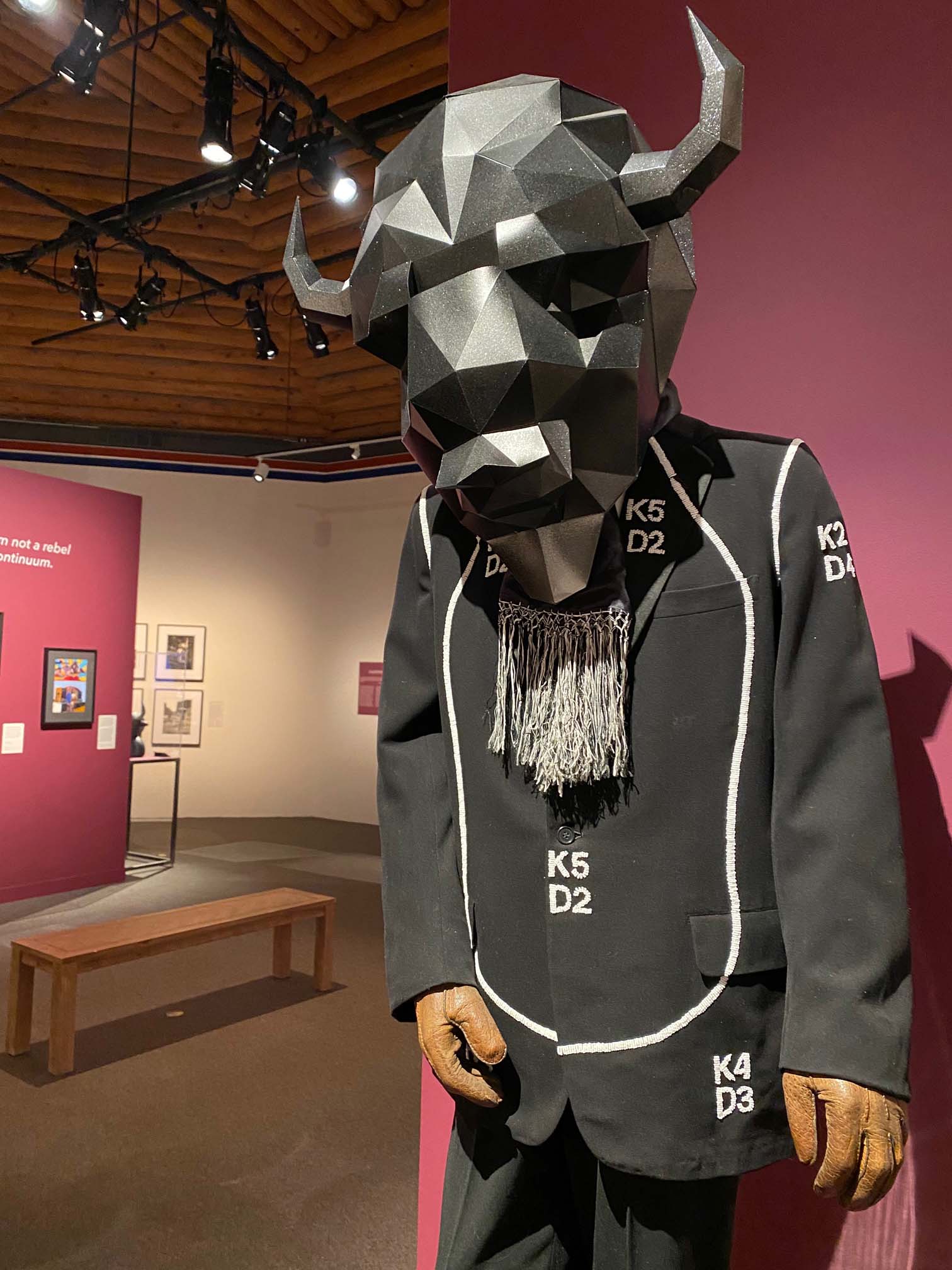
Amerman’s alter ego, Buffalo Man, features prominently in the show, particularly in his collaborations with acclaimed photographer Cara Romero, where icons of Native culture insert themselves into American pop culture.
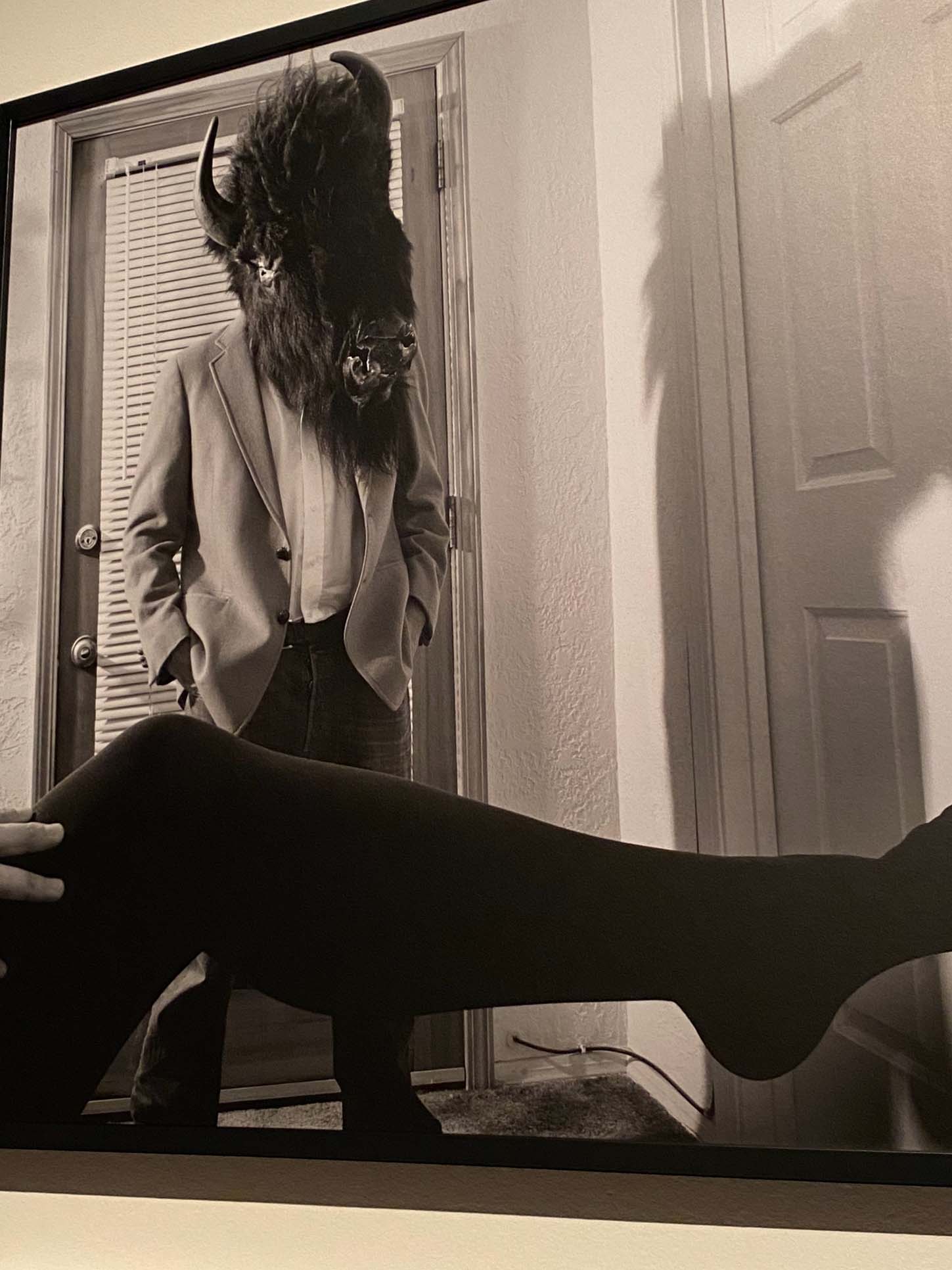
Cara Romero’s 2013 photo El Graduaté – a collaboration with Amerman’s performance alter ego, Buffalo Man. Courtesy: Cara Romero
2002 Target Jacket with glass beads, worn by the artist in fashion shows as himself and as Buffalo Man. Courtesy: the artist

The gorgeous collaborations with glass artists from Amerman’s time at Pilchuk are a delight – some self-referential and others harkening back to his own culture’s ancestry.  He claims that everything he makes is genuinely as “self portrait.”

2010 blown and sand-carved Buffalo Man – a collaboration by Amerman and Preston Singletary (Tlingit). Courtesy: the artist
2006 Glass Shield, one of a series created during a residency at Pilchuk Glass School and inspired by historic Plains Indian shields. Courtesy: the artist

It’s a joyful tribute to an artist who gives back, inspires others, and keeps asking pertinent questions about the role of art and artists in our society.

Enjoy this close-up look at some of Amerman’s masterful beadwork and hear why Amerman continues to create:

Past and Future of Santa Fe’s Indian Market

There’s no better way to see the best of the best at the Santa Fe Indian Market than to visit the remarkable retrospective assembled at the New Mexico History Museum in their honorary centennial exhibition, Honoring Tradition and Innovation: 100 Years of Santa Fe’s Indian Market, 1922-2022, on view through August 31.

The curators have gathered loans from private collections, museums, individual artists, and big-name galleries to give visitors a decade-by-decade chronicle of the people, families, maker innovations, and contemporary-art trends that converged to showcase works from one the most exciting confluences of creativity in the United States.

Santa Clara artist Nancy Youngblood’s 2018 polished pottery jar (best of pottery category award), granddaughter of Margaret Tafoya. Courtesy: private collection.

The items in the show – traditional pots, dazzling Navajo weavings, whimsical figurines, elaborately embroidered accessories and clothing, social-commentary photos and paintings – are so compelling that it takes two or three visits to actually focus on the thoughtful, illuminating text that accompanies each portion of the show.

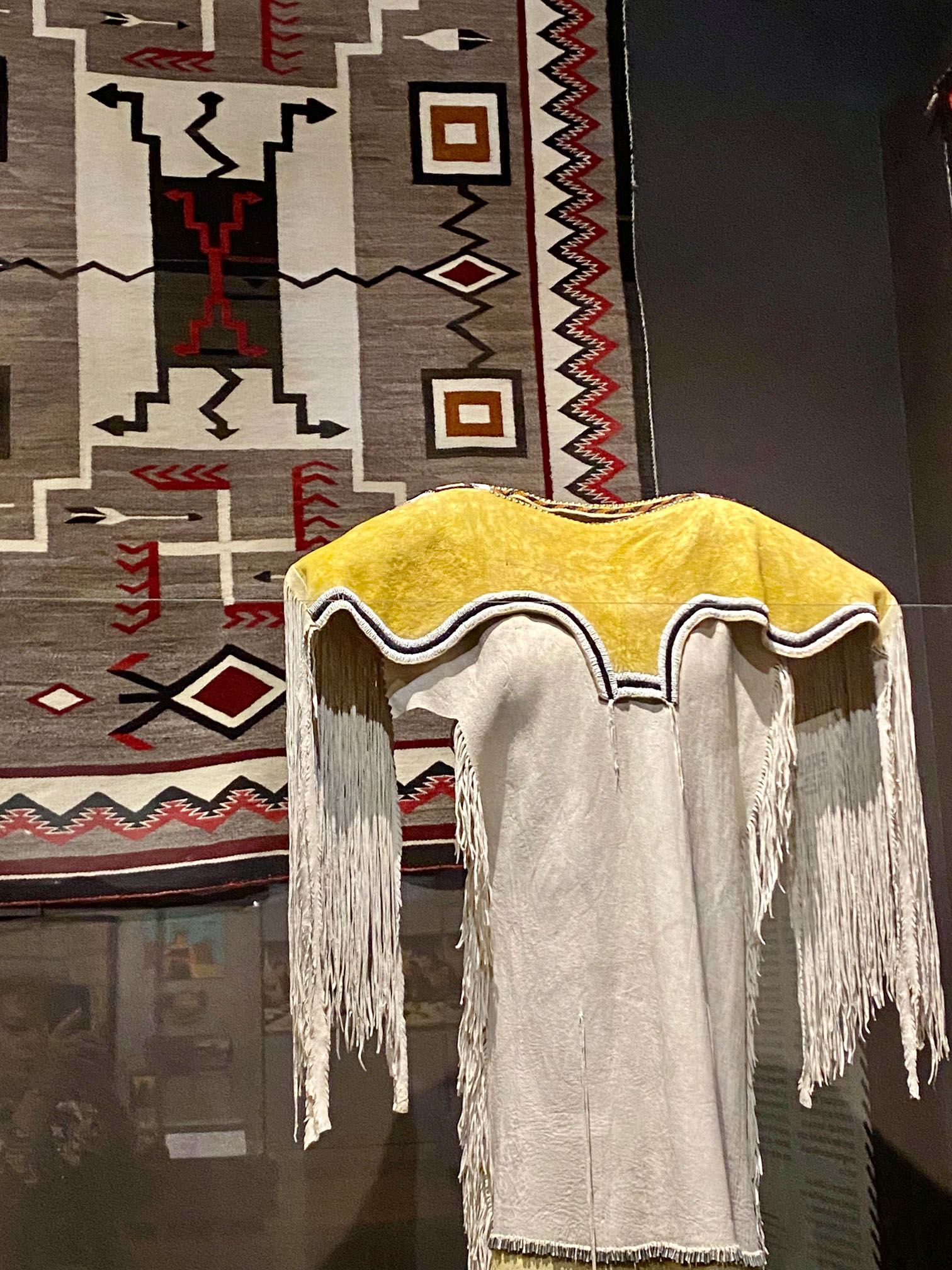
Embellished 1890 buckskin Apache/Ute dress; behind, a 1925-1930 Navajo rug. Courtesy: Cowboys and Indians Antiques, Historic Toadlena Trading Post Museum.

The organizers have provided a revealing chronology of the politics, economics, and social context of each decade of the arts festival, noting changes in the people, processes, power, and patronage over time.

The first gallery brings you back to the earliest days of the market – a time when there were no Indian curators or judges (unlike today!) and when Native makers were not even allowed to sell their own work or interface directly with non-Native buyers. 

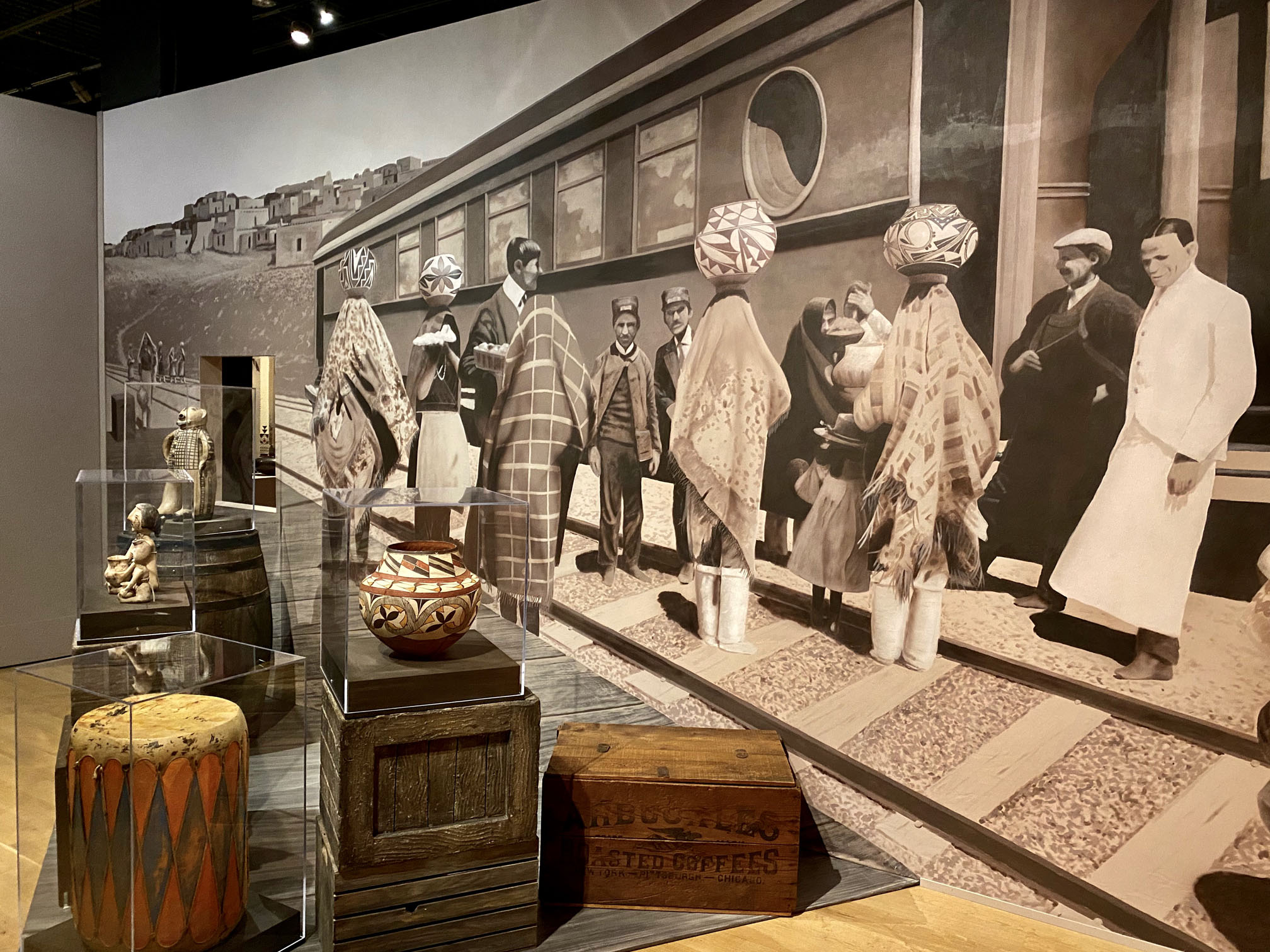
The wall mural harkens back to the days when Pueblo people sold their pots and creations to tourists along the railroad, which in the late 1890s and early 1900s brought curious travelers, East Coast dandies, and traveling showpeople out to the Western badlands.

David Rock’s mural with early Native-made collectibles – early 1900s pottery and 1920s drum.

Turn-of-the-century tom-toms, curios, and older pots are displayed near the rail-top mural; Navajo rugs and beaded moccasins from the period are arrayed across the way. It’s an arrangement that evokes what might be displayed in an old trading post, or at least in the early 1920s Santa Fe markets.

Many of these makers in New Mexico were still living on their ancestral lands, but across the United States, the majority of Indigenous populations had either been relocated to reservations or boarding schools.

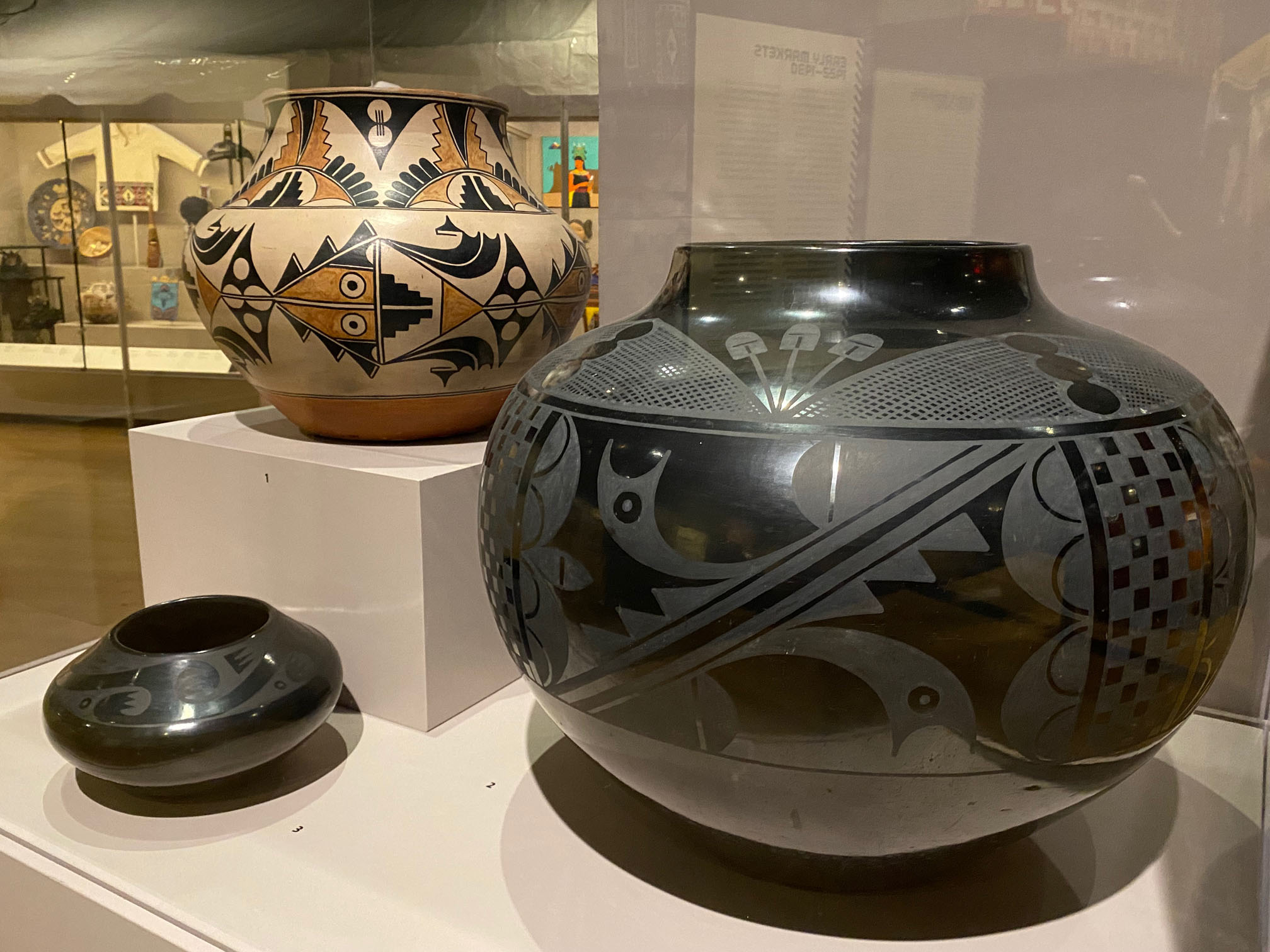
The inter-generational mastery of New Mexico’s Pueblo artists is featured in several vitrines holding examples of black-on-black (and other) masterworks by the Martinez family at San Ildefonso (go, Maria!) and the Tafoyas of Santa Clara, with Margaret’s famous bear-paw imprints.

Work by famed San Ildefonso artist Maria Martinez: 1922 polychrome, large 1942 black pot (award-winner painted by Julian Martinez); and 1928 jar. Courtesy: MICA, SAR

The surrounding gallery features dazzling painted pottery works by Zuni and Acoma from the 1920s – all drawn from the School for Advanced Research (SAR) collection, which began in 1922 to preserve classic works, SAR is the source of the acclaimed exhibition now at the Metropolitan Museum, Grounded in Clay: The Spirit of Pueblo Pottery. Sometimes the artists who made the pot is known; but often the maker is lost to history.

1928 Acoma jar. Courtesy: SAR

In the 1930s and 1940s across the United States, tribal mortality rates increased and their other economic lifelines decreased. But these conditions in the Southwest made the Market an even more important source of family revenue. Throughout the 1940s, the Santa Fe Market boomed.

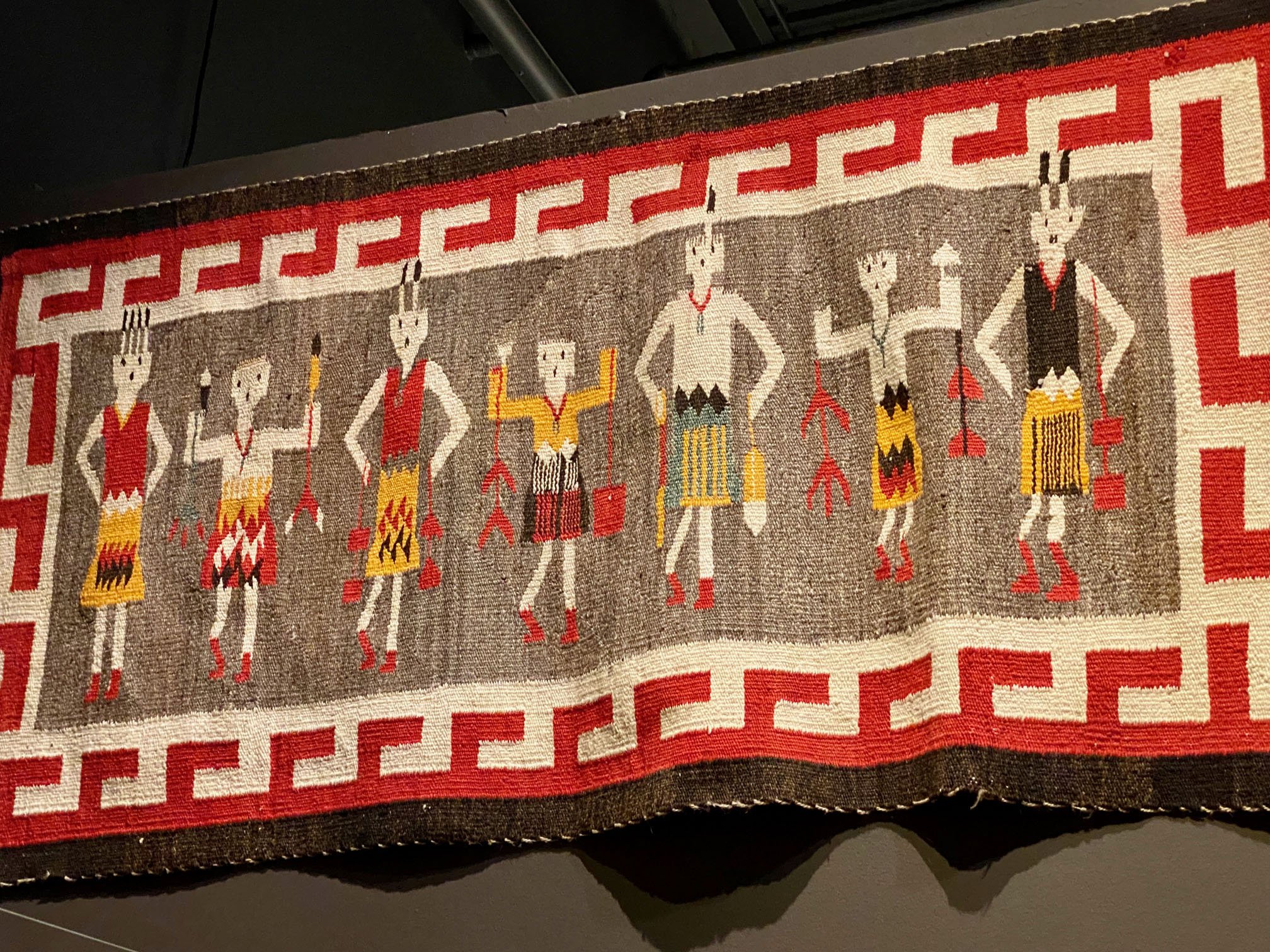
1920-1930 Navajo hand-spun wool rug with figures representing the fire dance. Courtesy: Historic Toadlena Trading Post Museum.

By the 1950s, Federal government instituted policies to encourage Indians to leave their land and move into cities. Unfortunately, Santa Fe Indian Market policies had the same depressing effect – the organizers reduced both the number of artists allowed to show and amount of prize money that could be won.

By 1959, the SF Indian Market was on life support, with a few private donors stepping in with funding just to let it survive.

But during the 1960s, changes were afoot. The Institute for American Indian Arts began in Santa Fe, where Lloyd Kiva New gave Native artists “permission” to throw off traditional conventions and make contemporary art. Across the United States, social-justice movements focused on indigenous people’s rights demanded policy changes to reverse the impact of oppression. By 1968, Congress had passed the Indian Civil Rights Act.

What did that mean for the Market? The majority of works on display in the museum gallery are from the post-1970s period, when the scope, range, voice, virtuosity, and experimentation reflected the times.

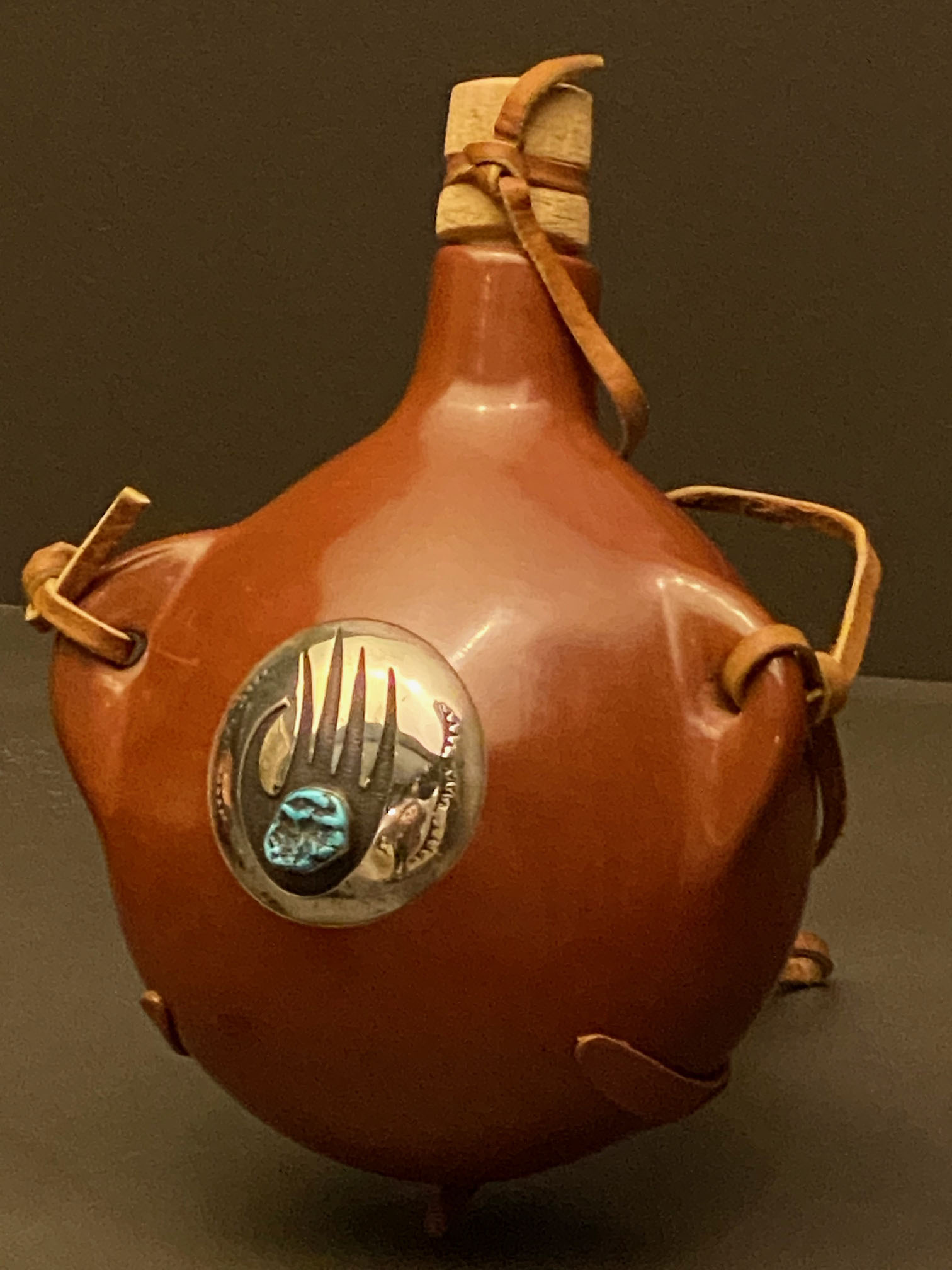
1974 pottery canteen with turquoise and silver by San Ildefonso artists Rose Gonzales and Tse Pe. Courtesy: private collection.

Here are some examples – the glorious, gleaming, turquoise-inlaied 1980s vessel by by Zia/Jemez/San Ildefonso artist Dora Tse Pe and the virtuoso painting on a jar by by Acoma artist Dorothy Toriio.

1980s pottery jar by Zia/Jemez/San Ildefonso artist Dora Tse Pe. Courtesy: private collection.
1990 pottery jar by Acoma artist Dorothy Toriio. Courtesy: King Galleries.

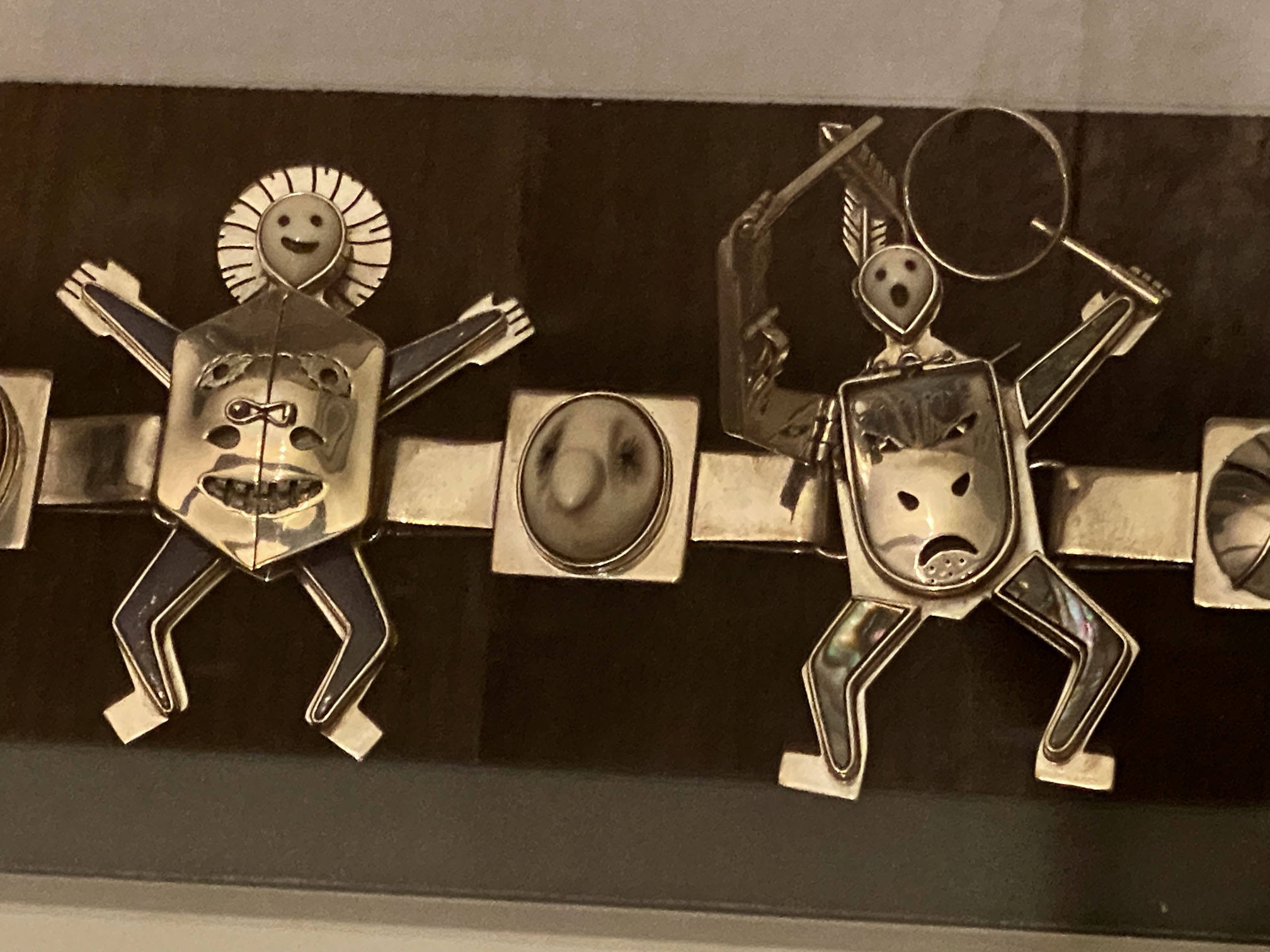
Or, consider the virtuoso silverwork and inlaid belt by Aleutian master Denise Wallace; edgy, theatrical 1990s Cochiti figurines by Virgil Ortiz; and a 1999 horsehair basket woven by Tohono O’odham artist Leona Antone. See more in our Flickr album.

Silver 1986 “Aleut Dancer Belt” by Aleut artist Denise Wallace with abalone, fossil ivory, and lapis; Best in Non-traditional Jewelry Award. Courtesy: private collection.

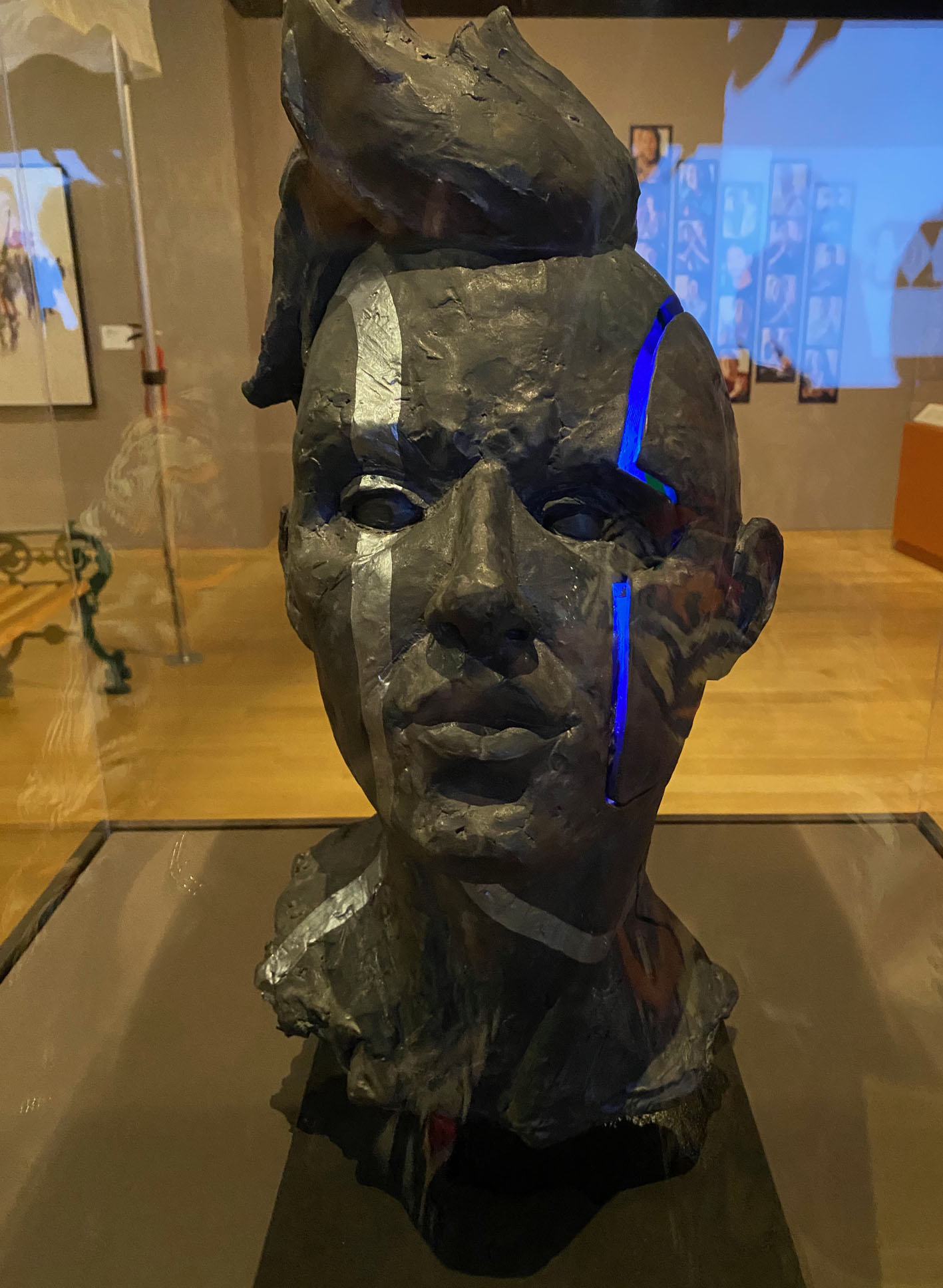
The show’s finale catapults the story of Indian Market into the future.  First, there’s a cluster of sculptural and video works by Virgil Ortiz, featuring his sci-fi, super-powered, time-traveling warriors from the future who travel back to 1680 to fortify the success of the Pueblo Revolt and save Pueblo culture.

“Kootz (Runner-twin brother of Tahu)” 2018 high-fire clay sculpture with “warning” LED lights by Cochiti artist Virgil Ortiz. – a character from his sci-fi 2180 ReVOltage Series. Courtesy: the artist
“Tahu (Blind Archer)” 2018 sculpture with LED lights by Cochiti artist Virgil Ortiz.. Courtesy: the artist

Second, there’s a photo wall of families and their young children, who create work to enter in to the children’s division. It leaves visitors with the strong feeling that not only will forward-looking artists keep innovating and creating, but that the kids will be all right.

Still of 2022 “Made in Native America” video by Cochiti artist Virgil Ortiz, featuring sci-fi costumes. Courtesy: the artist

Scandinavian Folk Dressing Takes a Stand

Forget about the picturesque fjords and pastoral views reindeer herders that we imagine when we envision Scandinavia. Completely different stories of history, revolution, oppression, and cultural revival are told by the array of colorful, decorative, embellished and loved clothing in Dressing with Purpose: Belonging and Resistance in Scandinavia, on view at the International Folk Art Museum in Santa Fe through February 19.
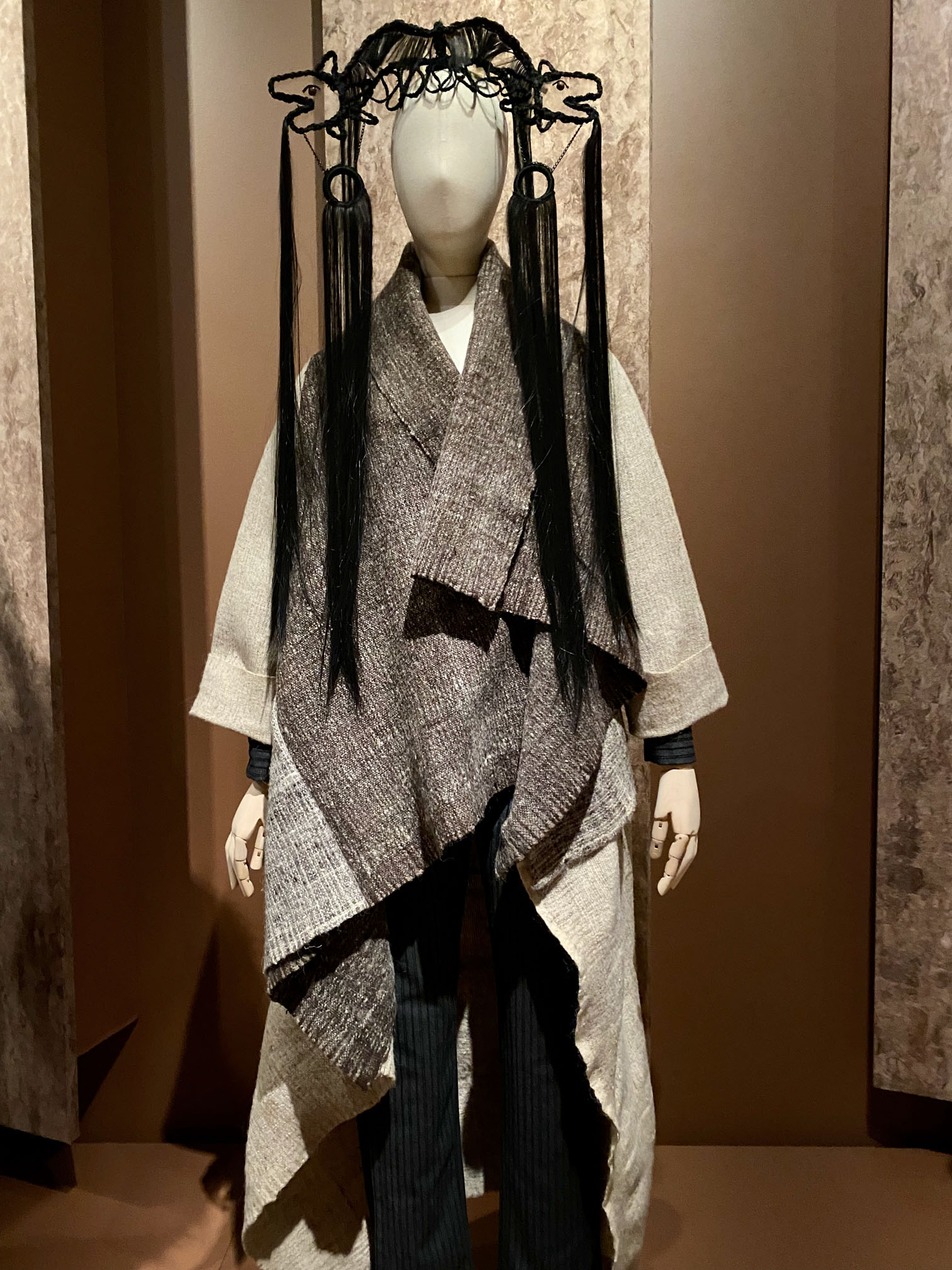
You’re introduced to the iconic folk clothing of three cultures when you enter the exhibition – Sweden, Norway, and Sápmi, the homeland of the indigenous Sami people that stretches across the northern boundaries of Russia and the three other Scandinavian countries.

Detail of mid-19th to early 20th century woman’s dräkt from Sweden’s Delsbo parish in Häsingland historical province.
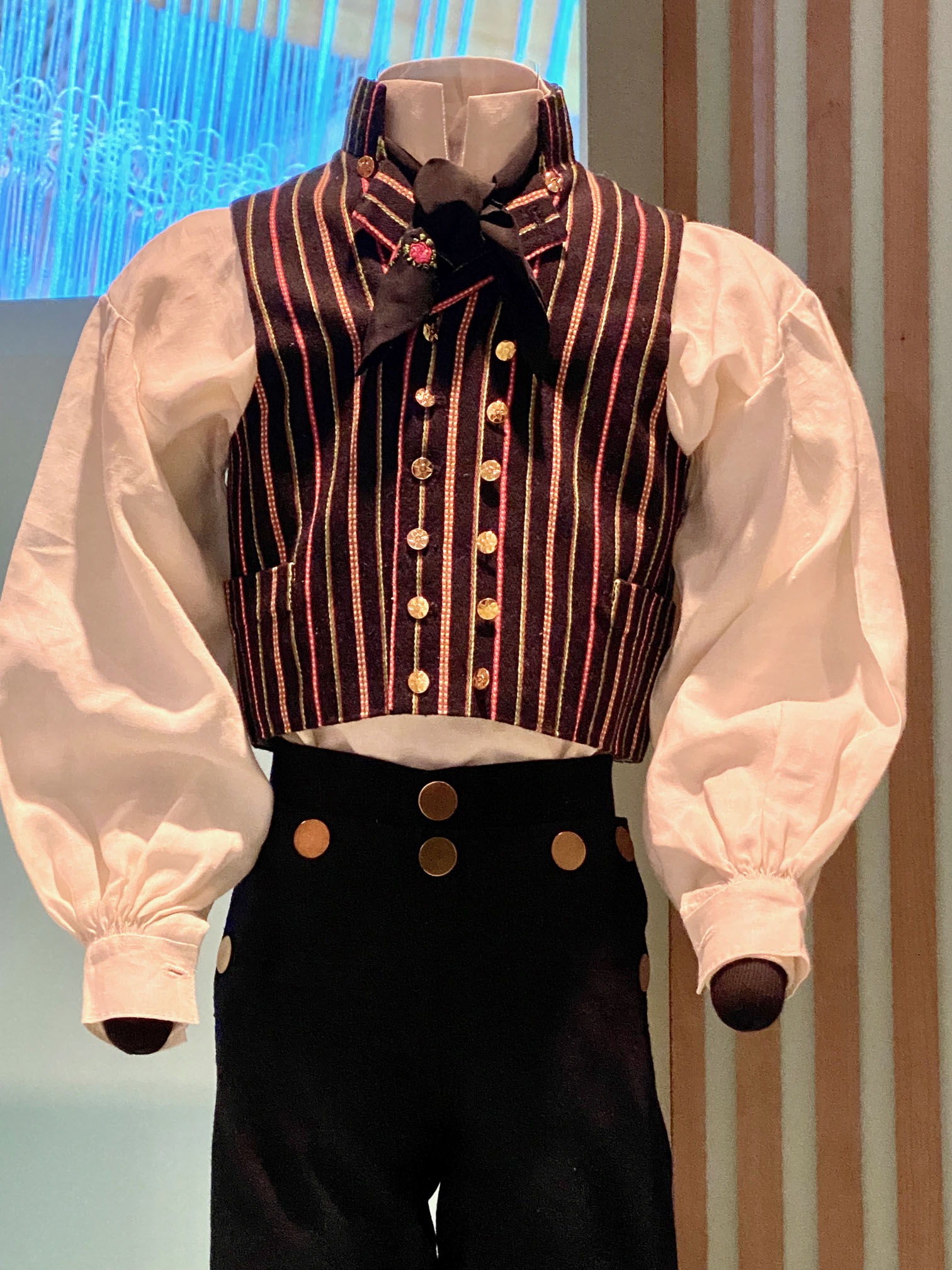
Young Swedish man’s dräkt, made in 1992 by Birgitta Lördal and Maj-Lis Halvarsson of Häsingland historical province.

But then it’s a deep dive into what each of these colorful creations represent.

The story behind Sweden’s folk costumes (folksdräkt) extends back into the 19th century, when rural peasants lived in a fairly hierarchical society and relied on their church clothes to signify where they ranked on the status ladder. Each community developed its own details and styling. In some communities, women used almanacs to help them keep track of various clothing combinations.

The exhibition displays an array of men’s and women’s country ensembles.

There are also examples of striking, elaborately silk-embroidered shawls that were essential to women’s status dressing.

In the 1800s, a series of economic and agricultural misfortunes caused rural Swedes to leave their communities and either migrate to the United States or to middle-class jobs in the city.

Swedish intellectuals worried that the rural population drain meant that country traditions and craftsmanship would vanish. Around 1900, cultural leaders prompted a craft awareness and revival movement ­– retail shops, showcases for hand-crafted clothing, and national museums.

Detail of woman’s 1834 silk-embroidered linen shawl, a status symbol worn on specified occasions; Leksand parish in Sweden’s Dalarna province.

Today, many Swedes gladly purchase and buy kits to make folksdräkt for festivals, parades, and other events.

The curators have even included items from a new cottage industry – protective garment bags specifically designed to store your folk costume!

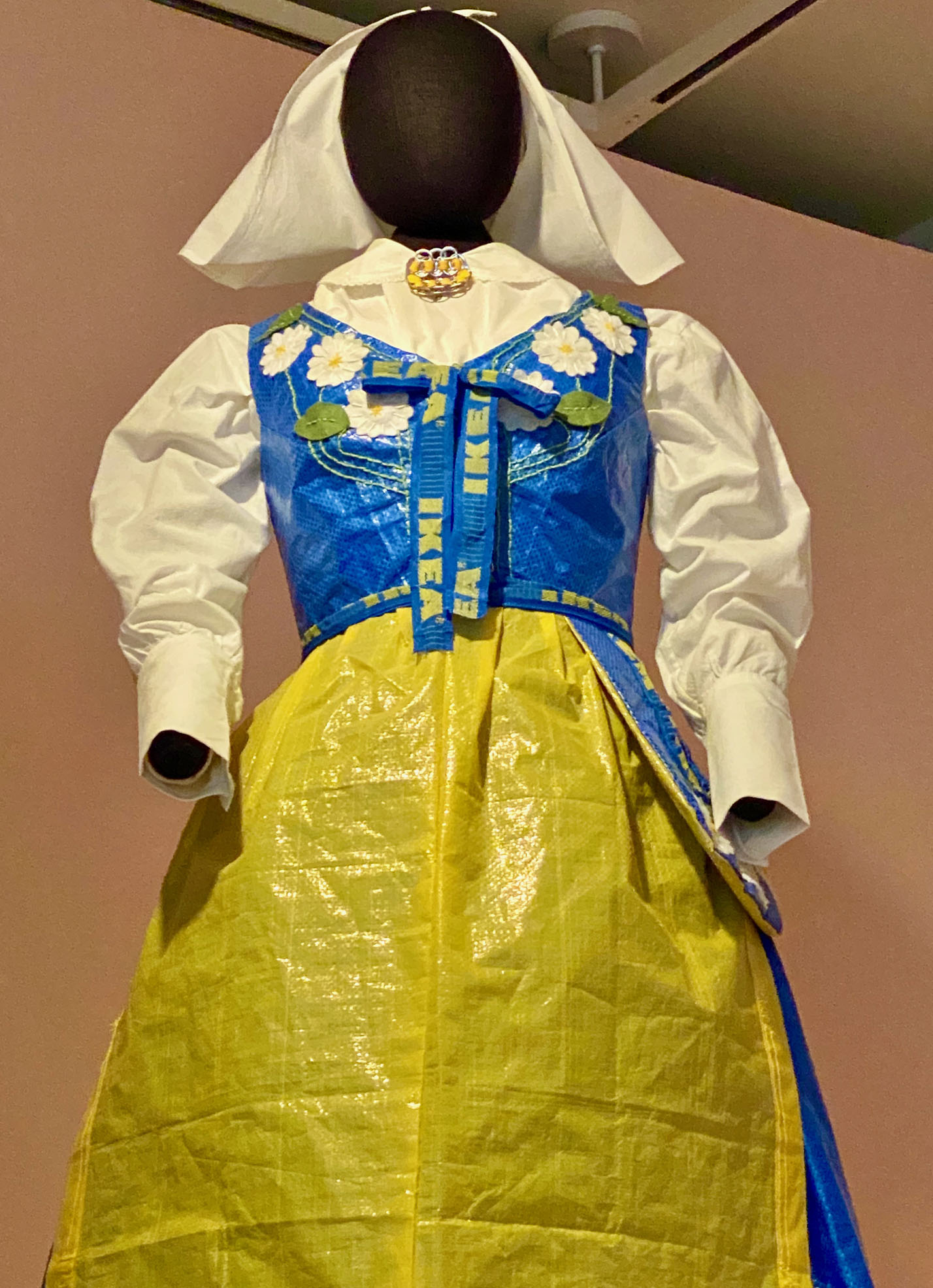
In a whimsical touch, the curators have included a contemporary take from artist Heidi Mattsson – the Swedish national costume made from Ikea shopping bags, a cotton nightshirt and napkin, and sodacan pop tops!

And the curators have included several other inventive modern takes on national wear.

Heidi Mattsson’s 2018 Swedish national costume fashioned from napkin, soda can pop tops, cotton nightshirt, and Ikea shopping bags. I
Täpp Lars Arnesson’s 2016 winter dräkt for his young daughter in Malung parish in Sweden’s Dalarna province; blended decorative elements from other parishes.
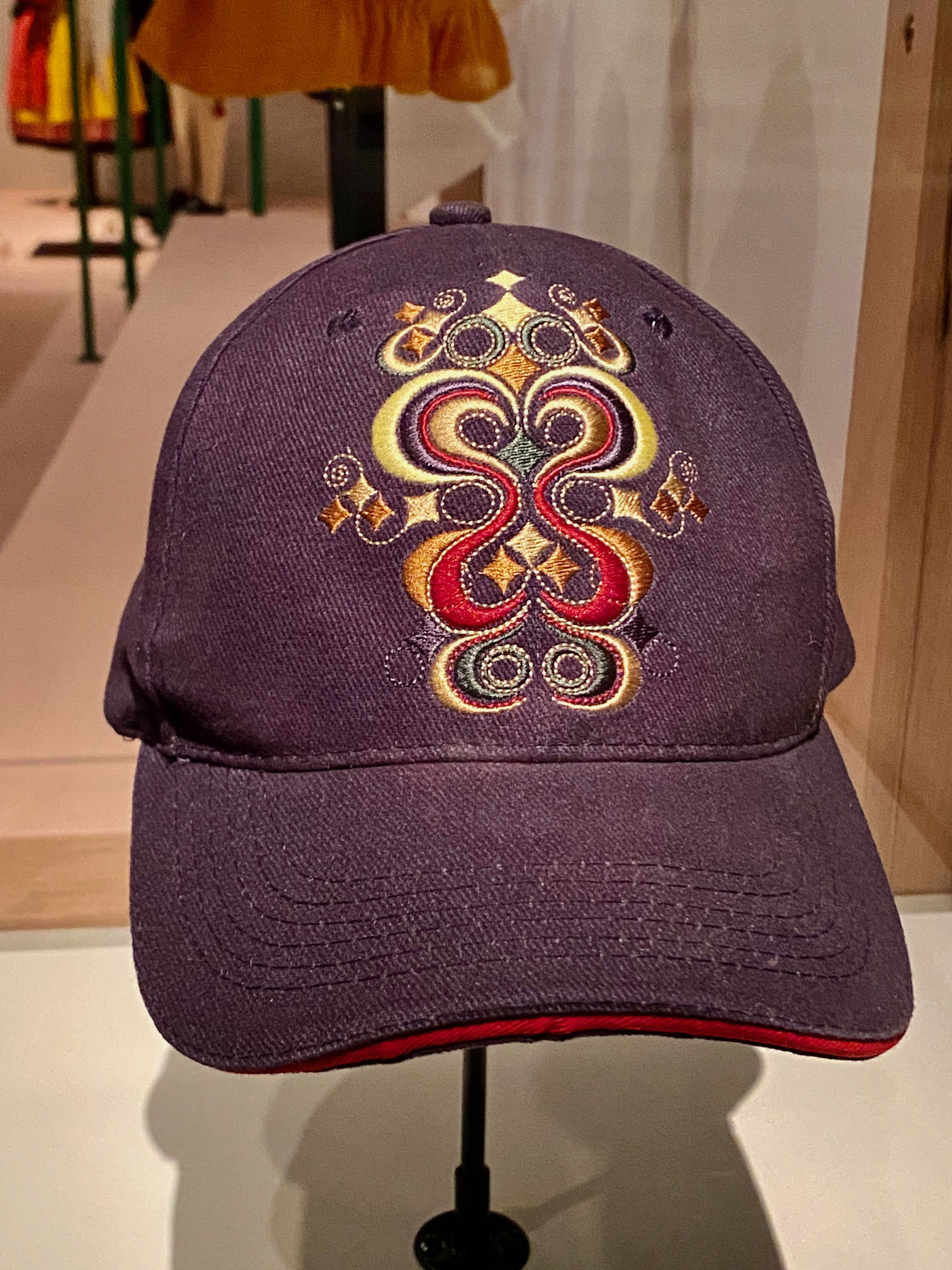
2017 embroidered baseball cap created in Leksand parish in Sweden’s Dalarna province, using traditional symbols. Private collection.

The story told by Norweigan folk dress is more tightly linked to the long revolutionary fight for independence throughout the 19th century. Rural Norwegian peasants were land owners. To city dwellers laboring under Danish and Swedish domination in the 1800s, rural people epitomized the “independent everyman” who had more control over their personal destinies.

During Norweigans’ century-long fight for independence, political activists began adopting bunader, contemporary clothing inspired by preindustrial rural clothing as a sartorial statement about their desire for freedom. It popped up at youth rallies and dances.

1900 national costume – red bodice with beaded insert and dark skirt – typical of Norway’s Hardanger district, depicted in photo.
Hans Kristiansen Lybeck’s fantasy drakt, worn in Oslo’s National Constitution Day parade in 1906. Courtesy: Vesterheim Norweigan-American Museum, Decorah, Iowa.

In 1903, activist and regional dance expert, Hulda Garborg, outlined a philosophy for nationalized clothing and popularized it.  Everyone’s enthusiasm for and pride in the national costume kept going, even after independence in 1905. Even in the 21st century, it’s a sure-fire tourism draw up in Norway’s fjord country.

Close-up of Reidun Dahle Nuquist’s embroidered red-jacket bunad, made in East Telemark, Norway by a relative in 1960-1963. She wore it for her wedding and throughout her life.
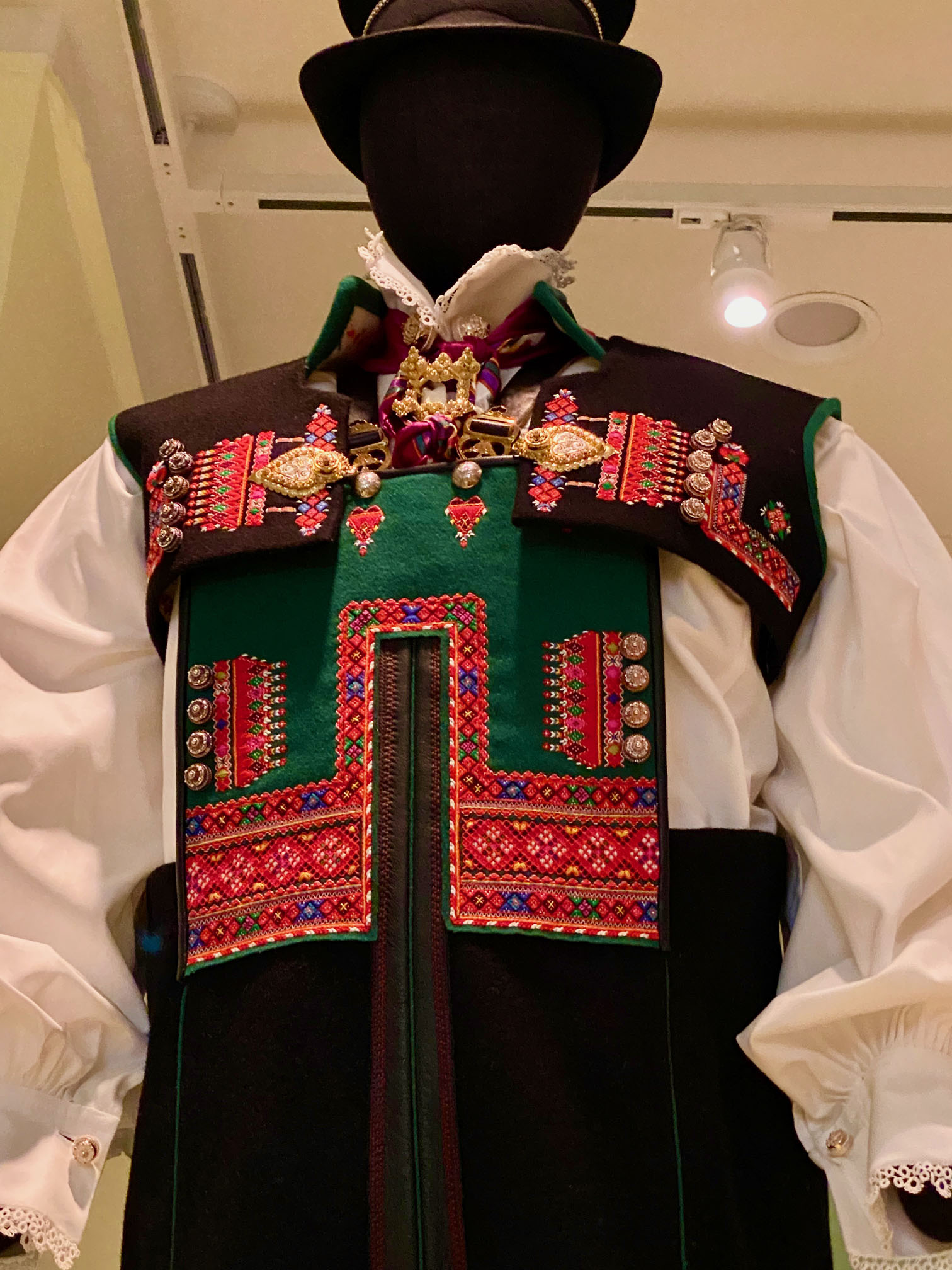
Man’s 2018 bunad by Inger Homme and other artists in Valle in Norway’s Setesdal district; silver, gold, brass jewelry by Hasla AS.

In the Sápmi portion of the exhibition, the clothing and art is mostly contemporary, with a focus on making declarative statement about indigenous rights.

Long an oppressed minority, the Sámi people have been subject to racial injustice, forced relocation of children to boarding schools, and industrialization of their traditional lands north of the Arctic Circle. In many jurisdictions, they were forbidden to wear their traditional garb.

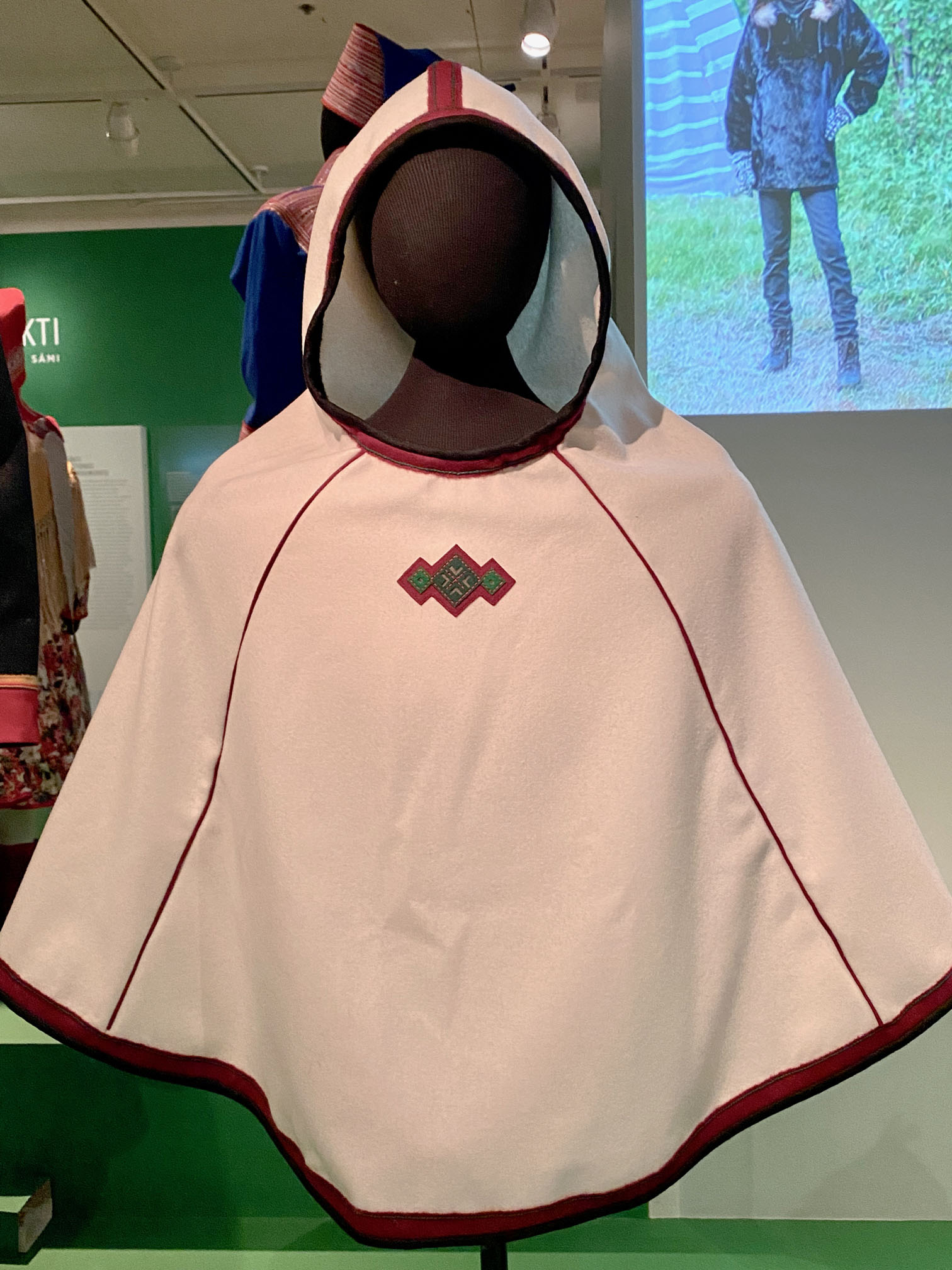
Symbol of Sámi pride: Jenni Laiti’s 2017 gákti creation from Karasjok – in Finnmark, the Norwegian side of Sápmi. Courtesy: the artist.

Around 1970, the Sámi were able to organize and raise public awareness about their status and why they opposed government dam building in Sápmi. Across their land, people began proudly wearing the traditional gákti and other symbols of their culture and engaging in direct political action on issues affecting them.

1966 summer gákti for a Sámi couple – wool tunics embellished with rose-colored ribbons and rickrack; made in Guovdageaidnu in Finnmark (Norwegian side of Sápmi)
Contemporary Sámi design: 2017 ready-to-wear cotton and poly “party outfit” by Stoorstålka (clothing line by Lotta W. Stoor and Per Niila Stålka) of Norrbotten (Swedish side of Sápmi).

The exhibition has posters and artwork proudly proclaiming native rights and identity, including an appropriated Sámi-style Rosie the Riverter image. For the contemporary eye, some of the most exciting clothing in the exhibition are by young Sámi designers and activists – ranging from Sámi-inspired home goods, modern woven designs, and even ready-to-wear party dresses from Sámi clothing lines.

The examples from Sámi makers demonstrate how design and fashion can help to reconnect young people with their ancestors’ heritage that society blotted out.

Jorunn Lokvold’s 2020 Igvu gákti with geometric applique, a style reconstructed in 1995.
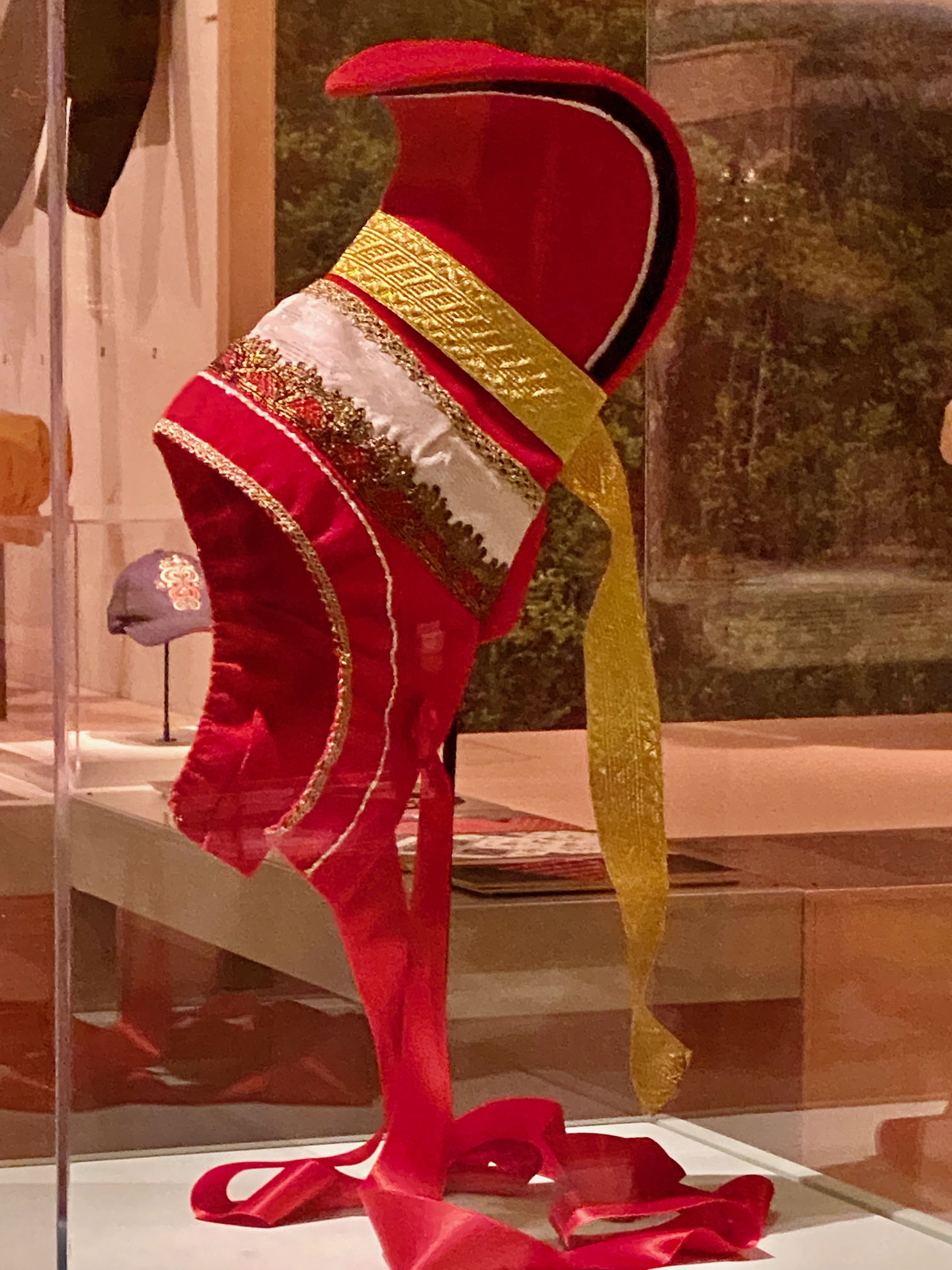
Outi Pieski’s 2020 Ladjogahpir, a revival of a headdress symbolic of Sámi women’s resistance; from Utsjoki (Finnish side of Sápmi).

This wonderful exhibition demonstrates exactly how old traditions can be reinvented to gain traction, even in the 21st century. Take a look through our Flickr album.

Resistance and revival continue in the far North. Meet Jenni Laiti, one of the Sámi artists, activists, and change-makers, who introduces you to art-making in the Arctic:

Art of Indigenous Fashion at IAIA

How do Native American designers transform traditional beading, ancient symbols, social commentary, and tribal embroidery into contemporary fashion? 

Answers are on display in the exhibition, Art of Indigenous Fashion at Santa Fe’s IAIA Museum of Contemporary Native Art (MoCNA) through January 8. It’s a fitting exhibition that opened in conjunction with the tenth anniversary of the Southwestern Association for Indian Arts (SWIA) Indigenous Fashion show.

Take a look at our favorite pieces in our Flickr gallery.

2015 Jamie Okuma wool dress with shells. Courtesy: National Museum of the American Indian
2022 Recon Watchmen costumes by Virgil Otiz (Cochiti Pueblo). Courtesy: the artist.

The show puts the work of 2022 Native American Treasure honoree Virgil Ortiz front and center, with three imposing Recon Watchmen costumes. No, it’s not runway fashion. But these futuristic sci-fi ensembles from the year 2180 are made for a film where protectors travel back in time to help the New Mexico pueblos successfully fight their opressors in the Revolt of 1680.

Ortiz (Cochiti Pueblo) combines film, fabric, headresses, and history to tell the story of a real-life Native revolution that Pueblo kids never learned in their New Mexican history classes. Look close at the awesome printed silk cloaks, lamé “armor”, and dramatic sculpted masks of these dramatic Native superheroes.

Next, you see how Native artists combined art and fashion from the mid-20th century until now.

Several historic pieces are by the godfather of Native American contemporary fashion (and early leader of IAIA), Lloyd Kiva New (Cherokee), who had a successful contemporary line in Scottsdale in the 1940s and1950s.

The clothes in this exhibition feature buttons and clasps made by Charles Loloma, a Hopi innovator in contemporary Native jewelry, who also had a shop in Scottsdale and joined New at IAIA in the Sixties. Lucky that collectors saved these gems for us.

1950s and 1960s ensembles by Lloyd Kiva New (Cherokee). Private collection.
2016 ribbon dress by Jamie Okuma ((Luiseño/Shoshone/Bannock)) and 2018 silk dress by Orlando Dugi (Dine’). Courtesy: the artist; IAIA

The rest of the work in the exhibition represents the 2000s, primarily three types – ensembles taking a luxurious haute-couture approach, wearable social commentary, and sly conceptual art-as-fashion installations.

The 2000 embroidered, appliqued wool “Chilkat” cape by Pamela Baker (Tlingit/Haida) is regal enough to wear at any black-tie affair.

The same for Orlando Dugi’s (Dine’) 2018 feathered and beaded evening dress with a subtle golden eagle and touches of sparkling corn pollen. Dugi is a self-taught couturier, who meticulously applies each bead and feather himself.

Two dramatic red-carpet dresses by Lesley Hampton (Anishinaabe) that have appeared at recent Emmy and Golden Globe Award events are reminders of the inroads being made by Native Americans artists in the entertainment sector.

Among the most dramatic social-commentary work, Canadian design team Decontie & Brown (Penobscott Nation) has two attention-grabbers – a “wedding dress” offering the wearer protective spikes from unwanted advances and radiating power-feathers, and the “I Am A Reflection…” mirrored man’s coat. Absorbed in the kaleidoscope of the coat’s reflected light, viewers contemplate Decontie & Brown’s message as they marvel at the visual magic.

Decontie & Brown’s 2017 Armored Beauty wedding dress and 2021 upcycled I Am a Reflection…Mirror Coat. Courtesy: the artists
2018 It’s in Our DNA, It’s Who We Are ensemble by Anita Fields reflecting tribe’s past and present. Courtesy: Minneapolis Museum of Art

The elegant embroidered cashmere shift by Sho Sho Esquiro (Kaska Dena/Cree) has delicate somber black wings fluttering across the back. But these are paired with a front shouting the savage message of 20th-century Indian boarding school government policy. Beautiful but chilling.

Anita Fields (Osage) is represented by a suspended fashion installation in the center of main gallery – a wildly oversized embroidered top hat and wedding coat titled “It’s In Our DNA, It’s Who We Are.” Intertwined strands are emblazoned on the front; images of the unfortunate treaty her tribe signed in 1808 line the inside.

Outside the main gallery, MoCNA has invited Mohawk multimedia artist Skawennati to create a digital mural and installation of her “Activist Avatars,” cyber-protesters modeling a virtual clothing line. Multiple screens of social-justice protesters in power-to-the-people cammo and calico march toward viewers in the MoCNA screening room to an energetic Native hip-hop track.

Skawennati’s (Mohawk) 2022 Calico and Camouflage: Assemble! multichannel video installation.

Many of the artists represented in this show – Patricia Michaels, Jason Baerg, Jamie Okuna, Sho Sho Esquiro, and others – were featured in this year’s Indigenous Fashion show. Watch the 2022 SWIA Fashion Designers runway videos here.

2019 silk and leather Sunset Dress by Jason Baerg (Cree Métis), symbolizing dynamic optimism and referencing trees, sky, and earth. Courtesy: the artist.

Fashion Manifestos by Carla Fernández

What does “slow” fashion look like? A revolutionary Mexican haute couture designer shows how it’s done in Carla Fernandez Casa de Moda: A Mexican Fashion Manifesto, on display at the Denver Art Museum through October 16.

As a young woman, Carla met and got to appreciate Mexico’s indigenous communities as she traveled with her father, a renowned anthropologist. She loved collecting hand-made indigenous garments reflecting the distinct local styles she saw. 

As a student of art history and fashion design, the complex indigenous textile techniques in these out-of-the way communities seemed to stand in contrast to the ever-changing, always-disposable cycle of Western fashion.

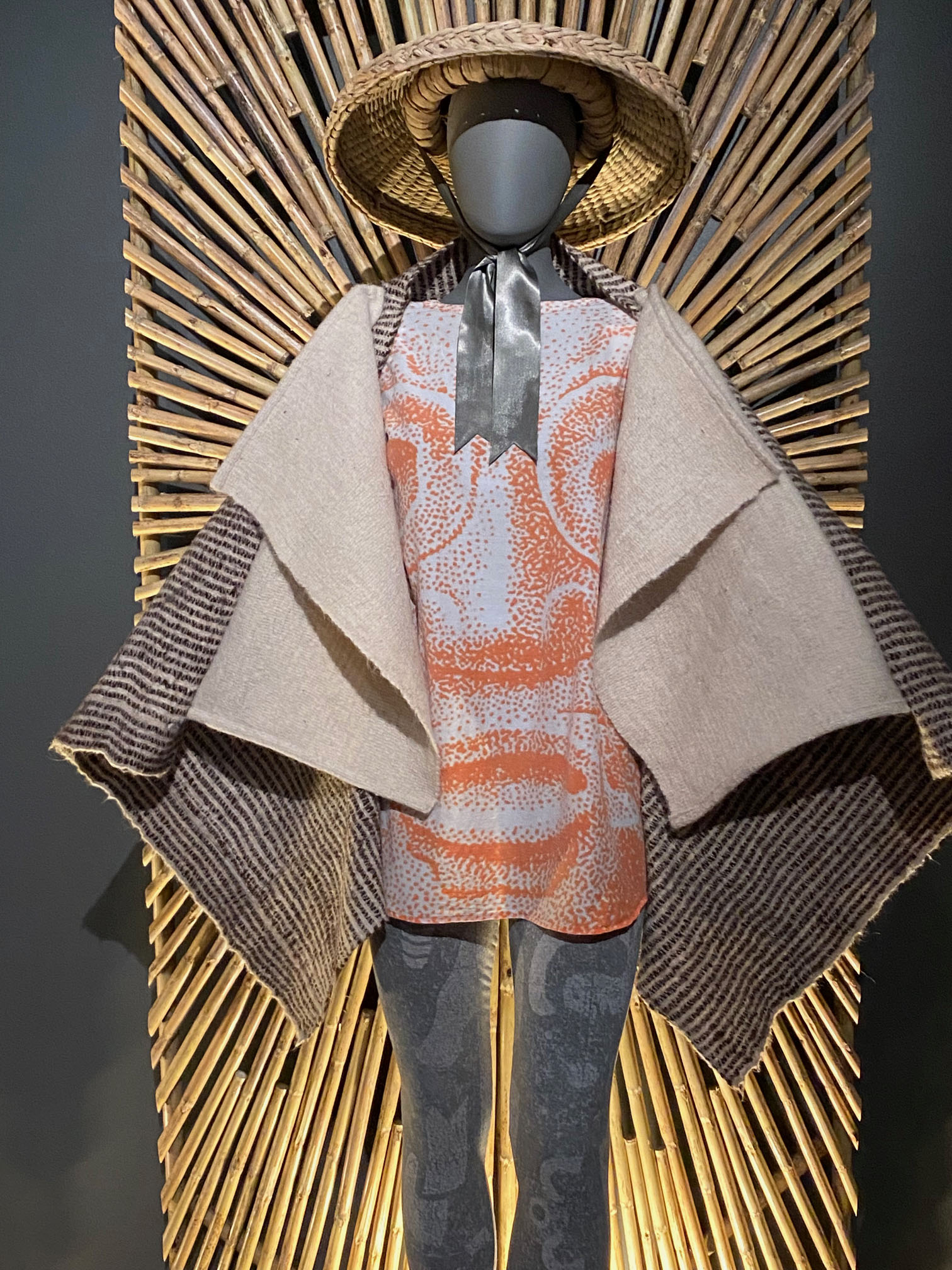
Carla Fernández 2014 jacket collaboration with Juanez Lopez Santis (San Juan Chamula, Chiapas) over digital-printed silk top and leggings.
2003 wool poncho – a Carla Fernández collaboration San Juan Chamula (Chiapas) artisans ­– over a 2009 pantsuit. From the collection of photographer/model Luisa Sáenz

Why not use these indigenous “haute couture” techniques for a high-fashion collection? Why not create a mix-and-match aesthetic using traditional, geometric shapes? Why not credit the artists?

As presented in her first-ever museum retrospective, the results are dramatic, detailed, intriguing, and one-of-a-kind – a completely different kind of fashion system that incorporates indigenous work, pays and credits community makers, and gives artisans the time to create pieces that collectors cherish.

Carla travels to mountain and desert communities to collaborate with textile artists.

With her fame growing, communities now invite her to drive over, see what they’re doing and brainstorm about potential collaborations. It’s an approach that involves time, dialogue, and mutual respect between the artisans and Carla-as-fashion-facilitator.

In her mobile studio (Taller Flora), they create hand-woven, dyed, and painted works of wearable art that Carla brings to the runway, but always with an eye toward collectors who value innovative, indigenous craft traditions.

The exhibition features runway looks, accessories, and videos of performance art that showcase different facets of her fashion manifesto – that artisan-made is the true “luxury” in a “fast fashion,” throw-away world.

2021 hand-painted coverall and digital-printed jumper and coat with Leonardo Linares (Mexico City); embroidered jumper with Antonia Vasquez (San Pedro Chenalhó, Chiapas).

Fiesta masks, leather caballero fretwork, whimsical basket-purses, and fuzzy handmade pom-poms provide home-grown Mexican flair to the cinched, draped, easy ensembles.

Take a look through our Flickr album, and enjoy this video of the installation at Denver Art Museum:

Every section of the exhibition demonstrates her commitment to stimulating innovation and creativity among indigenous makers.

Inspired by decorative fretwork on rodeo apparel, a 2022 wool poncho and pants done in collaboration with calado master Fidel Martínez (Chimalhuacán, State of Mexico).

As of 2022, Carla’s collaborated with more than 164 artisans in 39 communities in 15 Mexican states, with more to come. The show presents a map and identifies all of her collaborators.

To see and hear more about Carla’s collaborative process, watch the Denver Art Museum’s 2019 seminar on culture, cultural appropriation, and fashion in this YouTube video.

And join in on Carla’s beautiful, expressive fashion revolution by checking out her current and past collections on her website.

Dior Brings Opulent Extravagance to Brooklyn

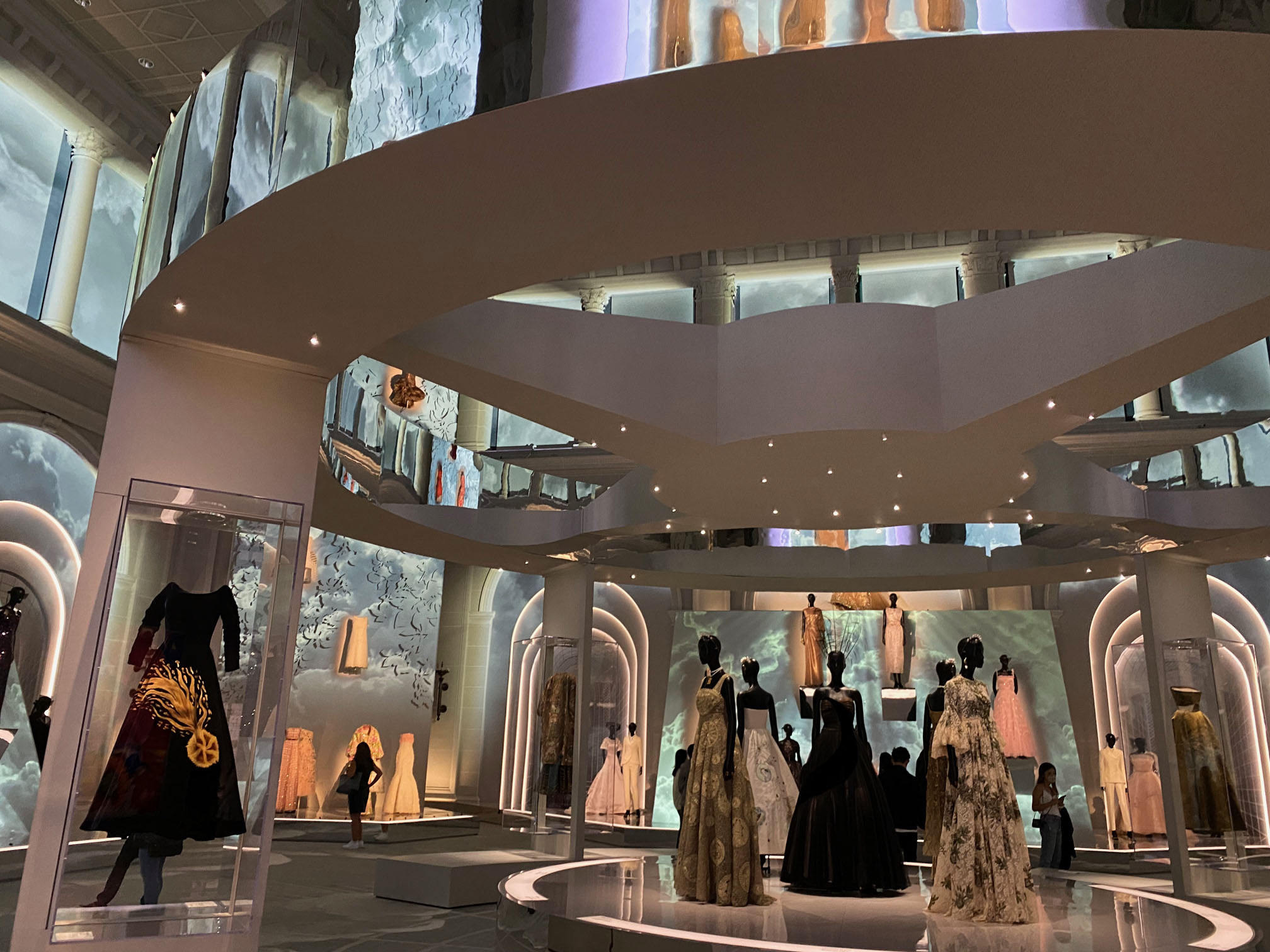
With lights dancing across dozens of floral dresses and sequined classical gowns in an over-the-top Beaux-Arts setting, visitors to the Brooklyn Museum generally stand speechless in awe of the extravagance before them in, Christian Dior: Designer of Dreams, closing February 20.

It takes a minimum of two hours to travel through the galleries, and much more time to absorb the wonders of this must-see fashion exhibition, drawn largely from the Dior archives in Paris.

Take a look at some of our favorites in our Flickr album.

Haute couture in Brooklyn’s Beaux Arts court. Courtesy: Dior heritage collection.
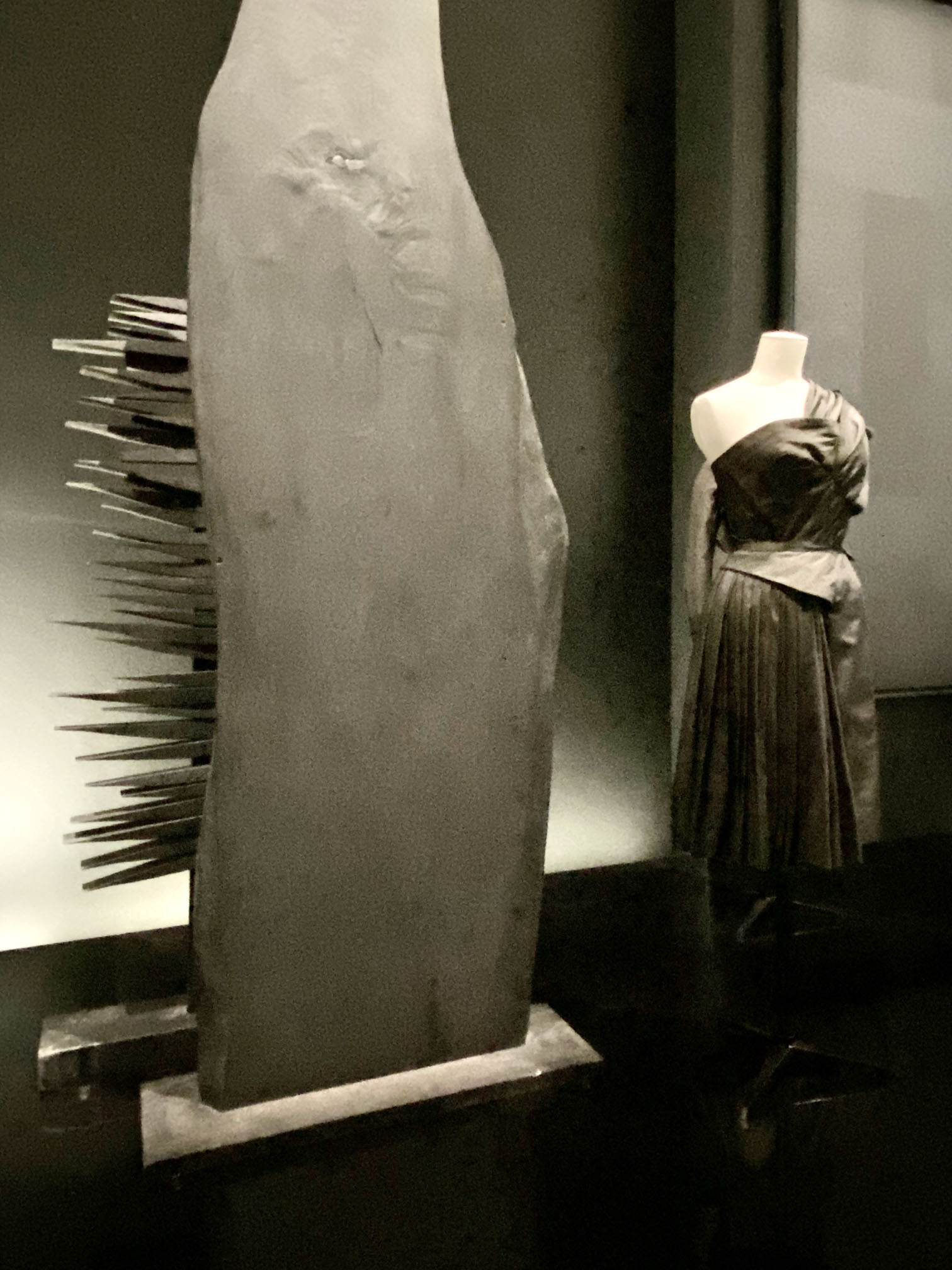
Nevelson’s 1956 sculpture and 1952 Dior dinner dress. Courtesy: Dior.

The exhibition begins in a traditional gallery format, showcasing Dior’s epic haute couture works of the Forties and Fifties.

Print and film media document Dior’s ecstatic reception in America, including custom client fittings and retail showings in New York and San Francisco.

Some of the most spectacular evening and cocktail looks are paired with modern sculpture by Nevelson and design by Eames from the Brooklyn Museum’s collection.

Turning the corner into the photography gallery, visitors encounter the full spectrum of photographers who have documented Dior couture from the Forties until today.

Visitors are ecstatic when they see the dress next to the Avedon photo that is one of the most iconic fashion images of the 20th century – Dovima modeling Dior’s spectacularly sinuous black-and-white gown, caressing massive, animated elephants that surround her.

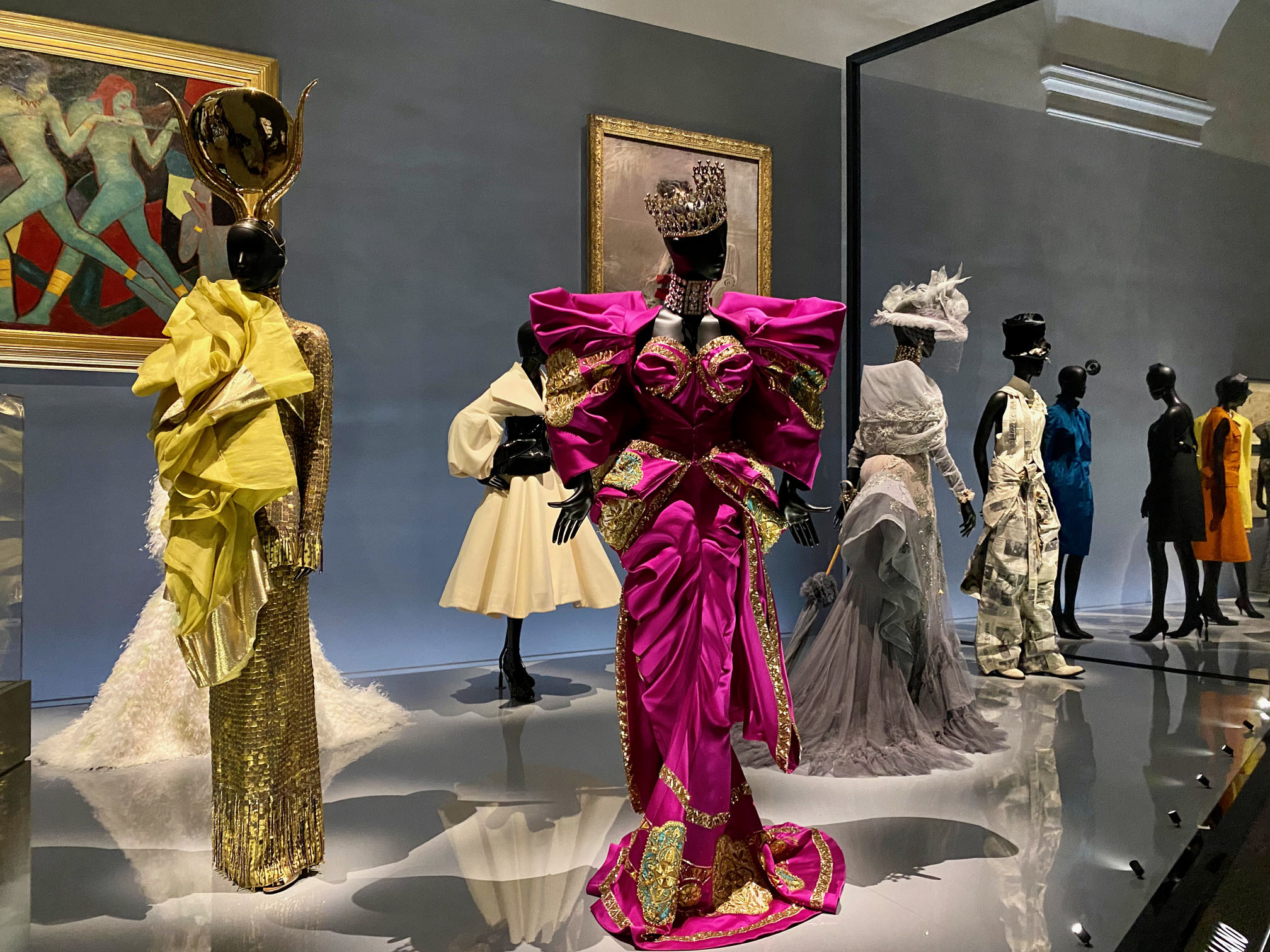
After Dior’s untimely death, a succession of fashion superstars led the creative side of the house. The show pays tribute to YSL, Bohan, Ferré, Galliano, and Simons with dramatic installations showing their inspirations from French film noir, modern art, opera, and art history. 

1955 haute couture, worn by Dovima for Avedon. Courtesy: Dior.

The garments are over-the-top, highly embellished, and smartly paired with Egyptian and Gilded Age works from the museum’s extensive permanent collection.

John Galliano haute couture for Christian Dior, inspired by ancient Egypt, the Belle Epoque, and other historical references. From the Dior Legacy gallery. Courtesy: Dior heritage collection.
Three 2020 ensembles by Maria Grazia Chiuri against Judy Chicago banners. Courtesy: Dior

There’s a special installation reserved for Dior’s current artistic director, Marie Grazie Chiuri, who has long used her platform in the fashion world to ask probing questions about culture, society, and women.

In this gallery, her dramatic haute couture work is surrounded by shimmering banners that she commissioned from Judy Chicago, whose epic The Dinner Party is the centerpiece of Brooklyn’s feminist art center.

A major set of galleries evokes the Hall of Mirrors at the Palace of Versailles – a source of inspiration for Mr. Dior.

The curators use the space to show off Dior’s Miss Dior perfume product displays and pairings of old and more recent haute couture inspired by 18th century glamour of the French court. If the exhibition ended right there, you’d be satisfied.

Haute couture from House of Dior: John Galiano’s 2000 dress in embroidered antique satin and Christian Dior’s 1952 satin cocktail ensemble. In the 18th-century gallery. Courtesy: Dior heritage collection.

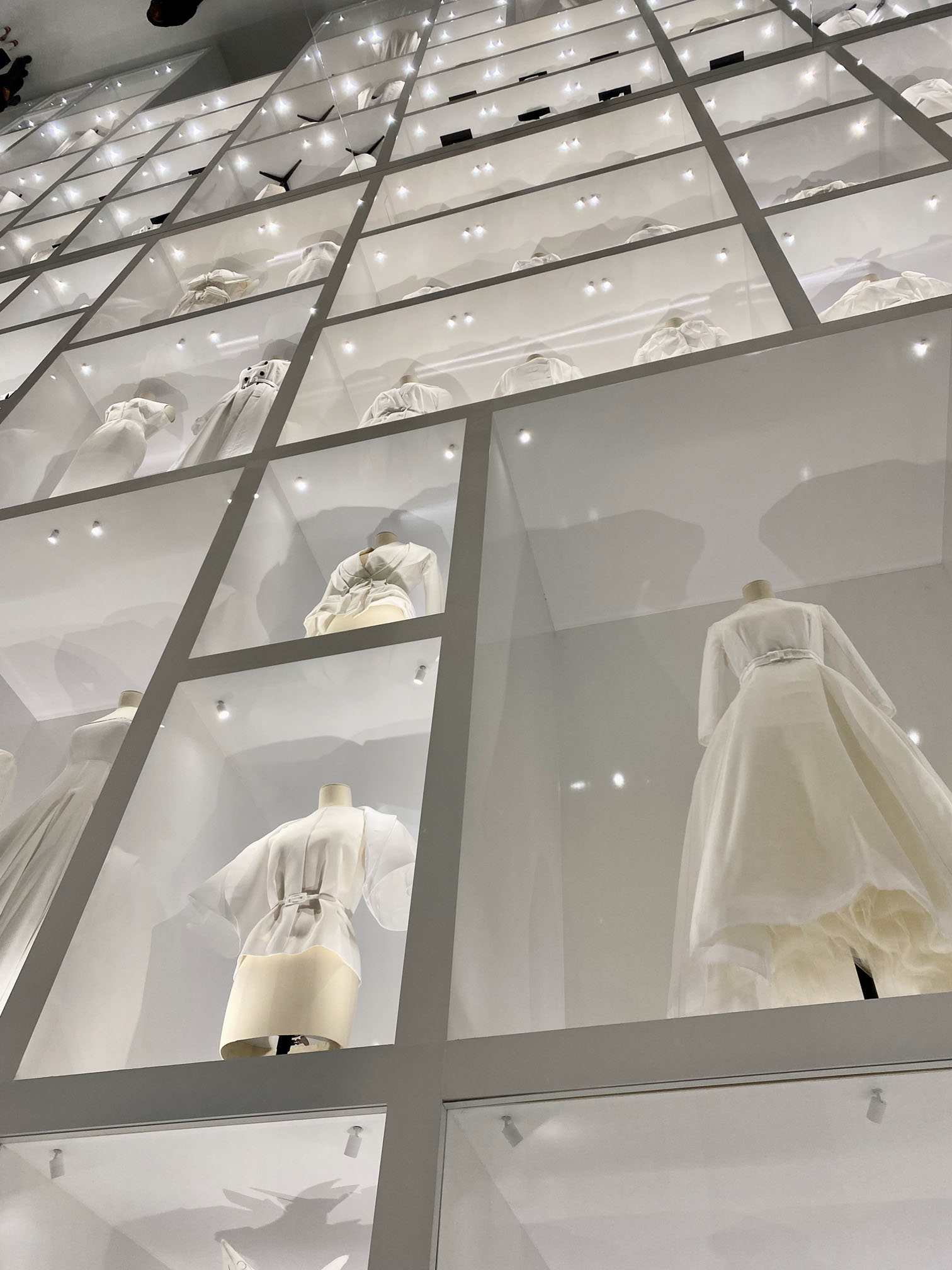
But there’s much more – a gallery segmented by color to show off fashions, accessories, shoes, and miniatures; and an Instagram-ready all-white infinity room with dozens of white toilles made by the Dior ateliers from the designer’s sketches.

It’s another unforgettable gallery experience that pays proper tribute to the teams of behind-the-scenes experts who bring these fashion visions to life. 

Although the gallery of celebrity Dior looks is the final stop in the show, it almost feels like an after-thought compared to the magical displays of the Beaux-Arts Court.

Wall of 2007-2020 toiles for haute couture dresses, jackets and coats.

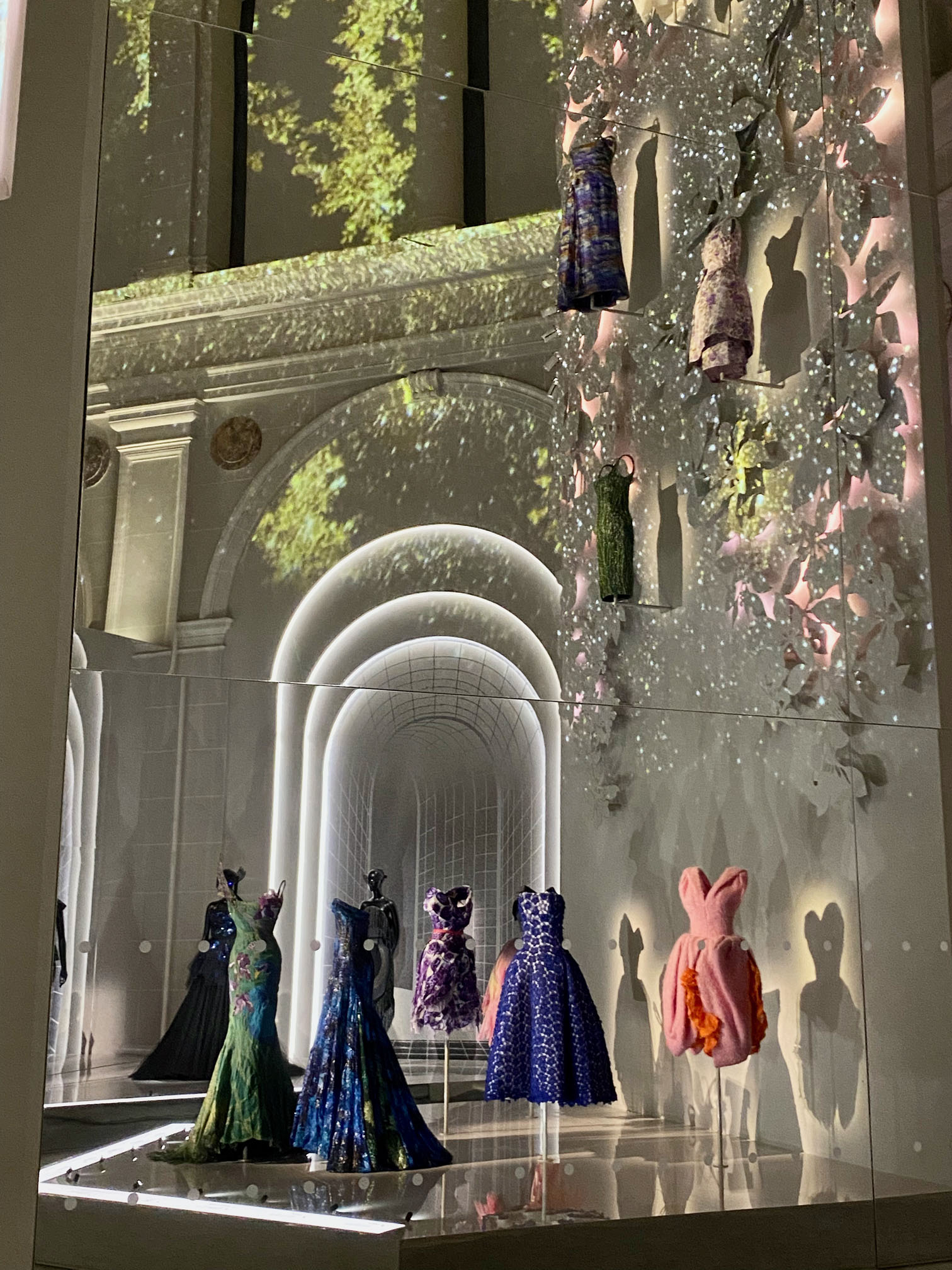
Haute couture is everywhere – clustered in the center, surrounding you on all sides, and artfully displayed on two-story-high walls and balconies.  One area features floral gowns, another shimmering gold ensembles, and another mysterious, dramatic black drama.

Haute couture dresses inspired by the divining arts surrounded by dresses inspired by nature, flowers, and gardens. Courtesy: Dior heritage collection.
2010 haute couture hand-painted embroidered evening dress by John Galliano for Christian Dior.

The show is a breathtaking array of light, sound, and visual riches – possibly the greatest feast for the fashion eye since the McQueen show at the Met.  Thanks to Dior for letting us see these amazing works from the archive, and to Brooklyn for giving us such an unforgettable fashion experience in its 125-year-old court.

Next up for Brooklyn’s galleries: a tribute to Virgil Abloh, opening July 1.

Jewelry for America Dazzles at The Met

Sparkling, historic, masterful jewels, settings, and stories await intrepid visitors who can find the out-of-the-way mezzanine gallery within the Metropolitan Museum’s American Wing. Jewelry for America, on view through May 8, chronicles the rise of the jewelry making arts through the Met’s own gorgeous collection.

Cases of jewelry from the mid-1700s though today are surrounded by period paintings that show how women (and men!) of different American eras sported, draped, and embellished themselves with the glittery treasures shown nearby.

The curators take five eras and angles, weaving in details of colonial dependency, Westward expansion, global discoveries, luxury consumption, high-end designers, and jewelry art trends.

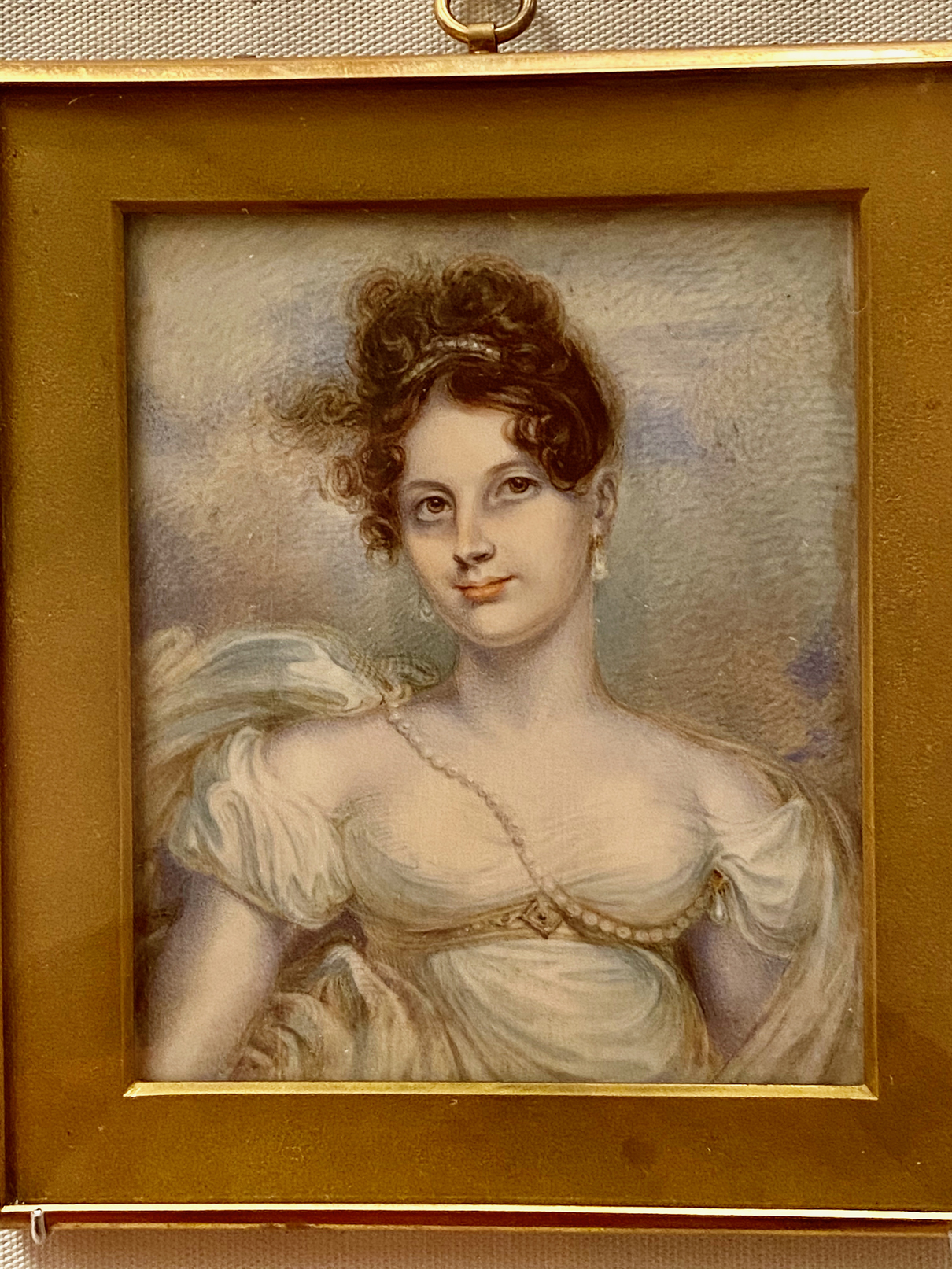
Robert Fulton’s 1813 wedding portrait of Susan Hayne Simmons, wearing her pearls Empire-style
Rare 1783 Society of the Cincinnati badge by L’Enfant, awarded to Washington’s Continental Army officers

But while looking at the small, finely crafted pieces, you can delight in just looking for looking’s sake.

The first section focuses upon the colonial era through the early 19th century, when toddlers wore coral necklaces and bracelets to keep them “safe” and it was popular to weave the hair of a loved one into a locket, fob, brooch, or little container hanging from a necklace.

But the most historic piece in this first section is the small Society of Cincinnati badge designed by Pierre Charles L’Enfant, for the group of Continental Army officers who served under Washington.

The next portion of the show introduces the rise of American jewelers in the mid-1800s with brooches and earrings inspired by nature, antiquity, and bygone eras, such as Tiffany’s 1856 transformation of an historic Connecticut oak tree into gold accessories and the artistic 1880 silver necklace by Shleiber & Co inspired by coins unearthed in Pompeii.

Tiffany’s 1889-1896 enameled and jeweled orchid brooch, designed by J. Paulding Farnham

In addition to Tiffany’s renowned, naturalistic orchid brooches and hair ornaments that wowed spectators at turn-of-the-century world’s fairs, the show also includes gorgeous nature-inspired statement pieces from workshops in Newark, New Jersey – high-end suppliers to famous celebrities and socialites in New York.

1924 silver box with enamel plaques by Eda Lord Dixon and her husband, Laurence

There are dozens of necklaces, pins, and special boxes adorned with diamonds, platinum, artistic enamels, opals, emeralds, and other precious gems.

The final portion of the show portrays the rise of the artist-jeweler, showcasing jazzy, one-of-a-kind pieces by mid-century creators like Art Smith and Calder, and finishing up with Elsa Peretti, Verdura, and cuffs by Kenneth Jay Lane from Lauren Bacall’s collection

1948 and 1946 custom cuffs by Greenwich Village artist Art Smith

Enjoy our favorites in our Flickr album, and read more of the history of American jewelry on the Met’s website.

Early 20th century Pueblo necklaces worn by Navajo leader Henry Chee Dodge

Virtual NYC Museum Events – Broadway, Brooklyn, Karma, Kusama, and McQueen

New York museums are offering a full calendar of virtual events this week, including trips to Broadway history, hipster restaurants of the world, Buddhist virtual reality, and tributes to artistic genius. Take a look at the list here! Here are just a few highlights:

2002 Broadway revival of Rogers & Hammerstein’s Flower Drum Song

Do you miss Broadway? Learn about some little-known secrets behind hit shows today, Monday (April 12) at 5:30pm. It’s a rare chance to meet the president of the Rogers & Hammerstein Organization, Ted Chapin, who will be giving a behind-the-scenes look at the Great White Way in his program, From Follies to Flower Drum Song and Beyond. It’s the premiere of a conversation recorded last Fall with Broadway World’s Richard Ridge, courtesy of the New York Public Library for the Performing Arts at Lincoln Center.

Did this global restaurant trend actually start in Brooklyn? Find out with MOFAD and the creators of Global Brooklyn: Designing Food Experiences in World Cities.

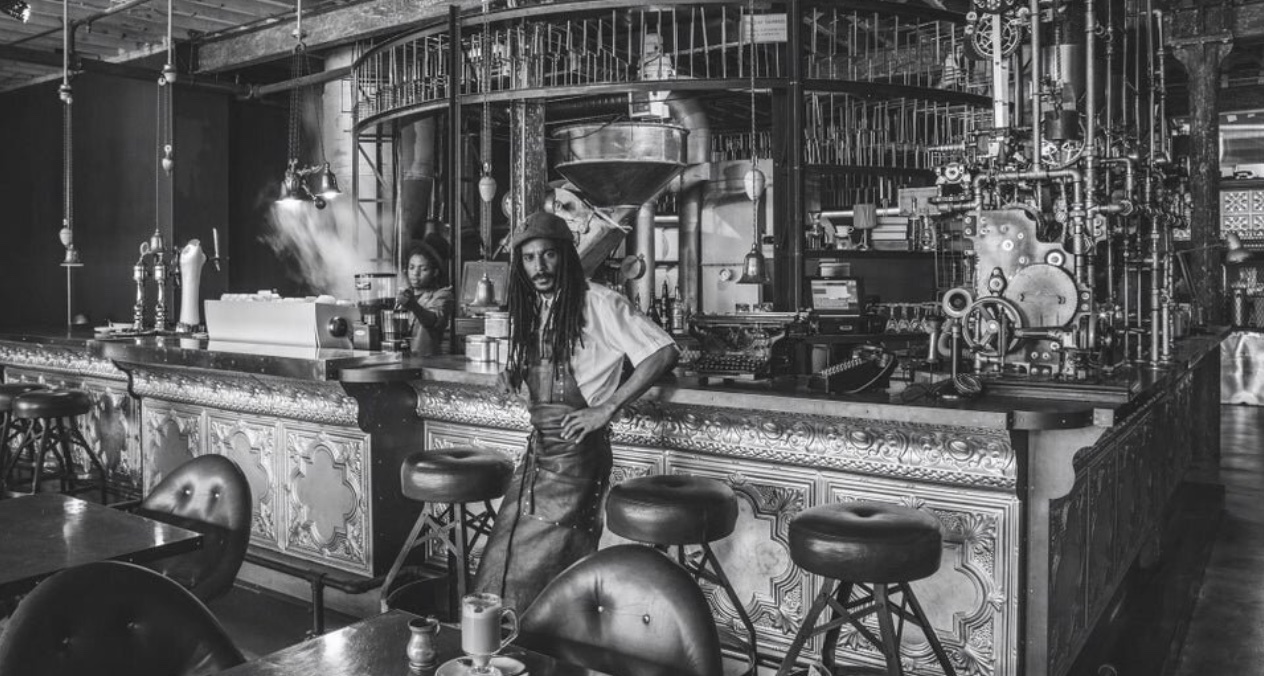
Love restaurants? Especially ones with slightly nostalgic post-industrial interiors decorated with that hand-crafted look? At 7pm, join the Museum of Food and Drink to meet the authors who explored how the Brooklyn aesthetic for How a Restaurant Aesthetic Became a Global Phenomenon. Learn how restaurants around the world adopted the style, and find out if this brand of hip actually started in Brooklyn.

On Tuesday (April 14) at 6pm, join the architecture crowd at the Skyscraper Museum to hear Mark Sarkisian, the structural and seismic engineer who is a partner at SOM in San Francisco. Mark designed one of Shanghai’s first supertalls back in 1999. His talk Pivot to China: How Jin Mao Portended Future Supertalls will explain how this tower’s innovations influenced the generation of supertall skyscrapers that followed.

Shanghai’s Jin Mao tower, 1999
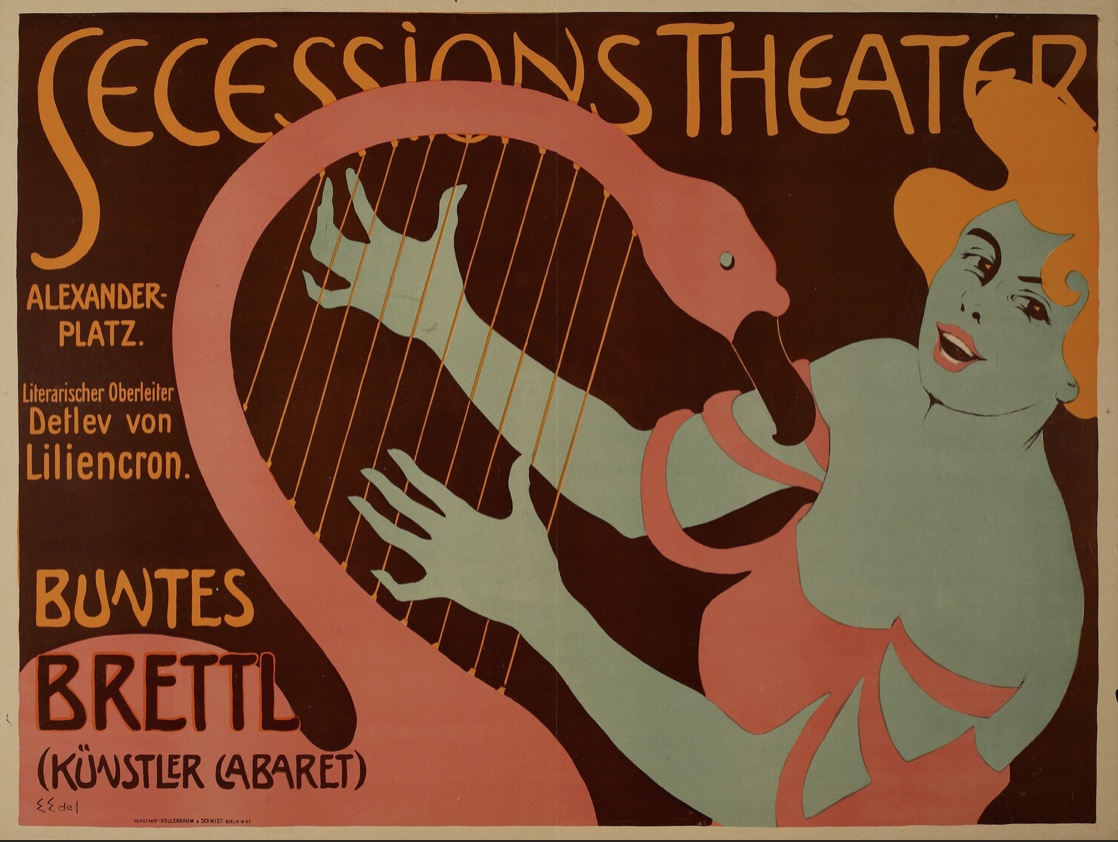
Berman Collection poster part of the Youth Style talk at Poster House.

On Wednesday (April 14) at 6:30pm, take a journey back to early modernist Europe at Poster House, who will be hosting A Tale of Three Cities: Youth Style in Berlin, Munich, & Vienna with the Kaller Research Institute. The evening will focus on how young designers made their mark on design from 1895 to 1910. You’ll see works from the Merrill C. Berman Collection (the collection featured at MoMA in Engineer Agitator Constructor), and works from the Poster House’s current Julius Klinger exhibition.

Also at 6:30pm – an opportunity to understand your karma. Join the Rubin Museum of Art for The Game of Life: An Interactive Virtual Experience. A contemplative psychotherapist will guide participants through a virtual Buddhist Wheel of Life to finding liberation from negative habits and patterns. The virtual game takes you throughout the different floors of the museum, and provides twists and turns. There are “Hell” and “God” Zoom rooms, but the payoff is higher awareness of one’s state of mind.

The Rubin’s reimagined Wheel of Life by eight graphic artists.
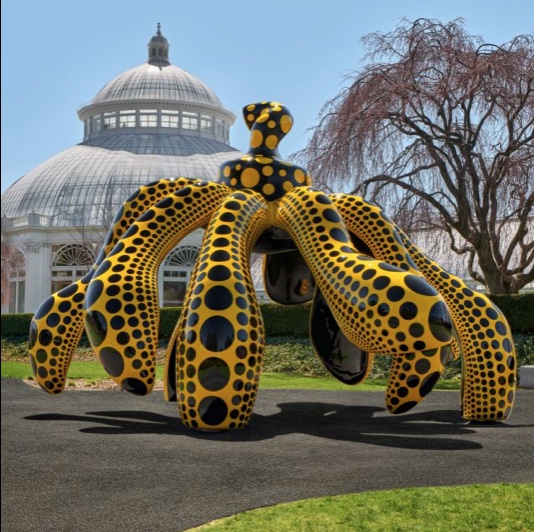
Kusama at New York Botanical Garden

On Thursday (April 15) at 11am, it’s what all of New York has been waiting for! Mika Yoshitake, the curator of New York Botanical Garden’s KUSAMA: Cosmic Nature will provide a look at how Kusama’s blockbuster installation reflects nature, the earth, the microscopic, and the cosmos. Cosmic Nature: Embracing the Unknown will present Mike’s insights about Kusama’s artistic language and her unrelenting, lifelong journey into new territory.

McQueen models backstage, as photographed by Richard Fairer

Want to go backstage at a McQueen show? At 6pm you can. Join Vogue photographer Robert Fairer at Museum at FIT for a live Q&A about his new book, Alexander McQueen: Unseen. Experience memorable moments of fashion’s greatest, most outrageous showman and see what a genius at work backstage before the show.

There’s a lot more happening this week, so check the complete schedule. Most of the events are free, but it’s always nice to add a thank-you donation.

Weekly Virtual Museum Events – Berlin Neon, Japanese Rap, Master Photographers, and Alice Neel

Commercial neon in Berlin under discussion at Poster House Monday

This week, NYC museums are offering more than 40 on-line events (mostly free) that will take you to Berlin in the Twenties, the music scene in Tokyo, studios of acclaimed photographers, and an opening at the Met.  See the full list on our virtual events page.

Tonight (Monday, March 22) at 6:30pm, join Poster House and photographer Thomas Rinaldi for Interwar Neon: Commercial Illumination in Weimar-Era Germany to look back on the electric art that flourished alongside the freewheeling nightlife scene for a brief time between the wars.

Dawoud Bey’s Birmingham series at the New Museum.

On Tuesday (March 23) at 4pm, join the New Museum to meet Dawoud Bey, a photography legend (and MacArthur genius) whose moving 2012 tribute, The Birmingham Project, is featured in the acclaimed exhibition, Grief and Grievance: Art and Mourning in America. 

At 7pm, join Japan Society for 333 Contemporaries – Looking for the Next Global Rap Star in Japan, the kickoff to its new on-line series which talks about how US rap music adopted and adapted by the next generation of Japanese artists.

Parlor of the Merchant’s House Museum, New York’s only intact 19th c. home

On Wednesday (March 24) at 6pm, if Monday’s session got you curious, Join the Merchant’s House for 19th Century Domestic Lighting: 100 Years of Change. It will be an in-depth look at the technology behind the historic home’s lighting fixtures from 1835 forward, a time when candles and oil lamps gave way to electric lighting.

Anthony Barboza’s 1972 Kamoinge Workshop portrait of Ming Smith

At 7pm, meet Kamoinge Workshop photographer Ming Smith in a live online event, discussing the publication of her recent Aperture monograph and the influence of music upon her work. Ming’s work features prominently in the current exhibition at The Whitney, Working Together: The Photographers of the Kamoinge Workshop. She is the first African-American female photographer to have her work enter MoMA’s collection.

On Thursday (March 25) at 6pm, get your fashion fix at the Museum at FIT with a special program, From Louis Armstrong to Dizzy Gillespie: Jazz and Black Glamour. The pre-recorded program will feature vintage performer Dandy Wellington, a deep-dive into the influence of jazz on 1920s menswear, and a live Q&A with FIT during the YouTube stream.

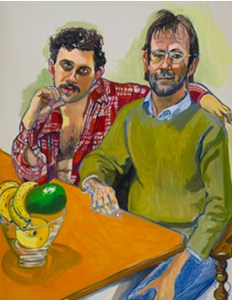
Alice Neel’s 1978 portrait Geoffrey Hendricks and Brian

At 7pm, join the Met for the online opening of its new exhibition, Alice Neel: People Come First, which features over 100 works by this beloved New York artist, considered one of America’s greatest 20th century portrait painters. You’ll find out all about how an artist who labored for decades in relative obscurity was drawn to document political movements, people, styles, and community in paint.

At 8pm, join MoMA for Virtual Views: Alexander Calder, a Live Q&A in honor if its new exhibition about Calder, MoMA’s founding, and modernism. The event will feature conversation with the artist’s grandson, who leads the Calder Foundation.

There’s a lot more happening, so check the complete schedule. Most of the events are free, but it’s always nice to add a thank-you donation.

Museum Update

1539 box for crossbow bolts made for the Bavarian duke. Value = 6 cows

We’re glad to report that the Met has extended its exhibition on the value of Renaissance art through the end of the 2021!  See it on the way to the Lehman Wing and the Dutch masters exhibition, and read about it (and the cows) in our February post The Met Asks What the Renaissance Thought It Was Worth.


Weekly Virtual Museum Events – Jim Dine, Niki de Saint Phalle, and Frida Khalo and New Artists

Jim Dine talking drawings online at The Morgan on Wednesday

This week, NYC museums are offering 35 on-line events (mostly free) on design, art, history, architecture, fashion, and performance.  See the full list on our virtual events page.

But we want to alert you to several events in connection with some of the brand-new exhibitions in town:

On Wednesday (March 10) at Noon, the Morgan Library is sitting down with Jim Dine to talk about classical and contemporary drawing. The program is being held in association with the Morgan’s new exhibition, Conversations in Drawing: Seven Centuries of Art from the Gray Collection. Register here for the on-line session (free, but limited seats). Jim will be talking about his own work that’s in the show and how his commitment to drawing relates to work by other artists included, such as Rubens, Ingres, Picasso, and Matisse.

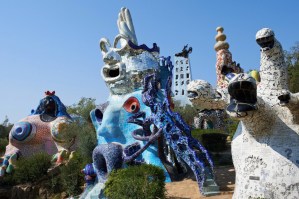
Niki de Saint Phalle arrives at MoMA PS1. Interior view of Empress, Tarot Garden, Italy

On Thursday (March 11) at 1pm, join MoMA PS1 for the launch of the catalogue for its newest exhibition, Niki de Saint Phalle: Structures for Life. Although Niki’s work was everywhere in the latter part of the 20th century, this exhibition marks her first New York retrospective. Curators, admirers, and artists come together at this panel to discuss the exhibition and her daring, provocative installations, ideas, and work.

At 2pm, the Cooper-Hewitt will host another conversation in honor of Willi Smith’s passion for making art outside of the dressmaking atelier – Art, Fashion, Performance: Seeing Through Creative Collaboration.

1939 portrait of Frida by Nickolas Muray. © Nickolas Muray Archives

At 6pm, the Museum at FIT is debuting a pre-recorded video with the curator of the acclaimed exhibitions in Brooklyn in 2019 on Frida Khalo’s style and art. Fashion curators from FIT will be running a live Q&A during the YouTube premiere of Curating Frida Kahlo: Fashion & Prosthetics.

On Friday (March 12) at 6pm, join the curators at El Museo del Barrio for an on-line tour of their important, new show on emerging artists – Estamos bien – La Trienal 20/21. The pandemic delayed the in-gallery opening of this important survey of new art, so El Museo put the work on line, and is just now welcoming in-person visits to its Fifth Avenue home. Check it out and see what’s new.

LaToya Ruby Frazier’s story in Grief and Grievance at the New Museum

At 7pm, join the New Museum to meet with another incredible artist participating in Grief and Grievance, the exhibition that has all of New York buzzing. LaToya Ruby Frazier, who has a compelling, wall-sized autobiographical work in the show, will be talking with Margot Norton – a discussion that you shouldn’t miss.

And in the run-up to St. Patrick’s Day, the Tenement Museum will be hosting a special on-line tour of the Moore family’s flat on Saturday (March 13) at 7pm and on Sunday (March 14) at 4pm.  Next week, too!

There’s a lot more happening, so check the complete schedule. Most of the events are free, but it’s always nice to add a thank-you donation.

Museum Updates

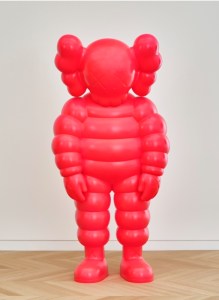
KAWS: WHAT PARTY © KAWS. Photo: Michael Biondo

New York has some exciting new shows coming on line right now! Last week, the Brooklyn Museum opened its big art-commerce-culture exhibition, KAWS: What Party, to celebrate 25 years of audacious work by Brooklyn’s own Brian Donnelly.

On March 11, Japan Society finally reopens its exhibition space with When Practice Becomes Form: Carpentry Tools from Japan. In honor of the earthquake’s tenth anniversary, the exhibition is a tribute to the resilient spirit of Japanese architecture and craftsmanship.

On March 14, MoMA opens Alexander Calder: Modern from the Start. We saw the workmen putting on the finishing touches on the third floor when we swung by MoMA this week to check out the other new show in the design galleries – Reconstructions: Architecture and Blackness in America.