Beer Makes Pots Sing at Met Breuer

Vessels from a range of eras, wired to amplify their ambient tone

Take 5,000 years of ceramic vessels from the Met’s collection, give them to art-installation genius Oliver Beer, and he’ll create something that will never let you think about fired clay or cast bronze the same way again.

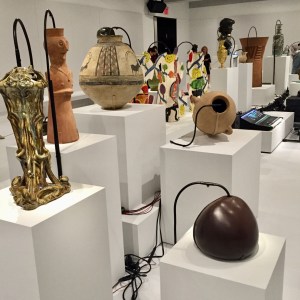
Beer has unleashed the “voices” of 32 precious objects in the beautiful, unforgettable installation Oliver Beer: Vessel Orchestra, in a fifth-floor showcase at the Met Breuer through August 11.

Beer recognized that ceramic and metal containers each have their own distinctive ambient note. It took him three years of searching through the Met’s collection to find which vessels among thousands could emit precise notes.

Oliver Beer at the mixing board and keyboards, demonstrating how the voices of the vessels are activated.

When you enter the Met Breuer gallery, you’ll meet his perfect cast. Beer has a sound mixer and keyboard to activate and amplify different combinations of sound from the 32 installation stars. A single microphone captures the natural, ambient sound of each vessel.

After spending decades on the Met’s shelves and in storage, each vessel’s distinctive voice is brought life in contemporary performance. As Beer and other artists play the keyboard, objects created in different eras and cultures blend their singular voices. They sound perfect.

Met LiveArts has invited guest artists to perform on Friday nights throughout the run of the show. When we were there, Helga Davis, a soloist who has triumphed in avant-garde operas like Einstein on the Beach, explained why she found the sensation so satisfying.
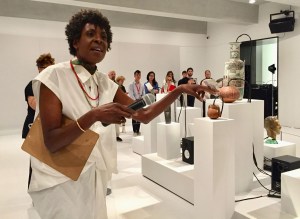
Vocalist Helga Davis

She said that she loved feeling her own voice “disappear” when the note she sang blended with a vessel’s own singular note. Listen in on our video clip.

Recently, the Brooklyn Raga Massive collaborated with the vessels in live performance to create a meditative, transcendental experience. Upcoming collaborators include composers Nico Muhly (August 4) and John Zorn and company (August 9).

Vessels in the orchestra — Qing Dynasty porcelain vase (1644-1911) and the back of one of Betty Woodman’s 2003 series The Ming Sisters.

When live performers are not present, Beer has programmed the keyboard to activate his ensemble. A little light on the cord running to each vessel illuminates when the vessel is singing, so viewers can see exactly who’s contributing to the ambiance at any given moment.

The vessels are quite an elegant crew, including a sinuous art nouveau porcelain, a sleek modern bronze portraits by Lachaise, and a monumental angular slab pot by American master William Daley.

Visually, the vessel presentation is clever. Betty Woodman’s whimsical 2003 ceramic trio The Ming Sisters knocks a bit of seriousness off their otherwise tightly controlled neighbor — turquoise-and-gold Qing Dynasty porcelain masterwork.

Vessels wired to amplify their ambient tone, including a female effigy (7th – 6th c. B.C.), Beatrice Wood’s fish, an Iranian storage jar (3800 – 3700 B.C.), and a Canaanite jar (1500 – 1400 B.C.).

And Beatrice Wood’s 1947 fish pot is swimming, singing, and bringing the fun out of a totally ancient threesome – an old, tipped-over Canaanite jar, an ibex wandering across a 4th millennium B.C. Iranian pot, and a 7th century B.C. lady.

Some things that look ancient aren’t. A simple, unassuming, unembellished creation seems to have been made at a more primitive, far-away time. But it’s a 1975 stoneware pot created by artist Juan Hamilton, Ms. O’Keefe’s friend and assistant, who taught her how to make pots in her later years at Ghost Ranch.

There’s so much to hear and see in this show, so be sure to experience this extraordinary ensemble before August 11. See close-ups of some of our favorite Met singers on Flickr.

Here, the engaging and brilliant Oliver Beer explains how it all comes together:

Bigger Field of Vision in Sixties Color Painting

Color Field: Fritz Scholder’s 1965 oil New Mexico Number 21 in the MoCNA show

When curators from two different museums in two parts of the country wanted to tell new stories about paintings from their collections, both chose to look at big, bold colorful work done by known and less-well-known artists in the Sixties and Seventies.

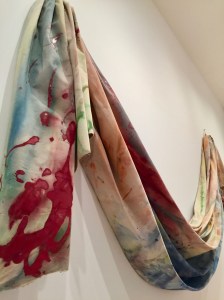
The Whitney Museum of American art created Spilling Over: Painting Color in the 1960s, which is on view through August 18, to showcase new acquisitions that tell a more complete story about painters using splatters, drips, and jazzy figures with in-your-face colors.

The AIA Museum of Contemporary Native Arts (MoCNA) in Santa Fe created Action/Abstraction Redefined, on view through July 7, to highlight the way young Native American painters – some of whom went on to have major art careers – channeled the zeitgeist of the East-Coast gallery scene into something with which they could make a personal mark.

Sam Gilliam’s 1968 pored-paint, draped canvas at The Whitney

The curators at both institutions were thinking along similar lines.

Although Spilling Over features Morris Louis, Kenneth Noland, Frank Stella, and other icons of the wall-sized color painting movement sweeping through New York galleries in the Sixties, the curators wanted to make sure that the public understood that there were female, Native American, and African-American color painters experimenting with these trends, too.

The Whitney has given Sam Gilliam’s draped and splattered canvas a place of honor at the end of the two-gallery vista. He was one of the few African-American artists to gain coverage in Artforum back in the day, but is largely unknown to younger art-going audiences.

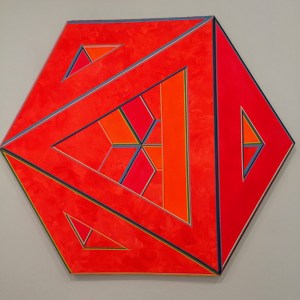
At the opposite end of the space, the curators showcase an electrifying neon canvas by Alan Loving, the first African-American to have a solo show at the Whitney in the late Sixties.

1970 acrylic by Alan Loving, the first African-American given a solo show at the Whitney

Color-figure work by Cherokee artist Kay Walking Stick is featured alongside other painters like Harlem’s Edith Amos and Alex Katz, who slathered color across figurative canvases. It’s all about introducing art-lovers to new faces in the canon of American Art.

While women and artists of color were trying to get their work on the walls of New York museums and galleries, up-and-coming Native American abstractionists were waging a different type of battle for acceptance – a struggle that led to the birth of the Institute of American Indian Arts (IAIA) in the early Sixties.

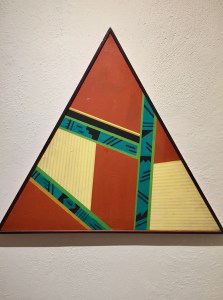
Hard-edged 1968 acrylic by Hopi/Pima artist Frances Makil, incorporating cultural motifs in the MoCNA show

Contemporary abstract work by Native American Modernists in the late 1950s was typically rejected from competitive and museum-curated art shows. Juries and curators were clearly biased toward traditional forms of expression, and young innovators bristled at being told to “stay in their place.”

When the Institute of American Indian Arts opened in 1962, the next generation seized the opportunity to put their mark on what was setting the art market on fire – big, expressive abstraction; atmospheric color field works; and geometry.

These works, some of which were accessed into MoCNA from the Bureau of Indian Affairs, tell quite a compelling story about early-stage experimentation and the opportunity that the arts-education initiative provided to emerging artists out West. The years spent making work at IAIA gave a kick-start to careers of some of the best-known native artists today – T.C. Cannon, Fritz Scholder, and George Morrison. Judge by the results you see here.

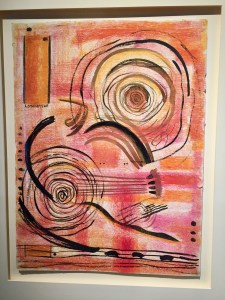
Gesture and expression: 1965 pastel by Hopi/Choctaw artist Linda Lomahaftewa

The MoCNA curators also wanted to make space for women in their exhibition, too, such as Frances Makil. The 1965 pastel by Hopi/Choctaw artist Linda Lomahaftewa uses the artist’s own culture as inspiration, but the lines and spirals echo some of the Whitney’s own abstract, meditative canvases by Lee Krasner, who also drew energy from spirit worlds.

Both shows open the doors to new faces to widen the conversation about color-painting history, and these paintings all have a lot to say.

Listen to Whitney curator David Breslin and artists explain how a collection show can reframe conventional art history, and learn more about the artists in the audio tour here:

When the Avant-Garde Took over Corporate Branding

Entrance to the show at Bard Graduate Gallery

With the world turned upside down by World War I, artists in the European avant-garde eagerly embraced new ways of looking, thinking, and creating.

Museum-goers are familiar with the innovative edge that Constructivism and Bauhaus thinking brought to painting and architecture, but few realize it extended so directly into corporate identity and industrial sales in those post-war years.

Bard Graduate Center tells this previously untold story through a young man’s collection who was at the center of it all in its exhibition, Jan Tschichold and the New Typography: Graphic Design Between the World Wars, on display through July 7.

Cover of 1923 Bauhaus exhibition catalog by Herbert Bayer. Courtesy: MoMA.

Recent grad Jan Tschichold, a talented young typeface designer calligrapher steeped in the art of fifteenth-century letterforms, took a quick trip to the Bauhaus in 1923 and was blown away by what he saw coming out of the print shop and the minds of artists at the interdisciplinary hothouse.

Being a works-on-paper kind of guy, Jan was entranced by the book designs and letterheads – modern san serif letters, asymmetrical page layouts, and letters used as design elements on the page. In particular, he saw an essay by Moholy-Nagy that coined the term “new typography”.

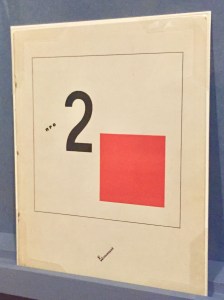
El Lissitzky’s 1920 children’s book About Two Squares, which teaches post-revolutionary ideals through interactions of abstract shapes. Courtesy: MoMA.

These rule-based design principles clearly appealed to him, and Jan soon began corresponding, organizing, sharing, and exhibiting with an energetic network of innovators like Schwitters, Moholy-Nagy, and El Lissitzky. Starting in 1925, Jan was the most vocal proponent of this “new typography.”

“Graphic design” was starting to become a “thing” and Jan found himself in the center of it. Jan began collecting anything with asymmetrical layouts, eye-catching photo-montages, and letters running wild — postcards, catalogues, book designs, business cards, brochures, promotional catalogs, and posters.

By 1928, Jan had seen and designed so much ground-breaking work that he decided to write a book that would summarize how any graphic-arts practitioner could blow up past conventions of graphic design, letters, and photography and repurpose them for industries and pop culture.

Title page of Jan Tschichold’s 1928 book, “The New Typgraphy,” which had essays by Moholy-Nagy, Dexel, and others.

Jan’s book, Typographische Gestaltung, went viral among the 80,000 members of the German print workers union, showing everyone how to juice up advertising layouts, movie posters, and industrial brochure designs in a more modern way.

German industries were just beginning to make a comeback after the war. Brochures about pumps, valves, and machinery all had a modern twist that created an identity for corporations to make a comeback. Inexpensive designs on paper — what a way to make a statement! What a way to glamorize and sell ergonomic chairs, new motorcycle engines, lathes, and metal parts!

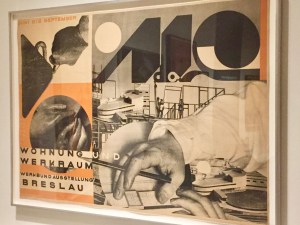
“Dwelling and Workplace” poster – an event identity campaign by Johannes Molzhan for the 1929 exhibition by Deutscher Werkbund, the German design association. Courtesy: MoMA

Curator Paul Stirton’s show shines a spotlight on this early move toward modern corporate branding, identity, industrial brochures, and the day-to-day business of simply selling things. Just like today, even avant-garde designers had to make a living!

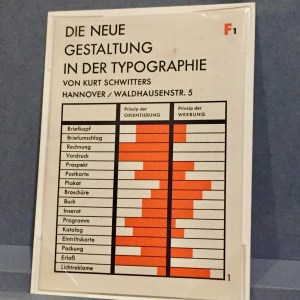
One of our favorites is Dadaist-in-chief Kurt Schwitters’ marketing brochure to explain his design agency’s services for corporate logos, brochures, and and other types of design.

Eventually, Hungarian and Czech designers started adopting what Jan was advocating. His influence largely bypassed the United States and the English-speaking world (except by osmosis), since it took decades for his book to be translated into English.

1930 marketing brochure by Kurt Schwitters to potential corporate clients. Courtesy: MoMA

Perhaps one of the most intriguing features of this show is that nearly everything on display is from Jan’s own collection, which is labeled as in the Museum of Modern Art’s collection. But ironically, much of the corporate marketing stuff on display here (and seen for the first time!) almost didn’t survive.

Jan amassed acres of his colleagues’ work in the Twenties, but had to leave the majority of his collection behind when he fled Germany in the run-up to World War II and ultimately landed in the United States.

Strapped for cash, Jan happily sold his poster collection to MoMA in the 1930s, but in the 1950s, MoMA said no to the rest of Jan’s remaining collection. Who needed that much work on paper from the Twenties when you were collecting wall-sized post-war American abstraction?

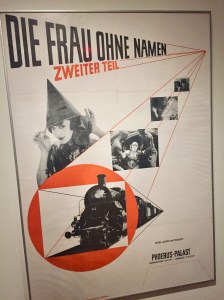
Jan Tschichold’s 1927 movie poster “The Woman Without a Name,” for Berlin’s Pheobus-Palast.

When Philip Johnson heard that MoMA refused to take Jan’s letters, catalogs, books, postcards, and other ephemera from Europe’s greats, he tracked down the California bookseller who acquired it, paid $350 for 800 pieces, and donated it to MoMA.

So, although MoMA’s closed for the summer, you can still see a capsule collection by a 20th century innovator that’s never been displayed as a whole before.

Take a look at our favorites on Flickr and watch the curator’s talk here.