Bard Resurrects NYC’s Crystal Palace

The domed Crystal Palace depicted on a commemorative window shade

With its exhibition New York Crystal Palace 1853, the Bard Graduate Center gallery is offering an exquisite experience of one of the 19th century marvels of New York – the enigmatic 1,500-paned glass structure that rose on what is now Bryant Park.

In 1853, New York was trying to claim its place as a culture capital. Two years prior, London had mounted its world-class exhibition in its beautiful Crystal Palace, and New York wanted to do Europe one better.

By this time, New York was dominating in global trade, so the City thought it could elevate American taste (and spur consumer appetite for luxury goods) by assembling technology innovations, art, and manufactured items all under one big domed glass roof.

Why not build the world’s largest cast iron and glass exhibition hall on the edge of the city at 42nd Street next to the Croton Reservoir? For 50 cents, visitors could spend the day inside and people watch to their heart’s content.

Showpiece parlor furniture, an 1853 armchair by Julius Dessoir

It would be the largest building that anyone had ever experienced – so big that it had its own police force and you had to buy a guidebook.

The exhibition selects some choice items from New York collections – many which were indeed exhibited under the dome in 1853 – to tell the story of the endeavor, give a feeling of what a wonder it was, and bring you back to a time in New York when parlor furniture was the rage, ladies were just venturing out for ice cream on their own, and oysters were still so plentiful in the harbor that they reigned as the best quick snack for lunch.

Take a look at the galleries exhibition on the Bard website, but see a close-up view on our Flickr album.

Although the physical exhibition ends July 30, the Bard team offers a through-the-looking glass digital site, where you can actually stroll through the interior and examine different items along the way. The journey takes you by evocative sculptures, beautifully crafted musical instruments, spectacular parlor furniture, and vitrines filled with over-the-top ladies’ hats.

High-tech Singer sewing machine for home and business

The technology section features the latest in fire engines, Eli Whitney’s original model of his 1794 cotton gin, Colt’s revolvers, a pyramid made of innovative cotton rope, and the revolutionary iron sewing machine. To show how it worked for industry and the home, Singer had women demonstrate this new labor-saving device.

In-gallery and online interactive walk-through tour of the Crystal Palace

The scope of the exhibition was so massive – the footprint of Bryant Park between 40th and 42nd Streets – that publishers offered guide books so that visitors wouldn’t miss a thing.

Helpfully, Bard provides you with digital access to the free July 23, 1853 Crystal Palace supplement from the Illustrated News, modeled upon a period newspaper.

For a thrilling view, you can go up to the 270-foot tall, 8-foot wide platform of the Latting Observatory (New York’s first authentic skyscraper) and get a bird’s eye view of the city all the way out to Jamaica Bay. Or duck into the saloon below for smash, the cocktail of the day, a shaken-not-stirred icy mix of brandy, lemon, mint, and sugar. (And consult the guidebook to find out which saloons allow ladies to sip alcohol.)

There’s also a digital guide to other 1853 attractions, including how to take an omnibus over to the Hippodrome and where to find Matthew Brady’s studio.
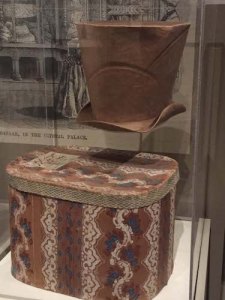
Must-have tophat displayed and available from John Genin’s downtown mega-store

It’s all so lively, that it’s sad to learn that the entire edifice came crashing down in a dramatic fire in 1858, which likely adds to the mystery. The curators have found a tiny, insignificant piece of its melted glass from the Museum of the City of New York’s collection. Treasure it.

If you have three hours, watch Bard’s symposium on how it all came together – the palace, the exhibition, and the digital experience that will provide everyone with hours of 19th century summer fun in the City:

Georgia O’Keeffe’s Always-Modern Style

Modern black-and-white dressing even in 1917. Photo: Stieglitz.

Like any home sewer, she was fond of certain fabrics and put a lot of love and care into crafting something she wore (and wore out) through important decades of her life.

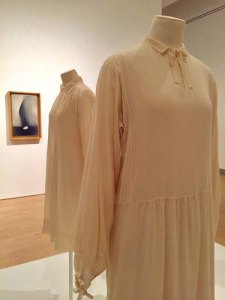
In Georgia O’Keeffe: Living Modern, on view at the Brooklyn Museum of Art through July 23, you will experience the pristine care this home sewer gave her hand-tucked tunics for over 60 years after she made them – crème silk, tiny stitches, thin bow ties, and shortened hems, all from the 1920s.

Brooklyn’s had a blockbuster season with this O’Keeffe show. It’s where Georgia had her first museum show in 1927, when she was a fixture on the high-art scene in New York, wearing a dramatic evening wraparound coat with rainbow-surprise lining – an upscale step from the loden cape that was her signature look a few years earlier.

Although many knew her for her Southwestern landscapes, she studied at the Art Students League and got her teachers training at Columbia in New York City. Only then did she take a teaching gig out west at Texas A&M. Stieglitz, her future husband was already showing her work in New York.

Clean lines of handmade silk dresses that Georgia made in the early 1920s.

For years, Georgia lived in Midtown, not too far from Bergdorf’s and other fancy shops. Although she chose an austere, modern look, the proximity to luxury and knowing the detail behind how elegant clothes was part of who she was.

Glimpse items from the show on our Flickr feed.

Once she moved out west permanently after Stieglitz passed, she adopted a select portfolio of western wear – denim shirts, 501s or Lady Levis, and rubber-soled PF sport shoes. No crazy fringe or cowboy frou frou.

Although there are no photos of it in the show, the curators say that her iconic adobe home featured mid-century modern furniture. It’s interesting how she kept up with modern fashion and surrounded herself with sophisticated, sleek lines from her remote perch in New Mexico’s redlands.

Working McCardell and a concho belt in this 1956 Todd Webb photo

She acquired one of the first Puccis sold in the United States – a stark black-and-white “chute” dress — and had a beloved collection of Marimekko and Clare McCardell sport dresses. She felt that McCardell was the greatest designer America had ever produced. So much so, she had the designs copied by local seamstresses.

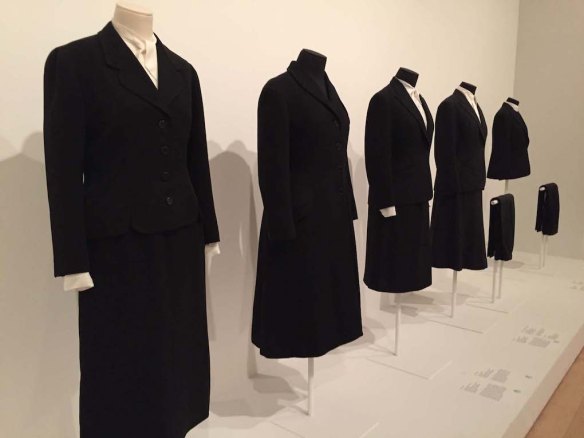
Georgia’s trips back to New York included stops at Bergdorf’s and at her favorite old neighborhood tailor. Although she wasn’t sewing anymore, she invested a lot of effort to work with meticulous artists who could fashion austere black wool suits into the perfect expression of her, with just a subtle detail added here or there.

The paintings, clothes, and photographs coexist throughout the show, informing your vision of one of the most famous artists of the 20th century.

It’s quite remarkable to realize that every great photographer (in addition to her husband) sought her out (or received an assignment) to capture her no-nonsense image – Ansel Adams, Bruce Weber, Richard Avedon, and Annie Liebowitz.

Sparkling 1980s Warhol shows how Andy feels about Georgia.

Appropriately, one of the highlights is the miniscule Polaroid that Andy snapped of Georgia some time in the Eighties. Her head is closely wrapped in her signature black scarf and she’s as serious-looking as she can be. Andy used it as the basis of a photo-silkscreen portrait that he sprinkled with diamond dust, which gives it an Interview magazine quality.

The piece is surrounded by fashion multiples, large-scale portraits by other famous photographers, big painted abstractions, and multiple images where she sports her Calder art-piece brooch. Her all-knowing, of-the-moment glittery visage peering out of the Warhol frame shows Georgia right in tune with the the modern, changing times.

Watch this brief overview of the show:

Georgia’s multiples from the 1960s — Balenciaga suit, copies, and custom pieces and slacks.

How to Build an Empire at The Met

Close up of Qin chariot horse replicas (221 – 206 B.C.). From: Qin Shihuangdi Mausoleum Site Museum, Lintong

You can’t take it with you, or can you? The Chinese emperor with the terra cotta army thought so. See for yourself in Age of Empires: Chinese Art of the Qin and Han Dynasties (221 B.C-A.D. 220), on view through July 16 at the Met.

There are only a few horses and men from that monumental undertaking on display, but the terra cotta visitors are stunners. They and the other luxury and art objects on loan from 32 museums and archeological institutions in China provide a vivid look into the culture and pride of a people who were just forming an identity as a nation in 221 B.C. Previously, the Chinese continent consisted of warring ethnic tribes.

Heavenly Han horse and military groom in bronze (25 – 220 A.D) from Mianyang City Museum.

About a century earlier, classical Greek style, art, and ideas washed over Europe and Asia due to Alexander’s empire-building success. At the time of the Qin dynasty, when the Great Wall was being built, scholars wonder whether the Chinese emperors had seen (or heard about) large-scale classical Greek sculptures and asked their artists to out-do their Mediterranean counterparts.

Why not build full armies, cities, entertainment troupes, cavalries, and watch towers and bury them in tombs of the emperors, princes, and princesses to serve them in the after life? Like the Egyptians, the Qin and Han emperors and princes wanted a lot of stuff to use in the afterlife. But unlike the Egyptian style, it was all about personality.

Each large-scale sculpture is imbued with individual flair in their apparel, expressions, hairstyles, and weapons. If you listen to the audio guide, the curators tell us that the large-scale terra cotta armies were mass-produced using molds, but the artists were told to give each sculpture-person a dose of individuality before they were done.

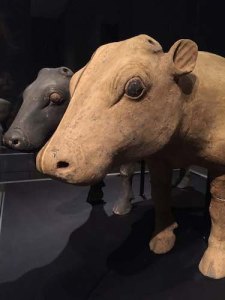
Terracotta cattle (206 B.C. – 9 A.D.) from the Yangling Mausoleum.

That holds true for the animals in the show, too. The Han dynasty had a thing for beautiful, spirited horses and the center gallery in the show displays some beauties. Grooms come along, too.

Apparently the conquering Han rulers kept menageries and ranches, as seen in the show’s room full of rhinos, elephants, cattle, pigs, and animals-turned-into-art-lamps. There’s a twinkle in each of their eyes, too.

Another highlight is the jade suit made for a princess, which was supposed to form added protection in the afterlife. Another is the money tree. Who wouldn’t want one of those?

The show’s objects reflect how many tribes and influences crossed paths over the course of the Han dynasty (think Silk Road) to create the modern view of a single, all-encompassing Chinese culture – diverse textiles, gems, inventions, and ideas.

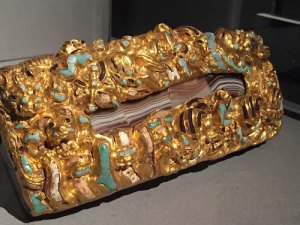
Han Dynasty belt buckle (206 B.C. – 220 A.D.) from Xinjiang Uyghur Autonomous Region Museum

The final object, a bronze mirror from the Han dynasty, reflects it all – the first recorded inscription expressing the desire for the peoples of the “Central Kingdom” (a.k.a. China) prospering for generations to come. It’s the earliest inscription to reference many ethnic groups considering themselves as one people, one China. 

Take a look at all the objects in the collection on the Met’s site, or look at our favorites on Flickr.

Browse through the catalog to see more spectacular stuff that Han dynasty emperors just had to have:


Behind the Scenes of the Revolution at NYHS

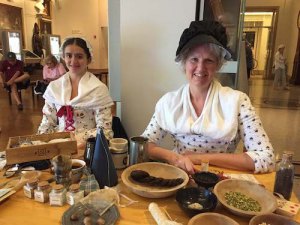
Women of the 3rd New Jersey Regiment, Continental Army, showing soldiers’ everyday life

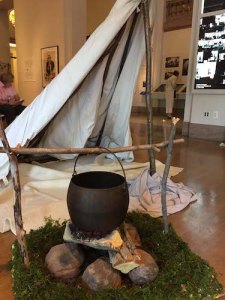
To celebrate the anniversary of the United States, the New York Historical Society hosted the reenactors of the 3rd New Jersey Regiment of the Continental Army for a little show-and-tell about the private lives of the people who enlisted in the Revolution. Dressed in colonial garb, the men and women of the Third showed what the enlisted men were given as rations, how they cooked it, and what they carried into battle – beans, hard tack, and (maybe) tobacco to barter.

A small tent and campfire cooking pot were set up just feet away from portraits of Revolutionary heroes and the remnants of the statue of King George III that the citizens of New York had torn down by their African-American slaves moments after the Declaration of Independence was read to Washington’s troops in lower Manhattan on July 9, 1776. All that remains here is half the horse’s tail.

A Revolutionary soldier’s home and kitchen during maneuvers

At a nearby table, men and women of the Third showed how the soldiers made their own bullets and cartidges, and the range of apparatus to keep the hand-made ammunition dry — leather pouches and tin boxes. As far as supplies, muskets, and gun powder went, you were on your own during the 1776 skirmishes.

See it all close up in our Flickr album.

Upstairs from demonstrations on the everyday life of troops, you can glimpse the everyday life of the more famous patriots through July 13 in the exhibition, Thomas Jefferson: The Private Man, from the Collections of the Massachusetts Historical Society.

The show includes his inventory of books, crops, slaves, and letters – personal papers that he willed to his granddaughter and her husband, who lived in Massachusetts and eventually gave them to the historical society there.

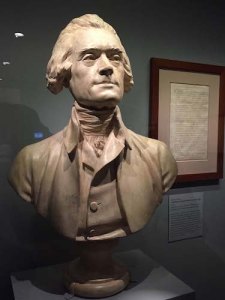
Houdon’s 1789 portrait bust of 46-year-old Jefferson next to his handwritten copy of the Declaration of Independence

The curators have displayed his architectural drawings of various iterations of Monticello, domed residences (never built) for friends, plans to improve the state capitol at Williamsburg (never built because the capitol was moved to Richmond), and an early plan for his summer residence at Poplar Forest (octagonal living room before he went all the way with a fully octagonal building with dramatic skylight).

Given the popularity of Hamilton, the gallery includes a copy of an 1801 letter to his granddaughter with an interesting postscript – a note telling her that Hamilton was doing everything in his power during the neck-and-neck presidential race between Jefferson and Burr to ensure Jefferson’s victory. We all know how that turned out from history and the plot arc of the show.

A nice touch of this small installation is the inclusion of Houdon’s famous 1789 portrait bust of 46-year-old Jefferson, which his granddaughter though made him look far too old. It’s a plaster copy of the marble original, and is positioned next to Jefferson’s own handwritten copy of the original, unedited Declaration of Independence (before the Continental Congress removed the part about slavery).

John Adams’ transcription of Jefferson’s original draft of the Declaration — how scholars know what the Congress cut out to get it passed

The paper next to it is an even bigger surprise – a hand-written copy of Tom’s original grievances by John Adams, who was on the Declaration committee with Jefferson and Franklin. Apparently, during the hot summer of 1776 while Jefferson was toiling away putting the finishing touches on his masterpiece, Adams wrote out his own copy with which he could lobby the various state representatives in the days leading up to the controversial ratification.

Understandably, this copy from the Adams Family Archive also makes its home at the Massachusetts Historical Society, and here in New York visitors get to see it side-by-side with the version written by the Declaration’s original author.