1890s Pleasure Island (Staten) Honored at MCNY

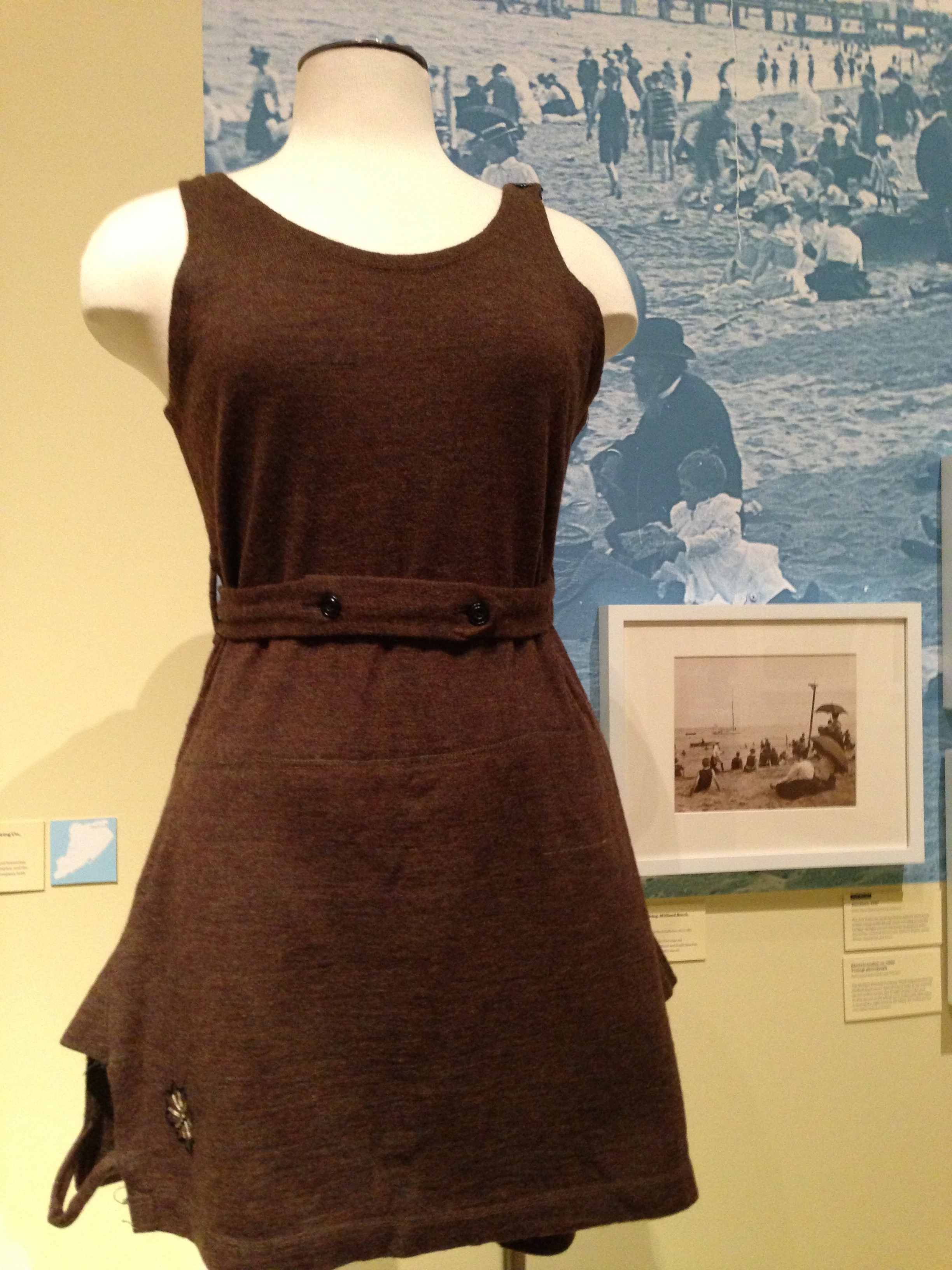
Installation view of woolen bathing suit (1905) and images of the 1890s Staten Island shore

Installation view of woolen bathing suit (1905) and images of the 1890s Staten Island shore

Over 100 years ago, the 59-mile square island rising up over New York harbor was the epitome of chic, cool sport – fantastic beaches, sunny farmland through which the well-heeled could enjoy an energetic fox hunt, and where one could witness the latest in tennis and cricket gear, to say nothing of the first tennis tournament in the United States.

It was all happening on Staten Island, playground to the upper, upper middle class, as chronicled in the Museum of the City of New York’s show, From Farm to City: Staten Island, 1661-2012. The shows covers the recent history of bridge-building and suburban development, but among the most fascinating parts of the show are those chronicling how our sometimes-forgotten borough gave the birth to modern sporting culture.

The Dutch bought it all from the Lenape in 1657, and SI thrived for centuries as the food supplier to Manhattan and the home of the overland stage service, operating between Philadelphia and Manhattan.

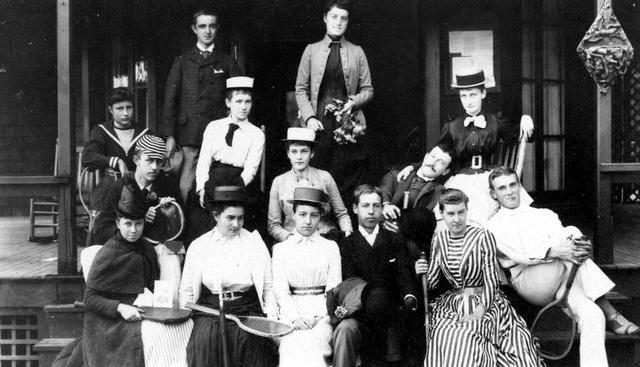
Alice Austen's photo of Tennis Clothing (1893). Source: Alice Austen House

Alice Austen’s photo of Tennis Clothing (1893). Source: Alice Austen House

But in the late 1870s, the Staten Island Cricket and Baseball Club became the epicenter of the lawn tennis craze (imported from England via Bermuda), and by the 1890s, the edge of the island had boardwalks and amusements to rival Coney Island.

Victorian sporting culture was well documented by Staten Island photography pioneer Alice Austen, whose photos have been enlarged to wall murals by the curators to convey the sense of fun, sun, and cachet in the exhibition. The historic home where she grew up has recently posted her work online, an incomparable look at everyday life here in the 1890s.

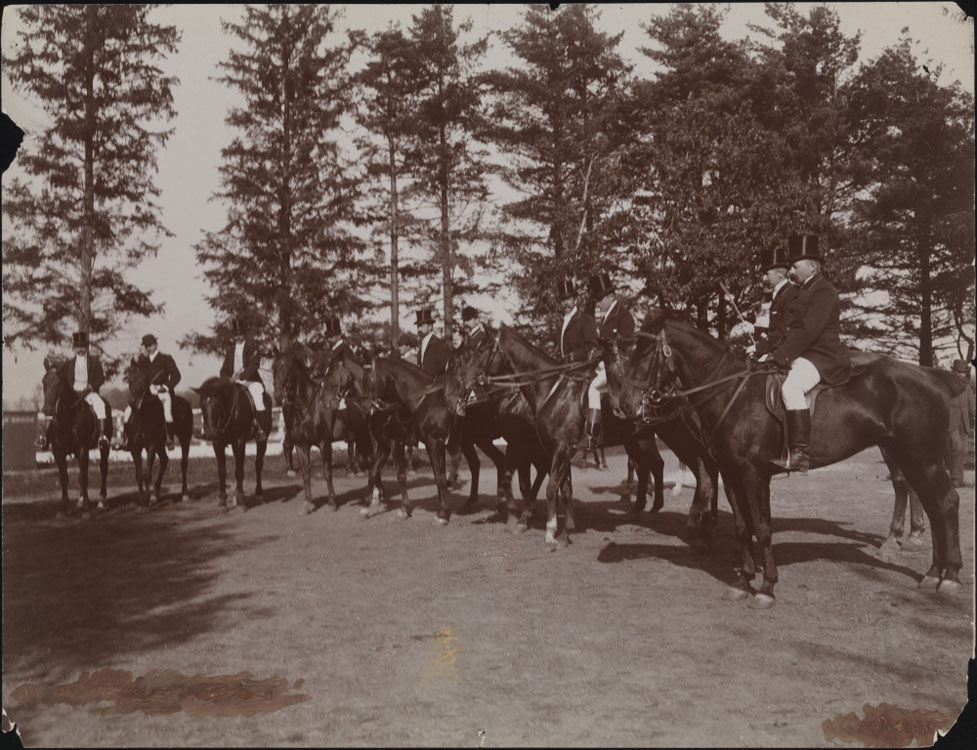
Richmond County Hunt Club in 1895. Source: MCNY

Richmond County Hunt Club in 1895. Source: MCNY

If you want to compare the past with today on Staten Island, MNCY has done a spectacular job of taking its historic maps and putting them into digital overlay of today’s world. Check out this great online resource to view the view in 1750 or 1829 compares to today. Click on the blue dots to see images of what used to be.

Extreme Renaissance Sportswear Back at The Met

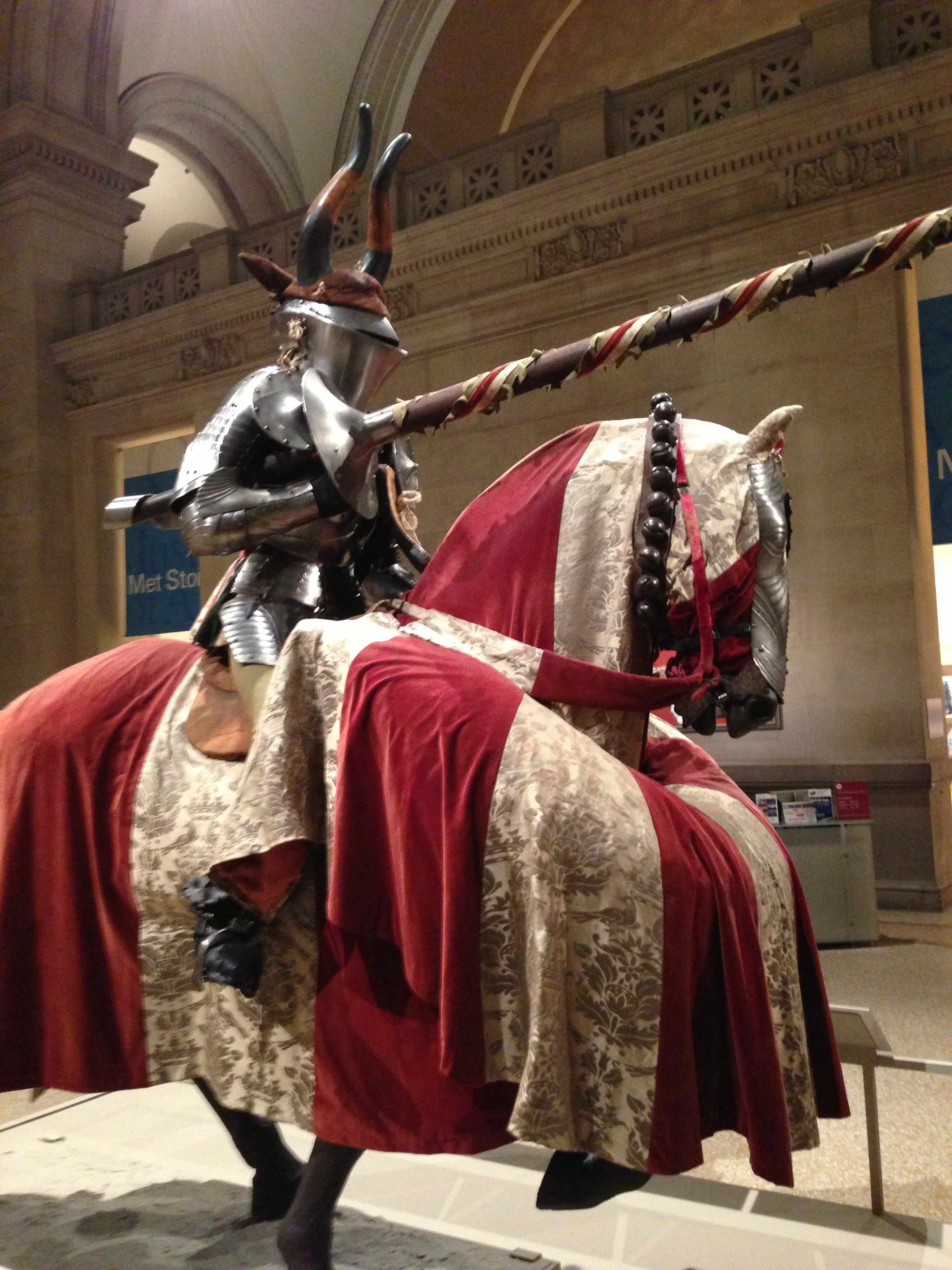
JoustAfter a brief Yuletide absence, the spectacular Armor for the Joust of Peace has been returned to the Great Hall of the Metropolitan Museum of Art, just inside the main entrance, to honor 100 years of the Arms and Armor Department.

Not seen in all its splendor since the 1980s, you’re looking at what extreme sports dressing looked like back in 1500. It all took place as the Renaissance was dawning across Europe, so this outfit was designed for safety and sport – not combat. The objective: unseat your opponent during a horseback charge across an open field with a blunt lance.

Jousts happened on open fields without barricades to separate the horses, so the horse’s head armor completely covered its eyes (yes, galloping blind). A straw-filled bumper hung around his chest for protection. This jouster’s wear was super-heavy (over 80 pounds for the body and 21 for the helmet), with the padded helmet physically bolted to the body armor to protect against whiplash when the inevitable impact occurred.

Solid covering over the horse's eye

Solid covering over the horse’s eye

The Met’s first curator of arms, Bashford Dean, found this German ensemble (even though some pieces were missing) and purchased it in 1904, setting the stage for many, many subsequent acquisitions (oh, about 14,000 more).  It lacked an original helmet, but when Dean saw the one on display (an 1891 recreation made by Parisian armorer superstar Daniel Tacheaux), Dean not only snapped it up, but hired Tacheaux to be the Met’s first armor conservator.

The shield and upper-thigh protectors are also restorations, and so is the horse’s brocade and velvet. But standing so close to this magnificent mount below the arches of the Great Hall, it’s easy to imagine you’re hearing the hoofbeats and roar of the sports crowd, and know that it’s not coming from the gift shop.Detail

Theatrical Staging Suits Dickens Characters at NYPL

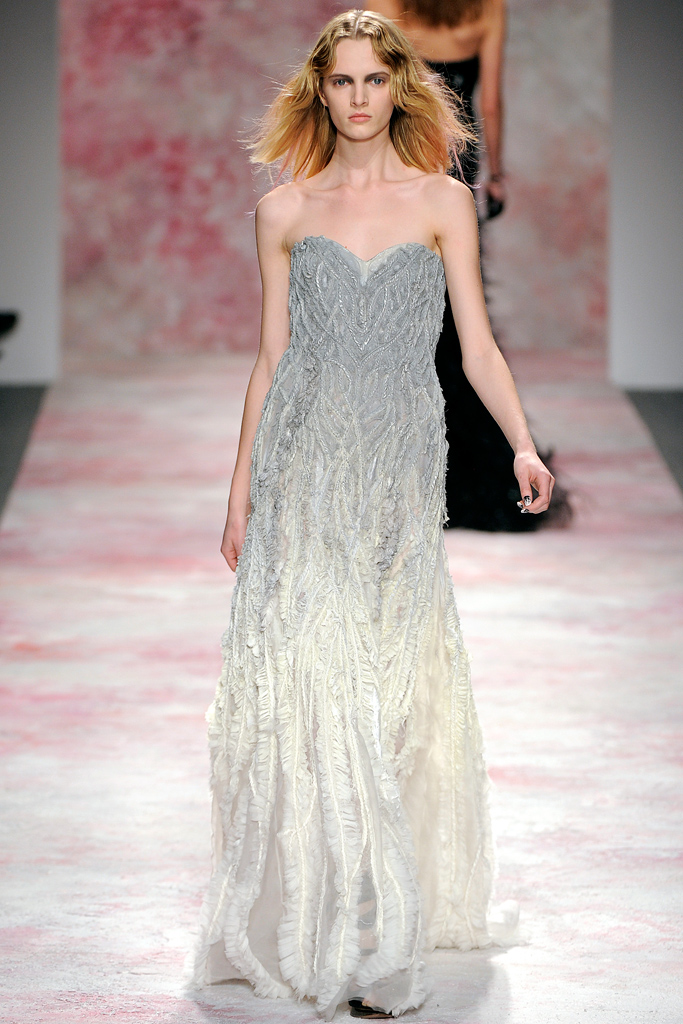
Daria Strokous walks the Fall 2011 runway in Prabal Gurung’s gown, part of a collection inspired by Miss Havisham. Photo: Caroloa Gualnari/GoRunway.com

Daria Strokous walks the Fall 2011 runway in Prabal Gurung’s gown, part of a collection inspired by Miss Havisham. Photo: Caroloa Gualnari/GoRunway.com

This runway model is surely not from a Dickens novel, but her dress was inspired by one of his characters. NYC designer Prabal Gurung, who first read Dickens in his native Nepal, used Great Expectation’s Miss Havisham as his inspiration for his Fall 2011 collection.

Lucky for us, the New York Public Library curators selected this evocative gown for inclusion in their 200th birthday tribute to the beloved author – NYPL’s exhibit Charles Dickens: The Key to Character.

Entering through the dramatic red-swagged doorway, you step back in time to a drawing room loaded with cabinets of curiosities, a crackling fire, a hanging birdcage, books, seashell collections, taxidermy, a zootrope, tiny Doulton porcelains, and Dickens-related treasures from NYPL and other collections, including the infamous cat-paw letter opener.

These worlds within worlds are arranged to shine a light on the over 3,592 characters created by Dickens in his lifetime. Above the fireplace is a reproduction photograph of his little nephew who inspired the character of Tiny Tim. Other ephemera posted near the case with the wooden leg show Warren’s Blacking Warehouse, where Dickens toiled away as a child laborer himself, many years before creating the characters of the Artful Dodger, Fagin, and Oliver Twist. A revealing letter demonstrates why his own father inspired him to create Micawber in David Copperfield.

Miss Havisham illustration by Charles Green (c. 1877) and installation view of the NYPL show

Miss Havisham illustration by Charles Green (c. 1877) and installation view of the NYPL show

See this beautifully designed show, which also delves into the author’s passion for theater and his own performances of particularly dramatic scenes. The décor, the Gurung gown, the 1870 edition of The Mystery of Edwin Drood, the 1867 ticket stubs from the Dickens reading tour, early films of his novels that you watch through peepholes, and photos from recent Broadway productions will have you sliding seamlessly back and forth through the last 200 years to meet truly remarkable characters.

Celebrity Lace at the Met

EuropeanLace_posterIt was all the rage 100 years ago – who could amass the best collection of antique lace owned by the rich and powerful, and what could you do with it to make a fashion statement?

The Met still has its Gems of European Lace micro-exhibit on display in a lower-level nook for a few more days, right outside of the Ratti Textile Center. (It’s down the stairs on the left side of the tiled medieval Gallery 304 on the first floor.)

The show blends astonishing craftsmanship with an object lesson in conspicuous consumption of the rich and famous of a century ago. It seems that in the late 1800s, wealthy American women tried to outdo one another with lace collections, vying for little masterpieces that might have been owned by European royalty.

Adolf de Meyer’s photo of Rita de Acosta Lydig in Harper’s Bazaar in 1917 (Source: The Met; gift of Mercedes de Acosta)

Adolf de Meyer’s photo of Rita de Acosta Lydig in Harper’s Bazaar in 1917 (Source: The Met; gift of Mercedes de Acosta)

One gem is the bobbin-made lace cravat end (featured above), allegedly commissioned by Austrian empress Maria Therese and later given to her daughter, Marie Antoinette. The Met cites this provenance, but will only say that it’s “maybe” true.

In the race by society ladies to amass the best lace collections, international lace-dealers made out like bandits. The frenzy only benefits us today, since so many patrons ultimately bequeathed their collections to the Metropolitan and the Brooklyn Museum.

By the early 20th century, the super-wealthy were also acquiring antique lace and asking for it to be refashioned into stylish haute couture. The example on display in Gems is a Callot Soers original made of 16th-century-style lace for the style icon Rita de Acosta Lydig, known for her celebrity-filled New York salons; lace-covered accessories and bedecked couture; and having her portraits done by Rodin, Sargent, and anyone who was anyone at the turn of the century.

Rita's 16th c. style lace remade by Callot Soers in the 1920s (Brooklyn Collection at the Met)

Rita’s 16th c. style lace remade by Callot Soers in the 1920s (Brooklyn Collection at the Met)

Check out the Met site for close-ups of masterworks of needle and bobbin.


Crisp Hepburn Clothing Tribute at Lincoln Center

There’s no surprise that the wardrobe on display in the Katherine Hepburn: Dressed for Stage and Screen exhibition is sharp, clean, and perfectly turned out. Finishing its run at NYPL at Lincoln Center this month, the Library has imported this stunning tribute developed by Kent State University. Check out this promo produced by WNET Channel 13:

The first clothes you encounter are a collection of her famous trousers and jodphurs, but tucked away in the corner to the right of the entrance is an item that underscores the purpose of this tribute – the Ernest Trova statuette that she received in 1985 from the Council of Fashion Designers of America for Lifetime Achievement (and inspiration).

Photo from NYPL’s Billy Rose Collection. This dress is in the show.

Photo from NYPL’s Billy Rose Collection, but the dress is in the show.

A fashion icon for the 20th Century, the show highlights her collaborations with the best designers throughout her life. The first gallery features her stage clothes – Valentina’s creations for the Broadway production of The Philadelphia Story, which look like they were made yesterday, and the Chanel outfits that she commissioned for her performances in Coco. Apparently she did not think that Cecil Beaton’s vision could compare to the real thing, so she wore genuine Chanel in the play. Beaton did get Hepburn to wear some of his creations, and you’ll see a gorgeous black gown there, too.

It was the same story for films. Edith Head said, ““One does not design for Miss Hepburn, one designs with her.” Hepburn bought hats directly from Hattie Carnegie for Alice Adams.  Margaret Furse, who loved working with the perfectionist Hepburn, said that she was glad to “share credit” for the contemporary designs in A Delicate Balance. You’ll see her solution – to simply let Bergdorf Goodman make the leopard-print caftan and other stuff.

Almost everything for Hepburn later in life had high necklines and longish sleeves. Still, the stunner is the revealing form-fitting black gown she wore in Adam’s Rib (1949) by Walter Plunkett, the designer who also did Gone With The Wind. (It’s the one in the video promo.)

Her theatrical make-up kit is also on display in the back room. Who else? Max Factor.

Ivy Style or Gangnam Style?

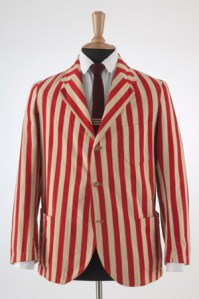
Red and white cotton flannel blazer, c.1928. Museum at FIT purchase.

Red and white cotton flannel blazer, c.1928. Museum at FIT purchase.

It’s hard to remember a time without Gangnam Style, but it’s even harder to remember before there was Ivy (as in Preppie) Style. There’s just a few more days to trek to The Museum at FIT for its revealing show on the roots of American menswear, Ivy Style.

Sure, the show is peppered with references and examples of the current Kings of Prep –Lauren, Hilfiger, and (prep with a twist) Thom Browne. But the real eye-opener here is the manner in which the curators journey back in time to show you how something so familiar today was once so radical – how “Ivy” got its name in 1876, how students set the sportswear trends before WWI, and the debut of the now-forgotten (but influential) “beer suits” at Princeton in 1912.

It’s also startling to learn that Brooks Brothers industrialized wardrobes as far back as 1818, and that J. Press “owned” the market for natural-shoulder jackets for pretty much the entire 20th Century.

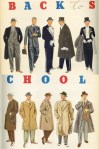
1937 illustration of college men’s fashions from FIT Library and Archives.

1937 illustration of college men’s fashions from FIT Library and Archives.

Thankfully, FIT has packed enormous amounts of menswear history on its special exhibition web site, so work your way through it and mine it for your own favorite tidbits (e.g. origins of saddle shoes, polo coats, and blazers).

Favorite factoid: In 1931, the average college student spent 51% more on clothes than the average man-on-the-street – a college trend that kept going right through the Great Depression. So, maybe it’s like Gangnam Style, after all? Psy sports it too, you know.

If you can’t get to the show in the next few days, take the virtual walkthrough with the Richard Press, the former President of J. Press, who interprets the who, what, why, and when of menswear history (including the roots of the most memorable scene in Animal House). Don’t ask, just watch:

Do-It-Yourself Fashion Alphabet

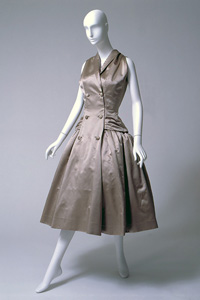
Christian Dior, dress in satin, 1954, France, gift of Sally Cary Iselin.

You’ve probably been too busy looking for electrical outlets below 34th Street to have noticed that today is the last day of the exhibition Fashion, A-Z: Highlights from the Collection of the Museum at FIT, Part Two.

Don’t worry, because as your power (and Internet) comes back on, you can get your fashion fix via FIT’s new digital archive that lets you surf by alphabet to see all the famous designers and dresses that are in the collection. Search by designer or brand, they’re all there.

The gallery show has the outfits arranged A (for Adrian with a MoMA-inspired creation) to Z (Zoran) in its upstairs gallery. The curators often placed two designer ensembles side-by-side, emphasizing the original designer (for example, Dior) and the younger designer who took over creative duties for the house over time (for example, YSL for Dior).

It’s a treat to see side-by-side examples of new and old Hermes (featuring Gaultier vs. the Kelly bag), Valentino, Balmain, Kenzo, YSL, Dior, and Comme des Garcon creatives.

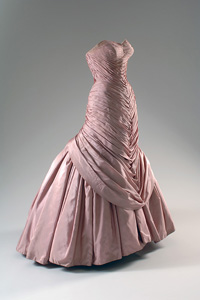
Charles James, evening dress in silk taffeta and net, 1955, USA, gift of Robert Wells In Memory of Lisa Kirk.

Is Charles James still the reigning world champion? Take a trip to Seventh Avenue today or start surfing fashion history to make your own determination.

Coe Multimedia Accessory Collection at The Met

Detail of Possible bag (1900) from the Coe Collection at The Met

McQueen and the Paris runways have nothing over the 18th and 19th-century Native Americans who knew how to mix unusual materials and meanings into symbolic, functional, innovative, and salable accessories. A collector with an eye for the interesting is honored in the Met’s Michael C. Rockefeller wing in the micro-show, The Coe Collection of American Indian Art.

Ted Coe of Santa Fe was inspired to collect both ancient and contemporary works by Native Americans that caught his attention, amassing thousands of pieces that he bequeathed to the Met. He mounted a truly innovative show at AMNH in 1986, which linked old and new traditions in Native American art making, Lost and Found Traditions: Native American Art 1965-1985. The Met’s curators decided to honor his work by selecting forty objects.

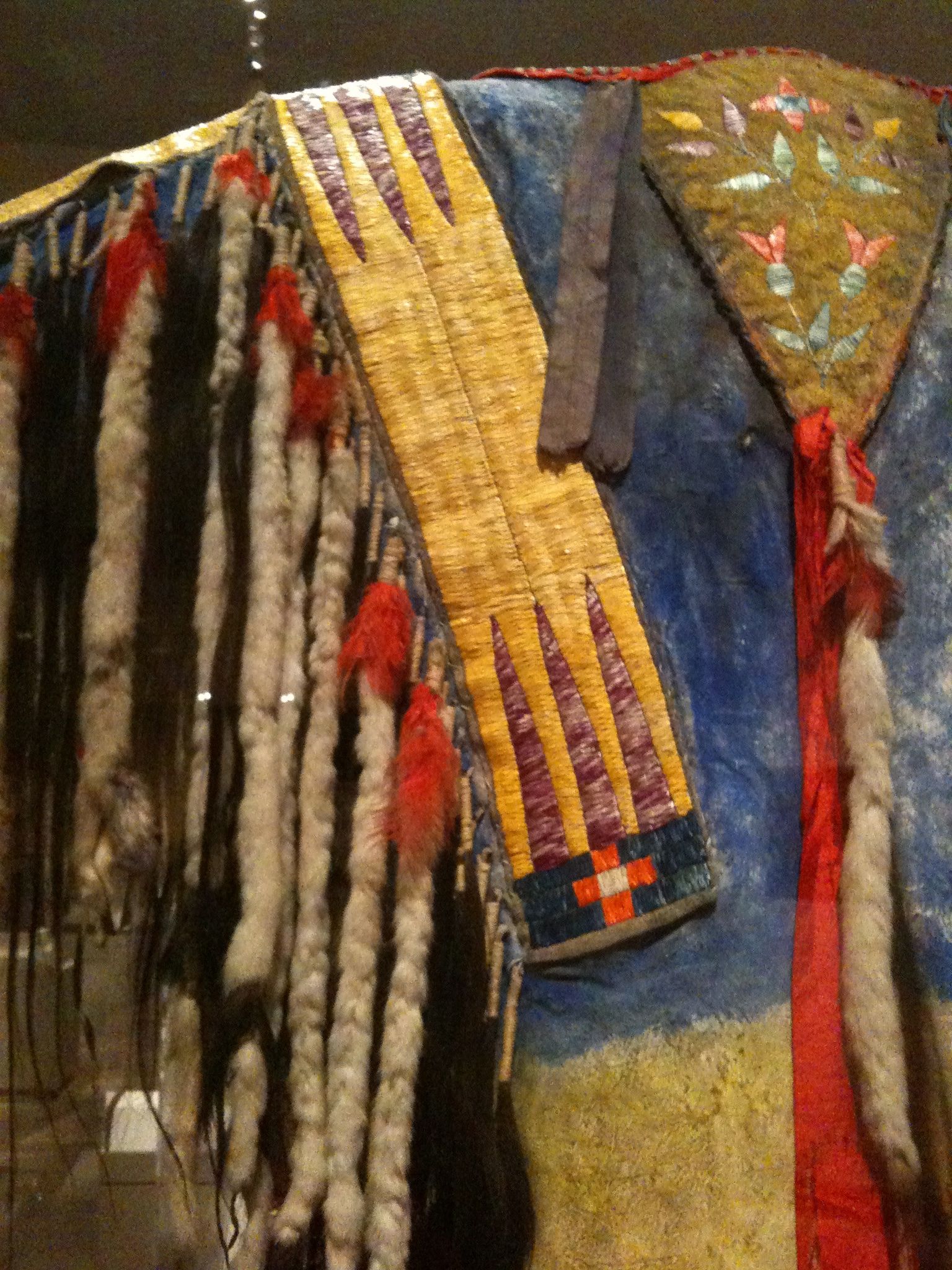
Detail of Arikara Leadership shirt (1860) from Coe collection at The Met

The show isn’t all about wearable art, but we decided to focus on a few details that you might find of interest. We’ve organized the Flickr feed to document some of the oldest to the newest creations on display, ranging from mid-Mississippian carved stone tools from 4,000 B.C. to the cheeky dough bowl (1994) made by Chochiti potter Diego Ramirez.

In between, you’ll see an array of sophisticated and rough creations made by artists from the 1700s to early 1900s for Native American leaders, nomads, and tourists – all designed, embellished, and crafted in a variety of materials. Who knew that nuns taught Canadian tribal artists to embroider with moose hair? Enjoy the details.

Afghanistan in MoMA’s Atrium

Afghanistan is in the house as part of MoMA’s tribute to Italy’s art povera superstar in their soon-to-close exhibition Alighiero Boetti: Game Plan. Although Boetti’s retrospective takes up room on MoMA’s other floors, it’s the Afghanistan-made kilims and other art works that really serve as the focal point of the visitor experience. Check out the photos.

Get there to see the series of embroideries on tissue and the grid-within-grid rugs with patterns designed by art students and woven by Afghan artisans. Up until the Soviet invasion in 1979, Boetti worked with artists there to carry out intricate woven collaborations – including over 150 maps of the world. Boetti traced the maps on canvas and let the weavers add whatever text they wanted and pick all the colors. A few are on display here, and you can hear a pretty amazing description about the logistics of Boetti’s collaborations from MoMA curators in a short audio.

Installation view of Alighiero Boetti map (1979), embroidered by Afghani craftswomen

You’ll enjoy the densely packed embroidery Everything, and the amazing tapestry of the thousand longest rivers in of the world (1976-1982). It took Botetti and his wife years to classify all of the rivers, and if you’ve ever seen this on display before at MoMA (it’s in their collection), it’s an amazing textile that never fails to draw a crowd.  You’ve got to see it in person.

Check out MoMA’s interactive site for the exhibition, but run over to examine all the Afghani creations up close. Enjoy the trip.

What’s Up with Those Dots, Yayoi?

You’ve seen them everywhere over town…the enigmatic dotted signs with the face of Yayoi Kusama peering out. During Fashion’s Night Out, the Vuitton store was ablaze in polka dots, all a tribute to this reclusive Japanese pop-art sensation who burst upon the Manhattan art scene in the 1960s.

This is the last weekend to see her retrospective in person at The Whitney, but if you can’t make it, enjoy the Vuitton collection that she inspired (they’ve created a whole website).

Take a peek into the show.

And click on this link to see a documentary clip about this Kusama’s life. Be surprised and find out how to merge into infinity!