Monumental Impression of Fashion at the Met

Monet’s
Women in the Garden (1866) from the
Musée d'Orsay, Paris features impressions of fast-changing dappled sunlight and ladies’ fashions (e.g. the fad for soutache)

Monet’s
Women in the Garden (1866) from the
Musée d’Orsay, Paris featuring impressions of fast-changing dappled sunlight and ladies’ fashions (e.g. the fad for soutache)

You can witness the collisions of the new crashing into the old in the Metropolitan Museum’s joyous show, Impressionism, Fashion, and Modernity. Impressionism’s heaviest hitters (Manet, Monet, Renoir, Cassatt, and Morisot) are displayed alongside stunning 19th Century dresses, suits, accessories, and underthings to prove a point — that incorporating the latest fashions was one of the cudgels that these rule-breakers used to facilitate their revolution in painting.

The show features paintings from three grand Impressionist collections (the Met, the Art Institute of Chicago, and the Musée d’Orsay), and includes breathtaking dresses from NYC’s fashion-collection superpowers – the Met, the Brooklyn Museum, FIT, and Museum of the City of New York.

The Met’s website explains the key themes of the show, but it’s no substitute for going through the galleries in person. Why? The tiny photos cannot do justice to the monumentality of these paintings, where scandalous 19th-century fashionistas stormed the barricades of the French Salon, in large-format framed paintings normally reserved for staid, moralistic history paintings.

Summer day dress worn by Madame Bartholomé in her husband’s painting In the Conservatory 
(1880) 
Source:
Musée d'Orsay

Crisp summer day dress worn by Madame Bartholomé in her husband’s 1880 painting In the Conservatory. Source:
Musée d’Orsay

The size, colors, and techniques are amazing, especially as the Impressionists moved outdoors just as new technology was encouraging lifestyle and fashion revolution. Steam-powered train lines were inventing the concept of the weekend getaway for City hipsters, so a lot of the paintings feature dappled sunlight with high-fashion young people lolling about in nature. (See the show’s highlights.)

The show’s curators shine the spotlight on how fashion, innovation, and the art world influenced one another: New aniline dyes allowed hot pink, bold color-blocking and vivid hues for extravagant skirts and dressing gowns. New fabric-finishing technology enabled super-white cotton fabric to be crafted into diaphanous, desirable, but high-maintenance dresses and gowns for the first time in fashion history.

The Met scatters mass media throughout the galleries, just to demonstrate fashion’s democratization during 1850-1890. New printing technology enabled trendy fashion magazines to be consumed by the masses. New-fangled duplication techniques revolutionized the studio photograph by inventing the eight-image carte-de-visite – a paper-based way to market your “celebrity” self and show off your fashion chops long 150 years before Facebook and YouTube.

Silk and ivory French parasol (1860-69) from Brooklyn Museum Costume Collection at The Met (Source: gift of Mrs. William Ashbaugh)

Silk and ivory French parasol (1860-69) from Brooklyn Museum Costume Collection at The Met (Source: gift of Mrs. William Ashbaugh)

Pop-art pink velvet, boleros with pompoms, lace parasols, Worth gowns, kid gloves, top hats, corsets, hat shop girls, high-end boutiques, and Cezanne’s surprising oil painting based on a fashion-magazine layout. Which part of this show is the best?

Go before May 29, when the show decamps for Chicago for its June 26 opening.

Interior Design Goes Medieval Avant-Garde at National Gallery

An avant-garde 1890s tapestry by Morris & Co., Edward Burne-Jones, William Morris, and John Henry Dearle (designers), The Arming and Departure of the Knights of the Round Table on the Quest for the Holy Grail. Collection of Jimmy Page, courtesy of Paul Reeves, London

An avant-garde 1890s tapestry by Morris & Co., Edward Burne-Jones, William Morris, and John Henry Dearle (designers), The Arming and Departure of the Knights of the Round Table on the Quest for the Holy Grail. Collection of Jimmy Page, courtesy of Paul Reeves, London

How did a secret society of artists in the 19th century turn into one of the most beloved interior design trends of the modern era? That story is the most surprising part of the exhibition (closing May 19) at Washington’s National Gallery of Art, Pre-Raphaelites: Victorian Art and Design, 1848–1900.

Organized by the Tate (and originally titled Pre-Raphaelites: Victorian Avant-Garde), the show introduces us to the PR Brotherhood (founded 1848), whose oil paintings and writings looked to the Middle Ages, myths, and legends of ancient literature for the spirituality that they felt was missing from modern, rapidly industrializing life.

Early collaboration by Rossetti and Morris, The Arming of a Knight chair, 1856 – 1857, painted pine, leather, and nails. Source: Delaware Art Museum, Wilmington.

Early collaboration by Rossetti and Morris, The Arming of a Knight chair, 1856 – 1857, painted pine, leather, and nails from the Delaware Art Museum,.

Dante Rosetti, William Holman Hunt, Edward Burne-Jones, William Morris, and others took inspiration from meticulous observation of nature, sensual textiles replicated in their paintings, and ethereal muses in medieval robes, which they often painted on location in leafy, natural settings.

In 1859, Rosetti painted a cupboard as a wedding gift for Morris. It wasn’t long before these pals ran with the inspiration — constructing medieval-inspired furniture and decorating it with similar mystical medieval images and experimenting with mixed media (images + poetry) on tiles, tables, and other creations made by hand.

For all the beautiful painting in the National Gallery’s show, the most startling room is the one that showcases the fact that the painters took it one step further by creating chairs, tapestries, tables, and textiles for forward-looking couples who wanted to live the 360-degree experience. In the 1860s, Morris & Co. was the go-to interior design shop for medieval-style avant-garde furnishings. They singlehandedly drove the stained-glass revival in Victorian architecture.

In 1873, Morris & Co. went international, selling wallpaper in Boston. Soon, American retailers in most major cities were carrying the hand-blocked or woven wall coverings and textiles.

Block-printed cotton designed by Morris (printed 1884-1917) from The Baltimore Museum of Art

Block-printed cotton designed by Morris (printed 1884-1917) from The Baltimore Museum of Art

Ever the advocate of the handmade, Morris was passionate about the relationship of decorative arts to the modernist movement. During Oscar Wilde’s US speaking tour in 1882, his lectures about Morris, the Pre-Raphaelites, and the nobility of hand-crafted work spread the trend in hand-crafted interior design in America.

Today, just about every museum shop carries William Morris-inspired something-or-others. Here’s the Tate’s video about the 17th century carved oak bed that Morris himself used in the 1890s. It’s all about the hand-made approach to the bedding textiles – a modern-medieval collaboration between his designer daughter, Mary, and wife, Jane.

Hats off to the Tate and National Gallery for presenting avant-garde design in a new light. Check out the rest of the Tate’s PR videos, including the one with Karen Elson on the topic of model as muse, then and now.

FIT’s Fashion Tech Timeline

Black velvet evening dress by Charles James (c. 1955) with a zipper inserted along that diagonal seam

Black velvet evening dress by Charles James (c. 1955) with a 3-ft. zipper inserted along that diagonal seam

Once you see the clothes in FIT’s Fashion and Technology exhibition inside a technology context, you’ll start making the connections at other shows all over town.

Exhibit A right inside the entrance – a seamless nylon-powder dress and bag made from CAD software and a 3D printer by Freedom of Choice in 2005 is a mesh wonder that is made by the same process as Amanda Levete’s woven Fruit Bowl in MoMA’s current Applied Design show.

Take the brilliant purple British day dress that FIT displays as an example of the revolution in color that occurred in the 1860s as analine dyes began to be used for the first time in commercial cloth manufacture. The Metropolitan Museum showcases the same point (except surrounded by Manet and Monet masterpieces) in its blockbuster time-series Impressionism, Fashion and Modernity. (Reference Camille.)

The 1860s color revolution due to analine dyes in commercial fabrics

The 1860s color revolution due to analine dyes in commercial fabrics

Outstanding achievement award invention + application at the FIT show: invention of the zipper in 1913 and the stunning accomplishment of Charles James, who inserted a three-foot-long zipper into a spectacular gown in a hidden seam on the bias (see left).

In Fashion and Technology, FIT makes brilliant use of its own stellar collection to chronicle the changes in technology that revolutionized fashion, from the advent of the Spinning Jenny in 1764 to the world’s first programmable T-shirt (see below).

For fans of the 18th and 19th centuries, here’s what technology mattered:

1764 – cotton replaces wool and linen as the go-to fabric (thanks, Spinning Jenny)

1780s – machine-knit textiles (200 years before double-knits)

1801 – Jacquard looms create complex patterns by using punch cards (up to 10,000, so take that Univac!)

1846 – sewing machines eliminate tedious hand stitching for the interiors of gowns

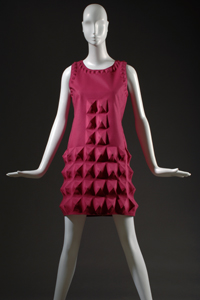
Pierre Cardin, dress, fuchsia “Cardine” textile with molded 3D shapes, 1968, Gift of Lauren Bacall.

Pierre Cardin, dress, fuchsia “Cardine” textile with molded 3D shapes, 1968, Gift of Lauren Bacall.

1856 – analine dyes bring about a color revolution to ladies’ fashions (go, hot pink!)

1857 – chain-stitch sewing machine

1860s – more color complexity with roller-printed fabrics

1880s – collapsible bustles let ladies sit down

1882 – celluloid used to imitate ivory and tortoiseshell for accessories

Check out the excellent exhibition timeline interactive to see these breakthroughs and what happened in the 20th and 21st centuries.

As promised, here’s the video of the world’s first programmable T-shirt:

Dance into Spring to Mr. Burrows’s Color-Block Beat at MCNY

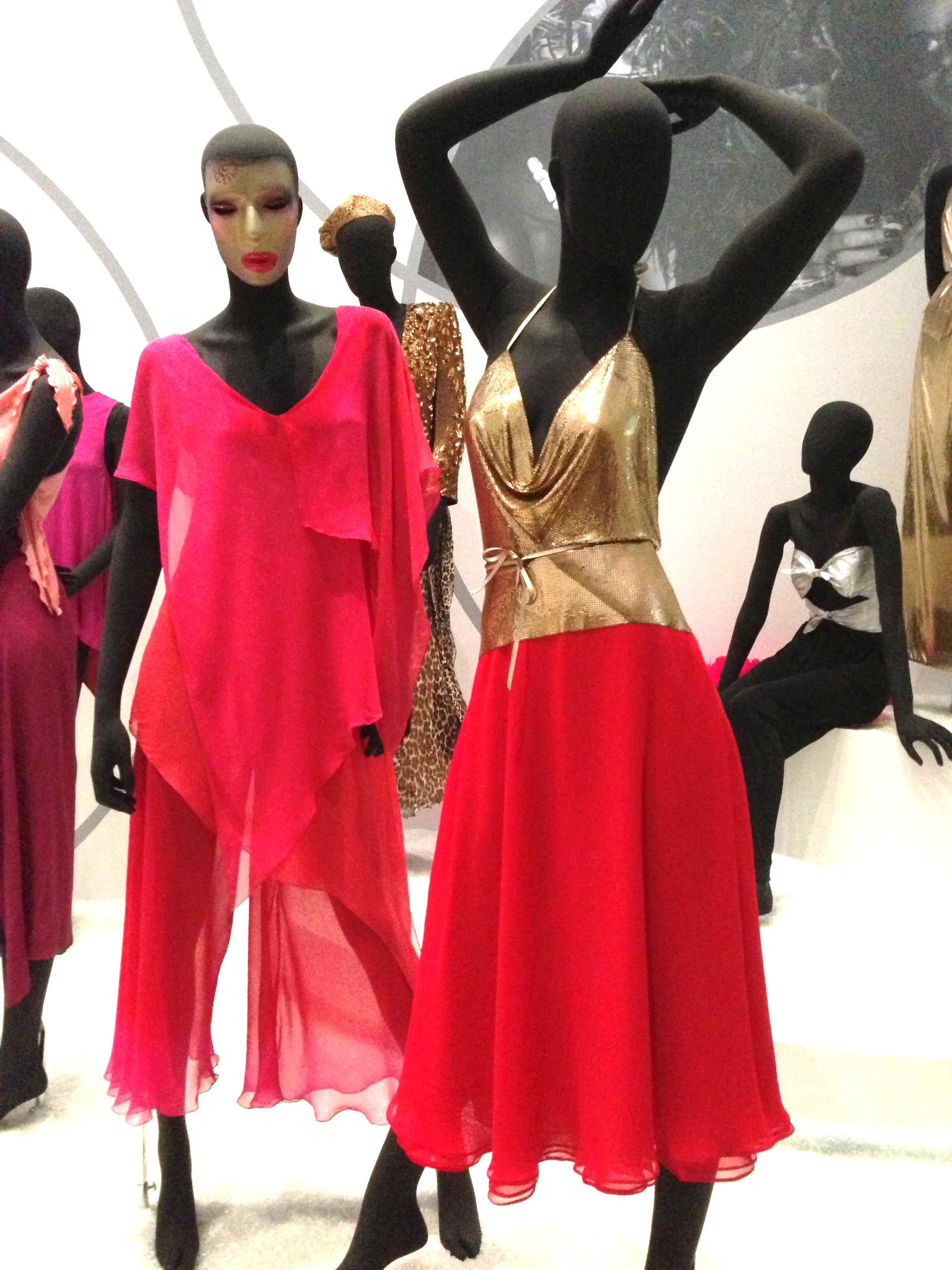
Studio 54 dance wear by Stephen Burrows.

Studio 54 dance wear by Stephen Burrows.

To experience an all-out burst of color, walk through the doors of the Museum of the City of New York and visit the paparazzi-worthy tribute to a 1970s design legend, Stephen Burrows: When Fashion Danced. You’ll get to know the man who styled Liza, Cher, Diana, Farrah, and so many icons of the 1970s with bright, beautiful, glamorous draped designs were made to whirl around the dance floor.

Vogue issues throughout the 1970s were filled with cavorting models sporting color-blocked coats, dresses, sweaters, and evening wear and lettuce-edged jersey wrap tops, cocktail dresses, and pant suits by King of Qiana, Stephen Burrows. When he burst upon the scene in the late Sixties, Geraldine Stutz installed him in her ground-breaking “street of shops” that she created at Henri Beldel, when it was still on 57th Street. If you don’t know Stephen’s work, a stroll through the first floor of MCNY will set you straight about who actually created the draped metallic disco top emblematic of Studio 54.

It’s the first retrospective dedicated to this stylish creative powerhouse, with ensembles drawn from the Burrows archive, FIT, the Metropolitan, and MCNY’s own treasure trove, and you’ll have until July 8 to see it.

Stephen gave us the draped metallic disco top and so much more.

Stephen gave us the draped metallic disco top and so much more.

The opening night party drew fashion royalty, and when we visited, Michael Kors was levitating with excitement, seeing the work that inspired so many to drape, piece, and glamorize with eye-popping colors. Check out the looks on the Flickr feed.

Don’t miss the major piece of fashion history hiding in one corner of the show: At a time when American fashion was viewed by Europeans as second rate, Burrows and Blass, Calvin, Oscar, and Halston were invited to follow the French at the still-talked-about 1973 benefit fashion show at Versailles. You’ll witness how Stephen and the NYC crew battled it out on the stage against YSL, Cardin, Ungaro, Givenchy, and Dior.

Spoiler alert: Stephen and his American crew won.  Historic is an understatement.

FIT Grad Students Give Everyone the Boot

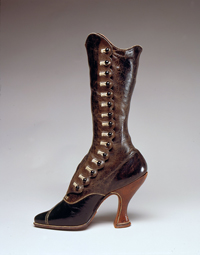
Curvy, red-lined leather “it” boot of 1900 by Jack Jacobus Ltd. Austrian fashion, gift of the V&A.

Curvy, red-lined leather “it” boot of 1900 by Jack Jacobus Ltd. Austrian fashion, gift of the V&A.

As part of FIT’s program in Fashion and Textiles Studies, the grad students have mounted a gem of a show about fashionable footwear  — Boots: The Height of Fashion, running just a few days more.

The museum’s side gallery tells an interesting story about how boots went from practical to glam, and from guy wear to girl fashion, beginning with some thought-provoking high-buttoned “look at me” boots from 1900, following on to the boot-clad flappers, and taking us straight through boot history to the heyday of the Warhol factory.

The students have rummaged through the FIT collection to show us their picks to demonstrate “boots as a second skin” (David Evins, Charles Jourdan, and silk Louboutins), the rebel look, fashion-tribe style, and over-the-top luxury.

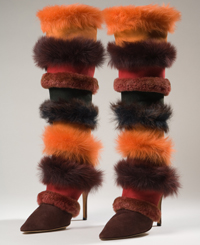
Fantasy-meets-luxury suede and shearling creation by Manolo Blanik (1997, UK). Gift of Ruffo.

Fantasy-meets-luxury suede and shearling creation by Manolo Blanik (1997, UK). Gift of Ruffo.

Among our favorites are the 1922 Ball Brand flapper galoshes and everything from the collection of Warhol superstar Baby Jane Holzer – 1963 Davide Beatle boots, 1969 Guccis, and 1971 embroidered boots from The Chelsea Cobbler.

The students also gave us a behind-the-scenes look with two cases about boot conservation. One case features pairs of boots (baby boots and high-buttoned shoes) with one shoe “conserved” and the other in its deteriorating state. The second case shows how the museum is preserving those famous “second skin” David Evins polyurethane leggings from 1960s, which sadly have broken down due to the atmosphere and light.

Although the following video is not associated with the show, it certainly shows that form-fitting high-style boots did not originate with Mr. Evins. Enjoy:

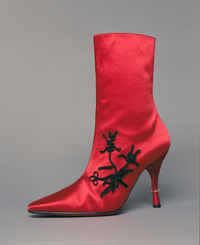
Second-skin Louboutin satin boots (1994-95 Fall collection)

Second-skin Louboutin satin boots (1994-95 Fall collection)

Easter Parade with Horses at Grand Central

GCT security keeping an eye on the red horse

GCT security keeping an eye on the red horse

The colors, crowds, finery, and promenade in Grand Central is every bit as celebratory as the famed Easter Parade on Fifth Avenue, except there’s live music and horses. It’s all part of Nick Cave’s monumental performance Heard NY going on each day at 11am and 2pm in Vanderbilt Hall.

Get there early and take your cameras to see The Ailey School students don the two-person horse costumes, created out of raffia, to whoosh and swirl away to the drums and harp. Take a look at the Flickr photos of yesterday’s 11am performance.

Creative Time and MTA Arts for Transit have decided to use both sections of Vanderbilt Hall for simultaneous performances, so you have lots of options to see the 30 magnificent horses close up. Afterward, you’ll see the volunteers grooming the horses, so there’s lots of opportunity to check out the loving detail that Cave has given each of them.

Half of the 30-horse herd

Half of the 30-horse herd

The raffia flies, the dancers whirl, and it’s breathtaking to see the horses come alive before your eyes and cavort about with their distinct personalities. Even if you go to the Easter Parade at St. Patrick’s on Sunday, you’ll still have time to catch their final 2pm performance.  If you want to see another example of Nick’s work, check out our post on The Armory Show a few weeks ago. For now, enjoy this wonderful promo:

Met Uses Dress to Deconstruct Matisse’s Creative Process

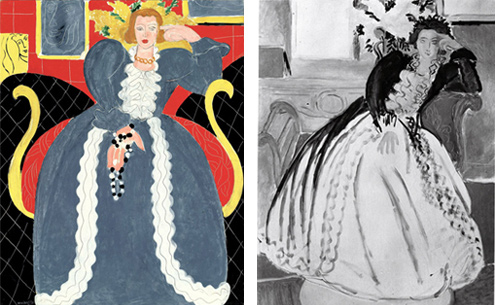
Finished product and earlier stage of Matisse’s The Large Blue Dress (1937). Source: Philadelphia Museum of Art. © 2012 Succession H. Matisse / Artists Rights Society (ARS), New York

Finished product and earlier stage of Matisse’s The Large Blue Dress (1937). Source: Philadelphia Museum of Art. © 2012 Succession H. Matisse / Artists Rights Society (ARS), New York

After walking through gallery after gallery of spectacular Matisse works, it’s a little shocking to turn enter Gallery 6 and see the actual skirt that his model wore to inspire one of his most loved works. Maybe it’s not so shocking, considering how much he loved textiles.

This surprise is just one part of a fascinating eight-gallery blockbuster that deconstructs the master’s creative process – the Metropolitan Museum of Art’s show Matisse: In Search of True Painting.

The show features nearly 50 works from Matisse’s career, chosen especially to reveal his thoughts behind selecting the colors, shapes, and patterns that we know so well. They’ve brought together versions of the same work and hung them next to one another. The Met’s website has views of each gallery.

The Gallery 2 view shows how the Met has displayed some of Matisse’s 1906 experiments. Check out this video narrated by curator Rebecca Rabinow:

Since Matisse liked to have visual reference points, by the 1930s he began more formal documentation of the various stages of each work. His famous Large Blue Dress painting (1937), lent by the Philadelphia Museum of Art, not only features photos of the painting’s stages but the actual blue dress made and worn by the model, Lydia Delectorskaya. Let the curator tell you more about it:

Take a look at some of the selected highlights of the show on the web, but get over to see it all in person to experience fully the power of Matisse’s color and light in a unique, exceptional, and illuminating context.

Sarongs in Winter

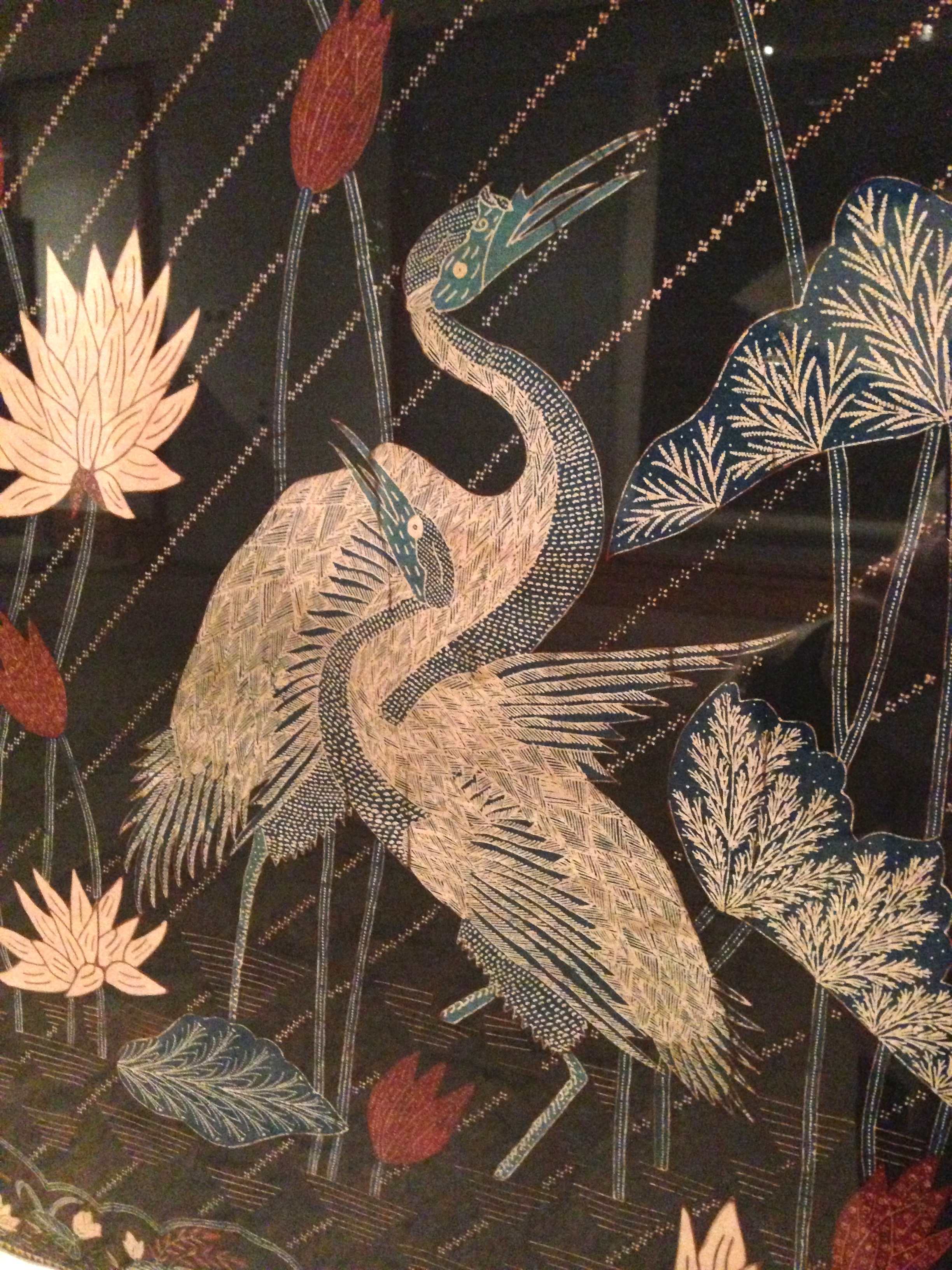
Installation view of woman’s cotton sarong incorporating Chinese-style cranes, probably from the workshop of Mrs. Wilemse (1890-1910). Central Java, Indonesia

Installation view of woman’s cotton sarong incorporating Chinese-style cranes, probably from the workshop of Mrs. Wilemse (1890-1910). Central Java, Indonesia

It’s the smallest show right now at The Met. It doesn’t even have its own web site. If you’re on the way to see Matisse on the First Floor, pause to take a close-up look at some marvels of the textile collection and imagine you’re on the faraway Indonesian island of Java in the micro-show, Resistance and Splendor in Javanese Textiles.

The curators have framed a collection of textile masterworks from that exotic corner of the world, mostly sarongs. If you read the label copy, the series of textiles embellished in the resist-dye technique evoke quite a bit of the recent history of Indonesia.

Everyone knows batik, but you may not know that it was cultivated as an export by the Dutch in colonial times on Java (formerly Dutch East Indies). Or that there were workshops whose fabric designs were as identifiable in 1890s Java as 1990s Versace prints are to us.

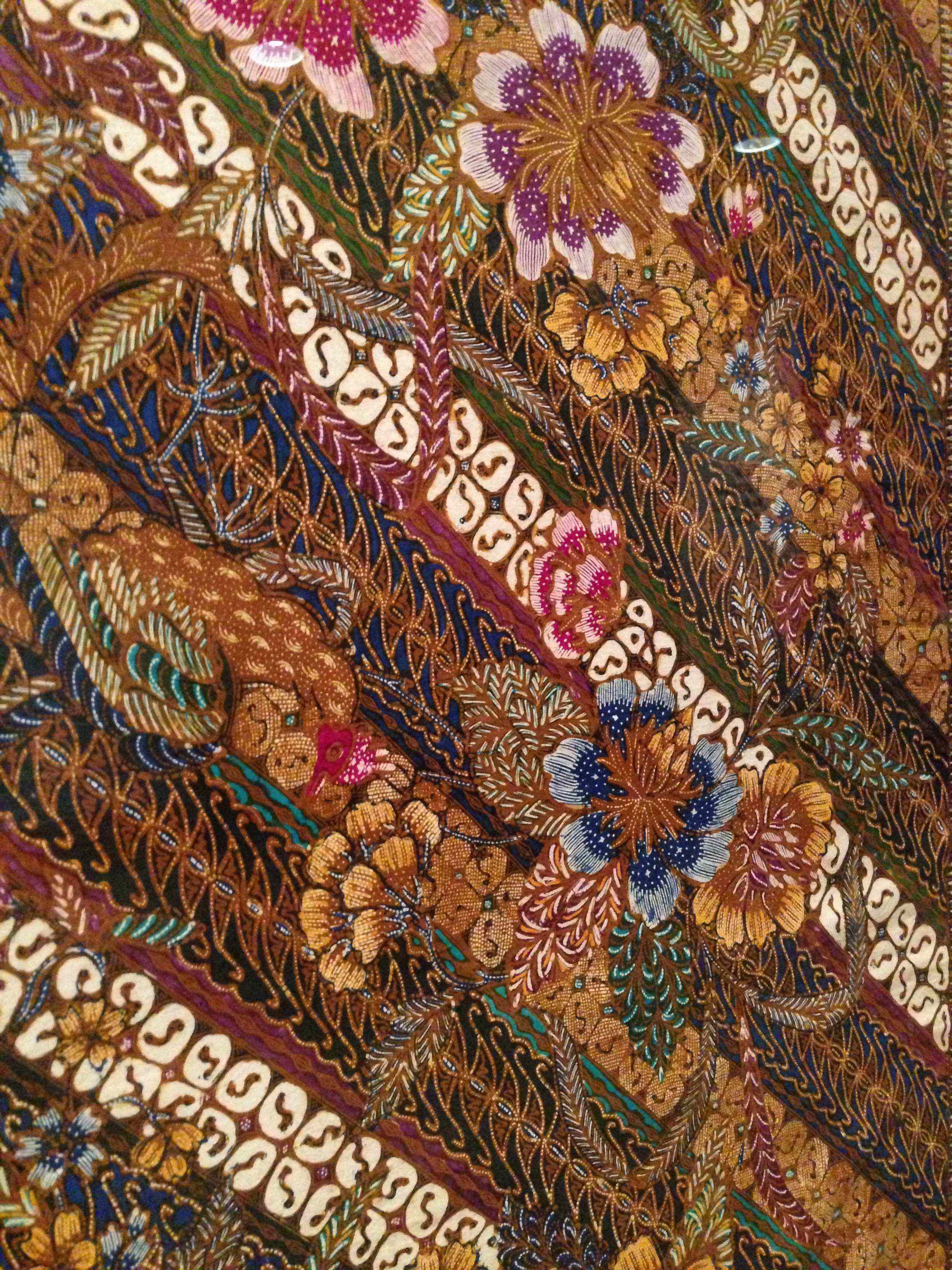
Small detail of wrapper in Hokokau style (early-mid 1940s). Traditional  motifs on diagonal with European-style flowers.

Small detail of wrapper in Hokokau style (early-mid 1940s). Traditional motifs on diagonal with European-style flowers.

As demand grew throughout the 20th century, designs changed, adhering to tastes of foreign buyers, even while the resist-dye masters kept mashing in the iconography of ancient Javenese royalty. As the curators mention, it’s particularly poignant that some of the most intricate, beautiful resist-dye textiles were made under the difficult WWII Japanese occupation of Indonesia. Apparently cotton shortages allowed the master craftsmen to spend more time perfecting elaborate techniques.

The intricacy, dynamism, and history of this textile display is something you really need to see up close. Thank you, Ratti Textile Center vault.

Look Up to See Where Your Grandmother’s Clothes Came From

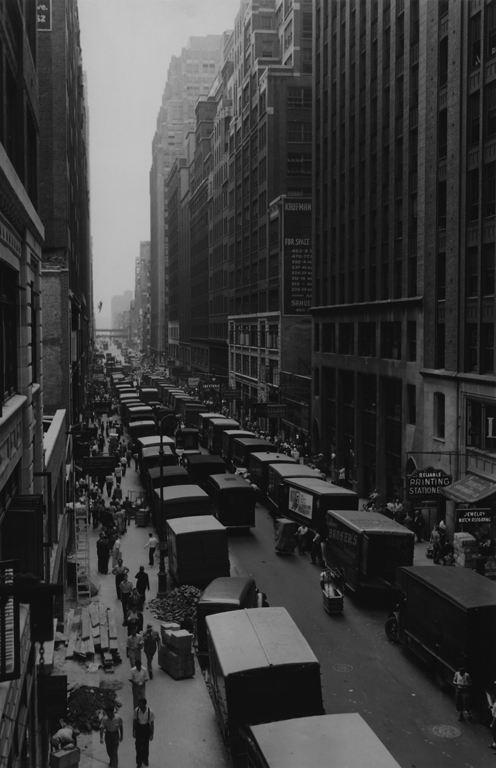
West 35th Street in 1938, looking east between Seventh and Eighth Avenues. Source: NYC Department of Records, Municipal Archives

West 35th Street in 1938, looking east between Seventh and Eighth Avenues. Source: NYC Department of Records, Municipal Archives

It can seem a little quiet walking over to Mood these days. Not too long ago, the streets above 34th Street between Sixth and Eighth Avenues were clogged with push boys, wheeling racks of  materials, trims, and fashions among jobbers, contractors, accessory importers, fabric stores, and showrooms. The way it used to be comes alive in the Skyscraper Museum’s show (closing today) Urban Fabric: Building New York’s Garment District.

In its heyday, those 18 blocks just north and west of Macy’s produced 75% of all US women’s and children’s clothes.  The exhibit tells the story of how this bustling hive happened.  In a nutshell, the old sweatshops in tenement buildings gave way to factory loft spaces in the 1890s around the area where NYU is today. When the big department stores emerged along Sixth Avenue and 23rd Streets, the lofts came with them. But the congestion proved to be a bit much for the female shoppers, who were disturbed by the throngs of guys loitering about on their lunch breaks, and the retailers took action.

The department stores (like Macy’s and Lord & Taylor) moved above 34th Street. To prevent the factory lofts from overwhelming them again, the City implemented the first zoning ordinance in America in 1916. The garment makers, closed out of the fancy retail neighborhood, started razing the Tenderloin District on the West Side and erecting architect-designed skyscrapers (like the Fashion Tower on West 36th) from that point on. About 125 buildings went up on those 18 blocks before the Depression hit.

Here’s a glimpse of what it was like in 1952:

As recently as the 1970s, carts were still being shuttled through the narrow streets, but we know how that story ended.  Today, no one even looks up at the entrances, set-backs, lobbies, or embellishments of these once grand hubs where models, marketers, Mad Men, laborers, seamstresses, teamsters, pattern makers, the designers co-mingled.

Interestingly enough, not a single building is landmarked. In fact, the Skyscraper Museum had trouble even finding photographs of the original buildings and had to turn to historic adverts and early brochures on factory electricity.

For the full, fascinating story by the curator who unearthed it all, listen to Andrew Dolkart of Columbia University, and watch his slide show:

Interns and staff built a nice model of the buildings lining 37th Street for the show, and a big thank you to The Skyscraper Museum for (again) putting the history and installation walkthrough on line. Tell your friends, and be sure to look up next time you walk over to Mood.

Thin, Rich, and MAD Embrace of the Middle East

Martin Munkácsi photo of Doris in an ensemble that is in the exhibition. Source: Doris Duke Charitable Foundation Historical Archives, Duke University.

Martin Munkácsi photo of Doris in an ensemble that is in the exhibition. Source: Doris Duke Charitable Foundation Historical Archives, Duke University.

Walking into MAD’s soon-to-close exhibit, Doris Duke’s Shangri La: Architecture, Landscape, and Islamic Art, what do you see? An architect’s model of a small palace by the sea, dazzling objects that adorned it, exotic loungewear inspired by faraway ports of call, Vogue-worthy jewelry, and photographs of a young socialite/philanthropist consulting with master craftsmen in busy Iranian and Moroccan workshops off the world’s most ancient streets.

As you examine these bits and pieces of Shangri La and its history, there’s a single vision that emerges – a portrait of a woman who knew about light, color, beauty, form, design, artistry, history, and had the vision, passion, and resources to put it all together in a way that any interior designer, fashionista, curator, and global traveler would envy.

Here’s the story line: In 1935, Doris Duke fell in love, went on a round-the-world honeymoon with James Cromwell, and fell in love again – with the exotic sights, sounds, patterns, textures, and artisanal wonders of the Middle East. Followed everywhere by reporters, she and James sojourned for months through Palestine, Jordan, Egypt, and the Indian subcontinent, marveling at the dazzling historic architecture, sinuous designs, luxurious carpets, lattice metalwork, colorful tile, and bejeweled ornament.

Tim Street-Porter’s photo of Doris’s dining room at Shangri La (2011) Source: DDFIA

Tim Street-Porter’s photo of Doris’s dining room at Shangri La (2011) Source: DDFIA

She just had to have it, and when she and James landed in Hawaii, she knew that no home in Palm Beach was going to cut it. They bought an ocean-view lot on the Big Island and began constructing a dream house. Her architects hewed to her vision — to create a seaside home into a tribute to the Islamic architecture and design that thrilled her imagination.

They brought artists and designers in from Iran, Syria, India, and Morocco to work on the home, and Doris herself traveled went back to check on progress in the home-country workshops and buy more. Eventually, she amassed one of the largest private collections of Islamic art in the world. Peruse her collecting timeline.

The actual home (now christened Doris Duke Foundation for Islamic Art) is now open to the public. Take time to explore Shangri La on the virtual tour. It hosts not only a 2,500-item collection, but thought-provoking installations by contemporary artists. (So does the show.) Here’s a video of artist Shahzia Sikander sharing what it felt like to project her light installations on this magical dream house.

For more history, watch the curators’ video. Doris’s vision, taste, and style will be on view at MAD for a few more days, then tour museums across the country.

You’ll never walk through the Islamic Wing at The Met again without thinking, “What would Doris do with this?”