Walking Into the Broken Boxes Podcast

Did you ever want to walk into a podcast? The grand installation of Broken Boxes: A Decade of Art, Action, and Dialogue lets you experience large-scale work by some of the socially conscious artists that have been featured on Ginger Dunnill’s interview series. Enter, listen, and get inside the heads of 23 artists at the Albuquerque Museum through March 2, 2025.

The exhibition honors ten years of Broken Boxes conversations, which you can hear at various “listening spots” inside the exhibition. Ginger began her project as a way to encourage community among artists who were creating disruptive work that prompts viewers to imagine a different world.
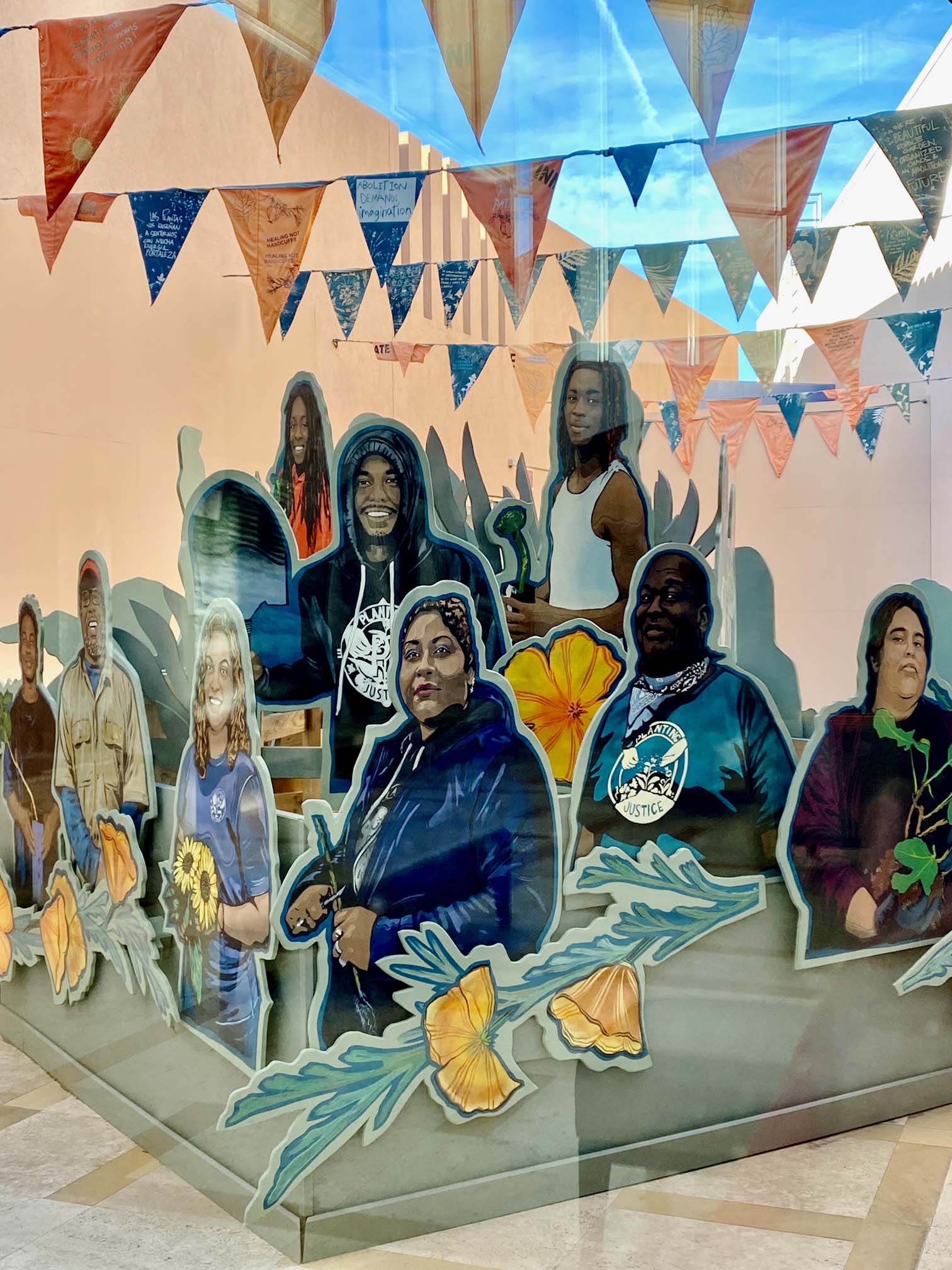
Kate DeCiccio’s Blooming Abolition depicts formerly incarcerated community members who develop gardens. Created by local artists, Planting Justice, Hiroyo Kaneko, and Malaya Tuyay.

The show spills way beyond this main gallery into a theater showing artist videos, another space featuring a soundscape by Raven Chacon, and a courtyard reflecting artist-educator Kate DeCiccio’s vision for sustainable community gardens that give purpose and fulfillment to formerly incarcerated neighbors. 

Inside the main space, visitors wind through and around different installations, such as Marie Watt’s hanging jingle sculptures and her spectacular collaboration with Cannupa Hanska Luger. The jingle “clouds” take a traditional element of powwow and turn it into fine art that invites participation in the soundscape.

2023 dangling jingle sculptures Sky Dances Light: Revolution VII, VIII, and IX created by Marie Watt (Seneca Nation of Indians). Courtesy: private collection

Across the way is an enormous canine created by Luger and Watt. As he’s done with other large-scale participatory projects, Luger sent out a call worldwide requesting people to embroider messages on bandanas and send them in. Visitors are fascinated by the Each Other collaboration, circling around the wolf to discover messages about rescue, shelter, and sustainability.

Guadalupe Maravilla’s installation draws inspiration from his own story and struggle. He assembled the piece from items picked up when he retraced his migration route from El Salvador to the United States when he was a child. But he made it to emit therapeutic vibrational sounds, similar to the sound therapy that brought him relief as an adult when he underwent therapies to cure his own cancer.
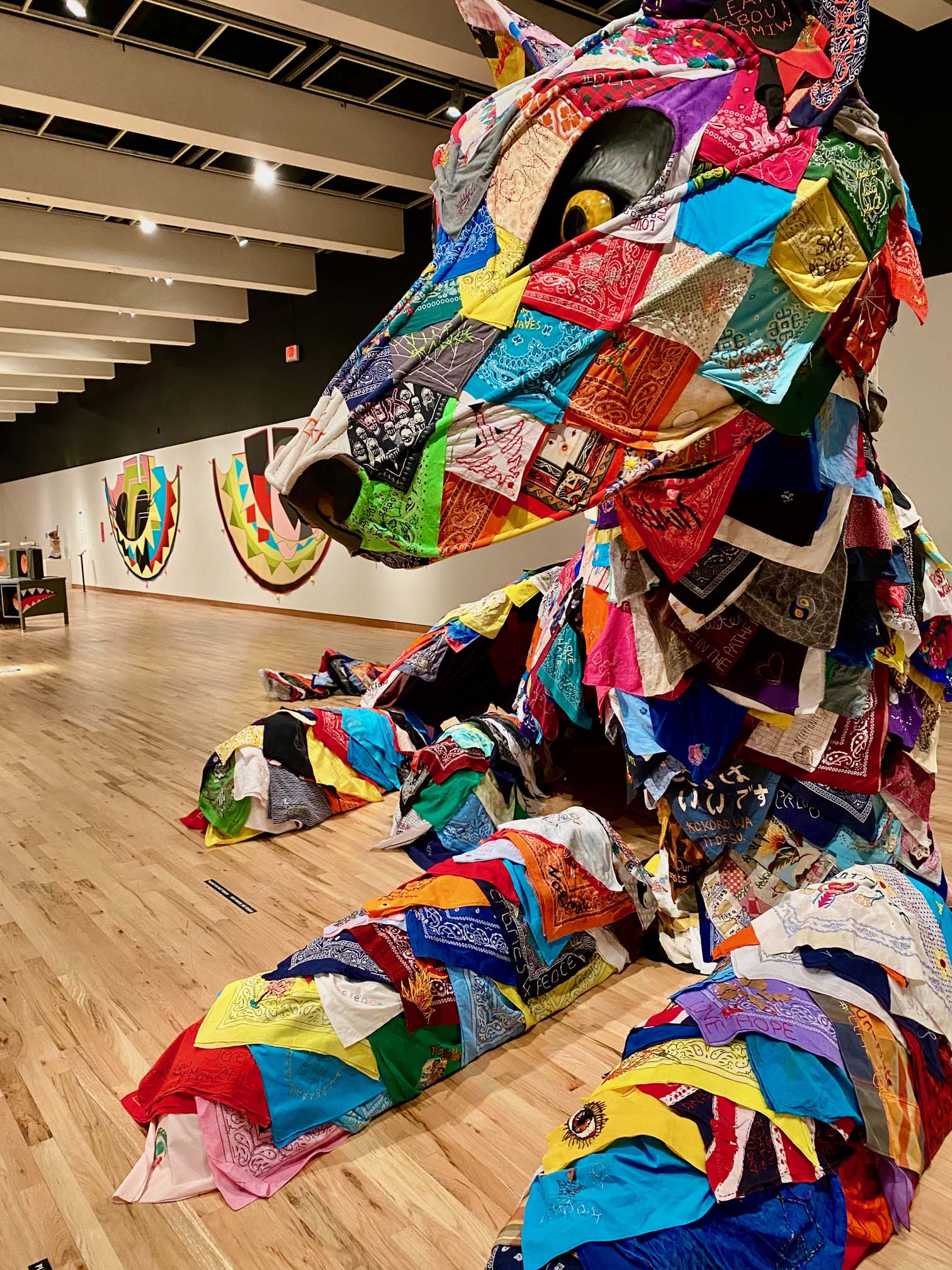
2020-2021 Each Other community bandana-sculpture created by Cannupa Hanska Luger (Mandan, Hidatsa, Ankara, Lakota) and Marie Watt (Seneca Nation of Indians). Courtesy: the artists
Guadalupe Maravilla’s 2021 Disease Thrower #17 – a therapeutic sound installation using materials found when he retraced his El Salvador-US migration route. Courtesy: the artist

Work by Ethiopian refugee Tsedaye Makonnen includes a performance video and installation that focuses attention on African refugees who risk dangerous ocean crossings to escape violence in their home countries. The blue fabric represents the ocean, and each mirror a life lost.
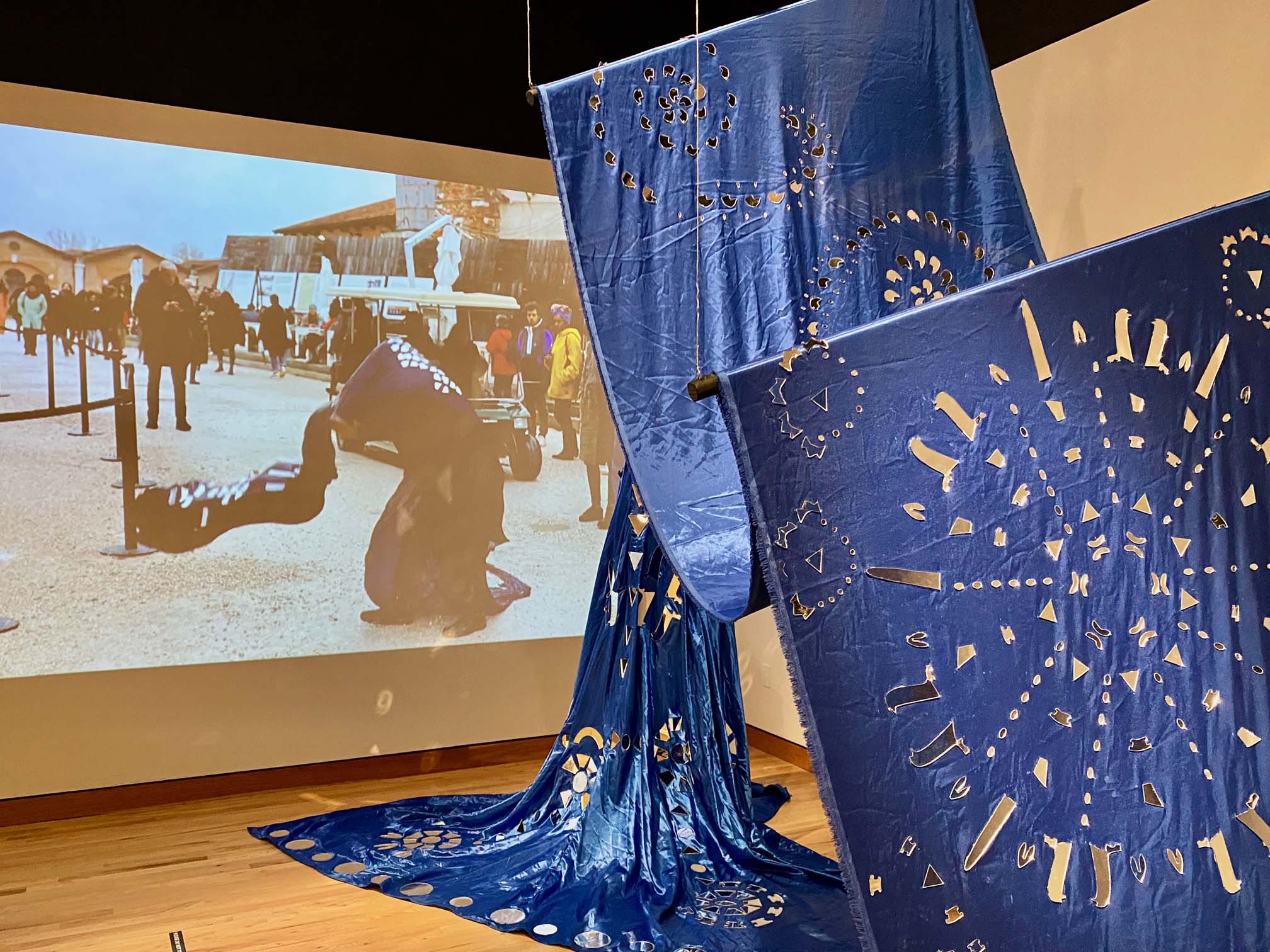
Tsedaye Makonnen’s Astral Sea Views video with Astral Sea Series mirrored fabrics – commemorating women migrants who perished attempting dangerous European ocean crossings. Courtesy: the artist. 

See some of our other favorite installations here in our Flickr album – a shrine by Mario Yvarra, Jr. dedicated to his Chicana-activist mother –Music My Mom Played While Cleaning House – and works by Natalie Ball (Klamath/Modoc) that are straight from her recent show at the Whitney.
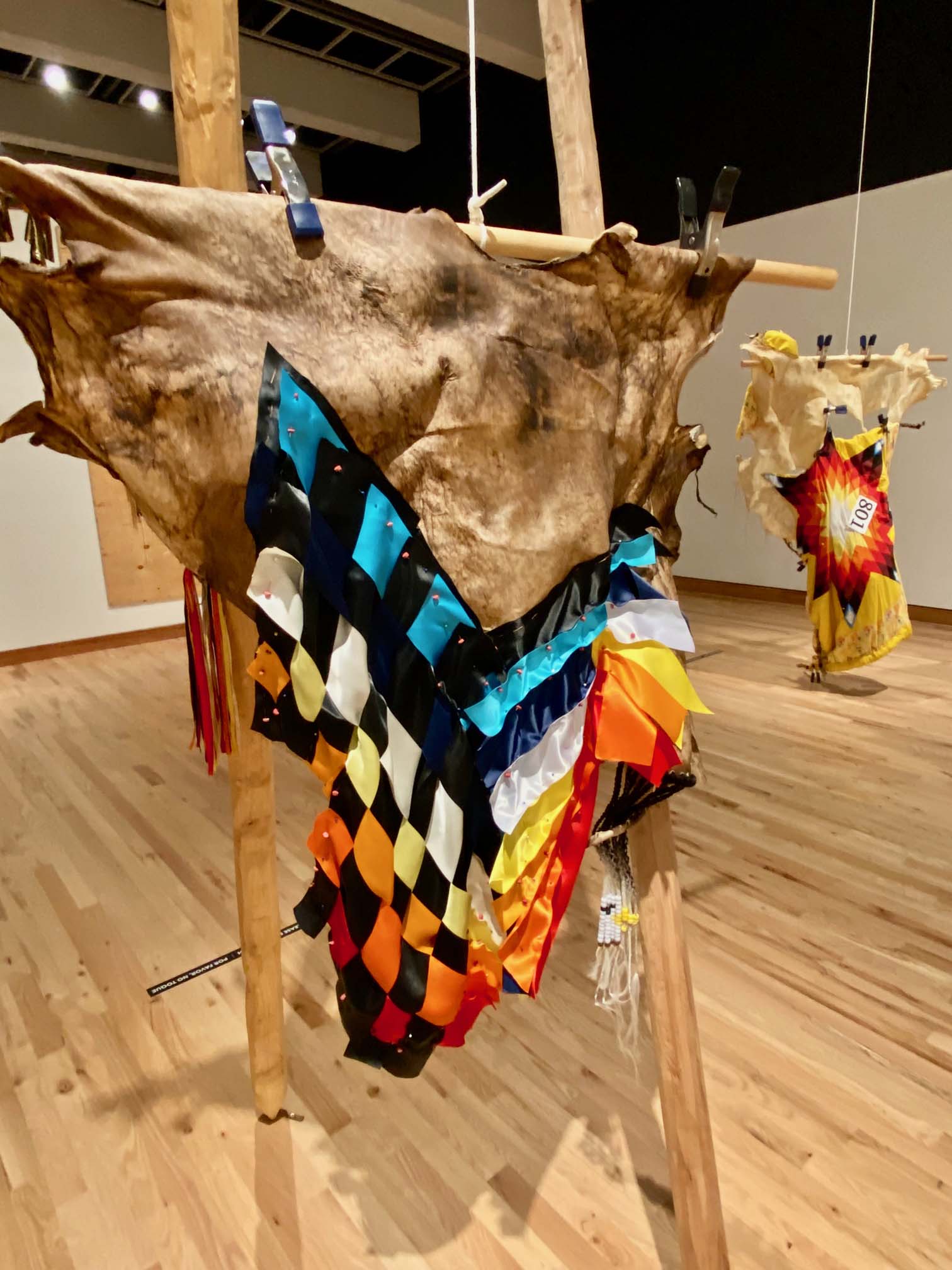
2023 mixed-media sculptures by Natalie Ball – ribbon skirt: There’s Indian and than there’s Indian; (rear) Baby Board. Courtesy: the artist.
Music My Mom Played While Cleaning the House…, a parade float by California artist Mario Ybarra, Jr. that honors his mother, a Chicana civil rights activist.

Listen to the Broken Boxes podcast to hear Ginger and international artists talk about making art, building community, and meeting the challenge of the moment.

Pedro Reyes Takes Direct Action in Santa Fe

You first see a group of anonymous protestors – statues that appear to be taking it to the streets with placards and bullhorns. Elevated at different levels, they present a monument to non-violent protest – a fitting opening to Pedro Reyes: DIRECT ACTION, on view at SITE Santa Fe through May 1.

Reyes believes in participatory art projects that transform art-making into social action.

The Protesters, Reyes’ 2016-2017 monument to unified voices that bring about change from non-violent protest. Courtesy: the artist, private collectors.
Memento, 2022 – vases made from gun parts by Albuquerque and Santa Fe students. All for sale.

The products of his 2022 Memento are right behind you – an array of fun flowers popping out of tall vases. Look closer.

The airy containers are transformed guns from a New Mexico buyback program that incentivized people to exchange their guns for grocery or home-store gift cards. The vases, made by welding-class students from Albuquerque and Santa Fe, are all for sale, with proceeds going to fund activities by New Mexicans to Prevent Gun Violence.

Turning the corner into the next installation, you encounter a wall of videos and shovels in a similar transformation – Palas por Pistoles – that Reyes organized in a particularly violence-prone community in western Mexico.

Reyes’ Palas por Pistoles (2006-present) – shovels made from melted-down gun parts, which were used by schools and museums to plant trees.

Reyes asked people to donate guns to be melted down for an art project promoting environmental peace. He received 1,527 weapons, crushed them in a public-art event, and commissioned a foundry to make shovels. Schools and museums used the shovels to plant 1,527 trees.

Every turn in the gallery reveals a different type of installation and project – libraries for “the people,” sculptures referencing language systems, posters protesting nuclear arms, and musical instruments and contraptions created from weapons.

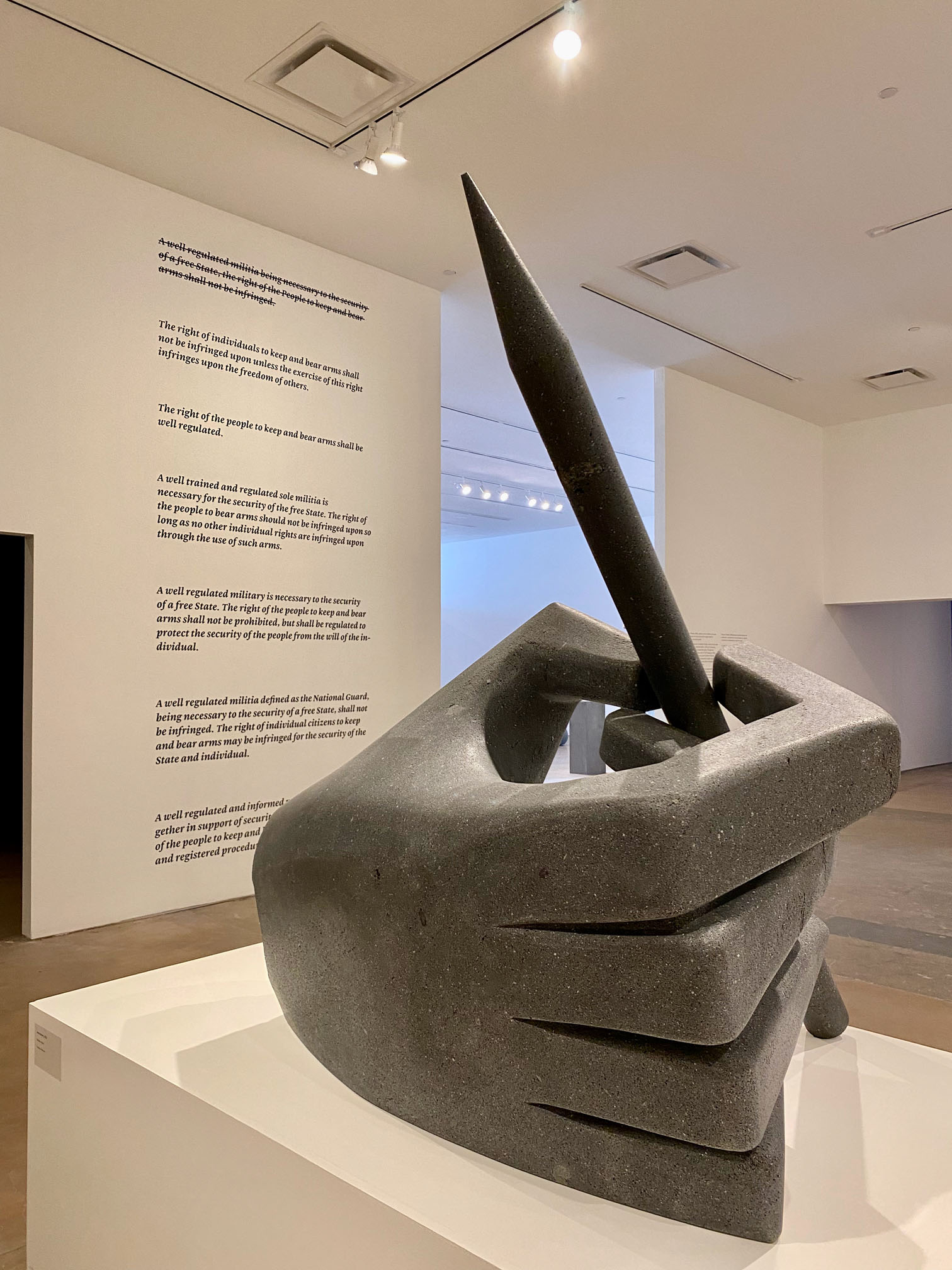
You can’t miss the artist’s large volcanic-rock hand with pencil – an emblem of Reyes’ Amendment project that held community meetings where rewrites to the Second Amendment were proposed and discussed. The idea is that with so much discussion on policies these days, it’s better to write down the “amendments to the Amendment” in pencil! A list of suggestions is prominently posted nearby.

2002 Amendment volcanic stone hand writes the Second Amendment in pencil to facilitate changes in wording as necessary. On wall, multiple drafts of the Second Amendment generated in a Tampa, Florida community project.
Reyes’ 2022 marble sculpture, Colloquium (Parafrasis) depicting the architecture of speech; in background, icons of solutions to social problems from The People’s United Nations (pUN) project – food insecurity, population, gun control, mass incarceration.

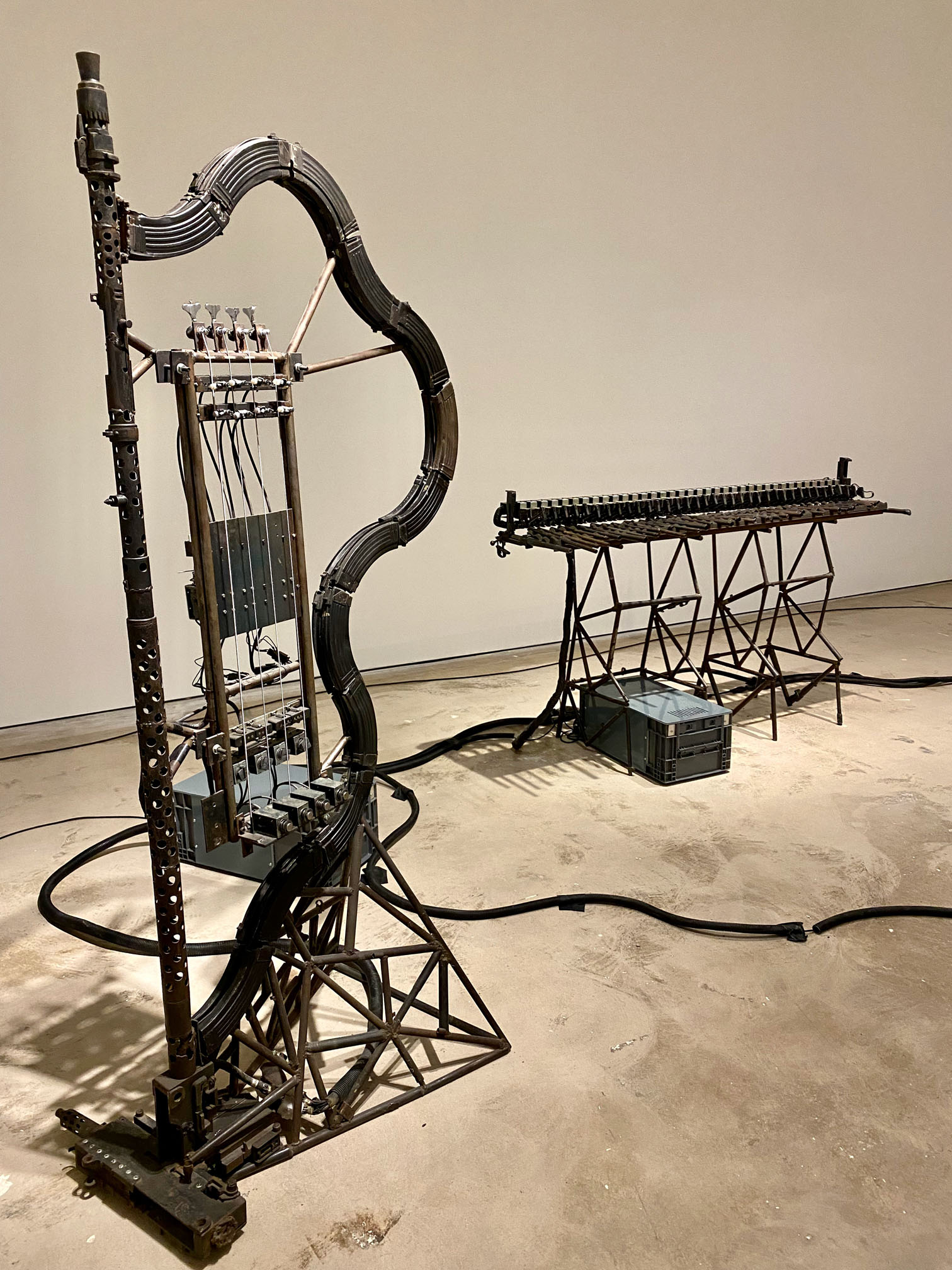
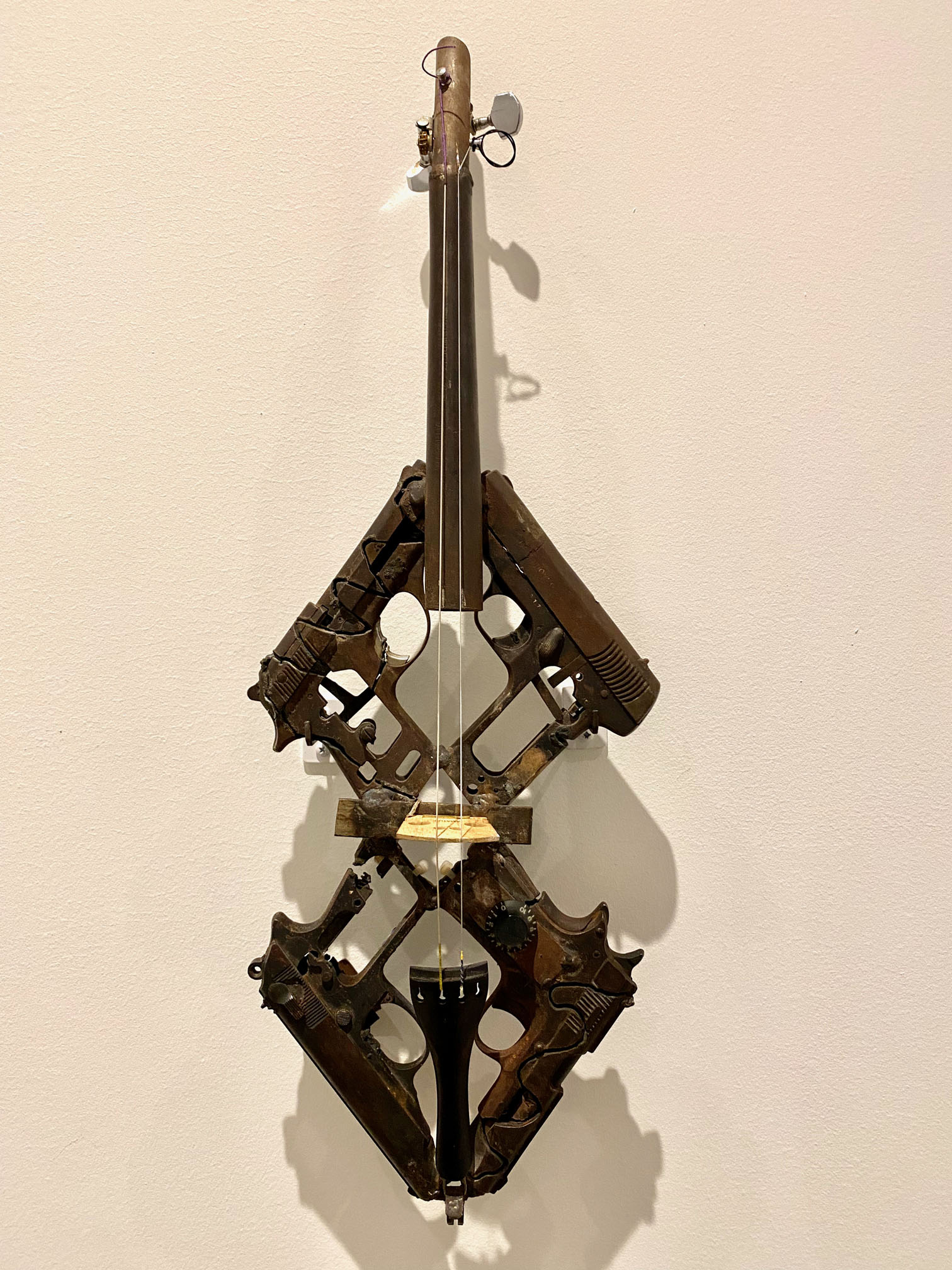
Visitors tend to linger in the Disarm gallery, closely examining the various automated musical instruments created from firearms. Every few minutes, one of the pieces awakens to pluck a string or tap out a slow sequence. It’s a bit startling, not knowing which of the seven is going to activate next.

Harpanet and Cañonófono in Disarm Mechanized, mechanized instruments made from recycled gun and rifle parts. Courtesy: Enrique Rojas.
Reyes’ 2012 Disarm (Violin) from destroyed weapons, played in SITE Santa Fe concerts in 2023. Courtesy: the artist.

Take a look at our Flickr album to see more of the exhibition and to hear the sounds made by the Disarm instruments.

SITE Santa Fe provides “activators” for Reyes’ Music Machine installation – an experience that demonstrates how one artist’s imagination can make you stop and think, even if it’s toward the end of a deep, contemplative show.  Reyes features iconic firearms from three European countries – Austrian Glocks, Swiss Carbines, and Italian Barettas – that have been transformed into classy music boxes. When activated, each plays a musical composition by a famous composer from that country.

Gallery educator Red Hart about to activate Reyes’ Machine Music – crank-operated music boxes made of Swiss Carbine rifles, Italian Barettas, and Austrian Glock pistols.

Hear the artist talk about each of these works in the SITE Santa Fe audio guide, and take time to ponder taking direct action as you visit this beautifully installed, socially relevant, and thought-provoking show.

No Nukes installation with series of 2022 hand-painted Zero Nukes posters in different languages, representing many countries. Courtesy: the artist.