Modern Art and Political Survival in 20th Century Germany

How do artists – and their art – survive two world wars, an authoritatian dictatorship, and the bifurcation of nation’s premiere art institution? It’s the story told by the must-see exhibition, Modern Art and Politics in Germany 1910-1945: Masterworks from the Neue Nationalgalerie, on view at the Albuquerque Museum through January 4, 2026.

Berlin’s Neue Nationalgalerie mounted the show to bring never-before-seen works to the United States and tell the story of how modern art became an ideological battleground in Germany during the early 20th-century and how the history of politics, artistic innovation, and social commentary are reflected in the institution’s collections today.
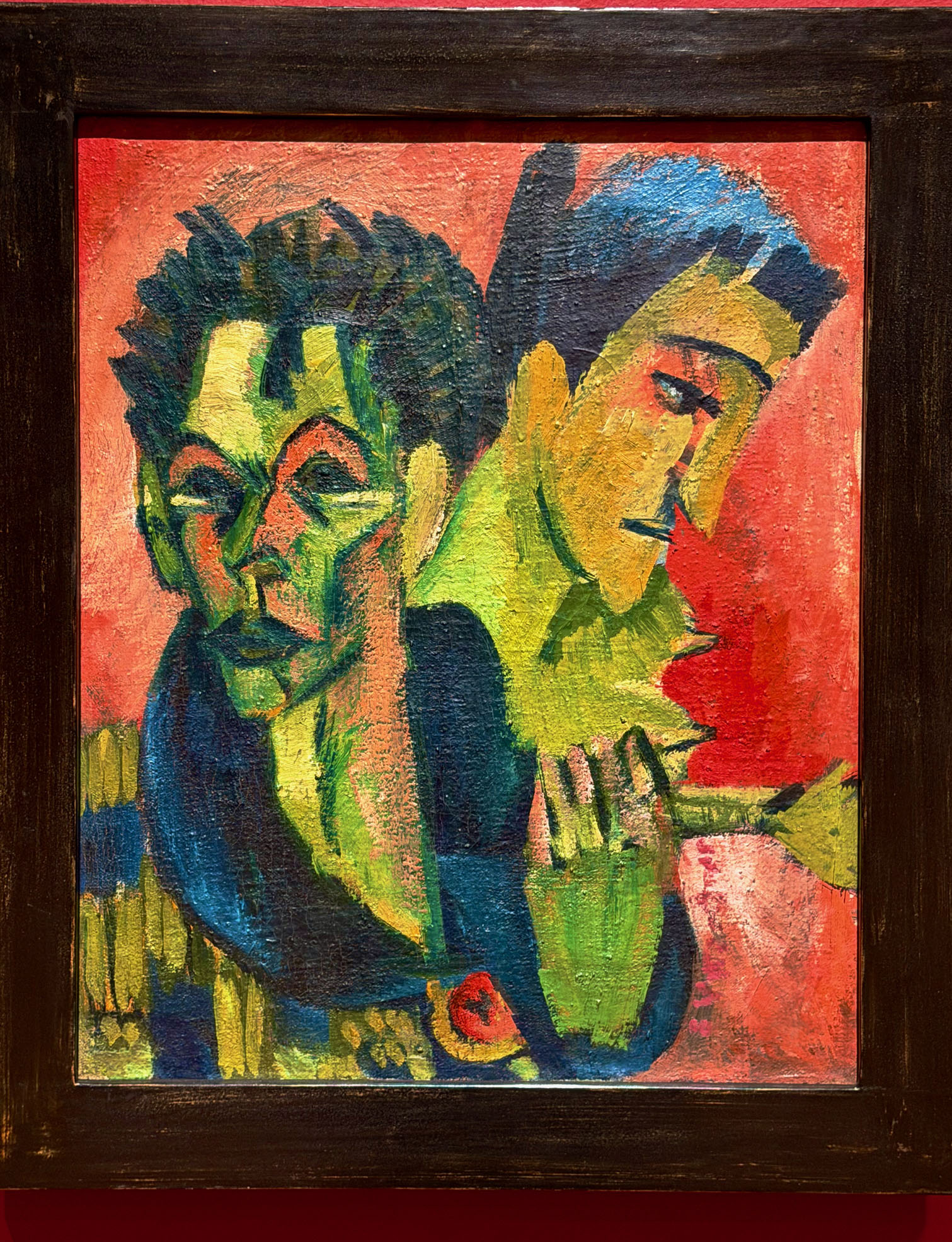
Ernst Kirchner’s 1914-1915 vividly expressionist Self-Portrait with a Girl.

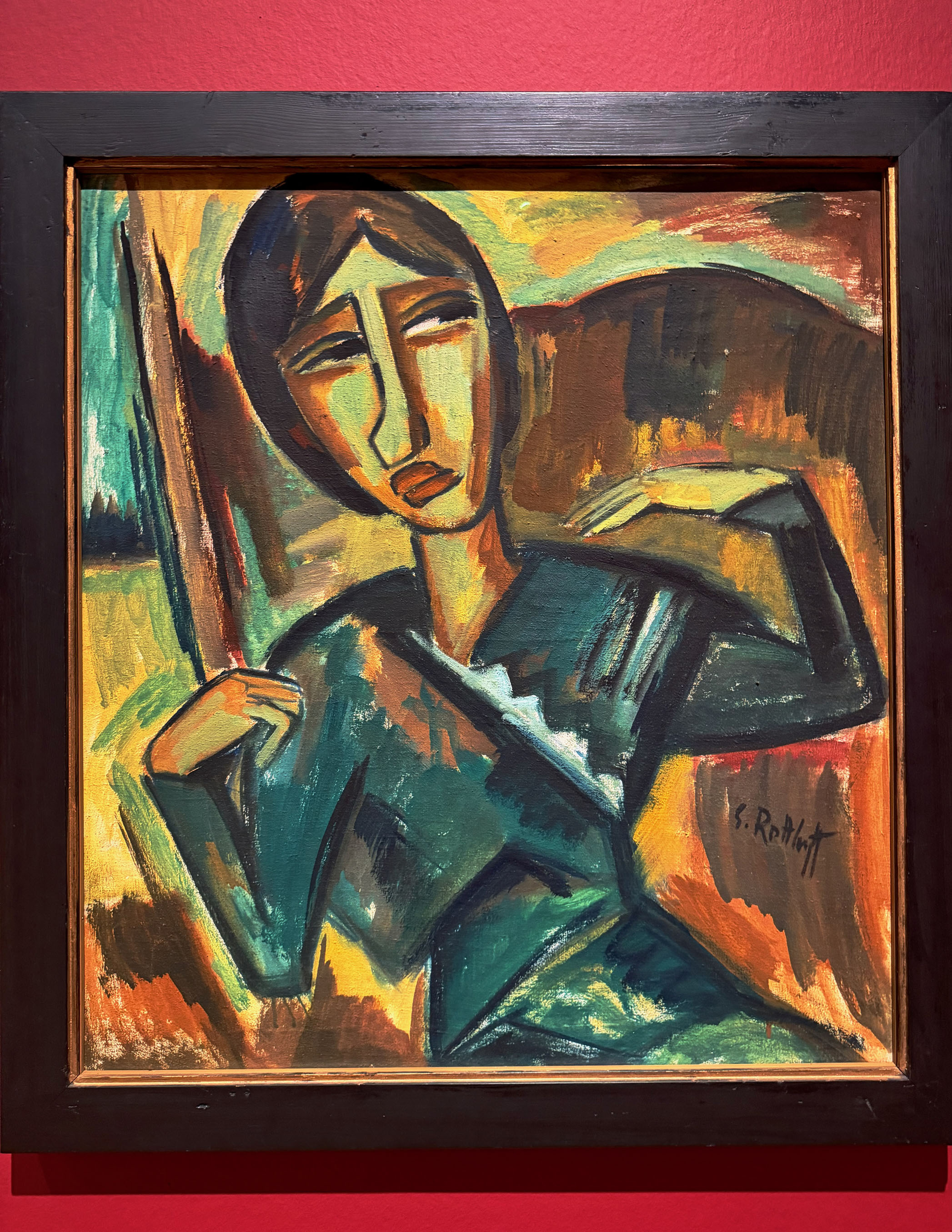
The exhibition opens with works from some of the best-known German expressionists – Kirschner, Pechstein, Schmitt-Rotluff, and Nolde. Slalshes of wild color, sharp angles, and modernist portraits nearly leap out of the frames of paintings, showing the influences of the French avant-garde fauves and Picasso’s angular Cubist planes.
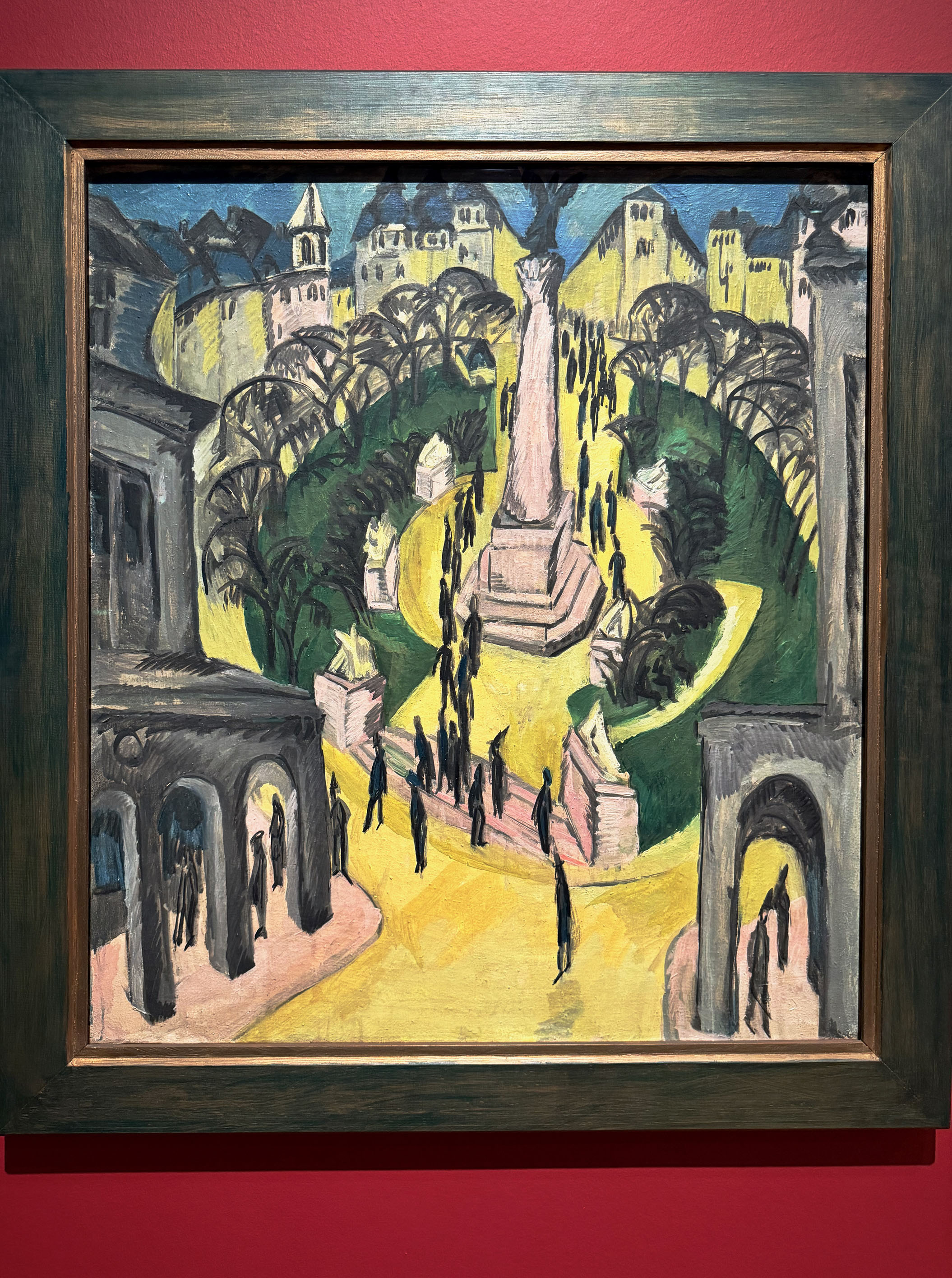
Ernst Kirchner’s 1914 expressionistic city view Belle-Alliance-Platz in Berlin.
Karl Schmitt-Rotluff’s 1915 expressionist painting The Green Girl.

Another section of the exhibition presents portraits of influential German art dealers who brought the best of the avant-garde to Berlin, Munich, Dusseldorf, and other German culture capitals in the early 20th century. Works by influential modernists Picasso, Leger, and Kokolschka hang alongside works by the Russian ex-pats who formed the forerunner group to Die Brücke in 1909 – Kandinsky, Alex Jawlensky, and Marianne von Werefki.

See some of our favorite works in our Flickr album.

Austrian avant-garde: Oskar Kokoschka’s 1909 oil portrait of Viennese architect, Adolph Loos; both artists represented by Berlin gallery owner Herworth Walden.

In 1911, the German modernists formed Die Brücke – a group that celebrated getting an artist’s inner feeling out on the canvas – not just a formalist declaration against classical painting and historical norms. When World War I broke out, many went to the front. If they survived, they continued painting to process the psychological agony of the War and the economic toll it took on the homeland.

The exhibition also features a gallery full of works that are a logical outcome of experimentation – abstract works by German artists that merge the symbology and energy of Italian Futurism with the riotous colors of Orphism.
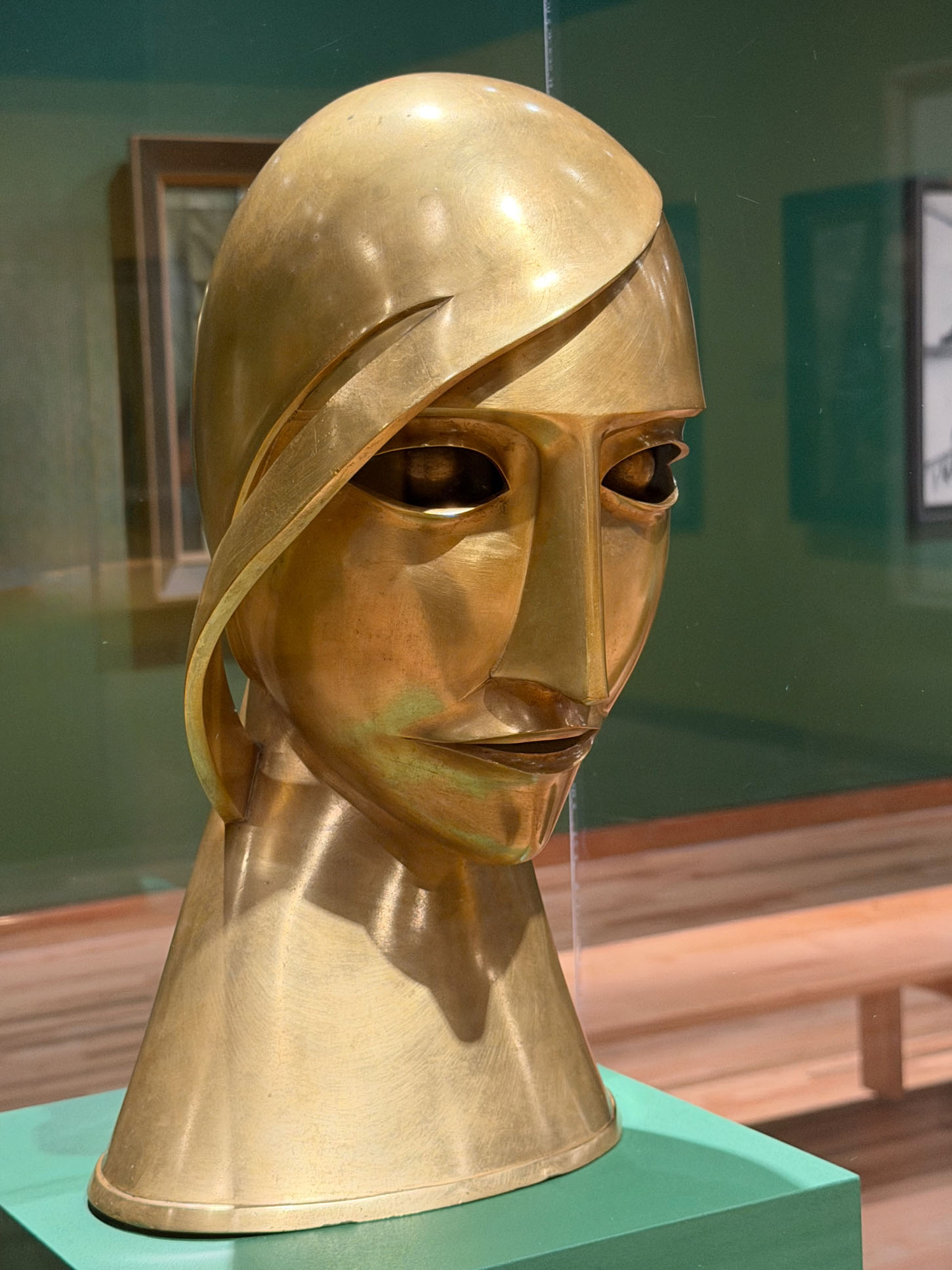
Abstract innovator: Rudolf Belling’s 1925 sculpture Head in Brass – confiscated and labeled “degenerate” by the Nazis in 1937.
Abstract innovator: Otto Möller’s 1921 oil painting City – influenced by Futurism.

Surviving hardship together, the end of World War I only motivated the survivors to come together, form societies and political action committees and keep creating.

Leading up to World War I, it seemed as though modernism would sweep the Continent and become the dominant art style collected by the progressive National Gallery. However, during the 1919-1933 democratic Weimar Republic, art preferences shifted to a highly literal, figurative style dubbed “the New Objectivity.”

This gallery shows the artistic and political shift to realistic portraits with hints of social commentary, depictions of new technology, and a new culture of enfranchised, emamcipated women (exemplified by the museum’s iconic Sonja by Christian Schad).

But over time, the political mood shifted, and the National Socialist Party rose.
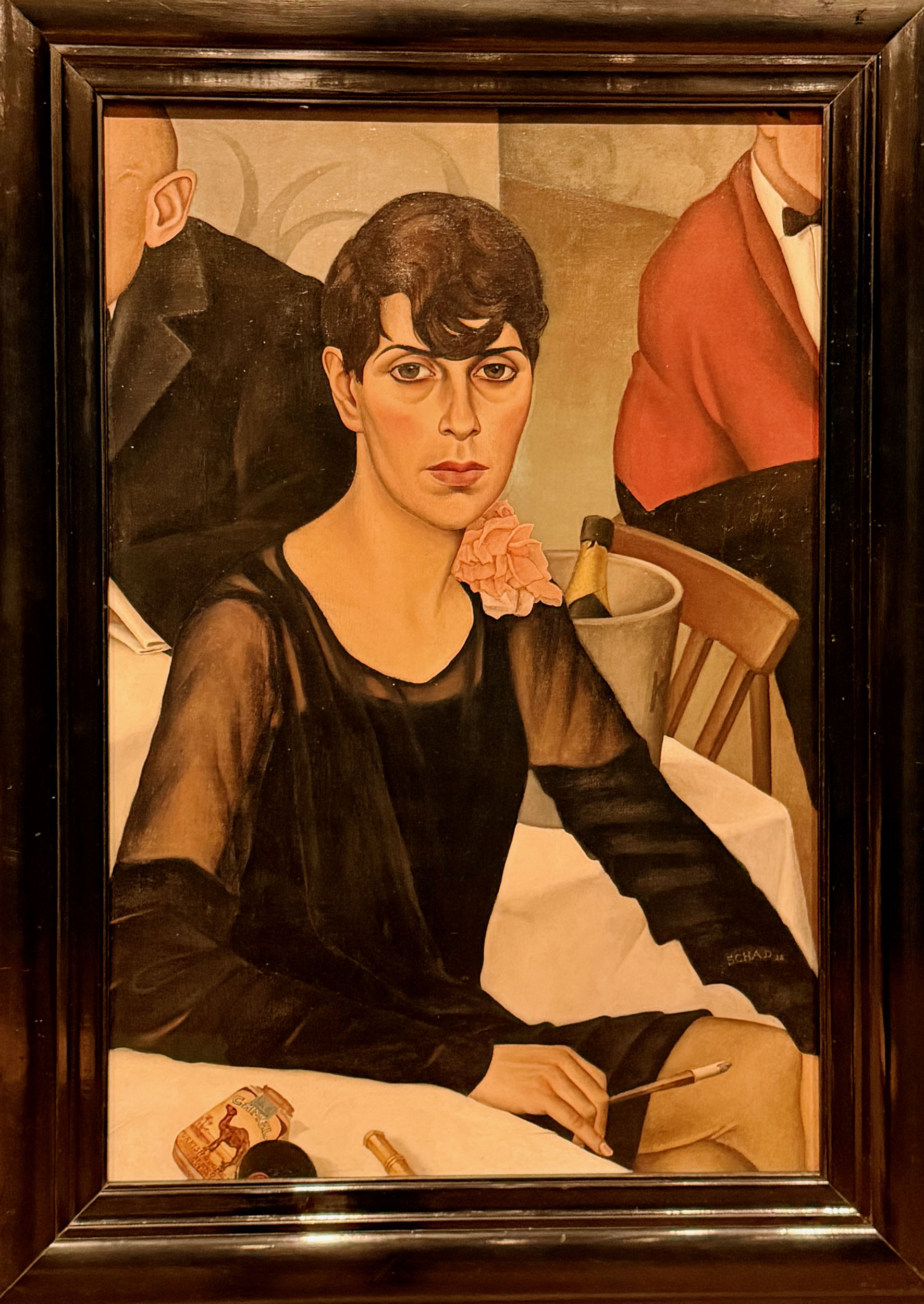
New Objectivity: Christian Schad’s 1928 Sonja– a portrait of the new emancipated women
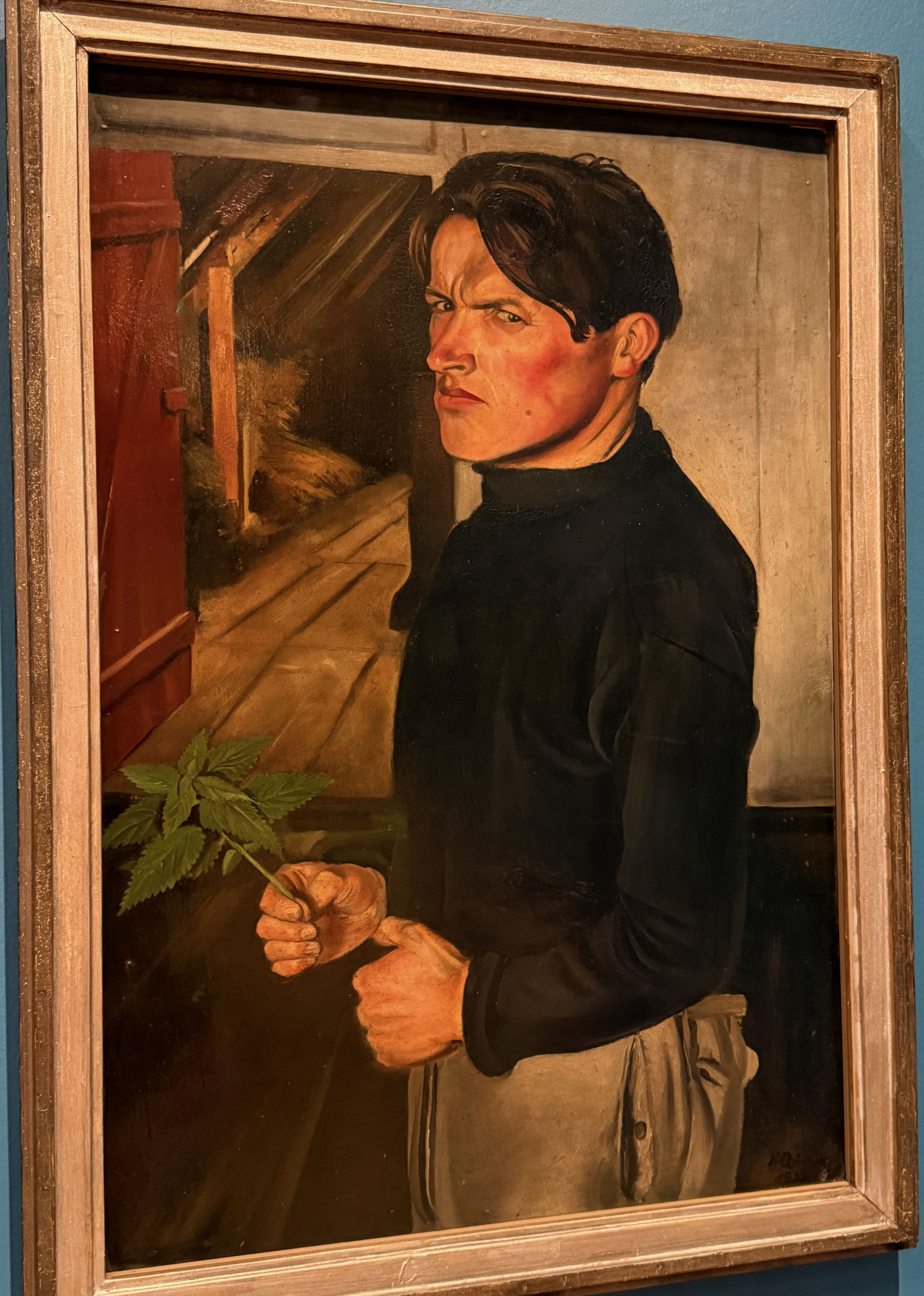
New Objectivity: Curt Querner’s 1933 oil on cardboard painting Self-Portrait with Stinging Nettle – painted in secret (and hidden) as a reaction to a violent police raid on a Communist Party meeting.

Throughout the 1930s, increasingly militaristic and anti-semetic groups formed in Germany, and as the National Socialists came to power, they fired heads of the leading art schools, shuttered the innovative Bauhaus, and banned abstract art and modernism because it did nothing to support their agenda. Artists either went underground (painting in basements) or fled the country entirely. 
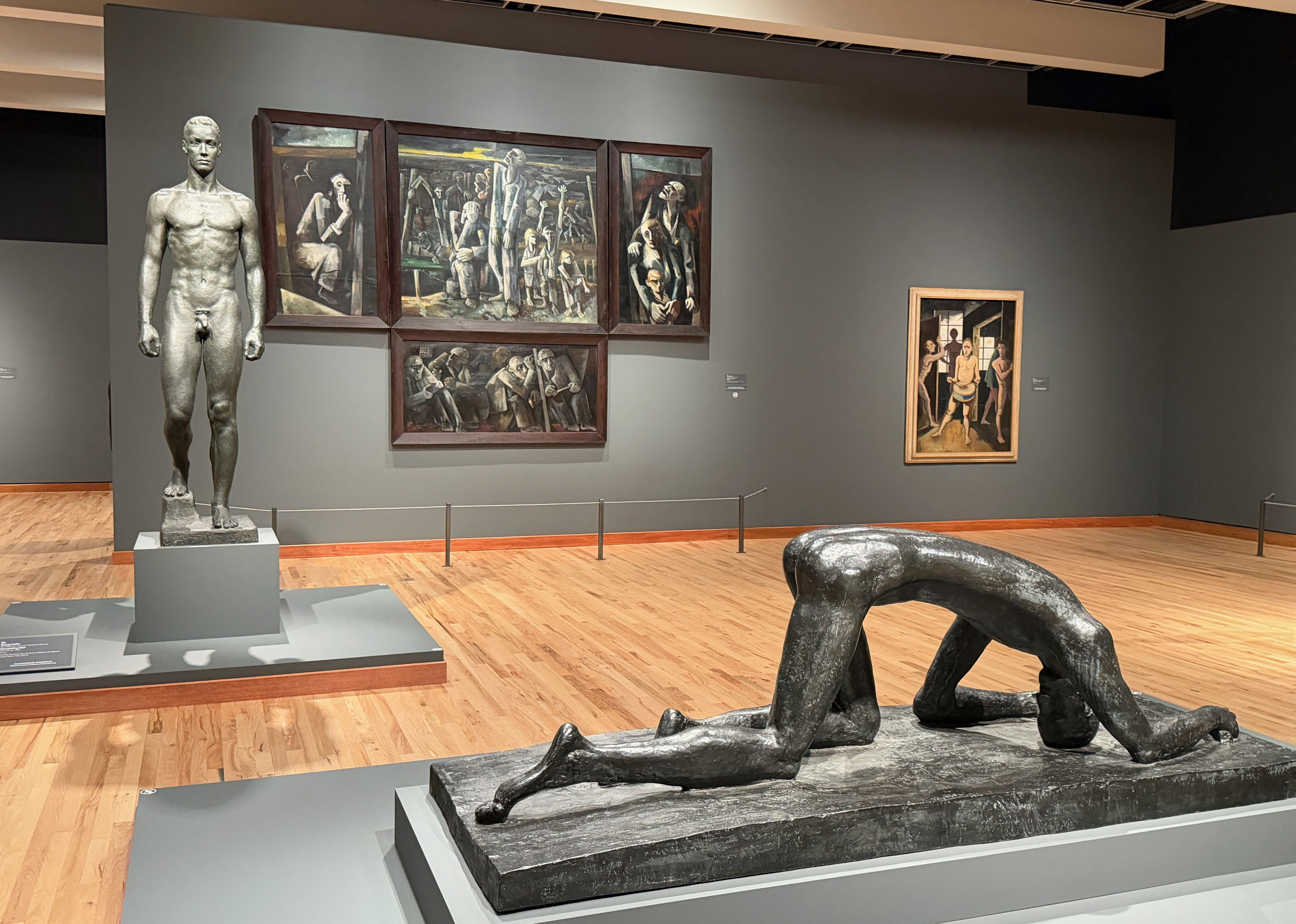
Art responding to WWI and WWII: Georg Kolbe’s 1939-1940 bronze Descending Man, Horst Strempel’s 1945-1946 oil on burlap Night Over Germany, and (foreground) Wilhelm Lehmbruck’s 1915-1916 bronze (cast 1972) Fallen Man.

The exhibition concludes by showcasing works made at the end of the war by German artists reacting to the societal disruption and atrocities.  In some cases, banned artists like Karl Kunz were able to paint in secret, wait until the War ended, and emerge to help a divided Germany revive the arts in the post-war years.

Watch the exhibition’s opening lecture by Berlin curator Irina Hiebert Grun, who provides an overview of the Neue Nationalgalerie’s collecting history, responses to the changing politics that affected early 20th century art, how the museum reassembled its collections and personnel after the Nazi-era persecutions.

The war destroyed the buildings and the Allies divided the country, but the story of this museum’s incredible 21st-century renaissance is one for the ages.

After the exhibition closes in Albuquerque, it be on view at the Minneapolis Museum of Art March 7 – July 19, 2026. Don’t miss it!

Banned modernist Karl Kunz was inspired by Picasso’s Guernica to paint Germany, Awake! in secret in 1942 – Kunz survived the war in Germany and participated in its post-War artistic resurgence.

Whitney Resurrects American Optimism from Storage

To get a taste of exuberant optimism, travel back with the Whitney Museum of American Art in At the Dawn of a New Age: Early Twentieth-Century American Modernism, on view through February 26.

It’s a showcase for art created at the beginning of the 20th century – a time when European experimentation in abstraction, urban skyscrapers and other engineering marvels, Einstein’s breakthroughs, and the success of the women’s suffrage movement made artists optimistic about the future.

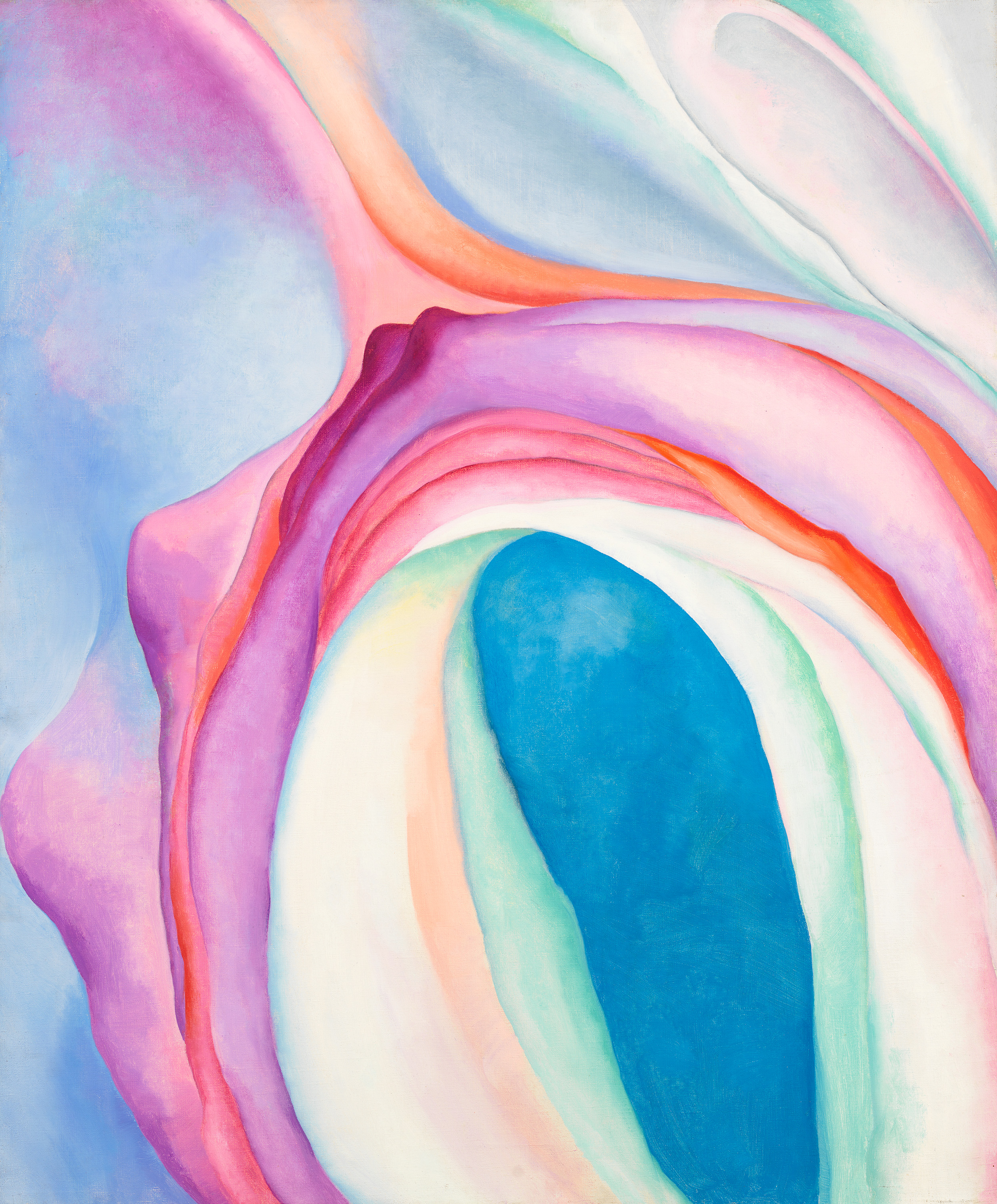
The show features work by well-known (and well loved) artists like lyrical abstractionist Georgia O’Keefe (Music, Pink and Blue No.2) and transcendentalist Agnes Pelton (Ahmi in Egypt).

Georgia O’Keeffe’s 1918 oil, Music, Pink and Blue No. 2. © 2022 Georgia O’Keeffe Museum / Artists Rights Society (ARS), New York

But the news story here is the Whitney’s interest in pulling work by their contemporaries out of storage to provide a more expansive look at early American modernism. Nearly half of the works on display have not been out of the stacks for more than 30 years!

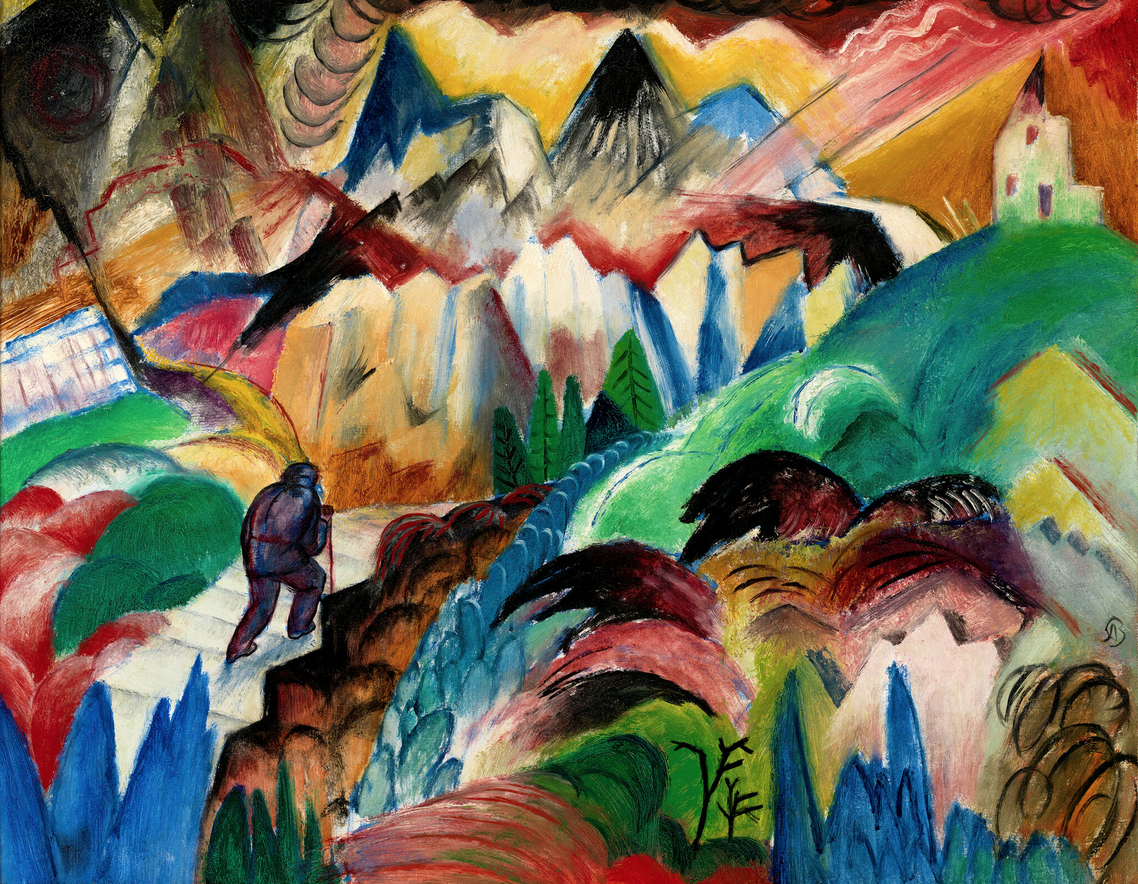
Look at Albert Bloch’s 1916 Mountain, which hasn’t been shown at The Whitney in 50 years. It’s somewhat shocking when you consider that Bloch was the only American invited to join the ground-breaking Der Blaue Reiter in 1911. It’s fitting that Bloch’s nearly forgotten, expressionist landscape was resurrected and featured as the show’s icon – a traveler on an upward journey toward a town on the hill amidst modernist peaks.

Albert Bloch’s 1916 Mountain.

The Whitney’s also pulled Carl Newman’s 1917 Bathers out of storage for this show and hung it side-by-side with Bloch.

Newman was an Academy-trained artist from Philly, but after getting swept up in the Parisian avant-garde one summer, he tried throwing art conventions out the window. 

Color, rainbows, naughty nudes, pleasure craft – a scandalous and joyous mix!

Carl Newman’s 1917 oil on linen painting, Untitled (Bathers)

And what about another “forgotten” convention-breaker? The vibrant 1926 Street Scene is by Yun Gee, a Chinese immigrant modernist who started his art career in San Francisco, but found more acceptance and exhibition opportunities in Paris. Gee was the only Chinese artist running in European modernist circles, and it’s nice to see his cubist expression of San Francisco’s Chinatown right where it belongs in the Whitney’s pantheon.

Yun Gee’s 1926 oil of San Francisco’s Chinatown, Street Scene. Courtesy: estate of Yun Gee.

Works by some of our modernist favorites are also featured – synchronist master Stanton Macdonald Wright, shape-shifter Arthur Dove, and former Brancusi studio assistant and abstracted design leader, Isamu Noguchi.

Henrietta Shore’s 1923 oil, Trail of Life – a recent acquisition by the Whitney to add Shore to its collection.

The stories and careers go on. The exhibition features artists from the West Coast, artists that fled to Paris and found success there, and some modernists that just couldn’t make a go of it and stopped making art entirely.

Henrietta Shore, the Los Angeles innovator who Edward Weston credits as a great influence on his style, was one who eventually opted out.

It’s a beautiful walk through the early 20th century to meet a new set of painters using abstraction to channel an optimistic future – E.E. Cummings (yes, the poet!), Blanche Lazzell of Provincetown, Aaron Douglas of the Harlem Renaissance, and Pamela Colman Smith of Tarot card fame.

Installation view of great modernists. In vitrine: Pamela Colman Smith’s 1909 Rider-Waite-Smith Tarot Deck. Left to right: O’Keeffe’s 1918 Music, Pink and Blue No. 2; Stettheimer’s 1931 Sun; E.E. Cummings’s 1925 Noise Number 13; Macdonald-Wright,’s 1918 Oriental – Synchromy in Blue-Green; Richmond Barthé,’s 1933 African Dancer; Jay Van Everen’s 1924 Abstract Landscape. Photograph by Ron Amstutz.

Here’s a short video by curator Barbara Haskell where she talks about what it was like to find “forgotten” paintings and other stories behind the Whitney’s fascinating modernist reveal: