Light, Space and Time in Albuquerque

Drift into another dimension in Light, Space, and the Shape of Time at the Albuquerque Museum through July 20, 2025. The show, with significant works from the museum’s own collection, harkens back to the founders of California’s 1960s Light and Space movement, but also presents work by contemporary artists – many from New Mexico – who continue to explore the same phenomenon.

The curators have arranged the exhibition to show how artists use light, space, and time as subjects through which visitors can slow down, contemplate, and experience.
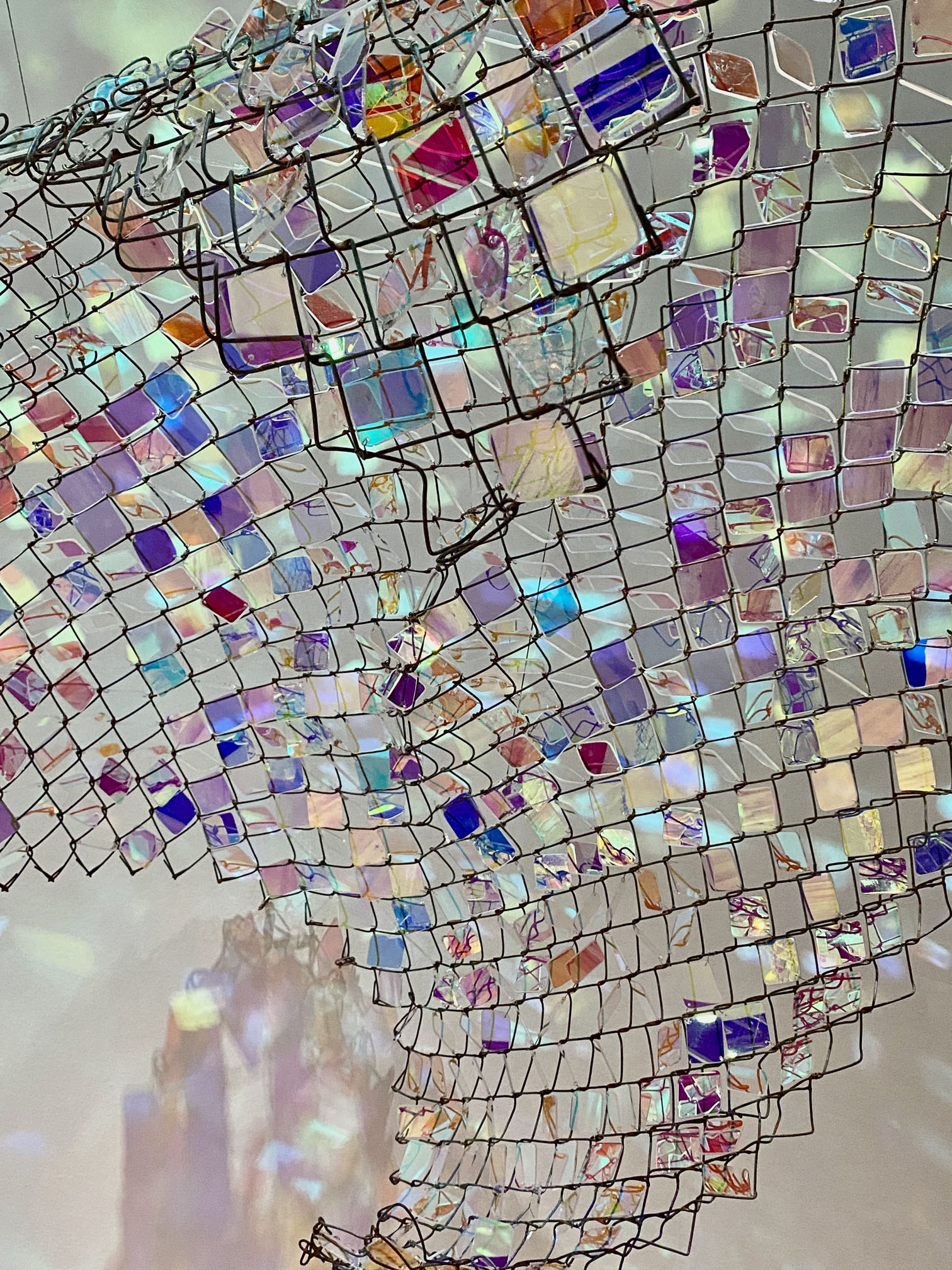
Detail of Soo Sunny Park’s 2013 Unwoven Light, an installation that seems to move as visitors walk through it. Courtesy: the artist

For more, see some of our favorites works in our Flickr album.

The first section showcases works where artists use light as the primary medium. Visitors can enjoy works by some of the most famous innovators from the Sixties and Seventies – Robert Irwin, who inspired a generation of West Coast art students to think differently; Dan Flavin, who merged minimalism with industrial light; and Helen Pashgian, who makes magic from luminous resins.

Irwin’s 2011 piece appears minimal, but his six fluorescent-light colors can be activated in four different variations, and he associated each with agricultural colors of Southern California. You can enjoy looking at Lucky You for its purity of form, or contemplate Irwin’s recollections of home.

Two fluorescent works by Space and Light superstars – Robert Irwin’s 2011 Lucky You and Dan Flavin’s 1987 untitled (in honor of Leo at the 30th anniversary of his gallery. Courtesy: Thoma Foundation

Behind the black curtain, you can enter a tranquility chamber. Helen Pashgian’s 2021 installation provides an unforgettable experience to visitors to slow down and wait. What are you seeing? The frosted, peach-colored epoxy sculpture at center stage appears dissolve in the light-filled space as lights slowly change. It’s like watching show changes to the sky during a dramatic sunset, but it’s light, white, ethereal, and pure.

Helen Pashgian’s 2021 untitled (peach lens) – the lens dissolve into space as the light changes to sunrise and sunset modes. Courtesy: Tia Collection

All-star word artist Jenny Holtzer’s Red Tilt takes an absolutely maximalist approach with multiple LED displays – a too-much, all-at-once, never-stopping tsunami of emotional words from her own story about survival and trauma.

Leo Villareal’s piece Scramble is the opposite. Albuquerque-bassed Villareal creates a mesmerizing, tranquil, never-repeating abstraction by programming LED lights. He’s done this on a larger scale in his epic commissions to light the San Francisco-Oakland Bay Bridge and all of London’s bridges over the Thames. Here, visitors get a more intimate experience – slowing down to watch Scramble’s gently changing colors and know what they’re seeing is unique to the moment.

Jenny Holtzer’s 2002 LED display, Red Tilt. Courtesy: Thoma Foundation
Leo Villareal’s 2011 Scramble, a programmed LED artwork that changes constantly. Courtesy: Thoma Foundation

Larry Bell’s 1984 installation is the centerpiece of exhibition’s exploration of how artists use light, illusion, and technology to explore (and play with) our perceptions of space. Direct from his retrospective in Phoenix, Bell’s barely-there The Cat is a delicate but monumental presence in the show.  Huge, planes of coated and non-coated glass require a circumnavigation. Moving around, you can see how works are reflected and how some opaque surfaces block views of others.
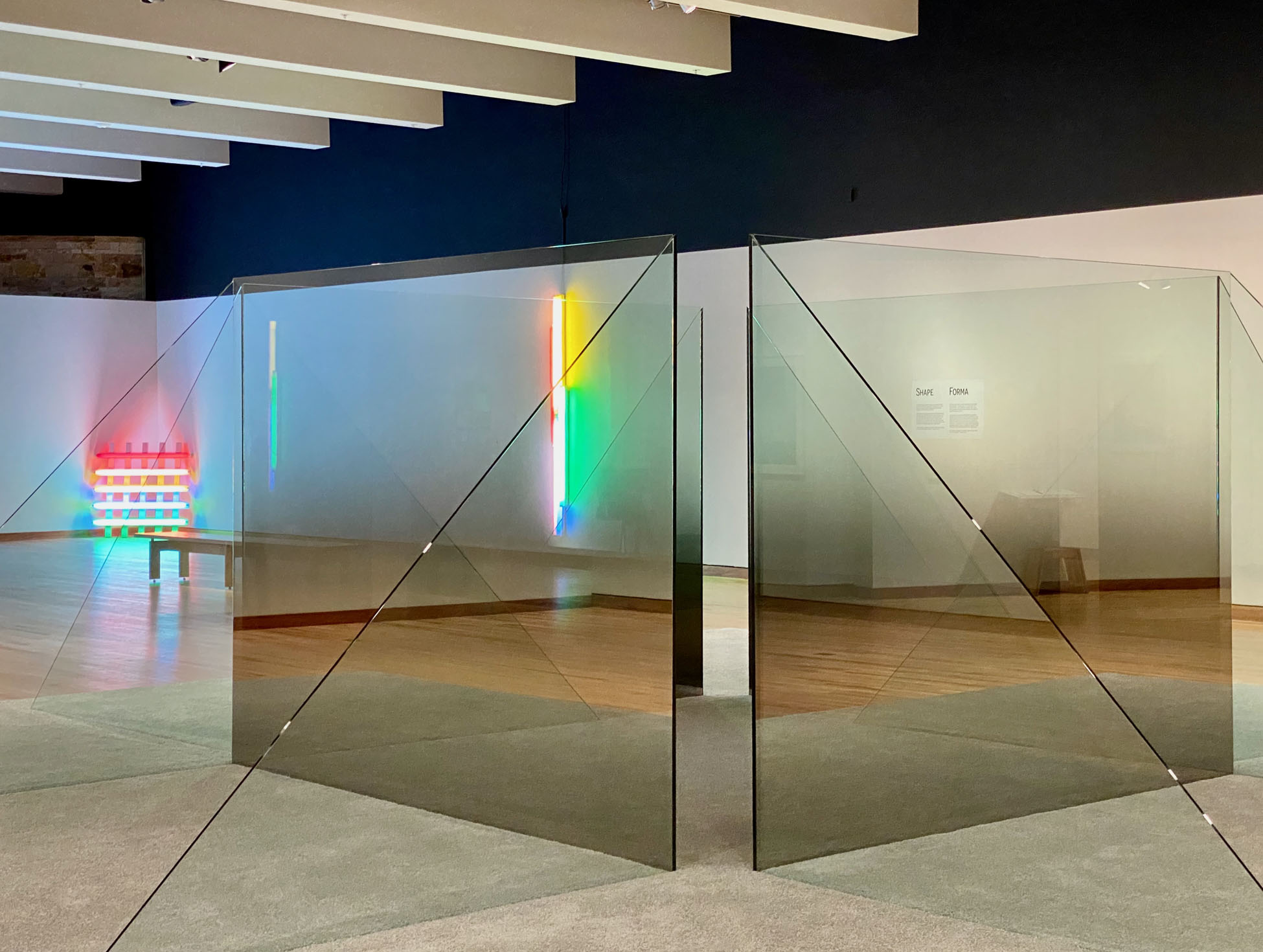
Larry Bell’s 1984 The Cat – rectangles of coated and uncoated float glass.

Two nearby works by Santa Fe-based August Muth offer visitors a more intimate experience. Muth uses a holographic etching technique in which he creates the illusion of a “floating” image.

August Muth’s 2024 holographic etching Shadow Within Light. Courtesy: Pie Projects Contemporary Art.
August Muth’s 2022 holographic etching Terra Solaris. Courtesy: Pie Projects Contemporary Art.

The exhibition concludes with a magnificent installation by Soo Sunny Park – an installation of lights and plexiglass pieces that appear to move as you move through. Take a peek in this video.

Detail of Soo Sunny Park’s 2013 Unwoven Light installation with tiles that appear to move as the visitor moves through it. Courtesy: the artist

Walking Into the Broken Boxes Podcast

Did you ever want to walk into a podcast? The grand installation of Broken Boxes: A Decade of Art, Action, and Dialogue lets you experience large-scale work by some of the socially conscious artists that have been featured on Ginger Dunnill’s interview series. Enter, listen, and get inside the heads of 23 artists at the Albuquerque Museum through March 2, 2025.

The exhibition honors ten years of Broken Boxes conversations, which you can hear at various “listening spots” inside the exhibition. Ginger began her project as a way to encourage community among artists who were creating disruptive work that prompts viewers to imagine a different world.

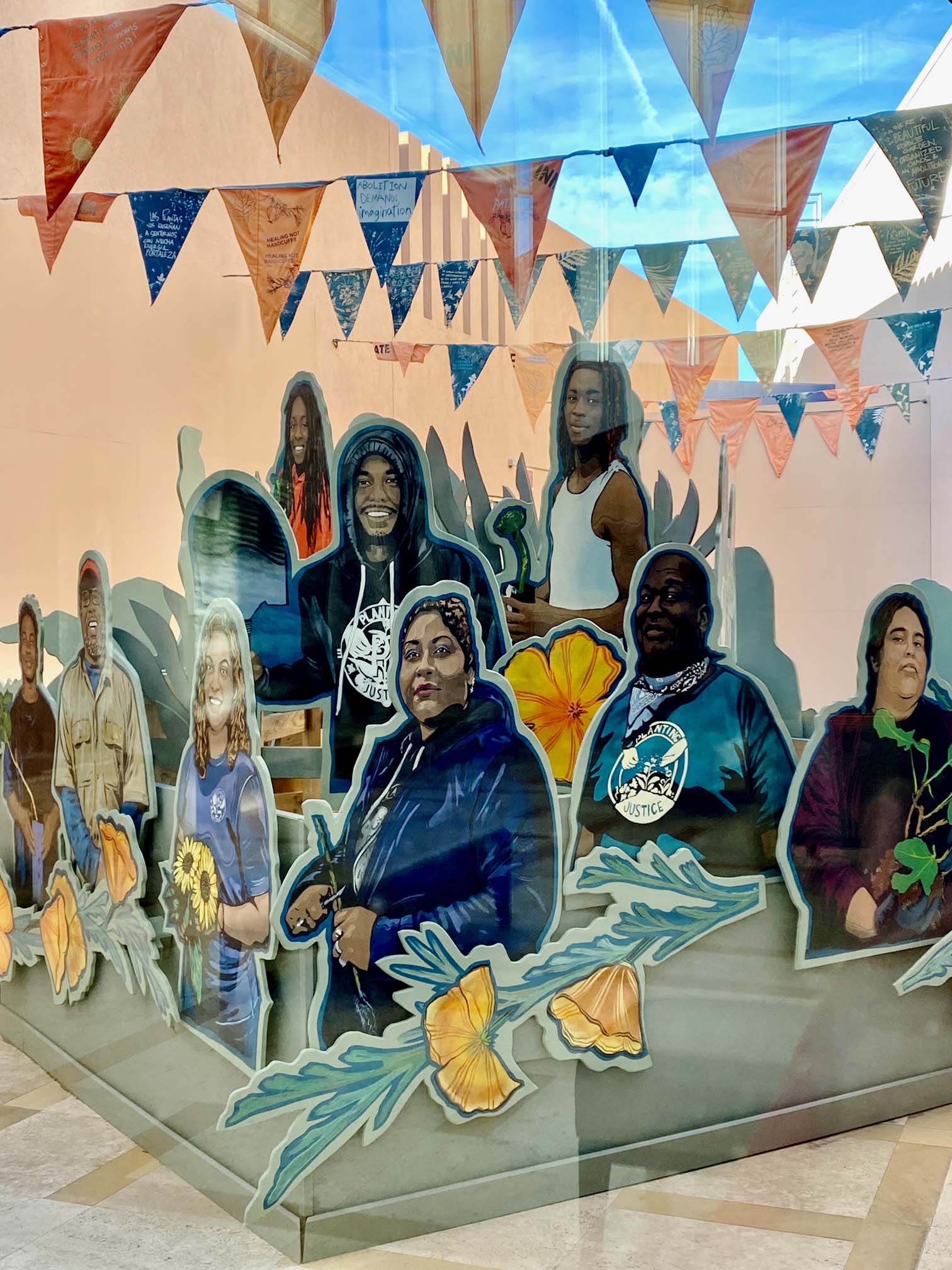
Kate DeCiccio’s Blooming Abolition depicts formerly incarcerated community members who develop gardens. Created by local artists, Planting Justice, Hiroyo Kaneko, and Malaya Tuyay.

The show spills way beyond this main gallery into a theater showing artist videos, another space featuring a soundscape by Raven Chacon, and a courtyard reflecting artist-educator Kate DeCiccio’s vision for sustainable community gardens that give purpose and fulfillment to formerly incarcerated neighbors. 

Inside the main space, visitors wind through and around different installations, such as Marie Watt’s hanging jingle sculptures and her spectacular collaboration with Cannupa Hanska Luger. The jingle “clouds” take a traditional element of powwow and turn it into fine art that invites participation in the soundscape.

2023 dangling jingle sculptures Sky Dances Light: Revolution VII, VIII, and IX created by Marie Watt (Seneca Nation of Indians). Courtesy: private collection

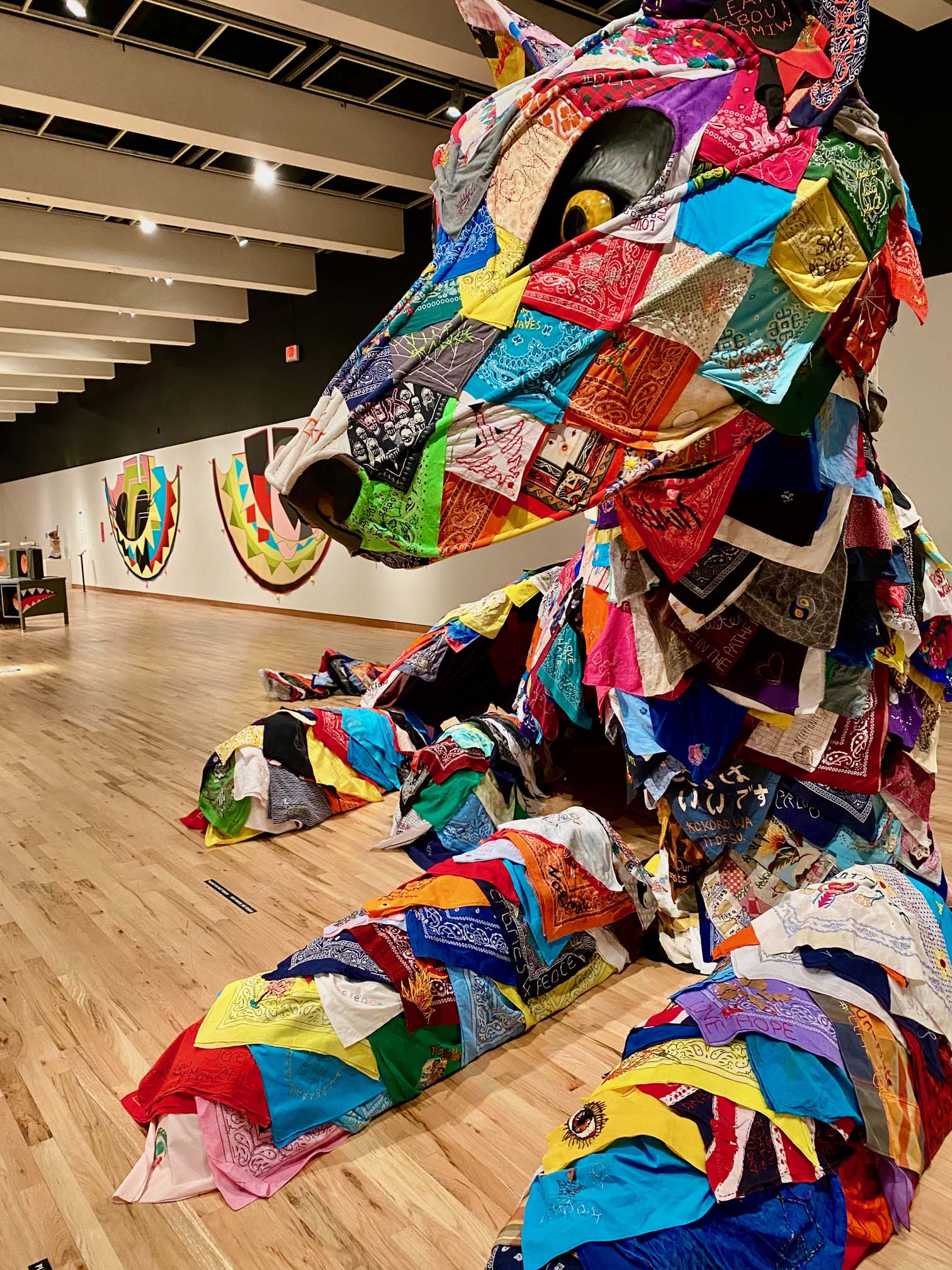
Across the way is an enormous canine created by Luger and Watt. As he’s done with other large-scale participatory projects, Luger sent out a call worldwide requesting people to embroider messages on bandanas and send them in. Visitors are fascinated by the Each Other collaboration, circling around the wolf to discover messages about rescue, shelter, and sustainability.

Guadalupe Maravilla’s installation draws inspiration from his own story and struggle. He assembled the piece from items picked up when he retraced his migration route from El Salvador to the United States when he was a child. But he made it to emit therapeutic vibrational sounds, similar to the sound therapy that brought him relief as an adult when he underwent therapies to cure his own cancer.

2020-2021 Each Other community bandana-sculpture created by Cannupa Hanska Luger (Mandan, Hidatsa, Ankara, Lakota) and Marie Watt (Seneca Nation of Indians). Courtesy: the artists
Guadalupe Maravilla’s 2021 Disease Thrower #17 – a therapeutic sound installation using materials found when he retraced his El Salvador-US migration route. Courtesy: the artist

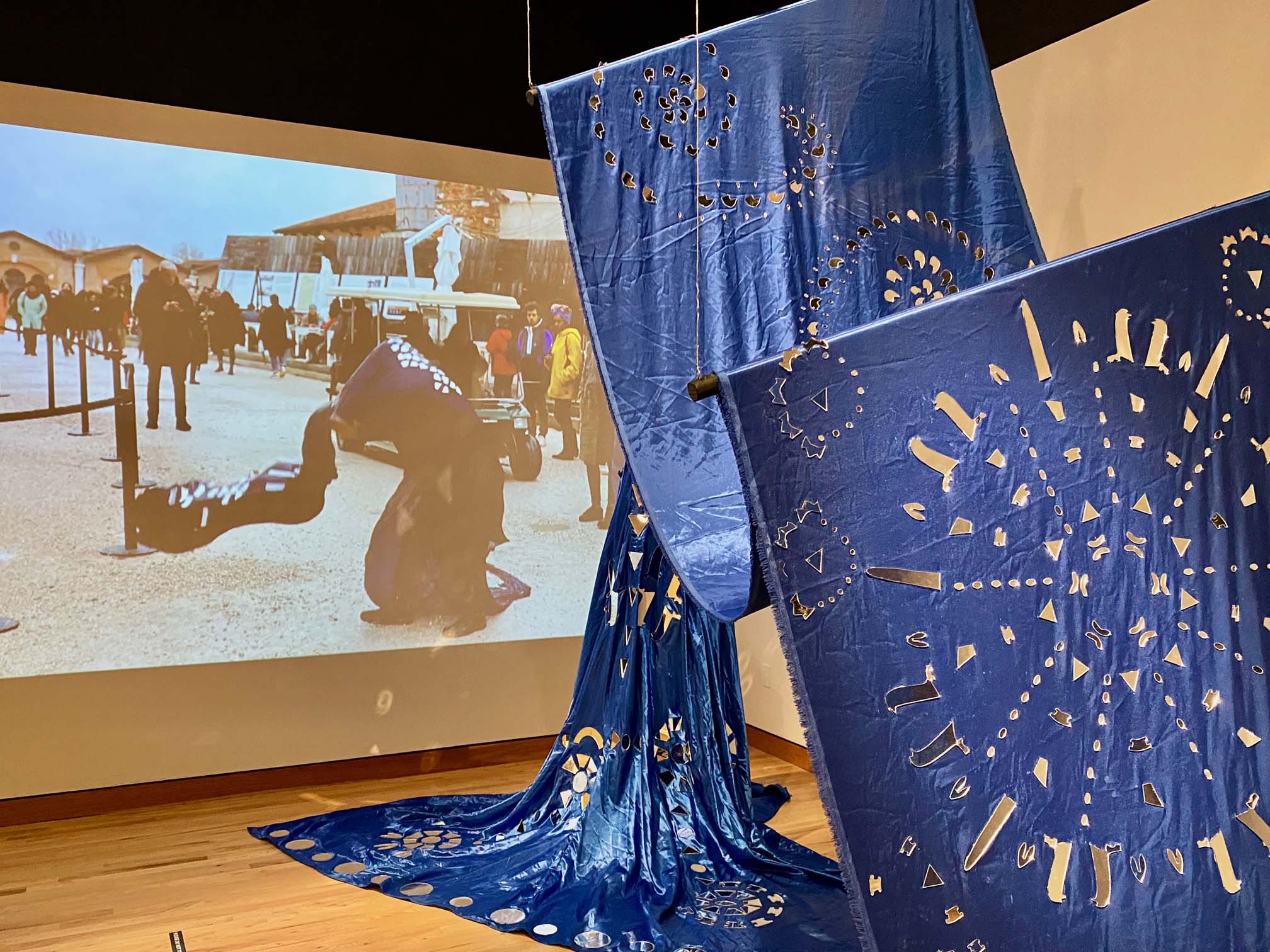
Work by Ethiopian refugee Tsedaye Makonnen includes a performance video and installation that focuses attention on African refugees who risk dangerous ocean crossings to escape violence in their home countries. The blue fabric represents the ocean, and each mirror a life lost.

Tsedaye Makonnen’s Astral Sea Views video with Astral Sea Series mirrored fabrics – commemorating women migrants who perished attempting dangerous European ocean crossings. Courtesy: the artist. 

See some of our other favorite installations here in our Flickr album – a shrine by Mario Yvarra, Jr. dedicated to his Chicana-activist mother –Music My Mom Played While Cleaning House – and works by Natalie Ball (Klamath/Modoc) that are straight from her recent show at the Whitney.

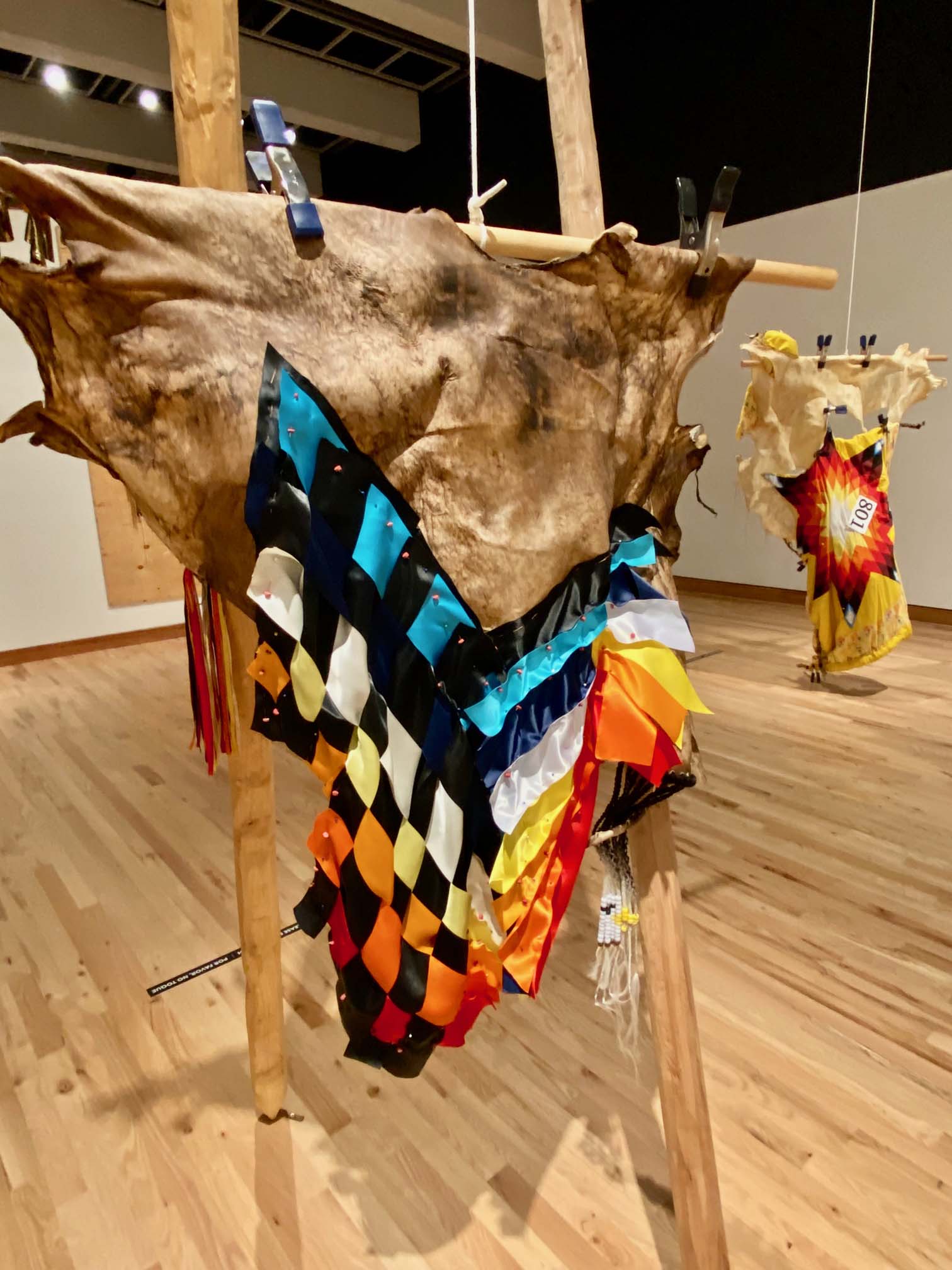
2023 mixed-media sculptures by Natalie Ball – ribbon skirt: There’s Indian and than there’s Indian; (rear) Baby Board. Courtesy: the artist.
Music My Mom Played While Cleaning the House…, a parade float by California artist Mario Ybarra, Jr. that honors his mother, a Chicana civil rights activist.

Listen to the Broken Boxes podcast to hear Ginger and international artists talk about making art, building community, and meeting the challenge of the moment.

Fernandez Curates Smithson at SITE Santa Fe

It’s not often you get to see Robert Smithson’s large-scale works inside gallery walls. Strolling through SITE Santa Fe’s magnificent Teresita Fernández/Robert Smithson exhibition, through October 28, provides an opportunity to see how a contemporary Brooklyn-based Cuban-American artist – inspired by landscape and societal histories of the Caribbean – positions her own work “in conversation” with Smithson’s 1960s-1970s geologic works, drawings, and photo installations.

SITE invited art-world superstar Teresita Fernández to curate this show with the Santa Fe-based Holt/Smithson Foundation. Prior to her deep dive into Smithson’s career, her primary knowledge centered around his 1970 epic Spiral Jetty – 6,650 tons of rock and earth jutting out from the shore of Utah’s Great Salt Lake.

Smithson’s 1969-1970 Mirrors and Shelly Sand and two by Fernández: 2009 Drawn Waters (Borrowdale) and 2024 Sfumato (Epic) 2. Courtesy: Dallas Museum of Art; the artist and Lehmann Maupin.
Still from Robert Smithson’s 1970 film Spiral Jetty, Great Salt Lake, Utah. Courtesy: Holt/Smithson Foundation.

But Fernández found a lot more from Smithson’s too-short career that she could couple with her own work to create SITE’s spectacular installation. Both artists use landscapes, deep time, ancient history, and travel.

Smithson’s 1968 installation A Nonsite (Franklin, New Jersey) with 2020 Archipelago charcoal work by Teresita Fernández. Courtesy: Museum of Contemporary Art Chicago; private collection

In the first gallery, Fernández selected a Smithson “nonsite” work – a minimalist series of boxes, each packed with rocks from the decidedly unromantic site of Franklin, New Jersey. Smithson’s “nonsite” includes a framed aerial photo that appears to document the site, but it’s a “readjusted” depiction of it. Not what it seems.

Next to the “nonsite,” Fernández hangs Archipelago, a charcoal wall sculpture., which appears to be a legit map, but it’s not. It’s an imagined map of separate Caribbean islands and continents linked together, making us reflect upon their shared socio-political colonial histories.

Viñales (Plateau) is a wall-sized “stacked landscape” depicting Cuba’s Viñales Valley, home of ancient karst caves once inhabited by Taino people and later where escaped plantation slaves sought refuge. At a distance, it evokes the valley’s ecological, social, and political legacies; up close, you see that the image is made up of thousands of tiny ceramic tiles. Something to get lost in.

2019 ceramic mosaic by Teresita Fernández Viñales (Plateau). Courtesy: the artist and Lehmann Maupin.

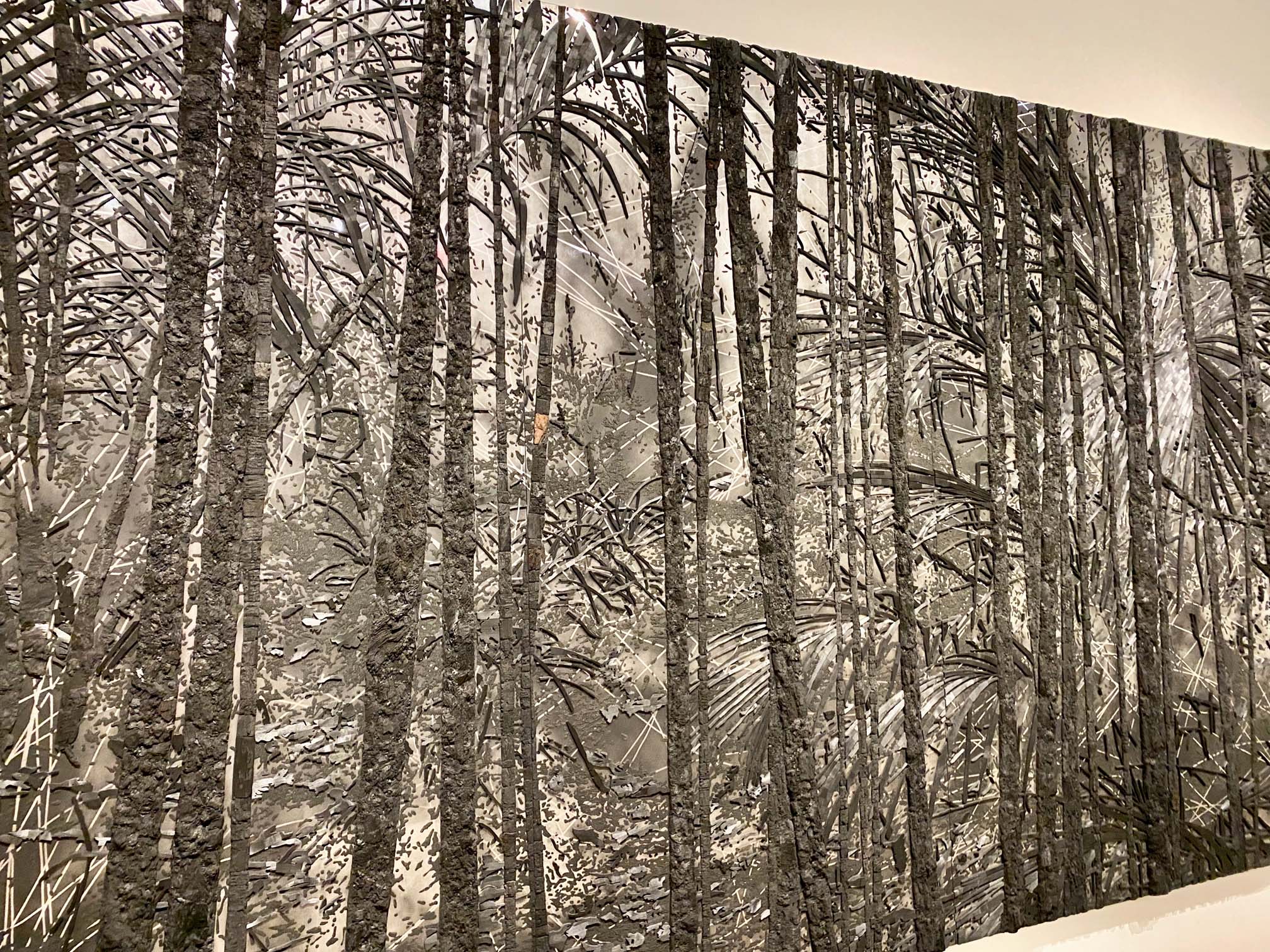
Both artists use reflection in their works. Manigual (Mirror) by Fernández– a tropical forest created from charcoal and sand – is affixed to a reflective surface, so you can “see yourself” in the charred thicket when you get right up to it. Smithson designed his earth-and-mirror Red Sandstone Corner Piece so that every gallery goer’s image is part of the visual experience – from close up, far back, and far away. You’re linked to the red sandstone.

Detail of 2023 Manigual (Mirror) by Teresita Fernández. Courtesy: Crystal Bridges Museum of American Art.

On the other hand, Smithson famous photographic series, Yucatán Mirror Displacements, documents his meticulously arranged mirrors set into Mexico’s coastal landscapes. Just reflections of landscape and sky in all the settings he documented his set of mirrors; no people.

Detail of Smithson’s 1969 Yucatán Mirror Displacements (1-9). Courtesy: Guggenheim Museum.

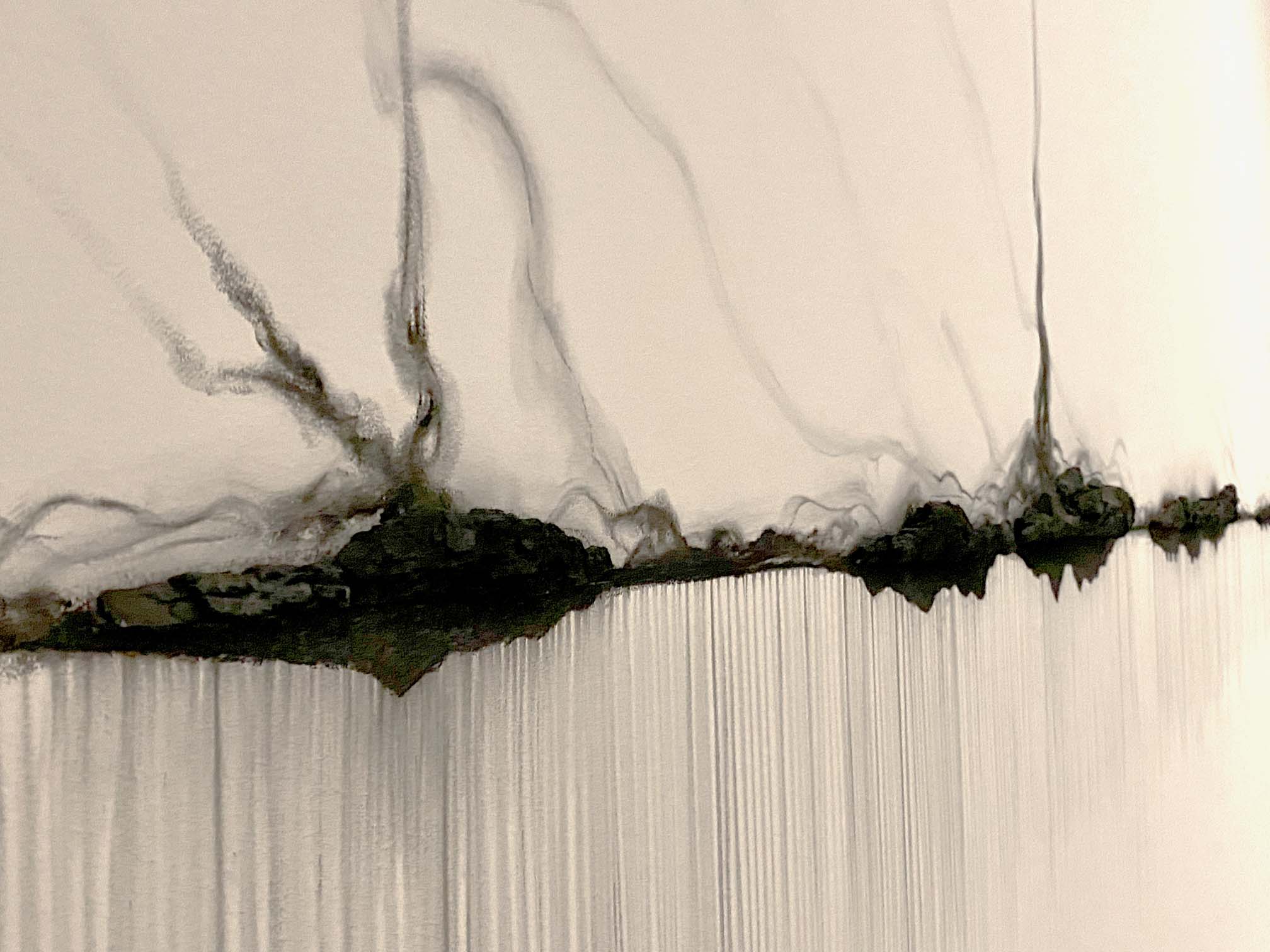
Nature’s continual ebb and flow, the Earth’s surface, ecosystems, and the cosmos ­are all subjects explored by both artists.What’s beneath the Earth’s surface, forces of nature, and human impact on it all pop up covertly in every room.  See more in our Flickr album.

Detail of 2017 charcoal work by Fernández Charred Landscape (America). Courtesy: the artist, Lehmann Maupin.
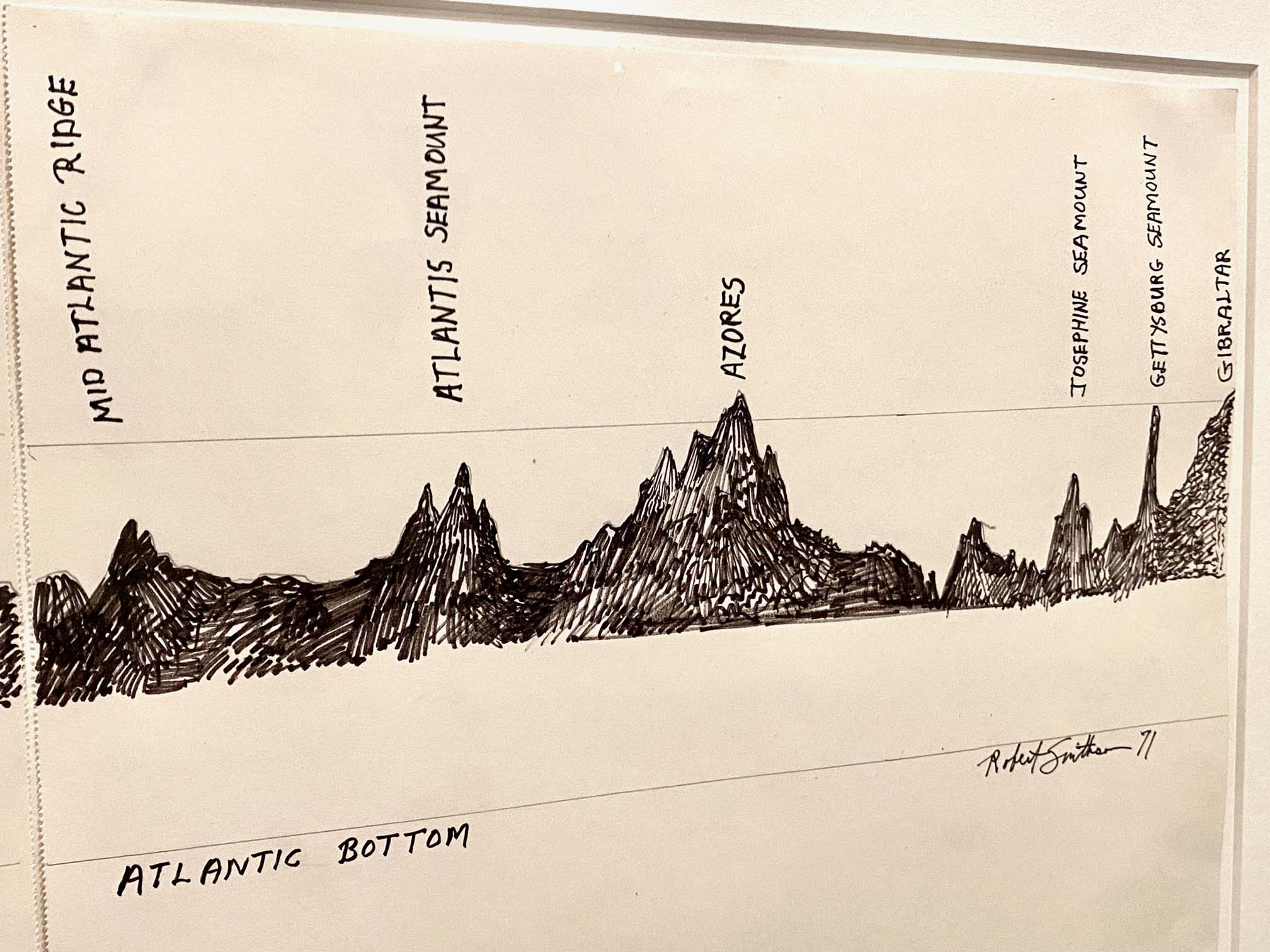
Detail of Smithson’s 1971 ink drawing A Profile of the Atlantic Bottom. Courtesy: private collection.

And learn more about the “conversations” that works by these artists are having in the curator lectures in SITE Santa Fe’s videos with Fernández herself and her co-curator from the Holt/Smithson Foundation.

Detail of Robert Smithson’s 1961-1963 paint and photo collage Algae, algae. Courtesy: Holt/Smithson Foundation and Marian Goodman Gallery.
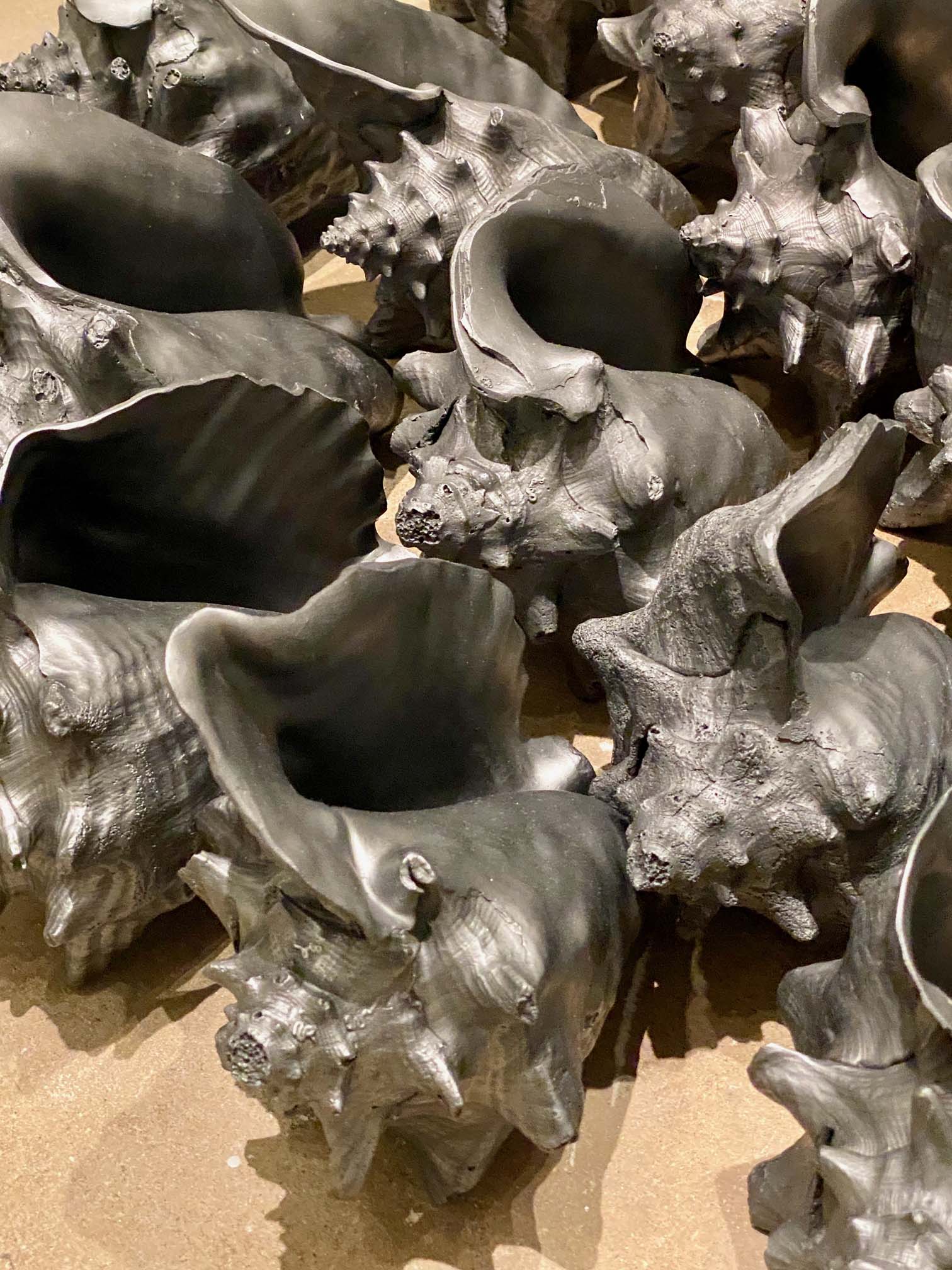
Detail of 2019 graphite-covered shell installation Chorus by Teresita Fernández. Courtesy: the artist and Lehmann Maupin.

National Gallery Celebrates 50 Contemporary Native Artists

If you want to take a trip across American land with 50 living Native artists, there’s still time to catch the ground-breaking exhibition, The Land Carries Our Ancestors: Contemporary Art by Native Americans, at Connecticut’s New Britain Museum of American Art through September 15, 2024.

The National Gallery of Art in Washington, D.C. asked Jaune Quick-to-See Smith (Citizen of the Confederated Salish and Kootenai Nation) to survey the United States and create an exhibition reflecting the diversity of the living Native American artists.

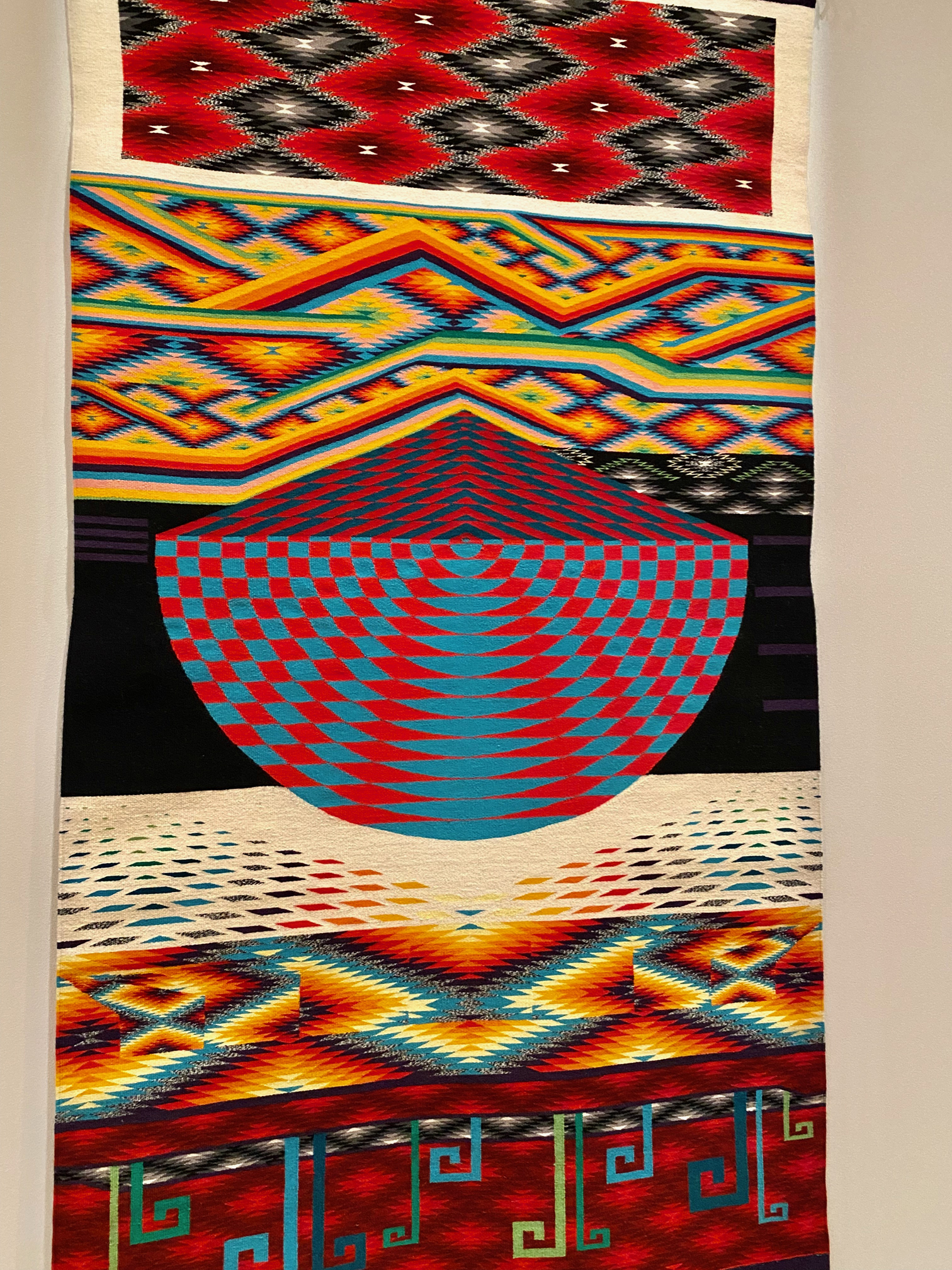
2014 wool weaving World Traveler by Melissa Cody (Navajo). Courtesy: Stark Museum of Art.

Smith, whose own artistic achievement was honored most recently in a three-museum retrospective in 2023-2024, became the first artist invited to curate a show at the National Gallery.

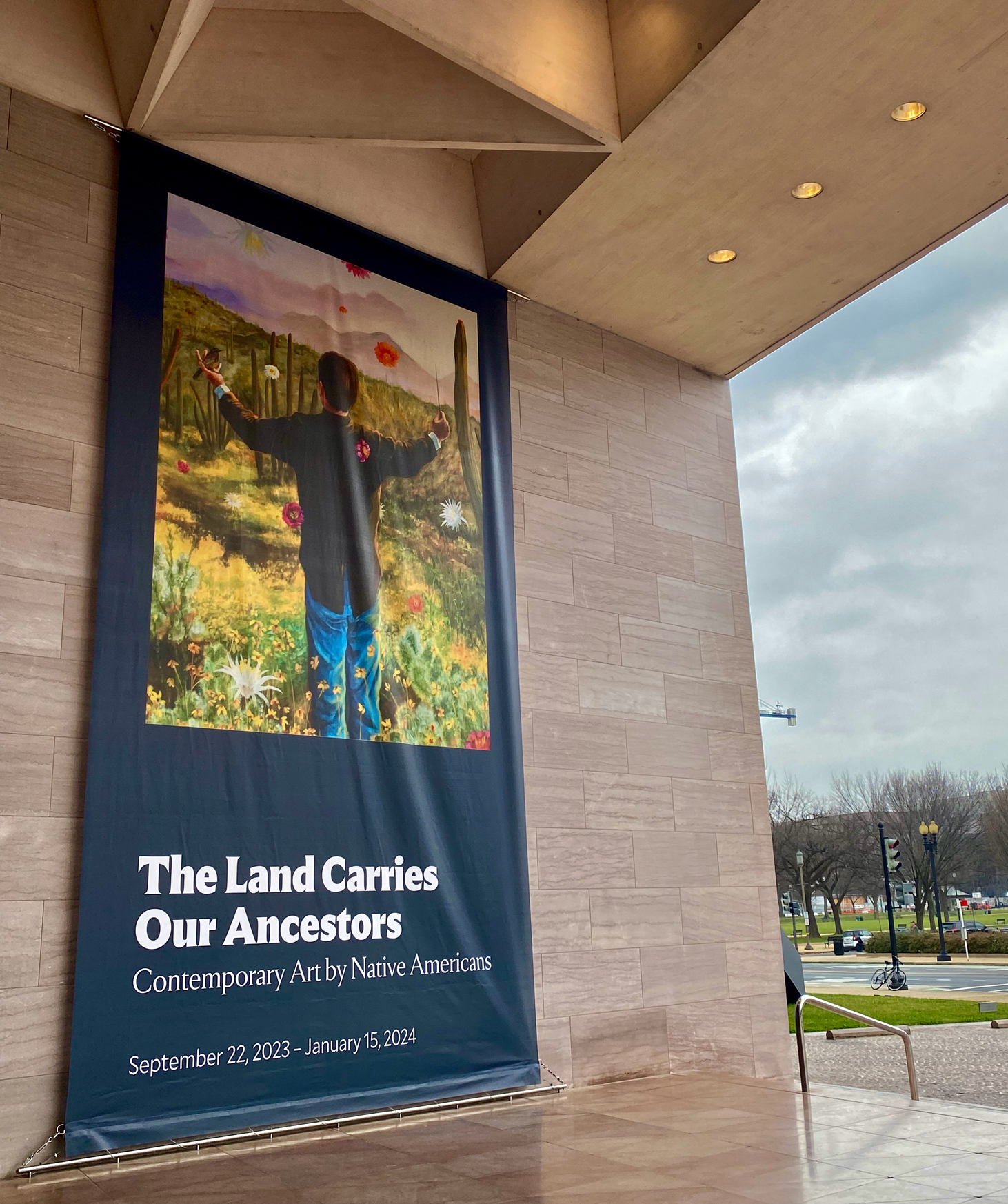
Entrance banner features Orchestrating a Blooming Desert by Steven Yazzie (Diné/Laguna Pueblo).

Smith has always done whatever possible to increase the visibilty of Native artists in the contemporary art world. For this exhibition, she chose 50 intergenerational artists from diverse regions, cultures, and artistic practices. Look at our Flickr album of the National Gallery installation to see some of our favorites.

All of the works reflect the artists’ deep connection to the land, especially Orchestrating a Blooming Desert by Steven Yazzie (Diné/Laguna Pueblo), a painting that reflects one man’s joyful encounter with a lush landscape.

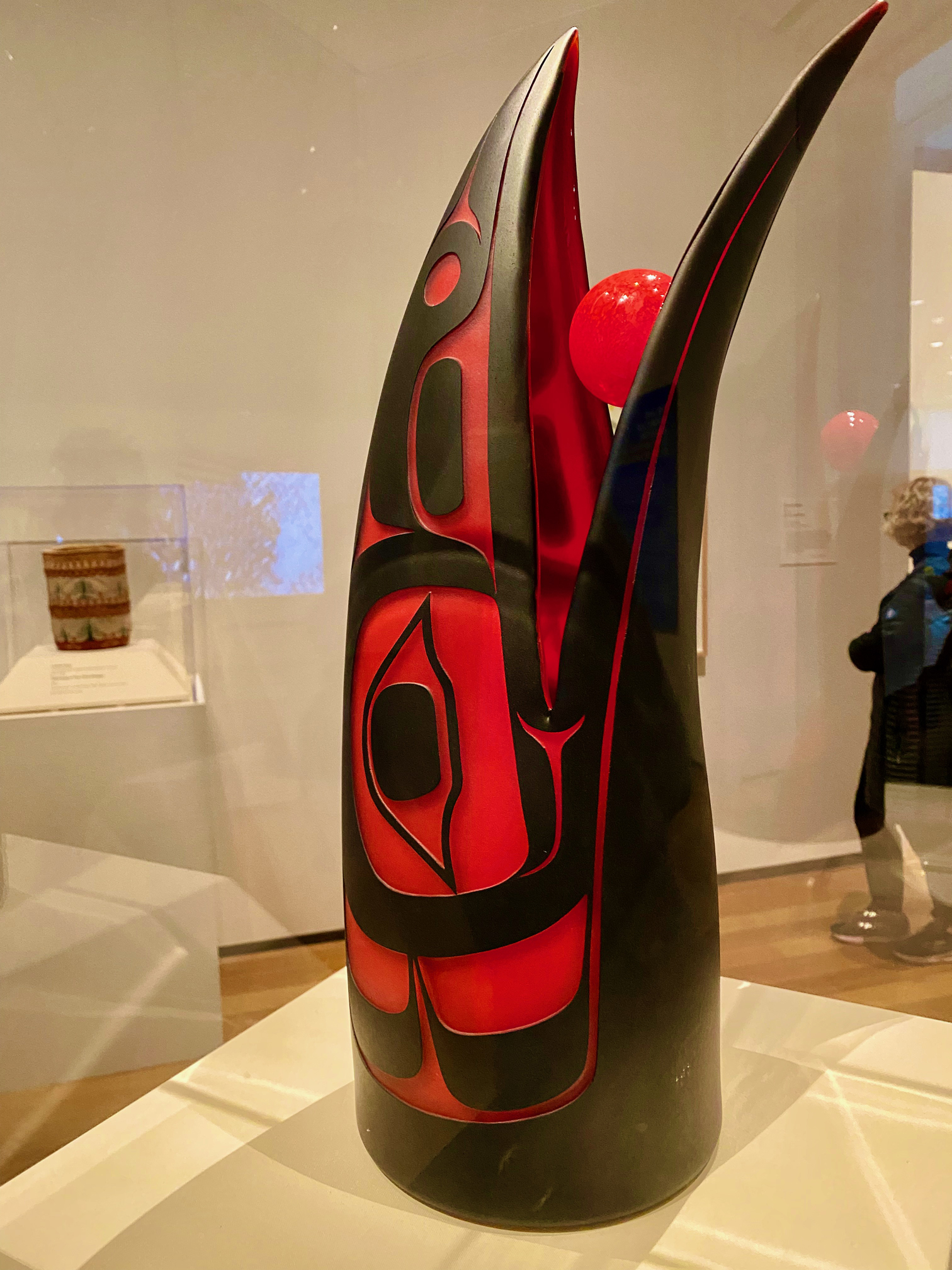
Some works depict a tribe’s link to the natural world through origin stories. Visitors are mesmerized by Preston Singletary’s exquisite sculpture of Tlingit creation-myth legend, Raven stealing the Sun. It’s glorious to admire this dramatic icon fully realized in a distinctly nontraditional medium – blown and sand-carved glass.

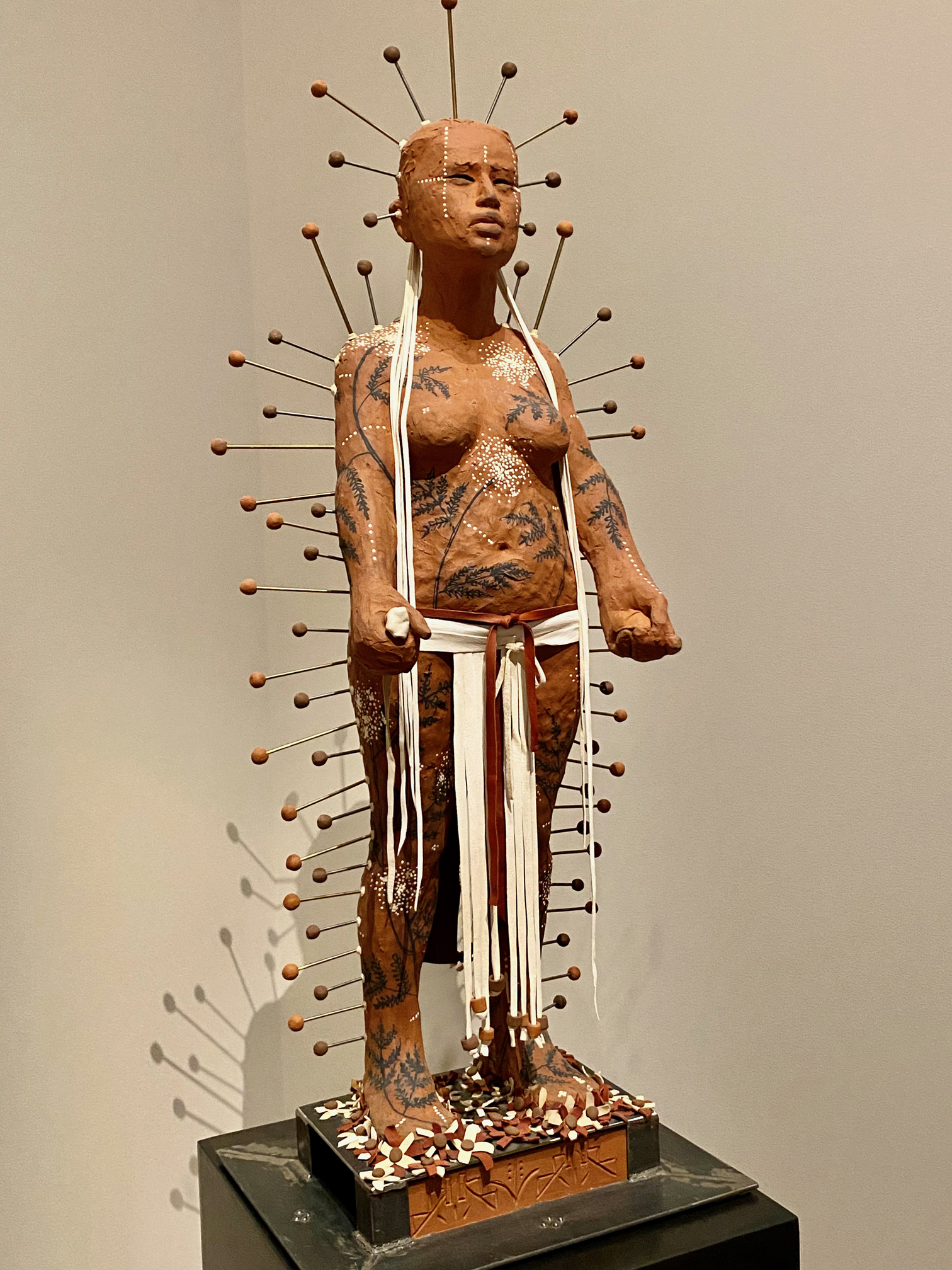
Experiencing the large, spiritual earth-colored ceramic figure by Rose B. Simpson (Santa Clara Pueblo) harkens back to eras when people had a more integral connection to the earth. Simpson calls her figure Tonantzin, an Aztec name for earth mothers, corn mothers, and even the Virgin of Guadalupe.

2017 blown and sand-carved glass Raven Steals the Sun by Preston Singletary (Tlingit). Courtesy: private collector.
2021 ceramic, steel, leather, and brass Tonantzin by Rose B. Simpson (Santa Clara Pueblo). Courtesy: Tia Collection.

Smith has chosen to hang many smaller two-dimensional works across a long wall in a checkerboard to suggest that visitors reflect on the impact of 1887 Dawes Act upon Native lands – a law that cut Native territory into “checkerboard” lots to facilitate private ownership.

At the National Gallery, Jeffrey Gibson’s punching bag (all made of found materials) was hung nearby, reminding us of the delicate balance that has to be struck by simultaneously caring for and taking gifts from the earth.

Next to checkerboard wall, the 2020 beaded punching bag To Feel Myself Loved On the Earth by Jeffrey Gibson (Mississippi Band of Choctaw Indians/Cherokee Nation). Courtesy: Hirschhorn Museum.

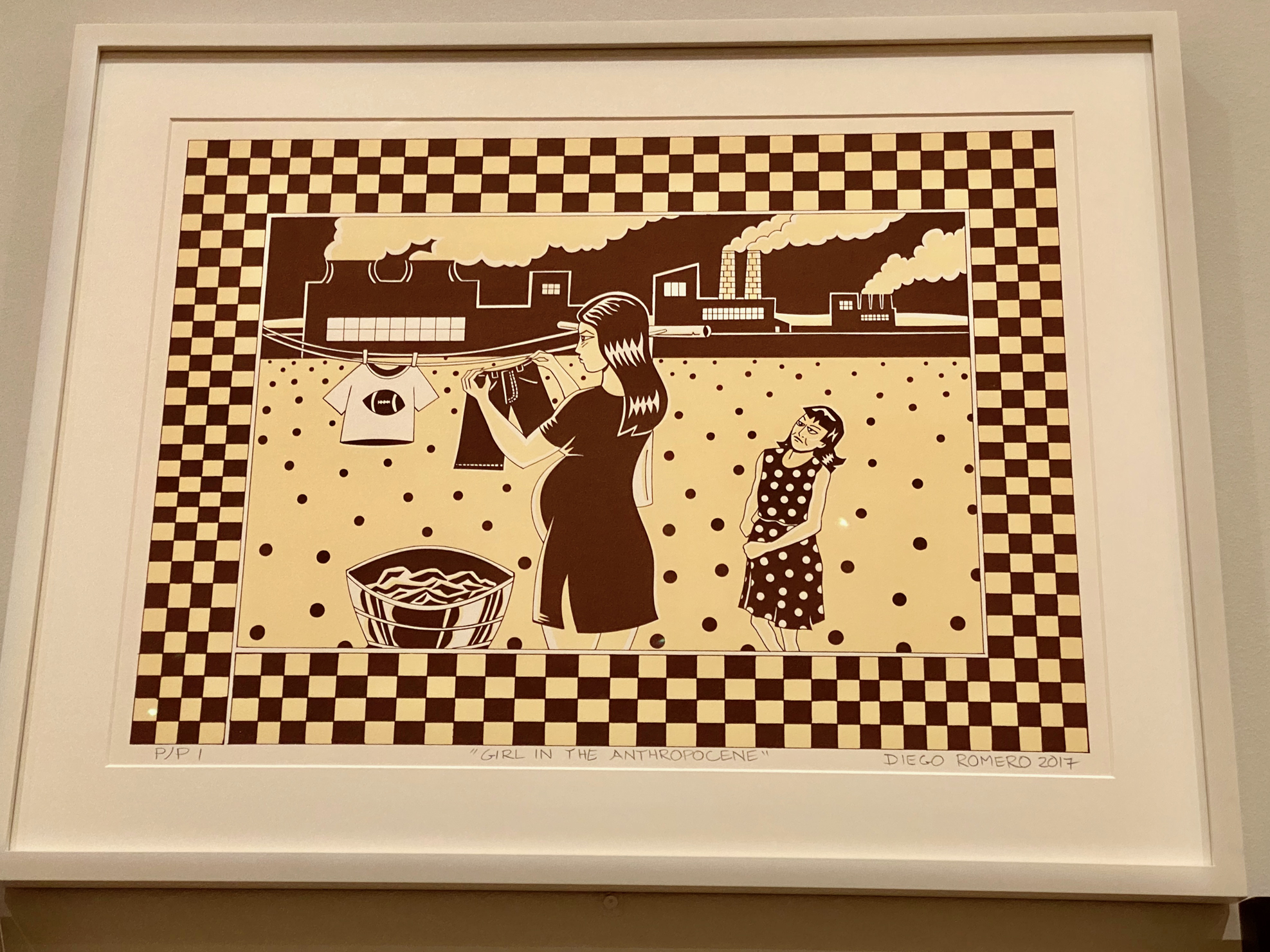
Some artists mix impressions of modern life with tribal lands, such as satiric works by Diego Romero (Cochiti Pueblo) and stylized symbols in a monoprint by Joe Fedderson (Colville Confederated Tribes).

2017 lithograph Girl in the Anthropocene by Diego Romero (Cochiti Pueblo). Private collection

In addition to sculptures, paintings, and photos, Smith has also included pieces made for fashion runways, live performances, and social protests.

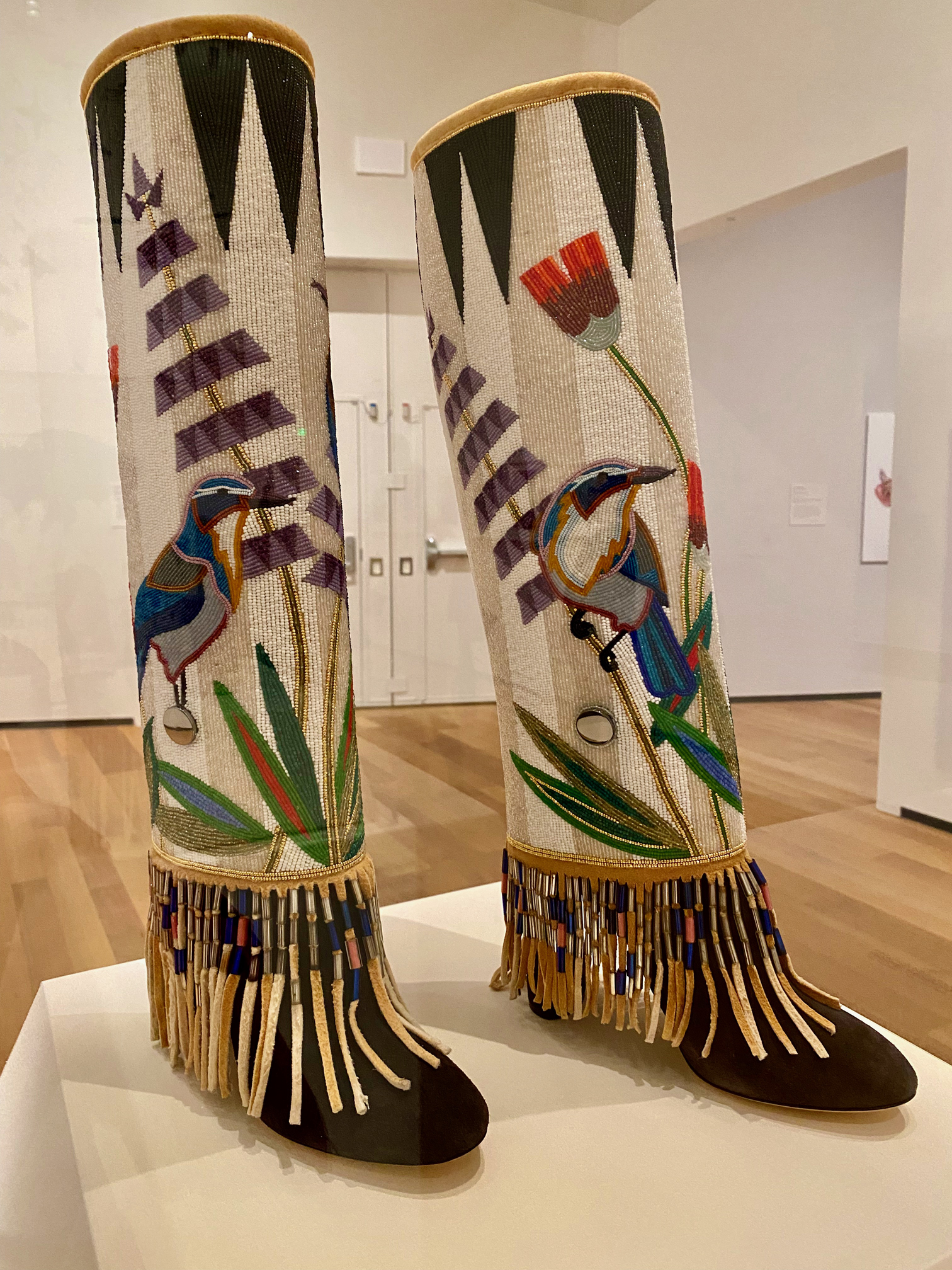
Fashion designer Jamie Okuma (La Jolla Band of Luiseno Indians) beaded her fringed fashion boots with a portrait of her family’s pet scrub jay.

Ten foot-long fiber seashell earrings designed for an interactive video and gallery performance by fiber and performance artist Eric-Paul Riege (Diné) are a reminder of the ancient trade networks that brought trade items from the ocean to the interior deserts.

2021 beaded and fringed Casedei boots by Jaime Okuma (La Jolla Band of Luiseno Indians). Courtesy: Dartmouth College’s Hood Museum
2020 mixed-fiber installation jaatloh4Ye’iitosoh [3-4] by Eric-Paul Riege (Diné). Courtesy: Tia Collection.

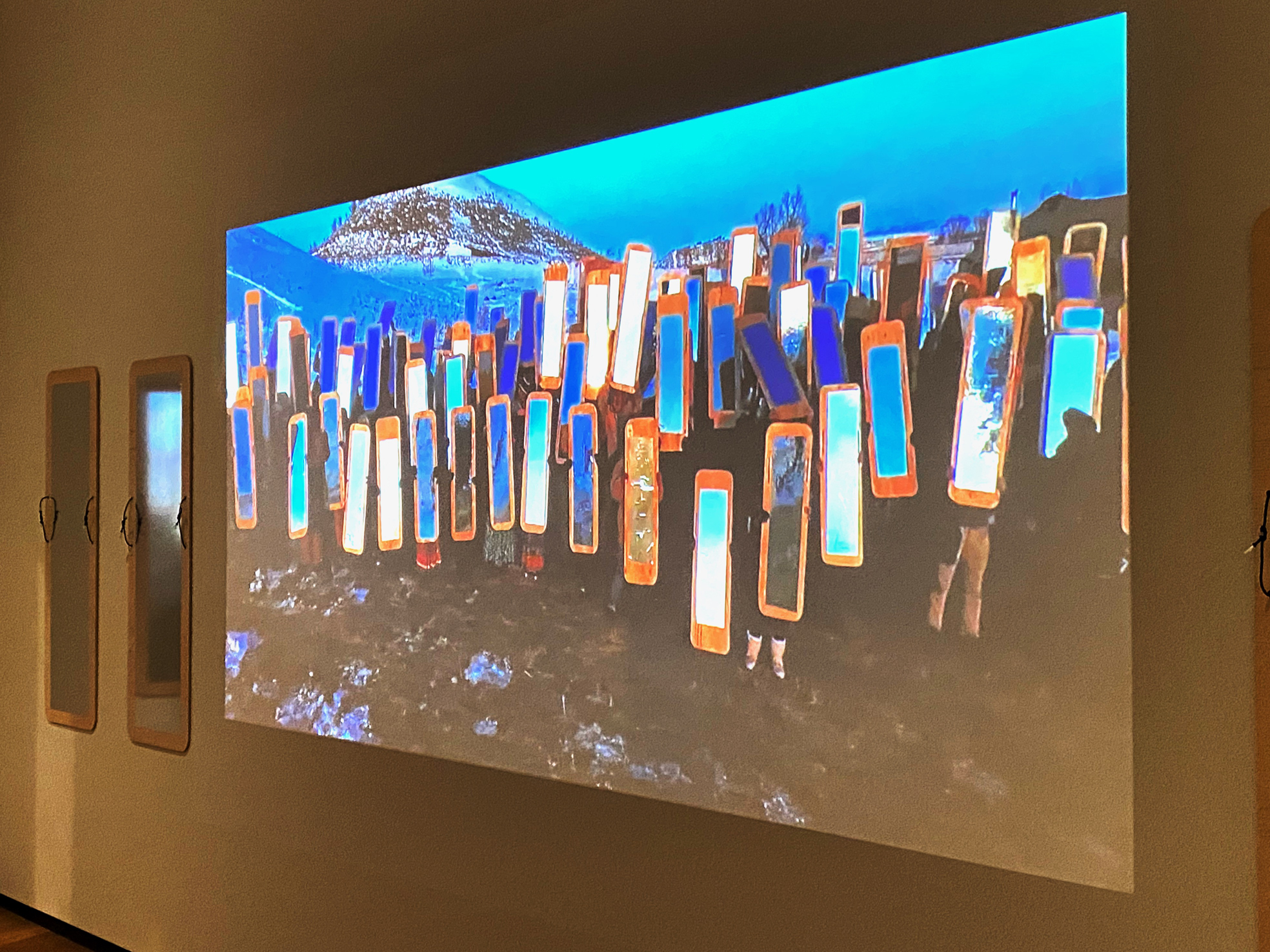
A wall of “mirror shields” were mounted by artist-activist Cannupa Hanska Luger (Mandan/Hidatsa/Arikara/Lakota), showing just a small sample of the 1,000 protective and reflective shields made by people to help water protectors during thre 2016 pipeline intervention at Standing Rock Sioux Tribe Reservation, Luger’s childhood home. Take a look at Luger’s instruction video here.

The shields served to protect the peaceful protesters from rubber bullets and water cannons, and reflected images of the security forces back to them. The crowd-sourced shields were also used in a social-action performance piece at Standing Rock.

2016 mirror shields and video for Mirror Shield Project – River (The Water Spirit) by Cannupa Hanska Luger (Mandan/Hidatsa/Arikara/Lakota). Courtesy: the artist, Garth Greenan Gallery.

Textiles and vinyl drawings also pack a punch in this show. Take a look at the dazzler woven by Melissa Cody (Diné), who draws inspiration from video gaming and the matriarchs of Navajo Nation. Watch her interview from her recent exhibition at MoMA PS1.

Here, John Hitchcock explains how his room-sized drawing, Impact vs. Influence, incorporates his influences – nature, family, Native beadwork, and the next-door military base:

Take a look the National Gallery’s trailer and meet the 50 contemporary artists whose work and relationship to the land is celebrated in the show:

Pedro Reyes Takes Direct Action in Santa Fe

You first see a group of anonymous protestors – statues that appear to be taking it to the streets with placards and bullhorns. Elevated at different levels, they present a monument to non-violent protest – a fitting opening to Pedro Reyes: DIRECT ACTION, on view at SITE Santa Fe through May 1.

Reyes believes in participatory art projects that transform art-making into social action.

The Protesters, Reyes’ 2016-2017 monument to unified voices that bring about change from non-violent protest. Courtesy: the artist, private collectors.
Memento, 2022 – vases made from gun parts by Albuquerque and Santa Fe students. All for sale.

The products of his 2022 Memento are right behind you – an array of fun flowers popping out of tall vases. Look closer.

The airy containers are transformed guns from a New Mexico buyback program that incentivized people to exchange their guns for grocery or home-store gift cards. The vases, made by welding-class students from Albuquerque and Santa Fe, are all for sale, with proceeds going to fund activities by New Mexicans to Prevent Gun Violence.

Turning the corner into the next installation, you encounter a wall of videos and shovels in a similar transformation – Palas por Pistoles – that Reyes organized in a particularly violence-prone community in western Mexico.

Reyes’ Palas por Pistoles (2006-present) – shovels made from melted-down gun parts, which were used by schools and museums to plant trees.

Reyes asked people to donate guns to be melted down for an art project promoting environmental peace. He received 1,527 weapons, crushed them in a public-art event, and commissioned a foundry to make shovels. Schools and museums used the shovels to plant 1,527 trees.

Every turn in the gallery reveals a different type of installation and project – libraries for “the people,” sculptures referencing language systems, posters protesting nuclear arms, and musical instruments and contraptions created from weapons.

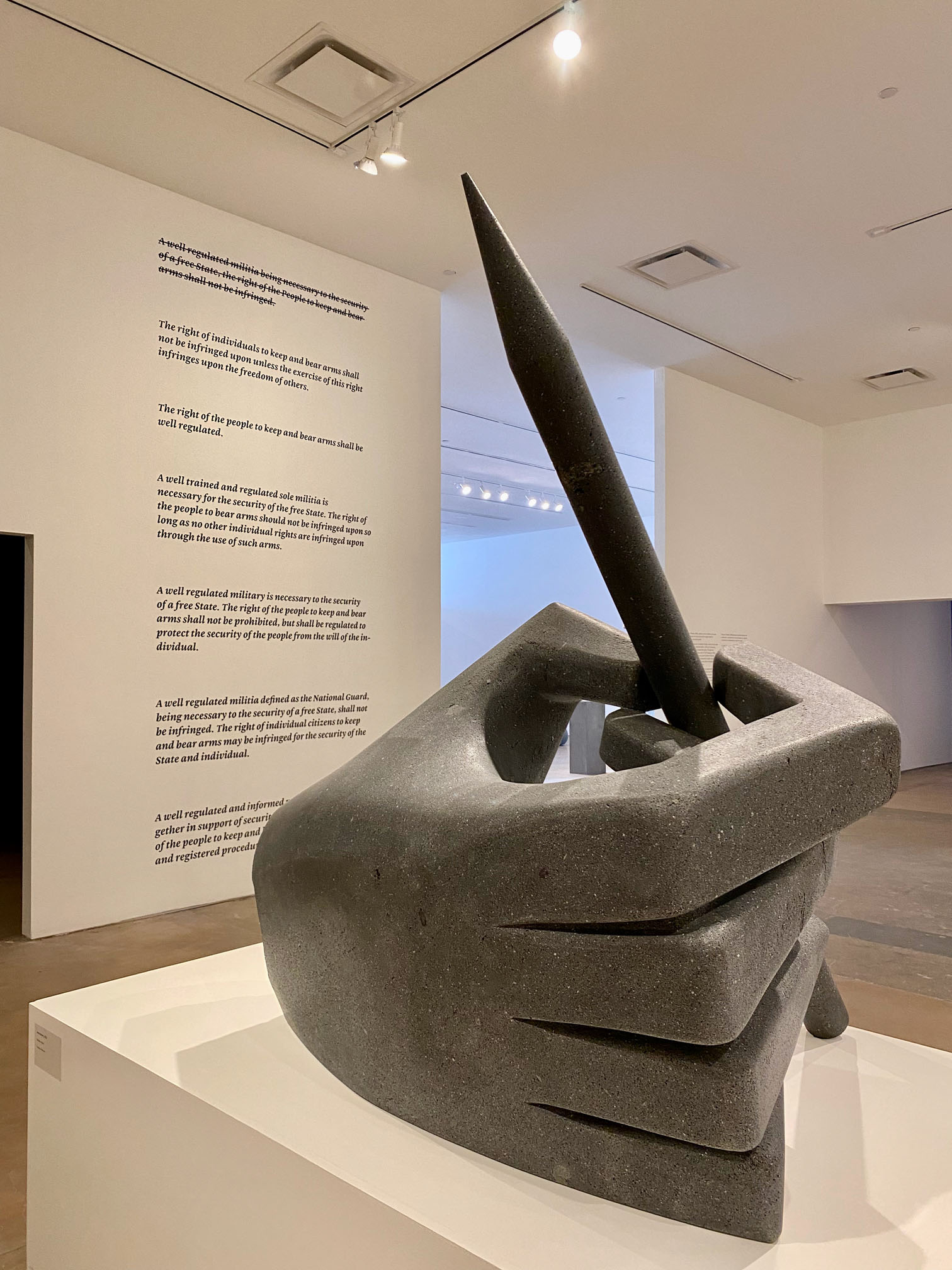
You can’t miss the artist’s large volcanic-rock hand with pencil – an emblem of Reyes’ Amendment project that held community meetings where rewrites to the Second Amendment were proposed and discussed. The idea is that with so much discussion on policies these days, it’s better to write down the “amendments to the Amendment” in pencil! A list of suggestions is prominently posted nearby.

2002 Amendment volcanic stone hand writes the Second Amendment in pencil to facilitate changes in wording as necessary. On wall, multiple drafts of the Second Amendment generated in a Tampa, Florida community project.
Reyes’ 2022 marble sculpture, Colloquium (Parafrasis) depicting the architecture of speech; in background, icons of solutions to social problems from The People’s United Nations (pUN) project – food insecurity, population, gun control, mass incarceration.

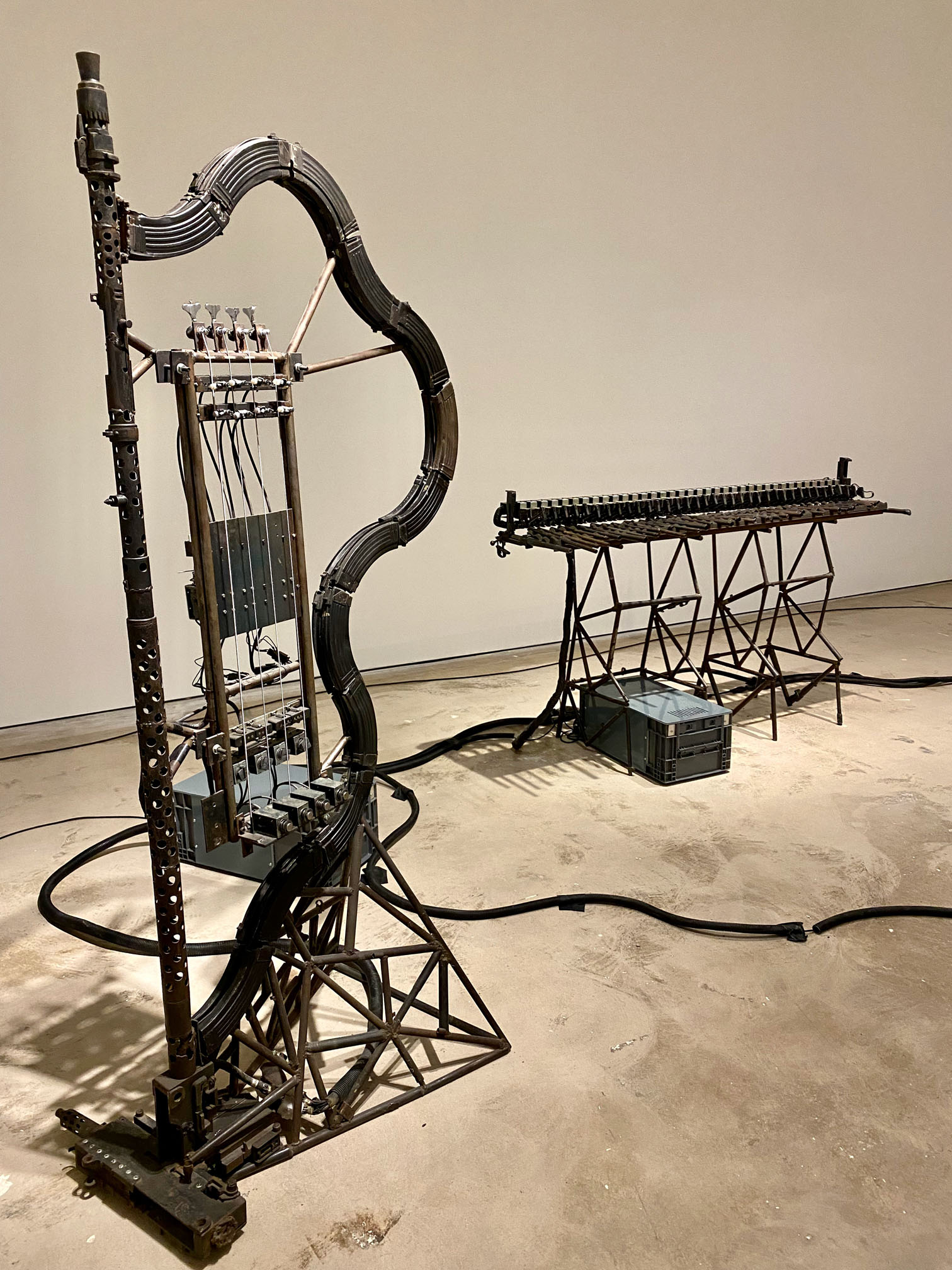
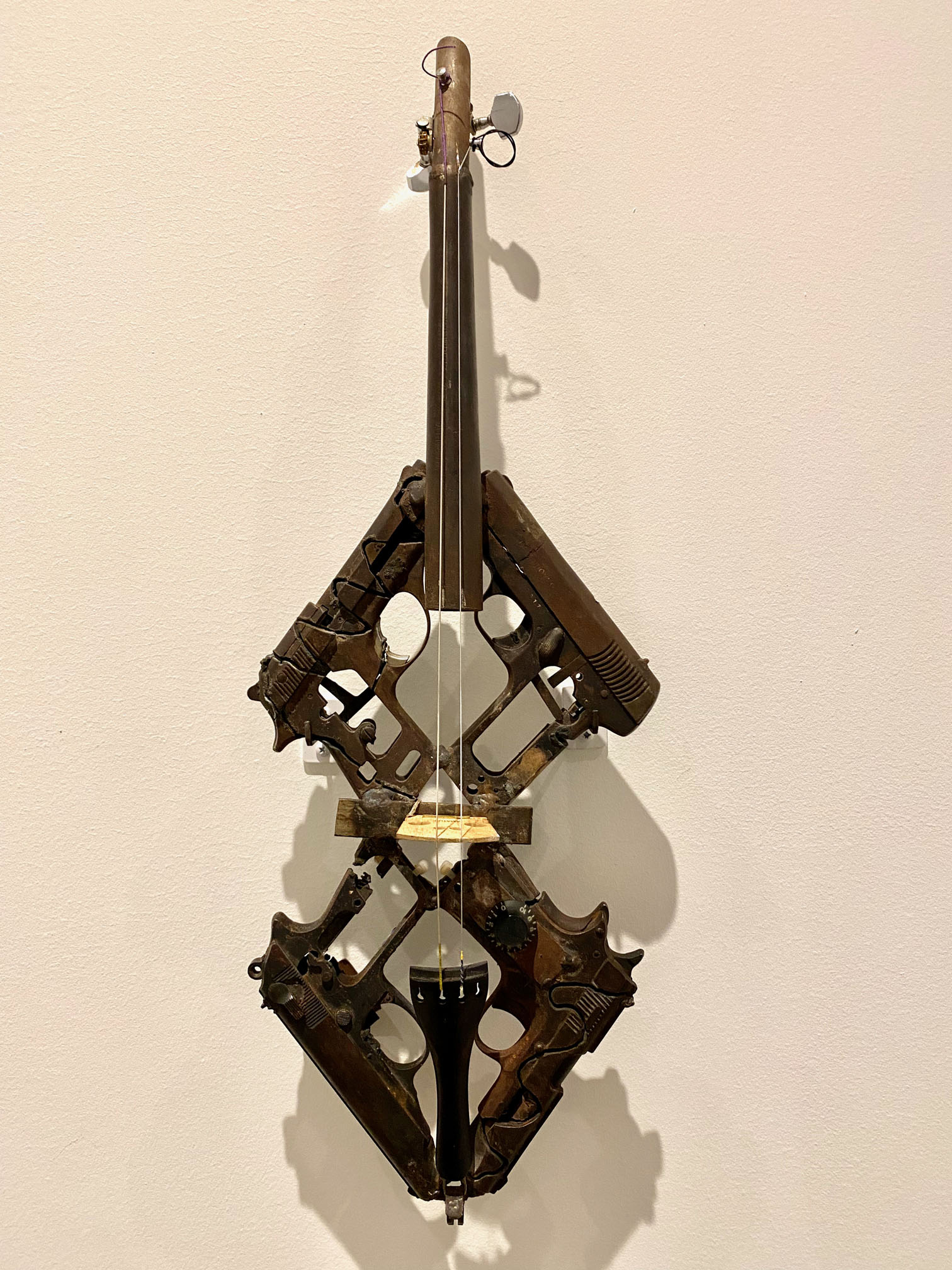
Visitors tend to linger in the Disarm gallery, closely examining the various automated musical instruments created from firearms. Every few minutes, one of the pieces awakens to pluck a string or tap out a slow sequence. It’s a bit startling, not knowing which of the seven is going to activate next.

Harpanet and Cañonófono in Disarm Mechanized, mechanized instruments made from recycled gun and rifle parts. Courtesy: Enrique Rojas.
Reyes’ 2012 Disarm (Violin) from destroyed weapons, played in SITE Santa Fe concerts in 2023. Courtesy: the artist.

Take a look at our Flickr album to see more of the exhibition and to hear the sounds made by the Disarm instruments.

SITE Santa Fe provides “activators” for Reyes’ Music Machine installation – an experience that demonstrates how one artist’s imagination can make you stop and think, even if it’s toward the end of a deep, contemplative show.  Reyes features iconic firearms from three European countries – Austrian Glocks, Swiss Carbines, and Italian Barettas – that have been transformed into classy music boxes. When activated, each plays a musical composition by a famous composer from that country.

Gallery educator Red Hart about to activate Reyes’ Machine Music – crank-operated music boxes made of Swiss Carbine rifles, Italian Barettas, and Austrian Glock pistols.

Hear the artist talk about each of these works in the SITE Santa Fe audio guide, and take time to ponder taking direct action as you visit this beautifully installed, socially relevant, and thought-provoking show.

No Nukes installation with series of 2022 hand-painted Zero Nukes posters in different languages, representing many countries. Courtesy: the artist.