Santero Nicholas Herrera at the Harwood

The local artist honored in Taos with a lifetime retrospective lives and works only 18 miles from Georgia O’Keeffe’s famous home in El Rito. But their work, lives, purpose, and legacy couldn’t be further apart.

Nicholas Herrera: El Rito Santero, on view at the Harwood Museum of Art through June 1, fills three galleries with work by a New Mexican wood carver who not only pays tribute to saints and ceremonies important to the nearby rural Hispanic communities, but also channels politics, social commentary, lowrider culture, and pressures of modern life in a mixed-up world into his craft.
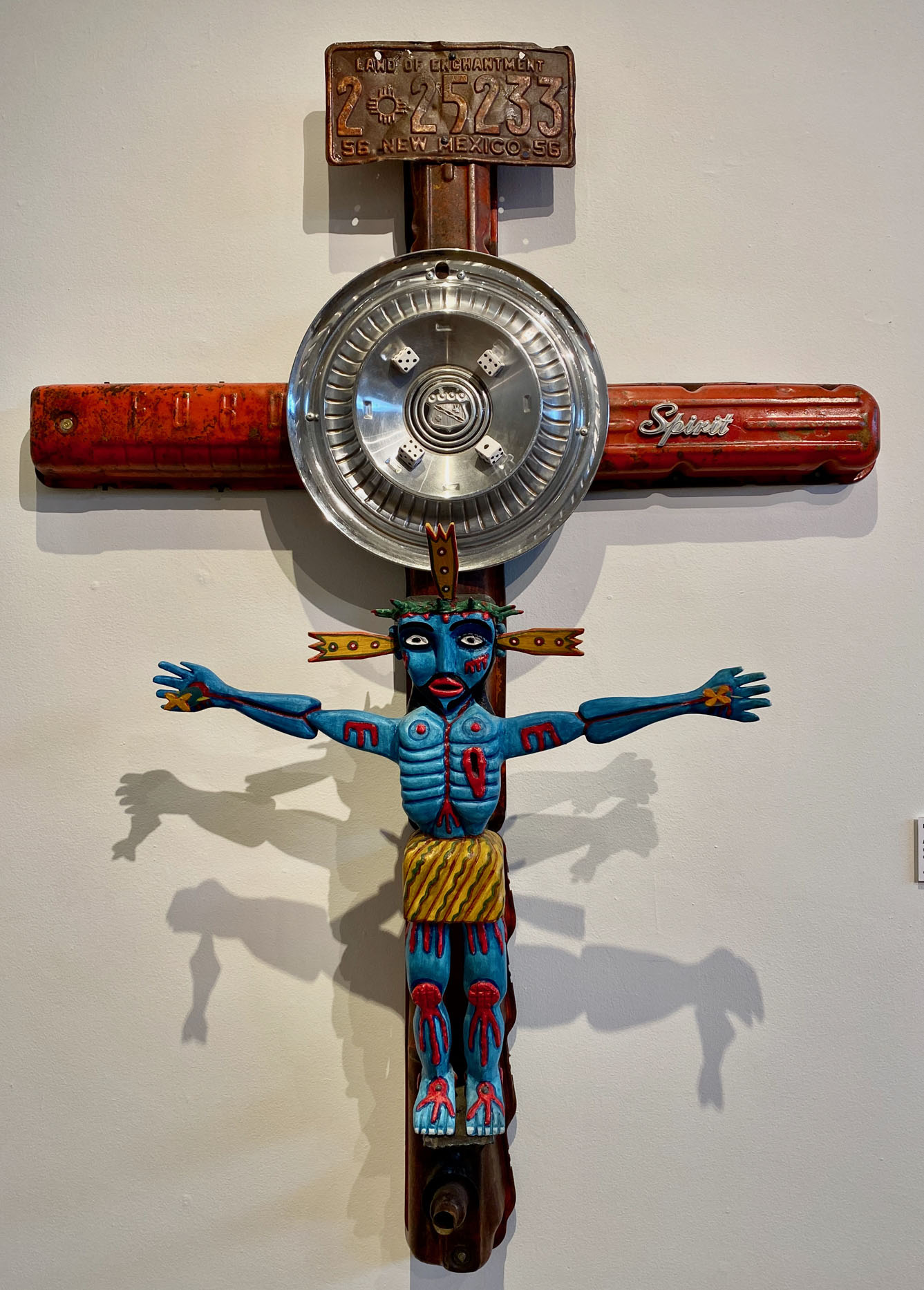
Herrera’s Espiritu mixes religion with found car parts. Courtesy: private collector

It’s a colorful, irreverent, heart-felt tribute to the people, places, religion, and culture of the rural high hills that he calls home. And here’s Herrera’s self-portrait – the namesake of this engaging retrospective.
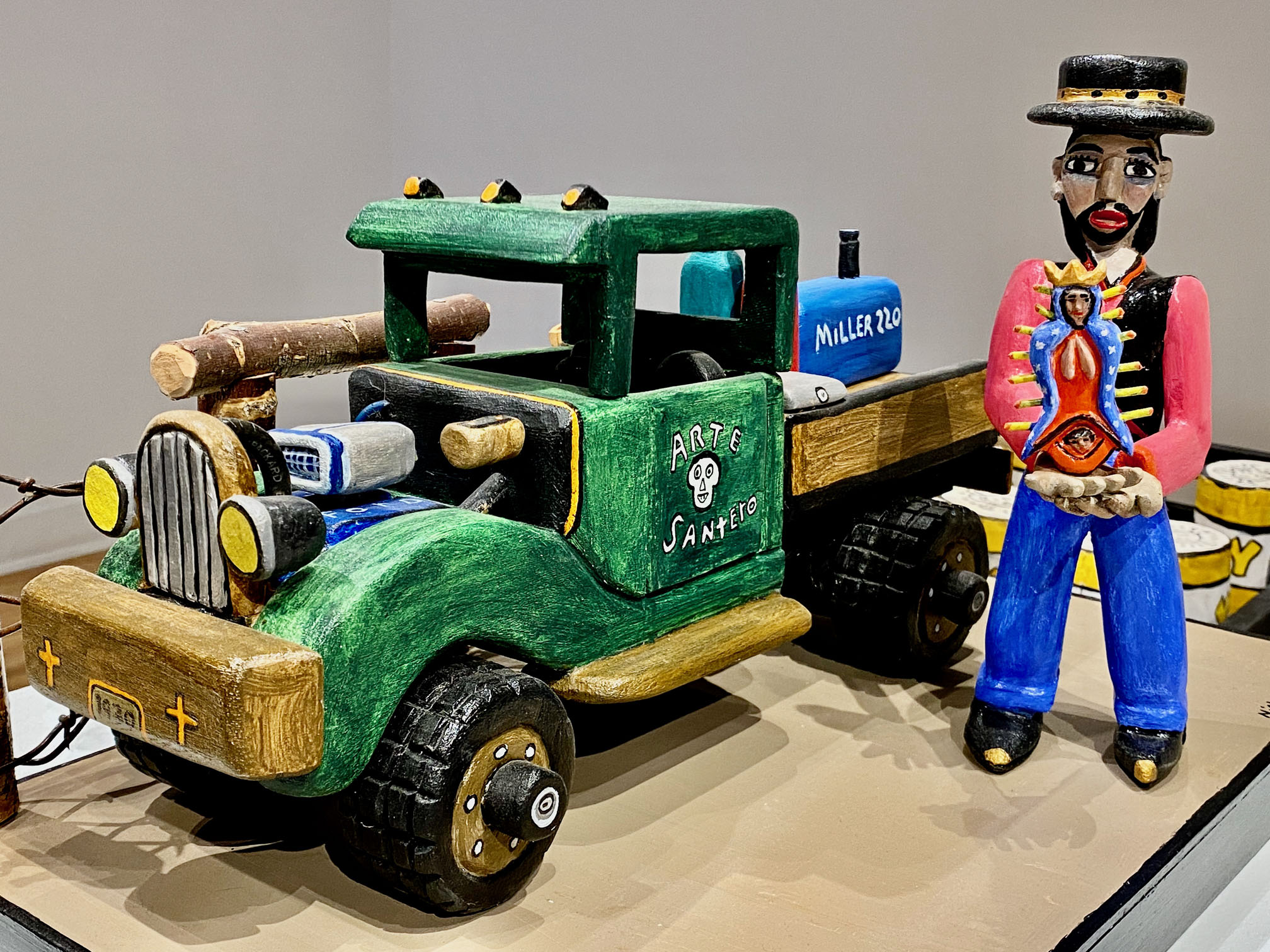
Herrera’s 2022 hand-carved self-portrait – El Rito Santero. Courtesy: private collection
Herrera’s1998 hand-carved image of his favored protector La Virgen de Guadalupe. Courtesy: Evoke Contemporary

At first glance around the gallery at the top of the back stairs, Herrera’s work seems firmly situated in the tradition of the last 400 years of northern New Mexico saint-carving. Since the 1600s, when Spanish farmers first colonized these remote hills, the faithful relied primarily on local artists and carvers to decorate home chapels, churches, and shrines.

Herrera’s work is the 20th century version. There’s a grand, colorful painted altar honoring his brother in which a pantheon of Catholic icons gazing benevolently upon you. You’ll also meet his special icon – a bright, enigmatic Lady of Guadalupe.

In a small, dark room you’ll experience a powerful home altar, filled with hand-carved spiritual tributes, surrounded by candles and and all manner of other-worldly retablos.  

But the next two galleries, you’ll encounter work using these same materials and techniques, but reflects life-changing events in the artist’s life that are mashed up with ancient spiritual traditions – Jesus in the back of a speeding cop car, Herrera’s own near-death experience in a car crash when he was in this twenties, and a crazy lights-flashing slot machine promising allures that only the Devil can love., or aerial views of old Spanish valleys.
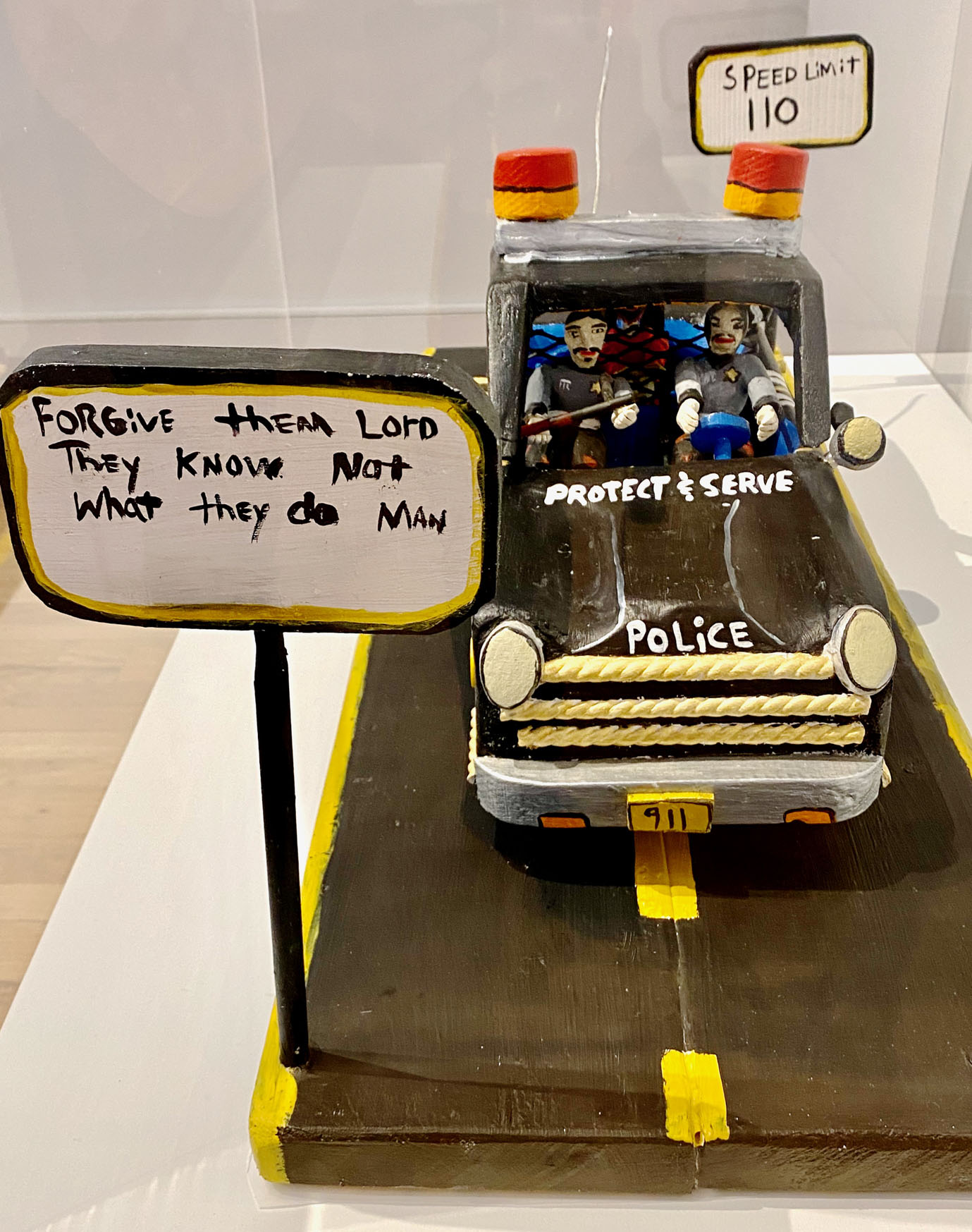
Herrera’s 1994 painted wood and mixed-media sculpture Protect and Serve with Jesus in the back seat of the patrol car. Courtesy: Smithsonian American Art Museum
Herrera’s 1995 painted wood and metal Los Alamos Death Truck. Courtesy: private collection

Like all great artists, Herrera is inspired from life events and the world around him – reflections about his growing up and home life, land-use and traditions in his community, and issues ripped from the headlines, like the terror of transporting Los Alamos nuclear waste or issues with the border patrol.
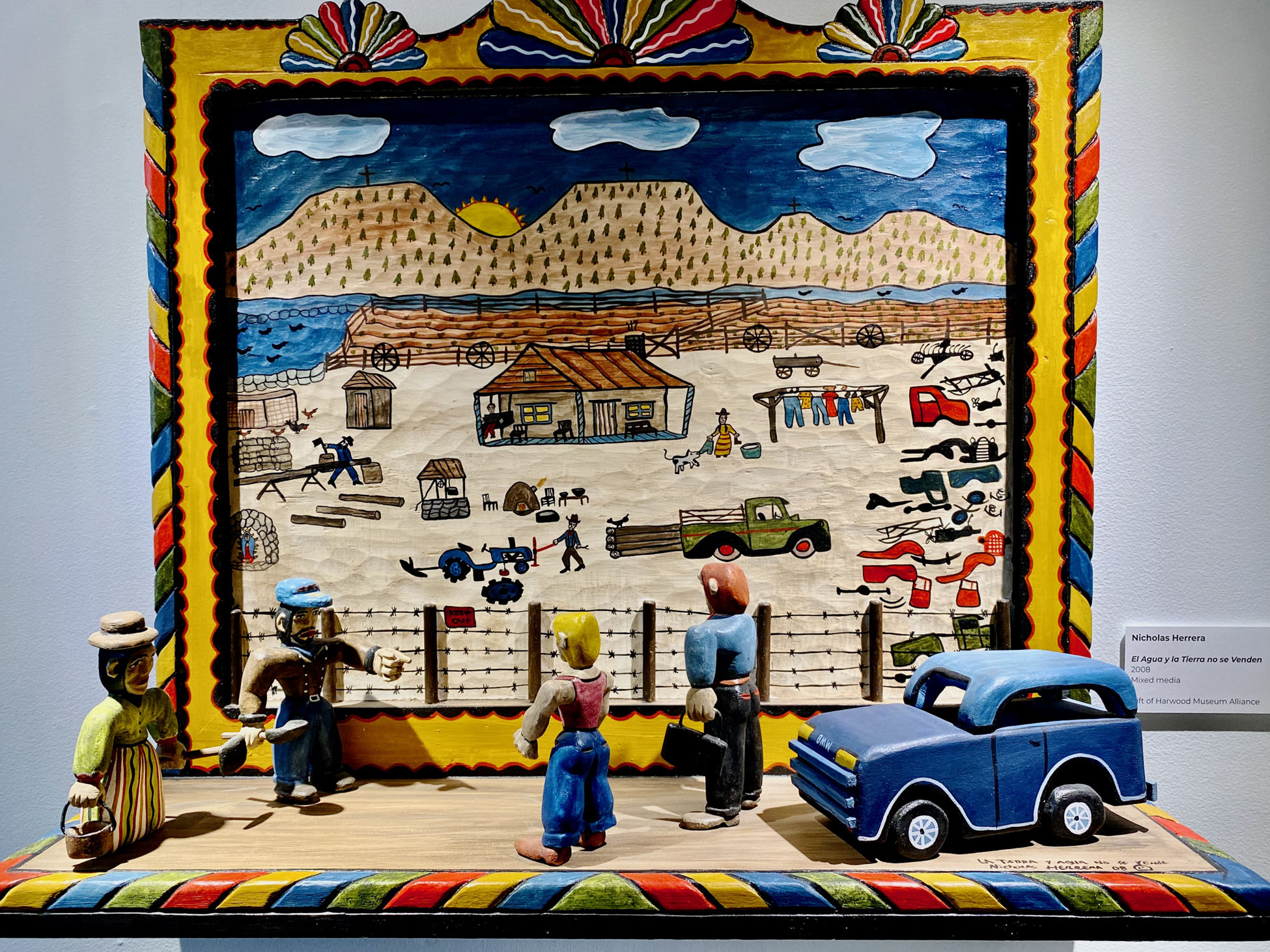
Herrera’s 2008 mixed-media El Agua y la Tierra no se Venden, highlighting the importance of 400 years of protective land stewardship in Northern New Mexico.

Used car parts, toy parts, and other stuff from the junkyard “tell” Herrera how and where he might use them. Lowrider culture is an important source of price in Northern New Mexico, so it’s not surprising that he’s channeled that part of the local experience into his work, too.
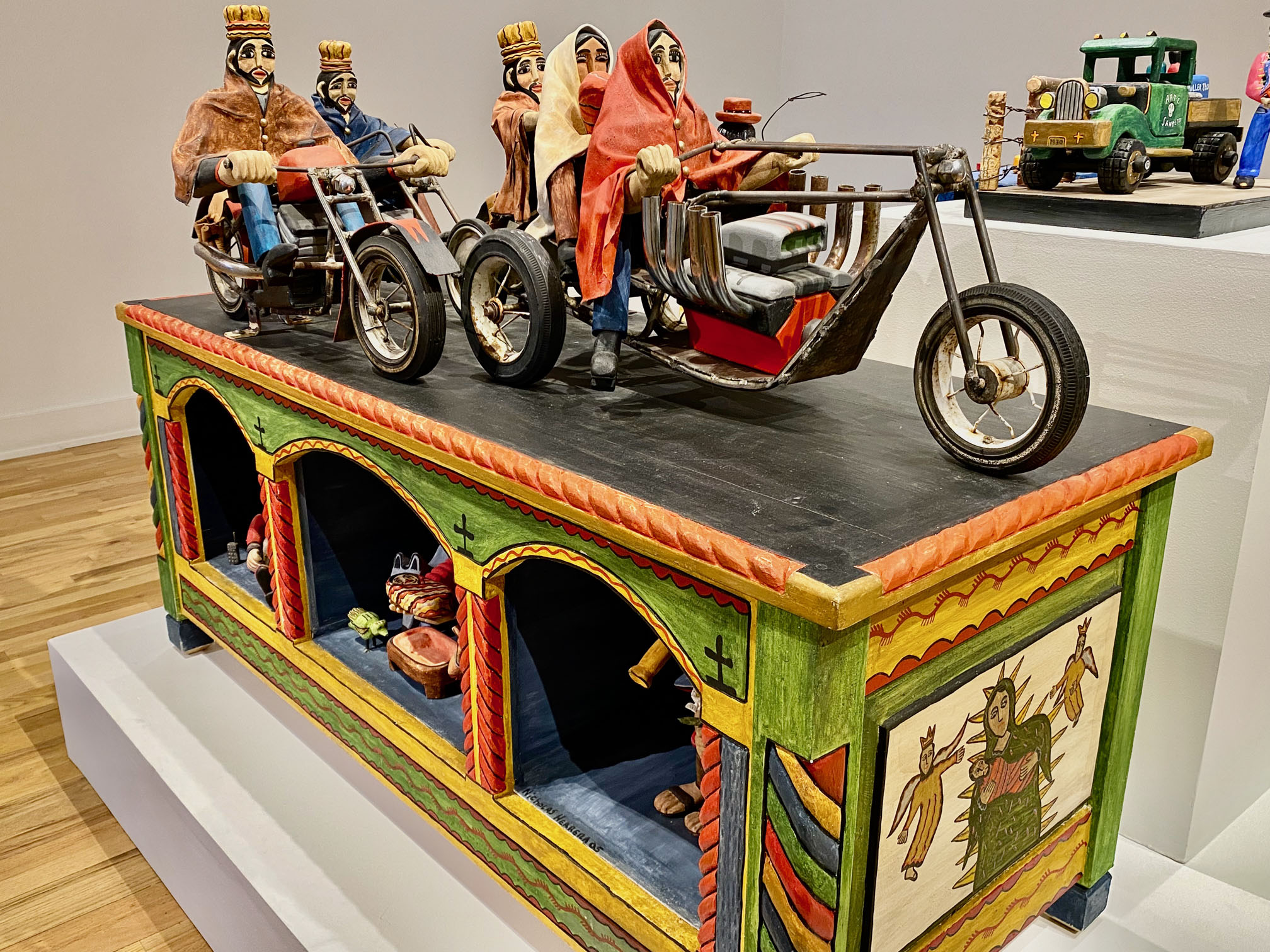
The Holy Family hits the road in Herrera’s 2005 carved and painted Low Rider Nativity, embellished with cloth, toy wheels, and found metal. Courtesy: private collection

See some of our favorite works in our Flickr album, and meet the artist himself in this short video profile created by the Smithsonian American Art Museum:

Fronteras del Futuro in the Southwest

Pow! Wham! What? It’s superheroes, avatars, and mixed-media channeling sci-fi social consciousness in an engaging, colorful, thought-provoking mix in the super-fun Fronteras del Futuro: Art in New Mexico and Beyond exhibition at Albuquerque’s National Hispanic Cultural Center through March 12.

These artists love mixing pop culture images, found objects, and historic iconography to question where we’ve been and where we’re going. Take a look at our favorites in our Flickr album.

Some artists use pop culture to get our attention on deeper issues. The back-to-the-future B-movie poster series by Angel Cabrales prompts reflection on societal attitudes about immigrants and border issues.

2016 B-movie poster by Angel Cabrales to spur discussion on immigration and border issues. Courtesy: the artist.

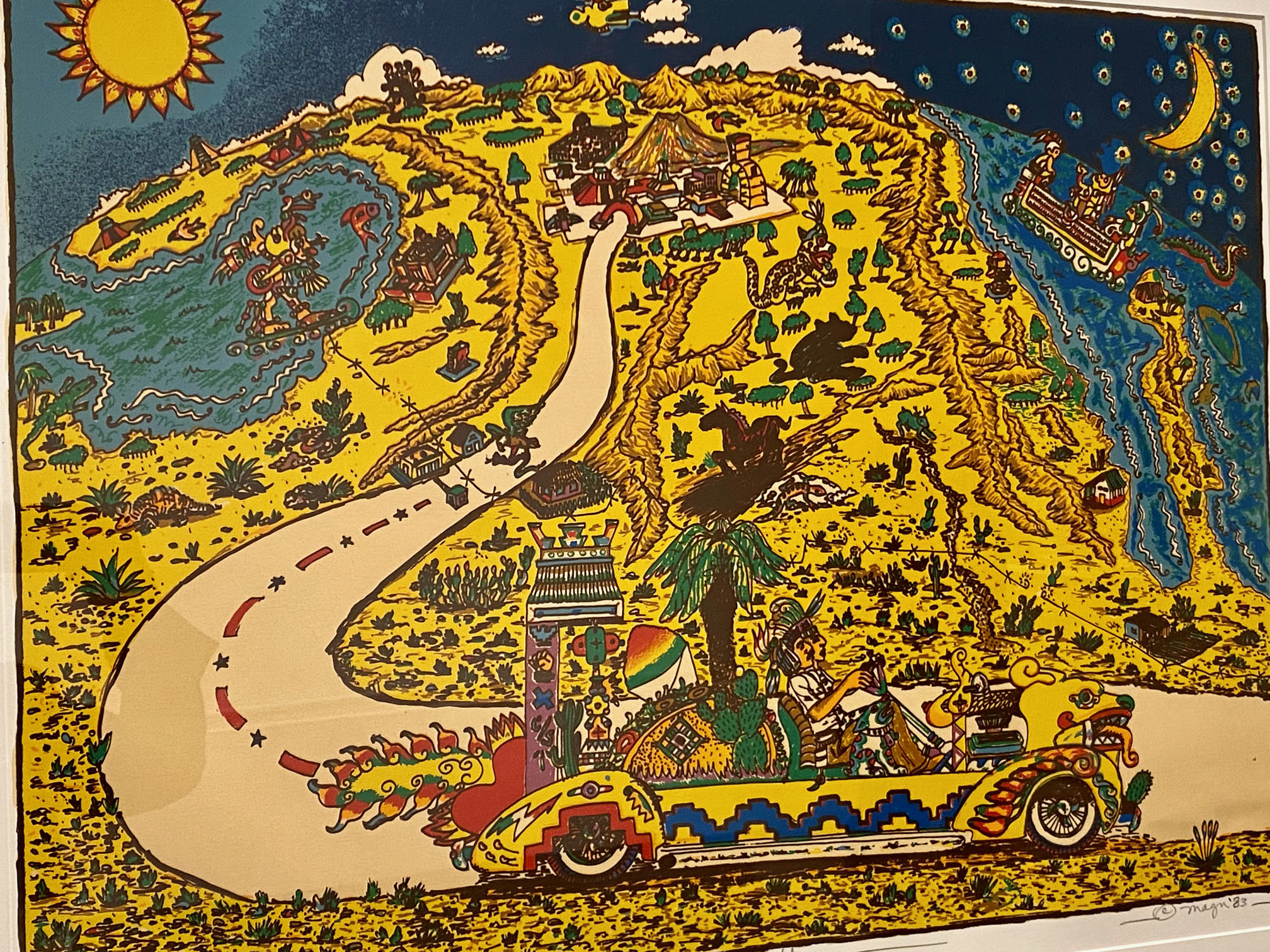
Gilbert “Magú” Luján’s silkscreen merges the epic scope of Mesoamerican history into a contemporary context. A stylish Aztec couple takes a cross-border journey from Aztlán to Texas in a pre-Columbian-styled low rider.

1983 silkscreen Return to Aztlán by Gilbert “Magú” Luján; a cross-border journey and reflection on pre-Columbian roots and heritage.

One of the most epic achievements is a wall-length, accordian-folded letterpress codex – a collaboration by Enrique Chagoya, Guillermo Gómez-Peña, and Felicia Rice. Codex Espangliensis features pop-culture superheroes, pre-Columbian imagery, comics, and social declarations to explore New World history from 1492 to the present.

Designed to be read right to left: cover and first pages of Codex Espangliensis from Columbus to the Border Patrol, a hand-colored letterpress accordian-folded book.
Pages from 1999 Codex Espangliensis from Columbus to the Border Patrol, a hand-colored letterpress book by Enrique Chagoya, Guillermo Gómez-Peña, and Felicia Rice.

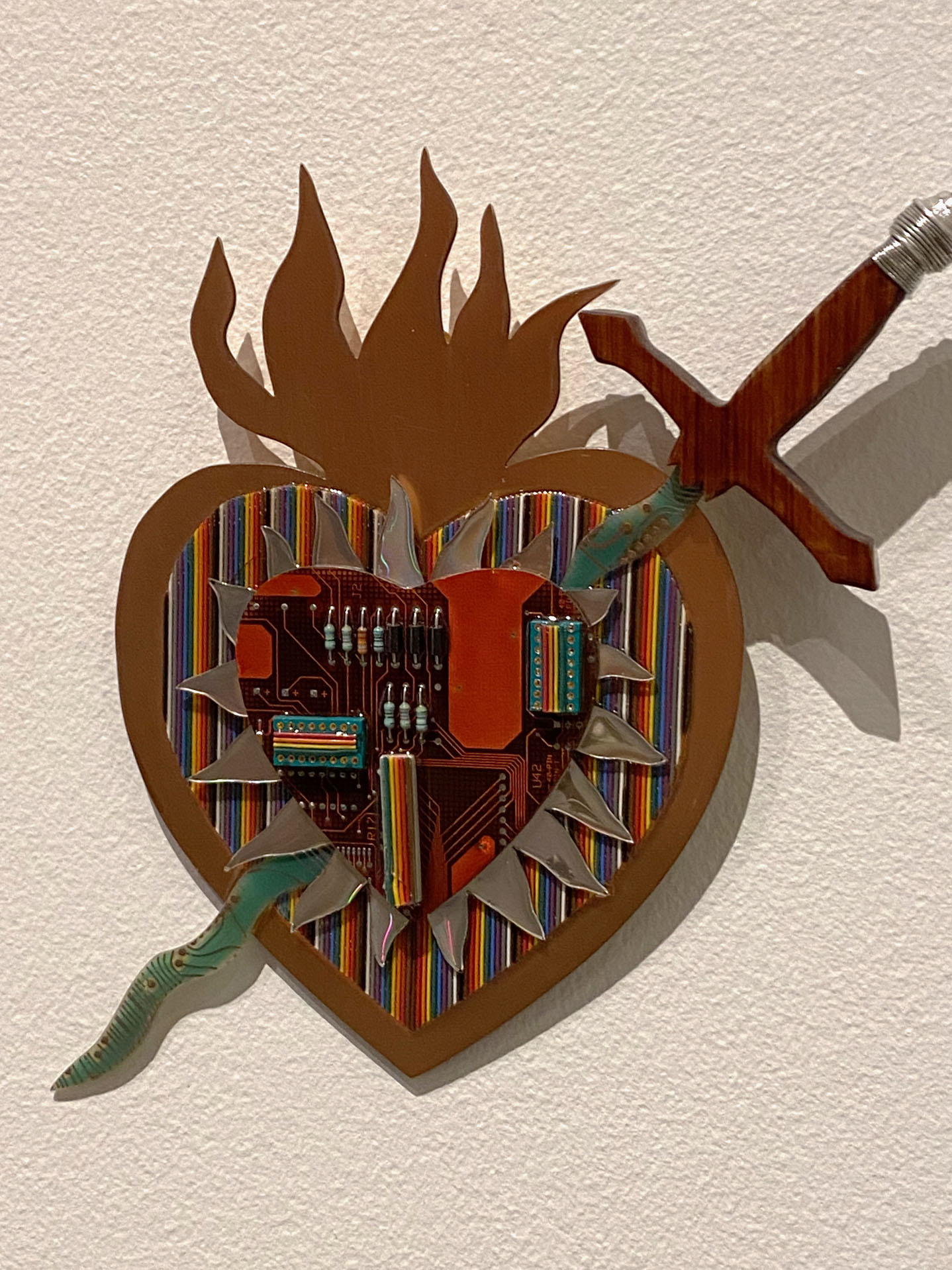
Another set of artists rummages around to find tossed-off computer parts, circuit boards, skateboard parts, and other found items to create their works.

Marion Martinez’s 2002 Pierced Heart/Milagro; circuit boards and wood. Courtesy: the artist
Esteban Borjorquez’s 2018 Zena of Urion – a sci-fi creation from discarded items. Courtesy: the artist.

Marion Martinez grew up near Los Alamos National Laboratory, and started visiting its salvage area to find components from which to assemble her artworks – transforming discarded tech into beautiful icons of Northern New Mexican heritage.

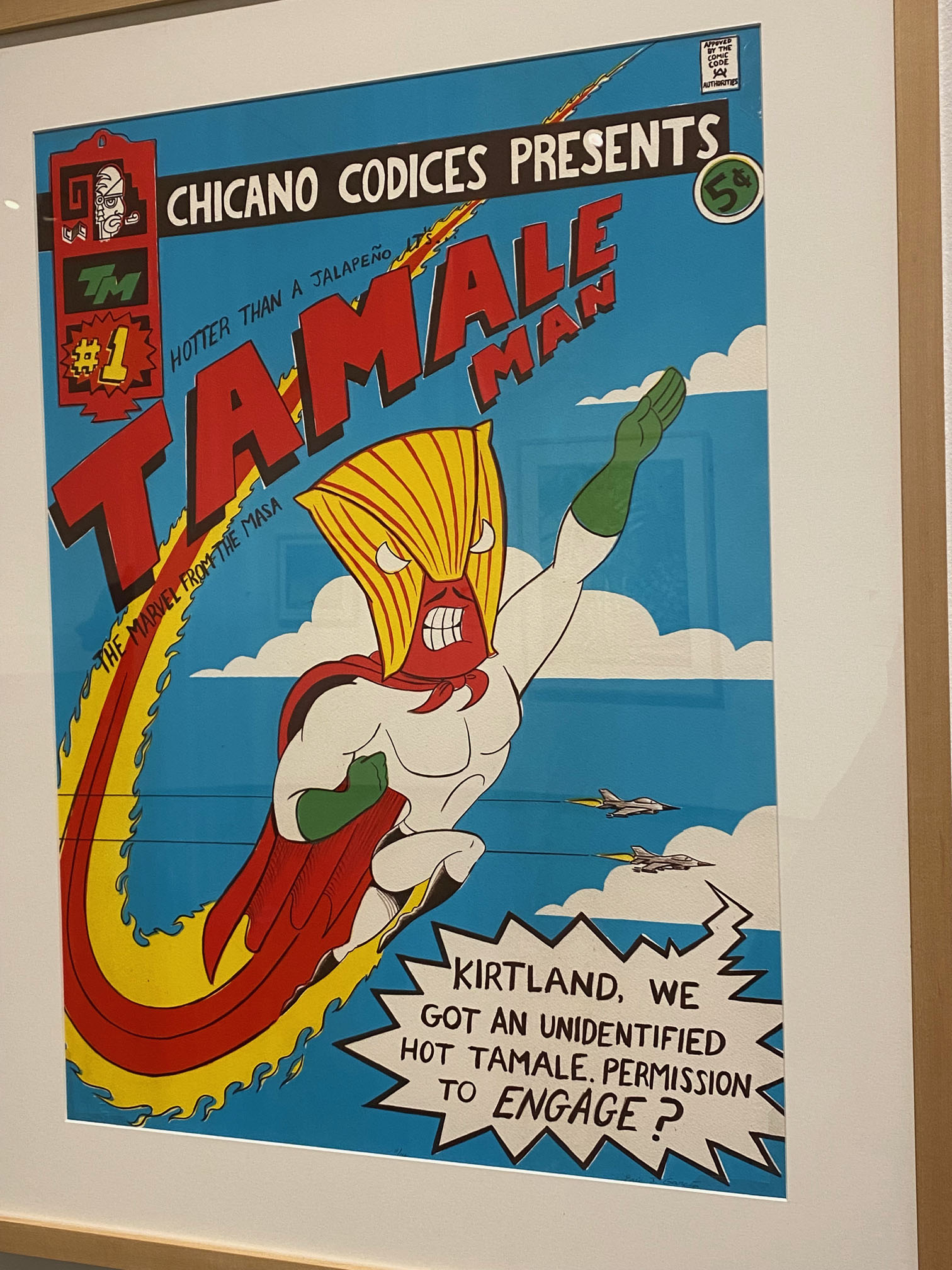
Eric J. Garcia’s 2005 lithograph Tamale Man.

Roswell political cartoonist Eric J. Garcia takes another angle on mixing New Mexico’s cultural, culinary, and nuclear history. His Tamale Man series features the transformation of a guy munching a tamale at the first blast at the Trinity Site into a radioactive superhero.

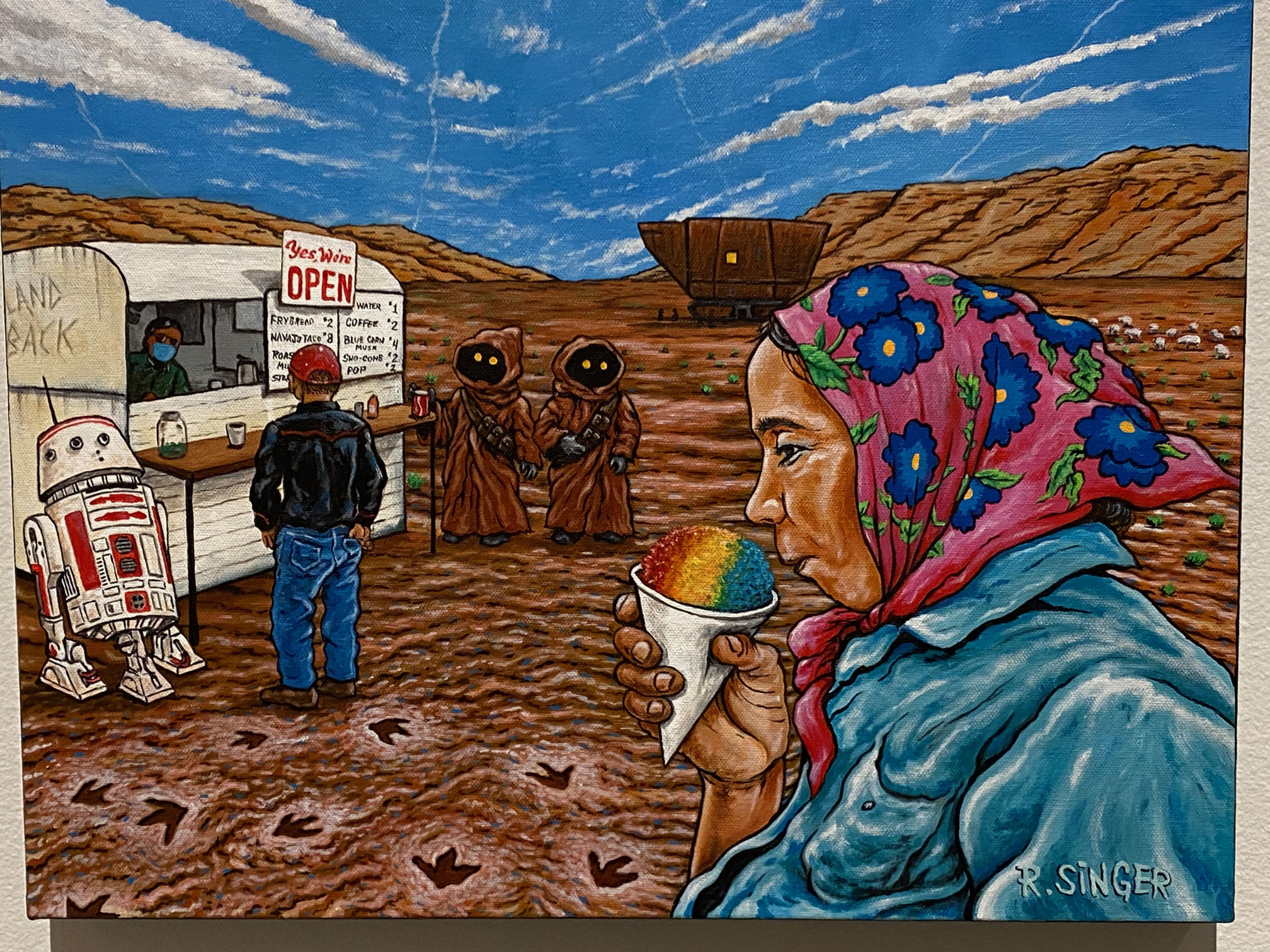
Ryan Singer’s painting series blends his childhood fascination with Star Wars and other futuristic sagas with his Navajo heritage and upbringing.

Ryan Singer’s 2021 acrylic, Rainbow Flavor.

Meet Ehren Kee Natay, a Diné artist, whose work opens the exhibition with a loving tribute to his grandfather, the first Native American to release a commercial record: